Louisiana State Board of Education v. Lark Brief on Behalf of Appellants
Public Court Documents
October 31, 1957
-
Brief Collection, LDF Court Filings. Louisiana State Board of Education v. Lark Brief on Behalf of Appellants, 1957. 904349da-bb9a-ee11-be36-6045bdeb8873. LDF Archives, Thurgood Marshall Institute. https://ldfrecollection.org/archives/archives-search/archives-item/fe4441a1-a2a4-4a40-a092-8d2a48cfc495/louisiana-state-board-of-education-v-lark-brief-on-behalf-of-appellants. Accessed October 06, 2026.
Copied!
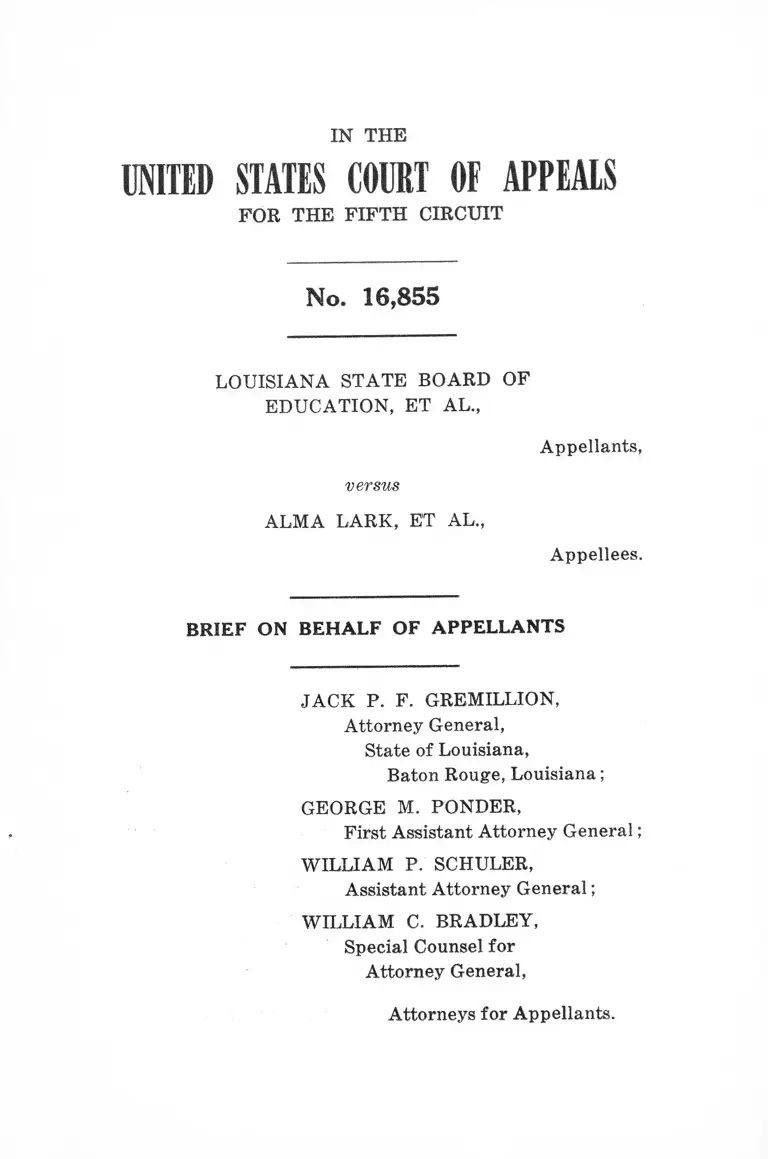
IN THE
UNITED STATES COURT OF APPEALS
FOR THE FIFTH CIRCUIT
No. 16,855
LOUISIANA STATE BOARD OF
EDUCATION, ET AL.,
Appellants,
versus
ALMA LARK, ET AL.,
Appellees,
BRIEF ON BEHALF OF APPELLANTS
JACK P. F. GREMILLION,
Attorney General,
State of Louisiana,
Baton Rouge, Louisiana;
GEORGE M. PONDER,
First Assistant Attorney General;
WILLIAM P. SCHULER,
Assistant Attorney General;
WILLIAM C. BRADLEY,
Special Counsel for
Attorney General,
Attorneys for Appellants.
SUBJECT INDEX.
STATEMENT OF THE CASE.......................................... 1
SPECIFICATION OF ERRORS....................................... - 4
ARGUMENT:
This is a suit between a state and some of its citizens
and the United States District Court is with
out jursdiction........................................................... 4
A suit to restrain the enforcement of a state statute
on grounds of unconstitutionality is not within
the province of a single-judge court...... ............... 12
The Certificate of Eligibility Law is constitutional
on its face and administered in a constitutional
manner................................................................... 18
That evidence used by the Court to reach its decision
was inadmissable........ ............................................... 27
Plaintiffs should not have been granted a prelimi
nary injunction without furnishing security..... 29
CONCLUSION................................................. 29
CERTIFICATE OF SERVICE....... ...................................... 31
APPENDIX:
Statutes involved-—........ ............................... 32
AUTHORITIES CITED.
California Water Service Co. v. City of Redding, 304 U.S.
252, 58 S. Ct. 865, 82 L. Ed. 1323; (1938)__________ 15
Page
a
AUTHORITIES CITED— (Continued).
Page
Caminetti v. United States, 242 U. S. 470, 61 L. Ed. 442,
37 S. Ct. 192 (1917)........................................................ 22
Chisholm v. Georgia, 2 U. S. 2 Dali. 419 (1 :440) (1793) 5
Davis v. County School Board, 142 F. Supp. 616 (D. C.,
E. D. Ya, 1956).......... 15
Davis v. Schnell, 81 F. Supp. 872, (D. C., S. D., Ala.,
1949)...................... 22
Ex Parte Bransford, 310 U. S. 354, 50 S. Ct. 947, 84 L.
944 (1949)......................................................................... 15
Ex Parte Buder, 271 U. S. 461, 48 S. Ct. 557, 70 L. Ed.
1036 (1 9 2 6 )-................................... 15
Ex Parte Collett, 337 U. S. 55, 93 L. Ed. 1207, 69 S. Ct.
Ed. 1249 (1940)............................................................. 22
Ex Parte Hobbs, 280 U. S. 168, 50 S. Ct. 83, 74 L. Ed.
353 (1929)..................... 15
Ex Parte Poresky, 290 U. S. 30, 54 S. Ct. 3, 78 L. Ed.
152 (1933)........................................................................ 14
Ex Parte Young, 209 U. S. 123, 28 S. Ct., 441, 52 L. Ed.
714 (1908)........................................... 9
George Van Camp & Sons Co. v. American Can Co., 278,
U. S. 245, 49 S. Ct. 112, 73 L. Ed. 311 (1929)........... 21
Georgia R. R. Banking Co. v. Redwine, 342 U. S. 299,
72 S. Ct. 321, 96 L. Ed. 335, (1952).... .......................... 9
Hamilton v. Rathbone, 175 U. S. 414, 419, 421, 20 S. Ct.
AUTHORITIES CITED— (Continued).
Page
155, 158, 44 L. Ed. 219 (1899).................................... 22
Hans v. Louisiana, 134 U. S. 1, 12, 13, 14, 10 S. Ct. 504,
33 L. Ed. 842, (1890)........ ........................................... 5
Harkness v. Irion, 278 U. S. 92, 49 S. Ct. 40, 73 L. Ed.
198 (1928)...... 15
Litchfield v. Bridgeport, 103 Conn. 565,131 A. 560 (1925) 28
Marchese v. United States, 126 F. 2d 671 (C. C. A.,
5,1942)........ 28
Orleans Parish School Board v. Bush, 242 F. 2d 156
(C. C. A. 5, 1947)........................................................... 22
Packard Motor Car Co. v. National Labor Relations
Board, 330 U. S. 485, 91 L. Ed. 1040, 67 S. Ct. 789
(1947)................................................................................. 22
Phillips v. United States, 312 U.S. 246, 61 S. Ct. 480, 85
L. Ed. 800 (1941)............................................................ 15
Russell Motor Car Co. v. United States, 261 U.S. 514, 43
S. Ct. 428, 67 L. Ed. 778 (1923).................................... 22
State v. Arkansas-Louisiana Gas Co., 78 So. 2d 825, 227
La. 179 (S. Ct., La., 1955).............................................. 22
State ex rel Noe v. Knop, 190 So. 135 (La. App. 1938).... 22
State v. Maestri, 5 So. 2d 499, 199 La. 49 (S. Ct., La.,
1941)................................................................................... 22
Third District Land Company v. Toka, 170 So. 793 (La.
App., 1936)........................................................................ 28
United States v. Barnes, 222 U.S. 513, 518, 519, 32 S. Ct.
117, 56 L. Ed. 291-293 (1912)........................................ 22
United States v. Hartwell, 6 W all 385, 18 L. Ed. 830.... 21
Yick Wo v. Hopkins, 118 U.S. 356, 366, 30 L. Ed. 220
(1886)................................................................................. 24
STATUTES CITED.
UNITED STATES CONSTITUTION:
Amendment 1 1 ......... 5
LOUISIANA CONSTITUTION:
Article 19, Section 26.......... 10
Article 12, Section 4......................................................... 11
Article 12, Section 5........................................................ 11
Article 12, Section 7................. 11
STATUTES:
United States:
28 U. S. Code 2281-2284.......................................... 2, 18
32 Stat. 823 (1903).......................................................... 12
36 Stat. 1087, 1162 (1911)............ 13
iv
AUTHORITIES CITED— (Continued).
Page
V
Louisiana:
Act 15 of 1956 (R.S. 17:2131-2135)................ 1, 2, 18
Act 249 of 1956 (R.S. 17:443)............................. 1, 2, 18
Act 556 of 1954....... ......................... ............. ...................... 24
La. R.S. 17:13................................................................ 11
MISCELLANEOUS:
American Jurisprudence, Vol. 55, p. 10..... .................... ..... 20
Federal Rules of Civil Procedure:
Rule 2 4 (c )........................................................ 29
Rule 65(c) ...................................... 29
Corpus Juris Secundum, Vol. 14, p. 1359........................... 20
Corpus Juris, Vol. 59, p. 1017.............................. .......... ...... 28
Cyclopedia of Federal Procedure:
Vol. 14, Sec. 73.30......... .......... .................................. . 10
Vol. 14, Sec. 73.55________ ___________ ___ ____ ____ 29
81 Federalist......... ......... 5
41 Harvard Law Review 623 (1928)........ 14
Hutcheson, A Case for Three Judges, 47 Harvard Law
Review 795 (1934)______ _____________ _____ _____ 14
Pogue, State Determination of State Law...... ......... ........... 14
Moore’s Federal Practice, Vol. 3, Secs. 104.01 and 107.02.....14
STATUTES CITED— (Continued).
Page
IN THE
UNITED STATES COURT OF APPEAES
FOR THE FIFTH CIRCUIT
No. 16,855
LOUISIANA STATE BOARD OF
EDUCATION, ET AL.,
versus
ALMA LARK, ET AL.,
Appellants,
Appellees.
BRIEF ON BEHALF OF APPELLANTS
STATEMENT OF THE CASE
Plaintiffs filed a complaint in the United States Dis
trict Court for the Eastern District of Louisiana, on January
17, 1957, aganst Louisiana State Board of Education, the
individual members of the Board, Shelby M. Jackson, State
Superintendent of Education, Luther H. Dyson, President,
and C. J. Hyde, Registrar, of Southeastern Louisiana College;
and Joel L. Fletcher, President, and Lea L. Seale, Registrar,
of Southwestern Louisiana Institute, seeking a temporary
restraining order and preliminary and final injunctions to
restrain the enforcement by officers of the State of Louisi
ana, of certain Louisiana Statutes, to-wit: Louisiana Revised
Statutes 17:443 and Revised Statutes 17:2131-2135 inclusive.
2
In this complaint they alleged that the aforesaid statutes
were contrary to the Fourteenth Amendment of the United
States Constitution in that said statutes deprived them and
others simularly situated of rights, privileges and immuntes
secured by the Constitution and Laws of the United States,
to-wit: Rights secured by the equal protection and due pro
cess clauses of the Fourteenth Amendment to the United
States Constitution and Title 42, U. S. C., Section 1981;
wherefore they prayed that a temporary restraining order
issue enjoining Defendants from denying them the right to
register at the respective colleges. They further prayed that
a three judge court be convened as required by Title 28,
U.S . C., Sec. 2281-2284, and that a hearing be held to deter
mine whether a preliminary and permanent injunction should
issue enjoining defendants and their agents from refusing
plantiffs’ registraton for the forth comng semester at the
colleges, and that Louisiana Revised Statutes 17:2131-2135
(Act 15 of 1956) and Louisiana Revised Statutes 17:443
(Act 249 of 1956) be found in violation of due process and
equal protection clauses of the Fourteenth Amendment of the
United States Constitution. (Tr. pp. 2-12)
On January 17, 1957, District Judge Herbert W.
Christenberry issued a temporary restraining order enjoining
defendants from refusing to register plaintiffs and others
simularily situated at Southwestern Louisiana Institute and
Southeastern Louisiana College until the hearing on said
application for interlocutory injunction, and this temporary
restraining order was extended from time to time until judg
ment on the interlocutory injunction. (Tr. pp. 26, 28, 64, 65,
66, 67, 68, 69, 70).
A hearing on the interlocutory injunction was had on
February 8, 1957, at which time appellants filed a motion
to dismiss based on lack of jurisdiction of the court and the
3
plaintiffs’ failure to state a claim upon which relief could
be granted. (Tr. p. 29).
Appellants then filed their answer in the matter deny
ing that the state statutes in question were contrary to or
in violation of plaintiffs’ constitutional rights. (Tr. pp. 51-56).
Appellants, in support of their position, filed affidavits
of college officials which showed conclusively that the Certifi
cate of Eligibility requirement had been applied uniformly
to white and negro students seeking admission for the Spring
Semester of 1957. (Tr. pp. 32-38)
At this point the Court consolidated this case with
the cases of Bailey v. Louisiana State Board of Education,
et al. and Ludley v. Louisiana State University Board of
Supervisors et al. (Tr. p. 62)
The Court heard argument of counsel on this and con
solidated cases and reserved judgment thereon allowing both
sides the opportunity to file memoranda in suppoiT of their
position within twenty (20) days. (Tr. p. 63)
On April 15, 1957, the Court in its opinion held that
Acts 249 and 15 of 1956 were unconstitutional in that they
deprived plaintiffs of their constitutional guarantees. (Tr. pp.
71-77).
In conformity with said opinion, the Court issued a
temporary injunction restraining defendants from refusing
to admit any qualified applicant to Southwestern Louisiana
Institute and Southeastern Louisiana College for the purpose
of pursuing a course of study offered by those colleges because
of failure of the applicant to present the Certificate of Eli
gibility provided in Louisiana Revised Statutes 17:2131-2135.
4
Application for new trial and rehearing was filed on behalf
of the appellants predicated on seven separate allegations of
error on the part of the District Court. (Tr. pp. 80-82). This
motion was denied on May 20, 1957 (Tr. p. 83).
Having exhausted all remedies before the lower court,
appellants, on May 29, 1957 filed a notice of appeal (Tr.
p. 83), and filed the necessary bond for costs (Tr. pp. 84-86).
SPECIFICATION OF ERRORS
The Lower Court erred in holding:
I. That this was not a suit against the State of
Louisiana, and therefore was within the Federal
judicial authority.
II. That, since there was no serious constitutional
question, a three-judge court did not have to be
convened.
III. That the Louisiana Eligibility Law was uncon
stitutional.
IV. That the evidence used to determine legislative
intent was admissable.
V. That plaintiffs were entitled to a preliminary
injunction even though they filed no security
bond.
THE UNITED STATES DISTRICT COURT IS
WITHOUT JURISDICTION TO MAINTAIN
A SUIT BETWEEN A STATE AND
ONE OF ITS CITIZENS.
The District Court erroneously overruled the motion
to dismiss and plea to the jurisdiction filed on behalf of the
5
State of Louisiana and all defendants. Said motion was
based upon the fact that this in effect was a suit against the
State of Louisiana and was predicated upon the firmly-
established precept of law that a United States Court cannot
entertain jurisdiction of a suit brought against a state by
any individual without the consent of such State.
The original enacters of the United States Constitution
believed that the sovereign states were immune from suit.
81 Federalist.
The first federal inroad to this basic concept of law
was made by the Supreme Court of the United States in
Chisholm v. George, 2 U. S. 2 Dali. 419 [1:440] (1793).
This decision created such a shock of surprise through
out the country that, at the first meeting of Congress there
after, the Eleventh Amendment to the Constitution was almost
unanimously proposed, and was in due course adopted by the
Legislatures of the states. This amendment, which provides
as follows, expressing the will of the ultimate sovereignty
of the whole country, superior to all legislatures and all
courts, actually reversed the decision of the Supreme Court:
“ The Judicial power of the United States shall not
be construed to extend to any suit in law or equity,
commenced or prosecuted against one of the United
States by citizens of another State or by citizens or
subjects of any foreign state.”
In the case of Hans v. Louisiana, 134 U.S. 1, 12, 13, 14,
10 S. Ct. 504, 33 L. Ed. 842, (1890), Mr. Justice Bradley
discussed the intent of some of the strong advocates of
6
adoption of the Constitution, with respect to a state’s im
munity to suit:
“ Looking back from our present standpoint at the
decision in Chisholm v. Georgia, we do not greatly
wonder at the effect which it had upon the country.
Any such power as that of authorizing the federal
judiciary to entertain suits by individuals against
the States had been expressly disclaimed, and even
resented, by the great defenders of the Constitution
whilst it was on its trial before the American people.
As some of their utterances are directly pertinent
to the question now under consideration, we deem it
proper to quote them.
“ The 81st number of the ‘Federalist’, written by
Hamilton, has the following profound remarks:
$ * * $
“ ‘It is inherent in the nature of sovereignty not to
be amendable to the suit of an individual without
its consent. This is the general sense and the gen
eral practice of mankind; and the exemption, as one
of the attributes of sovereignty, is now enjoyed by
the government of every State in the Union. Unless,
therefore, there is a surrender of this immunity in
the plan of the convention, it will remain with the
States, and the danger intimated must be merely
ideal.’
“ The obnoxious clause to which Hamilton’s argument
was directed, and which was the ground of the objec
tions which he so forcibly met, was that which de
clared that ‘the judicial power shall extend to all
7
. . . controversies between a State and citizens of
another State,. . . and between a State and Foreign
states, citizens of subjects.’ It was argued by the
opponents of the Constitution that this clause would
authorize jurisdiction to be given to the federal courts
to entertain suits against a State brought by the
citizens of another State, or of a foreign state. Adher
ing to the mere letter, it might be so; and so, in
fact, the supreme court held in Chisholm v. Georgia;
but looking at the subject as Hamilton did, and as
Mr. Justice Iredell did, in the light of history and
experience and the established order of things, the
views of the latter were clearly right,— as the people
of the United States in their sovereign capacity sub
sequently decided.
“ But Hamilton was not alone in protesting against
the construction put upon the Constitution by its
opponents. In the Virginia convention the same ob
jections were raised by George Mason and Patrick
Henry, and were met by Madison and Marshall as
follows. Madison said: ‘Its jurisdiction’ (the federal
jurisdiction) ‘in controversies between a State and
citizens of another State is much objected to, and
perhaps without reason. It is not in the power of
individuals to call any State into court. The only oper
ation it can have is that, if a State should wish to
bring a suit against a citizen, it must be brough be
fore the federal court. This will give satisfaction to
individuals, as it will prevent citizens on whom a
State may have a claim being dissatisfied with the
state courts. . . It appears to me that this (clause)
can have no operation but this—to give a citizen a
right to be heard in the federal courts; and if a State
should condescend to be a party, this court may take
8
cognizance of it.’ 3 Elliot’s Debates, 533. Marshall,
in answer to the same objection, said: ‘With respect
to disputes between a State and the citizens of
another State, its jurisdiction has been decried with
unusual vehemence. I hope that no gentleman will
think that a State will be called at the bar of the
federal court. . . It is not rational to suppose that
the sovereign power should be dragged before a
court. The intent is to enable States to recover claims
of individuals residing in other States. . . . But, say
they, there will be partiality in it if a State cannot
be a defendant— if an individual cannot proceed to
obtain judgment against a State, though he may be
sued by a State. It is necessary to be so, and cannot
be avoided. I see a difficulty in making a State de
fendant which does not prevent its being plaintiff.’ ”
Id. 555
In the same opinion Mr. Justice Bradley held that the
Eleventh Amendment applies equally to suits brought against
the state by one of its own citizens by stating:
“ . . . Can we suppose that, when the 11th Amend
ment was adopted, it was understood to be left open
for citizens of a State to sue their own State in the
federal courts, whilst the idea of suits by citizens
of other States, of foreign states, was indignantly
repelled ? Suppose that Congress, when proposing the
11th Amendment, had appended to it a proviso that
nothing therein contained should prevent a State
from being sued by its own citizens in cases arising
under the Constitution or laws of the United
States: can we imagine that it would have been
adopted by the States ? The supposition that it would
is almost an absurdity on its face.
9
“ The truth is, that the cognizance of suits and
actions unknown to the law, and forbidden by the
law, was not contemplated by the Constitution when
establishing the judicial power of the United
States. . .
“ This has been so often laid down and acknowledged
by courts and jurists that it is hardly necessary to
be formally asserted. . . .”
The next judicial inroad to the fundamental principal
of immunity of the state from suit occurred when the Supreme
Court decided the case of Ex Parte Young, 209 U.S. 123,
28 S. Ct. 441, 52 L. Ed. 714 (1908).
In that decision, recently cited with approval in
( Georgia R. R. & Banking Co. v. Redwine, 342 U. S. 299,
72 S. Ct. 321, 96 L. Ed. 335, (1952), the court held that a
state officer could be enjoined from taking or instituting
any action or proceeding to enforce the penalties and remedies
set forth in an unconstitutional state act.
This decision, however, layed down at least one re
straint on the power of the Federal Court to declare uncon
stitutional statutes of a state. This limitation is that the
defendants in a suit, to test the constitutionality of an act,
must be persons who are charged with the enforcement of
the act. The court so stated in the following language:
“ In making an officer of the state a party defendant
in a suit to enjoin the enforcement of an act alleged
to be unconstitutional it is plain that such officer
must have some connection with the enforcement of
the act, or else it is merely making him a party as
a representative of the state, and thereby attempting
to make the state a party.”
10
This doctrine has been recognized by the text books
dealing with Federal Practice. The Cyclopedia of Federal
Procedure, Third Edition, Volume 14, Section 73:30 states
it as follows:
“ If a suit is to enjoin a state officer from enforcing
a state statute on the ground that it violates the
Federal Constitution, the officer or officers con
nected with the enforcement of the statute should
be joined as defendants, to preclude objection that
the suit is one against the state. But only those
charged with the enforcement of the statute should
be joined as defendants.”
It is most appropriate at this time to look at the facts
revealed in the case at bar in relation to the foregoing
principles of law. The State of Louisiana by constitutional
amendment specifically withdrew the consent of the state to
a suit against the State Board of Education and the State
Superintendent of Public Education. Article XIX, Section 26,
reads as follows:
“ Section 26. The following named commissions,
boards, bodies or municipal corporations shall be
considered special agencies of the State of Louisi
ana:
$ $ $ $
“ (5) The State Board of Education,
:jc ^
“ (9) The State Superintendent of Public Education
in his capacity as such as well as in the capacity
11
of ex-officio secretary of the State Board of Educa
tion, and
“ The consent of the State of Louisiana to suits or
legal proceedings against any of the above listed
special agencies, (however heretofore given) is here
by expressly withdrawn and no such suit or proceed
ing shall be permitted except as provided in this
section. . .
Despite the above provisions of Louisiana Constitution,
plaintiffs herein saw fit to make the State Board of Edu
cation and the State Superintendent of Education, parties
defendant along with the Presidents and Registrars of the
two colleges and the individual members of the Board of
Education.
The State Board of Education is created by the consti
tution of the State of Louisiana (Article 12, Section 4 ). Its
right to supervise the two colleges involved herein is also
granted by the Constitution (Article 12, Section 7).
The position of the State Superintendent of Public
Education is created by the Constitution (Article 12, Section
5) and the duties of the office are set forth in Louisiana
Revised Statute 17:13.
A careful reading of these laws will clearly show that
they do not confer upon these state officials any power to
enforce the provisions of Act 15 of 1956. Probably the only
persons made defendants in this suit who have enforcement
power are the Registrars of the two colleges. The joinder of
these parties who have no enforcement power brings this
12
within the class of a prohibited suit against the State of
Louisiana.
The other act attacked by plaintiffs is Act 249 of 1956.
This act prohibits certain actions on behalf of permanent
teachers of the State of Louisiana. This act clearly provides
that it shall be enforced by the school board of the parish
or city as the case may be. Not only do the defendants in
this suit lack the power of enforcement of this statute, they
do not have the remotest connection with the statute in any
phase. There can be no doubt that under the rule set forth
above, this is, clearly and unalterably, a suit brought against
the State of Louisiana and thereby prohibited by the 11th
Amendment to the United States Constitution.
A SINGLE JUDGE, UNITED STATES DISTRICT
COURT IS WITHOUT JURISDICTION TO HEAR
THE QUESTION OF CONSTITUTIONALITY OF
A STATE STATUTE WHERE INJUNCTIVE
RELIEF IS REQUESTED
In March of 1911 the Congress enacted laws which
prohibited a single United States District Court Judge from
exercising his power to grant injunctive relief when the
constitutionality of a state statute is in question. Historically
this statute was a direct result of a Supreme Court decision.
Prior to the case of Ex Parte Young, 209 U. S. 123,
28 S. Ct., 441, 52 L. Ed. 714 (1908), the sole function of a
three-judge court was to entertain, under specified circum
stances, equity suits arising under the Sherman Anti-Trust
Act and the Interstate Commerce Act. 32 Stat. 823 (1903).
No thought had been given to the establishment of three-
judge courts with jurisdiction over matters pertaining to
injunctive relief sought against state action, as the general
feeling prevailed that such actions were barred under the
Eleventh Amendment. However, this opinion proved to be
erroneous.
In Ex Parte Young, officers of the State of Minnesota
attempted to enforce transportation rates established by the
State Legislature, and stockholder of a railroad sought an
injunction in a single-judge Federal Court against the en
forcement of the statute on the grounds that it violated the
federal constitution. The judge granted the injunction. The
Attorney General of Minnesota refused, however, to obey the
injunction, whereupon the Federal Court convicted him for
contempt. In refusing the release of the Attorney General on
habeas corpus, the United States Supreme Court upheld the
jurisdiction of the Federal Court and set down the rule
that notwtihstanding the Eleventh Amendment which pro
hibits individual suits against a state, federal courts, under
appropriate circumstances, can issue injunctions against state
officials seekng to enforce state statutes that violate the
United States Constitution. Justice Harlan, in a strong dis
senting opinion, pointed out that if the principles announced
in the majority opinion became “ firmly established. . . it
would enable the subordinate Federal Courts to supervise and
control the official action of the States as if they were
‘dependencies’ or provinces.” 209 U. S. at 175. This feeling
was more strongly echoed among the states. Since the Federal
Courts did not wish to release all power over such injunctive
relief, the protest of the states at being subjected to the
possible abuse of such injunctive powers vested in a single
federal judge called for a compromise. Therefore, in 1911,
Congress provided for three-judge courts, similar to the three-
judge courts of today, with exclusive jurisdiction to enter
tain petitions for injunctive relief against the enforcement
by state officials of unconstitutional state statutes. (Act of
March 3, 1911, 36 Stat. 1087, 1162). The three-judge court
14
device was adopted in the belief that the more careful con
sideration afforded each case when it was considered by three
judges would minimize the possibility of arbitrary abuse of
the injunctive power.
The major distinction between the 1911 three-judge
courts and those as presently constituted is that the former
were authorized to hear applications solely for interlocutory
injunctions while the latter are authorized to entertain
applications for permanent injunctions as well. Various
amendments have increased the jurisdiction of the three-judge
court to include orders of state boards or commissions as
well as state statutes; to include petitions for final as well as
interlocutory injunction; to add the analagous statute grant
ing injunctive relief from the operation of unconstitutional
federal statutes; and to perfect the method of direct appeal
to the United States Supreme Court. For a detailed discussion
of the history of these statutes as well as of the early case
law construing them, see 3 MOORE, FEDERAL PRACTICE
E, (1st ed. 1938) Secs. 104.0:1 and 107.02; POGUE, STATE
DETERMINATION OF STATE LAW, 41 HARV. L. REV.
623 (1928) ; Hutcheson, A CASE FOR THREE JUDGES, 47
HARV. L. REV. 795 (1934).
The Supreme Court of the United States further
limited the scope of the three-judge court by decreeing that
the constitutional question presented to the court must be
a substantial question of unconstitutionality. If such substan
tial constitutional question is not presented then there is no
necessity of invoking the three-judge court.
Ex Parte Poresky, 290 U. S. 30, 54 S. Ct. 3, 78 L.
Ed. 152. (1933)
It would appear that a substantial constitutional ques
tion is not raised in the following instances:
15
(1) Where the question is whether an officer is
exceeding the power granted to him.
Harkness v. Irion 278 U. S. 92, 49 S. Ct. 40, 73 L.
Ed. 198 (1928) ;
Phillips v. United States, 312 U. S. 246, 61 S. Ct.
480 ̂ 85 L. Ed. 800 (1941) ;
Ex Parte Bransford, 310 U. S. 354, 60 S. Ct. 947,
84 L. Ed. 1249 (1940).
(2) Where the plaintiff concedes the constitutionality
of the statute.
Ex Parte Hobbs, 280 U. S. 168, 50 S. Ct. 83, 74
L. Ed. 353 (1929).
(3) Where the U. S. Supreme Court has previously
declared the statute directly unconstitutional.
Davis v. County School Board, 142 F. Supp. 616
(D.C., E.D. Va., 1956)
(4) Where there is a question of interpretation of
laws rather than a question of constitutionality.
Ex Parte Buder, 271 U. S. 461, 48 S. Ct. 557, 70
L. Ed. 1036 (1926)
(5) Where there is no substantial claim of unconsti-
tutionality as a result of previous decisions.
California Water Service Company v. City of Red
ding, 304 U. S. 252, 58 S. Ct. 865, 82 L. Ed. 1323;
(1938)
Without question the matter at bar does not fall into
either of the first four classifications. Upon careful considera
tion it is also evident that exception No. 5 is not applicable
in this case. In regards to this, there has been a rather gen
16
eral trend for writers on the subject to say that a three-
judge court is not necessary unless there is a substantial
claim of constitutionality present. While this is true it could
leave doubt in an area in which none exists. The actual test
is not whether there is a serious question of constitutionality,
but whether there is a serious question of unconstitutionality
present. Probably the landmark case on this question is the
case of Ex Parte Poresky, 290 U. S. 30, 54 S. Ct. 3, 78 L. Ed.
152 (1933). In that case the Court definitely decided that
where the claim that a statute was unconstitutional was
obviously unsound there was no necessity of invoking a three-
judge court. The court said on page 31:
“ The District Judge recognized the rule that if the
court was warranted in taking jurisdiction and the
case fell within § 266 of the Judicial Code, a single
judge was not authorized to dismiss the complaint
on the merits, whatever his opinion of the merits
might be. Ex parte Northern Pacific Ry. Co., 280
U. S. 142, 144; Stratton v. St. Louis S. W. Ry. Co.,
282 U. S. 10, 15. But the provision requiring the
presence of a court of three judges necessarily as
sumes that the District Court has jurisdiction. In
the absence of diversity of citizenship, it is essential
to jurisdiction that a substantial federal question
should be presented. ‘A substantial claim of uncon
stitutionality is necessary for the application of §
266.’ Ex parte Buder, 271 U. S. 461, 467; Louis
ville & Nashville R. Co. v. Garrett, 231 U. S. 298,
304. That provision does not require three judges to
pass upon this initial question of jurisdiction.
“ The existence of a substantial question of constitu
tionality must be determined by the allegations of
the bill of complaint. Mosher v. Phoenix, 287 U. S.
17
29, 30; Levering & Garrigues Co. v. Morrin, 289 U.
S. 103, 105. The question may be plainly unsubstan
tial, either because it is ‘obviously without merit’ or
because ‘its unsoundness so clearly results from the
previous decisions of this court as to foreclose the
subject and leave no room for the inference that
the question sought to be raised can be the subject
of controversy.’ ”
Again in the case of California Water Service Com
pany v. City of Redding, 304 U. S. 252, 58 S. Ct. 865, 82
L. Ed. 1323 (1938) the Court decided that a three-judge court
was not necessary because the statute involved had already
been declared constitutional by the Supreme Court and, there
fore, no serious question of unconstitutionality was raised.
The Court stated as follows:
“ We are of the opinion that these rulings were cor
rect. We have held that § 266 of the Judicial Code
does not apply unless there is a substantial claim of
the unconstitutionality of a state statute or adminis
trative order as there described. It is therefore the
duty of a district judge, to whom an application for
an injunction restraining the enforcement of a state
statute or order is made, to scrutinize the bill of
complaint to ascertain whether a substantial federal
question is presented, as otherwise the provision for
the convening of a court of three judges is not
applicable. Ex parte Buder, 271 U. S. 461, 467; Ex
parte Poresky, 290 U. S. 30. We think that a simi
lar rule governs proceedings under § 3 of the Act
of August 24, 1937, as to the participation of three
judges in passing upon applications for injunctions
restraining the enforcement of federal statutes upon
the ground of constitutional invalidity. Had the deci
18
sions in the eases of Alabama Poiver Co. v. Ickes,
supra, and of Duke Power Co. v. Greenwood County,
802 U. S. 485, been rendered prior to the filing of
the bill of complaint in the instant case, no substan
tial federal question would have been presented. The
lack of substantiality in a federal question may
appear either because it is obviously without merit
or because its unsoundness so clearly results from
the previous decisions of this Court as to foreclose
the subject . . . . ”
In view of the above it is clear that prior court
decisions can only obviate the necessity for invoking a three-
judge court when the prior decisions have left no doubt that
the statute is constitutional and there can be no possibility
of an injunction issuing against the enforcement of such
statute. Since there is a question as to the constitutionality
of two State Statutes in this matter the District Court
should have invoked the mandatory provisions of 28 U. S. C.
2281-2284.
THAT THE LOUISIANA LAW REQUIRING STUDENTS
SEEKING ADMISSION TO PRESENT A
CERTIFICATE OF ELIGIBILITY
IS CONSTITUTIONAL
In the regular session of 1956 the Legislature of the
State of Louisiana passed Act 15 of 1956 (La. R.S. 17:2131-
2135, inclusive) which reads as follows:
“Be it enacted by the Legislature of Louisiana:
“ Section 1. No person shall be registered at or ad
mitted to any publicly financed institution of higher
learning of this state unless he or she shall have first
filed with said institution a certificate addressed to
19
the particular institution sought to be entered attest
ing to his or her eligibility and good moral character.
This certificate must be signed by the Superintend
ent of Education of the Parish, County, or Munici
pality wherein said applicant graduated from High
School, and by the principal of the High School
from which he graduated.
“ Section 2. The form of the above referred to cer
tificate shall be prepared by the Department of Edu
cation of the State of Louisiana, and a sufficient
number thereof shall be furnished to each Superin
tendent of Education through the State to meet the
annual requirements of those seeking admission to
the above institutions. He shall furnish sufficient
copies thereof to applicants residing outside the
State of Louisiana who apply therefor.
“ Section 3. Each student graduating from any pub
lic High School in the State of Louisiana shall be
given proper notice of the above requirement at the
time of his or her graduation; all publicly financed
institutions of higher learning shall incorporate in
their annual catalogues proper notice that the above
referred to certificate is an essential requirement
for admission.
“ Section 4. Any official or employee of any insti
tution of higher learning financed by the State of
Louisiana who admits any student to said institu
tion in violation of the provisions of this Act shall
be deemed guilty of committing a misdemeanor and
upon conviction thereof shall be fined not more than
$500.00 or imprisoned for not more than six months,
or both.
20
“ Section 5. The State Board of Education and/or
the Board of Supervisors of Louisiana State Uni
versity and Agricultural and Mechanical College are
hereby especially authorized and empowered to adopt
such other entrance requirements, including appti-
tude and medical examinations, as in their judgment
may be fit and proper.
“ Section 6. All laws or parts of laws in conflict
herewith are hereby repealed.”
An examination of the above quoted statute shows
beyond question that the legislature desired each and every
student applying for admission to a publicly financed insti
tution of high learning to furnish the institution, a Certificate
of Eligibility, which certifcate shall attest to the good moral
character and qualfications of said applicant.
That requirements of the above nature are well within
the province of the legislature to establish is without question.
As stated in 55 Am. Jur. 10:
“ The right to attend the educational institutions of
a state is not a natural one, but is a benefaction of
the law. One seeking to become a beneficiary of this
gift must submit to such conditions as the law im
poses as a condition precedent thereto. Hence,
where a legislature, acting under a constitutional
mandate, establishes a university, it may also legis
late as to what persons are entitled to be admitted
to its privileges and to instruction therein.”
See also:
14 C.J.S. 1359:
“ The legislature may properly regulate the conditions
on which students may be admitted to a university
21
maintained by the state, and under delegated author
ity and in the reasonable exercise of its discretion
the governing body of a state college or university
may establish rules as to admission of students.”
Nowhere in the complaint does plaintiff aver that any
of defendants have administered Act 15 of 1956 unfairly or
partially. Affidavits of various college officials show affirm
atively that the eligibility certificate law was uniformly
applied to all applicants for admission to the colleges regard
less of race or color. (Tr. pp. 32-38)
The contention of plaintiff in this matter appears to
be that Act 15 is not in itself unconstitutional, but that
Act 249 and other non-related acts of the Louisiana Legisla
ture show that the enacters intended Act 15 to be a part
of a system to deprive plaintiffs of their constitutional
rights.
Act 15 is a complete act within itself and depends
upon no implementation from other acts of the legislature
either in effect at the time nor passed at the same session
of the legislature.
Plaintiff in their contention run afoul of the unquali
fied legal doctrine that none of the rules of statutory con
struction should or may be used to ascertain the meaning
or application of a statute since the rules of statutory con
struction have no place except in the domain of ambiguity.
See:
United States v. Hartwell, 6 Wall 385, 18 L.
Ed. 880.
George Van Camp & Sons Co. v. American Can
22
Co., 278 U. S. 245, 49 S. Ct. 112, 73 L. Ed.
311 (1929).
Hamilton v. Rathbone, 175 U. S. 414, 419, 421,
20 S. Ct. 155, 44 L. Ed. 219 (1899).
Russell Motor Car Co. v. United States, 261,
U. S. 514, 43 S. Ct. 428, 67 L. Ed. 778 (1923).
United States v. Barnes, 222 U. S. 513, 518,
519, 32 S. Ct. 117„ 56 L. Ed. 291-293 (1912).
Caminetti v. United States, 242 U. S. 470, 61
L. Ed. 442, 37 S. Ct. 192 (1917).
Packard Motor Car Co. v. National Labor Re
lations Board, 330 U. S. 485, 91 L. Ed. 1040,
67 S. Ct. 789 (1947).
Ex Parte Collett, 337 U. S. 55, 93 L. Ed. 1207,
69 S. Ct. 944 (1949).
State v. Maestri, 5 So. 2d 499, 199 La. 49—
(S. Ct., La., 1941).
State v. Arkansas Louisiana Gas Co., 78 So. 2d
825, 227 La. 179 (S. Ct., La., 1955).
State ex rel Noe v. Knop, 190 So. 135 (La. App.,
1939)
The District Court in using other acts to determine
the constitutionality of Act 15 used the cases of Orleans
Parish School Board v. Bush, 242 F. 2d 156 (C.C.A. 5, 1947)
and Davis v. Schnell, 81 F. Supp. 872, (D. C. S. D., Ala., 1949)
to support its contention that other acts should be used to
determine the legislative intent. These two cases may be
easily distinguished on the factual situations.
In Davis v. Schnell, while the Court mentioned
another act (Title 17, Sec. 33, Code of Alabama 1940) in
23
its statement of facts it never once in its opinion referred
to that act or used that act to determine the constitution
ality of the “ Boswell Amendment” . Further, if the Court
had used another act to determine the constitutionality of
the Boswell Amendment, it is clear that they had a right
to do so since it found that the Boswell Amendment was
ambiguous. It so held in the following language:
“ When a word or phrase in a statute or constitution
is ambiguous, it is the duty of the court, in con
struing the meaning of that word or phrase, to at
tempt to determine whether an exact meaning was
intended and if so, to ascertain that meaning. If an
exact meaning of the phrase ‘understand and ex
plain’ were to be discovered by a process of con
struction in this case, it might be that a suitable
and definite standard could be found, which would
not give to the board of registrars arbitrary power.
However, a careful consideration of the legislative
and other history of the adoption of this Amendment
to the Constitution of Alabama discloses that the
ambiguity inherent in the phrase ‘understand and
explain’ cannot be resolved, but, on the contrary,
was purposeful and used with a view of meeting the
decision of the Supreme Court of the United States
in Smith v. Allwright, 321 U. S. 649, 64 S. Ct.
757, 88 L. Ed. 987, 151 A.L.R. 1110. The history of
the period immediately preceding the adoption of the
Boswell Amendment, of which we take judicial no
tice, and the evidence in this case prove this.”
In the case of Orleans Parish School Board v. Bush,
242 F. 2d 156, the court did not actually use other statutes
to find Act 556 unconstitutional. The Court definitely said
this in the following language:
“ Thus we need not determine whether the enactment
of this law contemporaneously with Act 555 and
closely following the readoption of the racially sepa
rate schools provision of the state constitution, . . .
is sufficient of itself to condemn it as part of the
illegal legislative plan comprehended in Act 555, al
though this is precisely the type of determination
on which the three judge court in Davis v. Schnell,
supra, based its decision striking down an amend
ment to the Alabama constitution.”
The District Court cited the above two cases in addi
tion to the case of Yick Wo v. Hopkins, 118 U. S. 356, 30
L. Ed. 220, which it felt supported its decision herein. All
three of these cases are clearly distinguishable on other
grounds, in that in all three cases the law attacked gave
to agencies discretion in the performance of their duties,
and the particular statutes allowed these officials to exercise
that discretion arbitrarily, according to whim or caprice.
In the case of Yick Wo v. Hopkins, 118 U. S. 356,
366, 30 L. Ed. 220, the Court stated as follows:
“ That court considered these ordinances as vesting
in the board of supervisors a not unusual discretion
in granting or withholding their assent to the use of
wooden buildings as laundries, to be exercised in
reference to the circumstances of each case, with a
view to the protection of the public against the
dangers of fire. We are not able to concur in that
interpretation of the power conferred upon the
supervisors. There is nothing in the ordinances
24
25
which points to such a regulation of the business of
keeping and conducting laundries. They seem in
tended to confer, and actually do confer, not a dis
cretion to be exercised upon a consideration of the
circumstances of each case, but a naked and arbi
trary power to give or withhold consent, not only
as to places, but as to persons. So that, if an appli
cant for such consent, being in every way a compe
tent and qualified person, and having complied with
every reasonable condition demanded by any public
interest, should, failing to obtain the requisite con
sent of the supervisors to the prosecution of his
business, apply for redress by the judicial process
of mandamus, to require the supervisors to consider
and act upon his case, it would be a sufficient
answer for them to say that the law had conferred
upon them authority to withhold their assent, with
out reason and without responsibility. The power
given to them is not confided to their discretion
in the legal sense of that term, but is granted to
their mere will. It is purely arbitrary, and acknow
ledges neither guidance nor restraint.”
See also:
Davis v. Sehnell, 81 F. Supp. 872 at page 880
“ To state it plainly, the sole test is: Has the appli
cant by oral examination or otherwise understood
and explained the Constitution to the satisfaction of
the particular board? To state it more plainly, the
board has a right to reject one applicant and accept
another, depending solely upon whether it likes or
dislikes the understanding and explanation offered.
To state it even more plainly, the board, by the use
of the words ‘understand and explain’, is given the
arbitrary power to accept or reject any propective
26
elector that may apply, or, to use the language of
Yick Wo v. Hopkins, 118 U. S. 356, 366, 6 S. Ct.
1064, 1069, 30 L. Ed. 330, these words ‘actually do
confer, not a discretion to be exercised upon a con
sideration of the circumstances of each case, but a
naked and arbitrary power to give or withhold con
sent’ * *
See also:
Orleans Parish School Board v. Bush, 242 F.
2d 156 at page 164:
“Whatever might be the holding as to the validity
of an administrative pupil assignment statute con
taining reasonably certain or ascertainable standards
to guide the official conduct of the superintendent
of the local school board and to afford the basis
for an effective appeal from arbitrary action, Act
556 is not such a statute. The plaintiffs, seeking
to assert their right to attend non-segregated schools
as guaranteed them under the Constitution, would
be remitted to an administrative official guided by
no defined standards in the exercise of his discretion.
In such circumstances no number of hearings or ap
peals would avail them anything because it would
be impossible for them to bring forward any proof
bearing on whether they possessed those attributes,
qualifications or characteristics that would bring
them within the group of students permitted to at
tend the particular school or schools. Attempts by
Statute to give any official the power to assign stu
dents to schools arbitrarily according to whim or
caprice are legally impermissible, especially if con
sidered in light of the history of assignments made
in a manner that has now been held to be uncon
stitutional and of the recently readopted requirement
27
of the state constitution reaffirming such unconsti
tutional standards, which is reinforced by the heavy
sanctions against any official permitting a departure
therefrom contained in a companion statute. Such a
statute is unconstitutional either because it has on
its face the effect of depriving appellees of their
liberty or property without due process of law or
as having implied as its only basis for assignments
the prohibited standard of race.”
The facts in this case are entirely different than those
set forth in the cases above. The statute herein leaves no
room for the exercise of any discretion whatsoever. The ad
mission of any student to the College under this statute is
purely a ministerial function. If the student has a Certificate
of Eligibility and is otherwise qualified, he will be admitted.
If the student has all other qualifications, but does not have
a Certificate of Eligibility, he cannot be admitted to the
College.
THAT THE EVIDENCE USED BY THE COURT TO
DETERMINE LEGISLATIVE INTENT WAS
CLEARLY INADMISSABLE
In the trial below the plaintiff presented absolutely
no evidence whatsoever which would show the intent of
the Legislature. However, the Court on its own motion tried
to determine the legislative intent in enacting Act 15 by
delving into the legislative history thereof.
The State of Louisiana does not keep any minutes
of the committee meetings on any particular bill or on debate
of a bill in either the House or Senate. Even if such debate on
the floor of either of the chambers or of the committee
were available such would not be admissable to deter
mine legislative intent.
28
Third District Land Company v. Toka
170 So. 793 (La. App. 1936)
Beck v. Fanion, 124 Conn. 549, 1 A. 2d 143 (1938)
It would appear that the Court based its decision
in this case to a large degree upon statements made by one
and/or some Legislators, referred to in 17 La. Law Review
112. It is clear that these statements of individual Legislators
as to their understanding of acts passed is clearly inadmiss-
able. As stated in 59 C.J., 1017:
“ The intention of the legislature to which effect
must be given is that expressed in the statute, and
the courts cannot inquire into the motives which in
fluenced the legislature, or individual members, in
voting for its passage; nor indeed as to the intention
of the draftsman; or the legislature so far as it has
not been expressed in the act. So, in ascertaining
the meaning of a statute, the court will not be gov
erned or influenced by the views or opinion of any or
all of the members of the legislature or its legisla
tive committees, or of any other person.”
This same rule of law applies even if the statements
are made by draftors of the particular legislation or by
members of the legislative committee.
Litchfield v. Bridgeport, 103 Conn. 565, 131 A. 560
(1925)
Marchese v. United States, 126 F. 2d 671 (C. C. A.
5 1942)
Third District Land Company v. Toka, supra
29
A PRELIMINARY INJUNCTION SHOULD NOT
HAVE ISSUED WITHOUT A BOND
FOR SECURITY
On April 15, 1957 the District Court issued a prelimin
ary injunction against defendants herein enjoining them from
denying admission to any otherwise qualified student be
cause of failure to produce a Certificate of Eligibility (Tr.
p. 121). The plaintiffs in this suit had not filed a security
bond either upon granting of the temporary restraining or
der or this preliminary injunction, nor have they done so
to date. Rule 65(c) (F.R.C.P.) provides definitely that no
restraining order or preliminary injunction shall issue ex
cept under giving of security by the applicant.
Cyclopedia of Federal Procedure Vol. 14, Sec. 73.55
Since applicants herein failed to comply with the direct
provisions of law the court erred in granting the said pre
liminary inj unction, and the same should be dissolved.
Holahan v. Holahan, 11 Fed. Rules Serv. 65c.l,
Case 1, 8 F.R.D. 221
Chatz v. Freeman et al., 204 F. 2d 764, (C. C. A. 7,
1953)
Hopkins et al. v. Wallin et al. 179 F. 2d. 137 (C. C. A.
3, 1949)
CONCLUSION.
In conclusion appellants submit that the District Court
committed many prejudicial errors of a technical nature in
overruling the well taken and well reasoned motion to dismiss.
The District Court further attempted to apply rules stated
in Brown v. Topeka and Orleans Parish School Board v.
30
Bush in this case, when the factual situations herein were
totally distinct and different. That was the fundamental
error of the District Court which produced the multiplicity
of erroneous rulings on technical questions. Had this sit
uation not existed, there can be no doubt that in the light
of the evidence and law presented in this case, an entirely
different conclusion ultimately would have been reached by
the Court.
It is accordingly submitted that this Court should set
aside the judgment of the District Court.
Respectfully submitted,
JACK P. F. GREMILLIQN,
Attorney General,
State of Louisiana,
Baton Rouge, Louisiana;
GEORGE M. PONDER,
First Assistant Attorney General;
WILLIAM P. SCHULER,
Assistant Attorney General;
WILLIAM C. BRADLEY,
Special Counsel for
Attorney General;
Attorneys for Appellants.
31
CERTIFICATE OF SERVICE
I hereby certify that on this day I have served copies
of the foregoing brief on behalf of appellants on counsel to
appellees by placing the same in the United States Mail with
sufficient postage affixed thereto.
Dated this_______ day of October, 1957.
WILLIAM P. SCHULER
Attorney for Appellant
403 Civil Courts Bldg.
New Orleans, Louisiana
32
APPENDIX
CONSTITUTION, STATE OF LOUISIANA, 1921,
ARTICLE XIX, SECTION 26
Section 26. The following named commissions, boards,
bodies or municipal corporations are and shall be considered
special agencies of the State of Louisiana:
(1) The State Parks Commission of Louisiana,
(2) The Recreation and Park Commission for the
whole Parish of East Baton Rouge,
(3) All recreation districts created under terms of
Article XIV, Section 14 (d-4) of this Constitution;
(4) Any municipal corporation, parish or subdivision
of the State in matters respecting the operation or mainte
nance of parks and other recreational facilities or in con
nection with any rule or regulation applicable thereto,
(5) The State Board of Education,
(6) The Board of Supervisors of Louisiana State Uni
versity and Agricultural and Mechanical College,
(7) The parish school boards of each of the parishes
of the State of Louisiana,
(8) The school boards of the municipalities of Mon
roe in Ouchita Parish and Lake Charles in Calcasieu Par
ish, and Bogalusa in Washington Parish,
(9) The State Superintendent of Public Education in
his capacity as such as well as in the capacity of ex-officio
secretary of the State Board of Education, and
(10) The State Department of Education.
33
The consent of the State of Louisiana to suits or
legal proceedings against any of the above listed special
agencies, (however heretofore given) is hereby expressly with
drawn and no such suit or proceeding shall be permitted ex
cept as provided in this section. This withdrawal of consent
to suits and legal proceeding shall apply not only to suits and
legal proceedings filed in the future but also to any pend
ing suits or legal procedure. There is expressly excepted
from the foregoing, suits for the enforcement of contracts
entered into by any of the special agencies or for the recov
ery of damages for the breach thereof. Additionally, the Legis
lature of Louisiana may, in individual cases, by appropriate
act grant to any party showing just and reasonable cause
the right to sue any of these special agencies, in compliance
with Section 35 of Article III of this Constitution.
This Section shall be self-operative and shall supersede
any other portion of this Constitution or any statutes or
regulations in conflict herewith. (Act 613 of 1956, adopted
November 6, 1956)
CONSTITUTION, STATE OF LOUISIANA, 1921
ARTICLE XII, SECTION 4
Section 4. (As amended Acts 1950, No. 566) There
is hereby created a State Board of Education to be com
posed of eleven members as follows: Three members to be
elected from districts corresponding to the present Public
Service Commission districts, for terms of six years, except
as herein provided, and eight members to be elected from
districts corresponding to the present Congressional districts,
for terms of eight years. The present members of the Board
shall serve the remainder of their terms, and their succes
sors shall be elected for terms as herein provided. The terms
34
of the three members elected from districts corresponding
to the present Public Service Commission districts at the
Congressional election of 1948 shall expire upon the quali
fication of their successors, as follows: the term of the Mem
ber from the First Public Service Commission District in
December, 1952; the term of the Member from the Second
Public Service Commission District in December, 1950; the
term of the Member from the Third Public Service Commis
sion District in December, 1954, and their successors shall
be elected for terms of six years at the time fixed for the
Congressional elections. Any vacancies occurring in the mem
bership of the Board shall be filled by appointment of the
Governor. All members shall serve without pay, except such
per diem and expenses as shall be fixed by the legislature.
The Legislature shall prescribe the duties of said
Board and define its powers; provided, that said Board shall
not control the business affairs of Parish School Boards,
nor the selection or removal of their officers and directors.
CONSTITUTION, STATE OF LOUISIANA, 1921
ARTICLE XII, SECTION 5
Section 5. (As amended Acts 1922, No. 105) There
shall be elected by the people at each succeeding general
election a State Superintendent of Public Education, who
shall be ex-officio Secretary of the Board, and whose salary
shall be fixed by the State Board of Education at not less
than Five Thousand ($5,000.00) Dollars nor more than
Seven Thousand Five Hundred ($7,500.00) Dollars, payable
monthly on his own warrant.
35
CONSTITUTION, STATE OF LOUISIANA, 1921
ARTICLE XII, SECTION 7
Section 7. Board of Supervisors of Louisiana State
University. (As amended Acts 1940, No. 397) The Louisiana
State University and Agricultural and Mechanical College
shall be under the direction, c o n t r o l , supervision and
management of a body corporate to be know as the “ Board
of Supervisors of Louisiana State University and Agricul
tural and Mechanical College” , which shall consist of the
Governor, as ex-officio member, and fourteen members ap
pointed by the Governor by and with the consent of the
Senate. The appointive members of the Board on the effec
tive date of this provision shall continue in office until the
expiration of their respective terms. Thereafter, except as set
forth hereinafter, the term of appointive members shall
be fourteen years or until their successors have been appoint
ed, the term of two appointive members to expire on June
first of every even-numbered calendar year; provided, how
ever, that in order to place this provision in operation,
the following terms shall apply: the successors to those mem
bers whose terns expire on January 1, 1941, shall be ap
pointed to serve until June 1, 1942; the members whose
terms expire on January 1, 1942, shall serve until June 1,
1944; the members whose terms expire on January 1, 1943,
shall serve until June 1, 1946; the successors to those mem
bers whose terms expire on January 1, 1944, shall be appoint
ed to serve until June 1, 1948; the members whose terms
expire on January 1, 1945, shall serve until June 1, 1950;
the members whose terms expire m January 1, 1946, shall
serve until June 1, 1952; the members whose terms expire
on January 1, 1947, shall serve until June 1, 1954. The
successors of all such members of the board shall be ap
pointed for terms of fourteen years each. In case of any
36
vacancy, the Governor shall fill such vacancy for the unexpir
ed term, by and with the advice and consent of the Senate.
More than one member of the board may be appointed from
the same parish, and at least seven appointive members
thereof shall have been students at and graduates of Lou
isiana State University and Agricultural and Mechanical
College. The Board shall elect from its appointive members,
a Chairman, and a Vice-Chairman; and shall also elect a
Secretary, who need not be a member of the board
State Board of Education. The State Board of Educa
tion shall have supervision of all other higher educational in
stitutions, subject to such laws as the Legislature may enact.
It shall appoint such governing bodies as may be provided.
It shall submit to the Legislature, or other agency designated
by the Legislature, a budget for said Board and for thest
institutions.
Teachers’ certificates; approval of private schools and
colleges. It shall prescribe the qualifications, and provide for
the certification of the teachers of elementary, secondary,
trade, normal and collegiate schools; it shall have authority
to approve private schools and colleges, whose sustained curri
culum is of a grade equal to that prescribed for similar pub
lic schools and educational institutions of the State; and the
certificates or degrees issued by such private schools or insti
tutions so approved shall carry the same privileges as those
issued by the State schools and institutions. (As amended
Acts 1940, No. 397, adopted Nov. 5,1940).
37
LOUISIANA REVISED STATUTES OF 1950
17:443
REMOVAL OF TEACHERS; PROCEDURE; RIGHT
TO APPEAL
A permanent teacher shall not be removed from of
fice except upon written and signed charges of wilful neglect
of duty, or incompetency or dishonesty, or of being a mem
ber of or of contributing to any group, organization, move
ment or corporation that is by law or injunction prohibited
from operating in the state of Louisiana, or of advocating
or in any manner performing any act toward bringing about
integration of the races within the public school system or
any public institution of higher learning of the state of Lou
isiana, and then only if found guilty after a hearing by the
school board of the parish or city, as the case may be, which
hearing may be private or public, at the option of the teacher.
At least fifteen days in advance of the date of the hearing,
the school board shall furnish the teacher with a copy of
the written charges. The teacher shall have the right to
appear before the board with witnesses in his behalf and
with counsel of his selection, all of whom shall be heard by
the board at the said hearing. Nothing herein contained
shall impair the right of appeal to a court of competent juris
diction.
If a permanent teacher is found guilty by a school
board, after due and legal hearing as provided herein, on
charges of wilful neglect of duty, or of incompetency, or dis
honesty, or of being a member of or of contributing to
any group organization, movement or corporation that is by
law or injunction prohibited from, operating in the state of
Louisiana, or of advocating or in any manner perform
ing any act toward bringing about integration of the races
within the public school system of the state of Louisiana,
38
and ordered removed from office, or disciplined by the board,
the teacher may, not more than one year from the date of
the said finding, petition a court of competent jurisdiction
for a full hearing to review the action of the school board,
and the court shall have jurisdiction to affirm or reverse
the action of the school board in the matter. I f the finding
of the school board is reversed by the court and the teacher
is ordered reinstated and restored to duty, the teacher shall
be entitled to full pay for any loss of time or salary he or
she may have sustained by reason of the action of the
said school board. As amended Acts 1956, No. 249. § 1.
LOUISIANA REVISED STATUTES OF 1950
17:13
SUPERVISORY DUTIES OF STATE
SUPERINTENDENT; TRAVELING EXPENSES
The state superintendent of education shall keep in
close touch with all of the state educational institutions
under the control of the state board of education, and of
all the public schools of the various parishes with the view
of seeing that the physical plants o f the schools are adequate
and kept in the proper state of repair and sanitation; that
the courses of study prescribed by the state board of educa
tion are faithfully followed; that teachers meet the standards
prescribed by the board; that classes are not overcrowded;
that children are properly classified as to grades; that wise
methods are used in the presentation of the subject matter;
and in all other ways possible, assist the local authorities,
superintendents, and teachers to secure the best possible re
sults from their efforts. In the prosecution of this work of
inspection and supervision, the various employees in the state
department of education shall be under the immediate direc
tion and control of the state superintendent of education,
and they shall make such verbal and written reports to him
as he may require. In the professional administration of the
schools, as indicated in this section, it shall be the duty of
the heads of the various state educational institutions and of
the public school officials in the various parishes to be guided,
as far as practicable, by the suggestions and directions of
the state superintendent.
The traveling and other necessary expenses of the
state superintendent of education and other employees of
the state department of education while engaged upon their
official duties shall be paid out of the state public school fund
not to exceed amounts appropriated by the legislature for
this purpose.
39