Petition of Appellees for Rehearing In Banc
Public Court Documents
March 19, 1969
19 pages
-
Case Files, Henry v. Clarksdale Hardbacks. Petition of Appellees for Rehearing In Banc, 1969. d86a093c-8418-f111-8342-7c1e526962fd. LDF Archives, Thurgood Marshall Institute. https://ldfrecollection.org/archives/archives-search/archives-item/01614ce1-89d8-4b3e-b563-82cbe0e5b9f0/petition-of-appellees-for-rehearing-in-banc. Accessed September 30, 2026.
Copied!
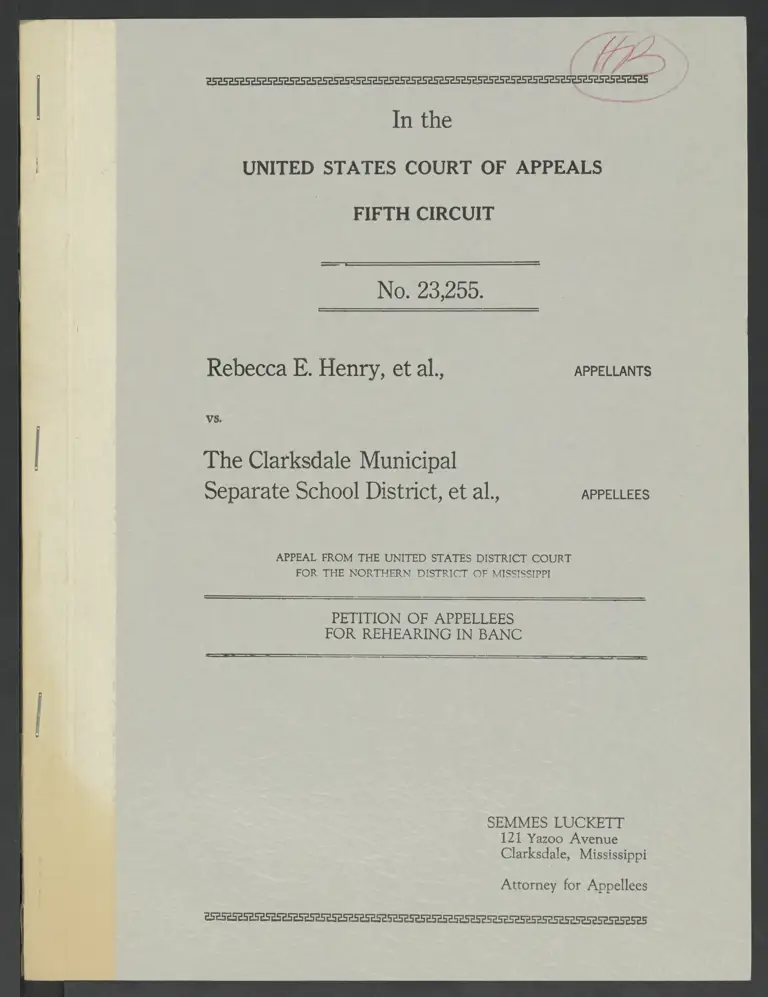
     [||ab770542-c3dd-4618-9b19-c228e5385e7a||] In the

UNITED STATES COURT OF APPEALS

FIFTH CIRCUIT

No. 23.255.

Rebecca E. Henry, et al. APPELLANTS

VS.

The Clarksdale Municipal

Separate School District, et al, APPELLEES

APPEAL FROM THE UNITED STATES DISTRICT COURT

FOR THE NORTHERN DISTRICT OF MISSISSIPPI

PETITION OF APPELLEES
FOR REHEARING IN BANC

SEMMES LUCKETT
121 Yazoo Avenue
Clarksdale, Mississippi

Attorney for Appellees

ooeacarseSEse5ese ose anaes eS Ese see aese see snses hese 5e5e5 25 525R5a50525252525


SUBJECT INDEX:

PETITION FOR REHEARING IN BANC 1

CONCLUSION 13

CERTIFICATE OF SERVICE 14

TABLE OF CASES:

Adams v. Matthews, F.2d (5th Cir.) 13
Alabama NAACP State Conference of Branches

v. Wallace, 269 F. Supp. 346 B77

Bell v. School City of Gary, Ind., 324 F.2d 209

(cert. den. 377 US 924, 12 IL. ed 216) 3, 4, 1]

Board of Public Instruction of Duval County, Fla.,

v, Braxton, 402 F. 24 900 12

Broussard v. Houston Independent School District,
32D F.24 817 6

Brown v. Board of Education, 347 US 483, 98 L ed 873 i. 2, 3, 8, 2

Brown v. Board of Education, 349 US 294, 99 L ed 1082 3

Brown v. Board of Education, 139 F. Supp. 468 3

Davis v. Board of School Comrs., of Mobile County,

364 F.2d 896 3 11

Deal v. Cincinnati Board of Education, 3689 F.2d 55 2, 4

Downs v. Board of Education of Kansas Clty,

336 F. 2d 988 (cert. den., 380 US 914, 13 IL ed 2d 800) 8:3

Gilliam v. School Board of the City of Hopewell, Va,,

345 F. 24 325 2, 4

Green v. County School Board of New Kent County, Va.,

30 US 430, 20 1,ed4 718 11

Griggs v. Cook, 273 7. Supp. 163 (N, D. Ga., July 21, 1967) 6

Monroe v. Board of Commissioners of the City
of Jackson, 391 US 450, 20 L ed (2d) 733

Montgomery Board of Education v. Carr, 400 F.2d 1.
Moses v. Washington Parish School Board, 276 F.Supp. 834

Northcross v. Board of Education of City

of Memphis, 333 F. 2d 661

12
13

6, 12


il.

INDEX. (Cont'd): Page.

TABLE OF CASES (Cont'd):

Raney v. The Board of Education of the Gould

School District, US 5; 20 Lred 727 i

Stell v.. Savannah-Chatham Board of Education,

387 F.2d 486 12

U. S. v. Bessemer Board of Education, 396 F. 2d 44 12

U. 8S. v. Greenwood Municipal Separate

School District, 7.24 10

U. S. v. Jefferson County Board of Education,

372 F.24 836; 330 7, 24 38H ge

YU. 8..v. Board of Pablic Instruction of

Polk County, Fla., 396 PF. 2d 66 12

OTHER AUTHORITIES:

Civil Rights Act of 1964 4, 7, 11

Civil Rights Act of 1964, Sections 401, 407, 410 B

Hearings before a Subcommittee of the Committee on
Appropriations, House of Representatives, Ninetieth

Congress, First Session, page 150 of Part 2 7

U. 8. News % World Report, March 10, 1969 'f


PETITION FOR REFEARING IN BANC

Appellees’ desegregation plan establishes compact attendance areas

or zones, with natural boundaries or perimeters, and requires all of the

district's pupils, without exception, to attend the appropriate school in

his attendance area or zone. The question raised by the majority opinion

handed down by a panel of this court on March 6 is whether such a desegre-

gation plan must be reconstructed in order to bring about a racial mix in

each of the schools of the systems, despite the fact that such desegrega-

tion plan is exactly that called for by Brown, and other such plans are

almost unanimously approved by the courts of the other circuits and are

accepted as meeting all constitutional requirements by such governmen-

tal agencies as HEW. Such question is of exceptional importance.

Because of the exceptional importance of the question herein in-

volved, appellees, the Clarksdale Municiral Separate School District,

et al., respectfully petition for a rehearing of this cause in banc. They

submit that it was error for this Court to withhold affirmance of the Dis-

trict Court's approval of their desegregation plan. Specifically, they

submit that it was error for this Court to hold- which it seemed to do in

effect—that de facto segregation which occurs fortuitously because of

housing patterns is unconstitutional. With all deference, that hasn't

been, and shouldn't be, the law.

Appellees' desegregation plan was designed to meet every require-

ment of Brown, both in letter and spirit. Unlike most other desegrega-

tion plans, it established attendance areas or zones to govern the assign-

ment of pupils to the schools of the district. It did so without the employr

ment of any escape provision whereby white pupils could arrange to en-

roll in a school of the district other than that provided for his attendance


area or zone, And it drew its zone lines in accordance with HEW Guide-

lines, i.e., "to follow the natural boundaries or perimeters of compact

areas surrounding particular schools." It did exactly that which was

called for by Brown, as any correct analysis of that case will show.

Brown, it is submitted, established two requirements, namely,

a) The cessation of the praetice of segregating

school children solely on the basis of race, and

b) The establishment of a system whereby the ad-

missions of children to the public schools are determined

on ga nonracial basis.

After establishing those requirements, the Supreme Court, in

spelling out the manner in which its original decision had to be imple-

mented (349 US 294, 99 L ed 1083), authorized the lower Federal Courts

to consider —

". . . problems related to administration, aris-
ing from the physical condition of the school plant, the
school transportation system, revision of school dis-
tricts and attendance areas into compact units to achieve
a system of determining admission to the public schools
on a nonracial basis. (Emphasis added.)

From the very beginning-- in fact, in Brown after remand to the

trial court— it has been held that if a school board, in obeying the man-

date of Brown to change its "attendance areas into compact units to

achieve a system of determining admission to the public schools on a

nonracial basis," creates attendance areas or zones with reasonable

and rational boundaries, it will have sustained its constitutional obliga-

tions, regardless of the consequent make-up of the student bodies. In-

cluded in the cases to that effect are those which will be hereinafter

cited, including Bell, Downs, Gilliam, Deal, and others.

The NAACP should have no quarrel with the holdings of those cases|.


For in the brief filed by it in Brown 2, it stated on page 12:

"The extent of the boundary alterations required,
in the reformulation of school attendance areas on a
nonracial basis, will vary. This is illustrated by the
recent experience in the District of Columbia in re-
casting attendance boundaries on a wholly geograph-
ical basis. In the neighborhoods where there is little
or no mixture of the races, and where school facili-
ties have been fully utilized, it was found that the elim-
ination of the racial factor did not work any material
change in the territory served by each school. " (Empha-
sis added.)

After the remand of Brown, the District Court, in Brown v. Board

of Education of Topeka, 132 F.Supp. 468, had this to say of the Topeka

plan which required all pupils living in each attendance area or zone to

attend the school in that area or zone:

"IL it is a fact, as we understand it is, with re-
spect to Buchanan School that the district is inhabit-
ed entirely by colored students, no violation of any
constitutional right results because they are com-
pelled to attend the school in the district in which
they live. "

Thereafter the leading case of Bell v. School City of Gary, Ind.,

324 F.2d 209, (cert. den. 377 US 924, 12 1 ed 216) was decided by the

Seventh Circuit Court of Appeals:

"We approve . . . the statement in the District
Court's opinion, 'Nevertheless, I have seen nothing
in the many cases dealing with the segregation prob-
lem which leads me to believe that the law requires
that a school system developed on the neighborhood
School plan, honestly and conscientiously constructed
with no intention or purpose to segregate the races,
must be destroyed or abandoned because the resulting
effect is to have a racial imbalance in certain schools
where the district is populated almost entirely by
Negroes or whites. * * *'"

The Tenth Circuit Court of Appeals reached the same conclusion

in Downs v. Board of Education of Kansas City, 336 F. 2d 988 (certiorari

denied 380 US 914, 13 L ed 24 800):

"We conclude that the decision in Brown and the

many cases following it do not require a school board


to destroy or abandon a school system developed on
the neighborhood school plan, even though it results
in a racial imbalance in the schools, where, as here,
that school system has been honestly and conscien-
tiously constructed with no intention or purpose to
maintain or perpetuate segregation. "

The Fourth Circuit Court of Appeals reached the same: conclusion

in Gilliam v. School Board of the City of Hopewell, Va., 345 F.2d 325;

"The Constitution does not require the abandon-
ment of neighborhood schools and the transportation
of pupils from one area to another solely for the pur-
pose of mixing the races in the schools. "

Deal v. Cincinnati Board of Education, 369 F. 2d 55, decided by

the Sixth Circuit Court of Appeals on December 6, 1966, is also to the

same effect:

"Because of factors in the private housing mar-
ket, disparities in job opportunities, and other out-
side influences (as well as positive free choice by
some Negroes), the imposition of the neighborhood
concept on existing residential patterns in Cincin-
nati creates some schools which are predominantly
or wholly of one race or another. Appellants insist
that this situation, which they concede is not the
case in every school in Cincinnati, presents the
same separation and hence the same constitutional
violation condemned in Brown. We do not accept
this contention. "

Bell is of particular importance because, according to Jefferson,

the thrust of its decision was written into the Civil Rights Act of 1964.

Jefferson quotes Senator Hubert Humphrey: "It was decided to write

the thrust of the court's opinion (in the Gary case) into the proposed

substitute. " And it held that its thrust was —

wi “districts are valid even if there'is a
racial imbalance caused by discriminatory prac-
tices in housing. "

The pertinent provisions of the Civil Rights Act of 1964 are, of

course, Sections 401, 407 and 410, which read as follows:


"Sec. 401. As used in this title--—

"(b) 'Desegregation' means the assignment of
students to public schools and within such schools
without regard to their race, color, religion, or
national origin, but 'desegregation’ shall not mean
the assignment of students to public schools in order
to overcome racial imbalance.

"Rec. 407.0...

". . . nothing herein shall empower any official
or court of the United States to issue any orders seek-
ing to achieve a racial balance in any school by re-
quiring the transportation of pupils or students from
one school to another or one school district to another
in order to achieve such racial balance.

"Sec. 410

"Nothing in this title shall prohibit classification and
assignment for reasons other than race, color, religion,
or national origin.

Jefferson, on which the majority opinion leans, does not support

its fulminations. It was concerned exclusively with the validity of "free-

dom of choice" plans and specifically disavowed any consideration of the

legality of de facto segregation. And there are post-Jefferson cases

from this circuit which bear out our contention that Jefferson is being

misused as support for an untenable proposition. For instance, Alabama

NAACP State Conference of Branches v. Wallace, 269 F. Supp. 346, de-

cided by a three-judge court sitting in the Middle District of Alabama,

contradicts any claim that Jefferson calls for mixing of the races, as an

end in itself, as can be seen from these words from that decision:

"The objective of the statute, as clearly and suc-
cinctly stated in that section, is not compulsory mix-
ing of the races but freedom from discrimination.
That statute does not require integration as an end in
itself, nor is that required by the fourteenth amend-
ment. Of course, some compulsory association of
the races is necessary for the purpose of desegregating


the schools, but that is limited to such as is ap-
propriate for eliminating a dual structure of sepa-
rate schools for students of different races and
removing every vestige of legal discrimination,
an expression which includes all state-imposed
or state-sanctioned discrimination on the ground
of race, color, or national origin. . . . The ac~
tual decision of the Court of Appeals in United
States v. Jefférson.County Board of Education,
supra, is to like effect and does not call for any
further or more complete mixing or balancing of
the races than may be appropriate for the purpose
of correcting discrimination. "

Griggs v. Cook, 272 F. Supp. 163 (N.D. Georgia, July 21, 1967),

affirmed by the court in 384 F. 2d 705, clearly recognizes —with Jefferson

before it—that there is nothing unconstitutional or illegal about fortuitous

de facto segregation, We quote:

", . . What is decided is that the establish-
ment of a school on nonracially motivated standards
is not unconstitutional because it fortuitously results
in all-negro or all-white enrollment. "

Moses v. Washington Parish School Board, 276 F. Supp. 834 (E.D.

La. Oct. 28, 1967), was also decided in the light of Jefferson. In i, U

was said:

® _,. This Court's considered position is that
separation which occurs fortuitously is not 'inherent-
ly' unequal. "

we this “Court cannot ‘sanction a rule of law
which places the legal burden on the state to correct
the effects on one class of individuals of chance oc-
currences or of the free exercise by another group
of their rights of free association. "

Broussard v. Houston Independent School District, 395 F. 2d B17,

rejected the contention that the construction of new schools should be

halted because they might promote or perpetuate de facto segregation,

Over the dissent of the author of the majority opinion herein, who relied

heavily on Jefferson, the Court held:


"Racial imbalance in a particular school does
not, in itself, evidence a deprivation of constitu-
tional rights. Zoning plans fairly arrived at have
been consistently upheld though racial imbalance
might. result.

In addition to the court cases and the Civil Rights Act of 1964, ap-

pellant's position on this point is contradicted by the highest officials of

HEW, on whose guidelines this Court puts great stress. On page 150 of

Part 2 of Hearings before a Subcommittee of the Committee on Appropria

tions, House of Representatives, Ninetieth' Congress, First Session, ap-

pears this statement by Mr. Peter Libassi, Special Assistant for Civil

Rights to the Secretary of HEW:

"In the case of Bell v. School District of Gary,
Ind., the Court held that fortuitous segregation was
not a violation of the Constitution. "

In amplification of that statement, Mr. Libassi made this further

statement, which appears on page 140 of the volume referred to:

"If a school district develops a plan of assign-
ing children to a school according to geography and
the children turn out to be all Negroes, that school
is considered in compliance with the guidelines of
the Commissioner of Education. "

In the March 10, 1969, issue of U. S. News & World Report, there

is reported an interview with the present Secretary of HEW wherein Mr.

Finch made it abundantly clear that his department sees no constitutional

objection to an all-white or all-black school which results from housing

patterns, and that the law forbids action to correct racial imbalance in

such schools.

It should be understood that appellees do not question their respon-

sibility to do that which is in their power to bring about integration in the

schools of the district where such is necessary for the purpose of de-

segregation. But their responsibility, in the words of Alabama NAACP


v. Wallace, supra, "does not call for any further or more complete mix-

ing or balancing of the races than may be appropriate for the purpose of

correcting discrimination." It does not require them to abandon or to

violate the concept of neighborhood schools in order to correct racial

imbalance caused by housing patterns.

In constructing their desegregation plan, appellees faced up to their

responsibilities to do that which Brown ordered. They did not take refuge

in a "freedom-of-choice" plan. They proceeded, as the Court had direct

ed, to create compact attendance areas to serve as the basis for deter-

mining admissions to the schools of the district. And they drew their

zone lines without regard to race. No one seriously contends that those

lines are gerrymandered.

Appellees’ plan requires every pupil in the district to attend the

appropriate school in his zone. No exception to that rule is permitted.

That that is contrary to the usual plan is shown by this quotation from

Judge Tuttle's opinion in Davis v. Board of School Commissioners of

Mobile County, 364 F.2d 596:

"So far as has come to the attention of this
court, no Board of Education has yet suggested
that every child be required to attend his 'neigh-
borhood school" if the neighborhood school is a
Negro school. Every board of education has
claimed the right to assign every white child to
a school other than the neighborhood school under
such circumstances.

Judge Tuttle apparently had never heard of appellees’ plan, although it

had been submitted to the court months before.

Appellees’ plan not only requires every child in every racially

mixed neighborhood in the community to attend the same school, but it

"paired" the only two of the schools which could be consolidated by

"pairing" a formerly all-white elementary school with a formerly all-

black elementary school.


Appellees' plan also goes the limit in guaranteeing equal education-

al opportunities for all of its pupils, in curriculum, pupil-teacher ratios,

per-pupil expenditures, and the like.

If there is ever to be a desegregation plan submitted to this Court

which deserves its approval, appellees' plan is that plan.

Now what has just been said is intended to call attention to the fact

that appellees' plan is an attendance area or zone plan, with no contami-

nation of "freedom-of-choice" elections, such as the transfer provisions

in the plans before the courts in some of the cases cited in the majority

opinion. Consequently it should be judged on that basis, in the light of

what was said in Brown and the other cases which have dealt with attend-

ance areas or zone plans. For it is conceded by practically every authorr

ity that attendance area or zone plans are subject to a different test than

that which applies to "freedom-of-choice" plans and that the limitation on

the use of "freedom-of-choice" plans has no application to attendance

area or zone plans.

At the time Brown was decided, "freedom-of-choice" as a method

for operating schools had never been heard of. Pupils were required to

go to their neighborhood school. Hence Brown directed, as the method

for eliminating the stigma of assignment by race, the creation of com-

pact attendance areas around schools and the assignment of those living

in an area to the school of the area. It was- and is- a normal and natural

way of operating schools and it is the effective way of bringing to an end

the assignment of pupils by race. It can be said that a school district

has the right to operate its schools under an attendance area or zone

plan, provided only that its zones are bounded by natural and rational

lines and are not racially motivated.

"Freedom-of-choice" thereafter came into being as a substitute


10.

for geographical assignment. It envisioned a new and radically different

method for eliminating the evil of assignment of pupils by race. Its use

has been permitted by the courts, as a matter of privilege and not of

right, and now its use will be permitted if— but only if- it brings about

a mixing of the races. The courts find their power for imposing such

limitation on the use of "freedom-of-choice" in the fact that such method

for desegregating school is, after all, a substitute for the normal and

natural way of operating schools. If a school district wishes to utilize

a substitute plan for operating its schools, it must accept the condition

imposed thereon by the authority which authorizes its use, to-wit, the

courts.

But the limitation upon the use of "freedom-of-choice" has no rele-

vancy to a neighborhood school plan. Its very use corrects the evil which

had to be corrected, i.e., the assignment of pupils on the basis of race,

for thereby pupils are automatically assigned on a basis other than race.

In assessing such a plan, there is no need for a court to go any further

than that necessary to assure it that it has been honestly constructed,

which is to say, whether its zone lines are reasonable and rational and

not racially motivated.

And now, in the short space which is left, the cases relied on in

the majority opinion will be summed up, in the belief that they do not

support the proposition that de facto segregation which occurs fortuitious+

ly because of housing patterns is unconstitutional:

U. S. v. Greenwood Municipal Separate School District involved

what was primarily a "freedom-of-choice" plan, although it does provide

for one zone-- called the Bankston zone-- in which only whites live. Its

opinion was written by one who joined in the majority opinion herein. At-

tention is called to the fact that whatever doubt it casts on the legality of


1.

the Bankston zone is based on Jefferson, Green and Raney, all "freedom

of-choice" cases. It is also called to this language in its opinion:

"We do not mean that the Bankston school, stand-
ing alone, is constitutionally defective because it is
all-white or that Negro children of elementary school
age have a constitutional right to attend the Bankston
School in particular. . . . Nor do we say that the
Bankston zone will not fit into a valid over-all plan.
; . It may be that district-wide, nonracial zone
lines would accomplish full conversion to a unitary
system by giving all Negro students a desegregated
education. "

Davis v. Board of School Commissioners of Mobile County, 393 F.

2d 690, ragain aiithored by the distinguished judge who joined in the ma-

jority opinion herein, was returned to the trial court, as the writer readg

it, for determination of the manner in which the zone lines were estab-

lished, and the underlying reasons therefor, with the distinct implication

that the zones would be held valid if the lines by which they were estab-

lished proved to be reasonable, rational and nonracially motivated.

Jefferson, argued the same day in 1966 as was this case, was con-

cerned exclusively with the validity of "freedom-of-choice" and specifi-

cally disavowed any consideration of the legality of de facto segregation.

It was stated therein that the question of the constitutionality of the con-

tinued use of the neighborhood school system "(is) not present in any of

the cases before this Court." And it admitted, in words written by the

author of the majority opinion herein, that the thrust of Bell v. School

City of Gary, Ind., was written into the Civil Rights Act of 1964 andthat

"The thrust of the Gary case (Bell) was that if
school districts were drawn without regard to race,
but rather on the basis of such factors as density of
population, travel distances, safety of the children,
costs of operating the school system, and conven-
ience to parents and children, those districts are
valid even if there is a racial imbalance caused by
discriminatory practices in housing. "

Green v. County School Board of New Kent County, Va., 39 US 430,


12.

20 L ed 716, was concerned solely with the constitutionality of the contin-

ued use of "freedom-of-choice" and what was said therein cannot be legiti;

mately translated as applicable to neighborhood school systems.

Monroe v. Board of Commissioners of the City of Jackson, 391 US

450, 20 L ed (2d) 733, did present a plan which called for zones, but

superimposed thereon was a free-transfer provision which converted it

into what was essentially a ."freedom-of-choice'" plan. The same observa

tion that was made of Green applies to it,

Moses v. Washington Parish School Board, 276 F. Supp. 834, spelled

out the differences between "freedom -oi-cholice' and zone systems, direct-

ed the adoption of a system-wide nonracial geographic zoned system,

pointed out that a goal of racial mixture in a school district where only

Negro children live "is simply not possible," and that its "considered

opinion is that separation which occurs fortuitously is not 'inherently'

unequal. "

Stell v. Savannah-Chatham Board of Education, 387 F.2d 486, inso-

far as it pertains to attendance areas or zones, simply required the filing

of maps showing the zones, so that the court could pass on their validity.

U. 3. v. Board of Public Instruction of Polk Co., Fla., 395 F. (2d)

66, had to do with the location of new schools; a matter not involved in

this case.

Board of Public Ingtruction of Duval Co. ,-Fla., Vv. Braxton, 402 7,

2d 900, as both the controlling opinion and the concurring opinions show,

involved zone lines which had been intentionally gerrymandered to pre-

serve segregation. Nothing like that is in this case.

U. S. v. Bessemer Board of Education, 396 F.2d 44, concerned

faculty requirements under a "freedom-of-choice" plan.


13.

Adams v. Matthews. was concerned solely with the requirement of

"freedom-of-choice" plans, as they might have been changed by Green.

Montgomery Board of Education v. Carr, 400 F. 2d 1, involved

faculty requirements under a "freedom-of-choice" plan and the right of

Negro students to preferential choice for attendance at a newly construct-

ed high schoo].

Northcross v. Board of Education of City of Memphis, 333 F. 2d 661,

is entirely consistent with appellees' position. The Court's order with

respect to attendance areas reads:

"Said single school attendance areas shall be on
a geographic basis according to the capacity and facil-
ities of the buildings and other factors important to
the efficient operation of a public school system. Each
pupil residing within the zone shall be assigned to and
shall have the right to attend the school within his zone
so that attendance areas based on race shall be Elimi-
nated. "

Not a single authority relied on in the majority opinion holds that de

facto segregation which occurs fortuitously because of housing patterns

is unconstitutional.

CONCLUSION

It is submitted that the only limitation on the use of an attendance

area or zone plan is that its zones must be bounded by natural and ration-

al lines and not be racially motivated. If such a plan meets that test, as

Appellees' does, it should be approved by this Court regardless of the

fact that because of housing patterns there is some de facto segregation

in the school district. That is particularly true of a district such as

that which is before the Court, in which transportation is not— and cannot-

be furnished.


It cannot be disputed that the majority opinion herein extends the

doctrine of compulsory integration beyond the limits heretofore fixed in

any decision of this Court or the Supreme Court of the United States and in

a manner contrary to the Civil Rights Act of 1964. Nor can it be gainsaid

that such extension of the doctrine of compulsory integration, involving,

as it does, every school district in this Circuit which includes neighbor-

hoods inhabited largely by either whites or blacks, i.e., every school

district in this Circuit which includes a community of any size, is 2 de-

velopment of tremendous”importance in this field of law. That it should

not be accomplished on the ipse dixits of two Judges--eminent though they

may be-- should be axiomatic.

What is finally done in this case will determine, for a large number

of school districts in this Circuit, whether public schools will continue to

have as their main objective the education of children, or whether they

will be transformed into laboratories for social change. If the majority

opinion stands, and if the latter doctrine is to prevail, the education of

our children will be hopelessly handicapped in the cause of a legal shibbo-

leth for which there is no reasonable, logical, educational or constitutionr

al foundation. Our children should be spared that disaster.

Certainly this case presents a question of exceptional importance.

Hence appellees close with a renewal of their prayer for a rehearing of

this cause in banc.

Respectfully submitted,

SEMMES LUCKETT

121 Yazoo Avenue

Clarksdale, Mississippi

ATTORNEY FOR APPELLEE.

14.


CERTIFICATE OF SERVICE

Copies of the foregoing PETITION OF APPELLEES FOR REHEAR-

ING IN BANC were mailed, postage prepaid, to Reuben V. Anderson,

Esq., 538% North Farish Street, Jackson, Mississippi, and to Jonathan

Shapiro, Esq., 10 Columbus Circle, New York, New York, 10019, on

March 18, 1849.

SEMMES LUCKETT

ATTORNEY FOR APPELLEES.


.
i
i


=


~

A
a


=


~


-


«
;

\


A


5


bod
a
g


~


aa?

™
~


”
pa

-

-


v

.

n
y


»


oy

vu

y 3
|

»


4

S


.

v


E
S


. [||ab770542-c3dd-4618-9b19-c228e5385e7a||]