Joint Appendix
Public Court Documents
March 19, 1984
160 pages
-
Case Files, Garner Working Files. Joint Appendix, 1984. bf63dd64-35a8-f011-bbd3-000d3a53d084. LDF Archives, Thurgood Marshall Institute. https://ldfrecollection.org/archives/archives-search/archives-item/01f4cdf5-31ba-4e00-bb4c-3a0711db669d/joint-appendix. Accessed September 25, 2026.
Copied!
0 :
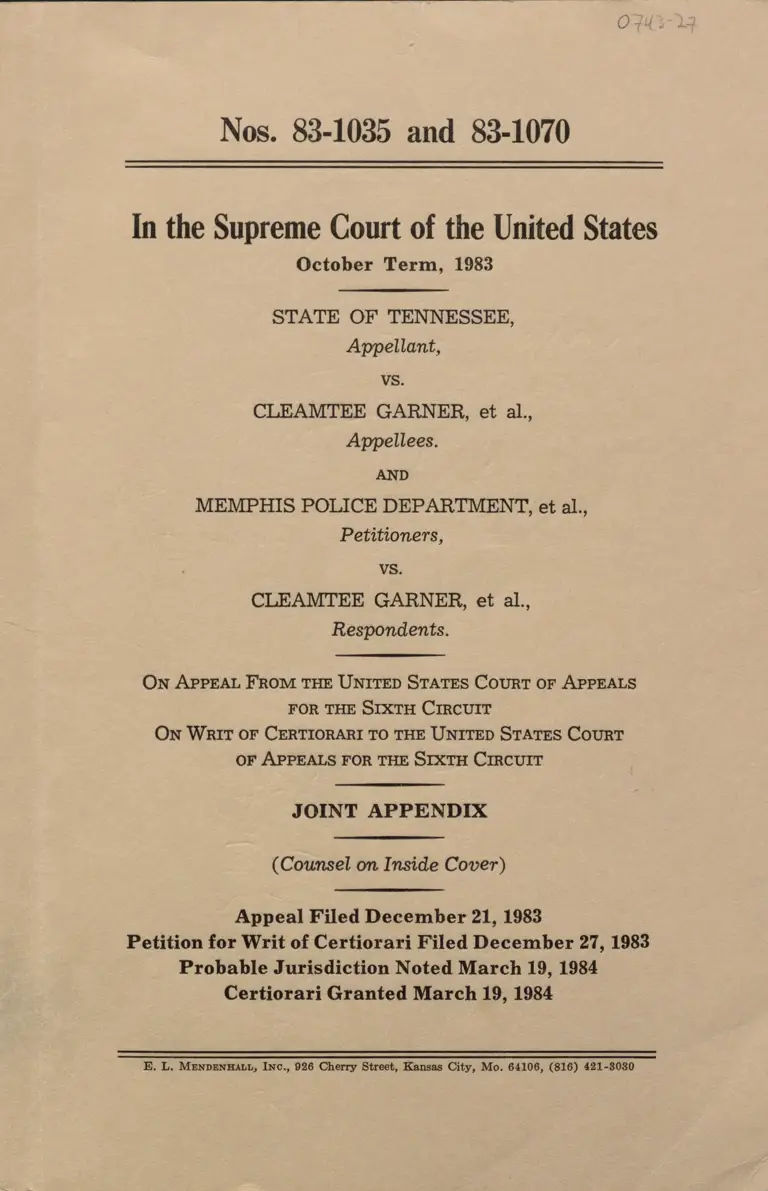
Nos. 83-1035 and 83-1070
In the Supreme Court of the United States
October Term, 1983
STATE OF TENNESSEE,
Appellant,
vs.
CLEAMTEE GARNER, et al.,
Appellees.
AND
MEMPHIS POLICE DEPARTMENT, et al..
Petitioners,
vs.
CLEAMTEE GARNER, et al.,
Respondents.
On A ppeal From the United States Court of A ppeals
FOR THE Sixth Circuit
On W rit of Certiorari to the United States Court
OF A ppeals for the Sixth Circuit
JOINT APPENDIX
(Counsel on Inside Cover)
Appeal Filed December 21,1983
Petition for Writ of Certiorari Filed December 27,1983
Probable Jurisdiction Noted March 19,1984
Certiorari Granted March 19,1984
E. L. M endenhalLj I n c ., 926 Cherry Street, Kansas City, Mo. 64106, (816) 421-3030
H enry L. K lein (Counsel of Record)
Staff Attorney
1500 First Tenn. Bank Building
Memphis, Tennessee 38103
(901) 523-2363
Attorney for Petitioners
Steven L. W inter
10 Columbus Circle, Suite 2030
New York, New York 10019
Attorney for Appellees-Respondents
W illiam M. Leech, Jr.
Attorney General of Tennessee
450 James Robertson Parkway
Nashville, Tennessee 37219
Attorney for Appellant
TABLE OF CONTENTS
Relevant Docket Entries.................................................... 1
Complaint filed April 8, 1975 ............................................ 4
Answer of Defendants filed September 18, 1975 ........... 19
Judgment on Decision entered March 3, 1980 .............. 25
Judgment filed July 8, 1981 ............................................ 26
Testimony of Cleamtee Garner (pp. 8-9, 18-19) .......... 27
Testimony of Talton Douglas Enoch (pp. 46, 62-63) ...... 30
Testimony of Leedell Anderson (pp. 92-94, 104-105) .... 32
Testimony of Elton Richard Hymon (pp. 129, 133-134,
145-146, 157, 170-171, 177, 185-186, 188, 190-193, 574,
613-630, 633, 644-646) .................................................... 35
Testimony of Eugene L. Barksdale (pp. 303, 317-318) .... 60
Testimony of John A. Coletta (pp. 132, 204) .............. 62
Testimony of Dr. J. T. Francisco (pp. 225, 229-230, 235,
262-263) ........................................................................... 63
Testimony of Velton J. Rogers (pp. 655, 657-660, 664-
665) .................................................................................. 67
Testimony of Jay W. Hubbard (pp. 577, 593, 595) ....... 72
Testimony of Leslie Burton Wright (pp. 672, 674, 677-
681, 694-695) ................................................................... 74
Testimony of F. J. Wheeler (pp. 697, 701-702) .......... 79
Affidavit of William R. Bracey......................................... 81
Affidavit of Lawrence W. Sherman................................. 90
Affidavit of James J. F y fe ................................................ 97
Deposition of Wyeth Chandler (pp. 4, 6, 9-15, 21-22,
27) .................................................................................. 107
Deposition of E. Winslow Chapman (pp. 4, 12-16, 18-20,
27, 29-35, 42-47, 49-54, 60-66) ....................................... 115
Memphis Deadly Force Policy dated February 5,1974 -... 140
Memphis Deadly Force Policy dated July 16, 1979 ....... 145
i ' u
. . . i r > ; •
■';r ; ;• -■ rW'i'
'. v~- - -
- ' - ' i S
.'1
RELEVANT DOCKET ENTRIES
Date NR. Proceedings
4- 8-75 1 Complaint
5- 23-75 3 Motion to Dismiss in Behalf of Defendants
5- 23-75 4 Memorandum in Support of Motion to Dis
miss
6- 10-75 6 Plaintiff’s Memorandum in Opposition To
Motion to Dismiss of Defendants, Memphis
Police Department, City of Memphis,
Wyeth Chandler, Jay W. Hubbard and E.
R. Hymon.
8- 18-75 7 Order on Motion to Dismiss
9- 16-75 8 Answer of Defendants
7- 12-76 37 Memorandum; of Points and Authorities of
Plaintiff Cleamtee Garner
7- 12-76 38 “Corrected Copy” of Memorandum of
Points and Authorities of Plaintiff Cleamtee
Garner
8- 23-76 49 Defendants’ Proposed Findings of Fact and
Conclusions.
8- 30-76 50 Plaintiff’s proposed findings of fact and
conclusions of law
9- 7-76 51 Order on Motions for Directed Verdict
9- 7-76 52 Judgment on Decision by the Court
9-29-76 53 Memo Op. Judgment in favor of all defen
dants rendered
9-30-76 54 Judgment on decision by the Court - dis
missing case
10-27-76
1-17-77
1-17-77
8-13-79
56 Notice of Appeal - of plaintiff
58 Court Reporter’s Transcript of Trial
(6) volumes
Six
7-19-79 59
CERTIFIED RECORD MAILED TO
COURT OF APPEALS - 7 vols of tran
script; 9 depos.
MANDATE AND OPINION FROM
COURT OF APPEALS, CASE REVERSED
AND REMANDED FOR FURTHER PRO
CEEDINGS AS TO THE CITY OF MEM
PHIS, AFFIRMED AS TO INDIVIDUALS,
CERTIFIED RECORD ALSO ENCLOSED
60 ORDER (Parties invited w/in 40 days to
submit memo as to whether further hear
ing & trial necessary and/or whether ques
tions may be resolved on the record with
opportunity for submission of briefs &
memo and argument)
9-21-79 63 MEMORANDUM SUBMITTED BY DE
FENDANTS
10-10-79 64 PLTF’S MEMO IN SUPPORT OF NECES
SITY FOR FURTHER HEARINGS
10-16-79 65 ORDER, oral hearing set 11-30-79, 10 AM
10-24-79 67 ORDER-Above motion GRANTED
1-15-80 69 MEMORANDUM
1- 24^80 70 SUPPLEMENTAL MEMORANDUM SUB
MITTED BY DEFTS
2- 7-80 71 PLTF’S RESPONSE TO SUPPLEMENTAL
MEMO SUBMITTED BY DEFTS
3- 3-80 72 ORDER (CRT CONCLUDES THAT
JUDGMENT SHOULD ISSUE FOR
DEFTS, INCLUDING CITY & POUCE
DEPT. IN LIGHT OF MONELL)
3- 3-80 73 JUDGMENT ON DECISION BY THE
COURT (Per Order entered 3-3-80, JUDG
MENT ENTERED FOR DEFTS; CASE
DISMISSED)
74 MOTION FOR RECONSIDERATION
W/MEMO IN SUPPORT ATTACHED
3- 11-80
4- 29-80
6-24-80
75 ORDER - Judgment for defendant sus
pended pending further consideration in
light of contention that plaintiff was not
given full opportunity to brief & argue
merits
77 PLAINTIFF’S MEMORANDUM OF LAW
W/15 ATTACHMENTS FURNISHED
W/ORIGINAL ONLY (NOTE: MEMO &
ATTACHMENTS FILED IN SEPARATE
FOLDERS -2)
7-30-80 78 DEFT’S RESPONSE TO PLTF’S MEMO
#77
7- 8-81 79 ORDER - judgment is rendered for City of
Memphis.
7-13-81 80 JUDGMENT ON DECISION BY THE
COURT
8- 7-81 81 NOTICE OF APPEAL
8- 7-81 MAILED TRANSMISSION FORM TO
COURT OF APPEALS
8-21-81 MAILED CERTIFIED RECORD TO
COURT OF APPEALS
(Filed April 8, 1975)
IN THE
UNITED STATES DISTRICT COURT
FOR THE WESTERN DISTRICT
OF TENNESSEE
WESTERN DIVISION
CIVIL ACTION
No. C-75-145
CLEAMTEE GARNER, father and next of kin of
EDWARD EUGENE GARNER,
a deceased minor.
Plaintiff,
vs.
MEMPHIS POLICE DEPARTMENT; CITY OF MEM
PHIS, Tennessee; WYETH CHANDLER, Mayor of Mem
phis; JAY W. HUBBARD, Director of Police of Memphis;
and E.R. HYMON, Police Officer of the City of Memphis,
Defendants.
COMPLAINT
1. On October 3, 1974, Edward Eugene Gamer, a 15
year old black citizen of the United States and of the State
of Tennessee, residing in the City of Memphis, Shelby
County, Tennessee, was shot and killed by an officer of the
Memphis, Tennessee Police Department. At the time the
officer shot and killed Gamer, he was acting under color
of the statutes, ordinances, regulations, customs and usages
of the State of Tennessee, County of Shelby, and City of
Memphis.
JURISDICTION
2. This is an action for damages brought pursuant
to 42 U.S.C. §§ 1981, 1983, 1985, 1986 and 1988 to redress
the deprivation of the rights, privileges and immunities of
Plaintiff’s deceased son, Edward Eugene Garner, secured
by the Fourth, Fifth, Sixth, Eighth and Fourteenth Amend
ments to the United States Constitution. Jurisdiction is
conferred on this Court by 28 U.S.C. § 1343(3) and 28
U.S.C. § 1331. The matter in controversy exceeds the sum
or value of $10,000.00, exclusive of interests and costs.
3. The shooting and killing of Edward Eugene Garner
by a police officer of the City of Memphis also deprived
the deceased of rights, privileges and immunities secured
him by the Constitution and laws of the State of Tennessee.
This action, therefore, seeks damages for wrongful death
and survival and also with respect to violations of the
deceased’s state-conferred rights through exercise of this
Court’s pendent jurisdiction.
Parties
4. Plaintiff Cleamtee Garner is an adult black citizen
of the United States and the State of Tennessee, residing in
Memphis, Shelby County, Tennessee. Plaintiff is father
and next of kin of Edward Eugene Garner, deceased minor,
who died on October 3, 1974 as a result of defendants’
policies, practices, customs and usages complained of here
in. At the time of his death, Edward Eugene Garner,
resided with plaintiff and was fifteen years old.
5. All of the individual defendants are citizens of the
United States and the State of Tennessee, residing in
Memphis, Shelby County, Tennessee. The defendants are
as follows:
(a) The Memphis Police Department is a department
or agency of the City of Memphis and is charged by law
with the law enforcement responsibilities of the City
of Memphis. The Department has a duty to operate
in a lawful manner so as to preserve to the citizens
of Memphis the rights, privileges and immunities guar
anteed and secured to them by the Constitution and
laws of the United States.
(b) The City of Memphis is a municipal corporation
organized and existing under the laws of the State of
Tennessee. The City, pursuant to law, operates the
defendant Memphis Police Department, which the City
has the duty to operate in conformity with the Consti
tution and laws of the United States.
(c) Wyeth Chandler is Mayor of the City and, as
such, is the City’s chief executive officer. Defendant
Chandler is responsible for all policies and practices
and actions or omissions of the Department and its
members and has the duty to preserve to all citizens
the rights, privileges and immunities secured by the
Constitution and laws of the United States. Prior to
becoming Mayor, on January 1, 1972, defendant Chan
dler was a member of the Memphis City Council, the
City’s legislative body.
(d) Jay W. Hubbard is and was, at all times relevant
herein. Director of Police of Memphis. In that ca
pacity as chief executive officer of the Memphis Police
Department, he is responsible for establishing general
practices, procedures and policies with respect to the
operation of that Department. Pursuant to that au
thority he has promulgated regulations relating to
the use of lethal force by Memphis officers and has
authorized the use of weaponry and ammunition by
police officers both of which acts are complained of
herein. Defendant Hubbard is sued individually and
in his official capacity with the Department.
(e) Defendant E.R. Hymon is sued individually and
in his official capacity. At all times relevant, he was
an officer of the City of Memphis Police Department.
He is a citizen of the United States and of the State
of Tennessee, residing in the City of Memphis.
First Claim for Relief
6. On information and belief, since February 5, 1974,
officers of the Department have been authorized by City
and Department officials to employ deadly force in the
following circumstances after all other reasonable means
to apprehend or otherwise prevent the offense have been
exhausted:
a) defense of themselves or others when confronted
with real and immediate threats of serious bodily
harm or death;
b) where the offense involves a felony and the suspect
uses or attempts to use or threatens the use of
physical force against any person; and
c) where the offense involved is (1) kidnapping, (2)
murder in the 1st or 2nd degree, (3) manslaughter,
(4) arson, (5) rape, (6) assault and battery with
intent to carnally know a child under 12 years
of age, (7) assault and battery with intent to com
mit rape, (8) burglary in the 1st, 2nd or 3rd
degree, (9) assault to commit murder in the 1st
or 2nd degree, (10) assault to commit voluntary
manslaughter, or (11) armed and simple robbery.
7. On information and belief, police officers of the
Department are issued .38 Smith & Wesson Special re
volvers for use in the carrying out of their official respon
sibilities.
8
8. On information and belief, since the latter part
of 1973, police officers of the Department have been issued
Remington 125 grain jacketed hollow-point bullets for use
in .38 revolvers in the exercise of their official duties.
9. The Remington 125 grain jacketed hollow-point
bullet is a member of a class of projectiles commonly
referred to as “Dum-Dum” bullets. Named after an arse
nal near Calcutta, India where bullets of this type were
first made, “Dum-Dum” bullets possess the very special
quality of expanding and flattening more easily in the
human body than do traditional cartridges for .38 revolvers.
10. Because of the expanding and flattening quality
of such bullets upon entering the human body they, unlike
traditional cartridges, do not exit immediately but tend,
instead, to expend their enormous force within the body.
This tendency to expend force within the body means
that persons wounded by such bullets in the head or torso
areas will undoubtedly suffer grievous bodily harm or
death.
11. Because of the devastating effect of “Dum-Dum”
type bullets upon the human body, their use has been
outlawed in international warfare as violative of bans in
various international agreements against “projectiles or
materials of a nature to cause superfluous injury” (Hague
Convention on Land Warfare of 1899), “arms, projectiles,
or materials calculated to cause unnecessary suffering”
(Hague Convention on Land Warfare of 1907 and the Ox
ford Manual of Naval War of 1913) among others, and
prohibited by regulations of the United States military
for use in warfare.
12. On information and belief, on or about October
3, 1974, Edward Eugene Gamer was observed by E.R.
Hymon behind a residence located at Vollintine in the
City of Memphis at about 11 P.M. in the evening.
13. On information and belief, defendant E.R. Hymon,
ordered the deceased, Garner, to halt, as the deceased was
in the process of approaching or actually climbing a 6-
foot cycline fence that extended the length of the area
behind the residence at 739 Vollintine.
14. When the deceased Gamer, who at the time of
his death was about five feet tall and under 100 pounds
in weight, did not respond to defendant Hymon’s order,
the defendant Hymon shot the deceased in the back of
the head with a Remington 125 grain jacketed hollow-point
bullet from his service revolver.
15. Edward Eugene Garner expired at the scene of
the shooting shortly after sustaining the gun-shot wound
to the back of his head.
16. On information and belief, the deceased. Garner,
was unarmed at the time he was mortally wounded by
defendant Hymon.
17. In using his service revolver armed with “Dum-
Dum” type bullets, defendant E.R. Hymon knew or should
have known that his apprehension of Edward Eugene Gar
ner would be effected only at the cost of severely wound
ing, maiming or killing the fleeing youth and would pre
vent, under normal circumstances. Garner’s being sub
jected to the due process protections of being formally
charged, tried by a court or jury, and, if guilty, punished
by incarceration or probation. Defendant E.R. Hymon
knew or should have known, that his shooting of Garner
would inflict summary capital punishment, a penalty which
even a court of law could not impose consonant with
the Eighth and Fourteenth Amendments at the time the
incident in question occurred.
18. The wounding and killing of the deceased. Garner,
by defendant, Hymon, constituted a wanton, willful, ma
10
licious and/or negligent violation of the deceased’s right
not to be subjected to summary punishment and death
at the hands of a law enforcement officer, but rather
to be charged and tried before a court of law and convicted,
if guilty, for any crimes he allegedly committed as guar
anteed by the Fifth, Sixth, and Fourteenth Amendments
to the United States Constitution, specifically by the Due
Process Clauses of the Fifth and Fourteenth Amendments.
19. The wounding and killing of the deceased. Garner,
by defendant, Hymon, constituted a wanton, willful, ma
licious and/or negligent violation of the deceased’s right
not to be subjected to unreasonable seizures of his body
as guaranteed by the Fourth and Fourteenth Amend
ments to the United States Constitution. In view of the
fact that the deceased was unarmed and posed no threat
to the life or person of the defendant, Hymon, or any
third person, the officer’s resort to lethal force was unnec-
sary and unreasonable, designed not to apprehend the de
ceased, but rather to cause his death or grievous bodily
harm to him.
20. The wounding and killing of the deceased. Garner,
by defendant, Hymon, constituted a wanton, willful, mali
cious and negligent violation of the deceased’s right not
to be subjected to cruel and unusual punishment as guar
anteed by the Eighth and Fourteenth Amendments to the
United States Constitution in that the lethal force used
by defendant, Hymon, was unreasonable and unnecessary
to apprehend the deceased. Instead, the force used was
excessive in that the natural and reasonable consequence
of its application to the deceased was death or grievous
bodily harm.
21. As a result of his wounding, the deceased. Garner,
suffered and was forced to endure intense pain and suf
11
fering prior to succumbing to the mortal damage sustained
by his body.
22. The wounding and killing of the deceased, Gamer,
by defendant, Hymon, occurred because the deceased was
black, that is to say, lethal force would not have been
resorted to under the circumstances had the deceased been
white. In that regard, the deceased was deprived of his
right to equal protection of the laws irrespective of race
as guaranteed by the Fourteenth Amendment to the United
States Constitution and by 42 U.S.A. § 1981.
Second Claim for Relief
23. Plaintiff reasserts and realleges paragraphs 6
through 22 above.
24. The wounding and killing of the deceased. Garner,
by defendant, Hymon, in violation of the deceased’s rights
guaranteed by the Fourth, Fifth, Sixth, Eighth and Four
teenth Amendments to the United States Constitution was
a direct and proximate result of the defendant, Memphis
Police Department’s hiring of defendant, Hymon, despite
the fact that it knew or should have known that defendant,
Hymon, was unsuited to perform the duties of a law en
forcement officer and that his employment in that capacity
would result in his causing grievous bodily injury or death
to persons in the City of Memphis.
25. The wounding and killing of the deceased. Garner,
by defendant, Hymon, in violation of the deceased’s rights
guaranteed by the Fourth, Fifth, Sixth, Eighth and Four
teenth Amendments to the United States Constitution was
a direct and proximate result of the defendant, Memphis
Police Department’s hiring defendant, Hymon, as a law
enforcement officer with the authority and capacity to
cause grievous bodily injury to persons in the City of
12
Memphis without providing him with adequate training
in the use of weapons generally and in the proper use of
non-lethal and lethal force in making apprehensions.
26. The wounding and killing of the deceased, Gamer,
by defendant, Hymon, in violation of the deceased’s rights
guaranteed by the Fourth, Fifth, Sixth, Eighth and Four
teenth Amendments to the United States Constitution was
a direct and proximate result of the defendant, Memphis
Police Department’s hiring defendant, Hymon, as a law
enforcement officer with the authority and capacity to
cause death or grievous bodily harm to persons in the
City of Memphis without providing him with adequate
training in the use of weapons generally and in the proper
use of non-lethal and lethal force in making apprehen
sions and, in reckless and negligent disregard for his lack
of training, issuing him “Dum-Diim” type bullets, the use
of which could result only in death or grievous bodily
injury.
27. The wounding and killing of the deceased. Gamer,
by the defendant, Hymon, in violation of the deceased’s
rights guaranteed by the Fourth, Fifth, Sixth, Eighth and
Fourteenth Amendments to the United States Constitution
was a direct and proximate result of defendant, Memphis
Police Department’s (a) providing authorization to officers
such as defendant Hymon to shoot to prevent the escape
of persons suspected of committing certain non-violent
felonies but who pose no threat to the life or physical
safety of the officer or of third persons and (b) arming
such officers with “Dum-Dum” type bullets that assure
that the alleged felon will be grievously wounded or killed
instantly obviating any possibility that the suspect will
be brought to justice in accordance with accepted notions
of due process. In so doing, the defendant, Memphis
Police Department, authorized the imposition of summary
punishment not the apprehension of criminal suspects for
disposition by the legal process.
28. As a consequence of the reckless and negligent
conduct of the defendant, Memphis Police Department,
as set forth in paragraphs 24 to 27 above, the defendant,
Hymon, resorted to the use of lethal force where non-lethal
force was appropriate, mortally wounding the deceased.
Gamer.
Third Claim for Relief
29. Plaintiff reasserts and realleges paragraphs 6
through 22 above.
30. The wounding and killing of the deceased. Garner,
by defendant, Hymon, in violation of the deceased’s rights
guaranteed by the Fourth, Fifth, Sixth, Eighth and Four
teenth Amendments to the United States Constitution was
a direct and proximate result of the defendant. Jay W.
Hubbard’s hiring of defendant, Hymon, despite the fact
that defendant, Hubbard, knew or should have known that
defendant, Hymon, was unsuited to perform the duties of
a law enforcement officer and that his employment in
that capacity would result in his causing grievous bodily
injury or death to persons in the City of Memphis.
31. The wounding and killing of the deceased. Garner,
by defendant, Hymon, in violation of the deceased’s rights
guaranteed by the Fourth, Fifth, Sixth, Eighth and Four
teenth Amendments to the United States Constitution was
a direct result of defendant. Jay W. Hubbard’s hiring de
fendant, Hymon, as a law enforcement officer with the
authority and capacity to cause death or grievous bodily
injury to persons in the City of Memphis without pro
viding him with adequate training in the use of weapons
generally and in the proper use of non-lethal and lethal
force in making apprehensions.
13
14
32. The wounding and killing of the deceased, Garner,
by defendant, Hymon, in violation of the deceased’s rights
guaranteed by the Fourth, Fifth, Sixth, Eighth and Four
teenth Amendments to the United States Constitution was
a direct and proximate result of defendant. Jay W. Hub
bard’s hiring defendant, Hymon, as a law enforcement
officer with the authority and capacity to cause death
or grievous bodily harm to persons in the City of Memphis
without providing him with adequate training in the use
of weapons generally and in the proper use of non-lethal
and lethal force in making apprehensions and, in reckless
and negligent disregard for his lack of training, issuing
him “Dum-Dum” type bullets for his use on duty, the
use of which could result only in death or grievous bodily
injury.
33. The wounding and killing of the deceased. Garner,
by the defendant, Hymon, in violation of the deceased’s
rights guaranteed by the Fourth, Fifth, Sixth, Eighth and
Fourteenth Amendments to the United States Constitu
tion was a direct and proximate result of defendant. Jay
W. Hubbard’s (a) providing authorization to officers such
as defendant Hymon to shoot to prevent the escape of
persons suspected of committing certain non-violent
felonies but who pose no threat to the life or physical
safety of the officer or of third persons and (b) arming
such officers with “Dum-Dum” type bullets that assure
that the alleged felon will be grievously wounded or killed
instantly obviating any possibility that the suspect will
be brought to justice in accordance with accepted notions
of due process. In so doing, the defendant. Jay W. Hubbard,
authorized the imposition of summary punishment not the
apprehension of criminal suspects for disposition by the
legal process.
34. As a consequence of the reckless and negligent
conduct of the defendant. Jay W. Hubbard, as set forth
15
in paragraphs 30 to 33 above, the defendant, Hymon,
resorted to the use of lethal force where non-lethal force
was appropriate, mortally wounding the deceased, Garner.
Fourth Claim for Relief
35. Plaintiff reasserts and realleges paragraphs 6
through 22 above.
36. The wounding and killing of the deceased, Garner,
by defendant, Hymon, in violation of the deceased’s rights
guaranteed by the Fourth, Fifth, Sixth, Eighth and Four
teenth Amendments to the United States Constitution was
a direct and proximate result of the defendant. City of
Memphis’ hiring of defendant Hymon, despite the fact
that defendant City of Memphis knew or should have
known that defendant, Hymon, was unsuited to perform
the duties of a law enforcement officer and that his em
ployment in that capacity would result in his causing
grievous bodily injury or death to persons in the City of
Memphis.
37. The wounding and killing of the deceased. Gamer
by defendant, Hymon, in violation of the deceased’s rights
guaranteed by the Fourth, Fifth, Sixth, Eighth and Four
teenth Amendments to the United States Constitution was
a direct result of defendant City of Memphis’ hiring de
fendant Hymon as a law enforcement officer with the
authority and capacity to cause death or grievous bodily
injury to persons in the City of Memphis without pro
viding him with adequate training in the use of weapons
generally and in the proper use of non-lethal force in
making apprehensions.
38. The wounding and killing of the deceased. Garner,
by defendant, Hymon, in violation of the deceased’s rights
16
guaranteed by the Fourth, Fifth, Sixth, Eighth and Four
teenth Amendments to the United States Constitution was
a direct and proximate result of defendant. City of Mem
phis’ hiring defendant Hymon as a law enforcement officer
with the authority and capacity to cause death or grievous
bodily harm to persons in the City of Memphis without
providing him with adequate training in the use of wea
pons generally and in the proper use of non-lethal and
lethal force in making apprehensions and, in reckless and
negligent disregard for his lack of training, issuing him
“Dum-Dum” type bullets for his use on duty, the use of
which could result only in death or grievous bodily injury.
39. The wounding and killing of the deceased Garner,
by defendant, Hymon, in violation of the deceased’s rights
guaranteed by the Fourth, Fifth, Sixth, Eighth and Four
teenth Amendments to the United States Constitution was
a direct result of defendant City of Memphis’ (a) providing
authorization to officers such as defendant Hymon to
shoot to prevent the escape of persons suspected to com
mitting certain non-violent felonies but who pose no threat
to the life or physical safety of the officer or of third
persons and (b) arming such officers with “Dum-Dum”
type bullets that assure that the alleged felon will be
grievously wounded or killed instantly obviating any pos
sibility that the suspect will be brought to justice in
accordance with accepted notions of due process. In so
doing, the defendant. City of Memphis, authorized the im
position of summary punishment not the apprehension of
criminal suspects for disposition by the legal process.
40. As a consequence of the reckless and negligent
conduct of the defendant, City of Memphis, as set forth
in paragraphs 36 to 39, the defendant Hymon resorted
to the use of lethal force where non-lethal force was ap
propriate, mortally wounding the deceased, Garner.
Fifth Claim for Relief
41. Plaintiff reasserts and realleges paragraphs 6
through 22 above.
42. The wounding and killing of the deceased, Gamer,
by defendant, Hymon, in violation of the deceased’s rights
guaranteed by the Fourth, Fifth, Sixth, Eighth and Four
teenth Amendments to the Constitution was a direct and
proximate result of defendant Wyeth Chandler’s publicly
expressed support for and approval of, as a member of
the City Council and since becoming Mayor of the City
Council, shooting by officers of the Memphis Police De
partment to prevent the escape of persons suspected of
committing certain non-violent felonies but who pose no
threat to the life or physical safety of the officer or of
third persons despite the fact that he knew or should
have known that: (a) The Memphis Police Department
was hiring persons as police officers who were unsuited
to perform the duties of law enforcement officers and
whose hiring would result in their improperly causing
grievous bodily injury or death to persons in the City
of Memphis; (b) The Memphis Police Department was
hiring persons as police officers with the authority and
capacity to cause death or grievous bodily injury to persons
in the City of Memphis without providing them with ade
quate training in the use of weapons generally and in
the proper use of non-lethal and lethal force in making
apprehensions; (c) The Memphis Police Department was
arming police officers with “Dum-Dum” type bullets, the
use of which could result only in death or grievous bodily
injury, thereby preventing any disposition of an alleged
felon in accordance with accepted notions of due process.
43. In publicly supporting the shooting by police of
ficers of the Memphis Police Department to prevent the
escape of persons suspected of committing certain non
17
18
violent felonies but who pose no threat to the life or
physical safety of the officer or of third persons, despite
the factors mentioned in 42(a) through (c) above, defen
dant Wyeth Chandler placed the prestige and authority
of his office as City Councilman and later Mayor of Mem
phis behind the imposition of summary capital punishment
by Memphis police officers which official policy was in fact
effectuated in the case of the deceased. Garner, as a result of
his shooting by defendant, Hymon.
Pendent Claim
44. Plaintiff reasserts and realleges paragraphs 1
through 43 above.
45. The foregoing acts of defendants Hymon, Mem
phis Police Department, City of Memphis, Hubbard and
Chandler which resulted in the death of plaintiff’s son,
Edward Eugene Garner, also violated the Constitution and
laws of the State of Tennessee, including but not limited
to TENN. Code Ann. § 40-808, as authoritatively con
strued by the courts of Tennessee and served to deprive
the deceased of rights granted by those provisions.
Prayer
46. Plaintiff respectfully requests that compensatory
and punitive damages be awarded under the federal claims
in the total amount of One Million Dollars ($1,000,000)
for which the defendants are jointly and severally liable.
47. Plaintiff respectfully requests that compensatory
and punitive damages be awarded under the pendent claim
in the total amount of One Million Dollars ($1,000,000)
for which the defendants Hymon, Hubbard and Wyeth
are jointly and severally liable, and reasonable hospital,
medical, funeral expenses and expenses of administration
19
necessitated by reason of injuries causing death to the
deceased, Garner.
48. Plaintiff also requests that this Court grant de
claratory relief pursuant to 28 U.S.C. §§ 2201 and 2202
declaring that the use of “Dum-Dum” type bullets by
Memphis Police officers to apprehend persons fleeing from
the alleged commission of non-violent felonies who pose
no threat to the life or physical safety to officers or of
third persons violates the Fourth, Fifth, Sixth, Eighth and
Fourteenth Amendments to the Constitution and federal
laws enacted pursuant to those Amendments.
49. Plaintiff respectfully requests that costs and coun
sel fees be awarded and that such other, further and addi
tional relief as may appear to the Court to be just and
equitable be granted.
(Signatures Omitted)
(Filed September 18, 1975)
(Caption Omitted)
ANSWER OF DEFENDANTS
COMES NOW the Defendants, Memphis Police De
partment, City of Memphis, Tennessee, Wyeth Chandler,
Jay W. Hubbard, and E. R, Hymon and while reiterating
and relying upon each and every ground set forth in their
Motion to Dismiss, heretofore filed in this cause, for an
swer to the Complaint filed herein state as follows:
FIRST DEFENSE
1. Complaint fails to state a cause of action upon
which relief can be granted.
20
SECOND DEFENSE
1. Defendants admit the averments set out in Para
graph 1 of the Complaint.
2. Defendants deny that this Court has jurisdiction
as averred in Paragraph 2 of the Complaint.
3. Defendants deny that the shooting and killing of
Edward Eugene Garner by a police officer of the City of
Memphis also deprived the deceased of rights, privileges,
and immunities secured him by the Constitution and laws
of the State of Tennessee. Defendants deny that this ac
tion is a proper one for damages for wrongful death and
survival and further deny that this is a proper action for
violations of the deceased’s state-conferred rights through
exercise of this Court’s pendent jurisdiction.
4. Defendants are without information sufficient to
form a belief as to the truth of the averment set out in
Paragraph 4 of the Complaint with regard to Plaintiff
Cleamtee Garner being an adult black citizen of the United
States and the State of Tennessee residing in Memphis,
Shelby County, Tennessee, and that he is the father and
next of kin of Edward Eugene Garner, deceased minor,
who died on October 3, 1974, and, therefore, deny same.
Defendants deny that the death of Edward Eugene Garner
was a result of Defendants’ policies, practices, customs, and
usages. Defendants are without information sufficient to
form a belief as to the truth of the averment set out in
Paragraph 4 to the effect that at the time of his death,
Edward Eugene Garner, resided with Plaintiff and, there
fore, deny same. Defendants admit that Edward Eugene
Garner was fifteen (15) years old at the time of his death.
5. Defendants admit the averments set out in Sub-
Sections (a), (b), and (e) of Paragraph 5 of the Complaint.
21
With regard to Sub-Section (c) of Paragraph 5 of the
Complaint, Defendants admit that Wyeth Chandler is
Mayor of the City of Memphis and as such is its chief ex
ecutive officer and further admit that prior to becoming
Mayor on January 1, 1972, Defendant Chandler was a mem
ber of the Memphis City Council, the City’s legislative
body. Defendants deny that Chandler is responsible for
all policies and practices and actions or omissions of the
Department and has the duty to preserve to all citizens
the rights, privileges, and immunities secured by the Con
stitution and laws of the United States.
With regard to Sub-Section (d) of Paragraph 5 of the
Complaint, Defendants deny that J. W. Hubbard is at this
time Director of Police of Memphis. However, they ad
mit that on October 3, 1974, he was Director of Police
of Memphis, and in that capacity, as chief executive officer
of the Memphis Police Department, he was responsible for
establishing general practices, procedures, and policies with
respect to the operation of that Department. Defendants
further admit that pursuant to that authority he has prom
ulgated regulations relating to the use of lethal force by
Memphis officers and has authorized the use of weaponry
and ammunition by police officers in certain instances.
Defendants deny that any regulations promulgated by De
fendant Hubbard in his official capacity or individually,
directly or indirectly, violated the constitutional rights of
the deceased.
6. Defendants admit the averments set out in Para
graph 6 of the Complaint.
7. Defendants admit the averments set out in Para
graph 7 of the Complaint, however, Defendants aver that
not all revolvers are issued by the Department as some
are privately owned.
22
8. Defendants admit the averments set out in Para
graph 8 of the Complaint.
9. Defendants admit that the Remington 125 grain
jacketed hollow-point bullet is a member of a class of
projectile sometimes referred to as “Dum-Dum” bullets.
However, Defendants deny that it is commonly referred
to by that name and aver that proper designation of such
bullets is “ controlled expansion projectiles.” Defendants
are without information to form a belief as to the truth of
the averment that the bullets were named after an arsenal
near Calcutta, India, and, therefore, deny same. Since the
Complaint does not define the meaning of “ traditional
cartridges,” Defendants are without information sufficient
to form a belief as to the truth of the averment set out
in Paragraph 9 of the Complaint with regard to the “Dum-
Dum” bullets possessing the very special quality of ex
panding and flattening more easily in the human body
than traditional cartridges, and therefore, deny same.
10. Defendants deny the averments set out in Para
graph 10 of the Complaint.
11. Defendants admit that the “Dum-Dum” type bul
lets have been outlawed in international warfare, but deny
that it is because of the devastating effect it has upon the
human body and aver that it has no more devastating ef
fect on the human body than land mines, mortars, re
coilless rifles, artillery, and atomic weapons which have
not been outlawed.
12. Defendants admit the averment set out in Para
graph 12 of the Complaint.
13. Defendants admit the averments set out in Para
graph 13 of the Complaint.
14. Defendants deny the averments set out in Para
graph 14 with regard to the height and weight of the de
23
ceased Gamer, however, they admit he did not respond
to Defendant Hymon’s order to halt and was shot with a
Remington 125 grain jacketed hollow-point bullet from his
service revolver. Defendants deny that the deceased was
shot in the back of the head and aver that he was actually
shot in the side of the head.
15. Defendants deny the averments set out in Para
graph 15 of the Complaint.
16. Defendants admit that the deceased Gamer was
unarmed at the time he was shot by Defendant Hymon.
17. Defendants deny the averments set out in Para
graph 17 of the Complaint.
18. Defendants deny the averments set out in Para
graph 18 of the Complaint.
19. Defendants deny the averments set out in Para
graph 19 of the Complaint.
20. The defendants deny the averments set out in
Paragraph 20 of the Complaint.
21. Defendants are without inforaiation sufficient to
form a belief as to the truth of the averment set out in
Paragraph 21 of the Complaint and, therefore, deny same.
22. Defendants deny the averments set out in Para
graph 22 of the Complaint.
23. Defendants deny the averments set out in Para
graphs 24, 25, 26, 27, 28, 30, 31, 32, 33, 34, 36, 37, 38, 39,
40, 42, 43, and 45 of the Complaint.
24. Defendants deny that they are liable for damages,
either compensatory or punitive, under any Federal claims
and further deny that Defendants Hymon, Hubbard, and
Chandler are liable for damages, either compensatory or
punitive, under the pendent claim.
24
25. Defendants deny that Plaintiff is entitled to de
claratory relief pursuant to 28 U.S.C., Sections 2201 and
2202, declaring that the use of “Dum-Dimi” type bullets
by Memphis Police Officers to apprehend persons fleeing
from the alleged commission of non-violent felonies who
pose no threat to the life or physical safety to officers or
third persons violates the 4th, 5th, 6th, 8th and 14th
Amendments to the Constitution and the Federal laws
enacted pursuant to those Amendments.
THIRD DEFENSE
1. For further answer to the Complaint, Defendants
aver that on October 3, 1974, Defendant E. R. Hymon
and his partner received a call to go to a residence at
737 Vollintine Street, Memphis, Tennessee, and they ar
rived upon the scene at approximately 11:00 P.M. where
they were met by the occupant of 737 Vollintine, who
advised them that the house next door at 739 Vollintine
was being burglarized. Defendant Hymon ran back to
his squad car, got his flashlight and advised his partner
that someone was breaking in next door at 739 Vollintine.
Defendant Hymon ran to the rear of the house and heard
the rear door slam and a noise on the back fence. He
shined his flashlight on the fence and spotted the deceased
on the fence at that time. He then called out for the
deceased to halt. The deceased continued to scale the
fence, at which time Defendant Hymon fired one shot
hitting the deceased in the side of the head.
2. Defendants aver that the actions of Defendant
Hymon are governed by TCA 40-808, which reads as
follows:
‘ ‘Resistance to Officer — If, after notice of the inten
tion to arrest the defendant, he either flee or force-
25
ably resist, the officer may use all the necessary
means to effect the arrest.”
All allegations contained in the Complaint that are
neither admitted nor denied are here and now denied
as though specifically denied.
And now having fully answered, Defendants pray
that this Complaint be dismissed and the costs be adjudged
against the Plaintiff.
(Signatures and Certificate of Service Omitted)
(Filed March 3, 1980)
(Caption Omitted)
JUDGMENT
This action came on for (hearing) before the Court,
Honorable HARRY W. WELLFORD, United States Dis
trict Judge, presiding, and the issues having been duly
(heard) and a decision having been duly rendered, on the
remand from the Sixth Circuit,
It is Ordered and Adjudged that in accordance with
the Order entered by the Court on March 3, 1980, judg
ment is hereby entered for defendants, including the City
of Memphis and the Memphis Police Department in light
of Monell.
Approved:
/s / Harry W. Wellford
United States District Judge
Dated at Memphis, Tennessee, this 3rd day of March,
1980.
/s / (Illegible)
Clerk of Court
26
(Filed July 8, 1981)
(Caption Omitted)
JUDGMENT
This action came on for consideration before the
Court, Honorable Harry W. Wellford, United States Dis
trict Judge, presiding, and the issues having been duly
tried (heard) and a decision having been duly rendered.
It is Ordered and Adjudged that in accordance with
the Order entered by the Court on July 8, 1981, judgment
is rendered for the City of Memphis.
Approved:
/s / Harry W. Wellford
United States District Judge
1981.
Dated at Memphis, Tennessee, this 8th day of July,
/s / (Illegible)
Clerk of Court
27
TESTIMONY OF CLEAMTEE GARNER
« * «
* * * [8] first witness the Plaintiff in this case,
Mr. Cleamtee Garner.
THE COURT: All right.
Whereupon,
CLEAMTEE GARNER,
after first being duly sworn, was examined and testified
as follows:
DIRECT EXAMINATION
BY MR. DAYS:
Q. Mr. Garner, would you state your full name and
address for the record, please? A. Stand or sit?
THE COURT: No, you may sit, Mr. Garner.
A. (By the witness) My name is Cleamtee Garner.
You want my address?
Q. That is right. A. I live at 928 Tully, Memphis.
Q. And how long have you lived at that address?
A. About 11 years.
Q. Are you the Plaintiff in this case, Mr. Garner?
A. Sir?
Q. Are you the Plaintiff in this case? A. Plaintiff,
Plaintiff, yes, sir.
[9] Q. Mr. Garner, could you indicate what your
educational background is? A. About six grade level.
Q. And where are you originally from? A. Mis
sissippi, Tillatoba, Mississippi.
Q. How long have you resided in Memphis? A.
Since 1945.
Q. Since 1945? A. Since 1945.
28
Q. Are you employed? A. I am employed at the
Memphis Defense Depot.
Q. And how long have you been employed there?
A. About, since 1952, about 24 years.
Q. And what is your job category at the depot?
A. W6 material packer.
Q. And have you been in that job since you started?
A. I haven’t been in that job since I started. I have
been in that job about 12 years.
Q. I see. At what level did you start in that em
ployment? A. I started out in laborers, W2 laborers.
Q. Is it correct to say that you moved up from that
original level to your present position? A. Correct.
* 4> « [18] third degree burglary, you know.
That is when I went in and talked with one of the
counselors, I believe, and they put him on probation for
a year.
Q. You talked to a councilman or to a counselor?
A. A counselor. I believe it was Mr. Rogers, if I’m not
mistaken. I’m not sure.
Q. And you say as a result of these charges, your
son was put on one year’s probation? A. Probation,
that is correct.
Q. As a result of these charges having been brought
against your son and his being put on probation, did
you take any action with respect to Eugene’s behavior,
Edward Eugene’s behavior after that time? A. 'That is
right. I counseled with him and I chastised him and
gave him certain hours to be home, you know, during
the day and at nighttime, and different things.
Q. What were the conditions of his probation, if
you recall? A. What was the—
Q. (Interposing) Conditions of his probation. Were
there any requirements that he had to meet to satisfy—
29
A. (Interposing) Restrictions. He had certain times of
night he would have to be at home. Somebody would
have to [19] know where he was at all times.
Q. And who in your family, if anyone, assumed the
responsibility of overseeing that he complied with those
requirements? A. I would, when I would be at home,
and my wife was supposed to when I would be away
from home. Of course, his other brothers and his older
brother, he was concerned about him and they would
keep check on him as near as they could.
Q. I believe you indicated that you were away from
home? A. Yes, I worked the second shift, evening shift,
and I’m supposed to be at work from four o’clock to
12:30 o’clock.
Q. And is that the regular shift you had? A. That
is the regular shift I had.
Q. And you continue to work that shift? A. I stiU
work that shift.
Q. So does that mean that you were away from
your home from four o’clock in the afternoon until twelve
o’clock midnight? A. I get off at twelve o’clock but I
usually get home about one o’clock if I don’t stop no
place. Sometimes I stop at the store, at Fred Montesi’s.
But if I don’t stop, I get home about one o’clock.
Q. Can you recall what, if any, problems Edward
Eugene * * *
30
TESTIMONY OF TALTON DOUGLAS ENOCH
♦ * ♦ [46] step down, Mr. Garner.
You may call your next witness.
MR. BAILEY: Your Honor, at this time we wish
to call—^may I peep in the jury room to see who is in
there?
THE COURT: Yes, sir.
Whereupon,
TALTON DOUGLAS ENOCH,
having been duly sworn, was examined and testified as
follows:
DIRECT EXAMINATION
BY MR. BAILEY:
A.Q. State your full name to the Court, please.
Talton Douglas Enoch.
Q. And Mr. Enoch, your occupation? A. Architect.
Q. With what firm? A. Gassner, Nathan and part
ners.
Q. And did I not engage you to go out to 739 Vollen-
tine in order to view an alleged scene involved in the
lawsuit in question? A. Yes, sir, you did.
Q. All right. While out there, did you happen to
view the scene? A. Yes, sir, I did.
♦ ♦ * [62] tell me what the distance— A. (Inter
posing) That is 37 feet six inches.
Q. 37 feet six inches. A. Right.
Q. When you were out there, Mr. Enoch—and I’ll
refer to it as a chicken wire fence rimning along the
west side of the house—was it up or down when you
31
were there? A. Partially up and down. The area near
est the house was up and then the part nearest the chain
link fence was down.
Q. All right. Do you know—of course, you wouldn’t
know what the condition of it was back in October 1974?
A. I wouldn’t have any idea.
Q. You wouldn’t have any idea. And that chicken
wire fence was how tall, did you say? A. Three feet.
MR. KLEIN: Three feet. That is all I have. Your
Honor.
THE COURT: Anything further of Mr. Enoch?
MR. BAILEY: Just one other question. Your Honor.
[63] RE-DIRECT EXAMINATION
BY MR. BAILEY:
Q. Does Exhibit 2 show pretty much the condition
of the fence when you were out there, the chicken wire
fence? A. Yes, sir. That is what I would—it was up,
you know, it was erect on the side nearest the residence
and then falling down or sagging near the chain link
fence.
MR. BAILEY: All right. That is all. Your Honor.
THE COURT: All right, sir. You may step down,
sir. Thank you.
Grentlemen, why don’t we take a brief recess now
before you call your next witness and we’ll be ready to
proceed. About ten minutes.
(Recess.)
THE COURT: Are you ready with your next wit
ness?
MR. BAILEY: Yes, sir. Mr. Enoch, would you re
sume the stand again, please?
There were three photographs, Your Honor, I ne
glected to get testimony on.
32
TESTIMONY OF LEEDELL ANDERSON
* * « [92] on to say that there was extensive cor
tical injury and superior saggital sinus transection. Do
you know what that means? A. No, I really don’t.
MR. KLEIN: I have no further questions.
MR. BAILEY: Your Honor, I might observe that
we plan to call Dr. Francisco, who can define that ter
minology.
THE COURT: In any event, this record is admitted
and Miss Stepp, after the next witness is called, the
Clerk will have an opportunity to go with you to the
Clerk’s office and make a copy so that you can retain
your record and the photostat will be introduced as the
next exhibit number.
You may call your next witness.
MR. BAILEY: Mr. Anderson.
Whereupon,
LEEDELL ANDERSON,
after first being duly sworn, was examined and testified
as follows:
[93] DIRECT EXAMINATION
BY MR. BAILEY:
Q. State your name to the Court, please. A. Leedell
Anderson.
Q. Mr. Anderson, where do you reside? Where do
you live? A. 739 Vollentine.
Q. And your age? A. Fifty-four.
Q. Married? A. Yes.
33
Q. All right. Is 739 Vollentine where you reside
the site or the place where young Garner was shot by
the police? A. Yes. Yes, sir.
Q. AH right, and were you present at the—you
weren’t present at the actual shooting, were you? A.
No, sir.
Q. You got home a little later after the shooting?
A. Right.
Q. All right, and after you got there, did you get
a chance to see the young boy who was shot? A. They
was fixing to put him in the ambulance when I rolled up.
Q. I see. And your house had been burglarized,
had it [94] not? A. Right.
Q. As a matter of fact, was there evidence that
somebody had gained forceful entry into the home? A.
Right.
Q. What kind of evidence was there? A. Well,
the window was broken out and the door hadn’t been
broken in, so somebody had to go through the window
to open the door.
Q. You say the door had been broken in? A. The
door hadn’t been broken in.
Q. Had not been broken in. A. The latch was
still on it, but when I went in there it was open, so I
assumed somebody opened the door from the inside.
Q. Was there no sign of any instruments used on
the door? A. No.
Q. And the door was completely intact? A. Right.
Q. What about your window that you—which window
are we talking about? A. The back window next to
the bedroom was broken out.
Q. All right. I ask you to step down just a second,
4i
34
[104] A. (Interposing) They didn’t let her in when
we first got to—
Q. (Interposing) They let your wife in when she
first— A. (Interposing) No, sir. They didn’t let her
in when we first got there.
Q. All right. But she went in before you did, is
that right? A. She was in about 40 minutes before I—
Q. (Interposing) All right. Was it you just didn’t
want to go in or they wouldn’t let you in? A. They
wouldn’t let me.
Q. I see. But how long was it before they let your
wife in the house? A. I imagine about 20 minutes,
somewhere like that, before she—
Q. (Interposing) All right. What did you notice
about the house when you went inside? A. All the
stuff was out on the floors, all the drawers was pulled
out, and stuff was scattered all over. That is all I re
member.
Q. All right. Well, it was obvious somebody had
been in there and ransacked the house, would that be
what happened? A. What happened.
[105] Q. All right. How many rooms were upset,
so to speak, or where there had been drawers out or
something had been done to the house? A. One that
I paid any attention to, and that was my wife’s room.
Q. All right. No other room was disturbed as far
as you remember? A. No, sir. The first I had some
old coins in there and when they did let me in, I went
to them. They were still there.
Q. The old coins were still there. Was there any
thing missing that you know of in the house? A. Well,
my wife’s rings was missing and she said she had a little
old purse in there, a pocketbook or something or other.
She had two five dollar bills in it.
Q. All right. Was that missing? A. Yes, sir.
35
Q. Anything else that you know of that is missing?
A. Not that I know of.
Q. Did you later recover the ring or the purse with
the two five dollar bills in it, or did your wife? A. They
never did recover the ring. So they give her the ten
dollars up here somewhere.
Q. I see. What about the purse that waŝ —did
she * * *
TESTIMONY OF ELTON RICHARD HYMON
* * * [129] counsel table if that is more convenient.
MR. DAYS: Fine. I am reading into the record
portions of— m̂y co-counsel has suggested that I take
the witness stand.
THE COURT: All right, sir.
MR. BAILEY: Your Honor, while Mr. Days is read
ing, may I indulge or request the Court’s indulgence to
check on some other witnesses?
THE COURT: Yes, sir.
MR. DAYS: I am reading into the record from the
deposition of Elton Richard Hymon, a Defendant in this
cause, taken on the 26th day of April, 1976. I begin
reading from the deposition at page four, lines six to
nine:
Q. (Mr. Days Reading) Would you give your full
name once again for the record, and your address? A.
Elton Richard Hymon; at the time, 901 Woodland,
Memphis, Tennessee.
(Mr. Days then reading from lines 15 to 24 on page 4:)
Q. Can you indicate to me your educational back
ground, Mr. Hymon? A. Yes. Where would you like
me to start?
36
[133] A. How fast, yes.
Q. How fast? A. Yes. In a given amount of time,
yes.
Q. And what distance did you have to run, and if
you recall, what minimum did people who wanted to be
police officers have to make? A. I think the distance
was roughly two miles or two and a half miles; I’m not
sure. In something like 15 minutes, I believe.
Q. So, it was really endurance as opposed to speed,
is that right? A. It was a combination of both. It wasn’t
a situation where you could run a few minutes, and walk,
and make it in that length of time.
(Turning to page 30 of the deposition, beginning at
line 22:)
Q. Were you given any instruction with respect to
dealing with persons who are fleeing from what may
have been the commission of a felony, who are unarmed,
in terms of resort to lethal force?
(Turning to page 31:)
A. Would you run that by me again?
Q. I will restructure the question.
Were you ever, during training, presented with a
[134] hypothetical situation where a person is fleeing
from what appears to be the commission of a felony,
but is imarmed, and the officer is aware of the fact
that that person fleeing is unarmed, was such a hypothet
ical ever presented to you during training? A. I don’t
think so, but we were given some instances where we
would—I think most of the instances where we use lethal
force, it was up to our discretion period. They never
said, “In this situation, you will use legal force.” It was
a discretionary situation. But some minor felonies, I
guess, like larceny, you know, if it was just a minor
larceny or something of this nature, then we were in
structed that it wouldn’t be a wise decision to use legal
force.
37
(Turning to page 33 of the deposition, starting at
line 19:)
MR. DAYS: Will you mark this for identification?
(Whereupon, said document “Agility test” was marked
Exhibit 2 for identification to the deposition of the wit
ness.)
Q. (By Mr. Days) Mr. Hymon, directing your at
tention to Exhibit 2 for identification, it’s a three-page
document. I want to ask you whether you can identify
the nature of that * * *
[145] Q. Where is the fire house located? A. It’s
located at Stonewall and Chelsea.
Q. And upon arriving at 737 Vollentine would you
described what you observed and what you did?
(Page 55:)
A. Yes. When we arrived, the—a lady was standing
in the door at 737 Vollentine, and she was pointing to
wards 739 Vollentine, and she was, you know, just making
a gesture with her finger, pointing in that direction. And
I asked her what she was saying, and she made another
gesture, make some type of gesture with her mouth,
and I couldn’t understand her, so I went up to the porch
and asked her what she was saying. Roughly I recall
her saying, “They are breaking in inside.” And at this
time I went back to the car and got my flashlight and
informed my partner of what she said, and told him to
go around to the other side.
Q. You used the term “They are breaking in.” Did
you understand her to be saying that there were several
people inside the house? A. I don’t really think she
knew. I think that she—I think she might have men
tioned that she had heard some glass breaking or some
thing, and she knew that somebody was breaking in. I
38
don’t think the plural form had any indication of her
knowing.
[146] Q. But you recall her saying something about
“They” ? A. “They are breaking in inside.”
Q. And after you notified your partner what you
understood the woman on the porch to have said, did
you or your partner make any effort to radio that infor
mation to the dispatcher, to other units in the area?
(Moving over to page 56:)
A. I didn’t make any indication. I don’t know what
he did from the time that he moved the squad car over
until the time he got around to the side of the house.
Q. Well, can you indicate what proper police proce
dure is, to the best of your knowledge, under such cir
cumstances? Is it appropriate for you, once you’ve re
ceived information with respect to a crime being in
progress, to radio that information to the dispatcher? A.
Well, the first appropriate thing is to investigate to see
that that’s actually what’s happening. Once we see that
that is actually what’s happening, we informed the dis
patcher of our findings.
Q. I see. So, it’s not incumbent upon you to commu
nicate the information that you receive upon arriving
on the scene to the dispatcher? A. No. He had already
received that information.
Q. When you were talking to the woman on the
porch, ♦ ♦ *
* * * [157] necessarily the best, but it would be
one form of cover.
Q. Did you place your patrol car in a position where
it might be resorted to for cover in case the person inside
were armed? A. No, we did not.
Q. Did you consider doing that at all? A. No,
we did not.
39
Q. Why didn’t you? A. Well, because we had no
indication that the person was armed. And for one thing,
when I got to the rear of the house and I saw the subject
running from the rear door, and I still had no indication
that he was armed, and if I had then it wouldn’t have
been a position where we could get the car in and use
it as a form of cover.
(Page 67:)
Q. Getting back to the woman on the porch, did
that person indicate anything about the nature of the
person in the house? Male? Female? A. No, she
didn’t.
Q. Did she indicate whether she had seen the per
son inside the house? A. No, she didn’t.
Q. Was there only one person on the porch at that
time? A. Yes. That’s all I ever did see.
* * * [170] approximate distance between the back
of the house to the chain link fence? A. No, I don’t.
Q. Do you recall whether the fence was new or old?
A. It really didn’t look brand new, but it didn’t look,
you know, rusty.
Q. Would you say the fence was in good condition?
A. Roughly, I would.
Q. Did the fence run down to the ground, or was
there any space underneath the fence? A. As far as I
can remember, it ran all the way to the ground.
Q. Now, you indicated that you saw some weeds
beyond that fence, is that right? A. Yes.
Q. Can you describe those weeds? A. As far as I
can remember, I believe it was Johnson grass or regular
grass, just tall grass.
Q. How tall would you say the grass was? A. Well,
I would think that it came up just roughly—T think that
it came up to almost the height of the fence.
40
Q. It was almost six feet high? A. It was rather
high. I am not sure that the fence was six foot, but Fd
say almost, or maybe half the height of [171] the fence,
but it was tall.
Q. Could you see beyond the weeds? A. No, be
cause it was a dark area.
Q. Well, could you see how deep the grass was
with your flashlight? A. I wasn’t really paying any
attention to it, as much as I was the subject.
Q. Well, is it fair to say that based upon what
you were able to see, the grass could have been tall
one foot beyond the fence and not tall after that? A. It
could have been tall one foot beyond the fence?
Q. Yes. A. No, I wouldn’t think so. From watch
ing him in the grass, and I watched him in the area
around, I just don’t recall exactly how it was, but to
the best of my ability, I was recalling that he was over
the fence, then he was gone because the grass was—to
me it was that tall.
Q. What, if anything else, did you observe about
the back of the house? You described the fence, the
grass, the building. Were there any clotheslines in the
back yard, to your knowledge? A. I guess roughly
it was. I think I remember seeing a clothesline.
Q. You also described seeing a garbage can. Can
you ♦ ♦ ♦
[177] A. I saw—I couldn’t plainly see him, but I
saw, you know, I knew it was an individual; and again,
I knew it was a black male.
Q. Was this person’s face turned toward you at
any point? A. I believe he looked in my direction, yes.
Q. Do you recall the position of his feet at the
time that you shined the light? A. No, I do not.
41
Q. Do you recall the position of his hands at the
time you shined your light? A. Yes. I believe his
hands were grasping the fence, and I believe he was in
a stooped position.
Q. And after you cried “halt” did you keep your
flashlight on this individual? A. Yes, I did.
Q. And what happened after that? A. My partner,
sometime before that, had made it to the edge of—to the
corner of the house, the southeast comer of the house,
and the individual stopped and I told him—my partner,
that he was around behind the building, you know, on
the fence. And told him to come around and get him.
Q. All right. Now, your partner had arrived at
the southeast corner of the house, is that right?
* * * [185] fence; and before I could have made
a step to get over the fence, he would have been already
over the fence. I mean, it was just that quick.
Q. Did you at any point instruct your partner to
try to circle around the other side of the fence, if pos
sible, to head him off? A. It happened too fast.
Q. You didn’t think about that? A. Well, I would
have thought about it, you know, had it been a slow
process. But like I said, when I told my partner and
he started in that direction, then the individual was
already up at the top of the fence. And as far as I can
recall, there was no way that he could have gone around
and circled.
Q. Did you indicate anything to your partner about
whether this individual was armed? A. I don’t recall
us discussing that. I’m sure that the—excuse me. I’m
reasonably sure that the individual was not armed, be
cause had he been armed, I assume that he would have
attempted to show that by firing a weapon, or I assume
42
that he would have thrown it down, or I assume that
I would have seen it.
Q. Well, if you had had any questions about whether
this person was armed, would it have been your respon
sibility [186] to notify your partner of that fact? A.
Definitely.
Q. And what would have been the normal way you
would have gone about notifying your partner of that
fact? A. Well, I would have—the thing I would have
said, I guess, is that “He has a weapon” or “He has a
gun” and I would have taken more cover than what
I had.
Q. Did you have a riot gun in your car that evening?
A. Yes, I sure did.
Q. During the course of this deposition I have been
using the term “individual” and so have you. Is this
individual we’ve been discussing Edward Eugene Garner?
A. Yes.
Q. You later determined that this person was Ed
ward Eugene Gamer? A. Right.
Q. Did you tell your partner to shoot Edward Gamer
at the time you told him where he was located, that is,
where Garner was located? A. No.
Q. Tell me again what you recall saying to your
partner. A. I recall telling him that he was on he
fence, on the side of the house, or in back of the house.
* * * [188] that time. It wasn’t exactly toward me;
his whole body was at an angle.
Q. His whole body was at an angle, meaning exactly
what? Could you see part of his face at the time that
he was climbing over? A. Just the side.
Q. You could see the side of his face? A. Yes.
Q. Could you see part of his chest? A. No. His
chest would have been in front.
43
Q. Could you see his hands at all times? A. I’m
reasonably sure I could.
Q. Did you aim your gun at that point? A. No.
It was a point shoulder position. It was not aimed—I
knew that I had the revolver on him, but it wasn’t aimed
at any certain portion other than the widest portion of
the body.
Q. Under those circumstances were you following
the correct procedure in firing your gun? Let me clarify
it a little bit more.
Was the way in which you fired the gun according
to proper police procedure, the stance that you took,
the way you pointed your gun, and the way you fired
it? A. I couldn’t elaborate on the stance because I
don’t ♦ ♦ ♦
[190] A. No.
Q. After you fired, what took place? A. After I
fired, my partner came around where the individual was
going across the fence, and said that he was bleeding
badly from what seemed like the head, I think he said.
He was slumped over the fence.
Q. Your partner yelled this information to you, or
stated this information to you? A. He stated it to me.
Q. And then what did you do? A. I proceeded
over to Garner. We got him off the fence, and I advised
my partner to call for the lieutenant and ambulance and
Crime Scene—
Q. (Interposing) How did you proceed over to the
fence? A. By stepping across the—what appeared to
be the chicken wire fence.
Q. So, you stepped over the fence, that is, the
chicken wire fence? A. Yes.
Q. And went to the chain link fence where Garner’s
body was draped? A. Right.
44
Q. And did you remove his body from the fence?
[191] A. Yes.
Q. Did you do that by yourself? A. I don’t recall.
Seemingly, we both removed it from the fence.
Q. Let me backtrack just briefly for a moment.
At the time you saw Garner at the fence, can you
indicate what the relationship of his body was to the
fence, how much fence was above his head at the point
he was standing at the fence? Was there any fence
remaining above his head? A. I would think that in
the stooped position, he was probably about halfway the
height of the fence.
Q. So, he was somewhat stooped at the time? A.
Right; in a jumping position.
Q. I see.
You are speaking of before the shot was fired? A.
That’s right.
(Turning to page 107 of the deposition:)
Q. At the time that this incident occurred on Octo
ber 3rd, who was in charge? Were you in charge, or
was your partner in charge? By “in charge” I mean
who had the superior rank? A. I did.
Q. So, you were in charge, is that right? A. Right.
[192] Q. When you first perceived a figure moving
from the back of the house to the fence, what was your
impression of the size of that person? A. In relation
to what? Height? Weight?
Q. Height and weight. A. Well, I really didn’t
have an opportunity to get a vivid impression. He looked
—looked like an adult, I mean, by—you know, by face,
by the look, well, I couldn’t tell really from the door
to the fence, but once I shined the light on the fence,
as far as I could see, considering the lighting factor, he
looked to be about seventeen or eighteen years old.
45
Q. Well, what sense did you get of his size when
he was at the fence and you could see his face? A. He
wasn’t short, you know, which would indicate that he
wasn’t necessarily that young, and he wasn’t real tall.
I would say he was in the neighborhood of five-five or
five-seven, and I would say maybe a little larger weight,
a hundred and maybe thirty pounds, just roughly.
Q. Do you recall whether Garner was wearing a
coat that evening? A. I don’t think he was. I’m not
sure.
Q. Would it be fair to say that what you saw, his
physical appearance, would not have been distorted by
any [193] additional clothing or unnecessary clothing?
A. That’s not necessarily so. I don’t remember what
he had on.
Q. I see. You testified, did you not, that when
Garner reached the fence he paused for a moment before
going up on the fence? A. Right.
Q. Could you give any quantification to that period
during which he paused? How many seconds? How
many minutes did he pause? A. Well, roughly, using
my judgment, I would say that as I appeared and shined
the light on him and said “police; halt” there was a
moment of, you know, stopping and looking, maybe to
see that I was who I said I was, since I had some light
from the house next door. And then, at the same time,
after I finished saying that, I had noticed that he stopped
a few minutes, and I was telling my partner to go around
and get him because he had stopped, you know, that’s
when, after the second time—
Q. (Interposing) You said you saw him pause there
for a few minutes. Do you mean to say that he was
in a paused position for a period of time that could
be measured in minutes? A. Well, I would say, I guess
I could say that, yes, * * *
46
* * * [574] attempt to simulate anything but as
conditions allegedly or purportedly were, but we simply
have that opportunity with counsel present at the place
after dark, but since neither side is pressing us on that
point, we will make no present plans to do so until or
unless we hear further from counsel to do that. All
right. You may proceed.
MR. KLEIN: Your Honor, in view of the Court’s
ruling and as the Court has indicated, not ruling at
this time on the training procedures, the policies of the
police department with regard to the use of lethal and
non-lethal force, and the policy of the police department
wherein they decided to use the hollow point bullet, I
would like to call one witness out of turn. Ordinarily
I would call Officer Hymon first, but I have General
Hubbard here.
THE COURT: All right. I want to make one other
thing clear. The Court, you are correct that the court
is not * * *
* ♦ *
[613] Q. Did you own the revolver or was that
issued by the police department? A. That was police
issue.
Q. The ammunition that you were issued, was that
also police issued? A. That was police issue.
Q. Who was your partner on October 3, 1974? A.
Patrolman L.B. Wright.
Q. All right. And what was your duty hours on
October 3 , ’74? A. We were working from 4:00 to 12:00.
Q. Was that 4:00 in the afternoon to 12:00 mid
night? A. Yes, it is.
Q. And I take it that you came on duty at 4:00
that day? A. Yes, sir.
Q. And your particular duties were what at that
time? A. My particular duties were to run ward 128.
47
Q. All right. Would you do that in a squad car?
A. Yes, we were just generally patrolling the area,
routine patrol.
Q. Do you recall getting a call with regard to [614]
an incident at 730 or 737 I believe, Vollentine that par
ticular evening? A. Yes, I do.
Q. Tell me how you first found out about it? A. I
was, first of all I was in the firehouse, I believe at Chelsea
and Stonewall, and my partner came in and told me that
we had received a call of a prowler inside 737 Vollentine,
and we proceeded from there to that location.
Q. All right. What did that indicate, you say prow
ler, did the report indicate that there was a prowler inside
a house, is that the report that you got? A. We really
didn’t know whether it was a residence or business, but
it did indicate prowler inside.
Q. And the given address? A. 737 Vollentine. I
didn’t receive the call. My partner may have been told
that it was a residence.
Q. Did he come and get you? A. Right.
Q. And what did you do next? A. We left that
area and proceeded in the direction of the call.
[615] Q. All right. Do you know approximately how
long it took you to get from where you were at the fire
station to the residence? A. Well, it took us a little
longer than usual. I think it was, may have been about
eight or nine minutes because we got lost on the way
going to the call.
Q. I see. Was that because you weren’t familiar with
the area? A. Right, you know, we thought the street
was one place and the street ended and we thought that
it was the, we thought it was a bad number, so to speak,
and we later discovered that it extended on the north side
of Chelsea.
Q. Who was driving? A. My partner, Leslie Wright.
48
Q. All right. And then tell me what happened, when
you arrived at the, I take it that you went to 737 Vollen-
tine? A. Yes, we did.
Q. All right. Tell me what happened then? A.
When we arrived on the scene, if I recall correctly, we
were going east down Vollentine to approach 737 and
we arrived on the scene and there was a lady standing
out on the porch and pointing in [616] an eastwardly di
rection to the house next door, and she was mumbling
something, but we could not hear what she was saying,
so we were still in the car, both of us sitting in the car,
so he asked her out loud, “What did you say?” She just
mumbled and made a motion toward the house next door.
Q. What would the house next door be? A. 739.
And since I couldn’t understand her, then I got out of the
squad car and went up to the porch where she was and
she pointed again and said, “ Their breaking in next door.”
Q. Now, what did she say? A. She said, “They are
breaking in next door.”
Q. That is her words as best you recall? A. Yes,
it is.
Q. All right. And then what did you do? What
did your partner—was he still in the police car? A. Yes,
he was still in the police car.
Q. All right. What did you do then? A. I went
back to the squad car, told him what she had told me,
that they were breaking in next door, they were breaking
in, however she put it, I got my flashlight out of the car
and proceeded [617] to the southwest corner of the house.
Q. All right. Did you give any instructions to your
partner at that time? A. I think I roughly recall telling
him to go around to the other side.
Q. All right. Let me ask you this about instruc
tions. Is either one of you or were either one of you, so
to speak, in charge at that time? In other words, were you
49
superior to Officer Wright or is he superior to you? What
I’m getting at, were either one of you in command of the
situation at that time? A. Generally the senior man was
in command and I was the senior man at that time.
Q. So you told Officer Wright to go around to the
other side of the house? A. Right.
Q. All right. Then tell me exactly what you did
step by step? A. After I told him that I proceeded toward
the southwest corner. I had my flashlight in my hand.
And sometime between the time that I got there it was a
rapid procedure, so I assume I immediately started draw
ing my service revolver and I got to the southwest corner
of the house, and [618] when I got to the corner and
looked around, then I heard the door, screen door open
and slam and I saw a figure run across a streak of light
that was there toward the south of that location. After
I had seen that I shined, I started my flashlight shining
where I had seen him from the beginning in a circular mo
tion to try and find him, and I picked up a young male
on the fence or what appeared to be a young male on the
fence.
Q. All right. When you say a streak of light, what
was the lighting situation out that at that time? A. The
lighting was very poor. I recall the lady who gave us
the directions from the beginning telling us that they
were breaking in next door, somehow or another flicking
on the porch light. I absorbed most of that, the light,
because most of that light was to the side of me, it was
just a ray of light going across the rear door. However,
the back portion fenced in area on back was dark, I
couldn’t see anything.
Q. When you say fenced area, there has been some
reference to a chain link fence that ran across the back
property line. A. Right, the chain link fence.
[619] Q. All right. Could you see beyond the chain
link fence? A. No, I could not.
50
Q. Did you have any idea at that time what was
beyond the chain link fence? A. No, I did not.
Q. All right. You say that you finally picked up
this male on the, in the back by the fence, is that what
you— A. Yes.
Q. All right. What part of the yard was he in when
you first picked him up? A. He was in the southeast
corner of the yard over there an outer house.
Q. All right. If I may, let me refer to this exhibit
that is marked Exhibit 6.
THE COURT: Counsel may approach.
MR. DAYS: Thank you. Your Honor.
Q. (By Mr. Klein) If you would take this pointer.
Officer Hymon, let me ask you this, does this simulate
the location at 739 Vollentine? A. I would think that
is a reasonable facsimile.
Q. Now, show us now which side of the house that
you came around when you left your car, when [620] you
say that you proceeded around the side of the house? A.
O.K. I came around at an angle to about here.
Q. All right. Now, that is the, what corner of the
house? A. The southwest corner.
Q. All right. Was there a fence in front of you,
immediately in front of you? A. Right, there was a
fence about in the area here than ran from the corner
of the house to the chain link fence in the rear.
Q. All right. And how high would you say that
fence was? A. I would say it was from three and a
half to four feet high.
Q. All right. Now, show me where you said the
someone ran out of the back of the house? I think you
said that you heard a screen door slam first—where were
you approximately, if you remember, when you heard the
screen door slam? A. I was about in the area just adja
cent to this where I could see, you know, in a straight line
almost in a straight line down in that direction.
51
Q. You are pointing just about to the comer [621]
of the house? A. Right.
Q. All right. Now, show me where you said that
the person running out of the back door went to the
chain link fence and was by the fence when you put your
spotlight or flashlight on him, is that what you said? A.
Right.
Q. Where at the fence was he when you put your
flashlight on him? A. I was about in the area because
he ran at an angle here, and he got in the area somewhat
close to the outer house and close to the corner of the
outer house near the fence.
Q. You would be talking about the southwest corner?
A. Right.
Q. Of the outer house? A. Right.
Q. All right. What did you do—well, let me ask
you this, did you say anything at any point? A. Yes,
after I had picked him up with my flashlight I immedi
ately yelled, “police, halt.” And after I had yelled, “Police,
halt,” I went to call to my partner, you know, a matter of
seconds, I went [622] to holler to my partner, “He’s on
the fence.” And my partner said, “What, he’s on the
fence?” And by that time when I told him that I made
a couple of steps this way in the direction and just as I
did that he started over the fence.
Q. When you say you made a couple of steps, now,
which direction are you—show me where you were when
you started to make it? A. I was here and I made a
couple of steps in the direction toward the fence.
Q. Why were you making steps toward the fence?
A. I was under, initially under the impression that once
I identified and he stopped momentarily and looked at me,
that he was going to stay there. I didn’t want to neces
sarily gamble on my partner getting along, I made a couple
of steps in his direction hoping in the future to go over
the fence and we were both going to apprehend him.
52
Q. And then you say, well, tell me then what did
he start to do as you made your couple of steps toward
the, I will call it the chicken wire fence? A. About the
time that I made one foot in front of the other, made the
step up toward the fence and [623] got even with the
fence he started over the fence in a leaping, I guess, real
leaping motion.
Q. All right. Then what did you do next? A. That
is when I fired one shot and he fell and draped across the
fence.
Q. All right. Let me ask you this question. Why
did you fire a shot at that time? A. Well, first of all
it was apparent to me from the little bit that I knew about
the area at the time that he was going to get away be
cause, number 1, I couldn’t get to him. My partner then
couldn’t find where he was because, you know, he was
late coming around. He didn’t know where I was talking
about. I couldn’t get to him because of the fence here,
I couldn’t have jumped this fence and come up, conse
quently jumped this fence and caught him before he got
away because he was already up on the fence, just one
leap and he was already over the fence, and so there is
no way that I could have caught him.
Q. Now, was this all happening rather quickly. A.
It was happening very quickly.
Q. All right. Now, after you fired your shot, what
did you do? A. After I fired the shot I recall my partner
[624] going to the fence area and saying that he was hit
very bad, and I was stepping over the fence and coming
in that direction.
Q. You say “stepping over the fence” you are talk
ing about the chicken wire fence? A. Right, the chicken
wire fence.
Q. Did you have any difficulty getting over the
chicken wire fence? A. No, I didn’t have any difficulty.
53
The fence was the size that I, you know, could step over
it.
Q. Well did you know at or immediately before you
shot what was immediately on the other side of the chicken
wire fence, and did you know what was in the yard or
anything about the terrain in the yard between you and
where he was on the fence? A. I didn’t know what
was immediately what was on the other side of the fence.
I do recall seeing some other articles in the yard that
would have been close to me, clothesline, clothes and tub
and what have you, which would have closed me down
to perhaps assure me of having not got, caught him, having
to push these articles out of the way, and I surely wouldn’t
have found him in the dark.
Q. Let me ask you this question, was there any [625]
question in your mind that you could not apprehend him
on foot? A. Definitely so. Perhaps if the area behind
him had been light and I would have known the general
area I would have, you know, I would have if I could
have seen where he went at a later time, what I’m saying
from where I was I couldn’t have gotten to him and
have got him without him getting away. If there had
been a big floodlight where I could see—
Q. The fact that you didn’t know what was on the
other side of the chainlink fence, did that influence you
in any way at all about your decision? A. Definitely
so.
Q. All right. Did you have any concern about being
able to get over the chainlink fence? A. Definitely
so, because I could have easily stepped over the chicken
wire fence, but, you know, I had my flashlight in one
hand and my pistol in the other hand and then we got
the handcuffs and what have you on, which is not exactly
light, and I would have had to somehow run and hold
onto my flashlight and hold onto my pistol and somehow
54
spring up and get on across the six and/or six and a
half foot. No doubt I would have fallen with all of that
[626] in my hand, and then after that I would have
to try and find out where I was.
Q. How tall are you? A. I’m 6-4.
Q. Did you think that you would have any difficulty,
aside from the fact that you had a flashlight in your
hand and a pistol in your hand, did you anticipate any
difficulty in getting over the chainlink fence, just climb
ing it without any handicap, such as a flashlight or pistol?
A. I think it would have been some kind of problem.
It is not exactly easy for a 6-4 man to go over a six
foot fence that way. It would have taken some effort.
Q. What kind of footwear did you have on? A.
We had on what they call jumper boots, they are some
what heavy boots.
Q. Would there be any way that you can put your
foot anyplace in a chain link fence where you can put
your foot to help you get over the fence? A. No, it
would have had to have been strength, flipped myself
over the fence and then got up and tried to go from
there. There is no way to put anything, you know, as
far as a stirrup to put your foot in.
[627] Q. Did you have any concern about the sub
ject being able to outrun you? A. Yes, I did, because
I have always got that concern, as a matter of fact, well,
because of the fact he was young and no doubt the fact
that he has a little more energy, and with me having
to run with all of the equipment that I had I don’t think
I could have caught him.
Q. Let me ask you this, did you know what was
in the house at that time? A. No, I had no idea. The
only thing that I observed, I saw the garbage can under
the window and the window broken, which indicated to
me after the subject came out the door that he had been
55
inside, that something was wrong inside, whether there
were people in the house or what exactly had gone on
inside.
Q. Do you know whether or not he had an accom
plice? A. I had no idea because I assume that he did
because the lady said when she told us the directions
that it was, “They were breaking inside,” which indicated
there might have been more than one.
Q. Did that present a problem for you as far as
going over the chicken wire fence and going across the
back yard in the same path where he had [628] exited
from the back door? A. Well, it certainly did because,
first of all my partner didn’t exactly—I think he had
gotten to the corner of the house somewhat at the last
minute or so, but he didn’t exactly know what was going
on and I would have had to have watched the subject
that was on the fence, see if my partner was there and
then watch the side at the same time to see if there
was somebody else in the house who might have had
a weapon or whatever. Basically somebody in the house
who might come out later on, so I think I had my hands
full really.
Q. In other words, what you say, you would have
left your backside exposed to somebody coming out of
the house? A. Right.
Q. Or somebody in the house who might have had
a weapon to shoot out—
MR. DAYS: I move to strike the recharacterization
of the witness’s answer.
THE COURT: I sustain the objection to the rechar
acterization of a witness’s response. Mr. Klein, as you
know we can only take the proof and evidence from the
[629] witness, and counsel’s recharacterizing it is im
proper.
56
Q. (By Mr. Klein) All right. After you got to the
subject, I think your partner got to the subject first, is
that correct? A. Right.
Q. All right. What did you observe about the
subject? A. Well, first of all where he was on the fence.
He was hanging across the fence about, right about in
this general area hanging across the fence with his arms
and chest area hanging across the fence and his feet
hanging back on this side of the fence.
Q. All right. Let me go back now to the time where
you first saw him. Did you know positively whether or
not he was armed? A. I really had no idea as to whether
he was armed or not. I could only see one of his hands,
and I wasn’t really— wasn’t really concentrating on it
as such. I assumed he wasn’t—I figured, well, if he is
armed I’m standing out in the light and all of the light
is on me, the I assume he would have made some kind
of attempt to defend himself, but I had no idea what
was in the hand or what he [630] might have had on his
person.
Q. Then after he was taken—who took him off the
fence? A. My partner and I.
Q. And then what did you all do next? A. We laid
him down in the area and we saw—we had seen where
the wound was. We laid him down and I think we took
a handkerchief and tried to stop the blood. He had blood
spewing from his head and we tried to exert direct pres
sure on the wound to stop the blood from running and
then we called the ambulance, for an ambulance.
Q. How long did it take the ambulance to arrive on
the scene? A. It took the ambulance something like
three minutes, if that long, they were very rapid.
Q. And what happened after that as far as the subject
was concerned? A. He was—
57
Q. Was he taken away? A. He was taken to one
of the hospitals. I believe it was John Gaston Hospital.
Q. Did you remain on the scene? A. Yes, I did.
Q. All right. And what happened after that as * * *
[633] Q. Was any action taken against you as a re
sult of this shooting? A. Yes, I was relieved of duty
with pay, as is customary, you know, in any type of action
such as this, they relieve you of duty with pay pending
the investigation. I think that was, to the best of my
knowledge, that was about Friday. I was relieved of
duty that Friday morning and I think I was back to
work that Monday.
Q. All right. Was any disciplinary action taken
against you as a result of this shooting? A. No, it
wasn’t. I had to go before the Firearm Review Board.
We have a Firearms Review Board that reviews whenever
an officer has to fire his weapon. I had to go before the
Firearms Review Board and tell them basically the same
thing that had happened out on the scene, and no action
was taken. They found that I was justified according to
policy.
Q. You know whether the matter was presented to
the Shelby County Grand Jury? A. Yes, it was pre
sented to the Grand Jury on a charge of murder and no
true bill was returned.
Q. All right. Do you know who testified before the
Shelby County Grand Jury?
* * * [644] that you stepped over the fence, that is
the chicken wire fence and you went over to where the
body was located, is that right? A. Right.
Q. Do you have any estimation of how long it took
you to move from where you were on the west side of
58
the chicken fence over to the east side and to the cyclone
fence? A. No, I don’t. I imagine it was rather rapid
because after the shot I really wasn’t expecting neces
sarily to hit him. Because of it, after my partner told
me he had been hit and bleeding badly from the head,
I might have got stunned and stood there for just a
minute, I don’t know if I rushed immediately over there.
Q. Once you started moving from the west side
of the house over to the east and to the cyclone fence,
how long do you think it took you? A. Well, it didn’t
take me that long. I almost got my neck hung on the
clothesline wire. It didn’t take me very long, just a
matter of ducking and moving around.
Q. All right. And I believe you testified that at
the time that you got to the back of the house you didn’t
have any knowledge of whether there [645] was one per
son or several persons in the house, is that right? A.
Well, from the indication, what the lady gave, I assumed
that it was more than one because she said, “they” , and
“they” means plural.
Q. Well, what are you taught, Mr. Hymon, in terms
of proper police procedure if you think there is more than
one person running from a house where a burglary has
been committed and one person runs out to a house and
you, as an officer, are exposed to the back of the house and
don’t know whether another person is going to rush out
of the house, or is it, is the procedure one of shooting at
the first person who is trying to go out of the yard or not
shooting at the first person or waiting until the second
person exits before taking any action? What generally
is the proper procedure, if you know? A. Well, the pro
cedure for me would be if I thought there was more than
one, to approach the one who I did see in a way where I
could also, so if possible, see the openings of the house.
In other words, I approach him cautiously.
59
Q. In other words, you would, if I understand you
correctly, make certain that you would not be in a posi
tion where you might be shot by someone running [646]
out of the house who happened to be armed? A. Or for
him that, or him for that matter.
Q. Or the person that was climbing over the fence?
A. Right.
Q. Well, did you do that, did you feel that under the
circumstances that you were in a position whereby you
wouldn’t open yourself up to this type of possible injury
by a second person, coming out of the house? A. Well,
ideally I say that is what I would do, but when you get
in that moment of situation, I recall perhaps not, you know,
jumping and running over to him as I knew he wasn’t
armed because I really didn’t know. I recall being a little
cautious, I don’t know if I just lingered and stood around
waiting for somebody else to come out of the house. I
don’t recall doing that at all.
Q. I believe on direct you also testified you really
didn’t know whether Garner was armed, isn’t that right?
Isn’t that what you testified? A. True.
Q. Let me direct your attention again to a document
that I showed you earlier and ask you whether in the
course of this examination you were asked anything * ♦ *
60
TESTIMONY OF EUGENE L. BARKSDALE
[303] EUGENE L. BARKSDALE,
having first been duly sworn, was examined and testified
as follows:
DIRECT EXAMINATION
BY MR. DAYS:
Q. Would you state your full name for the record,
please. A. Eugene L. Barksdale.
Q. And do you reside in Memphis? A. Yes, sir, I
do.
Q. Are you presently employed? A. I am on a leave
of absence from the Memphis Police Department.
Q. And prior to your taking leave of absence, what
capacity did you have at the Memphis Police Department?
A. I’m an inspector. At the time that I took my leave of
absence I was inspector of the personal crimes bureau.
Q. Can you give some indication of the nature of your
responsibilities as a commander of that division? A.
Right, I had the administrative duty and responsibility
and command responsibility of all detectives assigned to
homicide, assault, sex crimes, * * *
* * * [317] if his partner was not there, I think, if
I’m making myself clear, because you work on a partner
ship concept.
Q. Mr. Barksdale, how certain do you think an officer
should be that he could not apprehend a fleeing unarmed
felon using non-lethal means before he resorts to lethal
means? A. There again, you know, that is a matter of a
personal opinion as to what he is thinking at that par
ticular time because he is under a lot of stress and that
61
adrenalin is running and you are straining to do every
thing possible to apprehend an individual without resort
ing to violence, but it is an individual decision to make
that particular time based on the training and the job
knowledge that you possess, and that is where the in
dividual thought comes in.
Q. Well, should an officer be fairly certain that he
can capture the fleeing felon or reasonably certain or
merely absolutely certain, what standard? A. If he is
sure that he couldn’t apprehend that subject, and it is a
fleeing felon, then under the state law then that is his
job. Now, if he is sure that he could apprehend and knows
beyond a reasonable doubt that the individual is not armed,
[318] then I think he should use whatever means at his
disposal to apprehend without the shooting.
Q. What about something in between where the of
ficer knows the felon is unarmed and is not certain that
he can catch him but thinks that the likelihood is that he
cannot catch him? A. I think he should make the effort
to apprehend him without firing a shot.
MR. DAYS: We have no further questions.
THE COURT: O.K. You may examine.
MR. KLEIN: I would like to examine with the same
understanding that I examined Mr. Jones.
THE COURT: You are examining without waiving
your objection.
CROSS EXAMINATION
BY MR. KLEIN:
Q. Sir, you said you were on a leave of absence?
A. Yes, sir.
Q. I think it is because you are involved in a political
campaign at this time? A. Yes, sir, I am, yes, sir.
Q. I don’t mean to be prying. I assume that * * *
62
TESTIMONY OF JOHN A. COLETTA
* * *
[132] JOHN A. COLETTA,
resumed the stand and testified further as follows:
DIRECT EXAMINATION
BY MR. DAYS:
Q. Mr. Collett a, yesterday when we recessed I believe
we were discussing a concept called relative incapacitation
index, and you expressed a familiarity with that particular
phraseology and index. Could you again for the record,
indicate what you understand that index to reflect? A.
Yes, sir. Well, the index reflects the ranking or order
of various projectiles according to this particular study
by the law enforcement standards program that attempts
to rate various type of ammunition. However, I must
say again this morning that any study is subject to criti
cism, is subject to be tested for its validity. That the
table in and of itself is nothing but a group of numbers,
that it must be explained that it must be discussed, the
premise is brought forth for that to have any value or
significance whatsoever and then the significance of the
validity of the study can then again be questioned.
Q. Is this the document to which you have
been ♦ * *
* ♦ * [204] the characterization of the assumption,
I’m overruling that the witness is explaining his answer
and part of what the testimony will be, whether the
answer will be based upon the assumed question has been
made or not, so I’m overruling your objection. You may
proceed.
63
Q. (By Mr. Klein) Go ahead. A. The officer is
physically barred from the area by a fence so that he
can’t get to him. The officer has shouted to his partner
for help, and evidently that help did not arrive. The
officer saw that the subject was attempting to scale or
vault the fence and that in the event that he should succeed
then probably he would escape and feel like that if he
could see, that in the light, which in a city you stated
it was dark, but I know that in a city that light is re
flected and that certainly if he could observe, that he
could observe the fact that the man was scaling the fence
and attempting to escape, and that in my opinion, should
he have been successful in scaling the fence, I don’t
think that the officer would ever have caught him, so
I think he was justified for those reasons.
TESTIMONY OF DR. J. T. FRANCISCO
« * «
[225] DR. J. T. FRANCISCO,
having first been duly sworn, was examined and testified
as follows:
DIRECT EXAMINATION
BY MR. DAYS:
Q. Doctor, were you subpoenaed to appear in court
today? A. Yes.
Q. Would you give, for the record, your full name
and address. A. Jerry Thomas Francisco, Memphis, Ten
nessee.
Q. And would you indicate your present employ
ment? A. Professor of pathology, State of Tennessee,
64
state medical examiner, state of Tennessee, County med
ical examiner of Shelby County.
Q. Dr. Francisco, would you indicate something about
your training and background for your present position?
A. I received my premedical education at the Lambuth
College and the University of Tennessee at Knoxville,
M.D. degree from the University of Tennessee here at
Memphis, one year of rotating internship at the City of
Memphis Hospital, four years of pathology training at the
Institute of * * *
♦ ♦ * [229] of a deceased by the name of Edward
Eugene Garner? A. Yes.
Q. And can you indicate the circumstances surround
ing your performance of that particular autopsy, that
is, how was it that an autopsy was performed by you
of this particular deceased? A. Well, the death was
reported to the office of the county medical examiner
relating a death that fell into the categories that are re
ported, I believe. The body was delivered to the labora
tories of the medical examiner and at that time a post
mortum examination was conducted at that time.
Q. Based upon the autopsy that you performed, were
you able to determine anything about the height and
weight of the deceased Edward Garner? A. Yes.
Q. And what did your autopsy reveal? A. Height
64 inches, weight 60 pounds.
Q. Excuse me. A. 60.
Q. Broken down into height in terms of feet, how
many feet would that be? A. Five feet four inches.
Q. And you indicated the weight to be 60 [230]
pounds? A. Yes.
Q. Now, Doctor, there has been testimony in the
record of the deceased Edward Garner’s weight being any
where from 85 pounds to a hundred and thirty pounds.
65
Are you convinced that the result that is reflected on
that—reflected as a result of your autopsy weight is an
accurate one? A. No.
Q. Why do you say that? A. Well, the weight
of sixty pounds probably represents a light weighing of
the body. The body, at least based on the photographs,
the weight of the organs and other factors is probably
heavier than sixty pounds.
Q. Would you be able to suggest an outside limit
in terms of the weight of this particular body? A. The
weight would be less than a hundred.
Q. Were you able to determine anything about the
overall body structure of this deceased as a result of the
autopsy? A. Yes.
Q. And what did you conclude? A. This was a
thin individual.
Q. Is it part of your responsibility in conduct
ing * * *
* %[235] functioning of the individual? A. Within
certain parameters, yes.
Q. Within those parameters what would you be able
to conclude? A. Well, that this level of alcohol would
probably affect reaction time.
Q. Dr. Francisco, I would like to direct your atten
tion to the area of wound ballistics.
MR. DAYS: And, if Your Honor please, I think it
would be helpful to have a board on which Dr. Francisco
could write.
THE COURT: Yes, sir. You may approach if that
would be easy and counsel and adversary may approach if
that would be of assistance and you may proceed, Mr.
Days.
Q. (By Mr. Days) Dr. Francisco, you indicated that
you have a specialty in the area of wound ballistics. Can
66
you indicate generally the process by which one is, as an
expert in this field, would go about predicting the wound
ing capacity of certain types of projectiles? A. Well; the
features that are most significant in producing the wounds,
a formula in which the * * *
[262] Q. Did you perform the autopsy yourself? A.
Yes.
Q. Did anyone assist you? A. Yes.
Q. Who assisted you? A. Dr. James Bell and Dr.
Joseph Zepallo.
Q. So there were three of you who were actually per
forming the autopsy? A. That’s correct.
Q. You were commenting on the alcohol content ear
lier and did I understand you to indicate that that was
probably, or that was more than the normal alcohol con
tent that you would, than you would expect in a normal
person ? A. Yes.
Q. What would be the normal content or— A. Well,
theoretically zero and in practical terms certainly less
than .01.
Q. And .01 is what you found to be in— A. No, .09.
Q. Is that in any way correlated with the system
used by the Memphis Police Department in determining
whether a person is under the influence? A. Yes, sir.
Q. Do you know what the standards of the [263]
Memphis Police Department are with regard to or the
breakoff point with regard to whether or not one is under
the influence? A. Well, this is state law, this is predi
cated on state law which establishes that a level of .10
is the point of intoxication.
Q. And this level was what? A. .09.
Q. It is just right below? A. Well, it is .01 below,
right.
67
Q. Of course, you can’t ascertain what the source
of the alcohol is? A. No.
Q. But presumably it is something that is taken or
ingested? A. That’s correct.
Q. And you said possibly drinking a beer? A. Well,
I used beer only as an example, not as an indication that
it was, in fact, the beverage used.
Q. Could it be whiskey? A. Whiskey, wine, vodka,
gin, any alcoholic beverage.
Q. You further indicated. Doctor, that the wound to
the head was entered from the right * * ♦
TESTIMONY OF VELTON J. ROGERS
[655] VELTON J. ROGERS,''
having first been duly sworn, was examined and testified
as follows:
DIRECT EXAMINATION
BY MR. KLEIN:
Q. State your name, please. A. Velton J. Rogers.
Q. Where do you live, Mr. Rogers? A. 3464 Felton
Road.
Q. Is that in Memphis? A. Memphis.
Q. What is your occupation, please, sir? A. Pro
bation officer.
Q. With whom are you associated as a probation of
ficer? A. Memphis and Shelby County Juvenile Court.
Q. Are you here today in answer to a subpoena of
which I asked you to bring certain records with you? A.
Yes, sir.
68
Q. All right, and do you have those records with you,
please, sir? A. Yes, sir.
Q. All right. And who do those records pertain
to, Mr. Rogers?
[657] A. Yes, sir.
Q. All right. What matter did you handle personally
involving Edward Eugene Garner? A. I handled a matter
concerning burglary back in really November of ’71, and
violation of curfew that occurred in October ’73 and a
burglary that occurred July ’74.
Q. July of ’74? A. Yes, sir.
Q. All right. Tell us about the first burglary, what
brought, what are the facts surrounding that or how did it
come to your attention? A. He was arrested as a result
of he and several other younger boys, he was twelve at
the time, going into the Porter Leath Home at 850 North
Manassas. They placed a charge of burglary in the third
degree against him. Seems like they went through a
window and went into the place. It wasn’t an actual
break-in as such, but it was an illegal entry.
Q. I see. Did you handle that matter? A. Yes, sir.
Q. Who did you deal with in the family, do you re
member? A. Edward and his father, I’m pretty sure.
Q. Go ahead, if you need to refer to something [658]
A. He and his father.
Q. All right. What was the outcome or disposition
of that matter? A. He was placed on probation.
Q. All right. Was he placed in the custody of his
parents? A. Yes, sir.
Q. Any instructions given with regard to or any
terms of probation? A. Well, I was—there should be. I
can’t verify that because we have an auxiliary probation
service and we refer this—this ends my dealing with them
once he’s placed on probation. I make referral to the
69
auxiliary service and they set the instructions. We have
the rules or form.
Q. What did the rule generally cover, times when
curfews or limited activities anyway? A. Yes, sir, they
say a child shouldn’t be, we leave blank the time and the
supervising probation officer from the auxiliary services
is the one who sets the time and says that he shouldn’t
be out past whatever time they put in the blank without
being with the parent or guardian or some responsible per
son whom the parent approves.
Q. All right. What was the next, I think you [659]
mentioned curfew violation, is that correct? A. Yes, sir.
Q. What did that involve? A. Being out past mid
night. It was a matter for my understanding in talking
to him where he had permission to work at a close-by like
sundry store and while some incident occurred there on
the street and he went out to look at it and while the
officers were there they saw that he was quite young and
talked to him, and being out past midnight they issued
him—well, I guess they arrested him.
Q. All right. What was the disposition of that? A.
That was adjusted, non-judicial after warning and coun
seling.
Q. All right. Was he again placed in the custody of
his parents? A. Yes, sir, he was not at the time under
supervision and we didn’t, because he had served the first
period of probation and we didn’t reactivate his probation.
Q. And what is the next event that you have re
corded? A. Burglary, second degree.
Q. Burglary, second degree? A. Yes, sir.
[660] Q. What is the date of that? A. Of June
30, 1974.
Q. June 30, 1974. All right. What does that in
volve? A. That had to do with an incident—well, the
parent brought this to the attention of the police officers.
70
Seemingly he had gone into a close neighbors home and
obtained some money in a jar, I think it was in a jar, and
the family found out about it and called the police to
rectify the matter. They didn’t arrest him. At that time
they issued him a juvenile summons and he was later
summoned into the court.
Q. All right. And what was the disposition of that?
A. He was given a suspended sentence, commitment as
we call it, and placed on probation.
Q. Well, what was the commitment, in other words,
how does the sentence read? A. When read the petition
sustained committed to the Tennessee Department of Cor
rections, commitment suspended and placed on probation.
Q. All right. And what does that probation mean.
A. It means that he’s to stay out of trouble ♦ * ♦
* « «
* * ♦ [664] as they could have been had he been
home and that the mother was not able to provide the
supervision that they needed at the time.
MR. KLEIN: That’s all I have.
THE COURT: You may examine.
MR. DAYS: All right. Your Honor.
CROSS EXAMINATION
BY MR. DAYS:
Q. Mr. Rogers, I believe you indicated that at the
time that Edward Eugene Garner was brought to the
attention of the juvenile authorities for a curfew violation
that he received a certain type of counseling, is that right?
A. Yes, sir.
Q. Would you indicate briefly what the nature of
that counseling was? A. Basically it is a warning, this
was a little different from the normal violation of curfew.
71
Informal circumstances you just find a kid out, but with
the, after talking to him and with the parents and finding
that there was justification for him being there and that
they had this set up where the owner of this place would
deliver him home, and seemingly he was under supervision,
so we just [665] talked about it and made sure that it
wouldn’t happen any more. And we left, you know, we
didn’t feel that punishment or any type of supervision
probably was necessary at that time.
Q. Did you have occasion to discuss with Edward
the circumstances of the first charge? The burglary at
North Manassas? A. Yes, sir.
Q. And do you recall what he indicated or based
upon your discussion with Edward did you come to any
conclusion about the circumstances surrounding this par
ticular incident? A. Yes, sir. Now, in referring back
to the note I made that Everett stated that he, Michael
Eason and Jeffery Beckton did break into the Porter
Death Home. They were playing in the yard and decided
to go through a window. They ran when the police came.
They had been into the building prior to on a prior date,
this was basically what they told me.
Q. And do you know what the age of the other
boys’ were at the time, were they older or younger? A.
They were fairly close the same age. One of them seemed
to be younger because I can remember making an ad
justment in the case due to his age or something, about
ten years old or something.
72
TESTIMONY OF JAY W. HUBBARD
[577] JAY W. HUBBARD,
having first been duly sworn, was examined and testified
as follows:
DIRECT EXAMINATION
BY MR. KLEIN:
Q. State your name, please, sir? A. Jay W. Hub
bard.
Q. How do you spell your first name? A. J-a-y.
Q. And you reside where, sir? A. Currently in San
Juan Capistrano, California.
Q. What is your occupation? A. Western regional
manager for Guardsmark, Incorporated.
Q. All right, sir. Were you formerly the director of
police for the city of Memphis, Tennessee? A. I was.
MR. DAYS: Excuse me, may I ask that the witness
speak up, I have difficulty hearing.
THE COURT: If you will, please.
THE WITNESS: Yes.
Q. (By Mr. Klein) And how long did you hold the
position as director? A. Almost exactly two and a half
years.
[593] A. Yes, they were.
Q. All right. Are you familiar with a particular in
cident involving officer Hymon? A. I am.
Q. Do you know of your own knowledge whether
that matter was presented to the Shelby County Grand
Jury? A. Yes.
Q. Do you know the results of the Shelby County
Grand Jury’s deliberations in that case?
73
MR. DAYS: Objection, Your Honor, until the counsel
is able to elicit from the witness the basis of his personal
knowledge.
THE COURT: I’m going to overrule the objection.
As I understand the question he asked him to his personal
knowledge and the witness responded, yes.
Q. (By Mr. Klein) What was the outcome of the
grand jury investigation? A. No true bill.
MR. KLEIN: Your Honor, I know we have been into
this before and it may be objectionable. I will tell the ♦ * *
lie i|c >|! [595] variations, but I think that pertains to
what extent that is weighed. I think I will overrule the
objection on the basis of relevancy.
MR. DAYS: Very good.
THE COURT: You may proceed in the other area
and if counsel has objection to any of that line of inquiry.
I’m sure that I will hear from him.
Q. (By Mr. Klein) All right. Did you review the
matter, the firearms review board findings in connection
with officer Hymon? A. I did—
Q. And what were the conclusions by the board?
A. The conclusion was that the use of deadly force was
justified.
Q. All right, sir. Do you know whether any action
was taken against Officer Hymon as a result of the use
of deadly force? A. There was no punitive action. The
customary relief from duties pending outcome of the in
vestigation. Our officers sometimes think that is punitive,
but it has no such purpose, there was no action taken.
74
TESTIMONY OF LESLIE BURTON WRIGHT
* « »
[672] LESLIE BURTON WRIGHT,
having first been duly sworn, was examined and testified
as follows:
DIRECT EXAMINATION
BY MR. KLEIN:
Q. State your name, please, sir. A. Leslie B. Wright.
Q. How do you speU your last name? A. W-r-i-g-h-t.
Q. Where do you live, sir. A. 1221 Abernathy.
Q. Is that in Memphis? A. Yes, sir.
Q. What is your occupation? A. A policeman with
the Memphis Police Department.
Q. How long have you been with the Memphis Police
Department? A. Two years and ten months.
Q. All right, sir. Did you go through the academy,
the training academy for new officers? A. Yes, sir.
Q. Do you remember what session you went through?
A. The 37th.
Q. The 37th session?
* * * [674] certain wards? A. We were assigned to
a particular ward that night.
Q. All right. What is a ward, is that a geographical—
A. Yeah, just an imaginary area with imaginary bound
aries which you stay inside and answer calls in that
ward.
Q. And were you all in a patrol car at that time?
A. Yes, sir.
Q. Now, what ward were you in on that evening?
A. We were assigned to the ward designated 128.
75
Q. 128, all right. Do you recall getting a call with
regard to a breakin at 737 Vollentine that evening? A.
Yes, sir, it was a prowler inside call.
Q. And who received the call? A. I did.
Q. Is that the way that it came over to you? A. Yes,
sir, it was put out by the dispatcher as a prowler inside.
Q. What did that indicate to you?
[677] Q. All right. Now, is it accepted practice for
you to go outside of your ward? A. Well, that is a
pretty busy area of town and when a car is out of ser
vice in an area they usually send the next closest available
car to answer calls in another ward, particularly if it is
a more serious type call, and prowler inside is a fairly
serious type call.
Q. Does the call come out to anyone on the network
or comes directly to a particular car? A. At that time
on the radio system we were using, all of the cars running
in the north precinct area would have heard the call,
but we were the only ones who would have acknowledged
it, and our call letters were 128, so it comes specifically
for us to respond.
Q. Did you all acknowledge? A. Yes.
Q. All right. Then you proceeded on, you finally
made it to Vollentine? A. Yes, sir.
Q. And where did you go then? A. We stopped
right in front of 737, in front of the street and there was
a female black standing in front of that house, either on
the[678] porch or on the ground. She was in her night—
housecoat or nightgown, it wasn’t normal street wear, I
remember, and she was pointing to the house next door
which we found later was 739 Vollentine, and she was
moving her mouth but both of us were inside the car,
and, of course, the engine was running and couldn’t hear
76
anything. So my partner opened the door and got out
and went over to her and she was still pointing and she
wasn’t saying anything. Finally, I was leaning over in
the street like this trying to hear what she was saying
through the open door. She said, “Somebody is breaking
in there right now.” And she is still pointing to 739. So
my partner comes back to the car and gets his flashlight
and says, “Show us on the scene.” I hadn’t advised the
dispatcher on the radio that we had arrived on the scene,
which is the proper procedure that you are supposed to
do, let him know that you have gotten to the scene. So
he gets his flashlight, he says, “Show us on the scene”
and gets out of the car, actually just leaned in and picked
it up and went down toward the south of 739 along the
west side of that house, and I got on the mike and turned,
just turned the car into the curb to where it was almost,
or almost in front [679] of 739 and advised the dispatcher
once that we were on the scene and another transmission
from some other car, so we didn’t acknowledge it, so I
advised him again, “ 128 at the scene.” And he acknowl
edged it, so I just opened the door and got my flashlight
and I went around the northeast, to the northeast corner
of the house, 739— ŷeah, it is northeast, and I was shining
my flashlight and looking along the, it was the fence along
the left side of it, it was a driveway, as I remember it
was all concrete and I was looking along the fence to
see if there were any breaks and down to an outbuilding
there that was at the end of the fence, I thought it was
a garage at first, but I later found out it was too small
to be a garage. And I heard the screen door slam, sounded
like a screen, wooden screen door from the back of the
house and I heard my partner yell, “Halt” and then
there was a short pause, a couple of seconds, and I heard
one shot. And at that time I ran to the back corner and
there hadn’t been any verbal communication after the
77
shot, I didn’t know whether someone had fired at my
partner or he had fired at someone else. So I came around
the corner of the house slowly shining my flashlight.
[680] Q. Which corner of the house are you talking
about? A. Now, that is the southeast, that is the back
corner.
Q. All right. Let’s look at this, if you would, please,
sir, and this has been marked Exhibit 6. It has already
been introduced into evidence. And ask you if you will
just assume that this is the house at 739 with the back
yard, and what I’m pointing to now has been referred to
as a chain link fence five and a half to six feet tall with
the direction, the front of the house faces north, the back
of the house faces south, and if you would point out which
side of the house that you went down and where you
were when you heard the shot? A. Let’s see. I pulled
the car in here and I got out of the door and I ran around,
there is a picket fence that is not shown. I ran around
it, come down to the right here, when the, when I heard
the screen door slam and my partner yelled, “Halt” , and
as soon as I heard that and my partner yelled, “Halt” , I
stopped momentarily and then I heard the shot and then
I ran around, there is a window air conditioning unit that
stuck out here, and I ran around it, come down to this
comer right here and came around this [681] corner
slowly shining my flashlight in this direction.
Q. You say “this direction” , you are talking about
which— A. That is going to be west, yeah, west over
in this direction to try and pick up my partner. My
partner had his flashlight out, too, and his pistol drawn,
and I had my pistol drawn, and he pointed out with his
flashlight and said that “He’s on the fence.” And I swung
my light along the fence here until I come to the subject
who was draped over this chain link fence right here,
right just the edge of this small outbuilding. He was
78
draped over, torso, arms and head draped over on the
south side of this chain link fence and legs draped over
the north side right in the bend of the body just where
the hips join the abdomen, and there was a large volume
of blood coming from the head of the subject in a steady
stream about three quarters of an inch in diameter. Really
the most I had ever seen. And I was standing about here,
and I took a couple of steps closer and I said, I said, I better
go get an ambulance. And I believe my partner said,
“Yeah, it looks like he’s hurt pretty bad.” He was moving
toward the subject, so I ran back around the front of
the house to the front of the car. We weren’t * ♦ *
[694] Q. For the cameras taking the pictures. Would
you indicate again for the record and mark on exhibit 6
where you were when you heard the shot? A. Yes.
Q. Would you take this pen and mark it on exhibit 6
and put your initials next to it? A. Right here.
Q. All right. So you were at the northeast corner of
the house? A. Yes, sir.
Q. And was it your testimony on direct that you
heard your partner shout “Halt” at that point? A. The
first thing that I remember hearing was the screen door
slam and then my partner yelled “Halt” .
Q. And you were at that same position when you
heard your partner yell “Halt” ? A. Yes, sir.
Q. I believe you indicated in your direct testimony
that there was no verbal communication between you and
your partner until after the shot, is that correct? A. Yes,
sir, on my part.
Q. And I believe you testified that your partner at
some point indicated that he’s on the [695] A. Yes, sir.
Q. Did that occur before or after the shot? A. After
the shot.
79
Q. Now, when you got to the back of the house
after the shot, were you able to see your partner? A. Yes,
sir, after shining the flashlight.
Q. Did you see your partner after you got back there
move from his position to where the body was located?
A. I didn’t see him move. He was standing still as I
remember when I came back to the yard and he said he’s
on the fence and indicated with his flashlight the direction,
and as I was scanning toward the fence and caught sight
of the body and moved toward the subject, my partner
must have been moving as I was doing that because I
didn’t actually see him move, no.
Can you estimate how long it took your partner to get
from where he was to the location of the body? Just try
to give your best estimate? A. Three or four seconds.
Q. All right. Did you have any involvement of taking
the body off the fence? A. No, sir.
TESTIMONY OF F. J. WHEELER
[697] F. J. WHEELER,
having first been duly sworn, was examined and testified
as follows:
DIRECT EXAMINATION
BY MR. KLEIN:
Q. State your name, please, sir. A. F. J. Wheeler.
Q. And you are employed by whom, sir? A. Mem
phis Police Department.
Q. And what is your rank, please? A. It is sergeant.
Q. And how long have you been with the Memphis
Police Department? A. Be 14 years this coming October.
80
Q. O.K. Are you assigned to any particular depart
ment or division? A. To the homicide division.
Q. And how long have you been assigned to the
homicide division? A. A little over three years now.
Q. All right. Back on October 3, 1974, were you as
signed to the homicide division? A. Yes, sir, I was.
Q. All right, sir. Are you familiar with the incident
that involved a shooting out at 739 * * *
[701] MR. BAILEY: What does to an effect— ob
ject, the witness said he doesn’t know what Mr. Garner
said and Mr. Klein I suppose is asking him for paraphras
ing his version of what the witness said by saying to the
effect, and I object to it.
THE COURT: We will treat the objection this way,
as to what the witness’s impression may have been, the
objection may be well taken. If the witness is recalling
or trying to recall to the best of his recollection what was
said, though it may or may not be verbatim, he may be
asked but if all that he has is a general impression, I think
the objection may be well taken in that regard.
Q. All right. Do you have a recollection of what
in substance was said? A. Only one thing. He did state
that he did not want to go—he did want his son to go
and that he had been expecting something of this nature
to happen. As far as his exact words I can’t remember,
but it was to the effect that we have been [702] expect
ing something like this to have happened.
MR. KLEIN: That’s all I have.
THE COURT: You may cross examine.
81
CROSS EXAMINATION
BY MR. BAILEY:
Q. Sgt. Wheeler, you investigated many homicides
since this one, have you not? A. Yes, sir.
Q. And I take it that your recollection actually is a
bit fuzzy as to what Mr. Garner said, isn’t it? A. He was
upset, Mr. Bailey, but, no, sir, I do know to the effect
that they had been expecting something like this to happen.
Q. Well, he was in a state of shock when you told
him— A. Well, I don’t say shock, but he was visibly
upset.
Q. And he was crying? A. Yes, sir, he was.
MR. BAILEY: I have no further questions.
THE COURT: Anything further?
MR. KLEIN: No, sir.
THE COURT: You may step down.
(Witness excused.)
(Caption Omitted)
AFFIDAVIT
STATE OF NEW YORK )
)SS.:
COUNTY OF NEW YORK )
WILLIAM R. BRACEY, being duly sworn, deposes and
says:
1. I am a United States citizen and a resident of New
York State. I am the Chief of Patrol in the New York
City Police Department. I supervise the Patrol Service
Bureau and command 17,500 officers, a force that com
prises 80% of the personnel within the Department. Pa
trol Services handles all types of police services except
82
those calling for the use of Detectives. I am the fourth
ranking official within the New York City Police De
partment and exercise direct authority over all officers
of Assistant Chief and below.
2. I have worked as a police officer for thirty-four
years. I began my career in 1946, working as an officer
in Bedford-Stuyvesant, Brooklyn. After eight years I was
promoted to Sergeant and moved to the Borough of Queens,
then a predominantly white neighborhood. I was the first
black Police Sergeant ever assigned to Queens. In 1959 I
was promoted to Lieutenant and assigned as a desk officer
in a Precinct on the east side of Manhattan, where I worked
for eleven years. In 1970 I became a Captain and was
moved to the Central Harlem Precinct. Two years later
I was promoted to the rank of Deputy Inspector and the
following year, in 1973, was named an Inspector and sent
to Brownsville in the Borough of Brooklyn. Later in 1973
I was promoted to Deputy Chief, becoming second in com
mand of the police forces in Brooklyn, a force of 2500 of
ficers charged with serving a population of about two
million. I was elevated to Assistant Chief and became
the borough Commander. Finally, on March 23, 1979, I
was appointed to my present post as Chief of Patrol.
3. During my career I have belonged to a numbei" of
professional law enforcement organizations. I was one of
the founders of NOBLE, the National Organization of
Black Law Enforcement Executives, and for three years
was its recording and corresponding Secretary. Presently
I serve as NOBLE’s Sergeant-at-Arms.
I am also a member of the lACP, the International
Association of Chiefs of Police, serve on its Committee on
Arson, and have addressed lACP workshops on the use of
deadly force. The Guardians Association, an organization
of black policemen, and the Policeman’s Benevolent As
83
sociation are among the other professional groups with
which I am affiliated.
4. I graduated from Alexander Hamilton High School
in Brooklyn, New York. I have taken a wide variety of
courses at Baruch College and John Jay College and have
earned the equivalent of fifty-eight college credits.
5. With regard to the use of deadly force, the New
York Police Department policy since 1973 has allowed an
officer to fire his weapon only if he feels that his life or
the life of another person is in danger. Our policy also
dictates that there be no firing at moving vehicles, no firing
of warning shots and no shooting of animals. These rules
are strictly enforced with mitigating circumstances given
appropriate weight. What we emphasize, however, is that
officers seek alternatives to using their weapons. We
urge them to seek cover, to call for assistance and to use
the full range of their training and sophisticated equip
ment to apprehend suspects without loss of life.
6. Guidelines are very important. This cannot be
stressed enough. But reduction in firearm discharges can
not be accomplished unless officers are made to obey strict
guidelines. The key to actual influence exercised by regu
lations is the support these regulations receive from the
top of the police bureaucracy. The police leadership must
make it clear that regulations are to be followed and that
officers who violate regulations will be disciplined. Other
wise, it becomes quickly known that strict-sounding regula
tions are “just for the record” and have no real bite. This
is not to say that police officers should constantly be
second-guessed. Their judgments, viewed in the light of
Department guidelines, must be viewed realistically. But
it is important that those in authority within police depart
ments enforce deadly-force regulations and that they stress
the need to use alternatives to firepower that will decrease
the risk of unnecessary injuries and deaths.
84
7. The tightening of the deadly-force regulations has
had a considerable impact. The reforms instituted in 1973
have reduced firearms discharges by at least 30%. (See
Exhibit A.) This reduction in unnecessary use of firearms
has not hampered the New York Police Department’s pur
suit of effective law enforcement. Nor have the tightened
regulations threatened the safety of our officers. In fact,
just the opposite is true; regulations have enhanced police
safety. Four officers were killed last year, a year which
saw the fewest firearm discharges in the history of the
New York police. In contrast, eleven policemen died in
1972, the year before the current policy went into effect.
Moreover, the rates of assaults decreased in the wake of
the tighter deadly-force guidelines.
8. One reason why we think that restrictive deadly-
force policies enhance the safety of our officers is that they
become more aware of the need to act with prudence and
to employ tactical procedures which minimize the situa
tions where officers shoot or are shot at. Strict rules dis
couraged sloppy and unnecessary handling of weapons
which pose a threat not only to civilians but to officers as
well. Furthermore, as noted previously, there is no indi
cation that police adherence to regulations curbing the use
of deadly-force has encouraged a higher rate of attacks
upon officers. Here it needs to be emphasized that the
rationale behind strict policies it not to restrict necessary
resort to firearms, but only unnecessary reliance upon
deadly-force.
9. Evaluating an officer’s resort to deadly-force is
a complicated matter. Officers should be judged by a
different standard than that applied to the conduct of
civilians. On the one hand, this standard should be more
strict since the officer is a professional trained to act
with prudence and due consideration of alternatives even
85
under pressure. On the other hand, because an officer
has been trained and is the person who actually makes
these difficult decisions under pressure, I am loathe to
second-guess him unless it is obvious that his judgment
was poor.
10. Training is a key phase in our effort to reduce
unnecessary resort to deadly force. In the first two
years after we tightened our deadly-force regulations,
all the training units in all the boroughs of the city devoted
about an hour a day to discussion and questions about
the new rules. We made sure that these discussions were
led by officers of high rank. Captains or above. This
campaign to thoroughly familiarize Department personnel
with the changes in policy and the reasons behind these
changes has undoubtedly exercised a positive influence.
More important, though, than these initial efforts have
been our consistent and continuing efforts to train officers
in such a way that they will utilize firearms only as
a last resort. The Department provides officers with ex
tensive shooting practice at the range so that if they are
forced to shoot they can do so effectively. But the De
partment also uses classroom discussion, film, and simula
tion training. By acquainting an officer as fully as possible
with what he can expect on the streets, we hope to allay
the jumpiness that sometimes causes errors in judgment.
Often, for instance, ill-trained officers will exaggerate the
danger posed by particular suspects. We try to train our
officers so that they can quickly come to a realistic ap
praisal of the degree of danger they face in a particular
situation. Even more importantly, we stress throughout
our training process that good police work includes doing
everything possible to heighten safety and preserve life.
What we try to promote is not the macho image of the
cop but the need for highly professional law enforcement.
86
11. Disciplinary procedures comprise another impor
tant aspect of our effort to discourage unnecessary resort
to firearms. Anytime an officer discharges his weapon—
whether or not it results in injury—he is required to
report the incident to his commanding officer. In all cases
our process of investigation and discipline proceeds as fol
lows: A Duty Captain investigates a report of firearms
discharge. He does this immediately for experience has
taught us the necessity of eliciting testimony and collect
ing evidence while the incident is still “hot.” This Captain
files his report of the initial investigation with the Pre
cinct Commander and the Chief of Patrol. The Precinct
Commander is required to submit a report of his own
investigation of the incident within 72 hours if possible.
Periodically reports of firearms discharge incidents are
reviewed by a Borough Firearm Discharge Review Board,
a board comprised of a Borough Commander, an Inspector,
a Captain and a line police officer. This group makes
its own recommendation regarding the disposition of a
case and passes on its evaluation to the Headquarters Re
view Board, chaired by the Chief of Operations. The
Headquarters Review Board makes the final determination
regarding the disposition of an incident. In those instances
where the firearms discharge is not within the guidelines,
disciplinary measures include official censure, instruction
of the guidelines, retraining, change of assignment, loss
of pay for a certain amount of time, suspension, or, upon
occasion, discharge.
12. It requires special effort to make a disciplinary
process operate with fairness and integrity. Police officers
are naturally going to empathize with other police officers,
for we have all faced difficult situations when it would
have been easy to have made the wrong sort of decision
about using our weapons. That is why I usually find
it difficult to second-guess officers without good reason.
87
There is, however, no excuse to disregard restrictive pol
icies and their enforcement.
13. The best way to insure the integrity of the dis
ciplinary process is by leadership from above. When line
officers see their superiors are serious about deadly-force
regulations they will tend to observe these regulations
since indifference might pose a threat to present assign
ment and career advancement. This leads me to a final
point concerning intra-Department discipline: the neces
sity for official criticism of unnecessary recourse to fire
arms. Police officers take pride in their performance and
are sensitive to criticism from their superiors and col
leagues.
14. From my experience it seems that shooting a
fleeing felony suspect is mostly related to an officer’s
urge to punish a criminal. This instinct for punishment is
especially strong when the suspect is thought to have
just committed a violent crime. Much of the resistance
we faced when the Department tightened its deadly-force
regulations was grounded in the feeling that criminals
deserved no chance of escaping punishment and that the
punishment of being shot when fleeing from a police
officer was not excessive.
15. It takes time, patience and constant effort to
nudge old attitudes into line with new, professional, more
restrictive deadly-force policies. It can be accomplished.
16. Turning to the case at hand, the situation in
Memphis, Tennessee, it appears to me that a definite mes
sage was transmitted in 1972-1973 when the police de
partment there reiterated its policy of shooting “to stop”
and at the same time introduced the use of dum-dum bul
lets. The message transmitted to line officers would seem
to suggest the department’s support of firearms use. If
88
dum-dum bullets had always been used, the fact that they
are deadlier that other more conventional ammunition
would not be so significant. Their importance in the
Memphis situation is likely to have stemmed from their
newness, the fact that they were introduced seemingly
in tandem with the renewed emphasis on shooting to stop.
17. Unlike Memphis, the New York City police de
partment does not use dum-dum bullets. We believe that
conventional .38 caliber ammunition is potent enough for
our needs. We do, however, believe that when it is neces
sary to shoot, an officer’s duty is to stop immediately
and fully the aggression of the suspect.
18. In terms of training, I think that heavy reliance
upon films like “Shoot, Don’t Shoot” poses some problems.
In the first place, such films present some unrealistic
situations which ill prepares officers for what they will
face at their posts. More importantly, such films tend to
leave some officers far too jumpy. Rather than reliance
upon films, we emphasize actual simulation of bank rob
beries and other violent police-criminal confrontations.
While we provide intensive training in firearms use, we
stress seeking alternatives to firearms: taking defensive
or holding positions, asking for assistance and other tactical
options.
19. With reference to the statistics suggesting that
50.4% of the police shootings in Memphis involve those
suspected of crimes against property, I can only say that
such a trend seems wrong and excessive, particularly if
one believes in the doctrine of letting the punishment fit
the crime. Teamwork, effective use of communications
systems and good detective work is more than adequate
to apprehend the vast majority of fleeing suspects no
matter what the crime.
89
20. I react negatively to the policies of the Memphis
police Internal Affairs Board insofar as those policies in
clude subjecting those who complain of police misconduct
to polygraph tests. Making the complainant take a poly
graph test immediately while exempting the officer com
plained of is an unjustified double standard. This practice
is bound to discourage many citizen complaints.
21. It is very difficult to comment on the actions
the police officers took in the Garner case since I am not
intimately and thoroughly familiar with the facts and total
context of the tragedy. I can say, however, that in a
similar situation as that faced by the officer in question,
several alternatives should immediately spring to mind
that could avoid resort to deadly-force. Using a radio to
summon assistance is nearly always correct tactically.
With a quick call for assistance, a fleeing suspect can be
eventually caught even if he does manage to escape tem
porarily. Or if the suspect is unarmed, moving up on
him quickly with a drawn nightstick and an air of de
termination will do wonders toward halting a suspect
thinking about fleeing. The point is that in most cases
there are alternatives to deadly-force if officers are ex
pected and trained to reach for these options.
/s / William R. Bracey
Sworn to before me this 20th day of June, 1980.
/s / Ivalina R. Passe
Notary Public, State of
New York
No. 41-4526688
Qualified in Queens County
Commission Expires March 30,1982.
90
EXHIBIT A
Incidents of Firearm Discharges By New
York City Police Officers 1971 to the
Present
January - June
1971 630
1972 803
1973 556
1974 470
1975 439
1976 374
1977 414
1978 372
1979 364
1980 160
(Caption Omitted)
AFFIDAVIT
STATE OF NEW YORK )
) SS.:
COUNTY OF NEW YORK )
LAWRENCE W. SHERMAN, being duly sworn, de
poses and says:
1. I am a United States citizen and a resident of Wash
ington, D.C.
2. I hold a Bachelor of Arts Degree from Denison
University, a Master of Arts degree from the University of
Chicago, and a Ph.D. degree from Yale University.
3. I am presently Director of Research at the Police
Foundation in Washington, D.C. Other posts I have held
91
include the following: Executive Director, National Ad
visory Commission on Higher Education for Police Of
ficers; Director, Project on Homicide by Police Officers,
Criminal Justice Research Center, Albany, New York;
Consultant to Civil Rights Division, United States De
partment of Justice; Consultant to Solicitor General of
Canada. I have also served as a consultant to several
metropolitan police departments including those in New
York City, Dayton and Kansas City. I have served as an
expert witness in four prior court cases involving police
use of firearms and have spent several thousand hours
riding in patrol cars in ten American cities and four
European cities observing police decide whether or not
to resort to firearms. Finally, I have written extensively
in the area of police administration and police behavior.
My publications include Scandal and Reform: Controlling
Police Corruption (University of California Press, 1978);
The Quality of Police Education (Jossey Bass Publishers,
1978) with National Advisory Commission on Higher Edu
cation for Police Officers; Team Policing (Police Founda
tion, 1973); “Measuring Homicide by Police Officers,” 70
Journal of Criminal Law and Criminology 546 (1979) with
Robert H. Langworthy; “Execution Without Trial: Police
Homicide and the Constitution,” 33 Vanderbilt Law Re
view 71. In addition to these publications I have written
about twenty-five other articles or chapters in books, and
serve as the Criminal Law Bulletin’s Contributing Editor
for Law Enforcement.
4. Guidelines are extremely important. The best
available empirical evidence clearly indicates that even
minor changes in the direction of restricting firearms use
will reduce the number of citizens shot. These changes in
regulations must, however, be supported by strict enforce
ment if they are to become effective.
92
5. Extensive statistical studies by James J. Fyfe and
others indicate that reforms restricting police use of deadly-
force reduce the numbers of citizens shot without causing
corresponding increases in crime or assaults upon police
officers (see Exhibit A ). My own research has verified
Fyfe’s conclusions. In Kansas City and Atlanta, changes in
police deadly-force regulations have substantially decreased
the number of citizens wounded or killed by police fire
arms. At the same time, neither of these cities has ex
perienced an increase in crime as a result of more restric
tive policies. In Atlanta, moreover, there was no increase
in assaults against officers. Data on the number of police
assaults following the change of regulations in Kansas
City is not available. But in New York, the number of
assaults against police decreased substantially after policy
reforms tightened the rules governing police use of deadly
force.
6. Even more important than regulations however, is
strict enforcement of rules curbing unnecessary resort to
deadly force by police officers. If enforcement is strict,
strong guidelines will quickly exercise significant influence
on the conduct of officers. The message will go out that
the Department is serious about its deadly-force rules.
If enforcement is lax, the opposite message will be trans
mitted, no matter what the regulations themselves ac
tually prescribe as required conduct. The point, then, is
that the tone of enforcement and the attitude of a police
administration are equally as important as formal rules in
the successful implementation of restrictive deadly force
policies. Thus, the cities that have been most effective
in curbing police resort to deadly force have been those
where the ranking officers have created an atmosphere
of administration sypmathetic to restrictive policies.
93
7. One method of enforcing strict discipline with
regard to the use of firearms, is for police departments
to investigate every single firearms discharge whether or
not the incident involves injury or death. This process
of extensive review is used in New York City (and At
lanta) and has probably played a significant role in that
city’s effective campaign against unnecessary resort to
deadly force by the police,
8. Training is also an important factor in reducing
police use of firearms. Based upon my experience with
firearms decision training in New York City, the most ef
fective training techniques involve simulation drills which
accustom officers to processing the ambiguous situations
they are likely to encounter in the course of their work.
Drills where officers actually have people jump out at
them suddenly or where officers have to quickly appraise
whether someone is a suspect or a victim add to the readi
ness of an officer to face his duties with added poise and
a disciplined readiness to use alternatives to deadly force.
9. In my view, the Memphis Police Department’s pol
icy regulating the use of deadly force is deficient in several
important respects. The policy includes no provisions con
cerning the protection of bystanders. In contrast, both
the Model Penal Code and the 1977 President’s Commis
sion on Law Enforcement and the Administration of Jus
tice recommend that use of deadly-force be prohibited
when bystanders might be injured. More importantly, the
Memphis policy insufficiently stresses the need of police
officers to use alternatives to deadly-force in apprehend
ing fleeing felons. What these significant omissions in
dicate is a glaring looseness in policy regarding police
resort to firearms. It is clearly inappropriate, for instance,
for police guidelines to allow officers to use deadly force
against fleeing property crime suspects when convicted
94
criminals of these same violations are exempt from the
death penalty and most often are sentenced to jail terms
far less severe than life imprisonment. When property
crimes were punishable by the death penalty, police use
of deadly force against property violators at least rested
upon an internal logic. Now, however, that logic has been
shattered by charges in our conception of appropriate pun
ishments. Under modern conditions, then, regulations al
lowing force to be used against fleeing suspects of property
crimes is a dangerous anachronism.
/s / Lawrence W. Sherman
Dated: June 20, 1980
Sworn to and subscribed before me this 20 day of
June, 1980.
/s / (Illegible)
Notary Public
My Commission Expires December 15, 1984
ABSTRACT
James J. Fyfe, Shots Fired: An Examination of New
York City Police Police Firearms Discharges. (Ph.D. dis
sertation, S.U.N.Y., Albany) Ann Arbor, Michigan: Uni
versity Microfilms, Internaitonal, (1978).
This study examines extreme police-citizen violence,
focusing primarily on police firearms discharges. Its major
data sources include New York City Police Department
records of all incidents in which members of that agency
reported discharging their firearms and/or were subjects
of “ serious” assaults (e.g., assaults with deadly weapons;
assaults which resulted in serious officer injury or death)
during the period January 1, 1971-December 31, 1975. Nu
merically, these data include 3573 such incidents involving
4904 officers; 2926 of these incidents involve police shoot
ing; 3827 officers reported firing their weapons.
These reports, supplemented by various New York
City Police personnel records, were converted to computer
mode and subjected to analyses directed at three major
objectives:
1. Describing the Phenomenon: several hypotheses
concerning the circumstances and participants in police
shootings and other extreme violence were formulated and
tested. In addition, the study sought (successfully) to
derive empirical shooting incident, officer and opponent
typologies. Finally, the study presents the marginal fre
quencies of several variables related to shooting incidents
and officer shooters.
2. Analyzing the Effects of Direct Organizational In
terventions upon Police Shooting Discretion: in mid-1972
the New York City Police Department promulgated ad
ministrative shooting guidelines far narrower than the for
merly operative statutory limitations. Accompanying
these guidelines were provisions for internal administrative
review and adjudication of the actions of police shooters.
Several hypotheses relevant to the effects of these inter
ventions upon the frequency and nature of police shootings
were formulated and tested.
3. Analyzing the Effects of Indirectly Related Organi
zational Interventions upon Police Shooting: several hy
potheses concerning the effects of changes in such organi
zational variables as deployment and enforcement policies,
formal reward systems and officer “layoffs” upon the fre
quency and nature of police shootings were formulated
and tested.
Among the most significant findings of the research
are the following:
95
96
1. New York City police shootings are predominantly
an innercity, night-time phenomenon, whose geographic
distribution is closely associated with those of rates of
reported criminal homicide and rates of arrest for felonies
against the person (murder/non-negligent manslaughter,
felonious assault; forcible rape; robbery).
2. Blacks and Hispanics are disproportionately repre
sented among police shooting opponents. These dispropor
tions are closely associated with minority disproportion
among perpetrators and victims of criminal homicide and
among those arrested for felonies against the person.
3. New York City police shooting opponent age dis
tributions apparently do not vary among the races, but
are closely associated with rates of arrest for felonies
against the person.
4. Black and Hispanic New York City police officers
are far more likely to have fired their guns on duty than
are Whites; this variation is associated with dispropor
tionate minority officer assignment to the most hazardous
duties and areas.
5. Black and Hispanic New York City police officers
are far more likely to have fired their guns off duty
than are Whites; this variation is apparently associated
with the disproportionate presence of off-duty minority
officers in the city’s most hazardous areas.
6.
death.
Suicide is the data set’s modal cause of officer
7. The New York City Police Department’s major
direct organizational intervention upon police shooting dis
cretion was accompanied by decreases in the frequencies
of reported police shootings, shooting opponent injuries
and deaths and line of duty officer injuries and deaths.
97
8. The New York City Police Department’s major
direct organizational intervention upon police shooting dis
cretion was accompanied by changes in the nature of re
ported police shootings.
9. The New York City Police Department’s major
direct organizational intervention upon police shooting dis
cretion was apparently accompanied by changes in the
reporting behavior of officers anxious to avoid discipline
for proscribed shootings.
10. A change in New York City Police narcotics en
forcement policy (from “Buy and Bust” to a program
of pursuing “Higher-Ups” ) was accompanied by a decrease
in the frequency of incidents of extreme violence involving
narcotics officers.
11. The “layoffs” of the New York City Police De
partment’s 3000 junior officers were not followed by a
reduction of on-duty shootings, but were accompanied by
a decrease in the frequency of off-duty shootings.
(Caption Omitted)
AFFIDAVIT
STATE OF NEW YORK )
) SS.:
COUNTY OF NEW YORK )
JAMES J. FYFE, Ph.D., being duly sworn, deposes and
says: I am a United States citizen and a resident of Vir
ginia.
1. I am an associate professor at The American Uni
versity, College of Public Affairs, School of Justice and
I submit this affidavit on behalf of Cleamtee Garner.
98
2. I was a member of the New York City Police De
partment for sixteen years, and retired with the rank of
lieutenant in 1979. During my tenure with the New York
City Police Department, I performed patrol duties for more
than eight years in Brooklyn, Queens and Staton Island.
I also held the following assignments; Chairman, Police
Academy Police Science Department; Executive Officer,
Police Academy Management Training Unit; Commanding
Officer, Police Academy Management Training Unit;
Coordinator, Executive Development Program; Director,
Firearms Discharge/Assault Research Project.
3. During my tenure with the New York City Police
Department, I designed a multi-media firearms training
program in which more than 20,000 police officers have
participated.
4. I hold a Bachelor of Science degree in Criminal
Justice from the John Jay College of Criminal Justice,
City University of New York. I also hold a Master of Arts
degree in Criminal Justice from the State University of
New York at Albany and a Ph.D. degree in Criminal
Justice from the State University of New York at Albany.
5. I have held fellowships and grants for graduate
study from the Ford Foundation, the National Science
Foundation, and the New York City Police Foundation. I
was an adjunct assistant professor of police science at
John Jay College of Criminal Justice for four and one-half
years.
6. I wrote a doctoral dissertation on the use of deadly
force which anlayzed 2926 incidents in which 3827 New
York City police officers discharged firearms between
1971 and 1975. These incidents are enumerated by year in
Exhibit A attached. My doctoral dissertation was
awarded the American Society for Public Administration’s
99
Annual Award to the Outstanding National Contribution
to Criminal Justice Administration in 1979.
7. I have written articles on police use of deadly
force which have appeared in the FBI Law Enforcement
Bulletin, the Journal of Criminal Justice, the Journal of
Research in Crime and Delinquency and the Los Angeles
Times. I have served as a consultant on police deadly
force to the United States Department of Justice, Civil
Rights Division; United States Department of Justice
Community Relations Service; United States Civil Rights
Commission; Chicago Law Enforcement Study Group; and
the Police Foundation. Also, I have lectured on police
use of deadly force at universities and professional meet
ings throughout the United States.
8. A major conclusion of my research and studies
is that police use of deadly force to apprehend fleeing non
violent suspects is inconsistent with the concern for life
characteristics of the operations of the rest of the criminal
justice system.
9. A major conclusion of my research is that police
use of deadly force to apprehend fleeing non-violent sus
pects does not deter criminal behavior or increase law
enforcement effectiveness in any measurable way.
10. A major conclusion of my research is that police
administrators can take direct action in the form of agency
policies which will significantly reduce the incidence of
police use of deadly force to apprehend fleeing non-violent
suspects. This administrative action to reduce police use
of deadly force to apprehend fleeing non-violent suspects
does not endanger the lives and safety of police officers.
11. A major conclusion of my research is that mi
nority citizens are disproportionately and negatively af
fected by police use of deadly force.
100
12. I have examined data provided by the NAACP
Legal Defense Fund in connection with this case. Those
data concern crime and police use of deadly force in
Memphis, Tennessee during the years 1969 through 1974.
I have compared those data to data on crime and police
use of deadly force and firearms in New York City during
the years 1971-1975. That comparison shows the following:
a) The annual rate at which Memphis police officers
discharged firearms (33.45 shootings per 1000 officers an
nually) is 71 percent higher than that of New York City
(19.60 per 1000 officers annually).
b) When controlling for risk of exposure to situations
likely to precipitate police shooting, the rate at which
Memphis police officers discharged firearms during 1969-
1974 is nearly three and one-half times greater than the
1971-1975 New York City rate. During 1969-1974, Memphis
police reported 36.98 shooting events for each 1000 violent
crime arrests effected (murder non-negligent man
slaughter; forcible rape; robbery; aggravated assault).
The New York City rate was 16.71 shootings for each 1000
arrests effected.
c) More than half (50.7 percent) of the police shoot
ings in Memphis during 1969-1974 involved shooting at
property crime suspects. The comparable percentage in
1971-1975 in New York was no more than 11.3 percent.
This comparison is not precise because the New York City
figure includes all shootings to “prevent or terminate
crimes.” Thus, it includes shootings precipitated by both
property crimes and crimes of violence. My estimate of
the percentage of New York City police shootings which
involved property crime suspects only is four percent.
d) Using the same figures described in “c” above,
the average annual rate at which Memphis police fired
101
their guns at property crime suspects during 1969-1974
(16.95 shootings per 1000 officers annually) is at least 5.8
times greater than the New York City average annual
rate during 1971-1975 (average annual rate of shooting to
prevent or terminate all crimes — 2.90; estimated average
annual rate of property crime shooting = 1.28).
e) The 1980 census indicates that 38.86 percent of
the population of Memphis is black, but blacks accounted
for 84.21 percent of the property crime suspects shot at
by Memphis police during 1969-1974. Thus, the likelihood
that black citizens were shot at as property crime suspects
during 1969-1974 (rate = .40 per 1000 population) is ap
proximately ten times higher than is true for white citizens
(rate = .042 per 1000 population). The rate at which
blacks were wounded in property crime shooting (.054 per
1000 population) is approximately 20 times higher than the
white rate (.0026 per 1000). The rate at which blacks
were killed in property crime shootings (.058 per 1000)
is nearly six times higher than the white rate (.01 per
1000).
f) These great discrepancies hold true even when
one controls for differential involvement among the races
in property crime. Memphis police shot at 4.33 black
property crime suspects for each 1000 blacks arrested for
property crimes (burglary, larceny, and auto theft) dur
ing 1969-1974. This rate is more than twice as high as the
white rate (1.81 shootings per 1000 property crime arrests).
Black property crime arrestees were shot and wounded
more than five times as often as white property crime ar
restees (.586 black woundings per 1000 arrests, versus .113
white woundings per 1000 arrests). Black property crime
suspects were shot and killed 40 percent more often than
white property crime suspects (.63 black deaths per 1000
arrests, versus .45 white deaths per 1000 arrests). In
102
New York City, differential racial involvement in police
shootings also exists, but it is almost totally accounted for
by differential racial involvement in the types of activities
likely to precipitate shootings.
g) Memphis police officers were more than 15 times
more likely to have shot at black property crime suspects
than at white property crime suspects during 1969-1974.
More than one in five Memphis officers (206.06 per 1000)
shot at black property crime suspects during 1969-1974,
while approximately one in 75 officers (14.27 per 1000)
shot at white property crime suspects. The rate at which
Memphis police wounded black property crime suspects
(11.60 per 1000 officers) was more than 13 times higher
than the rate at which they wounded white property crime
suspects (.89 per 1000 officers). The rate at which
Memphis police killed black property crime suspects (12.49
per 1000 officers) was nearly three and one half times
greater than the rate at which they killed white property
crime suspects (3.57 per 1000 officers).
13. On the basis of these findings, I have reached the
following conclusions:
a) The police shooting rate discrepancy between
Memphis and New York City is almost totally attributable
to the high incidence of Memphis police shootings at prop
erty crime suspects. These shootings could be reduced
significantly by strong administrative action, such as that
taken in New York City in 1972. Since that time, “flee
ing felon” shootings have declined by 75 percent in New
York City.
b) As a result of the Memphis Police Department’s
apparent tolerance of police shootings not precipitated by
violent crime and not involving danger to police or cit
izens, black citizens of Memphis were far more likely to
103
have been shot at, wounded, or killed by police than were
white citizens during 1969-1974.
c) For reasons which cannot be precisely identified
from data made available to me, the individual black cit
izen of Memphis suspected of a property crime was far
more likely to have been shot at, wounded, or killed by
police than was the individual white property crime sus
pect. In other words, the data indicate that Memphis
police responded with more force to black property crime
than to white property crime during 1969-1974.
14. I have examined data on fatal police shootings in
Memphis during the years 1969 to 1976. The source of
these data is the report of the Tennessee Advisory Com
mission to the United States Commission on Civil Rights,
Civic Crisis-Civic Challenge: Police Community Relations
in Memphis 81 (1978). These data which do not include in
formation on police shootings occurring between January
16 and December 31, 1982, indicate that 39 persons were
killed by the Memphis police during the rest of the period
between...................... to 1976. Of these, 26 were black, 8
were white, and 5 were not identified by race.
15. I analyzed these data to determine whether the
blacks and whites among these victims were shot in sim
ilar circumstances. Table I, attached as Exhibit B, shows
the results of that examination. The table shows that
1/2 (13) of the black victims and 1/8 (1) of the white vic
tims were unarmed and none were assaultive at the time
they were killed. Conversely, the table shows that 1/2
(13) of the black victims and 87.5% (7) of the white
victims were reportedly engaged in assaulting behavior
against police or other citizens immediately prior to the
deaths, of these assaultive victims, 7 blacks (26.9% of total
black deaths) and 5 whites (62.5% of total white deaths)
were reportedly armed with guns when shot by police.
104
These are certainly dramatic differences, but no measure
of their significance is possible. This is so because the
only statistically significant category of whites killed is
those armed with guns.
16. On the basis of this analysis, I have reached the
following conclusions:
a) The circumstances under which the Memphis Po
lice shot and killed citizens during 1969 to 1976 varied
dramatically with the race of the victims.
b) Memphis Police were far more likely to shoot and
kill blacks in non-threatening circumstances than they
were to shoot whites in non-threatening circumstances in
this period.
c) The great disproportion of black citizens shot and
killed by Memphis Police between 1969 to 1976 is largely
accounted for by the great number of black citizens shot
in circumstances in which they presented little or no
danger to police or other citizens. In those years, Memphis
police shot or killed 0.6 armed and assaultive whites for
each non-assaultive white killed; but they shot and killed
nearly 2 unarmed non-assaultive blacks for each armed
assaultive black killed.
17. I have examined the account of the fatal shooting
of Eugene Garner set forth in the Sixth Circuit Court
of Appeals opinion. My opinion of this case is that it
involves a well-intentioned action on the part of a police
officer who acted up to the expectation of his superiors.
On the basis of the limited account available to me, I can
find no fault with the officer, who did only what he
had been trained to do by his superiors.
The larger question raised by this tragedy involves the
validity of what the officer’s superiors trained and ex
105
pected him to do. It was not wrong for the officer to
do what he was told; but it was very wrong that the of
ficer had been told to do what he did. Had Gamer been
apprehended, tried in accordance with due process guar
antees, and found guilty beyond a reasonable doubt of
the burglary he is alleged to have committed, he certainly
would not have been executed. He is dead, however, be
cause of policy and training which authorized the summary
shooting of non-dangerous suspects on the basis of sus
picion or probable cause.
/s / James J. Fyfe
James J. Fyfe
DISTRICT OF COLUMBIA: ss:
ON THIS DATE, before me, a Notary Public in and
for the aforementioned jurisdiction, personally appeared
James J. Fyfe, identifying himself as James J. Fyfe, and
acknowledged himself as the person who executed this
document as his free and volimtary act.
GIVEN under my hand and Notarial Seal, this 23rd
day of June, 1980.
My commission expires July 1, 1984.
/s / (Illegible)
EXHIBIT A
Incidents of Firearm Discharges By
New York City Police Officers 1971 to the
Present
106
January - June
1971 630
1972 803
1973 556
1974 470
1975 439
1976 374
1977 414
1978 372
1979 364
1980 160
EXHIBIT B
TABLE 1.
Actions of Memphis Shooting Fatalities by Race
1969 to 1976
Victim Actions
Non-assaultive
Assaultive - not
armed with gun
Assaultive - armed
with gun
Totals
Race of Victim
Black
50.0% (n=13)
23.1% (n= 6)
26.9% (n=7)
100.0% (n=26)
Race of Victim
White
12.5% (n = l )
25.0% (n==2)
62.5% (n=:5)
100.0% (n=8)
107
DEPOSITION OF W YETH CHANDLER
[4] WYETH CHANDLER,
The witness, being first duly sworn, deposed as fol
lows, to-wit:
DIRECT EXAMINATION
BY MR. ARNOLD:
A.Q. State your name and your position, please,
W'yeth Chandler, Mayor of the City of Memphis.
Q. Mr. Chandler, you have talked with Mr. Shea
about the purpose of this deposition and you know the
case that this is about? A. Briefly. I get confused.
May I ask you this?
Q. Certainly. A. Is this the one where the—is this
the one where the juvenile was in a car that had been
stolen, and ran and was shot? ~~~
Q. Yes, that’s correct. A. Okay.
Q. This happened on January 12, I believe, 1972.
A. Okay.
Q. And the person’s name is Eddie Madison. A. Ed
die Madison.
Q. The child who was shot.
Now, you had been Mayor how long at that point?
A. Twelve days, I assume.
* * * [6] to them.
First of all, before we get to that, though, in January
of 1972, there were several shooting incidents that occurred
very quickly after you had become Mayor, is that correct?
A. I’m not sure how quickly, but there were, it seems
like three or four within a two month period, maybe
three within three weeks.
108
Q. All right. And the incident that we are discussing
is one of those. A. Right.
Q. And you remember it as being one of those that
occurred in this short period of time? A. I sure do.
Q. Who was the Chief of Police at that point? A.
I believe Bill Price was the Chief of Police. As I recall,
Chief Lux had retired before I took office, and I’m not
sure whether—I guess Bill Price was Chief of Police. I ’m
not sure. We had no Director. We were waiting on
the appointment of a Director. My recollection is that
Bill Price had been appointed Chief of Police.
Q. This was your appointment? A. It was.
Q. And I re-read this deposition, and what
you * ♦ ♦
[9] A. All right.
Q. The sentence there says: “For example, we have
a situation that grew out of some deal where we had
a stolen car situation in which a child ran out of a stolen
car, and I think the child ended up mentally off or some
thing. I don’t know what. Gotten in a car with some
other people and they bailed out and left him holding
the bag, and he ran and so forth.” And the question
was: “And the shot?” And you answered: “And the
shot.”
And I believe that that is the situation that we are
talking about here in this case. A. The only thing,
of course, I’m not sure whether he was mentally off or
what, but I remember, as the story was told to me, that
was—that was the way I understood it.
Q. Yes, sir. We won’t try to prove his mental condi
tion through your testimony. A. No, that would be hard
to do.-
Q. This was the situation, then. I’m trying to focus
on some of these prior statements.
109
Again, on page thirty-two, beginning with line
eighteen, you made a statement and this was part of a
previous statement, if you want to read the whole state
ment, it’s fine, but the part that I think is referring to
this incident says: “As I say, I think the one thing we
did move [10] into this thing you will see is the car
thief, that just the car thief alone, not connected to any
thing else, but just the car thief, you run him down,
you get in the car, and he jumps out of the car and
runs, you can’t connect him to burglaries or robberies,
he’s nothing but a car thief, which is a felon, just never
strikes me like a burglar or robber or murderer or rapist
or et cetera. You know, he doesn’t fit into that category
with me. That’s my personal opinion. I think I—I think
it is in that area that I found some reason to relax it.
That is because, you know, so many kids joy-ride, I hate
to see them put in the same category with the burglar
and robber and rapist and murderer, that type of guy.
But that is just my personal opinion.”
Again, I believe, in this situation you were talking
about a change of policy which occurred after the incident
in which the juvenile was shot as he ran from the stolen
car. Is that correct? A. That’s correct.
Q. And, finally, on page thirty-eight, line seventeen,
you said: “I think if you have got a kid, you may have
a joy ride, certainly you don’t want to kill the kid, you
know, but the time, January 8, 1972, and that is what
I thought you were going to ask me, did I have a policy
to shoot all fleeing felons, I say, no, they followed the
policy of the State Law.” [11] And if I may stop read
ing although that’s in the middle of a sentence. Again,
you were referring there to the general policy, but some
different feelings you had about the situation of a kid
joy riding in a stolen car, is that correct? A. Yes.
The State Law, in my opinion, said they could shoot flee-
no
ing felons, and we began to relax that in certain areas,
not only joy riders, but primarily embezzlers, fraud peo
ple and so forth. It may be a felony, but I didn’t look
on it as necessary to shoot them if they were about
to escape.
Q. Now, at the time of this incident, January 12,
1972, again, we’re going back a long time in your history
as Mayor, if you would, I know you’ve just made mention
to it, but tell me in as complete terms as possible what
you understood the policy of the Police Department to
ward shooting—the use of deadly force, what you under
stood that to be. A. Well, I understood it to be, as
far as I knew it. I’d only been in office for twelve days,
but I had been on the Council and I had some knowledge,
not total knowledge, of the Police Department, my belief,
it is now, that it was their policy that you did everything
within human power to capture a fleeing felon without
the use of deadly force. But if it became apparent to
you that a fleeing felon would escape, if not apprehended
by the use of firearms, there was a policy of the Police
Department to use firearms.
[12] Q. And, then, of course, in addition to that, the
police could use firearms in self defense or defending an
other officer? A. Self defense, the protecting of someone
else and so forth.
Q. When this—or when these instances occurred
shortly after you became Mayor, you took it upon yourself
to investigate the Department’s policies and shortly there
after a new statement was issued, is that right? A.
That’s true.
Q. Now, again, I know I’m asking you to go back
a long way, but what did you do in that investigation?
You must have called Chief Price in and you must have
talked to some other people on the Force? A. I can’t
remember who all I talked to. I’m not even—if it’s a
I l l
police matter, in all likelihood I read the files as much as
I could and discussed the cases briefly.
Q. When you say “the files” are you talking about
the three or four incidents? A. The three or four in
cidents where they were shot at, yes. The first time I
remember conversing about this particular incident, I be
lieve it was an incident involving a situation that I don’t
believe the police had any fault in, and that was where
they shot a man where the Pepsi Cola driver had [13]
called and said that—I guess, had an armed robbery and
he had lied. And a youngster, I believe a young boy was
shot. I’m not sure how young he was. But those two
stick out in my mind. And it was simply my feeling that
in cases of joy riding or in cases of felonies that don’t
involve physical force, threat of life, rape, so forth, those—
threat of personal harm, or threat of—or certainly of steal
ing anything or being in a house or place of business
where others might be, and, therefore, possible violence
could occur, that we ought not to use firearms at all.
Now, that was just my thoughts about it and I expressed
them and felt that way about it. I know that it was not
tied into the State Law, and I knew that, you know, State
Law overruled anything, any policy I might have, but
that was the policy I felt would be best.
Q. Now, did you understand that in the Police De
partment, in the past, that is, prior to this period of
time in January of ’72, that police officers had utilized
deadly force against any situation where a felony might
have been committed? A. Well, I didn’t know whether
they had or not. I really didn’t make any study of whether,
for example, they’d ever shot an embezzler who was flee
ing. The primary thing I was—it was just something
that was brought up in the discussion about the Fleeing
Felony Statute. It was just my [14] feeling that as you
don’t apply it to an embezzler, that it should be in some
112
way, therefore, limited. As far as I knew, they had never
shot an embezzler. To my knowledge, they had not.
I assume they had not. But if you had the right to and
didn’t, as a policy, then we ought to extend that same
right to the juvenile in a joy riding situation. That was
basically the idea that I—so, we listed things that we
felt you could use it for and left off those things which
we, even though you may be able to under the State
Law, that I didn’t feel that you should.
Q. In fact, wasn’t it clear to you that they would
not have used force against say an embezzler? A. I
would assume they would not. But inasmuch as they
wouldn’t do it against an embezzler, I just simply put
the child, fleeing felon or joy rider in the same category.
Q. That’s extend that principle to some other felonies?
A. That idea, right.
Q. And I assume in fact that there are a lot of other
felonies that you knew then that the police simply would
not use force to capture such persons, and that would
be in non-violent situations? A. Well, not necessarily
non-violent. I didn’t not—was requested and did not
remove it, for example, I don’t think from burglaries,
which are not necessarily violent, but [15] that I have
considered always as the type of things that can lead to
violence.
Q. Well, now, I looked through the Code, the Ten
nessee Code this morning, just looking at a lot of different
felonies, trying to figure out ones that I thought were
in effect in 1972, and I found a lot that it appears to me
the department has never used force when trying to ap
prehend such a person. I found one like in TCA 39-1907,
it’s a felony to issue false stock certificates. We can assume
they’ve never used force in a situation like that? A. As
far as I know, they have never—I would assume so.
113
Q. And, in fact, when you were having this dis
cussion, wasn’t that the general flavor of the discussion,
that it was in certain situations, felony situations, it was
used and in others it just was not used? A. That’s why
the end result, I believe, was a publication of those felonies
that I felt you should use it.
Q. Now, prior to that publication that came out as
a result of this meeting or meetings—was there more than
one meeting? A. Probably so.
Q. Had there ever been a delineation of which felonies
the department, in those situations where the department
would ♦ ♦ ♦
[21] Q. Now, did you—you’ve seen this one before,
haven’t you? A. This statement here, yes.
Q. The last one I just handed you. A. Right. I’m
sure I have.
MR. ARNOLD: I’d like to make that Exhibit 1 to
your deposition.
(Whereupon, said STATEMENT was marked EX
HIBIT 1.)
Q. Now, this is dated January 20, and on page three
of that it says: “Firearms—” This is paragraph Roman
numeral V: “Firearms shall not be discharged: A. As
warning shots; or B. From a moving vehicle or to stop
a fleeing vehicle except as provided for in Paragraph IV.”
And that last statement I read, V-B, reflects the change
in your—in policy that resulted from these meetings, is
that correct? A. No, I don’t think so. That’s one of
the changes. I’m not sure about warning shots. I think
ICrelstein had been against warning shots and he brought
that up.
The real change in the policy, as I recollect it to
be, first of all, in . writing down those things under A
and B, and listing those things under II, by listing. In
114
other words, by saying, rather than “fleeing felons,” you
list the felonies that, if you can’t apprehend a guy, you
list all these things [22] that you can shoot, you can
use firearms, you can use deadly force to apprehend him.
Also, I think for the first time they had this report to
be made and so forth.
Q. Yes. I believe Chief Lux perhaps had prohibited
in 1969 the use of warning shots. A. That may be. That
was something that was discussed.
Q. In Section IV-B-2, the auto theft has been elimi
nated from that list. A. Grand larceny has not been
eliminated. I don’t know whether auto theft is listed
under grand larceny under the law or not. I can’t tell
you. I don’t think, as I remember, that auto theft per
se was discussed as needing to be eliminated. It was
the joy riders that bothered me, not the auto thieves.
I tried to make that clear earlier. I don’t consider a
professional auto thief as any less the type of guy that
I would want to apprehend personally than a guy who
would sneak into Joe’s Barbecue and ransack his building,
steal his money. One of the arguments was to eliminate
burglary and this type thing, some kinds of burglary, which
I did not do. I did not think it should be done. But
I don’t remember discussing auto theft as such. I do
remember discussing children joy riding.
Q. Now, you understand then that this document
we’ve labeled as Exhibit 1 excludes the situation where
a person * * *
* * * [27] deplore.
Q. Well, actually, the policy was such that it allowed
one officer to use deadly force in that siutation and an
other officer to—and when I say “policy” we know we’re
not talking about a written policy, but the way things
operated in the department at that time, it allowed one
115
officer to use force, deadly force, and another one not
to. A. Well, I’m not sure that that isn’t the policy in
everything in the Police Department today. I’m not sure
that every officer would react, for example, to a fleeing
burglar or fleeing murderer the same as another. They
perceive the law, and, therefore, the policy to be, if I
cannot shoot this person, if I cannot apprehend him, I
have the right to use force, I have the right to use a
firearm to apprehend him. That doesn’t mean, in my
opinion, that every policeman will shoot an escaping per
son, felon, if they can’t apprehend him. There may be
some people over there, I don’t know who they are or
anything else, but I believe some would say “I’m just
not going to shoot that fellow. I believe we can catch
him. I believe that he’s catchable.” And I believe that’s
true in this area. But in this area, I didn’t want, if
I could avoid it, anyone to have the decision in their
mind that I can or can’t. I wanted it eliminated as much
as we could by policy from their decision-making process.
I can’t make a * * *
DEPOSITION OF E. WINSLOW CHAPMAN
[4] E. WINSLOW CHAPMAN,
The witness, being first duly sworn, deposed as fol
lows, to-wit:
DIRECT EXAMINATION
BY MR. CALDWELL:
Q. You are E. Winslow Chapman? A. Yes, lam.
Q. And you’re the Director of Police Services, is that
the correct title? A. That’s correct.
116
Q. Which position you’ve held since September,
1976? A. Correct.
Q. And prior to that time you were the Mayor’s
Executive Assistant? A. Correct.
Q. From 1 January, 1972 until September, 1976? A.
Correct.
Q. And prior to being the Mayor’s Executive As
sistant what business were you in? A. I was self-
employed, farming and real estate.
Q. Are you a native Memphian? A. Yes.
Q. You attended the public schools of Memphis?
A. Yes.
[12] Q. Is that right? You had over thirteen hun
dred, fourteen hundred? A. I think they went over
fourteen hundred at one point, didn’t they, Art? I’m
not sure. It went up at least in the range of fourteen
hundred at one point.
Q. You were appointed Director in September of 1976
at about the time that the Civil Rights Commission was,
maybe during the course of its investigation of Police
Community Relations in Memphis? A. Directly before
they came in here, like days before they came in.
Q. And you presented testimony to the Civil Rights
Commission, is that correct? A. Yes.
Q. One of the big issues with which the Civil Rights
Commission concerned itself and which you testified to,
I believe, had to deal with the relationship of the Memphis
Police Department with the black community? A, It
was a major part of the issue.
Q. And you agreed at that time that it was a serious
problem? A. I did.
Q. Had it been a serious problem as long as you
had been observing the community and the situation?
[13] A. My feeling was it had been a serious problem
for years, yes.
117
Q. Now, from your perspective now what are the
contours of that problem? What are the dimensions of
it, and what causes it? How deep seated is it? How are
you going to remedy it, and Fm not trying to suggest that
you haven’t been taking steps to remedy it. A. Well, I
think it has been alleviated in large part at this time.
And I think that a major part of that is in, first of all,
the perspective of the black community as to what the
police department is going to do about them, and secondly,
the perspective of the police department itself as to where
they fit relative to the black community. You know,
its a discussion that we could go on for several hours if
we really got into it.
Q. I mean is it a fair definition of the problem that
historically the black community has not trusted the
Memphis Police Department, or Memphis police officers
in general? A. Oh, I think that’s a fair and correct state
ment.
Q. And they also feel that they are subject to abuse
by Memphis Police officers? A. Yes.
Q. And there’s a basis in fact and history for that,
is there not? [14] A. Yes. Yes.
Q. In fact it hasn’t been eliminated to this day? A.
Not completely, no.
Q. Last week you had a situation where you, well, I
guess you forced an officer to resign for passing out racist
literature on company time, so to speak? A. He chose
to resign.
Q. But am I correct in that he was passing out racist
literature to fellow officers? A. I don’t know how to
describe that literature to you, but yes, it was—It did
have—it was basically racial as far as its overtone was
concerned.
Q. According to the descriptions in the press, I don’t
know whether it was a pamphlet or a series of papers or
118
what, but it depicted blacks as still being in the ape age,
or the ape stage of development? A. That basically
was what it did, yes.
Q. All right. The Commercial Appeal’s article on
this incident also said that other white officers were ob
served reviewing this material and laughing. Is that a
fact or did you find out? A. That was as related to us
by the black officers who observed it.
Q. So there’s still a chance you have racist police
[15] officers? A. Oh, yes, I think that that’s a definite
possibility.
Q. And a police officer who would find fun in this
sort of thing might also mistreat a black person, mightn’t
he? A. Well, I don’t think that you could make that
definite assumption, I really don’t. I think that obviously
the treatment of all citizens, black and white, by this de
partment is not exactly all the time in every instance
what I think it should be. On the other hand the im
provement has been just tremendous over what it was
a few years ago, and I think that this improvement is
continuing.
Q. Well, I agree with that. I mean I agree with you
that there has been improvement and it is in contrast to
what it was a few years ago. A. I don’t relate the passing
out of that literature as necessarily being related to a
tendency to abuse people. I think it was just a very im
mature, childish, inexcusable, but immature and childish
thing.
Q. Well, someone who finds humor in this sort of
bigotry at least has a potential not to treat people equally
because of the color of their skin, would he not? Well,
anyway, the fact that we agree there is a basis in fact
for this— A. (Interposing) There’s a basis in fact for
the [16] distrust of the black community.
Q. And that would have been true in 1972? A.
Absolutely.
119
Q. And 1974? A. Absolutely.
Q. And 1976? A. Yes.
Q. A part of that historical tension between the
Memphis police officers and the black community is related
to incidents of the use of deadly force? That’s also been
a part of the overall community relations problem, has it
not? A. As far as the perception of some members of
the black community, yes.
Q. Would it be fair to say that in 1972 a black person
is likely to have feared contact with the Memphis police
officers? A. It’s possible, yes.
Q. And I saw an article a while back, I keep all kinds
of clippings, but this is—you may recall this situation
where the guy was standing on the corner and the police
arrived and he started running and was shot at. It
turned out that he was totally innocent of anything. He
was just standing on the corner, or were you statisfied
that he was— A. (Interposing) Well, no. I was not
satisfied. i * * *
* * * [18] the person he shoots at is responsible for
the crime. Use all reasonable means to capture a flee
ing, dangerous felony suspect before using his weapon.
Have a clear line of fire when he uses his weapon in
order to prevent injury to innocent persons.”
And then it says, “The Trial Board cleared him on
the first two sections but found him guilty on the third,”
apparently because a pellet struck a house and could
have injured an occupant. So he violated your deadly
force policy at that time by not having a clear field of fire?
A. Right.
Q. Before he fired. All right. When you took over
the Police Department in September of 1976 what was
your first action with respect to modifications or changes
in the deadly force procedure? Let me show you a
120
document which I believe is the last General Order on
Deadly Force before this summer, and that’s dated 5
February 1974?
(Passed to witness.)
A. Uh-huh.
Q. That was the policy in effect when you became
Director in 1976? A. Right.
Q. Now, you made some changes over the time that
you’ve been Director in the deadly force policies and pro
cedures, [19] and reporting procedures and so forth? A.
No, I don’t think so. I think I’ve made changes in the
reporting procedures. I think I have clarified, I hope, you
know, sufficiently what the policy is, but as far as I’m
concerned I changed nothing as far as this basic—well, I
have taken certain standing rules unwritten, such as fir
ing at juveniles, which I don’t think you will find written
anywhere, but it was a policy, unwritten, but nevertheless
a policy of the department. My instructions when that
1979—
Q. (Interposing) Now, how did you know about this
policy? Let me interrupt you a moment. How do you
know it was a policy? A. Through staff discussions.
Through staff discussions.
Q. How long do you think that had been a policy? A.
I don’t know. My instructions to Lieutenant Kenon were
to take all the extant procedures, policies, written and un
written, to come up with them, to discuss them with myself
and the command staff, and then from that we gave
him the instructions of how we wanted the new General
Order written, with a further instruction that it was to be
written in such a way that if at all possible there could
be no question about what it meant, because I think that
the problems that we had found in the policy was, you
know, some question as to what—at times as to what the
policy was, so [20] we wanted to make it as clear as pos
sible. But I don’t feel that I changed anything.
121
Q. The substance of the policy? A. No.
Q. All right. And in fact the—let me show you an
other document which is dated 16 July 1979, and this is the
policy that resulted from your instructions to Lieutenant
Kenon? A. Right. Right.
Q. Now, how did—^when you arrived at this policy
tell me who all was involved in formulating this policy
in addition to—^Lieutenant Clyde Kenon is your legal ad
visor, is that right? A. Right.
Q. And who else was involved? A. Oh, I would say
for sure the entire Command Staff which I refer to as
being Chief Inspector and above, probably some Inspec
tors and some Captains. What we do on a major—
Q. (Interposing) Let me interrupt you one second.
How many people are involved in the Chief Inspector and
above? A. Twelve.
Q. Twelve. A. But what we do on something of
this sort, we’ll tell the staff person what we want; that
is my Command Staff will * * *
* * * [27] them into a film. I guess you’re familiar
with a “Shoot - Don’t Shoot” film.
Q. Now, that’s a— A. (Interposing) That’s where
an officer is shown a set of circumstances on a screen and
he has a gun with blanks, and he had to make up his mind
whether to shoot or not shoot.
Q. Did Sixty Minutes run a program on one of these?
A. Yes. Yes. But we’ll make our own.
Q. Did you have any kind of film prior to this Or
der that you— A. (Interposing) We have the standard
“Shoot - Don’t Shoot” film, but I don’t like it because I
I don’t think it applies itself to what our problems are.
It has some situations in there that are just totally re
moved from anything that we would encounter, but we
122
will require in the future, probably during this next in-
service class, that the officer not only pass the P.P.C.,
which is the straight marksmanship course, he will also
have to pass our “Shoot - Don’t Shoot” course, which once
again will have those situations which we, and that’s the
Command Staff and the Training Staff, perceive to be our
most serious problems. It could be because it’s a very,
very serious shooting, or because it’s one that continues
to pop up and cause us problems.
* * * [29] the officer, and to effect arrest? A. Right.
A fleeing felon.
Q. A fleeing felon situation. And as you know this
case concerns the third category? A. Right. Well, I’ve
got to be honest with you. I’m not familiar at all. I
know nothing whatsoever about the case we’re discussing.
I was, you know, I don’t have any historic knowledge of
it, and I generally heard the Mayor discuss it, and that’s
the extent of my knowledge of it.
Q. Well, you know, it was an auto theft situation
where some teenagers had— A. (Interposing) I’ve heard
that discussed in his office.
Q. So you know that much about it. I mean I’m not
going to get into the facts of this case with you. Now,
what is the purpose of using deadly force to arrest some
body? Let’s assume that it doesn’t have any of the other
two elements in it. There’s no element of self-defense
involved. There’s no element of defending another citizen
involved. A. You and I discussed that at length in this
very room sometime back, but I’ll reiterate.
Q. All right. A. We feel a dangerous felon is a
person who by virtue of his actions and his temperament
and his propensity is an [30] individual who, if allowed
to escape from whatever crime you encounter him in, is
123
subject to cause danger, is subject to be in a situation
which will be dangerous in the future.
Q. To either the police officer or to who? A. Well,
to both the police officer and the citizens, primarily the
citizens, but I think you’d have to say to both; that he
is a potentially dangerous person, that by virtue of com-
miting one of these acts he has proved himself to repre
sent a danger to the community, which the community
I would hope would include both police and the citizens.
It should. Therefore, if allowed to escape he represents
a very clear future danger. That’s the rationale.
Q. So the purpose is to— A. (Interposing) The
purpose is to apprehend him.
Q. But when you use deadly force you’re also risking
his life? A. Yes.
Q. And it’s not for what he’s doing right then, but
it’s what he might do in the future, is that essentially
what you’re saying? A. No. I think you’ve got to
take it in steps. We’re saying that we’re using deadly
force, and we may use a lot of other methods with deadly
force being the last resort to apprehend this person. And
we’re saying that the reason we [31] would go as far
as deadly force is because if allowed to escape this person
would represent a danger to the community in the future,
and therefore we would do all of the things that we would
do in some other circumstances; for instance, if it’s some
one who’s a DWI and driving in a reckless manner, we
would try to cut him off. We would try to call in help.
We would do everything we could to stop him. We would
not use deadly force.
In the case of a fleeing felon who we consider to
be a basically dangerous individual, a person who by virtue
of committing a felony has proved himself to be a basically
dangerous person, we would go one step further, assuming
all other means were exhausted and use deadly force
124
to apprehend him. Now, the use of deadly force relates
to what he’s done only that by doing whatever he’s done
he has placed himself in the category of being a dangerous
felon, of having committed a felony and therefore being
a dangerous person who has to be stopped with everything
up to and including deadly force.
Q. All right. Now, some of the felonies on the list
are inherently dangerous felonies? A. Yes.
Q. Burglary in the First or Second Degree? A.
Right.
Q. But others may not be inherently dangerous fel
onies, [32] do you agree with that? A. We’ve discussed
that, too, yes.
Q. And we’ve talked about Third Degree Burglary?
A. Right.
Q. And how that frequently a crime is committed
by juveniles, frequently unarmed, I’m not saying all the
time but it does have a high degree of frequency that
these people aren’t armed. They’re not breaking into some
body’s house, they’re breaking into a business establish
ment. A. Well, as I said to you previously, unfortunately,
we don’t have specialized burglars, and we don’t have
burglars who specialize in Third Degree burglaries only,
nor can we say with any accuracy whatsoever that the
fact that an individual is a juvenile does not—automati
cally makes him not a dangerous person. I think statis
tics and facts would definitely not bear that assumption
out. So what we’re saying is that a burglar, a person
who would break into a building, we are not prepared
to say that a person who is encountered escaping from
a Third Degree Burglary is simply a Third Degree Bur
glar. We’re saying he is a burglar, and that burglars
are dangerous people. And this obviously could be de
bated, and you and I have debated it. But we’re saying
he’s subject to commit a First Degree Burglary maybe
125
tomorrow night, maybe not, but the chances are that at
least—and I [33] think I could run you through a series
of situations. For example, the burglars who broke into
Mrs. Dorris’ home, Mrs. Jewel Dorris’ home sexually as
saulted her in unspeakable ways, left her tied spread-
eagled to a bed for some forty-eight, fifty hours. She
escaped with her life by the hardest. They were in fact
guilty of Third Degree Burlaries before that event and
were apprehended in the course of a Third Degree Bur
glary after that event. So I don’t think you can categorize
persons involved in Third Degree Burglaries as a non-
dangerous person. They may not be.
Q. I agree. Now, what did you do with these peo
ple when you caught them? You didn’t take them out
and shoot them, you took them to a jail and charged
them with a criminal offense— A. (Interposing) Yeah.
Right. Hopefully we don’t take anyone out and shoot
them.
Q. Well, I agree that I’m not—I didn’t mean to over
state my point. You couldn’t just go through your rec
ords, your arrest records, or your conviction records and
pick out an individual with a high degree of Third De
gree burglaries on his card and go out and arrest him
because he might commit another one tomorrow night,
although the statistics are very good that he might? A.
Right.
[34] Q. You couldn’t go arrest him? You couldn’t
get an arrest warrant? A. No, I could not.
Q. On the basis of that information? A. No, I
could not.
Q. But what you’re telling me is that you shoot him
for that purpose because if he gets away he might commit
another one tomorrow night? Now, isn’t that what you’re
saying? A. Fm saying we apprehend him and we au
thorize the use of deadly force to apprehend him.
126
Q. Unless he’s thought to be a juvenile, now? A.
Unless he’s thought to be a juvenile. That is a policy
which brings about considerable conversation because, once
again, juveniles are increasingly subject to be dangerous
people themselves.
Q. But if they’re being dangerous in a way that the
officer believes presents a threat to his life or the life
of some other person— A. (Interposing) Right.
Q. (Continuing) —he’s authorized to use deadly
force, isn’t he? A. Absolutely.
Q. But it’s only that he’s not allowed to use deadly—
the officer is not allowed to use deadly force solely on
the [35] basis of the fact that he’s committed a crime?
A. Solely on the basis that he’s a fleeing felon.
Q. In one of these felony categories that’s listed?
A. Right.
Q. Do you think you ought to shoot auto theft sus
pects if there’s no other way to apprehend them? A. Do
I think so? Probably not but I have mixed emotions
on that.
Q. How about embezzlers? A. No. Statistics would
show you that embezzlers very seldom harm anyone in
the course of embezzlement, and the reason I said I have
mixed emotions on auto theft is because of the fleeing in
an automobile representing a clear and inherent danger, and
I—as I say, I’m saying “no” , but I’m telling you I have a
reservation about it. By the same respect I would tell
you that I’m not sure in terms of, and I think we’re
talking about danger, in terms of how dangerous a DWI
is, but I would say in the case of DWI or traffic or an
auto theft, and they all three basically fit in the same cate
gory as far as danger is concerned, is that there is almost
always another way to stop them.
Q. But these are— ŷou’re talking about people who
are in automobiles who are fleeing? A. Right.
127
* * * [42] force because the man was an auto theft.
He was using deadly force because according to him the
man was trying to run over him. He was reprimanded,
as I recall, for the way they treated the man once they
took him into custody, not for using deadly force.
Q. I was just exploring a hypothetical, and I didn’t
even mean to mention this officer’s name because I wasn’t
trying to get into the facts of his case, since I don’t repre
sent anybody involved in that.
I’ve lost my question now. All right. We were talk
ing about the purpose behind using deadly force, and
you’re telling me that the basic purpose is to prevent him
from getting away and committing another similar crime
or a worse crime? A. Committing a dangerous act in the
future.
Q. In the future. And this would be even though
he hasn’t committed a crime inherently dangerous to peo
ple at the time, at least so far as the police officer on the
scene knows from all the facts that he observes? Even if
this suspect—diet’s assume he’s breaking out of a ware
house or a school at night, or something. That’s a Third
Degree burglary, he’s guilty of a felony and he’s tried and
convicted. But you authorize the officer to use deadly
force in those circumstances because statistically you think
that a lot of people [43] in this category commit more
violent crimes if they don’t get apprehended? A. I think
that that is not an inherently non-dangerous crime. Sup
pose he encountered a guard or an individual in that?
The fact that the warehouse happened to be empty and
therefore he encountered no one, and therefore no harm
was done to anyone does not make him any less a danger
ous person. The propensity to commit an act. Suppose
that we caught someone burning down—arson is also on
the thing, suppose we caught someone burning down a
building which had no one in it, and it was a building
128
away from everything else. He would still be an arsonist,
because the propensity to burn down buildings, the fact
that that one building happened to be unoccupied, the
propensity to do that makes him an inherently dangerous
individual, and I think that is the issue, is that what is
a dangerous felon? An embezzler is not a dangerous
felon. He is a felon but not a dangerous felon. A burglar,
and we don’t—we don’t specialize burglars in categories.
Burglaries may be specialized, but burglars we don’t feel
are. A burglar is a dangerous felon.
Q. Although there are non-dangerous burglars? A.
No, I don’t think so. I think a person who would commit
burglary, you know, is subject to—he is an inherently dan
gerous person by virtue of the fact that he commits [44]
burglaries.
Q. I used to live in Parkway Village. I’ve never been
ripped off as much in my whole life as I was during those
two or three years I lived out there, but it was mostly
kids. They broke into houses. They broke into—stole
my tools.
MR. SHEA; This is off the record.
(Off the record comment.)
Q. (By Mr. Caldwell) There was never a situation
where deadly force was considered. I mean if we caught
these kids they went to Juvenile Court. We gave them
a lawyer. We gave them all the due process in the world,
and then they got put in the custody of their parents
where they were to begin with, and that’s all that hap
pened to them. We don’t kill them. But you’re saying
that police officers are authorized to kill them if they’re
escaping—not now because they’re juveniles, but if they’re
adults he’s authorized to kill them? A. Well, I think that
you hit on a very important point there, “authorized to
use deadly force.” We rest our case in the judgment of
police officer. A police officer is supposed to have judg
129
ment. And I think the issue here is not that he is re
quired to use deadly force in the case of an escaping bur
glar, but that he is authorized to do so. I think that you
would find more cases of escaping burglars who in effect
successfully escaped and who did not have deadly force
used [45] against them. I think that if you restrict the
officer from the use of that deadly force then you’ve got
a problem.
Q. All right. Let’s talk about that. Do you know
what percentages of arrest are effectuated by the use of
deadly force? A. Well, very few because you would
find that deadly force is the exception rather than the
rule. And as I say, statistics would easily bear you out
that—just offhand, just a jump at a number. I’d say maybe
one percent or less of all arrests involve the use of deadly
force in any way.
MR. SHEA: Excuse me. Could you clarify what you
mean by “ the use of deadly force” ? Is that unholstering
your revolver or is that actually—
Q. (By Mr. Caldwell) (Interposing) Discharging the
firearm is what I’m talking about. You know, we’ve got
statistics in the Wylie case covering about a four year
period, and I’d say that at least ninety percent of them
the suspect escaped. Now, he might have been arrested
later because of other information that he had. A. But
what I’m saying to you—that’s not the statistic I’m re
ferring to. What I’m referring to, of all arrests made
how many involve the use of deadly force, I would say
it would be less than one percent, probably less than a
half percent. I don’t have that statistic, but I know [46]
how many arrests we make, and if you want to even
boil it down to arrests of felons I think you’d still find
it less than—well, let’s say you’d find it a minute per
centage point.
130
Q. That’s true. I think when we compile these stat
istics something like, you know, I don’t know exactly, it
was something like a hundred instances of the use of
deadly force against property crime suspects during the
same period of time fifteen thousand property crime ar
rests were made. A. I would say that.
Q. So we’re talking about a very small percentage
of arrest situations in which deadly force is even used.
Now, my question is, let’s say there is a hundred in a given
period of time in which deadly force is actually used.
Still a small percent, less than half of those actually re
sult in the arrest of a suspect. In other words they miss
more— A. (Interposing) You’re saying in other words
do we hit at what we shoot at? The chances are, you
know, probably more likely, under the circumstances
where deadly force is used, he will not hit. I agree with
that.
Q. I mean if we just look through the incidences that
get Coverage in the paper over the past six months, one
or two of those the suspects were hit, but in other instances
like this police officer who was involved in the auto theft
[47] investigation, he didn’t hit anybody. I mean that just
happens more often than they hit somebody? A. Right.
Q. All right. So we’re down to where—^maybe we’re
down to a tenth of a percent now of arrests that are ac
tually made by the use of deadly force? A. Yes.
Q. And a high percentage of those are made because
the victim is killed or seriously wounded? A. Yes.
Q. Now, I’m just talking about the non-violent prop
erty crime suspects, or at least the unarmed property crime
suspects.
MR. SHEA; Excuse me. When you say “unarmed” ,
does the officer know that he is unarmed at the time the
property crime is being—
131
Q. (Interposing) Well, these statistics are ones that
Captain Coletta compiled for us and were separated into
those in which he used it for self-defense and defense of
others, and in those in which he just used it for arrest
purposes. He wasn’t using it because he thought the
suspect was armed, and all those instances were unarmed.
So you know, I’m not trying to get any general agreement
on unarmed or non-violent or inherently not dangerous
property crime suspects.
* * % [49] it would overwhelmingly pass that deadly
force should continue to be used for all felons, and I don’t
think they would restrict it to the ones we have. That’s
just an opinion.
Q. Well, it would be a difficult referendum to conduct
and have any meaning to it. If you gave them a fact
situation like kids breaking into Snowden School or some
public school and ask them if they thought the police
officer ought to use deadly force with those kids that
ran from the police—it would be a different response than
if you asked them if they ought to shoot a fleeing mur
der suspect? A. I’m not so sure that you correctly
interpret the feeling of the community, the black com
munity and the white community in regard to kids who
do something like that. I’m not sure we agree on that,
but that’s something we neither one of us will know.
I think, once again, I reiterate that persons who commit
burglaries have proved themselves to have a propensity
to be dangerous and therefore they are dangerous felons,
and therefore we allow the officers’ prerogative to use
deadly force. We do not require him to use deadly force,
and he probably does not use it more often than he uses
it, but he nevertheless has that right.
Q. Before you got off onto the referendum answer,
we were talking about what a small percentage of ar
132
rests are actually effected by using deadly force in the
property crime, [50] —unarmed property crime suspect
category. A. I would concede it as a very small percent.
Q. And I want to get back to this question because
I want, I really want to press you on just what legiti
mate law enforcement objective is served by that policy.
Now, it can’t be capturing criminals because you don’t
capture many that way. A. Well, nevertheless that’s
what it is.
Q. That’s it? Capturing criminals? A. Right.
Q. Chief Lux used to argue that it deterred other
people from fleeing, the use of— A. (Interposing) I
think in a degree it does deter them. I think that the
absence of it would be whatever the negative of deter
is, encourage, I suppose.
Q. And is that still a purpose of the— A. (Inter
posing) No. You just said it did. That’s not the purpose
of the policy. I’m just saying that I agree with that.
Q. I say Chief Lux argued that it did have a deter
rent effect. A. And I would agree with you that it
does, but I’m saying that’s not the purpose of the policy.
Q. You would agree with Chief Lux? [51] A.
Agree with—excuse me, agree with Chief Lux. I thought
I had you on my side there.
Q. No. In fact I’ve never subscribed to that, that
it deters people from commiting crimes by using deadly
force against fleeing suspects. I always thought that was
a hard way to—one time the department, I don’t know
if you’re familiar with this, in 1969 Chief Lux issued the
first Order prohibiting warning shots, and you still— ŷour
policy still incorporates that prohibition? A. Right.
Q. And he did that after some study indicated it
just wasn’t having any effect? A. Right.
Q. I think one police department reported that they
thought it just made the suspects run faster. A. Well,
I could give you a personal experience of that.
133
Q. Give me that. A. I was chasing a man through
a field and somebody in the back of the crowd said “Halt”
and shot up in the air and I was just about to catch
him, and he ran off and left me. I was running just
as fast as I could go.
Q. This was when you worked for the Sheriffs De
partment? A. Yes. I was within two steps of catching
him and he [52] just ran off and left me.
Q. Now, suppose he’d shot at him and missed? A.
I suspect that would have probably made him run.
Q. Had the same results? A. Yes.
Q. Chief Lux testified for us in the Wylie case, and
of course, he’s dead now, but he felt that there was—
one of the biggest problems he had in curtailing the use
of deadly force by police officers was what he called “peer
pressure.” You know, it seemed to be a sort of a macho
kind of thing to use deadly force. Is that a problem
in your judgment now? A. No.
Q. And that’s because you have had more effective
publication of the rules and regulations? A. I think
so.
Q. Does this General Order—do the officers get re
minded of that periodically at roll call? A. No, not
at roll call, but they’ll get a pretty extensive course on
it each year during in-service training to include, as I
say, the “Shoot - Don’t Shoot” film.
Q. Would you be satisfied just to have the State
law authorizing the shooting of fleeing felon suspects with
out any written orders of any kind? [53] A. I’m satis
fied with our written orders. I wouldn’t want to go
back strictly to State law.
Q. Why? A. Well, I think State’s law is too vague.
I think that State law is not specifically spelled out and
therefore represents a problem or a danger to the police
officer that in a situation he might do something which
134
caused him to be liable or him to have a problem, and
that’s one of the reasons that we wanted it spelled out,
I wanted it spelled out in just as fine a detail as pos
sible. So, no, I think the State—let’s face it, the State
law is mainly, in regard to fleeing felons, is not in fact
a law. It’s a series of case Opinions, and therefore it’s
very, very complicated, and you’ve almost got to take
it case by case to know what the State law is.
Q. But there aren’t that many decisions? I think
it’s only four or five. A. No, but they’re very compli
cated decisions, you know.
Q. Most of them arise in the criminal context, too,
when a police officer is being charged with manslaughter
or something? A. No. I think that the responsibility
of carrying a weapon and using that weapon is awesome.
It’s an awesome responsibility, and therefore we should
very closely regulate it, very closely monitor it, and insure
that every officer [54] who is empowered to do thus
is very clear under what circumstances. I think that’s
why I would be, you know, I would not wish to go away
from the General Order.
Q. Are you familiar with the President’s Commission
on Law Enforcement and the Administration of Justice
and the reports that were issued back in ‘67? A. Yes.
Q. One of them was called Task Force Report to
Police? A. Right.
Q. And the other was called the Challenge of Crime
in a Free Society? A. I have a copy of both.
Q. And both of those recommended that police de
partments should have detailed guidelines on the use of
deadly force? A. Right.
Q. And found that the lack of such guidelines in
police departments— A. (Interposing) Caused problems.
Q. Was a problem? A. Right.
135
Q. All right. Well, I understand the purpose now.
The purpose of deadly force, as far as you’re concerned
in the category that we’re talking about, that’s non-self-
defense or defense of others, is to capture the person
because he * * *
* * * [60] that they’ve been a part of some changes.
You see, many of these changes that we’re talking about
have been, if not directly, certainly indirectly by virtue of
our discussions and their encouragement and whatever,
many of them.
Q. Oh, I think you’re doing an effective job. The
people who are critical traditionally of the police depart
ment give you high marks for progress.
MR. CALDWELL: Can we take a short recess?
RECESS
Q. (By Mr. Caldwell) Director Chapman, I just
have a couple more short questions which Mr. Arnold has
called to my attention, some things I want to get kind of
specific about, and we’re not just using this as an op
portunity to get to spend the day with you, even though
we don’t get to spend much time with you.
We talked about the fact that there was a basis in fact
historically for the animosity, or whatever we want to
call it between the black community and Memphis police
officers? A. Right.
Q. We didn’t talk about many examples of what, you
know, what forms that basis, and I’m sure it’s a very
complex problem, but you were aware that in 1970 the
N.A.A.C.P. had an Ad Hoc Committee of black elected
representatives which held hearings on the police de
partment? [61] A. No. I was not here.
Q. That Committee’s report, you know, made a num
ber of reported findings, one of which was that the most
136
common form of address between a Memphis police officer
and a black person appeared to be “Nigger” or “Boy” . In
fact Mayor Chandler said in one of these depositions that
we’ve taken from him that he thought, you know, he
hoped this—this was, I guess the Wylie deposition back
in ‘75, and he hoped in the future that the black com
munity woxild come to the point where it wouldn’t view
the police officer as just, you know, “Hey, boy, come over
here” kind of response, but, you know, as a friend. And
I suppose that’s your goal.
But those kinds of things are the things we’re talking
about which have given the relationship a basis in fact,
you know, the “Hey, boy, come over here” kind of ap
proach. A. Yes, although really I think that’s an over
simplification. I think the relationship between this de
partment and the black community is a direct reflection of
the relationship between the white and black community
here in Memphis. I think that the “Hey, boy” syndrome ex
tended far beyond the Memphis Police Department. It
maybe lasted there longer, but lasted there only because
it was perceived by the department as being accepted
by the majority of this [62] community. I would like to
take credit for all the changes, but I think that the changes
are in fact reflective of what we have at least convinced
the police officers that this community expects of them
and the fact that they belong to the community. I mean
that literally, both black and white.
So I think that you could take those problems and
work them into that context, but I think that that’s an over
simplification of the real problem.
Q. The real problem is the community problem be
tween the white and black communities? A. Yes.
Q. And of course, during most of the time we’re
talking about the police department was all white, or
virtually all white? A. Certainly representative of the
white majority.
137
Q. And it s still disproportionately white but you’ve
made some fairly significant employment and promotional
gains in the last few years, is that correct? A. Well,
yes. But of course, and I suppose some people would
argue this. I think that the real key is the perspective
on the part of the individual police officer as to what
his responsibilities are and his personal vices, prejudices,
feelings may not enter into the performance of his duties
professionally any more than the bias of an attorney, the
[63] bias of any doctor can enter into his if they’re going
to be the professionals that they claim to be. I think that
the individual police officer has at last come to the reali
zation that he is in fact the servant of this entire com
munity and that this department belongs to the entire
community. And I think that these are the real keys, not
the racial make-up of the department, although I think
that the racial make-up of the department in retrospect
was reflected in the original problems mentioned. I think
that the racial make-up of the department is important,
but I think that in terms of what you’re talking about
and those problems, I have had equal problems with the
black officers in terms of the black officers trying to out
red-neck the white officers, and that’s a very poor way
to put it, but I mean that’s literally what we had. So
what we need is a realization on the part of all officers,
black, white, male or female, of what their role is, and
of course, that’s what we’ve tried to do.
Now, I’m not saying that we’ve completed that goal
one hundred percent, and I don’t think that we will over
a period of years because I think attitude changes are
slow in coming, but I think we’re on the road, and I think
that they do realize at this point. Whether they do it
in practice or not, by golly they realize what they’re sup
posed to do and they know, just as they found out the
other day, they know [64] that when they are caught not
138
doing that, action—remedial action will be taken. So I
don’t know—I’ve talked around the bush, but I dislike
the thing of saying the racial make-up of the department
solves the problems.
Q. I find your answer acceptable, that the racial
make-up of the department— A. (Interposing) It’s a
fact. It’s a fact.
Q. (Continuing) —and what was going on in the com
munity, and in the community law enforcement was used
primarily as something for white people and black people
were treated as second class citizens historically, is that
correct? A. Yes, I think we could say that.
Q. Your answer sort of prompts another question
on a sort of different level, but you talked about you
thought now one of the most important things you were
doing in terms of bringing officers into line with what
you want them to be and what the community wants them
to be is their perception of the Command Staff, and what
their policies are, and how important that is, to com
municate with the officer on the beat? A. Right.
Q. And this is also why policy should be written as
opposed to word of mouth and unwritten sorts of policies?
[65] A. Right.
Q. So that it will be clear that the people in charge
of law enforcement have this as their policy and that
you’re supposed to be carrying out that policy, isn’t that
correct? A. Right.
Q. And when you talk about this superiority of writ
ten policies as opposed to word of mouth policies, it’s es
sentially that kind of thing that we’re talking about? A.
Yes. The slipped con.
Q. The what? A. Slipped con. Word of mouth.
Q. You were talking about this unwritten policy, I
don’t know whether that was your word or mine, but
your feeling was when you developed this policy last sum-
139
mer, this new General Order on deadly force, now as I
understand you didn’t develop this policy, it’s sort of a
combination of all of the previous policies? A. It’s evolu
tionary.
Q. Evolutionary. But your understanding from the
people you talked to was that it had always been sort of
an unwritten policy that you shouldn’t shoot at juveniles?
A. It’s not my impression. That is a fact that that was
the general impression in this department. Once again,
when you talk about an unwritten policy you can not say
for [66] an absolute fact that every person in the depart
ment sees it or understands it that way, and I suspect that
you could find as many variations of that part of it as you
could any other, but there is no question—from a variety
of sources that that is what it was supposed to be. Whether
it was understood that way by everybody I couldn’t say.
Q. Now, the sources you’re talking about— A. (In
terposing) We didn’t come up with that as a revolution
ary new thing. In other words, my instructions to Kenon
were to take everything, written and unwritten, and to
present it to us, and then for us to sort it out and say “We’ll
have this and not have that.” Basically we wound up with
the exact same thing except some portions were perhaps
more minutely gone into than they had before, almost to
the point of change. In my opinion they weren’t changed.
In someone else’s opinion they might say they were changed,
because I suspect you could find someone on the subject
of juveniles that said, “Well, yeah, it wasn’t the policy
to shoot juveniles in this, that and the other situations, but
other ones it was.” But nevertheless, that’s just a problem
which you mentioned in terms of unwritten policy.
Q. The people you got this general impression from
were your Command officers, people who had been around
a long time? A. Command Staff plus Kenon and I don’t—
as I say, * * *
♦ ♦ ♦
140
MEMPHIS D EAD LY FORCE POLICY
DATED FEBRU ARY 5, 1974
MEMPHIS POLICE DEPARTMENT
123 Adams Avenue
Memphis, Tennessee 38103
GENERAL ORDER
Number: 5-74 Date: 5 February 1974
Subject: USE OF FIREARMS AND DEADLY FORCE
1. PURPOSE.
To define circumstances under which DEADLY
FORCE and NON-DEADLY FORCE may be used to pre
vent the commission of an offense and to effect an arrest.
2. BACKGROUND
a. Definitions.
As used in this order, DEADLY FORCE means the
discharge of a firearm; or the use of force by other
means calculated to inflict serious bodily injury or
death.
NON-DEADLY FORCE means the use of force by
methods, including a night stick or similar weapon,
not calculated nor intended to inflict serious bodily
injury or death.
b. Applicability.
The procedures defined in this order apply to the
use of firearms under the following circumstances:
(1) Situations involving the use of firearms by
departmental personnel in the line of duty in
141
volving the prevention of an offense or apprehen
sion of an offender whether or not death or a
wounding occurs as a result.
(2) In any case involving the accidental or negli
gent discharge of firearms involving departmental
personnel in the line of duty not covered under
sub-paragraph (1) above.
3. ACTION.
a. Non-deadly Force.
An officer may use NON-DEADLY FORCE when
it is necessary to:
(1) Effect an arrest;
(2) Prevent the escape from custody of a person
who is reasonably suspect of having committed an
offense; or to
(3) Defend one’s self or another in cases not in
volving serious bodily injury or death.
b. Deadly Force.
DEADLY FORCE may be used in the following
circumstances only after all other reasonable means to
apprehend or otherwise prevent the offense have
been exhausted:
(1) Self-Defense.
An officer may use DEADLY FORCE when
it is in the defense of himself or another from
serious bodily injury or death and the threat of
serious bodily injury or death is real and im
mediate.
142
(2) Felonies Involving the Use or Threatened Use
of Physical Force.
An officer may use DEADLY FORCE when
the offense involves a felony and the suspect uses
or attempts to use or threatens the use of physical
force against any person.
(3) Other Felonies Where Deadly Force is Au
thorized.
After all reasonable means of preventing or
apprehending a suspect have been exhausted,
DEADLY FORCE is authorized in the following
crimes.
(a) Kidnapping
(b) Murder in the 1st or 2nd degree
(c) Manslaughter
(d) Arson (Including the use of firebombs)
(e) Rape
(f) Assault and battery with intent to car
nally know a child under 12 years of age
(g) Assault and battery with intent to com
mit rape
(h) Burglary in the 1st, 2nd, or 3rd degree
(i) Assault to commit murder in the 1st or
2nd degree
(j) Assault to commit voluntary manslaugh
ter
(k) Armed and simple robbery
c. Use of Deadly Force Prohibited.
The use of DEADLY FORCE is prohibited when:
(1) Arresting a person for any misdemeanor of
fense; or
(2) Effecting an arrest of any person for escape
from the commission of any misdemeanor offense.
d. Use of Firearms Prohibited.
(1) As warning shots;
(2) From any moving vehicle or to stop any
fleeing vehicle, except in cases of self-defense or
cases involving:
(a) Murder in the 1st or 2nd degree
(b) Rape
(c) Assault and battery with intent to car
nally know a child under 12 years of age
(d) Armed or simple robbery
(3) In any case where an officer does not have
a clear field of fire and cannot be reasonably cer
tain that only the suspect will be hit and that the
potential for harm to innocent persons or their
property is minimal.
e. Notification Procedures.
(1) Once the situation is under control, any mem
ber who discharges a firearm in the line of duty will
immediately report the fact to the Dispatcher who
will have the cognizant watch or squad commander
notified. The latter will inform the precinct or bu
reau commander of the event, without delay. As soon
as practicable, the officer who fired a weapon will
143
144
submit a written narrative of the circumstances, via
the chain of command, to the Chief of Police, with
copies to the Senior Member of the Firearms Review
Board and to the Commanding Officer of the Firing
Range. In addition. Form F2100.149 shall be filled out
and forwarded to the Firing Range.
(2) In any case resulting in death or wounding,
the cognizant watch or squad commander, or his desig
nated representative, will proceed to the scene and will
relieve the officer (s) concerned pending completion
of the inquiry that will be conducted by the Firearms
Review Board. In addition, the Dispatcher will notify
the Homicide Squad and the Internal Affairs Bureau
as rapidly as possible. Preservation of the scene will
be the responsibility of the senior commander present.
4. SELF-CANCELLATION.
This order shall remain in effect until its provisions
have been incorporated into the department’s Manual of
Policies, Procedures and Rules and Regulations.
/s / J. W. Hubbard
J. W. Hubbard
Distribution: A
145
MEMPHIS DEADLY FORCE POLICY
DATED JULY 16, 1979
MEMPHIS POLICE DEPARTMENT
123 Adams Avenue
Memphis, Tennessee 38103
GENERAL ORDER
NUMBER:
SUBJECT:
5-79 Date: 16 July 1979
DEADLY FORCE POLICY
1. PURPOSE.
To establish uniform policies regarding the use of
deadly force by members of this department and to es
tablish procedures for the investigation and review of
police shooting incidents. This order rescinds General
Orders 18-76, 13-76, 13-77, 4-74, and 72-6 and Command
Bulletin 9-77.
2. ACTION.
a. USE OF DEADLY FORCE
Definitions:
(1) DANGEROUS FELONY - A dangerous felony
is any felony wherein the suspect has used,
threatened to use, or attempted to use deadly
force in the commission of a crime. Dangerous
felonies include the following crimes:
(a) Kidnapping
(b) Murder in the 1st or 2nd degree
(c) Manslaughter
(d) Arson
146
(e) Criminal Sexual Assault, 1st, 2nd, or 3rd
degree (Rape and Attempt Rape)
(f) Aggravated Assault
(g) Robbery
(h) Burglary, 1st, 2nd, or 3rd degree
(i) Any attempt to commit the above crimes.
(2) DEADLY FORCE - That amount of force that
is sufficient to, intended to, or may be rea
sonably expected to inflict serious bodily in
jury and/or death. This includes the dis
charge of any firearm, at, near, or in the di
rection of any individual.
(3) JUVENILE - Any person under the age of
eighteen (18) years.
(4) REASONABLE BELIEF - Such belief as
would appear reasonable to the ordinary and
prudent police officer of similar experience
in like circumstances. Such belief is not rea
sonable if the officer is reckless or negligent
in having such belief or in acquiring or failing
to acquire any knowledge or belief of fact or
of law which is material to the justifiability
of his use of force.
(5) EXHAUSTION OF ALL OTHER REASON
ABLE MEANS - All other reasonable means
have been exhausted when an officer has
tried to control conflict by using all alternate
methods other than deadly force; however, all
other reasonable means may be considered
to have been exhausted when an officer an
alyzes a set of circumstances and honestly and
147
reasonably concludes that any other means
will be ineffective, useless, or hazardous to
the officer or some innocent third party. In
order to qualify as having exhausted all other
reasonable means, the officer must be able to
show that his use of deadly force was im
mediately necessary. The officer must also
have communicated his identity and purpose
to the suspect, unless these facts are already
known by the suspect or cannot reasonably
be made known to the suspect under the
circumstances. In deciding whether the use
of deadly force is reasonably necessary, the
officer must consider whether later action on
his part could eliminate the immediate need
for deadly force.
The law in the State of Tennessee which regu
lates whether or not an officer has exhausted
all other reasonable means is best illustrated
by Reneau v. State, 70 Tenn. 720 (1879). In
this case the Tennessee Supreme Court ex
amined a situation wherein a constable and
a guard were transporting a prisoner to the
Jefferson County Jail when the prisoner broke
and ran in an attempt to escape. Neither of
the officers ran after the prisoner. Instead,
after commanding the prisoner three (3) times
to halt without being obeyed, the constable
fired two (2) shots at the prisoner. The con
stable was convicted of manslaughter and the
Supreme Court upheld this conviction and
laid down this rule for the State of Tennessee:
An officer having a prisoner in custody
who attempts escape will be excused for
148
killing him if he cannot be otherwise re
taken, but if he can be otherwise retaken
in any case without resort to such harsh
measures, it will be at least manslaughter
to kill him. The officer doubtless acted
under the belief that erroneously prevails
as to the rights of a public officer, that
is, that he may lawfully kill a prisoner
if he fails to obey his command to halt.
This is a very erroneous and very fatal
doctrine and must be corrected. Officers
should understand that it is their duty
to use such means to secure their prison
ers as will enable them to hold them in
custody without resorting to the use of
firearms or dangerous weapons and that
they will not be excused for taking life
in any case, where, with diligence and
caution, the prisoner could otherwise be
taken.
This earlier Tennessee law has since been applied
in many other cases involving the use of deadly
force by police officers and is equally applicable
to situations where an attempt is being made to
apprehend a fleeing felon. The Tennessee Su
preme Court in Scarbrough v. State, 76 S. W. 2d
106, (1934), specifically applied the above rule
of law to cases involving fleeing felons. The court
said:
The law does not clothe an officer with au
thority to arbitrarily judge the necessity of
killing, and such a course must be a last
resort; and whether or not there was a neces
149
sity for killing, and the reasonableness of the
grounds upon which the officer acted are
questions of fact for a jury. Killing in flight
is excusable only when it is shown that the
felon cannot be ultimately taken by less
drastic means.
Deadly force may be used in the following circum
stances after all other reasonable means of ap
prehension or prevention have been exhausted;
(1) In self-defense where the officer has been at
tacked with deadly force or is being threatened
with the use of deadly force.
(2) In defense of others where a third party has
been attacked with deadly force or is being
threatened with the use of deadly force or is
in danger of serious bodily injury or death
during the actual commission of a crime
against his person.
(3) To prevent the commission of a dangerous
felony in progress.
(4) To apprehend a suspect fleeing from the com
mission of a dangerous felony when an of
ficer has witnessed the offense or has suf
ficient information to know as a virtual cer
tainty that the suspect committed the offense.
(5) To kill an animal which poses a direct threat
to the safety of the officer or other persons.
However, the Ordnance Section should be
called to handle such a matter unless the
danger is immediate.
150
c. USE OF DEADLY FORCE PROHIBITED
The use of deadly force is prohibited in the fol
lowing circumstances:
(1) To apprehend or arrest a person for a mis
demeanor offense.
(2) To effect the arrest of any person for escape
from the commission of any misdemeanor
offense.
(3) As warning shots.
(4) To apprehend or arrest a person known to be
or believed to be a juvenile unless the use
of deadly force is immediately necessary in
the defense of the officer’s life or of another
person’s life when all other reasonable means
have been exhausted. The officer’s knowledge
or belief of a person’s age may be based upon
factors such as the officer’s previous knowl
edge of the person, his observations of the
person’s appearance, or upon reliable informa
tion given to him by other persons.
(5) To apprehend or arrest a person fleeing from
a felony which is not a dangerous felony.
This includes felonies such as auto theft,
larceny, embezzlement, fraud, burglary of an
auto, or any other felony which does not
involve the use of deadly force, attempted
use of deadly force, or threatened use of
deadly force.
(6) From or at any moving vehicle except in a
case where a dangerous felony has been com
mitted in the officer’s presence and the of
ficer has determined that there is a much
151
greater threat to innocent lives by not using
deadly force. In making this determination,
the officer must consider the consequences
of stray shots endangering innocent parties
and must consider the consequences of the
vehicle going out of control at a high rate of
speed. Officers should be extremely cautious
in using deadly force in self-defense when the
deadly force used by the other person is an
automobile, and the other person is trying to
get away. The suspect’s intentions are usually
ambiguous, and the officer can usually escape
harm at least as well by evading the vehicle
as he can be standing his ground and firing
at the oncoming vehicle. An officer almost
never has a safe, effective shot at a moving
vehicle. This is particularly true when an
officer is involved in a high speed chase and
is shooting from a moving vehicle.
(7) In any other case where the officer does not
have a clear field of fire and cannot be vir
tually certain that only the suspect will be
hit and that the potential for harm to innocent
persons is minimum.
d. NOTIFICATION PROCEDURES WHEN WEA
PONS ARE FIRED
When any officer of the Memphis Police Depart
ment discharges any firearm, whether on duty or
off duty, the officer will immediately report the
incident to the dispatcher who will have the
cognizant Watch or Squad Commander notified.
This Commander will proceed to the scene of the
shooting and will begin an immediate investigation
152
and notify the precinct or bureau commander of
the incident. The Commander will prepare a
Supervisor’s Shooting Incident Report (Attach
ment 1), and will also have the officer prepare a
Firearms Use Report (Form-2100.149, Attachment
2). The Commander will also request a Crime
Scene Squad unit to process the scene if neces
sary. The Commander on the scene may also
request investigative assistance from the Inves
tigative Services Division if said Commander feels
that it is necessary.
In all shooting incidents where a suspect, other
officer, or other citizen is wounded or killed, the
Watch or Squad Commander will request that
both Crime Scene and the investigative Services
Division conduct an on-the-scene investigation.
The Commander in such cases is to immediately
relieve the involved officer of duty pending the
completion of the preliminary investigation. The
Commander will notify the on duty or on call
Staff Commander, and a decision will be made as
to the necessity for notifying the Police Legal
Advisor and the Shelby County Attorney General’s
Office for additional investigation.
e. REVIEW PROCEDURES
All reports, including the Firearms Use Report,
Supervisor’s Shooting Incident report. Crime
Scene report, and General Investigation Squad
report, copies of arrest tickets, offense reports,
and memos will be immediately forwarded di
rectly to the Deputy Director of Operations, prior
to the end of the reporting officer’s tour of duty.
Upon reviewing all initial reports, the Deputy
Director of Operations will take the following
action:
(1) Determine that no additional administrative
investigation is required and either notify the
officer by letter that no action is to be taken
or issue a statement of charges using es
tablished disciplinary procedures.
(2) Determine that additional administrative in
vestigation is required and assign this inves
tigation to the Internal Affairs Bureau.
After the completion of the Internal Affairs in
vestigation, all file material will be returned to
the Deputy Director of Operations. The Deputy
Director of Operations shall take one of the fol
lowing actions:
(1) Notify the officer by letter that no action is
to be taken; or
(2) Submit the investigative file to the Police
Legal Advisor for review by the Attorney
General’s Office and/or the Shelby County
Grand Jury.
(3) Issue a statement of charges using the es
tablished disciplinary procedures and/or
schedule the case to be presented to the Trial
Board for a hearing.
3. This bulletin will remain in effect until revoked or
superceded by competent authority.
/s / J. D. Holt
J. D. Holt
Deputy Director of
Operations
Distribution - A
153
- ; v: ■ ’ r - "
■
: i -
■y\ ■
*.■■■■ ' .V--- i'
' .? ■ V • '-^y .
= i‘!' ■ 7.- % •
.1 ■ ' . y
-i
-A
■..
't>y
« • - i i-; . -’•
f’ri:
■■ . . . "■ : ' ■ ’ - . . ; J . r̂-
V 'y-',' '■ '■ -A 'r .^ . y
C-; C-’ ;'i-
■ •- ''“■- «■■■>.'•'■ •-
;j .r
m
- .1 . {