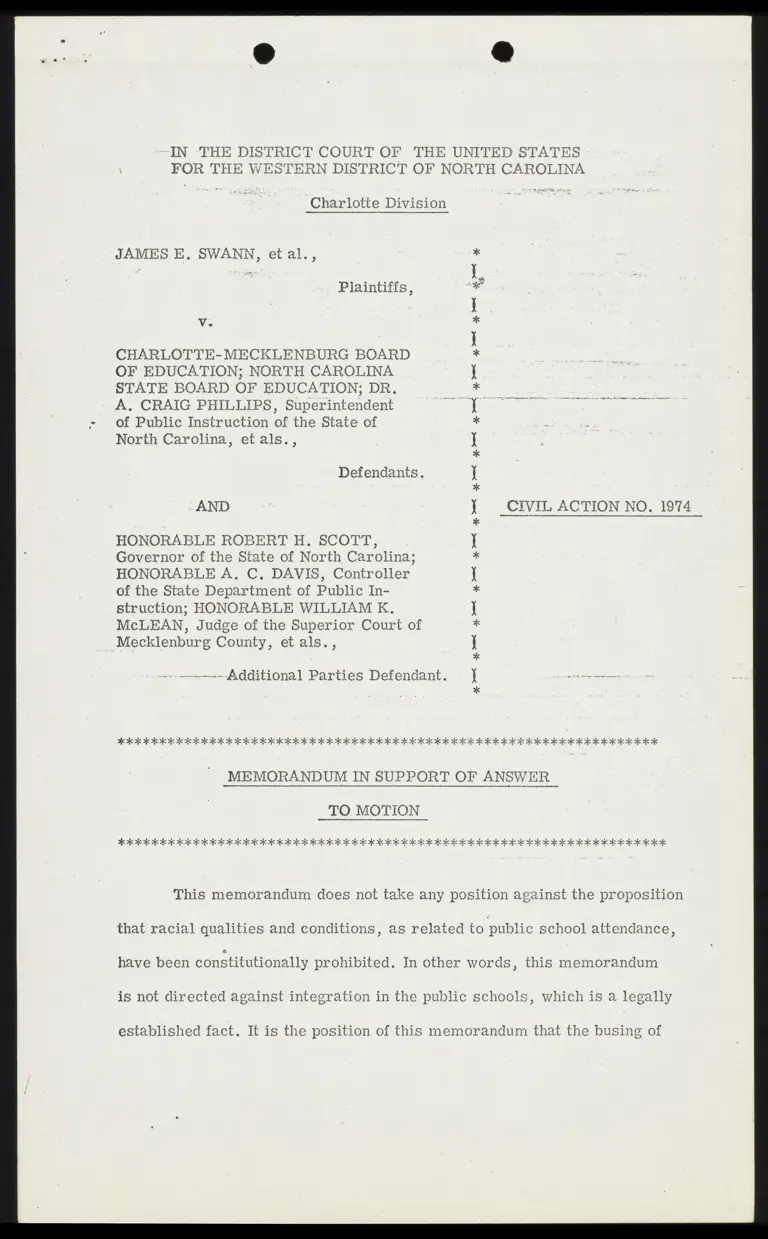
Memorandum in Support of Answer to Motion
Public Court Documents
8 pages
-
Case Files, Swann v. Charlotte-Mecklenburg Hardbacks. Memorandum in Support of Answer to Motion, 249bbd67-2e34-f111-88b4-7c1e526962fd. LDF Archives, Thurgood Marshall Institute. https://ldfrecollection.org/archives/archives-search/archives-item/0249021e-e39a-41e7-8ee2-f9d163803d46/memorandum-in-support-of-answer-to-motion. Accessed October 16, 2026.
Copied!
     [||0195592d-f72a-4d20-aef1-b0fdd477d989||] —IN ‘THE DISTRICT COURT OF THE UNITED STATES
FOR THE WESTERN DISTRICT OF NORTH CAROLINA

~ Charlotte Division


JAMES E. SWANN, et al.,

| Tr Plaintiffs,

Ye.

CHARLOTTE-MECKLENBURG BOARD
OF EDUCATION; NORTH CAROLINA
STATE BOARD OF EDUCATION; DR.
A. CRAIG PHILLIPS, Superintendent

+ of Public Instruction of the State of
North Carolina, et als.,

| { | { | { A on en An. em

Defendants.

“AND CIVIL ACTION NO. 1974


HONORABLE ROBERT H. SCOTT,
Governor of the State of North Carolina;
HONORABLE A. C. DAVIS, Controller
of the State Department of Public In-

~ struction; HONORABLE WILLIAM K,
McLEAN, Judge of the Superior Court of
‘Mecklenburg County, et als.,

Additional Parties Defendant.

m
C


gp
m
d


gy r
em
d

a
Se
d

gy
De

d
gy

e
d


yp
Se
ed
y

S
e
d


yy
em

d
yy

De
d

gg
de
d

D
e
m

e
n


*%

ak sk 3k ok 3k ok 3k of sf sk sk sk ok sk sk sk kk ok ok sk ok ok sk sk ok ok 3k ok ok ok ok ok sk ok sk ok ok ok 3k ok sk k sk sk sk sk 3k sk sk sk 3k ok sk ok sk sk sk 3k sk ok Skok 3k

MEMORANDUM IN SUPPORT OF ANSWER


TO MOTION


ak sk ok ok 3k ok ok ok sk sk sk sk sk sk ok ok sk sk sk es sk sk sk ok sk sk ok sk sk sk kok sk ok ok sk ok sk sk sk ok ok sk ok ok sk sk sk sk sk sk sk sk ok sk ok ok sk 3k ok kk ok

This memorandum does not take any position against the proposition

that racial qualities and conditions, as related to public school attendance,

have been constitutionally prohibited. In other words, this memorandum

is not directed against integration in the public schools, which is a legally

established fact. It is the position of this memorandum that the busing of


Sa

f

public school children or the mere moving around or changing the

“positions lof public school children, like pawns on a chess board, is

constitutionally unsound and legally invalid.

In their Motion to Add Additional Parties Defendant the plaintiffs

carefully avoid any language relating to the busing of public school children

to redress racial imbalances, although they well know that this is the

central proposition involved, and this is the purpose for which they wish

funds appropriated or allocated to purchase school buses. The plaintiffs -

refer to the matter as "transportation of students living beyond 'walking dis-

tance' from the schools to which assigned." They further refer to the

matter as implementing orders directed by the court or refusal to expend

public funds to implement the order of the Court or a seeking to obstruct

and prevent implementation of the Court's order, or, again, that no efforts

have been made "to secure the necessary buses for transporting students

as directed by the Court."

We have not had the privilege of reading the plans proposed to be

implemented but it seems to be common knowledge between both the black

and white that in certain instances it amounts to the transportation of

public school students beyond and away from their neighborhood schools

for the mere purpose of achieving a racial balance in these more distant

facilities.

The busing of public school students to achieve
a mere racial balance is not supported by the

Federal Constitution or by the statutes enacted
by both the Federal and State Governments.


Neither the Congress nor the General Assembly of North Carolina

have authorized this type of public school transportation. The Congress in

its definition of the word "desegregation'' specifically says: " * * * 'desegre-

gation’ shall not mean assignment of students to public schools in order to

overcome racial imbalance." (42 USCA 2000c(b) )


The Congress has also said:

"Provided that nothing herein shall empower any official
or court of the United States to issue any order seeking
to achieve a racial balance in any school by requiring
the transportation of any pupils or students from one
school to another or one school district to another in .
order to achieve such racial balance, or otherwise en-
large the existing power of the Court to insure com-
pliance with constitutional standards." ( 42 USCA 2000c(a) )

The Federal statute is broad and sweeping in this respect and is

specifically directed to the power of any official or court of the United
|

States to issue any such order for the objective of racial balance. These

clauses of the Federal statutes have not been declared unconstitutional by

any 3-judge Federal court.

It is provided by Chapter 1274 of the Session Laws of 1969, of the

General Assembly of North Carolina, that no person shall be refused ad-

mission or excluded from any public school on account of race, creed,

color or national origin and that attendance zones cannot be drawn for that

purpose. It is further provided that where there are geographic areas for

attendance purposes or districts or zones for such attendance purposes that

pupils shall be assigned to schools within such attendance areas or zones.

Pupils may be assigned outside the attendance areas or zones to attend

specialized schools or to attend schools for the mentally or physically

handicapped or for any other reason which the board of education in its

sole discretion deems sufficient. The Act prohibits any assignment of

students on account of race "or for the purpose of creating a balance or

ratio of race'and then states: "Involuntary busing of students in contra- ..

vention of this article is prohibited, and public funds shall not be used for

any such busing." The Act does not apply to temporary assignments for

overcrowded conditions nor does it apply where parents or pupils make a

choice pursuant to a freedom of choice plan adopted by the board of education.


Ld.

This statute is in substantial agreement with the language used in

the New York statute ( Article 65, Section 3201 of the New York Laws ),

which, as we Sidevsiand. has been upheld by te New York courts.

It is our contention that the busing of school children for the mere

purpose of redressing racial balance is contrary to he due process clause

and the equal protection clause of the Fourieonth Amendment. If is a

violation of due process because it is an arbitrary diktat which has no

belatinn to educational purposes and nowhere does it appear in the

Constitution of the United States that children must be transported in buses

away from their own neighborhood schools and in some cases for a con-

siderable distance in order to achieve racial balance. Ii is a violation of |

equal protection of the law because it creates discriminations as against

the children who are transported beyond their closést school facility or

neighborhood school, while other children attend a neighborhood school or

| attend school facilities much nearer to their homes. Such busing creates

~ arbitrary classifications of students for transportation purposes which

have no rational or reasonable connection with educational purposes and

B
E


—
—
—


works a discriminatory hardship on pupils of both the black and white races.

Plaintiffs are not entitled to any interlocutory,
prelimimry, temporary or permanent injunction.


It is true that Governor Scott has ordered that no funds be Spots to

buy buses to be used in transporting pupils to redress racial imbalance.

This would involve the expenditure of Sere million dollars and is Tho

hibited by the North Carolina statute above cited, ‘which has not been de-

clared to be unconstitutional by a 3-judge Federal court. It is, therefore,

the duty of the Governor to prohibit such expenditure of funds under Chap-

ter 1274 of the Session Laws of 1969, and, furthermore, the Governor of

North Carolina has a right to prohibit the expenditure of funds for improper

purposes as provided by the Executive Budget Act of the State of North Caro-

lina ( Article 1, Chapter 143, of the General Statutes ).


Adding the Governor as a party defendant and attempting to

restrain him from the performance of his duties as Chief Executive of

the State amounts to a suit against the State contrary to the Eleventh

Amendment to the Constitution of the United States ( EPSTEIN v.

MADDOX, 27 F. Supp. 613; ( affirmed 401 F. 2d 7; CITIZENS COMMITTEE

FOR HUDSON VALLEY v. VOLPE, 297 F. Supp. 809; FIRST NATIONAL

BEN. SOC. v. GARRISON, 58 F. Supp. 972; DUCKWORTH v. JAMES,

267 F. 2d 224). |

It is proposed to add A. c. Davis, who is Controller of the State

Board of Education, as a party defendant in this case. Mr. Davis is the

Executive Administrator of the State Board of Education in the supervision

and management of the fiscal affairs of the Board. His powers and duties

are fixed by Article 4 of Chapter 115 of the General Statutes, and he carries

out the policies of the State Board of Biuchiion but has no authority to ini-

tiate or create these policies. He is purely an administrative official and is

not charged with any independent duties, and, therefore, should not be a

party defendant in this case.

The Federal District Court has no authority

to enjoin or restrain the litigation pending
in the State Court.


We first deal with certain Federal statutes on this subject, and

we find that 28 USCA 2283, is as follows:

"A court of the United States may not grant an injunction

to stay proceedings in a state court except as expressly
authorized by Act of Congress or where necessary in
aid of its jurisdiction, or to protect or effectuate it judg-
ment."

We think that 28 USCA 2281 also is applicable, which is as follows:

"An interlocutory or permanent injunction restraining the

enforcement, operation or execution of any state statute by
restraining the action of any officer of such state in the en-

forcement or execution of such statute or of an order made

by an administrative board or commission acting under state
statutes, shall not be granted by any district court or judge


® »

. 6

thereof upon the ond of the unconstitutionality of such

statute unless the application therefor is heard and de-
termined by a district court of three judges under Section
2284 of this Title."

Certainly a judge of the Superior Court of the State has a right to

entertain an action involving the construction of a State statute and to

enjoin acts about to be committed that are invalid, and this is especially

true where the status of the statute stands as constitutional until interpreted

to the contrary by the State judge. The Shenae "where necessary in aid of

its jurisdiction, or to protect or effectuate its Suderiniat is usually filed

in bankruptcy matters or where there is property which is the subject of the

Hiteniion and which the Federal court has under its express jurisdiction

( AMALMAGATED CLOTHING WORKERS OF AMERICA v. RICHMAN

BROTHERS, 348 U. 8. Bll, 99 L. ed. 600, 75 8. Ct. 452; TOUCEY v.

NEW YORK LIFE INSURANCE COMPANY, 314 U. S. 118, 86 L. ed. 100, 62

S. Ct. 139; CLINE v. BURKE CONSTRUCTION COMPANY, 260 U, S. 226,

230, 43 5. Ct. 79, 67 L. ed. 226.

There is no reason why the State court cannot proceed on the con-

struction of its own State statute as measured against the State Constitution,

and, for that matter, as measured against the Federal Constitution.

In fact, as stated in the Richman Opinion, supra, there are three


exceptions to interference with State court cases by Federal court injunctions,

and these are as follows, and as stated in the Reviser's Notes, as follows:

"An exception as to acts of Congress relating to bankruptcy
was admitted, and the general S3enion substituted to cover
all exceptions.

"The phrase'in aid of its jurisdiction’ was added to conform to
Section 1651 of this title and to make clear the recognized
powers of the Federal courts to stay pr oceedings in Site cases
removed to the district courts.

"The exceptions specifically include the words'to protect or
effectuate its judgments’, a lack of which the Supreme Court held
that the Federal courts are without power to enjoin relitigation
of cases and controversies fully adjudicated by such courts."


TE


It will be seen that intervention by the Federal court should only be

exercised in the face of the most compelling reasons and to avoid grave and

irreparable injury ( BARNES v. DANVILLE, 337 F. 2d ai 503).

No injunctions of any nature should be granted
in this case at this time.


Aclilly, the plaintiffs are asking for a mandatory injunction against

. the defendants, State officials, in that they are asking the Court to compel... ......iou

them to nullify the Order previously entered cutting off State funds for the

purchase of buses. As stated in the case of W, A, MAC, , INC, v. GENERAL . ...

- MOTORS CORPORATION, 260 F. 2d 886:

""A preliminary injunction does not issue which ies to a
plaintiff the actual advantage which woud be obtained in a
final decree." E

See also on this point: DUNN v. RETAIL CLERKS INTERNATIONAL

ASSOCIATION, LOCAL 1529, 299 F. 2d 873, and VESTINGHOUSR ELECTRIC |

CORPORATION v. SEWING MACHINE COMPANY, 256 F. 2d 806, 808.

It does not make the case any better to request a temporary restrain-

ing order or a preliminary injunction as the result is the same. In GREEN

v. FAIR, 314 F. 200, the Court stated:

"The relief sought here ( preliminary injunction ) is extra-

“ordinary relief. It is granted only in exceptional cases."
E
E


—
—
—
—
—
—
.


The language in the case of UNITED STATES v. ADLER'S CREAMERY,

107 F. 2d 987, is here appropriate:

"The purpose of an injunction pendente lite is to guard against
the change in conditions which will hamper or prevent the
granting of such relief as may be found proper after the trial
of the issues. Its ordinary function is to preserve the status
quo and it is to be issued only upon a showing that there would
otherwise be danger of irreparable injury. * * * While it may
be granted to restore the status quo ante, it ought not to be
used to give final relief before trial."


And along this same line, see: CLUNE v. PUBL ISHERS ASSOCIA-

. TION OF NEW YORK CITY, 214 F. Supp. 520, affirmed 314 F. 2d 343.

It is respectfully submitted that a Federal District Judge should not

be allowed to avoid the obvious intent of 28 USCA 2281, by denominating an

order as a "temporary restraining order', which is in fact and effect a


@ | »
Pe

mandatory injunction. The plaintiffs cannot make a showing of extra-

ordinary circumstances and irreparable in] ary which would call into the

case the authority of one district judge to enter a temporary restraining

order which is proper in certain cases. It is no irreparable injury for the

pupils to continue to go to the schools to which they have heretofore been

assigned until this litigation is settled. The busing of public school pupils” = -

to retain a mere racial balance is not so compelling and irreparable that

great and untold damage will be done unless it is carried out. See, also,"

in this connection: GREEN v. FAIR, CCA-5, 314 F. 2d 200, where a Negro

citizen of Mis sissippi made application for admission to the University of

Mississippi and asked for an order requiring his immediate admission, and

see also: GANTT v. CLEMSON COLLEGE, 208 F. Supp. 416.

We ask the Court not to interfere with the litigation in the State

court, not to grant a temporary or permanent injunction and to dismiss the

Motion of plaintiffs as to making additional parties defendant, as well as

the other relief sought in the Motion.

Respectfully submitted,

Kn i h —v lg


ars Pa al of North Carolina

(rds 70 Ba 2


Deputy fier rney General
I!

oi Th } A. A avs ln


Ran Attorney General

P. O. Box 629
Justice Building
Raleigh, North Carolina 27602

A
R


A


S
e
t
a


a [||0195592d-f72a-4d20-aef1-b0fdd477d989||]