Plaintiff's Memorandum on the Impact of "City of Mobile v. Bolden"
Public Court Documents
June 16, 1980
19 pages
-
Case Files, Campbell v. Gadsden County District School Board Hardbacks. Plaintiff's Memorandum on the Impact of "City of Mobile v. Bolden", 1980. a05cced9-a111-f111-8407-0022482cdbbc. LDF Archives, Thurgood Marshall Institute. https://ldfrecollection.org/archives/archives-search/archives-item/02b23f52-e5a3-4be2-ab40-4de962f24c8c/plaintiffs-memorandum-on-the-impact-of-city-of-mobile-v-bolden. Accessed October 17, 2026.
Copied!
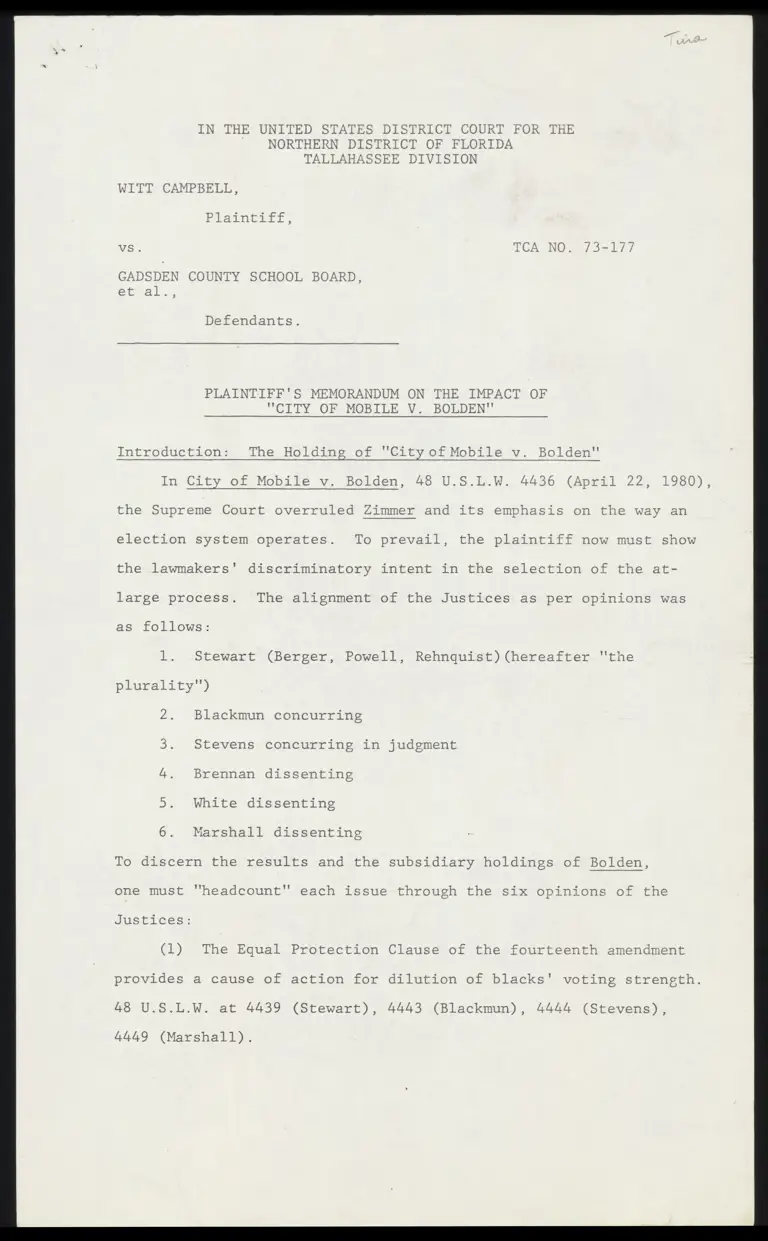
    IN THE UNITED STATES DISTRICT COURT FOR THE
NORTHERN DISTRICT OF FLORIDA

TALLAHASSEE DIVISION

WITT CAMPBELL,

Plaintiff,

ily TCA NO. 73-177

GADSDEN COUNTY SCHOOL BOARD,
et al.,

Defendants.

PLAINTIFF'S MEMORANDUM ON THE IMPACT OF
"CITY OF MOBILE V. BOLDEN"

Introduction: The Holding of "City of Mobile v. Bolden"

In City of Mobile v. Bolden, 48 U.S.L.W. 4436 (April 22, 1980),

the Supreme Court overruled Zimmer and its emphasis on the way an

election system operates. To prevail, the plaintiff now must show

the lawmakers' discriminatory intent in the selection of the at-

large process. The alignment of the Justices as per opinions was

as follows:

1. Stewart (Berger, Powell, Rehnquist) (hereafter ''the

pluralicy’)

2. Blackmun concurring

3 Stevens concurring in judgment

4. Brennan dissenting

5. White dissenting

6. Marshall dissenting

To discern the results and the subsidiary holdings of Bolden,

one must "headcount" each issue through the six opinions of the

Justices:

(1) The Equal Protection Clause of the fourteenth amendment

provides a cause of action for dilution of blacks' voting strength.

48 U.S.L.W. at 4439 (Stewart), 4443 (Blackmun), 4444 (Stevens),

4449 (Marshall).


(2) Dilution can also violate the fifteenth amendment.

Id. at 4443 (Blackmun), 4444 n.3 (Stevens), 4449 (White and

Marshall). The plurality's view that the fifteenth amendment

oes no further than guaranteeing the right to register and vote, a
q


C

id. at 4438, was rejected by the rest of the Court.

(3) An invidious legislative purpose to discriminate in

either the enactment or the retention of the at-large scheme

must be proved under both the fourteenth and fifteenth amendments.

Id. at 4438-39 (Stewart), 4445 (Stevens), 4448 (White).

(4) The Zimmer analysis is overruled as a sufficient measure,

by itself, of a constitutional violation. Id. at 4441 (Stewart),

4445 (Stevens).

The holding of the Bolden plurality is ''that the primary, if

not the sole, focus of the inquiry must be on the intent of the

political body responsible for making the districting decision.”

Id. at 4445 (Stevens, concurring in the judgment). The requisite

intent must be discerned in the evidence by use of the legal

principles of Washington v. Davis, 426 U.S. 229 (1976); Arlington

Heights, 429 U.S. 252 (1977); and Feeney, 442 U.S. 256 (1979).

48 U.S.L.W. at 4438 &n 10, 4439, 4440, 4441, The Plaintiff need

only show that part of the motivation was racially discriminatory.

As Justice Stewart's majority opinion in Feeney states:

Invidious discrimination does not become
less so because the discrimination accom-
plished is of a lesser magnitude. Dis-
criminatory intent is simply not amenable
to calibration. It either is a factor
that has influenced the legislative choice
or.:it is not.

60 L.Ed.24 870, 886 (footnote omitted).

What does Bolden mean for this case? Simply put, the Supreme

Court took from the plaintiff the Zimmer shotgun (previously

afforded by the Fifth Circuit) and handed the plaintiff the

Bolden rifle. Plaintiff has no difficulty in this case because

the target is visible and quite large.


The sole remaining issue of import is whether the passage of

the 1947 statute mandating at-large elections in the primaries for

school board was infected by a racially-discriminatory motivation

or purpose. The Plaintiff adduced abundant evidence of this

question and briefed the matter in the Proposed Memorandum Opinion

1-5 and 23-25 (copy attached).

I. THE 1947 STATUTE MANDATING AT-LARGE PRIMARY
ELECTIONS FOR SCHOOL BOARDS HAS BEEN DECLARED
UNCONSTITUTIONAL.

In McMillan v. Escambia County, PCA 77-0432, appeal pending,

No. 78-3507 (5th Cir.), Judge Arnow held that racial motivations

were a ''main force behind the enactment in 1947 of the current

1 at-large system." Memorandum Opinion at 25-26. Thus, the statute

was necessarily declared unconstitutional.

The plaintiffs in that case did not seek relief against the

enforcement of that statute outside of Escambia County, but it is

clear that they could have. Once a statute has been found

unconstitutional, subsequent decisions within the District Court

should conform to that rule of law. This is similar to the

practice of the Fifth Circuit in which each panel is bound by

previous panel decisions on rules of law and only an en banc panel

can transcend such binding authority.

11. IN THE ALTERNATIVE, IN THE INTEREST OF THE
BEST ADMINISTRATION OF JUSTICE, IT IS
APPROPRIATE THAT JUDGES OF THE NORTHERN
DISTRICT COORDINATE ON THIS QUESTION.

Consistent adjudication is important generally and of para-

mount importance in rulings on the constitutionality of a statute.

This concern for the consistent administration of justice has

been reflected in some districts in a so-called "low number rule.’

Thus, in the Middle District of Florida, Local Rule 1.04(b) is

designed to assure flexibility of case administration between the

judges on those cases in which there are ''common questions of law

or fact." It provides that they may be assigned to the judge to

<3

1


case has been assigned. In the instant case, A
.


5}


Tre 1
)
 whom the low numb

such a literal reading would not be appropriate because one case

has been decided and the other has not, and -- given the peculiar

history of the instant case -- the decided case is technically

not the "low numbered" one. Still, the policy of coordinated

adjudication is a sound one which will assure continuity and

consistency on important issues of law.

Thus, the instant case could be referred to Judge Arnow for

an adjudication on the constitutionality of the 1947 statute,

then referred back to Judge Stafford for the administration of

the remedy phase in accordance with the normal division assign-

ment practices.

III. THE DEFENDANT IS COLLATERALLY ESTOPPED FROM
DENYING THAT "RACIAL MOTIVATIONS' WERE A MAIN
FORCE BEHIND THE ENACTMENT IN 1947 OF THE
CURRENT AT-LARGE ELECTION SYSTEM."

This Court held, in McMillan v. Escambia County, PCA 77-0432

(Memorandum Decision, July 11, 1978), that "racial motivations

were a main force behind the enactment in 1947 of the current

at-large system." The defendant in that suit, Escambia

County School Board, acted as representative of the State of

Florida in its enforcement and defense of the statute. The Court

held that there was illegal racial animus in the enactment of

the 1947 statute. In the case presently at bar, Defendant Gadsden

County School Board seeks to show that racial animus was not a

factor in the 1947 enactment. This new defendant, however,

represents the same sovereign in enforcement and defense of the

same statute. This privity cf relationship precludes a contrary

finding of fact under the doctrine of collateral estoppel.

ty, PCA No. 77-0432, the defendant
oll A

Cou =
 rn Vg pa a : In McMillan v. Escambi 0


MW


H
h


H
h


I
.
 school board interposed as an affirmative defense the allegation

that the State of Florida, the Department of State of the State

of Florida, and the Governor of the State of Florida were


indispensable or necessary parties to the action, and had not

been sued. Docket Entry 29. The Court ordered that memoranda

of law be filed on this legal issue. Order of May 18, 1977.

The defendant School Board filed its memo and stated that it

would adopt as its own the memorandum filed by the co-defendant

Soanty commission. Docket Entry 37. The county commission fully

argued and briefed these issues of law in its memorandum. Docket

Entry 35. They pointed out that the present at-large system was

mandated by statewide law. They pointed out that the method of

holding and administering elections was entrusted to the State of

Florida rather than the county school board and that the failure

to join the State of Florida as a party might well leave them

subject to substantial risk of incurring inconsistent obligations

because they would not be carrying out the state election laws.

They further argued for the joinder of the Department of State

indicating that the disposition of the action might in some

practical manner impair or impede the ability of the Secretary of

State to protect the interests of the State.

Confronted with these affirmative defenses and the legal

arguments of the parties, the Court rejected such claims. In

its Letter Order of August 4, 1977, the Court indicated its view

that these issues should have been raised by motion and not as

defenses. However, the Court went on to announce that it had

studied the memoranda presented and expressed a clear and

unequivocable view that:

I have reached the conclusion neither the
State, the Governor nor the Department of
State are indispensable parties and, for
that matfer even proper parties,

Judge Arnow allowed the parties to raise this question again by

motion at the pre-trial proceedings; however, it appears from the

Court's Pre-trial Order of May 12, 1978, that these issues were

not raised again at that time.


Thus, it is clear from the rulings in McMillan that the Court

felt that the Escambia County School Board was an appropriate

representative of the sovereign with the unconstitutionality of

a statute at issue.

In the instant litigation, it was clear from pleadings and

discovery that the Plaintiff was attacking the congritucionality

of the same state statute. The instant Defendants expressed no

doubt about the sufficiency of their standing to defend the statute.

In order for the doctrine of collateral estoppel to bind a

later court in a different cause of action, there must be a showing

of privity between the parties to be bound and those bound by the

earlier decision. Privity may rest on concurrent relationships

to the same right of property; successive relationships to the same

right of property; or representation of the interests of the same

person. “1B Moore's Federal Practice ¥ 0.4111), at 1255 (1974).

In the latter circumstance, a judgment adverse to party X is

binding on party Y in another cause of action, if the interests

of the same person are represented by both X and Y with regard

to the matter at issue. The party whose interests are represented

may be X, Y, or indeed a third person. See Chicago, R.1. &P, Ry.

Co. v. Schendel, 270 U.S. 611.(1926),

There is no question that local officials may represent the

interests of the State in the enforcement of state statutes. In

a discussion of the applicability of 28 U.S.C. §2281 (formerly

28 U.S.C. §380), the three-judge court statute, the United States

Supreme Court noted:

An official may, in enforcing a statute
which embodies a policy of state-wide
concern, be performing a state function
within the meaning of §266, Judicial
Code (28 USC §380), though he is
localized by his geographic activities
and the mode of his selection

Rorick v. Everglades Drainage District, 307 U.S. 208 (1926).

That the 1947 statute stated a policy of state-wide concern

follows naturally from the findings of fact by the Escambia County


Court. Judge Arnow's decision to deny the defendant's request

to join the State of Florida implicitly recognized the adequacy

of representation of the State's interests by Escambia County.

Th
Lid MD

 refore, local officials seeking to conduct elections pursuant

to the statute must be deemed state officials for purposes of

enforcement. And it follows, finally, that in defending their

enforcement of the statute in a court of competent jurisdiction,

they act as representatives of the State and its officials.

Therefore, the issue of the legislative intent behind the

enactment of the 1947 statute prescribing the method of county

elections may not be relitigated by the Gadsden County School

Board. That issue was raised before and decided by this Court

in Escambia County, and both the State and the Gadsden County

School Board, who were privy to that decision through the repre-

sentation of Escambia County, are estopped. The issue has been

decided for all Defendants to this action.

IV. THE INFERENCE OF RACIAL MOTIVATIONS IN THE
1947 ENACTMENT IS CLEAR IN LIGHT OF FLORIDA'S
HISTORY OF DISENFRANCHISEMENT OF BLACKS AND
THE LEGISLATIVE HISTORY IMMEDIATELY PRIOR TO
THE PASSAGE OF THE ACT.

The Plaintiff has previously analyzed the evidence showing

the racial intent of the 1947 statute. [See attached portions

of Proposed Memorandum Opinion.] We will only summarize in this

Memorandum.

1. After the Civil War, there were various acts passed by

the Republican-controlled Legislature to enfrancise black citizens.

2. With the end of Reconstruction, the political concensus

became that of black disenfranchisement at the hands of the whites

who had gained the political ascendency. Reflecting this dominant

political tendency in the selection of school boards was the

statute which provided that members be appointed. This had the

effect of insulating the white minorities in the North Florida

counties in which there were black voting majorities. Notable


among the enactments was the passage of the poll tax in 1888

which ensured the virtual elimination of black voters as a major

participation was ensured in two ways:

(2a) The most significant part of the political process

was the Democratic Primary. Blacks were excluded from the primary

by means of the "white primary" svstem. Having thus "taken care J v Oo

of" black participation, such primaries were based on representation

by district:

(b) The only other way for blacks to participate was

as Republicans in the general election. Thus, in the general

election, voting for the offices was county wide at large, a

perfect vehicle for diluting whatever strength the blacks might

muster since it would tend to be concentrated in pockets by

patterns of residence.

What can be seen here is that the Legislature was conscious

even at the turn of the century of the racial implications of

at-large voting schemes.

4. In the 1940's black registration began to rise. Still

all was well for the white majority until 1945, when the Florida

Supreme Court held the "white primary" system to be illegal. Thus

deprived of the cornerstone of political control of blacks, the

Legislature responded at the next legislative session by passing

for the first time the provision for at-large primaries for school

boards.

In Nevett v. Sides, 571 F.24 20% (5th Cir. 1978), the Court

analyzed the history of the at-large statute to determine if an

inference of racial discrimination was indicated. The Court noted

that blacks had been effectively disenfranchised in 1901. Thus,

the Court reasoned that the inference of racial discriminatory

intent in 1909 was weak, because it was not necessary to accomplish

racist goals. The Court used the same analysis in McGill v. Gadsden

County, 535 F.2d 277, 280-81 (5th Cir. 1976).

“8


Applying the same analysis to the instant case the opposite

inference arises. The middle of the 1940's was a time of expanding

black franchise generally.

First, as Plaintiff's Exhibit 9 shows, in 1940 5 grand

total of 725,470 persons registered to vote; 2,083 were "col.

(i.e. colored") & misc.” This was 0.3% of the total. By 1946,

the year before the statute in question, the totals were:

White "Colored" Total % "Colored"

Democrat 664,312 32,280 696,592 4.6%

Republican 26,869 15,877 42,746 37.1%

TOTAL 691.181 48,157 739.338 6.35%

Thus, in a six-year period the percentage of black voters increased

from less than 0.3% to 6.5%, 0r more than 22 times in relative
A

voter strength!

Second, as discussed at length previously, the "white primary"

had just been stricken. Thus, the new at-large system of primary

elections was needed to implement the dominant racist ideology of

the day.

RESPONSE TO DEFENDANTS' BRIEF

Since the Defendants filed earlier,we will take this opportu-

nity to respond briefly to their memorandum.

As the Court can see from our memorandum, we basically agree

with 95% of what the Defendants state in pages 1-6 of their brief.

Boiling those six pages down to a sentence -- the Plaintiff must

take aim with the Bolden rifle rather than the Zimmer shotgun.

First, there is no ''clear and convincing'' evidentiary burden

on the Plaintiff. The burden is the normal civil burden of pre-

ponderance of the evidence.

The key to the Defendants' entire position is that they

choose to disregard the evidence, the impact of the 1947 statute,

ola

“Indicating that this was a trend rather than a fluke, by
1948 blacks constituted 8.5% of the registered voters.


and Judge Arnow's analysis and ruling in McMillan by somehow

pretending that what is at issue is the method of general

rather than the method of primary election In 1947, as the

registration figures show, the primary election was ''where t

action was." The same is still true in North Florida That

what this lawsuit is about.

Respectfully submitted,

t /
:

|

£

\

i NAN y/

")
I? A /

LY {

KENT BPRIGGS ~~]

Spriggs & Henderson
117 8.
Tallahassee,
(904)224-8701

/

ATTORNEY FOR

=10-

fartin Luther King, Jr. Blvd.


by

c
D


00)

(
@


i


I. HISTORY OF BLACK VOTING RIGHTS
AND AT-LARGE ELECTIONS

Florida has had a longstanding, ongoing history of official

action intended to minimize the voting strength of black citizens.

A careful review of election laws from the Civil War to the present,

considered in light of contemporaneous societal attitudes clearly

1
(1SAaAN

a ( ple A f ( indicts the at-large election scheme for school board ir

County as an instrument of purposeful discrimination against black

voters. Dr. Jerrell Shofner, an expert in Florida history,

detailed the evolution of the current law, noting that it resulted

from political and social attitudes which had their roots in post-

Civil War Florida.

Reacting to post-Civil War Black Codes passed by states to

keep blacks in their slave roles, Congress, in 1867, enacted

several acts designed to enfranchise blacks and integrate them into

the main stream of society. At the same time white political

strength was greatly diluted. The 1868 Florida Constitution,

which had to be approved by Congress, verbalized these rights and

was viewed by white Floridians as a Constitution imposed from with-

out. The Republican Party, composed of carpetbaggers,. scallywags

and freedmen became the dominant political party in Florida. In

fact, it was approximately 49% black.

By 1876, the winds of change brought a power shift in the

Federal government from the Republicans back to the Democrats and

set the stage for an overthrow in Florida of Republican rule. An

integral part of this overthrow was the disenfranchisement and

segregation of black citizens. Restrictive state laws controlling

elections by eliminating black voting strength were passed.

hief among these was the passage of the poll tax in 1888. 1889

la. Laws, Ch. 3350, §l1. It was decisive in eliminating black F
r
i


voters as a threat to white supremacy in Florida.

The 1888 election was the last in which the Republican Party

presented a serious threat to conservative Democrats in this state.

—In-the-last governor's election to be held prior to the imposition

of the poll tax, the Republican gubernatorial candidate received


26,000 votes to the Democratic gubernatorial candidate's 46,000

votes. In 1890, the year the poll tax was effected, the Republicen

candidate for Comptroller received only 4700 votes. By 1892, all

threat of a viable Republican Party was gone. In that year's guber-

natorial race, the Republican Party did not even slate a candidate.

Accompanying these state laws was a change in the national

policy. In effect, the Federal government withdrew from its

involvement in protecting black enfranchisement through Federal

legislation. A strengthened Federal election law failed to be

passed by the Congress. This resulted in the termination of efforts

to prcsecute white election law violators.

As a consequence of these developments, after 1890 blacks

ceased to play an important part in Florida elections. The Court

in McMillan v. Escambia County, PCA 77-0432 (Memorandum Decision,

July 11, 1978), concluded that by 1900: |

. . . enough blacks were disenfranchised to
permit the state to allow at-large election
of county commissioners, Fla. Const., Art. 8,
§5 (1901), and the members of the newly
created boards of public instruction (counter-
part of today's school boards). 1895 Fla.
Laws, Ch. 4328. (footnote deleted) 1d. at 5.

White isupremacy was established as the dominant political

philosophy of the time, a unique Southern offshoot of the Progressive

Movement. Progressives were for good government and against

p
e


corruption. However, in Florida and other Southern states, good

overnment meant white man's government. Progressive reforms were

enacted alongside a growing list of Jim Crow Laws which between

1895 and 1915 legalized the customary segregation of the races in

all aspects of Florida society. Paralleling the development of

restrictive social legislation were a number of political reforms,

twtr 34 $= ~ NN 2g re IE
including Lhe ise -O. ryrimnary e

3


H
h


45
)

0


3
 4


i


i (D
 =


1]

3


p
i
e


C
T


(D


4
)

~


a


H


fo


[a
 4

c
y


(0


9


45
) =


(D


c
t


5)


(


H


Oo


w
n


c
t


(D


F
h


H
h


MD

0


r
t


=


ol


(D


Q
l


(D
 5 (P
)

(D


H
h


oO


[a


preventing blacks from voting in the only elections which actually

tered in early twentiéth century Florida,

i,


fl

N
R
E
 to
n

Go
ta

n
m
A
 e
r
h
i
t


et
 a

t
oc
e
n


A few counties began using the primary instead of conventions

to nominate candidates in the 1880's, and the idea spread rapidly

A permissive primary law was passed in 1897. It allowed county

executive committees to hold nominating elections if they so chose.

It also give them the power to determine who was eligible to vote

in a primary. 1897 Accs, Ch. 3879, 858 1 and 3. t the 1900 Demo-

ion the Party ruled that only white peop .
 cratic Convent

voted the entire Democratic ticket from top to bottom in the prior

election would be eligible to vote in the party's primary. Thus,

the institution of a mandatory primary in 1901 resulted in a white

Democratic primary.

Within a few years the state provided for the primary election

of school board members to be held in single member districts.

5.3907 Fra. Laws, Ch. 5697 +81. By rhat
time the white primary system, effectively
disenfranchising black voters, was firmly
established. The resulting anomaly between
having district primary elections and at-
large general elections worked, not surpris-
ingly, to the unique disadvantage of blacks
Since blacks could not vote in the Democratic
Primary district elections, they were forced
to challenge white Democratic nominees in
at-large elections in which blacks had no
voter majorities. In effect, the white
primary was the election. McMillan at 5.

It is for these reasons that the white primary was, in 1945, finally

struck down by the Florida Supreme Court. Davis v. State, ex rel.

Cromwell. 156 Fla. 181, 23 So0.24 85 (1945).

Closely on the heals of this decision, the Florida Legislature

-

met to revise the education law, the Minimum Foundation Law. In

1947, in its first legislative session since the white primary was

struck down, the Legislature revised the election laws as they

applied to primary voting for school board seats. Dr. Shofner
iL

1 that the legislature enacted an at-large voting scheme at M®


h
d


i


f
d


%)


p
e


”


1]


o
N


this time in order to head off the possibility that majority black

districts within a county could elect blacks to school board offices

The legislative history shows that the measure was passed in order

11
to insure that "qualified people" would be selected for office. ___ _

However, as Dr. Shofner emphasized, this was often used as a code

23.


phrase to mean "white people" within the traditional progressive/ 4 0:


white supremacy philosophy of the South.

Granted, certain laws which on their faces showed an obviously

discriminatory motive were considered and rejected by the Legislature.

However, this does not mean that the ruling white majority had a

sudden change of heart or had resigned itself to accepting a black

1
electorate. Indeed, Dr. St wfner indicated that it is unnecessarily

extreme to credit the Florida Legislature with some benevolent intent

in rejecting those laws. Clearly the types of laws proposed by

"Senator Matthews and his associates were sO obviously racially dis-

criminatory as to surely be challenged and struck down by the courts.

Dr. Shofner noted that these laws simply went too far in trying to

preserve white supremacy in Florida. There was no reason to go to

such extreme measures when the same result could be accomplished

with a quieter, less obvious piece of legislation. The Legislature

was astute enough to realize that these few lines tucked away in the

Minimum Foundation Law were sufficient to effectively dilute black

voting strength.

The continued use of Jim Crow Laws and physical intimidation of

potential voters and candidates was sufficient to allay any fears

that blacks could control the school board in counties where they con-

stituted a majority of voting-age citizens. Dr. Shofner noted that

Le violence ( D


lynchings had long been commonplace in Florida and uncheck

continued to play a part in the intimidation of potential black

voters, including the bombing murder in 1951 of Harry Moore, head

of Florida's NAACP, and his wife in their home in Mims.

The development of white supremacy philosophy, social legislation

Tr a os | 4 ~~ mn ec Tra To cks and the sequence of events leading 0h
} designed to segregate bl

wn


wn


w
n


(o
y

(D


=


H
h


H


(®
) H


n

H


sa


o
q


[
a


M


directly to the change in the primary election’

member district to at-large voting clearly shows that discriminatory

intent was a motivating factor in the adoption of the current system.

LThis theory is ‘supported by V.0. Key:in Southern Politics in

State and Nation, _a very general study of politics in the South. It

1s important to remember that Dr fey never did the kind of in-depth

analysis of and research into the peculiarities of the development

of Florida laws that Dr. Shofner has done


II. BLACK PERSONS ARE DENIED "ACCESSIBILITY"

TO THE ELECTORAL PROCESS

There are many ways in which the "accessibility" to the

electoral process may be impeded as a matter of law. One of the

major impediments to access is the presence of polarized voting

a 9 mir. wore) . ; :
behavior.“ As the Fifth Circuit held in Bolden wv. Mobile, 571 V A

th Cir: 1978): w
n
 ys ANNO / in ‘

Bo LQ L308

... Although failure of black candidates
because of polarized voting is not suffi-
cient to invalidate pl wAteripalig an

C H
h


w


indication of lack-o

an,
cess to the political

process, Id. at 243 (cita tions omitted).

The failure of black candidates in Gadsden County is manifest.

Only one black has won a county-wide contest in modern times.

Dr. Dyson was qualified as an expert in the area of quanti-

tative analysis of voting behavior. He analyzed the voting behavior

by race in Gadsden County with a number of different statistical

tools. He also gave certain opinions based on studies of voting

behavior done by other political scientists.

The first statistical tool used by Dr. Dyson was the compu-

tation of an "RZ? " correlation as an indication of the degree of

polarization of white voting behavior, i.e., the degree to which

whites vote for white candidates. Dr. Dyson testified that it was

the same methodology as reflected in the three Appendices to the

Si at : Tiny 2 :
opinion in McMillan, supra. Having computed the "R“" correlations,

he then inscribed on the three sheets which had been admitted in

evidence as a stipulation between the parties. [Those three sheets,

with the inscriptions as per the Dr. Dyson testimony are appended

to this Proposed Memorandum Opinion as Appendices A, B and C.] It

vas clear from Dr. Dyson's testimony that as a methodological matter,

the "R » could vary from 0 to 1. Thus, the fget that all but one of

2In the instant case there is no present denial of right to
register, nor is there a slating requirement. However, the Court
in McMillan found barriers to access even though again in Escambia Co
there was no problem with registration or slating Interestingly,
the Court found that there were barriers even though "affirmative
efforts are made to encourage eligible citizens, both black and™ —
white, to register..." 1d. at 10. |

5.


3
r

ng iy - -

C. Proof of an aggregate of the factors set cut in Zimmer v.

McKeithen, supra. '{Z]immer criteria provide a factual basis from

which the necessary intent may be inferred." Nevett II, supra, at

223:: See also, McMillan,:supra at 28.

A. RACIALLY MOTIVATED ENACTMENT.

fo)
Referring to City of Richmond v. United States, 422 U.S. 358

(1975), the three-judge panel in Stewart v. Waller, 404 F. Supp

206 (N.D. Miss. 1975), struck down a 1962 Mississippi law that

required cities-of a certain size to change from single-member dis-

tricts to at-large elections as violating the Fifteenth Amendment.

Said the court: '"The legislative history, the inevitable and

foreseeable effect of the statute's provisions, and the historical

1

context in which the Act was passed permit no other conclusion.

404 F. Supp at 214 (emphasis added). In particular, the court

relied on the following evidence to reach its conclusion:

(1) It was foreseeable that blacks would have been elected in

many wards absent the change and in light of the growing black

registration. 404 F. Supp. at 213.

(2) The "author' of the bill was reported in the newspapers

to have said: "This is needed to maintain our Southern way of life.’

dé. m. 11.

(3) The subsequent effect of the 1962 Act was ''entirely con-

sistent with the racially discriminatory motive attributed to its

sponsor." 404 F. Supp at 214.

(4) "Another pertinent factor is the long history of statutory

racial segregation and discrimination in Mississippi, with conse-

quent token participation by blacks in the political processes of

the state." Id.

- . -

The Stewart court cited an earlier decision by Judge Frank

Johmson in Smith v. Paris, 257 7. Supp 901 (M.D. Ala. 1966), aff'd

386 F.2d 979 (5th ' Cir. 1967) .. There, the court struck ddvm a local

Democratic Party resolution changing from single-member district to

at-large election of Democratic Party Committee members as raciall

motivated in violation of the Fifteenth Amendment. As evidence of

the racial motive, the court pointed to the fact that district
?


ined for over thirty years, during a time ®


p
d


4)

0


{
Y


O
 v f c o
r


1
)


MD

3


=)


fn


3


c
t


(46
)
=


when "a minuscule number of eligible Negroes were actually regis-

tered to vote," and that the change was made only after blacks

began to register in significant numbers and to qualify as candi-

dates for committee members in wards which had a majority of

black voters. Id. at 903. Thus he gave due consideration to 'the

long history of racial discrimination in Alabama." Id. at 904.

And, finally, the court relied on the "clear effect" of the act to

diminish black voting strength. Ibid.

+


n Paige v. Gray, 437 7. 'Supp,/ 137: (M.D: Ga. 1977), Judge

Owens wrote a long opinion again invalidating the at-large scheme,

this time on both the Fourteenth Amendment dilution grounds and on

a


Fifteenth Amendment grounds that the 1947 act was racially motivated

in its adoption. In 1922, Albany changed from an at-large elected

city commission to a city-manager-council charter government using

single-member wards. In 1946, the all-white Democratic Party Primary

was struck down judicially in Georgia. Id. at 151. Relying heavily

on newspaper reports and editorials, Judge Owens described at length
& A

the circumstances indicating that city fathers were concerned about

growing black voter registration and participation of blacks in the

Democratic Primary. In 1947, a statute was enacted amending Albany's

city charter to provide that all seven commissioners (council

members) would be elected at large. Based on these facts, Judge

Owens concluded that the 1947 legislative change had the "inevitable

effect" of abridging the voting rights of Albany's black citizens.

e took place in 1947, the same

chool board, ®


45
)

H


40
)

wn


rt


(D


H


(D
 " (0
)

}
J

O


~


oO


H
h


1


p
d


(D


R


H
H


=


95
}

in


<


@]


t
T


4


4


a
q


wn

d


0]


r
t


(D


=


H
h


O


(a


n


3 +1 A vt $+} +} £ A E. A $e Dicta in other cases accord with the foregoing precedents.

HarnAdA+1 ~~ xr TAcanh C11 A 1350 ' = = I ~ Hendrix v. Joseph, supra at 1269 (''The adoption of an at-large

the scheme in a dubious light and indicates that it may be a tool


The history of the 1947 Statute changing the method of voting

in school board primaries has been described in depth in Section

I of this Memorandum Opinion. It is obvious from the entire

history of voting rights of black citizens in Florida and the

chain of events that the enactment was racially motivated. Faced

with an almost

lacking some of the evidence adduced by Plaintiff in thi

identical configuration of evidence, (actually

i
n


4))
]

MO


(


-


®)


N
a


the McMillan court held:

.The history and sequence of events
strongly suggest racial motivations. From
1907 until 1945 the white primary was in
effect. This was a period in which the
Black Codes were also in effect and in
which the white government was unwilling
or unable to prevent a shocking degree
of violence and intimidation suffered by
blacks at the hands of whites. The state
policy of excluding blacks from the primarsg
election was finally declared unconstitu-
tional in Davis v. State ex rel. Cromwell,
156: Fla. 181,23 S0.27d 35 (1345).
Then in the very first legislative session
following the decision, the legislature
enacted statutes providing for an at-large
requirement in both the general election,
1947 Fla. Laws, ich. 23726, §9, and the
primaries, 1947 ‘Fla.::Laws, ch. 23726, §7.
This marked a major substantive change from
a system in which all members had been
elected from single-member districts in the
primaries, which were tantamount to election.
The effect of the change was to prevent
blacks from running in single-member district
primaries which had existed up until that
time. It was the ‘testimony of plaintiffs’
expert historian that the 1947 election
system resulted from racial motivations
The evidence of discriminatory motives behind
the at-large requirements of the 1947
is compelling. The court finds that
motivations were a main force behind
enactment in 1947 of the current at-
election system. (emphasis added) Ret 25-6.

RACTALLY MOTIVATED MAINTENANCE -- CARRYING FORWARD
"PATTERNS

enjoined in 1970. As has been discussed, above the mere illegal

OF PURPOSEFUL AND INTENTIONAL DISCRIMINATION"

there were many other indignities and inequalities

i


ully visited upon the black students and employees. This

pattern of conduct did not end with this Court's Order in 1970. If

imited attention to adjudications of discrimination alone

record of intentional discrimination in the three years from 1970

25