Court Opinion
Public Court Documents
September 7, 1978
16 pages
-
Case Files, Henry v. Clarksdale Hardbacks. Court Opinion, 1978. c63b8fff-8418-f111-8342-7c1e526962fd. LDF Archives, Thurgood Marshall Institute. https://ldfrecollection.org/archives/archives-search/archives-item/02b3e811-99cc-4c99-9466-fd891d7f894e/court-opinion. Accessed September 29, 2026.
Copied!
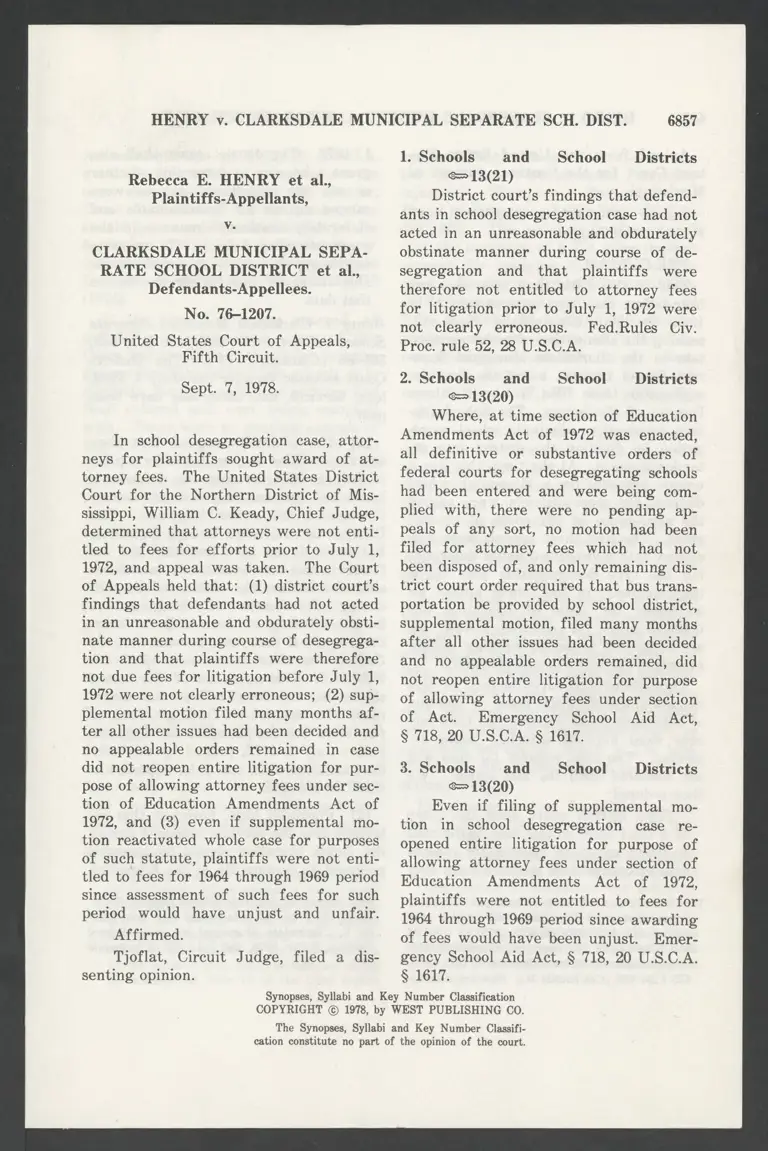
     [||322ee775-b9d1-4e44-a6dc-036805055859||] HENRY v. CLARKSDALE MUNICIPAL SEPARATE SCH. DIST.

Rebecca E. HENRY et al,

Plaintiffs-Appellants,

Vv.

CLARKSDALE MUNICIPAL SEPA-
RATE SCHOOL DISTRICT et al.,

Defendants-Appellees.

No. 76-1207.

United States Court of Appeals,
Fifth Circuit.

Sept. 7, 1978.

In school desegregation case, attor-
neys for plaintiffs sought award of at-
torney fees. The United States District
Court for the Northern District of Mis-
sissippi, William C. Keady, Chief Judge,
determined that attorneys were not enti-
tled to fees for efforts prior to July 1,
1972, and appeal was taken. The Court
of Appeals held that: (1) district court’s
findings that defendants had not acted
in an unreasonable and obdurately obsti-
nate manner during course of desegrega-
tion and that plaintiffs were therefore
not due fees for litigation before July 1,
1972 were not clearly erroneous; (2) sup-
plemental motion filed many months af-
ter all other issues had been decided and
no appealable orders remained in case
did not reopen entire litigation for pur-
pose of allowing attorney fees under sec-
tion of Education Amendments Act of
1972, and (3) even if supplemental mo-
tion reactivated whole case for purposes
of such statute, plaintiffs were not enti-
tled to fees for 1964 through 1969 period
since assessment of such fees for such
period would have unjust and unfair.

Affirmed.

Tjoflat, Circuit Judge, filed a dis-
senting opinion.

6857

1. Schools and

e=13(21)

District court’s findings that defend-

ants in school desegregation case had not

acted in an unreasonable and obdurately

obstinate manner during course of de-

segregation and that plaintiffs were

therefore not entitled to attorney fees

for litigation prior to July 1, 1972 were

not clearly erroneous. Fed.Rules Civ.

Proc. rule 52, 28 U.S.C.A.

School Districts

2. Schools and
e=13(20)

Where, at time section of Education

Amendments Act of 1972 was enacted,

all definitive or substantive orders of

federal courts for desegregating schools

had been entered and were being com-

plied with, there were no pending ap-

peals of any sort, no motion had been

filed for attorney fees which had not

been disposed of, and only remaining dis-

trict court order required that bus trans-

portation be provided by school district,

supplemental motion, filed many months

after all other issues had been decided

and no appealable orders remained, did

not reopen entire litigation for purpose

of allowing attorney fees under section

of Act. Emergency School Aid Act,

§ 718, 20 U.S.C.A. § 1617.

3. Schools and
e=13(20)

Even if filing of supplemental mo-

tion in school desegregation case re-

opened entire litigation for purpose of

allowing attorney fees under section of

Education Amendments Act of 1972,

plaintiffs were not entitled to fees for

1964 through 1969 period since awarding

of fees would have been unjust. Emer-

gency School Aid Act, § 718, 20 U.S.C.A.
§ 1617.

School Districts

School Districts

Synopses, Syllabi and Key Number Classification
COPYRIGHT © 1978, by WEST PUBLISHING CO.

The Synopses, Syllabi and Key Number Classifi-
cation constitute no part of the opinion of the court.


6858

Appeal from the United States Dis-
trict Court for the Northern District of
Mississippi.

Before COLEMAN, TJOFLAT,
FAY, Circuit Judges.

PER CURIAM:

This is the fifth time this case has
been before the Court in some form.! In
1964, the plaintiffs initially filed suit,
seeking the elimination of racial segrega-
tion in the Clarksdale Municipal Sepa-
rate School District, being the first de-
segregation case filed in the Northern
District of Mississippi. The School Dis-
trict proposed to eliminate school segre-
gation by dividing the district into at-
tendance zones. At the time, this was a

unique proposal for a Mississippi school
district, for most districts were urging
the acceptance of “freedom of choice”
plans. The first three appeals were con-
cerned with substantive issues determin-
ing the type desegregation plan to be
implemented. In the fourth appeal we
addressed the issue of providing bus
transportation for children. Now, we
are compelled to decide whether certain
attorneys fees are due the plaintiffs.

Throughout the early history of this
litigation, the plaintiffs made no mention
of attorneys fees. Further, no time rec-
ords were kept of attorney hours ex-
pended. The first request for fees was
not tendered until the last appeal. We

then ordered:

[TThe district court upon the entry
of a final order in this case, is directed
to grant appellees’ request for reason-
able attorneys’ fees incurred since July

and

1. Henry v. Clarksdale Municipal Separate

School District, 5 Cir. 1969, 409 F.2d 682, cert.

denied, 396 U.S. 940, 90 S.Ct. 375, 24 L.Ed.2d

242 (Clarksdale 1); Henry v. Clarksdale Mu-

nicipal Separate School District, 5 Cir. 1970,

425 F.2d 698 (Clarksdale II); Henry v. Clarks-

HENRY v. CLARKSDALE MUNICIPAL SEPARATE SCH. DIST.

1, 1972. The district court shall also
grant a hearing to determine whether
or not the appellants’ actions were
carried out in an “unreasonable and
obdurately obstinate” manner in the
years preceding July 1, 1972, so as to
entitle appellees to be awarded reason-
able attorneys’ fees for services before
that date.

Henry v. Clarksdale Municipal Separate
School District, 5 Cir. 1973, 480 F.2d 583,
585-86 (Clarksdale IV). The District
Court assessed fees for post-July 1, 1972,
legal services, and those fees have been
paid.

[1] The plaintiffs argued that they
are also entitled to fees for efforts prior
to July 1, 1972, because the defendants
had acted unreasonably and stubbornly
throughout the entire litigation. The
District Court [Judge Keady] disagreed.
Rather, it found as a fact that the de-
fendants had not acted in an “unreason-
able and obdurately obstinate” manner
during the course of desegregation.
Such a finding of fact may be over-
turned only if the record reveals that the
finding was clearly erroneous. Rule 52,
F.R.Civ.P. Our appraisal of the record
shows that the District Court had ample
reasons to support his finding. Thus no
fees were due the plaintiffs for litigation
before July 1, 1972, judged by the stan-
dard established in our order reported at
480 F.2d 585-86.

[2] Plaintiffs urge, however, that at-
torneys fees for services rendered during
the entire litigation should be awarded
pursuant to Section 718 of the Education

dale Municipal Separate School District, 5 Cir.

1970, 433 F.2d 387 (Clarksdale III); and Hen-

ry v. Clarksdale Municipal Separate School

District, 5 Cir. 1973, 480 F.2d 583 (Clarksdale

IV).


HENRY v. CLARKSDALE MUNICIPAL SEPARATE SCH. DIST.

Amendments Act of 1972, 20 U.S.C.A.
§ 1617.2 Plaintiffs say that because the
case was pending before the District
Court at the time § 718 was passed, fees

should be awarded retroactively to the
beginning of the litigation. Bradley v.
School Board of City of Richmond, 416
U.S. 696, 94 S.Ct. 2006, 40 L.Ed.2d 476
(1974).

At the time § 718 was enacted, all

definitive or substantive orders of this
Court and the District Court for desegre-
gating the Clarksdale public schools as to
students, faculty, staff, and services had
been entered and were being complied
with. There were no pending appeals of
any sort. Moreover, when § 718 was
enacted, no motion had been filed for
attorneys fees which had not been dis-
posed of, nor had such a claim ever been
made. The only District Court order af-
ter the passage of § 718 was to require
that bus transportation be provided by
the School District, pursuant to plain-
tiffs’ motion. No active issues were
present before the motion for bus trans-
portation. The question presented to us
is whether a supplemental motion, filed
many months after all other issues had
been decided and no appealable orders
remained, reopens the entire litigation
for the purpose of allowing attorneys
fees under § 718. We believe that it

does not.

In Bradley v. School District of City of
Richmond, supra, the Supreme Court
held that § 718 was applicable to litiga-
tion predating, but pending on appeal

2. That statute provides:

Upon the entry of a final order by a court

of the United States against a local educa-

tional agency, a state (or any agency there-

of), or the United States (or any agency

thereof), for failure to comply with any pro-

vision of this chapter or for discrimination

on the basis of race, color, or national origin

in violation of Title VI of the Civil Rights

6859

on, the effective date of the statute un-
less the award would cause “manifest
injustice”. Thompson v. Madison County
Board of Education, 5 Cir. 1974, 496 F.2d
682, 690. The opinion further stated
that the language of § 718 gives implicit
support for applying it to all pending
cases. Bradley v. School District of City
of Richmond, supra, 416 U.S. at 716, 94
S.Ct. at 2018. To apply § 718 retroac-
tively, a case must have an “active” is-
sue pending on the date of its enact-
ment, see Rainey v. Jackson State Col-
lege, 5 Cir. 1971, 551. F.24.672 676.

Since most school cases involve relief
of an injunctive nature, district courts
will maintain jurisdiction long after de-
termining the issues in controversy.
“The ultimate approach to finality must
be an individual and pragmatic one.
Such a matter should be committed to
the determination of the trial court.”
Johnson v. Combs, 5 Cir. 1972, 471 F.2d
84, 87.

As we read it, the District Court held

that the issues of the original desegrega-
tion suit, filed in 1964, had been finally
adjudicated before § 718 was passed. In
other words, no active issue was pending.

We believe that Bradley, correctly
read, requires the existence of an issue
actively pending in the District Court, or
unsettled on appeal, when § 718 took

effect if that legislation is to operate
retroactively.

The present motion for attorneys fees
was not filed until January 10, 1975, fol-

Act of 1964, or the Fourteenth Amendment

to the Constitution of the United States, as

they pertain to elementary and secondary

education, the Court, in its discretion, upon

a finding that the proceedings were neces-

sary to bring about compliance, may allow

the prevailing party, other than the United

States, a reasonable attorney’s fee as part of
the cost.


6860

lowed by a more formally constructed
motion in October. This did not, in our
opinion, reactivate the whole case, from
the beginning, so as to justify retroac-
tive application of § 718.

[3] If, however, we are mistaken in

this, there is yet another factor to con-
sider. Judge Keady found that “it
would be most unjust and inequitable to
assess the Board with liability for legal
services from 1964 to the Fifth Circuit’s
initial ruling in 1969”.

He further found, “We are not per-
suaded that at this late date there is a
reliable factual basis for allowing coun-
sel fees for services remotely rendered”.

He went on to say, “[IJt would be
manifestly unjust to allow any sum for
legal services asserted by Professor
Bell”.

He concluded, “Hence, we feel very
strongly that in the 1964-69 period it
would be improper to assess the school
board with plaintiff’s counsel fees”.

In and of itself, this disposes, correct-
ly, we think, of any claim for attorneys’

fees prior to 1969.

This leaves only the matter of fees,
claimed by Mr. Leventhal, from 1969 to
July 1, 1972. If such fees were allowa-
ble, the Court found that they should be
fixed at the sum of $8,500. He did not

find that it would be unjust or inequita-
ble to order the payment of this fee. Its
denial rests upon the original premise,
first discussed ante. It necessarily fol-
lows that in any event the Clarksdale
Municipal Separate School District
should not be liable for more than $8,500
and this sum would be due Mr. Leven-

thal.

Judge Keady’s resume of this litiga-
tion, together with his reasoning that
the plaintiffs were not entitled to attor-
neys’ fees prior to 1972, deserve to be

HENRY v. CLARKSDALE MUNICIPAL SEPARATE SCH. DIST.

annexed to this opinion, which will be
done.

The judgment of the District Court is

AFFIRMED.

TJOFLAT, Circuit Judge, dissenting:

Because I believe the issue whether
attorneys’ fees ought to be awarded for
the years prior to July 1, 1972, to be
foreclosed by our opinion in Clarksdale
IV, 1 respectfully dissent. I can well
understand the school district’s continued
resistance to being taxed at this late
date with attorneys’ fees all the way
back to 1964, when this school case be-
gan, but such a concern cannot deter us
from enforcing the mandate of Clarks-
dale IV.

As is recounted in the majority opin-
ion, the attorneys’ fees issue first sur-
faced during the appellate consideration
of Clarksdale IV. The Clarksdale IV
panel, following the teaching of Johnson
v. Combs, 471 F.2d 84 (5th Cir. 1972),
cert. denied, 413 U.S. 922, 93 S.Ct. 3063,
37 L.Ed.2d 1044 (1973), held that section
718, 20 U.S.C. § 1617 (1976), did not
sanction the award of fees generated be-
fore the effective date of the section,
July 1, 1972. Thus, in remanding the
issue to the district court, the panel di-
rected that it “grant appellees’ request
for reasonable attorneys’ fees incurred
since July 1, 1972.” Clarksdale IV, 480
F.2d at 585. With respect to whether
fees should be awarded for services ren-
dered prior to that date, the district
court was directed “to determine wheth-
er or not the appellants’ actions in this
lawsuit were carried out in an ‘unreason-
able and obdurately obstinate’ manner in
the years preceding July 1, 1972.” Id. at
585-86.

After the panel’s opinion in Clarksdale
IV, but before the district court’s hear-
ing on the attorneys’ fees issue, the Su-


HENRY v. CLARKSDALE MUNICIPAL SEPARATE SCH. DIST.

preme Court handed down its decision in
Bradley v. School Board of Richmond,
416 U.S. 696, 94 S.Ct. 2006, 40 L.Ed.2d
476 (1974). Bradley explicitly rejected
the approach this circuit followed in
Johnson and Clarksdale IV ; section 718

authorizes a district court to award fees
incurred prior to July 1, 1972.

In my judgment, the Clarksdale IV
opinion clearly mandates the award of
the attorneys’ fees for pre-July 1, 1972,
services. Under section 718 the pre-
sumption is that fees will be awarded to
a successful plaintiff. See Northcross v.
Board of Education of Memphis, 412
U.S. 427, 93 S.Ct. 2201, 2202, 37 L.Ed.2d
48 (1973). The July 1, 1972, date used
by the Clarksdale IV panel obviously
was in reliance upon the then existing
law of this circuit. 480 F.2d at 585.
The Supreme Court’s supervening opin-
ion in Bradley merely eliminates the re-
quirement that a plaintiff show “unrea-
sonable and obdurately obstinate” behav-
ior on the part of the school board be-
fore attorneys’ fees can be awarded.
Under the doctrine of “law of the case,”
we should not depart from the determi-
nation made in the earlier appeal in this
case that the plaintiffs ought to be
awarded attorneys’ fees. See, e. g., Lin-
coln National Life Insurance Co. v.
Roosth, 306 F.2d 110 (5th Cir. 1962), cert.
denied, 372 U.S. 912, 83 S.Ct. 726, 9
L.Ed.2d 720 (1963).

Even if we were to ignore the man-
date of Clarksdale IV and the law of the
case doctrine, I would disagree with the
majority’s determination that the Clarks-
dale case was not “pending” within the
meaning of Bradley at the time of the

1. See Bradley v. School Bd. of Richmond, 462

F.2d 1058, 1061, 1069 (4th Cir. 1972) (en

banc), aff’d by an equally divided court, 412

U.S. 92,93 S.Ct. 1952, 36 L.Ed.2d 771 (1973).

6861

effective date of section 718. In Bradley

a finding that the school district was
unified prior to the effective date of sec-
tion 7181 did not bar the application of
the section to the attorneys’ fees award.
As this court stated in Rainey v. Jackson
State College, 551 F.2d 672, 676 (5th Cir.
1977),

In Bradley, the Court authorized an
award of attorneys’ fees to plaintiffs
in a school desegregation case under
§ 718 of the Education Acts Amend-

ments of 1972, 20 U.S.C. § 1617, even

though (a) there were no pending or
appealable orders in the case except
for attorneys’ fees, and (b) § 718 had
not been enacted until after initial
submission of the case to the Court of
Appeals.

In my view, it follows that section 718
controls the awarding of attorneys’ fees
in a proceeding where the underlying de-
segregation action itself has not come to
a successful completion, that is, when
the school district has not been adjudged
unified. In that event, an award can be
made for the entire course of a pending
action upon the entry of a final order by
the court.

The majority, however, has found that
the Clarksdale school desegregation liti-
gation had, in effect, come to a halt pri-
or to the statute’s enactment and the
initial request for fees. After a review
of the complex proceedings of this case,
I disagree with the characterization
placed upon them by the majority. I
think it clear that the entire litigation
was still active or “pending” when the
attorneys’ fees were requested? As a

2. The Supreme Court in Bradley recognized

that many final orders may issue in the course

of a particular school case. It thus allowed

more than one fee award to be granted

throughout the litigation. 94 S.Ct. at 2021-22.


6862

result, section 718 allows an award for
fees incurred since the Clarksdale school
litigation began.

This court has made it abundantly
clear in the past that a school system is
not automatically desegregated when a
constitutionally acceptable plan is adopt-
ed and implemented. “If the journey
from Brown to Swann and beyond has
taught us anything, it is that integration
does not occur merely when and because
we say it should. The journey has been
necessary because we have been con-
cerned with conduct and action, not
words.” Thompson v. Madison County
Board of Education, 496 F.2d 682, 686-87
(5th Cir. 1974) (citing Sparks v. Griffin,
460 F.2d 433 (5th Cir. 1972)). To guar-
antee that systems become unitary under
acceptable plans, this court has required
district courts to retain jurisdiction to
receive periodic progress reports. E. g.,
Youngblood v. Board of Public Instruc-
tion of Bay County, 448 F.2d 770 (5th
Cir. 1971); Wright v. Board of Public
Instruction of Alachua County, 445 F.2d
1397 (5th Cir. 1971); United States v.
Hinds County School Board, 433 F.2d 611
(5th Cir. 1970).

Such was the case in the Clarksdale
litigation. An acceptable plan was final-
ly adopted in 1970. This court expressly
stated in Clarksdale III that “the district
court may proceed to consider alterations

The Court also recognized that in some cases

it would “be undesirable to delay the imple-

mentation of a desegregation plan in order to

resolve the question of fees simultaneously.”

Id. at 2022. This certainly does not mean,

however, that attorneys must seek fees in a

piecemeal fashion. Section 718 certainly al-

lows them to wait until the conclusion of the

case.

3. On January 25, 1971, the district court or-

dered that periodic reports on the continued

effectiveness of the desegregation order be

filed. The report of December 1, 1975, demon-

strated that the situation is still far from ideal.

Among the seven Clarksdale elementary

HENRY v. CLARKSDALE MUNICIPAL SEPARATE SCH. DIST.

and amendments to [the plan], to the
extent that they represent forward, not
backward steps.” 433 F.2d 387, 392 (5th
Cir. 1970). Supplemental relief was
needed, however, for the plan to be ef-
fective.

Several orders were entered by the
district court in the time between the
issuance of the mandate in Clarksdale
IIT and the filing of the motion that
served as the basis of Clarksdale IV23
The plaintiffs asserted their right to free
transportation and prevailed in both the
district court and on appeal in Clarksdale
IV. See also Brewer v. School Board of
Norfolk, 456 F.2d 943 (4th Cir.), cert.
denied, 406 U.S. 933, 92 S.Ct. 1778, 32
L.Ed.2d 136 (1972). Clarksdale IV also
affirmed the district court’s denial of a
request by the defendants that the de-
segregation plan be altered to minimize
the transportation requirements. The
panel agreed with the district court that
the defendants’ proposal would cause re-
segregation. Therefore, it is clear that
the supplemental relief sought by the
plaintiffs was not a sham or ruse calcu-
lated to reopen or “reactivate” the litiga-
tion for counsel fee purposes. The opin-
ion in Clarksdale IV demonstrated that
this was still another step on the journey
toward a unitary school system.4

The Fourth Circuit Court of Appeals
has been presented with a situation al-

schools, 809% of the black children attended

four schools in which only 8% of the white

children are enrolled. On May 27, 1971, the

plaintiffs obtained an order mandating faculty

desegregation. On April 3, 1972, they success-

fully urged the district court to restrain the

school board from purchasing a certain parcel

of land.

4. This case, therefore, is unlike Scott v. Win-

ston-Salem/Forsyth Cty. Bd. of Educ., 400

F.Supp. 65 (M.D.N.C.1974), aff'd without opin-

ion, 530 F.2d 969 (4th Cir. 1975), where the

motion for attorneys’ fees was not attached to

any continuing substantive litigation. We


HENRY v. CLARKSDALE MUNICIPAL SEPARATE SCH. DIST.

most identical to that confronting us
here. In Brewer v. School Board of Nor-
folk, 456 F.2d 943 (4th Cir.), cert. denied,
406 U.S. 933, 92 S.Ct. 1778, 32 L.Ed.2d
136 (1972), the plaintiffs attained free
bus transportation for students needing
it under a court-ordered desegregation
plan. The Fourth Circuit utilized an eq-
uitable theory to affirm an allowance of
counsel fees generated on the transpor-
tation issue. After remand the plaintiffs
appealed from what they alleged to be
an inadequate award. After the initial
appellate decision, section 718 was enact-
ed and Bradley was handed down. In
the subsequent appeal, Brewer v. School
Board of Norfolk, 500 F.2d 1129 (4th Cir.
1974) (en banc), the Fourth Circuit re-
manded again, stating, “As construed in
Bradley, it now appears that § 718 pro-
vides a vehicle for an award of fees for
the plaintiffs’ attorneys for services ren-
dered without limitation to what they
did with respect to the issue of free
transportation.” 500 F.2d at 1130.

I further note that this case comes
within the spirit of Bradley. The plain-
tiffs here have “rendered substantial ser-
vice both to the Board itself, by bringing
it into compliance with its constitutional
mandate, and to the community at large
by securing for it the benefits assumed
to flow from a nondiscriminatory educa-
tional system.” 94 S.Ct. at 2019-20.

For the foregoing reasons, I must dis-
sent.

APPENDIX

THE COURT:

This case is today before the Court on
remand from the Court of Appeals di-

have indicated in Davis v. Bd. of School

Comm'rs, 526 F.2d 865, 869 (5th Cir. 1976),

that even school cases must eventually end. I

note that in Davis, although the litigation of

student and faculty desegregation issues ended

6863

recting the district court to grant the

request of the private plaintiffs’ counsel

for reasonable attorney fees incurred
since July 1, 1972, and also to determine

whether the school board’s actions, in the
conduct of the lawsuit prior to July 1,

1972, were unreasonable and obdurately

obstinate, and, if so, also to make an

award for legal services rendered during

that period of time. Affidavits and

counter-affidavits addressing the issues

have been submitted. In addition, the

Court is familiar with its own record and
files in the case.

The evidence indicates that from the

beginning of this school desegregation

suit, in 1964, private plaintiffs were rep-

resented by various attorneys associated

with the NAACP Legal Defense & Edu-

cational Fund. The same attorneys had

far-ranging professional responsibilities

in connection with public school desegre-
gation suits in many cities and towns, in

both Mississippi and elsewhere in the

South. Derrick A. Bell, Jr., now a pro-
fessor of law at Harvard Law School,
along with other counsel, assisted in the

original prosecution of the Clarksdale
school case; in June 1964 he appeared

before District Judge Claude F. Clayton
and obtained a preliminary injunction re-

quiring the school board’s submission of

a student assignment plan without re-
gard to race. In response to that order,

the board produced a zoning attendance
plan which, after some alteration, re-

ceived the Court’s approval, and was or-
dered to be placed into effect. It is wor-

thy of note that Clarksdale eschewed a

plan based upon freedom of choice,

with the entry of a consent decree in 1971,

§ 718 was still applied with respect to the

attorneys’ fees issue. Moreover, the Clarks-

dale litigation had not ended when the motion
for attorneys’ fees was filed.


6864

though that method was then prevalent
and judicially countenanced. Instead,
the board opted for city-wide zoning
plan applicable to all students in all
twelve grades. The plaintiffs, dissatis-
fied with the plan approved by the dis-
trict court, took an appeal to the Fifth
Circuit.

Thereafter, the Court of Appeals held
the case for about three years before
rendering a decision in March 1969.
Henry v. Clarksdale Municipal Separate
School District, 5 Cir., 409 F.2d 682
(Clarksdale I). In this decision the
Court held that a finding by the district
court that the school board had acted in
good faith in drawing attendance lines
on a nonracial basis did not discharge
the board’s affirmative duty to liquidate
the dual system of schools. Finding that
the board’s plan to disestablish one-race
schools had failed, the Fifth Circuit re-
manded the case “for a hearing to deter-
mine the effectiveness of the Clarksdale
plan in today’s factual setting and in the
light of Green [v. School Board of New
Kent County, 391 U.S. 430, 88 S.Ct. 1689,
20 L.Ed.2d 716 (1968)] and other deci-
sions of the Supreme Court and of this
Court.” The Fifth Circuit observed that
a long time had elapsed since the trial of
the case in the district court, partly be-
cause of the Fifth Circuit's delaying its
decision in order “to obtain further en-
lightenment from the Supreme Court on
the subject of attendance zones plans as
against freedom of choice plans.” To
comport with Green’s requirements, the
Fifth Circuit was of the opinion that the
school board should consider re-drawing
attendance-zone boundaries, incorporat-
ing a majority-to-minority transfer pro-
vision in its plan, closing all-Negro
schools, consolidating and pairing
schools, rotating principals and taking
other measures to overcome the defects
of the plan. The case was remanded to

HENRY v. CLARKSDALE MUNICIPAL SEPARATE SCH. DIST.

the district court for entry of a judg-

ment consistent with that opinion.

The school board sought certiorari

from the Supreme Court of the United

States, which was denied on November

24, 1969. 396 U.S. 940, 90 S.Ct. 375, 24
L.Ed.2d 242. The district court then di-

rected the school board to confer with
Department of HEW regarding the

adoption of a new desegregation plan.

In December 1969 HEW representatives

came to Clarksdale, made a survey of

the schools and conferred with local
school officials. The local school officials
sought, without success, to interest HEW

in a desegregation plan based upon geo-

graphic zoning designed to promote
greater desegregation. These confer-

ences between HEW and the local school
officials proved to be abortive. There-
after HEW filed a report with the Court

recommending the consolidation of the
two senior high schools into one senior

high school, the consolidation of the
three junior high schools into one junior

high school, the pairing of five elementa-

ry grades on varying grade levels and
leaving unaffected one six-grade elemen-
tary school, Booker T. Washington. The

school board objected to the HEW plan

in its entirety, while plaintiffs objected

on the ground that Booker T. Wash-
ington was allowed to remain as an all-
black school. The school board main-
tained the position that its zoning plan

had been based upon genuine geographic

zoning without right of transfer and le-
gally resulted in a unitary school system,

and that the ensuing segregation was de
facto, and not de jure, segregation

caused by refusal of white people to at-
tend the schools to which they were as-
signed, a result the board insisted was

wholly beyond its control and which
should not affect the validity of its plan.


HENRY v. CLARKSDALE MUNICIPAL SEPARATE SCH. DIST.

On January 9, 1970, the district court
conducted an evidentiary hearing on the
adequacy of the school board’s zoning
plan, the HEW plan and objections
thereto. Disapproving both the board’s
plan and the HEW plan, the Court or-
dered consolidation of the upper five
grades, effective for the next semester
commencing in February 1970. While
accepting HEW’s concept as a single sen-
ior high school and a single junior high
school, the Court rejected the HEW pro-
posals for making a four-grade senior
high school out of the formerly all-black
Higgins Junior-Senior High School and
the nearby Oliver Elementary School.
Instead, the Court structured a three-
grade high school to utilize the buildings
occupied by the formerly all-white
Clarksdale junior and senior high schools.
Contrary to HEW’s recommendations,
the Court, provisionally, structured a
two-grade junior high school (eight and
nine) to occupy the formerly black Hig-
gins Junior and Senior High School, in-
cluding the Oliver Elementary building.
HEW recommendations for pairing the
elementary schools were rejected; and
the Court, while withholding an immedi-
ate order with respect to altering the
elementary schools, appointed a special
master to confer with a biracial commit-
tee and make a report of a new desegre-
gation plan, to become effective in Sep-
tember 1970. The order of reference,
entered January 10, 1970, directed the
filing of a report by the special master
not later than March 10, 1970.

Both the private plaintiffs and the
school board took separate appeals from
the district court’s order of January 10.
On April 15, the Fifth Circuit, in Henry
v. Clarksdale Municipal Separate School
District, 425 F.2d 698 (Clarksdale II) en-
tered an order deferring disposition of
plaintiffs’ motion for summary reversal
and of the appeal and cross-appeal by

6865

the school board and directed the district
court, within thirty days to (1) conduct a
hearing upon the special master’s report
and exceptions; (2) make and file find-
ings of fact and conclusions of law; and
(3) file supplemental record in the Court
of Appeals. During the limited remand,
jurisdiction of the appeal and cross-ap-
peal was expressly retained by the Fifth
Circuit.

The master’s report, when filed, called
for a city-wide three-grade high school,
utilizing the above mentioned buildings,
a city-wide two-grade high school as-
signed to the Higgins campus, a city-
wide seventh-grade school assigned to
the Riverton Intermediate School and
seven elementary schools retained to
serve the first six grades, with pupils to
attend schools nearest their residence re-
gardless of zoning, present or previous
racial enrollment of the school. The
master’s report was objected to by the
plaintiffs, as well as the school board.
Plaintiffs objected on the ground that
the master’s plan failed to desegregate
the elementary schools and departed
from the secondary school organization
which HEW had recommended. The
school board objected because the mas-
ter’s plan ignored existing geographical
zones providing for two senior high
school districts, three junior high school
districts and four elementary school dis-
tricts with sub-districts. By order dated
May 8, 1970, the district court approved
the special master’s plan. At every
stage all points were strenuously con-
tested by the parties, both in this court
and on appeal. The Fifth Circuit, by a
divided panel, in Henry v. Clarksdale
Municipal Separate School District, 433
F.2d 387 (1970) (Clarksdale III), reversed
the district court’s order with respect to
the elementary schools as clearly errone-
ous and mandated that HEW’s elementa-


6866

ry school plan be placed into effect as of
September 1970. The appellate court
emphasized that “with this plan in oper-
ation, the district court may proceed to
consider alternatives and amendments to
it, to the extent that they represent for-
ward, not backward steps.” The district
court’s order respecting the upper six
grades was affirmed. The cross-appeal
of the school board from the Court’s
January 10, 1970, order was rejected.
The HEW elementary school plan was
immediately placed into effect by order

of the district court.

In subsequent hearings, the district
court ordered that the final plan of pupil
assignment, beginning for the years
1971-72, and thereafter, would be as
contained in its order of May 27, 1971,
an order which was entered upon the
plaintiffs’ request for supplemental re-
lief, which included specific rations for
biracial facilities at each school. The de-
fendant school board, having lost all of
its previous legal positions, did not object
and acceded to the order. Thereafter,
save for minor modifications not perti-
nent to the overall school operation, the
Clarksdale school case did not remain ac-
tive. Save in one particular, all of the
district court’s orders were carried out
without further appeal by either side.

The sole exception to the entire litiga-
tion ending prior to July 1, 1972, arose in
the context of a motion filed by the pri-
vate plaintiffs to require the district to
provide bus transportation for certain el-
ementary students. This motion, which
was filed on August 1, 1972, sought an
order requiring the school board to
transport all elementary students as-
signed to schools more than one mile
from their residence. Defendants resist-
ed the motion, arguing that bus trans-
portation was not required under the cir-
cumstances. On August 25, the district

HENRY v. CLARKSDALE MUNICIPAL SEPARATE SCH. DIST.

court entered an order upholding the
right of the plaintiffs to obtain bus
transportation. The defendant board
thereafter sought to re-assign its stu-
dents in such manner as to minimize, if
not eliminate, the necessity for busing,
and this motion was rejected by the
Court on October 3.

The school board then appealed to the
Fifth Circuit, contending that late court
decision had altered school busing re-
quirements which had been established
in the litigation affecting the Greenwood
Municipal Separate School District. It
was on that appeal, Henry v. Clarksdale
Municipal Separate School District, 480
F.2d 583 (6 Cir. 1972) (Clarksdale IV),
where the district court’s order requiring
bus transportation was affirmed, that
the issue of attorney fees arose for the
first time. Counsel for private plaintiffs
sought an award of fees in the appellate
court, although no request had ever been
lodged with the district court. Whether
a claim for attorney fees would have
been made had the school board not seen
fit to prosecute its unsuccessful appeal
to the Fifth Circuit is, of course, a mat-
ter of speculation.

From the foregoing statement of the
history of the Clarksdale school case, it
may be readily observed that this litiga-
tion has been not only protracted but
hard fought by both sides. Plaintiffs
now seek to recover attorney fees in the
sum of $30,260 as the reasonable value

of legal services rendered to private
plaintiffs from the inception of the liti-
gation. Derrick A. Bell, Jr., who served

as plaintiffs’ counsel until April 1966,
has submitted an affidavit estimating
that during the period of his employ-
ment he devoted to the case at least 442
hours of service, for which a claim is
made in the amount of $17,680 based on

From May a charge of $40 per hour.


HENRY v. CLARKSDALE MUNICIPAL SEPARATE SCH. DIST.

1969 to the present date, Melvyn R. Lev-
enthal has been counsel for plaintiff.
This attorney has submitted an itemized
statement of $12,580 for his services, cal-
culated at 252 hours of legal work billed
at $40 per hour and 100 additional hours

spent in conference and correspondence
at $25 per hour. The Leventhal affida-
vit establishes that no more than 33
hours legal work have been expended on
behalf of plaintiffs since the filing of the
August 1, 1972, motion for student bus
transportation.

Since the issue before the Court today
is the determination of a counsel fee al-
lowable to private plaintiffs, the primary
question is to what extent the claims for
attorney fees are authorized by, and
come within the terms of, Section 718 of
the Education Amendment Act of 1972,
which was adopted June 23, 1972. That
statute which now appears as 20 U.S.C,,
Section 1617, provides:

“Upon the entry of a final order by a
court of the United States against a
local educational agency, a state (or any
agency thereof), or the United States (or
any agency thereof), for failure to com-
ply with any provision of this chapter or
for discrimination on the basis of race,
color, or national origin in violation of
Title VI of the Civil Rights Act of 1964,
or the Fourteenth Amendment to the

Constitution of the United States, as
they pertain to elementary and second-
ary education, the Court, in its discre-
tion, upon a finding that the proceedings
were necessary to bring about compli-
ance, may allow the prevailing party,
other than the United States, a reasona-
ble attorney’s fee as part of the cost.”

Although not emphasized, it is sug-
gested by defense counsel that the Elev-
enth Amendment may bar an award of
attorney fees against the Board of Trus-
tees of Clarksdale Municipal School Dis-

6867

trict, since it is an arm of the State of

Mississippi. We summarily reject the
Eleventh Amendment argument as here
applicable. In our view, this municipal
school district is not part of the state,
for Eleventh Amendment purposes; it is
no more than a local educational agency.
The district’s trustees are appointed by
the governing authorities of the City of
Clarksdale; the district has local taxing

power, it may enter into contracts, sue
and be sued, issue bonds and incur in-
debtedness to buy land, erect school
buildings and make other capital im-
provements. True enough, the board re-
ceives from the state a substantial por-
tion of its operating expenses to pay
teachers’ salaries and administrative
costs, but it has lawful power to, and
very probably does, supplement state
funds by local taxation levied upon prop-
erty situated within the separate school
district. Under Mississippi law, a munic-
ipal separate school district cannot claim
Eleventh Amendment immunity, or as-
sert that any money judgment rendered
against it is, in effect, a charge upon the
state’s treasury. That preliminary argu-
ment is therefore rejected.

The serious legal issue in the case is
whether plaintiffs’ claim for attorney
fees from the beginning of the Clarks-
dale school litigation through the last ap-
peal to the Fifth Circuit in June 1973, a
period of nine years, does, in its entirety,
come within the provisions of this Con-
gressional Act. The statute states that
an award of counsel fees is to be made
by the Court, in its discretion, where the

judicial proceedings were necessary to
bring about compliance with the Four-
teenth Amendment because of discrimi-
nation on the basis of race or color.
Certainly, plaintiffs are to be regarded
as the prevailing party, and the suit was
necessary to bring about compliance


6868

with the Fourteenth Amendment in pub-
lic school education. As mandated by
the Fifth Circuit, all legal services ren-
dered from and after June 23, 1972, are
certainly compensable under Section
1617. There are no circumstances which
make such an allowance inequitable or
improper. The difficulty with this stat-
ute is whether it should be construed to
authorize payment of fees for services
rendered long prior to its passage, in
view of the particular circumstances

here present.

At the time Section 1617 was enacted,
all definitive or substantive orders of
this Court and of the Fifth Circuit for
desegregating the Clarksdale public
schools as to students, faculty, staff and

services had been entered, were being
complied with, and there were pending
no appeals of any sort. Moreover, at
that time there had been filed no motion
for attorney fees which was undisposed
of, nor had a claim been made. The only
development after June 23, 1972, was the

filing by plaintiffs of the motion to ob-
tain bus transportation rights which
were ordered over the board’s objections.
Does the filing of a motion of that char-
acter, where all other aspects of the
school litigation have been previously de-
termined by final, unappealed orders,
have the effect of re-activating the en-
tire litigation for purposes of allowance
of counsel fees under Section 16177
Counsel for plaintiffs argue that it does,
relying upon the holding of the Supreme
Court in Bradley v. Richmond School
Board, 416 U.S. 696, 94 S.Ct. 2006, 40
L.Ed.2d 476. Plaintiffs point out that in
the Bradley case, the Fifth Circuit's in-
terpretation that Section 1617 was not,
in any case, retroactive was expressly

rejected.

Defendants argue that the Bradley

case should be limited by its facts, that

HENRY v. CLARKSDALE MUNICIPAL SEPARATE SCH. DIST.

in Bradley the question of allowing a fee
was on appeal at the time of the passage
of Section 1617, so that it was in direct
review, and not adding to or making an
attack upon a final judgment theretofore
entered. Defendants urge that because
nothing was pending in this case when
Section 1617 was adopted, Bradley
should not apply.

The parties present us with an inter-
esting question of statutory construction.
The Court is unwilling to subscribe to
the proposition that Congress intended
that so long as a school desegregation
case remained pending on the docket of
a federal district court plaintiffs could,
almost at will, secure an allowance of all

previously-incurred attorney fees, by
merely filing a motion in the cause. Un-
der such an interpretation, there would
be no bar to school districts which have
been successfully sued, in Mississippi or
elsewhere in the nation, in public school
desegregation cases, from being held lia-
ble for counsel fees incurred by plain-
tiffs, irrespective of when the case was
substantially concluded.

In Bradley, we do not believe that the
Supreme Court favored a broad interpre-
tation of this statute so as to render
public educational institutions liable for
attorney fees for litigation long since
concluded. If the opinion should not be
entirely clear on this point, it is certain
the court was merely considering rights
of the parties in the setting of a direct
appeal and where, in the process of ap-
peal, a law change occurred which was
immediately applicable to the appeal.
Though unwilling to conclude that Brad-
ley is limited to its particular facts, we
do believe that Bradley, properly read,
does require the existence of an action
unresolved in the district court or unset-
tled on appeal when Section 1617 took
effect, in order for it to operate retroac-
tively.


HENRY v. CLARKSDALE MUNICIPAL SEPARATE SCH. DIST.

Accepting that construction of the
statute, this Court rules that no right
was conferred by Section 1617 upon
which to base an award for attorney fees
incurred prior to its passage under the
facts of this case, since all substantive
school orders had been previously en-
tered, were being complied with, and no
appeals remained.

The post-July 1, 1972, motion for stu-
dent transportation does not have such
significance, in our opinion, as to re-acti-
vate the whole case for the purpose of
attorney fee determination. If that mo-
tion were accorded such effect, it would
be a very simple matter for plaintiffs to
re-activate  post-school desegregation
cases on the filing of motions relating to
the unlawful discharge of a single teach-
er, or a bus driver, or racially-motivated
discharge of students in disciplinary ac-
tions. Such incidents have allegedly
happened at one time or another in the
Clarksdale school operation, but it would
be incredulous to hold that should a
school board impermissibly discharge a
single teacher or expel or otherwise dis-
cipline a student, who successfully
sought relief in the school desegregation
case, such proceedings impose upon the
board liability for attorney fees under
Section 1617 extending back many years
to the commencement of the public
school desegregation case. It should be
noted that district courts are not allowed
to remove school desegregation cases
from the docket upon the entry of final
orders but they must remain thereon un-
til unitary schools are achieved.

I have considered how the Fifth Cir-
cuit construed Bradley, in Thompson v.
Madison County Board of Education, 496
F.2d 682, a case decided June 20, 1974.
This was a black schoolteacher-firing
case that had been twice appealed to the
Fifth Circuit. The district judge disal-

6869

lowed attorney fees at every stage, and
the schoolteacher’s counsel contended
that Section 1617 authorized the award
of counsel fees, retroactively to the com-
mencement of the teacher litigation.
That position was upheld. The Fifth
Circuit made this comment about the
Bradley case:

“The Supreme Court on May 15, 1974,
expressly rejected this holding [Johnson
v. Combs, 5 Cir., 471 F.2d 84] by conclud-
ing that the statute is applicable to liti-
gation predating, but pending on appeal
on, the effective date of the statute un-
less the award would cause ‘manifest in-
justice.” (Emphasis added)

In Thompson, the Fifth Circuit went
on to say:

“Since the school board has failed to
cite any special circumstances, and since
it is undisputed that these proceedings
were necessary to bring about compli-
ance with the law, the district court,
upon the entry of a final order in this
case, is directed to grant appellants’ re-
quest for reasonable attorney’s fees for
services rendered from the first district
court hearing through this appeal.”

At first glance, Thompson would ap-
pear to afford some comfort to plain-
tiffs’ position. Yet, it is plain that
Thompson was, like Bradley, continuing
litigation and before the Court of Ap-
peals twice for resolution, and thus was
a case pending at the time of the pas-
sage of Section 1617. It is this aspect of
the case which was dispositive of the
issue.

Moving on, the Court next addresses
the issue of whether there should be an
allowance of attorney fees under a judi-
cial standard wholly apart from the Act
of Congress. We were mandated by the
Fifth Circuit, in Clarksdale IV, to deter-
mine if the school board did act in an
unreasonable and obdurately obstinate


6870

manner in the years preceding July 1,
1972, so as to entitle plaintiffs to an
award of counsel fees. Of course, this
standard continues as an exception to
the general rule, as recently canvassed
by the Supreme Court in the Alyeska
Pipeline case, that litigants are not re-
quired to pay attorney fees incurred by
adversary parties.

For services rendered prior to 1969,
the Court has no difficulty whatever in
concluding no allowance should be made.
During that period the actions of the
school board were free of any possible
taint of obstinate non-compliance, and it
would be most unjust and inequitable to
assess the board with liability for legal
services from 1964 to the Fifth Circuits
initial ruling in 1969. The Clarksdale
case was the first desegregation suit
filed in the Northern District of Missis-
sippi; the board saw fit to adopt a
unique attendance zone plan. According
to the way defense counsel and many
courts then understood the law to be, a
zoning plan based upon compact, contig-
uous boundaries, irrespective of race,
was not objectionable. Certainly,
Clarksdale’s plan was unusual, since
most districts were resorting to freedom
of choice in efforts to comply with
Brown’s mandate. The board’s zoning
plan was approved by District Judge
Clayton after a full hearing. The case
was admittedly one of legal difficulty,
because it remained almost three years
before the Court of Appeals, and the
Court of Appeals frankly conceded that
it had been waiting for guidance before
acting. Although the Supreme Court
had no occasion to address the issue,
many lower court decisions were to the
effect that a benign attendance zone
plan was constitutionally acceptable if
devised without racial overtones or moti-
vation. When the specific guidance
from the Supreme Court was not forth-

HENRY v. CLARKSDALE MUNICIPAL SEPARATE SCH. DIST.

coming, the Fifth Circuit, influenced by
Green’s affirmative requirements for de-

segregation, decided to act in March
1969. As has been pointed out, the Fifth

Circuit did not directly repudiate the
Clarksdale plan, but sent the case back
to the district court for re-examination

in the light of changed law and the fact
that the plan was not producing substan-

tial student desegregation. Until that
date, the school board had readily com-

plied with all court orders, and its ac-
tions had been upheld, and its legal posi-

tions had been upheld.

Additionally, the Court finds there

was no expectation by plaintiffs of com-
pensation for legal services rendered in
this early period of time by Professor
Bell and his associates, that the Clarks-
dale case was merely one of many prob-
lems that the NAACP agency had in
furthering a program of eliminating ille-
gal segregation. There was no object in
documenting the nature and extent of
the legal services and no attempt made
to record elements of time allocable to
the Clarksdale school case. The esti-
mates of time furnished to the Court
have been constructed many years after
the event, and are necessarily vague.
We are not persuaded that at this late
date there is a reliable factual basis for
allowing counsel fees for services re-

motely rendered. Laches certainly oper-
ates to bar the resurrection of stale
claims where many years have gone by
and the law’s demands in public school
desegregation have materially changed.

With later changes in the law mandat-
ed by Supreme Court rulings, it would
be inequitable to fasten upon this dis-
trict, or any district, attorney fees in-
curred by the adversary parties for liti-
gation in accordance with the principles
as they were then understood by many


HENRY v. CLARKSDALE MUNICIPAL SEPARATE SCH. DIST.

courts and by many lawyers. Because of
these considerations, it would be mani-

festly unjust to allow any sum for legal
services asserted by Professor Bell.
Should this Court be in error as to its
interpretation of the Act of Congress
and it does authorize retroactively an
award to the beginning of the Clarksdale
school litigation, then it is nevertheless
our firm view that on the clear facts and
the case records it would be improper to
impose on this district liability for coun-
sel fees in any amount whatever for the
work done on behalf of plaintiffs prior
to the 1969 remand by the Court of Ap-
peals. Congress has indicated that dis-
trict courts have a measure of discretion
in this regard, for the statute says that
the courts may allow the prevailing par-
ty reasonable attorney fees. The Act
certainly does not say the court is re-
quired to allow fees despite the existence
of cogent reasons why such should not
be allowed. Hence, we feel very strong-
ly that in the 1964-69 period it would be
improper to assess the school board with
plaintiffs’ counsel fees.

That leaves one other aspect—whether
apart from Section 1617 an allowance
should be made for the valuable legal
services rendered by Mr. Leventhal after
the decision in Clarksdale I until July 1,
1972. In all candor, I find this to be a
close factual issue. It should be said
that this Court was disappointed at the
board’s failure to affirmatively address
the issue of a new desegregation plan on
remand and by endeavoring to adhere to
a rejected position. That attitude exhib-
ited by the board did thrust upon the
Court a heavier burden in trying to re-
solve the Clarksdale school desegregation
problems. Even so, several factors are
present which incline this Court against
a finding of unreasonable, obdurate ob-
stinacy by the board. One factor is that,
in the eyes of this Court, HEW’s plan in

6871

material respects was not satisfactory,

and the Court required the appointment
of a special master to study the school
system. The master’s contributions were

decidedly worthwhile as to the upper six
grades, notwithstanding the reversal by

the Fifth Circuit of the elementary

grade school structure. The master’s
services cost the school board a fair sum

of money, yet it was a direct conse-

quence of the board’s own failure to sub-
mit further plans. Nevertheless, when

the master’s plan was approved by the
district court, the school board defended

it on appeal, although losing as to the

elementary grade structure.

From that point forward, the school

board bowed to the inevitable, and rec-

ognized that new desegregation orders
governed the Clarksdale schools. The
litigation was vigorously contested, yet
this does not mean that it was unneces-
sary or vexatious for the board not to
yield without a fight.

Though the board’s attorney appears
to be unyielding in his personal view of
what is required by the constitution in
school cases, this is hardly an adequate
basis for holding the board itself acted
unreasonably or in an obdurately obsti-
nate manner. On the contrary, every-

thing considered, the evidence more fair-
ly justifies the opposite conclusion: That
though the suit was a bitter, hotly-con-
tested school case, it was not conducted

vexatiously or unnecessarily or in such
censorious manner that the board should

pay for plaintiffs’ attorney fees which
were incurred prior to July 1, 1972.
That the case was difficult and perplex-
ing cannot be denied, but this is no rea-

son to charge the board with obstinate
conduct. In answer to this aspect of the
Fifth Circuit's directive, we find on the

evidence, as well as on our records and


6872

files, that the school board, in the con-
duct of the litigation, did not act in an
unreasonable and obdurately obstinate
manner prior to July 1, 1972, and that it
should not, for that reason, be required
to pay for pre-July 1, 1972, legal ex-
penses incurred by plaintiffs.

The Court further finds on the record
that the reasonable attorney fees allowa-
ble from July 1, 1972, forward would be
$1,500. This sum is based on the time
Mr. Leventhal expended in the case in
court, as well as investment of travel
and conference time.

For appeal purposes only, I would fur-
ther find that if an additional award is
due for counsel services rendered prior
to July 1, 1972, the amount would be
fixed in the sum of $8,500. This finding
is amply supported by the court hours,
travel and conference time expended by
Mr. Leventhal. His professional services
were valuable to the case and are rea-

HENRY v. CLARKSDALE MUNICIPAL SEPARATE SCH. DIST.

sonably worth $8,500. We refrain, how-

ever, from making findings as to the
nature, extent or value of any legal serv-
ices rendered prior to the first decision
of the Fifth Circuit Court of Appeals in
Henry v. Clarksdale Municipal Separate
School District, 409 F.2d 682, since, in
our view, it would be manifestly inequi-
table under either Section 1617 or judi-
cial principles to entertain such an allow-
ance.

So, gentlemen, consistent with the

foregoing, I will issue an order directing
the school board to pay to plaintiffs’
counsel the sum of $1,500 and denying
further allowances. I have made de-
tailed findings in the thought that if I
have erred in the construction of Section
1617 or on my findings of lack of obdu-
rate obstinacy on the part of the school
board, the Court of Appeals will be in
position to make such adjustment as it
may deem proper.

Adm. Office, U.S. Courts—West Publishing Company, Saint Paul, Minn. [||322ee775-b9d1-4e44-a6dc-036805055859||]