Reply Brief for Plaintiff-Appellant
Public Court Documents
February 16, 1982
20 pages
-
Case Files, Garner Working Files. Reply Brief for Plaintiff-Appellant, 1982. 65119f0c-34a8-f011-bbd3-000d3a53d084. LDF Archives, Thurgood Marshall Institute. https://ldfrecollection.org/archives/archives-search/archives-item/04196f6b-ebc3-4768-a8d7-018af6f9008f/reply-brief-for-plaintiff-appellant. Accessed September 25, 2026.
Copied!
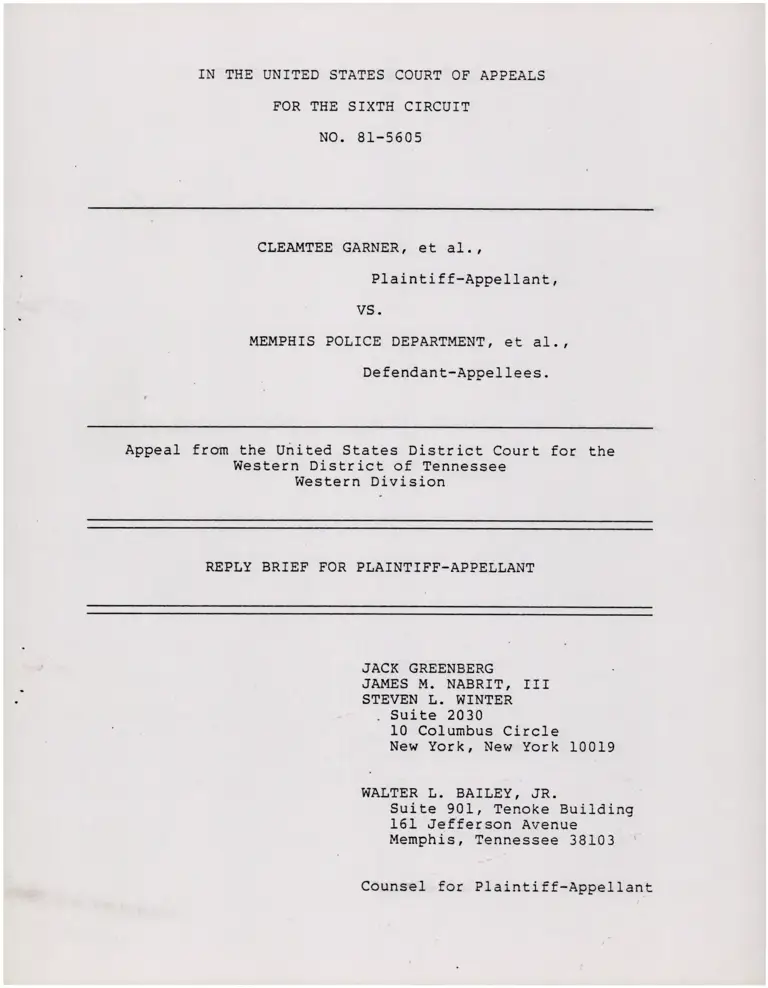
IN THE UNITED STATES COURT OF APPEALS
FOR THE SIXTH CIRCUIT
NO. 81-5605
CLEAMTEE GARNER, et al. ,
Plaintiff-Appellant,
VS.
MEMPHIS POLICE DEPARTMENT, et al.,
Defendant-Appellees.
Appeal from the United States District Court for the
Western District of Tennessee
Western Division
REPLY BRIEF FOR PLAINTIFF-APPELLANT
JACK GREENBERG
JAMES M. NABRIT, III
STEVEN L. WINTER
. Suite 2030
10 Columbus Circle
New York, New York 10019
WALTER L. BAILEY, JR.
Suite 901, Tenoke Building
161 Jefferson Avenue
Memphis, Tennessee 38103
Counsel for Plaintiff-Appellant
TABLE OF CONTENTS
TABLE OF AUTHORITIES .............................
ARGUMENT .........................................
I. THE CITY'S EFFORT TO DISTORT AND INTERJECT
AMBIGUITY INTO A CLEAR RECORD SHOULD
BE REJECTED ...........................
A. The Facts Surrounding the
Shooting ..........................
B. Memphis' Training and Deadly Force
Policies ..........................
II. THE CITY AND THE COURT BELOW MISAPPLIED
BOTH THIS COURT'S RULING REQUIRING
REMAND AND CONTROLLING CASE LAW .......
III. THE CITY IS NOT ENTITLED TO ANY
FORM OF GOOD FAITH DEFENSE ............
CONCLUSION .......................................
Page
i i
1
12
15
Cases; Page
Arlington Heights v. Metropolitan Housing Corp.,
429 U.S. 252 (1977) 11,12
Bell V. Wolfish, 441 U.S. 520 (1979) ................ 11
Bellotti V. Baird, 443 U.S. 622 (1979) .............. 7
Campbell v. City of Memphis, No. 79-2508
(W.D. Tenn. March 25, 1981) 9
Castaneda v. Partida, 430 U.S. 482 (1977) ....... 11,12
Coker v. Georgia, 433 U.S. 584 (1977) ........... 12
Cunningham v. Ellington, 323 F. Supp. 1072
(W.D. Tenn. 1971) 4,10,11,12
Eddings v. Oklahoma, 50 U.S.L.W. 4161 (1982) ..... 7
Garner v. Memphis Police Dept., 600 F.2d 52
(6th Cir. 1979) .......................... 2,3,10,13,14
Gregg v. Georgia, 428 U.S. 153 (1976) ........... 12
Johnson v. State, 173 Tenn. 134, 114
S.W. 2d 819 (1938) 4
Kennedy v. Mendoza-Martinez, 372 U.S. 144
(1963) ...................................... 11
Krause v. Rhodes, 570 F.2d 563 (6th Cir.
1977) 11
Love V. Bass, 145 Tenn. 522, 2385.
W. 94 (1921) 4
Monell V. Department of Social Services, 436
U.S. 658 (1978) 10
Owen V. City of Independence, 445 U.S. 622
(1980) ...................................... 12,13,14
Qualls V. Parish, 534 F.2d 690 (6th Cir.
1976) ....................................... 13
Reneau v. State, 70 Tenn. 720 (1879) 4
Scarborough v. State, 168 Tenn. 106, 76
S.W. 2d 106 (1934) 4
TABLE OF AUTHORITIES
- 11 -
Case Page
Washington v. Davis, 426 U.S. 224 (1976) ........ 11,12
Wiley V. Memphis Police Dept., 548 F.2d 1247
(6th Cir. 1977) 9,11
Other Authorities
Twentieth Century Fund Task Force on Sentencing
Policy Toward Offenders, Confronting Youth Crime
(1978) ........................................... 7
- I l l -
IN THE UNITED STATES COURT OF APPEALS
FOR THE SIXTH CIRCUIT
NO. 81-5605
CLEAMTEE GARNER, et al. ,
Plaintiff-Appellant,
v s .
MEMPHIS POLICE DEPARTMENT, et al.,
Defendant-Appellees.
Appeal from the United States District Court for the
Western District of Tennessee
Western Division
ARGUMENT
I. THE CITY'S EFFORT TO DISTORT AND INTERJECT AMBIGUITY
INTO A CLEAR RECORD SHOULD BE REJECTED______________
As in the prior appeal, the city relies heavily on
several distortions of the original trial record. In framing
their defense of the district court's misapplication of
prior Sixth Circuit precedent and this court's remand, appellees
seek to mischaracterize the record in an effort to make the
officer's conduct appear more reasonable. Presumedly, they
wish the court to infer that Memphis' policies and practices
were not deficient. They also distort the record evidence
regarding Memphis' training and deadly force policies.
This court rejected these attempts on the last appeal.
Garner v. Memphis Police Dept., 600 F.2d 52, 53 (6th Cir.
1979). They should be rejected again.
A. The Facts Surrounding the Shooting
The city's recitation of the facts surrounding the
shooting revolve around three assertions not borne out in
the record. They argue that the officer thought there might
be an accomplice who could be armed, that he did not know
for sure that young Garner was not armed, and that he tried
but could not have reached Garner in time to prevent an
escape. The record indicates otherwise.
The city relies on the officer's "rough" recollection
that the reporting witness indicated at the scene that "they
are breaking in next door." Byt the officer's full testimony
was that the witness was inarticulate and that his own understand
ing was that there was only one burglar. Moreover, his
testimony contains a second very different version of the
reporting witness's statement.
... When we arrived, the — a lady was standing in
the door at 737 Vollentine, and she was pointing
towards 739 Vollentine, and she was, you know,
just making a gesture with her finger, pointing in
that direction. And I asked her what she was saying,
and she made another gesture, made some type of
gesture with her mouth, and I couldn't understand
her, so I went up to the porch and asked her what
she was saying. Roughly I recall her saying,
"They are breaking inside." And at this time I
went back to the car and got my flashlight and
informed my partner of what she said, and told him
to go around to the other side.
Q. You used the term "They are breaking in."
Did you understand her to be saying that there
were several people inside the house?
- 2 -
A. I don't really think she knew, I think
that she — I think that she might have mentioned
that she had heard some glass breaking or something,
and she knew that somebody was breaking in. I
don't think that the plural form had any indication
of her knowing.
App. 207 (emphasis added). His partner confirmed that the
witness was confused. His report of her statement accords
with the emphasized portion of the above testimony.
[S]he was pointing to the house next door which we
found later was 739 Vollentine, and she was moving
her mouth but both of us were inside the car, and,
of course, the engine was running and couldn't
hear anthing. So my partner opened the door and
got out and went over to her and she was still
pointing and she wasn't saying anything. Finally,
I was leaning over in the street like this to hear
what she was saying through the open door. She
said, "Somebody is breaking in there right now."
App. 707.
The city acknowledges that young Garner "did not appear
to be armed," Brief for Appellees at 7, but asserts that the
officer "could not be certain of this at the moment." Id.
Like the district court's similar and oft repeated statement,
this is, perhaps, literally true but totally irrelevant.
One selection from the trial transcript suffices to lay this
canard to rest. Upon direct examination, the city's attorney
asked the officer: "Did you know positively whether or not
he was armed?" App. 658 (emphasis added). He answered: "I
1/assumed he wasn't...." Id.
_!/ He went on to explain: "I figured, well, if he is armed
I'm standing out in the light and all of the light is on me,
the[n] I assume he would have made some kind of attempt to
defend himself...." The record evidence on this point,
which is detailed in the opening brief, at 3 n. 2, and in
the Supplemental Brief for Appellant filed in the first
appeal. No. 77-1089, was reviewed and accepted by this court
on the prior appeal. Garner, supra, 600 F.2d at 53.
- 3 -
It is the officer's actual impression, and not the
existence of any asserted metaphysical uncertainty, that
controls. The courts have long determined the legality of
the use of deadly force based on the officer's reasonable
2/belief as to the underlying facts. See Cunningham v.
Ellington, 323 F. Supp. 1072, 1075 (W.D. Tenn. 1971), citing
Reneau v. State, 70 Tenn. 720 (1879); Love v. Bass, 145
Tenn. 522, 238 S.W. 94 (1921); Scarborough v. State, 158
Tenn. 106, 76 S.W. 2d 106 (1934); Johnson v. State, 173
Tenn. 134, 114 S.W. 2d 819 (1938). Since the officer's reason
able belief was that the victim was unarmed and posed no
danger to the officer or others, the legality of the city's
policy that taught the officer to shoot anyway must be judged
on that basis.
The city also asserts that the officer moved on Garner,
who was halted at the fence, and implies that he only fired
when he determined that he could not reach Garner because of
The city refers to the testimony of Inspector Barksdale
that an officer should only pursue a fleeing suspect and not
use his weapon if he knows "beyond a reasonable doubt" that
the suspect is not armed. This statement has no legal support,
In any case, the sum of Barksdale's testimony was that the
officer should not have fired, but should have pursued Garner.
See text, infra. And, in reference to his "reasonable doubt"
statement, he explained:
Well, if a person is unarmed, and you know that he
is unarmed, you are not in fear of your life in an
attempt to apprehend.... If you know that the
suspect is armed, you approach him more cautiously
and use a little discretion as to how you are
going to apprehend.
App. 364 - Barksdale believed that even when the
officer knows the suspect is armed, he should approach the
suspect and not necessarily shoot. This is a far cry from
the city's characterization of his testimony that if there
is a reasonable doubt as to whether the suspect is armed,
the officer should shoot.
- 4 -
the cluttered backyard between them. Again, the record
does not support this version of the events. The officer
testified that he did no more than take "a couple of steps,"
App. 651, which "wasn't, you know, far enough to make a
difference." App. 256. The obstacles between them, a
chicken wire fence and a clothesline, presented no real
problem, as he testified: "I could have easily stepped over
the chicken wire fence." App. 654. Avoiding the clothesline
was only "a matter of ducking and moving around." App. 673.
In all, it only took him "three or four seconds" to reach
1/the body after he shot. App. 720.
Indeed, even the district court found that:
Various persons with police experience were
permitted to testify as to whether or not under
assumed circumstances it was, or not, reasonable
for Hymon to fire his pistol at the fleeing Garner.
The substance of such testimony was to the effect
that Hymon should first have exhausted reasonable
alternatives such as giving chase and determining
whether he had a reasonable opportunity to apprehend
him in some other fashion before firing his weapon.
App. Chief Detective Dan Jones of the Shelby County
Sheriff's Department testified that: "I can only say that I
would not have shot the suspect myself.... I think the officer
should have moved over the fence and apprehended him." App.
277 - Inspector Eugene Barksdale of the Memphis
3/
The other factors cited were the officer's heavy footwear,
his flashlight and gun, his "not exactly light" handcuffs,
and the fact that he would have had to pursue Garner over
the chain link fence if he did not get to him in time. App.
654 - Brief for Appellees at 9-10.
This was the testimony of the officer's partner. The
partner also testified that when he rounded the corner of
the house after the shot, the officer who fired "was standing
still," not advancing on Garner. Id.
- 5 -
Police Department testified that "in all probability he
could have apprehended the subject without having to shoot
him." App. 373. Barksdale was asked:
Q. Well, based upon your knowledge of proper
police procedures, would an officer have been
expected to run over to that fence?
A. I think he should have tried to apprehend him.
App. 375. The only witness to testify that the officer was
justified in using his weapon was Captain Coletta. Coletta
had both trained this officer and sat on the review board
that condoned the shooting. App. 506 & 507 - Even so,
his trial testimony was based on an assumption not supported
by the record: that the officer was "physically barred from
5/the area by a fence." App. 532. “
Finally, the city seeks to portray the deceased as a
hard core recidivist of some sort. Brief for Appellees at
8-9. Young Garner's prior brushes with the law were quite
minor. The burglary in July, before the October instance
leading to his death, was quite literally the theft of a jar
of pennies. App. 8̂ - ^ & 689. The curfew violation was no
violation at all, as explained by the parole officer:
[A]fter talking to him and finding that there was
justification for him being there and that they
had this set up where the owner of this place
[where young Garner was working] would deliver him
home, and seemingly he was under supervision, so
we just talked about it and made sure it wouldn't
happen anymore.
5/ The hypothetical state of facts upon which he based his
testimony differed from that actually involved in this case
in another important respect. He was told that the suspect,
rather than pausing as was the case, attempted to conceal
himself when ordered to halt. App. 531.
- 6 -
App. 693 -94. In fact, he was not even on probation at the
time; the officer only arrested him because he was on the
street after midnight. App. 688. Finally, according to the
parole officer, the incident which occurred when Garner was
12 "wasn't an actual break-in as such, but it was an illegal
entry" into a house whose yard Garner and his friends were
playing in. App. 686 & 694. Apparently, nothing was taken.
Fourteen year-old Garner was not a hardened or dangerous
criminal whose apprehension necessitated tough and violent
police action. He was an admittedly errant, immature youth
engaged in illegality. In a case involving the death penalty,
the Supreme Court has only recently affirmed what should be
obvious,
that minors, especially in their earlier years,
generally are less mature and responsible than
adults. Particularly "during the formative years
of childhood and adolescence, minors often lack
the experience, perspective, and judgment of
adults."
Eddings v. Oklahoma, 50 U.S.L.W. 4161, 4164 (1982), citing
Bellotti V. Baird, 443 U.S. 622, 635 (1979). The Court also
quoted the Twentieth Century Fund Task Force on Sentencing
Policy Toward Offenders, Confronting Youth Crime at 7
(1978):
[A]dolescents, particularly in the early and middle
teen years, are more vulnerable, more impulsive
and less self-disciplined than adults.... [A]dolescents
may have less capacity to control their conduct
and to think in long-range terms than adults.
50 U.S.L.W. at 4164 n. 11. Certainly, despite his youth and
Iimmaturity. Garner should not have Ipurglarized the house nor
run from the police officer when accosted. But if he acted
impulsively and irresponsibly, he should not have been
- 7 -
shot for it.
B. Memphis' Training and Deadly Force Policies
The city would have this court believe that Memphis'
training and deadly force policies in 1974 were on a par
with the best police departments and the FBI. The evidence
offered on remand belies that assertion. Nor does the evidence
referred to by the city establish otherwise.
The only record evidence was testimony that the training
provided by Memphis "coincide[d] with the principles that
are taught at the FBI Academy." App. 380. In fact, it is
common knowledge that the FBI has long had a deadly force
policy that prohibits the use of deadly force except in
7/defense of life. App. 1869-70. Indeed, the Memphis
training officer, Captain Coletta, testifed that he did not
obtain his firearms expertise from the FBI Academy. During
that three month program, he elected what were basically
management courses. App. 303 - His firearm knowledge
6/
6/ The city cites to Cleamtee Garner's purported statement
on hearing of his son's death that he expected something
like that to happen. Brief for Appellees at 8. They do not
disclose that he denied he ever made such a remark. App.
105 - Cleamtee Garner's testimony establishes that he
was a caring and concerned father. App. 1̂ , ^ ^ -
88, 90. The officer who reported the purported statement
testified that when he heard of his son's death, Cleamtee
Garner was crying; "he was visibly upset." App. 829. In
any case, we fail to see the relevance of the city's point.
!_/ The court can take judicial notice of the FBI policy as
it is a matter of public record. Plaintiff-appellant's
proferred witness. Dr. James Fyfe — whom the district court
called biased because of his agreement with the FBI policy -
- is currently an instructor at the FBI Academy.
- 8 -
taught, App. 307 - his formal training was received in
the department and in state training programs. App. 308 -
Finally, the city notes that its deadly force policy in
1974 was "somewhat more restrictive" than state law. Brief
8/for Appellees at 11. In fact, it was identical to state
law in all respects relevant to this case. The only felonies
it excluded from the operation of the common law fleeing
felon doctrine were white collar crimes such as embezzlement.
App. 322 , 8 8 5 & 1275. Moreover, it only expressly prohibited
use of deadly force in cases involving misdemeanants. App.
1275 - 76.
II. THE CITY AND THE COURT BELOW MISAPPLIED BOTH THIS
COURT'S RULING REQURING REMAND AND CONTROLLING CASE LAW
As admitted by the city, the district court rendered
its decision primarily because of the opinion in Wiley v.
Memphis Police Dept., 548 F.2d 1247 (6th Cir. 1977). Brief
for Appellees at 16; App. But this court was clear in
stating that:
Although there is discussion of the consitutionality
of the Tennessee statute in the Beech, Qualls and
Wiley cases, all three of those cases dealt with
actions against individual officers under §1983,
and not liability based on the "policy or custom"
of a governmental entity.... The essential holding
of those cases was that an individual officer has
a qualified privilege or immunity from liability
for constitutional claims based on good faith
performance of his duties in accordance with statutory
or administative authority....
8/ The deadly force policy quoted in appellees' brief at 17
as part of the quote from Campbell v. City of Memphis, No.
79-2508 (W.D. Tenn. March 25, 1981), is not the same as the
one in effect on the night of October 3, 1974, when Garner
was killed. The relevant policy was introduced at the original
trial and appears at App. 1274 - 76.
- 9 -
Garner, supra, 600 F.2d at 54. This court could only have
remanded the question of constitutionality under Monell v.
Dept, of Social Services, 437 U.S. 658 (1978), because it
considered it open under Wiley and the prior precedents.
Moreover, as pointed out to the district court, even in
reaching the constitutional issue by way of dicta in Wiley,
the Sixth Circuit never adopted a ruling controlling decision
in this case. In Wiley, the court specifically noted that
the officers could reasonably have assumed that the victims
were armed because they had just robbed a sporting goods
store. In fact, a "stash" of guns and ammunition were later
found near where the victims lay. Wiley, supra, 548 F.2d at
1253. In concurring in Wiley, Judge McCree emphasized that:
On several occasions, [the Sixth Curcuit has]
approved a rule that permitted the use of deadly
force by police officers to apprehend a suspected
felon when the felon appeared to present a threat
to human life.... There is sufficient evidence in
the record to support the conclusion that the
fleeing felons in this case did present an apparant
threat to human life....
Id. at 1256. Since the officer in this case fired on the
assumption that Garner was unarmed, it is clearly not within
the ambit of Wiley and the other Sixth Circuit cases.
The city and the district court also evidence blithe
disregard of controlling principles enunciated by the Supreme
Court and this circuit on the due process and racial discri
mination issues. Both the district court, App. 59862, and
the city. Brief for Appellees at 19, rely on Cunningham,
supra. But neither Cunningham nor the district court made
any effort to analyze this question under the Due Process
- 10 -
Clause. The district court did not heed Judge Lively's
admonition that:
Where a state seeks to punish without an adjudication
of guilt, "the pertinent constitutional guarantee
is the Due Process Clause of the Fourteenth Amendment."
Krause v. Rhodes, 570 F.2d 563, 572 (6th Cir. 1977] Nor
did Cunningham or the court below apply the criteria enunciated
long ago in Kennedy v. Mendoza-Martinez, 372 U.S. 144, 168-
69 (1963), and recently reaffirmed in Bell v. Wolfish, 441
U.S. 520, 538 (1979), for determining whether a particular
action is regulatory or punishment. To say that "the short
answer to plaintiffs contention is that we simply are not
dealing with punishment," Brief for Appellees at 19, is
simply no substitute for analysis of controlling constitu-
9/tional principles.
Similarly, the district court and the city fail to
discuss or apply the Supreme Court's rulings in Arlington
Heights v. Metropolitan Housing Corp., 429 U.S. 252 (1977),
and Castaneda v. Partida, 430 U.S. 482 (1977). The city's
defense of the district court ruling seems to concede the
disproportionate impact of the policy, arguing that under
Washington v. Davis, 426 U.S. 229, 239 (1976), it is not
"unconstitutional soley because it has a racially dispropor
tionate impact." Brief for Appellees at 20, quoting Wiley
9/ As noted in the opening brief, the district court's
eight page opinion never once deals with the punishment
issue. App. ^ - 6̂ . Indeed, it first ruled on the merits
before plaintiff was given an opportunity to file a brief on
the substantive issues. After granting a motion for
reconsideration, it ruled without once noting the punishment
issue which was thoroughly briefed in the papers before it.
11 -
and Washington v. Davis, supra. But Arlington Heights makes
clear that, in the absence of a nonracial explanation, dispa
rate impact coupled with a history "of official actions
taken for invidious purpose," at 267, is evidence of
intentional discrimination. Moreover, Castaneda affirms
that the "presumption of discrimination" arising from the
statistics shifts the burden to the defendants to dispel the
inference of racial discrimination; this unrebutted presump
tion is confirmed by the existence of "heavily subjective"
10/decisional criteria. 430 U.S. at 494-97.
III. THE CITY IS NOT ENTITLED TO ANY FORM OF GOOD FAITH
DEFENSE___________________________________________
Both the city and the court below concede that, under
Owen V. City of Independence, 445 U.S. 622 (1980), there is
no qualified good faith immunity avaliable to municipalities.
Nevertheless, they argue that the city should be able to
rely on the prior rulings in Wiley, Beech, and Cunningham,
supra, and avoid liability.
10/ The district court did one other curious thing with
precedent. It noted that the fleeing felon doctrine is closely
related to the death penalty issue: "A particular state's
views of the validity of the death penalty may, of course,
effect [sic] its view of the issues involved in this case."
App. ^ n. 5. It pressed this analogy in the following
unusual way:
Jurisdictions may have strongly differing views on
imposition of or abolition of the death penalty in
any particular felony situation. Again, those
views should be expressed legislatively as a matter
of policy, not by a trial judge attempting to
apply his view of the law to a given set of facts.
App. ^ It failed to note that in requiring compliance
with the Constitution, the Supreme Court has specifically
limited the "particular felony situation" to which the death
penalty applies: murder. See Gregg v. Georgia, 428 U.S.
153 (1976); Coker v. Georgia, 433 U.S. 584 (1977).
- 12 -
Even ignoring the Court's ruling in Owen for the moment,
this argument must fail. As detailed in Point II, supra,
the prior opinions of this court did not uphold the constitu
tionality of shooting unarmed, nondangerous fleeing felony
suspects.
But the Supreme Court's decision in Owen cannot be
ignored. It held "that municipalities have no immunity from
damages liability flowing from their constitutional violations."
445 U.S. at 657. There is no distinction between asserting
the good faith of the municipality's officers or agents and
asserting that the municipality had a right to rely on
state law and prior dicta. The essence of the good faith
defense is that the official "relied, in good faith, upon
the settled law...." Garner, supra, 600 F.2d at 54, quoting
Qualls V. Parrish, 534 F.2d 690, 694 (6th Cir. 19756). Who
acts for a municipality but its officials? If, under Owen,
the municipality cannot claim the benefit of its officials'
good faith, it cannot claim the benefit of their reliance.
Moreover, the city's argument would accomplish precisely
what Owen sought to avoid: If a municpality as well as its
agents could avoid liability based on reliance on past prece
dents, it would "have the deleterious effect of freezing
constitutional law in its current state of development." 445
U.S. at 651 n. 33. Who would sue to vindicate constitutional
11/rights if they could not collect damages from anyone? Id.
11/ This case implicates another important policy considera
tion discussed in Owen. The city's liability turns on the
training, standards, and deadly force policies it has chosen
to impart to its police officers. In Owen, the Court was
- 13 -
The City of Memphis has a responsibility not to violate
the constitutional rights of any of its citizens, including
young Garner. This responsibility cannot be mitigated by a
state statute. Good faith reliance on the state law may
insulate the city's officials from liability, as this court
held. Garner, supra, 600 F.2d at 54. But the city has no
such privilege. As the Court noted in Owen:
How "uniquely amiss" it would be ... if the
government itself — "the social organ to which
all in our society look to for the promotion of
liberty, justice, fair and equal treatment, and
the setting of worthy norms and goals of social
conduct" — were permitted to disavow liability
for the injury it has begotton.
445 U.S. at 651.
11/ continued
concerned with "[t]he need to institute system-wide measures"
to prevent unconstitutional actions of municipal agents.
445 U.S. at 652 n. 36.
[T]he threat of liability against the city ought
to increase the attentiveness with which officials
at the higher levels of government supervise the
conduct of their subordinates.
Id.
- 14 -
IV. CONCLUSION
For the foregoing reasons, appellant is entitled
to relief for the 1974 shooting death of his minor son.
Respectfully submitted.
/. . /■
JACK GREENBERG
JAMES M. NABRIT, III
STEVEN L. WINTER
Suite 2030
10 Columbus Circle
New York, New York 10019
WALTER LEE BAILEY, JR.
Suite 901, Tenoke Building
161 Jefferson Avenue
Memphis, Tennessee 38103
Counsel for Plaintiff-Appellant
I hereby certify that two copies of the foregoing completed
Reply Brief for Appellant has been served by placing same in
the United States Mail , postage prepaid, to Henry L.
Klein, Esquire, 2108 First Tennessee Bank Building, Memphis,
Tennessee 38103, this •> th day of February 1 982.
CERTIFICATE OF SERVICE
STEVEN L. WINTER
Counsel for Plaintiff-Appellant