Reply Brief of the Appellant
Public Court Documents
1984
20 pages
-
Case Files, Garner Working Files. Reply Brief of the Appellant, 1984. 8c63dd64-35a8-f011-bbd3-000d3a53d084. LDF Archives, Thurgood Marshall Institute. https://ldfrecollection.org/archives/archives-search/archives-item/049a63cf-5496-4209-9c7a-723b33cd36ea/reply-brief-of-the-appellant. Accessed September 30, 2026.
Copied!
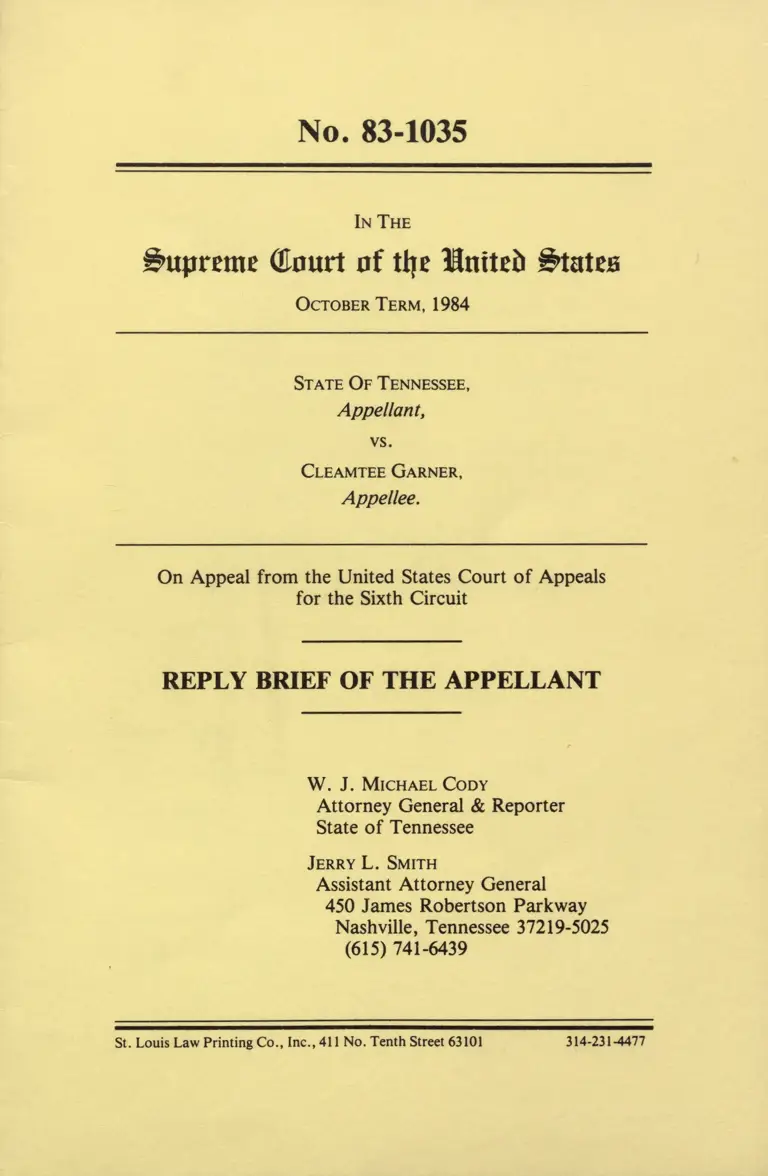
No. 83-1035
In The
Supreme Qlourt of tl}E llnftcii ^atco
October Term, 1984
State Of Tennessee,
Appellant,
vs.
Cleamtee Garner,
Appellee.
On Appeal from the United States Court of Appeals
for the Sixth Circuit
REPLY BRIEF OF THE APPELLANT
W. J. M ichael Cody
Attorney General & Reporter
State of Tennessee
Jerry L. Smith
Assistant Attorney General
450 James Robertson Parkway
Nashville, Tennessee 37219-5025
(615) 741-6439
St. Louis Law Printing Co., Inc., 411 No. Tenth Street 63101 314-231-4477
TABLE OF CONTENTS
Argument:
I. Universal Acceptance Of The Common-Law
Rule Respecting The Use Of Deadly Force To
Arrest At The Time Of Adoption Of The
Fourth Amendment Is Of Particular
R elevance In Determining The
Reasonableness Of A Seizure Under The
Fourth Amendment........................................
II. The Appellee Is Asking The Court To An
nounce A Constitutional Doctrine Where
Judicial Restraint Is Counselled.....................
III. Section 40-7-108 Is Constitutional As Applied
To The Facts Of This Case; It Therefore Can
not Be Said To Be Facially Unconstitutional .
Conclusion......................................................................
Page
6
9
TABLE OF AUTHORITIES
Cases Cited:
Camara v. Municipal Court, 387 U.S. 523, 539 (1967) .. 3
Cunningham v. Ellington, 323 F.Supp. 1072 (W.D.
Tenn. 1971)............................................................. 3,4
Duncan v. Louisiana, 391 U.S. 145, 159 (1968)............. 7
Furman v. Georgia, 408 U.S. 238, 383 (1972)................. 6
Garner v. Memphis Police Department, 600 F.2d 52,
54(6thCir. 1979)..................................................... 6
Human v. Goodman, 159 Tenn. 241 (1929)................... 8
Jones V. Marshall, 528 F.2d 132, 142 (2d Cir. 1975) . . . . 4
Love V. Bass, 145 Tenn. 522 (1921)................................. 8
Marshall v. Barlow’s, Inc., 436 U.S. 307, 315-316
(1978)....................................................................... 3
Mattis V. Schnarr, 547 F.2d 1(X)7, 1021 (8th Cir, 1976) . . 3,4
Payton V. New York, 445 U.S. 573, 591 (1980)............. 2,3
Reneau v. State, 70 Tenn. 720 (1879)............................... 8
Roe V. Wade, 410 U.S. 113, 177, 178............................... 9
Scarborough v. State, 168 Tenn. 106 (1934)................... 8
Solem V. Helm, 103 S.Ct. 3001, 3023 (1983)................... 7
State V. Boles, 598 S.W.2d 821 (Tenn. Crim. App.
1980)......................................................................... 8
State V. Dunn, 282 S.W.2d 203 (Tenn. App. 1943)........ 8
Taylor v. State, 157 Tenn. 421, 426 (1928)..................... 8
Village of Hoffman Est. v. Flipside, Hoffman Est., 455
U.S. 489 (1982)........................................................ 9
Whalen v. Roe, 429 U.S. 589, 597 (1977)....................... 6
Wiley V. Memphis Police Department, 548 F.2d 1247
(6th Cir. 1977).................................................. 3,4
Yick Wo V. Hopkins, 118 U.S. 356(1886) ..................... 9
Federal Statutes and Regulations:
Act of April 30, 1790, Ch. IX,
IStat. 112..................................................... 3
11
Ill
State Statutes and Regulations:
Tennessee Code Annotated § 39-3-401 ........................... 7
Tennessee Code Annotated § 40-7-108............................ 1,2,6,8
Other Authorities:
American Law Institute’s Model Penal Code
Section 3 .0 7 ............................................................. 5
Section 3.07(2)(b)................................................... 4,5
Section 3.07(3)......................................................... 4
Restatement of Torts Section 131 .................................. 5
No. 83-1035
In The
Supreme dourt of ti}e Enitcb SlatEo
October Term, 1984
State Of Tennessee,
Appellant,
vs.
Cleamtee Garner,
Appellee.
On Appeal from the United States Court of Appeals
for the Sixth Circuit
REPLY BRIEF OF THE APPELLANT
This case involves the constitutionality of Tennessee Code
Annotated Sec. 40-7-108, which provides:
Resistance to officer.—If, after notice of the intention to
arrest the defendant, he either flee or forcibly resist, the of
ficer may use all the necessary means to effect the arrest.
At issue is whether this statute is constitutionally invalid because
it permits police officers to use deadly force as a last resort to ef
fect the apprehension of a fleeing felony suspect in the absence
of probable cause on the part of police to believe the suspect is
dangerous or has committed a violent crime. The District Court
found the statute was not unconstitutional and that the wisdom
- 2
of the State’s deadly force policy is one properly left to the
legislature. The Court of Appeals, however, reversed the
District Court and held the statute unconstitutional on its face
under the Fourth and Fourteenth Amendments to the United
States Constitution because the statute was not drawn so as to
permit the use of deadly force as a last resort to arrest only upon
a finding by police of probable cause to believe the fleeing
suspect was dangerous or had committed a violent crime.
The issue presented to the Court in this appeal is whether
Tennessee Code Annotated Sec. 40-7-108 is constitutional under
the Fourth and Fourteenth Amendments to the United States
Constitution.
I. Universal Acceptance Of The Common-Law Rule Respec
ting The Use Of Deadly Force To Arrest At The Time Of
Adoption Of The Fourth Amendment Is Of Particular
Relevance In Determining The Reasonableness Of A
Seizure Under The Fourth Amendment.
Appellee suggests the curtailment of the death penalty for all
felonies except murder under special aggravating circumstances,
and the development of modern technology in the law enforce
ment area renders the common-law rule respecting the use of
deadly force to arrest unreasonable. Certainly, the Fourth
Amendment is not static in its application; however:
An examination of the common-law understanding of an
officer’s authority to arrest sheds light on the obviously
relevant if not entirely dispostive, consideration of what
the Framers of the [Fourth] Amendment might have
thought to be reasonable.
Payton v. New York, 445 U.S. 573, 591 (1980).
At the time of the adoption of the Fourth Amendment, the
common-law rule respecting the use of deadly force was univer
sally recognized. Appellee’s suggestion that this was so only
because felonies were punishable by death at the time is refuted
by the fact that the penal statute enacted by the First Congress
created certain felonies in addition to those at common-law and
made many of those felonies punishable by a term of imprison
ment rather than by death. See, Act of April 30, 1790, ch. IX, 1
Stat. 112. Although a number of states have legislatively moved
to a more restrictive deadly force policy than the common-law
rule, and a few have judicially created a more restrictive
privilege, the common-law rule remains widespread among the
states. The attitudes of many judges who have considered the
question of the constitutionality of the common-law rule in re
cent years regarding its necessity and viability would indicate the
rule is not so out of balance with contemporary norms and con
ditions that it should be jettisoned as violative of the Constitu
tion. See, e.g., Wiley v. Memphis Police Department, 5 2 d
1247 (6th Cir. 1977); Mattis v. Schnarr, SAl F.2d 1007, 1021 (8th
Cir. 1976) (Gibson, C.J., dissenting); Cunningham v. Ellington,
323 F.Supp. 1072 (W.D. Tenn. 1971) [Three (3) Judge Panel].
The ultimate test under the Fourth Amendment is one of
“ reasonableness.” Marshall v. Barlow's, Inc., 436 U.S. 307,
315-316 (1978); Camara v. Municipal Court, 387 U.S. 523, 539
(1967). The common-law rule respecting the use of deadly force
to arrest has for centuries, and until the present day been
thought by many states to be “ reasonable” in accommodating
effective law enforcement with the rights of criminal suspects.
The Court should refrain from declaring as unreasonable “ a
practice which has been thought entirely reasonable by so many
for so long.” See, Payton v. New York, supra, at 620 (White,
J., dissenting) (dealing with warrantless home arrests).
II. The Appellee Is Asking The Court To Announce A Con
stitutional Doctrine Where Judicial Restraint Is Counsell
ed.
— 3 —
The appellant submits that the instant case presents a situa
tion where judicial restraint is cautioned. Indeed, this has been
the approach of most judges who have considered the question
of the constitutionality of the common-law rule respecting the
— 4 —
use of deadly force to arrest. As the Second Circuit Court of
Appeals wrote in upholding Connecticut’s codification of the
common-law rule:
This would seem peculiarly to be one of those areas where
some room must be left to the individual states to place a
higher value on the interest in this case of peace, order, and
vigorous law enforcement, than on the rights of in
dividuals reasonably suspected to have engaged in the com
mission of a serious crime.
Jones V. Marshall, 528 F.2d 132, 142 (2d Cir. 1975) (per Oakes,
J.).
Implicit in the Jones case, the dissent in Mattis v. Schnarr,
supra, the holding in Wiley v. Memphis Police Department,
supra, and the holding in Cunningham v. Ellington, supra, is a
recognition that no single principle that seeks to accommodate
society’s interests with those of the fleeing suspect’s is free from
contradictions and ironies. Instead, all rules which seek to
reach such an accommodation are based upon extremely dif
ficult moral and philos^ophical choices^which require abalance
of values that is singularly suited for legislative rather than
judicial resolution.
In this case, appellee asks this Court to affirm the action of
the Court of Appeals in essentially adopting the American Law
Institute’s Model Penal Code Sec. 3.07(2)(b) (Official Draft,
1962) as the constitutional standard for the use of deadly force
to arrest. 710 F.2d at 247; (JS. App. A-13, A-14). However,
the Court of Appeals adopted this standard without inquiry as
to whether other rules on the use of deadly force might not be
equally reasonable. There is nothing to suggest that the Model
Penal Code was meant to be a constitutional standard. Ironical
ly, while not permitting the use of deadly force to arrest in the
instant situation, the Model Penal Code Sec. 3.07(3) (Official
Draft 1962), would apparently permit an officer to use deadly
force as a last resort to prevent the escape from jail of a person
detained awaiting trial on a misdemeanor. In fact, the
5 —
American law Institute has not only changed its position over
the years, and not always in the direction of a more restrictive
rule, but the ALI has simultaneously espoused different rules in
different projects. For example, in contrast to Model Penal
Code Sec. 3.07(2)(b) respecting an officer’s criminal liability for
using deadly force, the All’s Restatement (second) of Torts,
Sec. 131 (1965), adopts the common-law rule respecting the use
of deadly force in determining when an officer may be civilly
liable. It is apparent the ALI did not arrive at the common-law
rule for civil liability without considering other alternatives. In
fact, in the first Restatement of Torts Sec. 131 (1934), the use of
deadly force was permitted as a last resort to arrest only when
the officer is arresting for treason, for felonies normally involv
ing the threat of violence, or for burglary of a dwelling. Thus,
the ALI has moved from a more restrictive deadly force policy
to the common-law rule in its determination of civil responsibili
ty for the use of deadly force.
The commentators in the area have also disagreed as to the
appropriate formulation of a rule respecting deadly force to ar
rest. Professor Henry Hart of the Model Penal Code Advisory
Committee would have declared the use of deadly force to arrest
unreasonable unless postponement of arrest would be “con
trary to the public interest” because of one or more of some
four (4) factors including the officer’s knowledge of the
suspect’s criminal record, the risk of immediate danger the
suspect poses, and the degree of probability the suspect cannot
be identified and arrested at a later time. See, Model Penal
Code, Tentative Draft No. 8, Sec. 3.07 at 60 (1958). Professor
John Barker Waite provided a cogent defense of the common-
law rule in his dissent from the Model Penal Code’s restrictive
deadly force provisions. See, Model Penal Code, Tentative
Drafts Nos. 8, 9 and 10, pp. 60-62.
These standards discussed above illustrate the wide variety of
rules thought to be reasonable in this area. They also tend to il
lustrate that the moral and social judgments underlying each
6 —
rule should be expressed through the legislative branch of
government rather than the judiciary. Sec. 40-7-108 is but a
legislative enactment that, as construed by the state courts, ex
empts an officer from criminal and civil liability under state law
for the use of necessary force in making an arrest. Constitu
tional questions arise concerning the statute in this case only
because of the qualified immunity under 42 U.S.C. §1983 defen
dants might claim in reliance on the privilege the statute grants.
See, Garner v. Memphis Police Department, 600 F.2d 52, 54
(6th Cir. 1979). Appellee in effect asks this Court to declare this
statute to be immoral, unwise, and no longer needed because
advances in the technology of law enforcement have reduced the
justification for the common-law rule. Appellee’s brief at pp.
46-48. Appellant submits, however, that:
[I]n a democratic society legislatures, not courts, are con
stituted to respond to the will and consequently the moral
values of the people.
Furman v. Georgia, 408 U.S. 238, 383 (1972) (Burger, J.,
dissenting). State legislation such as that involved in the instant
case which may have some effect on individual liberty should
not be held unconstitutional because a court finds it unwise or
unnecessary in light of modern conditions. The apprehension
of persons suspected of crimes is one of vital public concern; as
such this Court has recognized the states should have broad
latitude in experimenting with possible solutions to such pro
blems. Whalen v. Roe, 429 U.S. 589, 597 (1977).
III. Section 40-7-108 Is Constitutional As Applied To The
Facts Of This Case; It Therefore Cannot Be Said To Be
Facially Unconstitutional.
Appellee suggests this case presents facts which indicated to
Officer Hymon that Eugene Garner was at most a suspect flee
ing a non-violent crime, one who posed no immediate danger to
anyone. Appellee’s brief at pp. 31-32. Thus, appellee and the
7
Court of Appeals suggest the instant case can be equated with
one involving an attempt to arrest a shoplifter, a tax evader or a
petty thief. Appellee’s brief at pp. 50-51; 710 F.2d at 244; (JS.
App. p. A-8). Of course, after the shooting it was determined
that Garner had not harmed anyone in the burgled house, nor
was he armed, but Officer Hymon did not have the benefit of
this hindsight while attempting to apprehend Garner. As stated
by the District Court:
The facts of this case did not indicate to Officer Hymon
that Garner was “non-dangerous.” (Pet. App. p. A-34)
Given the facts of this case as they confronted Officer Hymon,
the appellant submits the use of deadly force to apprehend
Garner was both reasonable and constitutional.
Burglary is a crime qualitatively different from that of
shoplifting, tax evasion or petty thievery. Because of its direct
invasion of a place of habitation, burglary of a residence, such
as that involved here, has traditionally been placed in the
category of one of the most serious of felonies. See, City’s Brief
at pp. 23-26. Four members of this Court have expressed views
that burglary is a crime which “cannot fairly be characterized as
‘non-violent’.’’ And is, in fact, a crime having “harsh poten
tialities for violence.” Solem v. Helm, ___ U.S. ____ , 103
S.Ct. 3001, 3023 (1983) (Burger, C. J., dissenting). In Ten
nessee, the burglary for which Garner could have been con
victed, had he been an adult, was first degree burglary,
punishable by a term of imprisonment of five (5) to fifteen (15)
years. Tennessee Code Annotated Sec. 39-3-401. Apart from
the potential for violence involved in a residential burglary at
night, the relatively lengthy penalty for the offense in which
Garner was engaged indicates compelling interests in the ap
prehension of burglars. See, Duncan v. Louisiana, 391 U.S.
145, 159 (1968) (” [t]he penalty authorized by the law of the
locality may be taken ‘as a guage of its social and ethical
judgments,’ of the crime in question.” )
Thus, Officer Hymon was faced with a situation of attemp
ting to arrest a suspect fleeing a crime that can be fairly
characterized as one where the potential for violence is great,
and one that society deems serious enough to punish by lengthy
imprisonment. Hymon could not know Garner was not
dangerous, nor could he know what Garner had done inside the
burgled house. Surely, the state has compelling interests under
such circumstances in preventing the escape of the fleeing
suspect, and Hymon acted reasonably in using deadly force to
prevent Garner’s escape when it could not be prevented by any
less intrusive means.
Assuming arguendo that Sec. 40-7-108 could be construed as
facially unconstitutional because it permits police to use deadly
force as a last resort to capture known non-dangerous suspects,
fleeing crimes not typically regarded as violent, i.e., the
shoplifter, tax evader, or petty thief, that is not the situation in
this case. Indeed, that question might never arise. Although
the Tennessee courts have recognized the common-law rule
respecting the use of deadly force to arrest, the state courts have
actually sustained the privilege only in one case which involved a
dangerous felony. Love v. Bass, 145 Tenn. 522 (1921) (suspect
attempted to run down sheriff with automobile). In Scar
borough V. State, 168 Tenn. 106 (1934), the privilege was not ac
cepted as a defense to manslaughter prosecution for the
shooting of a fleeing automobile thief not shown to be
reasonably necessary. The cases of Johnson v. State, 173 Tenn.
134 (1938); Human v. Goodman, 159 Tenn. 241 (1929); Reneau
V. State, 70 Tenn. 720 (1879); State v. Boles, 598 S.W.2d 821
(Tenn. Grim. App. 1980); State v. Dunn, 282 S.W.2d 203
(Tenn. App. 1943), all dealt with arrests for misdemeanors and
thus declined to sustain a defense based on the common-law
privilege. Interestingly, the Tennessee Supreme Court has in
dicated the common-law privilege to use deadly force might not
be extended to an officer who intentionally shoots to kill a non
violent person reasonably suspected of committing only a minor
felony. See, Taylor v. State, 157 Tenn. 421, 426 (1928).
The appellant submits this case presents a scenario where the
statute can be constitutionally applied. This Court has not
made a practice of striking down statutes as a whole, when cir
cumstances could exist where the statutes may be constitutional
ly applied. See, Village o f Hoffman Est. v. Flipside, Hoffman
Est., 455 U.S. 489 (1982) (pre-enforcement challenge); Roe v.
Wade, 410 U.S. 113, 177, 178 (Rehnquist, J., dissenting); Yick
Wo V. Hopkins, 118 U.S. 356 (1886) (statute unconstitutional as
applied).
CONCLUSION
For the reasons set forth above, and in the initial brief, the
appellant respectfully requests that the decision of the Sixth Cir
cuit Court of Appeals be reversed.
Respectfully submitted.
— 9 —
W. J. MICHAEL CODY
Attorney General and Reporter
JERRY L. SMITH
Assistant Attorney General
450 James Robertson Parkway
Nashville, Tennessee 37219-5025
(615) 741-6439
5
. '■■■'■'
:-c ;
:>V3
’ J ' t .