Ake v. Oklahoma Brief of Respondent
Public Court Documents
January 1, 1983 - January 1, 1983
-
Brief Collection, LDF Court Filings. Ake v. Oklahoma Brief of Respondent, 1983. 0dcb6826-ac9a-ee11-be37-00224827e97b. LDF Archives, Thurgood Marshall Institute. https://ldfrecollection.org/archives/archives-search/archives-item/04b9fe5c-e4fe-46a3-8d2e-83d86176ac4f/ake-v-oklahoma-brief-of-respondent. Accessed October 06, 2026.
Copied!
American Civil Liberties Union Fund
of the National Capital Area
600 Pennsylvania Aveneue, S.E. / Suite 301 / Washington, D.C. 20003 / 202-544-1076
p r e sid e n t
LAWRENCE H. .HIREL
EXECUTIVE DIRECTOR
J. WELSEY WATKINS
l e g a l d ir e c t o r
ARTHUR B. SP1TZER
l e g a l s t a f f
ELIZABETH SYMONOS Slaif Attorney
PEARL HOFFMAN
PHILIP W. L£SL£
Corxdin«ors
BOARS OF DIRECTORS
SARA-ANN DETERMAN
aJDRIENNE BARTH
H. STEWART OUNN. JR.
elt io r horwttz
ROBERT KAPP
LOISSCH1FFER HALwrrr
ADVISORY COMMITTEE
FREDERICA B. ABRAMSON
EARLCALLEH
DAVID ORACHSLER
CHARLES T. DUNCAN
jA/aES F FITZPATRICK
ALBERT A FCER
DAVID & ISBELL
DAVID l JOSEPH
FRANKUN E. KAMENY
SARRY KATZ
PATRICIA A KING
WARNER LAWSON. JR.
ANN KERNAN MACRORY
AUDREY ROWE
ROBERT 3. SCHWENGER
PAUL SILVERMAN
HELENE TCXV
WICHAELJ. WALSH. JR.
THCMAS S. W1LUAMSON. .R.
ARNO WINARD
August 23f 1984
Steven Winter, Esquire
NAACP Legal Defense & Education
Fund
99 Hudson Street - 16th Floor
New York, NY 10013
Dear Steve:
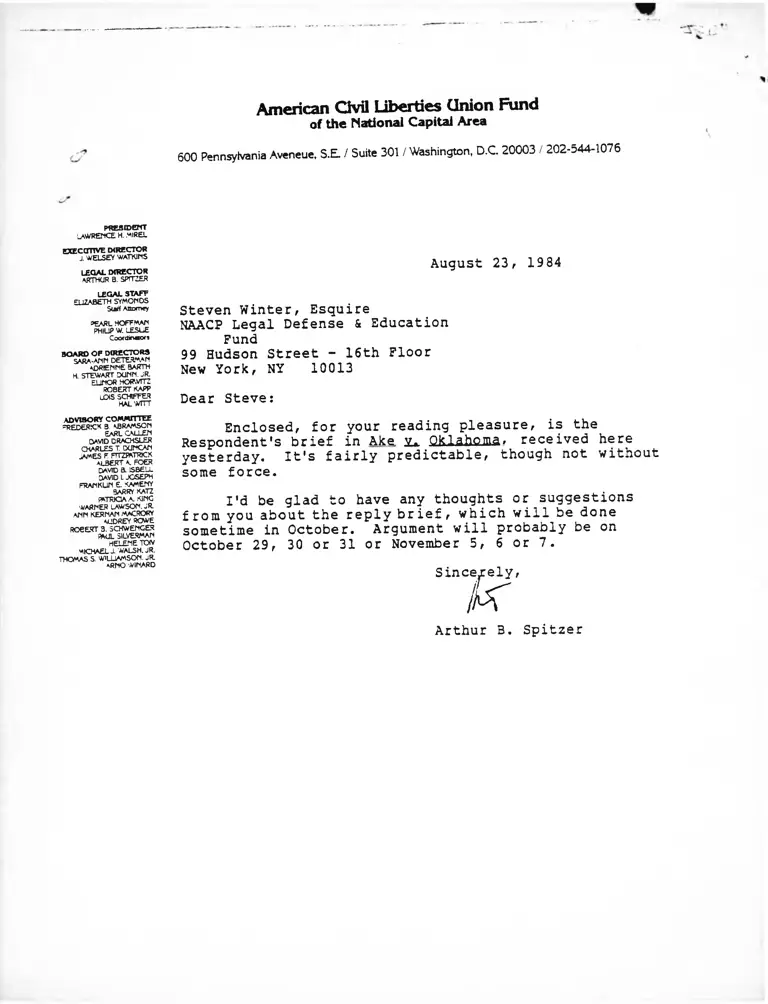
Enclosed, for your reading pleasure, is the
Respondent's brief in Ake y*. Oklahomar received here
yesterday. It's fairly predictable, though not without
some force.
I'd be glad to have any thoughts or suggestions
from you about the reply brief, which will be done
sometime in October. Argument will probably be on
October 29, 30 or 31 or November 5, 6 or 7.
Sincexely,
k
Arthur B. Spitzer
No. 83-5424
IN THE
SUPREME COURT OP THE UNITED STATES
OCTOBER TERM, 1983
GLEN BURTON AKE,
Petitioner,
v .
THE STATE OF OKLAHOMA
Respondent.
BRIEF OF RESPONDENT
MICHAEL,C. TURPEN*
ATTORNEY GENERAL OF OKLAHOMA
DAVID W. LEE
ASSISTANT ATTORNEY GENERAL
CHIEF, CRIMINAL AND FEDERAL DIVISIO
112 State Capitol Building
Oklahoma City, Oklahoma 73105
(405) 521-3921
ATTORNEYS FOR RESPONDENT
*Counsel of Record
i
QUESTIONS PRESENTED
1. Whether, under the facts and
circumstances of this case, the due pro
cess clause of the Fourteenth Amendment
required the State to provide funds to
allow the Petitioner to hire expert wit
nesses to assist in his defense.
2. Whether a State has the consti
tutional duty to provide funds to assist
a criminal defendant discover mitigating
evidence in a capital case.
3. Whether the facts of the pre-
gent case present a situation where the
Petitioner's claim that he was unable
to comprehend the nature of the proceed
ings against him and to assist in his
defense due to the medication prescribed
for him is supported by the record.
ii
TABLE OF CONTENTS Page
OPINION BELOW........ * . . . f . . 1
JURISDICTION . ' • * • • • « ........ 1
CONSTITUTIONAL AND STATU
TORY PROVISIONS INVOLVED ........... 2
STATEMENT OF THE CASE............... 2
8UMMARY OF ARGUMENT. . ................15
PROPOSITION I
WHERE AKE HAD NO HISTORY OF
MENTAL ILLNESS, GAVE A FORTY-
FOUR PAGE DETAILED ACCOUNT OF
THE MURDERS HE COMMITTED, FOUR
MONTHS PASSED FROM THE TIME OF
THE MURDERS UNTIL THE FIRST IN
DICATION OF MENTAL ILLNESS
APPEARED, AND AKE'S ATTORNEYS
DECLINED TO CALL AS WITNESSES
ANY LAY PERSONS TO TESTIFY AS
TO AKE'S MENTAL CONDITION AT
THE TIME OF THE CRIME DESPITE
THE AVAILABILITY OF A NUMBER OF
BUCH WITNESSES, THE STATE WAS
NOT CONSTITUTIONALLY REQUIRED
TO ALLOT FUNDS FOR THE PAYMENT
OF EXPERT WITNESSES ON THE IS
SUE OF INSANITY AT THE TIME OF
THE COMMISSION OF THE CRIME. . . . 19
ill
TABLE OF CONTENTS Page
PROPOSITION II
IN A CAPITAL CASE, THE STATE HAS
NO DUTY TO ASSIST A CRIMINAL DE
FENDANT DISCOVER MITIGATING EVI
DENCE; IN THE PRESENT CASE AKE WAS
FREE TO INTRODUCE ANY MITIGATING
EVIDENCE AND THEREFORE THE CONSTI
TUTIONAL REQUIREMENTS OF LOCKETT
AND EDDING8 WERE COMPLIED WITH . . 49
PROPOSITION III
WHERE AKE'S ATTORNEY WITHDREW HIS
MOTION FOR SANITY TRIAL TO DETER
MINE PRESENT SANITY AND THUS DID
NOT AVAIL HIMSELF OF THE PROCEDURE
IN OKLAHOMA FOR DETERMINING COMPE
TENCY TO STAND TRIAL, HE CANNOT
NOW CONTEND THAT HE WAS UNABLE TO COMPREHEND THE PROCEEDINGS AGAINST
HIM. ................................ 54
CONCLUSION............................57
APPENDIX A ............................la
Ta b l e o f a u t h o r it ie s“ " Page
Casest
Beck V. State, 626 P«2d 327 (Okl.Cr. 1961) • ,« ♦ ♦ • * « » • 55v • -V . / V W , :. :
. Bradburv v. Wainwright, 658 ,
W (5th dir. 1J72) ♦; * ■ .t » r
,U*-$6p. %-J" » ; ' •* "■ . V : V.. •"'■:* Buraer v. Zant, 718 F.2d '<
; ; 575 (16th CfrT 1983). * . * . • 39
:*f.- ..■ ■■, V. 'r ■' ’ . * ,'r • • ■ *. ' •••>
? v: ' Bush V. McCollum# 231 F.Supp.
?$}$ & l iB6d (N.D. Tex. 1964), af f' d
F*2d. 672 (5th Cir. 1965). » *l-\ ^ .
¥ 5 1968) ............... .. 39 'f
' ■"<Coker v. Georgia# 433 O.B.
584 (1977)..................... 36
Cox v. State, 644 P.2d 1077
(Okl.Cr. 1982)................ 55
Donnelly v. DeChrlstoforo,
4i6 U.S. 637 (1974) . . . . . . 45
. Drope v. Missouri# 420 • ,1).8. 1,62 (1975) (J f •• * #. 191?4f59 / ,
Puskv v. United States,, ,,562 U.S, 402 (I960) * . . . . 34
trrt.R OF AUTHORITIES —— " ~ Page
Cases <
Eads v. State, 460 P.2d
1370 (Okl.Cr. 1982)........ 40
Eddlngs v. Oklahoma, 455
U.d. 164 (198^ 7 T ........ 51
Engle v. Isaac, 456 O.S.
107 (1982)* ................. 48
Estelle v. Williams, 425
U.S. 501 (1976)............. 48'49
Earetta v. California, 422
U.S. 806 (1975) T T . . . * • • 34
Hawkins v. State, 569 P.2d
490 (Okl.Cr. 1977).......... 48
High v. State, 401 P.2d 189
(Okl.Cr. 1965).............. 28
Hlntz v. Beto, 379 F.2d 937
(5th Cir. 1967)............... 43
Hoback v. Alabama, 607 F.2d
680 (5th Cir. 1979).......... 41
Hurley v. State, 416 P.2d
967 (Okl.Cr. 1966)............. 48
Laland v. Oregon, 343 U.S.
790 (1952). . ................. jo
Little v. Streater, 452 U.S.
m § 8 i i . . . . r ............ 37'45
TABLE Of AUTHORITIES Zaas
TABLE OF AUTHORITIES
Casest Casesi
51
• v.V);
Lockett _v*_0hlo# 438 0.8.
§86 (1978i. . . • • * * * • • *
Matlock V. RQgQf 731 *,*2d .. Ae 47153^ (6th cirT^1984). . . .40,45,47
v. Eldrldqe, 424
U^S. 31^ (1976) . .
Moore v. Zant, 722 F.2d
648 (11th cir. 1993). t * •
V. 'M:i -’v-
Handstrom v. Montana, 442
U.8. 510 (1979) . • ........
Hatterfleld v. Zahradnlck,
572 F.2d 4 4 3 ( 4th Cir.
1978) . • • • • • •
47
40
1 patteraonv. New ;
I f l m | i »
\ .golem v. Stumes, 104 S.Ct.
1338 (1984) . . ............
x • s
Strong v. State, 547 P.2d
383 (Okl.Cr. i976)........ .
; united Stages v. sacoste_r,
^24 F.2d 19b (D.C. Cir.
1976) .....................
«til.Yi,T.!<a»- J,J
V
. ;:r‘y.-■v.;) ■ • ...■. i ; V'̂ LyV}-.;■ *}.•. c**tvv >
35
' Prootoi^ v . 'ttargliV 4*-3 ',-7t34- ; f
■ i t F T K f p S . \ V '-
Richards v. Solem, 693,1?*24
. 7*0 (8th Cir. i982)^ ' *
* . '< ̂ •• ’ \ di * v ..niters Delaware, 429 y»8.
177 • “ • ♦ * *
Rogers v. State, 634 P*2d 743
loki.Cr. 198*17 ...........
* V 'v'
52 } ■ :
36 . ■■ iX-
Westbrook v. Zant> 704 F.2d
1487 (11th cir. 1983) . • •
Wilson v. State, 568 P.2d
1279 (Okl.Cr* 1977) • • • •
• -Vi’1.1, . .•vM *?'•>.fib
^ > •
■ii1' (
•i'-
( P
!'
47
g.a.2£
.;/ 38
. 41
, . 46
. . 48
. . 39
) . 34
. . 33
. . 39
. 40,53
. . 28
viii
TABLE OF AUTHORITIES
Paqe
Statutes:
Federal
18 U.S.C. § 3306A . . . . . 39
28 U.S.C. § 1257(3) . . . . 1
State
Okla. Stat.
§ 652 (West
Ann., tit.
Supp. 1979)
21,
. . 2
Okla. Stat. Ann., tit. 21,
§ 701.7 (West Supp. 1979) . . . 2
i Okla. Stat.
j § 701.10. .
Ann., tit. 21,
. . 51
Okla. Stat. Ann., tit. 21,
§ 701.12 (West Supp. 1979). . . 3
Okla. Stat. Ann., tit.
§ 1171 (West 1979). . .
21,
. . 11
Okla. Stat.
: § 715 . . .
Ann., tit. 22,
. . 33
i Okla. Stat.
j § 718 . . .
Ann., tit. 22 ,
. . 33
Okla. Stat.
§ 723 . . .
Ann., tit. 22 ,
. . 33
Okla. Stat. Ann., tit. 22 ,
§§ 1161 et seq. (West Supp.
1971) ..................... 35,55
i
TABLE OF ^AUTHORITIES
Page
Statutes:
Okla. Stat. Ann., tit. 22,
§§ 1175.1 et seq. (West Supp.
1983)......................... 35
Other Author-
ties Cited: |
U.S. Const., Fourteenth
Amendment . ...........
I
No. 83-5424
IN THE
SUPREME COURT OF THE UNITED STATES
October Term, 1983
GLEN BURTON AKE,
Petitioner,
v .
THE STATE OF OKLAHOMA
Respondent.
i
BRIEF OF RESPONDENT
• OPINION BELOW
The Opinion of the Oklahoma Court
j
of Criminal Appeals is reported at 663
P.2d 1 (Okl.Cr. 1983).
JURISDICTION
This Court's jurisdiction is in
voked pursuant to 28 U.S.C. § 1257(3).
2
CONSTITUTIONAL AND STATUTORY
PROVISIONS INVOLVED
The Fourteenth Amendment to the
United States Constitution provides in
part:
"All persons born or naturalized
in the United States, and subject
to the jurisdiction thereof, are
citizens of the United States
shall make or enforce any law
which shall abridge the priv
ileges or immunities of citizens
of the United States; nor shall
any State deprive any person of
life, liberty, or property, with
out due process of law; nor deny
to any person within its jurisdic
tion the equal protection of the
law." ■
STATEMENT OF̂ THE CASE
Glen Burton Ake, a/k/a Johnny Van-
denover (hereinafter' referred to as
"Ake") was convicted ] of two counts of
Murder in the First Degree, Okla. Stat.
Ann. tit. 21, § 701.7 (West Supp. 1979)
and two counts of Shooting With Intent
to Kill, Okla. Stat. Ann. tit. 21,
§ 652 (West Supp. 1979), in the Dis-
I
trict Court of Canadian County, State of
Oklahoma.
Ake was convicted by a jury which
also found the existence of three aggra-
vating circumstances.1 « e received a
death sentence from the jury for each of
the two murders for which he was con
victed and a sentence of five hundred
years for each of the convictions for
Shooting With Intent to Kill.
The facts which were presented to
the jury reveal that on October 15,
1979 , Ake and his co-defendant, Steven
Keith Hatch, quit their jobs on an oil
̂ The jury found that (1) the mur
der was especially heinous, atrocious or
cruel; (2) the murders were committed to
avoid or prevent a lawful arrest or
prosecution; and (3) a probability ex
isted that Ake would commit criminal
acts of violence that would constitute a
continuing threat to society. See Okla.
Stat. Ann.r tit. 21, § 701.12 (West
Supp. 1979).
f ield borrowed a car2rig (Tr. 386),
I
from a friend and employer, Dwayne Lucas
(Tr. 386) and went Looking for a loca
tion to burglarize (k. 4a)3
Ake and Hatch finally decided upon
a house which wasj that of Reverend
Richard Douglass, his wife Marilyn, and
their two children, Brooks, age sixteen,
|
and Leslie, age twelve. The Douglasses
had recently returned from Brazil where
they had performed missionary work
(Tr. 446). i
Ake obtained entry into the house
using the ruse of attempting to locate
the residence of another person in the
area (Tr. 430-432). i While Ake was in
cript.
Tr,
'A'
refers to the trial trans
refers to the confession of
Ake given on November 23, 1979 and
signed on November 2&, 1979 and which is
attached hereto as "Appendix A."
5
the house, Hatch entered with a shotgun
and Ake pulled out a handgun which he
had been concealing in his belt, held it
in the face of the boy, Brooks, and said
that if he tried to do anything, he
would blow his head off (Tr. 434).
The boy went to get his father, who
was in the bedroom (Tr. 434). The
father stepped momentarily into the
bathroom and Ake stuck his handgun in
Reverend Douglass' stomach, and asked
him what he was doing (Tr. 435). Ake
pulled him out of the bathroom and
checked his pockets (Tr. 435). Ake then
took Reverend Douglass back into the
bedroom and asked him for his money and
wallet (Tr. 435). During this time
Hatch had the shotgun on Mrs. Douglass,
the boy and the girl (Tr. 435).
Ake then took Brooks (the boy) to
h is bedroom and had him obtain money
6
from his wallet ('ijr. 436). Ake then
I
took Mrs. Douglass to her room for the
same purpose (Tr. 433).
The Douglass family members were
forced to lie on their stomachs on the
living room floor ajnd were bound with
rope and gagged with curtain sash (Tr.
437). Ake tied them up (Tr. 437), began
ransacking the house, searching for
money (Tr. 283,437). Ake took the Doug
lass' twelve year oljd daughter, Leslie,
around the house locking for money and
then took her into the bedroom and
forced her to undress (Tr. 419-420,437).
Fie and Hatch then
tempted to rape the
suntan lotion on theLr penises to use as
a lubricant (Tr. 420,425). Mrs. Doug
lass wept as she heaJrd her daughter cry-
unsuccessful ly at-
girl after putting
ing during the rape attempts (Tr. 438).
7
During most of this time Hatch
guarded the Douglasses with the shotgun,
threatening them if they moved (Tr. 438-
439). Ake and Leslie (the girl) re
turned to the living room and she also
was tied up (Tr. 439 ). The heads of
Reverend Douglass, his wife, and the boy
were covered with shirts (Tr. 421-438).
Ake remarked to the family that he liked
to shoot people. Ake asked them if they
had seen the car and the Douglasses
stated they had not (Tr. 439). He kept
talking about shooting people and how
there was nothing wrong with it and
wondered whether or not he should shoot
them (Tr. 440). He then sent Hatch
outside to start the car (Tr. 440).
After Hatch left, Ake asked "for four
hours," to which the family agreed (Tr.
422,427,440). Mrs. Douglass pleaded
with Ake not to shoot them (Tr. 440).
I
8
Ake said "I'm in a bad position. I
don't want to shoot you all but, . . •"
(Tr. 441) and "I'm sorry but dead men
don't talk" (A. 39a). When Mrs. Doug
lass started to say something Ake shot
all four family members in the back with
the handgun and left (Tr. 422, 441).
Reverend Douglass and his wife died
from the gunshot wounds as their son
attempted to untie them (Tr. 422—423,
442). Partial strangulation was also a
contributing cause of | death to Reverend
Douglass (Tr. 325,332). The children
survived the gunshot wounds to the back
and eventually freed themselves and fled
to a neighbor's house.
After the shooting Ake and Hatch
fled to Arkansas, Tennessee, Louisiana,
Texas, California, Nevada, Utah, V7yoming
and Colorado (A. 6a-lla). While in
Louisiana, Ake and Hatch showed some
9
jewelry to a woman who traveled with
them named Virginia Keefe. Ake told her
that they had gotten it from some people
in Oklahoma that they had killed (Tr.
456-457,460). Ms. Keefe at one time
wore some of this jewelry (Tr. 456),
including Mrs. Douglass' wedding ring,
which was seized from Hatch when he was
arrested (Tr. 411, 445-446, 460). Ms.
Keefe also observed a credit card be-
longing to Mrs. Douglass in the pos-
session of Ake and Hatch (Tr. 45) . Ms.
Keefe later used the card herself (Tr.
459) . She said that Ake and Hatch had
also both worn the jewelry (Tr. 459-
460). Ms. Keefe testified that Ake had
telephoned his sister and that she had
advised him that the Douglass children
had survived (Tr. 457). Ms. Keefe
stated that Ake became "scared" upon
learning this news (Tr. 457).
I
10
Ake and Hatch were arrested in
Colorado on November 20, 1979. Upon
being booked into the jail, the ring
belonging to Mrs. Douglass was found on
Hatch and the credit card belonging to
Mrs. Douglass was found on Ake (Tr. 410-
412) .
Ake was returned to Oklahoma and
placed in the El Reno city jail. Three
days after his arrest, on November 23,
1979, he advised the jail dispatcher,
LuAnn Ramming, that he wished to speak
with the Sheriff and the Oklahoma State
Bureau of Investigation (Tr. 504-506).
When the Sheriff arrived, Ake stated
that he had some things he wanted to
"get off his chest" (Tr. 506,512).
Ake gave the officers a forty-four
page statement which was taped, subse
quently reduced to writing, corrected,
and signed by Ake three days later (Tr.
11
552-525). This statement was introduced
at trial as Exhibjit No. 68 (Tr. 546-549;
Appendix "A" infra). In this statement
Ake confessed tcj the shooting of the
Douglass family.
Ake was arraigned on November 23,
1979 and on December 11, 1979 he and
Hatch again appeared before the court.
At that time Hatch's attorney requested
and obtained an order transferring Hatch
to the state mentil hospital for a sixty
day observation period to determine
J 4competency to stand trial. Ake was
present in court .with his attorney, but
no such request wjas made on his behalf.
(December 11, 19^9 Transcript, p. 2-4).
iOn January 21, 1980, the prelimi
nary hearing for
held. Again no objections to the pro-
both Ake and Hatch was
Okla. Stat. Ann. tit. 21 § 1171
(West 1971) provided that if a doubt
12
ceedings or motions relating to Ake s
competency were made. Ake and Hatch
were bound over for trial at the conclu
sion of that hearing.
On February 14 , 1980 Ake appeared
for formal arraignment. Ake became
disruptive during that time. Subse
quently, on February 20, 1980 the court
ordered Dr. William Allen, a psychia
trist in private practice, to examine
Ake to determine his competency to stand
trial. On April 10, 1980 a competency
hearing was held and at the conclusion
of such the court found that Ake was a
mentally ill person in need of care and
treatment and he was transferred to the
state mental hospital, Eastern State
Hospital.
4 (Continued) arose as to the
sanity of a criminal defendant, he could
be committed to the state hospital for a
period not to exceed sixty days.
13
On May 22, 1980 Dr. R.D. Garcia,
Chief Forensic Psychiatrist for Eastern
State Hospital, sent the court a letter
advising that Ake was now competent to
stand trial and recommended that he be
maintained on 200 milligrams of Thora
zine, three times a day. Ake was re
turned to Canadian County and on June
23, 1980 the jury trial for Ake was com
menced. Hatch was tried in a separate
proceeding.
At the time of trial Ake's attorney
withdrew a pending Motion for Jury Trial
on Present Sanity (Tr. 2-4). Outside of
the presence of the jury the State
produced testimony of a cellmate of Ake,
who testified that Ake had told him that
he was going to try to "play crazy"
(Tr. 15).
At trial both Douglass children
testified as to the events surrounding
14
the terrorizing of their family and the
murder of their parents by Ake. Ake was
identified in court by both as the
person who murdered their parents (Tr.
427,448) and the boy identified his
parents' jewelry (Tr. 445-446) and
credit card (Tr. 446-447) which were in
Ake and Hatch's possession when ar
rested. The State also introduced the
signed confession in which Ake admitted
to the shooting of the Douglasses.
(State's Exhibit No. 68; Appendix A,
infra).
Dwayne Lucas, Ake's employer, and
Virginia Keefe, their traveling compan
ion, testified concerning their associa
tion with Ake and Hatch, which included
Ms. Keefe's testimony concerning Ake's
admission to her about the killings and
his telephone call to his sister (Tr.
456-460).
15
The State also introduced evidence
that Ake's palm print, which had been
lifted from the telephone receiver in
the Douglass' bedroom (Tr. 398-404).
Ballistics linked the bullet found at a
place where Ake and Hatch had been
target shooting on the morning of the
murders with bullets found at the Doug
lass residence (Tr. 351-367,384—386,394-
397).
The only evidence presented by Ake
in his defense was that of three doctors
(two psychiatrists and a physician) con
cerning his mental condition months
after the murders.
SUMMARY OF ARGUMENT
The facts of the present case do
not present a situation in which the due
process rights of a defendant have been
violated.
16
The facts reveal an overwhelming
amount of evidence against Ake. Shortly
after his arrest, which occurred approx
imately five weeks after the murder, Ake
gave law enforcement officers a forty-
four page taped confession which was
reduced to writing and then corrected
and signed by Ake three days later.
More than four months passed after
the murders before any claim was made
concerning his mental condition. Ap
proximately two weeks after his arrest
Ake and his attorney appeared in court
and watched Ake's co-defendant obtain an
Order transferring him to the State men
tal hospital for observation. Ake s
attorney made no such motion and over a
month later the preliminary hearing was
held and Ake was bound over without any
allegation being made concerning Ake's
mental state.
17
At trial Ake's attorney declined to
call any of Ake's family, friends,
co-workers or associates regarding the
issue of his sanity at the time of the
murders even though such testimony is
admissible in Oklahoma. Three doctors
conducted examinations concerning his
competency to stand trial and Ake's
motion for jury trial on the issue of
present insanity was withdrawn at the
time of trial. Furthermore, Ake had no
history of mental illness.
Ake's confession set forth in lucid
detail the facts relating to the Doug
lass' murders. The confession also
contained explicit accounts of Ake's
activities on the day of the murders and
his subsequent flight following such.
All witnesses to the confession testi
fied concerning his rational demeanor
18
and mental status at the time the con
fession wds given.
There was no showing that Ake
had possessed any mental illness at the
time of the murders. The first sign of
any mental illness occurred four months
after the murders, subsequent to his
preliminary hearing, and Ake received
prompt psychiatric examination and
treatment with regard to his competency
to stand trial. The constitutional
mandates of Drope v. Missouri, 420 U.S.
162 (1975) were therefore complied with.
Under the facts of the case the
Constitution does not require the State
to provide expert witnesses with regard
to Ake's mental status at the time of
the commission of the murders.
19
ARGUMENT
PROPOSITION I
WHERE AKE HAD NO HISTORY OF MENTAL
ILLNESS, GAVE A FORTY-FOUR PAGE j
DETAILED ACCOUNT OF THE MURDERS HE
COMMITTED, FOUR MONTHS PASSED FROM
THE TIME OF THE MURDERS UNTIL THE
FIRST INDICATION OF MENTAL ILLNESS
APPEARED, AND AKE’S ATTORNEYS DE
CLINED TO CALL AS WITNESSES ANY
LAY PERSONS TO TESTIFY AS TO AKE'S
MENTAL CONDITION AT THE TIME OF
THE CRIME DESPITE THE AVAILABILITY '
OF A NUMBER OF SUCH WITNESSES, THE
STATE WAS NOT CONSTITUTIONALLY RE
QUIRED TO ALLOT FUNDS FOR THE PAY
MENT OF EXPERT WITNESSES ON THE
ISSUE OF INSANITY AT THE TIME OF
THE COMMISSION OF THE CRIME.
In his brief Ake asserts that the
United States Constitution required the
State of Oklahoma to provide funds for
"reasonably necessary expert assis
tance." Ake argues that the State is
constitutionally required to furnish
expert assistance not only in the form
of expert witnesses at trial but also
with regard to trial preparation. Ihb
State contends that if any such previ-
r>
20 i
i
ously undiscovered constitutional right i
exists, the facts in the present case do |
not justify the invocation of such a
right on behalf of the Petitioner Glen
Burton Ake.
The facts of the case, as more
i
fully set forth in the transcript and
\ Ake's confession, reveal a calculated
and savage terrorizing of the Douglass
family. Nothing in the conduct of the
crime itself, apart from a certain
I
j amount of consumption of alcohol and
drugs by Ake and his companion Hatch,
I
! give the slightest indication that this
1i was anything other than a premeditated
J robbery-murder. From the time of the!
ruse used by Ake to gain entry into the
Douglass' home, the coordination of the
j
j simultaneous production of weapons by
I
the Ake and Hatch, the systematic search
i of the Douglass' home by Ake, the tear-
21
ing out of all three telephones in the
residence, the binding and gagging of
the victims, to the ingenuity of Ake in
applying suntan lotion to his penis in
order to facilitate the rape of the
twelve year old Leslie, Ake exhibited no
signs of mental illness.
Next, on November 23, 1979, after
being arrested after traveling through
nine states and using an assumed name,
Ake gave law enforcement officers a
lucid forty-four page confession which
gives a detailed chronology of the
robbery, murders and subsequent flight.
Ake was even able to remember the order
in which he shot the Douglasses (|A.
39a). :
The statement corroborates in
detail the accounts given by other
witnesses. It recounts the travels of
Ake and Hatch from state to state. A
22
notable exception to the account giver
by witnesses is the refusal of Ake tc
admit the attempted rape of the twelve
year old girl (A. 34a), which may re
flect recognition on his part of the
harsh treatment reputed to be imposed
upon child molesters by fellow prison^
inmates. The recitation of the events
referred to refutes any claim that Ake
was delusional at the time of the mur
ders. Furthermore, no statement in the
confession reflects on his mental compe
tency .
After Ake gave the taped statement
to the officers on November 23, three
days later the statement was reduced to
writing, reviewed, corrected and signed
by the Petitioner. Review of the writ
ten statement reveals the corrections
made by Ake, a fact testified to by
23
5
Sheriff Stedman (Tr. 547-548) .
Agent Shields of Oklahoma State
Bureau of Investigation testified that
when Ake gave his statement he was very
calm and communicated well (Tr. 523).
Sheriff Stedman, who was also present
when the confession was given, testified
that Ake was responsive, coherent and
alert (Tr. 536). The confession was
given after Ake himself notified the
jailer that he wished to see the Sheriff
and Oklahoma State Bureau of Investiga
tion (Tr. 506).
Since the statement was given five
weeks after the murders, this too should
5 obviously, the reproduction of
the statement in Appendix A, infra, does
not contain the handwritten corrections
made by Ake. Certain blank pages and
spaces appear throughout the statement
due to the fact that part of it was ex
cised to delete references to other
crimes (Tr. 479-482,502).
24
disprove Ake' s claim of insanity at the
time of the murders in view of his de
tailed recollection of such.
Furthermore, testimony at trial re
vealed that, when in Louisiana, Ake made
a statement to Virginia Keefe that he
had obtained the jewelry that he and
Hatch showed her from some people in
Oklahoma they had killed (Tr. 456-457,
460). According to Ms. Keefe, Ake also
telephoned his sister and became
"scared" when told that "the two kids
had lived" (Tr. 457). When arrested in
Colorado, Ake had the credit card of
Mrs. Douglass in his possession (Tr.
411). This card and some of Mrs. Doug
lass’ jewelry had been given to Ms.
Keefe to use and wear at certain times
after the murders (Tr. 458-461). Ms.
Keefe also testified that Ake eventually
told her that his name was not "Skip
25
Thompson" as he had previously told her
(Tr. 452) but Glen Ake (Tr. 457).
After the confession was given on
November 23 and 26, 1979, Ake and his
attorney appeared before the Court on
December 11, 1979. These proceedings
are set forth in a transcript which is a
part of the record. At that hearing
Hatch's attorney obtained an order
committing Hatch to a .State Mental
hospital for observation (p. 4). The
Court continued the preliminary hearing
from December 17, 1979 until January 21,
1980 to allow Hatch to undergo observa
tion (p.3-4).
The record reveals that no attempt
was made by Ake's attorney to secure a
similar mental examination for his
client.
Thereafter, on January 21, 1980,
the preliminary hearing for Ake and
26
Hatch was held. The preliminary hearing
was completed and Ake and Hatch were
bound over for trial. The transcript of
this hearing also reveals that no at
tempt of any kind was made to secure any
mental examination of Ake and no objec
tion to the proceeding was made on the
basis of his mental condition.
On February 14, 1980 Ake was form
ally arraigned. On February 20, 1980
the court, in response to Ake's behavior
at arraignment and other incidents of
bizarre behavior which had been reported
to the court, ordered Dr. V'/illiam Allen
to examine Ake to determine whether an
extended period of observation was
required.
Therefore, from the time of his ar
rest on November 20, 1979, until Febru
ary 14, 1980, there was no indication of
Ake having any mental problem. At trial
27
Dr. Garcia testified that Ake had no
history of mental illness (Tr. 599). ̂
Furthermore, on the day of trial,
Ake's attorney withdrew a Motion for
Sanity Trial to Determine Present San
ity. At that time the State also pro
duced a cellmate of Ake's who testified
that Ake told him that he was going to
"play crazy" (Tr. 15). The cellmate
also stated that Ake told him he had
i
learned what symptoms to use during his
stay at the "nut house" (Tr. 20-23),
that he was going to be some kind of an
angel (Tr. 20) and made the comment "I'm
messing with their minds" (Tr. 20). The
cellmate also stated that:
The court minute of February 20,
1980 reflects that the judge before whom
Ake appeared on February 14, 1980, felt
that Ake's behavior "may very well be
staged for the benefit of the Court,
. . ." (R. 20).
28
"He is sane. He knows what he is
doing. He is smart." (Tr. 22).
Ake contends that in this case the
United States Constitution requires that
the State provide funds for expert psy
chiatric assistance. It is significant,
however, that Ake made no attempt to
call any lay witnesses who had knowledge
of his mental condition at the tune of
the murders.
In Oklahoma a lay witness may give
his or her opinion as to insanity of the
defendant. In High v._State, 401 P.2d
189, 195 (Okl.Cr. 1965) the Court of
Criminal Appeals held:
"In Oklahoma, a nonexpert witness
may give his opinion as to whether
or not a man is insane where it is
shown that such witness has had
sufficient opportunity for obser
vation of the accused."
See also Wilson v. State, 568 P.2d 1279,
1281 (Okl.Cr. 1977) <". ■ • a nonexpert
may, upon a showing of sufficient oppor
29
tunity to observe, give his opinion as
to the defendant's sanity; • • •> ) •
In the present case a number of lay
witnesses could have testified as to
Ake’s sanity. Two such witnesses testi
fied at trial: Dwayne Lucas (Tr. 382-
391), for whom Ake worked as a driller,
took to work on the morning of the
murders, had dinner with on that day,
rode around with and then observed Hatch
and Ake target practice; and Virginia
Keefe, who had known Ake since February
or March of 1979 (Tr. 452-453), and who
traveled with him from Florida to Loui
siana, Texas, Wyoming after the murders
and wore the victim's jewelry and used
Mrs. Douglass' credit card (Tr. 455
7457) .
7 m s . Keefe also testified con
cerning her observation that Ake w .
30
Ms. Keefe was asked no questions by
defense concerning her knowledge of
Ake’s mental status at any time. With
regard to Dwayne Lucas, in response to
questions by Ake’s attorney, Mr. Lucas
testified that Ake always came to work
promptly (Tr. 390) , and that on the day
of the murders Ake worked as hard as
anyone, and that he did not notice any
thing strange about him (Tr. 390-391).
Lucas stated that at that time he con
sidered Ake to be a friend (Tr. 391),
and that he loaned him his car on the
day of the murders (Tr. 386,390-391), a
fact corroborated by Ake in his confes
sion (A. 3a).
Ake also failed to call other wit
nesses who would have had knowledge of
(Continued) "scared" when he
called his sister and found that the
Douglass' children were alive (Tr. 457).
31
his mental condition at the time of the
murders, such as his co-workers, any
other acquaintances, or the sister re
ferred to by Virginia Keefe from whom
Ake discovered that the Douglass child
ren were alive (Tr. 457).
Additionally, Ake's mother was
present and spoke to the Court during
the April 10, 1980 competency hearing
(p. 12-13). The mother also mentioned
that Ake was married (p. 13). Yet nei
ther of those witnesses were called by
Ake to testify as to his mental condi
tion at the time of the murders.
Ake's confession also contains
references to other persons who could
have testified as to his insanity at the
time of the crimes. Ake referred to the
fact that he was living with a Theresa
Colley, who was Hatch’s sister (A. 11a-
12a). He also related that on the morn-
32
ing of the murders his father and grand
father helped him move furniture out of
; . l,
his house (A. 3a).
Therefore, Ake produced not one |; I
witness who was personally acquainted |
with him to testify concerning his men- :
tal condition at the time of the mur-
J
ders but requests this Court to hold
that the State must provide him with
| expert assistance to attempt to deter-
j Imine his mental state four months ear- jI
lier. i
Ake is asserting that the Constitu
tion compels the State to provide a
i
i particular kind of witness, i.e., an
expert witness, despite the fact that
there were a number of lay witnesses ,I
available to testify on the issue of
I
Ake's sanity. J
This Court has thus far held that
the Sixth Amendment guarantees that a
I
33
defendant have compulsory process for
obtaining witnesses in his favor. Wash
ington v. Texas, 388 U.S. 14 (1967). In
the present case state process was
available for Ake to subpoena any wit
ness. Okla Stat. Ann., tit. 22 §§ 707-
710 (West Supp. 1979). This included
witnesses residing out of county and out
of state. Okla. Stat. Ann., tit. 22
8§§ 715, 718, 723. An arrest warrant
could also have been issued to insure
the presence of witnesses for trial.
Okla. Stat. Ann., tit. 22 §§ 274 and
719 .
Furthermore, with regard to Ake's
claim that he was denied the "necessary
Okla. Stat. Ann., tit. 22 § 718
provides that all witnesses for criminal
defendants who appear pursuant to a sub
poena issued on his behalf shall be paid
their fees and mileage out of the court
fund.
34
expert assistance," it is to be remem
bered that the only "assistance" which
the Constitution specifically guarantees
is the "Assistance of Counsel." Faret-
ta v. California, 422 U.S. 806 ( 1975).
There is presently no constitution
al right to have a psychiatric expert
provided to an indigent. United States
ex rel. Smith v. Baldi, 344 U.S. 561,
568 (1953). The State complied with all
present constitutional mandates concern
ing the mental status of defendants by
having appropriate mental treatment in
order for Ake to be competent to under
stand the nature of the proceedings
against him. Drope v. Missouri, 420
U.S. 162 (1975); Dusky v. United States,
362 U.S. 402 (1960). Ake's own attorney
declined to avail himself of procedures
35
to determine competency to stand trial
9(Tr. 3-4).
The state of mind of a defendant
with regard to criminal culpability has
long been the province of state court
systems. In Powell v. Texas, 392 U.S.
514, 534 (1968) the Court refused to
embark upon the course of articulating
"a constitutional doctrine of criminal
responsibility." In Leland v. Oregon,
343 U.S. 790 (1952) the Court refused-
to invalidate an Oregon law which placed
the burden upon the defendant to prove
his insanity at the time of the commis
sion of the crime beyond a reasonable
y Okla. Stat. Ann., tit. 22
§§ 1175.1 et seq. (West Supp. 1983)
grants a defendant the right to a jury
trial on the issue of competency to
stand trial. At the time of the Peti
tioner's trial the statute granting that
right was Okla. Stat. Ann., tit. 22
§§ 1161 et seq. (West 1971).
36
doubt, despite the fact that Oregon was
the only state placing such a burden on
a defendant. The continuing validity of
Leiand has been reaffirmed in recent
years. Rivera v. Delaware, 429 U.S. 877
(1976); Patterson v. New York, 432 U.S.
197, 205 (1977).
In his Brief Ake can point to only
nineteen states which have a statute for
compensation of expert witnesses for the
criminal defendants (Brief of Petition
er, p. 25). This is hardly the over
whelming number of states which this
Court has used as guidelines in deter
mining constitutional appropriateness in
other contexts. Cf . Coker v._Georgia,
433 U.S. 584 (1977) (Georgia only State
which imposed death penalty for rape of
an adult woman); Leiand v.__Oregon,
supra, 343 U.S. at 798.
37
Ake also cites the case of Little
v. Streater, 452 U.S. 1 (1981). How
ever, that case is clearly distinguish
able from the present one. There,
Connecticut imposed an "onerous eviden
tiary rule," 452 U.S. at 14, upon puta
tive fathers in paternity actions in
that under Connecticut law a defendant's
testimony was insufficient to overcome
the plaintiff's (mother's) prima facie
case. The Court held that denial of a
blood group test to an indigent putative
father denied him due process under
these circumstances. In addition to the
facts of the unfair evidentiary burden
placed upon the defendant, the Court
found that the unquestioned reliabilityI
of the blood grouping test was critical
in the finding that the putative indi
gent was denied due process when the
State refused to provide such a test.
I
38
In the present case no evidentiary
rules existed which placed Ake at a j
particular disadvantage. Cf. Sand-
strom v. Montana, 442 U.S. 510 ( 1979).
i
The instructions given to the jury
placed upon the State the burden of
proving beyond a reasonable doubt that
Ake was sane at the time of the commis
sion of the crime (R. 142-143, 152-153).
Furthermore, the validity of blood
grouping tests is accepted, while the
use of an expert witness on the question
of sanity is definitely without scienti-
f ic certainty. One can assume that a
jury would regard with skepticism a
claim by a psychiatrist or psychlolgist
that Ake was insane at the time of the
commission of the crime after his attor
ney declined to call as witnesses a i
number of people (parents, grandfather,
sister, wife, friends, co-workers, and
|
CP
39
employer) who saw him on that day, who
knew him well, and who would be expected
to be sympathetic toward the idea that
Ake was insane when he murdered the
Douglasses .
Ake contends in his Brief (p. 23-
24) that several Courts of Appeal "have
recognized the constitutional necessity
of providing expert assistance for
indigent criminal defendants in proper
„10cases.
The State disagrees with Ake's
flat assertion that "eight" Court of
Appeals have made this finding. A
reading of Burger v. Zant, 718 F.2d 979,
981 (11th Cir. 1983) does not support
this contention in any way. United
States v. Decoster, 624 F.2d 196, 210
(D.C. Cir. 1976) involved an interpreta
tion of 18 U.S.C. § 3006A. Cf. Proctor
v. Harris, 413 F.2d 383 (D.C. Cir. 1969)
(Burger, J.). In Christian v. United
States, 398 F. 2d 517, 519, n. 7 (10th
Cir. 1968), the Tenth Circuit stated
only that the denial of an expert "may"
in certain circumstances violate the
Sixth Amendment. Cf. Watson v. Patter-
son, 358 F. 2d 297 , 298 (10th Cir. 1966)
40
The cases cited by Ake and other
cases reveal that the various Courts of
Appeal use a case by case method of
determining whether due process has been
violated. Matlock v. Rose, 731 F.2d
1236, 1243-1244 (6th Cir. 1984) ("At a
minimum, there must be a fair factual
basis for the defendant's contention
that his sanity is in doubt, that that
issue must be a substantial one in his
defense."); Moore v. Zant, 722 F.2d 640,
648-649 (11th Cir. 1983) (defendant not
entitled to his own microscopic ex
perts); Westbrook v. Zant, 704 F.2d
1487, 1496-1497 (11th Cir. 1983) (under
the circumstances, defendant in capital
cases not entitled psychologist for
second stage evidence where friends,
(Continued) (failure to appoint
a ballistics expert upheld as not vio
lating fundamental fairness).
41
relatives or neighbors could have been
subpoened to testify); Bradbury v. Wain-
wr igh t, 658 F.2d 1083 , 1087 ( 5th Cir.
1981) ("A psychiatrist is not constitu
tionally required."); Payne v. Thompson,
622 F.2d 254, 255 (6th Cir. 1980); ("Nor
can we find a federal constitutional
violation in the state trial court's
refusal to provide expert witness and
psychiatric examination by witness of
his own choosing."); Hoback v. Alabama,
607 F. 2d 680, 683 (5th Cir. 1979) (re
fusal to provide investigative services
for defendant did not constitute a
denial of due process); Pedrero v.
Wainwright, 590 F.2d 1383, 1390-1392
\
(5th Cir. 1979); Satterfield v. Zahrad-
nick, 572 F.2d 443, 445 ( 4th Cir. 1978)
("Whatever may be the extent of an indi
gent's right to an impartial psychiatric
evaluation to enable him to place the
42
issue of insanity before the trial court,
see United States ex rel. Smith v.
Baldi, [citation omitted], we are of
opinion, on authority, that there exists
no constitutional right to the appoint
ment of a private psychiatrist of the
defendant's own choosing at public ex
pense. " ) .
In Pedrero v. Wainwright, supra,
the Fifth Circuit cited the cases of
Bush v. McCollum, 231 F.Supp. 560, 565
(N.D. Tex. 1964), aff'd 344 F .2d 672
(5th Cir. 1965) (defendant's sanity at
time of the offense must be "seriously
in issue") and Brinks v. Alabama, 465 F.
2d 446, 449 ( 5th Cir. 1972) (there must
be a "reasonable ground to doubt" the
defendant's sanity at the time of the
offense) and found that where, among
other things, no testimony was offered
at the arraignment or trial to suggest
43
that the defendant "behaved in a strange
or irrational manner at the time of the
offense," he was not constitutionally
entitled to a psychiatric examination.
590 F. 2d at 1390-1392. The Court also
distinguished that case from the case of
Hintz v. Beto, 379 F.2d 937 , 941 (5th
Cir. 1967) (court used test of whether
there was a "fair factual basis" for the
question as to the defendant's sanity at
the time of the offense) where a defen
dant who had a history of alcoholism and
bizarre behavior, and the circumstances
of the offense "tended strongly to speak
of his derangement." The Court in
Pedrero held that under the facts of
that case, defendant's sanity at the
time of the crime was not "seriously in
issue." 590 F.2d at 1392.
In the present case there was no
showing that on the day of the murders
44
Ake's behavior was in any way bizarre or
erratic. The detailed and complete
account of the day's activities in his
confession also negates any serious
question concerning his sanity on the
day of the crime. Many details of the
confession, such as the account of the
murders themselves, the activities of
Ake and Hatch on the day of the murders,
the locations where the two fled, the
telephone call to Ake's sister, Ake and
Hatch's association with Virginia Keefe,
are corroborated by other witnesses.
The only theory which the facts of
the case could rationally support is
that at some point approximately four
months after the murders Ake became men
tally ill. This is not sufficient to
support a constitutionally mandated men
tal examination on the issue of sanity
at the time of the offense.
45
The State concedes that there may
be cases in which the denial of funds to
conduct examinations or tests requiring
expert witnesses would render the trial
so fundamentally unfair as to deny due
process. Obviously, a State may take
some action or refuse to provide ar» in
digent access to a defense which con
stitutes such a denial. Little v.
Streater, supra. But unless a specific
provision of the Bill of Rights has been
violated, the "fundamental fairness
provision of the Fourteenth Amendment is
the determinative guide. Donnelly v.
DeChristoforo, 416 U.S. 637, 643-645
(1974); Matlock v. Rose, supra, 731 F.2d
at 1244.
Therefore, based on the facts of
this case, the State contends that Ake
received a fundamentally fair trial and
that the absence of expert testimony on
46
the issue of insanity, in view of the
absence of lay witness testimony on the
issue of insanity, did not deny him due
process of law.
The establishment of a constitu
tional right to expert testimony on the
facts of this case would open a pan
dora's box with regard to the claims of
prisoners, particularly those on death
row. Such a decision would surely be
held to be retroactive since the addi
tion of an expert witness would be held
to "enhance the accuracy of criminal
trials." Solem v. Stumes, 104 S.Ct.
1338, 1342 (1984). Obviously, delays in
the execution of death sentences would 1
inevitably follow.
Furthermore, the increase of ex
pense to the criminal justice system,
which should be considered a governmen
tal interest (which includes the "func-
47
tion involved and the fiscal and admini
strative burdens,") under the due pro
cess test of Matthews v. Eldridge, 424
U.S. 319, 335 (1976), would be stagger
ing. Virtually every defendant who had
a mental problem before or after a crime
would claim the right to funds for
independent psychiatric examinations to
determine if he or she was insane at the
time of the crime, or if even a reason
able doubt existed as to sanity, which
is the test in Oklahoma. Rogers v._
State, 634 P.2d 743, 744 (Okl.Cr. 1981).
Since a "fair factual basis" for
Ake's contention that his sanity was in
doubt did not exist, Matlock v. Rose,
supra, the State asserts that no consti
tutional error occurred in this regard.
Furthermore, the Oklahoma Court of
Criminal Appeals in the present case
held that the argument concerning his
48
alleged right to funds for expert wit-
nesses on this issue was waived by the
failure of Ake to raise such in his
Motion for New Trial. See , J . A . 71. In
Oklahoma, only assignments of error pre
sented in the motion for new trial will
be considered on appeal, unless the er
ror complained of is fundamental. Haw
kins v. State, 569 P.2d 490, 493 (Okl.
Cr. 1977). This is a long-standing rule
of criminal procedure in Oklahoma. See,
Eads v. State, 640 P.2d 1370, 1371 (Okl.
Cr. 1982); Strong v. State, 547 P.2d
383, 385-386 (Okl.Cr. 1976); Hurley v.
State, 416 P.2d 967, 971-972 (Okl.Cr.
1966) .
Failure to comply with a state pro
cedural rule normally bars federal re
view of an alleged constitutional error.
Engle v. Isaac, 456 U.S. 107 (1982).
ee also, Estelle v. Williams, 425 U.S.
49
501, 513-515 (1976) (Powell, J. concur
ring) (failure to object to appearing in
prison garb should act as waiver of con
stitutional right).
PROPOSITION II
IN A CAPITAL CASE, THE STATE HAS
NO DUTY TO ASSIST A CRIMINAL DE
FENDANT DISCOVER MITIGATING EVI
DENCE; IN THE PRESENT CASE AKE WAS
FREE TO INTRODUCE AMY MITIGATING
EVIDENCE AND THEREFORE THE CONSTI
TUTIONAL REQUIREMENTS OF LOCKETT
AND EDDINGS WERE COMPLIED WITH.
In Proposition II, Ake contends
that the State has a constitutional duty
to provide funds to an indigent defen
dant to enable him to prepare and pre
sent evidence in his favor at the sen
tencing hearing. Ake asserts that he
should have been able to attempt to ob
tain expert psychiatric testimony con
cerning his mental condition.
50
The State again notes that Ake
failed or refused to call any number of
witnesses who had direct knowledge of
his mental condition on the day of the
murders. Again, there is not a shred of
evidence to support Ake's contention
that he was insane at the time or was
suffering from any mental illness. Nc
witness was called who would say even
that Ake was acting in a bizarre or
unusual manner at any time contemporan
eous with the crime.
To the contrary, Dwayne Lucas test
ified that there was nothing unusual or
strange about Ake on the day of the
murders (Tr. 390-391). The State again
points to the detailed and explicit
confession which contains numerous
details corroborated by other witnesses
in the case such as Mr. Lucas, the
Douglass children and Virginia Keefe.
51
In Eddings v. Oklahoma, 455 U .S .
104 (1982) and Lockett v. Ohio, 438 U.S.
586 (1978) the Supreme Court held that
the State could not prevent a defendant
from presenting any relevant evidence
which would bear on the defendant's sen
tence in a capital case. The State has
not done so here; Ake was free to call
any of the numerous witnesses in exis
tence who had knowledge of his mental
condit ion at the time of the crime.11
If the Court rules that Ake is
entitled to funds for the hiring of an
expert to attempt to discover evidence
in mitigation of punishment, there would
seem to be no death penalty case in
which a State would be free from such a
^ Oklahoma specifically
defendant to present evidence
"any" mitigating circumstances.
Stat. Ann., tit. 21 § 701.10.
allows a
as to
. Ok 1 a.
• r
52
burden. Obviously, virtually every
murderer suffers from some degree of
mental disability or personality dis
order and the State should not be con
stitutionally compelled to pay for an
expert who would attempt to uncover a
justification for the murderer's con
duct .
The State is under no constitution
al duty to create exculpatory evidence.
Richards v. Solem, 693 F.2d 760, 766
(8th Cir. 1982) ("Although the State has
a duty to disclose evidence, it does not
have a duty to create evidence.")
Furthermore, Ake had the benefit of
three expert witnesses who examined him
with regard to his mental competency to
stand trial. Dr. Allen, Dr. Garcia, and
Dr. Enos all testified concerning his
mental condition. The fact that they
did not give an opinion as to the sanity
53
of Ake at the time of the crime is, in
the context of the entire case, not a
constitutional violation.
In Westbrook v. Zant, supra, 704
F .2d at 1496-1497 the Eleventh Circuit
stated that, in a capital case, where
the defendant's history of long incar
ceration was placed before the jury, the
defendant himself could have taken the
stand in the penalty phase of the trial
and introduced mitigating testimony, and
"[f]riends, relatives, or neighbors
could have been subpoened to testify,"
there was no constitutional error. The
Court observed that "[t]he evidence for
which Westbrook sought a psychologist
could have been demonstrated by other
methods." 704 F.2d at 1497.
For these reasons, no constitution
al error occurred by the lack of state
funding for Ake's attempt to secure
54
expert witnesses to testify concerning
alleged mitigating evidence which he
claims could have been discovered.
PROPOSITION III
WHERE AKE'S ATTORNEY WITHDREW HIS
MOTION FOR SANITY TRIAL TO DETER
MINE PRESENT SANITY AND THUS DID
NOT AVAIL HIMSELF OF THE PROCEDURE
IN OKLAHOMA FOR DETERMINING COMPE
TENCY TO STAND TRIAL, HE CANNOT
NOW CONTEND THAT HE WAS UNABLE TO
COMPREHEND THE PROCEEDINGS AGAINST
HIM.
Ake next complains that the pre
scribed Thorazine dosage prevented him
from comprehending the proceedings
against him.
As previously noted, Ake's trial
attorney withdrew his Motion for Sanity
Trial to Determine Present Sanity on the
day of trial.
In Oklahoma a defendant in a crim
inal case has the right to a jury trial
on the issue of whether he is competent
55
to stand trial. Okla. Stat. Ann., tit.
22, §§ 1161 et seq. (West 1971) (Now
Okla. Stat. Ann., tit. 22 O.S.1981,
§§ 1175.1 et seq. (West 1981); Cox v ,
State, 644 P.2d 1077, 1078 (Okl.Cr.
1982); Beck v. State, 626 P.2d 327 (Okl.
Cr. 1981). Since Ake withdrew the
motion for such determination and raised
this issue only in closing argument,
Ake's contention in this regard is mer
itless .
This case differs materially from
that in Drope v. Missouri, 420 U.S. 162
( 1975). In that case the defendant's
attorney objected to the case proceeding
to trial and requested a psychiatric
examination. The trial court overruled
a Motion for Continuance on this and
another ground.
In the present case Dr. Garcia sent
the Court a letter on May 22, 1980,
56
advising that Ake was "able to adequate
ly consult with an attorney and he does
have a rational as well as actual under
standing of the proceedings against
h im." ( R- 17).
With regard to the Thorazine, the
amount in question which was admini
stered to Ake, 200 milligrams, three
times a day, was prescribed by Dr. Gar
cia. Dr. Garcia is the Chief Forensic
Psychiatrist at Eastern State Hospital,
which is a State mental hospital in
Oklahoma (Tr. 587).
There is nothing in the record or
in Ake's Brief to suggest that the
amount of Thorazine administered to Ake
was excessive. His brief contains only
a general attack on the use of Thora
zine. The amount prescribed by Dr.
Garcia must be considered to be appro
priate since its correctness is uncon-
57
tradicted by anything in the record or
in Ake's Brief.
Furthermore, Ake's attorneys took
no action to attempt to reduce or halt
the amount of Thorazine given to him.
CONCLUSION
For the reasons stated, the State
respectfully requests that Ake's convic
tion and sentence be affirmed.
Respectfully submitted,
MICHAEL C. TURPEN
ATTORNEY GENERAL OF OKLAHOMA
DAVID W. LEE
ASSISTANT ATTORNEY GENERAL
CHIEF, CRIMINAL AND FEDERAL
DIVISIONS
112 State Capitol Building
Oklahoma City, OK 73105
(405) 521-3921
ATTORNEYS FOR RESPONDENT
appendix a
PETITIONER GIVEN
AND SIGNED ON
I
- STATEMENT OF THEI
ONt NOVEMBER 23, 1979
NOi/EMBER 26, 1979.
II
I
Ij
i
I
£
$I
V
■i
1
I
DS D.L. StedmanGS - Greg Shields
CANADIAN COUNTY SWORN AFFIDAVIT
STATEMENT OF GLENN BURTON AKE
Q : This will be an interview with Glenn
Burton Ake at the Canadian County Sher
iff's Office in the Sheriff's Office in
El Reno, Oklahoma. My name is D.L.
Stedman, Sheriff of Canadian County.
Present with me are Agent Greg Shields,
OSBI and Mr. Glenn Burton Ake. Glen
what is your date of birth?
A : Nineth month, the 8th day of 55.
Q:
and
(DS) Is Glen
correct name?
Burton Ake your true
A: Yes it is.
Q: (DS) Do you go by any aliases?
A: Yes I do.
Q: Tell those to me, would you?
A: John Vandenover , its not Johnny 1 ike
everybody has been saying, Skip Thomp
son.
Q: (DS) Spell Vandenover for me?
A; v-A-N-D-E-N-O-V-E-R. All one name,
no hyphens. The other name I went under
was Skip Thompson and I went under that
in Casper, Wyoming and Shoshoni, Wyom
ing. I went under Skip Jenkin that in
Louisiana, New Orleans when I was work
ing for Jack Thompson Shows. Billy
Williams I used one time for one day
i
2a
just passing through. The people that I
stayed at their house ask my name and
that's what I told them. That's all my
aliases.
q : (DS) Okay, Glenn, are you aware
that this conversation is being taped?
A: Yes I am.
Q: (DS) Have you agreed to it?
A: Yes I have.
q : (DS) Okay, let me read you your
rights under the Miranda Warning. You
have a right to remain silent. Any
statements that you make can and will be
used in evidence against you. You have
a right to consult with and have present
prior to and during interrogation an
attorney either retained by you or ap
pointed. If you cannot afford an attor
ney one will be appointed for you prior
to any questioning if you so desire.
You may stop talking at any time you
desire. Do you understand each of these
rights that I have explained to you?
A: Yes sir.
Q: (DS) Having these rights in mind do
you wish to talk with us now?
A: Yes sir.
Q: (DS) Okay, Glenn in your own words,
why don't you start back on October 15th
and tell us what happened that day and
during the previous days until you were
arrested in Colorado.
3a
A: Alright, a, there was one other
question that I wanted to ask you. Any
way it started out that morning. I got
up and I found out that the girl I was
living with, Theresa Colley, was a going
out on me, she stayed out all night that
night and the night before. And T woke
up and I was sort of pissed off. I
started drinking before I went to work.
Q: (DS) And this was all on Monday the
15th of October?
A: This was all on Monday. I woke up
about 8 o'clock in the morning and
started this. I started drinking. At
2 o'clock in the afternoon my crew
showed up and she wasn't there still.
So I went on ahead and went to work,
continued to drink all the way there
too. Got there and showed up for work
. . . So we decided to get rid of my
job, so X left my derick had there, X
was short-handed already, left my derick
hand to drill, cause the tool pusher
said that he could have a drilling job
next if I want to get rid of him. So me
and Steve borrowed Dewayne's car, De-
wayne Lucas, which was my derick hand
and he loaned it to us and so we went
ahead and went back to Enid, got back to
Enid and we was around the house and she
still hadn't come around. I tried to
find her and I finally located her and
I couldn't get in touch with her, she
wouldn't talk to me, so she there. So I
went ahead and moved all my furniture
out of the house, everything I had, cal
led my dad, he called my Grandfather,
they both showed up over there, we moved
the whole house out. We got the house
moved out, I didn't know what I was
4a
qoinq to do, I started looking for her,
couldn't find her, finally we just took
off. We were going to take the car back
out, we had Steve's car there, Steve has
a car in Enid, had one, still there pro
bably, somewhere. JVnd we took off and
we went out towards the rig, went by the
rig, we didn't go exactly by it, went
around the section line by it. Went
over to this other place, we looked at
it, didn't look very promising so we
just went on by it. At that time I
knew that I couldn't go back by the rig
so we just decided to head on down the
road and get out of there, we had a
little bit of money on us. So we went
on, we headed on down the road, I forget
which highway it was, we cut over the
Hennessey and started coming sought,
bought a bunch more booze, whiskey and
stuff, started drinking. We got down
the highway, it was dark time, I don t
know what time it was exactly and we
decided to start driving the section
lines to see if we could get us, pick
us up some more money by doing a bur
qlary or something, you know. We drove
uo to this one house and we didn t like
it so we drove out. We went into two or
three houses like that and final y we
came to this one house where Mr. Doug
lass lives. VJe pulled into the driveway
and there was about 6 or 7 Doberman P m
chers met us at the driveway so I wen
up and made a phone call, played like I
was going to make a phone call, wen
to the door and she let us in. Wei
she . . they didn’t let us in the dogs
stopped us and they came outside and
met us and they let us come m to make
a phone call. I said I forgot the
phone number in the car and so I went
5a
back to the car to get it, I was pretty
scared. I never done . . . all we was
going to do was the burglary but the
people was home. So we . . I went
back up to the house and played like I
was going to make a phone call and told
Steve to meet me coming in the door,
come on in the door. Steve came up to
the door and I pulled out my gun and I
said alright, everybody in the living-
room on the floor. Everybody went in
the livingroom on the floor. VJe contin
ued to go on through the house to bur
glarize the house with the people there
and all, that was all we was going to do
is burglarize the house. So we came
back in the livingroom, we stayed there
for about 30 minutes, I guess, searching
the place, we had one of the kids show
us around to every room, where all the
money was, all the little cups of money
and everything, trying to get some
money. So Steve goes through their wal
lets, I guess, doesn't find nothing but
"a credit of Mrs. Douglass. They had
bunches of credit cards but nothing was
takin except for one Visa car from Mrs.
Douglass. Left all his credit cards and
everything so people would think nobody
took credit cards. So we were all in
the living room and it was about time to
leave and I told Steve to go outside and
get in the car and turn it around and
get it ready to go, get it running and
ready to go. Steve goes outside and
hops in the car and he warns me, he
says, "don’t do nothing drastic before
we leave." I tell him, I say, "don’t
worry I ain't, don't worry a m t.
Finally I got him talked into leaving
outside, going outside. He walks out
side get in the car turns it around,
6a
starts it up. And I stands by the end
of the couch and I unloaded a .357 mag
num loaded with .38 wad cutters on these
people. I continue to run out the door
and the gods were all barking at me so 1
slowed down to a walk, walked out the
door, I drove off, drove off. Steve
asked me what I done and he told me I
should of never done nothing like that.
So we go on down the road to Arkansas,
Ft. Smith, Arkansas. So we decided to
get rid of that car that Dewayne Lucas
loaned us so we parked it in the back of
this motel where we stayed that night.
Vie parked it behind it and left it there
and hopped on a bus to Memphis, Tennes
see and we decided that we would make a
switch in buses and confuse everybody.
Vie switched buses and we went to Memphis
and we stayed there at the Ramada Inn
for two days where we got ripped out for
$800 but we still had $900 left. Vie had
$1700 when we left, before we done any
burglaries, but we knew that wasn't go
ing to last . . • Neverthe less, we
should of never done any of those ser
ious crimes. We went on down to New
Orleans, we got that job, we got that
job and we went to work and we worked
there for about a week or so and I met
this girl, Ginger, I don't know her last
name at all now. And we picked her up,
Steve told me not to pick her up, not to
take her with us but I wouldn't listen
to him cause I knew her before, when we
lived in Shoshoni with her and she knew
me as Skip, that's what everybody while
the whole journey was on, was Skip. So
we went ahead and worked awhile and she
was going to move on the lot with me and
they fired me for letting her move on
the lot. So we went ahead and left
7a
there headed towards Texas on the bus
and we got to Texas. Can I stop for a
moment?
Q: (DS) Yes.
A: When we were headed through Texas,
we started headed into Texas, we were on
the bus we didn't have enough money to
ride very far and we were going to stop
at that lake, right this, right that
side of Texas, still in Louisiana.
Q: (DS) Lake Charles?
A: Lake Charles. Okay we met this guy
on the bus and he said he could put us
up for the night if we made it to
Orange, Texas. The next town away. We
had just enough money to get there, we
done blow all our money on our travels.
So we went ahead and we went to Texas,
Orange, Texas, we stayed there the night
this man had a wad of money on him you
wouldn't believe, about $2800-$3000, but
he was being real good to us by giving
us a place to stay and everything and
Steve wanted to go ahead and burglarize
it but we didn't. I told him no and I
was the main whole thing the whole cap
pers was my brain, whatever I told Steve
we didn't do, we didn't do it. So we
went ahead and left the next morning
with just a few dollars in our pockets
and he gave us a ride . . . well we
stayed there two days, yeh, two days,
and we continued on and he gave us a
ride, he wanted to get rid of us out of
his house I guess, cause we had already
imposed on him two days. He gave us a
ride it was about 40 miles from there,
about 50 miles or something like that,
8a
where he dropped us off on this road by
this park, stopped by this park, went
across the street, he dropped us off
headed towards 80. We didn't want to
head north . We was headed north
there so we could just go south and cut
off on 10. We went down that way,
playing cash for all the gas. Wo one
could trace us with the credit card. We
get down south on 10 comes on across
into New Mexico into Arizona, into
Nevada, got up through Nevada, get into
the northern part of Nevada and just
crossed the border into California and
we're low on money. Se we head south
again cause there was no cut over from
where we were at. So we had to go all
the way down south to Barstow, towards
Barstow California, where I had a card
from that one guy in Texas. I used it
in one place. We went on from there, we
went on down south, started using that
Visa card, Ginger did. Started using
that Visa card and went all the way
across to California got up through my
home town, up through my home town, on
through there, went north of there and
started headed east again, figured we
would throw the patrol again, by heading
east. Changed plates three times al
ready by that time, on that car. Then
we picked up another set of California
plates on that last venture east. So we
threw them off cause we didn't want to
use that Visa card in the same place all
the time. We started headed east and
got into Nevada and started blowing all
our money. Well I gave Steve the money
and he goods with money and he can
handle money, I can't, I blow it too
much. I gave him $150 and I kept $300.
We were headed through there and we got
9a
to a place called Battle Mountain and we
was gambling in the Casino, he was
playing 21 and I was standing at the
bar, drinking whiskey. Every time we
don; this, I had to be all fucked up,
everytime I done any shooting I was all
fucked up on whiskey. Whiskey makes m
nutty, anybody will tell you that, any
tody!' that'sy the only time I'm ever
rowdy whenever I drink whiskey,
stopped there started driking Whiskey
and everything and these guys invited us
over for dinner, these young people, j
they were all bikers and stu .
kind of people I run around with. I had ,
a leather vest on at the time, lev s,
Harley Davidson belt buckle, . nJ°ot^ I
Harley Davidson hat and everything. So
they invited us over thinking we were j
bikers too, you know, So we wen - ,
there and we partied there for three i
days, hand, $300 worth of whiskey, hall
aallons, gallons of whiskey, wine, beer,
we headed^ out of there thinking we were ,
getting hot cause the cops were watching
Tsove’r very close. Heheaded out of J
there and headed into Utah on Visa, ,
everything, all our travels were on
Visa! We9 went all over Utah with that
Visa card. She just sign the shit right
out of it. Spend 3 or 4 thousand dol- I
1 ars on that Visa card in Utah alone.
Whatever she wanted to buy and whatever- ,
body wanted to buy, we bought with that ,
viccT car we got com checks with that
Visa card and9 everything. She always ,
kept saying com checks, com checks,
that’s all she got, she got Visa quick,
she got Visa power or what every you I
want to call it. He headed » d d U B ,
headed north up to Wyoming. Stayed in j
Rock Springs one night and headed on
10a
down to Baggs, got to Baggs and I went
over and seen a friend of mine I wanted
to see. I was going to work on a rig.
Was going to keep cool, lay low r}°
do nothing else wrong cause 1 didn t do
nothing wrong in that state. And here
we get into an argument that night at
the bar but we wasn’t bar hopping. We
was drinking all day before then. And
we left that night, well we got into an
argument and everything in the bar and I
wanted to knock the shit out of her but
I didn't, didn't ever hurt her, so I
busted her glasses, that's just as bad
as hurting her cause she can't hardly
see very good. So she called the law on
me, I guess, told them where I had my 7
mm rifle at. The law, they just went
over and got that. And I went over %
where the law was at, I didn't know they
were there, to get that 7 mm rifle. And
the laws was standing out on the road
around the corner of the block. So when
they seen us in there they come ground.
When they come around they said Hold it
you by the car.” And I was outside the
car, they couldn't see Steve inside the
car. So I took off running on foot.
Ran"for a little bit around the trailer,
they still were standing over there. So
I ran back to the car, hopped in the
car, backed it out of the driveway and
takes off and that’s when I headed
sought out of Baggs three miles from the
border. I comes down south about lo
miles, going about 130 miles an hour on
black ice trying to lose them. I could
n't lose them very easy, there lights
were back behind about a mile an a half
or two miles. So I flipped a huey,
slowed down enough where I could flip a
huey and 1 come slidding in the middle
11a
of the road like this here, making a
180. I start coming back, I get back up
there and we pass them and he sees what
I done and he was already going fast as
hell you know, and he couldn't stop and
I whipped off on this other road which I
knew, cause of an oil field up there
that I worked in. Whipped off it and
went on down theroad quite a ways, went
off this one road, parked, turned off
all the lights and everything and
watched him come back and go right on by
and he kept on going until his lights
were out of sight. We turned on and
came back down that one road where we
got caught at. That brings us up to
da te.
Q: (DS) Okay,Glenn, now that we've
gone through that with you in a narative
form telling us, lets go back and start
on October 15, which was a Monday. What
did you do that first thing on October
15?
A: Woke up and started looking for The
resa.
Q: (DS) Who is Theresa?
A: Theresa Colley was the one that I
was living with up there in Enid.
Q: (DS) Is that Steve Hatch's sister?
A: Theresa Colley's maiden name is
Theresa Hatch, yes it is.
Q: (DS) Okay, and why was you looking
for her?
12a
A: Cause I was living with her and she
hadn't been home in two nights in a row
and I was made at her and that why I
started drinking, and smoking pot.
q ; (GS) Had you had a fight with The
resa the night before she left?
A; No. That's what I couldn't under
stand, I gave her my whole check and
everything. Everything, I just come
home. . • • I'd work come home and give
her my money, taking care of it, buy the
kids what they need everything. I
couldn't understand it. That's what I
couldn't understand.
q . (DS) After you couldn't find her,
what did you do then?
A: We started drinking. I shot up
about half a gram of cocaine, at one
time, started smoking pot, looking for
her.
q . (DS) What time of day was that?
A: 9 o'clock in the morning, 10 o'clock
in the morning, somewhere around in
there.
q : (DS) Okay, and how long did you
look for her?
A: About an hour, that's all I could
drive.
Q: (DS) Were you by yourself?
A: No, Steve was with me.
Q: (DS) Steve Hatch?
13a
A: Steve Hatch, well he was with me the
last half hour, the first half hour he
was gone, I think, he was talking to
her.
Q: (DS) Okay, this puts us up to about
10 o'clock, where did you . . . what did
you do then?
A: I just kept looking for her, drink-
ing and smoking dope and shooting drugs.
Q: (GS) Inhere were you at that time?
A: In my house.
Q: (GS) And where was that?
A: 2112 West Pine, Enid, Oklahoma.
Q:
the
(DS)
house
Okay, what time did you
then?
leave
A : About 2 o'clock.
Q: (DS) Who did you lave with?
A : My derick hand came to pick us up.
Q: Who is he? (DS)
A : Dewayne Lucas.
Q: (DS) Okay, your derick hand?
A : He was my derick hand, yes.
Q: (DS)
living.
Okay, what did you do for a
A :
ing
I was a driller on a oil rig,
for Sarah Drilling Company.
work-
14a
Q: (DS) Where at.
A: Hennessey Highway and the Drummond
Highway, right at that corner.
Q: (DS) That would be went of Hennes
sey?
A: West of Hennessey, south of Drum
mond, all the way to the Hennessey high
way .
Q: (DS) How did you leave?
A: In his car, he was driving, I could
n't drive.
Q: (DS) Was anyone else with you?
A: Steve Hatch was.
Q: (DS) Okay, what kind of car did De-
wayne Lucas have?
A: 64 Malibu.
Q: (DS) Do you remember the color?
A: It was yellow with alot of primer
spots on it. Banana yellow, light yel
low, lighter than banana, like a real
faded out banana.
Q: (DS) And you said this was about 2
o 'clock?
A: About 2:30 or something like that.
Q: (DS) Where did you go?
Went to the rig.A:
15a
Q: (DS) Okay, did you do anything on
the way to the rig?
A: Okay, drank beer and whiskey. Soon
as we get to the rig, I could make it up
to the dog house and change clothes,
that's all that I could do. . . . that's
when we borrowed the car and left.
Q: (DS) Glenn do you, are you an out
doors man?
A: Yes I am.
Q; (DS) Do you like guns and hunt quite
abit?
A : No.
Q: (DS) You don't hunt much?
A: I've never went hunting at all.
Q: (DS) Is that right?
ft: i lugged guns while I was in the
army. I was an expert. I like tearing
them apart and working on them and put
ting them back together.
Q: (DS)
t ime?
Did you own a gun at
A: That day, yes I did.
Q: (DS) Ittiat was it?
A: .357 magnum.
Q: (DS)
time?
Where was that gun at
that
that
16a
ft: it was in the car, inmy lunch box.
I was going to take it out to the rig
and practice shot with it.
Q: Did you?
ft. Mo.. I went out and bought a
'whole box of shells but I never shot
them.
Q: (GS) When did you buy shells?
A: The day before, the 14th.
q . (GS) Where did you buy these
shells?
A: K-Mart, in Enid, Oklahoma. They had
no .357 rounds at all.
q . (GS) What type shells did you buy?
A: .38 wad cutters. .38 Special Wad
cutters. They said they would shoot
through the gun but they would leave
a lead build up so I bought a wire brush
and a cleaner so I could clean the bar
rel every time I fired 6 shots through
it, which I did. I practice shot with
it quite a few times before we went out
that night?
(GS) Q: Where did you practice shoot
ing?
ft. x practice shooting at the reserve
pits. Cross reserve pits, thats an oil
rig about. . .-•
(end of tape)
17a
Q: (DS) This will be the beginning of
side two.
A: I was practice shooting, I practiced
about 12 rounds at the Cross reserve
pit. About 150 yards and I could hit a
coke bottle with it at that range.
Pretty damn good.
Q: (GS) Where was this reserve pit
located?
A: The one we practiced on. It was
back towards Drummond and behind Wauko-
mis. It was back northwest, where a rig
had just moved off location. There was
nobody on it. I went in there and I
was just practice shooting. There was
no houses around in site or nothing.
Q: (DS) Was this that day?
A: That day.
Q: (DS) What were you shooting at?
A: Coke bottles, coke cans.
q : (GS) Who was present with you?
A: Me and Steve, period.
q : (DS) Was this before you went to
work?
A: No this was after we went to work
and after we took off • It was before I
moved. We had practiced about 15 shots
before we went home, before I moved.
18a
Q: (DS) Did you do any practicing be
fore you went to work when Dwayne was
with you?
A: Nope. I showed him the gun and
everything but we never shot it. Cause
I just had bought it?
q . (GS) Where did you buy the gun?
A: I bought it off another guy. I was
drinking in a bar in Lahoma and that guy
was talking about him having a bunch of
guns and stuff and he said he had a .357
for sale and I told him I would buy it
and we went out to his house that night
and we were drunk and I bougth it.
Q: (DS) When was this?
A: Around the 13th.
Q: (GS) Do you know his name?
A: No I don't.
Q: (DS) VJhat kind of gun was it?
A: .357 magnum, Ruger.
Q: (DS) Ruger, .357. Can you describe
the gun to us?
A: Just a regular .357, blue on one
side was tarnished.
Q: (DS) It was blue steel?
A: It was blue steel, yes, but the blue
on it on one side was bad.
19a
Q : (DS) How long a barrel did it have?
A: Maybe about 3", 3 V , I don't know
exactly.
Q: (DS) How much did you give the man
Cor thegun?
A: Gave him $125. I sold it Cor $50
when I sold it.
q . (GS) Where did you sell it at?
A: Louisiana.
Q: (GS) Who did you sell the gun to?
A: A guy who picked us up hitch hiking.
I don't know who he is, what, and where.
I know where he is located now, 5 miles
south oC New Orleans somewhere.
Q: (GS) How could you locate him?
A: Couldn’t. Not now.
q . (GS) Is this where the man picked
you up?
A* No, he picked us up down by, Homa,
Louisiana, south of New Orleans about 40
miles or so. We were hitch hiking. We
didn't have no money to catch a bus. So
I sold him that gun so we could have
some money. I seen a carnival along
the way back towards where he was taking
us and I had him drop us off so we went
and got a job right quick cause I knew
how to talk carney talk. I knew it when
I was 14, 13 years old as a run away
from home.
20a
0 : (DS) Okay, lets back up to on your
way to work. You were telling me you
did not do any practicing on your way to
work that day.
A: Nope.
Q: (DS) Okay, what time did you get to
work?
A: 5 minutes to 3, Right on relief.
Q: (DS) And that’s when you relieved
the day light tower?
A: That's when we relived, every day,
between a quarter tell and 3 o'clock on
the money, we relieved them everyday.
I've always been on time to work and
everything, never been late, always
showed up 7 day a week 30b and all.
Q: (GS) And how long were you at the
rig?
A: About an hour, I guess, if that
long, I don't know how long, I know it
wasn't over an hour.
q . (DS) This was the 15th of October,
was that pay day?
A' I think we got paid the day before.
No we got paid Friday and that was Mon
day. We got paid on Friday before then.
They still owe me a weeks check. I d
like to get that so I could give it to
my parents too.
q . (DS) Ulien you left the rig. How
did you leave?
21a
A : By Dwayne Lucas1 car, he loaned it
to us .
Q: (DS) And who left with you?
A: Me and Steve.
Q: (DS) What did you tell Dwayne Lucas
that you were going to do?
A: Take the car to Enid and that we
would bring the car back to him. Told
him that I was going to move and get the
hell out of Dodge.
q . (DS) And you took Dwayne's car and
went to Enid? (GS) What did you do
when you first got back to Enid?
A: I started looking for her and I
couldn't find her cause I knew she had a
key to the place. Then I called my par
ents to move and we got everything moved
out within 45 minutes. We moved
kitchen set all the utensils, the liv
ing room set, couches, TV's stereos,
hanging lamps, everything, bedroom set,
bunk beds and everything out of the
bathroom. That's everything I own.
Q: (DS) And who took that, your par
ents?
A: Its at my parents house now. I gave
it to them to take there.
Q: (DS) Okay, last night, you made a
phone call to your mother. Is that
stuff the stuff that you told her to
sell?
2 2a
A: Yes. And I'd like to call her back
and tell her not to sell it. Cause
I'm doing this and I'd like to give it
to my nephew when he gets older, cause
it was plush stuff.
Q: (DS) Okay, after you parents left
with the stuff and was moved over to
there house, what did you and Steve do?
A: We decided to take the car back out
there and on the way back out there we
decided that we didn't have no transpor
tation so we decided to take the car to
Arkansas until we could get on the bus,
which we had money.
Q: (GS) Did you have the money in your
pocket?
A: Yes I had money in my pocket. I had
that whole check, cause I never gave her
that check cause I found out she was go
ing out on me on Thursday.
Q: (DS) Did you have any other money
on you, other than your check.
A : no.
Q: (DS) Did Steve have any other money
on him other than what he got from his
check?
A: No. Not at that time.
q : (DS) Okay, you did not go write a
check or go to the bank and get any
money or anything?
A: Oh, yes we did, we went and drawed
out our savings accounts.
23a
Q: (DS) V/here was that at?
A: That was at Northwest Enid, North
west Bank of Enid.
q : (DS) How much money did you yet
there, Glenn? J
A: Hundred Dollars, I think, or some-
thing like that, I don't know what it j
was, I forget. 1
Q: (DS) Did Steve get any mone there? ;
A: He got his money he had there too.
Q: (DS) Do you know how much that is?
A: I think it was around the same
amount I had, it might have been 50
aoiece, I don't know. It was either
$50 apiece or 100 apiece we had in
there.
Q: (DS) Did you get that money out of
a checking account or a savings account?
A: Savings account under our alaises.
Q: (DS) And what was that?
A: John Vandenover and Steve Lisenbee.
That was John Vandenover and not Johnny.
I never have used Johnny.
q : (DS) Okay, when you started to
leave Enid, did you do anything in Enid
before you left?
A: Looked for her and that was it.
That's all we did man.
i
24a
Q: (GS) What time did you leave Enid?
A: I don't know it was in the afternoon
sometime. Evening around 5 o'clock,
5:30 maybe 6 . Somewhere around there.
Q: (DS) Okay, where did you go from
there?
A: Headed towards the rig.
Q: (DS) The rig that you worked on?
A: Right to take his car back there but
we decided right at the last moment that
we weren't going to take his car back.
Q: (GS) After you left Hennessey what
is the first town that you come to.
A: I don't know, to tell you the truth,
I was drunk and I don't know where we
were at. I wasn't driving, STeve was.
Q: (GS) Do you remember stopping any
place?
A: We stopped in Hennessey to get some
beer, south of Hennessey to get some
beer to drink. That's it. Love's Coun
try STore or what ever it was, south of
Hennessey. Stopped there and got some
beer, we had three cases of beer in the
back.
Q: Okay, were you on Highway 81 at this
time.
A: I think so, I'm not for sure.
Q: (DS) Where did you go from there
Glenn?
25a
A: South to these other peoples house.
We went around looking for other places
but nothing looked any good.
Q: (DS) Okay, if you were going south
on 81 did you go through Kingfisher?
A: I guess so.
Q: (DS) Did you stop in Kingfisher?
A: Maybe to get gas. No we gased up at
Love's Country Store. We didn't stop in
Kingfisher, I don't think. I don t
know, I was wiped out.
Q: (DS) Did you a. . . •
A: All I remember are the high points
of that night.
Q: (DS) Do you remember going through
Okarche?
A: When we went through, I slept most
of the time except when we were looking
at houses. I was getting ready to look
at this house and I'd say, "no, no, no".
And finally we came to that one house
and he kept bugging me and bugging me to
look at houses and I finally said, "pull
in this one."
Q: (DS) Who kept bugging you, Steve?
A: Yeh. He kept looking at the ones
with no lights on and everything.
Q: (GS) Did this house have lights on?
26a
A: Yeh, the one I said pull in to, sure
did, had a whole family in it. The
Douglass family.
Q: (DS) Could you tell us where that
house is?
A: To tell you the truth, I can't,
can't tell you how to get to it or noth
ing. All I know is that it s not far
from the highway.
q ; (DS) How far from the highway?
A: I don't know but its' not very far
cause it didn't take us very long to get
back on the highway.
Q: (GS) V/hat would you guess it would
be?
A: Quarter of a mile, not very far. I
don't know for sure but I don't think it
was very far from the highway.
Q: (DS) Is it on a country road, sec
tion line?
A: Dirt road, yeh. Section line.
Q: (DS) Which side of the section line
is it on?
A: If you're headed east I think, its
on the right had side. On the south
side of the road. I'm I right, south
side of the road, if you're headed
yeh, south side of the section
line, I'm pretty sure.
q : (DS) Okay, did you pull in the
driveway?
27a
A: Cause I don't know which way we were
headed. I think we were headed, east or
west when we pulled in. Yeh, we pulled
right in the driveway and I told Steve,
"pull right inthedriveway [sic], pull
right up like you're going to make a
phone cal 1 ."
Q: (DS) How long was the driveway?
A: Pretty good driveway, I guess, I
think.
Q: (DS) Straight or curved?
A: I think, it was straight with a
small curve at the end. I think.
Q: (DS) Can you describe the house to
us?
A: No, I sure can't. All I seen was 6
Doberman Pinchers or so.
q : (DS) Was it frame, brick, one
story, two story?
A: I think it was one story, with a
part with two story in it. In fact,
yeh, I know it had to be part of a two
story, it had to be, because I remember
going down stairs and there was a little
room there and that was it. Downstairs,
I think.
Q: (DS) Okay when you pulled up into
the driveway and parked, where did you
pa rk?
A: Right in front of the garage door.
28a
Q: (GS) Was there any other vehicles?
A: Yeh.
Q: (GS) Could you describe them?
A: One was in the drive, I don't know
what they was, there was two vehicles
there.
Q: (D3) Do you know what kind they
were?
A: I don't know, I was pretty messed up
whenever I was going in there, I was
scared off my ass. Cause I never done
nothing like that with people home, no
burglaries, I didn't know what I was
going to do.
Q: (DS) Who got out of the car first?
A: Me. I told Steve to set in it.
Q: (DS) And what did you do when you
got out of the car?
A: I went up to make a phone call.
When I seen they were going to let me
make a phone call I told them I had to
go back out to the car and get the num
ber.
Q: (DS) Was the dogs barking?
A: Severly.
Q: (GS) Who answered the door?
A: A, I never went to the door, I went
by the corner of the garage and I stop
ped and a girl and a boy came out.
29a
Q: (GS) What did you say the girl and
boy?
A- I said, "We need to make a phone
call; we're lost. I'm trying to find a
friend of mine."
Q: (GS) Who did you ask for?
A: Nobody. I don't remember who I
asked for.
q . (GS) Did you ask for anybody in
particular?
A: Yeah, I asked for some Joe Blow or
something, you know, some off the wal
name. Just the first two names that
caught in my head. Tom Brown or William
McKoney or something, you know. Just
anything that would pop up.
Q: (DS) But you don't remember what
those names were?
A: I don't remember what I asked for,
no.
Q: (DS) What did they tell you?
A: They said, "Yeah, you can come on in
and use the phone." So I went in and
seen there was a phone and I said, i
got to go get the numbers," so I walked
back out to the car and told Steve to
come on it as soon as I get inside and
everything. So I walked back up and the
dogs let us in at that time because the
people had done told them it was all
right, right? So we went back up to the
door and I had a 357 stuck in my belt
and my shirt on top of it and then I got
30a
to the phone and picked it up and
started dialing some numbers, just any
numbers, and I don't know what numbers
it was. 1 looked at the prefix and
dialed those first three numbers of the
prefix and dialed four more numbers, put
S f receiver down so it would discon
nect, pretending like I was talking
somebody and I was looking at the door
a n the time to see if Steve come up
,nd as soon as Steve come up, the man of
the house, like that, and then I w^PP^d
it out, hung the phone up. And l said,
"All right, everybody in the l^ing
room." I was the" top of all the whole
thing. I done all the talking and
everything of the whole bit. I was pre
tending like I was a crazy man from the
funny farm which I was just about at be
cause I was all fucked up on whiskey.
Q . (QS) Did ; you tell them that you
were crazy?
A: Yes.
q . (GS) \Jhat did you tell them?
A- I told them I just out of of Ft.
Supply- "I'm crazy, you better do what
I say."
g. (DS) And then what did you do,
Glenn?
A: Made them all lay down; tied them up
and started going through the house.
Covered their heads up.
q : (DS) V/as Steve in the house at that
t ime?
31a
I
II
)i
A: Yeah, at that time he was.
Q: (DS) Did he bring the shotgun in
with him?
A: Uh-huh. It was unloaded; didn't |
have no shells in it.
Q: (DS) Was it?
A: Can't shoot nobody with an unloaded
gun.
Q: (GS) What was Steve's job when he
got into the house?
A: He was to go through eveyrthing;
that's all he was good at. He was good
at that. Going through jewelry boxes
and stuff. Or finding hard to spot
things, you know, losing stuff; like
where people stash money and stuff. He
was pretty fair at that but even though,
he didrt't find no money.
Q: (DS) You told us earlier that you-- |
that you wore gloves. Did you both have
gloves on at this time?
i
A: Yeah, he did. I didn't at that j
time. As soon as I hung up the phone !
and got them all in the living room, I I
put the gloves on. And I think I wiped |
the phone off and I went out and yanked j
all the phone wires out of all the 1
phones; the receiver parts, went through
all those and yanked out all those.
Q: (DS) You did all that. You say
Steve didn't yank any phones out? I
I
3 2a
A: He might have yanked out one, I
don't know. He might have found one
that I didn't, I don't know. I found
two or three though I did in that house.
Q: (DS) Were all four of the people
laying on the floor?
A : Uh-huh.
Q: (DS) Where at in the house?
A ; In the living room.
Q: ( DS ) Can you tell us where in the
living room?
A: In front of the couch. One right in
front of the couch; coffee table separ
ating Mrs. and Mister and the girl was
behind the man and the body was up by
the fireplace laying lengthways from the
other ones.
Q: (DS) Okay, Glenn, at what point did
you tie them up?
A : At thait point as soon as I got them
laid down.
Q: (GS) Did you tie al 1 four of the
people up?
A: I tied everybody.
Q: (DS) What did you tie them up with?
A : Rope, cords, anything I could find.
Q: (GS) Where did you f ind the rope
and cords?
33a
A: Kitchen. I asked Mrs. Douglass
where there was any twine or any rope or
anything before I had her lay down. She
gave it to me. Is there any way I can
get some water?
Q: (GS) Why don't we go ahead and con
tinue this and I'll get you some water.
Q: (D3) Okay. While you were — where
did you end up getting the cords and
stuff, did you say?
A: At the kitchen.
Q: (DS) Can you tell me what kind of
cord it was and where it came from?
A: Nylon cord and I don't know where
it came from in the kitchen.
Q: (DS) You say you bound all four of
them?
A: Yes.
Q: (DS) Did you gag the people?
A: Yes, some of them. Yes, I did.
Q: (DS) Ifliat with, Glenn?
A: Pieces of cloth, anything I could
find. Pieces of cloth, I think most all
of them. I think it was all of them,
pieces of cloth.
Q: (DS) Did any of the family go
through the house with you?
A: Yes, I told the daughter to get up
and find us all the money spots.
34a
Q: (DS) This was before you bound her?
A: Right.
q : (DS) \Jlio went through the house
with her? You or Steve?
A: Me. She gave us all -- she found us
— she went through the rooms, she
showed up where all the money was and we
had her get back in the living room and
laid her down. Was trying to get in a
hurry because we already took took much
time.
Q: (DS) Where was Steve while you were
going through the house with her?
A: In the living room.
Q: (DS) What was he doing?
A: He was looking through all the
things in the living room and went into
the other bedroom and looked for things.
In the parent's bedroom.
Q: (DS) And the man and the woman and
the boy were tied in the living room
floor and the girl was with you?
A: For about fifteen minutes and then
she was tied up.
Q: (DS) At any time did you assault or
attempt to sexually assault the woman or
the girl?
A: No, just tied them up.
Q: (DS) Okay.
I
35a
A: All we wanted was the money.
Q: (DS) Did you take anything else,
Glenn?
A: Just the watch.
Q: Did you take anything other than
the watches? (DS)
A: All the change they had. There was
one big old cup of quarters and nickles
and dimes.
Q: (DS) Can you describe the watched
to me?
A: Both of them were Seiko watches;
blue face on one and white face on the
other.
Q: (DS) Both of them men's watched
or --
A: Both of them men's watches, yes. No
woman's watch. Yes, there was -- no,
there wasn't no woman's watch.
Q: (GS) Was there any other jewelry
taken? (DS) Rings, necklaces?
A: Oh, yeah, two rings. Matching set,
gold bands with red stones in them all
the way around.
Q: (DS) How many stones you think?
A: Eight a piece or something like
that.
Q: (DS) Okay. Where were those taken
f rom?
36a
A: I don't know. Steve got those.
Maybe they were out of the master bed
room because they were a matched set so
I would imagine they came out of the
master bedroom.
Q: (DS) Back up just a little bit,
Glenn, when you first went into the
house or you both went into the house,
where were the people in the house?
A: Mother was in the kitchen. The
daughter was in the living room. The
boy was in the living and theman was in
the living room -- bedroom.
Q: (DS) In the bedroom? Master bed
room?
A: When he came out though was just
about whenever Steve cocked it through
the door.
Q: (DS) Okay, after you go through the
house with the girl, what do you do
then?
A: Take her back in the living room and
tie her up and told Steve to go outside
and turn the car around.
Q: (DS) And let me understand correct
ly. You've told us they are all four
tied up in the floor and......... (End
of tape two) (Beginning of tape three)
A: Gagged.
Q: (DS) Were they covered up with any
thing or . . .
n
>
37a
A: Their heads.
Q: What with?
A: Shirts, whatever we could
Cloth.
find.
Q: (GS) Who covered the heads?
A: Steve covered the heads.
Q: (GS) On all or part of them?
A: (Part of them and I covered part of
them. I covered two and he covered two.
He covered the boy and the mom and I
covered the man and daughter.
Q:
you
(DS) Okay, what did you do
covered them up?
after
A: Looked through the house for about
anouther two minutes or so. I spent too
much time there so I told him to go out
and turn the car around and he told me
not to do anything that drastic, right,
we're already in bad enough. I told him
to go turn around the car and don't
worry about it. I wouldn't do nothing,
so he went out and started the car up
and turned around and he head me shoot.
Q: (GS) What was the conversation that
you had with the family? Were you talk
ing to them?
A: Yeh. (Affirmative) I told them I
was a crazy man.
Q: (GS) What were they saying to you?
38a
A: Uh, they was just saying don't shoot
us. That's it.
Q: (DS) Did you make any threats to
them?
A: I said just be quiet or I'll shoot
you.
Q: (DS) Did you know that the man was
a preacher?
A : No, I d idn't.
Q: (DS) Did anyone there tell you
that he was a preacher?
A: Uh, no, they didn't tell me that.
Q: Okay, Glenn, did you make any
threats to any one person?
A: No, I told them all, all the same.
Q: Okay.
A: All were in the same room when I was
threatening. All in that room.
Q: (DS) Okay, after you toldGlenn,
excuse me, when you told Steve to go
outside, did he go outside?
A: He hesitated for a few minutes, try
ing to calm me down because I was all
spaced out. I was all fucked up on
tli is, I done a bunch of speed in the
car before we got there. Drinking
whiskey and speed, they don't mix. He
was trying to calm me out of it. Tell
ing me come on, come on, lets get the
fuck out of here, come on. I said just
39a
go out and turn the car around and shut
up. So he went out and he turned the
car around and shut up.
Q: (DS) How long was he in the car be
fore you went out?
A: Three or four minutes.
Q: (DS) What did you do after he went
outs ide?
A: Told the people, I says, I'm sorry
but dead men don't talk. And then I
emptied out six shots.
Q: (DS) Out of what?
A: .357 magnum, 38 special wad cutter
shells.
Q: Okay, and who did you shoot first?
A: The man, the body, the daughter, the
mom, the man again, and I can't, I think
I shot the boy twice.
Q: (DS) But you don't remember for
sure?
A: I don't where I put that last shot.
I was all fucked up.
Q: (DS) Okay, and then after you shot
them what did you do then?
A: Ran out the door.
Q: (DS) When you ran out the door. .
A: I slowed down and stopped because of
all the dogs right there.
40a
Q: (DS) Okay, but when you ran out the
door did you think that all four people
were dead?
A: I didn't know. I didn't think so.
I thought I just hurt them bad enough,
I tied them loose enough to where they
could get away, but not right away,
wasn't intending to kill them all, I
just wanted to hurt them where we could
get out of state for awhile. We was
pretty close to the stateline, we headed
straight east. I didn't know they was
dead or not. I was just saying that.
Q: (DS) Okay, you ran out the door...
A: All I wanted to do was hurt them bad
enough to get out of the state.
Q: (DS) You ran out the door and you
slowed down because the dogs were bark
ing .
A: Uh-uh (affirmative). There was six
Doberman Pinchers, or a bunch of them
anyway. I don't know how many, there
was a whole bunch of them.
Q: (DS) Then what did you do?
A: That's when I hopped, I walked the
rest of the way to the car, got about
six foot from the door and ran out to
the car. I said get the hell out of
here.
Q: (DS) Who drove?
A: STEVE drove. He already had the car
started and I told him that I couldn't
drive.
41a I
Q: (DS) And. . . |IA: I was too tired. I was like shaking
like a leaf and I was all spaced out. 1
Q: (DS) And when you left, where did j
you go from there? ,
A: Went down the driveway and out and
was on the highway before long. I know!
that. We was headed south. I
I
Q: (DS) Did you know what highway thatj
was?
A: We was on a dirt road before then, j
We came in from a different direction. I
J
Q: (GS) What was the first thing you !
remember seeing after leaving the house? ,
A: The birdges. A wood bridge, a small j
one, real small, two foot on the sides, j
Q: (DS) Was that before you got to the j
highway.
A: Yeah. Like a big creek or some- j
thing. Right, just a rail, just a j
little guard rail, I wouldn't call it a j
bridge, little guard rails.
Q: (DS) Okay, after you got to the
highway which direction did you turn?
IA: We turned left. I think it was j
south. ;
Q: (DS) Okay. j
A: Cause we ended up coming out of the I
south.
42a
Q: (DS) Okay, where did you go from
there?
A: Oklahoma City. Through Oklahoma
City and we was worried about getting
busted being in that car. And we went
straight west across the border into
Fort Smith.
Q: (DS) Straight west?
A: Eas t. Excuse me.
Q: (DS) On what highway?
A: I think it was eighty. I sure it
was eighty.
Q: (DS) Did you make any stops in Ok
lahoma City?
A: Nope. No stops. Straight through.
Vie had gas .
Q: (DS) Did you make any stops between
Oklahoma City and Fort Smith?
A: Rest stop. Take a piss. We stopped
two or three times to do that. Not at
just rest stops but just off the side of
the road. And I was drinking pretty
heavy. And that's against the law.
Q: (GS) What were you drinking at that
time?
A: Boiler makers. Whiskey and beer,
half and half. Half a can of beer and a
half a can of whiskey. Canadian whis
key. Canadian Lord Calvert. Same thing
I was drinking before we got there.
43a
Q: (GS) Baking up just a moment, were
you smoking cigarettes at the time?
A: Smoking cigarettes, smoking pot,
shooting drugs, I was doing everything.
Q: (GS) What type of cigarette do you
normally smoke?
A : Camel filter 1ight.
Q: (GS) Do you know what STEVE normal-
iy smokes?
A : Marlboro's. But I, I ran out that
night once. I had to borrow some of
his to. He smokes Marlboro normally.
But I was smoking his anyway. Cause I
was forgetting mine in the car and smok
ing his in the house. I think maybe I
brought one or something like that on
me. I was smoking, I used to smoke
Raleigh filter Kings.
Q: (GS) Do you remember. . .
A: But I forget what kind of cigarettes
I had with me that night cause I don't
know. I don't know. All I know is that
I was smoking.
Q: (DS) What kind of beer do you usu
ally drink, GLENN?
A: Uh, Bud, Michelog, Lowenbraw.
Q: (DS) Anything?
A: Anything that's got, anything that's
good. Any thing that Anhuser Busch usu
ally.
44a
Q: (DS) What kind does STEVE usually
drink?
A: Anything that I drink. lie usually
goes along. . . . I used to drink a lot
of Oil Milwaukee up there in Enid. A
lot of it. A case and a half a day. It
took about, oh, a good two six-packs to
get me fucked up on beer. That's why I
was drinking whiskey. Alot of the two.
Whiskey and beer both.
Q: (DS) Okay, while we're backed up
here, do you recall what you were wear
ing that day?
A: I was wearing a red construction
company baseball cap, a blue shirt, a
T-shirt shirt, that said on the side of
it, in that little sign right here, with
two fingers pointing like that, it said
I'll show you mine, no, you show me
your's and I'll show you mine, or show
me yours and I'll show you mine, or
something like that it said on it. Had
levi pants on.
Q: (GS) V/hat type of shoes?
A: Boots. My boots, The boots that's
out here.
Q: (DS) What kind of boots are those?
A: Wolverines. They stink. Don' t ever
buy any. Feet sweat in them too much.
Q: (DS) What color are they?
A: Black.
45a
Q: (DS) What was STEVE wearing that
n ight?
A: I don't have the foggiest. I think
he was wearing a flannel shirt.
Q: (DS) But you don't remember.
A: I don't remember what the hell it
was. Cause I know that I got rid of
that blue shirt and that hat.
Q: (DS) You said that you had on a red
construction company hat.
A: Hat on, right.
Q: (DS) Do you remember what it said?
A: Red Construction Company.
Q: (GS) Where did you discard your
clothing?
A: Uh, Tennessee, no, New Orleans. I
got to New Orleans, that basball cap is
probably still there. And, uh, uh JACK
THOMPSON'S trailer bunk house.
Q: (DS) Okay, you stopped two or three
times between Oklahoma City and Fort
Smith to use the bathroom.
A: A: No bathrooms. We just pissed on
the side of the road.
Q: (DS) Okay. When you got to Fort
Smith, what did you do?
A : Rented a motel.
46a
Q: (DS) Remember the name of the
mote 1?
A: No, but it's across from the Ford
place. It was across from the Ford
place. I still got the card in my wal
let from the Ford place.
Q: (DS) Do you remember anything else
that it was close to?
A: Uh, shopping center. A small shop
ping center. In fact the parking lot
combined with it.
Q: (DS) If I named some motels to you
do you think you could remember the name
of it?
A: No.
Q: (DS) What time of day was it when
you got to the motel?
) A: Late.
Q: (GS) What would be your best guess
as to the time?
A: I wouldn't have the foggiest, to
tell you the truth. STEVE went in and
rented it. I had to stay in the car
because I was to fucked up. Then he
helped me, it was an upstairs too, cause
he had to help me upstairs too.
Q: (DS) Do you remember the number of
the room?
A: Two forty-three, I don't know for
sure. I think it was somewhere around
there through. I was in the back, way
back. It was a big motel.
47a
Q: (DS) Okay. How long did you sta>
there?
A: That night. The next morning we got
on the bus.
Q: (GS) Which bus did you take?
A: Greyhound.
Q: (G3) Inhere did you go?
A: From there to Memphis.
Q: (GS) And where was the first place
you went when you got to Memphis?
A: Ramada Inn.
Q: (DS) Before we leave there, how die
you get from the hotel to the bus?
A: Taxi cab.
Q: (DS) What kind of taxi cab?
A: Brown taxi. It was a brown colorec
taxi cab but it was called Black Tax:
Cab, or something like that.
Q: (DS) What did you do with the cai
that you went there in?
A: Left right at the motel.
Q: (DS) Was this DEWAYHE LUCAS' ca:
that you left there at the motel?
A: Yes,
you can
it was. That's probably ho:
find out what motel it was
48a
Q: (DS) Okay. What time did you catch
the bus?
A: Eleven o'clock in the morning. I
was half way straight by that time.
Eleven o'clock in the morning, I think.
Somewhere around then.
Q: (GS) What type baggage were you
carrying with you at that time?
A: Duffle bag. That's it.
Q: (DS) What did STEVE have with him.
A: Duffle bag. Some duffle bags that
was in the back of that car in Colorado.
Q: (DS) Do you have everything that
you had with you in the duffle bags?
A: Right.
Q: (DS) \7here was the pistol at this
time, GLENN?
A: In the duffle bag. Wrapped up in
the sleeping bag. Unloaded.
Q: (DS) Where was the shotgun at this
time?
A: Wrapped up in STEVE's sleeping bags,
unloaded. Well, his was wrapped up, but
the end of it was sticking out of the
sleeping bag. Cause one of the trucks
seen was the end of the barrel , one of
the bus drivers did by throwing it
around. That's why we didn't take an
airplane. Cause on an airplane they
search for weapons. In and on from top
to bottom. . That's why we took a bus.
49a
We were scared every through every town
we went through. Scared that there
would be another, bunch of cops waiting
there for us.
Q: (DS) Okay, after you got on the bus
at Fort Smith, you had bought a ticket,
I believe you said to Memphis, is that
right?
A: Yeah.
Q: (DS) Did the bus make any stops be
tween Fort Smith and Memphis?
A: Lots of time.
Q: (DS) Did you ever get off the bus
anywhere?
A : No.
Q: (DS) Did STEVE ever get off the bus
anywhere?
A No,
Q: (DS) So, you went directly to Mem
phis?
A: Right. Well, we got off the bus at
one time at one place. And I ran about
six blocks to get a bottle of whiskey
cause X had the shakes.
Q: (DS) Do you remember where this
was?
A: I don’t remember what town it was.
I know, I seen a liquor store as you
pull right up into the bus station. So,
I ran back and bought a half gallon of
50a
whiskey. Went back to the bus. Started
drinking it and got calmed down a little
bit and went to the bathroom and shot
some more drugs up.
Q: (DS) On the bus?
A: On the bus. By the water container
is where I done it. About a thousand
points. A thousand syringe needles.
With one glass syringe. I didn't need
help to shoot up. I shot it by myself
one time. Then when STEVE shot up I
shot him up. Cause I was good with a
needle.
Q: (DS) Was STEVE shot us this day?
As Yeah, I think so.
q . (DS) Was he shot up on the fif
teenth, the day you pulled the
A: Yeah, sure was. We had about six
grams of cocaine, about ten grams of
speed, and quarter pound of pot at that
time, before we took off from Enid,
which we got from a local, which I
rather not say, because he is ont of the
big dealers there.
q . (DS) You say that you don't want
to say?
A: Right. He is the biggest around
Enid. He is one of the only ones that
can get dope from California and bring
it in and sell it for little bit or
nothing.
Q: (DS) Does he live in Enid.
I
51a
A : I'd rather not say.
Q: Okay.
A: He lives in, in the, he sells to
Enid , let's put it that way •
Q: (DS) Okay , you got to your whiskey
and rode the bus on to Memphis, what did
you do when you got to Memphis? i
A: We went across the street to get, i
got a motel cause we was all fucked up i
at the time we got there. i
Q: (DS) Just across the street.
A: Just across the street.
Q: (DS) There was a motel right there?
A: Right. And then there was a bunch ;
of cops came to that bus station and
surrounded it and we thought they was
after us. Which they might have been. j
We don't know who they was after. We t
was across the street, the third floor, ;
in the Ramada Inn, looking out the win- j
dow watching them do this. Two days.
Q: (DS) It was a Ramada Inn that you
stayed at in Memphis?
A: Right.
Q: (DS) Right there at the bus sta
tion?
A: Right across the street, about a
block down from, about a block.
52a
Q: .(DS) Do you remember what room you
stayed in?
A: Third floor. I don't know what num
ber it was. It was an end room closest
to, it was the east end room closest to
the road, third story. Had a read sexy
looking bartender. Nothing but a hook
er.
Q: (GS) What did you do while you were
in Memphis?
A: Scored some drugs and stuff. Vie met
this taxi cab driver who got a couple of
hookers. Lost four hundred bucks from
those hookers. And partied like a son
of a bitch. Drank twenty-five Singapore
slings the first night, a piece, on top
of what we had.
Q: (DS) Where at?
A: At, uh, the room. And at, uh, oh,
one of those topless joints. By Annie
Fannie's Place, it's called the Library.
The Library. You know, at Annie Fan
nie's we had the Singapore slings. At
the Library we finished up drinking
beer.
Q: (DS) What were you paying for all
this with?
A: Cash.
Q: (DS) Did you you run a tab until
you got ready to lave every where you
went?
A: Nope.
53a
Q: (DS) Paid for it each time you had
a drink?
A: Each drink.
Q: (DS) Did you do any drinking at the
club at the Ramada Inn?
A: Yeah. Singapore slings. We ran a
tab there and then paid it up.
Q: (DS) Do you remember how much your
tab was that night?
A: Sure don't. Sure don't. Everybody
in that place knows we was all drunker
than shit, though.
Q: (DS) Did you get into any hassles
while you were in there? *
A: Nope. None that I can remember any- j
way. I don't know when I'm drinking
whiskey what I do. I black out. And
that's what the point was there in Mem- j
phis. I was at the stage I didn't know j
where I was at. I don't know how I got ;
there. I don't know how I got upstairs I
or nothing. All I knew was STEVE always
drug me around and took care of me.
That's why I like being in his company
cause he would always take care of me
and get me to the room instead of get
ting arrested.
Q: (DS) You and STEVE are brother-in-
laws, right? I
A: Right. Well, no, not no more.
Q: (DS) But he was married to your
sister?
54a
A : Right . They got a divorce.
Q: (GS) When did you leave Memphis?
A: Two days later. Third day we left.
Q: (GS) And how did you leave?
A:
bus
Bus. To New Orleans. We
all the way to New Orleans.
rode the
Q:
dred
(DS) You said you lost
dollars to hookers there.
four hun-
A : Taxi cab driver set up a couple of
hookers. And they ripped us off for
four hundred, we had the rest of the
money stached in the vent.
Q: (DS) In a vent? What kind of vent?
A: Vent in the room. Air duct.
STEVE's good about finding hiding
places. And he decided let's hide the
money. Just keep out of debt.
Q: (DS) Okay, you had two hookers in
the room with you?
A: Yeah.
Q: (DS) How did they rip you off,
GLENN?
A: Slipped us something. In our drinks
or something. Made us pass out.
Q: (DS) Where did they get the money
from?
A: Out
wallet.
of my wallet and out of his
55a
Q: (DS) All right. Then you, did you
tell us you took a bus and left there?
A: Yeah, sure did. And then we went
to New Orleans.
Q: (DS) What kind of bus did you take?
A: Continental Trailways. We switched
buses, bus companies. We rode all the
way down there Continental Trailways to
New Orleans. Got off at New Orleans,
rented a motel.
Q: (DS) Remember the name of the
motel?
A: No, I don't.
Q: (DS) How long did you stay at that
motel?
A: One night.
Q: (DS) Then what did you do?
A: Urn, I think we stayed in New Orleans
two days too, in the motel, cause we
could only get that one for one because
they already had it rented out for the
next day to someone else. It was
already booked. New Orleans is a hard
placed to get a motel you have to call
for reservations or put up in front
where you don't have one. We rented
this other motel and stayed there a
night and we got on Bourbon Street and
seen all the sights there. There ain't
nothing to see, just a ghetto. And then
the next day we headed out on Greyhound.
Q: (GS) Where did you go?
56a
A: From there to Homa, New Orleans.
Q: (DS) Homa, Louisiana, you mean?
A: Homa, Louisiana, yeah, excuse me.
Q: (GS) What did you do in Homa?
A: Look for a job. Stayed around the
V— L h i f p H —motel one day. Then we came back hitch
hiking. We were getting low on cash.
Hitchhiked back up and that's when we
seen that carnival.
q . (GS) What carnival did you see?
A: JACK THOMPSON'S show. Uh, it was,
uh, New Orleans.
Q: (DS) Where is the carnival itself
located?
A: Uh, I don't know, to tell you the
truth. I didn't know that much about
Louisiana.
Q: (DS) You told us earlier.
A: It's just south of New Orleans.
Q: (DS) You told us earlier that you
got rid of the pistol to somebody that
picked you up while you were hitchhik
ing, is this time?
A: Yeah, that was the time. From Homa
back to the carnival is where I got rid
of the pistol.
Q: (DS) And you do not remember the
man's name.
I
57a
A: No, I never even asked the man's
name.
Q: (GS) Do you know what type of occu
pation he was in?
A: Oil field. Off shore. He was a
welder. And he got hurt.
Q: (DS) Do you know how he worked for?
A: Sure don't. He drove a green beat
up truck he was in.
Q: (DS) Pickup truck?
A: No, it was a flat bed. You open up
the door and the door falls off. Only
had one hinge holding the door on it, on
both sides. Try to sell it to him for a
hundred. All he had was fifty he said.
So, I sold it to him for fifty. It was
a hot gun anyway. It was already a gun
that was in the robbery and committed a
crime. Even I know that ballistics
could show a thirty-eight shell through
a .357 couldn't tell. I wouldn't take
no chances, I sold it to him.
Q: (DS) Okay, then you saw the carni
val .
A: And then I went to work for the car
nival . Went up there and hired out to
them.
Motel
Stayed ini a motel. The Fiesta
Q: (DS) Was this day time, night
time?
A: It was day time.
58a
q : (DS) You went to work for them
right then?
A: Wei 1, went there, yeah, went to
work for them and he told us it was
their last night there, so, told us
they wasn't doing no hiring, he said
come back that night if we made good
help sloughing. That's when they tear
it down. So they call if sloughing.
Q: (DS) Sloughing means tearing down.
A: That's what it means, tearing down,
getting ready to move. They said if we
made good hands there they would put us
to work. So we went out there and work
ed like to niggers, we were slaves, they
put us on.
Q: (GS) How long did you work for this
carnival?
A: Week, maybe two weeks.
Q: (GS) And where did you live during
this time?
A: On the show, on the grounds itself.
In sleeping bags, in trucks, underneath
trucks.
q : (GS) Where was that located from
where the carnival was?
A: Right on the lot. Right on the lot,
right where everything was at. That's
where they sleep.
q : (GS) Was this carnival stationary
while you were working for them?
59a
A: No, they would move around all the
time. I think they moved the show three
days, one spot five days, the last spot
was a ten day spot and we got fired on
it.
Q: (DS) Why did you get fired?
A: Cause I got everybody drunk all the
time. They all picked up my habits.
They told me to come back next year. If
I ever wanted to come back they would
give me a good ride if I could get off
the whiskey.
Q: (DS) What did you do for the carni
val?
A: I was running the double ferris
wheel. A big ride man.
Q: (DS) What did STEVE do?
A: He run the sizzler. It was like the
sizzler. Yeah it was the sizzler.
That's what it was, a sizzler. Same
thing as a, just little thing. They are
just those little rides from up to, but
they are for adults.
Q: (GS) Did you do anything else that
cause you to be fired?
A: Yeah, shot off a shotgun shell. Did
that on a night when we was all drunk.
Right in the air. Just shot it in the
air. We was all fucked up. We was all
drinking Johnny Walker and Canadian we
drank about, about two gallons between
about eight people.
60a
Q: You mentioned to us earlier that it
was a long barrel gun but it ain't no
more.
A: No, that's where we sawed if off at.
Right there.
Q: (DS) At the carnival?
A: At the carnical
Q: (DS) When did you saw it off?
A: One night when we was all drinking?
Q: (DS) Who sawed the gun off?
A : I did.
Q: (DS) Was it sawed off before you
shot it the night you are talking about
then?
A: Yes. It made a pretty good noise.
Eerybody came out with their artillery
in hand ready to shoot them guns. He
came over, we gave, we had a bunch of
twenty gauge sheels that didn't fit
nothing, we gave him that and told him
that was all the shells. We told him
just take the cap off and popped them
with a hammer.
Q: (DS) This show was named Jack
Thompson's Shows, did you say?
A: Right.
Q: Was he there?
A: Yes.
61a
Q: (DS) Did he fire you right then?
A: No. He waited until he got some
more work out of us then he fired us.
Q: (DS) When was this?
A: Oh, about two days later.
q : (DS) After he fired you what did
you do?
A: Went on down the road. Started
hitchhiking and that's when we went into
Texas. No we got a bus there because we
had the money then, that he gave us.
Q: (DS) Did you leave that day or did
you stay and
A: We left that day.
Q: (DS) You didn't stay in New Orleans
any longer after you got fired?
A: Nope.
Q: (GS) How much money did you have
with you at that time?
A: Hundred and twenty dollars, between
us.
it.
We had to buy three tickets with
Q: (DS) Three tickets? •
A: Yeah •
Q: (DS) Why the third ticket?
A: That 's where we picked up Ginger at?
62a
Q: (GS) Where did you meet Ginger?
A: I met her at a laundromat. We was
sitting there, we went to buy a pack of
cigarettes and I bough some cigarettes.
She was standing at the laundromat door
and I was sitting in this car and I
thought she looked familiar. Then she
came over to the car that was parked
beside and talked to somebody else. And
she said don't I know you and I said
yeah, Iknow you too don't I. And she
said from Schshoni, Wyoming and I said
yeah. She said I'm Ginger. I said
yeah, I said do you know who I am. She
said yeah, you're Skip. I got out
there, I stayed with her. Went to her
house. She started being my girl then.
(End of tape three)
Q: (GS) Ginger was your girl?
A: She was going to be my girl. She
said she wanted to get away from her
boyfriend down there. I said Well,
just come on with me." That's whenever
I got fired from the carnival right then
because they didn't want no girl being
with me. Otherwise, I would probably be
still working for them.
Q: (GS) Do you remember her full name?
A: No, I don't. To tell you the truth,
I didn't even remember whenever she seen
me at all until she said it.
Q: (DS) Okay, you said you bought you
three tickets, three bus tickets.
A: That Paul's place, Lake Charles.
63a
Q: (DS) Okay.
A: We got on the bus there. We got a
cab. We got on the bus there.
q : (DS) You got a cab from where?
A: From the motel.
Q: (DS) You were staying at a motel at
that time?
A: Yeah.
Q: (DS) I thought you said aminute
ago that you — left as soon as you got
fired.
A: Yeah, well, we got fired at night;
about eleven o'clock at night so we went
to that motel and stayed the night and
that morning we left.
Q: (DS) I see. Okay, let me ask you a
question, Glenn, from the time you left
Enid up to this point, have you made any
phone calls back to any of your folks or
anywhere back here in Oklahoma?
A: Yes, I did.
Q: (DS) Who did you call?
A: I called my parents house. My sis
ter answered the phone. I told her it
was bugged so I only talked to her about
a minute.
Q: (DS) When.
A: She said they're looking for you. I
said, "That's all I want to know. Good
64a
bye, I'll talk to you later in another
state,: and hung up the phone.
q . (DS) \7hen did you make this phone
call?
A: This was in — keep wanting to think
it's Ft. Smith, but I think it's in Mem
phis where I called from and I called
right on the way before we left. BeforeL -Lt
we
j 1 l v_ wit
got our bus.
Q: (DS) Where did you call from?
A: From Memphis, I think . Memphis.
Qt (DS) I mean where at in Memphis?
From the motel?
A: Motel itself, yeah.
Q: (DS) Okay. Did you make any more
phone calls?
A* No. I made one when we left Loui
siana from the motel that morning. She
said the phone ain’t bugged. She said
they’re looking pretty hard; FBI and
everybody's looking for you.
Q: (DS) From when motel? You're talk
ing about the morning you left New Or
leans to go to Lake Charles?
A: Right. That motel.
Q: (DS) And who did you talk to?
A: My sister again. No, my mom. She
says, "I don't know what you're going to
do. I don't know what you're going to
do." That's all she could say. I said,
65a
"I love you, I'll talk to you later.
I've got to go. Good-bye."
Q: (DS) Did you tell her where you
were going?
A: No, I didn't tell her where I was.
I never told nobody at the house where L
was calling from or where I was going
because I didn't know myself.
Q: (DS) Did you tell them you would be
back or —
A : No.
Q: (DS) You didn't tell them anything
when you talked to them?
A: Just told them I loved them and that
was it.
Q: Okay. You get on the bus at New Or
leans to go to Lake Charles. What bus
did you ride?
A: Greyhound.
Q: (DS) Tell us about that.
A: We rode all the way to Nashville.
Lake Charles where we met a guy about
fifty miles before we got to Lake
Charles that lived in Orange County,
Texas. Lived in Orange, Texas, the
town.
Q: (DS) Met him on the bus?
A: Met him on the bus, yeah. He was;
drinking whiskey with us on the bus and!
66a
he got a little crazy and the bus driver
about kicked him off.
Q: (DS) What was his name?
A: I'm not good at names, but I can
show — I can see a face, but I don t
know names unless I deal with them or
something. I don't know who he was
still.
Q: (GS) Where did you go with him?
A: To his house. And his wife and his
daughter and us at the bus station.
Q: (DS) You said he lived in Orange.
A: Yes.
Q: (DS) How did you get any father
than Lake Charles, if you just bought a
tacke to Lake Charles?
A: We bought another ticket from Lake
Charles to Orange.
Q: (DS) Did you?
A: Uh-huh. About a fifty mile ride,
forty mile ride, something like that.
Q: (GS) What was the reason for going
to Orange?
A: Because he said he could put us up
for the night. Because we said we were
traveling and we had to get back on the
road. We stayed there two days and then
he gave us a ride out of town.
(
67a
Q: (DS) What did you do when you were
there?
A: Just drink; sit around and bullshit.
Q: (DS) Do you know what he did for a
1iving?
A: He worked on a ship.
Q: (DS) Where at?
A: Out of New Orleans; somewhere out of
New Orleans, some kind of ship, I don't
know what it is. Freighter. He was a
captain.
Q: (DS) Do you —
A: Of the ship.
q . (DS) Do you know where his house
was in Orange?
A: I could find it, but I don't know
where it is.
Q: (DS) You don't know where to tell
us where it is?
A* No, sure don't but there was quite
a ’few rooms in it. I can barely remem
ber how to get to it myself.
Q: (DS) Why did you decide to leave
his place?
A: Because he wanted us to leave. He
give us a ride out of town.
g. (DS) Where did you go from there?
68a
A: Up to that place in Texas. By that
park.
Q: (DS) Do you remember where this
was?
A: No, I sure don't.
Q: (DS) And you and Steve and Ginger
all went with him from his house iq his
car --
A: Just a little Datsun pickup, yes.
Q: (DS) In his Datsun pickup?
A: Uh-huh.
Q: (DS) And what was the conversation
then the reason you got out?
A: That we had to leave?
Q: (DS) No, that you got out of his
truck. You said you got out of the car.
A: Well, that's as far as he was going
to take us. He was going to a gas sta
tion to get some tires fixed or some
thing. Lennie was his name.
Q: (DS) Lennie?
A : Lennie.
Q: (GS) t/here did he let you out?
A:
park
On the side of the
, that's all I know
road, close to a
Q: (GS) V/here did you go?
69a
A: Across the street to the park.
Q: (DS) How far west on 1-10 did you
go?
A: All the way in to New Mexico.
Q: (DS) Did you make any stops from
the time you left there until you got
to New Mexico?
A: Gas and stuff, that was it. We went
straight through. Texas all the way to
California. Non-stop.
Q: (GS) How did you pay for your gas?
A: Cash. Well, not all the way to
Nevada.
Q: (DS) What time of the day did you
leave Texas?
l
A: Evening time.
Q: (DS) Did you stop and spend the
night any where?
A: No. Drove all night long. Tired us
out. Came that morning, I wake up and I
was driving.
Q: (DS) What kind of plates did the
car have on it?
A: Had Texas plates on it. We switched
them to Alabama plates. From Alabama
plates to California plates.
Q: (DS) When did you change plates?
70a
A: In Texas shortly -- that night. We
left in the evening, about seven o'clock
at his place and it was about eleven
o'clock before we changed plates.
Q: (GS) Did you keep the Texas plate?
A: Yeah. No, we threw them away •
Q: (DS) Whereabouts?
A:
know
At a rest stop. VJhere at, I don't
Q: (DS) About what date —
A: But it wasn't in
know what day it was.
track of days.
Texas.
I wasn't
I don't
keeping
Q: (GS) Do you know what day of the
week it was?
A: I don't know what day of the week —
oh, Friday was payday.
Q: (DS) Was it a Friday?
A: It was Friday, I know that. I am
pretty sure it was Friday. Might have
been a Saturday or Sunday. I don't know
for sure what approximate date it was
on.
Q: (DS) Okay. After you went through
Texas and got into New Mexico, where did
you spend the night?
A: We didn't. Me drove on.
Q: (GS) Inhere did you drive on to?
71a
A: Heading towards Las Vegas. Stayed
the night in Las Vegas.
Q: (GS) Do you know which motel?
A: No, we gambled all night. The next
morning was day light and we went on
North, towards Reno, but we've never
been as far as Reno. We was heading on
our way to Reno. We didn't make it
towards Reno, we cut off over into Cal
ifornia. Was getting low on cash again.
Headed down south from there; I don't
know what highway we was on — we was on
357 or something like that. I don't
know what highway that was and we stop
ped and I used that Gulf credit card one
time. We got over to Barstow and there
was no place to use Gulf so we started
using that Visa there and we headed
north into California, my hometown, and
seen my old house and headed on north.
Let's see — we stayed in a motel, no,
we didn't. We went on north and started
cutting over west to Nevada. We got
into Reno. We stayed the night there in
Reno I think. I don't know where at and
we gambled that night, the next day,
lost our money, most of it. Had three
or four hundred dollars left. I gave
some money to Steve. I kept the rest.
I knew he could handle money. Vie made
it on into Battle Mountain and then I
bought a bunch of whiskey and we par-
tied for three days there, drinking
whiskey and stuff and we left and headed
into Utah. Stayed in Utah, Salt Lake,
spent a couple of nights in Provo,
couple, three nights. Three nights, I
believe it was and then we went into
Wyoming. Stayed the night in Rock
Springs. The next day Vie went to Baggs
72a
and that's where we got Russell at.
Right out south of Baggs that night.
Q: (GS) If you would, describe your
activities while you were in Baggs.
A: Went over to see some friends I had.
Q: (GS) Vlho were the friends?
A: The friends -- weren't even home.
They were Rosyan and Johnny.
Q: (GS) What's their last name?
A: I don't know. I know they are not
married. They lived together for eight
years, but they're not married. And
then I went over to see Linda Crawdad
and that's where my old lady and Linda
got together and I guess that's where
they decided to turn me in. Then I was
in a bar and found out what they were
going to do and busted her glasses went
for my gun; couldn't find no gun; cops
found me I did a chow.
Q: (GS) What were you going to do with
the gun?
A: I don't know what I was going to do
it. I was just going to take it and
head south; get out of here. Head back
west.
Q: (D3) What kind of gun was this?
A: Seven millimeter rifle.
Q: (D3) Okay. In Baggs, you said you
busted Ginger's glasses. Then what did
you do?
I
73a
A: Left.
Q: (DS) Left the bar.
A: Left the bar.
q . (DS) Where did you go from there?
A: Went back to find the gun; couldn't
find the gun. The cops seen me so I
took off like a bat our of hell. I lost
them.
q . (GS) What were you driving at that
time?
A: A 280-Z
Q: (DS) What kind of plates did you
have on it at that time?
A: California.
Q: (DS) Where did you get them?
A: Stole them off the car that was
abandoned on the road, a Chevy Vega Sta
tion Vlagen. Had the windows all broke
in on it, but the plates were still good
on it. I looked at the plates.
Q: (DS) What do you mean they were
still good?
A: They still had the time left on it
before it expired. It ran through De
cember .
Q: (DS) Okay. You said the cops got
after you. What happened there?
7 4a
A : Pardon?
Q: (DS) You said the cops got after
you in Baggs. What happened there?
A : 1 lost them. I went out of Baggs
and went south
speed chase.
and lost them. I high-
Q: (DS) Can you tell us how you lost
them?
A: We was going straight down the high
way south towards Craig, Colorado, and I
got up to a speed of 135 and left them
behind me. I slowed down long enough
for me to go into a power slide and
turned back around to 180 and turned
back around and went and passed him up.
He was going the other way and I was
going this way. He probably thought I
was regular traffic. And I cut off on
this other road —
Q: (DS) You were going back towards
Baggs at that time?
A: Right. And then I cut off on this
other side road where I knew where a oil
field was. Went down that road a few
miles, pulled off on this other road,
killed our lights and everything, backed
up, got turned around and whenever I
seen him go by and seen the lights go
out of sight, I went on back out to the
highway and headed south again. That's
where we found that guy's house and we
turned off at his house just to get off
on another road. Didn't know where we
was at.
t/
a . '1
75a
Q: (DS) Did you drive up to his house?
A: Drove as much as we could until the
snow stopped us. Got stuck in the snow.
Q: (DS) Got stuck in the snow?
A : Uh-huh.
Q: (DS) How far from his house?
A: Hundred yards •
Q: (DS) Okay. You were arrested
taken to jail there in Craig, Colorado.
Is that correct.
A: Correct.
Q: (DS) How long was that before we
came up there?
A: From that morning to that evening.
And we were extradited that night up
there.
Q: (DS) Okay. Glenn, is there any-
thing else you want to say to us?
A: Yes, there is. Out of all this
here , I want the death sentence. And
I want an injection as soon as possible.
After — I would like to have a little
bit of time to see my parents and my
nephew and then I'm ready to be exe
cuted, but this shouldn't be on Steve's
part because Steve can't kill nobody be
cause he don't have no guts to do noth
ing. All this doing was my brain; none
of his. He just went along with the
program because I think he was scared
of me. That's all I have to say.
76a
Q: (DS) Okay. Since you say that's
all you have to say, let's end this con
versation interview with Glenn Burton
Ake.This interview began at 9:05 p.m.,
on Friday, the 23rd day of November,
1979, and will end at 11:35 p.m., on the
same day. The same three people are
present as at the beginning.
I have read this statement consisting of
44 pages, and I certify that the facts
contained therein are true and correct.
T further certify that I have made no
request for the advice or presence of a
lawyer before or during any part of this
statement, nor at any time before it was
finished did I request that this state
ment be stopped. I also declare that I
was not told or prompted what to way in
this statement.
s/Glen Burton Ake
GLEN BURTON AKE
WITNESS: s/D.L. Stedman
WITNESS: s/Greg D. Shields
Subcribed and sworn to before me,
Carol Nichols, a Notary Public, this
26th day of November, 1979.
s/Carol Nichols_____
Notary Public
My commission expires: 2-6-81.
(Seal)