Cross Petition for a Writ of Certiorari to the Fourth Circuit Court of Appeals
Public Court Documents
June 27, 1970
64 pages
-
Case Files, Swann v. Charlotte-Mecklenburg Hardbacks. Cross Petition for a Writ of Certiorari to the Fourth Circuit Court of Appeals, 1970. 80309710-2e34-f111-88b4-0022482cdbbc. LDF Archives, Thurgood Marshall Institute. https://ldfrecollection.org/archives/archives-search/archives-item/0501de46-f722-4552-a674-9fe6b98d66e4/cross-petition-for-a-writ-of-certiorari-to-the-fourth-circuit-court-of-appeals. Accessed October 16, 2026.
Copied!
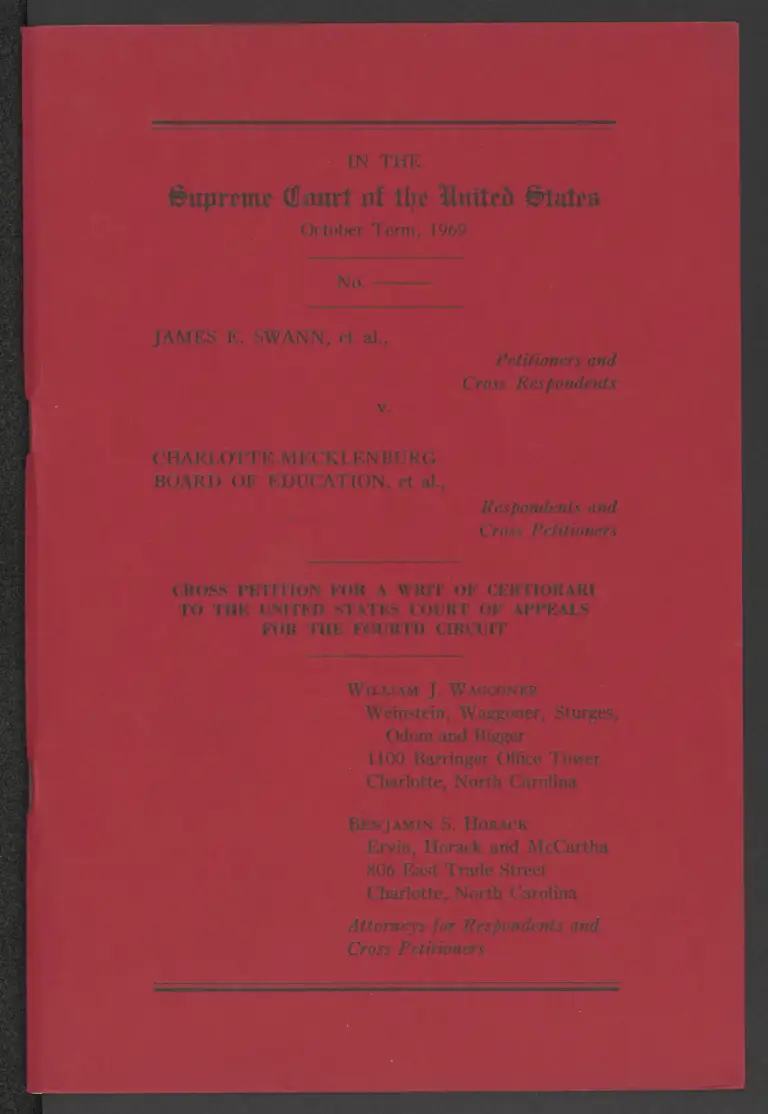
     [||76371417-1c64-4b6d-b4e9-23a3601faf72||] IN THE

Supreme Uourt of the Huited States.
October Tem, 1 969


No.


JAMES E. SWANN, et al.,
a Petitioners and

Cross Respondents

CHARLOTTE-MECKLENBURG

BOARD OF EDUCATION, et al.,
A Respondents and

Cross Petitioners


| CROSS PETITION FOR A WRIT OF CERTIORARI
TO THE UNITED STATES COURT OF APPEALS

FOR THE FOURTH CIRCUIT


- Wizriam J. WAGGONER

Weinstein, Waggoner, Sturges,
Odom and Bigger

1100 Barringer Office Tower

Charlotte, North Carolina

Benjamin S. Horack

Ervin, Horack and McCartha

806 East Trade Street

Charlotte, North Carolina

Attorneys for Respondents and

Cross Petitioners


OpPINIONS BELOW

JURISDICTION

QUESTIONS PRESENTED

CONSTITUTIONAL AND STATUTORY

Provisions INVOLVED

STATEMENT

REASONS FOR GRANTING WRIT:

INTRODUCTION ____

I. The Board Plan Based on Geographic

Attendance Gerrymandered to Achieve Maxi-

mum Racial Mix Established a Unitary System

and the Court of Appeals Joined in the Error

of the Trial Court by Disapproving that Plan 18


A. The Geographic Attendance Zones

B. The Neighborhood School Under the

Board Plan

. The Constitution Does Not Require Racial

Balancing in Schools or Busing of Children

Outside Geographic Attendance Zones to

Effect Such Balancing. The Court of Appeals

Joined in the Error of the Trial Court by

Requiring Such Balancing and Busing

A. Analysis of Racial Balancing and Busing

Imposed Upon Charlotte-Mecklenburg

Schools

. Racial Balancing as Basis for Decision

of Trial Court and Court of Appeals

i


Page

C. Role of School Boards and Administrators

in Controlling the Destiny of Public

Bdueation .............- o.. ... .  '35

D. Racial Balancing and Compulsory Busing

Infringe on the Personal Rights and

Freedom of the Children Involved 39

E. The Compulsory Busing Approved by the

Court of Appeals is Violative of the

Provisions of Section 401(b) and 407(a)

(2) of the Civil Rights Act of 1964

(42 U.S.C, 2000c(b) and 6(a)(2)

which Specifically Prohibits a United

States Court to Order Transportation to

Achieve Racial Balance in Schools 42

Concussion... ~~ : aa dh

Table of Cases:

Alexander v. Holmes, 396 U.S, 19 (1969) 14 43

Beckett v. School Board of the City of

Norfolk, 308 F, Supp. 1274 (E.D. Va, 1969) ._17,22, 33

Bivins v. Bibb County, — F. Supp. —

(ND. Ga, 1970). ah ee 17

Bivins v. Bibb County Board of Education,

419. 241211 (SthW Cit, 1970)... .....36

Briggs v. Elliott, 132 F. Supp. 776

(EDSC, 1933) .. 12

Brown 11, 3401.8. 204 (19353)... 12,13 14 30, 30


Building Service Employees International Union v.

Gazzam, 3301,8, 0014/1950). soo ir. 44

ii;


Page

Carr. v. Montgomery County Board of Education,


PF. Supp. — (M.D.Ala.1970) ....._.. ..___.. . . 34

Carter v. West Feliciana, 396 U.S. 200 (1970)... 14

Cooperv. Aaron, 3551.8. 1 (1958) 0 it. i: 13

Deal v. Cincinnati Board of Education, 324 F. 2d

200 (7th Cir. 1966). .ciieil dovenall dads

Ellis v. Orange County, Florida, — F. 2d —

(5th Cir. 1970) . ile 25

(Goss v, Knoxville, 373 U.S, 633 (1063Y * '.° 13

Green v. New Kent County,

301U.S 43001068)... V4] an ighys Yuwie 95

Hilson v. Washington County, — F. Supp. —

(M.D. Ga'1970Y = ee 0d

Nesbitt v. Statesville, 418 F. 2d 1040

(4th Cir. 1969) 0 Dall led e 07m 30a J) 011 ys

Northcross v. Board of Education of Memphis,

=) 0 (Oth Cir VOTO) i fon ni i i clea

Northcross v. Board of Education,

397 U.S. 232 (1970)... ¥en ne 12

Swann v. Charlotte-Mecklenburg Board of Ed.,

243. F.Supp. 667: (19065). ..& ii ie ini 3

Swann v. Charlotte-Mecklenburg Board of Ed.,

369 F. 2429 (1966). _ 23.15

Thornie v. Houston County, — F. Supp. —

(IM. D.Ga.1970).....cnins iit mel?

United States v. State of Georgia, — F. Supp. —

IND. Ga. 1969)... BL hl A AO 17

iii


Page

United States v. Jefferson County, 380


F.24383 (1967)... 01 ol 0... 13, 35,41, 42

United States v. Montgomery, 395 U. S. 225 (1969) __ 6

1U.S.L.W.3164 (1952) 21

42 U.S.C. Sec. 2000c(b) and 6(a)Y{(2). i <ieervivern3,13,42

North Carolina General Statutes, Sec.

115-116, et seq. .-.. henns S39

North Carolina General Statutes, Sec.

115-176.1 (Anti-Busing law) colitis 45

Bickell, The Supreme Court and the

Ideaof Progress (1970) 0. is. ii. .n: 21

Racial Isolation in the Public Schools—Summary

Report by the Commission on Civil Rights 24

School Desegregation: A Free and Open Society

(116 Cong. Rec. S 4351, Dail Ed.,

March 24,1970)... . 25,33, 36

APPENDIX coos io wom dad ed DIE his A-1

iv


IN THE

Supreme Cmut of the United States
October Term, 1969


No.


JAMES E. SWANN, et al,

Petitioners and

v Cross Respondents

CHARLOTTE-MECKLENBURG
BOARD OF EDUCATION, et al,

Respondents and

Cross Petitioners


CROSS PETITION FOR A WRIT OF CERTIORARI
TO THE UNITED STATES COURT OF APPEALS

FOR THE FOURTH CIRCUIT

Cross petitioners pray that a writ of certiorari issue to

review the judgment of the United States Court of Appeals

for the Fourth Circuit, entered in the above entitled case

on May 26, 1970.

OPINIONS BELOW

The opinions of the courts below directly preceding this

petition culminating in the judgment of the Court of
Appeals dated May 26, 1970, (226a) are set forth in peti-

tioners’ petition for writ of certiorari filed on June 19, 1970.

JURISDICTION

The judgment of the Court of Appeals for the Fourth

Circuit was entered on May 26, 1970, (226a). The juris-

diction of this Court is invoked under 28 U.S.C. 1254(1).

1


2

QUESTIONS PRESENTED

1. Did the Court of Appeals join in the error of the trial

court in rejecting the desegregation plan offered by the

Board of Education where 689 of the black students

would attend schools in which their race was in the minority

and where the remaining 32% of the black students would

attend schools having white ratios of 17% to 1% and these

black students would be taught by a predominantly white

faculty and further where such black students were offered

more generous freedom of transfer than that offered by the

customary majority to minority transfers?

2. Did the Court of Appeals join in the error of the trial

court in rejecting the plan for desegregation of the 76

elementary schools prepared and offered by the Board of

Education, where the plan left no all-black schools, though

nine of 76 schools had white ratios of 1% to 17% and black

students attending those schools would have an untram-

meled right to transfer to any one of the 67 remaining

elementary schools, and upon departure from elementary

schools would be assured of a desegregated education dur-

ing the remainder of their schooling?

3. Did the Court of Appeals join in the error of the trial

court in rejecting (by the trial court’s offering the Board a

“Hobson’s choice”) the Board plan for desegregation of

junior high schools where only one of 21 junior high schools

would have more than a 399% black student ratio and the

remaining predominantly black school would house 758

black and 84 white students and have a predominantly

white faculty by imposing a requirement on the Board to

create nine black satellite districts containing approxi-

mately 2700 black students and assigning them to predomi-

nantly white suburban junior high schools?

4. Did the Court of Appeals join in error of the trial

court in rejecting the Board plan for desegregation of senior


3

high schools where the plan provided that no school would
have more than a 36% black ratio and a predominantly
white faculty by imposing a further requirement upon the

Board that 300 black students residing in four designated
grids would be bused a substantial distance from the north-

western part of the city to a high school serving the extreme
southeastern portion of the county?

5. Did the Court of Appeals join in the error of the trial

court in imposing racial balances in junior and senior high

schools in contravention of Title 42 U.S.C. 2000c(b) and

6(a)(2) (Sections 401(b) and 407(a)(2)) of the Civil

Rights Act of 1964 and North Carolina General Statute
115-176.17

CONSTITUTIONAL AND STATUTORY
PROVISIONS INVOLVED

This case involves the equal protection clause of the

Fourteenth Amendment to the Constitution of the United

States, Section 401(b) and 407(a)(2) of the Civil Rights

Act of 1964 (42 U.S.C. 2000c(b) and 6(a)(2)); (230a)

and Title 28 U.S.C. 2281 et seq. (1964) (233a).

STATEMENT

This school desegregation action was instituted in 1965

and, after hearing, the District Court held this school sys-

tem to be in compliance with the Constitution. Swann v.

Charlotte-Mecklenburg Board of Education, 243 F. Supp.

667 (1965), which holding was affirmed by the Court of

Appeals for the Fourth Circuit in Swann v. Charlotte-

Mecklenburg Board of Education, 369 F. 2d 29 (1966).

Following the Supreme Court decision in Green v. New

Kent County, 391 U.S. 430, 88 S. Ct. 1689 (1968), and

companion cases, the plaintiffs filed a motion for further

relief alleging discrimination in teacher salaries, school


4

plants, facilities and numerous other areas, and in addition,

sought further desegregation. Following hearing on April

23,1969, the United States District Court for the Western

District of North Carolina found:

“Some Board actions found not to be discriminatory.

No racial discrimination or inequality is found in the

following disputed matters:

. . . The use of federal funds for special aid to the

disadvantaged. . . . Use of mobile classrooms. . . . the

quality of school buildings and equipment. . . . Coaching

of athletics. . . . Parent-Teacher association contributions

and activities. . . . School fees. . . . School lunches. . . .

Library books. . . . Elective courses. . . . Individual

evaluation of students. . . . Gerrymandering. . . .” (14a-

18a)

“... Location of schools in Charlotte has followed the

local pattern of residential development, including its

de facto patterns of segregation. . ..” (21a)

“The percentage racial mix. Counsel for plaintiffs say

that since the ratio of white to black students is about

70/30, the School Board should assign the children on a

basis of 709% white and 30% black and bus them to all

the schools. The Court does not feel that it has the power

to make such a specific order.” (Emphasis supplied)

(26a)

The District Court found with respect to the motives

and judgment of the School Board as follows:

“A word about the School Board—The observations in

this opinion are not intended to reflect upon the motives

or the judgment of the School Board members. They

have operated for four years under a court order which

reflected the general understanding of 1965 about the


5

law regarding desegregation. They have achieved a

degree and volume of desegregation of schools apparent-

ly unsurpassed in these parts, and have exceeded the

performance of any school board whose actions have been

reviewed in the appellate court decisions. The Charlotte-

Mecklenburg schools in many respects are models for

others . . . The difference between 1965 and 1969 is

simply the difference between Brown of 1965 and Green

v. New Kent County of 1968. The rules of the game have

changed and the methods and philosophies which in good

faith the Board has followed are no longer adequate to

complete the job which the courts now say must be done
‘now.’ ” (Emphasis supplied) (27a)

Concluding additional affirmative action was required

of the Board, the Court then ordered the Board of Edu-

cation to submit a plan for the complete desegregation of

teachers to be effective for the 1969-1970 school year and

to submit a plan and time table for the desegration of

pupils to be predominantly effective in the fall of 1969

and completed by the fall of 1970. (30a and 31a)

In order that the Court may be advertent to the ardu-

ous problem facing the Board of Education, the follow-

ing information is offered. The Charlotte-Mecklenburg

School System is the largest school system in the Caro-

linas, ranking 43rd largest in the United States and

serving 84,500 students, 299, of which are black and

71% of which are white. The present transportation sys-

tem carries approximately 23,000 students daily on buses.

Each bus averages 1.8 trips each way, each day. The

City of Charlotte comprises 64 square miles, making it

larger than the District of Columbia, and the total county

comprises 550 square miles, having an east-west span of

22 miles and a north-south span of 36 miles. (9a). Ninety-


6

five percent (95%) of the 24,000 black students, or

23,000, reside in the northwestern inner-city quadrant of

the City or on the fringes thereof. (14a).

Following submission of the Board’s first plan for further

desegregation, the Court entered its order of June 20, 1969,

(46a) which found the plan inadequate with reference to

pupil and faculty desegregation. The Board was directed

to submit a plan by August 4, 1969, in accordance with the

April 23, 1969, order.

During the interim, United States v. Montgomery, 395

U.S. 225,89 S.Ct. 1670 (1969) was decided which for the

first time indicated that racial ratios in facutly be im-

posed. In accordance with Montgomery, supra., the Board

of Education proposed a plan for desegregation which

would produce substantial faculty and student desegrega-

tion for the school year 1969-70 and proposed a compre-

hensive computer-assisted study for the purpose of re-

structuring attendance lines for the school years 1970-1971.

It was estimated that the study would require approxi-

mately six months to complete and would be available for

presentation on or about February 1, 1970.

On August 15, 1969, the Court entered an order (58a)

approving the policy statement of the Board, the faculty

desegregation program, the closing of seven all-black inner-

city schools, the re-assignment of students from over-

crowded black schools and local assignment of students

between two schools. In addition, the Court approved in

principle the proposed restructuring of attendance lines and

other factors, but rejected them for lack of specific detail

and time table. The Board was accordingly directed to

present by November 17, 1969, a plan for complete faculty

desegregation and student desegregation for the school

year 1970-1971 (70a). In view of the fact that it was im-


7

possible to complete the computer-assisted restructuring

of attendance lines within the time limited, which would

attain maximum desegregation possible by rezoning,

motion was made by the Board for additional time in which

to present its plan for desegegation, which was denied.

(81a). The District Court gratuitously and without bene-

fit of further evidentiary hearings reversed his previous

findings that segregation in Charlotte was de facto as
follows:

“... There is so much state action imbedded in and

shaping these events that the resulting segregation is

not innocent or ‘de facto’ and the resulting schools are

not ‘unitary’ or ‘desegregated.”” (87a)

In view of the rejection of the motion for the extension

of time, the Board was compelled to present an admittedly

incomplete plan for desegregation on November 17, 1969,

and sought direction from the Court with respect to the

meaning of a “unitary system” and related terms. There-

after, on December 1, 1969, the District Court disapproved

the Board’s plan for further desegregation and directed the

desegregation of faculties on a three-to-one ratio effective

not later than September 1, 1970, and indicated that a

Court consultant would be appointed. (109a). On Decem-

ber 2, 1969, the Court appointed Dr. John Finger, who had

formerly testified as an expert witness on behalf of plain-

tiffs as consultant. In the December 1 order, the Board was

invited to continue working on its plan by the District

Court.

On February 2, 1970, the Board of Education submitted

a plan utilizing computers to achieve a maximum racial

mix of 719 white and 299% black in each school where

possible by restructuring attendance lines. One hundred

(100) of the 103 schools would have a racial mix, leaving


8

only three all-white schools. Sixty-eight percent (68% ) of

the black students would attend schools having less than

40% black population. Thirty-two percent (32%) of the

black students would attend nine elementary and one

junior high schools which would have black ratios of 83%

to 99% black under the Board plan. (123a, 124a, 126a-
128a).

The plan for desegregation submitted by the School

Board on February 2, 1970, included imposition of faculty

ratios of approximately three to one, white predominating,

in each school and proposed implementation of its plan for

the school year 1970-1971 in accordance with the various

court orders. The Board plan would require the in-district

transportation to approximately 5,000 additional students,

who would qualify for such transportation under state law.

The Court consultant’s plan was submitted contem-

poraneously with that of the Board on February 2, 1970,

which effectively adopted in many respects the Board’s

geographic zoning plan and engrafted upon it the features

of pairing of distant elementary schools and creation of

satellite districts in predominantly black inner-city areas

who were assigned to distant predominantly white out-

lying secondary schools.

On February 2, 1970, the Court conducted a hearing

limited to the question of the time required for implementa-

tion and refused to hear any evidence with reference to the

merits of the two plans before the Court. On February 4,

1970, the Board made a motion for hearing on its plan and

for the opportunity to examine the Court consultant who

resides in Rhode Island and beyond the process available

to the Board. In response thereto, the Court permitted a

short hearing severely limited as to time on the following

day and did not direct the consultant to be present for

examination.


9

On the same day, February 5, 1970, the Court entered

its order in which the Court found in part as follows:

“The Board plan, prepared by the school staff, relies

almost entirely on geographic attendance zones, and is

tailored to the Board’s limiting specifications. It leaves

many schools segregated. The Finger plan incorporates

most of those parts of the Board plan which achieve

desegregation in particular districts by rezoning; how-

ever, the Finger plan goes further and produces desegre-

gation of all the schools in the system.

Taken together, the plans provide adequate supple-

ments to a final desegregation order.” (113a)

Although the Court stated, “The order which follows is

not based upon any requirement of ‘racial balance’ . . .”

(115a), the Court then adopted the entire plan of the

Court consultant and thereby directed racial balancing

with reference to the various schools:

A. The Board’s pupil assignment plan for senior high
schools was approved with the condition that the 300 black

students residing in four grids suggested by the Court con-

sultant would attend Independence High School. There-

fore, the Court consultant’s sole recommendation with ref-

erence to high schools was approved although no high

school under the Board plan would house more than a
369% black ratio.

B. With respect to junior high schools, the Board plan

was approved upon condition that the only junior high

school out of 21 which would remain predominantly black

would be desegregated by giving the Board a “Hobson’s

choice” of furnishing transportation and increasing blacks

in attendance at several outlying schools and in default of

rezoning (which had been fully explored), two-way trans-

portation of students (which is cross-busing to which the


10

Board is opposed) or closing the junior high school (whose

classrooms are desperately needed to minimize the already
serious overcrowding which exists at the junior high level),

the Board was directed to implement the Court consultant’s

plan, which provided for establishing nine satellite attend-

ance districts (containing 2,760 students) in inner-city

black areas for attendance at nine distant predominantly

white suburban schools.

C. With respect to elementary schools, the Court adopt-

ed the Court consultant’s plan which utilized the Board’s

rezoning and engrafted upon it the feature of cross-assign-

ment with resulting cross-busing of inner-city blacks in

attendance at nine schools with distant suburban whites

attending 24 schools. Approximately 10,200 students would

be involved in the elementary cross-assignment.

The Board plan contemplated furnishing transportation

only to those students eligible for transportation under

state law and would result in furnishing additional trans-

portation to approximately 5,000 students. The order of

desegregation imposed substantial additional transporta-

tion requirements upon the school system which were

compiled by the transportation office of the school system

as follows:

FINGER PLAN

Additional Students Number of Buses First-Year Cost


23,000 526 $4,199,439.00

BOARD PLAN

Additional Students Number of Buses First-Year Cost

4,935 104 $ 864,767.00

Upon the amendment of the February 5 order, dated

March 3, the Board submitted estimates that additional


11

transportation required by the amended order was as
follows:

Additional Students Number of Buses First-Year Cost

19,285 422 $3,406,687.00

Supplementary findings of the Court dated March 21,

1970, (155a and 157a) reflect a finding that transportation
would be required as follows:


Additional Students Number of Buses First-Year Cost

13,300 138 $1,011,200.00


Extensive objections and exceptions were filed by the

Board with reference to the findings of the Court dated

March 21, 1970, and the Court of Appeals noted that it

was difficult to furnish reliable predictions with respect to

transportation estimates. (193a and 194a)

The Board filed notice of appeal to the Court of Appeals

for the Fourth Circuit on February 25, 1970.

On March 5, 1970, the Court of Appeals stayed imple-

mentation of that portion of the order directing cross-

busing of students and on application to the Supreme Court

of the United States by the petitioners, this Court declined

to disturb the stay order of the Court of Appeals.

The Court of Appeals directed the District Court to

conduct evidentiary hearings with reference to the general

issue of busing and related considerations which resulted

in the supplemental findings of fact dated March 21, 1970

(136a) to which, as noted above, the respondents filed

numerous exceptions.

The District Court stayed implementation of the re-

maining portions of its February 5 order until September
1, 1970.


12

Thereafter, on May 26, 1970, the Court of Appeals for

the Fourth Circuit approved the provisions of the order of

the District Court with reference to assignment of faculty

and assignment of students to secondary schools and re-

versed and remanded for further consideration the assign-

ment of pupils attending elementary schools. (184a).

From this holding, the petitioners and respondents have

applied for writs of certiorari.

REASONS FOR GRANTING WRIT

Introduction

This Court should accept this case for review. It involves

fundamental issues which confront not only Charlotte-

Mecklenburg, but school systems throughout the nation

in their efforts to establish and maintain the unitary system

that the Constitution requires. A review of this case will

bring clearly into focus the practical problems which in

Northcross v. Board of Education, 397 U. S. 232 (1970),

the Chief Justice said ought to be resolved by this Court.

Charlotte-Mecklenburg is typical of school systems,

particularly those involving complex densely populated

urban areas that have been seeking conscientiously to
acquit their affirmative duty to eradicate the vestiges of

previously established dual systems.

For sixteen years, school boards, plaintiffs and the courts

have struggled with the elusive question, “What constitutes

a unitary system?” School boards have been roundly, and

often unjustifiably, condemned for not solving the demands

of Brown II,349 U.S. 294 (1955). It has been a difficult

struggle. A companion case to Brown II, Briggs v. Elliott,

132 F. Supp. 776 (E.D.S.C. 1955), held that although

there was a duty on school boards not to discriminate, there

was no duty to integrate. Although numerous opportuni-

ties were presented, this dictum was never repudiated by


13

the appellate courts until the late 1960’s by the Fifth Cir-

cuit and finally by the Fourth Circuit in Nesbitt v. States-

ville, 418 F. 2d. 1040 (4th Cir. 1969)." Brown II, supra.,

was, therefore, for a long time believed to stand for the

proposition that all schools should be opened to minority

groups and that the overlapping dual zoning be eliminated.

In Cooper v. Aaron, 358 U.S. 1 (1958), interference by

state authorities was put to rest.

After some lethargy, school districts began eliminating

the dual attendance zones which generally resulted in

moderate desegregation by reason of segregated residential

patterns. Desegregation efforts were thwarted by minority

to majority transfers which permitted the races to resegre-

gate. This device was held unconstitutional in Goss v.

Knoxville, 373 U. S. 683 (1963). There, the Supreme Court

gave a new indication of the means to accomplishing a

unitary system by expressing the view that although minor-

ity to majority transfers were condemned, a completely

open freedom of choice might satisfy constitutional de-
mands. The Department of Health, Education and Welfare

under the Civil Rights Act of 1964 and the Fifth Circuit

in its famous Jefferson decree, United States v. Jefferson

County, 380 F. 2d. 385 (1967), embraced freedom of

choice as their answer to the elusive unitary system ques-

tion.

In 1968, this Court in Green, supra, dealing with a small

two-school rural system, held freedom of choice was not

constitutionally prohibited but it was not the answer to

the unitary school system question. The scope of Green,

has been limited to Southern school systems without regard


1Although it may now be recognized that Green v. New Kent
County, 391 U. S. 430 (1968) nullified this dictum, it was not
expressly repudiated so as to be clearly understood.


14

to whether or not desegregation exceeds that of other areas

of the country. Since Green, the desegregation progress

of an enlightened community has been of no concern to

the courts, where the school systems are located in states

formerly imposing a dual system by law. The destruction

of state-enforced dual systems by Brown II has not in

sixteen years resulted in substantial mixing of the races in

schools, North or South, East or West. It has not resulted

in substantial mixing of the races in New York in a span

of 32 years after repeal of its dual school laws or in many

other states where such laws have been repealed for many

more years. Segregation in public schools rests more strong-

ly on factors other than state laws. It is time for the courts

to give recognition to this incontrovertible fact and apply

uniform national standards based upon a rule of reason

containing clearly understood parameters embracing solid

eduction values. After all, the foundation of all successful

desegregation rests upon improvements of education for

minority groups.

Recent pronouncements of the court, Alexander v.

Holmes, 396 U.S. 19 (1969) and Carter v. West Feliciana,

396 U.S. 290 (1970) have been generally addressed to the

question of time. The term “effectively excluded” has

received various interpretations by the courts and requires

immediate clarification.

In its February 2, 1970 plan, the School Board declared

the major thrust of its policy as follows:

“#* * (The) Board of Education firmly believes fur-

ther desegregation of students and professional staff will

contribute to the education and social development of

all children.”

This was not a new policy—but a reaffirmation of the

School Board’s long standing commitment to the proposi-


15

tion that every child in the system—black, white, rich or

poor—is entitled in full measure to a quality education un-

impaired by any restraints or restrictions upon his constitu-

tional rights or upon his opportunity to develop to the full
extent of his capabilities.

Charlotte-Mecklenburg has a pretty good “track record”

in connection with its desegregation efforts. Under the plan

in operation last year (1969-1970), the Charlotte-Meck-

lenburg system achieved a degree of desegregation which

exceeds that attained by most other major systems.”

The plan for desegregation offered by the Board and

rejected by the District Court and the Court of Appeals

provided for attendance of 68% of the blacks at predomi-

nantly white schools, which far surpasses the desegregation

offered by any major school system in this nation. We are

confident that this statement can be made without fear of

contradiction. It therefore appears punitive for a court to

impose a racial balance upon a system which has produced

such an exemplary plan that {ar exceeds the performance of

the school systems noted above.

In Swann v. Charlotte-Mecklenburg, 369 F. 2d 29 (4th

Cir. 1966), the Court of Appeals approved the new attend-

ance zones adopted by the School Board. In its April 23,


In Charlotte-Mecklenburg, 65% of the blacks during the school
year 1969-70, attended predominantly black schools (165a). Com-
parable information derived from HEW figures reflects the follow-
ing percentage of the black students at predominantly black schools:
New York City, 86%; Los Angeles, 96% ; Detroit, 91% :; Phila-
delphia, 90% ; Milwaukee, 88%; San Francisco, 54% ; Boston,
77% ; and Cincinnati, 78%.

The percentage of black students attending schools housing
95% to 100% black students in other cities is as follows: Balti-
more, 76% ; Cleveland, 80% ; Washington, 89% ; St. Louis, 86% ;
Newark, 75%; Buffalo, 61%; Gary, Indiana, 80%. In Chicago,
76% of the blacks attend schools less than 2% white. Source,
United Press International Release, May 17, 1970.


16

1970 order, the District Court acknowledged that Char-

lotte-Mecklenburg had been a leader in facing up to the

responsibility of providing quality education on a desegre-

gated basis for all children—white and black—but advised

the Board that since Green, “the rules of the game have

changed, and the methods and philosophies which in good

faith the Board has followed are no longer adequate.” (27a

and 28a).}?

As this case progressed in the District Court during the

intervening months between April, 1969, and February,

1970, it become increasingly evident that there were some

fundamental conceptual differences between the plaintiffs

and the trial court on the one hand and the School Board

on the other with respect to the identity and definition of
the necessary ingredients of the “unitary school system”

that the mandate of the Constitution requires.

The School Board earnestly was seeking to know and

understand what was required of it. In its plan submitted

November 17, 1969, the Board sought clear-cut directions

from the trial court by asking it to answer various basic

practical questions that were perplexing the Board regard-

ing the nature and composition of a “unitary school sys-

tem” and the necessary or permissible ingredients of an

acceptable plan.

The School Board was not alone in its quandry; other

courts expressed their concern regarding the resolution of

the practical problems involved in evaluating the efficacy

of desegregation plans and the need for standards that

define the steps required of local school districts in order

to acquit their affirmative duty to establish unitary sys-


3A pertinent historical observation: In 1958, the Charlotte City
School Board on its own initiative was the first in the South to
pioneer integration — albeit on a token basis.


17

tems.* Our own trial court did not share the doubts or uncer-

tainties expressed by these other courts. Boiled down to its

simplest terms, it was the trial court’s view that a school

system is not a unitary one if it has a single black or pre-

dominantly black school. Local conditions, practical prob-

lems, cost, educational considerations, natural boundaries

or the size and complexity of the system were regarded as

irrelevant by the trial court.

On appeal, the Court of Appeals, contrary to the trial

court, has held in this case that not every school in a unitary

system must be integrated and adopted “a test of reason-

ableness—instead of one that calls for absolutes.” (189a).

On review, this case will present a clear-cut opportunity

for this Court to determine whether the Constitutional

mandate regarding the abolition of dual school systems

and the establishment of unitary ones permits the applica-

tion of a “Rule of Reason” or whether the Constitution

requires the shifting of children “by the numbers” irre-

spective of the size and complexity of the system, costs,

disruptions, educational considerations, and the host of

other practical matters with which the school boards and

administrators must cope in fashioning an effective school

system and the day-to-day operations of their schools.

On June 24, 1970, the cross petitioners filed with this

Court a response to the petitioners “Motion to Advance”,

in which the cross petitioners joined in a request that this

Court grant certiorari and render its decision prior to the


“For example, see Bivins v. Bibb County, — F. Supp. — (N. D.
Ga. Jan. 21, 1970); United States v. State of Georgia, — F. Supp. —
(N. D. Ga. Dec. 17, 1969); Beckett v. School Board of the City of
Norfolk, 308 F. Supp. 1274 (E. D. Va. Dec. 20, 1969); Thornie v.
Houston County, — F. Supp. — (M. D. Ga. Jan. 21, 1970); Hilson

v. Washington County, — F. Supp. — (M. D. Ga. Jan. 28, 1970);
Northcross v. Board of Education of Memphis, — F. 2d — (6th Cir,
Jan. 12, 1970).


18

opening of schools next fall.” We sincerely hope that this

can be accomplished. Prompt resolution of the issues pre-

sented by this case will greatly assist not only Charlotte-

Mecklenburg, but other courts and school systems every-

where to conform their desegregation plans to the stand-

ards established by this Court in this case and to minimize

the costly disruptions that will be the result of continued

uncertainties or misconceptions regarding the necessary

ingredients of a unitary system and the means of estab-

lishing and maintaining one.

In the portions of this cross petition which follow, the

cross petitioners set forth a discussion of the questions

presented for review.

I.

The Board Plan Based on Geographic Attendance Zones

Gerrymandered to Achieve Maximum Racial Mix

Established a Unitary System and the Court of

Appeals Joined in the Error of the Trial Court

by Disapproving that Plan.

One of the basic issues involved in this case is whether

a desegregation plan based on comprehensively restruc-

tured geographic attendance zones satisfies the Constitu-

tional requirement of a unitary system, in a situation

where these zones are established to promote the maxi-

mum amount of desegregation possible by the employment

of this technique. This issue also involves a consideration

of the extent to which a School Board may employ this

technique as a means of preserving some semblance of the


Cross petitioners are advised that the Norfolk, Virginia and
Little Rock, Arkansas schools are seeking review of their cases in
this Court which will offer a broad spectrum in which to resolve this
national problem.


19

neighborhood school concept which it believes to be
beneficial.

A. The Geographic Attendance Zones.

To achieve maximum desegregation of the 103 schools

in the Charlotte-Mecklenburg System, the February 2,

1970, School Board plan is based exclusively on geographic

attendance areas which ignore natural boundaries. Maps

comprising a part of the Board plan (Exhibits A, C and

G attached to February 5, 1970 Order) show attendance

zones of the schools at each of the three instructional

levels.” These attendance zones were grotesquely gerry-

mandered by extending finger-like corridors into and out

of the densely populated, predominantly black inner-city

areas to obtain sufficient black and white children to

create a favorable racial composition at the schools in-
volved.

Under the Board plan, 100 of the 103 schools in the

Charlotte-Mecklenburg System would have some degree

of racial mix, leaving only three all-white schools. Sixty-

eight percent (689% ) of the black students would attend

93 schools with less than 409, black student bodies—leav-

ing the remaining 329% of the black pupils in the 10 re-

maining schools having white ratios of 17% to 19.

These 10 predominantly black schools remained in spite

of the Board’s best efforts to achieve a more satisfactory

racial mix in them by means of the drastically gerry-


The Court is reminded that these maps, plans, appendix and a
book containing supporting data were furnished to the Court in
connection with petitioners’ application for stay which was denied
on March 16, 1970.

“See appendix attached to this petition for statistical data pertain-
ing to the Board plan.


20

mandered attendance lines. Of these 10 schools 9 are

elementary® and 1 is a junior high school.’

In addition, the Board plan specifically provides that

the faculty of each school shall be assigned so that the

ratio of black teachers to white teachers in each school

will be approximately the same as the ratio in the entire

system (i.e., a ratio of about 1 to 3). The racial compo-

sition of its faculty is educationally beneficial and will

contribute substantially to thorough integration of the

103 schools of the system.

The remaining predominantly black schools are located

in the inner-city core which is populated for the most

part by blacks, many of whom due to shifting housing

patterns had moved into previously white areas. In its

Findings of Fact (146a), the trial court acknowledged:

“Both Dr. Finger and the school board staff appear to

have agreed, and the court finds as a fact, that for the

present at least, there is #o way to desegregate the all-

black schools in Northwest Charlotte without providing

(or continuing to provide) bus or other transportation

for thousands of children. All plans and all variations

of plans considered for this purpose lead in one fashion

or another to that conclusion.” (Emphasis supplied)

Brown II, 349 U. S. 294 (1955) recognized that an

acceptable desegregation plan may employ geographic re-


$Under the Board plan, these 9 elementary schools have the fol-
lowing black-white ratios: Bruns Ave. (90-10); Marie Davis (83-
12); Double Oaks (99-1); Druid Hills (96-4); First Ward (99-1);
Lincoln Heights (99-1); Oaklawn (99-1); University Park (85-
15); and Villa Heights (83-17). (A Plan for Student Desegrega-
tion — Systems Associates, Inc., page 31.)

9Under the Board plan, Piedmont Junior High has a black-white
ratio of 90% (B)-10% (W). (A Plan for Student Desegregation
—Systems Associates, Inc., Page 31.)


21

zoning if done fairly and in good faith to effect “a revision

of school districts and attendance areas into compact units

to achieve a system of determining admission to the public

schools on a non-racial basis.” See also Green, supra.

A consideration of the pro-desegregation gerrymandered

geographic zones of the Board plan excludes any inference

that they were formulated for any purpose other than a

conscious one to promote maximum desegregation of the

Charlotte-Mecklenburg schools.

The desegregation achieved by the geographic zones of

the Board plan is supplemented in another very material

respect: A majority to minority transfer provision which

allows any black child in a school having more than 30%

of his race to attend one that is less than 309% black, but

permits a white child to transfer only if the school he is

attending has more than 709% of his race and the one to

which he seeks assignment is less than 709, white. The

Court of Appeals correctly inferred that these transfer

provisions were purposely designed by the Board to pro-

mote stable desegregation in the schools by preventing

“tipping” or resegregation (199a). The Court of Appeals’


10A pertinent historical note is made by Alexander M. Bickell in
his recent book, The Supreme Court and the Idea of Progress:

“At the first argument of Brown v. Board of Education in
1952, Justice Frankfurter asked the future Justice Thurgood
Marshall, then counsel for the Negro children, whether a
decision in his favor would ‘entitle every mother to have her
child go to a non-segregated school?” Mr. Marshall replied
in the negative. ‘What will it do?’ Justice Frankfurther pur-
sued. Mr. Marshall replied: ‘The School Board, I assume
would find some other method of distributing the children by
drawing district lines.” The only requirement would be, Mr.
Marshall added, that the lines be drawn ‘on a natural basis,’
and not be gerrymandered so as to enclose or exclude Negro
neighborhoods.” Bickell, The Supreme Court and the Idea of
Progress, p. 117 (1970). See also 1 US.L.W. 3164 (1952).


22

determination that these transfer provisions are unduly

restrictive is unwise and unwarranted. The restrictions im-

posed are an effective method of preserving the stable

desegregation achieved by the Board’s geographic zones

at all three instructional levels and will allow more blacks

the opportunity to transfer than the usual majority to

minority transfer.

The Court of Appeals misconceived the beneficial pur-

pose sought to be achieved by the 70-30 transfer provision

as well as the 60-40 ratio of white to black utilized in-

itially in designing attendance zones. These limitations

were imposed for the sole purpose of assuring stability of

the desegregation effort. In Beckett v. Norfolk, supra,

the District Court quoted with approval the views of Dr.

Thomas F. Pettigrew, a member of the Advisory Commit-

tee to the Coleman Report:

“In sum, Pettigrew assigns five reasons why the ratio

of 70% white to 30% Negro, with a maximum of

609% white and 409 Negro, points to long-range suc-

cess. His testimony is quoted:

‘(1) That I believe it will minimize the middle class

flight, if you want to call it that. I don’t think it ex-

cludes it completely, that’s why I use ‘minimize.’

(2) That I think it gives you a good chance for in-

tegration, not just desegregation, therefore maximizes

black achievement.

(3) Maximizes or should maximize white achieve-

ment.

(4) It should maximize other positive benefits, non-

achievement benefits, like college aspirations, occu-

pations aspirations, interracial—better interracial

attitudes and behavior on the part of blacks.


23

(5) The same non-achievement benefits on the part

of whites.” ”

In disapproving the geographic plan of the School

Board, the Court of Appeals admonished the Board “to

explore every method of desegregation, including rezon-

ing with or without satellites, pairing, grouping, and

school consolidation.” (199a). The Board had previously

considered the feasibility of such techniques and con-

cluded that a plan based solely on non-discriminatory geo-

graphic attendance zones would best serve the Charlotte-

Mecklenburg System, the cause of education and the pro-

motion of stable desegregation.

We applaud the Rule of Reason espoused by the Court

of Appeals in desegregation cases, but question whether

the application of that Rule may properly veto a geo-

graphic plan such as the one presented by the School

Board. A review of this case will afford this Court an

opportunity to resolve this as yet unresolved problem for

the guidance of not only Charlotte-Mecklenburg, but

other school systems who await an authoritative declara-

tion of the scope and limits of techniques to be employed

in fulfilling the mandate of the Constitution that no child

is to be “effectively excluded” from any school on account

of his race or color.

B. The Neighborhood School Under the Board Plan.

The neighborhood school concept is one that the Board

considers to be beneficial to the children and enhances

the support that comes when children and parents identify

themselves with a particular school and its programs.

Fragmentation of this type of association is not in the

best interest of our schools.


24

In its April 23, 1969, Order, the District Court volun-

teered its own educational philosophy in opposition to the

neighborhood school concept (22a):

“Today people drive as much as forty or fifty miles

to work; five or ten miles to church; several hours to

football games; all over the country for civic affairs of

various types. The automobile has exploded the old-

fashioned neighborhood. * * * If this court were writing

the philosophy of education, he would suggest that edu-

cators should concentrate on planning schools as edu-

cational institutions rather than as neighborhood pro-

prietorships. * * *”

To the contrary, all too many of our present day rela-

tionships have become institutionalized and depersonal-

ized. We believe this trend to be unwholesome. Close rela-

tionships among teachers, parents and children should to

the maximum extent be encouraged and undergirded. The

neighborhood school plays an important part in fostering

such relationships—particularly at the elementary level

where the ties between home, school and after-class activi-

ties are an important part of the educational process of

children in their early formative years. In a metropolitan

system such as ours the ideal may not always be achieved.

This should not be a reason for dismantling and abandon-

ing the neighborhood school.

From the beginning there has been this marked contrast

between the views of the trial court and those of the

Board regarding the pertinence of the neighborhood

school." The School Board responded to the pressure of


HGeographical zoning is the common method of determining
school attendance and the neighborhood school is the predomi-
nant attendance unit. Racial Isolation in the Public Schools —
Summary of a Report by the Commission on Civil Rights, page 3,
(March 1967).


25

the trial court when it submitted its February 2, 1970

plan—a plan which retained, but severely strained, the

principle of the neighborhood school.

The Fifth Circuit has approved a neighborhood school

plan as satisfying the constitutional mandate for the es-

tablishment of a “unitary system.” Ellis v. Orange County,

Florida, F.2d (5th Cir. 1970); Deal v. Cin-

cinnati Board of Education, 324 F. 2d 209 (7th Cir. 1966)

succinctly stated the case for the neighborhood school:


“Appellants, however, pose the question of whether the

neighborhood system of pupil placement, fairly admin-

istered without racial bias, comports with the require-

ments of equal opportunity if it nevertheless results in

the creation of schools with predominantly or even ex-

clusively Negro pupils. The neighborhood system is in

wide use throughout the nation and has been for many

years the basis of school administration. This is so be-

cause it is acknowledged to have several valuable as-

pects which are an aid to education, such a minimization

of safety hazards to children in reaching school, econ-

omy of cost in reducing transportation needs, ease of

pupil placement and administration through the use of

neutral, easily determined standards, and better home-

school communication.”

In his policy statement of March 24, 1970, entitled

SCHOOL DESEGREGATION : A Free and Open Society

(116 Cong. Rec. S4351, Daily Ed., March 24, 1970), the

President of the United States addressed himself at length

and in depth to the important role that the neighborhood

school plays in the education of our public school children.

He said in part:

“In devising local compliance plans, primary weight

should be given to the considered judgment of the local


26

school boards—provided they act in good faith, and

within Constitutional limits.

The neighborhood school will be deemed the most ap-

propriate base for such a system.

Transportation of pupils beyond normal geographical

school zones for the purpose of achieving racial balance

will not be required.”

As previously noted, the trial court quite obviously dis-

agreed with the import of the President’s policy state-

ment. The Court of Appeals, although not addressing itself

per se to the neighborhood school concept, nevertheless

disapproved the geographic zones at all three instructional

levels which the Board in its considered judgment had

proposed to achieve a unitary system while retaining the

basic benefits of the neighborhood school.

On review, this Court should clearly address itself to

the extent that the neighborhood school may be retained

and employed as part of a fairly administered non-dis-

criminatory plan for the establishment of a unitary

system.

IL.

The Constitution Does Not Require Racial Balancing

in Schools or Busing of Children Outside Geographic

Attendance Zones to Effect Such Balancing.

The Court of Appeals Joined in the Error

of the Trial Court by Requiring Such

Balancing and Busing.

As previously noted, we approve the test of reasonable-

ness adopted by the Court of Appeals—instead of one that

calls for absolutes. Such a test is consistent with the

equitable principles elucidated in Brown 11, which made


27

it clear that desegregation plans and the means of imple-

menting them should take into account a variety of local

problems and conditions—including by implication those

specifically itemized by the Court of Appeals (age of

pupils, board resources, cost, effect of busing on traffic

and the distance and time for transportation).

We agree with the Court of Appeals that the applica-

tion of the Rule of Reason requires that school boards

must use all reasonable means to integrate their schools

and that, if these efforts prove unavailing, a system may

nevertheless be unitary even though an “intractible rem-

nant of segregation” and some predominantly black

schools remain.

Further, we agree that transportation may be employed

on a ‘reasonable’ basis as a legitimate tool to effectively

desegregate an otherwise dual system. However, this still

leaves open to question the circumstances under which and

the purposes for which busing may be or should be im-

posed upon a school system.

The net effect of the trial court order of February 5,

1970, was to require racial balancing at all three instruc-

tional levels and the busing necessary to implement it—

regardless of cost or disruptions. The net effect of the

Court of Appeals decision was to require racial balancing

at the junior and senior high levels and to authorize it at

elementary level—tempered only by its test of reasonable-

ness with reference to the amount of busing involved.

We do not believe that the mandate of the Constitu-

tion requires racial balancing nor compulsory busing out-

side of normal attendance zones to achieve such balancing,

assuming, of course, that the attendance areas are fairly

drawn so as to maximize desegregation.


28

The circumstances of this case and the decisions of the

trial court and Court of Appeals regarding the extent to

which racial balancing and compulsory busing may or must

be required are basic unresolved problems that are

plaguing not only Charlotte-Mecklenburg, but courts and

school systems everywhere. The sooner these problems are

resolved, the sooner the costly uncertainties and disrup-

tions in the field of school desegregation will be minimized

or dispelled and school boards and administrators can get

on with their primary task of providing quality education

for all children, black and white. We urge this Court to

take the opportunity afforded by this case to cope with

these issues.

A. Analysis of Racial Balancing and Busing Imposed

Upon Charlotte-Mecklenburg Schools.

At the heart of the controversy involved in this case

is the lawfulness of the trial court’s February 5, 1970,

order requiring long distance busing in the senior high,

junior high and elementary schools. In order to highlight

the implications of the decisions of the trial court and the

Court of Appeals with respect to balancing and busing, we

discuss the problems and issues involved at each of the

three instructional levels.

Senior High Schools

The Board’s pupil assignment plan for senior high

schools effectively desegregated each of the ten high

schools; nine of them would have black ratios of 17%-

36%. The student body of the remaining school, Inde-

pendence High, would be 29% black. This plan was adopted

by the court consultant and the trial court with one excep-

tion: A requirement was engrafted upon the Board plan

that 300 black students residing in the inner core of the


r
o


29

City must be bused from the area of their residence

through the center city traffic a distance of about 12

or 13 miles to Independence High School located in white

suburbia. This arrangement in turn was approved by the

Court of Appeals as a “reasonable” means of eliminating

Independence as an almost totally white school. The

Court of Appeals observed that the bus mileage involved

for the black youngsters was about the same as the

average one-way bus route of others attending that school

—but neglected to take into account the fact that the

existing bus routes were primarily in rural and suburban

areas rather than in the congested inner-city areas which

would be traversed by the 300 black students.

Under the plan as proposed by the Board, these 300

children would have attended a thoroughly desegregated

high school having a racial composition of 369, black and

649 white. The only purpose served by the court directed

shifting of these 300 was to make a white school less

white.

We do not think that the Constitution requires this

racial balancing nor the busing necessary to implement it.

Neither do we feel these requirements fall within the

purview of the Rule of Reason.

Junior High Schools

The Board plan proposed to restructure the attendance

lines of the 22 junior high schools so that all but one of

them would have not more than 389, black students. In

spite of the Board’s best efforts, the one remaining school

(Piedmont Junior High) housing about 840 pupils was

left 909% black and 109, white. In order to reduce the

percentage of blacks in this one school from 90% (758

pupils) to 329% (243 pupils) the court consultant re-


30

shuffled the Board’s proposed attendance zones for the

junior high schools and provided for satellite busing of

1,372 additional (total of 2,760) inner-city black young-

sters to nine predominantly white suburban schools. This

proposal of Dr. Finger was approved by the trial court

and the Court of Appeals.

By way of summary, the restructuring the Board’s

attendance lines and the busing of 1,372 additional black

children were directed in order that the black student

body at Piedmont would be reduced by 515 students.

We do not think that this dislocation of 1,372 additional

black pupils, nor the cost of busing required to accomplish

this racial balancing, can stand up under the test of rea-

sonableness or the requirements of the Constitution.

Elementary Schools™

The most burdensome part of the trial court’s order

was the long distance cross-busing of about 10,200 ele-

mentary children to eliminate the nine predominantly

black inner-city schools by clustering them with 24 pre-

dominantly white suburban schools—requiring the busing

of 5,100 black first, second, third and fourth graders to

the white schools and 5,100 white fifth and six graders

to the black schools. A schematic portrayal of the cluster-

ing and cross-busing ordered by the trial court follows

on the next page. The particulars regarding the number

and cost of the buses required to effectuate this arrange-

ment are set forth in the opinion of the Court of Appeals

(191a, 192a) and will not be repeated here."


13The 76 elementary schools referred to by the Court of Appeals
(191a) includes four child development centers and learning
academy. The remaining 72 schools are conventional elementaries.

- 14There is a marked disparity between transportation cost esti-
mates of the school staff and those set forth in the trial court’s


31

A Maze of Bus Routes to Integrate Charlotte Schools


=

Copyright © 1970, U. S. News & World Report, Inc.


Under its test of reasonableness, the Court of Appeals

properly held that, based on the trial court’s estimate, the

resulting increase of 399, in the number of elementary

children bused and 32% in the present bus fleet was too

extensive and too onerous. The Court of Appeals reversed

the trial court’s order with reference to this phase of the

plan and remanded with instructions that the Board con-


Supplementary Findings of Fact (152a-157a), which drastically
discounted those of the administrators and minimized the rele-
vance of the cost increases for administration, bus parking, mainte-
nance, driver education and similar items. In this opinion, the Court
of Appeals set forth both sets of figures and observed that the
findings of the district court and the evidence submitted by ‘the
Board rest on many variables (193a).


32

sult with HEW and consider methods other than geo-

graphic attendance areas, including rezoning with or with-

out satellites, pairing, grouping and school consolidation.

In its remand, the Court of Appeals directed that any

new elementary plan approved by the trial court be put

into effect next September. We reiterate our fervent hope

that this Court will give appropriate directions before the

Board is faced with the disruptions and expenditures that

may ultimately prove to be unnecessary.

B. Racial Balancing as Basis for Decision of Trial Court

and Court of Appeals.

The trial court’s February 5, 1970, order begins with

the assertion: “The order which follows is #ot based on

any requirement of ‘racial balance.’” (Emphasis sup-

plied) (115a). That it was the obvious purpose of the

trial court, not only to eliminate each black school, but

also to eliminate all-white schools by requiring a racial

mix to make them less white is readily apparent from the

following excerpt from Paragraph 12 of its December 1,

1969, Order (105a):

“* * * (T')he Court will start with the thought, orig-

inally advanced in the Order of April 23, that efforts

should be made to reach a 71-29 ratio in the various

schools so that there will be no basis for contending

that one school is racially different from the others, but

to understand that variations from the norm may be

unavoidable.”

Further, Paragraph 13 of the trial court’s February 5,

1970, order (118a) not only requires an initial establish-

ment of racial ratios in the various schools but also im-

plementation of a continuing program “computerized or


33

otherwise” of assigning pupils throughout the school year

“for the conscious purpose of maintaining each school

* * * in a condition of desegregation.”®

This requirement that children be reshuffled periodically

to maintain prescribed ratios makes of our children un-

witting pawns in a colossal numbers game.

Although the majority of the Court of Appeals did not

expressly confirm or deny that it was engaging in racial

balancing (albeit tempering the absolutism of the trial

court with its own rule of reasonableness), Bryan, Circuit

Judge, in his dissent made his own appraisal of the main

thrust of the majority’s decision (215a-217a):"

“The Court commands the Charlotte-Mecklenburg

Board of Education to provide busing of pupils to its

public schools for ‘achieving integration’. (Accent ad-

ded) ‘(A)chieving integration’ is the phraseology used,

but actually, achieving racial balance is the objective.

Busing to prevent racial imbalance is not as yet a Con-


The likely results of such a program were described in
Beckett v. School Board of City of Norfolk, supra.:

“If such a mandate requires the mixing of racial bodies in
each and every school building, irrespective of any local
problems confronting the School Board, the answer is obvious.
Under such circumstances racial balancing, or some system
approximating same, must be ordered, and it would be a
waste of time and effort to file plans which may be education-
ally beneficial to the children. The Civil Rights Division
conceded, in argument, that any approach to racial balancing
would annually require a constant shuffling and reshuffling of
children throughout the school system. It is agreed by all that
such a shuffling process is most detrimental to children.”
(Emphasis supplied)

16See also President Nixon’s policy statement of March 24, 1970,
entitled SCHOOL DESEGREGATION: A Free and Open Society,
supra.


34

stitutional obligation. Therefore, no matter the prior or

present utilization of busing for this or other reasons,

and regardless of the cost considerations or duplication

of the bus routes, I think the injunction cannot stand.

Without Constitutional origin, no power exists in the

Federal courts to order the Board to do or not to do

anything. I read no authority in the Constitution, or in

the implications of Brown v. Board of Education, 237

U. S. 483 (1954), and its derivatives, requiring the au-

thorities to endeavor to apportion the school bodies in

the racial ratio of the whole school system.

The majority opinion presupposes this racial balance,

and also busing to achieve it, as Constitutional impera-

tives, but the Chief Justice of the United States has

recently suggested inquiry on whether ‘any particular

racial balance must be achieved in the school; . . .

(and) to what extent transportation may or must be

provided to achieve the ends sought by prior holdings

of the Court’ > = *

I would not, as the majority does, lay upon Charlotte-

Mecklenburg this so doubtfully Constitutional ukase.”

(Emphasis by Judge Bryan).

The concerns and dissent of Judge Bryan find expres-

sion in earlier cases. For example, in Carr v. Montgomery

County Board of Education, — F. Supp. — (M.D. Ala.

1970):

“Plaintiffs’ objections * * * appear to be based on a

theory that racial balance and/or student ratios as op-

posed to the complete disestablishment of a dual system

is required by the law. Such is not this Court’s concept

of what the law requires. Complete disestablishment

of the dual school system to the extent that it is based


35

on race is required. While pairing of schools may some-

times be required to disestablish a dual system, the

pairing of schools or the busing of students to achieve

a racial balance, or to achieve a certain ratio of black

and white students in a school is not required by law.

kx 7 (Emphasis supplied)

And even more succinctly in the dissent of Judge Gewin

(Bell, J., concurring) in U. S. v. Jefferson County Board

of Education, 380 F. 2d. 385, 403 (5th Cir. 1967):

“* * * No consideration is given to any distinction in

any of the numerous school systems involved. Urban

schools, rural ones, small schools, large ones, areas

where racial imbalance is large or small, the relative

number of Negro and white children in any particular

area, or any of the other myriad problems which are

known to every school administrator, are taken into

account. All things must yield to speed, uniformity, per-

centages and proportional representation. There are no

limitations and there are no excuses. This philosophy

does not comport with the philosophy which has guided

and been inherent in the segregation problem since

Brown II. As the Court there stated:

‘Because these cases arose under different local con-

ditions and their disposition will involve a variety of

local problems, we required further argument on the

question of relief.’ (340 1. S. p. 298, 75S. Ct. p.

755)” (Emphasis added).

As suggested by Circuit Judge Bryan, it would be in

order for this Court to address itself to this as yet unre-

solved problem.

C. Role of School Boards and Administrators in Con-

trolling the Destiny of Public Education.


36

“In devising local compliance plans, primary weight

should be given to the considered judgment of local

school boards—provided they act in good faith, and

within Constitutional limits.” President Nixon’s March

24, 1970, policy statement entitled SCHOOL DESEG-

REGATION : A Free and Open Society, supra.

If it were otherwise, the admonition of Judge Coleman in

his dissenting opinion in Bivins v. Bibb County Board of

Education, 419 F. 2d. 1211 (5th Cir. 1970), is pertinent:

“Some of these days, the Courts are going to have * * *

to free themselves of their tragic failures in the role of

school administrators and get back to their primary

functions.”

As expressed in its February 2, 1970, plan, it was the

considered judgment of the Charlotte-Mecklenburg School

Board that the benefits to be obtained from the use of

extensive transportation to eliminate the 10 remaining

black schools previously referred to would be far out-

weighed by the resulting burdens, inconvenience and cost:

‘k * x Buyssing in a school system as large as the

Charlotte-Mecklenburg System is at best an expensive

and complex operation. It is acknowledged that a large

number of children are already being bussed to and

from school. However, the burden, expense, hardship,

inconvenience, hazards, expenditures of unproductive

time and added administrative problems occasioned by

any bussing program should be minimized. * * * The

Board cannot justify on any reasonable basis the very

substantial additional cost and burden of the compul-

sory bussing that would be required for the sole purpose

of effecting a desired racial mix in the remaining 10

black schools. Under the best arrangement, the Board

could envision to eliminate these black schools, massive


37

cross-bussing would require the transportation of about

10,300 black and white children, 5,150 into and 5,150

out of the inner-city at the elementary level and 590

into and 590 out of the inner-city at the secondary

level. This involuntary bussing would involve an ap-

proximate 15-mile trip each way (30 miles round trip)*’

for each student moved through the heart of the busi-

ness and residential sections of the City. * * * A plan

that generates unnecessary transportation costs and

occasions unnecessary burdens and inconveniences for

parents and children alike would jeopardize the public

support which provides the tax and bond money upon

which our schools are totally dependent for financing

the already high cost of education. * * * The burden of

extra bussing that would be required to desegregate

each of the 10 remaining predominantly black schools

would fall primarily on elementary children. The major

impact of this burden would be imposed upon children

who, because of their tender years, are the most illogical

candidates to bear this burden.”

The Charlotte-Mecklenburg School Board is an elective

body and, as such, is charged with the responsibility of

exercising its own judgment regarding the needs of the

System and the best interest of its children.

It is the School Board’s duty to determine whether the

dollars allocated to it by other elective officials (the Board

of County Commissioners for Mecklenburg County) for

the education of our children shall be spent for books or

buses. 1t is for the Board to determine whether the exist-

ing transportation system shall be expanded or contracted,

whether it is educationally good or bad to stagger the


"Compare findings of trial court; 8,000 students cross bussed,
7 miles one way and 14 miles round trip. (155a).


38

opening and closing of schools at any particular grade

level, whether after school activities will suffer, whether

inconvenience and disruptions to children and parents are

justifiable, whether overloaded buses are acceptable or

safe, whether the time of children in transit is justifiable

and how the host of other value judgments and policies

shall be made to administer effectively a large complex

metropolitan school system charged with awesome re-

sponsibility of providing 84,500 school children in 103

schools with a quality education.

Books, bricks and buses (and all that they imply) are

part of the tools to be used in the educational process.

How and when these tools are used must be left to the

good faith decision of local school boards or the boards

should be disestablished and the administration of school

systems should be turned over to the courts.

The fact that now the Charlotte-Mecklenburg school

system transports 23,000 children with 280 buses, the

opening and closing of some of its schools are staggered,

in some schools after-school activities are impaired, some

school buses travel over congested traffic arteries, some

elementary children wait for the school bus by the side

of the road at 6:30 in the morning and others get home

at 5:00 in the afternoon, some buses are overloaded and

some children must stand up, some buses are unsound and

should be replaced—is no answer to the administrative

and educational problem of how much of this is desirable,

tolerable or necessary in a system as large and complex as

Charlotte-Mecklenburg. A court mandate that edicts racial

halancing and forced busing supplants the value judg-

ments of the elected school board and the educators on its

administrative staff. An overdose of judicial paternalism

and control will ultimately sign the death warrant for

public education.


39

We hope this Court will evolve standards and guidelines
for desegregation plans sufficiently clear and definite that

courts will not be tempted or required to rely on their

personal educational and social philosophies.

D. Racial Balancing and Compulsory Busing Infringe

on the Personal Rights and Freedom of the Children
Involved.

In its February 2, 1970, plan, the School Board con-

cluded with a statement of its conviction that its duty is to

protect the rights of all children:

‘k * * The Board understandably is prone to exercise
caution lest, in protecting the rights of some of its citi-

zens, it tramples on the rights of others in the absence

of a clear mandate from the Supreme Court.” (Emphasis

supplied)

The caution of the Board was well-founded. We believe

that the busing requirements of the trial court and the

Court of Appeals will violate the individual rights guar-

teed by the Fourteenth Amendment of those blacks and

whites caught up in the forced mass movement of children

away from their neighborhoods and out of their normal

attendance zones for the sole purpose of achieving racial

balancing.

It is obvious that a School Board must necessarily have

wide latitude in the establishment of attendance zones for

orderly administration of the various schools in its system

and that, if these zones are fairly conceived on a non-

discriminatory basis, the children may be compelled to

attend the school to which they are assigned under the

applicable compulsory attendance laws. (See N.C.G.S.

Secs. 115-116 et seq.) Absent an unlimited freedom of

choice arrangement (which the Charlotte-Mecklenburg

Board has not proposed), the right of a child to go to a


40

particular school is, of course, not absolute, but circum-

scribed by the inherent power of a School Board to make

reasonable attendance assignments to conform to the needs

of the school system and the community it serves.

Whether or not the Board itself could lawfully have

required cross and satellite busing to effect the compulsory

mass movement of children is an open question. But the

resolution of that question is not before this Court—for the

reason that the Board did not choose to go to this extreme.

The point now at issue is whether the orders of the trial

court and Court of Appeals infringe on the individual con-

stitutional rights of the children and their parents—black

and white—who do not want to be bused. These orders

effectively exclude a child from attending the school in his

attendance zone solely on account of the child’s race.

From time immemorial, the public school has been a

focal point of community and family life. The location of

a particular school is a major consideration for parental

decisions regarding the location of their homes and the

neighborhood in which they choose to live. Obviously,

affluent whites and blacks are normally better able to make

this choice than poor whites and blacks. Nevertheless, some

poor people prefer that their children attend the school

serving the areas of their residence. To afford disadvan-

taged parents the flexibility of greater options for the

education of their children than their existing economic

or social status may permit and to bring these available

options more in line with those enjoyed by the more

affluent citizens are worthwhile objectives of any desegre-

tion plan. But it is quite a different matter for a judicial

decree to compel busing to a distant school outside the

normal attendance zones—whether the parents like it or

not. A court mandate that requires this coercion to achieve

what it conceives to be a worthy social purpose (i. e. racial

balance) is judicial paternalism.


41

The dissenting opinion of Judge Bell (concurred in by

Judge Gewin) in United States v. Jefferson County Board

of Education, 380 F. 2d. 385 (5th Cir. 1967) at p. 411,

involving the desegregation of numerous deep south

schools, speaks to the matter at hand:

“Then there is the matter of personal liberty. Under

our system of government, it is not to be restricted ex-

cept where necessary, in balance, to give others their

liberty, and to attain order so that all may enjoy liberty.

History records that sumptuary laws have been largely

unobserved because they failed to recognize or were

needlessly restrictive of personal liberty. * * * They

(the majority opinion) cast a long shadow over personal

liberty as it embraces freedom of association and a free

society. They do little for the cause of education.”
(Emphasis supplied)

In Jefferson County, supra, Judge Gewin in his own dissent

(concurred in by Judge Bell) expressed similar views (at
pp. 404-406):

‘k * > There must be a mixing of the races according

to majority philosophy even if such mixing can only be

achieved under the lash of compulsion. * * * Accordingly,

while professing to vouchsafe freedom and liberty to

Negro children, they have destroyed the freedom and

liberty of all students, Negro and white alike. There

must be a mixing of the races, or integration at all costs,

or the plan does not work according to the opinion. Such

has not been and is not now the spirit or the letter of the

law. * * * When our concepts as to proportions and

percentages are imposed on school systems, notwith-

standing free choices actually made, we have destroyed

freedom and liberty by judicial fiat ; and even worse, we

have done so in the very name of that liberty and free-

dom we so avidly embrace.” (Emphasis supplied)


42

The majority in Jefferson, supra, and other courts have

sought to justify infringement on the rights of students in

the majority where segregation is said to rest upon de jure

action.

We respectfully suggest that the distinction between de

facto and de jure is not a valid test by which to measure

the constitutional rights of either black children or white

children and that there is no valid reason for applying a

more exacting standard to a de jure child than a de facto

child in a consideration of his individual rights. We think

it a fair assumption that both the black and white ele-

mentary (junior and senior high) child are blissfully un-

aware of the differences between de facto and de jure and

suggest that the subtle difference between de facto and

de jure has no pertinence when it comes to appraising the

personal rights and liberties of a child.

This case presents for review the important question of

whether court decreed compulsory racial balancing and

busing unlawfully inroad upon the constitutional rights

and freedoms of the children and parents involved.

E. The Compulsory Busing Approved by the Court of

Appeals is Violative of the Provisions of Section 401(b)

and 407(a) (2) of the Civil Rights Act of 1964 (42 U.S.C.

2000¢(b) and 6(a)(2)) which Expressly Prohibits a United

States Court to Order Transportation to Achieve Racial

Balance in Schools.

The Court of Appeals has read into the Civil Rights Act

of 1964 interpretations which are not fairly warranted by

the plain and intelligible language of the Act or supported

by its legislative history. In doing so, it has joined the error

committed by the Court of Appeals for the Fifth Circuit in

Jefferson, supra, which reached its conclusion by a strained

illogical analysis of this Act and the legislative history.


43

The clear language of the Act makes no distinction be-

tween de facto and de jure segregation and the legislative

history expressly disclaims any sectional or tenuous dis-

tinctions adopted by the Court of Appeals and the cases

on which it relies. If it were otherwise, Congress would
have expressly so stated and the proponents of the bill

would have made it so known.

The courts have been unwilling to give any definitive

statement with respect to the term “desegregation” and,

therefore, it became incumbent upon Congress to supply

answer in this void. 42 U.S.C. 2000c(b) provides as fol-
lows:

“ ‘Desegregation’ means the assignment of students to

public schools and within such schools without regard

to their race, color, religion or national origin, but

‘desegregation’ shall not mean the assignment of students

to public schools in order to overcome racial imbalance.”

It is therefore apparent that Congress in expressing a defi-

nition of “desegregation” in a positive manner stated that

no student would be excluded from his school on account of

race, color, religion or national origin. This is the language

of Alexander v. Holmes, 396 U. S. 19 (1969). Congress

also negatively stated “desegregation” does not mean

assignment to overcome racial imbalance.

In order to give further meaning to its definition, Con-

gress by 42 U.S.C. 2000c-6(a) provides in part as follows:

‘kx * (P)rovided that nothing herein shall empower

any official or court of the United States to issue any

order seeking to achieve a racial balance in any school

by requiring the transportation of pupils or students

from one school to another or one school district to

another in order to achieve such racial balance, or other-


44

wise enlarge the existing power of the court to insure

compliance with Constitutional standards.***”’

The term “desegregation” has taken on such national

concern and importance that a definition may properly be

regarded as a statement of public policy. Although the

courts may take action with reference to establishing pub-

lic policy, it primarily rests with the lawmakers to deter-

mine public policy. In Building Service Employees Inter-

national Union v. Gazzam, 339 U. S. 991, 70 S. Ct. 1019

(1950), the Supreme Court held:

“The public policy of any state is to be found in its

Constitution, acts of the legislature, and decisions of

its courts. Primarily, it is for the lawmakers to determine

the public policy of the state. (p. 787) Twin City Pipe-

line Company v. Harding Glass Co., 283 U. S. 353, 357,

518.Ct.476,473,73L.Ed4.1112,83 A1.R. 1163.”

Having primary responsibility, and acting to fill a void

left by the courts, the public policy as expressed by the

Congress of the United States is binding upon the judiciary.

Obviously, the opinion and order of the Court of Appeals

approving the order of the trial court, when measured with

the attempt to achieve precise balances or ratios of students

in the secondary level, clearly indicates that the effect of

the order was directed unerringly to the premise of racial

balance. If not, why would the court disturb desegregation

on the senior high level where no school was more than

369% black. The answer is supplied by the Court of

Appeals:

“The transportation of 300 high school students from

the black residential areas to suburban Independence

School will tend to stabilize the system by eliminating

an almost totally white school in a zone to which other

whites might move with consequent “tipping” or re-

segregation of other schools.” (195a)


45

It is clear that the district court and the Court of Appeals

were of the opinion that all high schools in the system

should contain the same racial ratio or racial balances.

Similarly, the establishment of nine satellite zones in

black areas for assignment to distant suburban white

schools was devised for the purpose of achieving maximum

racial balance. Of the 21 junior high schools, 16 of them

would have black ratios of 279% to 33%, four a ratio of

219% to 259% and one at 9%. It is obvious that a system of

this size having such ratios imposed has been “racially bal-

anced” under the plain meaning of the Civil Rights Act
of 1964.

Judge Bryan in his dissent clearly reveals congressional

hostility to the principle of “racial balance:”

“Even construed as only incidental to the 1964 Civil

Rights Act, this legislation in 42 United States Code

§2000c-6 is necessarily revealing of Congress’ hostile

attitude toward the concept of achieving racial balance

by bussing. It unequivocally decried in this enactment

“any order [of a Federal Court] seeking to achieve a
racial balance in any school by requiring the transporta-

tion of pupils or students from one school to another . . .

to achieve racial baalnce. .. ”

Similarly, the North Carolina Legislature in North Caro-

lina General Statute 115-176.1 adopted a state law express-
ing the public policy of this state to be such that involun-

tary transportation of students for the purpose of creating

a balance or ratio of races is prohibited. The constitution-

ality of this statute is on appeal to the Supreme Court from

the opinion of a three-judge court which held this statute

to be unconstitutional on April 29, 1970. To have separate

treatment herein is deemed unnecessary.

The de jure-de facto distinction adopted by certain

courts of appeal (216a) defies all reason in applying


46

different standards to school systems solely because of their

geographical location. The United States Commission on
Civil Rights study concerning causes of segregation has

found substantial similarity without regard to state laws.

It is now time for the Supreme Court to address itself to

this question, which unanswered, threatens to further

divide this nation.

CONCLUSION

Therefore, the cross petitioners respectfully request

that this Court grant this cross petition for a writ of

certiorari to review the judgment of the United States

Court of Appeals for the Fourth Circuit.

Respectfully submitted,

/s/ WILLIAM J. WAGGONER


Weinstein, Waggoner, Sturges,

Odom and Bigger

1100 Barringer Office Tower

Charlotte, North Carolina

/s/ BENJAMIN S. HorRACK

Ervin, Horack and McCartha

806 East Trade Street

Charlotte, North Carolina


Attorneys for Respondents and

Cross Petitioners


APPENDIX

STATISTICAL DATA RELATING TO

THE CHARLOTTE-MECKLENBURG SCHOOLS

AND THE BOARD PLAN


A-1

SUMMARY OF RESULTS
FROM RESTRUCTURED SCHOOL ATTENDANCE LINES


1969-1970 1970-1971

% No.of No.of No.of No.of
Black Students Schools Students Schools


Elementary Schools... All White 6,607 9 6,437 8
1- 5 0519 17 2477 4
6-10 7.349 11 5.603 8


11-15 3,595 6 531 10

16-41 6,516 12 17626 33

42.100 11,312 - 17 7242 9
Error 2.

Totals 44898 73 44.898 72

Junior High Schools... All White -0-  -0- 557 1

1- 5 4,539 3 15,835 2

6-10 6,372 5 524 1

11-15 876 1 12% 1

16-41 5,049 5 16227 15

42-100 4,563 5 842 1

Error a 92

Totals 21399 19 21.390 2

High Schools ............ All White -0- -0- -0- -0-

1-5 2.133 1: 1,264 1

6-10 1,592 1 -0- -0-

11-15 5,398 3 -0- -0-

16-41 4,287 2 15,395 9

42-100 3,902 3 -0- -0-

Error 153


Totals 17312 10 17.312 10

Total All Schools ........ All White 6,607 9 6,994 9

1- § 16,191 21 5,616 7

6-10 15,313 17 6,127 9

11-15 9,869 10 6,593 11

16-41 15,8352 19 49748 57

42-100 19777 26 8084 11

Error 447

Totals 83,609 102 83,609 104


*Figures presume present inner-city bussing remains in effect.


A-2

POPULATION CHARACTERISTICS OF THE SYSTEM


Black

Elementary... ....... 13,162

Junior High ............ 5,931

Hish School ........... 4,139

(Brior) 4 0 0. 4

23,232

Number of Students

White

31,534

15,374

13,020


59.930


Total % Black

44,696 30

21.307 28

17,139 26

447 0.5

83,609 28


A-3

BLACK STUDENT POPULATION DISTRIBUTION


Black Students in Predominantly Black Schools

Flementary Schonls ..............ccocco oats 6,739

Junior High Schools ov occ li od nmi id dn on Hi hed nina. 7358

Senior HIgh Schools... iia, -0-

7,497

oof Black StudentsinBluck'Schools” .... =... i 5... 32%

BLACK STUDENT DISTRIBUTION BASED ON

RESTRUCTURED ATTENDANCE LINES


% of Number of % Black Students
Black Students Black Students by Integration %

0- 5% 121 5

6- 10% 436 2.0

11- 15% 855 3.8

16- 41% 14,246 61.4

42-100% 7,497 323

23,155 100.0


ELEMENTARY SCHOOLS

Results of Attendance Line Restructing Projected for 1970-71*


1969-70 69-70 Over
Enroll- % Black White Total Rated (Under) %

School ment Black Students Students Students Capacity Capacity Black

Albemarle Road ................ 514 1 4 469 473 432 41 1

Allenbroock . ................... 513 12 59 496 555 540 15 11

Ashley Park ................. 601 4 155 421 576 621 (45) 27

Bain... .... 768 4 25 706 731 702 29 3

Barrmger ............. ......... 875 98 203 320 523 486 37 39

Berryhill .................. 789 14 247 574 821 836 (15) 30

Beverly Woods ................. 752 9 8 648 656 540 124 1

Billingsville .................... 610 100 113 325 438 594 (156) 26

Briarwood... 686 1 2 663 665 540 225 0

Bruns Avenue ................. 784 99 624 73 697 675 22 90

Chantilly... 492 1 142 303 445 432 13 32

Clea Creek... 295 17 43 266 309 297 12 14

Collinswood: .................... 554 20 224 448 672 621 51 33

Cotnelius ...................... 432 45 182 265 447 459 (12) 41

Cotswold .................. 560 4 128 449 S77 540 37 24

Davidson ................... 290 36 102 174 276 324 (48) 32

Mare Davis ................. 691 100 666 82 748 756 (8) 88

Derita... .................... 851 19 152 595 747 783 (36) 20

Devonshire ....................... 903 0 0 925 925 648 277 0

Dilworth ...................... 449 25 241 376 617 567 50 39

PDoubleOaks.. ............ 836 100 825 3 828 675 153 99

Prd Hills... ................ 475 99 465 20 485 486 (1) 96

Eastover ......................... 601 7 157 478 635 648 (13) 25

y-
v


1969-70 69-70 Over


Enroll- % Black White Total Rated (Under) %
School ment Black Students Students Students Capacity Capacity Black

Elizabeth") ©... ............. 517 71 112 294 406 405 1 28

Enderly Park ................. 374 1 119 238 357 297 60 33

Fist Warde... 820 100 770 7 777 702 75 99
Hickory Grove .................. 603 12 74 556 630 459 171 12

Hidden Valley .................. 1,100 0 1 1,077 1,078 648 438 0

Highland s....................... 374 18 76 237 313 297 16 24

Hosking ......000............... 241 5 124 219 343 297 46 36

Huntersville ................... 689 22 130 554 684 675 9 19

Huntingtowne Farms ........ 610 1 3 614 617 594 23 1
Idlewild «.s.................... 653 9 59 549 608 594 14 10

Irwin Avenue... 315 100 277 7 284 837 {3553) 98

AmyJames on... 476 99 90 169 259 243 16 35 2
Lakeview... 0... 364 78 119 285 404 378 26 29 hh
Lansdowne .................. 877 9 79 719 798 756 42 10

Lincoln Heights:................ 711 100 903 6 909 648 261 99

LongCreek ................. 735 36 259 523 782 837 55 33

Matthews... ............ 888 10 81 837 918 945 (27) 9

Menry:Oaks ................ 442 0 0 557 557 486 71 0

Midwood..................... 488 2 116 401 S17 459 58 23

Montclaire ..................... 718 0 1 781 782 675 107 0

MyersPark ............... 478 5 150 314 464 432 32 32

Nations Ford... 728 6 177 548 725 621 104 24

Newelleoo...... ........ 512 14 64 436 500 594 (94) 13

Oakdaleass 7... 586 12 202 460 662 540 122 31
Oakhurst... 621 1 92 504 596 594 2 15

Oaklawn. ....................... 613 100 597 3 600 594 6 99


1969-70 69-70 Over


Enroll- % Black White Total Rated (Under) %
School ment Black Students Students Students Capacity Capacity Black

PatkiRoad .... ......... 592 7 41 570 611 540 71 7
Paw Creek... ......... 636 4 83 602 685 774 (89) 12
Paw. Creek Annex ............. 301 10
Binevillessy.... © 521 28 123 379 502 486 16 25
Pinewood... ... .......... 674 0 0 900 900 648 242 0
PlazaRead 450 20 181 350 531 459 72 34
Bama Road... = = 816 0 3 744 747 648 99 0
Sedeeficld 551 1 223 364 587 540 47 38
Selwyw nce... 0... 648 5 32 459 491 486 5 #:
Shamrock Gardens ....... Lo 51S 0 84 496 580 486 94 15
Sharopvere 453 20 91 421 512 459 53 18
Stacthount =... 737 3 67 838 905 648 257 7 >
Statesville Road ................ 855 39 160 553 7.3 549 164 23 2)
Steele Creeks... 514 1 195 475 670 378 292 29
Thomasboro........ 690 0 135 777 912 729 183 15
Tryon Hills... 488 66 200 342 542 513 29 37
Tuckaseegee ... ........ 636 9 57 510 567 540 27 10
University Park ................ 825 100 733 132 867 648 219 85
Villaleights.................... 1,017 91 877 170 1,047 810 237 83
Westerly Hills.................... 585 8 144 332 476 405 71 30
Wilmore un... 463 49 153 250 403 378 25 38
WindserPack 749 0 1 782 783 648 135 0
Wmterfleld ................... 736 7 52 653 705 648 57 7

TOTALS .............. 44,898 13.162 31,534 44,696

*These projections are based on 1969-70 enrollment by map location code or “grid”. This population data contains an error of ap-
proximately 0.5% and therefore, projected enrollment does not exactly equal actual enrollment.


AT

POPULATIONS OF PREDOMINANTLY BLACK

ELEMENTARY SCHOOLS,


Projected Number of Students ”
0


School Capacity White Black Total Black

Bruns Avenue................. 675 73 624 697 90

Marie Davis .................». 756 82 666 748 90

DoubleiOaks ................. 675 3 825 828 99

Druid Hills...................... 486 20 465 485 96

Fist Ward ................... 702 7 770 777 99

Irwin Avenue ................ 837 7 277 284 97

Lincoln Heishts-.............. 648 6 903 909 99

Qoklawn., ..................] 594 3 597 600 99

University Park .............. 648 132.735 867 85

Villa Heights .................. 810 170 877 1,047 84

Tools .............. 6,831 503 6,739 17,242


A-8

ELEMENTARY SCHOOLS

With Predominately Black Student Populations

1969-1970 Projected for 1970-1971*

1: Barringer. =... 0 98%

2. Billingsville ~~... 100%

3. Bruns Avenue..." 09% Bruns Avenue ............ 90%

4. MarieDavis ................ 100% MarieDavis.................. 90%

5. Double Oaks ............ 106% - Double Oaks ............. 99%

6. Dud Hills ................ 99%: DroidHills ............... 96%

7. Elizabeth .............. 71%

8B. First Ward... i. 100%: Fust Ward... .5... 99%

9. IrwinAvenue .............. 100% . Irwin Avenue ................ 97%

10. Amy James ............. 99 %

it Lakeview 00 2 78%

12. Lincoln Heights ©..." 100% Lincoln Heighis..... 99 %

13: Oaklawn ...........=..0 0 100%. Ogklawn................... 99%

14. Tryon Hills... 66%

15. University Park ......... 100% ;: University Park ............ 85%

16. Villa Heights .............. 01% VillaHeights ......... 84%


A-9

ELEMENTARY SCHOOLS

With 99 or 100% White Populations™


School % Black School % Black

AlbemarleRoad ................ 1 Albemarle Road...............:. 1

BeverlyWoods ................ BeverlyWoods................... 1

Brimiwood:-........o....0 0, 1 Brimmwood ..................L. 0

Chantilly... .......... 1

Devonshire... 0 Devonshire .............0...... 0

Enderly Park... 0... 1

Hidden Valley ................. 0 Hidden. Valley. ............. :.. 0

Huntingtowne Farms ........ 1 Huntingtowne Farms ........ 1

Merry Oaks ............co..... 0 MentyOsaks .............o.. 0

Montclaire ........................ 0 Montclaire... ci rie 0

Oakhurst =.0....00 0 5.1 1

Pinewood ............n... in 0 Pinewood .............o....0 0

Rama Road .................. 0 Rema Road............0...n.¢ 0

Sedeefield x... 1

Shamrock Gardens ........... 0

Steele Creek ov.n..04,. 1

Thomasboro ................... 0

WindsorPark .................. 0 WindsorPark ................ 0
*If present inner-city bussing is discontinued, Lansdowne, Park Road, and
Sharon Schools will be 100% white as they would also have been in 1969-70.


JUNIOR HIGH SCHOOLS


Results of Restructured Attendance Lines

6 ver
Eorall oy Number of Students Rated (Cndar) : %

School ment Black Black White Total * Capacity Capacity Black

Albemarle Road ................ 1,058 6 19 783 802 948 (146) 2
Alexander... == 1,140 32 309 699 1,008 874 127 30
Cochtane 38 1,631 5 571 1,150 1.721 1,190 531 33
Coulwood ..... 2. = 876 12 313 551 864 704 160 36
Fastway ........ = LE... 1,417 4 375 971 1,346 1,093 253 28
Alexander Graham ............ 1,141 10 261 888 1,149 996 153 23
Hawthorne... 2... = 1,068 56 276 704 980 850 130 28
Kennedy... 25... 21. 863 94 325 540 865 801 64 38
McCintock .. 22... 0". 1,381 7 25 1,048 1,073 923 150 2
Northwest... =... 1,053 100 296 685 981 1,068 (87) 30
Piedmont .. ......2........ 498 89 758 84 842 631 211 90
Quail Hollow ..= =... 1,576 10 138 1,144 1,282 1,238 44 11
Randolph .......0 0... 999 29 327 703 1,030 672 58 31
Ranson ......... 2... 808 32 295 558 853 851 2 35
Sedgefield... =... 976 17 234 612 846 117 69 28
Smith... =2= .-  . 1,491 4 330 957 1,287 1,093 194 26
Spaugh mae... 1,126 25 346 752 1,098 826 272 32
Williams... 2... 1,081 100 336 722 1,058 801 257 32
Wilson... 25. .=. 1.216 6 346 795 1,141 1,044 97 30
Carmel... 50... — — 2 555 557 558 (1) 0
JHGwm. >>. =. —_— we 49 475 524 558 (34) 9

21,399 3.931 15,376 21.307 18,796 2,389

*These projections are based on 1969-70 enrollment by map location code or “grid”. This population data contains an error of ap-
proximately 0.5% and therefore, projected enrollment does not exactly equal actual enrollment.

01
-V


|

|
|


SENIOR HIGH SCHOOLS

Results of Restructured Attendance Lines


Over Over
; 69/70 69/70 (Under) (Under)

Enroll- b Number of Students Expt. Rated Incl. Max. Max. %
School ment Black Black White Total* Growth Capacity Growth Capacity Capacity Black

West Lee 1,592 9 494 998 1,492 75 1,374 193 1,660 (93) 33

Olympic es 888 42 201 687 888 50 807 131 1,100 (162y" 23

Harding ....... 1.356 47 395 692: 1,087 25 1,202 (90). 1,300 (188). 36

‘West Charlotte. 1,658 100 5307 1,043 1,642 50 :.1,593 99. 1,800: (108) 36 >

‘South Te 2.133 S 482 1,846 2,328 150 +1523 955 + 2.200 278 21 .

Myers Pak... 2,000 12 426 1,883 2,309 =30 1,679 580 - 2,200 59 18

Garinger  , 2,640 19 721 1914. 2.633 50 1,874 811 2,450 235 27

Bast ...., hin 2,152 11 360 1,716: 2,076 130 1,700 526 2,200 26 17

Independence 1,246 11 23: 1,241. 1,264 100 1,047 317 1,400 (36). 2

North ...: as 1647 28 440 998 1,438 0 1,138 280 1,650 (212) 31

17.312 4,139 13,020. 17,159 600 13,937 3,802 17,960 (201)

*These projections are based on 1969-70 enrollment by map location code or “grid”. This population data contains an error of ap-
proximately 0.5% and therefore, projected enrollment does not exactly equal actual enrollment.


A-12

IN THE

Supreme Court of the United States
October Term, 1969

No.

JAMES E. SWANN, et al.,

Petitioners and Cross Respondents,


V.

CHARLOTTE-MECKLENBURG BOARD

OF EDUCATION, et al,

Respondents and Cross Petitioners.

CERTIFICATE OF SERVICE

This is to certify that copies of cross petitioners’ pe-

tition for a writ of certiorari to the United States Court

of of Appeals for the Fourth Circuit were served upon

counsel listed below by United States mail, first class or

airmail as required by the rules of this Court as follows:

James M. Nabrit, III Honorable Erwin N. Griswold

10 Columbus Circle Solicitor General of

New York, New York 10019 United States

Department of Justice
J. LeVonne Chambers Washington, D. C. 20530
Chambers, Stein, Ferguson

& Lanning Honorable Robert Morgan
216 West Tenth Street Attorney General
Charlotte, North Carolina State of North Carolina

28202 Department of Justice
Raleigh, North Carolina

This 27th day of June, 1970.

/s/ BENJAMIN S. HorRACK


Benjamin S. Horack

Attorney for Cross Petitioners [||76371417-1c64-4b6d-b4e9-23a3601faf72||]