Brief for Appellants
Public Court Documents
1975
30 pages
-
Case Files, Henry v. Clarksdale Hardbacks. Brief for Appellants, 1975. 14e92c57-8418-f111-8342-000d3a199651. LDF Archives, Thurgood Marshall Institute. https://ldfrecollection.org/archives/archives-search/archives-item/06aff7f4-dcdf-4a72-bd21-5c87e4c14d0e/brief-for-appellants. Accessed September 28, 2026.
Copied!
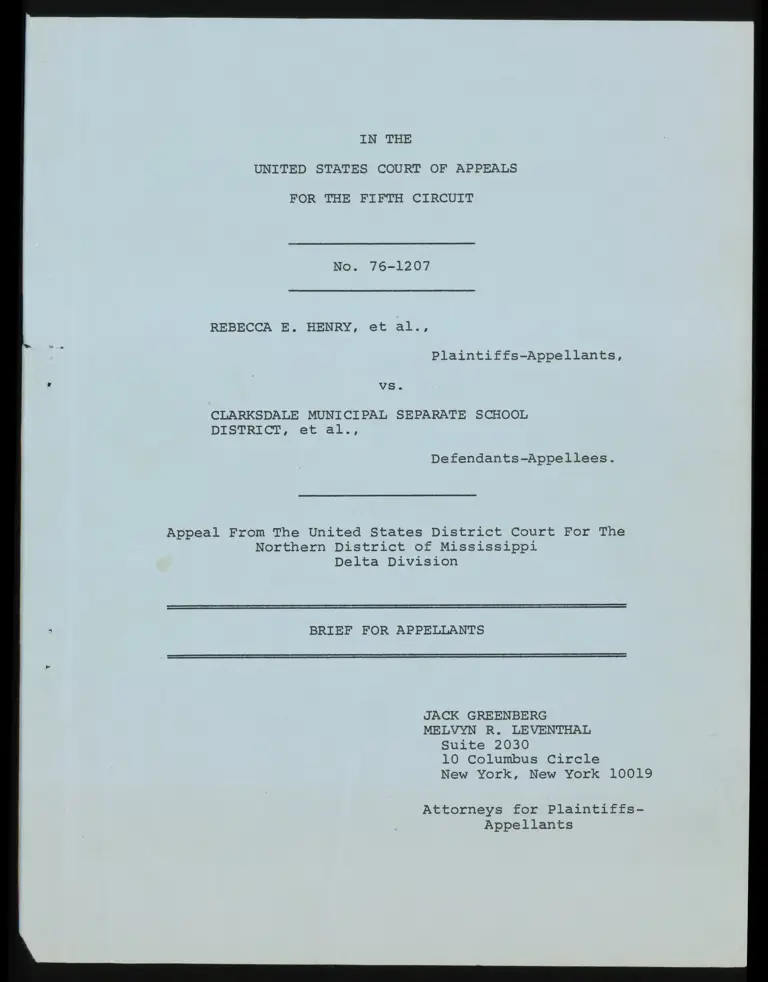
     [||cdc63638-c1ed-462a-9098-25593cbc745f||] IN THE

UNITED STATES COURT OF APPEALS

FOR THE FIFTH CIRCUIT

No. 76-1207

REBECCA E. HENRY, et al.,

Plaintiffs-Appellants,

¥ VS.

CLARKSDALE MUNICIPAL SEPARATE SCHOOL

DISTRICT, et al.,

Defendants-Appellees.

Appeal From The United States District Court For The
Northern District of Mississippi

Delta Division

" BRIEF FOR APPELLANTS

JACK GREENBERG

MELVYN R. LEVENTHAL

Suite 2030
10 Columbus Circle
New York, New York 10019

Attorneys for Plaintiffs-
Appellants


IN THE

UNITED STATES COURT OF APPEALS

FOR THE FIFTH CIRCUIT

No. 76-1207

REBECCA E. HENRY, et al.,

Plaintiffs-Appellants,

vs.

CLARKSDALE MUNICIPAL SEPARATE SCHOOL
DISTRICT, et al.,

Defendants-Appellees.

CERTIFICATE OF COUNSEL

The undersigned counsel of record for appellants

certifies that the following listed parties have an interest

in the outcome of this case. These representations are made

in order that Judges of this Court may evaluate possible dis-

qualification or recusal pursuant to Local Rule 1l3(a)

l. N.A.A.C.P.Legal Defense Fund

2. Black school age children of Clarksdale, Mississippi

3. Board of Trustees of Clarksdale M.S.S.D.

MELVYN R. LEVENTHAL
Attorney of Record for

Appellants.


TABLE OF CONTENTS

Certificate Of COUNSEL. ccsecrereseserrenenesesnns ‘e i

Table Of Cases and StatuteS.c.cececcccecececsss .'s ii

Statement of the Case...... ses esensts eres snnnns 1

Statement OF the FaCtSecrtcrrsetecrrtececenee cower 4

Argument

I. Attorneys' fees should have been
awarded because defendants' con-
duct must be characterized as "un-
reasonable and obdurately obstinate"...... 15

II. Attorneys' fees should have been
awarded for all time expended by
plaintiffs' counsel under 20 U.S.C.
810) 7ceccesnnnen MERI aF VI a tere eniesns renee 22

III. The district court's decision to
award less than plaintiffs requested,
in the event plaintiffs prevailed on
this appeal, failed to specify the rea-
sons for such a reduction and must be
re-examined on remanQes ces cesessassscnns 25

CONC US ION cc ss svt ss nsnnvs sssusnseoos yee ee vee. 25


TABLE OF CASES

Albemarle Paper Co. v. Moody, 45

Le BAe 20 280 (1975) cn vennninnecodvnoinnnsninssons 16

Bradley v. School Board of City of
Richmond, Va., 53 P.R.D. 28
IE De Va: JOT aie env teneerstnesonsnevonvuesiess 16,19

Bradley v. School Board of the City
of Richmond, 472 F.2d 318,
(AL Cir. 1972) nnvuternrernonsneeidanvienioeiosss 16,23

Bradley v. Richmond School Board,
415. 0.8. 698 11974) vis snnsntnsrssnunsismsonvns 3,23,24

Brewer v. School Board of the City of
Norfolk, 456 F.2d 943 (4th Cir.
1972), modified, 3500 P.24 1129,
{GE CA, 1074) i sone vavidovosnniinsssnnesinnsas 23,24

Bush v. Orleans Parish School Board,

308 FP.24 491 (Sth Cir. 1082) cus ceeinsvironsoemes 10

Evers v. Jackson M.8.8.D., 323 P.24 408,

Bosom eh ia LT) SUI I RB PEC AS 6

Green v. New Kent County Virginia, 391
U.S. 430 (1068) ein sisvavsnsovnnisnssnsansnsisissdsns 20

Henry v. Clarksdale M.S.S.D., 409 F.2d
682 (5th Cir. 1969), cert. den.,
396 U.S. 940 (1969), 425 F.2d
698 (1970), 433 2.24 397 (1970),
480 T.24 583 {1973 vi tsvnivsnnnssvosnensaines passim

Johnson v. Combs, 471 F.2d 84 (5th
Cail O72) cninnnuninoneessurienicesnne vo nner ee 3

Johnson v. Georgia Highway Express,
488 F248 714 (5Eh Cir. 1974) esses vessnneens 25

Local 189, United Paperm. & Paperworkers
v. United States, 416 F.2d 980
(EI Cire OBO) cess ens r sais tts nnn s bond 18

Monroe v. Board of Commissioners, 453 F.2d

259 (6Eh-Qir. 1972) ccensnn iain evinde v sin oo nininte 16

Plessy v. Ferguson, 163 U.8. 537 (1896) cece eveese 5,11 .7:19

it


Singleton v. Jackson M.S.S.D., 419 F.2d
3211 (5th Cire 1909) use srrsinnrnosnsnsnneesos 13

Stell v. Savannah-Chatman County Board of
Bducation, 318 FP.248 425 (5th Cir. 1963)..... 6

Swann v. Charlotte-Mecklenburg Board of
BAucation, 202. :U.8. 1 {1971) cecvcvsvenvscnes 20

STATUTES

20 U.S.C. §1617 [1718 of the Education
Amendment Ack OF 1972 cc vnsivsveronssvnnoesns passim

iii


IN THE

UNITED STATES COURT OF APPEALS

FOR THE PFIPFTH CIRCUIT

No. 76-1207

REBECCA E. HENRY, et al.,

Plaintiffs-Appellants,

VS.

CLARKSDALE MUNICIPAL SEPARATE SCHOOL

DISTRICT, et al.,

Defendants-Appellees.

Appeal From The United States District Court For The
Northern District Jf Mississippi

Delta Division

BRIEF FOR APPELLANTS

STATEMENT OF THE CASE AND FACTS

This is a postscript to the protracted Clarksdale
1/

school desegregation litigation. At issue is whether the

district court erred in denying plaintiffs an award of

attorneys' fees for time expended prior to the effective

1/ 409 F.2d 682 (5th Cir. 1969), cert. denied, 396 U.S.
940 (1969); 425 F.2d 698 (1970); 433 F.2d 387 (1970);
480 7.24 583 (1973).


27
date of 20 U.S8.C. $1617.

I.

Proceedings on Motion for Award of
Attorneys' Fees

June 22, 1973, this Court entered its opinion affirming

a district court order requiring the transportation of

elementary students at school district expense and refusing

defendants' request for modifications to the plan of pupil

assignment. 480 F.2d 583 (5th Cir. 1973) (Clarksdale 1IV).

That opinion also disposed of a motion for an award of fees,

addressed to this Court, by directing the district court to:

(a) award fees for time expended subsequent to July 1,1972,

the effective date of 20 U.S.C. §1617 [§718 of the Education

Amendments Act of 1972]; and (b) award fees for time ex-

pended prior to July 1, 1972, in the event plaintiffs demon-

strated that Clarksdale school officials acted in an "un-

reasonable and obdurately obstinate" manner during the earlier

stages of the litigation. No immediate action was taken by

2/ 20 U.S.C. 81617 provides:

Attorney fees

Upon the entry of 4 final order by a court of
the United States against a local educational agency,
a State (or any agency thereof), or the United States
(or any agency thereof), for failure to comply with
any provision of this chapter or for discrimination
on the basis of race, color, or national origin in
violation of title VI of the Civil Rights Act of 1964,
or the fourteenth amendment to the Constitution of
the United States as they pertain to elementary and
secondary education, the court, in its discretion,
upon a finding that the proceedings were necessary to
bring about compliance, may allow the prevailing
party, other than the United States, a reasonable

attorney's fee as part of the costs.


the district court in response to this Court's directive.

May 15, 1974, the Supreme Court held that attorneys’

fees must be awarded in a school desegregation case for time

expended prior to the effective date of 20 U.S.C. §l617, pro-

vided the case was still pending on the statute's effective

date. The Court specifically rejected this Court's holding

to the contrary in Johnson v. Combs, 471 F.2d 84, 86 (5th Cir.

1972) and Clarksdale IV, 380 F.2d 583. Bradley v. Richmond

School Board, 416 U.S. 696, 715.n.20 (1974).

September 18, 1974, the district court entered an order

providing plaintiffs 30 days to file a motion and affidavits

in support of an award of attorneys' fees; the court request-

ed that plaintiffs distinguish between amounts sought for time

expended prior to July 1, 1972 from amounts sought for time

expended subsequent thereto. Defendants were given an

opportunity to respond. (A. 280 ) The motion, BiTioavice

and defendants' response were duly filed. (a. 281-292)

Plaintiffs' sought through affidavits of counsel, $30,260.

in attorneys' fees for all time expended by all counsel for

plaintiffs from the suit's inception in 1963 through the full

decade of litigation culminating in Clarksdale IV. (A. 2860292)

3/ Through inadvertence, plaintiffs filed their motion for
an award of fees after they filed their affidavits in support.

Plaintiffs' motion advanced both traditional equity
principles and 20 U.S.C. §1617 as bases for a fee award for
time expended throughout the litigation (A. ) 2°


November 10, 1975, the district court entered an opinion and

order: (a) granting plaintiffs $1,500. for services performed

subsequent to July 1, 1972; (b) holding that, except for

plaintiffs' August 1, 1972 motion leading to Clarksdale 1V,

this litigation was inactive at the time of and subsequent to

the enactment of 20 U.S.C. §1617 and hence no fee award for

pre-Clarksdale IV work could derive from that statute:

(c) holding that defendants' conduct in this litigation from

the filing of the Complaint in 1963 through Clarksdale I

[409 F.2d 682] could not be characterized as "unreasonable or

obdurately obstinate;" (d) holding that, although a "close

factual issue," defendants' conduct could not be so character-

ized for the period subsequent to Clarksdale I; (e) that in

the event of reversal in this Court on point "(d)," a reason-

able fee for all time expended subsequent to Clarksdale I

would be $10, 000. [$8,500. plus the $1,500 already awarded].

(A.293-315).

Plaintiffs challenge on this appeal holdings "(b)"

through "(e)" above.

ll.

A detailed review of the history of this litigation may

be necessary for a resolution of the issues presented by this

appeal: if the court rejects our argument that 20 U.S.C.

§1617 supports a fee award from the litigation's inception

then we ask the court to reverse the district court's findings

that defendants' conduct was not "unreasonable and obdurately

obstinate;" in addition, the question of whether this case


was "active" on the effective date of §l617, is illuminated

by a review of proceedings.

April 22, 1964, plaintiffs filed their Complaint alleg-

ing a complete dual racial system-students, faculty, trans-

portation and extra-curricula activities - highlighted not

merely by segregation but by violations of Plessy v.

Ferguson, 163 U.S. 537 (1896), with black schools inferior

as to monies spent, teacher salaries and training and pupil-

teacher ratios. The Complaint also alleged, and defendants’

Answers admitted, that members of plaintiff class had

petitioned defendants in 1955, 1963 and 1964 to terminate

the dual racial system which petitions defendants refused to

even leis oF (A. 12,-17 -.19);

the Complaint prayed for, inter alia, a decree "for the re-

organization of the entire Clarksdale school system into a

unitary nonracial system . . . [and] costs herein and . . .

such further, other, additional or alternative relief as may

appear to the Court to be equitable and just." (A.21-22)

Plaintiffs also filed a Motion for Preliminary Injunction,

which included references to then recent authority in the Fifth

4/ It was alleged, however, that the names of the 1955
petitioners were published in the local newspaper of
Clarksdale. O.R. Vol. I, p.7.

- i


Circuit holding that exhaustion of the administrative remedies

under the State's 1954 "Pupil Placement," statute unnecessary.

Evers v. Jackson M.S.85.D., 328 F.24 408 (5th Cir. 1964); the .

motion also referred to Stell v. Savannah-Chatham County Board

of Education, 318 P.24 425 (5th Cir., May 24, 1963) holding

that proof that racial segregation was "advantageous" to both

black and white students could not sustain a district court

decision "reversing" Brown. (A. 23-26)

June 10, 1964, defendants answered: they admitted that

schools were operated on a completely dual racial basis but

denied violations of the Fourteenth Amendment. Two months

after Evers, supra, they alleged that plaintiffs should be

required to exhaust remedies under the State's pupil place-

ment law; in addition, more than a year after Stell, they

alleged:

there are such differences and disparities
between the ethnic group allegedly represent-
ed by plaintiffs and the Caucasian children
in the Clarksdale Municipal Separate School
District as to form a rational basis for
separating such ethnic groups in the schools
of the Clarksdale M.S.S.D., and that the
establishment and maintenance of separate
specially-adapted schools granting equal
opportunity for development of the differing
capacities and abilities of the children of
the two ethnic groups is most advantageous
£0 all.

racial differences are factual differences;
that neither [defendants] nor those represented by
them in the Clarksdale M.S.S.D. have ever
been a party or parties to, or represented
by counsel, in any cause wherein an integra-
tion decree was entered and hence they are
not bound by any decree heretofore rendered
between other parties.

(A. 31-32)


June 10, 1964, defendants moved the district court to

strike those paragraphs of the complaint alleging violations

of Plessy on the ground that such allegations "are immaterial

and impertinent." (A.36-37)

June 27, 1964, the district court, without hearing,

entered an order granting plaintiffs' motion for preliminary

injunction directing defendants to formulate a plan of

desegregation. (O.R. Vol. I, pp. 40-46)

July 27, 1964, defendants filed a plan of desegregation

which proposed to "desegregate" Clarksdale schools through

geographic zoning. (A. 38-60) July 30, 1964,

plaintiffs filed objections to the plan noting that the pro-

posed plan failed to specify zone boundaries so that plaintiffs

could not determine whether desegregation would be achieved

under the plan, failed to provide for desegregation of students

entering the school system for the first time, failed to provide

for transfer by students making specific requests therefor, all

of which was required by then controlling precedents of the

Fifth Circuit. Plaintiffs also objected to the absence of

any plan to desegregate faculties. (A.62-65)

August 19, 1964 a hearing on the proposed plan was held;

at its conclusion the district court entered its decision

approving defendant's "plan 1" for September, 1964 to be

modified in January, 1965 upon the completion of the


5/
Riverton Elementary School. The Court made it very clear

that its decision was "for the interim only, subject to

complete review and reconsideration by the court as the

development of this plan . . . occurs." (Trial Transcript

Vol. lv, p.1l68, A.66-67.)

After schools opened in September, 1964, and enrollment

data became available, it became patently clear that nothing

whatsoever had changed; plaintiffs filed a Motion for Further

Injunctive Relief alleging, inter alia:

Based upon information contained in the
Answers to interrogatories . . . there
are no Negro children attending schools
formerly designated solely for white
children, and no white children attend-
ing schools formerly designated for
Negro children. It also appears that
this situation will not be changed after
school begins for the second semester of
the 1964-65 school year.

The Board's plans are further defective
in failing to contain provisions for the
desegregation of teachers and other
faculty personnel as well as all curric-
ular and extra-curricular activities.

(A.69-70).

The problem with defendants' plan had little to do with

white flight:

Traditionally, most Negro residents in the
city have lived south of the Illinois
Central tracks while the great majority of
the white residents have lived north of the

5/. The school, constructed south of elevated tracks, upon
opening in January, 1965 enrolled black children only, and
employed black teachers and administrators only. (O0.R. Vol.I,

Pp.


tracks. Under the school board's proposed
attendance-zone plan, no school child will
cross those tracks. The result was obvious
from the beginning: the zoning could produce
only token desegregation. Henry v. Clarksdale

M.5.8.D., 409 1.24 682, 686 (5th Cir. 1969)
(Clarksdale I) (Emphasis added). [See more
detailed analysis of why segregation was in-
evitable, 409 F.2d 686, n.8.]

August 11, 1965, after full hearing, the district court

entered its first full decision on the merits. It made these

pertinent findings: (a) defendants proposed plan for elemen-

tary schools located in the black community (south of rail-

road tracks) was racially gerrymandered to assure that the

small white population residing in that area attended its

formerly white Clark Elementary School: "the evidence

strongly indicates, if it does not conclusively show, that

to the west of Wilson Avenue and the subdivision boundary

(a zone boundary line) the population is white and to the

east the population is Negro; " (A.89) for this

reason the Court declined to approve the south elementary

zone boundaries; (b) faculties and staffs were completely

segregated; the court declined to require immediate changes

but put the district on notice that faculty segregation would

be later considered; (A.97-98) (c) plaintiffs’

Plessy allegations "are justified;" defendants were ordered to

eliminate all disparities in program, salaries and expenditures

between white and black schools. (A.95-97) In

other respects, the school district's plan was approved over

plaintiffs' strenuous objections and Motion to Amend Findings

and Judgment. '(A.123,129)


Although this Court had held that black children in

grades not yet covered by the "stair-step" plan must be given

an opportunity to individually transfer to white schools, e.g.,

Bush v. Orleans Parish School Board, 308 F.2d 491, 501 (5th

Cir. 1962), the district court declined to require such a

provision in defendants' plan; it did require transfer rights

for pupils desiring to take a course offerred in a school other

than the ones to which they were assigned. (A. 118-19)

Betty Jean Yarbrough, one of the courageous named plaintiffs,

denied an opportunity for a desegregated education under the

school district's zoning plan by virtue of her residence south

of the railroad tracks, was impelled to file a Motion for

Further Relief seeking a transfer to the white Clarksdale High

School to take Latin - a course not offerred at the black high

school. {O.R. Vol. 1, p.178) Defendants resisted that motion

alleging that plaintiff Yarbrough had filed her application for

transfer one day late. (Vol. I, p.182) The district court

directed the transfer approved, as required by its earlier

order, while noting that defendants' position had some merit.

(O.R. Vol.I, p.202)

In accordance with the district court's August 11,1965

order defendants submitted a new plan of geographic zoning

for the elementary schools located south of the railroad track.

(O.R. Vol.I, p.191) Plaintiffs filed objections thereto,

noting that racial segregation throughout the system would

go uncorrected by defendants' proposal. (0.R. Vol.I,pp.217-221)

EC Le


The district court approved defendants' plan, as revised, by

opinion and order entered December 14, 1965. (A.131-138)

It is fair to observe that defendants plan provided for

the assignment of a handful (if that many) black children to

schools located north of the railroad with the overwhelming

majority of white students assigned such schools; and it

provided for the assignment of 115 white elementary students

residing south of the railroad to one of the several schools

attended by virtually all of the district's black students.

Thus, after a year and half of the most intensive

litigation, Clarksdale changed its plan of pupil and faculty

assignments not at all. Rights protected by Plessy were

achieved by order of the district court. And plaintiffs

noticed their appeal. (0.R. Vol.I, p.247)

On March 6, 1969, this Court (Judge Cox, sitting by

designation, dissenting), reversed. It provided this clear

mandate to the district court and Clarksdale school officials:

The Board should bear in mind that it
bears the burden of proving that its ex-
isting plan of desegregation is adequate
now 'to convert [the dual system] to a
unitary system in which racial discrimi-
nation would be eliminated root and
branch. If the plan does not promise
'realistically to work now, ' the Board
bears the burden of taking corrective
action. An effective plan should produce
desegregated faculties, staff, facilities,
transportation, and school activities
(such as athletics) along with integrated
student bodies. If there are still all-
Negro schools, or only a small fraction
of Negroes enrolled in white schools, or

=i ll =


no substantial integration of faculties and
school activities then, as a matter of law,
the existing plan fails to meet constitution-
al standards as established in Green and its
companion cases.

Henry v. Clarksdale M.S.S.D., supra, 409 F.2d

at 689.

Defendants skillfully maneuvered to prevent any change

in their zoning plan effective for the 1969-70 school year.

Plaintiffs sought an order directing the immediate issuance

of the mandate in Clarksdale I which was granted. (A.141l) Defendants

filed a motion in this Court to recall the mandate and filed

a motion in the district court to stay proceedings pending

disposition of its motion in this Court; (A.143,149) the district court

granted defendants' motion, (A.l50a)whereupon plaintiffs filed a motion

in this Court for an immediate order denying defendants' motion

for a stay of the mandate; (A.l1l50b) this Court took no action on

plaintiffs' request nor on defendants' motion to recall the

mandate. And the district court was to take no action until

the Supreme Court denied defendants' petition for writ of

certiorari on November 24, heh 4 (A. 157: 3)

Two days after certiorari was denied, November 26, 1969,

the district court entered an order providing for the implementa-

tion of this Court's March 6, 1969 opinion. The court directed

school officials to confer with HEW, directed HEW to file a

6/ During this school year, the black community utterly
frustrated by its failure to obtain desegregated schools,
picketed school officials demanding a free transfer right
to white schools. October, 1969, defendants sought and
obtained an order enjoining plaintiff class members from
picketing the homes of counsel opposite and school board
members. (A.154(b)-(h), 155)

A


proposed plan by December 13, 1969, with objections thereto

filed by the parties by January 2, 1970. (A.157-58)

HEW duly filed its proposed plan and the parties filed

objections thereto. Defendants maintained that the geo-

graphic zoning plan condemned in Clarksdale I, (review of

which had been declined by the Supreme Court) was in all
1/ 406 “3 (§

respects constitutional. (A.159-164) Hearing was held

on January 10, 1970; on the same day the district court

entered orders: (a) requiring defendants to implement fixed

racial faculty ratios required by the then recently pro-
8/

mulgated uniform Singleton decree, 419 F.2d1211(5th Cir.1969);

(b) rejecting the HEW plan and the school district's "plan;"

(c) appointing a special master to formulate and submit to the

court an alternative plan which satisfied Clarksdale I. (A.173-182)

id Defendant did offer one proposal; they suggested that
two new autonomous school districts be formed with the railroad

tracks the divide. (A. )s

8/ It appeared that at least plaintiffs would at last have
desegregated faculties during the second semester of the
1969-70 school year. But even this defendants avoided by
ignoring the Court's January 10, 1970 order: March 19, 1971,
plaintiffs filed a Motion for Supplemental Relief (in effect,
for contempt judgment), alleging that Singleton faculty ratios
had not been implemented during the second semester of the
1969-70 school year; the district court, after a hearing,
found for plaintiffs, directed fixed ratios for the 1970-71
school year and observed that defendants failed to offer any
satisfactory explanation for their failure to comply with
the Court's January 10, 1969 order. (A.225-230)

- 13 -


Plaintiffs appealed and defendants cross appealed

from the district court's January 10 orders. Plaintiffs

urged summary reversal under Alexander v. Holmes County

Board of Education while defendants insisted that their

geographic zoning plan should be upheld. This Court

declined to enter any immediate relief and remanded for

further hearings and findings of fact. 425 F.2d 699

(5th Cir. 1970) (Clarksdale II)

Thereafter, the special master filed his plan and

plaintiffs and defendants filed objections thereto. (183-97) After

a full hearing, the district court on May 8, 1970, entered

its opinion and order adopting in toto the special master's

plan which fully desegregated the junior-senior high school

grades but left defendants' elementary geographic zoning

plan in tact.

Cross appeals with defendants still insisting that

their 1964 geographic zoning plan was constitutional

resulted in plaintiffs prevailing on all issues. Clarksdale

III, 433 F.2d 387 (5th Cif. October 27, 1970); in that

opinion defendants were characterized as "intransigent."

433 P.24 at 389, n.s5.

On remand plaintiffs and the district court labored

through January, 1971 on the details of a plan of pupil

assignment. A. 219: ) In March, 1971, defendants’

refusal to implement Singleton faculty ratios led to a motion

ww 14 -


for supplemental relief; a hearing on that motion was not

held until May 27, 1971. (A.225-230) See n.7, p.l1l3, above. A plan

of pupil assignment promising to satisfy constitutional

requirements and a meaningful merger of faculties was not

achieved in this school district until the 1971-72 school

year.

During the 1971-72 school year, plaintiffs carefully

reviewed defendants' reports to the court to determine

whether the plan proved effective in operation. It 4is

not: on August 8, 1972 plaintiffs filed their motion for

school district transportation of elementary pupils which

culminated in an appeal by defendants
and thé June, 1973

Y\

oa

Clarksdale IV; (A.256) in addition, defendants’ effort to dispose

of certain property required an examination of such action

in light of the "new construction" provisions of the

desegregation decree, with district court action as late

as August, 1972. (A. 240-253)

ARGUMENT I

The District Court's Findings That
Defendants Were Not "Unreasonable
Or Obdurately Obstinate" Both
Before And After Clarksdale I is
Inconsistent With Controlling
Principles.

Of course, the district court has wide discretion on

the issue whether defendants' conduct justifies an award of

attorneys' fees. "But such discretionary choices are not

left to a court's inclination but to its judgment; and its

- 15 w-


judgment is to be guided by sound legal principles."

Albermarle Paper Co. v. Moody, 45 L.Ed. 24 280, 295 (1975).

The courts have uniformly held that the issue of

obstinancy turns on whether plaintiffs were required to

litigate, i.e., expend considerable resources, to "secure

what [was] plainly due them." Bradley v. School Board of

City of Richmond, Va., 53 P.R.D. 28,39 (E.D. Va. 1971)

"In determining whether this Board's conduct was, as found

by the District Court, unduly obstinate, we must consider

the state of the law as it then existed." Monroe v. Board

of Com'rs of City of Jackson, Tenn., 453 P.24 259, 263 (6th

Cir. 1972). See similar analysis, Bradley v. School Board

Of City of Richmond, 472 P.24 318, 320-21: {4th Cir. 1972),

rev'd on other grounds, 416 U.S. 696 (1974). The district

court's findings in favor of the Clarksdale defendants must

be examined and ultimately rejected in light of this

principle.

A. Pre-Clarksdale I Proceedings

The district court, in holding that this case was "hard

fought on both sides," (Ruling of the Court, p.1l0, herein-

after, R.C.) as opposed to holding defendants recalcitrant

and obstinate, made these findings as to pre-Clarksdale I

proceedings: (a) the Clarksdale school case was the first

in the Northern District of Mississippi; (b) defendants saw

fit to adopt a "unique attendance zone plan;" the "plan was

unusual since most districts were resorting to freedom of

- 16 =


choice in efforts to comply with Brown;" (c) the Board's

plan was approved by District Judge Clayton after a full

hearing and "many lower court decisions upheld benign

attendance zone plans when devised without racial overtones

or motivations;" (d) until Clarksdale I, the school board

"had readily complied with all court orders, and its actions

had been upheld, and its legal positions had been upheld."

(A.310-311)

The first point, that this was the first school

desegregation suit filed in the Northern District of

Mississippi is legally irrelevant; it would be different

if the district court could have found that Clarksdale

officials were the first to abandon the "pupil placement"

ruse or the first to take voluntary steps to desegregate.

More to the point, plaintiffs repeated petitions to

defendants - from 1954 through 1963 - for compliance with

Brown were totally ignored by defendants thereby necessi-

tating this litigation in the first instance. It was

error for the district court not to consider these facts.

The second point, that defendants adopted a "unique

attendance zone" plan supports plaintiffs position. The

"result [of the plan] was obvious from the beginning: the

zoning could produce only token desegregation," Clarksdale I,

409 F.2d at 686, and an "intent to discriminate may be in-

ferred from the fact that the defendants persisted in the

conduct after its racial implications had become known to

- 17


them." Local 189, United Paperm. & Paperwork v. United

States, 416 F.2d 980, 997 (5th Cir. 1969). Since

defendants' zoning plan achieved no more desegregation

than any freedom of choice plan then in use, the district

court erred in finding the plan submitted, evidence of

good faith. In fact defendants knew that freedom of choice

have
in Clarksdale would/producedmore desegregation than geographic

zoning.

The third point, that defendants' plan was conceived

free of racial overtones or motivation is unsupported by the

record. In fact, as we point out above, p.9, defendants

plan of pupil assignment was found to entail elements of

racial gerrymandering and was rejected by the district court.

The law at the time, as Judge Clayton clearly held, prohibit-

ed such gerrymandering. And Judge Keady erred, in not

considering relevant to the issue of obstinancy, that

defendants' plan of pupil assignment as submitted, was found

to assure that the only white elementary students residing

south of the railroad would be assigned to the formerly white

elementary school.

Fourthly, that defendants prior to Clarksdale I complied

with all outstanding court orders is irrelevant to the issue

of whether defendants were "obdurately obstinate." If fee

awards turned on proof of contemptuous conduct we would not

have the "obdurately obstinate" standard. The district

court's finding that defendants' actions and legal positions

- 16.


had been upheld by Judge Clayton is also error. In fact,

the district court found defendants in violation of Plessy

and their first plan inconsistent with Brown.

Under the controlling standard, Judge Keady was required

to consider - but did not - all of these factors: plaintiffs

were required to file the lawsuit to uproot the dual racial

system when Brown had required as much ten years before;

plaintiffs were required to gather elaborate proof of dis-

parities between white and black schools and vindicate rights

assured by Plessy; to prevent the implementation of a plan

of pupil assignment based upon racially gerrymandered zones,

plaintiffs were required to gather elaborate proof, and

present evidence at a lengthy trial when even defendants

admitted that any such plan would not pass muster. hit is

not unfair to characterize a defendant's conduct as obstinate

and unreasonable and as a perversion of the purpose of adju-

dication, which is to settle actual disputes," when plaintiffs

must litigate to secure "what is plainly due them." Bradley,

supra, 53:7.R.D. at 39,

B. Post-Clarksdale I Proceedings

The district court began by noting that "in all candor

. « » this [is] a close factual issue." (R.C. 21)

It should be said that this Court was
disappointed at the board's failure to
affirmatively address the issue of a new
desegregation plan on remand [from
Clarksdale I] and by endeavoring to adhere
to a rejected position. That attitude
exhibited by the board did thrust upon the

~~ 10


Court a heavier burden in trying to resolve
the Clarksdale school desegregation problems.
Even so, several factors are present which
incline this Court against a finding of un-
reasonable, obdurate obstinancy by the board.
One factor is that, in the eyes of this Court,
HEW's plan in material respects was not
satisfactory, and the Court required the
appointment of a special master to study the
school system. The master's contributions
were decidedly worthwhile as to the upper
six grades, notwithstanding the reversal by
the Fifth Circuit of the elementary school
structure. The master's services cost the
school board a fair sum of money, yet it was
a direct consequence of the board's own
failure to submit further plans. Neverthe-
less, when the master's plan was approved by
the district court, the school board defended
it on appeal, although losing as to the
elementary grade structure.

(R.C. D.22)

Every point made by the district court either supports

an award of attorneys' fees or is factually inaccurate.

Defendants refused to offer any plan other than their geo-

graphic zoning plan or a proposal to form two new separate

school districts, from the inception of this litigation through

Clarksdale III.(A.159,167,183) They took that position after

certiorari was denied; they took that position after Swann v.

Charlotte Mecklenberg, Board of Education, 402 U.S. 1 (1971)

and after Green v. New Kent County, Virginia, 391 U.S. 430 (1968)

both of which left absolutely no doubt that the Clarksdale

plan was facially and wholly violative of controlling

principles of law. During this stage of proceedings the

district court was impelled to virtually hold defendants in

contempt for violations of its January 10, 1970 order

- 20


requiring merger of faculties. (See above, p. 13, n.7)

The district court's final thought - that defendants

defended the special master's plan on appeal is factually

inaccurate. Defendants never supported any plan but their
from

1964 zoning plan in this Court and cross-appealed /the district

court's order approving the master's plan.

The district court notes the great burden placed upon

it by defendants' refusal to offer any new proposal of its

own, but ignores the equally relevant burden it placed upon

plaintiffs. We advanced the HEW plan, entered evidence in

its support and successfully defended it through intensive

district and appellate litigation, all because defendants

declined to offer their own constitutional proposal. The

district court credits the master's plan with developing

the concept of paired junior-senior high school programs,

but the HEW plan contained provisions therefor three months

before the master submitted his report.

It is also irrelevant that in "the eyes of the

[district] court, HEW's plan . . . was not satisfactory."

The key fact is that defendants refused to offer an alter-

native,a responsibility clearly assigned to them by Brown,

Green and Swann.

Again, returning to the controlling principle. The

right to a new plan of pupil assignment subsequent to

Clarksdale I, subsequent to the denial of certiorari in

-tY


Clarksdale I, subsequent to Swann and Green was "plainly due"

plaintiffs. The right to merged faculties after the

Singleton uniform decree was similarly due and it should have

been unnecessary for them to engage in litigation to obtain

compliance.

With due respect to the district court, the issue of

recalcitrance subsequent to Clarksdale I is not "a close

factual question." Defendants can cite not a single event,

nor for that matter did the district court, in support of

the conclusion from which we appeal.

ARGUMENT IT

An Award of Attorneys' Fees Under
20 U.S.C. 81617 is Required for All
Time Expended in the Litigation of
A School Desegregation Case Provided
Only That the Case Was Pending on

The Effective Date of the Act.

The district court held that:

[Tlhis Court rules that no right was
conferred by Section 1617 upon which
to base an award for attorney fees
incurred prior to its passage under
the facts of this case, since all
substantive school orders had been
previously entered, were being
complied with, and no appeals remained.

(emphasis added, R.C. p.1l5)

This holding is clearly at odds with Bradley v. Richmond

School Board, 416 U.S. 696, 710 (1974). There the Court

reviewed a Fourth Circuit holding that "because there were

no orders pending or appealable on either May 26, 1971, when

the District Court made its fee award, or on July 1, 1972,

-


when the statute became effective, §718 did not sustain

the allowance of counsel fees." The lower court had found,

as did the district court in this case, that all substantive

litigation had ended at the time §718 was enacted and hence a

fee award for time expended on such litigation was improper.

In other words, a court was to apply the law controlling at

the time the violations of law occurred and were litigated.

Bradley v. Richmond School Board, 472 F.2d 318, 331-32 (4th

Cir. 1972).

The Supreme Court reversed holding that "a court is to

apply the law in effect at the time it renders its decision,

unless doing so would result in manifest injustice or there

is statutory direction or legislative history to the contrary."

416 U.s. at 711. Since the appeals court rendered its

decision subsequent to the effective date of §718, a fee

award for time expended well in advance of the statute's

enactment was proper. The Supreme Court concluded:

Accordingly, upon considering the rights
‘ of the parties the nature of the rights,

and the impact of §718 upon those rights,
it cannot be said that the application

’ of the statute to an award of fees for

services rendered prior to its effective
date, in an action pending on that date,
would cause 'manifest injustice.’
416 U.S. at 721 (emphasis added)

The Fourth Circuit en banc, has already applied

Bradley to a case remarkable similar to ours and in

plaintiffs' favor. In Brewer v. School Board of the City

of Norfolk, 456 F.2d 943 (4th Cir. 1972) the appeals court

approved an award of attorneys' fees for time expended to

- 23,


obtain free transportation for students; on remand plaintiffs

sought fees for all time expended in the litigation which

request was refused. On a second appeal the Fourth Circuit

reversed its earlier holding. "As construed in Bradley it

now appears that §718 provides a vehicle for an award of fees

for the plaintiffs' attorneys for services rendered without

limitation to what they did with respect to the issue of free

transportation." 500 F.2d 1129, 1130 (4th Cir. 1974) (en banc).

Alternatively the district court held that a fee award

was barred by laches - i.e., that plaintiffs request for

fees,filed either in the Court of appeals through Clarksdale IV

or on remand therefrom,came too late.

In fact, plaintiffs filed a motion for attorneys' fees

at the approximate conclusion of the litigation which dates

not from the approval of a plan of pupil assignment effective

for the 1971-72 school year, but from after that plan was

modified and proved constitutional in operation. Every

significant order entered by Judge Clayton and Judge Keady

properly noted that the Court retained jurisdiction to examine

the plan in light of the school district's experiences. §718

clearly provides for the award of fees upon the entry of a

Hfinal order." Although a district court, upon application

of plaintiffs may make a fee award "incident to the final

disposition of interim matters," to prevent "substantial

hardship on plaintiffs and their counsel," Bradley, supra,

416 U.S. at 723, a request for fees at the time the orders

- 24


entered prove their efficacy, is timely under the clear

language of §718.

111.

The district court held that in the event of reversal

by this Court it will, on remand, reduce plaintiffs' award

of fees for post Clarksdale I litigation from the requested

$12,500. to $10,000. The district court offered no explanation

for the reduction in the face of defendants' failure to object

to either the hourly rate claimed or plaintiffs' statement of

hours expended. (A. ) This is error under Johnson v.

Georgia Highway Express, 488 F.2d 714 (5th Cir. 1974) and the

district court must make specific findings which support its
S/

decision to substantially reduce the award.

CONCLUSION

For the foregoing reasons the district court's Judgment of

November 10, 1975 must be vacated and the case remanded for an

award to plaintiffs' of counsel fees, from the date litigation

began through the present, and in an amount to be established on

remand with the district court guided by the standards of Johnson

v. Georgia Highway Express.

Respectfully submitted,

JACK GREENBERG

MELVYN R. LEVENTHAL

Suite 2030
10 Columbus Circle
New York, New York 10019

Attorneys for Plaintiffs-
Appellants

9/ The district court did not state the fee it would award in the
event of reversal in this Court of its decision to deny fees for
pre-Clarksdale I litigation. Accordingly, in the event this Court
requires a fee award for pre-Clerksdale I litigation a Georgia Highway

Express inquiry will also be required for that earlier period.

- 05 [||cdc63638-c1ed-462a-9098-25593cbc745f||]