NAACP v. Alabama Transcript of Record
Public Court Documents
August 23, 1957
-
Brief Collection, LDF Court Filings. NAACP v. Alabama Transcript of Record, 1957. 25261028-bf9a-ee11-be36-6045bdeb8873. LDF Archives, Thurgood Marshall Institute. https://ldfrecollection.org/archives/archives-search/archives-item/071310cf-3fd5-48cd-bdb9-acf35ce6b3a5/naacp-v-alabama-transcript-of-record. Accessed September 20, 2026.
Copied!
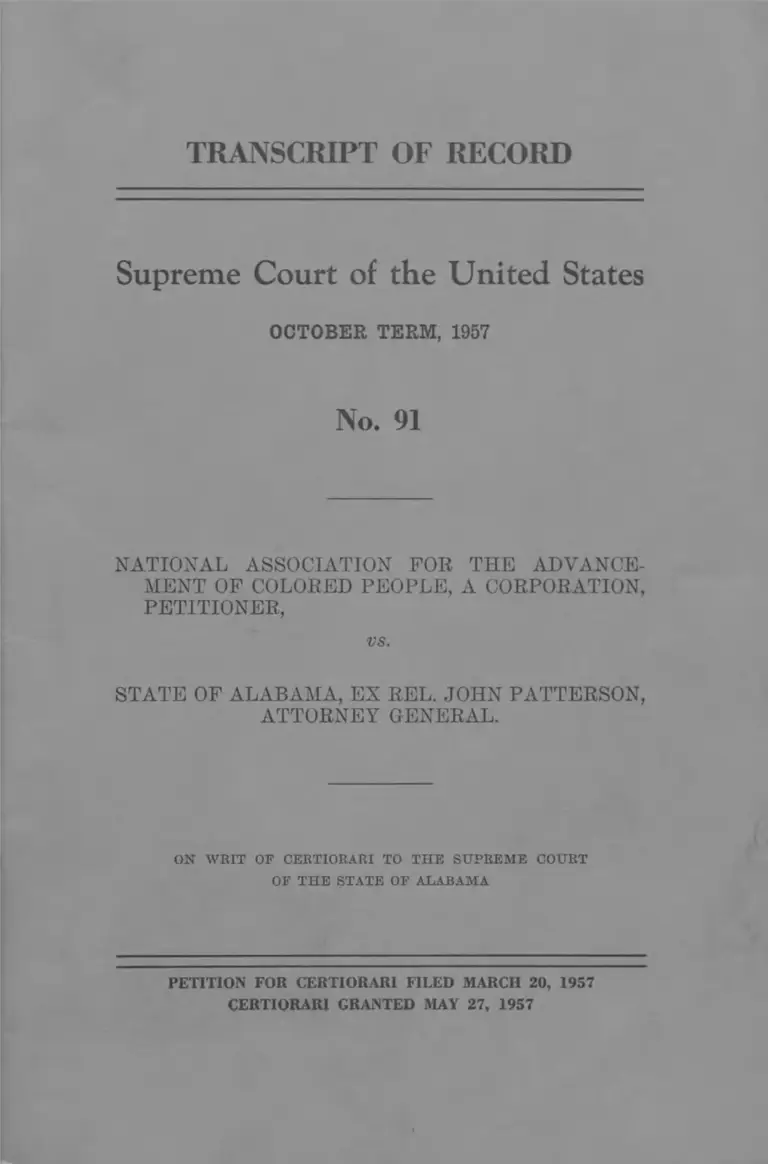
TRANSCRIPT OF RECORD
Supreme Court of the United States
OCTOBER TERM, 1957
No. 91
NATIONAL ASSOCIATION FOR THE ADVANCE
MENT OF COLORED PEOPLE, A CORPORATION,
PETITIONER,
vs.
STATE OF ALABAMA, EX REL. JOHN PATTERSON,
ATTORNEY GENERAL.
ON WRIT OF CERTIORARI TO THE SUPREME COURT
OF THE STATE OF ALABAMA
PETITION FOR CERTIORARI FILED MARCH 20, 1957
CERTIORARI GRANTED MAY 27, 1957
SUPREME COURT OF THE UNITED STATES
OCTOBER TERM, 1957
No. 91
NATIONAL ASSOCIATION FOR THE ADVANCE
MENT OF COLORED PEOPLE, A CORPORATION,
PETITIONER,
vs.
STATE OF ALABAMA, EX REL. JOHN PATTERSON,
ATTORNEY GENERAL.
ON WKIT OF CERTIORARI TO THE SUPREME COURT
OF THE STATE OF ALABAMA
I N D E X
Original Print
Proceedings in the Supreme Court of the State of Alabama .... 1 1
Petition for writ of certiorari to the Circuit Court of the
15th Judicial Circuit of Alabama, Montgomery County,
Alabama ______________________________________________ 1 i
Exhibit I—Decree of Circuit Court of Montgomery County
of June 1, 1956 for temporary restraining order and
injunction .............................................................................. 16 18
Exhibit II—Interlocutory decree of Circuit Court of Mont
gomery County of July 11, 1956 on motion of the State
to require respondent to produce certain books, papers
and documents ...................................................................... 18 20
Exhibit III—Decree of Circuit Court of Montgomery
County of July 30, 1956 denying petition to stay order
of July 25, 1956 _____________________________________ 21 22
Submission of cause _____________________________________ 21% 23
Opinion, per curiam ........ 22 23
Order denying writ of certiorari and dismissing petition ....... 30 31
Clerk’s certificate (omitted in printing) ................................... 31 31
Order extending time to file certiorari .................................... 32 32
Order granting certiorari ................................................................ 33 32
R ecord P ress, P rinters, N ew Y ork , N. Y., A ugust 23, 1957
1
[fol. 1]
IN THE SUPREME COURT OF ALABAMA
THIRD DIVISION
No.........
N atio n al A ssociation for t h e A d van cem en t of
C olored P eople , a corporation, Petitioner
In R e : N atio n al A ssociation for t h e A d van cem en t
of C olored P eople , Petitioner-Respondent
v.
S tate of A labam a on t h e R elation of J o h n P atterso n ,
Attorney General of the State of Alabama, Respondent-
Complainant
P e titio n for W rit of C ertiorari to t h e C ir c u it C ou rt of
t h e 15t h J u d icial C ir cu it of A lab a m a , M on tgom ery
C o u n t y , A la b a m a , in E q u ity
To the Honorable Chief Justice and Associate Justices
of the Supreme Court of Alabama
Comes the petitioner-respondent and respectfully peti
tions this Honorable Court to review and determine the
judgments and orders adjudging petitioner in contempt
and fixing punishment against petitioner therefor in the
sums of $10,000 and $100,000 rendered by the Circuit Court
of the 15th Judicial Circuit of Alabama, Montgomery
County, Alabama, in Equity, on July 25, 1956, and on
July 31, 1956, in a cause styled No. 30468, State of Ala
bama on the relation of John Patterson, Attorney General
of the State of Alabama, complainant against the National
Association for the Advancement of Colored People, a
corporation, respondent.
Petitioner avers that the state, on June 1, 1956, filed a
complaint in the court below alleging: (1) That petitioner,
a New York corporation, maintains its Southeast Regional’
office in Birmingham, Alabama; (2) that petitioner has
employed agents to operate this office; (3) that local chap
ters of petitioner are organized in the State of Alabama;
2
(4) that membership dues and contributions for said chap
ters and petitioner are solicited; (5) that petitioner has
[fol. 2] paid monies to Autherine Lucy and Polly Myers
Hudson to aid them to enroll as students at the University
of Alabama to test its policy of denying entrance to
Negroes; (6) that petitioner has furnished legal counsel to
represent Autherine Lucy in her proceedings against the
University of Alabama; (7) that petitioner has supported
and financed an illegal boycott to compel the Capitol Motor
Lines of Montgomery, Alabama, to seat passengers without
reference to race; (8) that petitioner’s officers, agents and
members have for years past and are presently engaged in
organizing chapters in the State of Alabama, in collecting
dues therefor, soliciting contributions and expending
monies in advancing the aims of petitioner; (9) that peti
tioner has never filed with the Secretary of State a certi
fied copy of its Articles of Incorporation and other infor
mation required by Title 10, Sections 192, 193 and 194 of
the Code of Alabama, 1940; (10) that petitioner has been
and continues to do business in the State of Alabama and in
the County of Montgomery in violation of Article 12, Sec
tion 232, Constitution of Alabama, 1901, and Section 194,
Title 10, Code of Alabama, 1940; (11) that petitioner is
continuing to do business within the state without first
having complied with the aforesaid constitutional and
statutory provisions and is thereby causing irreparable
injury to the property and civil rights of the citizens of
Alabama for which criminal prosecution and civil action at
law afford no adequate relief.
The state prayed for a temporary injunction enjoining
and restraining petitioner, its agents and members from
further conducting its business within the state and organ
izing chapters and maintaining offices within the state, it
requested dissolution of all existing chapters of the organ
ization and that upon final hearing the court issue a perma
nent injunction embodying the foregoing and oust peti
tioner from the state.
On June 1, 1956, the day this bill was filed without notice
or opportunity for hearing, the court below issued a tempo
rary restraining order and injunction. The aforesaid order
and judgment is appended hereto as Exhibit No. I to this
3
petition and made a part thereof. It restrained petitioner,
its agents, all parties in active concert with petitioner,
and all persons having notice of the court’s order from
conducting any further business of any description or kind
within the state; from further organizing chapters within
the state; from maintaining offices within the state; from
soliciting members, contributions or collecting member
ships for petitioner or any local chapters or wholly con
trolled subsidiaries in the State of Alabama. The court
[fob 3] further enjoined petitioner—although the state’s
bill did not request it—from filing with the Department of
Revenue and the Secretary of State of Alabama any docu
ment to qualify to do business within the state.
Petitioner avers that this order and judgment is null and
void and beyond the jurisdiction of the court below in that
the court seeks to exert authority not in keeping with the
decisions of this Court and which invades petitioner’s
right under Article I, Section 8 and the Fourteenth Amend
ment to the Constitution of the United States.
On July 2, 1956, petitioner filed a motion to dissolve the
temporary restraining order and injunction and demurrers
to the bill. Hearing thereon was set for July 17, 1956.
On July 5, 1956, the state filed a motion to require peti
tioner to produce certain books, documents and papers,
as set out below, alleging the examination thereof was
essential to its preparation for trial:
1. Copies of all charters of branches or chapters of
the National Association for the Advancement of
Colored People in the State of Alabama.
2. All lists, documents, books, and papers showing
the names, addresses and dues paid of all present mem
bers in the State of Alabama of the National Associa
tion for the Advancement of Colored People, Inc.
3. All lists, documents, books and papers showing
the names, and addresses of all contributors in the
State of Alabama who have contributed money, goods,
services or anything of value, to the National Associa
tion for the Advancement of Colored People, Inc.,
within the last twelve months next preceding the date
of filing the petition for injunction in this case.
4
4. All lists, documents, books, and papers showing
the names, addresses and official position in respondent
corporation of all persons in the State of Alabama
authorized to solicit memberships in and contributions
to the National Association for the Advancement of
Colored People, Inc.
5. All files, letters, copies of letters, telegrams and
other correspondence, dated or occurring within the
last twelve months next preceding the date of filing the
petition for injunction, pertaining to or between the
National Association for the Advancement of Colored
People, Inc., and persons, corporations, associations,
groups, chapters and partnerships within the State of
Alabama.
6. All deeds, bills of sale and any written evidence
of ownership of real or personal property by the Na
tional Association for the Advancement of Colored
People, Inc., in the State of Alabama.
7. All cancelled checks, bank statements, books, pay
rolls, and copies of leases and agreements, dated or
occurring within the last twelve months next preceding
the date of filing the petition for injunction, pertaining
to transactions between the National Association for
the Advancement of Colored People, Inc., and persons,
chapters, groups, associations, corporations and part
nerships in the State of Alabama.
8. All papers, books, letters, copies of letters, docu
ments, agreements, correspondence and other memo
randa pertaining to or between the National Associa
tion for the Advancement of Colored People, Inc., and
Autherine Lucy, Autherine Lucy Foster and Polly
Myers Hudson.
[fol. 4] 9. All papers, books, letters, copies of letters,
documents, agreements, correspondence and other
memoranda pertaining to or between the National
Association for the Advancement of Colored People
Legal Defense and Educational Fund and Artherine
Lucy, Artliwrine Lucy Foster and Polly Myers Hudson.
5
10. All papers, books, letters, copies of letters, docu
ments, agreements, correspondence and other memo
randa pertaining to or between the National Associa
tion for the Advancement of Colored People, Inc., and
the Montgomery Improvement Association.
11. All lists, books and papers showing the names
and addresses of all officers, agents, servants and em
ployees in the State of Alabama of the National Asso
ciation for the Advancement of Colored People, Inc.
12. All lists, books and papers showing the names
and addresses of all officers, agents, servants and em
ployees of the various chapters of the National Asso
ciation for the Advancement of Colored People, Inc.,
in the State of Alabama.
13. All papers, books, files, documents, letters,
copies of letters and correspondence, cancelled checks,
bank statements, leases, contracts and agreements in
the Southeastern Regional Office of the National Asso
ciation for the Advancement of Colored People, Inc.,
in Birmingham, Alabama, or in possession of any offi
cer, agent, servant or employee of said corporation in
the State of Alabama.
14. All papers, books, letters, copies of letters, files,
documents, agreements, correspondence and other
memoranda pertaining to or between the National
Association for the Advancement of Colored People,
Inc., and Aurelia S. Browder, Susie McDonald, Claud
ette Colvin, Q. P. Colvin, Mary Louise Smith and
Frank Smith, or their attorneys, Fred D. Gray and
Charles D. Langford.
15. All papers, books, letters, copies of letters, files,
documents, agreements, correspondence, cancelled
checks, bank statements, financial statements and all
other memoranda, dated or occurring within the last
twelve months next preceding the date of the filing of
petition for injunction in this case, concerning all trans
actions and activities within the State of Alabama of
the National Association for the Advancement of
Colored People, Inc.
6
This motion was set down for hearing on July 9, 1956.
On July 11, 1956, after hearing argument by the state and
petitioner in which the petitioner raised objections to the
motion on grounds supported by basic principles of equity
jurisprudence, by decisions of this Court and by the Con
stitution of the United States, the court overruled the
objections and issued an interlocutory order and decree
requiring the petitioner to produce certain of the docu
ments as requested in the motion. The order of the court
is appended hereto as Exhibit II and made a part of this
petition.
Petitioner avers that the aforesaid order is null and void
and outside the jurisdiction of the court below under basic
principles of equity jurisprudence, the decisions of this
Court and the Constitution and laws of the United States,
namely, the Fourteenth Amendment, Article I, Section 8
of the Constitution of the United States and Title 42,
United States Code, Section 1981.
Petitioner was ordered to produce the documents as indi-
[fol. 5] cated in the order as of July 16, 1956. Thereafter,
the court extended the time to produce until July 24, 1956;
it simultaneously postponed until July 25, 1956, hearing on
the demurrers and motion to dissolve.
On July 23, petitioner filed its answer, admitting: (1)
That it was a New York corporation; (2) that it main
tained its Southeast Regional Office in Birmingham; (3)
that it hired and employed agents to operate this office; but
(4) denied that it had organized local chapters in the state
and that agents of the corporation solicited for said local
chapters and the parent corporation; denied (5) that it had
employed or paid money to Autherine Lucy and Polly
Myers Hudson to encourage or aid them in enrolling in the
University of Alabama; admitted (6) furnishing legal
counsel to assist Autherine Lucy in prosecuting her suit
against the University of Alabama; admitted (7) that it
had given moral and financial support to Negro residents
of Montgomery in connection with their refusal to use the
public transportation system of Montgomery and had
furnished legal counsel to assist Rev. M. L. King and other
Negroes indicted in connection with that matter, but denied
all other allegations and inferences contained in that alle
7
gation and bill of complaint; and denied (8) that its officers,
agents or employees have engaged in organizing chapters
for the Corporation in Alabama and Montgomery County,
collecting dues, soliciting memberships, loaning or giving
personal property to aid present aims of the Corporation;
admitted (9) that it had never filed with the Secretary of
State Articles of Incorporation or designated a place of
business or authorized agents within the State; but denied
(10) that it was required by Sections 192, 193 and 194 of
Title 10, Code of Alabama to do so. Petitioner denied that
it has violated Article 12, Section 232, Constitution of Ala
bama, 1901 and Section- 192, 193 and 194, Title 10, Code of
Alabama, 1940; further petitioner denied (11) that its acts
are causing irreparable injury to the property and civil
rights of the residents and citizens of the State of Alabama.
In addition to the various defenses to the Bill of Com
plaint, petitioner, while asserting that Title 10, Sections
192, 193 and 194 of the Code of Alabama, 1940, was not
applicable, had procured the necessary forms from the
Office of the Secretary of State, Montgomery, Alabama, and
had filled in the forms as required by law and offered to
file the same. Said forms were attached to its answer and
[fob 6] petitioner stated that it would file these forms if
the court would dissolve its orders barring petitioner from
registering and would permit petitioner to file the forms
attached to its answer.
With its answer petitioner filed a motion to set aside the
order to produce. Hearing on this motion was set down
for July 25, 1956. On that date, testimony in support of
the motion to set aside was introduced. The Attorney
General testified that if petitioner would agree that it was
doing business in the State of Alabama, the material sought
by its motion would not be needed. The court overruled
the motion to set aside and ordered petitioner to produce
the documents aforesaid.
Petitioner avers that the court order overruling its mo
tion to set aside the order to produce is null and void and
beyond the jurisdiction of that court in that the court below
acted arbitrarily and contrary to principles enunciated in
decisions of this Court and in violation of petitioner’s right
to due process and equal protection of the laws as secured
8
by the Fourteenth Amendment to the Constitution of the
United States.
Petitioner, advised by counsel that the order was arbi
trary and unreasonable and not in accord with the Consti
tution and laws of the State of Alabama and Constitution
and laws of the United States, informed the court that it
was unable to comply with the court’s order. The court,
thereupon, found and adjudged petitioner in willful con
tempt for failure to produce the documents in accordance
with the court’s order and assessed a fine of $10,000 against
petitioner as punishment for this contempt:
This suit seeks to enjoin among other things, the
respondent, from further conducting its business with
in the State of Alabama, seeks the dissolution of all its
chapters in the State, and asks that on final hearing
an order of ouster be entered against the respondent.
Due and proper service of the bill has been had upon
the respondent, and through its attorneys it has en
tered an unqualified appearance in the cause. A tempo
rary restraining order was issued upon the filing of the
bill. Later the State filed a motion to require respond
ent to produce certain books, documents and papers.
This was duly set down for hearing before the court.
At that time counsel for respondent objected to the
motion to produce and the court ruled, as showm by its
order on file, that certain books, papers and documents
mentioned in the motion to produce should be brought
into court, and a time was fixed for the production
of the evidence requested by the State. Later the re
spondent moved the court to set aside the order to
produce, assigning in substance that it had filed a full
and complete answer, that the information called for
by the State was already known to the Attorney Gen
eral and that the books and papers were not now ma
terial or necessary to the trial and determination of
the issue raised in the suit.
The motion to set aside the order to produce has been
argued at length before the court by the Attorney
General and by counsel for the respondent, and the
respondent has offered oral testimony on the motion to
9
set aside. Several hours have been consumed in hearing
[fol. 7] the matter in open court. The grounds of the
motion to vacate are not well taken.
Upon the denial by the court of the motion to set
aside the order to produce, the court offered respond
ent additional time to produce the documents hereto
fore ordered produced. Counsel for respondent stated
in open court that additional time would not be re
quired, that respondent would not produce the books,
documents and papers as ordered by the court and that
it elected to stand on its decision not to bring the
papers into court for the inspection of the State.
The action of the respondent without question puts
it in contempt of court, and its counsel practically con
cede this. So the respondent is in willful contempt of
the court, and the only matter before the court at this
time is a formal order adjudging respondent in con
tempt and in taking judicial sanctions against it for
its contempt.
The court adjudges and decrees that the respondent
is in willful contempt in failing to obey the order of the
court to produce for inspection the documents re
ferred to in the order to produce. This brings up now
for the consideration of the court what punishment
should be decreed against the respondent. Before fix
ing that punishment these general principles of equity
may be stated: The purpose of punishing for a con
tempt is to vindicate the dignity and authority of the
court from the disrespect shown to its orders, to aid
in compelling the performance of the court’s order,
performance which is confessedly in the power of the
respondent at this time, and which performance re
spondent’s counsel state will not be given. In the
present contempt proceeding the court must consider
the character and magnitude of the harm threatened
by respondent’s continued contumacy and the probable
effectiveness of the sanction invoked.
Under the law, there is no way by which a corpora
tion can be jailed or imprisoned, so a fine must be im
posed, and in the imposition of this fine the presiding
judge may properly consider the extent of the willful
10
and deliberate defiance of the court’s order, the seri
ousness of the consequences of the contumacious be
havior, the necessity of effectively terminating re
spondent’s defiance as required by the public interest,
and the importance of deterring such acts in the future.
The extent of the punishment is discretionary with the
court.
The present willful and deliberate, and considered,
defiance of the court’s order is not to be lightly taken.
It is not such an act which admits of any but severe
punishment. The court can not permit its orders to be
flouted. It cannot permit a party, however wealthy
and influential, to take the law in his own hands, set
himself up above the law, and contumaciously decline
to obey the orders of a duly constituted court made
under the law of the land and in the exercise of an
admitted and ancient jurisdiction. If this were allowed
there would be no government of law, only the govern
ment in a particular case of the litigant who elected to
defy the court for his own private and selfish ends.
The respondent in this case has elected to stand on its
brazen defiance of the order of a court with full power
and authority to issue the order against it. Respond
ent having made its election to defy the court must
abide the consequences of its stand. Upon a full con
sideration of the record in this case, it is
Ordered, adjudged and decreed by the court that
National Association for the Advancement of Colored
People is in contempt of court for its willful and de
liberate refusal to produce the documents described
in the former order of the court in this cause.
Ordered, adjudged and decreed further by the court
that as punishment for its said contempt the said Na
tional Association for the Advancement of Colored
People be and it is hereby fined the sum of Ten Thou
sand Dollars, and judgment is hereby rendered against
the said respondent and in favor of the State of Ala
bama for said sum of Ten Thousand Dollars, for which
let execution issue.
Ordered, adjudged and decreed further that in the
event the respondent fully complies with the court’s
u
order to produce within five days from this date, then
it may move to have this fine reduced or set aside.
However, in the event the respondent fails to comply
fully with the order to produce within five days from
this date, then it is ordered, adjudged and decreed
[fol. 8] that the fine for this contempt be $100,000.00.
Let the costs in this matter, to be taxed by the Reg
ister, be paid by the said National Association for
the Advancement of Colored People.
Done in open court in the presence of the counsel
for the parties to this suit on this July 25, 1956.
/ s / Walter B. Jones
Circuit Judge Presiding
Petitioner avers that this order and judgment is null and
void and beyond the jurisdiction of the court in that it is
clear on the face of the order that the court has exceeded
the limits set by Title 13, Section 143 of the Alabama Code
of 1940.
Petitioner further avers that the fine fixed is so arbitrary
and excessive, without any reasonable relationship to the
act committed, or to petitioner’s ability to pay it as to
render the judgment null and void and beyond the juris
diction of the court below in that it violates petitioner’s
rights to due process and equal protection of the laws
secured by the Fourteenth Amendment to the Constitution
of the United States.
On July 30, 1956, petitioner filed a motion to set aside
and/or stay execution of said order pending review, and
tendered compliance with the court’s order to produce as
set forth in the Affidavit of its Executive Secretary, Roy
Wilkins.
As to documents requested in paragraph 1 in the state’s
motion as listed supra and ordered produced by the court,
petitioner tendered a copy of the standard form of charter
issued to 58 branches in the State of Alabama. Petitioner
alleged that it was unable to produce a copy of each such
charter since no copies are kept by it, but asserted that
each charter issued Branches in the state conform to the
standard form which petitioner tendered.
12
As to documents requested in paragraph 4 of the state’s
motion and ordered produced by the court below, peti
tioner asserted that it does not authorize any person or
persons as such to solicit memberships or to secure con
tributions for it; that Mrs. Ruby Hurley and W. C. Patton
are the only persons impliedly authorized by virtue of their
employment to solicit memberships and/or contributions.
Persons soliciting memberships are volunteers and peti
tioner prescribes no restrictions in this regard.
As to documents requested in paragraph 5 of the state’s
motion and ordered produced by the court below, petitioner
[fol. 9] stated that its files are kept under subject matter
headings and that to comply with this portion of the court’s
order would require it to search all of its files in order to
secure the information requested; that it receives corre
spondence at the rate of 50,000 letters per year and that
files are maintained for a period of ten years. Petitioner
tendered, however, all memoranda to branches during the
twelve-month period preceding June 1, 1956, which would
include memoranda to its branches in the State of Alabama.
As to documents listed in paragraph 6 of the state’s
motion and ordered produced by the court, petitioner as
serted that it owns no real property; that all bills of sale
for purchase of personal property were in the possession
of Mrs. Hurley, who is on vacation, and that petitioner has
no key to this office; that the only personal property peti
tioner owns in the state consists of desks, filing cabinets,
chairs, typewriters, mimeograph machine and office sup
plies estimated to be approximately valued at $400.00 and
that this personal property is in its Southeast Regional
office in Birmingham. The only bills of sale in its posses
sion were two which petitioner tendered.
As to documents listed in paragraph 7 of the state’s mo
tion and ordered produced by the court, petitioner sub
mitted all the cancelled checks and payroll checks covering
transactions in Alabama and a copy of the lease of the
office used by petitioner in Birmingham, and averred that
there are no other agreements. Petitioner asserted it does
not maintain a bank account in the State of Alabama. Peti
tioner’s bank statements are statements referring to its
general funds from all sources, and petitioner tendered
13
a statement showing all income and expenditures in the
State of Alabama prepared by its accountant.
As to documents listed in paragraph 8 of the state’s
motion and ordered produced, petitioner submitted all pa
pers, books, letters, etc., pertaining to or between it and
Autherine Lucy, Artharine Lucy Foster and Polly Myers
Hudson received from and sent to the State of Alabama.
As to documents listed in paragraph 14 of the state’s
motion, petitioner asserted that it had no papers of any
kind in this category.
With respect to paragraphs number 2 and 11 of the state’s
motion as granted in the court’s order which required peti
tioner to submit a list of the names and addresses of its
[fol. 10] members and names and addresses of its officers,
employees and agents, etc., in the State of Alabama, peti
tioner asserted through affidavit of its Executive Secretary
that it believes in good faith that to make available to
the Attorney General the names and addresses of its offi
cers and members would subject these persons to private
economic reprisals, loss of public and private employment,
to harrassment by persons opposed to integration in public
schools, to threats of use of force, intimidation and the use
of actual force. In support of this, petitioner tendered as
exhibits to the affidavit of its Executive Secretary, the affi
davits of several of its members residing in Selma, Ala
bama, whose names had been published for signing a peti
tion requesting the Board of Education to consider de
segregation of the public schools in Selma, Alabama, in
accordance with the decisions of the United States Su
preme Court and, as a result, had been discharged from
their employment. Petitioner attached to this affidavit evi
dence that local laws applicable to Macon and Marengo
Counties had been enacted authorizing the Board of Educa
tion of these counties to discharge school teachers who
belong to organizations advocating racial integration; and
newspaper clippings which show that groups operating in
the State are organized for the express purpose of opposing
the policy and program of petitioner. Despite this show
ing, the court overruled petitioner’s motion to set aside or
modify its adjudication of contempt and refused to stay
execution of its judgment pending review by this Court.
14
The decree of the court denying and overruling petitioner’s
motion to set aside, modify or stay its order of July 25,
1956, is attached hereto as Exhibit III and made a part of
this petition.
Petitioner avers that the decree and judgment of the
court below denying and overruling its motion to set aside,
modify or stay its order of July 25, 1956, is null and void
and beyond the jurisdiction of the court below in that it
denies to petitioner equal protection and due process of
law secured by the Fourteenth Amendment and rights se
cured under Article I, Section 8 of the Constitution of the
United States.
On July 30, petitioner filed a motion to stay execution of
the judgment below in this Court pending review here.
After hearing on this application on July 31, this motion
was denied on the ground that no petition for writ of cer
tiorari was before the court. While this Court was con
sidering petitioner’s application for a stay, the court below
issued a new order and judgment, adjudging petitioner in
[fol. 11] further contempt and fining and punishing peti
tioner for that contempt in the sum of $100,000.00:
This Court, having by decree, dated July 25, 1956,
ordered, adjudged and decreed respondent, National
Association for the Advancement of Colored People,
in contempt of Court for its willful and deliberate
refusal to produce the documents described in the for
mer order of the Court in this cause, dated July 11,
1956, and having further ordered, adjudged and de
creed that as punishment for said contempt the said
National Association for the Advancement of Colored
People, be fined the sum of $10,000.00, and judgment
rendered against the said respondent in favor of the
State of Alabama for the sum of $10,000.00, and having
further ordered, adjudged and decreed that in the
event respondent fully complied with the Court’s order
to produce within five days from July 25, 1956, that it
might move to have its fine reduced or set aside, but
in the event the respondent failed to comply fully with
the order to produce within five days from July 25,
1956, it was ordered, adjudged and decreed that the
fine for this contempt be $100,000.00.
15
And the respondent, National Association for the
Advancement of Colored People, having failed to com
ply with this order and not having produced the docu
ments described in the former order of the Court in
this cause by midnight, July 30, 1956, It Is;
Ordered, Adjudged and Decreed by the Court that
the National Association for the Advancement of Col
ored People, is in contempt of this Court for its will
ful and deliberate refusal to produce the documents
described in the former order of the Court in this
cause by midnight, July 30, 1956.
It Is Further Ordered, Adjudged and Decreed by
the Court that as punishment for its said contempt the
said National Association for the Advancement of
Colored People, be and it is hereby fined the sum of
$100,000.00, and judgment is hereby rendered against
the said respondent and in favor of the State of Ala
bama for said sum of $100,000.00, for which let execu
tion issue.
That the costs in this matter to be taxed by the Reg
ister be paid by the said National Association for the
Advancement of Colored People.
Done in Montgomery, Alabama, on this the 31st day
of July, 1956.
/ s / Walter B. Jones
Circuit Judge, Presiding
Petitioner avers that this order and judgment is null and
void and beyond the jurisdiction of the court in that it is
clear on the face of the order and judgment that the court
has exceeded the limits set by Title 13, Section 143 of the
Alabama Code of 1940.
Petitioner further avers that the fine fixed is so arbitrary
and excessive, without any reasonable relationship to the
act committed, or to petitioner’s ability to pay it as to
render the judgment null and void and beyond the jurisdic
tion of the court below in that it violates petitioner’s rights
to due process and equal protection of the laws secured by
the Fourteenth Amendment to the Constitution of the
United States.
16
Petitioner further avers that it has been denied access
to Alabama courts resulting from the action of the court
[fol. 12] below to secure a hearing on the merits of this
cause and to seek a vindication of its rights to continue
its operations in the state and that such denial of access
constitutes an infringement of its rights to procedural due
process secured by the Fourteenth Amendment to the Con
stitution of the United States.
Petitioner avers that it has done everything within its
power, consistent with its rights and the rights of its
members, to comply with the order of the court below to
produce certain documents and papers for pre-trial dis
covery, and that it has failed and refused to comply further
with the court’s order solely because to do so would con
stitute a waiver of basic constitutional rights. Petitioner
has no other adequate remedy to seek a review of the orders
and judgment of the court below except by this petition,
[fol. 13] Petitioner respectfully shows unto this Honor
able Court as follows:
1. That the Circuit Court erred in entering its order of
July 11, 1956, requiring petitioner to produce certain
documents and papers set out therein.
2. That the Circuit Court erred in overruling petitioner’s
motion to set aside its order to produce.
3. That the Circuit Court erred in adjudging petitioner
in contempt and assessing a $10,000 fine against it as
punishment therefor.
4. That the Circuit Court erred in punishing petitioner
$10,000 for contempt in excess of its statutory authority
under Title 13, Section 143 of the Alabama Code of 1940.
5. That the Circuit Court erred in overruling petitioner’s
motion to set aside and/or modify its order and judgment
adjudging petitioner in contempt and/or stay execution of
its judgment pending review by this Court.
6. That the Circuit Court erred in adjudging petitioner
in contempt and in assessing a $10,000 fine against it as
punishment therefor.
17
7. That the Circuit Court erred in punishing and fining
petitioner $100,000 for contempt in excess of its statutory
authority under Title 13, Section 143 of the Alabama Code
of 1940.
i
8. That the Circuit Court erred in granting the tempo
rary restraining order.
9. That the Circuit Court erred in failing to dissolve its
injunction and in refusing to permit petitioner to register
with the Secretary of State after it had tendered com
pliance with its answer.
10. That all of the errors committed by the Circuit Court
and set forth above are in violation of petitioner’s right
and the rights of its members to due process of law and
equal protection of the laws secured under the Fourteenth
Amendment to the Constitution of the United States, and
violate petitioner’s rights under the commerce clause of
the federal Constitution.
Wherefore, your petitioner most respectfully prays that
a writ of certiorari be issued out of and under the seal of
this Court directed to the Circuit Court, Montgomery
County, commanding and requiring said Court to certify
and send to this Court on a day certain to be designated
by this Court, a full and complete transcript of the record
[fob 14] and all proceedings of said Circuit Court, in the
cause numbered and entitled aforesaid, to the end that this
cause may be reviewed and determined by this Court, and
that this Court thereupon proceed to review and correct
the errors complained of and to reverse the judgment of
the Circuit Court or render such judgment as said Court
should have rendered.
Petitioner further prays that it be permitted to proceed
in this matter without bond or with cost bond only in that
the judgment entered below is not a money judgment in the
real sense but a penal judgment; that the state needs no
indemnification, that petitioner is suffering irreparable
harm in that its operations and activities have been dis
rupted by virtue of the court’s injunction; that petitioner
has no assets to enable it to put up bond in excess of
minimum herein requested and that to require such bond
18
would in effect deny petitioner its right to a hearing in
this Court in violation of its rights to due process of law.
And petitioner prays for such other, further and addi
tional relief in the premises as to this Court may seem
appropriate, and to which he may be entitled and your peti
tioner will ever pray, etc.
Respectfully submitted,
Fred D. Gray, 113 Monroe Street, Montgomery,
Alabama.
Robert L. Carter, 107 West 43rd Street, New York,
New York.
Arthur D. Shores, 1630 Fourth Avenue, North,
Birmingham, Alabama.
Attorneys for Petitioner.
[fol. 15] D u l y S w orn to by F red D . G ray (Jurat omitted
in printing).
We hereby certify that we have served personally a
copy of this petition upon the Honorable John Patterson,
Attorney General of the State of Alabama, at Montgomery,
Alabama.
This the 20th day of August, 1956.
Fred D. Gray, Attorney for Petitioner.
[fol. 16] E x h ib it I to P etitio n
In t h e C ir c u it C ourt of t h e 15t h J u d icial C ir cu it
of A lab a m a , M o n tg o m ery C o u n t y , A labam a
In Equity
S tate of A labam a on t h e R elatio n of J o h n P atterso n ,
Attorney General of the State of Alabama, Complainant
vs.
N atio n al A ssociation for t h e A d v a n c e m e n t of
C olored P eople , a corporation, Respondent
19
D ecree for T em porary R estrain in g O rder and I n ju n c t io n
This cause, being submitted to the Court upon applica
tion of the complainant duly verified as required by law
for a temporary restraining order and injunction as prayed
for in the original complaint filed in this cause and upon
consideration thereof and of the evidence offered in sup
port thereof in the form of sworn petition and exhibits
attached thereto, and the State not having elected to give
bond, the Court is of the opinion same should be granted.
It Is, T herefore , O rdered, A djudged and D ecreed by
the Court that the respondent, its agents, servants, em
ployees, attorneys, and all officers thereof and all persons
in active concert or participation with respondent, and all
persons having notice of this order be, and they hereby
are, restrained and enjoined until further orders of the
Court from:
1. Conducting any further business of any description
or kind or respondent within the State of Alabama; organ
izing further chapters of respondent within the State of
Alabama; maintaining any offices of respondent within the
State of Alabama.
2. Soliciting membership in respondent corporation or
any local chapters or subdivisions or wholly controlled
subsidiaries thereof within the State of Alabama.
3. Soliciting contributions for respondent or local chap
ters or subdivisions or wholly controlled subsidiaries there
of within the State of Alabama.
[fol. 17] 4. Collecting membership dues or contributions
for respondent or local chapters or subdivisions or wholly
controlled subsidiaries thereof within the State of Alabama.
5. Filing with the Department of Revenue and the Sec
retary of State of the State of Alabama any application,
paper or document for the purpose of qualifying to do busi
ness within the State of Alabama.
It Is F u r t h e r O rdered, A djudged and D ecreed that the
Sheriff of Montgomery County, Alabama, or any other
lawful officer of the State of Alabama, serve a copy of the
20
petition and this order upon the respondent by service
thereof upon any officer, agent or servant of respondent
found within the State of Alabama.
D one at M o n tg o m ery , A labam a , this the 1 day of June,
1956.
s / Walter B. Jones
Circuit Judge
[fob 18] E x h ib it II to P etitio n
In t h e C ir cu it C ourt of M o n tgom ery C o u n t y , A labam a
In Equity No. 30468
S tate of A labam a on t h e R elation of J o h n P atterso n ,
Attorney General of the State of Alabama, Complainant
vs.
N atio n al A ssociation for t h e A d v a n c e m e n t of
C olored P eople , a corporation, Respondent
I n terlocu to ry D ecree on M otion of t h e S tate to R equire
R espon d en t to P roduce C ertain B ooks, P apers and
D o cu m en ts
The present suit was initiated by the State of Alabama
filing an original bill having for its purpose among other
things the issuance of a temporary injunction restraining
the Respondent from further conducting its business within
the State of Alabama; and praying on final hearing that
the Respondent be permanently enjoined from conducting
any business within the State of Alabama and that the
Respondent be enjoined from organizing or controlling any
chapters and from exercising any of its corporate func
tions within the State of Alabama.
In accordance with the prayer of the bill, a temporary
restraining order was issued on June 1st, 1956, and on
July 5th the Complainant filed its motion to produce and
same was duly set for hearing on July 9th, 1956. Then on
21
June 26, 1956, the Respondent filed its motion to dissolve
the temporary injunction and also demurrers to the bill,
which were duty set for hearing on July 17, 1956; but the
matter is now before the Court and is submitted on the
motion to produce filed by the State. A hearing has been
had on this motion to produce at which time the same was
argued to the Court by the Attorney General and Counsel
for the State, and by Counsel for the Respondent.
[fob 19] In support of the State’s motion to produce, the
Attorney General offered the sworn original bill, the sworn
motion to produce, and the answer of the Respondent in
its motion to dissolve the temporary restraining order.
It is the contention of the Respondent that the motion
to produce is premature, that the motion should not be
ruled upon until the demurrer to the bill has been passed
upon, and the Attorney for the Respondent makes the con
tention that the motion to produce is in the nature of
discovery by the State in aid of a penalty or forfeiture
against the Respondent, and Respondent argues that a
Court of Equity will not grant discovery in aid of a penalty
or forfeiture.
The State, on the other hand, contends that its bill is
one for discovery and relief in aid of a public purpose, and
that under a motion to produce the Respondent may be
compelled to present any papers, books, or documents
relating to matters within the exclusive knowledge of the
Respondent. The State also insists that, aside from any
statute, a Court of Equity has inherent power to compel
the production of original documents for evidential pur
poses. This is settled law in Alabama, and this right, as
our Supreme Court has frequently said, is a right given
under the inherent power of a Court of Equity to compel
the production of books and documents when it is shown
that such production is indispensable to the doing of jus
tice as auxiliary to any proper relief.
The Court is of opinion that the points urged by the
Respondent are not well taken, and that, to the extent here
inafter indicated the Respondent should produce on or
before 10:00 a.m., Monday, July 16, 1956, in the office of
the Register of the Court, for the inspection of the State
of Alabama, the records hereinafter named. It is, there
fore,
22
[fol. 20] O rdered, A djudged , and D ecreed b y the Court
that Respondent on or before the above-named date and at
the above-named place, do produce all of the books, papers
or documents described in paragraphs 1, 2, 4, 5, 6, 7, 8,
11 and 14 of the Motion to Produce.
All other questions reserved.
Done at Montgomery, Alabama, this July 11, 1956.
(Signed) Walter B. Jones
Circuit Judge
[fol. 21] E x h ib it III to P etitio n
I n t h e C ir cu it C ourt of M o n tgom ery C o u n t y , A labam a
In Equity No. 30468
S tate of A labam a on t h e R elation of J o h n P atterso n ,
Attorney General of the State of Alabama, Complainant
vs.
N atio n al A ssociation for t h e A d v an cem en t of
C olored P eople , a corporation, Respondent
D ecree D e n y in g P e t itio n to S tay O rder of
J u l y 25, 1956
This matter now comes on to be again heard upon the
Petition filed this day in open court requesting the Court
to set aside, modify, or stay its order of July 25, 1956,
wherein Respondent was decreed to be in contempt of
court. There are now present in court the attorneys for
both the Complainant and the Respondent and the said
motion to stay or set aside the Court’s order of July 25,
1956, in this court has been argued to the Court by Counsel
for the respective parties. The Court took the matter
under consideration and is now of opinion that the said
motion is not well taken. It is, therefore,
O rdered, A djudged and D ecreed by the Court that the
motion of Respondent filed herein this day to set aside,
23
modify, or stay the execution of said order of July 25, 1956,
be, and the motion is hereby denied and overruled.
Done this July 30, 1956.
s / Walter B. Jones
Circuit Judge Presiding
[ fo l . 2 1 % ] I n t h e S u prem e C ourt of A labam a
S u bm ission of C ause— August 20, 1956
Come the parties by Attorneys, and submit this cause on
briefs for decision.
[ fo l . 22] I n t h e S u prem e C ou rt of A labam a
October Term 1956-57
3 Div. 779
Ex P arte N atio n al A ssociation for t h e A d van cem en t
of C olored P eople , a Corporation
I n r e : T h e S tate of A labam a ex r e l . J o h n P atterso n ,
as Attorney General of the State of Alabama
v.
N atio n al A ssociation for t h e A d van cem en t
of C olored P eople , a Corporation
PETITION FOR CERTIORARI TO MONTGOMERY CIRCUIT COURT
IN EQUITY
O p in io n — December 6, 1956
Per Curiam.
The Circuit Court ordered the petitioner to bring certain
books, documents and papers into court on a certain date
for inspection by the State of Alabama in a cause filed by
the Attorney General on behalf of the State against the
petitioner. On the date set to produce, the court granted
24
the petitioner eight additional days within which to comply
with its order.
Thereafter the court offered the petitioner additional
time to produce the documents. In reply to the court’s offer
to grant additional time, counsel for petitioner stated in
open court that additional time would not be required,
that the petitioner would not produce the books, documents,
and papers as ordered by the court and that it elected to
[fol. 23] stand on its decision not to bring the papers into
court for inspection by the State.
As a result of petitioner’s brazen defiance of the order
of the court, the petitioner was adjudged in contempt of
court and fined $10,000.00. The decree provided that in the
event the petitioner failed to comply fully with the order
to produce within five days from that date that the fine for
contempt would be raised to $100,000.00.
On the last day that petitioner had to comply with the
court’s order or suffer the fine to be raised for refusing to
comply, the petitioner offered to bring some of the docu
ments into court, but refused to fully comply with the order
to produce. This offer of partial compliance by the peti
tioner was not accepted by the court. Thereafter the court
decreed that the fine be raised as indicated above.
This petition for writ of certiorari presents the single
question, v iz: The legality vel non of the order of contempt.
The ultimate aim and purpose of the litigation is to deter
mine the right of the state to enjoin petitioners from doing
business in Alabama. That question, however, is not before
us in this proceeding.
On the petition for certiorari the sole and only review-
able order or decree is that which adjudges the petitioner
to be in contempt. Certiorari cannot be made a substitute
for an appeal or other method of review. Certiorari lies
to review an order or judgment of contempt for the reason
that there is no other method of review in such a case.—
Ex parte Dickens, 162 Ala. 272, 50 So. 218. Review on
certiorari is limited to those questions of law which go to
the validity of the order or judgment of contempt, among
which are the jurisdiction of the court, its authority to make
the decree or order, violation of which resulted in the judg
25
ment of contempt. It is only where the court lacked juris
diction of the proceeding, or where on the face of it the
order disobeyed was void, or where procedural require
ments with respect to citation for contempt and the like
[fol. 24] were not observed, or where the fact of contempt
is not sustained, that the order or judgment will be quashed.
It is well to remember that “ a proceeding for contempt
is not a part of the main case, before the court, but is col
lateral to it, a proceeding in itself.” Ex parte Dickens,
supra. In the process of the trial in the main case there
are ample remedies for review. Appeal lies from inter
locutory decrees, such as those on demurrer to the bill,
orders granting, or refusing temporary injunctions, orders
sustaining or denying motions to dissolve or disteharge.—
Tit. 7, §§ 754, 1057, Code of 1940.
An order requiring defendant to produce evidence in a
pending cause may be reviewed on petition for mandamus.
—Ex Parte Hart, 240 Ala. 642, 200 So. 783. Hence, if peti
tioner felt itself aggrieved by the order requiring it to
produce certain evidence, it should have sought to have
the order reviewed by mandamus. Where a party to a
cause elects not to avail of such remedies to test the valid
ity of an order requiring him to do or refrain from doing
a certain act and simply ignores or openly declines to obey
the order of the court, he necessarily assumes the conse
quences of his defiance, and is remitted to the lone hope of
having the reviewing court find and declare the order of
contempt void on its face. That is the status of petitioner
here.
Here we do not have before us a decree on the equity of
the bill, or a final decree granting relief to complainant,
or, in fact, the decree granting a temporary injunction. All
that we have presented to us is the order adjudging the
petitioner to be in contempt, and as we will show that order
is well sustained.
So, were the sanctions imposed upon petitioner for its
willful contempt committed in the presence of the court
within the court’s lawful authority? We will first inquire
whether the contempt in the instant case is in its nature
civil or criminal.
We approved the following definition of a civil contempt
in Ex parte Dickens, supra.
26
“A ‘civil contempt’ consists in failing to do something
ordered to be done by a court in a civil action, for
[fol. 25] the benefit of the opposing party therein.”
162 Ala. 276.
The distinction between civil and criminal contempts is
thus stated in 12 Am. Jur., Contempt, §6, p. 392:
“ Criminal contempt proceedings are those brought
to preserve the power and vindicate the dignity of the
court and to punish for disobedience of its orders. Civil
contempt proceedings are those instituted to preserve
and enforce the rights of private parties to suits and
to compel obedience to orders and decrees made for
the benefit of such parties. The former are criminal
and punitive in their nature, and the government, the
courts, and the people are interested in their prosecu
tion. The latter are civil, remedial, and coercive in
their nature, and the parties chiefly interested in their
conduct and prosecution are those individuals for the
enforcement of whose private rights and remedies the
suits were instituted.”
Criminal and civil contempts are defined in 17 C.J.S.,
Contempt, §§ 5 and 6, pp. 7, 8, to be as follows:
“A criminal contempt is conduct that is directed
against the dignity and authority of the court, or a
judge acting judicially; it is an act obstructing the
administration of justice which tends to bring the court
into disrepute or disrespect.
* * # # #
“ Civil contempt consists in failing to do something
ordered to be done by a court in a civil action for the
benefit of the opposing party therein, and is, therefore,
an offense against the party in whose behalf the vio
lated order is made. If, however?/, the contempt con
sists in doing a forbidden act, injurious to the opposite
party, the contempt may be considered criminal.”
We indicated our approval of both of the above quotations
in Ex parte King, 263 Ala. 487, 491, 83 So. 2d 241, 245.
27
We held the contempt to be criminal in the King case at
page 490 because it was “ ‘ * * * punishment for what has
been done, and it committed petitioner to jail for a definite
period of time.’ ” We further stated at page 491, “ It seems
to us that the penalty is for past disobedience rather than
to compel obedience.”—Ex parte King, supra.
[fol. 26] We also held the contempt to be criminal in Ex
parte Hill, 229 Ala. 501, 158 So. 531, for the same reasons.
The petitioner insists that its contempt was criminal
because the trial court used the word punishment in the
decree. The Supreme Court in United States v. United
Mine Workers of America, 330 U.S. 258, 297, n. 64, 67 S.
Ct. 677, 91 L. Ed. 884, speaking of the use of the word
punishment as indicating the type of contempt said:
“ ‘punishment’ has been said to be the magic word indicat
ing a proceeding in criminal, rather than civil contempt.
* * * But ‘punishment’ as used in contempt cases is am
biguous. ‘It is not the fact of punishment but rather its
character and purpose. . . .’— Gompers v. Bucks Stove <£
Range Co., 221 U.S. 418, 441 (1941).” There were two fines
in the United Mine Workers of America case. The fine
assessed for past contumacy was held to be for criminal
contempt; and the fine to coerce the union into future
compliance with the court’s order was held to be for civil
contempt.
In the light of these principles it is clear to us that the
fines in the instant case were for civil contempt. The decree
adjudging the $10,000.00 fine said:
“ Ordered, adjudged and decreed further that in the
event the respondent fully complies with the court’s
order to produce within five days from this date, then
it may move to have this fine reduced or set aside.
However, in the event the respondent fails to comply
fully with the order to produce within five days from
this date, then it is ordered, adjudged and decreed that
the fine for this contempt be $100,000.00.” (Emph. sup.)
The $10,000.00 fine was coercive because it gave the peti
tioner a right to have the fine set aside after full com
pliance with the order to produce. The $100,000.00 fine
28
was coercive because the petitioner had five days within
which to comply with the court’s order or to be fined said
amount. Neither fine apparently was severe enough or
the petitioner would have produced the documents within
[fol. 27] the time allowed instead of offering partial com
pliance with the court’s order on the last day of grace.
The time given the petitioner in the instant case prior to
assessing the larger fine was the same time given the union
by the Supreme Court of the United States in modifying
the civil contempt fine in the United Mine Workers of
America case, supra. We quote from page 305:
“ * * * to pay a fine of $700,000, and further to pay
an additional fine of $2,800,000 unless the defendant
union, within five days after the issuance of the man
date herein, shows that it has fully complied * * # ”
(Emph. sup.)
Our statutes limit punishment for contempt by the cir
cuit court to five days in jail and a fine of fifty dollars.—
Title 13, §§ 9 and 143, Code of 1940. But our cases hold
that the statutory limitations apply to criminal contempt
and not to civil contempt.—Ex parte King, supra; Ex parte
Hill, supra; Ex parte Dickens, 162 Ala. 272, 50 So. 218.
The amount of the fine in the instant case, not being lim
ited by statute, is within the sound discretion of the court
and in the absence of an abuse thereof will not be disturbed.
—Maclrmis v. United States, C.A. Cal. 191 F. 2d 157, 342
U.S. 953, 96 L. Ed. 708 cert, denied 72 S. Ct. 628; United
States v. Landes, C.C.A. N.Y., 97 F. 2d 378; Ex parte Hill,
supra. The fine adjudged by the circuit court is not exces
sive.
We could well conclude here by ordering a denial of the
writ and a dismissal of the petition, but will discuss briefly
the merits of the order to produce so that the parties may
know the views entertained by the court.
The petitioner argues that its belated offer to produce
included everything except items number 2 and 8 as set
out in its brief, and that it was not required to produce
these. Items 2 and 8 are:
[fol. 28] “ 2. All lists, documents, books, and papers,
addresses and dues paid of all present members in the
29
State of Alabama of the National Association for the
Advancement of Colored People, Incorporated.
* * * # *
“ 8. All lists, books, papers showing the names and
addresses of all officers, agents, servants and employees
in the State of Alabama of the National Association for
the Advancement of Colored People, Inc.”
Assuming that the petitioner did offer to bring in for
inspection by the State everything except the documents
listed in items 2 and 8, could the court require the petitioner
to disclose this information? We think so. The court held
the information to be competent and relevant; and the peti
tion shows that the court had jurisdiction of the petitioner
and of the subject matter.
This court in holding that an officer of the Ku Klux Klan,
Inc. was in contempt of court for failing to turn over a list
of members of said organization when ordered to do so by
the court, said:
“ The first duty of every citizen is allegiance to the
constitution and laws of the state and nation and the
lawful judgments and decrees of the courts. . . . Only
privileged communications and facts made so by the
law or lawful government regulations are protected
from disclosure. The identity of the membership of
said organization does not fall within such privileged
class.”—Ex parte Morris, 252 Ala. 551, 554; 42 So. 2d
17.
The Supreme Court of the United States recently upheld
a contempt citation of a labor union official, for his failure
to produce before a grand jury, union records “ showing its
collections of work-permit fees, including the amounts paid
therefor and the identity of the payors. . . .” (Emph. sup.).
The court said at page 705:
“ The union and its officers acting in their official
capacity lack the privilege at all times of insulating
the union’s books and records against reasonable de-
[fol. 29] mands of governmental authorities.”—United
States v. White, 322 U.S. 694, 64 S. Ct. 1248, 88 L. Ed.
1542.
30
The courts, when their jurisdiction is duly invoked, have
authority to exercise visitatorial powers and inquire as to
the acts of such corporations as the petitioner and keep
them within the bounds of their lawful authority.—Essgee
Co. of China v. United States, 262 U.S. 151, 43 S. Ct. 514,
67 L. Ed. 917; In re Verser-Clay Co., 10 Cir., 98 F. 2d 859,
120 A.L.R. 1098; Wilson v. United States, 221 U.S. 361,
31 S. Ct. 538, 55 L. Ed. 771, Ann. Cas. 1912 D, 558; Ex parte
Morris, supra.
The guaranties found in the Federal and State Consti
tutions against compulsory self-incrimination do not extend
to a private corporation so as to justify it in refusing, on
the ground that it might be thereby incriminated, to comply
with a lawful order directing it to produce corporate rec
ords in legal proceedings.—United States v. White, 322 U.S.
694, 64 S. Ct. 1248, 88 L. Ed. 1542; Wilson v. United States,
supra; Hale v. Henkel, 201 U.S. 43, 26 S. Ct. 370, 50 L. Ed.
652; United States v. Laivn, S.D.N.Y., 115 F. Supp. 674.
It is clear, therefore, that the circuit court, in equity, had
authority to order the petitioner to disclose names, ad
dresses and dues paid by petitioner’s members, officers,
agents, and employees and that the petitioner could be
held in contempt of court for non-compliance with the
court’s order to produce.
Writ denied and petition dismissed.
All the Justices concur.
31
[fol. 30] I n the S upreme Court of A labama
Ex Parte:
N atio n al A ssociation for t h e A d van cem en t
of C olored P eople , a Corporation,
Petition for Writ of Certiorari to
Montgomery Circuit Court, In Equity.
[In r e : T h e S tate of A la b a m a ex rel. J o h n P atterson ,
as Attorney General of the State of Alabama, vs. N a
t io n a l A ssociation for t h e A d van cem en t of C olored
P eople , a Corporation.]
O rder D e n y in g W rit of C ertiorari and
D ism issin g P e t it io n — December 6, 1956
Comes the Petitioner, National Association For The
Advancement of Colored People, a Corporation, by Attor
neys, and the Petition for a Writ of Certiorari to the Cir
cuit Court of Montgomery County, In Equity, being sub
mitted on briefs and duly examined and understood by the
Court,
It is Considered and Ordered that a Writ of Certiorari
to Montgomery Circuit Court, In Equity, be and the same
is hereby denied, and that the Petition be and the same
is hereby dismissed at the cost of the Petitioner, National
Association For The Advancement of Colored People, a
Corporation, for which costs let execution issue accordingly.
[fol. 31] Cl e r k ’s C ertificate to F oregoing T ran script
(omitted in printing).
32
[ fo l . 32] S u prem e C ou rt of t h e U n ited S tates
[Title omitted]
Order E x te n d in g T im e to F ile P etitio n for
W r it of C ertiorari
Upon Consideration of the application of counsel for
petitioner(s),
It Is Ordered that the time for filing petition for writ of
certiorari in the above-entitled cause be, and the same is
hereby, extended to and including March 20th, 1957.
Hugo L. Black, Associate Justice of the Supreme
Court of the United States.
Dated this 4th day of March 1957.
[ fo l . 33 ] S u prem e C ou rt of t h e U n ited S tates
[Title omitted]
O rder A l lo w in g C ertiorari—Filed May 27, 1957
The petition herein for a writ of certiorari to the Su
preme Court of the State of Alabama is granted.
And it is further ordered that the duly certified copy of
the transcript of the proceedings below which accom
panied the petition shall be treated as though filed in re
sponse to such writ.