Brief for Appellees
Public Court Documents
January 6, 1982
28 pages
-
Case Files, Garner Hardbacks. Brief for Appellees, 1982. 603f202c-27a8-f011-bbd3-000d3a53d084. LDF Archives, Thurgood Marshall Institute. https://ldfrecollection.org/archives/archives-search/archives-item/07a33d43-f57b-4b2c-9e3e-3c849d8beca6/brief-for-appellees. Accessed September 28, 2026.
Copied!
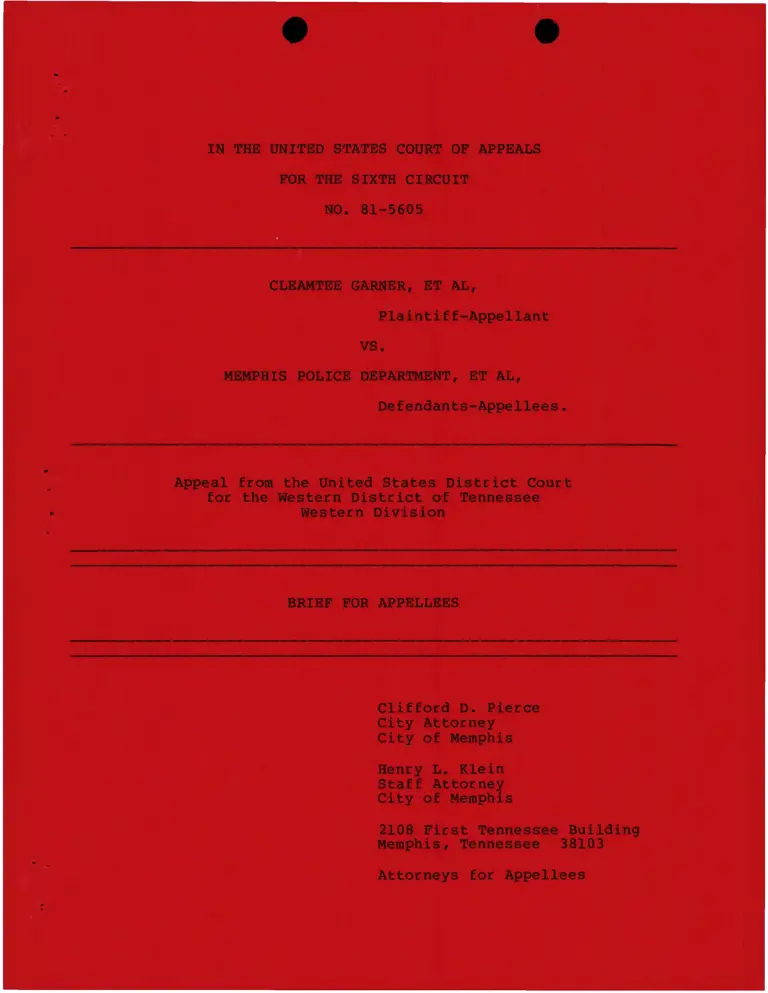
IN THE UNITED STATES COURT OF APPEALS
FOR THE SIXTH CIRCUIT
NO. 81-5605
CLEAMTEE GARNER, ET AL,
Plaintiff-Appe1Iant
VS.
MEMPHIS POLICE DEPARTMENT, ET AL,
Defendants-Appellees.
Appeal from the United States District Court
for the Western District of Tennessee
Western Division
BRIEF FOR APPELLEES
Clifford D. Pierce
City Attorney
City of Memphis
Henry L. Klein
Staff Attorney
City of Memphis
2108 First Tennessee Building
Memphis, Tennessee 38103
Attorneys for Appellees
INDEX
Page
Table of Authorities.................................. ii - iii
Statement of Issues Presented for Review ................ 1
Statement of the Case .................................. 2
Statement of the F a c t s .................................. 5
ARGUMENT
I. DOES A MUNICIPALITY HAVE A SIMILAR QUALIFIED
IMMUNITY OR PRIVILEGE BASED ON GOOD FAITH
UNDER MONELL? ................................ 14
II. IS A MUNICIPALITY'S USE OF DEADLY FORCE UNDER
TENNESSEE LAW TO CAPTURE ALLEGEDLY NONDANGEROUS
FELONS FLEEING FROM NONVIOLENT CRIMES CONSTI
TUTIONALLY PERMISSIBLE UNDER THE FOURTH, SIXTH,
EIGHTH AND FOURTEENTH AMENDMENTS?............... 15
III. IS THE MUNICIPALITY'S USE OF HOLLOW POINT
BULLETS CONSTITUTIONALLY PERMISSIBLE UNDER
THESE PROVISIONS OF THE CONSTITUTION?........... 21
IV. IF THE MUNICIPAL CONDUCT IN ANY OF THESE RESPECTS
VIOLATES THE CONSTITUTION, DID THE CONDUCT FLOW
FROM A "POLICY OR CUSTOM" FOR WHICH THE CITY IS
LIABLE IN DAMAGES: 22
CONCLUSION........................................ 23
CERTIFICATE OF SERVICE .................................. 24
Table of Authorities
Cases;
Beech v. Melancon, A65 F.2d A25
(6th Cir. 1972) ................
Campbell v. City of Memphis,
(DC Tenn No. 79-2508,
March 25, 1981) ................
Cvmningham v. Ellington, 323 F. Supp 1072
(W.D. Tenn 1971) ................
Garner v. Memphis Police Department,
600 F.2d 52 (6th Cir. 1979) ................
Love V. Bass, 145 Tenn 522,
238 S.W. 94 (1922) ................
Mattis V. Schnarr, 547 F.2d 1007 ................
Monell V. Department of Social Services,
436 U.S. 658 ............ 1, 2, 4, 5,
Owen V. City of Independence,
445 U.S. 622 (1980) ................
Reneau v. State, 70 Tenn 720 (1879) ............
Rochin v. California, 343 U.S. 165 (1952) . . . .
Washington v. Davis, 426 U.S. 229 ..............
Wiley V. Memphis Police Department,
548 F.2d 1247 (6th Cir. 1977) . . 14, 16, 19, 20, 21,
Statutes:
T.C.A. §40-808 .............................. 3,
28 U.S.C. §1331 ..............................
28 U.S.C. §1343(3) ..............................
42 U.S.C. §1981 .................. ..........
42 U.S.C. §1983 ..............................
Page
14, 17
14, 17
18, 19
2 1 , 22
23
18, 19
14, 16
15
23
22
20
22, 23
21, 23
2
2
2
2
XI
A2 U.S.C. §1985 ........................
42 U.S.C. §1986 ........................
42 U.S.C. §1988 ........................
Other Authorities;
Comment, Deadly Force to Arrest: Triggering
Constitutional Review, 11 Harv. Civ.
Rights-Civ. Rights-Civ. Lib. L. Rev
361 (1974) ........................
2
2
2
18, 19
1 1 1
IN THE UNITED STATES COURT OF APPEALS
FOR THE SIXTH CIRCUIT
NO. 81-5605
CLEAMTEE GARNER, ET AL,
Plaintiff-Appellant
VS.
MEMPHIS POLICE DEPARTMENT, ET AL,
Defendants-Appellees.
Appeal from the United States District Court
for the Western District of Tennessee
Western Division
BRIEF FOR APPELLEES
STATEMENT OF ISSUES PRESENTED FOR REVIEW
1. Does a municipality have a similar qualified immunity
or privilege based on good faith under Monell?
2. If not, is a municipality's use of deadly force under
Tennessee law to capture allegedly nondangerous felons fleeing
from nonviolent crimes constitutionally permissible under the fourth,
sixth, eighth and fourteenth amendments?
3. Is the municipality's use of hollow point bullets consti
tutionally permissible under these provisions of the Constitution?
t
4. If the municipal conduct in any of these respects violates
the Constitution, did the conduct flow from a "policy or custom"
for which the City is liable in damages under Monell?
STATEMENT OF THE CASE
This is a civil rights action brought by Cleamtee Garner on
April 8, 1975, in the United States District Court for the Western
District of Tennessee pursuant to 42 U.S.C. §§1981, 1983, 1985,
1986 and 1988 and 28 U.S.C. §§1343(3) and 1331, to seek redress
for the fatal shooting of his son Edward Eugene Garner on October 3,
1974, by an officer of the Memphis Police Department. Named as
defendants were the Memphis Police Department, City of Memphis,
Tennessee, Wyeth Chandler, Mayor of Memphis, Jay W. Hubbard, Director
of Police of Memphis and E. R. Hyman, Police Officer of the City
of Memphis.
The suit alleges that defendant Hyman violated the constitu
tional rights of Edward Eugene Garner when he shot and killed Garner
in attempting to apprehend him while fleeing from a private residence
at 739 Vollintine, Memphis, Tennessee. The other defendants were
sued on the grounds that their failure to exercise due care in
the hiring, training and supervision of defendant Hyman made them
equally responsible for Garner's death and all defendants were
sued on the grounds that their use or authorization to use the
"hollow point" bullet further caused the deprivation of Garner's
rights under the Constitution and Laws of the United States.
On May 2 3 , 1975, the defendants filed a Motion To Dismiss
which was overruled on August 18, 1975.
* Thereafter, on September 18, 1975, defendants filed their
answer denying liability; any violation of the Federal Civil Rights
Statutes; and any deprivation of the deceased's constitutional
rights. In further answering, defendants alleged that the actions
of defendant E. R. Hyman were governed by Tennessee Code Annotated
§40-808.
After preliminary hearings for discovery and motion for produc
tion of documents, the case came on for trial on August 2, 1976,
before the Hon. Harry W. Wellford, sitting without a jury. The
plaintiff's proof included testimony of the plaintiff himself,
Cleamtee Garner, father of the deceased, Edward Eugene Garner;
Talton Douglas Enoch, an architect who made a model of the scene
of the shooting; David Michael Cordero, an ambulance driver for
the City of Memphis Fire Department who transported Garner to the
hospital; Ann Stepp, employee of the City of Memphis Hospital who
introduced hospital records covering the condition of Garner follow
ing the shooting; Leedell Anderson, owner of the home that was
broken into by Garner; Dan L. Jones, Chief of Detectives, Shelby
County Sheriff's Department who testified as an expert relative
to when an officer is justified in using his revolver to apprehend
a fleeing felon; John A. Coletta, Captain, Memphis Police Department,
Commander of the Training Bureau; Eugene L. Barksdale, Inspector,
Memphis Police Department, who also testified as an expert relative
to when a police officer was justified in using his revolver to
apprehend a fleeing felon; Dr. J. T. Francisco, Shelby County
Medical Examiner; and the reading of portions of pretrial discovery
depostion of defendant E. R. Hyman,
At the conclusion of plaintiff's proof on August 4, 1976,
the court granted defendants' Motion For A Directed Verdict as
to defendants Hubbard and Chandler and a partial Directed Verdict
as to the City of Memphis and the Memphis Police Department with
regard to hiring practices.
Defendants' proof consisted of testimony of J. W. Hubbard,
former Director of Police, Memphis Police Department; defendant
E. R. Hyman; Velton J. Rogers, Probation Officer, Memphis and Shelby
County Juvenile Court; Leslie Burton Wright, Officer, Memphis Police
Department; F. J. Wheeler, Sergeant, Memphis Police Department,
and C. A. Russell, Sergeant, Memphis Police Department.
At the close of the trial, the court requested proposed findings
of fact and conclusions of law which were submitted by counsel
for both sides. On September 29, 1976, the court handed down its
Memorandum Opinion indicating a judgment should be rendered for
all defendants on all issues. On September 30, 1976, a Judgment
was entered in accordance with the Memorandum Opinion and on October
27, 1976, plaintiff filed a notice of appeal.
On appeal, the court affirmed the portion of the District
Court's Judgment dismissing the case against the individual defen
dants, but reversed and remanded the case against the City for
reconsideration in light of Monell v. Department of Social Services,
436 U.S. 658.
On remand, the District Court after reviewing memoranda and
hearing oral argument, concluded as a matter of law that plaintiff
was not entitled to reopen the case by way of a new trial on issues
already decided and found for the defendant City of Memphis in
light of Monell.
Plaintiff filed a Motion for Reconsideration which was granted
on May 29, 1980. The Court suspended its previous judgment and
permitted plaintiff to submit further briefs and memoranda as well
as any offer of proof.
After allowing plaintiff to make its offer of proof and the
filing of memoranda by both sides, the Court entered an Order on
July 8, 1981, finding in favor of defendant City of Memphis. There
after plaintiff filed his Notice of Appeal.
STATEMENT OF THE FACTS
A. Original Trial
On the evening of October 3, 1974, Edward Eugene Garner broke
into the Leedell Anderson home at 739 Vollintine, Memphis, Tennessee,
for the purpose of committing a robbery. (App. 23, 157, 158). Daisey
Bell Statts, 737 Vollintine, a next door neighbor, observed evidence
of a break-in and called the police. (App. 23). Although
the Statts house was not the one being broken into, the address
of 737 Vollintine was given to the police. (App. 23, 644, 645).
A call went out by radio over the police network to the police
car in Ward 128 that was manned by Defendant Hyman and Patrolman
Leslie Wright directing them to proceed to 737 Vollintine where
there was a prowler inside. (App. 23, 24, 642, 643, 703). Upon
arriving at 737 Vollintine the officers saw Daisey Bell Statts
standing on her porch pointing to the house next door. (App. 24, 644,
645, 707). Defendant Hyman questioned her about the situation and
she said, "they are breaking in next door". (App. 24, 644, 645).
Hyman then returned to the car, got his flashlight, advised his
partner what was happening, and then proceeded south along the
west side of the house at 739 Vollintine. (App. 24, 645, 646, 707).
Patrolman Wright then moved the squad car to the curb, called
the police dispatcher to advise they were on the scene, picked
up his flashlight and moved toward the east side of the house.
(App. 24, 707, 708).
Defendant Hyman became aware that there was a light on inside
the house as he proceeded down the west side towards the rear.
(App. 24). As he approached the southwest corner of the
house Hyman heard the back screen door slam and reaching the corner
of the house he saw a figure running from the back of the house
to the back of the lot where a cyclone fence extended across the
south boundary of the property. (App. 24, 646, 647). The
backyard of 739 Vollintine was completely encircled by fencing.
(App. 24).
There was a three to four foot chicken wire fence supported
by boards which ran in a north to south direction along the west
side of the backyard and was situated between Hyman and the cyclone
fence which appeared to Hyman to be approximately six or seven
feet high. (App. 24, 649, 654). As defendant Hyman was stand
ing at a point near the southwest corner of the house, he could
also observe that a garbage can had been placed under a window
on the back side of the house and the glass was broken out of the
window in the rear. (App. 24, 25, 656). Hyman could also make
out a clothesline and the outline of objects in the backyard between
him and the fleeing subject. (App. 25, 653).
Defendant Hyman shined his flashlight along the fence and
spotted Edward Eugene Garner in a stooped position next to the
cyclone fence near the southwest corner of an outbuilding located
in the southeast corner of the yard. {App. 25, 252, 650).
He did not appear to be armed, but Hyman could not be certain of
this at the moment. (App. 25, 658).
Defendant Hyman immediately shouted "halt" and identified
himself. (App. 25, 650). Garner paused momentarily and then
as Hyman started in his direction and toward the chicken wire fence.
Garner sprang to the top of the cyclone fence extending half of
his body and his head over the fence when Hyman fired his service
revolver hitting Garner in the right side of the head. (App. 25
651, 652).
The area to the south beyond the fence was in darkness and
there was poor illumination in the Anderson backyard. (App. 25,
647, 648). Hyman was not familiar with this particular
location or neighborhood, having lost his way in proceeding to
the site. (App. 25, 644).
Patrolman Wright, in the meantime, had proceeded along a picket
fence on the other side of the house and heard Defendant Hyman
yell "Halt" in a loud voice, following which there was a pause.
(App. 25, 708) . As Patrolman Wright approached the south
east corner of the house, he heard a shot. (App. 25, 810).
Wright then flashed his flashlight along the fence until he picked
up Garner whose body was draped on the fence, the torso, arms,
and head draped over the south side and the legs draped over the
Wright apparently did not hear Hyman's earlier indication to get
Garner when Hyman first located him with his flashlight as Garner
paused before attempting to scale the fence. (App. 25, 26).
An ambulance was called and Garner was transported to the
hospital where he never fully regained consciousness. (App. 26, 710),
It was later determined that after brealcing into the Anderson
house. Garner ransacked the bedrooms and removed a ring and a wallet
containing a small amount of cash. (App. 26, 168, 169).
Less than two months prior to October 3, 1974, Garner, who
was 15 years old, was placed on probation by the Juvenile Court
in Memphis in connection with an adjudication of Juvenile Delinquency
stemming from a charge of burglary which his parents had investi
gated and reported. (App. 26, 689). Previously, Garner
was placed on probation by Juvenile Court on November 1, 1971,
in connection with a lesser charge of burglary, and he had also
been charged with violation of curfew set by the Juvenile Court.
(App.26, 686). The boy's father conceded that his son was somewhat
of a problem for him, particularly since he (the father) worked
at night. (App. 26,' 82, 83). When the father was notified
of the boy's death following the shooting he indicated to the police
that he had been expecting something like this to happen. (App.
726, 727).
At the time of his death, the alcohol content in the blood
of Edward Eugene Garner was .09 which is just under the standard
for adults established by Tennessee Law on the presumption that
north side right in the bend of the body. (App. 25, 710).
8
592). Although Garner was about five feet/ four inches tall
and weighed probably in the neighborhood of 100 to 110 pounds at
death, Hyman stated that at the time he was pursuing him he looked
to be about 17 or 18 years old, in the neighborhood of 5'5" to
5'7" tall and weighing less than 130 pounds. {App. 26, 253, 557).
The blood alcohol content was sufficient to slow his reaction.
(App. 26, 563).
Defendant Hyman, at the time he was attempting to apprehend
Garner, could not be certain whether there was an accomplice in
the house or in the area, and whether the accomplice might be armed.
(App. 27, 656, 674, 675). The area by the cyclone fence in the back
of the yard was not illuminated, and the area south of the fence
was very dark at the time defendant Hyman was trying to apprehend
Garner. (App. 27, 647). He could detect only traces of tall
underbrush and trees on the other side of the cyclone fence. (App.
27, 232, 233). He did not know the lay of the land in this area
which was only a few blocks from the Garner home. (App. 27, 648).
Defendant Hyman testified that the reason he fired at Garner
was because he knew that he would not be able to apprehend him
on foot. (App. 652, 654). The factors that he considered were
his difficulty in getting through the cluttered backyard; Garner
already being halfway over the six foot chain link fence; his concern
about his ability to scale the six foot chain link fence due to
his own size, his foot wear, having a flashlight in one hand and
a pistol in another and the other paraphernalia on his person;
one is acting under the influence of an intoxicant. (App. 2 6 ,
the area being dark; his uncertainty about the terrain on the other
side of the cyclone fence, and the concern that there may have
been an accomplice in the house who may be armed. (App. 652-657).
Plaintiff's expert witness, Eugene Barksdale, testified that
if a police officer, in pursuing a fleeing felon, is sure that
he cannot apprehend the subject, it is his duty under state law
to use whatever means is necessary to apprehend him, which would
include use of his weapon. (App. 377). He further testified
that the officer should pursue the subject on foot without firing
his weapon only if he knows beyond a reasonable doubt that the
individual is not armed. (App. 377).
Captain John Coletta of the Memphis Police Department also
testified as an expert witness on the question of when an officer
was justified in using his firearm in attempting to apprehend a
fleeing felon. In response to a hypothetical question covering
a factual situation identical to circumstances surrounding the
shooting of Edward Eugene Garner, he stated that in his opinion,
Hyman was justified in using his pistol in view of the fact that
this would be the only means of apprehending Garner who was fleeing
from a private residence after having burglared the same. (App.
532) .
After full investigation of the incident of October 3, 1974,
and a review of same by the Memphis Police Firearms Review Ward,
no disciplinary action was taken against Hyman nor was any action
taken by the Shelby County Grand Jury, although the matter was
10
presented to it. (App. 27, 623, 625, 662). There is nothing in the
record to indicate that defendant Hyman had any propensity toward
precipitous or reckless use of firearms as a police officer or
otherwise. (App. 27).
The training methods used and the subject matter taught at
the Memphis Police Department Training Academy in the area of the
use of firearms and deadly force are generally consistent with
those used by other police departments and the FBI Academy. (App.
27, 534, 535). Memphis police instructors received training
at the FBI Academy. (App. 27, 304). They taught police
to fire at the largest target present, usually the trunk or torso
area, the "center mass". (App. 27, 28, 348, 349). Police were
given instruction also by legal advisors on the Tennessee law with
respect to the use of lethal force. (App. 28, 323).
Regulations published by the Memphis Police Department in
connection with the "Use of Firearms and Deadly Force , effective
at the time were somewhat more restrictive than Tennessee Code
Annotated §40-808, which deals with the lawful means by which a
fleeing felon may be apprehended. (App. 28, 322).
Prior to October 3, 1974, the Memphis Police Department decided
to make a study of various types of ammunition following complaints
by officers that the "round nose" type ammunition they were issued
for their service revolvers was not sufficiently effective in stop
ping or neutralizing individuals with whom they were confronted
in dangerous situations. (App. 28, 494, 495, 627, 628). This
11
followed an episode in which a police officer was killed (and a
Federal Probation Officer wounded) by an apparently beserk man
firing at random at others. (App. 28, 496). Tests were con
ducted by the Firearms Section of the Memphis Police Department
under the auspicies of Captain John Coletta who recommended a change
to a "hollow point" projectile or bullet as more effective in "neu
tralizing" or incapacitating an individual and less likely to pene
trate through a target and thus continue in flight to the possible
harm of others. (App. 28, 495).
During the term of Police Director Hubbard, the Memphis Police
Department thereafter, following consideration of the Coletta recom
mendation, changed to the use of "hollow point" ammunition, specif
ically .38 Special Caliber Remington 125 Grain, semi-jacketed hollow
point. (App. 28, 29, 627-629). Hubbard also established a
Firearms Review Board to investigate incidences wherein police
employed a firearm. (App. 29, 613).
"Hollow point" ammunition is used by many other police depart
ments throughout the United States and by the FBI, although it
is more lethal in its effect. (App. 29, 493). A key
factor in the injury producing effect of a bullet is the part of
the body it strikes and the point of entry. (App. 29, 494).
The particular type of ammunition used by the Memphis Police had
a greater wounding producing potential with greater velocity than
was formerly utilized, and was more accurate. (App. 29).
"Hollow point" ammunition produces more injury than round nose
ammunition, all other factors being equal, but state and local
12
Medical Examiner and County Coroner, Francisco, could not state
the type of ammunition used in this particular episode would have
made any difference in bringing about Garner's death in light of
the place where the bullet struck and the point of entry. (App.
29, 569, 570, 597, 598).
There is no evidence introduced tending to indicate any personal
involvement whatsoever by Director Hubbard or Mayor Chandler in
the episode of controversy, or in any failure on their part with
respect to police hiring procedures regarding the employment of
Hyman as a police officer. (App. 29, 30). There was evi
dence to the effect that Hyman was, prior to this episode, a compe
tent police officer, indeed, that he was the type of person who
was a desirable police recruit by reason of his education, back
ground, ability and his race. (App. 30). There was no
evidence indicating insufficient or inade<guate police hiring methods
or standards. (App. 30).
B. On Remand.
In its original order of February 29, 1980, the court found
that there was no basis for reopening the case and introducing
additional evidence because the plaintiff's Constitutional claims
received full and careful consideration under §1331 in the initial
trial. (App. 36-46).
The Court further found that a municipality's use of deadly
force under Tennessee law and the use of hollow point bullets was
not unconstitutional. (App. 46). After this judgment
was suspended to allow plaintiff to make an offer of proof.
13
plaintiff did so in the form of reports, depositions from other
cases, data computed in Wiley v. Memphis Police Dept., 548 F.2d
1247 (6th Cir.), cert, denied, 434 U.S. 822 (1977) and affidavits.
(App. 760-1477). Thereafter on July 8, 1981, the District Court
entered an Order dealing specifically with plaintiff's offer of
proof (App. 55-62) and the questions posed by this Court when
the case was remanded. (App. 55-62). Although the court
did not believe the additional tender by plaintiff should be taken
into account, after giving it full consideration, its conclusion
was not changed. (App. 58). The court again responded to
the four (4) questions, concluding specifically that the City's
deadly force policy and use of hollow point ammunition was consti
tutional. (App. 61, 62). A judgment was rendered again
for the City of Memphis primarily because of previous decisions.-
(App. 62).
1/
ARGUMENT
I
DOES A MUNICIPALITY HAVE A SIMILAR QUALIFIED IMMUNITY OR PRIVILEGE
BASED ON GOOD FAITH UNDER MONELL? ~~
The City submits that even though it does not have a qualified
immunity per se, under the circumstances of this case it had the
right to rely upon its current policy as being constitutional.
Wiley V. Memphis’ Police Dept., supra. Beech v . Melancon,
465 F2d 425 (6th Cir. 1972); Cunningham v. Ellington, 373 F.Supp.
1072 (WD Tenn 1971) and Campbell v. City of Memphis (DC Tenn No.
79-2508, March 25, 1981)
14
The District Court found that under Owen v. City of Independence,
445 U.S. 622 (1980) the City does not have a good faith defense
in a 1983 action nor may it claim immunity simply because of the
good faith action of its agent, officer Hyman. (App. 61).
The court went on to point out however, that the answer to this
question is in some doubt because the City was apparently relying
upon the Tennessee law as it had been interpreted by the Federal
and State Courts. (App. 61). In the case of the City
of Memphis, their policy relative to the use of firearms was more
restrictive than the state law. (App. 28, 322). It is extremely
difficult to comprehend any reasoning or rationale which would
predicate liability upon the City where they were relying upon
a policy which was within the limits of a state law and has been
constitutionally upheld.
II
IS A MUNICIPALITY'S USE OF DEADLY FORCE UNDER TENNESSEE LAW TO
CAPTURE ALLEGEDLY NONDANGEROUS FELONS FLEEING FROM NONVIOLENT CRIMES
CONSTITUTIONALLY PERMISSIBLE UNDER THE FOURTH, SIXTH, EIGHTH AND
FOURTEENTH AMENDMENTS?
The District Court answered this question in the affirmative.
The City submits the answer should be yes.
A. Facts.
This question presupposes that the instant case involves a
"non dangerous felon", fleeing from a "non violent crime." At
the time of the shooting, the officer acting under the policy of
the City could not be certain at the moment that the suspect Garner
15
was unarmed (App. 25, 658) or whether there was an accomplice
in the house from which Garner was fleeing and whether the accom
plice might be armed. (App. 27, 656, 674, 675). When the officer
arrived at the scene he was told by a neighbor that "they are break
ing in”. (App. 24, 644, 645). Further the officer did not know
whether the suspect had committed a so called "property crime”
or whether persons in the house which he had forceably entered
might be endangered. (App. 32). He could have committed
another crime in the house such as rape, assault or even homicide.
In analyzing one of the affidavits tendered by plaintiff,
the District Court said in its Order of July 8, 1981:
"Furthermore, as was indicated in considering the facts
of the instant case, a police officer simply cannot clearly
determine at night or in darkness whether a suspect is
armed or has been armed with a deadly weapon when involved
in the suspected felony. The bias of plaintiff's expert
is apparent in his last conclusion, 'it was very wrong
that the officer had been told to do what he did,' (a
conclusion drawn not from the record in this case, but
from a brief account of facts in an appellate decision)
and that Garner was dead 'because of policy and training
which authorized the summary shooting of non-dangerous
suspects on the basis of suspicion or probable cause'.”
(App. 58)
Then the Court goes on to say:
"This Court does not believe that the additional tender
by plaintiff should properly be taken into account for
the reasons set forth in the Court's Order (and Opinion)
dated February 29, 1980, but even giving it full consid
eration, the conclusion heretofore reached is not changed.
The facts of this case did not indicate to Officer Hyman
that Garner was 'non-dangerous'.” (App. 58)
B. Existing Law.
Upon reconsideration in light of Monell, the District Court
rendered judgment for the City primarily because of previous deci
sions by this court in Wiley v. Memphis Police Department, supra;
16
Beech v. Melancon/ 465 F2d 425 (6th Cir. 1972); and Cunningham
V . Ellington, 323 F.Supp. 1072 (W.D. Tenn. 1971). (App. 62).
The Court then commented on an opinion by the Chief Judge
of the Western District of Tennessee involving the deadly force
policy of the Memphis Police Department;
"The very question involved in this case was recently
decided by Chief Judge McRae of this District in Campbell
V . City of Memphis, NO. 79-2508 (March 25, 1981), who
held;
The Memphis Police Department's deadly force
policy, inter alia, authorized police after
having made known their identify and purpose,
to use deadly force;
To apprehend a fleeing person, after
exhausting every other reasonable
means of prevention, apprehension,
or defense, when the officer has
reasonable cause to believe the sus
pect has committed a felony which
is either a burglary in the first,
second, or third degree, or a felony
involving an actual or threatened
attack which the officer has reason
able cause to believe could result,
or has resulted, in death or serious
bodily injury.
As plaintiffs stress, this motion does not
question the use of deadly force by police
officers against suspects who forcibly resist
arrest, who pose a threat to the life or bodily
security of the arresting officers or other
persons, or the use of deadly force to apprehend
persons suspected of felonies involving vio
lence. Instead, "[t]he only issue presented
here in the constitutionality of using deadly
force against a property crime suspect, who
has not engaged in violence."
Plaintiffs contend that the deadly force policy
of the Memphis Police department is unconsti
tutional on several grounds. First, they argue
17
that use of deadly force against a non-violent
property crime suspect is cruel and unusual
punishment. Second, they argue that this policy
violates the equal protection clause of the
Fourteenth Amendment. Third, they contend
that the use of deadly force against a non
violent property crime suspect violates the
due process clause of the Fourteenth Amendment.
Fourth, they argue that use of deadly force
to arrest a non-violent property crime suspect
is an unreasonable seizure.
* * * *
. . . In accordance with Cunningham, this Court
holds that the deadly force policy of the Memphis
Police Department does not violate the equal
protection clause of the Fourteenth Amendment
because of not allowing deadly force to be
used against fleeing misdemeanants.
* * ★ *
The definition of the goal to be served by
the deadly force policy becomes important.
Clearly, a goal to be served by the deadly
force policy of the Memphis Police Department
is the prevention of all future felonies.
As such, the deadly force policy is not over-
inclusive. See discussion in Comment, Deadly
Force to Arrest: Triggering Constitutional
Review, 11 Harv. C.R. - C.L.L. Rev. 361, 375-
380 (1976).
* ★ * *
The dissenting judges in Matt is (v. Schnarr,
547 F.2d 1007 (8th Cir. 1976)), criticized
the majority for failing to identify the interests
of the state which should be balanced against
the felon's right to life. The dissent said
these state interests "include effective law
enforcement, the apprehension of criminals,
the prevention of crime and the protection
of members of the general populance who, like
fleeing felons, also possess a right to life."
Id., 1023.
18
The dissenting judges in Mattis also criticized
the majority for a "single-minded focus on
the seemingly absolute right of an individual
to life." Id., 1022. After noting that life
is filled with contradictions and obstacles,
the dissent noted, in a statement quoted by
the Sixth Circuit in Wiley at 1253:
There is no constitutional right
to commit felonious offenses and
to escape the consequences of those
offenses. There is no constitutional
right to flee from officers lawfully
exercising their authority in appre
hending fleeing felons.
Mattis, 1023.
The dissent in Mattis, with which the Sixth
Circuit agreed in Wiley, points out that the
interests of the state in effective law enforce
ment, the apprehension of criminals, and the
prevention of crime outweigh the interests
of the fleeing felon in this matter. As noted
earlier, deadly force may be used only after
the officer has warned the fleeing felon to
halt, and only if the officer reasonably believes
that no lesser menas will prevent the escape
of the fleeing felon.
* * * *
"No court has ever specifically found force
necessary to effect arrest to be unreasonable
under the fourth amendment." Deadly Force
to Arrest! Triggering Constitutional Review,
supra, 384, 385.
C. Punishment.
Plaintiff argues at length that the deadly force policy of
the City is tantamount to punishment. In Cunningham v. Ellington,
supra, the Court said at page 1075:
. . . and the short answer to plaintiff's contention
is that we simply are not dealing with punishment.
19
D. Equal Protection - Racial Discrimination
At the trial of this case, plaintiff presented no evidence
to substantiate the assertion that there had been a denial of equal
protection on the basis of race. As a matter of fact, counsel
for plaintiff expressed no desire to pursue this facet of the case.
(App. 42).
This issue was raised in Wiley and pursued against all defen
dants which included the City of Memphis. Statistical information
was introduced along racial lines. This Court said in Wiley at
page 1254:
The District Court held with respect to plaintiff's claim
of racial discrimination that "plaintiff has failed to
persuade the court that under the circumstances of this
case defendants have discriminated against her or against
her son because of their race."
Nor did the Court find a denial of equal protection when
it said:
No racial animus or basis is shown to motivate the policy
involved. Both white and black fleeing felons have been
shown by plaintiff's own proof to have been fired upon
or shot by Memphis police as a matter of last resort
where otherwise arrest cannt be reasonably accomplished
and escape is inevitable, even in the case of so-called
property crimes.
In our opinion these findings of fact are supported by
substantial evidence and are not clearly erroneous.
As to racial impact, the Supreme Court in Washington
V. Davis, 426 U.S. 229, 239, 96 S. Ct. 2040, 2047, 48
L. Ed. 2d 597 (1976) stated:
. . . Our cases have not embraced the proposition that
a law or other official act, without regard to whether
it reflects a racially discriminatory purpose, is unconsti
tutional solely because it has a racially disproportion
ate impact.
20
E. Municipality v. Officers and Officials
This Court in its opinion remanding the case for further consi
deration ruled that its previous decisions do not establish the
constitutionality of TCA §40-808 permitting a city to authorize
its officers to use deadly force against a fleeing felon. 600
F2d at 54. However, in Wiley the Court said at page 1254:
We are of the opinion further that MPD, the City, the
Mayor, and the former Mayor, and the Chief of Police
had the same right to rely on the law of Tennessee and
the decisions of this Court and the decision of the three-
Judge Court in formulating their policies. Also, they
would rely on the presumption that the Tennessee statute
was constitutional and on the fact that no court at that
time had ever held that statute or a similar statute
to be unconstitutional. (Emphasis Ours)
It is difficult to ascertain the difference in the constitu-
tonality of a statute as it relates to individuals as opposed to
a municipality. If TCA §40-808 is constitutional to the extent
that individuals can in good faith rely upon it, then it would
logically follow that the city has a right to rely upon it.
Ill
IS THE MUNICIPALITY'S USE OF HOLLOW POINT BULLETS CONSTITUTIONALLY
PERMISSIBLE UNDER THESE PROVISIONS OF THE CONSTITUTION?
The District Court answered in the affirmative.
Defendant submits the answer should be yes.
Hollow point bullets are used by many other police departments
throughout the United States as well as the FBI. (App. 29, 493).
As the District Court pointed out in its initial findings (App.
33-35) and in its Orders of February 29, 1980, (App. 37, 46)
and July 8, 1981, (App. 62) the use of this type of ammunition
21
.did not violate standards of civilized conduct so as to shock the
conscience of the Court. Rochin v« Californiar 343 U.S. 165 (1952).
Furthermore, as the Court found, "the question of the use of hollow
point bullets does not require a Constitutional determination under
the facts of this case because it had no causative relation and
regarldess of whatever kind of ammunition had been used, the result
would have been the same. (App. 62)
IV
IF THE municipal CONDUCT IN ANY OF THESE RESPECTS VIOLATES THE
CONSTITUTION, DID THE CONDUCT FLOW FROM A "POLICY OR CUSTOM" FOR
WHICH THE CITY IS LIABLE IN DAMAGES?
The District Court found that the city was not liable.
Defendant submits that the District Court was correct in find
ing no liability.
. If the city's deadly force policy and use of hollow point
bullets are constitutionally permissible, then we do not get to
this last question. Irrespective of whether you get to this ques
tion or not, the District Court found that "there was demonstrated
no constitutionally impermissible action or practice in the record."
(App. 62).
In a footnote in the previous opinion, this Court referred
to certain statistics submitted in the Wiley case on the question
of "policy or custom" 600 F2d at 55. In Wiley, this Court said
at page 1249:
22
The facts as found by the District Judge, however, were
that these policies, practices, customs and usages were
authorized by the Legislature of Tennessee in its enact
ment more than one hundred years ago, of the present
language of T.C.A. §40-808, hereinabove set forth. This
language appeared as Section 5040 of the Tennessee Code
of 1858, the first official code of Tennessee, and embodied
the common law of that State. Love v. Bass, 145 Tenn.
522, 529, 238 S.W.2d 94 (1921); Reneau v_̂ State, 70 Tenn.
720 (1879).
If this Court in Wiley did not see fit to disturb the trial
court's findings relative to "policies, practices, customs and
usages" based on City of Memphis statistics, then certainly there
would be no justification for disturbing the findings in this case
which likewise involves the City of Memphis.
CONCLUSION
It is respectfully submitted that the judgment of the District
Court should be affirmed.
Respectfully submitted,
Clifford D. Pierce, City Attorney
City of Memphis
125 North Main, Room 314
Memphis, Tennessee 38103
Henry L. 'Klein, Staff Attorney
2108 First Tennessee Building
Memphis, Tennessee 38103
23
CERTIFICATE OF SERVICE
I hereby certify that two copies of the foregoing Brief have
been served by United States mail, postage prepaid, to Steven L.
Winter, Suite 2030, 10 Columbus Circle, New York, New York 10019,
this the 6th day of January, 1982.
Henry L. ^lein
f
J*
24