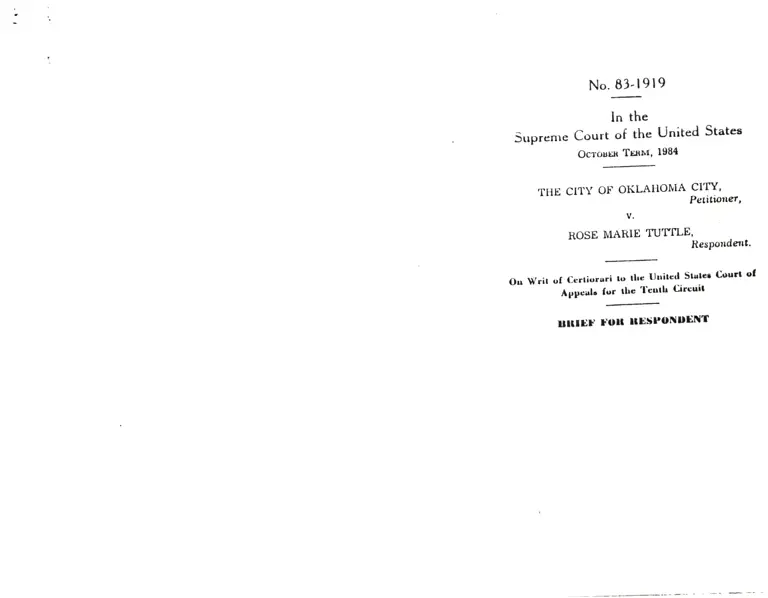
Oklahoma City v. Tuttle Brief for Respondent
Public Court Documents
December, 1984
30 pages
-
Case Files, Garner Working Files. Oklahoma City v. Tuttle Brief for Respondent, 1984. c3ab6351-35a8-f011-bbd3-000d3a53d084. LDF Archives, Thurgood Marshall Institute. https://ldfrecollection.org/archives/archives-search/archives-item/0867393c-bf65-4990-98bc-f32918d9d0db/oklahoma-city-v-tuttle-brief-for-respondent. Accessed September 26, 2026.
Copied!
No. 83-1919
In the
Suprem e C ourt of the U nited S tates
OCTOBtH TtHM, 1984
THE CITY OF OKLAHOMA CITY,
Petitioner,
r o s e IVIARIE TUTfLE,
Respondent.
Oil W rit o f C ert iorari to the IJiiiteil S ta le* C ou rt o f
Appeal* for the T e n th C ircuit
UlUEi'' F o i l llESFOl^iOENT
No. 83-1919
In the
Suprem e C ourt of the U nited States
OcTOBtm TiiHM, 1984
THE CITY OF OKLAHOMA Cl FY,
Petitioner,
V.
r o s e m a r ie TU-TrLE.
Respondent.
O n W rit o f C ert iorari to llie IJiiile.l SluleB C ourt o f
Appeals fo r the T e n th Q r e u i l
I t l l l E F r o l l UESI'OIMUEIMT
QUESTION PKESENTBO
W hether a single isolated incident of the use of exces
sive force by a police ollicer establishes an ofiicial policy
or custom of a municipality suflicientno render the munici
pality liable m damages under 42 U.S.C. §1983.*
•Tins is ihe quesrion reci.ed in the Petition for W tit of Certionti and
the Brief for Petitioners. We urge at pages 38 39 of this brief that
this question is not in fact presented by this case.
TABLE OF CO NTENTS
PAGE
QUESTION PRESENTED i
TABLE OF AUTHORITIES ........... ii»
RULES INVOLVED .................................... 1
STATEMENT OF THE CASE 2
(1) The Killing of William Tuttle ................ 2
(2) Proceedings in the District Court 4
(3) Proceedings in the Court of Appeals 10
SUMMARY OF ARGUMENT ................................-.... 12
ARGUMENT:
I. The Evidence Was Sufficient to Support the
Ju ry ’s Finding of Municipal Liability Under
Mwiell V. New York City Dept, of Social Serv
ices, 436 U.S. 658 (1978) .......... .. ....... — 15
(1) The Decision in Monell 15
(2) The Standard of Review ......................... 23
(3) The Evidence in This Case .......- 29
II. The “Question Presented” By Petitioner Is
Not in Fact Presented By This Case _ 38
HI. Monell Does Not Require that the Municipal
Policy or Decision Which Injured a Plaintiff
Have Also Injured Other Individuals 40
CONCLUSION ..................................... .............. ...... - ...... 48
—II—
— I l l —
T A B LE OF AUTH O RITIES
Canes fAOE(l)
Anderson v. City of Bessemer Cit/,-No. 83-1623 25
Anderson v. Smith, 226 U.S. 439 (1913) ........... —
Bailey v. Central Vermont R. Co., 319 U.S. 350 (^^43) 24,25
Bennett v. City of Slidell, 728 F.2d 762 (5th Cir. 1984)
Berry v. McLemore, 670 F.2d 30 (5th Cir. 1982) —
Bivens v. Six Unknown Federal Narcotics Agents, 403
U.S. 388 (1971) - ........
Black V. Stephens, 662 F.2d 181 (3rd Cir. 1982)
Castle V. Bullard, 64 U.S. 172 (1859) ̂ _ 45
Continental Ore Co. v. Union Carbide Co., 370 U.S.
690 (1962)
Ellis V. Union Pacific R. Co., 329 U.S. 649 (1947) . 24, 25.26
Familias Unidas v. Briscoe, 619 F.2d 391 (5th Cir.
1980) .................................................... ......... - ............ -
Gallick V. Baltimoie & Ohio R. Co., 372 U.S. 108
(1963) ............... .....- ............
Gilmore V. City of Atlanta, 735 F,2d 838 (5th Cir.
1984) .......................................................................... ........
Gunning v. Cooley, 281 U.S. 90 (1930)
Hearn v. City of Gainesville, 688 F.2d 1328 (11th Cir.
J902) .............................................................. 16,17
Herrera v. Valentine, 653 F.2d 1220 (8th Cir. 1981) 43
Hodges V. Easton, 106 U.S. 408 (1882) 28
Hopper V. Evans, 456 U.S. 605 (1982) ..... .....................
Jones V. East Tennessee, V. & G.R. Co., 128 U.S. 443
(1898) .................................... ................................... -
Kane v. Northern Cent. R. Co., 128 U.S. 91 (1888) 24
Katris V. City of Waukegan, 498 F. Supp. 48 (N.D.
111. 1980) .................................... ...................
Kingsville Independent School District v. Cooper, 611
F.2d 1109 (5th Cir. 1980) ....................................._16,17
— IV—
AUIHOimiES CONIIN'JtD PACERS)
Languirand v, Hayden, 717 F.2d 220 (5th Cir. 1983) 43
Lavender v. Kuril, 327 U.S. 645 (1946) 24,25
McClelland v. Facleau, 610 F.2d 693 (lOlh Cir. 1979) 43
Munell V, New York City Dept, of Social Services, 436
U.S. 658 (1978) pii.ssim
Monroe v. Pape, 365 U S. 167 (1961) 15. 19,32
Owen V. City of Independence, 455 U.S. 622 (1980) 40
Owens V. Haas, 601 F.2d 1242 (2d Cir. 1979) 46
Palmer v. Hoffman, 318 U.S. 109 (1943) 45
Parklane Hosiery Co. v. Shore, 439 U.S. 322 (1979) 28
Parratt v. Taylor, 451 U.S. 527 (1981) 11,19
Pawling V. United States, 8 U.S. (4 Cranch.) 219
(1808) 24
Peters v. Township of Hopewell, 534 F. Supp. 1324
(D.N.J. 1982) .......................................—
Pullman Standard Co. v. Swint, 456 U.S. 273 (1982) 20
Richmond & Danville Railroad Co., v. Powers, 149
U S. 43 (1893) 25
Scheuer v. Rhodes, 416 U.S. 232 (1974) 46
Schlesinger v. Reservists to Slop the War, 418 U.S.
208 (1974) 'll
Schneider v. City of Atlanta, 628 l'.2d 915 (5th Cir.
1980) ■ 16
Scott V. London & St. Katherine Docks Co., 3 H. & C.,
496, 159 Eng. Rep. 665 (1865) 45
Sioux City & Pacific R R. Co. v. Stout, 84 U.S. 657
(1874) 26
Teamsters v. United Slates, 431 U.S. 324 (1977) 42
Tennant v. Peoria & Pekin Union R. Co., 321 U.S. 29
(1944) 24,25,26
Tiller v. Atlantic Coast lane R. Co., 318 U.S. 54 (1943) 26
Turpin V. Mailel, 619 F.2d 196 (2d Cir. 1980) 43, 46
Warth V. Seldin, 442 U.S. 490 (1975) 41
Webster v. City of Houston, 735 F.2d 838 (5th Cir.
1984) ......................................................... ................ ........ ^2
-V— rA6f(s;
- 43
_ 24
46
4
4
4
AUTHOamiS CONTINUED
Wellington v. Daniels, 717 F.2d 932 (4th Cir. 1983) .
Wilkerson v. McCarthy, 336 U.S. 53 (1949) ..........
Zant V. Stephens, 77 L.Ed.2d 235 (1983-) ....................
IJiiileil Slulea Coiialilulion
Fourth A m endm ent.... ....... .....-............ ................ .........
Fifth Amendment ........ ...... -......... ...... ......
Sixth Amendment --------- ----------- -------- - ...............
Seventh Amendment ................ ...............- ................ ’ ’
Fourteenth A m endm ent........ - --- -------------- -------------
Lnitcd Sutea Code
28 U.S.C. § 1331 ...............................- ------------------
28 U.S.C. § 1343 ........... ......... - ...................
28 U.S.C. § 1391(b) .............................- .... - ...... —
42 U.S.C. § 1983 ............................................. ...... -
42 U.S.C. § 1985 ..................................... - - ..............
42 U.S.C. § 1986 ------- ---- ------ ------
42 U.S.C. S 1988
Federal Uulea of Civil Procetlure
........................................ .......................................................................1,45
13
4
4
4
15,38
4
19
4
1
Rule 51 .... ........................... ................... ......
Rule 52 . ................................ - ........... ..........—
Federal Uulea of Evidence
Rule 401 ............ .......
Miacellaneoua
1 Annals of Congress (1789) ................................- ...... — 28
J. Elliot, The Debates in the Several State Conventions
on the Adoption of the Federal Constitution (1856) .
W. Prosser & W. P. Keeton, The Law of Torts (5th ed.
1984) ............... ....... - .................. - ........
G. Rude, Wilkes and Liberty (1962) ................ - .......... -
Writings of Thomas Jefferson (Washington ed. 1861)..
“Civil Rights Litigation after Monell", 79 Col. L. Rev.
213 (1979) ................ - ........................- ---- ---------------
28
19
27
27
32
No. 83-1919
In the
2)upreme C ourt of the U nited States
O c t o b e r T e r m , 1984
THE CITY OF OKLAHOMA CITY,
Petitioner,
ROSE MARIE TUTTLE,
Respondent.
On Wril of Certiorari to the United States Court of
Appeals for the Tenth G rcuil
BRIEF FOR HESPOIMDENT
h u i .e s in v o l v e d
Rule 51, Federal Rules of Civil Procedure, provides in
pertinent part:
No party may assign as error the giving or the failure
to give an instruction unless he objects Uiereto before
the jury retires to consider its verdict, stating distinctly
the m atter to which he objects and the grounds of his
objection.
Rule 401, Federal Rules of Evidence, provides:
“Relevant evidence” means evidence having any tend
ency to make the existence of any fact that is of con
sequence to the determination of the action more prob
able or less probable than it would be without the
evidence.
-2—
STATEI»IElVr O F T H E CASE
( 1 ) The k illin g of William Tullle
Although many details of the events leading to this
litigation were the subject of sharply conflicting trial testi
mony, certain basic facts are not in controversy. On Oc
tober 4, 1980, the Oklahoma City Police received a tele
phone call reporting that an armed robbery was in progress
at a bar known as the We’ll Do Club. The caller, laughed
during the report, and described the alleged robber as a
37-year-old white male with brown hair and glasses. The
dispatcher radioed the report to police cars in the vicinity
of the Club. The first car to arrive at the scene was driven
by Police Officer Julian Rotramel, a rookie officer who had
completed the police academy only ten months earlier. Al
though rookie patrolmen less than a year out of the acad
emy frequently rode with experiencerl senior officers, Ro
tramel had been assigned to patrol on his own. When
Rotramel arrived at the bar a second backup car, driven
by an experienced officer, was less than a minute away.
Rotramel chose, however, not to await the imminent aiiival
of a backup unit; he parked his patrol car directly in front
of the bar and entered it alone.
No robbery was in progress, threatened, or had in fact
occurred at the bar. Whether or not Rotramel was actually
told this when he was in the bar is among the issues that
were disputed at trial. In any event, shortly after Rotramel
entered the bar, he was approached by William Tuttle. Be
cause Tuttle matched the description of the alleged robber,
Rotramel directed Tuttle to remain in the bar. Tuttle ini
tially complied, but then left the bar through the same door
by which Rotramel had entered. Rotramel followed Tuttle
out of the bar, drawing his service revolver as he left. Out
side the bar Rotramel observed TuUle approximately ten
feet away. Tuttle had his back to Rotramel, and was in a
crouched position. Rotramel fired his service revolver, hit
ting Tuttle in the back.
When Rotramel shot Tuttle, another officer, Riley Len
nox, had already arrived at the bar, but was on another
side of the building out of sight of the shooting. Lennox
hurried to the scene of the shooting, and was directed by
Rotramel to search the boots of Mr. Tuttle, who lay dying
on the sidewalk. Lennox conducted a search of the boots,
but found nothing. Tuttle’s wife, who had had a baby only
5 days earlier, was called to the scene, but was not per
mitted to see or talk to her husband. Tuttle was taken by
ambulance to a local hospital, in the custody of several
police officers. At the hospital a nurse who was treating
Tuttle removed his boots, and this time a toy plastic cap
pistol fell out. Tuttle died shortly after arriving at the
hospital. (J.A. 63-64).
I t is undisputed that Tuttle was neither an armed rob
ber nor chargeable with any other felony. Similarly, all
parties agree that Tuttle in fact never had a gun or any
other type of dangerous weapon. Tuttle never made any
verbal threats to Rotramel and never posed any actual
danger to Rotramel, Lennox, or any other officer or civilian.
The most serious offense with which Tuttle could have been
charged was leaving the custody of officer Rotramel, a
misdemeanor for which the maximum penalty is a $35 fine.
(2 ) Procee«Iingi in the Diitlrict Court
Respondent Rose Marie Tuttle, William Tuttle s widow,
commenced this action in the United States District Court
for the Western District of Oklahoma. Her complaint was
brought pursuant to sections 1983, 1985, 1986 and 1988 of
42 U.S.C., and directly under the Fourth, Fifth, Sixth and
Fourteenth Amendments to the Constitution. See Bivens
V. Six l/7ikHOUJn Federal Narcotics Agents,' 403 U S. 388
(1971). Jurisdiction was based on 28 U.S.C. 1331, 1343,
and 1391(b). The complaint named as defendants both offi
cer Rotramel and the City of Oklahoma City. Respondent
alleged that in killing Tuttle, Rotramel “was acting pur
suant to the orders and directives” of the city (J.A. 15), and
that the city had “inadequately trained” its police ofliceis.
(J.A. 16). Re.spondent sought compensatory and punitive
damages, as well as an award of costs and counsel fees.
(J .A .20-21).
In the trial court both the city and ofiicer Rotramel
were represented by the City Attorney of Oklahoma City.
The nature of the defense adduced at trial is of consideiable
importance because it is very different from the contentions
now advanced by the city. In this Court the city insists that •
• Neither court below considered wlieiher tl.e peculiar requirements of
Motull V. Nett' Yori City Peparrmriit of Social Senicii, 436 U S. 658
(1958), rooted as tliey are in the particular legislative history of the
1871 Civil Rights Act, are applicable to an action brought directly
under the Constitution. Should this Court hold that the decision of the
Tenth Circuit cannot be upheld under Monell. the question of what
impact Monelt has on a Btoofis action should be remanded for consid
eration in the first instance by the court of api>eals
i By the time this action came to trial Rotramel was no longer on the
police force.
“the act of Rotramel in discharging his service revolver
and thereby causing the death of William Tuttle, was at
odds with the ‘official policy’ of Oklahoma City.” (P Br. 20,
see also id. at 19, 21). But at trial, counsel for petitioner
contended that Rotramel’s action was absolutely proper.
The Answer filed by petitioner asserted the following “af
firmative defenses”;
That the Defendant employee at all times herein men
tioned acted in good faith without malice and within
the scope of his duties as a police officer of the City of
Oklahoma City and peace officer of the State of Okla
homa.
That the actions of the Defendant and its employee
were lawful and proper and probable cause existed for
the arrest of Tuttle.
That the action of the Defendant and its employee in
all respect [siej was reasonable, proper and legal. (J.A.
22-23).
The defense offered by the city at trial was not that Rotra
mel had erroneously shot Tuttle in violation of city policy,
but that Rotramel’s action was proper in every respect
After eliciting testimony intended to show that Rotramel
had killed Tuttle because he feared that Tuttle was about
to shoot him, counsel for the city argued;
There’s no problem with the policy, I don t believe
[Rotramel] shot that man because he thought his
life was in danger. He did not wait to see an offensive
weapon. . . . He thought William Adam Tuttle was the
armed robber. He was in a position to grab a weapon.
He was in a position to turn around and shoot him, and
I submit to you, he shouldn’t have to wait to see that
weapon under those circumstances. . . . I contend that
officer Rotramel acted in a reasonable and good faith
belief, while he was acting as a police officer, and as
he should have reacted, to protect his life. . . . He was
acting as should have acted, acting as he reasonably
believed he was in danger of his life. He was a properly
trained police officer. . . . I hope that you’ll bring back
a verdict for both defendants, Julian Rotramel, for act
ing properly, and for the City of Oklahoma City for
training him so. (1r. 672-79).
In this Court the city denounces Rotramel’s conduct as
“excessive" and unauthorized, but in the district court the
city urged the jury to conclude that Rotramel’s action was
entirely consistent with city policies and training.
The defense adduced at trial hinged, not on any criti
cism of Rotramel’s action, but on a disagreement about
what had occurred on the night of October 4, 1980. The
city otfered testimony which, if believed, might have led
a jury to conclude that Rotramel had substantial rea.son to
think that Tuttle had a gun and was preparing to use it.
Rotramel testified that the barkeeper did not tell him there
was no armed robbery in progress,« that while in the bar
Tuttle had twice attempted to reach for his boot, that
Rotramel had physically restrained Tuttle® until lu t t le
broke loose and ran out of the bar,*' that Rotramel had
repeatedly shouted at Tuttle to halt,’ and that outside the
- J A 169. 179. 210.
* J A. 171, 179, 207, 209.
J A. 168. 169, 178, 203, 205.
« J A. 179.
’ J A. 158. 170, 172, 180, 183, 222.
bar Tuttle had jumped up and started to turn around be
fore Rotramel shot him." Witnesses who were in the bar,
on the other hand, gave a completely different story, as
serting that Rotramel was expressly assured in the bar that
there was no robbery in progress" that Tuttle had never
reached in his boot,*" that Rotramel had not tried to re
strain Tuttle physically,** that Tuttle had merely walked
out the door,*" and that Rotramel had never shouted halt.**
Medical evidence offered by plaintiff indicated that outside
the bar Tuttle had stumbled rather than crouched to reach
for his boot,** and that Tuttle was still bent over when he
was shot in the back.*® The testimony offered by plaintiff’s
witnesses, if credited by the jury, could have compelled the
conclusion that Rotramel had killed Tuttle without any
reasonable justification.
There was also conflicting evidence on several other
issues. First, the various police officials who testified gave
different answers regarding whether under city policy a
police officer were authorized to shoot a possibly dangerous
suspect if the officer had not actually seen a gun or other
—7—
» J.A, 158, 183, 224.
i* J A 82, 83, 90, 106. Rotramel himself told one investigating officer
that he had received that assurance. Tr. 204, 211.
A. 84, 100, 107.
“ J.A. 83-84, 97.
“ JA. 109, 132.
>aj.A. 86, 100, n o , 132, Tr. 601.
“ Tr. 181.
“ Tr. 177, 178, 179, 300.
weapon in the suspect’s possession.'" Second, witnesses
called by petitioner and respondent disagreed about the ade
quacy of the city’s training policies and about whether any
defects in those policies had caused the killing of Tuttle.'^
Third, the testimony raised questions about whether Ro-
tramel was adequately supervised particularly concerning
whether Rotramel was too inexperienced to have been per
mitted to be on patrol by himself."*
The district judge instructed the jury, in a manner
entirely consistent with Monell, that the city could only
be held liable if respondent prove<l both the existence of
a city policy, and that that policy had caused the alleged
constitutional violation.'" Petitioner did not object to those
instructions at trial, and does not complain of them here.
Throughout the proceedings in the district court, however,
the city consistently but unsuccessfully insisted that to es
tablish municipal liability under Monell respondent was
required to establish, not merely that the alleged policies
had resulted in the unconstitutional killing of Tuttle, but
also that those policies had brought about other sirnilaily
unconstitutional police killings or assaults.
The jury returned a verdict holding the city liable for
$1,500,000 in actual damages, but imposing no liability on
officer Rotramel. The city attorney attacked these verdicts
—8—
‘ •’Tlic conlliciing testimony regarding whetlicr city poliqr authorized the
shooting in question is discussed at pp. 29 32, irt/ra.
' ‘Tlie conflicting testimony regarding the city’s training policies is dis
cussed at pp. 31-32, infra.
* **See pp 36-37, infra.
***Sce pp. 21-22, infra.
as inconsistent, apparently insisting that the jury either
also hold Rotramel liable or to exonerate both his clients.
(Tr. 696, 702). The district judge concluded that the ver
dicts were consistent:
“ IW jhere a municipality pursues as a m atter of policy
activities that do not comport to the constitution . . . . its
liability is absolute even though officials who imple
ment such policies are protected by qualified immun
ity.” . . . I think the good faith defense on behalf of
an individual which is not available to the city or
municipality is the linchpin of the fact that this is not
inconsistent.
• • •
Now, I thought that that was perhaps the hardest
part of the plaintiffs case to prove that the failure to
train or inadequacy of the training was willful and
wantonly negligent. . . . I submitted it to the jury . . .
and the jury apparently felt that that was where they
thought the illness lay rather than upon officer Ro
tramel, who I assume . . . they felt that although he
did violate tlie decedent’s constitutional rights, that it
was in the good faith belief that he had the right to
do so under the circumstances here.
(Tr. 703-06). The city moved orally and in writing for
judgment notwithstanding the verdict. The district court
denied both motions, concluding “the plaintiff brought for
ward sufficient evidence regarding inadequate training and
procedures to w arrant submission to the jury of the issue
of municipal liability . . (J.A. 58).-°
- ‘•See also Tr. 702 (respondent adduced, not only proof of the constitu
tional violation at issue, but "additional evidence of . . . lack of training
or failure to train, or failure to supervise . . ."), 704 ("there was con
siderably more evidence presented here than the fact that the . . . shot
-1 0 -
( 3 ) Proceeding* in the ('.ourt of Appeal*
Both petitioner and respondent appealed from the ver
dict and the decision of the district court. Respondent con
tended that the judgment in favor of officer Rotramel was
improper, and that the trial judge should have directed a
verdict against Rotramel on the issue of liability. The city
challenged on a number of grounds the verdict against it.
The tenth circuit rejectcni both appeals.
In upholding the verdict in favor of Rotramel, the court
of appeals emphasized the role of the jury in resolving the
conflicting testimony. (J.A. 65). The court of appeals rec
ognized that Rotramel’s good faith defense “does not seem
to be strongly supported,” but concluded that the issue was
properly submitted to the jury for decision. (J.A. 66). "In
asmuch as the jury was properly instructed and since there
is evidence which favors Rotramel, we cannot assume that
the [jury’s] conclusion was improper.” (J.A. 66). If the
jury construed the evidence “in the light most favorable to
the defendant . . . it could find that he reasonably believed
his response was permitted.” (J.A. 65-66).’■**
-"(ConiinucJ)
someone- in deprivation of their civil rights. Tlierc was a good deal of
evidence. . . 701 05 ("1 was impressed wiili the evidence tliat was
presented in this case that the airriculum methods and the lack of sup
ervision and training was more than . . . just negligence ). 706 ( you
pot in enough evidence in my opinion that reasonable minds could dif
fer with regard to that.” ).
- 'T h e court of appeals’ opinion asserts that "Rotramel admitted at trial
that he violated Police Department policy in shooting Mr. futile.
(J A. 65). Tliat is not correct. Rotramel insisted that his action was
entirely consistent with city policy. Sec pp. 29-30, infra.
Petitioner argued in the tenth circuit that the trial
judge had instructed the jury that it could find the city
liable for a policy that was m erely negligent, and insisted
that respondent should have been required to prove gross
negligence. The court of appeals rejected this objection on
the ground that the jury had in fact been instructed that
the city could not be held liable unless there was “gross
negligence and deliberate indifference to the rights of the
decedent." (J.A. 69). Somewhat inexplicably, the tenth
circuit’s opinion contains no reference to this Court’s opin
ion in Parratt V. Taylor, 451 U.S. 527 (1981), which ex
pressly rejected the contention that liability could not be
imposed in a section 1983 action without a showing of in
tentional or grossly negligent conduct.
Petitioner also contended that respondent had failed to
adduce sufficient evidence to w arrant submitting to the
jury any claim against the city. The court of appeals,
however, observed that, in addition to the particular cir
cumstances surrounding the killing of Tuttle,
there was plenty of independent proof of lack of actual
training. In this case the individual defendant had
been on the police force for a very short period of
time; moreover, he admitted his lack of training to
cope with robberies. Nevertheless, he was allowed to
go in on a suspected robbery by himself. (J.A. 71).**
The tenth circuit therefore concluded that there was ade
quate evidence” to w arrant submission of the claim to the
jury. (J.A. 68).
— 11—
--Sec abo J.A. 68 ("Even the olTicer admitted the inadequaqr of the
training").
Third, respondent argued in the court of appeals, as
it does here, that municipal liability under Monell required
proof of a series of constitutional violations, and that a city
could not be held liable if there was only a “single inci
dent.” The tenth circuit held that the relevance and im
portance of evidence of any other violations depended in
each case on the type of municipal policy which a plaintiff
sought to prove, and on the nature of the other evidence
which the plaintiff adduced to support his or her claim.
In this case the court of appeals concluded that respondent
had produced sufficient evidence, over and above the killing
of Tuttle, to warrant submission of her claim to the jury.
(J.A. 70-71).
The court of appeals also upheld the amount of dam
ages awarded by the jury. Judge Barrett concurred on the
ground that “the trial court properly and adequately in
structed the jury .” (J.A. 72).
- 1 2 -
SUM M AKY O F AHCJFMEIMT
I. The district court in this case expressly instructetl
the jury that it could not impose liability on the city based
on respondeat superior, and that municipal liability would
have to be based on a finding (a) that there was a relevant
city oHicial policy or action, and (b) that that official policy
or action had caused the death of respondent’s husband
William Tuttle. The jury was also instructed that the issue
of whether or not Tuttle’s death was caused by a city policy
was “a question of fact.” (J.A. 43). Each of these instruc
tions was consistent with Monell v. New York City Dept,
of Social Services, 436 U.S. 658 (1978), and none were ob
jected to by petitioner.
The jury verdict in this case must be sustained on
appeal even though the evidence might justify a finding
either way. The Seventh Amendment limits appellate re
view of jury verdicts even more severely than the Rule 52
restriction on appellate review of trial court findings. See
PuIIrmin Standard Co. v. Swint, 456 U.S. 273 (1982). Ap
pellate reconsideration of a jury verdict is particularly in
appropriate when, as here, issues of crc*dibility are involved.
Compare Anderson v. City of Bessemer City, No. 83-1623.
In reviewing a jury verdict this Court must "view the evi
dence in the light most favorable to [the prevailing party]
and . . . give it the benefit of all inferences which the evi
dence supports, even though contrary inferences might rea
sonably be drawn.” Continental Ore Co. v. Union Carbide
Co., 370 U.S. 690, 696 (1962).
In this case there was conflicting evidence regarding
whether (a) the shooting of Tuttle was authorized by city
policy, (b) the shooting was caused by inadequate city
training policies, and (c) the shooting was caused by in
adequate city supervision policies. The resolution of this
conflicting evidence was a m atter for the jury.
II. The question presented framed by petitioner is
w hether the m ere existence of a single act of police bru
tality compels as a m atter of law a finding of municipal
liability. This case presents no such question.
Tliis case is not a case in which the plaintiff proved
only that an innocent civilian had been killed. Respondent
offered direct evidence that the shooting was caused by
municipal policies. The officer who shot Tuttle testified that
city training policies were inadequate and had led to Tut-
— 13—
lie’s death. The offical who was Chief of Police when Tuttle
was shot insisted that the shooting was entirely consistent
with city policy.
The implausible doctrine to which petitioner objects
that a single constitutional violation invariably compels
a finding of municipal liability—has never been advanced
by respondent, was not adopted by either court below, and
is not presented by this case.
III. Petitioner appears to argue that a plaintill undei
Monell must prove both the existence of a policy or custom
that caused the injury complained of and the existence of
“a regular pattern of constitutional deprivations.” Nothing
in Monell sanctions this second requirement. Monell itself
provided that an oflicial “decision” would sufiice to estab
lish liability, although a single decision will often have only
a single victim. There was only one constitutional violation
and deprivation in Chotm v. City of Indeptnidencc, 45.) U.S.
622 (1980).
Proof of a “regular pattern of constitutional depriva
tions” is not the only type of evidence on which a plaintift
can rely to prove an oflicial policy or decision. Such proof
clearly cannot be required where a plaintiff asserts the ex
istence of a policy or decision which by its own terms will
have only one victim. Even as to policies which might
cause several constitutional violations, direct evidence of
the substance of those policies, such as was introduced here,
is at least as probative as a statistical pattern of injuries
suggesting the existence of a common cause
—14—
— 15—
AnClJMENT
I. THE EVIDENCE WAS SUFFICIENT TO SUPPORT
THE JURY’S FINDING OF MUNICIPAL LIABILITY
UNDER mOISELL v. NEW YORK CTY DEPT. OP
SOCIAL SERVICES, 4 36 U.S. 6 58 (1 9 7 8 ) .
( 1 ) T lie Decision in Monell
The issue raised by the petitioner in this Court poses
a narrow question regarding the circumstances under which
damages may be awarded against a city under Monell v.
New York City Dept, of Social Services, 436 U.S. 658 (1978).
Petitioner has not sought, and this case does not require, any
comprehensive exegesis of Monell, but the basic holding of
that decision provides the context in which the present case
arises.
Prior to Monell this Court had held in a series of de
cisions dating from Monroe v. Pape, 365 U.S. 167 (1961),
that a local government was not a “person” subject to suit
under 42 U.S.C. § 1983.-^ Monell overruled Monroe, and
held that that earlier decision had misread the legislative
history of the 1871 Civil Rights Act, from which section
1983 is derived. Monell also concluded, however, tliat a
local government could not be held liable under section
1983 merely because a government employee had engaged
in unconstitutional conduct. To establish a claim under
Monell a plaintiff is required to establish two distinct ele
ments, first, that there was a relevant oflicial action or
custom, and, second, that that action or custom had caused
the constitutional violation complained of. 436 U.S. at 692-95.
see Monell V. New York City Dept, of Social Servicei, 436 U.S. at
6f)3 and nn 5 and 6.
Monell recognized that in establishing the existence of
an official action a plaintiff might rely either on the identity
of the official who took that action or on the substance the
action itself. Thus Monell referred both to action “by those
whose edicts or acts may fairly be said to represent olFicial
policy,” 436 U.S. at 694, and to “a policy statement, ordi
nance, regulation, or decision officially adopted and promul
gated. . . ." 436 U.S. at 690. In any governmental unit there
will be some individuals with such broad authority that all
of their “edicts or acts may fairly be said to represent offi
cial policy.” But liability under Monell is not limited to
the conduct of high ranking officials; it extends to any ac
tion or policy that has received “approval through the
body’s official decision making channels.” 436 U.S. 691.
Frequently the official decisionmaking process in a city or
county will be delegated to a number of subordinate em
ployees. The policy at issue in Monell, for example, had
been adopted by a minor personnel official of the Depart
ment of Social Services, exercising authority delegated to
him by his supervisors.-®
—16—
-<A number ol lower court decisions under Mondl have focused on die
high position of the government employee responsible for die consti
tutional violation. Haunt V. City of Gawesttlle. 688 F.2d 1328 (1 Uh
Cir. 1982) (city manager and personnel director); Black V. Stapbans,
662 F.2d 181 (3rdCir. 1982) (police chief); Ktn^tville iHdcpandaut
School Dionct V. Cooper, 611 F.2d 1109 (5th Cir. 1980) (trustees of
school board). Several decisions correctly observe that the actions of
ollicials who exercise the "final authority" over some area of responsi
bility arc necessarily olheial action under Monell. Sebnetder v. City of
Atlauta, 628 F.2d 915. 920 (5thCir. 1980); Familiui Unidu, v. lim
coe, 619 F.2d 391, 401 (5thCir. 1980).
-^Mouell V. New York City Dept, of Social Services, stipuation dated
May 16, 1974, p. 2. The lower courts have consistently recognized time
Monell does not require proof of an ordinance, regulation
or policy of general application which injures a number of
different individuals; a single “decision”, possibly harming
only one person, is sufficient. In Owen v. City of Independ
ence, 455 U.S. 622 (1980) the city “policy” which gave rise
to liability under Monell was the dismissal of a single city
employee.
Monell also held that a city or county could be held
liable on the basis of an official custom. This holding has
its roots in the language of section 1983, itself, which pro
vides a cause of action for certain conduct . . . under color
of any law, statute, ordinance, regulation, custom, or usage
of any State. . . .” This Court noted that in framing section
1983 Congress had “included such customs and usage be
cause of persistent and widespread discriminatory practices
by state officials.” 436 U.S. at 691. Monell emphasized that
the actual practices of government officials were often a
better indication of official policy than ordinances or regu
lations which might ignore or even forbid those very prac
tices;
It would be a narrow conception of jurisprudence to
confirm the notion of “laws” to what it found written
oil the statute books . . . settled state practice . . . can
establish what is state law----- Deeply embedded tra-
—17—
-^(Cuiuinucd)
u plaimilf may meet liia burden under Monell by offering proof of
action takett by olliciab cxerctstng delegated autliority or discretion.
Hearn V. City of Gatnetville, 688 F.2d 1328, 1334 (llih C ir. 1982),
Ktngsville Independent School DtOnct V. Cooper, 611 F.2d 1109, 1112
5iliCir. 1980); Peters V. Tounsbtp of Hope-well, 534 F.Supp. 1324
(D N.J. 1982); Katns v. Ctiy of U-'anke îun, l98 FSupp. 48. 51 (N.D.
lU. 1980).
ditional ways of canyiny out state policy . . are often
tougher and truer law than the dead words of the
written text.
436 U.S. at 691 n.56. The lower courts have generally held
that a custom within the meaning of Monell is established
where a plaintiff shows that a particular practice occurred
with such frequency or notoriety that responsible super
visory officials would or should have known of its exist
ence.
In addition to proving the existence of an official ac
tion, policy or custom, a plaintiff must also demonstrate that
that action, policy or custom in fact “ ‘cause |d ]’ an employee
to violate another’s constitutional right.” 436 U.S. at 692 - ‘
Section 1983 imposes liability on any person who “shall
subject, or cause to be subjected, any person” to a depriva
tion of a constitutional right. Thus an action, policy oi
custom might cause a constitutional violation in eithei of
two ways. First, a city policy might itself be unconstitu
tional, such as a rule that police are to shoot at a fleeing
suspect if he or she is black. Second, a city policy, although
not unconstitutional on its face, might cause municipal em
ployees to engage in unconstitutional conduct, such as a
practice of teaching police rookies how to shoot to kill, but
not instructing them when they should and should not shoot
at all.
— 18—
V. a iy ol SUdiU, 728 F 2d 762 (5th Cir. 1984) noted, "where
the violations are llagrant or severe, the fact finder will likely require
a sliorter pattern of conduct to be satisfied that diligent governing Ixidy
members would necessarily have learned of the objectionable practice
and accetled to its continuation "
alto id. at 691 (government liable only if official action or custom
"of some nature caus^ a constitutional tort.").
—la
in Parratt v. Taylor, 451 U.S. 527 (1981), this Court
held that in a section 1983 action against an individual, lia
bility could be imposed so long as it was foreseeable that
the defendant’s actions would cause a constitutional vio
lation.““ Nothing in Parratt, Monell or the language of sec
tion 1983 suggests that the negligence standard announced
in Parratt is any less applicable when the “person” named
as the defendant is a government body rather than a gov
ernm ent employee or some other individual. The legisla
tive history of section 1983 relied on in Monell itself clearly
indicates that Congress believed liability appropriate where
a government defendant with the ability to prevent an
injury “neglectledj or refuse! dj so to do.” 436 U.S. at 692
n.57, quoting 42 U.S.C. § 1986.
The elements which Monell establishes as essential to
a claim against a municipality—causation and custom or
official action—are all essentially factual in nature. The
issue of causation under Monell is indistinguishable from
the issues of causation which frequently arise in ordinary
tort actions, and are generally regarded as issues of fact
to be resolved by a jury. A question of “proximate cause
is ordinarily a question of fact for the jury, to be solved
by the exercise of good common sense in the consideration
of the evidence of each particular case.” W. Prosser & W.
P. Keeton, The Law of Torts p. 321 (5th ed. 1984).
In Monell actions the parties are typically in disagree
ment as to w hether the action of a particular employee
•■‘ ‘̂Monroe V. Pape had earlier noted that Section 1983 "stiould be read
against the backgtound of tort liability that makes a man responsible
for the natural consequences of his actions. 365 U5. at 187.
-20—
which occasioned the injury at issue was caused by tlie
poor judgment or malice on the part of that employee, or
by the directions and training, or lack thereof, which the
employee received from the city. Such disputes are similar
to questions of motivation, the factual nature of which this
Court emphasized in Pullman-Standard Co. v. Sivint, 450
U.S. 273, 288-89 (1982). When, as will ordinarily be the
case, reasonable observers could disagree about why a city
employee engaged in unconstitutional conduct, the matter
must be left to the jury. If in such a case the jury concludes
that the constitutional violation was caused by a city action,
policy or custom, " ( ijt does not m atter that, from the evi
dence, the jury may also with reason . . . attribute the re
sult to other causes." Gallick v. Baltimore & Ohio R. Co.,
372 U.S. 108, 117 (1963).
A claim that a constitutional tort was caused by an
official custom would raise similarly factual issues. Al
though Monell holds that a custom can be demonstrated by
proof of “persistent and widespread . . . practices,” 436 U.S.
at 691, Monell does not fix any particular number of discrete
incidents as necessary or sufficient to meet that standard.
Similarly, althought the lower courts generally, and in our
view correctly, have held that incidents of particular grav
ity or notoriety are especially probative of the existence of
a custom, no mechanical test has been suggested or can
readily be imagined for factoring in the significance or
triviality of the events alleged to demonstrate a custom.
The weighing of such evidence must ordinarily be left to a
jury instructed to decide whether that evidence is sufficient
to establish a custom for which the government involved
may fairly be held accountable.
Disputes about the existence of an official action or
policy are similarly factual in nature. In this particular
case the district judge expressly-instructed the jury that
“ [t]he existence of . . . a policy is a question of fact for
you to determine” (J.A .43); respondent did not object to
that instruction at trial and does not complain of it here.
The factual disputes that arise in Monell actions about the
existence of an official action are typically one or both
of two varieties: first, whether a particular action was
taken or policy was promulgated by a given official; second,
w hether the official responsible for that action or policy
was exercising delegated authority. In government agencies
where actual practice may often seem to differ from policies
suggested by written rules or trial testimony, the record
will ordinarily present conflicting evidence which only a
jury can resolve. Similarly, in local government bodies
where the delegation of authority is generally informal and
unwritten, the evidence adduced at trial will often support
different conclusions.
The specific instructions of the district judge in the
instant case closely tracked the language of Monell. The
judge expressly admonished that it could not hold the city
liable merely because officer Rotramel was a municipal
employee:
If a police officer denies a person his constitutional
rights, the city that employs that officer is not liable for
such a denial of that right simply because of the em
ployment relationship. Thus, in this particular case,
you are instructed that the City of Oklahoma City is
not liable for the deprivation of the decedent’s consti
tutional rights solely because it hired and employed
the Defendant Rotramel. But there are circumstances
- 2 1 -
under which a city is liable for a deprivation of a con
stitutional right. Where the official policy of the city
causes an employee of the city to deprive a person of
such rights in the execution of that policy, the city may
be held liable. (J.A. 42).‘**
The trial judge noted that the parties were in disagreement
as to whether there was “an official policy of the City of
Oklahoma City which results in constitutional deprivations
(J.A. 43); the jury was instructed, with regard to the con
flicting claims and evidence:
The existence of such a policy is a question of fact for
you to determine. The policy, if it existed, need not be
expressed in writing; it may be an implicit policy. An
official policy can be inferred from the acts of a mu
nicipality’s supervisory officials, as well as from its
omissions. . . .
(J.A. 43-44).
The district judge also made clear that respondent was
required to establish a causal connection between any ofii-
cial action, policy or custom and the injury complained of.
(J.A. 42-43). The judge explained;
Anyone who “causes” any citizen to be subjected to a
constitutional deprivation is . . . liable. The rec}uired
causal connection can be established not only by some
kind of direct personal participation in the deprivation
but also by setting in motion a series of acts by others
which the actors know or reasonably should know
would result in the constitutional injury being inflicted
upon othere. (J.A. 45-46).
—22—
■-‘'Tliis instruction is essentially the same as the standard urged by peti
tioner in this Court. See P. Br. ii, 8, 9.
The petitioner did not object at trial to any of these instruc
tions, and does not contend in this Court that any of them
were incorrect. The instructions set out above are entirely
faithful to the decision in Monell, and properly called upon
the jury to resolve the conflicting contentions and testi
mony regarding both causation and the existence of official
action or policy.
( 2 ) The Standard o f Review
Petitioner expressly contended in the court of appeals
that district judge erred in denying its motions for a di
rected verdict and for judgment notwithstanding the ver
dict, contending, as it did at trial, that the evidence was
insufficient to justify submission of the case to the jury.
(J.A. 66). Petitioner did not, however, seek review by this
Court of this aspect of the tenth circuit’s opinion, but
limited its petition to the so-called “single incident” ques
tion discussed infra. In its principal brief in this Court pe
titioner does not refer to its unsuccessful motions in the
district court, does not assert that the case was improperly
submitted to the jury, and does not suggest that any dispute
about the sufficiency of the evidence could be characterized
as encompassed within the actual question presented. A
brief review of the conflicting evidence adduced at trial is
nonetheless necessary to understand the context in which
the “single incident” question arises in this case.
In assessing the sufficiency of the evidence on which a
jury based its verdict, neither a trial judge nor the appel
late courts are free “to reweigh the evidence and set aside
the jury verdict merely because the ju iy could have drawn
different inferences or conclusions or because judges feel
—23—
that other conclusions are more reasonable.” Temuint v.
Peoria & Pekin Unum R. Co., 321 U.S. 29, 35 (1944 ) . - A
case must be submiUed to the jury “if evidence might just
ify a finding either way." Wilkerson v. McCarthy, 33(i U.S.
53. 55 (1949), and “fair-minded men might reach dillcrent
conclusions”. Bailey v. Central Vermont R. Co., 319 U.S.
350, 353 (1943)- A direct verdict is inappropriate except in
the’ extrem e case in which there is only one reasonable
conclusion that a jury could possibly draw. In assessing a
request for such a directed verdict or judgment n.o.v.. the
courts are requireii “to view the evidence in the light most
favorable to [the opposing party 1 and to give it the beneht
of all inferences which the evidence supports, even though
contrary inferences might reasonably be drawn.” Cmiti-
nental Ore Co. v. Union Carbide Co., 370 U.S. 090, 696
(1962).“*
“ (W)here, as here, the case turns on controverted facts
and the credibility of witnesses, the case is peculiarly one
for the jury.” Ellis v. Union Pacific R. Co., 329 U.S. 649,
653 (1947). In instant case counsel for petitioner re
peatedly and correctly contended in his closing argument
that the jury’s verdict would necessarily turn on its assess-
'•^ec also UreJer V. K«r,;, 327 U.S. 643. 653 (1946) (it is ".mma-
.erial that the court inigl.t draw a couttary inference or (eel that an
other conclusion is more reasonable").
...iV. aho AuJcn.n v, S>nhh. 226 U.S. 439. -liO 0913)
s.Jermg motion by defendant must adopt jh e view most to
,he pUint.ft of the evidence"). Kane V. Nortbern Len t . k. Co.. 128
US 91 94 (1888) (opposing party to be given the bcnUit “
arferene’e to L fairly drLn from" the evidence). </. Fanhn, V. U iW
Sutes. 8 US. (4 Cranch.) 219. 222 (1808) ( the testimony is lo be
talten’most strongly against" tlie moving j«rty).
—24—
m ent of the credibility of the witnesses.®* This Court has
repeatedly emphasized that issues of credibility are solely
within the province of the jury.®* Cf. Anderson v. City of
Bessemer City, No. 83-1623. The resolution of conflicting
evidence is equally a m atter for the jury alone. “Where
uncertainty . . . arises from a conflict in the testimony . . .
the question is not one of law but of fact to be settled by
the jury.” Gunning v. Cooley, 281 U.S. 90, 94 (1930).*^
“ (T]he jury is free to discard or disbelieve whatever facts
are inconsistent with its conclusion." Lavender v. K um ,
327 U.S. 645, 653 (1946).
—25—
®-Tr. 671 ("1 want you to recall wliai you heard of! the witness stand,
and recall each of those witnesses and their demeanor, and decide whom
you believe” ), 676 ("You have to see wfio you believe on the credi
bility of that witness [Hinds] . . ."), 677 ("You've seen all these wit
nesses. You have to decide which ones are telling the truth . .
"[Y]ou just have to depend on the credibility of officer Rotramel. ).
■'3/:7//r v. Union Pactfic K. Co., 329 U.S. 649, 653 (1947). ("[T]hc de
cision as to which witness was telling the truth . . . [is a] question[]
for the jury"); Lavender V. Kurn, 327 U.S. 645, 652 (1946) ( I[I]t
would be an undue invasion of the jury’s historic function for an ap-
jsellate court to . . . judge the credibility of witnesses . . .” ); Tennant
V. Peoria 0 Pekin Union R. Co., 321 U.S. 29, 35 ( 1SH4) ( It is the
jury, not the court, which . . . judges the credibility of witnesses . . . ).
^*See alio Ellis V. Union Pacific R. Co., 329 U.S. 649, 643 (1947); Lav
ender V. Kurn, 327 U.S. 645, 652 ( 1946); Bosley v. Central Vermont
R. Co., 319 U S. 350, 353 ( 1943), Richmond 6 Danville Railroad Co.
V. Powers, 149 U.S. 43, 46 (1893).
'Hie drawing of inferences from both disputed and un
controverted testimony is also ordinarily a matter tor the
—2&—
jury . 3 5
It is the jury, not the court, which . . . draws the ulti
mate conclusion as to the facts. The very essence of
Its function is to select from among conHicling infer
ences and conclusions that which it considers most
reasonable.
Tennant v. Peoria & Pekin Union R. Co., 321 U.S. 29, 35
(1944) In the instant case the trial judge instructed the
jury, correctly and without objection, that it could “make
deductions and reach conclusions which reason and com
mon sense lead you to draw from the facts which have been
established___ ’’ (J A- 31). The drawing of such inferences
“in the light of common experience” (J.A. 31) is consigned
to the jury because of the very wealth and diversity of ex
periences which the members of the jury bring to then-
deliberations.
a../-7/n V. Uu.ou Paafu K. Co., 329 US. a. 633 r U h would be an m-
vasKin of ibc jury s funcoon for an apj-llaie court I*-"'
n.feiences. T.lUr v. Arlanlu Coa>t L,»e k. Co., 318 U S. 3 l. 68
( 1943) (where ' fair-minded men may draw dillcrem mfctentcb, the
ca»e iliould go to the jury )■
;ni 'Twelvc men of the average of the community. compriMUg men of edu
cation and men of little education, men of learning and men whose
learning consists only in what they have themselves sern and heard, the
merchant, the mechanic, the farmer, the laborer, these sit together, cen-
sult. apply their separate experience of the affairs of life lo the fact
proven and draw a unanimous conclusion, 'n.is average judgment tJms
given it is the great elfort of the law to obtain. It is assumed that
twelve men know more of the common tdfa.rs of life than does one
man. that they can draw wiser and safer conclusions from adm.tted
facts thus occurring, than can a single judge." .Vio/ix Cay 6 / uei/.c k .k .
Co. V. Siout, 84 U.S. 657. 664 (1874).
-27-
The application of Monell frequently requires, as it did
here, that the finder of fact resolve conflicting evidence and
draw inferences regarding policies, customs, causation, and
the delegation of authority. Several of the cases cited by
petitioner reflect an ill-conceived inclination on the part of
the lower courts to usurp the role of the jury in such m at
ters. But nothing in Monell suggests that the factual issues
made critical by that decision are to be resolved by courts.
There is “no reason, so long as the jury system is the law
of the land, and the jury is made the tribunal to decide dis
puted questions of fact, why it should not decide such ques
tions as these as well as all others.” Jones v. East Tennes
see, V. & G. R. Co ..128 U.S. 443, 446 (1898).
Deference to the preeminent role of the jury is partic
ularly appropriate in actions such as this seeking redress
for unconstitutional conduct by government officials. Al
though the Seventh Amendment’s right to trial by jury
extends to the most mundane conunercial and tort litiga
tion, the prim ary concern which led to the adoption of that
guarantee was a desire to assure that in civil as well as
criminal cases juries would protect and enforce the sub
stantive rights guaranteed by the Constitution. The men
who framed the Seventh Amendment were well aware of
the critical role which civil juries had played in establish
ing the right against unreasonable searches and seizures.*’
Thomas Jefferson insisted that jury trials were “the only
anchor yet imagined by man, by which a government can
*’For a discussion of the infamous Wilkes case, and the resulting litiga
tion, see, e.g., G. Rude, Ik'jRei ami Liberty, 17-37 ( 1962).
be held lo the principles of its constitutton The Vii
smia convention resolved that "in snits between man and
man, the an cen t trial by jnry Is one of the greatest se
curities to the rights of the pa.ple, and 1 ought 1 to remain
sacred and inviolable." ” The first draft of the Seventh
Amendment also characterized trial by jury in civil cases
as "one of the best securities to the rights of
This Court emphasizcKi in llotipcs v. fastm i. lOfi US, 4011.
413 (181121, that the right of trial by jury in civil cases was
intendetl as "a fundamental guaranty of the rights am i
erlies of the people.
In Parklane Hosiery Co. V. Shore. 439 U.S. 322 (19791,
Justice Rehnquist observed that the Seventh Amendment
was adopted in part because its framers believed that J u n e s
would often be more vigilent than judges in enforcing fun-
dumental liberties;
The founders of our Nation considered the right of trial
by jury in civil cases an important bulwoik against
tyranny . . . a safeguard too precious to be left to he
whim of . . . the judiciary. . . . iT jhe concerns for the
institution of jury trial that led ^
the Declaration of Independence and to the Seve
Amendment were not animated by a belief that use o
juries would lead to more enicient judical administra
tion. Trial by a jury of laymen rather than by the
sovereign’s judges was important to the founders be
cause juries represent the layman’s common sense^
and thus keep the administration of law m
the wishes and feelings of the community. . . Ihose
aT5 n e o/ Thomas JelJersou 71 (Wasl.ing.on ed. 1861).
:n.3 J Elliot, The Debates ,n the Several Stale Convent,ons on the AJop
non of the hederal Constitunon 658 (1856).
n»i Annals of Cong 435 (1789).
^ 2 8 —
who favored juries believed that a jury would reach
a result that a judge either could not or would not
reach.
439 U.S. at 343-44 (dissenting opinion). Where, as here,
the vindication of fundamental rights and liberties is at
issue, federal judges should be particularly reluctant to
interfere with the institution which the Seventh Amend
ment contemplates will prevent or provide redress for vio
lations of the Constitution.
—29—
(3 ) The Evidence in This Case
The evidence adduced at trial was sufficient to w arrant
submitting the issue of municipal liability to the jury on
each of three distinct theories. First, there was substan
tial evidence from which the jury could have inferred that
the shooting of Tuttle under the circumstances of this case
was authorized by city policy. Second, there was sharply
conflicting evidence with regard to whether the shooting
at issue had been caused by a city policy of inadequately
training police officers. Third, there was similarly conflict
ing evidence regarding w hether the city policy regarding
the supervision of rookie officers had led to Tuttle s death.
(1) The defense theory in the district court, as we
noted earlier, was that Rotramel’s conduct was in every
respect “reasonable, proper and legal.” (J.A. 23). See pp.
7-10, supra. At trial officer Rotramel insisted that his shoot
ing of Tuttle was entirely consistent with departmental
rules requiring the “utmost discretion” in the use of his
gun;
Q. And you knew that you were to exercise the u t
most discretion in the use of your weapon?
A. Yes, sir.
Q And you really didn’t exercise the utmost discre
tion in the use of your weapon, did you, sir.
A. Yes, I did.
• * ♦
Q, If you had to do it over, would you do it again?
A. Yes, sir I would have to.
Q. Without any hesitation?
A. Yes, sir.
Q. That’s the way they trained you, isn’t it?
A. I believe so.
(Tr 587-88- J A. 227). Former Police Chief Hagey,^' who
was the chief of police when Tuttle was killed, testified that
Rotramel was authorized to use his gun if he believed, how
ever mistakenly, that Tuttle was armed and dangerous.
Q. Would you shoot him?
A. 1 don’t know.
Q. Would you be justified in shooting him?
A. If I thought my life was in danger, yes, sir.
Q. At that point and time and that h y p o th e tic a l ,
would you be justified in shooting iiim ?
A Well see, you’re asking for somebody’s answer,
bu, i mere. I don’t know. 1 don’t know
what the officer felt at that time.
. r P i T ^ r h i e l ’. name is .n l.c. spclkd ’’H w ”. to. p w ,« es of
consistency with the Keto.J. howces. we use il.e inio.teu spci I
"Jlagcy” which occurs ihroughoui the transcript.
—30—
(Tr. 418-19).^- Other officers give conflicting testimony
regarding whether they understood Rotramel was author
ized to kill Tuttle under the circiynstances of this case.**
There were similar conflicts regarding other possibly
critical aspects of departmental policy. Captain Adams tes
tified that officers were permitted to shoot without actually
waiting to see if a suspect had a gun (Tr. 339); officer
Routon insisted that officers were instructed not to shoot
until they saw a gun. (Tr. 431). Chief Hagey stated it was
city policy that where possible officers were to shoot to
wound and thus “stop a person from doing what he intends
to do’’ (Tr. 394); but another officer insisted police were
only taught to shoot to kill, and Rotramel testified he never
considered shooting to wound. (J.A. 162, 225). Officer Rou
ton stated that officers were instructed never to shoot “if
there is the slightest doubt’’ (Tr. 432); but Chief Hagey
swore that officers were authorized to shoot even if there
is “a certain amount of doubt.” (Tr. 353).
In this Court petitioner, disregarding all of this testi
mony, relies exclusively on the section 9.03 of the police
manual, which provides “a police officer is justified in using
his firearm only in defense of life and instances where the
suspect is armed and/or making an attem pt to kill or do
—31—
■*̂ Sce also id. at 424;
"Q. Okay. Are you jusc telling this jury chat if that olEcer thought
he was going for a gun, he was encided to shoot hint and kill
him dead.’
A. I'm saying if the oflicer thouglic he was going for a gun, the
ofTicer had a right to stop him, yes."
**Tr. 144-46 (no), 160 (yes), 170 (no), 475 (probably not), J.A. 245-
48 (no), 262-64 (probably not).
V ’’ ( P B r 6 19). Petilloner suggests thatgreat bodily harm. U or. «, i^».
fhis section means that only a suspect who is in /net armeal
and dangerous may be shot, and that an ontcer would v.o-
lale that policy il he used his weapon m a mistaken he
« l t his 1 was ,n danger. But neither Clue, Hagey nor
any other officer who testilied umlerstoint
the written rules to impose such strict liability. Clue, lagey
explained that Section 9,03 aulhorizerl police officeis to i
..m defense obviously of their life or when they M ienc t ,e
l,fe is threatened . . .” (Tr, 373) (emphasis addedb
Ihe witnesses apparently agreed that city policy autlioi izcc
Z of a firearm based on a mere belie, that a suspect
was armed and dangerous.
Petitioner’s argument clearly illustrates the danger m
construing city policy solely by referciice to the cold lette
of city manuals and memoranda, rather than by relying
,n acLal practice and the understanding of city olhciaK
MoiiCl itself cautioned that actual
law than the dead words of the written tex , 4 0 U ^ t
691 n 5C In Monroe V. P.ipc this Court noted that the C
gress which framed Section 1983 was primarily concerned
with abuse, that had occurred tinder color of
not contained in “the state law on the books. .3b .^.
176 see also id. at 174.183, It the mere adoption of an empty
rule forbidding on unconstitutional practice
sively establish the existence of a munltipa P° “-S'.
Moriell and Monroe would be a dw d letter. ee ivi
Rights Litigation after Moiiell." 79 C ol, L. Reu. 31.i,
( .hr <■««■ ““ '■>
life is ilircaieiicvl a( iliai )
—32—
(1979). In this case the jury, although concluding that
Rotramel had no reasonable basis for fearing that Tuttle
would shoot him, was certainly entitled to credit the testi
mony of Chief Hagey and other witnesses that Rotramel s
action was nonetheless authorized by city policy.
(2) A considerable portion of the trial was concerned
with whether the killing of Tuttle was the result of inade
quate training policies. As petitioner notes, Rotramel re
ceived the same training as all other cadets. (P.Br. 21).
Petitioner acknowledged that tlie training program repre
sented official policy, but insisted that the training was en
tirely adequate and had not caused the shooting at issue.
Much of the testimony supporting respondent’s attack
on petitioner’s training policy was elicited from officer Ro
tramel himself in a deposition that was subsequently ad
mitted into evidence . Rotramel repeatedly acknowledged
that his training appeared to be inadequate.'*® Rotramel
identified half a dozen areas in which he had never received
—33—
^®J.A. 133:
"Q. Can you tcil me under oath that you were adequately trained
to handle that specific situation.’
A. No."
J.A, 159:
"Q. Perhaps they didn't quite train you well enough in that situa
tion, did they?
A. Perhaps.”
J.A. 162-63:
"Q. So perhaps you weren’t as well trained by your employer as you
should have been in that specific situation, is that a fair state
ment?
A. Yes."
any Ira.nmg, including whether to wait tor a backup nn.t.^'
how to handle an aimed robbery call as a single oll.cer
how to enter a building m which an armed robbery might
he taking p lace ,- especially it the building had no win
dow s.'” how to apprehend a lleemg ■*"
shoot a suspect so as to disable but not to kill him,- I^o-
tramel conceded that, had he been given this training,
tie might well not have been killed.-'-
Respondent also relied on the testimony ot an expert
on police training and procedure. Dr. George Kmkham^
Dr Kirkham had experience in the training ot ofl.ceis in
some 50 different law entorcement departments across
country, including the F B I., and was the author ot a num-
—34—
' “J A. 147, 152, 153.
<iJA. 146.
^'’JA. 146.
^“j.A. 146, 152.
A. 159. 164 65.
A. 162.
And .f you would have been adequately trained that si^cihc
situation, Mr Tuttle would be alive. . ■(
A. That’s possible."
' ■ '-o'^Do ,..u iliiiik II ""■■'‘I
^ L .C been .1.11. It t in '“ ■* "
ing?
A It's possible.
Q So your answer is yes.
A. Yes."
ber of the training manuals actually used by Oklahoma City
Police Department. (J.A. 271-282). Kirkham characterized
the city training program as "slipshod” (J.A. 288), and
identified many of the same deficiencies in the training pro
gram that had been recognized by Rotramel himself, in
cluding the lack of training regarding waiting for a backup
unit,®3 entry into a building in which a robbery was in
progress,®^ and apprehension of a fleeing or dangerous sus
pect.*® Kirkham emphasized that the Oklahoma City train
ing program focused heavily on how to kill a suspect, with
little consideration of how to investigate a crime without
resorting to violence. 'Fhat training program provided some
80 hours of practice on the firing range, but only 24 minutes
of instruction concerning how to act at the scene of an
armed robbery.®" Kirkham explained;
[O lf course its fine for officers to know the . . . me
chanics of firearms use, but its also important for them
to understand from the practical standpoint, the cir
cumstances in which one uses firearms, . . . and these
things apparently were not gotten across.
(J.A. 288). Kirkham concluded, as had Rotramel, that "(i]f
he had been properly trained and supervised, the occur
rence would not have taken place.” (J.A. 301; see also J.A.
286,288).
The city offered in response to this testimony evidence
which, as petitioner’s brief makes clear, might, if credited
—35—
®3J.A. 286, 289, 291. 292, 301, 302.
®«J.A. 286-91.
®®J.A. 294, 300-01.
»«J.A. 287-88, 302-04.
by the jury, have led to the conclusion that the city training
policies had not caused the constitutional violation at issue.
(RBr. 6-7). But the direct conllicts in the evidence ad
duced by the parties, and the ditlering inferences that
might have been drawn from that evidence, were matters
for the ju ry ’s consideration.
The city urges that the evidence of inadequate train
ing was “irrelevant.” asserting that any defective training
concerned only the time and manner in which oflicer Ro-
tramel entered the bar (P B r. 8). In fact both Rotramel
and Kirkham noted that the city had failed to provide ade
quate training concerning the manner in which Rotramel
should have acted after both he and Tuttle left the bar.
In addition, as Kirkham noted. Rotramel’s ill considered
conduct prior to the actual shooting had needlessly placet!
Rotramel in a potentially dangerous situation and created
the very ill founded fears which led to Tuttle’s death. The
jury of course, was not obligated to find that the shooting
was caused by any aspect of Rotramel’s training, but the
question of whether that training was in fact the cause of
the shooting was an issue for the jury to resolve.
(3) There was a somewhat simpler conflict regaiding
whether the shooting of Tuttle was caused by the city’s
supervision policies. Chief Hagey testified that ideally a
rookie cop should not be permitted to patrol alone in a
squad car until he or she had at least 18 to 24 months ex
perience on patrol with a senior olllcer. (Tr. 369-372). At
one time the city had apparently enforced a rule that no
rookie could be placed on solo patrol without at least one
year of experience. (Tr. 199). At some undetermined time,
however, that rule was relaxed because of a shortage of
—36—
—3 7 -
manpower. As of 1980 rookie officers were permitted to
patrol by themselves as soon as six months after they left
the police academy. (Tr. 200). In this Court, as at trial,
the city defends this practice as a method of saving money.
(Tr. 206, 446; P.Br. 22).
Respondent contended that officer Rotramel should not
have been permitted to drive alone in a squad car, not ac
companied by a senior officer. In this regard the substance
of city policy, which perm itted rookies to patrol alone with
less than one year of experience, was undisputed. The dis
agreement among the parties was limited to the question of
whether that policy of putting rookies on the street without
direct supervision had led to the shooting of Tuttle. Dr.
Kirkham testified that Rotramel was too inexperienced to
have been in a solo patrol car (J.A. 302), and that the re
sulting lack of direct supervision was cause of the killing
which followed. (J.A. 301). The petitioner defended the
six month policy, and offered testimony designed to show
that that policy had not been a factor in Tuttle’s death. The
conflicting evidence regarding the issue of causation was a
m atter for the jury to resolve.
—38—
II. THE “ QUESTION PHESENTEO” BY PETITIONEK
IS NOT IN FACE PHESENTEO BY THIS EASE.
The question presented framed by petitioner is as fol
lows:
W hether a single isolated incident of the use of exces
sive force by a police oflicer establishes an onicial policy
or custom of a municipality suflicient to render the
municipality liable in damages under 42 U.S.C. § 1983.
(P.Br. i).
Read literally the issue thus cast is whether a plaintiff who
proves no more than that he was the victim of one act of
police brutality is entitletl as a m atter of law to a judgment
against the oflicer’s employer.
Petitioner’s brief is devoted largely to a discussion of
whether the mere existence of a constitutional violation
would in every case not only permit but compel such a
verdict. Thus at page 7 petitioner describes the issue as
“whether a single isolated occurrence of tlie use of exces
sive or deadly force results in municipal liability under 42
U.S.C. § 1983.” (Emphasis added). On page 8 the brief
states, ‘‘The City of Oklahoma City asserts that the single
act of Rotramel in shooting Tuttle . . . does not establish
an ‘olhcial policy or custom’ of Oklahoma City. And at
page 14 petitioner relies on several lower court decisions
which it characterizes as holding that “a single act or iso
lated incident is insufiicient to establi.sh municipal liability
under S 1983.”
Were the instant case one in which respondent had
proved only that Tuttle was killed by an Oklahoma City
police officer, and had failed to offer any direct proof of the
substance of city policies or the circumstances of the shoot
ing, the question presented by petitioner would be of ob
vious relevance. But respondent offered far more evidence
than merely that incident of excessive force; she adduced
testimony directly bearing on the nature of city policies
regarding training, supervision, and the use of firearms by
police, as well as testimony that those policies had caused
the killing of her husband. Both the certiorari petition and
the brief for petitioner are cast in such a way as to suggest
that no such evidence had ever been presented. With re
gard to the city’s training policies, for example, petitioner
argues:
How can it seriously be contended that Oklahoma City
had “an official policy or custom” of giving its police
officers grossly inadequate training? Where is the proof
that would support such a bazaar [sic] contention?
Such proof does not exist. (P.Br. 21).
If this is an assertion that no witness ever testified that the
city training policies were inadequate, it is simply false.
Petitioner argues persuasively against the notion that
the mere occurrence of a single constitutional violation
should invariably compel a finding of municipal liability.
Such a rule would be inconsistent w ith both MonelVs re
jection of the doctrine of respondeat superior, and with
the constitutionally protected prerogatives of civil juries.
But the implausible doctrine which petitioner denounces
had never been advanced by respondent, was not adopted
by either court below, and is not presented by the record
in this case.
—3&—
Ill MONELL DOES NOT HE<^IJ1HE THAT H IE MU
NICIPAL POI-ICY OH DECISION WHICH INJUHED
A PLAINTIFF HAVE ALSO INJUHED OTIIEH IN
DIVIDUALS.
• Petitioner appears to make in tlie alternative a second
argument, that liability cannot be imposed under Mmiell
unless a plaintiff proves the existence of a series of constitu
tional violations caused by the same offending policy or
custom. Thus petitioner asserts that “a plaintiff should be
required to submit probative evidence of a regular pattern
of unconstitutional deprivation of citizen’s rights before
municipal liability can attach under § 1983.” (P.Br. 17; see
also id. at 22). Assuming, arguendo, that this contention
is fairly encompassed within the question presented, it is
clearly without merit.
Insofar as petitioner is arguing a plaintiff prove Iwtii
the existence of a policy or custom imd “a regular iiattern
of unconstitutional deprivation!si,” that argument is en
tirely inconsistent with the decision in Monell. Manell im
poses liability for all official action or custom that causes
a constitutional violation, and is not limited to actions or
customs that happen to injure scores or hundreds of inno
cent victims. Mcmell expressly provided that an ofhcial “de
cision” would suflice to establish liability, although a single
decision will often have only a single victim. 436 U.S. at
690. Section 1983 imposes liability on a defendant which in
flicts a deprivation of constitutional rights on “any citizen of
the United SUites or any other person,” not on “a series of
citizens” or “yet another person.” The policy which served
as the basis of municipal liability in Oioen v. Citij of Inde
pendence was, to use petitioner’s terminology, “a single
isolated” decision with “a single isolated” victim. Had the
Oklahoma City council adopted an ordinance directing the
summary execution of Mr. Tuttle, it is inconceivable that
the city could have avoided liability under Monell by argu
ing that there was only one name on its hit list. Even' an
ongoing policy may, because of its particular nature, only
result in occasional, although foreseeable, constitutional vi
olations.
Even where a municipal policy is likely to injure a
large number of victims, nothing in Monell requires that
redress be denied to the early victims, or that injunctive
relief be withheld until the body count or destruction of
property has reached catastrophic proportions. If Oklahoma
City were to adopt a policy of expelling all Catholics from
the public schools, but was enjoined from implementing
that policy after the first few expulsions, surely the success
of that injunctive action would not preclude the actual
victims of that short lived policy from obtaining compen
satory relief. The doctrine advanced by petitioner would
require an aggrieved plaintiff to base his or her claim in
large measure on evidence that a defendant had violated
the constitutional rights of a large number of unrelated
third parties; ordinarily, however, a plaintiff is not per
mitted to “rest his claim to relief on the legal rights or
interests of third parties,” Worth v. Seldin, 442 U.S. 490,
499 (1975), and cannot vindicate in federal court a “gen
eralized grievance” shared by a large class of citizens.
Schlesinger v. Reservists to Slop the War, 418 U.S. 208
(1974).
Petitioner’s contention is equally indefensible as a rule
of evidence. Proof of a pattern of violations clearly cannot
— 41—
be reciuired where a plaintiff seeks to establish the exist
ence of a decision, policy or custom that by its very nature
hail only a single victim, or which has as yet caused but a
single injury. The existence of a pattern of violations, like
the occurrence of a series of accidents with a piece of ma
chinery, may indicate that existence of a common cause,
see Teamsters V. United States, 431 U.S. 324, 349 (1977),
but such a pattern is certainly not the only or necessarily
the best way to establish the elements of causation or oHi-
cial action. Frequently, as here, a plaintiff will be able
to rely on direct evidence of the causation and ofTicial ac
tion behind his or her injuries, rather than relying on the
experiences of third parties. In this case the city might
have augmented its defense with proof that such shootings
had not occurred, and the plaintiff might have strengthened
her case with proof of other shootings, but the absence of
such arguably relevant evidence is not conclusive of the
claims of either party.
In some cases, of course, a plaintiff will advance a
theory of liability which by its own terms is basetl on a
pattern of constitutional violations. The lower court cases
relied on by petitioner are generally of this variety. If a
plaintiff alleges the existence of a custom, proof of “per
sistent and widespread practices” is expressly contemplated
by Manell. 436 U.S. at 691." Where a plaintiff contends
that his or her injury was caused by a failure to discipline
government employees who earlier engaged in similar un-
0/ SI,Jell, 728 F.2d 762. 768 (5ihCir. WW) (̂ en
banc) C.,l,nore V. Cuy of AdanU, 737 F.2d 894. 902. 904 (Ih h C .r.
1«)8.1); U'eOaer V. C„y of llouaon, 73-> F 23 838. 840. 842 (5.1, Or.
1984).
—42—
consttutional conduct, both such prior conduct and a lack
of disciplinary action will have to be shown.®* Similarly,
a claim that responsible supervisory officials failed to put
a stop to a known pre-existing unconstitutional practice
will require evidence of that earlier practice.®* But in the
instant case respondent’s claim was not based on any theory
which necessarily asserted the existence of any pattern of
constitutional violations.*®
Even in a case such as this, a defendant could urge
the jury to discount the evidence adduced by plaintiff be
cause there was no proof of “a regular pattern of uncon
stitutional deprivation[sj.” A jury would be free to draw
any reasonable inference it saw fit from the absence of
such evidence. The arguments now advanced by petitioner,
suggesting that this Court infer from that lack of such evi
dence that the city was without fault, are arguments that
could and should have been made to the jury that heard
this case and was responsible for drawing such inferences.
Petitioner’s trial counsel, however, apparently considered
its “single incident” argument to be little more than a legal
technicality by which to prevent submission of respondent’s
^^Berry V. McLemore, 670 F.23 30, 32 (5t),Cir. 1982); Herrera v. Val-
enttne, 653 F.23 1220, 1224-25 (8thCir. 1981); Turpin v. MaUet, 619
F.23 196, 202-03 (23Cir. 1980); sec also J A. 58.
■'<*McClelland v. Facteau, 610 F.23 693. 697-98 (10thCir. 1979); V'el-
ington V. Daniels, 717 F.23 932, 937 (4thCir. 1983).
'***Thc 3ecision in l^anguirauJ V. Hayden, 717 F.23 220 (5thCir. 1983),
3oes appear to limit liability un3cr Monell to policies an3 decisions
that cause multiple violations. For the reasons set forth above, we urge
that Languirand was wrongly decided.
claims 10 Iho jury; p C lio n e r’s counsel, c lh e r regard.uB Ihe
inferential force of this argument as unpersuas.ve, or recog-
mrm g that the existence of other evidence made the iss.m
irrelevant, never bothered to urge the jury itself to draw
any adverse inferences from the fact that respondent had
proved only a “single isolated incident.
In any Mo/icll action the nature and circumstances of
the particular constitutional violation at issue will, as even
petitioner appears to acknowledge, be relevant ev. ence
with regard to the issues of causation, custom, or othc.al
action. The weight of such evidence will ordmarily be a
m atter of dispute. The trial judge properly referred to he
jury the task of assessing the inferences from that and the
rest of the evidence. At petitioner’s urging the distiic
court cautioned the jury not to give undue weight to the
shooting of Tuttle in determining the existence o a ci y
policy."* * Although that cautionary instruction apparently
fell short of what petitioner might have wished petitionei
failed to “state distinctly the m atter to which | . t | ob-
die first .x.r.ion of wind, is otn.ncd in petitioners
brief, wus as follows;
• Absent more evidence of supervisory indifference, such as acquiescence
tl^ a ...o r matter of conduct, ollicia. policy ^
'iZ in g « .nioumiiig lo ad ib i,:.,. in.I.lfcrcW g.oii
negligence’ on .he par. of the olhc.als ... charge
J A. 44
ject[ed] and the ground of (itsj objection” as required by
rule 51, Federal Rules of Civil Procedure.®'*
The instructions in this case, considered as a whole,
were clearly correct. See Castle v. Bullard, 65 U.S. 172
(1859). The trial judge properly left to the jury the re
sponsibility for deciding what inferences, if any, were to
be drawn from the circumstances of the Tuttle shooting
with regard to the cause of that tragic incident. Section
1983 was enacted against a background of tort law which
clearly permitted a jury to draw such inferences in an ap
propriate case.®® Nothing in Monell or the legislative his
tory of section 1983 suggests any intent to strip federal
juries of their established authority to decide whether or
"-Qiunsel for petitioner stated, somewhat opaquely, "we make a second
objection, your honor, particularly to the one, the Oklahoma City lan
guage, the language in tlie light of the City of OkJahotna City, which is
the single .xcurrence language.” (Tr. 693). While this appears to be
a reference to the instruction quoted in note 61, supra, it is less clear
which portion of the instruction was regarded as objectionable. More
seriously, the quoted objection simply contained no explanation of the
ground of petitioner's objection, and thus was not "sufl.ciently specific
to bring into focus the precise nature of the alleged error." Palmer v.
Hoffman, 318 US. 109, 119 (1943). Even in this Court the nature
of petitioner's contentions remains less than clear.
•‘•'Chief Justice Erie observed in 1865;
" riiere must be reasonable evidence of negligence; bur where the
thing is shown to be under the management of the defendant . . .
and the accident is such as in the ordinary course of things docs not
happen if those who have the management use proper care, it affords
reasonable evidence . . . that the accident arose from want of care.”
Scost V. London & St. Katherine Docks Co., 3 H. & C 396, 159, Eng.
Rep. 665 (1865). Certainly it is possible that the specific circumstances
of a particular constitutional violation may be 'such as in the ordinary
not the specific circumstances ot an injury warranted any
conclusions as to its cause. See i-cliecer V. l!liode.s, 416 U.b.
232, 243-44 (1974).
Since this is not a case in which plaintiff introduced
no evidence other than proof of a constitutional violation
any erroneous implications in the instruction with regard
to such a case was irrelevant. Ihiyper v. Evans, 436 U.S.
605 (1982). Here neither counsel referred in his opening
or closing statements to any inferences that might he drawn
from the Tuttle killing itself, and the jury’s decision regard
ing omcial action and causation was doubtless baseil on the
substantial direct evidence adduced with regard to those
issues. Under these circumstances, the trial court’s instruc
tions regarding any inference to be drawn from the lu t t le
killing could have had no more tlian “an inconsequentia
impact on the ju ry ’s decision regarding” municipality, .an
V. Stephens, 77 L.Ed.2d 235, 257 (1983).
Petitioner closes its brief with a plea that this Court
consider “the citizens of the municipality, who bear^the
financial burden of the judgment through taxation.” (P.Br.
22) But the verdict of which petitioner here complains
was rendered by those very taxpayers, men and women
who were certainly aware of the ultimate source of munici
pal funds, but who may have been more concerned about
the dangers they faced if the city failed to improve its
—46—
parnculur cas prescms such circumsianc« .s a matter for the ,ury
—4 7 -
training and supervision policies. Petitioner contended at
trial that it had done all that could reasonably be asked
to guide its police olTicers in the use of deadly force; the
jury found otherwise. Petitioner now urges that by over
turning that verdict, rendered by a jury selected from a
cross section of Oklahomans, this Court would somehow
vindicate “the theory that the people are the ultimate sover
eign.” (P.Br. 22). The logic of this argument is far from
apparent. In finding for respondent, the members of the
jury placed the community’s interest in the vigorous en
forcement of the Constitution ahead of the city’s interest
in saving money. That is precisely the choice which the
framers of the Seventh Amendment contemplated would
occur, and it is a choice with which this Court should not
interfere.
COlMCI.rSIOIM
For the foregoing reasons the decision of ti)e court of
appeals should be aflirmed.
Respectfully submitted,
CARL HUGHES*
MICHAEL GASSAWAY
Hughes, Nelson & Gassaway
1501 N. Classen, Suite 200
Oklahoma City, Oklahoma 73106
(405) 528-2300
AttorncTys for Respondent
Of Counsel:
j. leVONNE c h a m b e r s
ERIC SCHNAPFER
NAACP Legal Defense &
Educational Fund, Inc.
yy Hudson Street
New York, New York 10013
(212) 219-1900
December, 1984