Memo from Craven to Wallace Re: Firearms Seminar and Firearms Training Recommendations
Working File
June 4, 1974
9 pages
-
Case Files, Garner Working Files. Memo from Craven to Wallace Re: Firearms Seminar and Firearms Training Recommendations, 1974. d6a3759c-33a8-f011-bbd3-000d3a53d084. LDF Archives, Thurgood Marshall Institute. https://ldfrecollection.org/archives/archives-search/archives-item/088b2bb8-6dcf-4cd0-ad48-f4b8a38ec2e3/memo-from-craven-to-wallace-re-firearms-seminar-and-firearms-training-recommendations. Accessed November 11, 2026.
Copied!
j.O~^
j\2'*-lVNKStr>E)̂
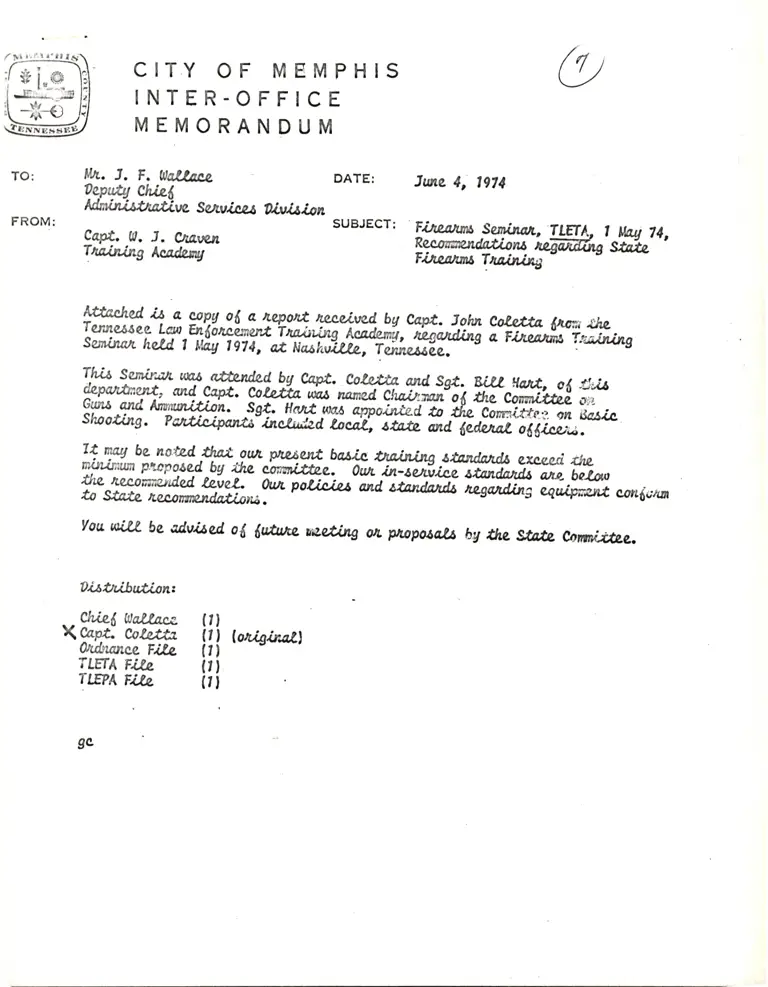
C I T Y OF M E M P H I S
I N T E R - O F F I C E
M E M O R A N D U M
TO:
FROM:
M/i. J. F. WotCace
Vzputij ZhJuLi
Acbiniit/tattve Se'iv-ccw Vl̂ JUlon
Capi, W, J. OiCLvzn
TficUnJbiQ Acjddzcu/
DATE: 4 ̂Jg-J4
SUBJECT: V ln zoJm > TLETA^ 1 PxLy 7 4 ,
Rec(?2c;cndaitoiX6 A /^ a fid o ig S ta te .
FtM ca/im6 T /u touK i^
Mtached i i a capi) o( a nepoiit iMtdMid. ba Copt. John Cotetta Um- jh .
Anminj^n. Sgt, HMt vm appotnt&d to Ae. CorrAtte?. on liaitc
hooting. PaittcUpant^ Anctadzd lo ca l, i t̂ate. and ^tdenal oi^lceju,.
U may bz noted t f ^ oun pfie^cnt ba&lc tnabting itasidandi exceed zhe.
^ ^ c cor̂ rncttcc. O u n ln ^ v lc T ^ Z S ^
con^.^
Vou. w ill bz advlizd o£ ^utuAa ineting ok pJtopo^aU by tkz State CotmUtzz.
Vlit/Ubution:
Ckiẑ Wallacz
KCapt. ColUta
Ofidjiancz Vile.
TLETA File
TLEPA Vile.
(/)
(n [ofUginal]
(T)
(7)
(/)
9C-
On May 1st and 2nd 1974, a firearms seminar was held at
the Tennessee haw Enforcement Training Academy. This seminar
was attended by firearms instructors from across the State of
Tennessee. Federal, state, municipal and county instructors
were represented.
The members were divided into topic groups. Each topic
had a permanent chairman.^ The other members of the groups
rotated among the various topics until all had discussed
each topic. The chairmen stayed with their single topic
throughout the entire session. After two days of intensive
discussions the group made some recommendations which are set
out below.
The group suggested 6>i hours of classroom work in addition
to the field work on the range. This classroom work should
include:^
1 . firearms safety 5
2 . liability with firearms 6
3. nomemclature
4. weapon accessories and
shooting tips
'"hooting positions
itrinciples of revolver
shooting
range procedures
introduction to
shoulder weapons
und groSp c^a?™“ ?" Participants, topics.
See attachment two for suggested classroom rurriculira.
It was suggested that 40 hours be spent on the range ,
,r>i jT f j i ' i y f i t : , ( C.- '
^ M i'. f* *with a minimum of 800 rounds of ammunition^ In view of the
fact that ammunition is packed in 50 round boxes it was suggested
that a 50 round course be taught. This to be used on a police
practical course and a modified police practical course.^
These courses should be fired on a sillouette target with a minitnum
qualifying average on both courses of 70 per cent with adherence
to time. Instruction should be in both the single and double hand
method with a 1 to 5 coach pupil ratio.
It was observed that failures should be given more
instruction, possibly on their own time, and if tiiey still
fail to qualify a notation should be sent with their record
to the chief administrative officer of their agency.
In the area of in-service training, it was suggested
tliat a scaled down version of basic training be used. The
training should be 3 eight hour ^s^^with some classroom work
included and 250 rounds of ammunition per man per expended.
Also it was brought out that the agencies should attempt
to qualify every man at every one of these sessions.
Recognizing the need to somewhat standardize firearms and
firearms training in the state of Tennessee, the following
observations were made:
See attachment three for proposed firearms training
course for Tennessee Law Enforcement Academy.
1. The .38 or .557 caliber S and
sufficient to meet the requirements of
is primarily self-defense.
W or Colt should be
a police officer which
2. For uniform personnel the barrel length should be
4" with fixed or adjustable sights. No accessories should be
placed on the weapon except grip adaptor or oversize custom
grips which must be modified to allow easy ejection. The grips
should be made of wood with no thumbrest.
3. Handguns for plainclothesmen and off duty should consist
of the above except could consist of five or six shot and have
a barrel length of less than 4” . For extraordinary duty, special
assignments, or undercover work the chief could vary at his discretion.
4. The agencies should purchase and issue duty weapons;
oif duty weapons, that are carried under the auspicies ot an
agency should be qualified with.
L
5̂ ''̂ ''-Ammunlf.ign should meet SAAMl specifications and be factory
loaded?-n‘̂ ‘ro'^Ysf'gr ain, high-speed load with soft or hali_p̂ v̂ point.«
lead or semi - j acketed projectile, viitdi muzz(|£^ velocity/not‘to^*^*/'
exceed 1000 FPS out of a 4” barrel wd-th- 1-oad pro-j-octi'ke.s.._̂ ^̂ Ay,̂ '̂ ̂
service ammunition should be purchased by the Agency and ' sl^e^-d^kvv.V^ y>ioc
be-.expo.nded. at-every-training session or every six months whichever
CjOhi© s-rfirrfj't-.
6 . Ail
agency after
manufacture
ô ‘̂'Duikshot,
shoulder weapons should be owned and issued by the
proper training. Shotguns should be of American
12 ga., police riot type; duty ammunition consisting
slugs or tear gas projectile.
See attachment four for shotgun qualifications course
proposed by participants-
May 1, 1974
ATTACHMENT #1
8:30 a . m. Assembly - Introduction - Mr. Grigsby, TLETA
8:45 a . m. Scope of the problem - Mr. Soltys, TLETA
9:20 a . m. Break
9:30 a . m. Firearms training in the U.S.
1 0 : 2 0 a . m.
William Ahrens - FBI, Quantico
Break
10:30 a . m. William Ahrens (continued)
1 1: 00 a • 111. Group assignments
11:30 a .m. • Lunch
1 : 0 0 p • in • Group Participation
May 2
9:00
, 1974
a . m. Group Presentations
1 0 : 2 0 a . m. Break
10:30 3. • m • Continued
11: 30 a . m . Lunch
1 : 0 0 p • in • Range
2 : 0 0 p . m. Continued
3:00 p .m. Preparation of recommendations for
Tennessee Law Enforcement Training Academy
Tennessee Law Enforcement Planning Agency
ATTACHMENT #1 continued
BASIC SHOOTING
John Manning - Chairman, Metro PD Academy Nashville
Henry Newell - Clarksville PD
Bill Hart - Memphis PD
Jackie R. Moore - Jackson PD
William Cole - F.B.I. Chattanooga
QUALIFICATION REQUIREMENTS
Lewis P. Auer - Chairman, Johnson City PD
Bill Waggoner - T.L.E.T.A. Donelson
Albert Wood - Johnson City PD
Lee Roy Tate - Chattanooga PD
Ben Hale - F.B.I. Memphis
IN-SERVICE TRAINING ̂ CLASSROOM CURRICULA
Lee Hick, - Chairman, PD Academy Chattanooga
James Sandidge - T.H.P. Chattanooga
A 1 Bennevworth - T.L.E.T.A. Donelson
Norman Pipkin - Jackson PD
Barry Seay - Montgomery Co. SD
GUNS AND AMMUNITION
John Coletta - Chairman, PD Academy Memphis
Tom Burnley - T.L.E.T.A. Donelson
Don Collins - T.H.P. Knoxville
William.Ahrens - F.B.I. Quantico, Va.
William Gerst - U.T. Knoxville
Troy Hamner - A.T.^F. Nashville
ATTACHMENT #2
I. Basic Training Classroom Curriculum
A. Police Officers Liability with Firearms. (2 hrs.)
1. Lecture
2 . Film "Shoot or Don't Shoot"
B. Safety with Firearms (1 hr.)' Taught as a block sub
ject and intergrated into all other subjects.
1. Safety on the Job
2. Safety at Home
C. Firearms Nomenclature hr.)
1. General knowledge (mechanical)
2. Fuctioning
3. Maintenance care and cleaning
D. Weapon Accessories and Shooting Tips (Jj)
4.
E.
F,
1. Target grips
2 . trigger shoes
3. adjustable sights
painted sights
holster types
6 . ammunition
5.
Shooting Positions (1 hr.)
Principles of Revolver Shooting (h)
1. Sight alignment and sight picture
2. Grip and Trigger control
3. Stance and Positions
4. Single and Double Action
5. Loading and unloading
G. Range Procedures { h )
1. Target Types
2. Conduct on the Range
3. Scoring
4. Relays and Miscellaneous Rules
H. Introduction to Shoulder Weapons (Jj)
ATTACHMENT #3
PPG - 50 Yard
(50 rounds -)
Stage Distance Position Number o£ Rounds Time
1 . 7 yds. line Crouch^/^'^ 10 rds. (DA) 25 sec.
2 50 yd. line Prone 5 rds. (SA) 2 min. 45
Kneeling Barricade 5 rds. (SA)
R. H. Barricade 5 rds. (SA)
L. H. Barricade 5 rds. (SA)
3 25 yd. line Kneeling 5 rds. (DA) 2 min.
R. H. Barricade 5 rds. (DA)
L. H. Barricade 5 rds. (DA)
Standing-no support 5 rds. (DA)
- MODIFIED PPG
Stage Distance Position Number of Rounds Time
1 7 yd. line Crouch/ 5 rds. (DA) 10 sec.7 yd. line Crouch//*'/^ 10 rds. (DA) 25 sec.
2 15 yd. 1 ine Point shoulder 5 rds. (DA) 10 sec.
3 25 yd. line Prone 6 rds. (DA) 2 min. 45
1 b yd. line Kneeling 6 rds. (DA)25 yd. 1 ine R. H. Barricade 6 rds. (DA)
2 S yd. line L. II. Barricade 6 ’rds. (DA)
4 25 yd. line Standing no support 6 rds. (DA) 12 sec.
SHOTGUN TRAINING (60% qualification)
A. 25 rds. skeet or trap for familiarization
B. Qualification
ATTACHMENT #4
Yrd. line
50 yds.
25 yds.
15 yds.
Position
Shoulder
Shoulder
Hip
Total;
rds.
2
6
4
12
type
Slug
OO Buck
00 Buck
Points
5 points each
1 point Bk. hole
1 point eac. Bk.
hole
100 points
SITUATIONAL SHOOTING
(No qualifying score required)
(No time limit)
Single Action Shooting
Automobile Course
Exertion Course
Duelling Course