Patterson v. The American Tobacco Company Opinion
Public Court Documents
May 7, 1975 - February 23, 1976
-
Brief Collection, LDF Court Filings. Patterson v. The American Tobacco Company Opinion, 1975. 152653dd-c09a-ee11-be36-6045bdeb8873. LDF Archives, Thurgood Marshall Institute. https://ldfrecollection.org/archives/archives-search/archives-item/0896c91e-d3ec-42cf-92d8-4fcad29c5740/patterson-v-the-american-tobacco-company-opinion. Accessed October 07, 2026.
Copied!
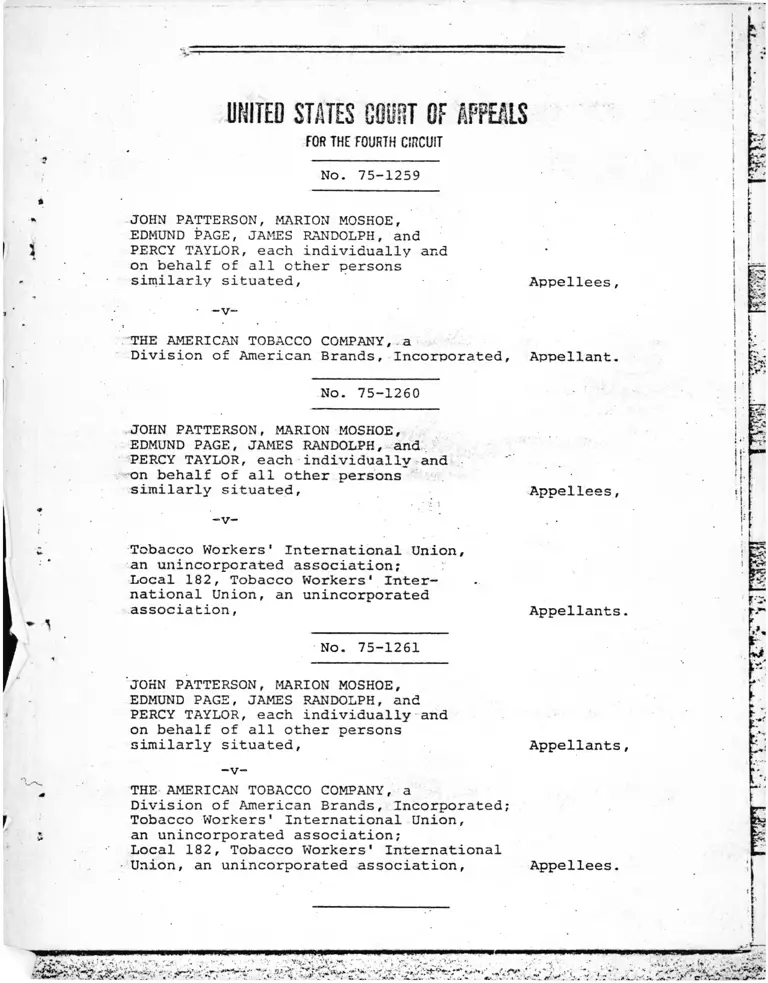
UNITED STATES GOilITT OF APPEALS
FOR THE FOURTH CIRCUIT
No. 75-1259
JOHN PATTERSON, MARION MOSHOE,
EDMUND PAGE, JAMES RANDOLPH, and
PERCY TAYLOR, each individually and
on behalf of all other persons
similarly situated, Appellees,
THE AMERICAN TOBACCO COMPANY, a
Division of American Brands, Incorporated, Appellant.
No. 75-1260
JOHN PATTERSON, MARION MOSHOE,
EDMUND PAGE, JAMES RANDOLPH, and
PERCY TAYLOR, each individually and
on behalf of all other persons
similarly situated, Appellees,
-v-
Tobacco Workers' International Union,
an unincorporated association;
Local 182, Tobacco Workers* Inter
national Union, an unincorporated
association, Appellants
No. 75-1261
JOHN PATTERSON, MARION MOSHOE,
EDMUND PAGE, JAMES RANDOLPH, and PERCY TAYLOR, each individually and
on behalf of all other persons
similarly situated, Appellants
-v-
THE AMERICAN TOBACCO COMPANY, a
Division of American Brands, Incorporated;Tobacco Workers' International Union,
an unincorporated association;
Local 182, Tobacco Workers' International
Union, an unincorporated association, Appellees.
EQUAL EMPLOYMENT OPPORTUNITYCOMMISSION, Appellee,
-v-
Local 18 2, Tobacco Workers'International Union (AFL-CIO), Appellant.
No. 75-1263
EQUAL EMPLOYMENT OPPORTUNITYCOMMISSION, Appellee,
-v-
AMERICAN BRANDS, INC., d/b/aAmerican Tobacco Company, Inc., Appellant.
Appeals from the United States District Court for the
Eastern District of Virginia, at Richmond. Albert V.
Bryan, Jr., District Judge.
(Argued May 7, 1975. Decided Feb. 23, 1976
Before WINTER, BUTZNER, and WIDENER, Circuit Judges.
Henry L. Marsh, III; (S. W. Tucker; John W. Scott, Jr.;
Randall G. Johnson; Hill, Tucker and Marsh; Jack Greenberg;
Elaine R. Jones; Barry L. Goldstein; and Morris J. Bailer
on brief) for John Patterson, et al.; Henry T. Wickham
(John F. Kay, Jr.; Kenneth V. Farino; Mays, Valentine,
Davenport and Moore; Chadbourne, Parke, Whiteside and
Wolff; Paul G. Pennoyer, Jr.; Arnold Henson; Bernard W.
McCarthy; and Bernard J. Dushman on brief) for The Ameri
can Tobacco Company and American Brands, Incorporated;
(cont.)
Herbert L. Segal (Irwin H. Cutler, Jr.; Walter Lapp
Sales; Segal, Isenberg, Sales and Stewart; Jay J. Levit
Stallard and Levit; and James F. Carroll on brief for
Tobacco Workers' International Union and Local 182);
Margaret C. Poles, Attorney, Equal Employment Oppor
tunity Commission, (Julia P. Cooper, General Counsel;
Joseph T. Eddins, Associate General Counsel; and
Beatrice'Rosenberg and Charles L. Reischel, Attorneys,
on brief) for the Equal Employment Opportunity .Commis
sion.
BUTZNER, Circuit Judge:
These appeals and cross appeals question certain
provisions of a judgment entered in consolidated actions
brought by the Equal Employment Opportunity Commission and
several black employees of the American Tobacco Co. against
the company, the Tobacco Workers International Union, and
its Local 182. The case concerns the application of Title
VII of the Civil Rights Act of 1964 [42 U.S.C. § 2000e et
seq.] and 42 U.S.C. § 1981 to redress race and sex discrim-
1
ination in working conditions. Following is a summary of
the district court's decision and our disposition of the
assignments of error:
I. The district court defined the class of black
employees as those, whether currently employed or not, who
-worked on or after July 2, 1965, the date Title VII became
effective. It found no discrimination in hiring but ruled
that the company and the labor organizations had engaged in
unlawful employment practices by racial discrimination in
the promotion of employees. It ordered American to institute
company-wide seniority, eliminate certain lines of progression
1. 42 U.S.C. § 2000e2 prohibits both employers and
labor organizations from engaging in employment
practices that discriminate on the basis of race
or sex.
42 U.S.C. § 1981 assures all persons the same
right to make and enforce contracts as is enjoyed by
white citizens.
-4-
from lower to higher paying jobs, post definite job descrip
tions, grant back pay, and adjust pensions and profit
sharing plans in amounts to be determined at a subsequent
hearing. The court also ordered that white incumbents be
bumped from jobs for which senior black employees were
qualified.
Neither party has assigned error to the court's
finding of no discrimination in hiring. We find no error in
the designation of the class. We affirm the finding of
discrimination in promotions and approve the relief ordered
by the court, except for provisions of the judgment dealing
with company-wide seniority and bumping.
II. The district court ruled that the EEOC was
empowered to bring suit to eliminate discrimination against
women, although the initial charge dealt only with discrimi
nation against men. It defined the class of aggrieved women
in terms similar to those used to describe the class of
black employees. The court found discrimination in pro
motions but not in hiring, and it ordered relief similar to
that afforded black employees.
On these issues we affirm the district court,
modifying only its grant of relief.
III. The district court found discrimination in
the selection of supervisors and ordered the company to
prepare written job descriptions and objective criteria
-5-
;
i-
Vs
f .
r
* ,Av * * * ■ i - . u . . - '• - •»*> . - . j f •• *
J
for appointments. It also ordered preferential hiring of
blacks and women to fill supervisory vacancies.
We affirm these aspects of the court's judgment
except for those dealing with preferential- hiring.
IV. The district court held that the actions were
timely filed, that the statute of limitations for an action
brought under § 1981 is five years, and that the statute is
not tolled by filing a charge with the EEOC. It also held
that back pay for discrimination against women should accrue
from two years before the charge was filed.
Except for the application of the five-year
statute of limitations and the accrual of liability for the
women's back pay, we affirm these rulings. The proper
limitation, we hold, is two years, and.the accrual date for
back pay must be reexamined in light of EEOC v. General
Electric Co., ____F.2d ____, No. 74-1974 (4th Cir. 1975),
which was decided after the district court wrote its opinion.
I
American operates three facilities in Richmond,
Virginia. The "Virginia Branch" makes cigarettes; the
"Richmond Branch" makes pipe tobacco; and the "Richmond
Office" keeps accounts and records for both branches.
Approximately 250 of the 1,280 employees at both branches
are black, and in the Richmond office 13 of the 62 employees
are black. In each branch the prefabrication department
blends and prepares tobacco before sending it to the fabrication
-6-
department, which manufactures the finished products. Workers
in prefabrication generally earn less than those in fabrication,
and .most employees at the Richmond branch make less than
those at the Virginia branch.
Before 1963 the union and the company overtly
segregated employees by race with respect to job assignments,
cafeterias, restrooms, lockers, and plant entrances. White
employees were represented by Local 182 of the Tobacco
Workers International Union, while black employees were re
presented by Local 216. Blacks were generally assigned to
positions in the prefabrication departments. The higher
paying jobs in fabrication were largely reserved for white
employees. Each department had its own seniority roster, on
which promotions depended. Employees could not transfer
from one department to another without forfeiting their
seniority. •
In September 1963 the black union was assimilated
by the white Local 182 to comply with an executive order
relating to the government's purchase of supplies. Simul
taneously, the company abolished departmental seniority, but
it continued to maintain separate rosters at the two branches.
The 1963 changes did not eliminate racial discrimination
from the company's promotion practices. The district court
found that until 1968 the company utilized a system of
unwritten qualifications which denied black employees access
to the higher paying jobs at the Virginia branch. For
certain positions an employee had to be familiar with the
duties of the new job in the opinion of his supervisor.
Also, he had to work a minimum number of hours on a temporary
basis to qualify as an operator of a making or packing
machine. Consequently, black employees not working in
proximity to the higher paying jobs had limited opportunity
to qualify, regardless of their seniority. Combined with
static employment in the tobacco industry, this system
allowed little advancement of black employees from jobs in
prefabrication to those in fabrication. Indeed, from 1963
to 1968 there was an increase of only four blacks in the
fabrication department at the Virginia branch.
The Richmond branch had no qualification restric
tions on promotions. Instead, supervisors canvassed employees,
seeking the senior worker willing to fill a vacancy. There
were, however, no written job descriptions. This system
provided slight opportunity for black employees to move from
prefabrication to fabrication, and from 1963 to 1968, there
was an increase of only six black employees in the latter
department. As of 1968, only three of the 26 machine operators
were black.
In January 1968 the company discontinued its
qualifications system. Instead, it posted vacancies and
promoted the senior employee who bid for the job. The district
court found that this innovation was "facially fair and
neutral" but ordered that it be implemented by posting
written job descriptions. Furthermore, the district court
found that access to certain jobs was barred to black
employees by lines of progression and the maintenance of
separate seniority rosters for each branch.
Although the company and the union have taken
steps in recent years to correct some of the inequalities of
the past, the lines of progression, the lack of definite
written job descriptions, and barriers to transfer between
the branches remain impediments to fair and neutral employ
ment practices. Much must still be done to eradicate any
taint of racial discrimination at the plant. The most
recent figures available indicate that as of the end of
1973, more than 80 percent of all the employees in the
Virginia branch's prefabrication department were black,
while in the fabrication department only-about 14 percent
were black. At the Richmond branch, black employees'
penetration into the fabrication department was greater,
with blacks comprising more than 38 percent of the workforce.
But the lower paying prefabrication department remained
almost completely segregated; 92 percent of its employees
were black. These figures provide ample support for the
district court's findings that "[t]raditionally, at both
branches there have been more blacks in the prefabrication
• department than whites, and more whites in the fabrication
department than blacks."
The company emphasizes that from July 2, 1964, to
March 1, 1974, 25 percent of all employees promoted and 20
percent of those advanced to operate automatic machinery at
the Virginia branch were black. Also, since the initiation
in January 1968 of the posting and bidding procedure, 51.5
percent of the successful bidders have been black. These
gross figures, however, include promotions in both prefabri
cation and fabrication departments, and, while laudable,
they do not address the crucial issue of the case— the entry
of black employees into the historically white fabrication
department. Apart from the fact that many of these pro
motions were made after charges were filed with the EEOC,
the company's reliance on the overall promotion rate in both
departments misses the mark because blacks have always been
promoted in the historically black prefabrication department.
Moreover, as late as 1973, of the approximately 200 hourly-
paid, non-craft job classifications at Virginia, 18 had never
been held by whites and 10 had never been held by blacks.
Even more rigid segregation characterized the Richmond
branch; of the approximately 43 hourly—paid, non—craft job
classifications, 21 had never been held by whites and nine
had never been held by blacks.
We conclude, therefore, that the record amply
supports the district court’s finding that after the effective
date'of Title VII the company and the union discriminated in
the promotional policies of their bargaining agreements and
practices. Tested by familiar standards, the court's findings
2
must be sustained.
We next consider the assignments of error that
challenge the relief ordered by the district court. The
directive that definite job descriptions must be provided in
order to implement a fair method of promotion was clearly
warranted. Cf^ Brown v. Gaston County Dyeing Machine Co.,
457 F.2d 1377 (4th Cir. 1972).
In those jobs that were filled according to lines
of progression, an employee had to work, in the first job
before proceeding to the next, and so on up to the highest
job in the line. Most of these jobs were in the fabrication
departments. Since black employees had been largely excluded
from the fabrication departments, they held few jobs in most
of these lines and could not advance despite their seniority.
In this respect, the lines of progression perpetuated the
effects of past discrimination in a manner similar to the
formerly segregated departmental seniority rosters. On the
2. Federal Rule of Civil Procedure 52(a) pro
vides in part that "[fjindings of fact [by the court] shall not be set aside unless clearly
erroneous . . . "
- 11-
basis of its evaluation of conflicting expert testimony, the
district court held that only three of the nine lines are
3
ju-stified by business necessity. For the others, alternative
means such as on-the-job training are available to provide
competent workers.
Addressing the discrimination caused by lines of
progression, we pointed out in Robinson v. Lorillard Corp.,
444 F.2d 791, 799 (4th Cir. 1971), that the vagaries of
chance inherent in this promotion system might bar a qualified
worker from advancement for years, although he could learn
to perform the job competently in a relatively short time.
To deal with such situations, we formulated the following
standard for ascertaining whether a condition of employment
-was justified by business necessity:
”[T]he applicable test is not merely
whether there exists a business purpose
for adhering to a challenged practice.
The test is whether there exists an
overriding legitimate business purpose such that the practice is necessary to
the safe and efficient operation of the
business. Thus, the business purpose
must be sufficiently compelling to over
ride any racial impact; the challenged
practice must effectively carry out the
business purpose it is alleged to serve;
and there must be available no acceptable
alternative policies or practices which
would better accomplish the business pur
pose advanced, or accomplish it equally
well with a lesser differential racial
impact." 444 F.2d at 798.
3. The three positions for which lines of progression
can be maintained are adjuster, overhaul adjuster,
and adjuster prefabrication.
-12-
* *
l i
!*t
lt
i»ii
j
Measured by this test, the district court's elimination'
of the six lines of progression was correct.
The district court also ordered a single seniority
roster for the Virginia and Richmond branches to enable
employees in each branch to bid for posted jobs in 'the
other. The order is designed to correct the present effect
of past discrimination, which denied black employees entry
into the higher paying jobs of the fabrication departments,
particularly at the Virginia branch. For example, under the
present method of job assignments, a black employee hired in
1955 at the Richmond branch prefabrication department has no
realistic opportunity to secure a higher paying job in the
formerly white Virginia fabrication department because he
cannot transfer his company seniority to the Virginia branch.
If he seeks a new job there, he must forfeit his seniority
and start as a new hire.
The district court correctly found that the denial
of transfer between the branches without retention of
company seniority perpetuates the effect of past discrimination.
We believe, however, that the relief ordered by the district
judge is broader than necessary. Title VII does not require
the company or the union to forego the benefits of separate,
nondiscriminatory seniority rosters. "Application of the
Act normally involves two steps. First, identification of
the employees who are victims of discrimination, and second,
prescription of a remedy to correct the violation disclosed
-13-
The Act does not require the applicationby the first step,
of the remedy to employees who are not subject to discrim
ination." United States v. Chesapeake and Ohio Ry., 471
F.2d 532, 593 (4th Cir. 1972). The only employees who
suffered discrimination were blacks who could not obtain
jobs in the fabrication departments because of their race.
Consequently, they are the only employees who should be
allowed to transfer under the posting and bidding system
from one branch to' the fabrication department in the other
branch on the basis of their company seniority. Black
employees need not be allowed to transfer with company
seniority to jobs in prefabrication, because the^ were
never barred from these jobs in the first place. Similarly,
white employees seeking transfers are not entitled to utilize
company seniority, because they were never barred from fabrica
tion departments. Finally, no employee hired after the
cessation of discrimination in job assignments need be allowed
to transfer with seniority intact. See, e.g., Russell v.
American Tobacco Company, ____F.2d ____, No. 74-1650 (4th
Cir. 1975); Robinson v. Lorillard Corp., 444 F.2d 791 (4th
Cir. 1971); Quarles v. Philip Morris, Inc., 279 F.Supp. 505
(E.D. Va. 1968).
The company and the union assert that this case is
distinguishable from departmental seniority cases like
Robinson because the Richmond and Virginia branches are in
different locations. They emphasize that the branches make
i
\
I
\
-14-
j $
.1 &
r
!
different products, have different managements, hire separately,
•and are some distance apart. For these reasons, they argue,
the case falls within 42 U.S.C. § 2000e-2(h), which provides
that:
"Notwithstanding any other provision of
this subchapter, it shall not be an un
lawful employment practice for an employer
to apply different standards of compensa
tion, or different terms, conditions, or
privileges of employment pursuant to a
bona fide seniority or merit system . . .
or to employees who work in different loca
tions, provided that such differences are
not the result of an intention to discrimi
nate because of race, color, religion, sex,
or national origin . . . . "
Noting that neither the Act nor the regulations
define the statutory term "employees who work in different
. locations," we recently construed § 2000e-2(h) in Russell
v. American Tobacco Co., ____F.2d ____, No. 74-1650
(4th Cir. 1975) . We pointed out that the labor market
is the most important factor in determining whether a
company's employees work in different locations. A company
operating two or more of its plants with employees who are
from the same geographic area and who are unskilled or
possess the same skills can assign an applicant to an entry
level position in either plant. Therefore, employees the
company hired from the same labor market would not generally
fall within the statutory class of "employees who work in
different locations." £ ' :
M-15-
On the other hand, even though a company's plants
are in the same city, as they are here, their proximity does
not conclusively show that they are in the same location.
If one plant requires labor possessing skills different from
those of workers at another plant, the company cannot draw
from the same labor market to man its plants. Under these
circumstances, employees would work at different locations,
even though they reside and work in the same geographic
area.
American hires employees for both branches from
the same labor market. The branches are only a few city
blocks apart. There are entry level jobs at both places
that require neither particular skills nor experience, and
jobs in fabrication can be filled just as well by trans
ferees as by persons hired off the street.
Other facts support the district court's finding
that these plants are not in different locations. The same
bargaining agreement covers employees at both plants, and
the company has contractually reserved the right to shift
employees from one plant to the other without depriving them
of seniority. The Richmond office, located in a building at
the Virginia branch, serves both branches, and the Virginia
branch ships the Richmond branch's products.
There is another reason why the exemption granted
in § 2000e-2(h) is not available to American. As we noted
-16-
V it
in Russell, supra, slip op. at 10, that section contains a
proviso that restricts its application to situations where
differences in the conditions of employment "are not the
result of an intention to discriminate." Past intentional
segregation that is perpetuated by a company’s seniority
system precludes it from claiming that its system is bona
fide within the meaning of § 2000e-2 (h.) , Robinson v. Lorillard
Corp., 444 F.2d 791 (4th Cir. 1971). Similarly, "where
present differences in working conditions are remnants of
past intentional discrimination, the proviso of § 2000e-2(h)
bars a company from defending its employment practices on
the ground that its employees work in different locations."
Russell v. American Tobacco Co., ____ F.2d ____, ____, No.
74-1650 (4th Cir. 1975), slip op. at 11.
We therefore affirm the district court on this
issue but note that on remand it should vacate the provision
of its judgment requiring a single seniority roster for both
branches. It should substitute an order allowing those
black employees who formerly could not obtain jobs in the
fabrication departments because of discrimination to utilize
their company seniority to bid for such jobs in the fabrica
tion department of either branch. Of course, an employee
who transfers must have the capacity to perform the job
after receiving a reasonable amount of training.
-17-
r-ffvI
&
Milll
Title VII nor its legislative history requires bumping in
this case.
Relief under § 1981 is limited to correcting
racial discrimination. See Delavigne v. Delavigne, No.
75-2203, ____ F.2d ____ (4th Cir. 1976); Willingham v. Macon
Telegraph Publishing Co., 482 F.2d 535, 537 n. 1 (5th Cir.
1973). But apart from this, Title VII and § 1981 provide
complementary remedies for employment discrimination, Johnson
v. Railway Express Agency, Inc., 421 U.S. 454, 459-60 (1975).
Although the legislative history of Title VII cannot support
a decision that bumping relief is unavailable under § 1981,
the pragmatic considerations we advance apply with equal
force to the § 1981 claim. Moreover, "in fashioning a
substantive body of law under § 1981 the courts should, in
an effort to avoid undesirable substantive law conflicts,
look to the principles of law created under Title VII for
direction." Waters v. Wisconsin Steel Works of International
Harvester Co., 502 F.2d 1309, 1316 (7th Cir. 1974). For
these reasons, we hold that bumping relief is not available
to American's black employees under § 1981.
On remand, therefore, the district court should
modify its decree to eliminate bumping, but it should take
steps to assure that back pay will be computed to include
compensation for the entire time that a minority employee is
i denied a promotion for which he or she is qualified by
I
A*
)
continuing jurisdiction over the case and make periodic back
pay awards until the workers are promoted to the jobs their
seniority and qualifications merit. Or perhaps counsel and
the court can devise some other convenient method of taking
all the effects of past discrimination into account. In any
event, the compensation must include, as the district court
properly noted, increments for pensions and profit sharing.
Compensatory pay and adjustment of benefits provide
monetary relief for discrimination against minority employees
but do not afford the satisfaction that comes from being
promoted to a more responsible job. Nevertheless, such an
intangible benefit does not justify injunctive relief mandating
bumping. Weighed against a minority employee's sense of
achievement are the harm that demotion will cause to incumbents
who have done no wrong and the disruption of the company's
business that bumping entails. The survey of employees
referred to in footnote 8, supra, indicates that 39 minority
employees are seeking jobs held by 8 white men and 31 other
minority employees. This survey, however, does not prove
that the employees seeking different jobs were motivated
even in part by non-monetary factors, for it was conducted on
the assumption that bumping was the only way they could
receive better pay and fringe benefits. Since full monetary
compensation and the removal of barriers to promotion provide
adequate relief to minority employees without disruption to
other employees and management, we conclude that neither
-25-
I
economy and making persons whole for injuries suffered
through past discrimination." 422 U.S. at 421.
To satisfy these objectives, back pay must be i
allowed an employee from the time he is unlawfully denied a
promotion, subject to the applicable statute of limitations,
un._il he actually receives it. Some employees who have been
victims of discrimination will be unable to move immediately )
into jobs to which their seniority and ability entitle them.
The back pay award should be fashioned to compensate them
until they can obtain a job commensurate with their status.
This may be accomplished by allowing back pay for a period
commencing at the time the employee was unlawfully denied a
position until the date of judgment, subject to the applicable
statute of limitations. This compensation should be supple
mented by an award equal to the estimated present value of
lost earnings that are reasonably likely to occur between
the date of judgment and the time when the employee can
assume his new position. See Bush v. Lone Star Steel Co.,
373 F.Supp. 526, 538 (E.D. Tex. 1974); United States v.
United States Steel Corp., 371 F.Supp. 1045, 1060 n. 38
10
(N.D. Ala. 1973). Alternatively, the court may exercise
This measure of compensation is analogous to that awarded in an ordinary tort case, where compensation
is assessed for one's loss of earnings whether the loss
occurs before or after the judgment is entered. The
analogy is apt because a statutory action attacking
discrimination is fundamentally for the redress of a tort. See Curtis v. Loether, 415 U.S. 189, 195
is no reason to suppose that this process will soon abate.
Bumping could mean that employers and workers would likely
have their businesses and their working lives rearranged by
court decrees from time to time, as various unlawful employment
practices are identified. See generally Note, Title VII,
Seniority Discrimination, and the Incumbent Negro, 80 Harv.
L. Rev.. 1260, 1274-75 (1967).
V • Finally, although Congress did not intend the Act
i '
to be used as a vehicle for displacing incumbents, it did
not leave the victims of discrimination without a remedy.
Section 2000e-5(g) expressly authorizes a district court to
: award them back pay. While an employee who has been unlawfully
denied a promotion must await a vacancy before advancing, he
[ need not prove that a vacancy exists in order to qualify for
back pay. Hairston v. McLean Trucking Co., 520 F.2d 226
I (4th Cir. 1975); Robinson v. Lorillard Corp., 444 F.2d 791
(4th Cir. 1971).
In Albemarle Paper Co. v. Moody, 422 U.S. 405, 408
i (1975), the Court explained the standards a district court
should follow in awarding back pay to employees who "havei '*
lost the opportunity to earn wages because an employer has
f
| engaged in an unlawful discriminatory employment practice."
The Court said that the back pay provision must be applied|
{ in a manner that is "consonant with the twin statutoryI
objectives" of "eradicating discrimination throughout thei ;
* -23-
>■»
t
are not responsible for wrongdoing, undoubtedly would
. encounter more resistance than deferring their future
expectancies. As this case illustrates, bumping is an
unsettling process. Its domino effect adversely affects
employees who have done no wrong and who, indeed, may have
8been the victims of discrimination.
The effects of bumping are exacerbated by another
aspect of Title VII. The Act does not provide a definitive
catalogue of unlawful employment practices. Congress placed
this responsibility on the EEOC and, ultimately, the courts.
It soon became obvious that overt discrimination is not the
. 9only obstacle to equal employment opportunity. As a result
of litigation, many practices, procedures, or tests neutral
on their face, and even neutral in terms of intent" have
been exposed as discriminatory and condemned. See Griggs v.
Duke Power Co., 401 U.S. 424, 430 (1971); United States v.
Dillon Supply Co., 429 F.2d 800, 804 (4th Cir. 1970). There
As part of its compliance with the district court1s decree, American conducted a canvass of its employees
to determine the effect of bumping. The results of
that survey are contained in a report filed with this
court to supplement the record. The report showed that
40 employees requested jobs to which their plant-wide
seniority would entitle them. One of these has already
obtained the job he requested. The others would bump
eight white male employees and 31 minority employees
out of the jobs they now occupy. We stayed the provision
of the decree that required bumping pending this appeal.
See generally Introduction, The Second Decade of
Title VII: Refinement of the Remedies, 16 Wm. & Mary L Rev. 433, 436-37 (1975).
- 22-
Since the Act should not be applied retroactively,
it is, of course, much easier to justify the retention of
incumbents who obtained their positions before the ei.fective
date of the Act than the retention of those who were unlaw
fully preferred after this date. Nevertheless, neither
Congress not the EEOC nor the courts have drawn a distinction
between pre-Act and post-Act incumbents. The reasons for
applying the Act uniformly are largely pragmatic. The
enactment of Title VII was the result of many concessions,
including the unequivocal assertion by proponents of the
legislation that it was not intended to be used to displace
7incumbent workers. A primary goal of Title VII is to
induce voluntary compliance by employers and unions. Section
2000e-5; see EEOC v. Hickey-Mitchell Co., 507 F.2d 944, 948
(8th Cir. 1974). Demoting employees, especially those who
6. This principle is established by the legislative
history. Senators Clark and Case, two of the bill's sponsors, circulated an interpretative memorandum
stating that Title VII's operation was "prospective and not retrospective . . . (T)he employer's obligation
would be simply to fill future vacancies on a non-
discriminatory basis." 110 Cong. Rec. 6992 (daily ed.
April 8, 1964), quoted in Quarles v. Philip Morris,
Inc., 279 F.Supp. 505, 516 (E.D. Va. 1968).
7. The Clark-Case memorandum, note 6 supra, states
that an employer "would not be obliged--or, indeed,
permitted— to fire whites in order to hire Negroes, or
to prefer Negroes for future vacancies, or, once
Negroes are hired, to give them special seniority
rights at the expense of white workers hired earlier."
110 Cong. Rec. 6992 (daily ed. April 8, 1964).
- 21-
■
. ...,.fV> ~-r
{has accepted this interpretation. Equally important, when
Congress was considering the 1972 amendments to Title VII,
5
it approvingly noted Papermakers' construction of the Act.
These precedents cannot be satisfactorily distin
guished on the ground that bumping would be required only
when the proof discloses a static industry that has few
vacancies. The difference between static and dynamic indus
tries is not always readily ascertainable because employment
opportunities fluctuate for many reasons over long and short
periods. Requiring bumping for static industries while
denying it in dynamic industries would introduce into the
i'k
.administration of the Act countless variables for which
Congress has made no provision.
4
4. E.g,, EEOC v. Detroit Edison Co., 515 F.2d 301
(6th Cir. 1975); United States v. N. L. Industries, Inc., 479 F.2d 354 (8th Cir. 1973); United States v.
Chesapeake & Ohio Ry., 471 F.2d 582 (4th Cir. 1972);
United States v. Bethlehem Steel Corp., 446 F.2d
652 (2d Cir. 1971).
5. The section-by-section analysis of the Housebill states that "it was assumed that the present
case law as developed by the courts would continue
to govern the applicability and construction of
Title VII." Legislative History of Equal Employment Opportunity Act of 1972, Government Printing
Office (1972) at 1844. Papermakers, of course, was
a prominent part of that case law.~
iTJ
branch and May 12, 1966, in the Virginia branch. Employment
in both branches decreased from 1953 to 1973 by approxi
mately 1300 workers.
One of the early questions about the construction
of Title VII was whether "present consequences of past
discrimination [are] covered by the act." Quarles v. Philip
Morris, Inc., 279 F.Supp. 505, 510 (E.D. Va.-1968). The
generally accepted answer is a qualified "yes": employers
and unions using pre-Act discriminatory practices to bar
employees from filling post-Act vacancies violate the Act.
Robinson v. Lorillard Corp., 444 F.2d 791 (4th Cir. 1971);
Quarles, supra. On the other hand, Title VII has not been
construed to impose a duty to demote incumbents. In Local
189, United Papermakers and Paperworkers v. United States,
416 F.2d 980 (5th Cir. 1969), the court rejected the contention
that "allowing junior whites to continue in their jobs
constitutes an act of discrimination." Judge Wisdom, writing
for the court, said:
"The Act should be construed to prohibit
the future awarding of vacant jobs on the
basis of a seniority system that 'locks in'
prior racial classification. White incumbent workers should not be bumped out of
their present positions by Negroes with
greater plant seniority; plant seniority
should be asserted only with respect to new job openings. This solution accords
with the purpose and history of the legis
lation." 416 F.2d at 988.
Every appellate court to whom the issue has been presented
-19-
■>¥ -
The company and the union also assign error to the
part of the district court's order that allowed senior black
and female employees to bump junior employees from preferred
jobs. The court ordered immediate company—wide posting and
bidding on each non-supervisory job in the Richmond 'and
Virginia branches. The only qualifications for advancement
were to be seniority and a willingness to learn the job. To
.facilitate the bidding, the court ordered that job descrip
tions be posted. It further provided that employees who
were displaced by senior black or female workers, and
therefore had to move to lower paying jobs, must be paid as
much as they were in their former jobs. The court explained
the reason for this provision of its decree as follows:
"The present system of posting and bidding adopted in 1968 is fair, although it needs,
in the Court's view, further implementation.
As indicated in the findings of fact, how
ever, black and female employees in the Richmond Branch and the Virginia Branch have
been locked in their jobs as a result
of prior discriminatory practices. This is
because of the static condition of the tobacco industry generally, and American in
particular, and the advent of automation,
both of which have limited opportunities
for upward movement of present employees and for new hiring." (Appendix at 37-38.)
The court's description of the lack of employment opportunities
is well supported by the evidence. No new employees were
hired to fill jobs under jurisdiction of the union from
September 12, 1955, through June 12, 1964, in the Richmond
- 18 -
£
t> •I .} We affirm the district court's award of relief
against both the local and the International, except as
noted in Part II. The local acquiesced without protest in
the lines of progression. Not until 1968 did it negotiate
for the removal of the qualification.requirements for pro
motion. In 1968, 1971, and 1974, it proposed a company-wide
seniority system that would have allowed transfers between
’* branches. When the company declined, the union settled for
assurances of indemnity that would protect its treasury
against the claims of its members.
A union may not bargain away minority employees'
rights to equal treatment, see Robinson v. Lorillard Corp.,
444 F.2d 791, 799 (4th Cir. 1971), and, indeed, it must
"negotiate actively for nondiscriminatory treatment" of its
minority workers. Macklin v. Spector Freight Systems, Inc.,
478 F.2d 979, 989 (D.C. Cir. 1973); see also United States
v. N. L. Industries, Inc., 479 F.2d 354, 379 (8th Cir.
1973). The Supreme Court has recently emphasized the duty a
union owes to its minority members by pointing out that one
of the purposes of a back pay award is to spur unions, as
well as employers, to evaluate employment practices and
eliminate unlawful discrimination. Albemarle Paper Co. v.
Moody, 422 U.S. 405, 417-18 (1975). Tested by these principles,
the district court's imposition of liability on both the
local and the International was warranted by the law and the
i
( facts.
Nor can we accept the International's argument
that it should not be held liable because it was not respon-
* sible for the contracts negotiated by the local. The
evidence disclosed that a vice president of the Interna
tional acted as an "advisor" to the local, playing an active
role as the president's deputy in the 1971 and 1974 negotiations
for bargaining argeements. Moreover, the constitution of
the International provides:
"It shall be the principal duty of the
Local Union to secure satisfactory col
lective bargaining and working agreements
showing an adequate minimum wage and fair
working conditions for workers who have
become affiliated with the TWIU, provided,
however, that no collective bargaining and
working agreement shall be consummated
until first submitted to the general presi
dent who may approve or reject any proposed
agreement, and no such agreement can be
executed without the approval of the gen
eral president or his deputy."
The district court was not obliged to accept representations
of the vice president that contradicted the plain meaning of
this provision. The court properly concluded that the
International's approval of the bargaining agreement pursuant
to this provision made it jointly responsible with the
local. Cases dealing with an international union's exonera
tion of Liability to an employer are inapposite where its
duties to members of its local unions are at issue.
II
The EEOC's complaint contains allegations of
discrimination against women employees. The company contends
that the commission lacked authority to press this claim
-28-
because no female employee filed a charge. On the contrary,
the company points out, the only charge of sex discrimination
filed by a male employee. The district court overruled
the company's motion to dismiss this aspect of the case,
holding that the commission could institute the suit if its
investigation of the male employee's complaint disclosed
discrimination against women.
We affirm the district court. We recently decided
this issue adversely to the company's position in EEOC v.
General Electric Co., ____ F.2d ____, No. 74-1974 (4th Cir.
1975). The company's argument does not persuade us to
depart from the conclusions reached in that case.
On the merits of the claim of sex discrimination,
we uphold the district court's finding of liability. Because
the company's discrimination against women bears many similarities
to its discrimination against black employees, we need not
recite the evidence in detail. It is sufficient to note
that for many years the company overtly segregated jobs by
sex, discriminating against women, as the district court
found, "with respect to wage structure, departments, seniority
and hiring." Even after these practices were nominally
eliminated in 1963, their discriminatory effect was perpetuated
by- lack of definite job descriptions, lines of progression,
and obstacles to transfers. The court found that as recently
11. see Part IV infra for a discussion of the statute
of limitations with respect to this issue.
-29-
as 1973, 23 of the approximately 200 non-craft, hourly-paid
jobs at the Virginia branch had not been held by women, and
six had not been held by men. At the Richmond branch, 32 of
the 43 non-craft, hourly-paid jobs had not been held by
women, and six had not been held by men. The company has
not demonstrated that these segregated positions cannot be
filled by persons of the opposite sex. The court also found
that from 1967 through 1972 women had a lower mean income
than men with comparable seniority.
Again, the district court's findings are supported
by the evidence and cannot be set aside as clearly erroneous.
The relief the court afforded women is essentially the same
as the relief it granted black employees. Accordingly, we
approve the relief for women employees, subject, however, to
the same modifications of the court's decree that we mentioned
in Part I. This relief, however, can be granted only against
the company. The complaint against the union for sex discrim
ination must be dismissed for reasons we' will next discuss.
The commission's complaint names the company and
Local 182 as defendants. The commission acknowledged that s
it had not attempted to conciliate the charges with the
union before filing suit. While the suit was pending, it
made an offer to conciliate, which the union accepted. In
the course of discussion with the union, however, the
commission's representative conceded that he had no authority
to settle the suit. Understandably, the conciliation efforts
-30-
uf
were unsuccessful. The district court, viewing the lapse as
technical, held that the belated offer to conciliate and its
acceptance substantially complied with the Act.
The Act requires, however, that after receiving a
charge and before bringing a suit the commission must take
four steps: serve the charge on the employer and labor
organization, investigate the charge, determine that reason
able cause exists to believe the charge is true, and endeavor
to eliminate alleged unlawful employment practices "by in- 1
formal methods of conference, conciliation, and persuasion."
The 1972 amendments to Title VII empowered the commission to
sue if it is unable to secure an acceptable conciliation
13agreement. This provision of the Act has been construed
to create an express condition on the commission's power to
sue. Consequently, a suit brought by the commission before
|
iI
I
:
\j
|
i
»
Ii
attempting conciliation is premature. EEOC v. Hickey-
Mitchell Co., 507 F.2d 944, 947-48 (8th Cir. 1974); EEOC v.
E. I. DuPont de Nemours & Co., 373 F.Supp. 1321, 1333-34 (D.
Del. 1974); EEOC v. Westvaco Corp., 372 F.Supp. 985, 991-93
14
(D. Md. 1974) .
12. 42 U.S.C. § 2000e-5(b).
13. 42 U.S.C. § 2000e-5(f)(1).
14. We have held that the commission's failure to attempt
conciliation is not a jurisdictional bar to an employee's
action, because the employee cannot be charged with the
commission's failure to execute its statutory duties.
Russell v. American Tobacco Co., ____ F. 2d ____, ____,
No. 74-1650 (4th Cir. 1975); Johnson v. Seaboard Air
Line R.R., 405 F.2d 645 (4th Cir. 1968). These cases,
however, are inapposite where the commission's power
to sue is in question.
-31-
. V,.V • > / b ■ ' * V ■' ' *■: : ■
i .. . • : - . v ■ - ■ - : t < ' V *■’ ■ . .. . v ■:_ I V . • i •" f . - jfi * «y* W •' ■ • • - . . • • * .
‘- :4 <
*vV
i
We recently emphasized that the commission's
statutory duty to attempt conciliation is among its most
15
essential functions. It is particularly important for the
commission to attempt conciliation with a union when investi
gation discloses that provisions of a bargaining agreement
concerning seniority and job assignments are causing the alleged
unfair employment practices. Then the employees who enjoy
majority status are frequently more directly affected than
their employer by changes that will advance minority employees.
In such cases, the success of conciliation often hinges on the
union's response.
We do- not rule out the possibility that exceptional
circumstances may excuse a failure to attempt conciliation, but
that is not the case here. The union's willingness to negotiate
even after suit was brought tends to negate any suggestion that
timely conciliation of the sex discrimination charges would have
been unsuccessful. When it became apparent that the commission's
representative lacked authority to settle the case, the possi
bility of conciliation was dealt a severe blow by the very
circumstances Congress sought to avoid— commencement of a civil
action before attempting conciliation. Accordingly, we conclude
that the district court should have dismissed the part of the
commission's complaint which alleges that Local 182 caused the
company to discriminate unlawfully on the basis of sex.
15. EEOC v. Raymond Metal Products Co.,
_, No. 75-1007 (4th Cir. 1976).
-32-
F. 2d
m i - v
4> vTV *I
I
ftI
j' 111t •The district court also found that the company hadi
.< engaged in race and sex discrimination in appointing supervisors.
The evidence supports this finding. At both the Richmond• l
and Virginia branches, the entry level position for supervisory
personnel is assistant foreman. The company fills about 34
percent of the vacancies in this position by promoting
hourly employees; it fills the balance by hiring new applicants.
With no formal, objective, written standards for appointment,
the company relies in part on recommendations from the
union, which also lacks objective standards. Until 1963 the
company appointed only white males to supervisory posts, and
the enactment of Title VII failed to effect any immediate
change in this policy. At the Richmond branch, the first
black supervisor was appointed in 1966 and the second in
1971. As of June 1, 1973, there were only three, constitut
ing 9.6 percent of the supervisory force of 31. In 1967 the
company named its first female supervisor at the Richmond
branch. By 1973 two (6 percent) of the 31 supervisors were
women. At the Virginia branch, a black employee was promoted
to assistant foreman in 1963. In the next decade four more
were appointed, so that by 1973 7.24 percent of the 69
supervisors were black. The first female was not appointed
as a supervisor at this branch until 1972. Two more were
appointed by June 1, 1973.
Before the trial of the case, neither a black
employee nor a woman had ever been appointed to a supervisory
-33-r
• *tIposition at the Richmond office. The court noted, however,
|
that a vacancy existed, and the company proffered additional
evidence that as of November 1, 1974, the Richmond office
had one black supervisor and one white female supervisor on
a staff of eight.
The district court enjoined the company from
"implementing, maintaining, or giving effect to any criteria
utilized for the selection of supervisory personnel which is
designed to or has the effect of discriminating against
black or female candidates for supervisory positions." It
ordered the company to post job descriptions for these
positions and to devise objective criteria for selecting new
appointees. The propriety of these provisions of the court's
decree is well settled. See Brown v. Gaston County Dyeing
ii
r(>i
t
rI
i
Machine Co., 457 F.2d 1377, 1383 (4th Cir. 1972); Rowe v.
General Motors Corp., 457.F.2d 348, 358-59 (5th Cir. 1972).
We think, however, that on.remand the court's decree should
be enlarged to require the union to publish objective
criteria for making its recommendations for supervisory
appointments.
Finally, the district court ordered that vacancies
in the assistant foreman, foreman, and office supervisory
positions must be filled with qualified blacks and women,
except when none can be found, until the percentage of
blacks and women equals the percentage of these classes of
workers in the Richmond Standard Metropolitan Statistical
-34-
Area (SMSA). The company's attack on this provision of the
decree is two-pronged. First, it contends that Title VII
*
) condemns preferential hiring, especially when, as here, the
i
)
4
\
1 ,I*
!*
(1{t
j
ii
preferences are absolute. It relies primarily on § 703 (j)
of the Act, 42 U.S.C. § 2000e-2(j), which provides in part:
"Nothing contained in this subchapter shall
be interpreted to require any employer . • .
to grant preferential treatment to any indi
vidual or to any group because of the race
. . . [or] sex . . . of such individual or
group on account of an imbalance which may
exist with respect to the total number or
percentage of persons of any race . . . [or]
sex . . . employed . . . in comparison with
the total number or percentage of persons of
such race . . . [or] sex . . . in anycommunity . . . or in the available work
force in any community. . . . "
This section plainly bans the use of preferential hiring to
change a company's racial imbalance that cannot be attributed
to unlawful discrimination. In Griggs v. Duke Power Co.,
401 U.S. 424, 430-31 (1971), the Court said:
"Congress did not intend by Title VII, how
ever, to guarantee a job to every person re
gardless of qualifications. In short, the
Act does not command that any person be hired
simply because he was formerly the subject of discrimination, or because he is a member of
a minority group. Discriminatory preference
for any group, minority or majority, is precisely and only what Congress has proscribed.
What is required by Congress is the removal
of artificial, arbitrary, and unnecessary
barriers to employment when the barriers op
erate invidiously to discriminate on the basis
of racial or other impermissible classification."
Uniformly, however, Title VII has been construed
to authorize district courts to grant preferential relief as
-35-
v -V- s > v ■ " j -*0
Rios v. Enterprise
I .
a remedy for unlawful discrimination. Rios v. Enterprise
Association Steamfitters Local 638 of U.A., 501 F.2d 622,
628-31 (2d Cir. 1974); United States v. N. L. Industries,
Inc., 479 F.2d 354, 377 (8th Cir. 1973); Southern Illinois
Builders Association v. Ogilvie, 471 F .2d 680, 683-86 (7th
Cir. 1972); United States v. Ironworkers Local 86, 443 F.2d
544, 552-53 (9th Cir. 1971); United States v. International
Brotherhood of Electrical Workers, Local No. 38, 428 F .2d
144, 149-51 (6th Cir. 1970); Local 53 of International Ass'n
of Heat & Frost I. & A. Workers v. Vogler, 407 F.2d 1047,
1053-54 (5th Cir. 1969). This construction of the Act is in
harmony with other cases which authorize preferential relief
from unlawful employment discrimination in situations where
Title VII is not applicable. Associated General Contractors
of Massachusetts, Inc. v. Altshuler, 490 F.2d 9, 16-18 (1st
Cir. 1973); Carter v. Gallagher, 452 F.2d 315, 330 (8th Cir.
1971); Contractors Association of Eastern Pennsylvania v.
Secretary of Labor, 442 F.2d 159, 172, 176-77 (3d Cir.
1971). In all, eight circuits have approved some form of
temporary preferential relief for discriminatory employment
practices. See Sape, The Use of Numerical Quotas to Achieve
Integration in Employment, 16 Wm. & Mary L. Rev. 481, 499
(1975)• No court of appeals has ruled to the contrary,
although there have been dissents.
*J
a case
We have not previously ruled on the issue, but in
involving the Civil Rights Act of 1866 and the
thirteenth and fourteenth amendments, we declined to impose
quotas where the district court concluded that adequate
relief could be obtained without their use. See Harper v.
Kloster, 486 F.2d 1134, 1136 (4th Cir. 1973). In view of
the substantial precedent sanctioning preferential relief
for unlawful discrimination, we reject the company's argu
ment that Title VII forbids the remedy ordered by the
district court. We recognize, however, that cases which
approve such remedies caution that the necessity for prefer
ential treatment should be carefully scrutinized and that
such relief should be required only when there is a compelling
need for it. See Associated General Contractors of Massachu
setts, Inc. v. Altshuler, 490 F.2d 9, 17 (1st Cir. 1973).
This brings us to the company's second reason for vacating
the decree's provision for preferential appointment of
supervisors.
The company argues that its appointment of black
and female employees to supervisory positions already
exceeds the ratio that preferential relief would require.
Its argument rests on two premises. One, its conduct before
the effective date of Title VII does not provide a proper
base to measure its compliance with the Act; instead, it
must be judged by the manner in which it filled vacancies
-37-
after this date. Two, the district court erroneously
considered the number of blacks and women in the Richmond
SMSA workforce as a whole to ascertain a ratio of acceptable
performance, instead of using only the blacks and women in
the Richmond SMSA supervisory workforce.
We believe these premises are well founded. Title
16
VII is not retroactive. It does not provide a remedy for
discrimination which occurred before it became effective in
1965. Robinson v. Lorillard Corp., 444 F.2d 791, 795 (4th
Cir. 1971). At the Virginia branch 51 of the supervisors
were appointed before Title VII prohibited discrimination in
their selection. They should not be counted in determining
whether preferential hiring is required now. Between 1965
and 1973 the company appointed 18 assistant foremen, the
entry level position for supervisors. Of that number, five
(27.5 percent) were black and three (16.6 percent) were
women. At the Richmond branch, 22 of the supervisors were
appointed before Title VII became effective and nine afterwards.
Of the nine, three (33.3 percent) were black and two (22
percent) were women. At the Richmond office, the evidence
is not as clear. It has six entry level supervisory positions,
which at the date of trial were filled by five white males
with one vacancy. The district court found that four of the
six positions had been filled after 1965. Subsequently, the
16. The legislative history of Title VII indicates
that it is not intended to be retroactive. See note 6
supra.
-38'-
H
i
i
■>*
i
' 4
3
ii
i
i
i
%
tArt*
*iI
1x
J
*
*
e
? . ' • I , • ' y . , . ( ■ . r : , : .. . .v ̂ ‘ V ■ . ^__ J *'■ ' , y V
f .
company proffered evidence that it has promoted one black
employee and one female to supervisory positions, constituting
for each classification 16.6 percent of the appointments
17
since 1965.
The record discloses that 6.8 percent of the
blacks and 1.5 percent of the women in the Richmond SMSA are
placed in a category that includes supervisory personnel.
Those percentages furnish a more realistic measure of the
company's conduct than the gross percentage of blacks and
women in the whole workforce, including unskilled labor.
See Harper v. Mayor, 359 F.Supp. 1187, 1193 n.5 (D. Md.),
aff'd sub nom. Harper v. Kloster, 486 F.2d 1134 (4th Cir.
1973).
The fact that the company's appointments since
1965 exceed the ratio of qualified blacks and women in the
workforce does not exonerate the company for the violations
of the Act which the district court found. The tardy appoint
ments of blacks and women to supervisory positions long
after the passage of Title VII and the present lack of
published job descriptions and objective selection procedures
17. The district court declined to reopen the record to
consider this proffer. Under the ratio <;°urtused for comparative purposes, the evidence had but
slight probative effect. Its import, however, is
magnified by acceptance of the company s premise t Tts performance since 1965 is what must be examined in
determining whether it has violated the Act. 0* remand
the court should reexamine the situation at the Richmond
office.
-39-
r - \ ipppf! p . /■■■-■ g p f p p jppgjjg j I Ip
fully justify the injunctive relief the district court
ordered. We believe, however, that the rate at which the
company currently appoints blacks and women to supervisory
positions is sufficient to show that^there is no compelling
need for the imposition of a quota. But see Karst &
Horowitz,'Affirmative Action and Equal Protection, 60 Va. L.
Rev. 955 (1974).
IV
The company contends that the charge filed with
the EEOC on January 3, 1969, was not timely because there
were no discriminatory practices at either branch after
January 15, 1968. It argues that for this reason the action
should be dismissed for failure to meet the jurisdictional
requirement of a timely charge. The district court,
however, found that the discrimination was of a continuing
18 We do not mean to suggest that the company may use
its percentage of black and female supervisors as a
defense to future charges of discrimination against blacks and women. It must consider each application on
its merits. If the company discriminates against a
black or a woman, it can be called to account for
violating Title VII, regardless of the percentage of
blacks and women among its supervisors.
19 Before the 1972 amendments to Title VII, a charge
had to be filed with the EEOC within 90 days of the
alleged unlawful employment practice. 42 U.S.c.
§ 2000e-5(d) (1964). In 1972, this period was changed
to 180 days. 42 U.S.C. § 2000e-5(e).
-40-
1
*\
V
i
'•’A
- * • /
’4-1549
nature and properly held that the charge was timely.
Williams v. Norfolk i Western ?.y. , ____ ~. 2c ____, Nc
(4th Cir. 1975', ; llar^lin v. Freight ?ys:«s. Ir.c. ,
478 F. 2d 979 , 994 (D.C. Cir. 1973); s£e Johnson v. Railway
F.xprcss Agency, Inc. , 421 U.S. 454, 467 n.13 (1975) (dictum) .
The district court ruled that the filing of the
charge in 1969 did not toll the statute of limitations for
the § 1981 action which was filed in 1973. The Supreme
Court recently confirmed the district court s correct
understanding of the law. Johnson v. Railway Express Agency,
Inc., 421 U.S. 454 (1975).
The district court applied the Virginia five-year
statute of limitations to the § 1981 action. We have ruled,
however, that the state's two-year statute applies to § 1982
actions. Allen v. Gifford, 462 F.2d 615 (4th Cir. 1972).
Doth § 1981 and § 1982 were enacted to redress infringements
of closely related civil rights. We conclude, therefore,
that the same two-year statute should apply to § 1981 actions.
Accord, Revere v. Tidewater Telephone Co., No. 73-1390 (4th
Cir., October 2, 1973)(unpublished opinion applying the two-
year statute to a § 1981 action); cf. Almond v. Kent, 459
F.2d 200 (4th Cir. 1972). Accordingly, on remand, the two-
year statute of limitations should be applied to the § 1981
claim. Of course, the point has little practical significance
in this case in view of the fact that the § 1981 action was
not tolled by the filing of the charge' with the EEOC.
The district court ruled that back pay for sex
discrimination should accrue from April 8, 1967, two years
before the charge was filed with the EEOC. The two-year
period mentioned bv the district judge conforms with the
20 'statute. However, this charge did not allege discrim
ination against women. Instead, this type of discrimination
21
was initially disclosed by the EEOC's investigation.
Dealing with similar circumstances, we held in EEOC v.
General Electric Co., ____F.2d _____, No. 74-1974, slip op.
at 34-36 (4th Cir. 1975), that in the absence of countervailing
equities a trial court should limit back pay to two years
before the employer received notice of the results of the
investigation. On remand the district court should reconsider
its decree in light of this case.
The judgment is affirmed in part and modified in
part, and the case is remanded for further proceedings con
sistent with this opinion.
fit•?\
j
■ y
t
*
h
?. -
20. 42 U.S.C. § 2000e-5(g)
21. See Part II supra.
-42-
' H <vv/**», - fi'*?**
. r
WIDENER, Circuit Judge, concurring and dissenting,
I concur in large part with the opinion of the
court for the reasons stated in the opinion. I differ, how
ever, in some respects, and as to those I respectfully drs-
sent.
SO far as the opinion is based on BEOCjr^General
,.,v r i - -1 9 7 5 ) I dissent for„ ,, Mn 74-1974 (4tn Cir. »Electric Company, No. v
the^reasons set forth in my dissent in that case, our judg
ment in which is not yet final. I should say. however, that
v, +- oingpr one than General Electric this case may be a somewhat closer one tn ----
because here, at least, sex discrimination was the subject
o£ the EEOC complaint, while in GH^era^lectrio it was not.
This case points up the importance of retiring the EEOC to
comply with its own regulations as well as the statute. The
onion here is excused from liability f o r discrimination on
account.of sox because the statute was not complied with.
Tht< IVll,,,„ i':!|vf in 1 ly emphasized and held is that ". . -a
suit brought by the commission before attempting conciliation
is premature," p. 31, because ". . .the commission*s statu
tory duty to attempt conciliation is among its most essen
tial functions." p.32. Despite the fact that both the com
pany and the union were deprived of the first conciliation
step as set forth in 29 CFR § 1601.19a, as well as the statu
tory benefits of conciliation attempts, the company is held
to liability, while the union is not, although the
liability was caused by the collective bargaining agreement
.
-43-
signed by both the company and the union. Thus, I dissent
not only from the finding against the company, but also
from the disparate treatment awarded the company and the
union on facts which are indistinguishable.
While the subject of collective bargaining agree
ments is at hand, I should say I have grave reservations
about considering evidence in this type case of the respec-
p
. . tive positions taken by the company and the union in nego
tiations leading up to collective bargaining agreements when
«
the agreement results in unlawful discrimination. This is
tantamount to allowing a good faith defense disapproved by
us in Moody v. Albemarle Paper Company, 474 F2 134 (4th Cir.
1973). (Modified on other grounds, 422 US 405 (1975).
The district court had only this to say about dam
ages :
"The formulation of the method of calculation
and distribution of the back pay award and
adjustment to the pension and profit-sharing
plans will be complex— sufficiently so as to
tax the ingenuity and good faith of counsel.
In this regard counsel are directed to confer
with a view to agreeing on a plan of calcu
lation and distribution of the back pay award
‘ for submission to the Court--and, indeed, toI
\
■ -44-
1i
J
\.3
1
.
s
ii
m \ • -..' y . ? - •. * •• • . . * •
explore the possibility of settling the
monetary aspects of the case." App. p.
- 42.
With the opinion of the district court in mind, it is seen
that the method of computing damages was not considered by
that court and is not properly before this court, McGowan
v. Gillenwater, 429 F2 586 (4th Cir. 1970), so the detailed
discussion of that subject is a dictum. If the district
court, in ascertaining damages, adopts standards with
which either side is in disagreement, either is at per
fect liberty to appeal the award. Taking up the matter
now, and especially its treatment in detail, when the mat
ter is so complex" as to "tax the ingenuity and good faith
of counsel, and upon no record, is too great a departure
from what I conceive to be the proper rule of courts ex
pressing opinions only with reference to existing contro
versies. There is no controversy at this time between the
Parties about this matter, and an expression of opinion I
think beyond the legitimate function of an appellate court.
I express no opinion as to the correctness of the dictum.
We hold that the imposition of quotas for super
visory positions is error because the "rate at which the
company currently appoints blacks and women to super
visory positions is sufficient to show that there is no
V t -
'■
-45-
*
t