Plaintiff's Motion to Compel Production of Documents; First Request for Documents; Defendant's Response and Objection
Public Court Documents
November 12, 1975 - January 1, 1976
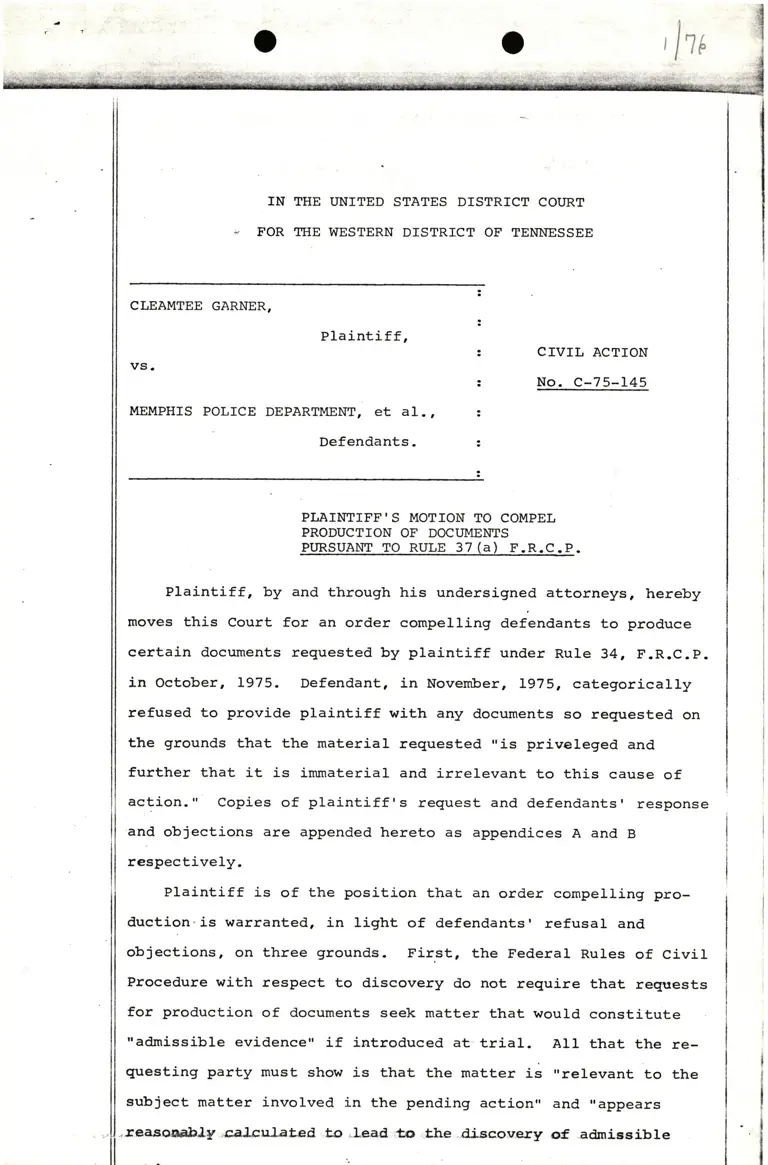
12 pages
-
Case Files, Garner Working Files. Plaintiff's Motion to Compel Production of Documents; First Request for Documents; Defendant's Response and Objection, 1975. fc739100-34a8-f011-bbd3-000d3a53d084. LDF Archives, Thurgood Marshall Institute. https://ldfrecollection.org/archives/archives-search/archives-item/08bdeb9c-5770-4344-bbe0-2c1aff013f60/plaintiffs-motion-to-compel-production-of-documents-first-request-for-documents-defendants-response-and-objection. Accessed September 26, 2026.
Copied!
U li MiHseKittiMMlii mmitk
IN THE UNITED STATES DISTRICT COURT
FOR THE WESTERN DISTRICT OF TENNESSEE
CLEAMTEE GARNER,
Plaintiff,
vs.
MEMPHIS POLICE DEPARTMENT, et al..
Defendants.
CIVIL ACTION
No. C-75-145
PLAINTIFF'S MOTION TO COMPEL
PRODUCTION OF DOCUMENTS
PURSUANT TO RULE 37(a) F.R.C.P.
Plaintiff, by and through his undersigned attorneys, hereby
moves this Court for an order compelling defendants to produce
certain documents requested by plaintiff under Rule 34, F.R.C.P.
in October, 1975. Defendant, in November, 1975, categorically
refused to provide plaintiff with any documents so requested on
the grounds that the material requested "is priveleged and
further that it is immaterial and irrelevant to this cause of
action." Copies of plaintiff's request and defendants' response
and objections are appended hereto as appendices A and B
respectively.
Plaintiff is of the position that an order compelling pro
duction is warranted, in light of defendants' refusal and
objections, on three grounds. First, the Federal Rules of Civil
Procedure with respect to discovery do not require that requests
for production of documents seek matter that would constitute
"admissible evidence" if introduced at trial. All that the re
questing party must show is that the matter is "relevant to the
subject matter involved in the pending action" and "appears
.xeasofiwbly calculated to Lead to the discovery of admissible
evidence." Rule 26(b), F.R.C.P. Plaintiff submits that these
standards are, indeed met with respect to his request for pro-
^^^tion. In brief, plaintiff souqht the following documents:
1. Documents relating to the Police Department's
investigation of Garner's death;
2. Documents relating to employment record of defendant
Hymon including citizen complaints and disciplinary
action involving him;
3. Documents setting forth positions of defendants Chandler
and Hubbard on the training of police officers in using
lethal force and on actual use of lethal force;
Police Department documents relating to the investigation
of, selection of and testing of service revolvers and
ammunition used at the time of Garner's death;
5. Documents relating to incidents in which lethal force
was used by Memphis police officers during approximately
a year and a half period prior to Garner's death;
6, Organizational charts, rules and regulations and opera
tion manual of the Memphis Police Department.
Since the complaint is filed on behalf of the deceased
alleging misconduct by Hymon and other police and City officials.
Department investigation files are clearly relevant and material.j
The complaint also alleges that police officials and the Mayor
were negligent in several respects, including selection, train
ing and directions as to how lethal force should be used. Docu
ments relating to their actions in this regard are relevant and '
material. Documents on Hymon's service record, including ;
history of citizen complaints against him and disciplinary actions
related to his fitness at the time of Garner's death and the |
extent to which higher officials might have been negligent in !
I
keeping Hymon on patrol. The complaint alleges, moreover,
that the Department issued arms and ammunition and directed
- 2 -
their use, with the knowledge that death or grievous bodily
injury would definitely result, even in non-life threatening
situations. Hence, documents relating to the selection and
testing of such revolvers and ammunition are relevant and
material. Documents as to incidents in which lethal force was
used relate to allegations in the complaint that lethal force
was used in a racially-discriminatory manner. If the percentage
of blacks shot at and shot is far above that of whites subjected
to lethal force, such evidence may be probative on this point.
The organizational chart, rules and regulations and operations
manual are needed by plaintiff to identify responsibilities of
lower level personnel for training and supervision in the use
of lethal force and for overall Department views on the use of
such force. In sum, these documents are eminently relevant
and material.
Secondly, defendants claim of privilege is broad, unselec-
tive and clearly contrary to the spirit of the Federal Rules of
Civil Procedure on discovery and applicable case law. As the
cases listed in the accompanying memorandum indicate, federal
courts ruling on production of documents requests must seek to
balance two overriding congressional policies against generalized
claims by police departments of privilege and confidentiality.
The first policy is that federal civil litigation should not be
relegated to the level of a "sporting contest." Open discovery.
Congress decided, would serve the interests of justice more fully
than a procedure that engrafted numerous, vague limitations upon I
the scope of discovery. The second policy is that 42 U.S.C.
i
§ 1983 be interpreted by courts to permit plaintiffs suing -
governmental officials full latitude. For such suits are designed
to serve the public-at-large by bringing officials who engage in ̂
illegal conduct to task. Plaintiff respectfully submits that both
- 3 -
policies would be served by compelling the production of docu
ments sought herein.
And,finally, any privilege enjoyed by defendants must fall
within those recognized as consonant with the terms of Federal
Rules of Evidence, Rule 501. There is no indication that
defendants are so protected. State privileges are generally
inapplicable.
For the foregoing reasons, plaintiff submits that an order
compelling production of dociiments is appropriate.
Respectfully submitted.
JACK GREENBERG
CHARLES STEPHEN RALSTON
DREW S. DAYS, III
10 Columbus Circle
New York, New York 10019
WALTER LEE BAILEY, JR.D'ARMY BAILEY
Suite 901, Tenoke Building
151 Jefferson Avenue
Memphis, Tennessee 38103
Attorneys for Plaintiff
CERTIFICATE OF SERVICE
This is to certify that on this _____ day of January, 1975,
I I served a copy of the foregoing "Plaintiff's Motion to Compel
'1:! Production of Documents" upon counsel for defendants, Henry L.
Klein, Esq., City of Memphis, Suite 3500, 100 North Main Bldg.,
Memphis, Tennessee 38103, by placing same in the United States
i
j mail, postage prepaid.
Attorney for Plaintiff
- 4 -
IN THE UNITED STATES DISTRICT COURT
FOR THE WESTERN DISTRICT OF TENNESSEE
WESTERN DIVISION
CLEAMTEE GARNER, father and next of kin
of EDWARD EUGENE GARNER, a deceased minor.
Plaintiff,
vs.
MEMPHIS POLICE DEPARTMENT; CITY OF
MEMPHIS, Tennessee; WYETH .CHANDLER, Mayor
of Memphis, JAY W. HUBBARD, Director of
'Police of Memphis, and E. R. HYMON,
Police Officer of the City of Memphis,
Defendants.
CIVIL ACTION
No. C-75-145
PLAINTIFF'S FIRST REQUEST FOR
PRODUCTION OF DOCUMENTS
Pursuant to Rule 34 of the Federal Rules of Civil Procedure,
plaintiff hereby requests that the Memphis Police Department,
the City of Memphis, V7yeth Chandler, Jay W. Hubbard, and E. R.
Hymon, each a defendant in this action, produce and permit
plaintiff and his representatives to inspect and copy the
documents specified below which are within their possession,
custody or control or in that of any of their affiliates or
representatives.
Ihe documents requested are to be produced at the offices of !
I
Drew S. Days, III, Esq., one of the attorneys for plaintiffs.
Suite 2030, 10 Columbus Circle, New York, New York 10019, within
thirty (30) days after the date of this request, if the production
of any document, or any part of a document is objected to on grounds
of privilege or otherwise, each such document should be specifi
cally Identified, with a description of the document (e.g.,letter,
memorandum. Report, etc.), the general topic, the title and date,
the number of pages, the name, and position of the author and of
each addressee or recipient, the location of each copy of such
document and the grounds for refusing to produce such document,
term "Document" as used herein has the same meaning
as in Rule 34 (a), Federal Rules of Civil Procedure, and includes
without limitation, all case records, incident reports, investi
gating officers' reports, witnesses' statements, police log book
entries, photographs, papers, correspondence, memoranda, notes,
recordings, transcripts of recordings, transcripts, films,
communications and other records. The documents requested are
those in the possession or control of defendants, their attorneys
or agents. In any case where duplicate copies of the same
document exist, all copies should be produced which contain any
writing or notes which do not appear on all other copies of the
document. In each case where a document is called for, all
drafts of the document are also called for.
Documents to be Produced
1. All documents regarding, involving, or referring to any
any City of Memphis police officer's contact, investigation
of, or charges against Edward Eugene Garner on or about
October 3, 1974;
2. The City of Memphis Police Department personnel file on
defendant E. R. Hymon;
3. All documents relating to the directives of Wyeth Chandler
and Jay W. Hubbard with respect to the training of Memphis
police officers in the use of lethal force;
4. All documents relating to the .directives of Wyeth Chandler
and Jay W. Hubbard -with respect to the training of Memphis
police officers in the use of lethal force;
- 2 -
- \
8,
9.
1 0 .
11.
12.
13,
All documents relating to Wyeth Chandler's or Jay Hubbard's
expressions with respect to the use of lethal force in the
apprehension of criminal suspects or the prevention of
crime;
All documents relating to the selection of the type of
service revolver and service revolver ammunition issued
by the Memphis Police Department for its officers as of
October 3, 1974;
All documents relating to the promulgation of regulations
on the use of lethal force by the city of Memphis Police
Department;
All documents relating to any studies conducted by or at
the request of the City of Memphis Police Departpient on
the effects of various ammunition used by its officers as
of October 3, 1974 on the human body;
All correspondence, memoranda, reports and other records
of the Memphis Police Department relating to citizen or
departmental complaints against E. R. Hymon prior to
October 3, 1974;
All records relating to disciplinary action taken by the
Memphis Police Department against E. R. Hymon prior to
October 3, 1974;
All documents relating to any disciplinary action taken
against E. R. Hymon by the Memphis Police Department as a
result of the death of Edward Eugene Garner on October 3,
1974;
All documents setting out the official policies regarding
promotion of police officers of the Memphis Police Department;
All documents relating to the training of Memphis police
officers, generally and to the training of the officers in
the use of lethal and non-lethal weapons, specifically;
- 3 -
‘ I
14,
15.
16,
17
All documents relating to incidents in which lethal force
was resorted to by officers of the Memphis Police Depart
ment from January, 1973 to October 3, 1974 including but
not limited to:
a. Official investigation reports
b. Citizen complaints
c. Disciplinary proceedings instituted against
officers resorting to lethal force.
An organizational chart of the Memphis Police Department,
showing the names of all supervisory officers and their
respective duties as of October 3, 1974
All rules and regulations governing the conduct of police
officers of the Memphis Police Department as of October 3,
1974
The operations manual of the Memphis Police Department as
of October 3, 1974.
Dated October 1975
JACK GREENBERG
CHARLES STEPHEN RALSTON
DREW S. DAYS, III
10 Columbus Circle
New York, New York 10019
WALTER LEE BAILEY, JR.
D'ARMY BAILEY
Suite 901, Tenoke Building
151 Jefferson Avenue
Memphis, Tennessee 38103
Attorneys for Plaintiff.
- 4 -
IN THE UNITED STATES DISTRICT COURT
FOR THE WESTERN DISTRICT OF TENNESSEE
WESTERN DIVISION
CLEAMTEE GARNER, father and
next of kin of EDWARD EUGENE
GARNER, a deceased minor.
Plaintiff,
VS.
MEMPHIS POLICE DEPARTMENT;
CITY OF MEMPHIS, Tennessee;
WYETH CHANDLER, Mayor of
Memphis; JAY W. HUBBARD,
Director of Police of Memphis,
and E. R. HYMON, Police Officer
of the City of Memphis,
Defendants.
X
X
X
X
X
X
X
X
X
CIVIL ACTION
No. C-75-145
DEFENDANT'S RESPONSE AND OBJECTION TO
PLAINTIFF'S FIRST REQUEST FOR
PRODUCTION OF DOCUMENTS
COME NOW the Defendants, Memphis Police Department, City
of Memphis, Tennessee, Wyeth Chandler, Mayor of Memphis, Jay W.
Hubbard, Director of Police of Memphis, and E. R. Hymon, Police
Offj.cer of the City of Memphis, and in response and in objection
to Plaintiff's First Request For Production Of Documents, state
as follows:
1. Defendants object to producing material requested
in Item 1, Page 2 of Plaintiff's Request on the grounds that
the investigation of the Memphis Police Department on or about
October 3, 1974, is privileged.
2. Defendants object to producing the material requested
in Item 2, Page 2 of Plaintiff's Request on the grounds that the
personnel file on Defendant, E. R. Hymon, is privileged and further
that said rile is immaterial and irrelevant to this cause of
action.
3. Defendants object to producing the material requested
in Item 3, Page 2 of Plaintiff's Request on the grounds that the
directives referred to are privileged and further that they are
not material or relevant to this cause of action.
4. Defendants object to producing the material requested
in Item 4, Page 2 of Plaintiff's Request on the grounds that the
directives referred to are privileged and further that they are
immaterial and irrelevant to this cause of action.
5. Defendants object to producing the material requested
in Item 5, Page 3 of Plaintiff's Request on the grounds that it
is too vague, too broad, privileged and further that it is irrelevant
and immaterial to this cause of action.
6. Defendants object to producing the material requested
in Item 6, Page 3 of Plaintiff's Request on the grounds that this
information is privileged and the request is too broad.
7. Defendants object to producing the material set out
in Item.7, Page 3 of Plaintiff's Request on the grounds that it
is too broad.
8. Defendants object to producing the material requested
in Item 8, Page 3 of Plaintiff's Request on the grounds that it
is too broad and further that it is immaterial and irrelevant in
this cause of action.
9. Defendants object to producing the material set out
in Item 9, Page 3 of Plaintiff's Request on the grounds that it
is privileged and further that it is immaterial and irrelevant
to this cause of action.
10. Defendants object to producing the material set out
in Item 10, Page 3 of Plaintiff's Request on the grounds that it is
privileged and further that it is immaterial and irrelevant to this
cause of action.
11. Defendants object to producing the material set out
privileged and that it is immaterial and irrelevant to this cause
of action.
12. Defendants object to producing the material set out
in Item 12, Page 3 of Plaintiff's Request on the grounds that it
pifivileged, too broad, and further that it is irrelevant and
immaterial to this cause of action.
13. Defendants object to producing the material set out
in Item 13, Page 3 of Plaintiff's Request on the grounds that it
is privileged, too broad, and further that it is irrelevant and
immaterial to this cause of action.
14. Defendants object to producing the material set out
in Item 14, Page 4 of Plaintiff's Request on the grounds that it
is too broad, it is privileged, and further that it is immaterial
and irrelevant to this cause of action.
15. Defendants object to producing the material set out
in Item 15, Page 4 of Plaintiff's Request on the grounds that it
is immaterial and irrelevant to this cause of action.
16. Defendants object to producing the material set out
in Item 16, Page 4 of Plaintiff's Request on the grounds that it
Ig pifivileged, too broad, and further that it is immaterial and
irrelevant to this cause of action.
17. Defendants object to producing the material set out
in Item 17, Page 4 of Plaintiff's Request on the grounds that it
is privileged, and immaterial and irrelevant to this cause of
action.
-N ^Dated the / 7 day of November, 1975.
, 4 .
Henry L. Klein
Staff Attorney, City of ^3emphis
Attorney for Defendants
Suite 3500, 100 North'Main Bldg.
Mcmchis. Tennessee 38103
CERTIFICATE OF SERVICE
I, Henry L. Klein, Attorney, hereby certify that a copy
of the foregoing Defendant's Response and Objection To Plaintiff's
First Request For Production Of Documents has been mailed to
Drew S. Days, III, Esquire, 10 Columbus Circle, New York, New York
10019, and Walter L. Bailey, Jr., Esquire, Suite 901, Tenoke Building,
161 Jefferson Avenue, Memphis, Tennessee 38103, on this f > day
of November, 1975.
M/ /
Henryk L. Klein