Not-So-Trigger-Happy New York City Police Officers (The New York Times)
Press
December 26, 1977
-
Case Files, Garner Hardbacks. Not-So-Trigger-Happy New York City Police Officers (The New York Times), 1977. 1c4866e9-26a8-f011-bbd3-000d3a53d084. LDF Archives, Thurgood Marshall Institute. https://ldfrecollection.org/archives/archives-search/archives-item/08eff45e-4bfa-4626-a11b-a7dfe1e00ff5/not-so-trigger-happy-new-york-city-police-officers-the-new-york-times. Accessed September 26, 2026.
Copied!
I
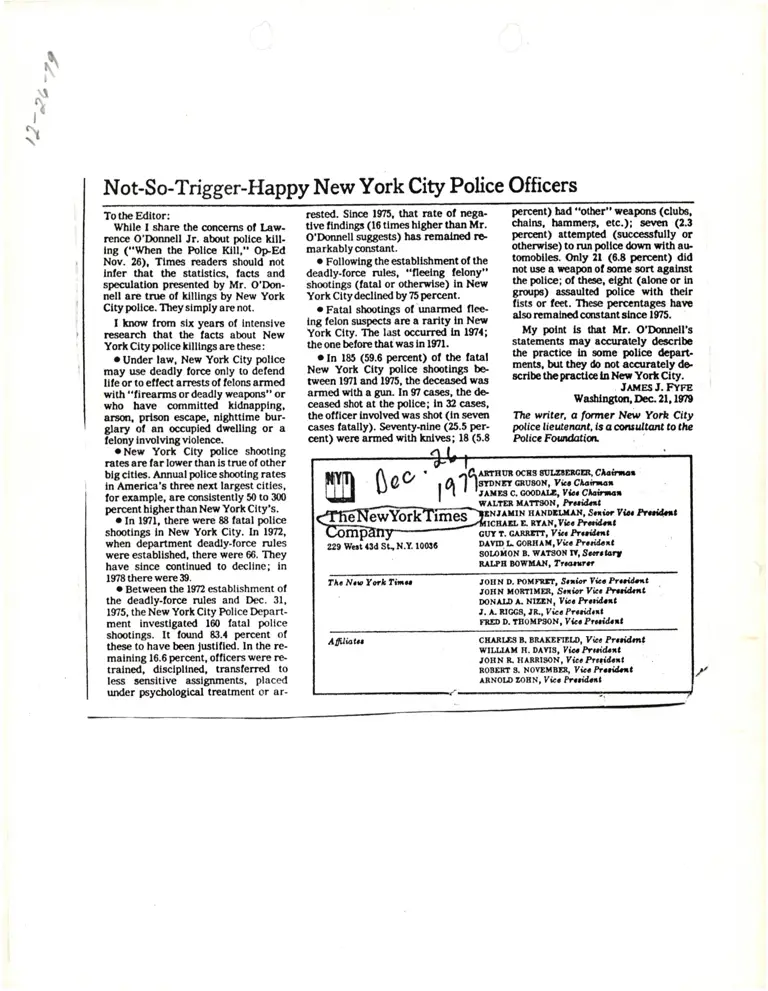
Not-So-Trigger-Happy New York City Police Officers
To the Editor;
While I share the concerns of Law
rence O’Donnell Jr. about police kill
ing ("When the Police K ill," Op-Ed
Nov. 26), Times readers should not
Infer that the statistics, facts and
speculation presented by Mr. O’Don
nell are true of killings by New York
City police. They simply are not.
I know from six years of Intensive
research that the facts about New
York City police killings are these:
• Under law. New York City police
may use deadly force only to defend
life or to effect arrests of felons armed
vdth "firearms or deadly weapons” or
who have committed kidnapping,
arson, prison escape, nighttime bur
glary of an occupied dwelling or a
felony Involving violence.
• New York City police shooting
rates are far lower than Is true of other
big cities. Annual police shooting rates
in America’s three next largest cities,
for example, are consistently 50 to 300
percent higher than New York City’s.
• In 1971, there were 88 fatal police
shootings in New York City. In 1972,
when department deadly-force rules
were established, there were 66. They
have since continued to decline; in
1978 there were 39.
• Between the 1972 establishment of
the deadly-force rules and Dec. 31,
1975, the New York City Police Depart
ment investigated 160 fatal police
shootings. It found 83.4 percent of
these to have been Justified. In the re
maining 16.6 percent, officers were re
trained, disciplined, transferred to
less sensitive assignments, placed
under psychological treatment or ar
rested. Since 1975, that rate of nega
tive findings (16 times higher than Mr.
O’Donnell suggests) has remained re
markably constant.
• Following the establishment of the
deadly-force rules, “ fleeing felony”
shootings (fatal or otherwise) in New
York City declined by 75 percent.
• Fatal shootings of unarmed flee
ing felon suspects are a rarity In New
York City. The last occurred in 1974;
the one before that was in 1971.
• In 185 (59.6 percent) of the fatal
New York City police shootings be
tween 1971 and 1975, the deceased was
armed with a gun. In 97 cases, the de
ceased shot at the police; in 22 cases,
the officer involved was shot (In seven
cases fatally). Seventy-nine (25.5 per
cent) were armed with knives; 18 (5.8
percent) bad “ other” weapons (clubs,
chains, hammers, etc.); seven (2.3
percent) attempted (successfully or
otherwise) to tun police down with au
tomobiles. Only 21 (6.8 percent) did
not use a weapon of some sort against
the police; of these, eight (alone or in
groups) assaulted police with their
fists or feet. These percentages have
also remained constant since 1975.
My point is that Mr. O ’Donnell’s
statements may accurately describe
the practice in some police depart
ments, but they do not accurately de
scribe the practice in New York City.
James J. Fyfe
Washington, Dec. 21,1979
The writer, a former Sew York City
police lieutenant, is a consultant to the
Police Foundation.
jmp3ny
229 West 4Jd St, N.Y. 10036
AKTHUn OCHS SUI2nEKGER, CAatmam
STDNET GRUSON, Vies Chairman
JAMES C. GOODALE, Vie* Chairman
WALTER MATTSON, PretHent
lENJAMIN HANDELMAN, Senior Viee Preoident
ICHACL E. RTAN, Vies Preeident
GUT T. GARRETT, Viee Preeident
DAVID L. GORHAM, Vies Preeident
SOLOMON B. WATSON IV, Seeretarf
RALPH BOWMAN, Treaeurer
The Neto York Time* JOHN D. POMFRET, Senior Viee Preeident
JOHN MORTIMER, Senior Viee Preeident
DONAU) A. NIZEN, Viee Preeident
J. A. RIGGS, JR., Viee Preeident
FRED D. THOMPSON, Viee Preeident
Afiliatee CHARLES B. BRAKEHELD, Viee Preeident
WILLIAM H. DAVIS, Vie* Preeident
JOHN R. HARRISON, Vice Prerident
ROBERT S. NOVEMBER, Viee Preeident
ARNOLD lOHN, Vies Preeident