Laney v. United States Brief for Appellant
Public Court Documents
January 1, 1923
-
Brief Collection, LDF Court Filings. Laney v. United States Brief for Appellant, 1923. 9316864e-ba9a-ee11-be36-6045bdeb8873. LDF Archives, Thurgood Marshall Institute. https://ldfrecollection.org/archives/archives-search/archives-item/09b83a94-d583-4a4e-b503-4b418a4e6729/laney-v-united-states-brief-for-appellant. Accessed October 05, 2026.
Copied!
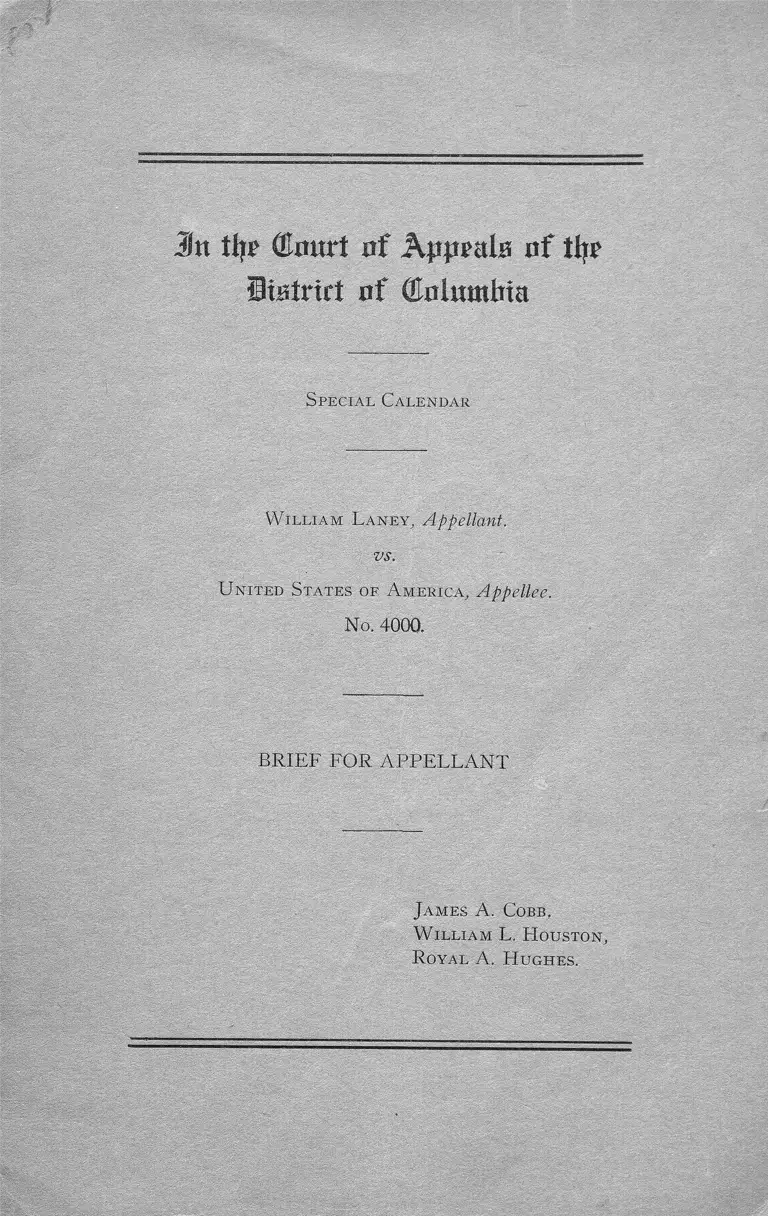
3tt % (Eouri of Appeals of ilje
Sistrirt of (Eolumhta
S pecial Calendar
W illiam L an ey , Appellant,
vs.
U nited States of A merica , Appellee.
No. 4000.
BRIEF FOR A PPE LLA N T
Jam es A. Cobb,
W il l ia m L. H ouston,
R oyal A. H ughes.
Jtt tin (Enuri of Appals of %
Histrict of (Eolumbia
S pecial Calendar
W illiam L an ey , Appellant,
vs.
U nited States of A merica , Appellee.
No. 4000.
BRIEF FOR A PPE LLA N T
The indictment contained one count, charging the de
fendant with “ Murder in' the First Degree” (R. 1 & 2 ).
On March 10, 1920, a jury was empaneled and sworn and
on March 23, 1920, after the defendant had been on trial
for thirteen days, a juror was withdrawn and a mistrial de
clared. On June 20, 1921, a jury was sworn and on June
30, 1921, the jury found the defendant guilty o f man
slaughter. On October 28, 1921, .after overruling o f de
fendant’s motions in arrest of judgment and for a new trial,
the defendant was sentenced to eight years in the peniten
tiary. (R. 2, 3, & 4 .)
STA TE M E N T OF FACTS.
On Monday night, July 21, 1919, between the hours o f
10 and 11 o ’clock, one Kenneth Grail was shot through the
head by a .32 calibre pistol, from which he died at the
Emergency Hospital (R . 26) . The shooting which caused
the death of Kenneth Crall occurred in and around 617 and
619 Massachusetts Avenue N. W., where Crall was said to
be standing. (R. 25, 27 and 81). A few minutes prior to
the shooting, in front, back, and around 617 and 619 Massa
chusetts Avenue N. W., a mob of white men and boys, vary
ing all the way from fifty to two thousand, chased the de
fendant, William Laney, down Massachusetts Avenue to the
area way in front of 617 and 619 of the same Avenue. The
mob was throwing stones and bricks at the defendant Laney
and hollering “ Catch the Nigger.” The mob was chasing
every colored man it saw. (R . 18, 19, 20, 21, 22, 23, 57, 66,
68 and 74). The defendant stopped the mob long enough
to escape into the areaway of the house of one Ferguson
at 617 Massachusetts Avenue N. W ., by drawing his pistol
and pointing at the mob. The pistol would not fire and the
defendant went into the backyard of the said premises and
adjusted the safety on the pistol, at which time it went off
accidentally. (R . 68). Meanwhile the mob was making a
tumultuous demonstration against a colored family across
the street at 620 and 624 Massachusetts Avenue (R. 66).
Upon Laney’s returning to the front of the house the mob
started across the street to 617 Massachusetts Avenue. The
testimony was undisputed that the street was in an uproar
at this time; but there was a conflict of evidence whether
there was any shooting before the defendant shot. (For
example, R. 18, 23, 66,. 74). The defendant shot his pistol
about three times, testifying that he did so in self-defense,
only after he had heard shooting from the direction of the
mob and had been feloniously attacked by it. (R. 68).
2
After he had shot his pistol as stated, the defendant escaped
the scene through the rear of the premises. The mob then
overran the premises (R . 18).
The defendant was apprehended in his rooms in the West
minster Apartment House, July 27, 1923, by a detachment
o f the Metropolitan Police Force, headed by Lieutenant
Burlingame. On this occasion the officers illegally searched
for and seized certain articles of clothing belonging to the
defendant, which on or about March 23, 1923, were ordered
returned by the Court to the- defendant, because of said
illegal search and seizure. (R. 69, 70).
ARGUM ENT.
Assignments of error are thirty-two (32) in number; but
may be grouped under four (4 ) headings, as follows:
(1 ) The Court erred in the admission and rejection of
evidence in the instances specifically to be indicated later.
(2 ) The Court throughout the trial made an erroneous
application of the law of self-defense as applied to the facts
o f the case.
(3 ) The Court failed to state the law properly and fully
to the Jury in its charge.
(4 ) The defendant, viewing the record as a whole, did
not have a fair and impartial trial.
The Court erred in the admission and rejection of evi
dence in the following instances:
A. (Exception 3) The admission of the evidence of
Government witness, John Ramsey Nevitt, relative to the
disinterment o f the body o f Kenneth Crall without proof
that the defendant had been notified of such proposed dis
interment and given an opportunity to attend, violates that
fundamental ideal of fairness and openness which lies at
the root of the Sixth Amendment to the Constitution of
the United States, and is opposed to the practice o f the
Government of the District of Columbia in criminal prose
cutions, wherein the defense is notified and given access to
3
all Government witnesses before trial. No notice of the
disinterment or opportunity to inspect the results o f the
same was given the defendant before this expeotea testi-
mony was offered and received in Court.
B. (Exception 6) The refusal of the Court to allow
Government witness, William Ferguson, to answer the
question propounded by counsel for the defendant: “ And
there was a riot going on in the street that night, was there
not?” excluded a vital item of evidence clearly admissible
under the principle of res gestae. The defense, for the pur
pose of showing that the defendant was not the aggressor
in the fatal incident, had a right to show hostile acts and
conduct against him individually and, under the circum
stances, against him generally as a Negro, where such hos
tile acts and conduct were near enough to the principal act
to color and explain it. 30 Corpus Juris 197, 235. See
also 16 Corpus Juris 573, 574. Any objection to the form
of the question as being too indefinite is removable by ref
erence to the record (p. 21) showing the narrow scope of
the whole examination.
C. (Exception 9 ) The refusal of the Court to allow the
defendant to impeach Government witness, William Far
rell, by ascertaining what he read in the papers concern
ing the race riots on the morning of the homicide, pre
vented the defendant from showing its version o f the rea
son for the witness’s- presence with the mob in the neigh
borhood at the time o f the homicide and thereby attack
ing his right to credibility as an impartial witness. Further,
the question was to prepare the way for an attack on the
credibility of the witness by bringing out inconsistent state
ments as to his movements following the homicide.
D. (Exception 12) The admission o f testimony by
Government witness, Jacob Peterson,: relative to certain
clothing alleged to have been found in the defendant’s room
upon the occasion of an unlawful search and seizure vio
lates the principle of the Fourth Amendment to the Con
4
stitution of the United States, as announced by the case of
Gouled vs. United States, 255 U. S. 298, and also by the
Silverthorne Lumber Company case, 251 U. S. 385. In
In the instant case the search, and seizure was not the indi
vidual unlawful act of a single police officer, but the act of
a whole detachment of the District Police Force, acting on
a Governmental mission.
E. (Exception 14) The refusal to permit the defendant
to question the same witness, Jacob Peterson, as to an omis
sion to testify at the former trial, which occurred a year
closer to the homicide than the instant trial, concerning a
matter testified to at the instant trial was erroneous, even
though the witness in his answer might satisfactorily have
accounted for the omission. See Underhill, Criminal Evi
dence, Par. 242.
F. (Exceptions 17 and 20) The admission o f the pis
tols and bullets and the demonstrations and experiments
with the same before the jury by Government witness,
George Cornwell, went beyond the sound discretion resi
dent in the trial court because o f the inflammatory and
generally excitive effect that such demonstrations and
experiments were bound to have on the jury to the preju
dice of the accused. See Underhill, supra. ; .
G. (Exception 26) The refusal to let the defendant’s
witness, William Manuel, testify to what the mob did to
him in his room deprived the defendant of one of the indis
pensable items of evidence necessary to combat the theory
of the case entertained by the Government. The theory of
the .Government (R. .91) was that the previous attack, by
the mob on the defendant had come to a close; that the de
fendant had gotten to a place of safety by running into the
Ferguson lot and that he had had a sufficient cooling time
to make the subsequent shooting malicious. This testi
mony proferred went directly to contradict the contention
that the walls of a house are a place of safety against the
assault of a mob. (R. 66 and 69).
5
H, (Exception 27) The refusal to permit the defendant
to testify that he read about, the race riots in the daily
papers was not cured by the subsequent admission, o f the
papers themselves into evidence (R. 71, and 72), because,
it closed all inquiry, into the effect of such reading on the
mind of the defendant, as to whether it made him appre
hensive of any attacks by rioters, and irremediably crippled,
his plea of self-defense as excluding relevant evidence o f
an .apprehensive state of mind, continuing from,the reading
of the papers down to and inclusive of the time o f the homi
cide. See Corpus Juris, 203.
II.
The Court failed to make the proper application o f the
law of self-defense in the instant trial, in that :
At It never contradicted the theory of the prosecution
which treated the case as a conflict between individuals
whereas a proper understanding o f the case is impossible
unless it is brought out that it grew out o f a race riot involv
ing the whole community with continuous apprehension and
clashes running over clays. This attitude on the part of the
prosecution and .the Court-can be seen in the charge of the
Court, especially pp. 87 and 91 o f the Record. It is admitted
with , the Court that the sole, issue of the case is the guilt
ors innocence, of the defendant of the death of the deceased,
but it-is the.contention ,of : the defendant that this issue can
not- be.. resolved without projecting it against■ the general
and immediate; background o f the riots.
B. ( Exception 26). The: argument hereon,in its connec
tion- with the contention, of the. Government that the de
fendant had reached a place of: safety has already been
made: (See. above?I; G ),
C. (Exception 27) (See I, I I ).
D. The, charge of the Court misstated the law so spe
cifically on page 92 of the Record to the effect that:: “ Now,
6
what is the truth of the matter? Is Laney’s story true, or
did Laney go hunting for trouble? * * * I f Laney’s
story is not true, then you must make up your minds on
the evidence o f what, offense he is guilty” was not cured
by the subsequent correction o f the Court in general lan
guage. (R . pp. 94, 95). Language as conclusive as that
quoted must be corrected by language equally as pointed
in. order to preserve to the defendant a fair and impartial
trial within the meaning o f the Sixth Amendment to the
Constitution of the United States, especially where, as in
the instant case, there is other evidence sustaining the claims
o f self-defense. (R. pp. 28, 29, 57, 66, 67, 74) State vs.
Jacketl, 81 Kan. 168:
E. . (Defendant's Prayer No. 2 ) The refusal o f the
Court to give the defendant’s prayer noted, or otherwise
to point: out to the jury the relative difference in strength
and physical advantage between the collective mob and the
single defendant was an unlawful restriction o f the defend
ant’s claim o f ; self-defense. See 30 Corpus Juris 243.
Smith vs. United States, 161 U. S. 85: 40 L. ed. 626.
F. (Defendant’s Prayers 4 and 7) The refusal o f the
Court to give these prayers further eliminated all considera
tion of the relative differences between the mob and the
defendant. In addition, it lay an erroneous stress on the
old doctrine, of retreat to the wall. See Brown vs. United
States, 256 U. S. 335, 65 L. ed. 961; State vs. Gardner
(M inn.) 2 L. R. A. (N . S.) 49, 63; Kerr, Homicide, 203.
See also 48 Central Law Journal, 5, 10. There can be no
equality of terms between a mob and a single individual,
and it is a mockery o f justice to attempt to insist upon such.
The instruction is not misleading as giving the defendant
an opportunity to commit murder under the color o f self-
defense, but clearly and fairly deals with the actual sit
uation. Moreover: the refusal casts aside any consideration
as to the apparent immediate peril to life, as reasonably it
would have appeared, to an ordinary prudent man in the
7
position of the defendant, See 30 Corpus Juris, 68.
Marshall vs. United States, 45 App. D. C., 373, 384. See
also the refusal of the defendants prayer No. 9.
G. (Defendant’s Prayers 6 and 18) The refusal of the
Court to. give these prayers was erroneous, when read in
connection with Goverjim&nt’s Prayer No.. 11, given by the
Court (R . p. 90), as some confusion in the minds
of the jury as to the extent to which the presumption of
innocence follows the accused and as to just what was meant
by proof beyond a reasonable doubt. 57 University of
Pennsylvania Law Review 318-320 (1909 ); and Wharton,
Homicide (3rd edition, p. 550). The jury should have been
instructed as prayed by the defendant in order that all ele
ments, oni.this none too clear proposition should have been
before them. Tjje following quotation from Wharton, as ,
cited above, wijl show in a measure the prejudice sustained
by the,def^pdapj: in.having nothing before the jury, but the
Government Prayer No. 11: “ The rule is well supported
that the burden rests with the state in a, prosecution for
homicide, fo show that the killing was not justifiable or
excusable,Ipy reason of self-defense; and, that it is.sufficient
if the qyj.dence raises in the minds of the jury a, reasonable
doubt pf his guilt. Within the purview of this rule, that
the kilj,i,ng was not done in self-defense is an element of the
crimp,which must be proved by the state beyond a reason
ably, doubt. Nor is the accused limited to the benefit, of
evidence adduced on his behalf on this question. He may
avail himself, of any evidence in the case tending to show
that the homicide,was justifiable, and require a submission
of the question to the jury, whether introduced by him or
the prosecution. It is a reasonable doubt,of guilt, however,
to the benefit of which the accused is entitled, and not a
material doubt upon any material fact involved in the case.
And an instruction is erroneous where it applies the reason
able doubt to that particular element of the proof, instead
of requiring it to arise out of all the evidence in the
case. * *
8
H. (Defendant’s Prayer No. 8) The refusal of the
Court to give this prayer when read in connection with the
following language of the Court used in its charge (p. 92)
was clearly prejudicial to the defendant: “ Now, what is
the truth of the matter? Is Laney’s story true, or did Laney
go hunting for trouble? He says he had a weapon with
him? What for? He says that two weeks before this
occurrence he had been attacked or assailed by four or five
men at the corner of 14th and Corcoran Streets N. W ., and
that it was in fear that he had been carrying this weapon
from that time on because he feared, I suppose, a renewal
o f the attack. Well, he had the gun, he said, he had the
gun, he said that he fired it. He says that he fired it in self-
defense, as the law of self-defense has been given you.
What do you say is the truth of the matter on the facts?”
State vs. Evans, 124 No. 397; Gourko vs. U. S. 153 U. S.,
183; Thompson vs. U. S„ 155 U. S. 271; Allen vs. U. S„
164 U. S. 492.
I. (Defendant’s Prayer No. 16) The refusal of this
prayer left on the defendant the onus of remaining con
cealed on the Ferguson premises, assuming that said pre
mises were a safe place of refuge, which the evidence re
futes (R. pp. 21, 57, 74, 75), while the mob roamed the
street at will. The defendant does not contend he had a
right to go out into the street or areaway to provoke a
fight with the mob, but does maintain his right to be there
without such purpose and be freed of the inference o f the
charge (R . pp. 91, 92) that he was hunting for trouble.
See cases cited under G above. Also Allen vs. United
States, 157 U. S. 675, 39 L. ed. 854; Gray vs. State (Texas)
22 L. R, A. (N. S.) 513; 30 Corpus Juris 50-51, and
Beale, Plomicide in Self-Defense, 3 Col. L. Rev. 526-543.
Moreover, granted for the sake of the argument that the
defendant was willing to enter into a fight with the mob
with deadly weapons, as he may still plead self-defense if
in shooting he acted solely for the protection o f his own
life and not to inflict harm on the mob. State vs. Pollard
(N. C.) 1915 B. L. R. A. 529.
9
J. (Defendant’s Prayers 20 and 21) The refusal to
give these prayers was error because there was nothing in
the charge of the Court, making it sufficiently clear to the
jury that the jury was to judge the defendant not by the
actualities o f the case, but by the reasonable appearances
to a man of ordinary prudence situated as the defendant
was, to justify this refusal. 30 Corpus Juris 59; 25 Ameri
can and English Encyclopedia o f Law, 259; Finder vs.
State 27 Fla. 370; United States vs. Lewis, 111 Fed. 630;
and see also Defendant’s Prayer No. 15.
K. (Defendant’s Prayer No. 22) The refusal o f the
Court to give this prayer was erroneous when the said
prayer is read in connection with the charge of the Court
(p. 92) specifically holding out to the jury whether, the
defendant was hunting for trouble. The whole tenor of the
charge on page 92 was damaging to the character of the
defendant, and it was a violation o f the Constitutional,
rights of the defendant for the Court not to show the jury
the other side o f the situation, as covered in this prayer.
Jones vs. United States Court of Appeals, D. C., Mav
7,1923.
III.
The Court erred in its charge to the jury as follow s:
A. On self-defense, see II A, D, E, F, G, FI, I, and J.
B. The statement of the Court in its charge on page 92,
already noted, that if the defendant's story was not true, the
jury.was to find on the evidence what offense he was guilty
of “ was prejudicial error not cured by any other part of
the charge, in that it concentrated the attention o f the jury
on the element of self-defense and diverted the attention
o f the jury away from the necessitating of finding first,
that the defendant did in fact kill the deceased. The very
theory of the prosecution as adopted by the Court in its
charge on page 87 was that the defendant shot in the gen
10
eral direction o f the mob. There was evidence from other
witnesses than the defendant both that there was firing
before the defendant shot and immediately afterward.
(R . pp. 21, 59, 75). Further, there was some conflict
among the Government witnesses as to the identification of
the bullet which killed the deceased and its connection with
the defendant (R. pp. 49-55). The attention of the jury
was directed away from this evidence by the portion o f the
charge noted and this error was not cured by the subsequent
correction by the Court in general language on Pages 94
and 95. This portion of the charge deprived the defendant
o f his Constitutional right to a fair and impartial jury trial.
IV.
Even if there be no specific errors grave enough to war
rant a reversal of the conviction of the defendant, yet the
whole record discloses that throughout the trial the de
fendant was laboring under restrictions and rulings, the
cumulative effect of which was to deprive him of a fair
and impartial trial, as Constitutionally guaranteed' to him.
Eagan vs. United States, 51 Wash. L. Rep. 242.
We respectfully submit that the judgment should be
reversed.
James A. Cobb,
W illiam L. H ouston,
R oyal A. H ughes,
, For Appellant.
11