Syllabus and Opinion
Public Court Documents
March 27, 1985
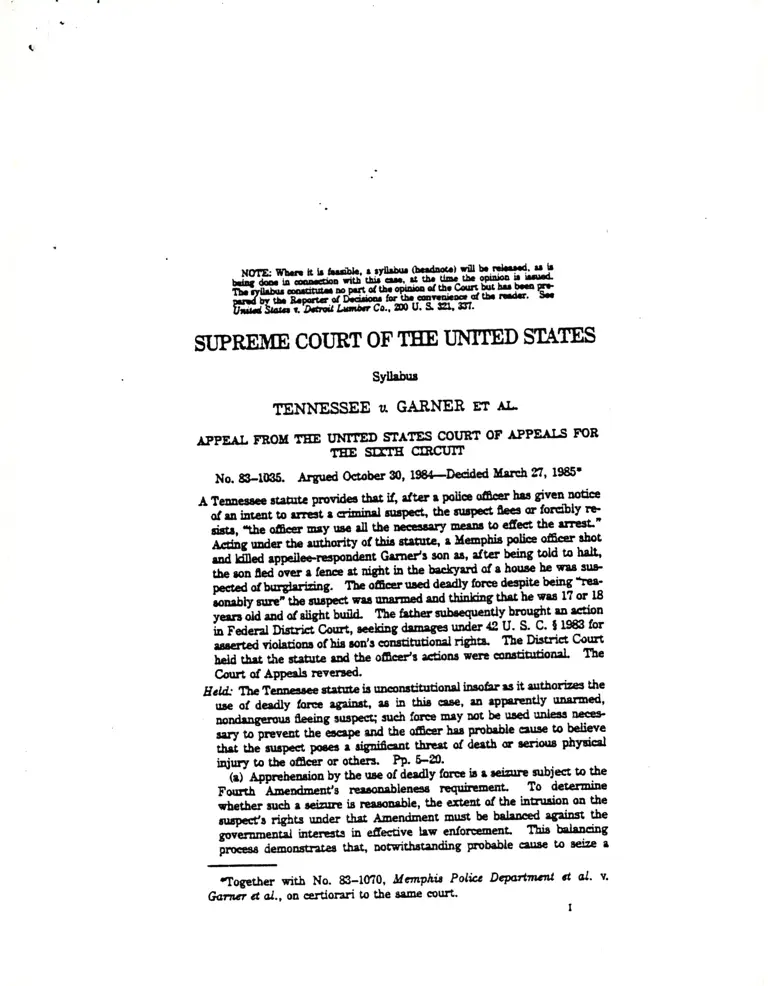
23 pages
-
Case Files, Garner Working Files. Syllabus and Opinion, 1985. 272c81c3-35a8-f011-bbd3-000d3a53d084. LDF Archives, Thurgood Marshall Institute. https://ldfrecollection.org/archives/archives-search/archives-item/0a3eec19-2444-4b47-9b2c-a91b60825bb7/syllabus-and-opinion. Accessed September 25, 2026.
Copied!
MfYTE* it ifl feasible, e tyiUbua (beedaote) viU be releeteri, asb jJS ^ iSTSTat tb. t^th.
SUPREME COURT OF THE UNTIED STATES
Syllabus
TENNESSEE v. GARNER ET a l .
APPEAL PROM THE UNITED STATES COURT OP APPEALS POR
THE SIXTH dRCUTT
No. 83-1035. Argued October 30, 1984— Decided March 27, 1985*
A Tennessee statute provides that if, after a poUce officer has given notice
of an intent to arrest a crinainal suspect, the suspect flees or forcibly r e
sisU, “the officer may use ail the necessary means to effect the arrest.
Acting under the authority of this statute, a Memphis police officer shot
and appellee-respondent Gamer's son as, after being told to halt,
the son fled over a fence at night in the backyard of a houM he was sus
pected of burglarizing. The officer used deadly force despite being “rea
sonably sure" the suspect was unarmed and thinking that he was 17 or 18
years old and of slight build. The father subsequently brought an action
in Federal District Court, seeking damages under 42 U. S. C. 5 19ffl for
iflflfTtni viol&tions o f his son's constitutional rights* *nio District Court
K*iH that the statute and the officer’s actions were constitutional. The
Court of Appeals reversed.
Held: The Tennessee statute is unconstitutional insofar as it authorizes the
use of deadly force against, as in this case, an apparently unarmed,
nondangeroiis fleeing suspect; such force may not be used unless neces
sary to prevent the escape and the officer haa probable cause to beliw e
that- the suspect poses a significant threat of death or serious physical
ipjury to the officer or others. Pp. ^ 2 0 .
(a) Apprehension by the use of deadly force is a seizure subject to me
Fourth Amendment's reasonableness requirement. To determine
whether such a seizure is reasonable, the extent of the intrusion on the
suspect's rights under that Amendment must be balanced against the
governmental interests in effective law enforcement. This balancing
process demonstrates that, notwithstanding probable cause to seize a
•Together with No. 83-1070, Memphia Police Departmeni et al. v.
Gamer et al., on certiorari to the same court.
TENNESSEE u GARNER
Syllabus
suspect, an officer may not always do so by killing him. The use of
deadly force to prevent the escape of all felony suspects, whatever the
drcuinstances, is constitutionally unreasonable. Pp. 5-10.
(b) The Fourth Amendment, for purposes of this case, should not be
construed in light of the common-law rule allowing the use of whatever
force is necessary to effect the arrest of a fleeing felon. Changes in the
legal and technological context mean that that rule is distorted almost
beyond recognition when literally applied. Whereas felonies were for-
meriy crimes, few are now, or can be, and many aim es claasiM
as misdemeanors, or nonexistent, at common law are now felonies.
A1./1 the common-law rule developed at a time when weapons were rudi
mentary. And, in light ofthe varied rules adopted in the States Indicat
ing a long-tom movement away from the common-law rule, particuiariy
in the police departments themselves, that rule is a dubious i n d « ^ of
the constitutionality of the Tennessee statute. There is no indication
that a police practice such ss that authorized by the statute un
reasonable will severely hamper effective law enforcement. Pp. 10-18.
(c) While burglary is a serious crime, the officer in this case could not
reasonably have believed that the suspect—young, slight, and un
armed—posed any threat. Nor does the fact that an unarmed suspect
has broken into s dwelling at night automaticaUy mean he is dangerous.
Pp. 18-20.
710 F. 2d 240, affirmed and remanded.
Whtiz, J., delivered the opinion of the Court, in which Brsknan, Mab-
TOAi i BLAcntUN, Powell, and Stevens, JJ., joined. O’Connor, J.,
filed a dissenting opinion, in which Burgee, C. J., and Rehnquist, J.,
joined.
NOTICE: Thii 1* iabj«et W fornai ravuioo b«tor» puUkmUon in the
pNliiniawr priat̂ rS* Uaiud Suut JUpofU. IU «kn iw r»q u «^ U
iwuN tlM Bcporwr ot D*a^t», SupTwii# Coun 0/ th« U nî S U U «,
inttao, D. Cr»MS, ot «ny typographical ot othar 16r«al teron, m ortar
that eocraetiona may ba mada batota lha praiiininary pnat foaa to praaa.
SUPREME COURT OF THE UNITED STA.TES
Nos. 83-1085 AMD 83-1070
TENNESSEE, APPELLANT
83-1035 ^
CLEAMTEE GARNER, e t c . , e t a l .
ON APPEAL FROM THE UNITED STATES COURT OF APPEALS
FOR THE SIXTH CIRCUTT
MEMPHIS POLICE DEPARTMENT, ET a l . ,
PETITIONERS
83-1070
CLEAMTEE GARNER, ETC., ET a l .
ON W R IT OF CERTIORARI TO THE UNITED STATES COURT OF
a p p e a l s FOR THE SITTH CIRCUIT
[March 27. 19851
J u s t ic e W h it e delivered the opinion of the Court.
This case requires us to detenxune the constitutionality of
the use of deadly force to prevent the escape of an apparently
unanned suspected felon. We conclude that such force may
not be used unless it is necessary to prevent the escape and
the ofacer has probable cause to believe that the suspect
poses a significant threat of death or serious physical injury
to the officer or others.
I
At about 10:45 p. m. on October 3, 1974, Memphis PoUce
Officers Elton Hymon and LesUe Wright were dispatched to
answer a “prowler inside call.” Upon arriving at the scene
they saw a woman standing on her porch and gesturing to-
2 TENNESSEE u GARNER
ward the adjacent house.* She told them she had heard
glass breaking and that “they” or “someone” was breaking m
next door. While Wright radioed the dispatcher to say t ^ t
they were on the scene, Hymon went behind the house. He
heard a door slam and saw someone run across the b a ^ yard.
The fleeing suspect, who was appellee-respondent s dw ^
dent, Edward Gamer, stopped at a 6-feet-high
at the edge of the yard. With the aid of a ^ h lig h t ,
Hymon was able to see Gamer's face and hands. He saw no
sign of a weapon, and, though not certam, was “reasoMbly
sure” and “figured” that Gamer was unarmed. App. 41, 50;
Record 219. He thought Gamer was 17 or 18 yearn old and
about 5 '5 " or 5 '7 " talk* While Gamer was crouched at the
base of the fence, Hymon called out “police, halt" and took a
few steps toward him. Gamer then began to climb over the
fence. Convinced that if Gamer m ^ e it over the fence he
would elude capture,* Hymon shot him. The bullet hit Gar
ner in the back of the head. Gamer was taken by ambulance
83-1035 i 83-1070—OPINION
‘ The owner of the house testified that no lights were on in the
but a Iw k door light was on. Record 160. Officer Hymon, twugh
stated in his deposition that there were Ughts on in the house.
‘ In fact. Gamer, an eighth-grader, was 15. He w m 5' 4 ' ' tall ^
weighed somewhere around 100 or n o pounds. App. to Pet. for Cert. A5.
•When a*kBd at trial why he fired, Hymon stated:
"W eil, first of all it was apparent to me from the little bit that I knew about
the area at the time that he was going to get away because, number 1, I
couldn’t get to him. My partner then couldn’t find where he was becauM,
you know, he was late coming around. He didn't know irhm 1
ing about. I couldn’t get m him because of the fence here, I couldn t have
jumped this fence and come up, consequently jumped this fence and caught
him before he got away because he was already up on the fence, jiu t one
leap and he was already over the fence, and so there is no way that I could
have caught him." App. 52. , , , v .u
He also stated that the area beyond the fence was dark, that he could i» t
have gotten over the fence easily because he was carrying a lot of eqmp-
ment and wearing heavy boots, and that Gamer, being younger and more
energetic, could have outrun him. Id., at 53-54.
TENNESSEE u GARNER 3
to a hospital, where he died on the operating table. Ten dol
lars and a purse taken from the house were found on his
body.̂
In deadly force to prevent the escape, Hymon was
acting under the authority of a Tennessee statute and pur
suant to Police Department policy. The statute provides
that “[i]f, after notice of the intention to arrest the defendant,
he either flee or forcibly resist, the officer may use all the
necessary means to effect the arrest.” Tenn. Code Ann-
140-7-108 (1982).* The Department policy was sli^ tly
more restrictive than the statute, but still allowed the um of
deadly force in cases of burglary. App. 140—144. The inci
dent was reviewed by the Memphis Police Firearm’s Review
Board and presented to a grand jury. Neither took any ac
tion. App. 57.
Gamer's father then brought this action in the Federal Dis
trict Court for the Western District of Tennessee, seeking
damages under 42 U. S. C. § 1983 for asserted violations of
Gamer's constitutional rights. The complaint alleged that
the shooting violated the Fourth, Fifth, Sixth, Eighth, and
Fourteenth Amendments of the United States Constitution.
It named as defendants Officer Hymon, the Police Depart
ment, its Director, and the Mayor and dty of Memphis.
A fter a 3-day bench trial, the District (3ourt entered judg
ment for all defendants. It dismisaed the claims against the
Mayor and the Director for lack of evidence. It then con
cluded that Hymon’s actions were authorized by the Tennes
see statute, which in turn was constitutional Hymon had
'Garner had ru m m a^ through one room in the houae, in which, in the
worda of the owner, “la]U the stuff was out on the floota, all the drawers
was pulled out, stuff waa scattered all over." App. 34. The owner
testified his valuables were untouched but that, in addition to the
purae and the 10 dollars, one of his wife's rings waa miaaing. The ring was
not recovered. App. 34-35.
‘ Although the statute does not say so explicitly, Tennessee law forbids
the use of deadly force in the arrest of a misdemeanant. See Johnaon v.
StaU, 173 Tenn. 134, 114 S. W. 2d 819 (1938).
83-1036 & 83-1070—OPINION
83-1035 i 83-1070— OPINION
4 TENNESSEE u GARNER
employed the only reasonable and practicable means of pre
venting Gamer's escape. Gamer had “recklessly and heed
lessly attempted to vault over the fence to escape, thereby
assuming the risk of being fired upon." App. to Pet- for
Cert. AlO.
The Court of Appeals for the Sixth Circuit affirm ^ with
regard to Hymon, finding that he had acted in good-faith reli
ance on the Tennessee statute and was therefore within the
scope o f his qualified immunity. 600 F. 2d 62 (1979). It re
manded for reconsideration of the possible liability of the
dty, however, in light of Monell v. New York City Dept, o f
Social Services, 436 U. S. 658 (1978), which had come down
after the District Court’s decision. The District Court was
directed to consider whether a city enjoyed a qualified unmu-
nity, whether the use of deadly force and hollow point bullets
in drcumstances was constitutional, and whether any
unconstitutional municipal conduct flowed from a “policy or
custom" as required for liability under Monell. 600 F. 2d, at
54-55.
The District Court concluded that Monell did not affect its
decision. While acknowledging some doubt as to the possi
ble immunity of the dty, it found that the statute, and
Hymon's actions, were constitutionaL Given this conclu
sion, it declined to consider the “policy or custom" question.
App. to Pet. for Cert. A37-A39.
The Court of Appeals reversed and remanded. 710 F . 2d
240 (CA6 1983). It reasoned that the killing o f a fleeing sus
pect is a “seizure” under the Fourth Amendment,* and is
therefore constitutional only if “reasonable. ” *1116 Tennessee
statute feiled as applied to this case because it did not ade
quately limit the use of deadly force by distinguishing be
tween felonies of different magnitudes— “the ^ t s , as found,
did not justify the use of deadly force under the Fourth
*'*The right of the people to be secure in their persons . . . against
unreasonable Marches and seizures, shall not be violated . . . U. S.
Const., Arndt. 4.
TENNESSEE u GARNER &
Amendment." /d ., at 246.' Officers cannot resort to deadly
force unless they “have probable cause . . . to believe that
the suspect [has committed a felony and] poses a threat to the
safety of the officers or a danger to the community if left at
large." Ibid.'
The State of Tennessee, which had intervened to defend
the statute, see 28 U. S. C. § 2403(b), appealed to this Court.
No. 83-1035. The dty filed a petition for certiorari. No.
83-1070. We noted probable jurisdiction in the appeal and
granted the petition. 465 U. S. —— (1984).
II
Whenever an officer restrains the freedom of a person
to walk away, he haa seized that person. United States v.
Brigrumi-Ponce, 422 U. S. 873, 878 (1975). While it is not
always dear just when minimal police interference becomes a
seizure, see United States v. Mendenhall, 446 U. S. 544
(1980), there can be no question that apprehension by the use
'The Court o f Appeals concluded that the rule set out in the Model
Penal Code “accurately states Fourth Amendment limitations on the use of
deadly force against fleeing felons.- 710 P. 2d, at 247. The relevant por
tion of the Model Penal Code provides:
“The use of deadly force is not justifiable . . . unless (i) the arrest is for a
felony; and (ii) the person effecting the arrest is authoraed to act as a peace
officer or is a person whom he believes to be authorized to act as a
officer, and (iii) the actor believes that the force employed creatM no
y^KatanHal nsk of injury to innocent persons; and Qv) the actor believes
that (1) the crime for which the arrest is made involved conduct induding
the use or threatened use of deadly force; or (2) there is a substantial̂ risk
that the person to be arrested will cause death or serious bodily harm if his
apprehension is delayed." American Law Institute, Model Penal Code
i 3.07(2Xb) (Propoeed Official Draft 1962).
'Die court found that “ta)n analysis of the fects of this case under the
Due Process Clause" required the same result, because the sUtute was not
narrowly drawn to ftirther a compelling state interest. 710 F. 2d, at
246—247. "Hie court considered the generalized interest in effective law
enforcement sufficiently compelling only when the the suspect is danger
ous. Finally, the court held, relying on Owen v. City of Indtpendettct, 446
U. S. 622 (1980), that the dty was not inunune.
83-1035 i 83-1070—OPINION
6 TENNESSEE u GARNER
of deadly force is a seizure subject to the reasonableness
requirement of the Fourth Amendment.
83-1035 & 83-1070—OPINION
A police officer may arrest a person if he has probable
caiisy* to believe that person committed a crime. E. g..
United StaUs v. Watson, 423 U. S. 411 (1976). Petitioners
and appellant argue that if this requirement is satisfied the
Fourth Amendment has nothing to say about how that sei
zure is made. This submission ignores the many cases in
which this C)ourt, by balancing the extent of the intrusion
against the need for it, has examined the reasonableness of
the "^atinpr in which a search or seizure is conducted. To de
termine the constitutionality of a seizure “[w]e must balance
the nature and quality of the intrusion on the individual s
Fourth Amendment interests against the importance of the
governmental interests a lleg^ to justify the intrusion.
United States v. Place, 462 U. S. 696, 703 (1983); see Dela
ware V. Prouse, 440 U. S. 648, 654 (1979); UniUd States v.
Martvnez-Fuerie, 428 U. S. 543, 555 (1976). We have de
scribed “the balancing of competing interests” as “the key
principle of the Fourth AmendmenL” Michigan v. Sum
mers, 452 U. S. 692, 700, n. 12 (1981). See also Camara v.
Municipal Court, 387 U. S. 523, 536-537 (1967). Because
one of the factors is the extent of the intrusion, it is plain that
reasonableness depends on not only when a seizure is made,
but also how it is carried out. United States v. Orta, 422
U. S. 891, 895 (1975); Terry v. Ohio, 392 U. S. 1, 28-29
(1968).
Applying these principles to particular facts, the Court has
that governmental interests did not support a lengthy
detention of luggage. United States v. Place, supra, an air
port seizure not “carefully tailored to its underiying justifica
tion,” Florida v. Royer, 460 U. S. 491, 500 (1983) (plurality
opinion), surgery under general anesthesia to obtain evi
dence, WiTiston V. L ee ,------ U. S .------- (1985), or detention
TENNESSEE u GARNER 7
for fingerprinting without probable cause, Davis v. M issis
sippi, 394 U. S. 721 (1969); Hayes v. Florida, ------ U. S.
____ (1985). On the other hand, under the same approach it
has upheld the taking of fingernail scrapings from a suspect,
Cupp V. Murphy, 412 U. S. 291 (1973), an unannounced
entry into a home to prevent the destruction of evidence, Ker
V. Califomia, 374 U. S. 23 (1963), administrative housing in
spections without probable cause to believe that a code viola
tion will be found, Cartuxra v. Municipal Court, supra, and a
blood test of a dnmk-driving suspect, Schmerber v. Califor
nia, 384 U. S. 757 (1966). In each of these cases, the ques
tion was whether the totality of the circumstances justified a
particular sort of search or seizure.
B
The hfllanring process applied in the cases dted
above demonstrates that, notwithstanding probable cauM to
a suspect, an o ffice may not always do so by killing
him The intrusiveness of a seizure by means of deadly force
is The suspect’s fiindamental interest in his own
life need not be elaborated upon. The use of deadly force
also frustrates the interest of the individual, and of society,
in judidai determination of guilt and punishment. Against
these interests are ranged governmental interests in effec
tive law enforcement.* It is argued that overall violence will
•The diesect »wipha>rin»« that subsequent investigation cannot replace
apprehension. We recognize that this is so, see vnfra, n. 13;
indeed, that is the reason why there is any dispute. If subsequent arrest
were assured, no one would argue that use of deadly force ^ justified.
Thus, we proceed on the assumption that subsequent arrest is not likely.
Nonetheless, it should be remembered that fisilure to apprehend at the
scene does not necessarily mean that the suspect will never be caught.
In lamenting the inadequacy of later investigation, the dissent relies on
the report of the President's Commission on Law Enforcement and Adnun-
iitr«Hrtn of Justice. It is worth noting that, notwithstanding its aware
ness of this problem, the Commission itself proposed a policy for use of
deadly force arguably even more stringent than the formulation we ^ o p t
today. See President's Commission on Law Enforcement and Adminisoa-
83-1036 &. 83-107O -O PIN IO N
8 TENNESSEE u GARNER
be reduced by encouraging^ the peaceful submission of sus
pects who know that they may be shot if they flee. Effec
tiveness in making- arrests requires the resort to deadly
force, or at least the meaningful threat thereof. “Being able
to arrest such individuals is a condition precedent to the
state’s entire system of law enforcement.” Brief for Peti
tioners 14.
Without in any way disparaging the importance of these
goals, we are not convinced that the use of deadly force is a
sufficiently productive means of accomplishing them to jus
tify the killing of nonviolent suspects. Cf. Delaware v.
Pnmae, ntpro, at 659. The use of deadly force is a self-
defeating way of apprehending a suspect and so settmg the
criminal justice mechanism in motion. If successful, it guar
antees that mechanism will not be set in motion. And
while the meaningful threat of deadly force mig^t be thought
to lead to the arrest of more live suspects by discouraging
escape attempts,* the presently available evidence does not
tion of Justice, Task Force Report: The Police 189 (1967). The Commis
sion proposed that deadly force be used only to apprehend “perpetrators
who, in the course of their crime threatened the use of deadly force, or if
the officer believes there is a anbatantial risk that the person whoM u rest
is sought will cause d?at>̂ or serious bodily harm if his apprehension is de
layed." In addition, the nff\r»r would have “to know, as a virtual cer
tainty, the suspect committed an offense for which the use of deadly
force is permiasible." Ibid.
•We note the usual mannar of deterring illegal conduct— through
punishment— has been largely ignored in connection with flight from ar
rest. Arkansas, for example, specifically excepts flight from arrest from
the of “ obstruction of governmental operations.* The commentary
notes that this “reflects the basic policy judgment that, absent the use of
force or violence, a mere attempt to avoid apprehension by a law enforce
ment docs oot give fise to an independent offense.” Ark. Stat.
Ann. §41-2802(3Xa) (1977) and commentary. In the few States that do
outlaw flight from an arresting officer, the crime is only a misdemeanor.
See, s. g ., Ind. Code i 36-44-3 -3 (1982). Even forceful resistance, though
generally a separate offense, is elsssified as a nuademeanor. E. y., RL
Rev. Stat., ch. 38, S 31-1 (1904); Mont. Code Ann. i 45-7-301 (1984); N. H.
Rev. Stat. Ann. 5 642:2 (Supp. 1983); Ore. Rev. Stat, S 162.316 (1983).
83-1035 & 83-1070—OPINION
TENNESSEE u GARNER 9
support this thesis.** The fact is that a majority of police de
partments in this country have forbidden the use of deadly
force against nonviolent suspects. See infra, at 16-17. If
those charged with the enforcement of the criminal law have
abjured the use of deadly force in arresting nondangerous fel
ons, there is a substantial basis for doubting that the of
such force is an essential attribute of the arrest power in all
felony cases. See Schwnuinn v. McGinn, 307 Minn. 4 ^ ,
472, 240 N. W. 2d 525, 540 (1976) (Rogosheske, J., dissenting
in part). Petitioners and appellant have not persuaded us
that shooting nondangerous fleeing suspects is so vital as to
outweigh the suspect’s interest in his own life.
The use of deadly force to prevent the escape of all felony
suspects, whatever the drcumstances, is constitutionally un
reasonable. It is not better that all felony suspecte die than
that they escape. Where the suspect poses no immediate
threat to the officer and no threat to o th ^ , the harm result
ing from failing to apprehend him does not justify the use of
deadly force to do so. ItTs no doubt unfortunate when a st̂
pect who is in sight escapes, but the feet that the police
arrive a little late or are a little slower afoot does not always
justify ViliiTig the suspect, A police officer may not seize an
unarmed, nondangerous suspect by shooting him dead. The
Thia approach does avoid the anomaly of automatically trana-
every fleeing TniB/̂ »mMnnTlt mto a fleeing felon— aubject, under
the common-law role, to apprehension by deadly force—solely by vutue of
his flight. However, it is in real tension with the harsh consequences of
flight in cases where deadly force is employed. For example, Tennessee
does not outlaw fleeing from arrest. The Memphis City Code does,
} 30-16, subjecting the offender to a maximum fine of $50, { 1-3. T h ^ ,
Garner's attempted escape subjected him to (a) a $50 fine, and (b) being
shot.
“ See Shoi-man, TUduang Police Gun Use, in Control in the Police Orga
nization 98, 120-123 (M. Punch, ed. 1983); Fyf«. Obeervations on Police
Deadly Force, 27 Crime 4 Delinquency 376, 378—381 (1981); W. Geller 4
K. Karales, Split-Second Decisions 67 (1981); App. 84 (Affidavit of William
Bracey, Chief of Patrol, New York Q ty Police Department). See gener
ally Brief tor Police Foundation et aL as Amici Cwioc.
83-1036 & 83-1070— OPINION
10 TENNESSEE u GARNER
Tennessee statute is unconstitutional insofar as it authorizes
the use of deadly force against such fleeing suspects.
It is not, however, unconstitutional on its face. Where the
has probable cause to believe that the suspect poses a
threat of serious physical harm, either to the officer or to
others, it is not constitutionally unreasonable to prevent es
cape by using deadly force. Thus, if the suspect t h r e a p
the officer with a weapon or there is probable cause to l^ e v e
that he has committed a crime involving the infliction or
threatened infliction of serious physical harm, deaffiy force
may be used if necessary to prevent escape, and if, where
feasible, some warning has been given. As applied in such
drcumstances, the Tennessee statute would pass constitu
tional muster. m
83-1036 Sl 83-1070—o p in io n
It is insisted that the Fourth Amendment must be con
strued in light of the common-law rule, which allowed the use
of whatever force was necessary to effect the arrest of a fle^
ing felon, though not a misdemeanant. As stated in Hale’s
pr>at>wTTinnHly published Pleas of the Crown:
*TOf persons that are pursued by these officers for felony
or the just suspicion thereof . . . shall not yield them
selves to these officers, but shall either resist or fly be
fore they are apprehended or being apprehended shall
rescue themselves and resist or fly, so that they cannot
be otherwise apprehended, and are upon necessity slain
therein, because they cannot be otherwise taken, it is no
felony.” 2 M. Hale, Historia Pladtorum Coronae 85
(1736). See also 4 W, Blackstone, Commentaries *289.
Most American jurisdictions also imposed a flat prohibition
against the use of deadly force to stop a fleeing misde
meanant, coupled with a general privilege to use such force to
stop a fleeing felon. E. g., Holloway v. Moser, 193 N. C.
185, 136 S. E. 375 (1927); StaU v. Smith, 127 Iowa 534, 535,
83-1036 &. 83-1070-O P IN IO N
TENNESSEE u GARNER 11
103 N. W. 944, 945 (1905); Reneau v. StaU, 70 Tenn. 720
(1879); Brooks v. Commonwealth, 61 Pa. 352 (1869); Roberts
V. StaU, 14 Mo. 138 (1851); see generaUy R. Perkins & R.
Boyce, Criminal U w 1098-1102 (3d ed. 1982); Day, Shooting
the Fleeing Felon: State of the Law, 14 Grim. L. Bull 285,
286-287 (1978); Wilgus, Arrest Without a Warrant, 22 Mich.
L. Rev. 798, 807-816 (1924). But see Storey v. StaU, 71 Ala.
329 (1882); StaU v. Bryant, 65 N. C. 327, 328 (1871); Cald-
well V. StaU, 41 Tex. 86 (1^4).
The State and dty argue that because this was the prevail
ing rule at the time of the adoption of the Fourth Amendment
and for some time thereafter, and is still in force in some
States, use of deadly force against a fleeing felon must be
“reasonable.” It is true that this Court has often looked to
the common law in evaluating the reasonableness, for Fomrth
Amendment purposes, of police activity. See, e. g.. United
States V. WaU&n, 423 U. S. 411, 418-419 (1976); Gerstein v.
Pugh, 420 U. S. 103, 111, 114 (1975); Carroll v. United
States, 267 U. S. 132, 149-153 (1925). On the other hand,
it “has not simply frozen into constitutional law those law
pnfnTyoment practices that existed at the time of the Fourth
ATTiPTiriTT»»nt'a passage.” Payton v. Wcio York, 445 U. S.
573, 591, n. 33 (1980). Because of sweeping change in the
legal and technological context, reliance on the common-law
rule in case would be a mistakp.n literalism that ignores
the purposes of a historical inquiry.
B
It has been pointed out many times that the common-law
rule is best understood in li^ t of the fact that it arose at a
timp when virtually all felonies were punishable by death.”
“ 'n»e roots of the concept of a “felony* lie not in capital punishment but
in forfeiture. 2 F. Poliock 4 F. Maitland, The History of Engiiah Law 465
(2d ed. 1909) (hereinafter Pollock & Maitland). Not all felonies were
always p u n ia^ le by See id ., at 466-467, n. 3. Nonetheless, the
link was profound. Blackstone was able to write that “ttjhe idea of felony
is indeed so generally connected with that of capital punishment, that we
12 TENNESSEE u GARNER
“Though effected without.the protections and formalities of
an orderly trial and conviction, the killing of a resisting or
fleeing felon resulted in no greater consequences th ^ those
authorized for punishment of the felony of which the individ
ual was charged or suspected." American Law Institute,
Model Penal Code §3.07, Comment 3, p. 56 (Tentative Draft
No. 8, 1958) (hereinafter Model Penal Code Comment).
Courts have also justified the common-law rule by emphasiz
ing the relative dangerousness of felons. See, «. g., Sehu-
viOtTvn V. McGinn, 307 Minn., at 458, 240 N. W. 2d, at 533,
Holloway v. Moser, supra, at 187, 1 ^ S. £ ., at 376 (1927).
Neither of these justifications makes sense today. Almost
all crimes formerly punishable by death no longer are or can
be. See, e. g., Enmund v. Florida, 458 U. S. 782 (1982);
Coker v. Georgia, 433 U. S. 584 (1977). And while in earUer
riTnAQ “the gulf between the felonies and the minor offences
was broad deep,” 2 Pollock & Maitland 467, n. 3; Carroll
V. United States, 267 U. S. 132,158 (1925), today the distinc
tion is minor and often arbitrary. Many crimes classified as
misdemeanors, or nonexistent, at common law are now felo
nies. Wilgus, 22 Mich. L. Rev., at 572-573. These changes
have undermined the concept, which was questionable to
begin with, that use of deadly force against a fleeing felon is
merely a speedier execution of someone who has already for
feited his life. They have also made the assumption that a
“felon” is more dangerous than a misdemeanant untenable.
Indeed, numerous misdemeanors involve conduct more dan
gerous than many felonies. “
83-1035 & 83-1070—OPINION
find it hard to separate thpm; and to this usage the interpretations o f the
law do now conform. And therefore if a statute makes any new offence
felony, the law implies that is shall be punished with death, viz. by hang
ing, as well as with forfeiture . . . 4 W. Blackstone *98. See also
R, Peridns i R. Boyce, Criminal Law 14—15 (3d ed. 1982); 2 Pollock &
MaiMnwi 5 1 L
“ Whita collar crime, for example, poses a less significant physical threat
•than, say, drunken driving. See Welth i. WiMconxin, 466 U. S. ------
83-10S5 St 83-1070—OPINION
TENNESSEE u GARNER 13
There is an additional reason why the common-law rule
cannot be directly tra n sla^ to the present day. The com
mon-law rule developed at a time when weapons were rudi
mentary. Deadly force could be inflicted almost solely in a •
hand-to-hand struggle during which, necessarily, the safety
of the arresting offlcer was at risk. Handguns were not car
ried by police officers until the latter half of the last century.
L. Kennett & J. Anderson, The Gun in America 150-151
(1975). Only then did it become possible to use deadly force
from a distance as a means of apprehension. As a practical
matter, the use of deadly force under the standard articula
tion of the common-law rule has an altogether different
meaning— and harsher consequences—now than in past cen
turies. See Wechsier & Michael, A Rationale for the Law of
Homicide: I, 37 Colum. L. Rev. 701, 741 (1937).“
One other aspect of the common-law rule bears emphasis.
It forbids the use of deadly force to apprehend a misde
meanant, condemning such action as disproportionately se
vere. See Holloway v. Moser, 193 N. C., at 187, 136 S. E .,
at 376; State v. Smith, 127 Iowa, at 535, 103 N. W ., at 945.
See generally Annot., 83 A. L. R. 3d 238 (1978).
(1984): id., a t ------ (Bl a o MUN, J., concurring). See Model Penal ( ^ e
(i)oniXDent, at 57. .
” It haa been argued that sophisticated techniques of apprehension and
ixureased «»n*nTT'iiTii«»at̂ nn between the police in different junadictiona have
tnt»4«i it more likely that an escapee will be caught than was once the case,
and that thia change haa alao reduced the “Teasonableneaa’’ o f tbe uae of
deadly force to prevent escape. E. g., Sherman, Execution Without Trial:
Police Homicide the Constitution, 33 Vand. L. Rev. 71, 76 (1980). We
are unaware of any data that would permit senaible evaluation of thia
Current arrest rates are sufficiently low, however, that we have
doubt whether in paat centuries the failure to arrest at the scene
the police had their only chance in a way that ia not
presently the case. In 1983, 21% of the offenses in the FBI crime index
were cleared by arrest. Federal Bureau of Investigation, Uniform Crime
Reporta, Crime in the United States 169 (1984). The clearance rata for
burglary was 15%. Ibid.
14
83-1035 Sl 83-1070—o p in io n
TENNESSEE u GARNER
In short, though the co i^ o n law pedigree of Tenness^'s
rule is pure on its face, chang^es in the legal and technolopcal
context mean the rule is distorted almost beyond recognition
when literally applied.
B
In evaluating the reasonableness of police procedures
under the Fourth Amendment, we have also looked to pre
vailing rules in individual jurisdictions. See, c. United
States V. Watson, 423 U. S., at 421-422. The rules in the
States are varied. See generally Comment, 18 Ga. L. Rev.
137, 140-144 (1983). Some 19 States have codified the com
mon-law rule,** though in two of these the courts have signifi
cantly Urnit/Ki the statute, “ Four States, thou^ without a
“ Ala. Code 513A-3-27 (1982); Arit. Stat. Ann. 541-610 (19T7); CaL
Penal Code Ann. 5196 (West 1970); Conn. Gen. Sut. 5 63a-22 (1972); Fla.
S 776.06 (1983); Idaho Code 519-610 (1979); Ind. Code 5 35-41-3-3
(1982) - Kan. Stat. Ann. 521-3216 (1981); Ifiaa. Code Ann. 597-3-l5(d)
(Sunp. 1984); Mo. Rev. Stat. 5663.046 (1979); Nev. Rev. Stat. 5200.140
(1983) ; N. M. Stat. Ann. 530 -2 -6 (1984); Okla. Stat., Tit. 21, 5732
(1981); R. L Gen. U w e 512-7-9 (1981); S. D. Codified U w e 55 22-16-32,
-33 (1979); Tenn. Code Ann. 540-7-108 (1982); Waah. Rev. Code
5 9A-16.040(3) (1977). Oregon liinita uae of deadly force to violent felons,
but allows its use against any felon if “necessary." Ore. Rev. Stat.
5161 239 (1983). Wisconsin's statute is ambiguous, but abould probably
be to this bst. Wia. Stat. 5 939.45(4) (1981-1982) (officer may use
force necessary for “a reasonable accomplishment o f a lawful arrest").
But see Clark v. Zisdonia, 368 F. Supp. 644 (Wis, 1973), aff’d on other
grounds, 513 F. 2d 79 (CAT 1975).
“ In r.«iifrnTiia, the police may uae deadly force to arrest only if the
crime for w hid the arrest is sought was “a forcible and atirooous one which
thryntJtiB fjoath or serious bodily harm," or there is a substantial risk that
the psaon whose arrest is sought wfll cause death or senous bodily harm if
apprehension is delayed. Kortum v. Alkxn, 69 CaL App. 3d 325, 333, 138
Cal Rptr. 26. 30-31 (1977). See also PeopU v. CebaUo*, 12 CaLSd 470,
476-484,526 P. 2d 241, 246-250 (1974); Long Beach Police Officm Asm. v.
Long Beach, 61 CaL App. 3d 364, 373-374, 132 CaL Rptr. 348, 353-354
(1976). In tnriiana, deadly force may be used only to prevent injury, the
unminent danger of injury or force, or the threat of force. It is not permit
83-1036 & 83-1070— OPINION
TEN NESSEE u GAENER 15
relevant statute, apparently retain the common-law rd e .“
Two States have adopted the Model Penal Code's provision
verbatim.” E ig h th others allow, in slightly varying lan
guage, the use of deadly force only if the suspect has commit
ted a felony involving the use or threat of physical or deadly
force, or is escaping with a deadly weapon, or is likely to en
danger life or inflict serious physical injury if not arrested.”
Louisiana and Vermont, though without statutes or case law
ted limply to prevent escape. Rote v. Staie, 431 N. E. 2d 521 (Ind. App.
1982). . . „
“ These are Michigan, Ohio, Virginia, and West Virgima. Weimer v.
Hartfelder, 113 Mich. App. 747, 318 N. W. 2d 825 (1982); StaU v. FotUr,
60 Ohio Misc. 46. 59-66, 396 N. E. 2d 246, 255-258 (Com. PL 1979) (citing
eases); Berry v. Hamman, 203 Va. 596,125 S. E. 2d 851 (1962); Thompam
T. Norfolk <£ W. R. Co., 116 W. Va. 705, 711-712, 182 S. E. 880, 883-884
(1935).
“ Haw. Rev. Stat. 5703-307 (1976); Neb. Rev. Stat. 528-1412 (1979).
Massachusetts probably belongs in this category. Though it once rejected
(iistinctions between felonies, Uraneck v. Lvma, 359 Mass. 749, 750, M9
N. E. 2d 670, 671 (1971), it has since adopted the Model Penal Code limita
tions with regard to private dtiaens, CommonweaUh v. Klein, 372 Mass.
823, 363 N, E. 2d 1313 (1977), and seems to have extended that decision to
police officers, Julian v. Randaxxo, 380 Maas 391, 403 N. E. 2d 931 (1980).
“ Alaska .St?* Ann, 5 11.81.370(a) (1983); Ariz. Rev. Stat. Ann. 513-410
(1978) ; Colo. Rev. Stat. 518-1-707 (1978); Del Code Anm, Tit. 11, 5467
(1979) (felony involving physical force and a subsfanfial risk that the sus
pect will <-an«o or serious bodily injury or wiD never be recaptured);
Ga. Code 5 16-3-21(a) (1984); DL Rev. StaL, ch. 38, 5 7-6 (1984); Iowa
Code 5 804.8 (1983) (suspect has used or threatened deadly force in commis
sion of a felony, or would use deadly force if not caught); Ky. Rev. Sta^
5 603.090 (1984) (suspect committed felony involving use or threat of physi
cal torce likely to cause death or serious injury, and is likely to endanger
hfe nnl»<i» apprehended without delay); Me. Rev. Stat. Ann., H t. 17—A,
5107 (1983) (commentary notes that deaidly force may be used only “where
the person to be arrested poses a threat to human Kfe"); Minn. Stat.
5 609.066 (1984); N. H. Rev. Stat. Ann. 5 627:5(11) (Supp. 1983); N. J. Stat.
Ann. 52C -3-7 (West 1982); N. Y. Penal U w 536.30 (McKinney Supp.
1984-1985); N. C. Gen. Stat 5 16A-401 (1983); N. D. C ent Code
512.1-06-07.2.d (1976); Pa. Stat Ann., H t 18,5 508 (Purdon); Tex. Penal
Code Ann, 5 9.51(c) (1974); Utah Code Ann, 5 76-2-404 (1978).
16
83-1036 & 83-1070—OPINION
TEN NESSEE u GARNER
on point, do forbid the use of deadly force to prevent any but
violent felonies." The remaining States either have no rele
vant statute or case-law, or have positions that are unclear.®
It cannot be said that there is a constant or overwhelming
trend away from the common-law rule. In recent years,
some States have reviewed their laws and expressly rejected
abandonment of the common-law rule.® Nonetheless, the
long-term movement has been away from the rule that
deadly force may be used against any fleeing felon, and that
remains the rule in less than half the States.
This trend is more evident and impressive when viewed in
light of the policies adopted by the police departments them
selves. Overwhelmingly, these are more restrictive than
the common-law rule. C. Milton, J. Halleck, J. Lardner, &
G. Abrecht, Police Use of Deadly Force 45-46 (1977). The
Federal Bureau of Investigation and the New York City Po
lice Department, for example, both forbid the use of firearms
except when necessary to prevent death or grievous bodily
harm. Id., at 40-41; App. 83. For accreditation by the
Commission on Accreditation for Law Enforcement Agen-
■See U . Rev. StaL Ann. i 14:20(2) (West 1974); VU StaU A ^ , Tit. 13,
S 2305 (1974 and Supp. 1984). A Federal District (2ourt has interpreted
the to limit the use of deadly force against fleeing sus-
peeu to ffifiarinnii where *7ife itself is endangered or great bodily harm is
threatened.” Souls v. Hutto, 304 F. Supp. 124, 132 (ED La. 1969).
"These are Maryland, Mf̂ ntana, South (Carolina, and Wyoming. A
Maryland appellate court has Indicated, however, that deadly force may
not be used against a felon who “was in the process of fleeing and, at the
riTTia present^ no danger to . . . anyone . . . ." Giant Food,
Inc. V. Scherry, 51 Md. App. 686, 589, 596, 444 A. 2d 483, 486, 489 (1982).
"In yiftpring its current statute in 1979, for example, Alabama ex
pressly the common-law rule over more restrictive provisions. Ala.
Code pp. 67-68 (1982). Missouri Ukewiae considered but rejected a pro
posal akin to the Model Penal Code rule. See Mattis v. Scknarr, 547 F. 2d
1007, 1022 (ClAS 1976) (Gibson, C. J., disaenting), vacated as moot su6
nam. Athenfi v. Jkfottis, 431 U. S. 171 (1977). Idaho, whose currrat stat
ute the common-law rule, adopted the Model Penal Code in 1971,
but abandoned it in 1972.
83-1035 dc 83-107O-rOPINION
TEN N ESSEE u GARNER 17
des, a department must restrict the use of deadly force to
situations where “the officer reasonably believes that the ac
tion is in defense of human life . . . or in defense of any per
son in immediate danger of serious physical injury.” Com-
mission on Accreditation for Law Enforcement Agendes,
Inc., Standards for Law Enforcement Agendes 1-2 (1983)
(italics deleted). A 1974 study reported that the police d e
partment regulations in a majority of the large dties of the
United States allowed the firing o f a weapon only when a
felon presented a threat of death or serious bodily ham .
Boston Police Department, Planning & Research Division,
The Use of Deadly Force by Boston Police Personnel (1974),
pit-pd in Mattia v. Scknarr, 647 F. 2d 1007, 1016, n. 19 (CAB
1976), vacated as moot nam. Ashcroft v. Mattis, 431
U. S. 171 (1977). Overall, only 7.5% of departmental and
TTiiiniwpal polides explidtly permit the use of deadly force
against any felon; 86.8% explicitly do not. K. Matulia, A
Balance of Forces: A Report of the International Association
of Chiefe of Police 161 (1982) (table). See also Record
1108-1368 (written polides of 44 departments). See gener
ally W. Geller & K. Karales, Split-Second Decisions 33-42
(1981); Brief for Police Foundation et aL as Amici Curiae,
In li^ t of the rules adopted by those who must actually
administer them, the older and fading common-law view is a
dubious in<ii<diTTTi of the constitutionality of the Tennessee
statute now before us.
C
Actual departmental polides are important for an addi
tional reason. We would hesitate to declare a police practice
of long standing “unreasonable” if doing so would severely
hamper effective law enforcement. But the indications are
to the contrary. There has been no suggestion that crime
has worsened in any way in jurisdictions that have adopted,
by or departmental policy, rules similar to that an
nounced today. Amici note t ^ t “[alfter extensive research
flnri consideration, [they] have conduded that laws permit-
18
88-1035 & 83-107O -O PIN IO N
TENNESSEE u GARNER
ting police officers to use deadly force to apprehend unarmed,
non-violent fleeing felony suspects actu^y do not protect
or law enforcement officers, do not deter crime or al
leviate problems caused by crime, and do not improve tte
crime-fighting ability of law enforcement agencies." Brief
for Police Foimdation et aL as Am ici Curiae 11. The sub
mission is that the obvious state interests in apprehension
are not sufficiently served to warrant the use o f lethal weap
ons against all fleeing felons. See supra, at 8 -9 , and n. 10.
Nor do we agree with petitioners and appellant that the
rule we have adopted requires the police to make impossible,
split-second evaluations of nnknow^le facts. See Brief for
Petitioners 25; Brief for Appellant 11. We do not deny the
practical rfiffipiiltiea of attempting to assess the suspect's dan
gerousness. However, simflarly difficult judgments must be
by the police in equally uncertain circumstances. See,
«. g., Terry v. Ohio, 392 U. S., at 20, 27. Nor is there any
that in States that allow the use of deadly force
only against dangerous suspects, see supra, nn. 15, 17—19,
the standard has been difficult to apply or has led to a rash of
litigafcioTi involving inappropriate second-guessing o f police
officers' split-second decisions. Moreover, the hi^ily tech
nical felony/misdemeanor distinction is equally, if not more,
to apply in the field. An officer is in no position to
know, for example, the precise value of property stolen, or
whether the crime was a first or second offense. Finally, as
noted above, this HaiTn must be viewed with suspicion in light
of the giTniiar aelf-imposed limitations of so many police
departments.
IV
The District Court concluded that Hymon was justified in
shooting Gamer because state law allows, and the Federal
Constitution does not forbid, the use of deadly force to pre
vent the escape of a fleeing felony suspect if no alternative
TpAaT̂ H of apprehension is available. See App. to Pet. for
Cert. A9—A ll, A38. This conclusion made a determination
85-1035 & 83-1070—OPINION
TENNESSEE u G ARN ER 19
of Garner^s apparent dangerousness unnecessary . The court
did find, however, that Gamer appeared to be unarmed,
though Hymon could not be certain that
at A4, A23. See also App. 41, 56; R e c ^ 219. R e s ta ^ m
Fourth Amendment terms, this means Hymon had no articu
lable basis to think Gamer was a rm ^
In reversing, the Court of Appeals accept^ the Distnrt
Court's factual conclusions and held that “^ e fw ts, as f o i^ ,
did not justify the use of deadly force.” 710 F. 2d, at 2 ^
We agree- Officer Hymon could not reasonably have be
lieved that Gamei^young, slight, and unarmed— any
threat. Indeed, Hymon never attempted to justify his ac
tions on any basis other than the need to prevent an
The District Court stated in passing that “[t]he facts of this
case did not indicate to Officer Hymon that Gamer was *non-
dangerous.’ ” App. to Pet. for Cert. A34 This ~ndim on is
not explained, and seems to be based solely on the ^
Gamer had broken into a house at night. However, the fact
that Gamer was a suspected burglar coffid not, v ^ o u t re-
zard to the other drcumstances, automatically justify the use
I f deadly force. Hymon did not have preb^ ie cause to be
lieve that Gamer, whom he correctly believed to be un
armed, posed any physical danger to hinaself or
The argues that the shooting was justifiw by toe
ffict that Officer Hymon had probable cause to believe ttot
Gamer had committed a nighttime burglary. Post, at 8, 11.
While we agree that burglary is a serious c ^ e , we
agree that it is so dangerous as automatically to justify the
use of deadly force. The FBI classifies burglary as a “prop
erty” rather than a “violent” crime. See Federal B u ^ u of
Investigation, Uniform Crime Reports, Crane m the Umted
States 1 (1984).“ Although the armed burglar would present
■In a recent report, the Department o f Correctiona of the D istort of
r^inT„hi» 4i8o noted that “there is nothing inherently d a n g e j^ o r violent
about the offense," which is a crime against property. D. C. Department
of Correctiona, Prisoner Screening Project 2 (1985).
83-1036 & 83-1070—OPINION
TENNESSEE u GARNER
. different situatien, the &et that an unattned s“ sp«ct t o
broken into a dwelling at night ^ not
he is physicahy d »gerom
nn. 22-23 (1983). In fact, the available
strate that burglaries only rarely mvolve physic^
S g period from 1 9 T 3 -m . only 3 8% of
J1 bJglaries involv^ v i t o t enme. o M u a to
Statistics, Household Burglary, p. 4 ( 1 ^ . ^
T. Reppetto, Residential Crime 17, 105 (1974); C^^hn
B ittneriB ur^ary in a Suburb, 11 Craninology 208, 214
(1973). ’ ^
We wish to make dear what our holding meaM in the con
text of this case. The complaint has been (hsmissed as to ^
the individual defendants. The State is a p a ^
tue of 28 U. S. C. § 2403(b) and is not sub3ect to l ia ^ ^ .
The possible liability of the remaining d e f e a t s —^ Poh<»
Department and the dty of M em p h is-^ b i^
N ^ Y ^ k City Dept, o f Social Sertness, 436 U. S. 6K (1978),
and is left for remand. We hold that the statute is m ^hd
insofar as it purported to give Hymon the authority t o ^ M
he did. As for the policy of the Police Departm ^t, the al>
of any discussion of this issue by the courts below, and
-T te dissent ixMiito out th3Uth«e-fifth5 of an i » p « in the
fifths o f sll home robberies, and about s third of home
ted by bupgiars. Post, at 5. These figures mean o^ y t ^ i f ® *
that a suspect a rape in the home, there is s d is n c e j^
Jteiuspectisslsoaburgiar. That haa nothing to do question
h ere^ eh S is whether the fact that someone haa conmutted a burglary in-
that he has committed, or might commit, a violent o t m .
ThTdissent also points out that this 3.8% adds up to 2-8 n ^ n violcmt
crimes over s 10-yesr period, as if to imply that today's h o l ^ ^ ^
loose 2.8 million violent burglars. The relevant amvei« is, of ^
Bnaller. At issue is only that dny fraction of c s ^ w h ^
taken place and an officer who baa no other means of apprehending the sus
pect is unaware of its occurrence.
20
83-1036 & 83-1070—OPINION
TENNESSEE u GARNER 21
the uncertain state of the record, preclude any consideration
°^ 'S e 'jtd ^ e n t of-the Court of Appeals is affirmed, ^ d
case is remanded for further procedings consistent with this
opinion. So ordered.