Gebhart v. Belton Brief for the Congress of Industrial Organizations as Amicus Curiae
Public Court Documents
January 1, 1953
-
Brief Collection, LDF Court Filings. Gebhart v. Belton Brief for the Congress of Industrial Organizations as Amicus Curiae, 1953. 47910ef2-b29a-ee11-be36-6045bdeb8873. LDF Archives, Thurgood Marshall Institute. https://ldfrecollection.org/archives/archives-search/archives-item/0b600e19-983f-471f-a6ff-77b5c377eb54/gebhart-v-belton-brief-for-the-congress-of-industrial-organizations-as-amicus-curiae. Accessed September 21, 2026.
Copied!
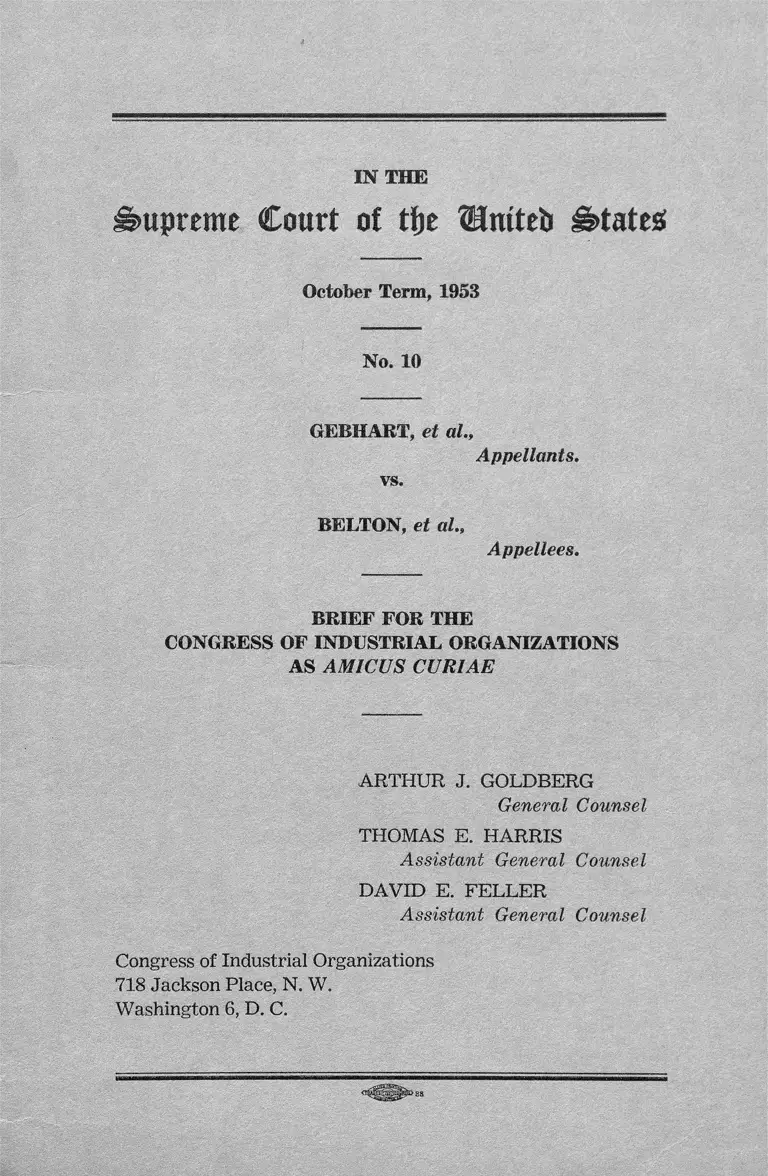
IN THE
Supreme Court of tje Urnteb States?
October Term, 1953
No. 10
GERHART, et al.,
Appellants.
vs.
BELTON, et al.,
Appellees.
BRIEF FOR THE
CONGRESS OF INDUSTRIAL ORGANIZATIONS
AS AMICUS CURIAE
ARTHUR J. GOLDBERG
General Counsel
THOMAS E. HARRIS
Assistant General Counsel
DAVID E. FELLER
Assistant General Counsel
Congress of Industrial Organizations
718 Jackson Place, N. W.
Washington 6, D. C.
•88
IN THE
Supreme Court of tfje Umteb States:
October Term, 1953
No. 10
GERHART, et al.,
Appellants.
vs.
BELTON, et al.,
Appellees.
BRIEF FOR THE
CONGRESS OF INDUSTRIAL ORGANIZATIONS
AS AMICUS CURIAE
THE INTEREST OF THE CIO
This Brief amicus curiae is submitted by the Congress of
Industrial Organizations with the consent of the parties.
The CIO is dedicated to the protection of our democratic
system of government, and, hence of the civil rights of all
Americans. Therefore, it supports the elimination of racial
segregation and discrimination from every phase of American
life.
The CIO’s interest in the specific issues before the Court
in this case is two-fold.
First, racial segregation in the public schools directly af
fects the millions of CIO members whose children attend these
schools. The CIO is convinced that school segregation is
harmful to the Negro children who are thus treated as in
ferior, to the white children in whom attitudes of racial hos
tility and discrimination are thus engendered and encouraged
at an early age, and to the community as a whole. School
2
segregation is a weakening and divisive force in American
life. At the CIO’s International Convention in November of
this year, the delegates unanimously declared their opposi
tion to school segregation, and their support for the position
taken by the plaintiffs in these cases.
Secondly, the outcome of these cases will have indirect ef
fects of great importance to the CIO. The CIO is endeavor
ing to practice non-segregation and non-discrimination in the
everyday conduct of its union business. This effort has re
peatedly been obstructed by statutes, ordinances, and regula
tions which require segregation in public meeting halls, pub
lic dining places, toilet facilities, etc. These laws seek to re
quire CIO unions to maintain “equal but separate” facilities
even in their own buildings, despite our membership’s repudia
tion of segregation in any form. Since the constitutionality
of these laws rests on basically the same line of reasoning
which is put forward to justify school segregation, the de
cision of this Court in these school cases will, in all probability,
have far-reaching implications as to the validity of these other
segregation laws.
More broadly, school segregation, and the general pat
tern of government enforced segregation of which it is a part,
fosters an atmosphere of inter-racial hostility which makes it
more difficult for the CIO to carry out its own non-segregation
policy. Further, this atmosphere of inter-racial hostility is
used by anti-labor employers in opposing CIO organizing
drives: invariably these employers stress the CIO’s opposition
to segregation and discrimination.
THE QUESTION DISCUSSED
In prior briefs amicus curiae, last year in Brown v. Board
of Education of Topeka, and earlier in other school segrega
tion cases, the CIO argued that segregation in public schools
on the basis of race violates the Fourteenth Amendment per
se. That is still our view, and we wholeheartedly subscribe to
the arguments in support of it advanced by counsel for the
appellants in Nos. 1, 2, and 4, and for the respondents in No.
10. Instead of repeating those arguments, however, we have
concluded that it would be most helpful to the Court for us
3
to confine our discussion to one particular issue on which the
CIO has a certain amount of special experience and expert
knowledge.
That issue, set out in paragraph 4 of the Court’s Order of
June 8, 1953, is what the Court should do if it concludes that
segregation in the public schools violates the Fourteenth
Amendment, i. e., whether the Court should order segregation
terminated “forthwith” or permit “gradual adjustment.”
This issue is very similar to the problem which the CIO and
its affiliated unions have repeatedly faced as to how best to
put into effect the non-segregation and non-discrimination
policies of the national organizations in localities where segre
gation and discrimination have theretofore prevailed. It is
our experience in the handling of this problem that we wish
to lay before the Court.
ARGUMENT
NON-SEGREGATION COULD BE EFFECTUATED WITH
LESS DISTURBANCE BY A “FORTHWITH” DECREE
THAN BY “GRADUAL ADJUSTMENT.”
This memorandum seeks to summarize for the Court the
experience and conclusions of unions and employers as to the
best way to effectuate non-discrimination or non-segregation
policies, and specifically as to how “forthwith” enforcement
compares with “gradual adjustment.” The bulk of this ex
perience, both union and employer, relates to the institution
or enforcement of a policy of non-discrimination and non
segregation in employment. The unions have, however, also
had some experience with respect to desegregation in other
fields, such as use of meeting halls and other union facilities.
As will be seen, all of this experience, union and employer,
reinforces this central point: if a union or an employer wants
to put into effect a policy of non-discrimination or non-segre
gation, it should do it “forthwith,” firmly and decisively, and
should avoid “gradual adjustment” or any other formula of
indefinite postponement. If the policy of non-discrimination
or non-segregation is put into effect concurrently with its an
nouncement, and if it is enforced with firmness and decisive
4
ness, there is every likelihood that the policy will be generally
accepted and that any substantial degree of inter-racial fric
tion will be avoided. The bulk of the people in any communi
ty or plant or office are influenced in their attitudes on racial
discrimination by the current practice in the community or
plant or office. If the practice is changed, and if the change be
made unequivocally, they accept the new practice and their at
titudes come to reflect it. Thus traditional Southern attitudes
on racial segregation largely mirror, according to our ex
perience, simply the prevailing practices, rather than deeply
or strongly held individual convictions. Once the practice is
changed, beliefs as to what the practice should be will change
too.
Conversely, “gradual adjustment” to a new policy of non
segregation or non-discrimination is apt to work less well.
Long drawn out discussion of a contemplated ultimate end of
segregation or discrimination may serve only to exacerbate
racial tensions. Division along racial lines may harden and
people may be led to take more extreme and adamant stands
than they would have if the issue had been disposed of prompt
ly, once and for all. For example, in a plant where Negro
workers have customarily been excluded from certain types
of jobs it may prove extremely difficult to persuade the
white workers, through a program of education and discus
sion, that the time has come to end this discrimination. Such
a program may serve only to accentuate inter-racial tension
by keeping the issue alive and in suspension. On the other
hand, if the union and employer firmly announce that hence
forth there will be no job discrimination, the new policy will,
in our experience, be accepted by the workers with little fric
tion, and the issue will be disposed of once and for all.
We do not mean that education and discussion do not serve
a purpose in this field; they do. But they should accompany
the effective implementation of a policy of non-discrimination
and non-segregation. Absent such effective implementation,
endless discussion and the indefinite postponements of “grad
ual adjustment” may serve only to freeze or accentuate at
titudes. If no fixed terminal date for segregation is set, its
proponents will regard the issue as really still open, and the
5
controversy is likely only to become more intense with the
passage of time.
Our experience suggests, we think, one further point:
The CIO and its unions have put non-segregation and non
discrimination policies into effect in all parts of the country.
No major strife has resulted within these organizations—and
they are voluntary organizations, whose officers are elected
by the membership and whose very existence depends upon the
continued good will of the membership. If the non-segregation
policies of these voluntary organizations, when promptly and
firmly implemented, can win such acceptance, then, a fortiori,
a definitive decree of the highest Court of the land will receive
general acceptance.
I
UNION EXPERIENCE
We have stated the conclusions which the CIO has reached
as to the best procedure to follow in putting into effect a policy
of non-discrimination or non-segregation. These conclusions
rest on a very considerable body of experience. The CIO and
its affiliated unions have some hundreds of thousands of mem
bers in Southern communities where racial segregation and
discrimination, except for the changes the CIO has effected,
permeate all aspects of life. It and its affiliates have other
hundreds of thousands of members in border communities,
or others, where some degree of segregation and discrimina
tion is prevalent.
Yet the CIO has from its beginning stood out against these
community prejudices. The CIO Constitution dedicates our
organizations “to bring about the effective organization of the
workingmen and women of America regardless of race, creed,
color or nationality” and “to protect and extend our demo
cratic constitutions and civil rights and liberties, and thus
to perpetuate the cherished traditions of our democracy.”
Similar provisions are found in the constitutions of the inter
national unions affiliated with the CIO. Accordingly the CIO
and its affiliated unions have, from their inceptions, opposed
discrimination in any form based on race or color.
6
The meetings of the CIO and its affiliates are never segre
gated, although, in many areas where we operate ours are the
only unsegregated meetings held in the community. Negro
members belong to the same local unions and have the same
rights as white members. Local union officers are elected
without regard to color. Scores of Negroes now hold local
union offices, or participate in collective bargaining as mem
bers of union negotiating committees. There are local unions
that have Negro presidents.
The CIO conducts educational institutes at various places
in the south for southern workers—white and Negro; male
and female. These educational classes are entirely non-seg-
regated. So also are the political meetings held from time
to time by the CIO’s Political Action Committee.
As discussed in more detail later, there is now no segre
gation in the use of CIO facilities, such as meeting halls, rest
rooms, drinking fountains, etc. Where the CIO and its unions
have their way, there is likewise no segregation in the use
of plant eating places, locker rooms, rest rooms, etc. Some
times, however, state laws or local ordinances require seg
regation in the use of these facilities, and employers usually
comply with laws, unlike the CIO which disregards them as
unconstitutional.
Many of the collective bargaining agreements which the
CIO and its affiliates have negotiated specifically forbid dis
crimination on account of race in hiring, promotion, or any
term or condition of employment; and whether or not the
contracts contain such specific provisions we see to it that
they are administered in a non-discriminatory manner.
We do not assert that this insistence by the CIO and its
unions on no segregation and no discrimination on account of
race has not sometimes been the subject of friction within the
unions. Nor do we say that it has not sometimes made the
CIO’s organizing task more difficult in some communities.
There has been some friction: Our unions have had to expel
a few members and have even suspended the charter of an
occasional local union for refusal to abide by these principles,
likewise, anti-union employers have repeatedly cited our
anti-discrimination policies in opposing organizing campaigns
7
of CIO unions, and their opposition has sometimes been suc
cessful.
We do assert, however, that there has been no major strife
or difficulty or division within CIO unions or locals on this is
sue. We are confident, moreover, that the unequivocal stand
taken by the CIO and its affiliated unions in opposition to seg
regation or discrimination, and their refusal to temporize on
this issue, has resulted in more rapid acceptance of this policy
by locals in the South, and in less friction with regard to it,
than would have been the case had we followed a program of
gradual adjustment to local mores.
We will set forth, with a minimum of comment, some of
the experiences of the CIO and its unions on this subject.
At the outset we wish to call to the Court’s attention
the experience of the United Automobile, Aircraft and Ag
ricultural Implement Workers of America, CIO, on this sub
ject. The following quotation is from an article by Brendan
Sexton, Educational Director of the UAW, entitled “The In
tervention of the Union in the Plant,” appearing in The Jour
nal of Social Issues. Volume 9, No. 1, pages 8-10. Italics
have been added.
“Where the problem of ‘up-grading’ has created conflict,
the union has been divided regarding the attitude it
should take towards the recalcitrant group of workers.
One group has advocated a ‘soft’ educational approach,
another a ‘hard’ course of action. Those who favor edu
cation have argued that the abrupt introduction of Ne
groes into cohesive work groups can only produce aggra
vations, incite suspicions and provoke wildcat strikes
and/or slowdowns. Those who argue for ‘action’ insist
that an informal work group should not be allowed to
constitute itself, on the basis of its own sentiments or
prejudices, the arbiter of a man’s right to a job. The
job is the man’s right and the work group must bend to
that broader democratic rule; the individual seeking that
job should not have to bend to the wishes of the work
group. But more than demonstration of principle is in
volved, the action partisans would argue. Tactically, the
approach is also correct, for the union and the company
are also claimants to a man’s loyalty, and by invoking the
authority of the union and management, the work group
can psychologically accept these wider claims. In some
8
instances, this dispute has been complicated by two
groups of extremists; on the one hand, the Communists
and their supporters have espoused action largely for
disruptive purposes; on the other hand, advocates of ‘do-
nothingism’ argue for education as a blind to postpone
change. Apart from these extraneous motivations, the
issue remains as a real moral and tactical dilemma.
“The writer knows of no objective tests of either ap
proach. In practice, the union has found that the great
est progress has been achieved where the action method
has been used, followed by educational techniques. In
those instances, the educational materials have served
as a convenient and psychologically necessary rational
ization to make acceptable the fact that his behavior has
been changed by external sanction— the authority of
the union.
“There are many drawbacks to the use of ‘group dis
cussion’ as a technique of effecting change in a work
plant. Actually we doubt that minority individuals would
win many jobs or promotion if unions had put the ques
tion to a vote in the work group. Lazy prejudices are
hard to change when the group is allowed to feel that
that being accepted by it is a privilege. The question
arises, too, what is the locus of democratic opinion? Who
should be permitted to vote on such a question? Should
it be the workers in the specific department where the
job is open, the general job classification to which the
workers are assigned, the local union of which they are
members?
“In the UAW, as in many other unions, the basic issue
is decided at international union conventions. And resolu
tions establishing a non-discrimination policy received
all but unanimous support. Since this was accepted as
basic union policy, all sub-units of the union are expected
to carry out this policy. . . .
“. . . Sometimes great resistance develops when such a
policy is imposed. In such instances both the action and
education techniques must be applied judiciously. In
an area in which prejudices are strong, however, pro
longed discussion may only serve to generate and re
inforce resistance to the application of the union policy.”
In the passage of his article just quoted, Mr. Sexton sums
up the conclusions which have been reached by the UAW-CIO,
one of the country’s largest unions, on how a union can best
go about implementing a non-discrimination policy. Else-*
9
where in this article Mr. Sexton summarizes some of the ex
periences which led his union to this conclusion. Typical of
these experiences is the following, described on page 9 of
Mr. Sexton’s article:
“Members of Local 988 of the UAW-CIO, at the plant of
the International Harvester Corporation in Memphis, Ten
nessee, struck against the upgrading of a Negro into a
semi-skilled job in which Negroes had hitherto not been
employed. A good deal of education on the desirability
of eliminating discrimination had been carried on in this
local. In all likelihood this program was as effective as
any union education program in any similar local. More
over this local union had seemed to be more advanced in
its attitudes than many other ‘Southern’ locals in the
UAW. It had elected Negroes as local union officers and
bargaining committeemen and had, on at least two oc
casions, sent Negroes as delegates to international union
conventions. Nevertheless, when a Negro was promoted
to a welding job, the workers at the plant struck to en
force an informal ban against the admission of Negroes
into this classification.
“The union neither debated nor discussed the question
with the workers affected. It sent to the local union
an order adopted by the international executive board,
signed by Walter Reuther, which ‘instructed’ all workers
to return to their jobs. The order called upon the author
ity, of the constitution which had been adopted at the in
ternational union’s convention. As a result of the order,
the strike was called off. The Negro worker was up
graded and there has been no recurrence of trouble at this
plant.”
The experiences of the United Steelworkers of America,
CIO, another of the country’s largest unions, have been simi
lar. The greatest aggregation of heavy industry in the South
is found in and around Birmingham, Alabama. The mines
and mills of the area—coal, iron, and steel—are all unionized,
with tens of thousands of steelworkers and iron miners be
longing to the United Steelworkers of America.
Despite a prevalent community pattern of segregation and
discrimination, the Steelworker’s locals have been unsegre
gated from their inception. White and Negro members be
long to the same local unions, attend meetings together, and
10
elect their local union officers without regard to the color of
their skins. In the administration of collective bargaining
agreements, the local union officers and the staff representa
tives of the International—some of whom, like some of the
local union officers, are Negroes—are scrupulous to see that
there is no discrimination in hiring, advancement, or any
term or condition of employment on account of race.
In past years there was undeniably some friction in the
Birmingham area over these union policies of no discrimina
tion and no segregation. The union, nevertheless, adhered
to these policies firmly and unequivocally, while at the same
time undertaking to persuade its members of their soundness
and justice. As part of the latter effort, the late Philip Mur
ray, then President of the CIO and of the United Steelwork
ers of America, on one occasion addressed a mass meeting
of thousands of persons in the Birmingham ball park.
The international unions’ firm adherence to its policies,
coupled contemporaneously with discussion and explanation,
has won general acceptance for those policies among the mem
bership in the Birmingham area. They are no longer a source
of friction or difficulty. Relations between white and Negro
workers in the local unions and in the plants are now general
ly excellent. Indeed a few months ago the largest steel mill in
the area was shut down when thousands of white workers
joined a small number of Negro workers in protesting cer
tain work conditions of the latter.
The experience of the Steelworkers’ Union with regard to
race segregation has not, incidentally, been confined to the
South. In 1947 the Gary, Indiana, schools started admitting
Negroes to elementary and high school classes theretofore re
served for whites, and hundreds of the white students, many
of them children of steelworkers, declared a “holiday” from
classes. The Steelworker’s Union went into action in sup
port of the school authorities. The District Director, Joseph
Germano, explained to a meeting at the union hall the policies
of the union against discrimination or segregation, and the
meeting voted to suspend from the union members whose
children remained away from school. The children went back
11
to school. (This incident was reported in The New York
Times for September 8, 1947.)
The following quotation relates to one of our smaller
unions, the United Packinghouse Workers, CIO. It is from
John Hope H, “The Self-Survey of the Packinghouse Union,”
in The Journal of Social Issues, Vol. 9, No. 1, p. 35:
“An effort of a dissident white minority to stymie the
desegregation of plant facilities, as required by the mas
ter contract of 1952, in a Southern branch plant of a
major chain packer was defeated when the local officers
who had courageously abided by their contractual obliga
tions were re-elected over a lily-white slate of candidates
who had sought to retire them from office purely on the
race issue. In another Southern plant a brief protest of
white women against, newly hired Negro women using the
some locker room was followed by their acceptance, and
later by the insistence of white women that procrastina
tion in the desegregation of the men’s locker room be
ended. Both are now integrated and no unfavorable
consequences are apparent.”
These illustrations could be multiplied indefinitely.
We shall, however, cite but one further instance from the
CIO’s experience; an instance which relates not to segregation
or discrimination on the job, but to segregation in union
meeting halls, eating places, toilets, etc.
We have already mentioned that various state and local
ordinances purport to require separate and segregated facili
ties. The existence of these laws, and uncertainty as whether
they should be complied with, occasioned a certain amount
of friction and confusion in CIO State and local councils for
some years.
However, in April 1950, the General Counsel of the CIO
advised its state and local councils that all such laws and
ordinances were, in his opinion, unconstitutional, and that,
in line with general CIO policy, “Therefore, no segregation
in the use of facilities in buildings or office space under the
control of CIO Industrial Union Councils should be permitted,
and there should be no signs indicating such segregation.”
This policy, once clearly laid down, received complete ac
ceptance. There is now no segregation in the use of any CIO
12
council facility—and there has been not the slightest friction
or difficulty about it.
AFL and independent unions seem to have reached the
same conclusions that we have: That a union policy against
discrimination or segregation can be implemented without
substantial strife or difficulty, if such a policy is unequivocally
enunciated and unhesitatingly enforced.
For example, the Indianapolis News, for June 24 and 25,
1953, carries a story about a wildcat strike among a minority
of Indianapolis railway operators against the proposed hiring
of Negro drivers. It reports that the secretary-treasurer
of the local union, a local of the Amalgamated Association of
Street, Electric Railway & Motor Coach Employees of Amer
ica, AFL, declared that “Our International Union prohibits
any kind of discrimination,” and ordered the strikers to
return to work, on pain of suspension from the union. The
newspaper account further relates that the strikers returned
to work, and gave assurances that there would be no repeti
tion of the walk-out.
The United Mine Workers (Independent) has followed the
same policy, and with the same results. Here is a quotation
from Herbert R. Northrup, “Organized Labor and the Negro,”
New York, 1946, p. 166, emphasis added:
“It must be re-emphasized at this point that the UMW
has an enviable record of practicing, as well as preaching,
racial equality in its organization ever since it began to
function. It is true that there have been instances of
discrimination against Negroes in particular locals, both
in the North and in the South. But the officials of the
national union have never, to the writer’s knowledge,
condoned such action, and have not hesitated to chas
tise individual locals for failing to live up to the letter
of the non-discrimination policy. Moreover, the UMW
has always conducted both its organizing campaigns and
its day-to-day union affairs without prejudice to any
race.”
We close this enumeration of union experiences and view
points on how best to effectuate an anti-discrimination, anti
segregation, policy with a quotation from Hugo Ernst, Presi
dent, Hotel and Restaurant Employees & Bartenders Inter
13
national Union, AFL, which appears in that Union’s publica
tion, The Catering Industry Employee, for July 1952:
“I wish to speak out in the strongest possible terms con
cerning the question of our local unions and the admis
sion of non-Caucasian members.
“This article is prompted by a newspaper clipping which
was sent me the other day by a West Coast friend. It
was from the front page of a daily paper, and it set forth
the sorry details of a lawsuit filed against one of our
local unions by an employer and three bartenders who
work for him.
“The suit was filed because, although the employer was
willing and ready to sign a union contract, and his work
ers were willing and ready to join the union, the union
would not sign the contract and would not accept these
bartenders as members. The bartenders are all three
Negroes.
“By far the most damaging part of this story lies, not
in the unfavorable publicity of that front-page story, but
in the fact that there are still, in 1952, members of our
International Union who will thus attack the principles
of fair play on which every strong union must be built.
“Our International Constitution is explicit on this matter
of discrimination. Section 11, Article XI states:
“ ‘No Local may reject a person prior to applying for
membership; nor may any Local reject any applicant by
reason of race, religion or color.’
“Nothing could be plainer than that.
“Nobody can be denied membership in our union because
he is a Negro, or because he is an Oriental, or an Indian
or because he is a Catholic or a Jew or a Protestant or
a Moslem or a Buddhist.
“If he is employed at the trade he is eligible for member
ship in the Local Union established to represent persons
in his craft—and that’s that!
“Indeed, it is necessary for me to declare in the plainest
possible terms that I will have no choice, whenever such
situations are brought to my attention, but to place the
guilty local union under trusteeship wherever it persists
in flaunting our constitution on this point.”
II
EMPLOYER EXPERIENCE
The views of employers who have sought to carry out a
policy of non-discrimination, on how best to implement such
14
a policy, largely agree, we believe, with the unions’ conclu
sions on this subject. We wish particularly to call attention
to the testimony on this subject of Ivan L. Willis, Vice Presi
dent in Charge of Industrial Relations, International Har
vester Company, given at Hearings on “Discrimination and
Full Utilization of Manpower Resources”, before the Subcom
mittee on Labor and Labor-Management Relations of the
Senate Committee on Labor and Public Welfare, 82nd Con
gress, 2nd Session, pp. 84-85. The quotation is long, but,
we believe, well worth the Court’s consideration:
“In carrying out our nondiscrimination policy, our ap
proach is about this.
“First, we do something about the problem, rather than
just talk about it.
“Second, we take our actions at as rapid a pace as cir
cumstances permit, and, once taken, we do not retreat.
“Third, we try to keep everyone involved as well in
formed as possible, all the time.
“To illustrate this approach, let me take the example
of a new factory located in a Southern city. In this
particular city there are state laws in effect which re
quire separate drinking fountains, separate toilet facili
ties, separate eating facilities, and so forth. Obviously,
we have to comply with state laws, and we do.
“But, beyond that, many questions arise. The first ques
tion is, of course, ‘Are we going to hire Negroes at all?’
Our answer is ‘Yes’.
“The second question then may be: ‘If we do hire Negroes,
are we going to segregate them, in the sense that we will
simply have all-Negro departments?’
“Our answer is ‘No’. We do not favor all-Negro or all-
white departments.
“The third question is: ‘Shall we start out that way, or
shall we start in conformity with local customs and try
to make a change later?’
“Our answer was: ‘We are going to start on an unsegre
gated basis’.
“The next question is: ‘How can we do that?’
“Our answer—for now we are coming to the root of the
problem—was more complicated. We said: ‘First, we will
have to make sure that all our managerial people, our
foremen, and supervisors thoroughly understand our
policy and the reasons behind it, so that they will be able
and willing to do a good job in its application.’
15
“Second, we said, ‘Everybody must know our policy’. So,
as men came to the hiring office to apply for work in the
new plant, they were all told what our policy was.
“I might insert there, Senator, when we first started em
ploying people at that plant, we permitted all applicants
regardless of their race or color to come into a common
waiting room. That was our first departure perhaps from
the customary practice in that area where it was nor
mally the practice to have white employees come into
one room for interviews and the Negroes be either hired
at the gate or to come into a separate room.
“They were told that they might find themselves working
next to a Negro employee and were given the oppor
tunity at that time to decide whether that would be dis
tasteful to them. Surprisingly few withdrew at that
point. Next, in the orientation classes for new employees,
all employees were taken together, with no segregation.
Finally, their job assignments were made on the same
basis. As time has passed and they have gained expe
rience, their promotion and upgrading to better jobs
have been carried out on the basis of seniority and
ability.
“We have had very few evidences of resentment or bad
feeling as a result of our policy. A few times, in this
southern plant, there have been incidents, principally
arising in cases where a Negro employee was being up
graded. These have not been too serious in nature and
have been met successfully, through the joint efforts of
the company and the labor union involved, which was
the UAW-CIO.
“As a consequence of our experience, we feel perfectly
sure that progress can be made, with proper planning
and execution of policy. We know that more progress
will be made in the future. We have every reason to be
quite satisfied with the development of our Negro em
ployees, in productivity and in other ways.
“In the introduction of Negro employees into some of
our offices, as distinguished from the manufacturing
shops, we have followed essentially the same procedures.
First, we have thoroughly discussed all phases of the
change with supervisory people. Next, we have had
similar discussions with the employees already on the
rolls. In practice, we have not met any difficulty which
I would consider to be a real problem. In general, things
have gone smoothly, and the Negro men and women
have fitted in quite well with the rest of the group.
16
“As a result of our total experience, I think all of us are
convinced that there is nothing insuperable about the
problem of integrating minority groups into industry, in
any area of the United States. We recognize that prog
ress may be faster in some places than in others, but we
do see progress all along the line.”
If the views set forth in this testimony are compared with
those of Brendan Sexton, UAW Educational Director, quoted
supra, p. 7, it will be seen that here is one subject on
which the views of the company and the union coincide to
a remarkable degree. They are in full agreement that the
best way to effectuate a policy against racial discrimination
or segregation is to announce it firmly and carry it out un
equivocally, instead of attempting to depart gradually from
local customs.
These views likewise find support in the conclusions of the
New York State War Council Committee on Discrimination
in Employment. In a pamphlet issued in 1942, entitled “How
Management Can Integrate Negroes in War Industries”, the
Council stated:
“Introduction of the Negro Worker. Necessity for Firm
ness and a Real Desire to Integrate Negroes.
“All persons who have dealt with the problem, including
the personnel managers and government officials inter
viewed, agree that nothing is so important as a firm posi
tion on the part of management. Once this position has
been stated in terms of Executive Order 8802 and the
laws of the State of New York and a recalcitrant white
worker still refuses to work with colored persons, man
agement can only transfer the worker or ask for his
resignation. This will seldom or never be necessary if
the situation is clearly explained. Of all the companies
interviewed only one found it necessary to allow a person
to resign.”
Finally, we respectfully call attention to certain conclu
sions which resulted from a study conducted by the New York
State School of Industrial and Labor Relations, at Cornell
University. Its Research Bulletin No. 6, February 1950, on
“Negroes in the Work Group”, states:
“Certain conclusions may be reasonably inferred from
the data obtained from this study. Again it must be
17
noted that this is a selected study of a few firms, all of
which had a good record for employing Negroes.
“ (1) A Firm and Unequivocal Stand
“Employers who decide to hire Negroes for the first time
or to hire additional Negroes in new capacities should
adopt a firm attitude in this matter. The employer must
be resolute in his intentions to enforce this policy re
gardless of any real or illusory objections that may be
raised by people in the organization.
“By adhering to a determined attitude to make the pro
gram work, any obstacles that may be raised will be
smoothed over or adjusted. Employers earnest in their
determination to integrate the Negro will soon find their
subordinates as well as their employees following their
views.”
CONCLUSION
For the reasons stated, we respectfully suggest to the Court,
that if it concludes, as we think it should, that segregation
in public schools violates the Fourteenth Amendment, it would
be preferable for it to implement this conclusion by directing
the cessation of segregation “forthwith” rather than by “grad
ual adjustment”.
Respectfully submitted,
ARTHUR J. GOLDBERG
General Counsel
THOMAS E. HARRIS
Assistant General Counsel
DAVID E. FELLER
Assistant General Counsel
Congress of Industrial Organizations
718 Jackson Place, N. W.
Washington 6, D. C.