Plaintiff's Memorandum in Opposition to Motion to Dismiss of Defendants
Public Court Documents
June, 1975
-
Case Files, Garner Hardbacks. Plaintiff's Memorandum in Opposition to Motion to Dismiss of Defendants, 1975. d3d498c8-24a8-f011-bbd3-000d3a151b15. LDF Archives, Thurgood Marshall Institute. https://ldfrecollection.org/archives/archives-search/archives-item/0bd74483-ea0b-4427-9ca4-dfafd766a035/plaintiffs-memorandum-in-opposition-to-motion-to-dismiss-of-defendants. Accessed September 26, 2026.
Copied!
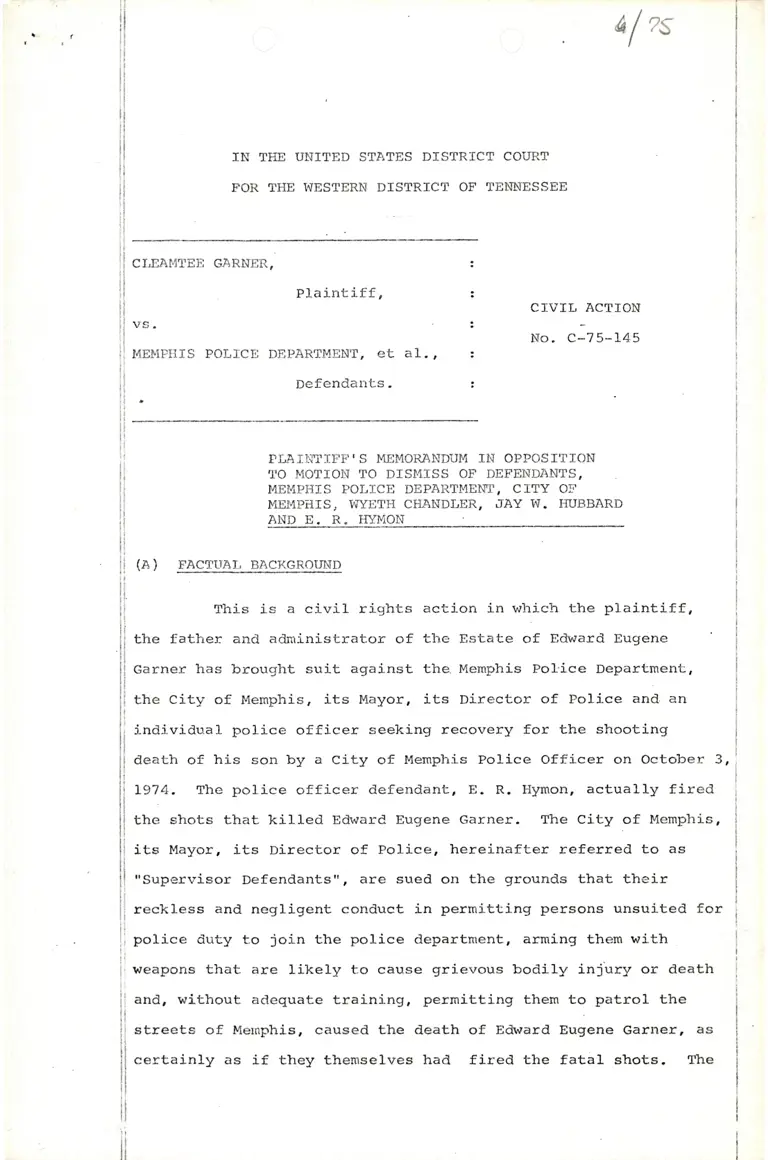
IN THE UNITED STATES DISTRICT COURT
FOR THE WESTERN DISTRICT OF TENNESSEE
CLEAMTEE GARNER,
Plaintiff,
1 vs.
MEMPHIS POLICE DEPARTMENT, et al..
Defendants,
i!I'
CIVIL ACTION
No. C-75-145
PLAIOTIFF'S MEMORANDUM IN OPPOSITION
TO MOTION TO DISMISS OF DEFENDANTS,
MEMPHIS POLICE DEPARTMENT, CITY OF
MEMPHIS, WYETH CHANDLER, JAY W. HUBBARD
AND E. R. HYMON
i (A) FACTUAI, BACKGROUND
This is a civil rights action in v^hich the plaintiff,
the father and adrainistrator of the Estate of Edward Eugene
Garner has brought suit against the. Memphis Police Department,
the City of Memphis, its Mayor, its Director of Police and an
individual police officer seeking recovery for the shooting
death of his son by a City of Memphis Police Officer on October 3,
1974. The police officer defendant, E. R. Hyraon, actually fired
the shots that killed Edward Eugene Garner. The City of Memphis,
its Mayor, its Director of Police, hereinafter referred to as
"Supervisor Defendants", are sued on the grounds that their
reckless and negligent conduct in permitting persons unsuited for
police duty to join the police department, arming them with
weapons that are likely to cause grievous bodily injury or death
and, without adequate training, permitting them to patrol the
streets of Memphis, caused the death of Edward Eugene Garner, as
certainly as if they themselves had fired the fatal shots. The
action was brought pursuant to 42 U.S.C. §§ 1981, 1983, 1985,
1986 and 1988 and the Fourth, Fifth, Sixth, Eighth and Fourteenth
Amendments to the United States Constitution. Jurisdiction was
invoked under 28 U.S.C. § 1343(3) and 28 U.S.C. § 1331. An amount
in controversy exceeding Ten Thousand Dollars ($10,000.00) was
duly alleged. Pendent jurisdiction of this Court was also sought
v;ith respect to claims brought pursuant to the Constitution and
laws of the State of Pennsylvania.
All defendants have moved for a dismissal of the action
against them on essentially the following grounds:
(1) The City of Memphis is not a "person" within the
meaning of the Civil Rights Acts;
(2) The Memphis Police Department is not a "person"
within the meaning of the Civil Rights Acts;
(3) The City of Memphis and the Memphis Police Department
i
cannot be held liable under federal or state law for acts of |i
individual police officers under the theory of respondeat superior;
(4) The Mayor of Memphis and the Director oi: Police
cannot be held liable under federal or state law for acts of
individual police officers under the theory of respondeat superior-
(5) The complaint fails to state a cause of action |
Iagainst defendant. Mayor of Memphis based upon his public support
of police policies with respect to resort to lethal force;
(6) The defendant City of Memphis is not liable under
Tennessee law for torts committed by its police officers under
the doctrine of governmental immunity; and
(7) The supervisor defendants are not liable for any
claims based upon violation of state law under the doctrine of
pendent jurisdiction.
/
- 2 -
(B) STTOIARY OF ARGUMENT
As will be discussed more fully below, plaintiff contends
that the foregoing grounds asserted by defendants do not, as a
matter of law, justify this Court's dismissing them from this
litigation for, the following reasons:
(1) Though the City of Memphis and the Memphis Police
Department are not "persons" within the meaning of 42 U.S.C.
§§ 1933, 1985 and 1986, jurisdiction of this Court is properly
asserted over these defendants based upon:
*■ (a) The general federal question jurisdictional
statute, 28 U.S.C. § 1331, in conjunction with the Fourteenth
Amendment; and also upon
(b) 42 U.S.C. § 1981 and 28 U.S.C. § 1343;
(2) Though it has been heid that the doctrine of
respondeat superior has no applicability in 42 U.S.C. § 1983
actions against municipalities and local governmental entities,
where plaintiff seeks to hold such defendants liable on the basis
of non-1983 statutes, the doctrine should retain its vitality;
(3) Though the doctrine of respondeat superior cannot
be relied upon in federal civil rights suits under 1983 to
establish the liability of supervisory police and city officials,
tort law concepts of negligence can be looked to for purposes of
fixing liability upon such defendants;
(4) A mayor can be held liable for publicly supporting
lethal force policies of the police where such support can be
identified as the proximate cause of wrongful police conduct;
(5) The City of Memphis is liable under state law for
injury caused by one of its police officers up to the limits of
Tenn. Code Ann. § 6-640 and/or the extent of the City's liability
insurance;
- 3 -
(6) Since the defendants are, for reasons set out in
numbers 1 through 5 above, subject to jurisdiction on the Federal
claims and, by defendants' admission, are subject to liability
under state law, the exercise of pendent jurisdiction by this
Court is eminently proper. Moreover, were these defendants not
subject to jurisdiction on the Federal claims, the exercise of
pendent jurisdiction would be appropriate, nevertheless, since
both Federal and State claims grow out of a "common nucleus of
operative fact," joint consideration would avoid hardship to the
plaintiff, the officer defendant and witnesses and the efficient
resolution of the entire controversy would be promoted by having
the matters tried in one proceeding.
(C) ARGUMENT
Before addressing in detail the specifics of defendants'
motion to dxsmiss, plaintiff would lihe to emphasise that a motion
to dismiss under Rule 12(b) of the Federal Rules of Civil Proce
dure does not provide the proper context for resolution by this
Court of disputed questions of fact or the ultimate merits of
allegations made against defendants in the complaint.
Instead, for the purposes of a motion to dismiss, the
material allegations of the complaint must be taken as admitted,
the complaint must be liberally construed in favor of the plain
tiff and the complaint may not be dismissed unless it appears
that plaintiff can prove no set of facts in support of his claim
which would entitle him to relief. Jenkins v. McKeithen, 395
U.S. 411, 422-23 (1969); Conley v. Gibson, 355 U.S. 41, 45-46
(1959).
1, City of Memphis and the Memphis Police Department
Defendants are correct in asserting that the City of Memphis and
the Memphis Police Department are not "persons" within the mean-
- 4 -
I
II
ing of 42 U.S.C. §§ 1983, 1985 and 1986 and, therefore, cannot
be held liable in law or equity for alleged violations of those
provisions. Monroe v. Pape, 365 U.S. 167 (1961); Moor v. County
of Alameda, 411 U.S. 693 (1973); and City of Kenosha v. Bruno,
412 U.S. 507 (1973). However, plaintiff contends that the juris- j
diction of this Court can be exercised over the City of Memphis j
and its Police Department damages awarded against it in this liti-j
gation based upon the Fourteenth Amendment to the Constitution i
Iand 28 U.S.C. § 1331 and upon 42 U.S.C. § 1981 and in conjunction ;
with 28 U.S.C. § 1343. !\1Plaintiff relies upon the decision of the U.S. Supreme !
Court in Bivens v. Six Unknown Named Agents of the Federal Bureau ,
Iiof Narcotics, 403 U.S. 388 (1971) and subsequent Federal Court j
- • !interpretations of its holding to support the proposition that j
the City of Memphis and its Police Department are subject to !
Federal Court jurisdiction and liability under the Fourteenth ;
* . IAmendment and 28 U.S.C. § 1331. There, the Court resolved a i
Question reserv'ed by it fifteen years earlier in Bell v. Hood, 327
, iiU.S. 678 (1946), namely whether recovery could be had against a j
Federal officer in Federal Court for violations of the Fourth !
I
Amendment. In Bivens, supra, it resolved that a Federal cause j
of action was stated for v/hich relief could be granted, finding |
that a claim based directly upon the Fourth Amendment would |
satisfy § 1331 jurisdictional requirements. The contention that |
ia specific Federal statute enforcing the Fourth Amendment had to j1
be found to justify proceedings under § 1331 was rejected. Since j
Bivens, the Supreme Court and lower Federal Courts have functioned
on the assumption that the rationale of that case applied equally
to situations where a litigant suing a municipality sought to
proceed under § 1331 on the grounds that the Fourteenth Amendment 'i
had been violated by the Governmental body, despite the presence of
- 5 -
municipal immunity to liability under §§ 1983, 1985 and 1986. In
City of Kenosha v. Bruno, 412 U.S. 507 (1973), where the Court
extended the Monroe, supra, principle of municipal immunity under j
§ 1983 to even equitable actions. Justice Rehnquist, writing for
the majority, strongly implied that federal jurisdiction against (
the municipal defendant would attach under § 1331 if plaintiffs j
could show that the amount in controversy exceeded Ten Thousand |
Dollars ($10,000.00), since they had alleged a direct violation of
)the Due Process Clause of the Fourteenth Amendment. Kenosha, I
1supra, at 514. Justices Brennan and Marshall, concurring, expressedi
their conviction that the Kenosha plaintiffs would definitely be j
Iiable to proceed under § 1331 if the jurisdictional amount require
ment were satisfied, citing Bivens, supra, and Bell v. Hood,
supra, in support of their conclusion. Kenosha, supra, at 516. |
i
Since the Supreme Court's decision in Kenosha, lower Federal courts
have generally found municipalities liable to suit under § 1331 ;jand the Fourteenth Amendment. Maybanks v. Ingraham, 378 F.Supp. |
I
913, 914-16 (E.D. Pa. 1974); Dahl v. City of Palo Alto, 372 F.Supp
647, 649-51 (N.D. Calif. 1974); Manos v. City of Green Day, 372
F.Supp. 40, 44-45 (E.D. Wis. 1974); Fields v. Romano, 370 F.Supp.
1053, 1055 (E.D. Pa. 1974); and Dupree v. City of Chattanooga,
362 F.Supp. 1136, 1138039 (E.D. Tenn. 1973). The well considered
opinions of Chief Judge Lord in Maybanks, supra, and of the Court
in Dahl, supra, establish, plaintiff would suggest, the strong
justifications for not reading the municipal immunity doctrine
of § 1983 into suits brought pursuant to § 1331 for Fourteenth
Amendment violations. Such a reading of § 1331 is consonant with
a long line of cases prior to Kenosha that rejected any claims of
municipal immunity to liability for violations of constitutional j
rights. North American Cold Storage v. City of Chicago, 211 U.S. |
195 (1908), (allowing a suit for recovery of allegedly improperly
/
- 6 -
■!!
improperly condemend frozen poultry); Foster v. City of Detroit,
405 F.2d 138 (6th Cir. 1968) (due process of law claim); Greater
Fremont, Inc., v. City of Fremont, 302 F.Supp. 652 (N.D. Ohio
1968), (CATV operators claiming City Ordinances denied them due
process and equal protection of the laws). See Cayhoga River
Power Co, V. City of Akron, 240 U.S. 462 (1916).
The complaint contains sufficient allegations to satisfy
the two requirements of § 1331: that the amount in controversy
exceed Ten Thousand Dollars ($10,000.00) exclusive of costs and
interest, and that the case "arise under the Constitution, laws
or treaties of the United States." On the first account, the
complaint alleges that the amount in controversy exceeds Ten
Thousand Dollars ($10,000.00). Since plaintiff here sues in
essence, seeking recovery for the loss of a human life and the
economic impact of such loss upon the decedent's family, it cannot
be established to a legal certainty that the amount in controversy!i
is less than Ten Thousand Dollars ($10,000.00). St. Paul Mercury !}
Indemnity Co. v. Red Cab Co., 303 U.S. 283, 288 (1938). In fact, |
plaintiff's good faith claim for damages in this litigation totals'
I
over a million dollars. On the question of whether this suit
"arises under the Constitution, laws or treaties of the United
States", it has been well established that the use of excessive
force by police officers or other state officials violates
several provisions of the Bill of Rights incorporated into the
Fourteenth Amendment and the Fourteenth Amendment itself. Jenkins
V. Averett, 424 F.2d 1228, 1231-32, (4th Cir. 1970) (violation of
the Fourth Amendment); Screws v. U. S,, 325 U.S. 91 (1941), (Fifth
and Sixth Amendment violation); and Howell v. Cataldi, 464 F.2d
272, 280-82 (3rd Cir. 1972), (Eighth Amendment violation); and
Johnson v. Click, 481 F.2d 1028, 1030-34 (2nd Cir. 1973), (Four
teenth Amendment violation). See also, Basista v. Weir, 340 F.2d
- 7 -
74 (3rd Cir. 1965); Brazier v. Cherry, 293 F.2d 401 (5th Cir.
1961); MacDaniel v. Carroll, 457 F.2d 968 (6th Cir,, 1973); and
Jackson v, Martin, 261 F.Supp 902 (N.D. Miss. 1966), Hence,
plaintiff's reliance upon the Fourteenth Amendment is neither
frivolous nor insubstantial. Bell v. Hood, 327 U.S. 678 (1946).
This Court also has jurisdiction over the City of
Memphis and its Police Department and the right to hold them
responsible in damages if plaintiff prevails based upon 42 U.S.C.
§ 1981 and 28 U.S.C. § 1343. Chief Judge Lord in Maybanks v.
Ingraham, 378 F.Supp. 913, 916-18 (E.D. Pa. 1974), found that the
City of Philadelphia was not immune to suit under § 1981 in a
suit alleging racial discrimination. There he held that the
municipal immunity doctrine of § 1983 was inapplicable to § 1981
since the latter statute was enacted pursuant to the Thirteenth
Amendment and was designed to operate generally to protect blacks
from racial discrimination by v.’hatever -person or entity. To the
extent that other lower courts have disagreed with Judge Lord's
interpretation, such decisions can be distinguished on the ground
that they, like Judge Lord's earlier decisions on § 1981 in U . S.
ex rel. Washington v. Chester County Police Department, 294 F.
Supp. 1157 (E.D. Pa. 1969), and 300 F.Supp. 1279 (E.D. Pa. 1969),
were rendered without the benefit of the Supreme Court's opinion
in District of Columbia v. Carter, 409 U.S. 418 (1973) in which
the Court established that 42 U.S.C. § 1982 barred absolutely all
racial discrimination in the sale or rental of property, "pri
vate as well as public, federal as well as state." .M., at 422.
As the companion provision of § 1982 in the Civil Rights Act of
1866, § 1981 justly deserves to be interpreted equally as broadly
and construed to admit of no exceptions, on the grounds of
municipal immunity .or otherwise, to its operation.
The complaint contains sufficient allegations of racial
- 8
discrimination on the part of the defendants to support a claim
under § 1981. In paragraph 22, plaintiff alleges that Edward
Eugene Garner would not have become the victim of a police bullet
had he been white. The supervisor defendants have, in other
words, created an atmosphere of such reckless disregard for the
sanctity of black life that officers like defendant Hymon feel
little compunction about using lethal force to apprehend a black
youth, convinced that only where whites are concerned should
less drastic means be employed. In no sense can such treatment
satisfy the right of blacks such as the deceased under § 1981 "to
the full and equal benefit of all laws and proceedings for the
security of persons and property as is enjoyed by white persons."
2. Defendants are correct in asserting that the
doctrine of respondeat superior cannot be relied upon to hold
municipalities and local governmental units liable under § 1983
for acts committed by police officers. _ This is so for the simple
reason that municipalities and its creatures are immune under
§ 1983 to suits seeking injunctive or monetary relief. Monroe v.
Pape, supra, and City of Kenosha v. Bruno, supra. The "masters"
are, in essence, unavailable to satisfy liability. Jennings v.
Davis, 476 F.2d 1271, 1274-75 (8th Cir. 1973). Where, as here,
the City of Memphis and the Memphis Police Department are being
sued not under § 1983 but rather under 28 U.S.C. § 1331 and the
Fourteenth Amendment, there should be no categorical bar to the
respondeat superior concepts coming into play. In fact, the
letter and spirit of the Fourteenth Amendment would seem to
require its use. It was passed to provide federal protection to
persons against illegal actions by states and local governmental
entities. Civil Rights Cases, 109 U.S. 3 (1883). States and
local governmental entities can act only through individual
authorized to discharge responsibilities under their laws, ordi-
- 9 -
nances, regulations and customs. Ex Parte Young, 209 U.s. 123
(1908). To the extent that state and local governmental entities
benefit from lawful conduct engaged in by its officer, employees
and agents, equally should they share liability for wrongful
acts of such persons which cause injury to others. The policy
arguments underlying the application of the respondeat superior
doctrine to non-governmental units, see generally Prosser, Law of
Torts (3rd Ed. 1964) at 470-478, are equally strong where govern--
mental units are being sued for violations of the Fourteenth
Amendment. In viev; of the fact that only states enjoy absolute
immunity under the Eleventh Amendment to suit in federal courts
on any grounds absent their consent, Edelman v. Jordan, 415 U.S.
651 (1974), no constitutional bar exists to the doctrine of
respondeat superior being used to establish the liability of muni
cipalities like the City of Memphis and its agency, the Memphis
1/Police Department.
Moreover, reliance upon the doctrine of respondeat
superior does not provide the only reasonable basis for holding
the City of Memphis and the Memphis Police Department liable for
Fourteenth Amendment violations by their officials, employees or
agents. It would seem proper for liability to attach where
negligence on the part of officials of the City or Police Depart
ment,,acting in their official capacities, resulted in injury to
others. Here it is alleged that the City and Police Department
were negligent and reckless in the selecting, training and arming
of the police officer who actually shot the deceased. Certainly
the Fourteenth Amendment means more than that innocent persons
!• jL/ It should be noted that where principles of agency establish
that a non-immune (non-governmental) entity occupies the status
it of master, courts have found no difficulty in applying traditional
' concepts of respondeat superior in § 1983 actions, even in the }
absence of state law. Hill v. Toll, 320 F. Supp.- 185 (E.D. Pa. 197|
1970); Fleming v. South Carolina Electric & Gas Co. 224 F.2d 752,
753 (4th Cir. l'9'5'5)k
- 10 -
will be protected only from intentional conduct of officials and
governmental units, left to suffer in silence injuries caused by
negligence. If it can be established that the City and Police
Department conduct with respect to defendant Hymon was unreason
able in terms of what the forseeable consequences of their negli-
I
Igence would be, liability should attach. For no one questions j
!the duty of those entities to take all reasonable precautions to i
. . . . I
prevent violations of constitutional rights. Slaughter-House J
Cases, 16 Wall. 36, 21 L.Ed. 394 (1873). For such negligence, the ;— i
liability of defendants would result from their own failures, j
i
not from application of any respondeat superior theories. {
13. The Mayor of Memphis and the Director of Police 1
cannot be held liable in § 1983 actions under the doctrine of jirespondeat superior for actions of their subordinates since, :
I
very simply, such persons are not "masters": They are fellow {
!servants of the governmental entities. Where state law recogni?:es iiIthe doctrine of respondeat superior, however, federal courts have
adopted it to accord relief in § 1983 actions. McDaniel v. Carroll,
457 F.2d 968, 969 (6th Cir. 1972). Hence, there are circumstan
ces in which that doctrine and the responsibility of federal
courts to accord relief under § 1983 become entirely compatible.
But respondeat superior principles, once again, do not |
provide the only basis for establishing the liability of the |
Mayor and Director of Police of Memphis. As in the case of the |
City of Memphis and the Memphis Police Department under the j
I
Fourteenth Amendment directly, negligent conduct by the Mayor and |
Director of Police is sufficient to make them liable in damages |
under § 1983. In Whirl v. Kern, 407 F.2d 781 (5th Cir.), cert.
denied, 396 U.S. 901 (1969), this Court held a sheriff liable in '
damages under § 1983 for his having kept the plaintiff there }
incarcerated for almost nine months after charges against him had
- 11 -
been dismissed. Though it found that the sheriff's conduct was
not intentional but rather the result of negligence ("custodial
derelictions") on his part, this Court remarked as follows with
respect to the scope of § 1983 liability:
Such language [referring to the Supreme Court's
opinion in Monroe v, Pape] suggests that a
federal forum is no less desirable for the in
advertent than for the malicious violation of
constitutionally protected rights. Whirl,
supra, at 788.
Several other circuits and federal district courts have adopted
this view of § 1983 liability for negligent conduct. Jenkins
V. Averett, 424 F.2d 1228 (4th Cir. 1970)(negligently shooting
by policeman of unarmed, cornered suspect); McCray v. Maryland,
456,F.2d 1, 4-5 (4th Cir. 1972) negligent failure of a court
clerk to file prisoner's writ of habeas corpus); Puckett v.
Cox, 456 F2d 233 (6th Cir. 1972)(negligence established as proper
basis for § 1983 but v/arden not held negligent for prisoner's
injury by other inmate). In the area of false arrest and im
prisonment, the Supreme Court's decision in Pierson v. Ray, 386
U.S. 547 (1967) establishing that good faith and probable cause
could be raised by police officers to defend against § 1983
damage actions speaks essentially the language of negligence.
That is, where a police officer arrests a citizen in the good
faith, but unreasonable and erroneous, belief, that probable
cause is present, § 1983 liability attaches. To hold otherwise
would result in a police officer's gaining immunity, based upon
his subjective state of mind, for conduct that falls far below
that reasonably expected of him under the circumstances. Section
1983 would be rendered nugatory, thereby, in all but the most
egregious false arrest or imprisonment situations, placing citi
zens at the mercy of incompetent or inadvertent law officers.
Joseph V. Rowlen, 402 F.2d 367 (7th Cir. 1968).
In Whirl, supra, Jenkins, supra and McCray, supra,
- 12 -
liability was based upon negligent conduct by a person directly
involved in the unconstitutional deprivation. Nevertheless,
nothing in the legislative history of § 1983 nor in the law of
negligence dictates that such liability cannot attach to persons
not immediately responsible for acts violative of constitutional
rights. Under traditional tort law concepts, a cause of action
for negligence must contain the following elements:
(1) A legal duty to conform to a standard of
conduct for the protection of others against
unreasonable risks;
(2) A failure to conform to the standard;
(3) A reasonably close causal connection between
the conduct and the resulting injury; and
(4) Actual loss or damage resulting to the
interests of another.
Prosser, law of Torts, p, 146 (3rd Ed., 1964). As the cases
cited above. Whirl, etc., make clear, the Fourteenth Amendment
and § 1983 do impose a duty upon persons acting under color of
state law to avoid conduct, negligent or other wise, which
results in denial of equal protection or due process to others.
Cenrainly, police officials who administer departments under
color of state law are no more absolved from the duty to act
reasonably than are officers on the beat in order to prevent
forseeable or avoidable injury to third persons. Hence, deter
mining whether requirements (1) and (2) are met in a § 1983
action against a police official should pose no insurmountable
problems for a court. Negligent conduct may involve affirmative
acts or failure to act. Prosser, supra, at 182-190. Byrd v.
Brishke, 446 F.2d 6, 10 (7th Cir. 1972). Nor should it be hard
to establish whether a plaintiff has suffered injury congnizable
under § 1983: requirement (4), Difficulties do arise, however,
- 13 -
in attempting to identify the presence of element (3), the element
; of "causation*'. For though it may be determined that a police
official failed to conform to a certain standard of conduct
toward third parties which § 1984 and the Fourteenth Amendment I
• imposed upon him, can it be said that his negligence caused injury ;
'to another, even where he was not present during, did not directly
i
ii participate in, nor direct, the unconstitutional conduct, i.e., !J ' :1 ;
I the immediate cause of injury was conduct of a subordinate? The
{issue of "proximate cause" or "legal cause" in the law of torts j
; is not one free of complexity. But we think that the following ;
; i{analysis provides the proper standard for § 1983 purposes: |
j
'Proximate cause' - in itself an unfortunate I
term - is merely the lim.itation which the courts !
have placed upon the actor's responsibility for ■
the consequences of his conduct . . . . As a |
practical matter, legal responsibility must be i
limited to those causes which are so closely
connected with the result and of such signifi
cance that the law is justified in imposing
liability. Some boundary must be set to liabi
lity for the consequences of any act, upon the
basis of some social idea of justice or policy.
This limitation is sometimes, but rarely, one
of the fact of causation. More often it is one
of policy, not connected with questions of
causation at all. Prosser, supra, at 240-41.
(Emphasis added. )
III Moreover, the questions of duty and proximate cause are evolution
ary and dynamic, not static, concepts. As Prosser points out
ijwith respect to the question of duty:
I j
* ]ij . . . [ I] t may be said that the courts have
j; merely 'reacted to the situation in the way in
j. v;hich the great mass of mankind customarily
ii react' and that as our ideas of human relations
change the law as to duties has changed with
them. Various factors undoubtedly have been
I: given conscious or unconscious weight, including
j; convenience of administration, capacity of the
j' parties to bear the loss, a policy of preventingij future injuries, the moral blame attached to the
I, wrongdoer, and many others. Changing social
!' conditions lead constantly to the recognition of
i. new duties. No better general statement can be
made, than that the courts will find a duty
where, in general, reasonable men would recognize
it and agree that it exists. Law of Torts, at
333-34.
- 14 -
j.
Federal circuit and district courts have not been
unmindful of the applicability of such principles to the § 1983
iliability of public officials such as police chiefs and prisonI
authorities. For example, in the recent case of Roberts v.I '
Ŵilliams, 456 F.2d 819 (5th Cir. 1972) affirming, 302 F.Supp. 972
'(N.D. Miss. 1969), this Court upheld the imposition of liability •
upon the superintendent of a county prison farm for injury to a
prisoner caused directly by conduct of a trusty gu-ard. There,
liability was found to exist because the superintendent had beenij
negligent in failing adequately to train and supervise the trusty
guard in his use of firearms and because it was reasonable to
conclude, under the circumstances, that his negligence "caused"
the prisoner to be wounded, despite the fact that the trusty held
.the shotgun which accidently discharged severely injuring the
!i plaintiff. The superintendent was held liable in the amount ofij
I'$85,000. And in Anderson v. Nosscr, 438 F.2d 183 (5th Cir. 1971),
this Court, while there affirmdng a trial court's ruling absolving
the Mississippi Commissioner of Public Safety of liability, im
plicitly recognized that allegations of negligent conduct on that
official's part might have warranted a contrary determination.
I,As this Court wrote in Anderson;
I j
It was stipulated that Commissioner Birdsong
|i was charged by law with the duty of supervision
and control of all Mississippi Highway Safety
Patrolmen. However, there is no evidence that
he participated in, had knowledge of, or was
negligent with regard to the actions of the
highway patrolmen who assisted in the detention
,, and transportation of plaintiffs. ^d. , at 199.
II (Emphasis added. )
ijI Curiously, even Jordan v. Kelly, supra, cited so often for the
J<;j| principle that the doctrine of respondeat superior cannot be used
I to establish a police chief's § 1983 liability in damages fori
I acts of his subordinates, recognized that negligent conduct by a
chief could support such liability. For, in support of that
- 15 -
principle, the Jordan court quoted with approval the following
language from an Arkansas state court decision:
A sheriff is responsible for his deputies, for
they are acting in his private serv'ice in his
name and stead, and are only public officers
through him. A chief of police may select a
police force, but he is not responsible for their
acts, as each policeman is a public servant him
self . . . . There is no liability in such cases,
unless the appointing officer fails to exercise
reasonable care in the selection of the appointee
- a question not presented here. 233 F.Supp.
at 737. (Emphasis added.)
In Carter v. Carlson, 447 F.2d 358 (D.C. Cir. 1971) rev^ d in ̂ a^^t
Isub nom. District of Columbia v. Carter, 409 U.S. 418 (1973), i--------- ------------------------------------------- I
ithe court held that a police precinct captain and the Chief of .
Police of the District of Columbia Police Department could be held't
liable in damages under § 1983 if plaintiff were able to establish
!
at trial that they were negligent in performing their duty to |
supervise or train the subordinate officer who effected an alleged
ly false arrest and that such negligence caused the plaintiff to
be subjected to an unconstitutional deprivation, , at 355. • '
And in Rundle v. Madigan, 355 F.Supp. 1048 (N.D. Calif, j
1972), the trial court held that a § 1983 cause of action, suffi
cient to withstand motions to dismiss and for summary judgment,
was alleged against a sheriff for the shooting of third persons
by his deputies where the following allegations were made:
(1) That he failed to make adequate plans based upon
intelligence available to him that a riot might
occur;
(2) That he failed to utilize any meaningful criteria
or standards in selecting which deputies to send
to the scene of the expected riot;
2/ The Supreme Court ruled in the subsequent review of Carter,
that U.S.C. § 1983 did not apply to the District of Columbia.
- 15 -
(3) That he selected deputies who were untrained
in riot control work and, in a few cases,
still on probationary status;
(4) That he issued riot guns and double-aught
buckshot to his untrained deputies;
(5) That he failed to provide any leadership
or control of his deputies once the guns
were handed out; and
(6) That his actions or failure to act caused
plaintiffs' injuries. / at 1050.
It must be stressed that the court in Rundle found the sheriff
subject to § 1983 liability not on a theory of respondeat superior
but because the complaint sufficiently alleged personal conduct
on his part - negligence - as a result of which constitutional
deprivations resulted. Similarly, in Moon v. Winfield, 368 F.Supp.
843 (N.D. 111. 1973), the trial court denied a motion for summary
judgment filed by the Superintendent of Police of the City of
Chicago in a § 1983 action resulting from plaintiffs' alleged
beating by a Chicago police officer. The court grounded its
decision upon the fact that the complaint and discovery documents
established:
(1) That the superintendent had before him evidence
that the police officer in question had, within
a two-week span prior to the beating of plaintiff,
been the subject of five meritorious separate
misconduct complaints;
(2) That four of the cases concerned physical abuse
or malicious or threatening conduct toward
citizens;
(3) That in two of these cases, the officer was
found to have committed crimes (perjury and
battery) ; •'
- 17 -
(4) That the officer's district commander had
recommended his discharge;
(5) That the superintendent had notice of eight
other misconduct complaint against the
officer in question;
(6) That the previous superintendent had recom
mended that, because of his questionable
pre-employment history, the officer^ should
not be hired as a Chicago policeman; and
(7) That, despite this evidence, the superin
tendent failed to remove the officer from
duty. I_d. , at 845.
In ruling aginst summary judgment, the court stated;
[I]t is possible that a jury might find that
[the Superintendent] unreasonably failed to
fulfil his affirmative duties with respect to
[the offending officer] and that [his] failure
was a proximate cause of the injuries suffered
by the [plaintiffs]. S45.
A second attempt to have the Moon suit terminated prior
to trial was similarly rejected. Moon v, Winfield, 383 F.Supp, 31
(N.D. 111. 1974). And at least two courts have left open the
question of whether municipal and police officials can be held
liable for negligent failure adequately to select, train and
control police officers. Ames v. Vavreck, 356 F.Supp. 931, 939
(D. Minn. 1973) and Arroyo v. Walsh, 317 F.Supp. 869, 870 (D.
Conn. 1970).
As careful readings of Roberts, supra, Carter, supra,
Rundle, supra, and Moon, supra, reveal, the courts in those cases
attached liability to public officials, or admitted that liability
could attach if the allegations were proven, for acts of their
subordinates not through application of strict rules of causality.
Rather, the decisions grew out of a weighing of various considera
tions such as the standard of conduct public officials should be
- 18 -
reasonably expected to foresee will result from their own actions |
ior failure to act, the extent to which attaching liability will
effect adequate protection for citizens from unconstitutional
conduct perpetrated under color of state law and the extent to
which attaching such liability will unreasonably chill or handicap :
public officials in the discharge of their lawful responsibilities
without appreciably enhancing the possibility that persons will
not be subjected in the future to unconstitutionaT deprivations.
;The court in Rundle, supra, described the nature of the process
3/
j! as follows:
This Court’s decision whether plaintiffs'
allegations state a cause of action under
§ 1983 should consider the policy behind
allowing recovery under the civil rights acts.
If the purpose of the acts is to deter indi
viduals acting under color of state law from
abusing the rights of others, then the dis
tinction between gross and simple negligence
is sensible. There is deterrent value in
charging a sheriff, or even a court clerk,
with the responsibility of organizing and
supervising the affairs of his office so as to
insure against even the chance that someone's
constitutional rights will suffer as a result
of his or one of his subordinate's actions.
In every case refusing to dismiss a complaint
where only negligence is alleged, we have a
situation, as we do here, where reasonable
precautions could easily avoid catastrophic
consequences; delegating authority to wield
and discharge a firearm in the presence of
people is a very serious matter demanding a
high degree of care. Failure to exercise such
care would seem to be gross negligence, which is
the same as conscious disregard for the rights
of others. 355 F.Supp., at 1053. (Emphasis in
the original.)
ij The court there did not resolve the question of whether "gross"
j| or "mere" negligence should be actionable under § 1983, nor do we
113/ Clearly, a similar balancing process resulted in the establish'
ing of absolute immunity on the part of judges for § 1983 damages,
Pierson v. Ray, 386 U.S. 547 (1967), and legislators, Tenney v.
Brandhove, 341 U.S. 357 (1951) and comes into play where official
. immunity doctrine is invoked by other state officials not abso-
|j lutely immune under § 1983. See Anderson v. Nosser, 438 F.2d
1! 183, 200-202 (5th Cir. 1971) and Scheuer v. Rhodes, 416 U.S. 232
(1974).
- 19 -
think it wise or necessary to do so in the abstract. Instead,
we would argue for a determination, on a case-by-case basis, of
whether an official's conduct falls so far below reasonable
ij
standards as to warrant his being held liable for acts of his
'subordinates.11
!' 4. It is contended that no cause of action is stated
I \
I’ against the Mayor of Memphis for his public support of Police
:j Department lethal force policies. Yet ample support exists for
;the proposition that such public expressions by the chief execu-
\ i;tive of a municipality can, standing alone, create impermissible
i ! ' ■jj standards for pllice conduct that may result in civil rights
{i violations. Wliere it can be shown that the Mayor's public utter-
j: ances could reasonably have been foreseen as prompting police tol;
!| resort to the use of lethal force under circumstances warranting
jinon-lethal methods, liability in damages may attach to the chief
l| executive. A very recent case in point is Palmer v. Hall, 380
IjF.Supp. 120 (M.D. Ga. 1974). There, the Mayor of Macon, GeorgiaI i
jtwas held liable in the amount of $50,000 for the shooting of a
I youth by a Macon police officer. The court found that the mayor's !
ti public pronouncements urging police officers to "shoot to kill"
'jviolators of the law precipitated, as surely as if the mayor had
ipulled the trigger himself, the shooting of the plaintiff. Palmer,
» ! M supra, is not the first case to recognize the extent to which a
!ti mayor of a city can, by the sheer force of his office informally
!i 'j, redefine existing laws or create new laws that guide city employ-
i|.--------------------------- !
I; ̂ We might point out that courts have demonstrated little reser- j
!vation in holding police chiefs liable in § 1983 injunctive- j
’i declaratory relief actions, even in the absence of any showing of ■
' direct participation or direction. Schnell v. City of Chicago,
‘ 407 F.2d 1084, 1086 (7th Cir. 1969); Wheeler v. Goodman, 298 F.Supp.
935 (W.D. N.C. 1969); Hernandez v. Noel, 323 F.Supp. 779, 783-84
(D. Conn. 1970). Why this should not be equally true where damages^
■ 1 are sought is perplexing since strictly speaking, liability under i
§ 1983 should not depend in the least upon the nature of the !
remedy being sought. City of Kenosha v. Bruno, 412 U.S. 507 (1973).
20
ees in the carrying out of their day-to-day responsibilities.
Lombard v. Louisiana, 373 U.S. 267 (1963). In any event, the
issue of whether Mayor Chandler's statements reached a level of
irresponsibility to justify holding him liable for the death of
Edward Eugene Garner cannot and should not be resolved in the
context of a motion to dismiss.
5. Defendants allege that the City of Memphis is not
liable for torts committed by police officers under the doctrine
of Governmental Immunity. As set out in Section (C) 1. supra,
that doctrine has no relevance to the federal cause of action
against the City brought under § 1331 and the Fourteenth Amend
ment. If it has any place in the context of this litigation, the
doctrine should guide this Court in evaluating the City's liabi- I
lity only under the pendent state claim. In that regard, Tennessee
law does not give municipalities absolute iirimunity for damages, |
i
Rather, such immunity is limited by the provisions of Tenn. Code ;* I
Ann. § 6-540 and/or the extent of the City's liability insurance. !
A municipality waives its governmental immunity from, tort liabi- !I
lity up to the amount of any liability insurance coverage it !
carries. McArthur v, Pennington, 253 F.Supp. 420 (E.D. Tenn. 1953
Nishan v. Godsey, 165 F.Supp, 6 (E.D. Tenn, 1958); and City of
Kingsport v. Lane, 243 S.W. 2d 289 (Tenn. App. 1951). By statu
tory mandate, Tennessee has thus waived municipal immunity up to
$50,000. Tenn. Code Ann. § 6-640. This statute provides, inter
alia, that cities "shall be authorized and required . . . to
indemnify "a police officer for a damage judgment arising out of
the performance of his official duties and while engaged in the
course of his employment" with the city. The statute imposes a
single-injury limit of $50,000, unless the city must purchase
liability through the assigned risk pool, in which event the
single-injury limit is $10,000. Consequently, the City of Memphis|
cannot claim absolute immunity in this lawsuit even under Tennessee
law. - 21 -
6. Pendent Jurisdiction: As plaintiff has demonstra
ted in the foregoing discussion that the defendants are subject
to federal jurisdiction and liability on the federal claims,
and under state law, this suit provides the proper situation for
exercise of this Court's pendent jurisdiction. Both federal and
state claims grow out of "a common nucleus of operative fact" and
will undoubtedly be resolved through evaluation of identical
evidence and testimony. This Court should exercisre its pendent
jurisdiction to spare all concerned parties, w’itnesses and counsel
the hardship and possible conflict that would be caused if two
actions instead of one were required. United Mine Workers v.
Gibbs, 383 U.S. 715 (1966).
Finally, should this Court find that certain defendants
herein are not subject to jurisdiction or liability on the federal
claims, there can be no question as to the Court's jurisdiction
over the officer defendant, K'/mon, on the federal claims. Since
the liability of the supervisor defendants under state lav; will
undoubtedly hinge on the proof and testimony adduced at the
federal trial of the officer defendant, the exercise of pendent
jurisdiction is still appropriate. The retention of jurisdiction |
over pendent parties (i.e. parties not liable under the federal
law) under the Gibbs rationale has been tacitly approved by the
Supreme Court in Moor v. County of Alameda, 411 U.S. 693 (1973)
and acknowledged by the majority of federal circuit courts of
appeals.
22 -
CONCLUSION
For the foregoing reasons, plaintiff respectfully
ij requests that defendants' motion to dismiss herein be denied in
n full.
Respectfully submitted.
JACK GREENBERG
CHARLES STEPHEN RALSTON
DREW S. DAYS, III
10 Columbvis Circle
New York, New York i0019
WALTER LEE BAILEY, JR.
D'ARMY BAILEY .
Suite 901, Tenoke Building
151 Jefferson Avenue
Memphis, Tennessee 38103
Attorneys for Plaintiff
I)
it
-23 -
CERTIFICATE OF SERVICE
This is to certify that on this day of June, 1975,
I served a copy of the foregoing "Plaintiff's Memorandum in i
Opposition to Motion to Dismiss," by United States air mail, |
special delivery, upon counsel for defendants:
Henry L. Klein, Esq.
City of Memphis
Suite 3500 - 100 N. Main Bldg,
Memphis, Tennessee 38103
Attorney for Plaintiffs
- 24 -