Plaintiffs' Memorandum of Law in Opposition to HEW's Motion for Protective Order Opposing the Deposition of Edward Koven
Public Court Documents
December 20, 1977
16 pages
-
Case Files, Hatcher v. Methodist Hospital - Hardbacks. Plaintiffs' Memorandum of Law in Opposition to HEW's Motion for Protective Order Opposing the Deposition of Edward Koven, 1977. cc8284fb-5384-f111-ab0f-7c1e527d528a. LDF Archives, Thurgood Marshall Institute. https://ldfrecollection.org/archives/archives-search/archives-item/0bf402b6-22da-4d9b-b0c0-38c148753636/plaintiffs-memorandum-of-law-in-opposition-to-hews-motion-for-protective-order-opposing-the-deposition-of-edward-koven. Accessed October 10, 2026.
Copied!
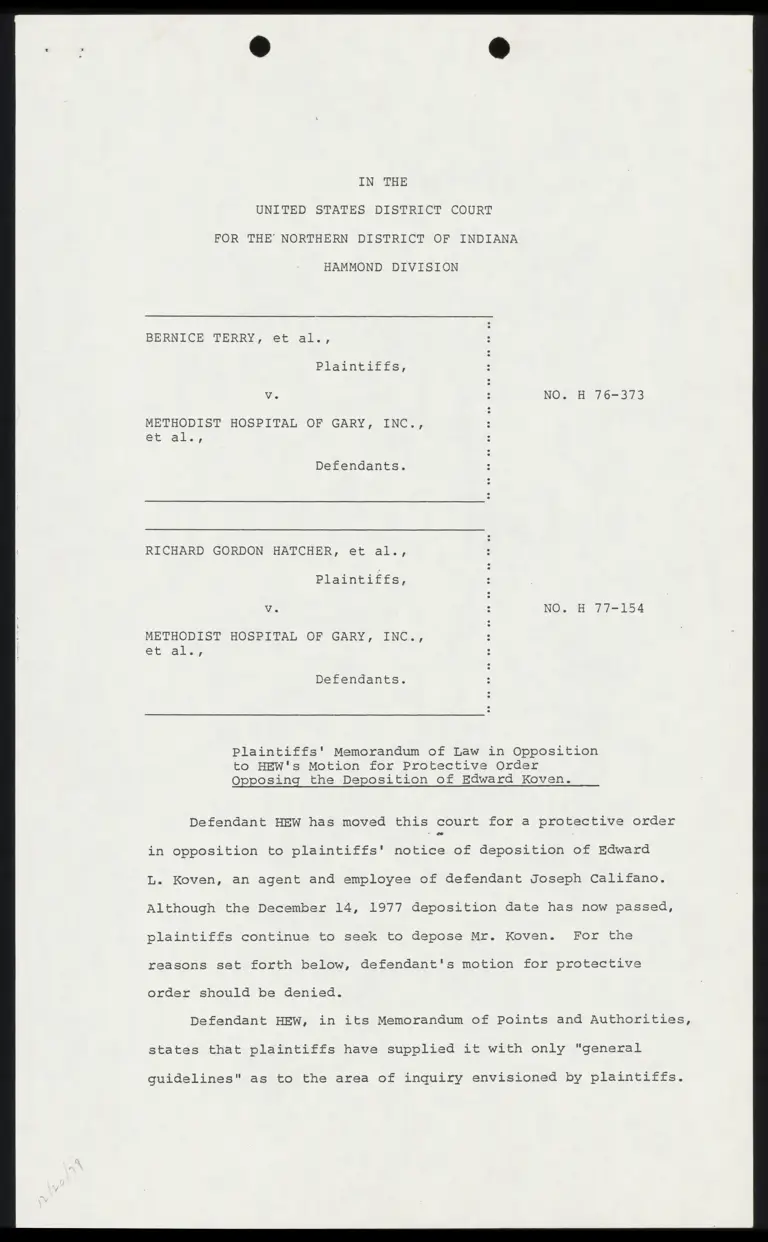
     [||29aad68c-2b93-49b6-9384-5044c9387970||] IN THE

UNITED STATES DISTRICT COURT

FOR THE NORTHERN DISTRICT OF INDIANA

HAMMOND DIVISION


BERNICE TERRY, et al., :

Plaintiffs,

v. : NO. H 76-373

METHODIST HOSPITAL OF GARY, INC.,

et al.

Defendants.


RICHARD GORDON HATCHER, et al.,

Plaintiffs, :

Vv. : NO. H 77-154

METHODIST HOSPITAL OF GARY, INC., 3

et al., 3

Defendants.


Plaintiffs' Memorandum of Law in Opposition
to HEW's Motion for Protective Order
Opposing the Deposition of Edward Koven.


Defendant HEW has moved this court for a protective order

in opposition to plaintiffs' notice of deposition of Edward

L. Koven, an agent and employee of defendant Joseph Califano.

Although the December 14, 1977 deposition date has now passed,

plaintiffs continue to seek to depose Mr. Koven. For the

reasons set forth below, defendant's motion for protective

order should be denied.

Defendant HEW, in its Memorandum of Points and Authorities,

states that plaintiffs have supplied it with only "general

guidelines" as to the area of inquiry envisioned by plaintiffs.


Normally, no more than general guidelines are required under

Federal Rules of Civil Procedure 26 (b) (1), which provides:

Parties may obtain discovery regarding any matter,
not privileged, which is relevant to the subject

‘matter involved in the pending action . . . It
is not ground for objection that the information
sought will be inadmissible at the trial if the
information sought appears reasonably calculated
to lead to the discovery of admissible evidence.

However, since the defendant is here alleging certain privi-

leges, plaintiffs will provide the following additional infor- 5

mation as to the areas they seek to investigate during a

deposition of Mr. Koven.

1/
As Mr. Koven states in his affidavit, he has been employed

as an attorney in the Regional Attorneys Office of the Office of

the General Counsel, Region V, since November, 1968. Since March,

1973, Mr. Koven has rendered legal advice to the Office for Civil

Rights (OCR) concerning the Methodist Hospital of Gary, Inc.

In their complaints against HEW, plaintiffs have alleged,

inter alia, that HEW has violated its duties to enforce Title VI


of the Civil Rights Act of 1964; that it has failed to enforce

civil rights assurances submitted by Methodist Hospital; that it

has failed to enforce civil rights regulations under Title VI and

the Hill-Burton Act; and that HEW fails to consider civil rights

criteria in the context of reviews under § 1122 of the Social

Security Act.

Plaintiffs contend that Mr. Koven played a key role in def-

ining policy guidelines “for civil rights regulations and responsi-

bilities between Methodist Hospital and HEW, from March 1973 to

the filing of these ptiohe His deposition is therefore directly

related to the facts underlying plaintiffs' cause of action against

HEW.


1l/ See Affidavit of Edward Louis Koven, attached to defendant
HEW's Motion for Protective Order.

2/ The original complaint was filed as Wesson Vv. Methodist


Specifically, plaintiffs seek to ascertain: (1) what policy

guidelines, if any, Mr. Koven received from defendant HEW, during

the period March, 1973 through December, 1976; (2) what Mr. Koven

understood those guidelines to mean; (3) how Mr. Koven sought to

effectuate those guidelines in his drafting of the civil rights

assurances, signed by Methodist Hospital on July 27, 1973; (4)

what standards did Mr. Koven apply in reviewing the affirmative

action plan, submitted by Methodist Hospital; (5) what considera-

tion did Mr. woven give to Title VII regulations (45 C.F.R. Part

80, effective July 5, 1973) and § 1122 regulations (42 C.F.R.

Part 100, effective November 13, 1973); (6) what role, if any,

Mr. Koven played in the review of Methodist Hospital's 1974 and

1976 proposals to expand Broadway Methodist Hospital.

Admittedly, certain of these items involve Mr. Koven's

thought processes. However, as plaintiffs set forth below, Mr.

Koven's advisory role between March, 1973 and December, 1976

does not fall within the immunities of either the attorney-

cliant privilege or work-product rule. Mr. Koven's duties should

have been ministerial in nature; that is, he should have been

solely engaged in implementing national policy guidelines as

established by the Secretary of HEW. Such a ministerial role

is not protected by intra-governmental immunity, which attaches

only to policy formulation -- not to implementation of policy.

Plaintiffs have a right to determine to what extent Mr. Koven

engaged in policy formulation not based on established national

guidelines. If Mr. Koven did formulate policy, plaintiffs con-

tend that it was a violation of HEW's obligation to establish

national guidelines and that plaintiffs have a right to discover

such violation. Intra-governmental immunity cannot be invoked


2/ H{cont'd)
Hospital of Gary, Inc., No. H76-373, on December 29, 1976. Plain-


tiffs therefore seek to depose Mr. Koven with reference to his
advisory role to OCR during the period March, 1973 through December,

1976,


to conceal official misconduct.

Finally, since it is Mr. Koven's legal advice itself

which plaintiffs seek to establish as evidence of HEW's viola-

tion, only Mr. Koven can be deposed as to its contents. Mr.

Koven's thought processes are discoverable in these particular

circumstances, and defendant HEW's motion for protective order

must be denied.


A. DEPOSING MR. KOVEN WITHIN THE AREA OF INQUIRY

ENVISIONED BY PLAINTIFFS WOULD NOT VIOLATE THE

ATTORNEY-CLIENT PRIVILEGE.

Defendant HEW in its Memorandum of Points and Authorities

argues that Mr. Koven is bound by the attorney-client

privilege because:

The Professional Ethics Committee,
Federal Bar Association, has recog-
nized that the attorney-client
relationship exists where the
federally employed lawyer, whether
he is a principal legal officer or
a member of the legal staff of a
department, agency, or other legal
entity of the Government performs
his professional responsibility

S/

Plaintiffs do not dispute that such an attorney-client

relationship exists in the present case. The issue is,

however, how broad a privilege can defendant HEW assert

on the facts of the present case. According to Community


Sav. & L. Ass'n v. Federal Home Loan Bank Bd., 68 P.R.D.


378 (E.D. Wis. 1975), defendant HEW's definition of the

attorney-client privilege is too broad in scope, exceeding

the judicially defined extent of the privilege.

In Comm. Sav. & L. Ass'n, the defendant Federal Home


Loan Bank Board approved an application by defendant First

Federal Savings and Loan Association of Wisconsin to

establish a branch office after the Bank Board had denied

the application on three previous occasions, based on

evidences of insufficient need. Plaintiff Community Savings

and Loan filed suit alleging that the Board's approval of

the application was (1) arbitrary and capricious and an

abuse of discretion, (2) failed to consider the anticompetitive


3/ See Defendant HEW's Memorandum of Points and Authorities
in Support of Motion for Protective order, p.3.


effect of the approval, and (3) denied due process for

failing to include specific findings of fact and a reasoned

opinion. The plaintiff then filed a request for the

production of documents, most of which the Board provided.

However, the Board refused to produce, inter alia,


. . documents, or portions thereof,
which consisted of recommendations,
evaluations, analyses, and opinions
prepared by Board staff members and
supervisory agénts; the legal opinion
provided by the office of the general
COUNSAL <4, wiv

68 F.R.D. af 381,

In response to the Board's assertion of attorney-client

privilege, the court stated:

The next question involves the opinion
of the General Counsel. The Board
asserts that the relation of attorney
and client exists between an agency or
department of the United States and its
staff attorneys. Therefore, the Board
argues that the opinion of the General
Counsel is protected from discovery by
the attorney-client privilege. The
Board's definition of this privilege is
too broad in scope. The attorney-client
privilege does not extend to correspondence
from an attorney to a client when that
correspondence contains advice based upon
public information rather than confidential
information provided by the client.
Congoleum Industries, Inc. v. GAF Corporation,
49 P.R. D.82, 85-86 (E.D. Pa. 1969), aff'd,
478 F.2d 1398 (3rd cir. 1973).4/ In this case,
it appears that the information which was sent
to the office of the General Counsel consisted
almost entirely of material which was in the
public record. Therefore, the General Counsel's
opinion is not protected from discovery by the
attorney-client privilege.


68 F.R.D. at 382 (emphasis added).

The holding in Comm. Sav. & L. Ass'n, supra, clearly


governs the present case. Plaintiffs here seek to depose


4/ Congoleum Industries, Inc. v. GAF Corp., involved a


motion for production of documents in a patent suit. The
subject documents consisted of technical information and
advisory opinions compiled by individuals "who do not
personify the corporate client." The Court went on to
observe:


Mr. Koven as to "legal opinion provided by the office of

the general counsel" concerning HEW's review and investigation

of information that was a matter of public record - i.e.


4/ (contd)

While the documents in group (1) constitute
correspondence from an attorney to his
client, plaintiff contends that they do
not contain legal advice based upon material
that came from the client. In other words
plaintiff argues that the advice was given
on the basis of public information that was
available, rather than on confidential
information supplied to the attorney by the
client in seeking legal advice. The basis
for the attorney-client privilege is to
protect communications by the client seeking
legal assistance and it does not extend to
opinions of counsel which are unrelated to
any such communication by the client,
American Cyanamid Co. v. Hercules Powder Co.,
211 P.Supp. 85 (D.C. Del, 1962); United
Shoe Machinery Corporation, supra. An
examination of these documents reveals that
they do indeed refer to basically public
information or, at the most, indicate a
general summary of business information
obtained from individuals who do not personify
the corporate client. These documents :
represent a report of general corporate business
decisions as opposed to legal advice based upon
confidential information and for this reason
are without the asserted privilege.


See also United States v. United Shoe Machinery Corporation,
89 F.Supp. 357, 360 (DD. Mags. 1950):


. «. «. United's general counsel and his clerks
constitute, for purposes of the privilege,
attorneys. However, no doubt a high percentage
of the communications passing to or from them
fall outside the privilege because they report
or comment on information coming from persons
outside the corporation or from public docu-

ments, . .

Also United States v. Anderson, 34 F.R.D. 518, 523
(D. Colo. 1963); Thill Securities Corp. v. New York Stock
exchange, 57 FP.R.D. 133, 139 (E.D. Wis. 1972).


the applications of Methodist Hospital for federal monies

to fund construction projects and the standards governing

the review under Title VI and § wes

Between March, 1973 and the filing of the present

suits, Mr. Koven's duty was to advise the Office of Civil

Rights of its obligations under the law. To cloak such

communications in the veil of attorney-client privilege

would be detrimental to the public interest and would

encompass the risks envisioned by the Seventh Circuit

in Radiant Burners, Inc. v. American Gas Association, 320


P.24 314, 324 (7th Cir. 1963), cert. denied 375 U.S. 929:


Certainly, the privilege would never
be available to allow a corporation
to funnel its papers and documents
into the hands of its lawyers for
custodial purposes and thereby avoid
disclosure.

See also Handgards, Inc. Vv. Johnson & Johnson, 69 F.R.D.


451, 454 (N.D. Cal. 1975):

Fuller disclosure is particularly
appropriate in situations where the
privilege is claimed by in-house
counsel, who "could be converted into
a privileged sanctuary for corporate
records" with relative ease.

An assertion of attorney-client privilege here is subject

to no less a risk of abuse when raised by a government

attorney. Indeed, the assertion of the privilege in this

context poses an even greater threat to the public interest.

As the Seventh Circuit in Radiant Burners, Inc., supra,


went on to state:

In balancing the competing goals
of the free and unobstructed search
for the truth with the right and
absolute necessity for confidential
disclosure of information by the
client to its attorney to gain the
legal advice sought thereby, the courts
will realize that they are not dealing
with a blanket privilege.


5/ Mr. Koven admits he is knowledgeable of civil rights
matters "relating to the Methodist Hospital of Gary, Inc.”
in his Affidavit, para. 3, p.l.


Forge - Sp


B. THE WORK-PRODUCT DOCTRINE DOES NOT PROHIBIT THE

DEPOSING OF MR. KOVEN

While plaintiffs acknowledge that the work-product

doctrine protects counsels' legal strategies and thought

processes from discovery by an adversary, it has been

consistently held that statements, documents and reports

prepared "in the ordinary course of business," and not in

preparation for trial are outside the scope of the doctrine

and are discoverable.

As the court in Thomas Oregan Co. v., Jadranska Slobodna


Piovidba, 54 P.R.D, 367, 371 (N.D., Ill. 1972) held:


« « « « [T]he courts generally have held that
statements or reports made by parties and their
employees in the regular course of business are
not work-product and should be produced for dis-
covery when so requested by the opposing party. . .
As this rule of law has not been changed by the 1970
amendments with the exception of deleting the occa-
sionally imposed good cause requirement, we conclude
that any document which was prepared in the ordinary
course of business and not in anticipation of trial
or litigation is routinely discoverable without
any showing of need under Rule 26(b) (1) and is not
protected by Rule 26(b) (3) notwithstanding that it
contains mental impressions, conclusions, opinions
and legal theories. Accord, Peterson v. United
States, B52 ¥.R.D. 317, 321 (S.D. T1l. 1971).

See also Zucker V. Sabla, 72 F.R.D. i, 3 (8,D. N.Y. 1975):


It is . . . clear that materials assembled during
routine investigations by counsel do not receive
the qualified immunity afforded an attorney's "work
product" by Rule 26(b) (3).

Plaintiffs seek to depose Mr. Koven concerning his

communications with OCR from March, 1973 until the filing of

the present actions. His advisory role and legal opinions

are not protected by the work-product rule since they were

not performed in anticipation of litigation, or, in the

language of Hickman v. Pavior, 329 U.S. 495, 511 (1947),


6/
"with an eye toward litigation." Mr. Koven's activities

were performed in the ordinary course of his duties as an

assistant regional attorney employed by HEW. As the court

in United States v. Swift & Company, 24 F.R.D. 280, 282 noted:


Statements or reports made in the ordinary
course of business and not in preparation for
trial do not embody the lawyer's opinions,
tactics, or conclusions, and accordingly they
do not enjoy the privilege afforded the
attorney's work.

The court also noted that government agencies are subject

to the same rule:

The government enjoys no general right to
withhold information from an opposing litigant.
Secrecy must be predicated upon the specific
claim of some privilege based upon considerations
peculiar to the operations of government or the
government must conform to the rules governing
private parties.

24 P.R.D. 21 284.

While plaintiffs recognize that "prudent parties anticipate

litigation and often begin preparation prior to the time suit

is formally commenced," as this Court indicated in Galambus v.


consolidated Freightways Corp., 64 F.R.D. 468, 472 (N.D. Ind.


1974) :

". . . The test should be whether, in light
of the nature of the document and the factual
situation in the particular case, the document
can be fairly said to have been prepared or
obtained because of the prospect of litigation.
Conversely, even though litigation is already
in prospect, there is no work product immunity
for documents prepared in the regular course of
business rather than for the purposes of liti-
gations vw ,


6/ See e.dg.,Virginia Electric & Pow. Co. v. Sun Shipbuilding
& D.D.  CO., 68 F.R.D. 397, 401 (E.D. Va, 1975):


An attorney's 'work product' consists of the
content . . . of information prepared by the
attorney (or in some circumstances by his
agents) in his capacity as an attorney repre-
senting a client and 'with an eye toward
litigation’ . « vv

See also Annot., "Discovery-Attorney's Work Product,”


35 A.1..R. 3d 412, 429-30 (1571).

wi YO -


. . . The advisory committee note on Rule 26 (b) (c)
stated:

‘Materials assembled in the ordinary course
of business or pursuant to public requirements
unrelated to litigation, or for other non-liti-
gation purposes are not under the qualified
immunity provided by this subdivision. '"

Plaintiffs contend that Mr. Koven's advisory role was clearly

"pursuant to public requirements unrelated to litigation."

Agency reports of the government are discoverable, when

not prepared in anticipation of trial, even though they contain

opinions and conclusions. See United States v. Illinois Fair


Plan Association, 67 P.R.D. 639, 662 (M.D. Ill, 1975). cConse~


quently, Mr. Koven's legal advice and other communications to

OCR do not fall within the immunity of the work-product rule.


C. DEPOSING MR. KOVEN WOULD NOT VIOLATE INTRA-
GOVERNMENTAL IMMUNITY

Defendant HEW in its Memorandum of Points and Authorities

states that "the intra-governmental immunity evidentiary pri-

8/
vilege" is also available to Mr. Koven. However,

(f)or evidentiary purposes . . . Government
information that is exempt under the Freedom of
Information Act is not privileged without an
additional showing that disclosure would be
contrary to the public interest.

Pleasant Hill Bank v. United States, 58 F.R.D. 97,100-1 (w.D. Mo.


1973). Beyond a mere allegation of detriment to the public

interest in the context of the attorney-client berviisaa

HEW has not shown that deposing Mr. Koven would in fact be in-

jurious to the public interest. The converse is actually true.

The public interest lies in knowing whether or not the appro-

priate legal and civil rights standards were applied by Mr.

Koven in advising OCR.

"The privilege which attaches to government documents,

such as advisory opinions and evaluations, is not absolute."


Community Sav. & L, Ass'n., supra, 68 F.R.D. at 38l; see also


Environmental Protection Agency v, Mink, 410 U.S, 73, 86-7 (1973).


Where the privilege asserted is not absolute, a
court must see whether "production of the con-
tested document would be 'injurious to the con-
sultative functions of government that the privilege
of non-disclosure protects.'"

Comm, Sav, & L, Assn,, 68 PF.R.D., at 381. 7t is well established


that the "consultative functions" of government covered by

governmental immunity involve the process of policy formulation:


8/ See Memorandum, footnote 1, P.2. Also, defendant HEW cites
United States v. Nixon, 418 U.S. 683, 705 fn. 15 (1974).  T™e
relevance of footnote 15 is not altogether clear to plaintiffs.


9/ See HEW's Memorandum of Points and Authorities, p.4.


(T)he privilege obtains with respect to intra-
governmental documents reflecting advisory
opinions, recommendations and deliberations

comprising part of a process by which govern-
ment decisions and policy are formulated. 10/


Carl Zeiss stiftung v. V.E.B, Carl Zeiss, Jena, 40 F.R.D. 318,


324 {(D.D.C. 1966), affirmed 384 F.24 979, cert. denied 389 U.S.


952.

Mr. Koven's responsibility to OCR during the period March,

1973 to December, 1976 was "the rendering of legal advice . . .

in civil rights tie es rl Such advisory role carried no

responsibility for policy formulation in the review and investi-

gation of applications and proposals by Methodist Hospital.

It should also be noted that where "the basis of a parti-

cular suit arises from the alleged misconduct or perversion of

power by a government official . . . discovery may well be

proper." Wood v. Breier, 54 ¥#,R.D. 7, 12 (B.D. Wis. 1972).


Defendant HEW was default of its obligations under Title VI

and § 1122. Mr. Koven's thought processes and legal advice to

OCR are strong evidence of HEW's "official misconduct". It

has been observed that: |

The Congressional policy in favor of broad enforce-
ment of the civil rights laws supports complete
discovery when their violation is alleged. Similarly,
when the case involves colorable claims of official
misconduct the Courts are reluctant to permit offi-
cials to withhold relevant material by claiming pri-
vilege.

12/
Kigov Vv. Mitchell, 67 P.R.D. 1, 12 (8.D. N.Y. 1975).


10/ See also Wood v. Breier, 54 F.R.D. 7, 12 (E.D. Wis. 1972);
Smith v. P,02.C., 403 F.5upp. 1000,-1015 (D.D=2l., 1975), which pro-
vides:

The purpose behind the executive privilege against
disclosure of intra-agency advisory communications
is the encouragement of frank discussion within
the government as regards the formulation of policy,


(Emphasis supplied).

ll/ See Koven Affidavit, para. 3, p.l.

12/ A final policy consideration provides that:


It is not appropriate for attorneys who are this
close to the matter and who, by the nature of
the adversary system, have a vested interest in

the outcome to decide whether or not relevant

material should be privileged . . . . (M)aterial

- 13 =


CONCLUSION


For the foregoing reasons, defendant HEW's Motion for

a Protective Order must be denied.

Respectfully submitted,

ill /

Ac —p
, ~, 4


""JACK GREENBERG
BETH J. LIEP

BRENT SIMMONS

10 Columbus Circle

Suite 2030
New York, New York 10019

JULIAN B. ALLEN, JR.
2009 Broadway
Gary, Indiana 46407

Attorneys for Plaintiffs


12/ {Cont'd.)

which might otherwise be eligible for non
disclosure because of executive privilege
must be produced unless the privilege is pro-
perly claimed by the appropriate agency head.

Thill Securities Corp, v. New York Stock Exchange, 57 F.R.D. 133,

138 (E.D. Wis. 1972). See also United States v. Reynolds, 345
U.S. 1, 7-8 (1954); Center on Corporate Responsibility, Inc. v.


Shultz, 368 F.Supp. 863, 872 (D.D.C. 1973). Defendant HEW has
not included an assertion of privilege from Secretary Joseph
Califano in its Memorandum of Points and Authorities.


Certificate of Service

1 hereby certify that a copy of the foregoing

Plaintiffs' Memorandum of Law in Opposition to HEW's


Motion For Protective Order Opposing the Deposition

of Edward Koven


was served by United States mail, postage prepaid, on

the «C74 day of December + 1977, on counsel for


defendants as follows:

Rebecca L. Ross, Esq.

Department of Justice
10th and Pennsylvania Avenue
Washington D.C.

Marvin G. Garvin, Esg. and Edward L. Koven, Esq.
Regional Attorney and General Attorney
Department of Health, Education and Welfare
300 South Wacker Drive, 18th Floor
Chicago, 1llinoils

Fred W. Grady, Esq.
Assistant United States Attorney
Northern District of Indiana

Federal Building, 502 State Street
Hammond, Indiana 46325

Attorneys for Defendant Secretary of Health,
Education and Welfare

Hodges, Davis, Gruenberg, Compton & Sayers
Bruce E. Sayers, Esq.

5525 Broadway
Gary, Indiana 464C1

Attorneys for Defendant Methodist Hospital
of Gary, Inc.

Theodore L. Sendak, Esq.

Assistant Attorney General of Indiana
219 State House

Indianapolis, Indiana

Attorneys for State Defendants


Anthony DeBonis, Jr., Esq.
Joseph E. Costanza, Esq.
Murphy, McAtee, Murphy & Costanza
First National Bank Building
720 W. Chicago Avenue
East Chicago, Indiana 46312

Attorneys for Defendant Kipton Kaplan

#
‘ ) 5 or — 4 i»
Fp Af A Cy { 2

pa 7 1 fe — % :

r ENF > A rE ay
i'd Fd 1-3, 7 2, wen LIN Cro \ HUAI HA


BPent E. Simmons
Counsel for Plaintiffs. [||29aad68c-2b93-49b6-9384-5044c9387970||]