Mitosis v. Honest Sam's Fission & Fusion, LTD. Brief for Respondent
Public Court Documents
January 1, 1964
-
Brief Collection, LDF Court Filings. Mitosis v. Honest Sam's Fission & Fusion, LTD. Brief for Respondent, 1964. e360cf11-be9a-ee11-be36-6045bdeb8873. LDF Archives, Thurgood Marshall Institute. https://ldfrecollection.org/archives/archives-search/archives-item/0ccb3bcc-8fd8-4d11-baaf-f50e2cc6150d/mitosis-v-honest-sams-fission-fusion-ltd-brief-for-respondent. Accessed October 06, 2026.
Copied!
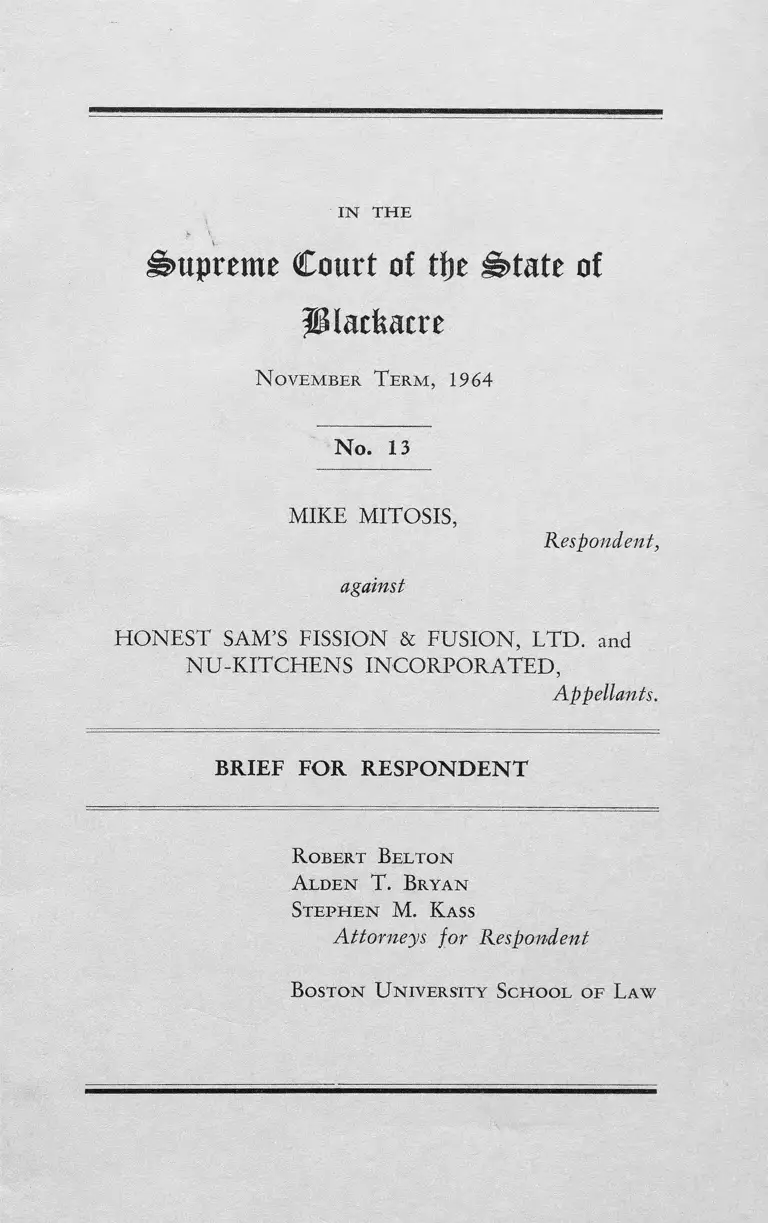
IN THE
Supreme Court of tfje ii>tate of
plackacre
N o v e m ber T e r m , 1964
No. 13
MIKE MITOSIS,
R esponden t,
against
HONEST SAM’S FISSION & FUSION, LTD. and
NU-KITCHENS INCORPORATED,
Appellants.
BRIEF FOR RESPONDENT
R o bert Be l t o n
A l d e n T. B r y a n
St e p h e n M. K ass
A ttorn eys f o r R esponden t
B o sto n U n iv e r sit y Sc h o o l o f L aw
I N D E X
PAGE
Q u e stio n s Pr ese n ted .......................................................... 1
St a t u t e In v o lv e d ................................................................. 2
St a t e m e n t ............................................................................... 3
Su m m a r y of A r g u m e n t ..................................................... 4
A r g u m e n t :
I. The notice requirement of the due process clause of
the Fourteenth Amendment to the United States
Constitution was satisfied in this c ase ...................... 5
II. Personal jurisdiction over the defendants was ob
tained in conformity with the due process require
ments of the Fourteenth Amendment to the United
States Constitution......................................................... 7
A. For a state to assert jurisdiction over a foreign
corporation, due process requires only that the
defendant have certain "minimum contacts”
with the forum state so that the assertion of
jurisdiction would not violate "traditional no
tions of fair play and substantial justice.” . . . 7
B. This court should follow the trend of defining
"minimum contacts” lib era lly ............................. 8
C. The tortious commercial activity of the defen
dants constitutes a sufficient nexus with the
State of Blackacre so that the courts of this State
may constitutionally hold them amenable to
personal jurisdiction................................................ 9
III. The acts of the defendants constitute sufficient con
tacts with this State so as to render them amenable
to the exercise of personal jurisdiction under the
statutory provisions of Section 711 of the Blackacre
Code of Civil Procedure............................................... 12
11
A. Section 711, Blackacre Code of Civil Procedure,
is complied with if the defendants had sufficient
''minimum contacts” with this S ta te ................ 12
B. Defendants, although foreign corporations, are
nonetheless "non-domiciliaries” within the
meaning of Section 7 1 1 ......................................... 13
C. The defendants, by soliciting through advertis
ing and by selling products for consumption in
Blackacre, "transacted business” within the
meaning of Blackacre Code of Civil Procedure,
Section 711 ............................................................... 14
D. The fact that defendants committed a "tor
tious act” in the State of Blackacre, under Sub
section 711 (a) (2 ), affords this court a further
basis on which to sustain the exercise of personal
jurisdiction, even though the conduct giving
rise to the injury may not have occurred in
B lackacre.................................................................... 14
IV. The manufacturer or retailer of a defective product
should be held strictly liable to any person injured
while using the product for its intended purpose,
whether or not there is privity of co n trac t........... 16
A. The present nature of modern commercial en
terprise dictates that negligence, or fault, on the
part of the manufacturer should no longer be
the basis of liability to an injured consumer 16
B. Public policy requires that a manufacturer be
held strictly liable to any person injured by the
normal use of a defectively manufactured prod
uct, whether or not there is privity of contract 17
C. Policy reasons in favor of privity free strict lia
bility to the consumer apply with equal force
against the seller of a defective product........... 20
I l l
D. Because a breach of an implied warranty caus
ing personal injury is an action sounding in tort,
no privity of contract is required ....................... 21
V. Moreover, the plaintiff has alleged sufficient facts
to hold the defendant-retailer liable under the im
plied warranties of the Uniform Commercial Code 22
A. The defendant-retailer impliedly warranted un
der the Uniform Commercial Code, Sections
2-314 and 2-315, that the Nu-Kitchen would
be suitable and fit for the purposes for which it
was designed, manufactured and purchased 22
B. Furthermore, the Uniform Commercial Code,
§2-318, should be extended to include injured
employees of the purchaser.................................. 23
C o n c l u s io n ............................................................................. 25
IV
C it a t io n s
C ases
PAGE
A nderson v . P en n cra ft T ool Co., 200 F. Supp. 154
(N.D. 111. E.D. 1961) .................................................. 15
Atkins v . Jon es & Langhlin Steel C orp., 258 Minn.
571, 104 N.W.2d 888 (1960) .................................. 13
Bank o f Atigtista v . Earle, 38 U .S .519(1839) ........... 7
Beck v . Spindler, 256 Minn. 543, 99 N.W .2d 670
(1959) ............................................................................. 9,13
B ergn er & Engel B rew in g Co. v . D rey fu s, 172 Mass.
154, 51 N.E. 531 (1898) ............................................. 13
B. F. G oodrich Co. v . H ammond, 269 F.2d 501 ( 10th
Cir. 1959) ......................................................................... 21
B rew ster v . F. C. Russell Co., 78 S.D. 129, 99 N.W.2d
42 (1959) ...................................................................... 11
B row n v . Chapman, 304 F.2d 149 (9th Cir. 1962) 21
Chapman v . B rown , 198 F. Supp. 78 (D. Hawaii
1961) 19,23
Compania, De Astral, S.A. v. B oston Metals Co., 205
Md. 237, 107 A.2d 3 57 (1954), ce r t , d en ied 348
U.S. 943 (1955) ............................................................. 13
D etro it Fort ~Wayne U Belle Isle R y. v . O sborn, 189
U.S. 383 (1902) ........................................................... 7
D even y v . R heem Mf g . Co., 319 F.2d 234 (2nd Cir.
1963) 19
D oty v . Love, 295 U.S. 64 (1935) ................................ 6
Ehlers v . U.S. H eating U C oolin g Mf g . C orp., 124
N.W.2d 824 (Minn. 1963) ...................................... 16
Escola v . C oca-C ola B ottlin g Co. o f Fresno, 24 Cal.2d
453, 150 P.2d 436 (1944) ...................................... 17,18,19
Fisher G overnor Co. v . Superior C ourt, 53 Cal.2d
222, 1 Cal. Rptr. 1, 347 P.2d 1 (1959) ................ 14
Fornabio v. Swiss Air Transp. Co., 42 Misc.2d 182,
247 N.Y.S.2d 203 (Sup. Ct. 1964) ......................... 14
V
G oldberg v . K ollsm an In strum en t Corp., 12 N.Y.2d
432, 191 N.E.2d 81, 240 N.Y.'S.2d 592 (1963) . . . 21, 22
G oldblatt v . T ow n o f H em pstead, 369 U.S. 590
̂ (1962) ............................................................................. 6
G ordon A rm stron g Co. v . Superior C ourt, 160 Cal.
App.2d 711, 325 P.2d 21 (Dist. Ct. App. 1958) . . 13
G osling v. N ichols, 59 Cal. App.2d 442, 139 P.2d 86
(Dist. Ct. App. 1943) ................................................ 21
Gray v . A merican Radiator & Standard Sanitary
Corp., 22 Ill.2d 432, 176 N.E.2d 761 (1961) ___
9, 12, 13, 14, 15
G reenb erg v . Lorenz, 9 N.Y.2d 195, 173 N.E.2d 773,
213 N.Y.S.2d 39 (1961) ............................................. 24,25
G reenman v . Yuba P ow er Prods. In c., 59 Cal.2d 57,
27 Cal. Rptr. 697, 377 P.2d 897 (1963) ................ 18,22
Hanson v . Denckla, 3 57 U.S. 235 (1958) .................. 6
H ech t v . M onoghan, 307 N.Y. 461, 121 N.E.2d 421
(1954) ............................................................................. 6
H enningsen v . B loom field M otors, In c., 32 N.J. 3 58,
161 A.2d 69 (1960) ........................................... 17, 18, 19
H enry R. Jahn & Son v . Superior C ourt, 49 Cal.2d
855, 323 P.2d 437 (1958) ....................................... 9 ,11,13
Hess v . Pawalski, 247 U.S. 3 52 (1927) ......................... 11
In R e Miller, 172 F. Supp. 208 (D. Kan. 1959) ......... 10
In terna tiona l Shoe Co. v . W ashington, 326 U.S. 310
(1945) ............................................................... 6, 7, 8, 11, 14
Ja co b E. D eck er & Sons v . Capps, 139 Tex. 609, 164
S.W.2d 828 (1942) ...................................................... 18, 19
K in g v. D ouglas A ircra ft, In c., 159 So.2d 108 (Fla.
App. 1963) ...................................................................... 19
Latimer v . S/A Industries R eundias F. Matarazzo,
175 F.2d 184 (2ndCir. 1949) , cer t , d en ied 338 U.S.
867 (1949) ...................................................................... 12
M acPherson v . Buick M otor Co., 217 N.Y. 382, 111
N.E. 1050 (1916) ......................................................... 16, 17
M cGee v . In ternationa l Lif e Ins. Co., 355 U.S 220
(1957) ............................................................................. 6 ,8 ,9
VI
M ullane v . C entra l H anover Bank & T rust Co., 339
U.S. 306 (1950) ........................................................... 6
P enn oyer v . N eff, 95 U.S. 714 (1878) ......................... 6 ,7
Verkins v . B en gu et Consol. W ining Co., 342 U.S. 437
(1952) ............................................................................. 9
R ubino v . Utah C anning Co., 123 Cal. App.2d 18,
266 P.2d 163 (Dist. Ct. App. 1954) ....................... 21
S choln ick v . N ational Airlines, In c., 219 F.2d 115
(6th Cir. 1955) ............................................................. 9
Shepard v . R heem Mf g . Co., 249 N.C. 454, 106 S.E.2d
704 (1959) ....................................................................... 9
S inger v . Walker, 21 App. Div.2d 28 5, 250 N.Y.S.2d
216 (1964) ...................................................................... 9,15
S m yth v . T w in State Im p rov em en t Corp., 116 Yt.
569, 80 A.2d 664 (1951) ........................................... 9 , 14
State v . A merican-H awaiian S.S. Co., 29 N.J. Super.
116, 101 A .2d 598 (1953) ........................................... 6
S teele v . D eLeeuw, 40 Misc.2d 807, 244 N.Y.S.2d 97
(Sup. Ct. 1963) ............................................................. 14
T atlow v . Bacon, 107 Kan. 26, 165 Pac. 835 (1917) 6
Thomas v . Leary, 15 App. Div.2d 438, 225 N.Y.S.2d
137 (1962) ...................................................................... 24
T raveler ’s H ealth Ass’n. v . Virginia, 339 U.S 643
(1950) ..........................................................................................8
Vandermark v . Ford M otor Co., 61 Cal.2d 245, 37
Cal. Rptr. 896, 391 P.2d 168 (1964) .................... 20,22
W estern Life Indem . Co. v . Rupp, 23 5 U.S. 261
(1914) ........................................................................... 6
W. H. Elliott & Sons v . N uodex Prods. Co., 243 F.2d
116 (1st Cir. 1957), cer t , d en ied 3 55 U.S. 823
0957) ............................................................................. 9,11
W in terb o ttom v. W right, 10 M. & W. 108, 152 Eng.
Rep. 412 (1842) ........................................................... 23
St a tu te s
42 U.S.C.A §§ 2012-2296 (Supp. 1963) .................. 19
111. Rev. Stat. ch. 110 § 17 (1956) 6,8
Me. Rev. Stat. Ann. c. 112, § 21 (1959) ................... ’ 8
Minn. Stat. § 303.13 (3) (1961) .................................. 9
N.H. Stat. Ann. § 300:11 (1949) ................................ 9
N.Y. Civ. Prac. Law § 302 ............................................. 9, 13
N.C. Gen. Stat. § 55-145 (1949) .................................. 9
Vt. Stat. Ann. tit. 12, § 855 (1947) ............................. 9
Uniform Commercial Code
Section 2 -3 1 4 .................................................................. 23
Section 2-315 .................................................................. 23
Section 2-318 .................................................................. 24
T reatises a n d Periodicals
Ames, H istory o f Assumpsit, 2 Harv. L. Rev. 1
(1888) ............................................................................. 21
Annot. 78 A.L.R.2d 397 (1961) .................................. 10
Briggs, C on tem pora ry P rob lem s in C on flic t o f Laics.
Ju r isd iction b y S tatute, Part I, 24 Ohio St. L. J.
223, Part II, 24 Mont. L. Rev. 85 (1963) ............. 9
Cavers, Im p rov in g Financial P ro te c t ion o f th e Public
A gainst th e Hazards o f N uclear P ow er, 77 Harv.
L. Rev. 644 (1964) .................................................... 11,20
75 Harv. L. R ev. 1431, 1432 (1962) ........................... 12
Kurland, T he Suprem e C ourt, The Due P rocess Clause
and In Personam Ju risd iction in State C ourts From
P enn oyer to D enckla: A R eview , 25 U. Chi. L.
Rev. 569 (1958) ......................................................... 9
Note, D evelopm en t in Law — S ta te-C ourt Ju r isd ic
tion , 73 Harv. L. Rev. 909, 919-923 (1960) . . . . 7 , 8
Prosser, The Assault Upon th e C itadel (S tr ic t Liabil
i t y to th e C on sum er), 69 Yale L. J. 1099, 1124
(I960) ............................................................................. !8
Prosser, Torts 493 (2nded. 1955) .................................. 21
Prosser, Torts 4 (3rd ed. 1964) ...................................... 1 j
Restatement, Conflict of Laws (1934)
Section 318 ...................................................................... 15
Section 377 ...................................................................... 15
Section 379 ...................................................................... 12
Stason, Estep & Pierce, Atoms and tJoe Law (1959) 11, 20
1 Williston, Sales, § 195 (rev. ed. 1948) .................... 21
vii
IN THE
Supreme Court of tfje #>tate of
placfeacre
N o v e m ber T e r m , 1964
No. 13
MIKE MITOSIS,
R esponden t,
against
HONEST SAM’S FISSION & FUSION, LTD, and
NU-KITCHENS INCORPORATED,
Appellants.
BRIEF FOR RESPONDENT
QUESTIONS PRESENTED
1. Whether the defendants can challenge the jurisdiction of
the court on the ground that the notice requirement of the
due process clause of the Fourteenth Amendment to the
United States Constitution was not complied with?
2 . Whether the defendants, who are non-domiciliaries of
the State of Blackacre, had sufficient "minimum contacts”
with this State so as to be amenable to the personal juris
diction of the court?
2
3. Whether the defendants "transacted business” or "com
mitted a tortious act” within the meaning of Section 711
of the Blackacre Code of Civil Procedure?
4. Whether the State of Blackacre has chosen to assert per
sonal jurisdiction over non-domiciliaries to the constitu
tional limits sanctioned under the "minimum contacts”
test?
5. Whether the manufacturer and the retailer should be held
strictly liable in tort when a defective product put into
circulation in the market subsequently results in personal
injury to a foreseeable user of the product even though
there is no privity of contract?
6. Whether an action for breach of an implied warranty is
a cause of action sounding essentially in tort?
STATUTE INVOLVED
Section 711 of the Blackacre Code of Civil Procedure (R.
12) provides:
(a) Acts which are the basis of jurisdiction. A court may
exercise personal jurisdiction over any non-domicili-
ary, or his executor or administrator, as to a cause of
action arising from any of the acts enumerated in
this section, in the same manner as if he were a domi
ciliary of the state, if, in person or through an agent,
he:
1. Transacts any business within the state; or
2. Commits a tortious act within the state, except as
to a cause of action for defamation of character
arising from the act; or
3. Owns, uses or possesses any real property situated
within the state.
(b) Effect of appearance. Where personal jurisdiction is
based solely upon this section, an appearance does not
confer such jurisdiction with respect to causes of ac
tion not arising from an act enumerated in this sec
tion. (Effective date January 1, 1959.)
3
STATEMENT
On May 14, 1964, plaintiff initiated this action for per
sonal injuries against defendants alleging a breach of an
implied warranty. Defendants entered a motion to dismiss
on the grounds of: ( 1) lack of personal jurisdiction and (2 )
failure to state a cause of action in that there was no privity
of warranty (R. 4 ). This appeal comes to the Supreme
Court of the State of Blackacre from an order of the Superior
Court, County of Bullduram, denying defendants’ motion
to dismiss (R. 12) . For purposes of this appeal, the relevant
facts are not contested by the parties to the action. The facts
as alleged are based upon the plaintiff’s complaint and the
parties’ subsequent affidavits as stated in the Transcript of
Record.
The plaintiff, Mike Mitosis, a resident of the County of
Bullduram, State of Blackacre, was employed as a short order
cook at the Atomic Table, a restaurant located in the County
of Bullduram (R. 1, 2 ) . While using an atomic kitchen unit
in accordance with the Manual of Operation published by
defendant-manufacturer, Nu-Kitchens, Inc., a corporation
existing under the laws of the State of Bliss (R. 1 ), he suf
fered radioactive sickness as a result of an inadequate radio
active protection shield, and was rendered sick, sore, lame and
permanently disabled from continuing his employment (R.
3 ) 'The kitchen unit, known as a "Nu-Kitchen,” is a complete
kitchen installation, having as its power source a central
nuclear power plant (R. 2 ) . The Nu-Kitchen was sold
f.o.b. plant, to defendant-retailer Honest Sam’s Fission and
Fusion, Ltd., a corporation existing under the laws of the
State of Bonanza (R. 1) . Its office and principal place of
business is in Squaresville, the largest city in the State of
Bonanza and known to be a prime shopping area for the
residents of Blackacre (R. 8).
The plaintiff’s employer purchased the Nu-Kitchen from
the retailer in Squaresville. The unit was transported to the
plaintiff’s place of employment by an independent trucking
company and there installed by an independent contractor,
both hired by the purchaser (R. 6).
Approximately 20% of the total retail business volume in
4
Squaresville is attributable to residents of Blackacre (R. 9 ).
Furthermore, according to the manufacturer’s annual report,
approximately 10% of the manufacturer’s total production
is sold to purchasers in the State of Bonanza, the majority of
which are purchases for resale (R. 9 ). The retailer partici
pated in a cooperative advertising plan offered by the manu
facturer, whereby the manufacturer paid to the retailer a
twenty-five dollar allowance for each and every Nu-Kitchen
sold by that store, on the condition that such allowance
would be applied to local newspaper advertising of the Nu-
Kitchen (R. 9, 10).
The retailer placed a full page advertisement in virtually
every issue of the Squaresville W eek ly S entinel and Guardian
for the past three years, of which twenty-five such advertise
ments prominently featured the respective year’s model of
the Nu-Kitchen. The Squaresville W eek ly S en tin el and
Guardian has a paid circulation of 126,394 as of December
13, 1963. Of these, 42,139 are known to be subscribers lo
cated in the State of Blackacre (R. 10).
SUMMARY OF ARGUMENT
In our modern society, commercial transactions frequently
cross state borders. In addition, our era has been confronted
with the reality of the production of nuclear powered ma
chines which have the potential for causing great harm.
These factors make it imperative that a state be capable of
asserting jurisdiction over non-domiciliary corporations chan
nelling such dangerous products into the stream of interstate
commerce. The Supreme Court has sanctioned the assertion
of personal jurisdiction over non-domiciliary corporations
where such corporations had certain "minimum contacts”
with the forum state. The defendants, who actively solicited
business from the citizens of Blackacre and who caused an
inherently dangerous product to be shipped there, should be
deemed to have sufficient "minimum contacts” with Black
acre so as to be amenable to personal jurisdiction.
Furthermore, the defendants "transacted business” and
committed a "tortious act” in the State of Blackacre within
the meaning of the Blackacre Code of Civil Procedure. In
5
implementing the desirable objective of obtaining personal
jurisdiction over foreign corporations, the State of Blackacre
has asserted personal jurisdiction to the furthermost limits
allowable under the due process clause. Since the defendants’
tortious commercial activities, resulting in a personal injury
within the State of Blackacre, satisfied the "minimum con
tacts” test required by the due process clause, the statutory
requirements have been complied with.
Although the due process clause of the Fourteenth Amend
ment to the United States Constitution requires proper no
tice, the jurisdiction of the court is not subject to challenge
on this ground. The Blackacre Code of Civil Procedure
either expressly or impliedly requires notice. Even if the stat
ute does not require notice, the defendants, having actually
received notice, cannot attack the procedure below on this
ground for the first time on appeal.
A manufacturer or a retailer of a defective product should
be strictly liable in tort to any person injured as a result of
using that product for its intended purpose, even though
there is no privity of contract. Individuals injured by de
fective products are the persons least able to bear the risk of
injury. Furthermore, the doctrines of negligence and breach
of an implied warranty, when limited by a privity require
ment, are not adequate vehicles for redressing the harm done.
The manufacturer and the retailer, who are responsible for
putting defective goods into the stream of commerce, can
adequately insure against the inevitable losses and spread the
risk among the public as a cost of doing business. Therefore,
any foreseeable user who is injured by a defective product
should be able to hold the manufacturer and retailer strictly
accountable to him in a cause of action sounding in tort.
ARGUMENT
I.
The notice requirem ent of the due process clause
of the Fourteenth Amendment to the United States
Constitution was satisfied in this case.
Personal jurisdiction must be obtained over a non-resident
6
defendant prior to the rendering of a binding in personam
judgment. Traditionally, this has required two elements:
( 1) jurisdiction over the non-resident, Hanson v . Denckla,
3 57 U.S. 235 (1958); M cG ee v . In terna tiona l Lif e Ins. Co.,
3 55 U.S. 220 (1957); In ternationa l Shoe Co. v . W ashington,
326 U.S. 310 (1945); P en n o y e rv . N eff, 95 U.S. 714 (1878);
and (2 ) effectively bringing such defendant before the court
by proper notice, M ullane v . C entral H anover Bank Sf T rust
Co., 339 U.S. 306 (1950).
The notice requirement should be deemed to have been
satisfied in this case on any one of three theories. Firstly, it
is submitted that Section 711 of the Blackacre Code of Civil
Procedure provides for notice. The lower court stated that
the Blackacre Statute is similar to the Illinois Statute. 111.
Rev. Stat. ch. 110 §17 (1956) (R. 13). The Illinois Statute
provides for personal service on a defendant outside the state.
Although the record does not reveal that the Blackacre Code
contains such a section, it is nevertheless logical to assume that
Blackacre does have a notice provision since the lower court
deemed the statutes of 'both states to be similar. In addition,
even if the Blackacre Code does not expressly require notice,
it is submitted that a notice procedure should be implied. State
legislatures are presumed to act constitutionally. G oldblatt
v . T ow n o f H em pstead, 569 U.S. 590, 596 (1962). A stat
ute is not invalid merely because it does not expressly provide
for notice. Such notice may be implied by the court unless
the statute expressly dispenses with the necessity of notice.
T atlow v . Bacon, 107 Kan. 26, 165 Pac. 83 5 (1917) ; State
v . A merican-H awaiian S.S. Co., 29 N.J. Super. 116, 101
A.2d 598 (1953); H ech t v . M onoghan, 307 N.Y. 461, 121
N.E.2d 421 (1954).
Secondly, even assuming a rgeundo that the Blackacre Code
does not have a notice provision, the fact that the defendants
did appear, albeit to contest jurisdiction, indicates that actual
notice was received. Consequently, the defendants had
ample opportunity in the initial stages of the litigation to
defend their rights, and therefore, the lack of any statutory
provision relating to notice did not prejudice the defendants.
D oty v . Love, 295 U.S. 64, 74 (193 5 ); W estern Li f e Indem .
Co. v . Rupp, 23 5 U.S. 261 (1914).
7
Finally, although lack of jurisdiction may be raised at any
stage of the litigation, lack of notice, not raised below, can
not be raised for the first time on appeal. D etro it Fort
W ayne & Belle Isle R y. v . O sborn, 189 U.S. 383, 390-391
(1902). Therefore, the only jurisdictional issue before this
court is whether the defendants’ acts were sufficient to come
within the tenor of Section 711 of the Blackacre Code, and
if so, whether due process was satisfied.
II.
Personal jurisd iction over the defendants w a s ob
tained in conform ity w ith the due process requ ire
ments of the Fourteenth Amendment to the United
States Constitution.
A. For a state to assert jurisd iction over a foreign
corporation, due process requires only th a t the defen
dant have certain "m inim um contacts” w ith the forum
state so th a t the assertion of jurisd iction would not
v io late " trad ition al notions of fa ir p lay and substan
t ia l ju stice .”
Historically, the jurisdiction of courts to enter judgments
in personam against a non-resident was grounded on d e fa c t o
power over the defendant. P enn oyer v. N eff, supra. Ini
tially, jurisdiction could not be obtained over foreign cor
porations. Bank o f A ugusta v . Earle, 38 U.S. 519 (1839).
As corporate business increased, new concepts, viz. "consent,”
'doing business” and "presence” under which a state court
could assert personal jurisdiction over foreign corporations,
were developed. Note, D evelopm en t in Law—S ta te-C ourt
Ju r isd iction , 73 Harv. L. Rev. 909, 919-923 (1960).
In terna tiona l Shoe Co. v . 'Washington, supra, has estab
lished a more modern concept of jurisdiction over foreign
corporations. According to In terna tiona l Shoe, the exercise
of jurisdiction by a court is constitutional if the corporation
has certain "minimum contacts” with the forum state. Id.
at 316. The quality and nature of the "contacts” are deci
sive, and must be such that the maintenance of the suit within
the forum does not offend "traditional notions of fair play
and substantial justice.” Id. at 317. The Supreme Court in
8
applying the "minimum contacts” test to the facts of In te r
national Shoe Co., supra, held that a foreign corporate shoe
manufacturer, whose only contact with the state was the
continuous operation of salesmen in the state, was subject to
the jurisdiction of the Washington Court under a Workman’s
Compensation Statute. See Note, D evelopm en ts, 73 Harv.
L. Rev. at 923-932.
The "minimum contacts” test was further clarified in
T raveler ’s H ealth Ass’n. v . Virginia, 339 U.S. 643 (1950),
where it was held that a foreign corporation doing a mail
order insurance business within the state might be sued there.
The defendant corporation only had claim investigators op
erating within the state. Its place of incorporation and only
office was in Nebraska, and in the course of its business, the
corporation had mailed applications for insurance to persons
in Virginia. The Supreme Court held that Virginia had
jurisdiction to entertain an action since the corporation had
furnished the "minimum contacts” necessary to satisfy the
requirements of due process.
The limits of due process were further extended to encom
pass a single transaction of business within the state. In
M cGee v . In ternationa l Li f e Ins. Co., supra, the defendant
corporation issued a re-insurance policy on the life of the
insured, a resident of California. The defendant’s only con
tact with the state of California was the mailing of the re
insurance certificate to the insured in California and the re
ceipt of annual premiums. In upholding the exercise of per
sonal jurisdiction, the Supreme Court held that California
had a manifest interest in providing an effective means of
redress for its residents when insurers refused to pay.
B. This court should follow the trend of defining
"m inim um contacts” lib era lly .
Subsequent to In terna tiona l Shoe, many states enacted
comprehensive statutes in an effort to expand the basis of
personal jurisdiction over foreign corporations and at the
same time give effect to In ternationa l Shoe, supra, and M c
Gee, supra. Many of these statutes are similar or analogous
to Section 711 of the Blackacre Code of Civil Procedure.
111. Stat. ch. 110, § 17 (1956); Me. Rev. Stat. Ann. c. 112,
9
§21 (1959); Minn. Stat. §303.13 (3) (1961); N.Y. Civ.
Prac. Law §302; N.C. Gen. Stat. §5 5-145 (1949). SeeN.H.
Stat. Ann. §300:11 (1949); Vt. Stat. Ann. tit. 12, §855
(1947).
The assertion of jurisdiction over foreign corporations un
der Section 711 of the Blackacre Code of Civil Procedure is
a question of first impression in this State (R. 12) . In con
struing this statute, this Court should be guided by the trend
towards greater liberality adopted by the United States Su
preme court and other state courts to obtain jurisdiction
over foreign corporations. M cG ee v . In terna tiona l Li f e Ins.
Co., supra; Perkins v . B en gu et Consol. M in ing Co., 342 U.S.
437 (1952); Sch o ln ick v . N ational Airlines, In c., 219 F.2d
115 (6th Cir. 195 5 ); W. H. E lliott & Sons Co. v . N uodex
Prods. Co., 243 F.2d 116 ( 1st Cir. 1957); ce r t , d en ied 355
U.S. 823 (1957); H enry R. Jahn & Son v . Superior C ourt,
49 Cal.2d 855, 323 P.2d 437 (1958); Gray v . A merican Ra
d ia tor & Standard Sanitary Corp., 22 Ill.2d 432, 176 N.E.2d
761 (1961) ; Beck v . Spindler, 256 Minn. 543, 99 N.W.2d
670 (1959); S inger v . Walker, 21 App. Div.2d 285, 250
N.Y.S.2d 216 (1964); Shepard v . R heem s Mf g . Co., 249
N.C. 454, 106 S.E.2d 704 (1959); Sm yth v . T w in S tate Im
p ro v em en t Corp., 116 Vt. 569, 80 A.2d 664 (1951); Briggs,
C on tem pora ry P rob lem s in C on flic t o f Laws. Ju r isd iction
b y S tatute, Part I, 24 Ohio St. L. J. 223 (1963); Briggs, C on
tem pora ry P rob lem s, Part II, 24 Mont. L. Rev. 85 (1963);
Kurland, T he Suprem e C ourt, The Due P rocess Clause and
In Personam Ju risd iction in State Cotirts From P enn oyer to
D enckla: A R ev iew , 25 U. Chi L. Rev. 569 (1958).
The case of In terna tiona l Shoe clearly left the precise na
ture of the "contacts” required under due process indefinite.
The constitutionality of the exercise of jurisdiction in each
case depends primarily upon an individual analysis of its
own facts. Id. at 319. It is submitted, as will now be demon
strated, that this court can, consistent with due process re
quirements, sustain jurisdiction over the defendants.
C. The tortious commercial activity of the defen
dants constitutes a sufficient nexus with the State of
Blackacre so that the courts of this State may consti
tutionally hold them amenable to personal jurisdiction.
10
The evolution of the "minimum contacts” test has been a
judicial attempt to implement three basic policies. These
policy considerations justify the assertion of personal juris
diction in the instant case.
First of all, our country, although comprised of a multi
tude of semi-sovereign bodies, is nevertheless, a unified eco
nomic community. In this highly integrated climate, normal
intercourse must prevail among the several States. For pur
poses of commercial discourse, therefore, the states must be
accorded certain advantages, of which personal jurisdiction
over foreign corporations is an essential. Annot. 78 A.L.R,2d
397 (1961).
The facts of the instant case graphically reveal how com
merce may easily cross state borders, and how the realities of
modern commercial life dictate the necessity of jurisdiction
over non-domiciliaries. In the case at bar, the defendant-
retailer is engaged in the sale of nuclear powered appliances
in Squaresville, State of Bonanza (R. 1) . It is a well known
fact, of which this court may take judicial notice, that the
metropolis of Squaresville is a prime shopping area for a vast
number of neighboring Blackacre residents (R. 8) , thereby
constituting one metropolitan commercial center of the re
spective municipalities of the two states. In R e M iller, 172
F. Supp. 208, 209 (D. Kan. 1959) . Since 10% of the manu
facturer’s products is sold to retailers in Bonanza, and 20%
of the retail business volume of Squaresville is attributable to
residents of Blackacre (R. 9 ), it is reasonable to assume that
defendants did an appreciable volume of business with resi
dents of Blackacre.
Pursuant to a cooperative advertising plan offered by
defendant-manufacturer, a twenty-five dollar allowance was
paid to the retailer for each Nu-Kitchen sold, which was to
be used only for the purpose of local newspaper advertising
of the manufacturer’s product. The record indicates that
during the three years this plan was in effect, defendant-
retailer placed advertisements in virtually every issue of the
Squaresville W eek ly S entinel & Guardian (R. 10) , and at
least twenty-five such advertisements prominently featured
the respective year’s model of the Nu-Kitchen. As one third
of the subscribers to the newspaper were residents of Black-
11
acre, it is apparent that both defendants participated in ac
tively soliciting trade from these residents.
It has been recognized, under the In terna tiona l Shoe deci
sion, that sales solicitation alone can constitute the necessary
"minimum contacts” to subject a foreign corporation to the
personal jurisdiction of a state court. H enry R. Jahn 2> Son
v . Superior C ourt, supra at 859, 323 P.2d at 440. Solicita
tion is an integral part of any business activity and often is
the foundation of a sale. Furthermore, completing the sale
is often a mere formality once the order has been solicited.
Every businessman would regard solicitation as an integral
part of his business. B rew ster v . F. C. Russell Co,, 78 S.D.
129, 142, 99 N.W.2d 42, 50 (1959). However, the facts
in the case at bar show more than mere solicitation. The
sale of the Nu-Kitchen to a resident of Blackacre and the
resulting injury to the plaintiff are additional "contacts”
between the defendants and Blackacre.
Courts, on analogous facts, have held the "minimum con
tacts” required by the due process clause to be satisfied in
subjecting a non-resident defendant to personal jurisdiction.
W. H. E lliott & Sons Co. v . N uodex Prod., supra; H enry R.
Jahn & Sons v . Superior C ourt, supra. In the N uodex case,
an action was brought in New Hampshire against a New
Jersey corporation. The defendant at no time delivered goods
or sent agents into New Hampshire, though some of its ad
vertising had reached that state. The court held the defen
dant was amenable to jurisdiction within the scope of the
"minimum contacts” test.
Another general policy involved in the exercise of personal
jurisdiction over foreign defendants is the justified applica
tion of the state’s police power over dangerous instrumentali
ties brought into the state. Hess v . Pawalski, 247 U.S. 3 52
(1927). The Nu-Kitchen involved was powered by a nu
clear reactor, and because of the unusual dangers involved
in radiation hazards, certain products, such as containers for
radioactive materials and reactor fuel elements, have been
considered "inherently dangerous” articles. See Stason, Estep
& Pierce, A toms and th e Law, chs. 4,5 (1959); Cavers, Im
p ro v in g Financial P ro te ct ion o f th e P ub lic Against th e Haz
ards o f N uclear P ow er, 77 Harv. L. Rev. 644 (1964). A
12
finding by this court that defendants are amenable to the
personal jurisdiction of the courts of this State for the
alleged injury to the plaintiff would not offend "traditional
notions of fair play and substantial justice,” since the defen
dants knew or should have known this dangerous instrumen
tality would ultimately jeopardize the citizens of Blackacre,
A third general policy concerns the bringing of suits in
the forum in which they may be most conveniently litigated.
The normal rule of conflict of laws is that the law of the
place of the injury or wrong should apply. Restatement,
Conflict of Laws §379 (1934). That state, therefore, whose
law is being applied should also be allowed to assert jurisdic
tion in order to apply its law. Gray v . A merican Radiator
& Standard Sanitary Corp., supra. In the instant case, the
injury occurred in Blackacre, and the witnesses to the injury
live in Blackacre. Blackacre, therefore, is obviously the most
convenient forum, and "minimum contacts” have been de
scribed as essentially the equivalent of a constitutional rule
of a convenient forum. Latimer v . S/A Industries Reundias
F. Matarazzo, 175 F.2d 184, 18 5-186 (2nd Cir. 1949), cer t,
d en ied 338 U.S. 867 (1949) ; see also 75 Harv. L. Rev. 1431,
1432 (1962).
The nature of the commercial and tortious activities in
volved in this case, coupled with the fact that Blackacre is
the most convenient forum in which this matter can be liti
gated, should lead this court to conclude that defendants had
reasonably sufficient "minimum contacts” with Blackacre so
as to be subject to its personal jurisdiction.
III.
The acts of the defendants constitute sufficient con
tacts w ith this State so as to render them amenable to
the exercise of personal jurisd iction under the s ta tu
to ry provisions of Section 711 of the B lackacre Code
of C iv il Procedure.
A. Section 711, B lackacre Code of C iv il Procedure,
is complied w ith if the defendants had sufficient "m in
imum contacts” w ith this State.
Section 711 of the Blackacre Code of Civil Procedure pro
13
vides that certain conditions must be fulfilled as a prerequisite
for the assertion of personal jurisdiction. The limits of these
requirements, however, are not spelled out in the statute.
Several states courts have adopted the ''minimum contacts”
test as the standard for determining statutory compliance.
See H enry R. Jahn & Son In c. v . Superior C ourt, supra ;
Compania De Astral, S.A. v . B oston Metals Co., 205 Md.
237, 107 A .2d 3 57 (1964), c e r t , d en ied 348 U.S. 943 (1955);
Beck v . Spindler, supra. See also, G ordon A rm stron g Co. v .
Superior C ourt, 160 Cal. App.2d 711, 325 P.2d 21 (Dist.
Ct. App. 1958) where Mr. Justice Ashburn stated in a con
curring opinion, "In the process of evolution . . . California
had committed itself to the proposition that any set of facts
which would sustain service of summons as due process would
also spell doing business within the state.” Id. at 715, 325
P.2d at 27. Thus it would appear that the courts have
striven to obtain maximum jurisdiction to the extent per
mitted by due process. Gray v . A merican Radiator & Stand
ard Sanitary C orp., supra ; Atkins v . Jon es S> Laugblin Steel
Corp., 258 Minn. 571, 104 N.W.2d 888 (1960).
It is submitted, therefore, that the legislature of Blackacre
also intended to extend its scope of personal jurisdiction over
non-resident defendants by enacting a liberally worded stat
ute. Hence, since the defendants had sufficient "minimum
contacts” with Blackacre, the state’s statutory requirements
were fulfilled.
B. Defendants, although foreign corporations, are
nonetheless "non-domiciliaries” within the meaning of
Section 711.
The facts show that defendant-retailer is a corporation
duly organized under the laws of the State of Bonanza (R.
1) , and that defendant-manufacturer is a corporation duly
organized under the laws of the State of Bliss (R. 1) . It is
submitted that both defendants are non-domiciliaries within
the meaning of Section 711, since a corporation is domiciled
only in the state of its incorporation. B ergn er S' Engel B rew
in g Co. v . Drey f us , 172 Mass. 154, 51 N.E. 531 (1898). The
New York statute, N.Y. Civ. Prac. Law §302 (effective Sept.
1963) employing the exact language as the Blackacre Statute,
14
has been utilized to obtain jurisdiction over foreign corpora
tions. Steele v . D eLeeuw, 40 Misc.2d 807, 244 N.Y.S.2d 97
Sup. Ct. (1963). See also Fisher G overnor Co. v . Superior
C ourt, S3 Cal.2d 222, 1 Cal. Rptr. 1, 347 P.2d 1 (1959).
Therefore, defendants, in the instant case, are members of
the class which the statute was enacted to reach.
C. The defendants, by soliciting through advertis
ing and by selling products for consumption in Black-
acre, "transacted business” within the meaning of
Blackacre Code of Civil Procedure, Section 711,
It has been demonstrated above that the facts show suf
ficient "minimum contacts” with the State of Blackacre,
and that the statutory language of Subsection 711 (a) ( 1)
is based upon the "minimum contacts” requirement of
In terna tiona l Shoe, supra. Because the solicitation and sub
sequent sale are sufficient to meet the "minimum contacts”
requirement, it follows that they are sufficient to constitute
"transacting business” within the statutory meaning of Sub
section 711(a) (1 ).
D. The fact that defendants committed a "tortious
act” in the State of Blackacre, under Subsection 711
( a ) (2) , affords this court a further basis on which
to sustain the exercise of personal jurisdiction, even
though the conduct giving rise to the injury may not
have occurred in Blackacre.
Subsection 711(a) (2 ) provides for personal jurisdiction
over non-domiciliaries who "commit a tortious act within
the state.” Similar provisions have been employed by other
states to obtain personal jurisdiction over non-domiciliaries.
Gray v . A merican Radiator & Standard Sanitary Corp.,
supra; Fornabio v . Swiss Air Transp. Co., 42 Misc.2d 182,
247 N.Y.S.2d 203 (Sup. Ct. 1964); Smy t h v . Tw in State
Im p rov em en t Corp., 116 Vt. 569, 80 A.2d 664 (1951).
It is true that the present action is for breach of an implied
warranty, but, as will be demonstrated below, the action for
breach of an implied warranty sounds essentially in tort.
(Brief p. 21).
There appears to be no valid reason for distinguishing be
tween "tort” and "tortious act” so as to limit the exercise of
15
jurisdiction by the forum. The Restatement, Conflict of
Laws, §377 (1934), states that the place of the wrong is
where the 'last event occurs which is necessary to render the
actor liable. Also, the Restatement, Conflict of Laws §318,
holds that the law to be applied, regardless of where the ac
tion is commenced, is the place of the wrong. Since the law of
Black acre is the law to be applied in the instant case, and
since the injury occurred there, it follows that the "tort” or
"tortious act” occurred in Blackacre.
In A nderson v . P en n cra ft T ool Co., 200 F. Supp. 154
(N.D. 111. E.D. 1961) the plaintiff was injured by an instru
ment manufactured and sold outside the state by a defendant
whose only contact with Illinois was that the accident oc
curred there. In upholding jurisdiction over the defendant,
the court held that the phrase "tortious act” refers to an act
which causes injury, and that the technical distinction be
tween the word "tort” and "tortious act” would not avail
to defeat or obscure the intention of the legislature to extend
the reach of the state’s process as far as possible, consistent
with the limitations of the Fourteenth Amendment.
As the record indicates, the injury occurred solely within
the State of Blackacre (R. 3). Since it is a basic concept
of tort law that liability does not arise until injury occurs,
Prosser, T orts 4 (3rd ed. 1964), it follows that the tort was
committed in Blackacre. To reach a contrary conclusion
would make more onerous the burden imposed upon a plain
tiff seeking redress for injuries caused by a defendant who
produces a defective product outside the state injuring a resi
dent therein. Such a result would clearly contravene the
legislative intent of Blackacre in protecting its citizens. It
is tree that the defective product was manufactured in the
State of Bliss and sold in the State of Bonanza, but it has
been held, nonetheless, that the wrongful conduct is insep
arable from the resulting injury. Gray v . A merican Radiator
& Standard Sanitary C orp., supra.
It is further submitted that in the case of defectively
manufactured instruments, the hazard persists so long as the
product circulates. Singer v . Walker, 21 App. Div.2d 28 5,
250 N.Y.S.2d 216 (1964). The placing of the dangerous
force in motion resulted in the tortious act continuing and
16
persisting into the State of Blackacre where the actual dam
age occurred. In addition, the defendants knew or should
have known (because of the scope of their business) that the
Nu-Kitchen might find its way into the State of Blackacre.
Ehlers v . U.S. H eating and C oolin g Mf g . Corp., 124 N.W.2d
824 (Minn. 1963). This is demonstrated by the fact that
approximately 20% of the retail sales in Bonanza were with
residents of the State of Blackacre (R. 9 ). One who has
such foreseeable knowledge should not be able to escape lia
bility in the state where his products cause injury. There
fore, this Court should conclude that a "tortious act” oc
curred in the State of Blackacre, within the meaning of
Blackacre Code of Civil Procedure, Subsection 711(a) (2 ).
IV.
The m anu factu rer or re ta ile r of a defective product
should be held s tr ic tly liab le to any person in ju red
w hile using the product for its intended purpose,
w hether or not there is p r iv ity of contract.
A. The present natu re of modern commercial en
terprise dictates th a t negligence, or fau lt , on the p art
of the m anufactu rer should no longer be the basis of
liab ility to an in ju red consumer.
The modern consumer comes into contact with an extra
ordinary number and variety of articles for sale in the market.
Furthermore, damage to property or injuries to the person
are bound to result from defects which somehow, through
no particular fault of anyone, find their way into products
displayed for public consumption. Negligence has long been
the most common basis for finding liability to the consumer.
Moreover, M acPberson v . Buick, M otor Co., 217 N.Y. 382,
111 N.E. 1050 (1916), extended this liability to any con
sumer injured by the product because of the manufacturer’s
negligence, whether or not he was in privity of contract.
The rapid economic growth of this country, however, has
placed a noticeable burden upon the law to keep pace with
this expansion. As commercial transactions increase and
goods are produced more rapidly, the time and ability to find
the cause of product defects becomes increasingly difficult
17
because the injured plaintiff is seldom in a position to be
familiar with the manufacturing process. Escola v . C oca -
Cola B o ttlin g Co. o f Fresno, 24 Cal.2d 453, 150 P.2d 436
(1944) (concurring opinion). Many products today are no
longer made by one individual. They often are manufac
tured by many persons or organizations, many of which are
independent contractors. Defects in products can exist with
out anyone being at fault. A machine can turn out a defec
tive part, though it has made thousands like it before with
no apparent difficulty. Inspection may meet all prudent re
quirements of safety, yet fail to reveal the defect which
cannot be found without destroying the usefulness of the
product itself. Even when discovered before reaching the
consumer, it is often impossible to tell what caused the defect.
Escola v . C oca-C ola B o ttlin g Co., supra. In the case of such
machines as automobiles, the defect causing injury may go
unfound because the product is partially destroyed during
the accident. H enningsen v . B loom field M otors, In c., 32
N.J. 358, 161 A.2d 69 (1960). Accordingly, as it becomes
more difficult to accurately trace the fault to the proper
source, the reliance of the courts on the doctrine of negli
gence, which in turn is based on fault, becomes less useful as
a tool of justice. The injury remains while the responsibility
for its cause is unfound. Therefore, the responsibility for
injury must be governed by factors more firmly grounded
on public policy, and not upon the concept of fault based
on a particular act or omission.
B. Public policy requires that a manufacturer be
held strictly liable to any person injured by the normal
use of a defectively manufactured product, w hether
or not there is privity of contract.
Since M acPherson v . Buick M otor Co., supra, where the
privity requirement was swept away in negligent manufac
turing cases, courts have been making similar inroads in the
area of implied warranty. In Escola v . C oca-C ola B o ttlin g
Co. o f Fresno, supra, Mr. Justice Traynor advocated the ap
plication of manufacturer’s strict liability in tort. His theory
was firmly grounded upon public policy. Courts long have
been using such devices as Agency and Res Ipsa Loquitor to
avoid the privity requirement. Ja cob E. D ecker & Sons v.
18
Capps, 139 Tex. 609, 164 S.W.2d 828 (1942) ; Prosser, The
Assault Upon th e C itadel (S tr ict L iability to th e C on sum er),
69 Yale L. J. 1099, 1124 (1960). Viewing these devices
largely as an ineffective attempt to apply what was essentially
strict liability, Justice Traynor said:
The injury from a defective product does not be
come a matter of indifference because the defect
arises from causes other than the negligence of the
manufacturer. . . . It is needlessly circuitous to make
negligence the basis of recovery and impose what is
in reality liability without negligence. Escola v .
C oca-C ola B o ttlin g Co., supra at 462, 130 P.2d
at 441.
In G reenman v . Yuba P ow er Prods. In c., 59 Cal.2d 57,
27 Cal. Rptr. 697, 377 P.2d 897 (1963), the majority of the
court adopted Justice Traynor’s reasoning and held the man
ufacturer strictly liable in tort when the product he placed
in the stream of commerce, to be used without further in
spection, turned out to be defective and caused personal in
jury. The cost of such injuries must be paid for by someone,
and in a commercial situation where fault is no longer an
effective determinant in fixing liability, the burden should
be born by those best able to bear the loss. Such persons,
Justice Traynor points out, are not the consumers. G reen-
man v . Yiiba P ow er Prods. In c., supra at 63, 27 Cal. Rptr. at
701, 377 P.2d at 901. Liability should be placed on the
manufacturer who put the product into circulation, and who
can insure against the inevitable losses while at the same time
passing along any increased cost to the consumer as a price
of doing business. Escola v . C oca-C ola B o ttlin g Co., supra.
Another element in the movement toward strict liability
is the increasing public interest in the safeness of products.
Prosser, Assault U pon th e C itadel, supra at 1122. No longer
is this an acceptable era for the doctrine of ca vea t em p tor.
Initially, the manufacturer and the seller were one and the
same person. Markets were local in nature. It was not par
ticularly unjust to force upon a person the risk of looking
after his own interests while dealing at arms length with a
local merchant. Today, however, the manufacturer has all
the advertising media at his command to invade nearly every
19
home in order to demonstrate the merits of his product.
H enningsen v . B loom field M otors, supra; Ja cob E. D ecker
& Sons V. Capps, supra. No longer can purchasers rely only
on the integrity and reputation of the local merchant. Goods
are easily moved all over the country. Therefore, the public
must increasingly rely on the manufacturer’s judgment as to
the safeness of a product. Escola v . C oca-C ola B ottlin g Co.,
supra. As the consumer becomes less able to protect himself,
public interest in the general quality of products correspond
ingly increases. Because of this need for protection, the de
vice of risk spreading becomes a necessary and proper solu
tion. The manufacturer, therefore, should not be able to
obstruct this process by claiming lack of privity of contract.
Manufactured products, moreover, are intended for the
public. Ja cob E. D eck er & Sorts v . Capps, supra. Though
the manufacturer sells to the retailer and has no contract
with the consumer, his sale is made with the full knowledge
and intent that the product will be resold in the general mar
ket. The public must be induced to buy because the manu
facturer cannot continue to produce unless his retailer’s in
ventory is sold. Ja cob E. D ecker & Sons v . Capps, supra.
Consequently, all the manufacturer’s advertising is directed
toward the ultimate purchaser.
Formerly, when commerce was local in nature, the pur
chaser was more likely to be in privity of contract with the
manufacturer. However, privity of contract is no longer
the usual relation between manufacturer and plaintiff. Es
co la v . C oca-C ola B o ttlin g Co., supra. Nevertheless, injury
to the plaintiff is no less foreseeable today simply because the
product is generally distributed and sold by persons other
than the manufacturer.
The privity requirement is losing much of its former effect
and is being increasingly abolished by the courts. D even y
v . R heem Mf g . Co., 319 F.2d 234 (2nd Cir. 1963) ; Chap
m an v . B rown, 198 F. Supp. 78 (D. Hawaii 1961) ; K in g v.
Dcntglas A ircra ft, In c., 159 So.2d 108 (Fla. App. 1963). In
connection with the potentially extensive liability in atomic
energy cases, the Atomic Energy Act, in the 1957 Anderson
Amendment, 42 U.S.C.A. §§ 2012-2296 (Supp. 1963), pro
vides that the United States may limit liability and make
20
funds available for public indemnification in case of a "nu
clear incident.” See also Stason, Estep & Pierce, A toms and
th e Law 752 (1959). It would appear, therefore, that in
the area of atomic energy, the standard of strict liability is
all the more desirable from the standpoint of fairness to the
consumer. See Cavers, Im p rov in g Financial P ro tection o f
th e Public A gainst th e Hazards o f N uclear P ow er, 77 Harv.
L. Rev. 644, 664 (1964).
C. Policy reasons in favor of p r iv ity free str ic t l ia
b ility to the consumer apply w ith equal force against
the seller of a defective product.
In applying strict liability, the courts have made it clear
that the manufacturer alone is not the only defendant against
which there made be recovery. The manufacturer may be
either unavailable as a defendant or unknown altogther.
However, even where the manufacturer is known, served
with process, and can be held liable, the injured plaintiff may
proceed against the seller as well. Vandermark v . Ford M otor
Co., 61 Cal.2d 245, 37 Cal. Rptr. 896, 391 P.2d 168 (1964).
The reasons for this result are manifest. The seller shares
the responsibility for putting goods into the stream of com
merce. Vandermark v. Ford M otor Co., supra. He benefits
from the sale to the public. His advertising is extensive.
The manufacturer may spread the risk through insurance as
a cost of doing business, but the retailer is also in business
and can procure insurance. In view of these various factors,
the courts appear to have made no distinction placing more
responsibility upon one defendant than the other. Vander
mark v . Ford M otor Co., supra. In that case the plaintiff
sued both the manufacturer and the dealer for breach of
implied warranty. The dealer contended that strict liability
applied only to the manufacturer. The court replied that:
Retailers like manufacturers are engaged in the
business of distributing goods to the public. They
are an integral part of the overall producing and
marketing enterprise that should bear the cost of
injuries resulting from defective products. . . . Ac
cordingly . . . [the dealer] is strictly liable in tort
21
for personal injuries caused by defects in cars sold
by it. 37 Cal. Rptr. at 899, 391, P.2d at 171.
The facts of the instant case conclusively show that both
defendants were engaged in advertising the Nu-Kitchen to
the general public and were both responsible for its circula
tion in the stream of commerce. Therefore, recovery may
be had against both the manufacturer and the retailer in this
action.
D. Because a breach of an implied w arranty caus
ing personal injury is an action sounding in tort, no
p r iv ity of contract is required.
The action for a breach of an implied warranty was ini
tially a tort action. Subsequently, however, it was taken
over by assumpsit. Ames, H istory o f Assumpsit, 2 Harv. L.
Rev. 1 (1888) ; Prosser, T orts 493 (2nd ed. 1955). Never
theless, 1 Williston, Sales § 195 (rev. ed. 1948), states that
liability upon a warranty may sound in tort as well as in
contract. The tort characterization has been recognized in
implied warranty actions as to the survival of actions, Gos
lin g v . N ichols, 59 Cal. App.2d 442, 139 P.2d 86 (Dist. Ct.
App. 1943), and the statute of limitations, R ubino v . Utah
C anning Co., 123 Cal. App.2d 18, 266 P.2d 163 (Dist. Ct.
App. 1954).
In B. F. G oodrich Co. v . H ammond, 269 F.2d 501 ( 10th
Cir. 1959), there was recovery for wrongful death on the
theory of implied warranty. The court held that an implied
warranty was imposed by law and not by agreement of the
parties. No privity of contract, therefore, was necessary.
It did not matter that the wife was not the purchaser. In
accord is B rown v . Chapman, 304 F.2d 149 (9th Cir. 1962),
where the plaintiff was injured when a borrowed hula skirt
caught fire. Here too an implied warranty was held to be
"not contractual,” and privity of contract was not required.
Courts have gone further, however, and have actually
characterized a breach of implied warranty as a tort action,
thus avoiding contract implications entirely. G oldberg v .
Kollsm an In strum en t C orp., 12 N.Y.2d 432, 191 N.E.2d 81,
240 N.Y.S.2d 592 (1963). Here action was brought against
22
Lockheed Aircraft Corporation and others. The court char
acterized the breach of warranty as:
Not only a violation of the sales contract out of
which the warranty arises but [as] a tortiou s
jv r o n g (emphasis added) suable by a noncontract
ing party whose use of the warranted article is
within the reasonable contemplation of the vendor
or manufacturer. Id. at 436, 191 N.E.2d at 82, 240
N.Y.S.2d at S94.
The California Court in Green-man v . Yuba P ow er P rod-
u cts , In c., supra, puts such cases solidly in the tort category,
without any reliance on warranty. In Ytiba the plaintiff was
injured by a defective lathe. The court said that it is "clear
that the liability is not one governed by the law of contract
warranties but by the law of strict liability in tort.” Id. at
63, 27 Cal. Rptr. at 701, 377 P.2d at 901. The reasoning
again is that liability is not assumed by agreement but is im
posed by operation of law. Being purely a tort remedy, there
is no requirement of privity of contract. This result was
approved in Vandermark v . Ford M otor Co., supra, where
strict liability was imposed. Even contractual attempts to
disclaim liability were ineffectual. Any contract elements
associated with implied warranties were considered irrelevant
to the plaintiff’s recovery. Under G reemnan and Vander
mark, privity and the law of sales are not controlling. Lia
bility simply extends to the foreseeable plaintiff.
In the light of the foregoing authorities and public policy
supporting strict liability, this court should conclude that
on the facts alleged in the complaint, the plaintiff has ample
foundation for recovery against both defendants in this
action.
V.
Moreover, the p laintiff has alleged sufficient facts to
hold the defendan t-reta iler liab le under the implied
w arran ties of the Uniform Commercial Code.
A. The defendan t-reta iler im plied ly w arran ted
under the Uniform Commercial Code, Sections 2-3 14
and 2-3 1 5 th a t the Nu-Kitchen w ould be suitable and
23
fit for the purposes for which it was designed, manu
factu red and purchased.
Under the Blackacre Uniform Commercial Code, § 2-314,
HONEST SAM’S FISSION & FUSION, LTD., as seller,
impliedly warranted that the Nu-Kitchen would be mer
chantable. Goods are "merchantable” under § 2-314 if they
are "fit for the ordinary purposes for which such goods are
used.” Because the Nu-Kitchen did not operate properly
and thereby caused injury to the plaintiff, the defendant
breached his implied warranty of merchantability.
Furthermore, at the time of the sale the defendant-seller
had reason to know of the particular purpose for which the
product would be installed, and that the purchaser would
necessarily rely on the seller’s skill and judgment to provide
goods fit for the purpose. Consequently, the defendant’s
failure to provide suitable goods, fit for the purpose involved,
breached the warranty of fitness in § 2-315 of the Uniform
Commercial Code.
B. Furthermore, the Uniform Commercial Code, §
2 - 318 , should be extended to include injured employ
ees of the purchaser.
The defendant-retailer relies on the doctrine of privity
of contract as a defense to this suit brought by an employee
of the purchaser. The question raised is whether such a re
quirements meets the needs of modern commercial trans
actions.
It is important to remember that the requirement of priv
ity came primarily from the case of W in terb o ttom v. W right,
10 M. & W. 108, 152 Eng. Rep. 402 (1842). Though this
case was widely followed, the requirement of privity did not
become statutory. In Chapman v . B rown, 198 F. Supp. 78
(D. Hawaii 1961) (the District Court decision in the hula
skirt case) the defendant contended that the Uniform Sales
Act required privity of contract. However, the court dis
missed this contention:
[P jriv ity is not expressly mentioned in the Uniform
Sales Act [nor is it in the Uniform Commercial
Code], but is a supposed requisite tracing its origin
24
to an old English decision in 1842 [the W inter b o t
tom case] on a question of pleading in a case in
volving an alleged negligent breach of an express
contract. . . . Id. at 102.
The court then went on to show that privity of contract
was not required in implied warranty cases.
The Uniform Commercial Code, § 2-318, has clearly rec
ognized the injustice of the privity requirement when, for
example, it serves to bar the wife or child from recovery
simply because the husband was the purchaser of the defec
tive product. Thus, by statute there is now adequate con
sumer protection with respect to household goods. However,
the extension of warranty recovery does not go far enough.
Is there any meaningful distinction which favors the house
hold member or guest over the employee? Concerning the
need for consumer protection, there is no fundamental dif
ference between the workshop and the home. In both in
stances, the product is ordinarily bought with the idea that
a person other than the purchaser will be the user. Both the
manufacturer and the retailer can foresee the use to which
a product will be put. In the case at bar, all the parties knew
that an employee would be the person most likely to suffer
from radiation sickness if the Nu-Kitchen were defective.
Restaurant employees are as dependent upon the safe oper
ation of the equipment as are the housewives who are pro
tected by § 2-318. No valid reason exists why warranties
on a Nu-Kitchen installed in the home should run to a greater
number of persons than if that same unit were installed in
a restaurant. Foreseeability of harm in one case is no greater
than in the other.
The New York cases are in accord with the above reason
ing. In G reenb erg v . Lorenz, 9 N.Y.2d 195, 173 N.E.2d
773, 213 N.Y.S.2d 39 (1961), a child was injured. Though
the Uniform Commercial Code was not yet in force, the
court extended warranties to members of the purchaser’s
family, substantially as provided by § 2-318. A year later,
action was brought by an employee who was injured when
a defective chair collapsed. Thomas v . Leary, 15 App. Div.2d
438, 225 N.Y.S.2d 137 (1962). This case extended the
G reenb erg decision (and by implication § 2-318) to cases
25
involving employees, even though they were not in privity
with the seller:
On logic, as distinguished from an arbitrary limita
tion, there should be no distinction between the
G reenb erg case and the present case, merely because
food and family were involved in that case and a
chair and an employer-employee relationship in this.
Id. at 440, 225 N.Y.S.2d at 140.
As it is apparent that the Blackacre Uniform Commercial
Code has extended the benefits of warranties to household
members and guests, there is no sound logic or reason why
this court should not adopt the view of the New York Courts
and abolish the requirement of privity as applied to employees
injured by products purchased for their use.
CONCLUSION
For the reasons herein specified, it is respectfully submitted
that the order of the court below be affirmed.
R o be rt Be l t o n
A l d e n T. B r y a n
St e p h e n M. K ass
A ttorn eys f o r R esponden t
B o st o n U n iv e r sity Sc h o o l o f L a w