Stout v. Young Men's Christian Association of Bessemer Alabama Brief of Appellants
Public Court Documents
January 1, 1968
-
Brief Collection, LDF Court Filings. Stout v. Young Men's Christian Association of Bessemer Alabama Brief of Appellants, 1968. 1aa2af41-c59a-ee11-be37-00224827e97b. LDF Archives, Thurgood Marshall Institute. https://ldfrecollection.org/archives/archives-search/archives-item/0cfbe528-286b-4f54-8b4e-e413405b65a4/stout-v-young-mens-christian-association-of-bessemer-alabama-brief-of-appellants. Accessed September 13, 2026.
Copied!
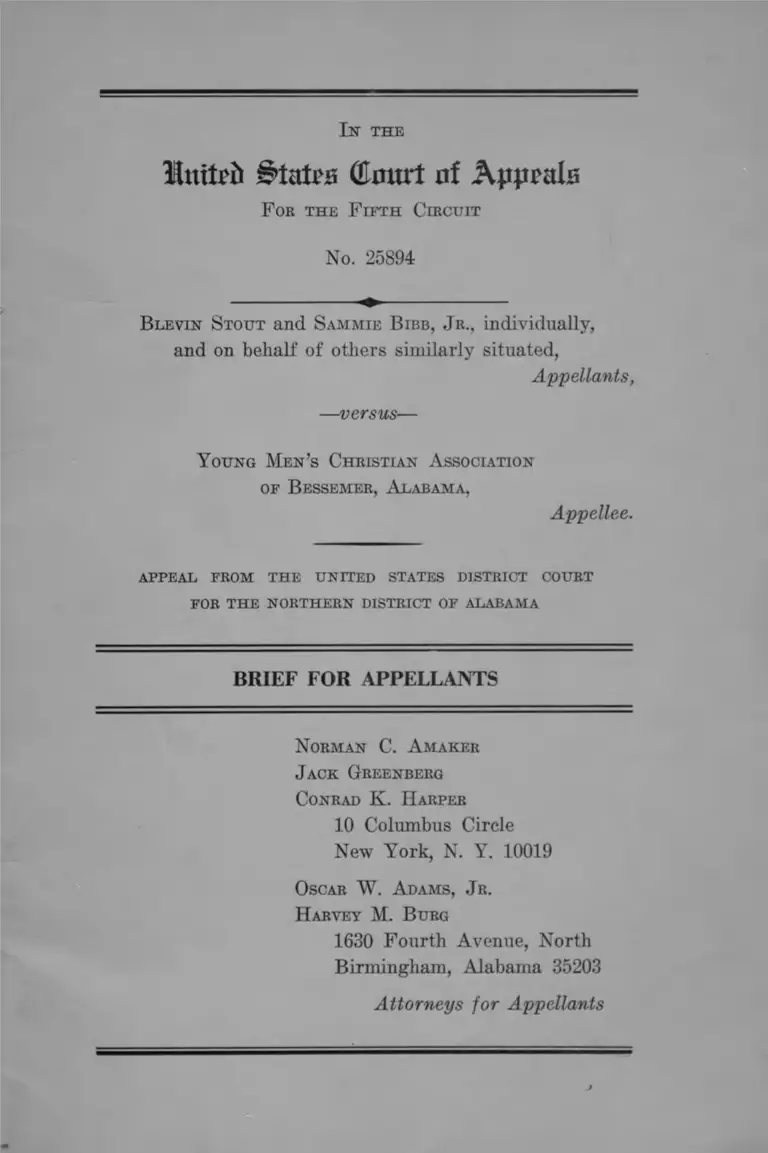
I n the
Imtri* (Emtrt at Ajiyrals
F ok the F ifth Circuit
No. 25894
B l e v in Stout and Sammie B ibb, J r., individually,
and on behalf o f others similarly situated,
Appellants,
—versus—
Y oung Men ’s Christian A ssociation
of B essemer, Alabama,
Appellee.
APPEAL FROM THE UNITED STATES DISTRICT COURT
FOR THE NORTHERN DISTRICT OF ALABAMA
BRIEF FOR APPELLANTS
Norman C. A maker
J ack Greenberg
Conrad K. H arper
10 Columbus Circle
New York, N. Y. 10019
Oscar W . A dams, Jr.
Harvey M. B urg
1630 Fourth Avenue, North
Birmingham, Alabama 35203
Attorneys for Appellants
I N D E X
Statement .............................................................................. 1
Specification of Error ........................................................ 5
A rgument :
The Bessemer YMCA is a place of public accom
modation under Title II of the 1964 Civil Rights
Act because (a) it provides lodging to transients
and (b) it serves food to the public for consumption
on the premises ....................................... 5
A. Lodging .................................................................. 5
B. Food ........................................................................ 10
C. The authority of Nesmith v. YMCA of Raleigh,
North Carolina ....................................................... 13
Conclusion............................................................................... 15
Table of A uthorities
Cases:
Adams v. Fazzio Real Estate Co., 268 F. Supp. 630
(E. D. La. 1967) aff’d, No. 24825 (5th Cir., May
28, 1968) ............................................................................ 13
Adler v. Northern Hotel Co., 80 F. Supp. 776 (N. D.
111. 1948), rev’d, 180 F. 2d 742 (7th Cir. 1950) ........... 6
Asseltyne v. Fay Hotel, 22 Minn. 91, 23 N. W. 2d 357
(1946)
PAGE
6
ii
Beale v. Posey, 72 Ala. 323 (1882) ................................... 6
Bolton v. State, 220 Ga. 632, 140 S. E. 2d 866 (1965) .... 11
Codogan v. Fox, 266 F. Supp. 866 (M. D. Fla. 1967) .... 12
Evans v. Laurel Links, Inc., 261 F. Supp. 474 (E. D.
Va. 1966) ......................................................................... 11,12
Foster v. State, 84 Ala. 451, 4 So. 833 (1888) ............... 6, 7
Gregory v. Meyer, 376 F. 2d 509 (5th Cir. 1967) ........... 12
Hamm v. Rock Hill, 379 U. S. 306 (1964) ..... ............. 11,12
Heart of Atlanta Motel v. United States, 379 U. S.
241 (1964) ......................................................................... 5
Holstein v. Phillips & Sims, 146 N. C. 366, 59 S. E. 1037
(1907) ............................................................................. 6
Katzenbach v. McClung, 379 U. S. 294 (1964) ............. 12
Kyles v. Paul, 263 F. Supp. 412 (E. D. Ark. 1967),
aff’d No. 18,824 (8th Cir., May 3, 1968) ..... ......... ..... 13
Meaeham v. Galloway, 102 Tenn. 415, 52 S. W. 859
(1899) ..... 6
Miller v. Amusement Enterprises, Inc., No. 24,259 (5tli
Cir. en banc, April 8, 1968) reversing 391 F. 2d 86
(5th Cir. 1967) .......................................................... .....12,13
Nesmith v. YMCA of Raleigh, North Carolina, 273 F.
Supp. 502 (E. D. N. C. 1967), rev’d, No. 11.931 (4th
Cir. June 7, 1968) ............. 10,11,13,14,15
PAGE
Ill
Newman v. Piggie Park Enterprise, Inc., 256 F. Supp.
941 (D. S. C. 1966), rev’d, 377 F. 2d 433 (4th Cir.
1967) .................................................................................. 12
Pettit v. Thomas, 103 Ark. 593, 148 S. W. 501 (1912) .. 6
Pinkney v. Meloy, 241 F. Supp. 943 (N. D. Fla., 1965) .. 13
Statutes :
Title II of the Civil Rights Act of 1964, 78 Stat.
PAGE
243, 42 U. S. C. §2000a et seq................... 2, 5,10,12,13,14
42 U. S. C. §1981 .............................................................. 2
Other Authorities:
43 C. J. S. Innkeepers §3 (1945) ................................... 8
Hearings on Miscellaneous Proposals Regarding the
Civil Rights of Persons Within the Jurisdiction of
the United States Before a Subcommittee of the
House Committee on the Judiciary, 88th Cong., 1st
Sess., ser. 4, p. 2 (1963) ............................................... 7,9
Hearings on S. 1732 Before the Senate Committee
on Commerce, 88th Cong., 1st Sess., ser. 26
(1963) ...................................................................... 8,9,10,12
H. R. 7152, S. 1731, S. 1732, 88th Cong., 1st Sess.
(1963) ................................................................................ 11
H. Zworensteyn, Fundamentals of Hotel Law (1963) .... 7
I n the
l&nxttb States (Emtrt of Appeals
F or the F ifth Circuit
No. 25894
B levin Stout and Sammie B ibb, J r., individually,
and on behalf o f others similarly situated,
Appellants,
—versus—
Y oung Men ’s Christian A ssociation
of B essemer, A labama,
Appellee.
APPEAL FROM THE UNITED STATES DISTRICT COURT
FOR THE NORTHERN DISTRICT OF ALABAMA
BRIEF FOR APPELLANTS
Statement
On November 21, 1966, appellants, Blevin Stout and
Sannnie Bibb, Jr., Negro citizens of Jefferson County,
Alabama, instituted a class action in the United States
District Court for the Northern District of Alabama against
the Young Men’s Christian Association of Bessemer, Ala
bama, Inc. (R. 1, 56). The appellants claimed that the
Y. M. C. A. was depriving them, and Negro citizens simi
2
larly situated, of rights, privileges and immunities secured
by (a) the Fourteenth Amendment to the Constitution; (b)
the Commerce Clause of the Constitution; (c) Title II of
the Civil Rights Act of 1964, providing for injunctive relief
against discrimination in places of public accommoda
tions; and (d) 42 U. S. C. Section 1981, providing for the
equal rights of citizens and all persons within the juris
diction of the United States (R. 1, 2). The complaint al
leged that the Y. M. C. A. pursued a policy of racial dis
crimination in the operation of its facilities, services and
accommodations (R. 4). Plaintiffs prayed for injunctive
relief (R. 5).
On January 5, 1967, the Y. M. C. A. answered the com
plaint (R. 7). After a trial without a jury, the district
court, on December 13, 1967, held that the activities of
the Y. M. C. A. do not affect commerce within the contem
plation of the Civil Rights statutes, and that the Y. M. C. A.
is not a place of public accommodation (R. 15), and dis
missed the complaint with prejudice (R, 15, 16). On De
cember 20, 1967, the findings of fact, conclusions of law and
judgment were amended by striking therefrom the words
“ with prejudice” (R. 18). The appellants filed notice of
appeal to this Court on January 10, 1968 (R. 19).
The Y. M. C. A. is a tax exempt, non-profit corporation
(R. 114). Over 50% of its funds are derived from the
Jefferson County Community Chest, a county-wide solicita
tion of the general public (R. 44, 45). Membership in the
Y. M. C. A. is open to the general public (R. 78, 124, 128).
Of approximately 3,000 membership applications in 1966,
all were accepted except four dormitory applications which
were rejected (R. 102).
3
The Y. M. C. A.’s building located at 1815 Fourth Avenue,
North, Bessemer, Alabama (R. 78, 90), live blocks from
TJ. S. Highway 11 (R. 88), contains forty-six rooms for
rent (R. 47). When rooms are available, lodging is pro
vided to individuals for one night (R. 46, 105). Since the
dormitory membership fee is set on a weekly basis, persons
staying for only one night are not charged a dormitory
membership fee and have no membership privileges (R.
104). Although persons staying for only one night are
supposed to fill out an application (R. 53), Stephen Cotton,
a white Harvard College student temporarily living in
Birmingham, Alabama, testified that he rented a room for
one night on December 7, 1965, without being required to
fill out any membership application or other forms (R.
35). He was given a receipt which stated that the charge
of $1.50 included a membership fee of $.50 (R. 64). Per
sons renting a room for one night are not asked where they
are from or if they are members of any Y. M. C. A. before
being rented lodging (R. 53, 59). They are rented a room
without the prior approval of the Y. M. C. A.’s Board of
Directors (R. 59). During the year 1965, the Y. M. C. A.’s
records show that six individuals stayed at the Y. M. C. A.
less than one week, and in 1966 there were five such in
dividuals (R. 51).
In the basement of the Y. M. C. A .’s building is a dining
room exclusively engaged in selling food for consumption
on the premises (R. 71, 85). This dining room can accom
modate 75 to 80 people comfortably (R. 116). Food is
cooked on the premises (R. 117). The dining room is run
by a caterer employed by the Y. M. C. A. (R. 116). Dinner
is served to church and civic groups two or three nights
each week (R. 117, 124). These groups are not members
4
of the Y. M. C. A. (R. 123). Any group wishing to meet
there regularly must obtain the prior approval of the
Y. M. C. A.’s Board of Directors (R. 116, 124). If the
facilities are available, however, the caterer may serve any
group she chooses on a single occasion (R. 116, 124). Use
of these facilities by any Negro group would under any
circumstances require the prior approval of the Board of
Directors (R. 118, 123, 124). No Negro group has ever
used these dining facilities (R. 111).
Groups using the dining facilities pay the caterer (R. 71,
85). The Y. M. C. A. receives ten cents for each plate
served (R. 117). As the Y. M. C. A. furnishes the equip
ment, lights, gas and maintenance for the dining room,
the dining room operation is not self-supporting (R. 117).
The deficit from this operation is not kept separately in
the Y. M. C. A.’s accounts (R. 117). Once each year for
the past several years, the Lions Club served a supper
in this dining room to which the general public was invited
(R. 49). This tradition has now been discontinued (R. 49).
The Y. M. C. A. does not advertise on radio or television
or in newspapers (R. 84) or by signs on highways (R. 51).
However, the Y. M. C. A. does benefit from the national
publicity of the National Council of Y. M. C. A.’s (R. 98),
of which the Bessemer Y. M. C. A. is a member (R. 84, 97).
In addition, the Bessemer Y. M. C. A. is listed in the Official
Roster of Y. M. C. A .’s published by the National Council
and sold to the general public (R. 53).
On November 17, 1965, appellants Blevin Stout and
Sammie Bibb, Jr., went to the Y. M. C. A. at Bessemer
and asked to rent a room (R. 24, 29). They also inquired
about membership applications (R. 24, 29) and about dining
facilities for organizations (R. 24, 29). The district court
5
found as a fact that Blevin Stout and Sammie Bibb, Jr.
were denied membership and the use of the Y. M. C. A.’s
facilities, because they are Negroes (R. 14), but the court
held the Y. M. C. A. was not subject to Title II because it
allegedly did not accommodate transients or open its facili
ties to the public (R. 15).
Specification of Error
The court below erred in failing to find that the Young
Men’s Christian Association of Bessemer, Alabama, Inc.,
is a place of public accommodation as defined in Title II
of the Civil Rights Act of 1964, 78 Stat. 243, 42 U. S. C.
Sections 2000a et seq., and in failing to issue an injunc
tion requiring desegregation.
A R G U M E N T
The Bessemer YMCA is a place of public accommoda
tion under Title II of the 1964 Civil Rights Act because
(a) it provides lodging to transients and (b ) it serves
food to the public for consumption on the premises.
A. Lodging
The section of Title II of the Civil Rights Act of 1964,
which states that any establishment which provides lodg
ing to transient guests is a place of public accommodation,
was viewed by the court in Heart of Atlanta Motel v.
United States, 379 U. S. 241, 249 (1964) as applying to a
motel which admitted coverage under §201 (a) and which
had refused lodging to transient Negroes. Based on the
legislative history regarding this section, the meaning of
the term “ transient guest” at common law, and the express
6
words of the statute itself, it is clear that the Y. M. C. A. of
Bessemer is an establishment which provides lodging to
transient guests.
At common law, a distinction is made between a transient
guest or simply a guest on the one hand, and a lodger on
the other. An individual whose stay is temporary is a
guest, while an individual who intends to remain indefi
nitely or permanently, without any present purpose of
going to any other place, is a lodger. Adler v. Northern
Hotel Co., 80 F. Supp. 776 (N. D. 111. 1948), rev’d on other
grounds, 180 F. 2d 742 (7th Cir. 1950); 43 C. J. S. Inn
keepers §3, 1140, 1143 (1945). The length of an individu
al’s stay, the existence of a special contract for a room,
and the existence of a home elsewhere are material cir
cumstances in determining whether an individual is a guest
or a lodger, but these circumstances are not controlling.
43 C. J. S. Innkeepers §3, 1138 (1945). An individual may
be a transient guest, although he has stayed at an establish
ment for one week or longer, Asseltyne v. Fay Hotel, 22
Minn. 91, 23 N. W. 2d 357 (1946); Pettit v. Thomas, 103
Ark. 593, 148 S. W. 501 (1912); Meacham v. Galloway, 102
Tenn. 415, 52 S. W. 859 (1899); 43 C. J. S. Innkeepers §3,
1138 (1945); even though he is paying a weekly, monthly,
or other reduced rate, Pettit v. Thomas, supra; Holstein v.
Phillips & Sims, 146 N. C. 366, 59 S. E. 1037 (1907); Beale
v. Posey, 72 Ala. 323 (1882); 43 C. J. S. Innkeepers §3,
1138 (1945); and even though he is not a traveler but re
sides in the immediate vicinity, Beale v. Posey, supra; 43
C. J. S. Innkeepers §3, 1140 (1945). A single establish
ment may be both a boarding house in respect to permanent
residents and an inn in respect to transient guests. Adler
v. Northern Hotel Co., supra; Foster v. State, 84 Ala. 451,
4 So. 833 (1888); see also H. Zworensteyn, Fundamentals
of Hotel Law, 16, 34-35 (1963).
The term “ transient guest” was used by the authors of
the Civil Rights Act of 1964 with the intent that it have a
meaning at least as broad as its meaning at common law.
Attorney General Kennedy defined the “ transient guest”
test in a document prepared at the request of the House
Judiciary Committee:
The “ transient guest” requirement exempts estab
lishments, like apartment houses, which provide per
manent residential housing. For example, apartments
rented on month-to-month tenancies automatically re
newed each month unless specifically terminated, are
exempted. The question of coverage would be deter
mined by the actualities of the arrangement. The ques
tion whether an establishment caters to “ transient
guests” would be a question of Federal, not State local
law. Hearings on Miscellaneous Proposals Regarding
the Civil Rights of Persons Within the Jurisdiction of
the United States Before a Subcommittee of the House
Committee on the Judiciary, 88th Cong., 1st Sess.,
ser. 4, p. 2 at 1402 (1963) (hereinafter cited as House
Civil Rights Hearings).
Before the Senate Commerce Committee, Assistant At
torney General Marshall was asked by Senator Morton how
long a person had to stay at a hotel or rooming house to
cease being a transient guest:
Mr. Marshall. I think, Senator, I wouldn’t be able
to cover all possible situations with a definition of it,
but I think places generally either furnish rooms or
apartments to permanent residents or they hold them
7
8
selves out to people that come for maybe a week at a
time or maybe in the case of a summer establishment,
for the summer.
But I think that in almost every case you could tell
the difference between a place that rents from month
to month with the intention of the people that rent
from it of staying there and a place that caters to
people that move in and out. Hearings on 8 . 1732 Be
fore the Senate Committee on Commerce, 88th Cong.,
1st Sess., ser. 26 at 213 (1963) (hereinafter cited as
Senate Civil Rights Hearings).
The Y. M. C. A. at Bessemer is neither an establishment
merely providing permanent residential housing nor a
social club. It is apparent from the legislative history
that the language—“ any establishment which provides
lodging to transient guests”—was intended to embrace this
Y. M. C. A. Aside from one or two retired individuals who
make their home permanently at the Y. M. C. A. (R. 51), the
Y. M. C. A.’s residents are primarily men who work in Bes
semer and have a home in some other place (R. 58). They
go home each weekend (R. 58). They do not intend to stay
at the Y. M. C. A. indefinitely or permanently, without any
present intention of going elsewhere, but to remain only
as long as their employment in Bessemer lasts (R. 58).
At common law and under the meaning intended by Con
gress, these individuals are transient guests and not per
manent residents. That the Y. M. C. A. categorizes these
men as permanent residents and defines a transient as an in
dividual who stays less than one week (R, 57, 58) is imma
terial. The transient guest requirement was intended to
exempt establishments providing permanent residential
9
housing and was never intended to exempt establishments
simply because guests usually remain longer than one week.
The district court erred in construing “transient guest” to
mean travelers who remain at an establishment less than
one week.
Assuming arguendo that the district court’s definition of
transient guest is correct, the undisputed facts show that
the Y. M. C. A. provides lodging to transient guests (R. 13).
But because rooms are rented to such transients only occa
sionally and because “ as far as the evidence reveals, all
of these so-called transients were residents of the State of
Alabama” (R. 13), the lower court erroneously concluded
that the Y. M. C. A. is not a place of public accommodation
(R. 15). An establishment providing lodging to transient
guests was intended to be covered whether the guests are
from within the state or from without, and whether or not
transient guests in large numbers are accommodated.
Senate Civil Rights Hearings at 66, 170 (testimony of
Attorney General Kennedy).
A requirement that a “ substantial” part of an establish
ment’s business be in interstate commerce was intentionally
omitted. House Civil Rights Hearings at 1386 (testimony
of Attorney General Kennedy). In testimony before the
House Judiciary Committee and the Senate Commerce
Committee, Attorney General Kennedy affirmed that the
provision on lodgings was intended to cover small as well
as large establishments and that the size of a business was
not a criterion for coverage. Id. at 1384; Senate Civil
Rights Hearings at 24. It was decided not to set some arbi
trary standard because discrimination by many small
establishments imposes a cumulative burden on interstate
commerce, Senate Civil Rights Hearings at 24 (testimony
10
of Attorney General Kennedy), and because it makes little
sense to prohibit a large and not a small establishment
from discriminating, Id. at 59.
There is no basis in the legislative history for the tests
imposed by the district court in determining whether the
Y. M. C. A. provides lodging to transient guests within the
meaning of Title II of the Civil Rights Act of 1964. The
statutory language was intended to be absolute, in order
that virtually all persons operating establishments provid
ing public accommodations would know they were covered.
Senate Civil Rights Hearings at 24 (testimony of Attorney
General Kennedy) and at 210 (testimony of Assistant At
torney General Marshall). On the basis of the undisputed
fact that the Y. M. C. A. occasionally rents rooms to tran
sient guests, that the Y. M. C. A. is listed in a directory cir
culated throughout the United States, and that Y. M. C. A .’s
customarily provide lodging to transient guests (R. 112),
the Y. M. C. A. is a place of public accommodation.
B. Food
It is not disputed that there is an eating place exclusively
engaged in selling food for consumption on the premises
located within the Y. M. C. A .’s building (R. 12). The dis
trict court found that the Y. M. C. A. did not operate this
eating place (R. 12). There is no support for this finding
in the record. The Y. M. C. A. employs a caterer to pur
chase and prepare the food sold (R. 116). The Y. M. C. A.
absorbs the deficit from this operation in its general budget
(R. 117). This factor was regarded by the Fourth Circuit
as significant in finding that the Raleigh Y. M. C. A. was
a single establishment. Nesmith v. Y. M. C. A. of Raleigh,
N. C., 273 F. Supp. 502 (E. D. N. C. 1967), rev’d, No. 11,931
11
(4th Cir. June 7, 1968) (slip op. 5). The caterer is not free
to serve any group she chooses, but must obtain the Board
of Directors’ prior approval before serving any group on
a regular basis (R. 116, 124) or before serving a Negro
group under any circumstances (R. 118, 123).
The original civil rights bill required that an eating place
serve interstate travelers to a substantial degree; this re
quirement was later omitted by substituting the current
provision that an offer to serve interstate travelers would
affect commerce, H. R. 7152, S. 1731, S. 1732, 88th Cong.,
1st Sess. (1963). That this offer is made only to groups
and not to individuals is immaterial. An offer to serve the
general public, whether in groups or as individuals, under
circumstances which make it reasonable to assume that
some interstate travelers will accept the offer has been
treated as an offer to serve interstate travelers, where, as
here, there is no inquiry made as to the customers’ origin.
Hamm. v. Rock Hill, 379 U. S. 306 (1964); Evans v. Laurel
Links, Inc., 261 F. Supp. 474 (E. D. Ya. 1966); Bolton v.
State, 220 Ga. 632, 140 S. E. 2d 866 (1965). In Evans v.
Laurel Links, Inc. the court held that where a lunch counter
on a golf course offered to serve the general public and
players occasionally came from Washington, D. C., to par
ticipate in tournaments, it was reasonable to assume that
some interstate travelers would accept the lunch counter’s
offer. In serving groups such as the Rotary Club, The
Kiwanis Club, and The Industrial Management Club (R.
116), which customarily provide guest speakers at lunch
eons and which customarily hold their luncheons or dinners
out to members from all over the United States, the
Y. M. C. A. is offering to serve interstate travelers. That
interstate travelers are in fact actually served without
12
inquiry as to their origin is evidenced by the fact that
Stephen Cotton, a Harvard College student temporarily
residing in Birmingham, was served without question at a
Lions Club dinner (R. 39-40). The fact that the Y. M. C. A.
does not formally advertise its eating place does not pre
clude finding an offer to serve interstate travelers. Codogan
v. Fox, 266 F. Supp. 866 (M. D. Fla. 1967). The Y. M. C. A .’s
location five blocks from an interstate highway (R. 88) is
also material to coverage under Title II. Gregory v. Meyer,
376 F. 2d 509 (5th Cir. 1967) (3 blocks from federal high
way) ; Evans v. Laurel Links, Inc., supra (4 blocks from
State highway and 5 miles from nearest II. S. highway);
see also Miller v. Amusement Enterprises, Inc., No. 24,259
(5th Cir. en banc, April 8, 1968).
In addition, a substantial portion of the food served at
the Y. M. C. A. has moved in commerce. It is settled that
substantial means “more than minimal” . Gregory v. Meyer,
376 F. 2d 509, 511 n. 1 (5th Cir. 1967); Newman v. Piggie
Park Enterprise, Inc., 256 F. Supp. 941 (D. S. C. 1966),
rev’d on other grounds, 377 F. 2d 433 (4th Cir. 1967) (18%
is substantial); Codogan v. Fox, 266 F. Supp. 866 (M. D.
Fla. 1967); Senate Civil Bights Hearings at 24 (testimony
of Attorney General Kennedy). The Supreme Court has
recognized that Congress intended to cover retail store
lunch counters, Hamm v. Rock Hill, 379 IJ. S. 306, 310
(1964) and that Congress was especially concerned with
the effect on commerce of racial discrimination in restau
rants, Katzenbachv. McClung, 379 U. S. 294, 299-301 (1964).
In view of this recognized congressional policy, food served
in the Y. M. C. A. must be deemed to have affected com
merce.
This Court may take judicial notice that coffee, tea and
bread ingredients originate without the State of Alabama.
13
Adams v. Fazzio Real Estate Co., 268 F. Supp. 630, 639
n. 18 (E. D. La. 1967) aff’d, No. 24825 (5th Cir., May
28, 1968); Kyles v. Paul, 263 F. Supp. 412 (E. D. Ark.
1967), aff’d, No. 18,824 (8th Cir., May 3, 1968) (petition
pending for rehearing en banc). As the only beverages
served in the Y. M. C. A .’s eating place are coffee and tea
and as the dinners consist of the regular plate (R. 117),
more than a minimal amount of the food served at the
Y. M. C. A. has undoubtedly moved in interstate commerce.
Thus the Y. M. C. A. is subject to Title II because it pro
vides lodging for transients and serves and offers to serve
food, a substantial portion of which has moved in com
merce, to interstate travelers.
Since the YMCA is a place of public accommodation
on all of the above grounds, it is a place of public accom
modation as to all services rendered within its physical
confines. Nesmith v. YMCA of Raleigh, North Carolina,
No. 11,931 (4th Cir., June 7, 1968); Pinkney v. Meloy, 241
F. Supp. 943 (N. D. Fla., 1965).
C. The authority of Nesmith v. YMCA of Raleigh,
North Carolina
This court has made it clear that Title II of the Civil
Rights Act of 1964 is to be liberally construed so as to
effectuate its purpose of eradicating racial discrimination
in public accommodation. Miller v. Amusement Enter
prises, Inc., No. 24259 (5th Cir., en bam, April 8, 1968)
(slip op. 13) reversing 391 F. 2d 86 (5th Cir., 1967); Fazzio
Real Estate Co., Inc. v. Adams, No. 24825 (5th Cir., May
28, 1968). The only authority cited by the district court
in the instant case for its conclusion that the activities of
the YMCA do not affect commerce and are not open to
the public was Nesmith v. YMCA of Raleigh, N. C., 273
14
F. Supp. 520 (E. D. N. C., 1967) (R. 15). But the Nesmith
district court recently has been reversed by the Fourth
Circuit (No. 11,931, June 7, 1968).
Appellants urge that the application of standards set out
in the Fourth Circuit Nesmith decision makes it incon-
trovertibly clear that the Bessemer YMCA is covered by
Title II. For example, the district court found as a fact
that some 53% or 54% of the income of the Bessemer
YMCA is derived from the United Appeal (R. 12). In de
termining that the Raleigh YMCA was not a private club,
the Fourth Circuit put heavy reliance upon the fact that
more than 20% of the operating funds of the athletic
building was provided by the United Fund. Nesmith v.
YMCA of Raleigh, N. C., supra, slip op. 11.
The district court impliedly put some reliance upon the
fact that the facilities of the Bessemer YMCA are allegedly
not open to the public (R. 15). Support for the district
court’s conclusion is apparently contained in its finding of
fact that a person wishing to become a member of the
YMCA must file an application, which application is pur
portedly reviewed by a committee and the board of direc
tors (R, 13). Yet the record is clear, and the district
court found as a fact, that Steven Cotton, a white student,
was rented a room for $1.50 and that he attended a Lions
Club oyster supper—all with no hint that the YMCA made
any effort to bar him as a non-member (R. 14, 36-37). As
an indicium of how little membership in the YMCA meant
for a person who was white, Mr. Cotton was given a
receipt at the time he paid his $1.50, which receipt indi
cated that 50 ̂ was for membership.
15
In rejecting the contention that the Raleigh YMCA was
a private club in light of its requirements for applications
and review by a membership committee, the Fourth Cir
cuit significantly noted that it was “ admitted that there
are no prescribed or regularly used qualifications for
membership” and the court went on to conclude that, “ The
YMCA, with no limits on its membership and with no
standards for admissibility, is simply too obviously un-
selective in its membership policies to be adjudicated a
private club.” (Nesmith v. YMCA of Raleigh, North Caro
lina, supra, slip op. 10-11). We submit that the district
court’s reliance in the instant case upon the Nesmith dis
trict court was clearly misplaced in light of the disposi
tion made by the Fourth Circuit.
CONCLUSION
For the foregoing reasons, we respectfully submit
that the judgment of the district court should be re
versed.
Respectfully submitted,
Norman C. A maker
J ack Greenberg
Conrad K. Harper
10 Columbus Circle
New York, N. Y. 10019
Oscar W. A dams, Jr.
H arvey M. B urg
1630 Fourth Avenue, North
Birmingham, Alabama 35203
Attorneys for Appellants
RECORD PRESS — N. Y. C. 38