Plaintiff's Motion for Partial Summary Judgment on the Question of Liability
Public Court Documents
1985
6 pages
-
Case Files, Garner Working Files. Plaintiff's Motion for Partial Summary Judgment on the Question of Liability, 1985. a09fd8e6-34a8-f011-bbd3-000d3a53d084. LDF Archives, Thurgood Marshall Institute. https://ldfrecollection.org/archives/archives-search/archives-item/0d733afc-7ad1-48f7-a7f0-5d9b6efa3a5c/plaintiffs-motion-for-partial-summary-judgment-on-the-question-of-liability. Accessed September 27, 2026.
Copied!
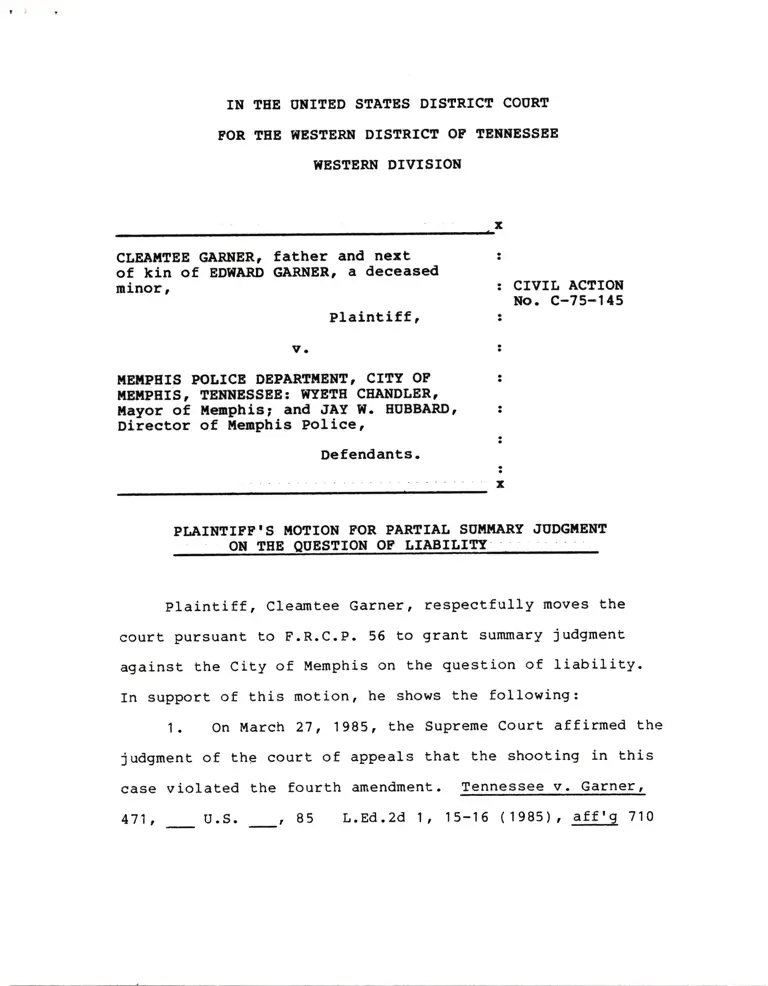
IN THE UNITED STATES DISTRICT COURT
FOR THE WESTERN DISTRICT OF TENNESSEE
WESTERN DIVISION
CLEAMTEE GARNER, father and next
of kin of EDWARD GARNER, a deceased
minor.
Plaintiff,
MEMPHIS POLICE DEPARTMENT, CITY OF
MEMPHIS, TENNESSEE; WYETH CHANDLER,
Mayor of Memphis; and JAY W. HUBBARD,
Director of Memphis Police,
Defendants.
CIVIL ACTION
No. C-75-145
PLAINTIFF'S MOTION FOR PARTIAL SUMMARY JUDGMENT
ON THE QUESTION OF LIABILITY.........
Plaintiff, Cleamtee Garner, respectfully moves the
court pursuant to F.R.C.P. 56 to grant summary judgment
against the City of Memphis on the question of liability.
In support of this motion, he shows the following;
1.______ On March 27, 1985, the Supreme Court affirmed the
judgment of the court of appeals that the shooting in this
case violated the fourth amendment. Tennessee v. Garner,
471, ___ U.S. ___, 8 5 L.Ed.2d 1 , 15-16 ( 1985) , aff'g 710
F.2d 240, 246 (6th Cir. 1983). It remanded for further
proceedings to determine the city's liability under Monel1
V. Department of Social Services, 436 U.S. 658 (1978). The
amount of damages is the only other issue that remains in
addition to the question of liability.
2. Under Monell v. New York Dept, of Social Services,
436 U.S. 658 (1978), municipalities are "persons" within the
meaning of § 1983 and subject to suit under that statute.
Under Monell, a city may be held liable in damages under
§ 1983 for constitutional deprivations that result from a
"policy or custom" followed by the city. Under that
standard, Mr. Garner is clearly entitled to relief.
3. "[I]t is when execution of a government's policy
or custom, whether made by its lawmakers or by those whose
edits or acts may fairly be said to represent official
policy, inflicts the injury that the government as an entity
is responsible under § 1983." Monell, 436 U.S. at 694. A
city is responsible for its own acts, "that is, acts which
the municipality has officially sanctioned or ordered."
Pembaur v. Cincinnati, 475 U.S. ___, 89 L.Ed.2d 452, 463
(1986). "[T]o establish the constitutional violation [as]
in Monell no evidence [i]s needed other than a statement of
the policy by the municipal corporation, and its exercise."
Oklahoma City v. Tuttle, 471 U.S. ___, 85 L.Ed.2d 791, 803
(1985).
- 2 -
4. Under these standards, plaintiff is entitled to
summary judgment on the issue of liability. All he need
show is the municipal policy and its exercise. There can be
no genuine issue of fact because it cannot be denied that
Memphis had an explicit, written policy sanctioning the
shooting in this case. It was this municipal policy of
Memphis that was "the moving force of the constitutional
violation." Monell, 436 U.S. at 694.
5. The record material attached to this motion
establishes beyond doubt that the Memphis deadly force
policy in effect on the night of Edward Eugene Garner's
death explicitly authorized the shooting of fleeing burglary
suspects. General Order No. 5-74, Attached as Exhibit 1, is
a policy statement signed by then Director of Police, J.W.
Hubbard (see Exhibit 4) — "a municipal policymaker."
Pembaur, 89 L.Ed.2d at 464-65; Tuttle, 85 L.Ed.2d at 804. It
was adopted with the explicit consideration and approval of
the Mayor, Wyeth Chandler. Indeed, although this policy is
more restrictive than state law, the inclusion of burglary
as an enumerated underlying felony justifying the use of
deadly force to prevent escape was a considered policy
choice "consciously chosen from among various alternatives
__/' Tuttle, 85 L. Ed.2d at 804, by Mayor Chandler and
Director Hubbard. See Exhibit 2, 3, and 4. As the Mayor
testified in deposition: "One of the arguments was to
- 3 -
eliminate burglary and this type thing, some kinds of
burglary, which I did not do. I did not think it should be
done.” Exhibit 2, Deposition of Mayor Wyeth Chandler at 22
(Dec. 19, 1979).
6. The district court previously found that;
Under ... regulations of the Memphis Police
Department ... lethal force may be used by police
officers to apprehend persons fleeing from the
commission of certain felonies.... Burglary of a
residence is one of the felonies covered ....
Lethal force may be resorted to in order to
apprehend a person fleeing from the commission of
a burglary such as that in which deceased Garner
was involved....
Memorandum Opinion of September 29, 1976, Slip. op. at 9-10.
On the first appeal, the court of appeals affirmed the
finding that the officer "shot because he believed that the
boy would elude capture," and that the officer "was taught
that it was proper to kill a fleeing felon rather than run
the risk of allowing him to escape." Garner v. Memphis
Police Department, 600 F.2d 52, 53 (6th Cir. 1979). There
can be no doubt that the officer was taught and acted
pursuant to the policies of the City of Memphis.
7. The Supreme Court held that, without probable
cause to believe that he is dangerous, the shooting of a
fleeing suspect solely because there is a probable cause to
believe that he committed a burglary violates the fourth
amendment. Garner, 85 L.Ed.2d at 16. The record leaves no
doubt that there can be no genuine issue of material fact;
- 4 -
(1) that this was the explicit policy of the City of
Memphis, adopted by its Mayor and Director of Police; (2)
that this policy was taught to Officer Hymon who fired the
fatal shot; and (3) that he shot because of the policy.
Accordingly, plaintiff is entitled to judgment on the
question of liability. He had made an incontrovertible
showing "sufficient to impose liability under Monell ...
[that] includes proof that [the unconstitutional shooting]
was caused by an existing, unconstitutional municipal
policy, which policy can be attributed to a municipal
policymaker." Tuttle, 85 L.Ed.2d at 804.
8. In Sartor v. Arkansas Natural Gas Corp., 321 U.S.
620 (1944), the Supreme Court held that "Rule 56 'authorizes
summary judgment only where the moving party is entitled to
judgment as a matter of law, where it is quite clear what
the truth is, that no genuine issue remains for trial.'" 6
Moore's Federal Practice H 56.15 [ 1-.00] (quoting Sartor,
321 U.S. act 627) (emphasis added). Given the Supreme
Court's holding in Garner, "it is quite clear what the truth
is" — a policy that authorized the use of deadly force
claimed the life of Edward Eugene Garner. The execution of
the city's policy, made by municipal decisionmakers,
inflicted the ultimate injury of death. The city is liable
under § 1983.
- 5 -
9. Even though the question of damages may be at
issue. Rule 56 clearly provides for partial summary judg
ment. According to Rule 56, a claimant may "move ... for a
summary judgment in his favor upon all or any part" of a
claim. F.R.C.P. 56; see 6 Moore's Federal Practice
H56.20[3.-0] at 56-1208. Under subdivision (c) of F.R.C.P.
56, there is little doubt that summary judgment should be
granted in this case: "A summary judgment, interlocutory in
character, may be rendered on the issue of liability alone
although there is a genuine issue as to the amount of
damages." Id. (emphasis added).
For the foregoing reasons, and as more fully set out in
the attached memorandum and exhibits, the motion for partial
summary judgment on the question of liability should be
granted.
Respectfully submitted.
JULIUS LeVONNE CHAMBERS
STEVEN L. WINTER
16th Floor
99 Hudson Street
New York, New York 10013
WALTER L. BAILEY, JR.
Suite 901, Tenoke Building
161 Jefferson Avenue
Memphis, Tennessee 38103
COUNSEL FOR PLAINTIFF
- 6 -