Defendant's Memorandum in Opposition to Plaintiffs' Motion for Class Certification
Public Court Documents
September 9, 1977
24 pages
-
Case Files, Hatcher v. Methodist Hospital - Hardbacks. Defendant's Memorandum in Opposition to Plaintiffs' Motion for Class Certification, 1977. bc4479e7-5384-f111-ab0f-7ced8d2181dd. LDF Archives, Thurgood Marshall Institute. https://ldfrecollection.org/archives/archives-search/archives-item/0ea170c9-6d2a-4716-89ab-37ed9d2af862/defendants-memorandum-in-opposition-to-plaintiffs-motion-for-class-certification. Accessed October 10, 2026.
Copied!
     [||58b35f7e-3a63-49ef-b7da-c48fa73bb520||] rt Sina *


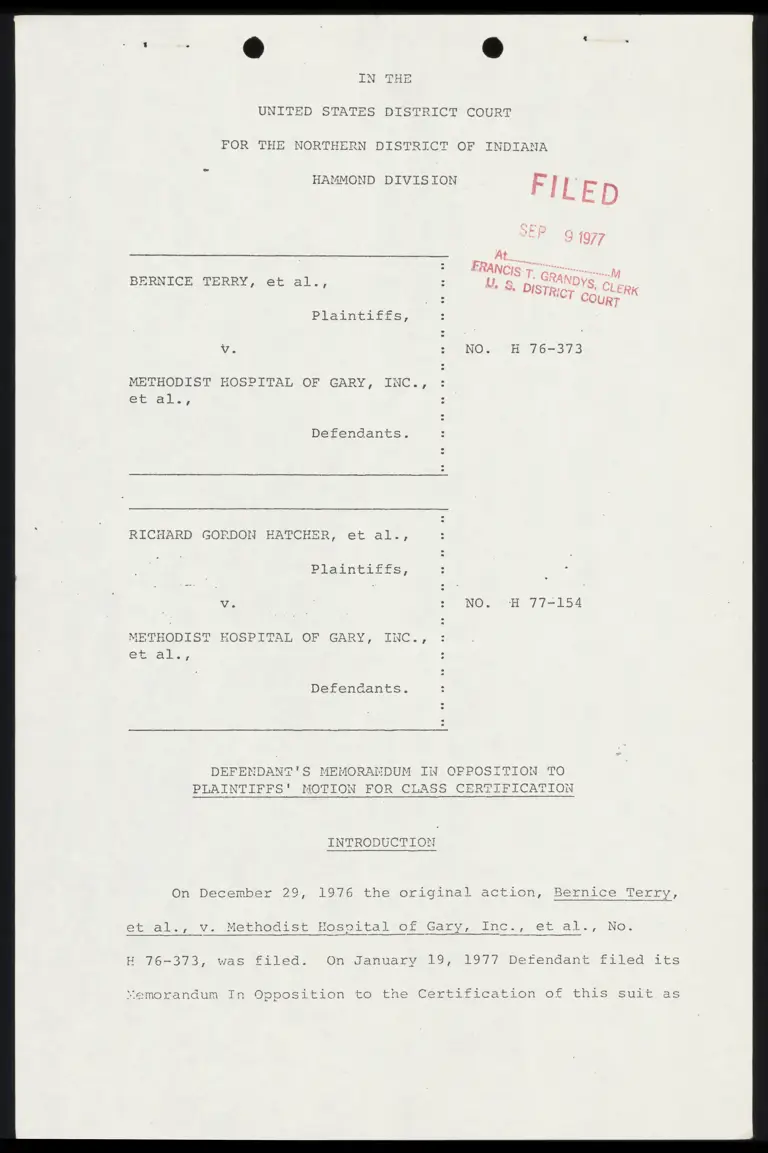
UNITED STATES DISTRICT COURT

FOR THE NORTHERN DISTRICT OF INDIANA


HAMMOND DIVISION FILED

of 1977

At
> FRANC i 5 . !

BERNICE TERRY, et al., : u \ GRANDYS A
> DISTRICT An “LERK

s - COURT

Plaintiffs, :

v7. + “NO. ‘BE 76-373

METHODIST HOSPITAL OF GARY, INC., :

et al., :

Defendants. :
(N

X


RICHARD GORDON EATCHER, et al., s

Plaintiffs, :

va. : ¢ NO, HH -77~154

METEODIST EBEOSPITAL OF CARY, INC., 12

et al., :

Defencants. :


DEFENDANT'S MEMORANDUM IN OFPOSITION TO

PLAINTIFFS' MOTION FOR CLASS CERTIFICATION


INTRODUCTION

On December 29, 1976 the original action, Bernice Terry,

etial,, v. Methodist Hosnital of Gary, Inc., et al., No.


H 76-373, was filed. On January 19, 1977 Defendant filed its

wemorandum In Opposition to the Certification of this suit as


4 L]

: : »


a class action. Subsequently, on May 6, 1977, Hatcher, et al.,


V. Methodist ‘Hospital of Gary, Inc., et al., No. H 77-154 was


filed. This memorandum is in response to Plaintiffs' Motion

for Certification of Hatcher, et al., v. Methodist Hospital of


Gary, Inc., et al., as a class action, by which Plaintiffs seek


to represent a class consisting of the following classes:

1. All black and hispanic residents of Gary,

Indiana who use, have used or will use

Gary Methodist Hospital and who are, have

been, or will be injured by the creation,

perpetuation, and expansion of a segregated

hospital system.

2. All handicapped residents of Gary, Indiana

who use, have used or will use and are

better served by facilities at Gary Methodist
Hospital, and who are, have been or will be

injured by the placement, removal to or expan-

sion of facilities at Broadway Methodist

Hospital.

Defendant also reiterates all arguments made in its memorandum

in opposition to the certification of Bernice Terry, et al.,


v. Methodist Hospital of Gary, Inc., et al., as a class action.


I- THE REQUESTED CLASS CERTIFICATION SHOULD

BE DENIED BECAUSE TEE FOUR REQUIREMENTS

OF RULE 23 HAVE NOT BEEN SATISFIED.


Federal Rule of Civil Procedure 23(a) provides that a

class action may be maintained only if the four requirements

usually referred to as numerosity, commonality, typicality,

and adequate representation are satisfied. It is well set-

rled that these four requirements are not disjunctive, but,


/ : é | p

rather, that each requirement must be fulfilled if a class is

to be certified. If any one of the requirements is not satis-

fied, the effort at class certification must necessarily fail.

Valentino v. Howlett, 523 P.24:875,.-978 (7th Cir. 1975);


Rutledge v. Electric Hose & Rubber Co., 511 F.2d 668, 673


(9th Cir. 1975). In the process of establishing each pre-

requisite, the burden of demonstrating that the requirements

have been met lies with the party seeking certification.

Nguven Da Yen v. Kissinger, 70 P.R.D. 656 (M.D. Calif., 1876);


Redhouse v. Quality Pord Sales, Inc., 511 2.24 230, 236 (10th


Cir. 1975). In rejecting proof by speculation, the United

States Court of Appeals for the Second Circuit has stressed

that the burden on the moving party must be satisfied by

evidence rather than allegation:


"[I]t is fundamental that those seeking

to maintain an action as a class action
must make a positive showing that it would

be impracticable to deny the prayer." Demarco

v. Edens, 390 7.28 836, 845 (1968). (Emphasis

added.)


Thus, as the moving party in this action the Plaintiff has the

burden of making a positive showing that each and every pre-

requisite of Rule 23(a) is satisfied. If the Plaintiff fails

to meet this burden as to any one prerequisite, the motion for

class certification must be denied.


y y & »

A. Identification of Purported Class.


Before turning to the specific requirements of Rule 23,

it should be noted that a pervasive inadequacy of Plaintiffs’

attempt to classify this case as a class action is the unin-

formative nature of Plaintiffs' Complaint (hereinafter referred

to as "Complaint”) and Memorandum In Support of the Certifica-

tion of this Lawsuit as a Class Action (hereinafter referred

to as "Memorandum In Support"). As will be discussed in greater

detail, infra, Plaintiffs’ tan convince the Court to

certify this case as a class ACLion is totally devoid of factual

support. Instead of presenting facts from which the Court can

determine whether or fos thi requirements of Rule 23 are satis-

fied, the Plaintiffs apparently premise their argument upon

the simplistic assertion that since "[T]lhis is an action

attacking Defendant's policies and practices af¥anting or

generally A to all blacks, hispanics and handicapped

persons residing in gary" and "[I]lt seeks injunctive relief

... [and] declaratory relief with respect to such] classes]

as a whole," Defendants "cannot seriously dispute that class

certification is therefore here contemplated by Rule 23(b)2."

Memorandum In Support at page 3. Such conclusory statements

are plainly insufficient to support a finding that the require-

ments of Rule 23 have been satisfied.

Individuals who seek to maintain an action as a class

action may not rely on allegations of "across the board" dis-

crimination to acquire standing to represent a class. Instead,


£4 1

hd -

\

factual allegations must be presented and searched to determine

whether the proposed class would be cohesive and homogeneous.


Martin v. Easton Publishing Co., 14 P.2.P, Cases 785, 769 (E.D

Penn. 1977). Moreover, the premise that every civil action

claiming discrimination on the basis of race, nationality or

handicap states a case for treatment as a class action is un-

acceptable. Recently the Supreme Court in East Texas Motor


Freight v..Rodriguez, g.s. r 14 P.R.P, Cases 1505

1509 (1977) stated:

"The mere fact that a complaint alleges

racial or ethnic discrimination does not in

itself ensure that the party who has brought

the lawsuit will be an adequate representative

of those who may have been the real victims

of that discrimination.”

See also, McFarland v. Upjohn Lo., 15 FEP Cases 129 (E.D. Penn.


1977); Kinsey v. Legg Mason 8 Co., 60 P.R.D. 21,:98-99 (D.D.C.


1973): Bean v. Star Fibers, Inc., 5 P.E.P. Cases 932, 933

(D.S.C. 1972); Harding v. Atlantic City Directory Co., 3 F.BE.P.


Cases 1214, 1215 (N.D. Ga. 1971); Gresham v. Ford Motor Co.,


53 P.R.D. 105, 10&6-107 (N.D. Ga. 1970). 'This principle neces-

sarily applies to other allegations of discrimination, speci-

fically handicapped discrimination.

AS in any other cage, Plaintiffs’ bear the burden of

factually demonstrating that the requirements of Rule 23 have

peen met. See Taylor v. Safeway Stores, Inc., 524 F.24 263,


— ny —
~?


269 (10th Cir. 1975). Along these lines, the Court. of Appeals

for the Fourth Circuit recently stated:

"Rule 23(a) sets forth the 'mandatory

requirements' that must be satisfied for

the maintenance by a plaintiff of a class

action; and, while suits involving racial

discrimination lend themselves generally

to class treatment, a plaintiff does not

satisfy the burden that is his in order
to qualify as a proper representative to

maintain such an action merely because of

his or her race or because he designates

his action as a class action. 'Title VII

plaintiffs are not exempted from the pre-

requisites of Rule 23(a).' To satisfy the

requirements of Rule 23, there must be a

class of individuals raising the same claims

or defenses too numerous for joinder and the

plaintiff must be a representative of that

class with a claim 'typical of the claims or

defenses of the class' both 'at the time the

complaint is filed, and at the time the class

action is certified by the District Court


pursuant to Rule 23, % % #.1 ‘As stated, the

burden of establishing these requirements rests

on. the plaintiff". {Emphasis added). Doctor


v. Beaboard Coast Line R.R., 13 F.E.P, Cases

139, 145 (4th Cir. 1976). at

Implicit in the above statement is the recognition that

conclusory allegations are an insufficient basis on which to

permit a case to proceed as a class action. Yet, this is all

the Plaintiffs present here.

A cause of action is not maintainable as a class action

merelv because it is designated as such ih the pleadings.

Veathers v. Peters Realty Corp., 499 F.24 1197 (6th Cir. 1974);


Rossen v. Southern Union Gas Co. 472: 9.24. 707,712 {10th Cir.


1973): uoff v. B.D. Cass Co. of Alabama, 485 7.28:710. {5&th


Cir. 1973); 7A Federal Practice & Procedure (Wright & Miller

ed.) § 1735 at 131. The reason that mere speculation as to


the existence of the class is VASUEElelalt: £0 comly with Rule

23 is that the maintenance of a class action involves conse-

quences of great import. From a constitutional standpoint

there must be no possibility, for example, ot any antagonistic

interests between the named plaintiffs and the purported class.

The allowance of a class representative with antagonistic in-

terests to other members of the class would deny unnamed class

members due process. Sullivan v. Winn-Dixie Greenville, Inc.,


52 ».R.D. 370, 375 4{D.5.C. 1974). Similarly, from a procedural

standpoint, the maintenance of a class action invokes conse-

quences which are time consuming, complex, and of a serious

nature. Borovac v. Meat Cutters Local 8, 13 F.E.P. Cases 296,


297 {D. Reb. 1973).

Because of these ramifications, the Plaintiffs' burden

of proof cannot be glossed over. When allegations of the ex-

istence of a class cannot be ascertained in fact, the pur-

ported class cannot be certified. See, e.g., Peltier v. City


of Fargo, 10 P.BE.P. Cages 70), 704 {(D.X.D. 19735).


The Plaintiffs’ complaint is nothing more than a series

of conclusory allegations. The purported class cannot be

certified, therefore since a conclusory recitation of the

of the provisions of Rule 23(a) does not satisfy the Plain-

tiffs’ burden of proof. Sée Doctor v. Seaboard Coast Line


R.B.» 713 7.2.7. Cases 133, 134 (M.D. N.C. 18974), aff'd 13

F.E.P. Cases 139 {4th Cir. 1976). . As expressed by one Federal

digtrict court, "{tlhe members of a class must be capable of


-

@ ®


definite identification as being either in or out of it."

  Chaffee v. Johnson, 229 F.Supp 445, 448 (S.D. Miss. 1964):

accord, Vietnam Veterans Against the War v. Benecke, 63 F.R.D.


875, 680 (M.D. Mo, 1973).

In addition to the general considerations outlined above,

it should be noted that the factual circumstances of the in-

stant case intensify the need for the Plaintiffs to identify

with particularity the purported class of persons they seek

to represent. The management of this case as a class action

would pose hii problems because the Court is not confronted

with an easily identifiable pool of aggrieved Plaintiffs. In

hd the inclusion of all handicapped persons eesidisle

in Gary poses extremely difficult, if not impossible, identifi-

cation problems. Section 7 of the Rehabilitation Act as amended

in 1973, 29 U.S.C. § 706, defines "handicapped individual" for

ele of the instant action, to mean any Sciam "who (A) has

a physical or mental impairment which substantially limits one

or more of such perscn's major life activities, (B) has a

record of such an impairment or (C) 1s regarded as having such

an impairment."

Defendant submits that under such a broad definition of

"handicapped individual," it would be virtually impossible to

identify, with any degree of certainty, a class of citizens

of Gary who are handicapped. To meet its burden under Rule

23(a) Plaintiffs must make a positive showing and identifica-

rion of a class of all Gary citizens who are "handicapped"


within the Rehabilitation Acts definition. As stated by the

Court in Giordono v. Radio Corporation of America, 183 F.2d


Sr 5583, 561 (3rd Cir.. 1359);

"In a true class suit the plaintiffs

stand in judgment for the class and a

judgment for or against the plaintiffs

benefits or binds each member of the class

personally under the principles of res ju-
dicata. The members of a class must, there-

fore, be capable of definite identification

as being either in or out of iL."

The class of all handicapped citizens in Gary, plaintiffs

seek to represent, comprise an amorphous phantom group, in-

capable of identification in terms of both individuals and

numbers. By definition, such a grcup does not exist in any

but the most abstract sense. Since any such showing necessarily

will be vague and unintelligible, both policy and logic dictate

that the purported class cannot be defined to include all handi-

capped individuals in Gary.

B. There Is No Positive Showing That There
Are Questions Of Law Or Fact Common To

The Class.


Rule 23(a) (2) requires the Plaintiffs to demonstrate that

common questions of law and fact predominate among members of

the purported class as a condition precedent to certification.

Plaintiffs contention that the "commonality" requirement of

Rule 23(a) (2) is mere surplusage and should therefore be satis-

fied "undoubtedly" or "certainly” runs directly contrary to the

asove noted and accepted principle that a plaintiff must meet


its burden of a positive showing that all four prerequisites

Of Rule 23(a) have been satisfied.

Plaintiffs alternatively contend that satisfaction of

this requirement is evident because "defendant's policies and

practices are tainted by racial or other discrimination pro-

scribed by federal law" (Memorandum in Support at 5). Charac-

teristically, Plaintiffs offer no factual basis for their po-

sition.

Since Plaintiffs have failed to identify purported

class members, the court lacks any basis in fact on which

to determine whether the commonality requirement has been

satisfied. In similar circumstances, courts have concluded

that conclusory allegations. are insufficient under. Rule 23

to support a case proceeding as a class AChion. The court in

Hyatt v. United Aircraft Corp., S50:7.8.D. 242 (DD. Conn. 19703},


for example, held that a Title VII class action could not be

certified where, as in the instant case, the plaintiff couched

its complaint in generalities rather than facts:

"In order to determine whether there are

questions of law or fact common to the class

which plaintiff seeks to represent, normally
the Court would look at the complaint to make

that determination. Here, as indicated above,

the complaint is couched in such broad, sweep-
ing terms that it would be utterly impossible

to determine whether there are questions of

law or fact common, for example, (a) to those

Negro persons now employed, (b) to those here-

tofore employed, and (c) to those hereafter to

be employed. Certainly there are no allegations

in the complaint specifying questions of law or

fact claimed to be common toc the class." Id. at
246,

- if -


The refusal of the court in Hyatt to gloss over the

commonality requirement is instructive for purposes of the

instant case. Although the Plaintiffs purport to represent a

large class of people, it is fundamental shad Plaintiff's or

moving party's burden is not satisfied 29 Conclnsany statements.

Courts must have facts in order to apply the law. Substitution

of conclusory allegations for the actual similarity of griev-

ances for which the commonality requirement was aimed to en-

compass would emasculate the purpose of Rule 23(a). Before the

commonality requirement is satisfied, the court must be able to

identify the instances where minorities unlawfully have been

discriminated against by defendant's policies and practices.

Where, as in the instant case, the Defendant's program of

expansion snd construction is designed to Lenefit all citizens,

white, black, hispanic, whether handicapped or not, such a show-

ing cannot be made.

The cases relied upon by Plaintiffs in its Memorandum are

clearly distinguishable. For example, Norwalk CORE v. Norwalk


Redevelopment Agency, 395 F.24 920 (2&8 Cir. 1968), dealt with

the question whether Plaintiffs who asserted that they had

been displaced by a city urban renewal project, had standing

to bring suit. The court held that the plaintiffs did have

standing since "[T]lheir stake in the outcome in the case is

immediate and personal." The Norwalk CORE case did not even


touch on the question of "commonality" under Rule 23 (a) (2).


However, even if Plaintiffs reliance on that case is accepted,

Defendant asserts that the instant case is more akin to the
“~~.

case of Harrison - Halstead Community Group, Inc. v. Housing


and Home Finance Agency, 310 P.24 99 (7th Cir. 1962) cert.


denied 373 U.5. 914 (1963) which the Court in Norwalk CORE


distinguished from the case at bar. In the Harrison - Halstead


case the Plaintiffs sought to bar the acquisition and clearing,

under an urban renewal program, of an area in Chicago for the

use of the University of Illinois. They alleged that they

would suffer economic injury if the plan were carried out, and

that some of them had relied on past promises and representa-

tions of government officials in connection with previously

announced plans for residential and commercial development in

the area. The court held that it did not appear that any of

the plaintiffs’ "private legal rights” had been violated.

Like the Plaintiffs in Norwalk - Ealstead, the named


Plaintiff in the instant case does not allege any personal in-

jury in fact. Mayor Hatcher alleges that he will require use

of health facilities in the future. This allegation of injury

-is speculative and does not form a basis for the Mayor's stand-

ing to bring this suit. Jackson v..Dukakis, 526 F.2d 64 (lst


ir. 1975). It is not ‘an injury in facr,


The allegation by Mayor Hatcher that he has been obstructed

by "the putative acts of Methodist Eospital in enforcing his

"responsibility" to assure the social service and health needs

of the citizens of Gary is not a personal injury to Richard

Gordon Eatcher, but is an attempt by the Mayor to represent

and/or enforce the rights of others before this court. It is

elemental that an individual does not have standing to assert

the deprivation of another individual's rights. Simon v.


Eastern Kentucky Welfare Rights Organization, supra; Worth v.

      Seldin, supra; O'Malley v, Brierly, 477 7.28 785 (3x8 Cir.

1973).

The other two cases relied upon by Plaintiffs likewise

are distinguishable from the instant case (Memorandum In Sup-

port at 5). In Jenkins v. United Gas Corp., 400 2.24 28, 31

(5th Cir. 1968) the court expressly noted that the Plaintiff's

complaint "was a model of specificity in plant-wide, system-

wide racial discrimination which took its toll of Emplovee and

his group principally in denial of promotion to the position

; of Serviceman." (Emphasis added). Similarly, in Donaldson v.


Pillsbury Co., 554 F.249825%, 830 (8th Cir. 1977), the plain-


tiff alleged that the Employer had engaged in employment prac-

tices which have had the effect of limiting job opportunities

of women and blacks and, unlike the plaintiffs in the instant

case, Offered specific statistical evidence of the alleged

discriminatory patterns. Plaintiffs use .the English language

rather loosely in their contention that the question whether

defendants policies and practices are discriminatorily tainted


arises for all of the putative class members (Memorandum In

Support at 5). Moreover, the Complaint and Memorandum lack

any specificity as to the fact questions shared in common.

The allegations say only that there has been discrimination;

the facts of such discrimination may vary immensely given the

differing situations of each citizen in the purported class,

especially where, as here, the entire class sought is composed

of three distinct groups. The commonality requirement cannot

be satisfied where factual inquiries necessarily will be dif-

ferent in each individual case, regardless of the merits of

the individual allegations of discrimination. Odom v. U.S.


Homes Corp, of Texas, 14 F.E2.P, Cases 156 {(S.D. Tex. 1875),


Plaintiffs’ fallure to define the purported class with

particularity totally undercuts its ability to satisfy the

commonality requirement. See Hill v. American Airlines, Inc.,


479 F.24 1057, 1059 {5th Cir. 1973). Neither Plaintiffs’

Complaint nor its Memorandum In Support present the Court with

an identifiable cohesive class bound together by common ques-

tions of law and fact. See Beasley v. Kroehler Mfg. Co., 406


F.Supp. 926, 931 (M.D. Tex. 1976}. Unless and untill Plaintiffs

can present factual evidence that Defendants have acted in a

general discriminatory manner towards the numerous minorities

which allegedly compose the aggrieved class, the Plaintiffs

will be unable to establish the existence of common cguestions

of fact.

The allegedly common questions of law suffer from the

same defects as the questions of fact. The cuestions cannot


be common to all class members because the class members

obviously are not all similarly situated. Moreover, the re-

quired positive showing of commonality consists only of the

conclusory allegations. Mere conclusory assertions of com-

monality are not adequate to establish the prerequisite.

O'Connell v. Teachers College, 63 F.R.D. 638, 639-40 (S.D.


N.Y. 1974). Such conclusory allegations are especially in-

adequate in view of the fact that Plaintiff also fails to

demonstrate the typicality of his claim.

Ce. There Is No Positive Showing That

The Claims Of The Plaintiff Are

Typical Of The Claims Of The Class.


Plaintiffs have failed to sustain their burden of demon-

strating that the claims or defenses of $e representative

parties are typical of the Sratng or defenses of the purported

class pursuant to Rule 23(a) (3). Plaintiffs employ conclusory

statements and shun supporting facts in their attempt to

convince the court that the ploatiey recilesnont of Rule 23(a)

has been met. According to the Plaintiffs, typicality is sub-

stantiated on the basis of the blanket allegation that "defendant

is and all other members of the class have been injured ...

affording services and is engaging in a construction program in

a racially discriminatory manner.” Memorandum In Support at 6,

footnote 4 Cases indicate, however, that where a court is

presented only with a conclusory allegation that a class exists

and that the claim of the members are typical, the typicality

requirement is not met. O'Brien v. Shimp, 356 F.Supp. 1259,


MN

1266 (N.D. Ill. 1973); Peltier v. City of Fargo, 10 F.Z.D.


Cases 701, 705 (N,D, 1975); Ellison v. Rock Hill Printing Co.,


8. 7.B.P, Cases 386, 339 (D.S.C. 1974). In determining typicality

the court must look beyond such allegations to "the nucleus of

facts which underlie those allegations and the evidence necessary

to prove them." Sommers v. Abraham Lincoln Federal Savings and


Loan Association, 66 FRD 581, 587 (E.D. Penn. 1975).


The typicality requirement obligates the Plaintiffs, at

a minimum to identify other members of the class who have

similar grievances. Collier v. Hunt~-Wesson Foods, 13 F.E.P.


Cases 883, 92 (8.D. Ga. 1976); Bean vy. Star Fibers, Inc.,

5 P.E.P, Cases 932, 933 (D.S.C. 1972). vVhevre as in the instant

case, there is no evidence other than speculation and assertion

that Shgpeane that any other individuals share the Plaintiffs’

grievance, a court has no basis on which to declare the

typicality requirement satisfied.

In Whites v. Gates Rubber Company, 53 F.R.D. 412 (D. Col.


1971), the court expresses this concept as follows:

"Since the typicality requirement must be

given an independent meaning, we are of the

opinion that it requires the plaintiff to

demonstrate that other members of the class he

purports to represent have suffered the same

grievances of which he complains. The plaintiff

is required to show that his action meets the

prerequisites of a class action. Demarco Vv.

Edens, 390 7.24836 {24 Cir. 1968); Tippeti v.

Liggett & Meyers Tobacco Co., 316 F.Supp. 292

(M.0.N.C. 1970); Male v. Crossroads Assoc.,

320 F.Supp. 141 (S.D.N.Y. 1970). Consequently,

it will not be unduly burdensome for the plaintiff

to demonstrate the presence of other complaints.”

1d. at 415.


The duty to identify the members of the purported class as a

condition precedent to class certification was also emphasized

in Taylor v. Safeway Stores, Inc., 524 P.28 263 (10th Cir.


where the Tenth Circuit, stated:

"We accept White's compelling reasoning that

subsection (a) (3) must have a meaning independent
of the other provisions of Rule 23(a). Any

inquiry into typicality under Rule 23(a) (3)

requires a comparison of the claims or defenses

of the representative with the claims or defenses

of the class. Since the burden is on the plain-

tiff to establish the prerequisites of Rule 23,

Redhouse v. Quality Ford Sales, Inc., 10 Cir.,

511 F.2d 230, 235, -it is not unreasonable to
require the plaintiff to establish the existence

of a class as preliminary to the court's compari-

son of claims and defenses. The White definition
of typicality has done no more than verbalize an

implicit requirement of subsection (a) (3); there-
fore, we must conclude that this definition is
correct.” Id. af 270. :


1975),

Again in Wright Vv. Stone Container Corp., 524 F.24 1058 (8th

Cir.


1975), the court employed a similar rationale in rejecting

the argument that a class should have been certified.

court reasoned:

The

"[5] Under the peculiar circumstances of this

case however, we cannot say that the trial court

abused its discretion in refusing to certify the

class under Rule 23(a). Except for two vague

references at the class hearing, Wright could not

identify any person who had been subjected to the

same or similar discriminatory treatment as he

allegedly suffered. He could only speculate that

approximately two hundred past and present employees

and job applicants were involved. The typicality

requirement of Rule 23(a) (3) obligates that there

are other members of the class who have similar

grievances. Green v. Missouri Pac. R.R., 62 F.R.D.


434, 436 (B.D. Mo. 1973), rev'd on other grounds,


523 7.24 1290 (8th Cir. 1975); accord, Williams v.


Matthews Co. , 499 F.28 819, 822 48th Cir.) , cert,

denied, 419 U.8.°1027, 85 S.Ct. 507, 42 .-L,.Fd.24

302 (1974). Wright failed in this regard.” 18.

1062.

at


Accord, Thomson v. Sun Oil Co., 523 F.2d 647, 545


(3th Cir. 1975); Collier v. Hunt-Wesson Foods, 13 F.E.P.


Cases 88 (S.D. Ga. 1978). See also, Doctor v. Seaboard Coast


Line R.R. Co., 13 FP.E.P. Cases 139 "(4th Cir. 19756); Odom


v. U.S. Homes Corp, of Texas, 14 F.E.P. Cases 158 (5.0. Tex.


1975); Donaldson v, Pilisbury Co., 11 FP.E.P. Cases 577 (D, Minn.


1975). Moreover, a "bald assertion" that such others exist is

not sufficient to comply with the typicality requirement.

Binsey v. Legg, Mason.§ Co., 60 F.R.D. 91, 100 (D.D.C. 1973).


Here, of -course, Plaintiffs have failed to identify any signi-

ficant number of individuals who purportedly suffer from the

same grievances.

In support of its position that the purported class meets

< Rule 23(a)'s requirement of "typicality", plaintiffs rely

exclusively on a decision by the Eighth Circuit in Donaldson


V.. Dilishury Co., 554 F.24 825, 830 (8th Cir. 1977). However


in Donaldson not only did the appellant's complaint allege


that the Company had engaged in employment practices which

have had the effect of limiting job opportunities of women

and blacks but the Plaintiff offered statistical evidence to

show that the Company had consistently employed a low number

of women and blacks in its headquarters since 1965, and that

of those minority groups actually employed, there has been a

significantly high turnover. The court concluded that "{Bly

demonstrating that there were in fact other members of the


.

¢ y $


class who had similar grievances, Wright v. Stone Contalner


Corp., Supra., appellant has met the quantitative aspect of

the typicality requirement." 14 F.E.P. Cases at 83.

(Emphasis added).

While, in the instant case the complaint alleges the

construction and expansion in question "have had and will

continue to have the purpose and effect of creating a hospital

system which excluded persons from, denies them the benefit

Of, and otherwise discriminates against and segregates them

on the basis of race, national origin and physical handicap"

(comp. p.8), no showing has been made that a significant

number of the members of the proposed Ess. in fact, have

been victimized in a similar manner by any one pattern or

praibide by the Defendant. on the contrary, there has been

no allegation that any of the members of the purported class

have been denied any services or been denied access to any

services offered by the Defendant. !lMoreover, the proposed

construction and expansion attacked by the Plaintiffs is

designed to benefit both black and white, hispanic and non-

hispanic, handicapped and non-handicapped citizens of Gary in

a like manner.

Furthermore, in Donaldson the court noted, at the outset,


that many courts have. noted that the purpose of the typicality

requirement overlaps with those of the other subsections of

Rule 23{a). Thus, the court noted, "{A} few courts have


» -

- -

equated 'typicality' with the existence of the common questions

required by Rule 23(a){(2)." 554 F.24 at 829. As discussed

above, there has been no positive showing that there are

questions of law or fact common to the class in the instant

case. The court in Donaldson also noted that:


"More often, courts have equated typicality

with the adequacy of the class representative or

the absence of conflict of interest between the

representative and class members, the interests

protected by Rule 23(a) (4). See, e.g., Windham

v. American Brands, Inc., 68 F.R.D. 841, 649

{D.S.C. 1975), rec'd on other grounds 539 P.24

1016 {4th Cir. 1976); Kinsey v,., Legg, Mason & Co.,

60 F.2.D. 91, 99 (D.D.C. 19873); Cannon Vv. Tejas

Gulf Sulphur Co., 47 F.R.D. 60, 83 (S.D.N.Y. 1969);

Vernon J. Rockler and Co. v. Graphic Enterprises,

Inc., supra ...% 354:7.24 at 829, |


As is discussed in part D below, there also has been no posi-

tive showing that Plaintiff Hatcher will be an adequate

ri biasantan ite od the class, and that, in fact, Hatcher's

position as the duly elected Mayor of Gary while he acts as

the named representative in the instant action creates a

serious conflict of interest.

D. There Has Been No Positive Showing That

Plaintiff Hatcher Will Be An Adequate

Representative Of The Class


Prior to certification of a class, a court must find

that the named representative of the class, in this case

Richard Gordon Hatcher, will fairly and adequately protect

the interests of the class. As was stated recently by the


Seventh Circuit Court of Appeals in Ann Flamm and Arnold Flamm


-

- -


v. Rudolph Fprexstadt, Jr. and Microdot, Inc., No. 77-1146


{7th Cir. Ang. 31, 1377), .8lip opinion at pp. 6-8:

" ... Basic considerations of fairness

require that a court undertake a stringent

and continuing examination of the adequacy

of representation by the named class re-

presentatives at all stages of the litiga-

tion where absent members will be bound by
the court's judgment. National Association

of Regional Medical Programs v. Mathews,

551 F.28 340 (D.C. Clix. 1576), Strict over~

sight is necessitated since due process re-

quires that absent class members be adequately

represented in order to be bound by a court's

judgment. National Association of Regional

Medical Programs, 551 F.2d at 344-5; Hansberry
Vv. Lee, 311 0.8. 32, 42~43 (1940); Gonzales v.

Cassidy, 474 F.24 67 (5th Cir. 1973): Wright 5

Miller, Federal Practice and Procedure, § 1765,

Pp. 617. ‘Adequate representation depends on

two factors: (a) the plaintiff's attorney must

be qualified, experienced, and generally able

to conduct the proposed litigation, and (b) the

plaintiff must not have interests antagonistic

to those of the class. t Wetzel 'v. Liberty

Mutual Insurance Co., S508 F.28 239, 247 (3x8

Cir. 1975), cert. denied, 421:-U.8. 1011; Risen

v.. Carlisle s&s Jacaguelin, 391-2.24 555, 582 (24

Cir. 1968); Cross v. National Trust Life Insur-
ance Co., 553 F.24 1026, J031 (6th Cir. 15777...

A putative class representative has the burden

of convincing the trial court that the mandatory
requirements of Rule 23 (a) have been satisfied.

Valentino v. Howlett 528 F.24 975 (7th: Cir. 1976);

Doctor v. Seaboard Coast Line R. Co., 540 F.24

699, 706-707 (4th Cir. 1976); %Wright & Miller,

wederal Practice and Preccedure, § 1765, p. 626."

(footnote omitted, emphasis added).


The requirement that the Plaintiff be an adequate repre-

sentative of the class is most commonly viewed as dictating

that there be no antagonistic or divergent lnterests between

the Plaintiff and other class members.


~ -
™ ~


"Conflicts of interest, especially antagonistic
or divergent claims, preclude formulation of
relief which will benefit all the members of the
class. Antagonistic claims thwart the adeguacy
of representation. See Albertson's Inc., v.

Amalgamated Sugar Co., 503 F.28 459, 463 (13th
Cir. 1974). A court must decline to entertain
an action as a class suit if it discerns that

the interests of the named plaintiffs are in

significant part antagonistic to those of the

class they purport to represent. Phillips v.

Rlassen, 163 U.S. App. D.C. 360, 502 7.28 362,

366 (1972), cert. den. 419 U.S. 996,395 SS. Ct.

309, 42 L.KE8.24 269.% Nguyen Da Yen, 70 7.R.D,

at 665,


That a conflict of interest necessarily will result

from Plaintiff Hatcher acting simultaneously as the duly

elected Mayor of A of Gary and as the class represen-

tative is patently obvious. As the Executive officer of Gary,

Plaintiff fa vehan is the duly elected representative of all

the citizens of Gary, not merely those classes of citizens

he seeks to represent in the instant actions! Clearly, the

interests of all the citizens of Gary will not be served by

the instant action which seeks to enjoin funding for expansion

of hospital facilities operated by the Defendant. As such,

an obvious conflict of interest results in Plaintiff Watiher’s

acting as the named representative in a suit against Defendant

Hospital. Even assuming, arguendo, that Plaintiffs were able


to establish all the allegations contained in their complaint by

a preponderance of the evidence, nevertheless, the conclict

clearly exists.

Moreover, as Executive office of Gary, Plaintiff Hatcher

is as he states in his affidavit dated August 15, 12877 and

filed in support of Plaintiffs’ opposition to Defendant's

~~

for the public health and motion to dismiss, "responsible


- ad

a w

welfare of the City of Gary." Plaintiff Hatcher further

states that "[Tlhis responsibility is carried out through the

following agencies:

(a) The Health Department

(b) Model Cities Health Program

(c) Medical Center of Gary

(d) The Drug Abuse Center

(e) Gary Ambulance Service

(£f) Rodent Control

(g) Mosquito Abatement

(h) Immunization Program

£1) Women's Infant Child Food Program

(j) Gary Dental Health Program"

With respect to these agencies Plaintiff iy as Chief

Executive, RW, the responsibility to enforce all relevant

ordinances, which responsibility includes a duty to enforce

the ordinances in a fair and impartial manner. Yet, Dy acting

as the named renresvitative in the ingtant action, Plaintiff

Hatcher is bringing the action on behalf of only certain seg-

ments of Gary's population.

On several counts the Plaintiff necessarily will fail

to be an adequate representative of the desired class. On

this basis alone, the requested certification should be denied.


CONCLUSION


The Plaintiff has the burden cof making a positive showing

Of each of the four prerequisites to certification. The Plain-

tiff has failed to make such a showing. Each of the four pre-

requisites is supported only by speculation and assertion. The

Plaintiff has failed to make a positive showing as to any one

of the four requirements of Rule 23(a). Moreover, Plaintiffs’

Motion for Certification of the suit as a class action is pre-

mature. Clearly, the totality of the circumstances militates

against a demonstration of class treatment. Therefore, the

Defendant respectfully submits that the Plaintiff's request for

certification of the class should be denied.

Respectfully submitted,

HODGES, DAVIS, GRUENBERG,

COMPTON & SAYERS

Attorneys for Defendants

Methodist FEospital of Gary, Inc.

dad) 4 sv SUA J) BAY
/ 4


By Don 7 I fy [||58b35f7e-3a63-49ef-b7da-c48fa73bb520||]