Reply Brief of the Appellant
Public Court Documents
January 15, 1993
26 pages
-
Case Files, Garner Working Files. Reply Brief of the Appellant, 1993. b0fbe7ef-35a8-f011-bbd3-000d3a53d084. LDF Archives, Thurgood Marshall Institute. https://ldfrecollection.org/archives/archives-search/archives-item/0f54ed8c-fb8f-47ad-b27a-707f66ce5171/reply-brief-of-the-appellant. Accessed September 26, 2026.
Copied!
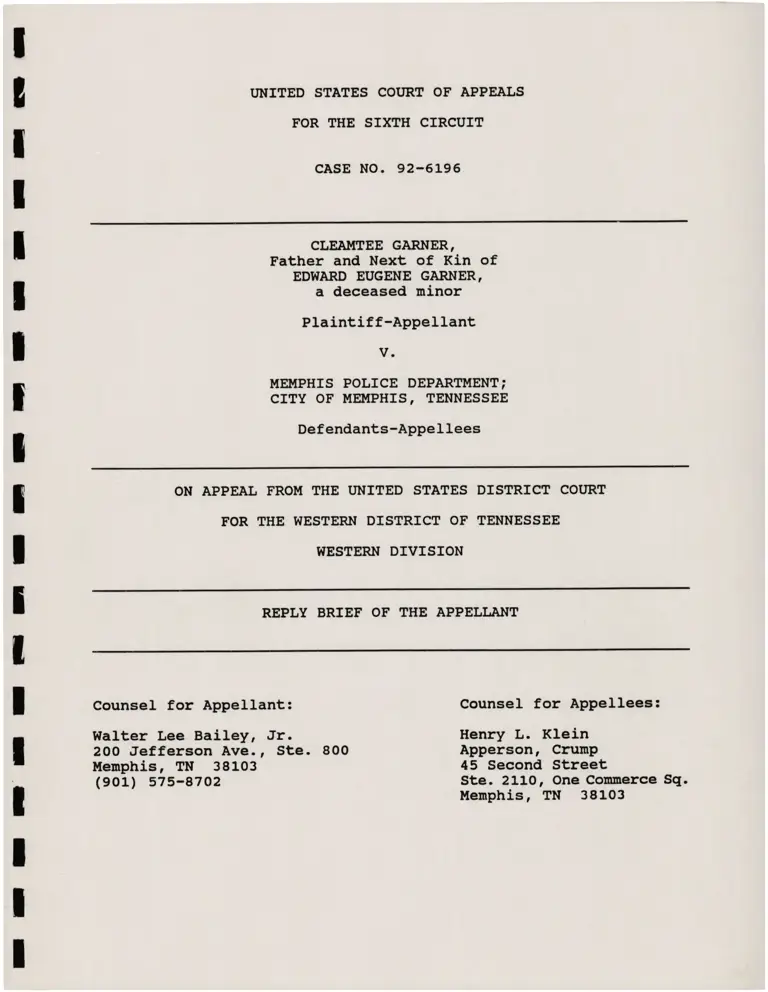
    CASE NO. 92-6196

UNITED STATES COURT OF APPEALS
FOR THE SIXTH CIRCUIT

CLEAMTEE GARNER,
Father and Next of Kin of

EDWARD EUGENE GARNER,
a deceased minor

Plaintiff-Appellant
V.

MEMPHIS POLICE DEPARTMENT;
CITY OF MEMPHIS, TENNESSEE

Defendants-Appellees

ON APPEAL FROM THE UNITED STATES DISTRICT COURT
FOR THE WESTERN DISTRICT OF TENNESSEE

WESTERN DIVISION

REPLY BRIEF OF THE APPELLANT

Counsel for Appellant:
Walter Lee Bailey, Jr.
200 Jefferson Ave., Ste. 800
Memphis, TN 38103
(901) 575-8702

Counsel for Appellees:
Henry L. Klein
Apperson, Crump
45 Second Street
Ste. 2110, One Commerce Sq.
Memphis, TN 38103


P H O N E  9 0 1 - 5 7 5 - 8 7 0 2
F A X  9 0 1 - 5 7 5 - 8 7 1 7

A n n e  B r o w n l e e  G u l l i c k
A T T O R N E Y  A T  U A W

O N E  M E M P H I S  P L A C E
2 0 0  J E F F E R S O N  A V E . ,  S U I T E  8 0 0

M E M P H I S ,  T N  3 8 1 0 3 - 2 3 4 0

A L S O  L I C E N S E D
IN  M I S S I S S I P P I

January 15, 1993

Mr. Clyde Murphy
Attorney at Law
NAACP Legal Defense Fund
99 Hudson St., 16th Floor
New York, NY 10013

RE: Garner v. Memphis Police Dept., et al

Dear Mr. Murphy:
Enclosed you will find your copy of the appellant's reply brief
filed in the above styled cause. I hope that I incorporated your
helpful criticisms in the reply, and I appreciate all your
assistance. I look forward to more opportunities to work with
you in the future.
Thank you for your time and cooperation. If I can provide any
further information or service, please feel free to call.
Sincerely,

Anne Brownlee Gullick
Enclosure


CASE NO. 92-6196

UNITED STATES COURT OF APPEALS
FOR THE SIXTH CIRCUIT

CLEAMTEE GARNER,
Father and Next of Kin of

EDWARD EUGENE GARNER,
a deceased minor

Plaintiff-Appellant
V.

MEMPHIS POLICE DEPARTMENT;
CITY OF MEMPHIS, TENNESSEE

Defendants-Appellees

ON APPEAL FROM THE UNITED STATES DISTRICT COURT
FOR THE WESTERN DISTRICT OF TENNESSEE

WESTERN DIVISION

REPLY BRIEF OF THE APPELLANT

Counsel for Appellant:
Walter Lee Bailey, Jr.
200 Jefferson Ave., Ste. 800
Memphis, TN 38103
(901) 575-8702

Counsel for Appellees:
Henry L. Klein
Apperson, Crump
45 Second Street
Ste. 2110, One Commerce Sq.
Memphis, TN 38103


8

Table of Authorities........................................... ii
Rebuttal Argument .............................................. i
Conclusion..................................................... 18
Certificate of Service......................................... 19

TABLE OF CONTENTS

I


CASE PAGE
Barber v. City of Salem, Ohio,

953 F.2d 232 (6th Cir. 1992)............................  2, 3

Belcher v. Oliver,
898 F.2d 32 (5th Cir. 1990)................................ 14

Brandon v. Holt,
469 U.S. 464 (1985).......................................... 3

Carter v. City of Chattanooga, Tenn.,
850 F.2d 119 (6th Cir. 1988)........................ 1, 2, 4

7, 8
Chevron Oil Co. v. Huson,

404 U.S. 97 (1971).....................................  2,8

City of Canton, Ohio v. Harris,
489 U.S. 378 (1989).................................... 15, 16

City of Los Angeles v. Heller,
475 U.S. 796 (1986)......................................... 11

City of Oklahoma City v. Tuttle,
471 U.S. 808 (1985)......................................... 15

Coal Resources, Inc. v. Gulf & Western Industries,
865 F.2d 761 (6th Cir. 1989)................................. 8

Doe V. Sullivan County, Tenn.,
956 F.2d 545 (6th Cir. 1992).................... 3, 11, 12, 14

Garner v. Memphis Police Department,
City of Memphis, Tenn.,
600 F.2d 52 (6th Cir. 1979)...................................13

Garner v. Memphis Police Department,
710 F.2d 240 (6th Cir. 1983)....................  1, 8, 12, 14

TABLE OF AUTHORITIES

ii


James B. Beam Distilling Co. v. Georgia,
___ U.S. ___, 111 S.Ct. 2439 (1991)..................  1, 5, 8

Monell V. Department of Social Services,
436 U.S. 658 (1978)........................ 11, 15, 16, 17, 18

Owen V. City of Independence,
445 U.S. 622 (1980)...................................... 2,3

Pleasant v. Zamieski,
895 F.2d 272 (6th Cir. 1990)..............................  17

Pruitt V. City of Montgomery, Alabama,
771 F.2d 1475 (11th Cir. 1985)...................... 9, 10, 11

Rodriguez v. City of Passaic,
730 F.Supp. 1314 (D.N.J. 1990)............................  14

Tennessee v. Garner,
417 U.S. 1 (1985)............................ 1, 3, 4, 5, 6, 7

8, 12, 13, 14, 18

111


REBUTTAL ARGUMENT

L:--The holding in Carter v. City of Chattanooga. Tenn.. 850 F.2d
1119 (6th Cir. 1988) does not justify the granting of the summary
iudcfment by the district court in the instant case.

The defendants in the instant case insist that Carter v.
City of Chattanooga, Tenn., 850 F.2d 119 (6th Cir. 1988) controls
this case. However, the defendants' arguments cannot withstand
scrutiny when viewed in light of the United States Supreme
Court's decisions in Tennessee v. Garner, 471 U.S. 1 (1985) and
James B. Beam Distilling Co. v. Georgia, ____ U.S. , ill
S.Ct. 2439 (1991).
__The City of Memphis did not have the right to formulate a

course of conduct or policy that was unconstitutional.
The defendants initially assert that the Carter case held

that municipalities have a defense to a claim pursuant to 42
U.S.C. Section 1983 based upon their reliance on a policy or
course of conduct previously determined to be within
constitutional limits. The district court came to this same
conclusion by holding that Carter obviously overruled that part
of Garner v. Memphis Police Department, 710 F.2d 240 (6th Cir.
1983)[Garner II] which had held that municipalities do not enjoy
a good faith immunity from liability under Section 1983. Garner
II, 710 F.2d at 248.

It is evident that the district court was in error. As
noted in the original brief, Carter is not a case of immunity.
The court did not address any type of good faith immunity, and it
never even mentions the questioned section of Garner II. The

1


Carter court, in fact, recognized that the City of Chattanooga
could claim, "no immunity since Owen." Carter, 850 F.2d at 1135.
Rather, the Carter court utilized Chevron Oil Co. v. Huson, 404
U.S. 97 (1971) to find that there simply was no violation of
constitutional magnitude. To reach that point the court was
forced to find that Tennessee v. Garner, supra, did not apply
retroactively to fact patterns antedating that decision. Carter,
850 F.2d at 1134.

Adding credence to the submission that Carter did not
overrule Garner II is Barber v. City of Salem, Ohio, 953 F.2d 232
(6th Cir. 1992) . There, the court directly addressed the issue
of a municipality's immunity and held:

While officials may not be liable under
section 1983 because their actions (or
failure to act) were not constitutional
violations according to clearly established
law at the time the actions took place, a
municipality may nevertheless be liable if
the actions complained of rise to the level
of constitutional violations in light of
present law. [Emphasis added].

Barber, 953 F.2d at 237 citing Owen v. City of Independence, 445
U.S. 622, 657-658 (1980) but not citing Carter. Consequently,
municipalities in the Sixth Circuit cannot escape liability by
pointing to preexisting law. That is the Garner II holding, and
it obviously survived Carter.^

‘Note that Barber was decided long after Carter and makes no
mention of the Carter decision. In fact. Carter has not been cited
in the Sixth Circuit for any other proposition but that Tennessee
V. Garner would not apply retroactively.


Even though the Carter decision distinguished Owen on
retroactivity grounds, it could not and did not argue Owen's
effect on municipal liability and immunity to Section 1983
claims. In Owen, the Supreme court held that even though
individuals may be entitled to qualified immunity for the
discharge of a police chief, the city remained liable. The Court
so held even though the case holding such a discharge to be
constitutionally defective was decided two months after the
discharge in question. See Barber, 953 F.2d at 232. Again, the
Supreme Court pretermits the defendants' arguments in the instant
case.

There obviously is a difference between individual liability
and municipal liability under Section 1983. Brandon v. Holt, 469
U.S. 464, 471 (1985). Even where the individual may not be
liable, the City may remain in the suit. Doe v. Sullivan County,
Tenn., 956 F.2d 545 (6th Cir. 1992). However, the defendants
fail to recognize this difference when they argue that the
"author of the General order relied upon a statute that had
passed the test of time not only by the Courts of the State, but
also Federal Courts deciding cases pursuant to Section 1983."
Defendants' Brief, p. 4. It is not the individual author of the
policy that remains in this suit, but rather the City through
whose policies Edward Eugene Garner's civil rights were violated.
Therefore, the reliance argument set forth here is of no import.


B» The holdings in Tennessee v. Garner and Garner II should be
applied retroactively.

The defendants also argue that the holding of Tennessee v.
Garner, supra, should not be applied retroactively based upon the
Carter decision. Defendants' Brief, p. 5. It is axiomatic that
Carter v. City of Chattanooga has no overruling effect upon the
explicit directions of the Supreme Court in Tennessee v. Garner.
It is crystal clear from the reading and holding of Tennessee v.
Garner that the Supreme Court intended for Cleamtee Garner as
representative of his deceased son to have the new rule of law
applied to his case until final disposition. There would have
been no need to remand otherwise. The Carter court and any other
lower court is powerless to assume any different.

What is missing from the Carter opinion is the Court's
determination of its reasoning as applied to Garner. The Carter
court never explicitly states what its decision would have been
had the plaintiff been Garner instead of Carter. In fact, it can
be assumed that the Sixth Circuit could not have anticipated that
its decision would have had any effect on this litigation at all.
Tennessee v. Garner was decided by the Supreme Court and remanded
in 1985. Carter was decided in 1988. There was no intervening
Sixth Circuit activity on the Garner case, and it could have
easily and properly been assumed that this case had been decided.
Because of the different postures of the plaintiffs involved,
this lack of knowledge or consideration of this crucial factor
precludes the use of Carter to dismiss Garner's cause.


The defendants next argue that Tennessee v. Garner should
not be applied retroactively in the instant case because the City
of Memphis would be penalized whereas the City of Chattanooga was
absolved of liability. Defendants's Brief, p. 8. However, the
Supreme Court's decision in James B. Beam Distilling Co. v.
Georgia^ ____ U.S. ____, 111 S.Ct. 2439 (1991) anticipated this
very argument and quelled it when it stated:

Nor, finally, are litigants to be
distinguished for choice-of-law purposes on
the particular equities of their claims to
prospectivity: whether they actually relied
on the old rule and how they would suffer
from retroactive application of the new. It
is simply in the nature of precedent, as a
necessary component of any system that
aspires to fairness and equality, that the
substantive law will not shift and spring on
such a basis. To this extent our decision
here does limit the possible application of
the Chevron Oil analysis, however irrelevant
Chevron Oil may otherwise be to this case.
Because the rejection of modified
prospectivity precludes retroactive
application of a new rule to some litigants
when it is not applied to others, the Chevron
Oil test cannot determine the choice of law
by relying on the equities of the particular
case. . . .Once retroactive application is
chosen for any assertedly new rule, it is
chosen for all others who might seek its
prospective application. The applicability
of rules of law are not to be switched on and
off according to individual hardship;
allowing relitigation of choice-of-law issues
would only compound the challenge to the
stabilizing purpose of precedent posed in the
first instance by the very development of
"new” rules. . .

Beam, 111 S.Ct. at 2447-2448.
Ironically, the defendants here rely upon the same argument

as did the Beam court, namely, the reliability of the doctrine of


stare decisis. The defendants state that holding Memphis liable
for following existing law would be to depart from the important
principle of stare decisis. The Beam court also noted the
importance of stare decisis and crafted a rule that would enable
litigants to be assured of what law will apply to their case.

The defendants arguments concerning their reliance upon the
Tennessee statute and common law implies that the option of
shooting nonviolent, nondangerous fleeing felons was a common
practice in the United States. The Supreme Court summarized the
state of the practice in Tennessee v. Garner when it stated:

. . . Nonetheless, the longterm movement has
been away from the rule that deadly force may
be used against any fleeing felon, and that
remains the rule in less than half the
States.
This trend is more evident and impressive
when viewed in light of the policies adopted
by the police departments themselves.
Overwhelmingly, these are more restrictive
than the common-law rule. C. Milton, J.
Halleck, J. Lardner, & G. Abrecht, Police Use
of Deadly Force 45-46 (1977) . The Federal
Bureau of Investigation and the New York City
Police Department, for example, both forbid
the use of firearms except when necessary to
prevent death or grievous bodily harm. Jd.,
at 40-41; App. 83. For accreditation by the
Commission on Accreditation for Law
Enforcement Agencies, a department must
restrict the use of deadly force to
situations where "the officer reasonably
believes that the action is in defense of
human life . . .  or in defense of any person
in immediate danger of serious physical
injury.” commission on Accreditation for Law
Enforcement Agencies, Inc., Standards for Law
Enforcement Agencies 1-2 (1983)(italics
deleted). A 1974 study reported that the
police department regulations in a majority
of the large cities of the United States
allowed the firing of a weapon only when a


felon presented a threat of death or serious
bodily harm. Boston Police Department,
Planning & Research Division, The Use of
Deadly Force by Boston Police Personnel
(1974), cited in Mattis v. Schnarr, 547 F.2d
1007, 1016, n. 19 (CAS 1976), vacated as moot
suh nom. Ashcroft v. Mattis, 431 U.S. 171, 97
S.Ct. 1739, 52 L.Ed.2d 219 (1977). Overall,
only 7.5% of departmental and municipal
policies explicitly permit the use of deadly
force against any felon; 86.8% explicitly do
not. K. Matulia, A Balance of Forces: A
Report of the International Association of
Chiefs of Police 161 (1982)(table). See also
Record 1108-1368 (written policies of 44
departments). . . .  [Emphasis added].

Tennessee v. Garner, 471 U.S. at 19. Even though the policy of
the City of Memphis may have been based upon previously upheld
law, the obvious trend was for departments to recognize the
problems with such policies and voluntarily move to correct them.

Finally, the defendants continue to rely upon Carter and its
Chevron analysis by their attempted distinction of the Beam
decision. The defendants argument is self-contradictory when
they state:

The distinction between Beam and Garner is
that in Garner the Court was not confronted
with a previous Supreme Court ruling on the
same issue. It would appear that Beam
modifies Chevron Oil only to the extent that
the Courts cannot determine the choice of law
relying on the equities of each case. The
principles of equality and stare decisis must
prevail on a claim based on a Chevron Oil
analysis. Ill S.Ct. at 2446. Defendants
submit that the Beam case does not alter in
any way this Court's reliance on Chevron Oil
in the Carter decision.

Defendant's Brief, p. 9. On the one hand, the defendants admit
that Beam rejects a consideration of the equities of each case
for retroactivity purposes, but on the other hand, they argue

7


that Beam does not affect the Carter decision. From page 1130 to
page 1137, the Carter decision specifically "weigh[s] the
ineguity imposed by retroactive application” as required by the
third factor in Chevron Oil Co. Carter, 850 F.2d at 1130-1137.
Consequently, the Beam decision appears to nullify that entire
portion of the Carter opinion. Therefore, the three Chevron
factors are no longer met, and the Garner case must be applied
retroactively.
C. The "law of the case” doctrine is applicable to this case.

Incredibly, the defendants contend that the "law of the
case” doctrine does not apply because a "controlling authority
has since made a contrary decision of law applicable to such
issues.” Defendants' Brief, p. 10 quoting Coal Resources, Inc.
V. Gulf & Western Industries, 865 F.2d 761, 767 (6th Cir. 1989).
The defendants contend that Carter is just such a decision by a
controlling authority. Even if the Carter decision overruled any
part of the Garner II decision, it simply cannot undo the Supreme
Court's handiwork. It is obvious that the Supreme Court, the
highest judicial body in the United States, decided that there
had been a constitutional violation in the cause Cleamtee Garner,
Father and Next of Kin of Edward Eugene Garner, a deceased Minor
V. Memphis Police Department; City of Memphis, Tennessee, and
that its ruling would be applied to that very case. Tennessee v.
Garner, 471 U.S. at 22. No decision by the Sixth Circuit can
change that. No intervening Supreme Court decision has changed
that. Therefore, there is no option for the court other than to

8


determine that the Garner rule applies retroactively to the
Garner litigants.
II. The City of Memphis did have a policy in place which was in
violation of the deceased^s constitutional rights.

The defendants insist that since the General Order at issue
in the instant cause was based upon state and casebook law, any
policy of the city was established by the legislature and courts
rather than the city. As pointed out in plaintiff's original
brief, the facts of this case undermine that argument. If the
City were compelled to follow this law as they insist they were,
then they would not have had the power to restrict the
application of deadly force as they did. Instead, the City
"chose" to exempt some fleeing felons from the deadly force
policy in contradiction to the state law. Obviously, at the time
General Order 5-74 was adopted, the City did not feel compelled
to adopt a policy mirroring the statute. It made a choice to
include nondangerous burglary suspects to the list of persons
that a police officer of the City of Memphis was free to shoot.

Particularly instructive on this point is Pruitt v. City of
Montgomery^ Alabama, 111 F.2d 1475 (11th Cir. 1985). This case
involved incredibly similar facts as in Garner, but the legal
outcome was entirely different. There, the district court ruling
on Pruitt's claim found that the City of Montgomery's "deadly
force" policy was unconstitutional as applied to the shooting of
an unarmed fleeing burglary suspect and granted partial summary
judgment to the plaintiff and against the city. Pruitt, 771 F.2d
1476.

9


Pruitt was an 18 year old boy who had walked into a wooded
area behind an auto parts store. A citizen heard a disturbance
and reported a possible burglary at the store. Police responded
to the call, and Officer Kidd walked toward the rear of the
store. Pruitt came out from behind some bushes and started
running away. Kidd yelled "halt, police” several times. When
Pruitt failed to stop, Kidd fired his weapon at Pruitt twice.
The second shot hit Pruitt in the buttocks leaving him paralyzed.
Pruitt, 771 F.2d at 1477. Pruitt filed suit under Section 1983
against the City, the Mayor, the Chief of Police, and Kidd
alleging violations of his Fourth, Fifth, and Fourteenth
Amendment rights. As stated, the district court granted summary
judgment for Pruitt, and the City appealed. Id.

On the point at issue here, the district court in Pruitt
first made a determination that Pruitt's civil rights had indeed
been violated. Additionally, the court found that the City was
liable for Kidd's use of deadly force "because Kidd had been
acting pursuant to the city's deadly force policy (which itself
was based upon the Alabama statute)." Id. at 1478. The court
then noted:

See Monell v. Department of Social Services,
436 U.S. 658, 98 S.Ct. 2018, 56 L.Ed.2d 611
(1978). There was no real dispute over the
fact that Kidd was acting pursuant to the
City's deadly force policy, and the City does
not appeal the district court's finding under
Monell that "Pruitt's shooting was merely an
execution of this policy." District Court
Order at 4, Record, vol. II at 93. If an
officer acts pursuant to City policy, the
City can be held liable for damages despite
the officer's "good faith" execution of that

10


policy. Owen v. City of Independence, 445
U.S. 622, 100 S.Ct. 1398, 63 L.Ed.2d 673
(1980).

Pruitt, 771 F.2d at 1478, n. 6.
The plaintiff's position as to the policy of the City of

Memphis is just as that found by the court in Pruitt. Memphis
Police Department had a deadly force policy based upon Tennessee
law. The law of Tennessee has been declared unconstitutional as
applied. Officer Hymon was acting pursuant to that policy when
he shot young Garner, and the shooting was merely an execution of
that policy. Under the Monell standards, then the City of
Memphis itself is clearly responsible for the violation of young
Garner's constitutional rights.
III. The City can be held liable in the absence of individual
liability on the part of the police officer.

The defendants here argue that this case is controlled by
City of Los Angeles v. Heller, 475 U.S. 796 (1986) in which the
court held that a city would not be held liable where an
individual had suffered no constitutional injury at the hands of
the individual police officer even though a city's policy may
have authorized unconstitutionally excessive force. Defendants'
Brief, p. 12-13. In the instant case, the defendants argue that
since the district court in its first opinion exonerated Hymon on
the merits, then the City of Memphis cannot be held liable. The
fallacies in this argument are apparent from the record in the
instant case and the law as it has developed.

In Doe V. Sullivan County, Tenn., supra, the court explained
Heller's application in the context of qualified immunity. The

11


Doe court held that a city may still be liable for section 1983
violations even though the individual is dismissed from the case
on qualified immunity grounds. Doe, 956 F.2d at 554-555. That
is exactly the situation at work in the instant case, and the
City of Memphis can still be held liable.

The defendants here argue that since the district judge held
that "Hymon acted within his duties as a reasonable police
officer without malice, predisposition or racial animus and with
the guidelines afforded him as a Memphis policeman,” then the
individual was exonerated, and the City should be dismissed also.
Defendants' Brief, pp. 12-13. However, this argument misses
several key points. The first of which is that the district
court found no constitutional violation on anybody's part in its
first or second opinions. That finding was overruled in Garner
II and Tennessee v. Garner. The Supreme Court stated:

The District Court concluded that Hymon was
justified in shooting Garner because state
law allows, and the Federal Constitution does
not forbid, the use of deadly force to
prevent the escape of a fleeing felony
suspect if no alternatives means of
apprehension is available. . . This
conclusion made a determination of Garner's
apparent dangerousness unnecessary. The
court did find, however, that Garner appeared
to be unarmed, though Hymon could not be
certain that was the case. . . . Restated in
Fourth Amendment terms, this means Hymon had
no articulable basis to think Garner was
armed.
In reversing the Court of Appeals accepted
the District Court's factual conclusions and
held that "the facts, as found, did not
justify the use of deadly force.” 710 F.2d
at 246. We agree. Officer Hymon could not
reasonably have believed that Garner — young,

12


slight, and unarmed— posed any threat.
Indeed, Hymon never attempted to justify his
actions on any basis other than the need to
prevent an escape. The District Court stated
in passing that ”[t]he facts of this case did
not indicate to Officer Hymon that Garner was
'non-dangerous.'” . . . This conclusion is
not explained, and seems to be based solely
on the fact that Garner had broken into a
house at night. However, the fact that
Garner was a suspected burglar could not
without regard to the other circumstances,
automatically justify the use of deadly
force. Hymon did not have probable cause to
believe that Garner, whom he correctly
believed to be unarmed, posed any physical
danger to himself or others.

Tennessee v. Garner, 471 U.S. at 20-21. Obviously, then, the
district court's findings on the constitutional violation by
either Hymon or the City is not controlling.

Another aspect of this case overlooked by the defendants is
that Hymon was dismissed from the case on qualified immunity
grounds. The defendants' cite to the original holding of the
district court and state that this finding was not challenged on
appeal. However, the appellate court certainly addressed Hymon's
individual liability in Garner v. Memphis Police Department, City
of Memphis, Tennessee, 600 F.2d 52 (6th Cir. 1979)[Garner J].
There, the court found that the district court had dismissed the
case against Hymon because he acted in good faith reliance on
Tennessee law. Garner I, 600 F.2d at 54. Further, the Sixth
Circuit specifically held, "Applying the qualified "good faith"
privilege or immunity from liability for constitutional claims,.
. . we affirm that portion of the District Court's judgment
dismissing the case against the individual defendants." Id. See

13


also Garner II, 710 F.2d at 242; Tennessee v. Garner, 471 U.S. at
5 (Sixth Circuit affirmed Hymen's dismissal on qualified
immunity). Accordingly, the reason that Hymon is not a defendant
today has nothing to do with whether he, in fact, violated
Garner's constitutional rights. Instead, it is clear that he was
dismissed on the doctrine of qualified immunity. Therefore,
under Doe the city is still a viable defendant. Doe, 956 F.2d at
554.

The defendants also rely upon Rodriguez v. City of Passaic,
730 F.Supp. 1314 (D.N.J. 1990) and Belcher v. Oliver, 898 F.2d 32
(5th Cir. 1990) for the proposition that municipalities have been
absolved of liability even where the officer was just granted
qualified immunity. This is not the proposition for which
Belcher stands. In Belcher, there was no constitutional
violation. One of the claims against the officers is that they
"failed” to follow city policy, and the court found the claims
against the city "more attenuated" than those against the
officers. Belcher, 898 F.2d at 36. The court concluded that
since there had been no constitutional violation, there was no
need to reach the city policy questions. Id. Consequently,
Belcher actually supports the plaintiff's position, and Rodriguez
is not the law of the Sixth Circuit.
IV. The plaintiff need not show a deliberate or conscious
decision on the part of the City of Memphis to ignore the
constitutional rights of the deceased.

The defendants' final argument seeks to insert a new
standard at the juncture of the litigation. The defendants

14


contend that the meaning of the term "policy" as used in Monell
has mutated into a "deliberate indifference" standard in all
situations. As support, the defendants cite City of Canton, Ohio
V. Harris, 489 U.S. 378 (1989), but they admit that the City of
Canton case involves a "failure to train" claim. As will be
seen, that is a different situation from the one at issue here.

In City of Oklahoma City v. Tuttle, 471 U.S 808 (1985), the
Supreme Court examined the difference in the type "policy" claim
made in the instant case and that of a "failure to train" claim.
In Tuttle the respondent did not claim that Oklahoma City had an
express policy of authorizing excessive force. Rather, the
respondent argued that the city had a "policy" of training and
supervising police officers and that the policy resulted in
inadequate training and the constitutional violations. Tuttle,
471 U.S. at 822-824. The Court then explained the difference in
the type "policy" at issue in Monell and that before it. While
the Monell decision analyzed an express, written policy of the
city of New York, in Tuttle, there was no written policy.
Rather, liability could only be based upon an affirmative link
between the training and adequacies alleged to have caused the
violation. Tuttle, 471 U.S. at 822-824.

It is evident that the issue of "deliberate indifference"
does not arise in every situation in which a city is alleged to
have violated a constitutional right through its "policy." It
only arises where there is an absence of an explicit,
unconstitutional policy. In that case, plaintiffs can still

15


prevail if they can show that the city manifested deliberate
indifference to repeated constitutional violations to the point
that the practice becomes the policy through which liability
attaches. City of Canton^ Ohio, 489 U.S. at 390. The Court in
City of Canton, Ohio makes the point most eloquently when it
notes:

For example, city policy makers know to a
moral certainty that their police officers
will be required to arrest fleeing felons.
The city has armed its officers with
firearms, in part to allow them to accomplish
this task. Thus, the need to train officers
in the constitutional limitations on the use
of deadly force, see Tennessee v. Garner, 471
U.S. 1, 105 S.Ct. 1694, 85 L.Ed.2d 1 (1985),
can be said to be "so obvious," that failure
to do so could properly be characterized as
"deliberate indifference" to constitutional
rights.
It could also be that the police, in
exercising their discretion, so often violate
constitutional rights that the need for
further training must have been plainly
obvious to the city policy makers, who,
nevertheless, are "deliberately indifferent"
to the need.

City of Canton, Ohio, 489 U.S. at 390, n. 10.
In the instant case, we are not compelled to get into such a

nebulous area as would justify a "deliberate indifference"
standard. At issue here is an express, written unconstitutional
General Order of the City of Memphis which authorized the
constitutional violation in the instant case. We need not look
any farther to prove the right to recover. Just as in Monell we
need no evidence other than this statement of the policy and its
exercise. Just as in Monell the written policy as applied in

16


this case was found to be unconstitutional in a Supreme Court
case. Consequently, no proof of deliberate indifference is
necessary to find the constitutional violation and the city's
responsibility for it. In other words, there is no need to show
deliberate indifference to show that the city's policy was the
cause of Garner's deprivation.

No "deliberate indifference" standard is discussed in
Pleasant v. Zamieski, 895 F.2d 272 (6th Cir. 1990). There, the
court scrutinized Detroit's deadly force policy after an officer
had accidentally shot a defendant when he was resisting arrest.
Pleasant, 895 F.2d at 274. Detroit's policy stated that no
amount of force was too great to overcome dangerous resistance,
and it restricted the use of deadly force in felony cases where
absolutely necessary and subject to other rules and regulation.
The Court then noted, "Taken as a whole, Detroit's policy, unlike
the policy in Garner, does not authorize police officers to shoot
unarmed, fleeing suspects. As such, Detroit has no policy
condoning violations of the Constitution." Pleasant, 895 F.2d at
274. Conversely, then, the Sixth Circuit has already found that
the City of Memphis did, in fact, have a policy which would
subject it to liability for the constitutional violation.

The Pleasant decision negates the defendants' argument in
the instant case that this plaintiff is required to show
deliberate indifference on the part of the City of Memphis or a
conscious decision to ignore Garner's constitutional rights. Its
holding is quite on point that Memphis' policy at the time of the

17


Garner death authorized police officers to shoot unarmed, fleeing
suspect and so condoned violations of the Constitution.

CONCLUSION
The issues of municipality immunity and the retroactive

application of the Garner rule are genuinely not the problem for
the court in the instant case. The Sixth Circuit law on
municipal immunity or lack thereof is clear, and Tennessee v.
Garner decided the applicability of its rule of law to the
litigants before it, the same litigants before this court. In
any event, James B. Beam Distilling Co. v. Georgia weakens the
effect of the Carter decision in the instant case.

The overriding concern in this case is whether the
constitutional violation at issue was the result of a City of
Memphis policy as defined by Monell for which it could be held
liable. The plaintiffs have submitted undisputed evidence of
that issue, and the defendants have failed to introduce any proof
to the contrary. Further, the legal arguments advocated by the
defendants are incorrect. Therefore, this record is ripe for
this court to reverse the grant of summary judgment in favor of
the defendants and resolve the issues in favor of the plaintiff.
It will then only be for the court to remand for a finding on
damages.

18


Respectfully submitted.

Plaintiff/Appellant
200 Jefferson Ave., Ste. 800
Memphis, TN 38103
(901)575-8702

:lydb -̂ MlCLYDBJ MURPHY
NAACP Legal Defense Fund
99 Hudson St., 16th Floor
New York, NY 10013
(212)219-1900

X

ANNE BROWNLEE GULLICK
200 Jefferson Ave., Ste. 800
Memphis, TN 38103
(901)575-8702

CERTIFICATE OF SERVICE
I hereby certify that two copies of the Rebuttal Brief of

the Appellant was mailed by United States Mail to Henry L.
Klein, Attorney for Defendants-Appellees, Apperson, Crump, 45
Second Street, Suite 2110, One Commerce Square, Memphis, TN
38103, this the i  ‘a

AILEY. JRv
Attorney for Plaintiff/Appellant

19


w
Ay

NAACP LEGAL DEFENSE AND EDUCATIONAL FUND, INC.

MEMOCANDU/H

TO: File
FROM: Clyde E. Murphy
RE: Oral Argument - Pre-argument Conference

DATE: April 26, 1993

I. Argument

II.

III.

IV.

A. Whether the District Court is required to apply the Supreme Court’s holdings
in Monell and Tenn v. Gamer, to the facts of this case, as ordered twice by
the Court of Appeals and once by the Supreme Court.
1. General Order 5-74 of the Memphis Police Department established

the policy of the department under the Monell standard
2. Tenn v. Gamer, demands that once the Monell standard is satisfied the

City of Memphis must be held liable for the injury to Cleamtee
Garner

B. This court has the power to resolve the outstanding issues in plaintiffs favor
and grant plaintiffs motion for summary judgment
1. The Court must exercise that power here in the face of the lower

court’s consistent refusal to abide by the instructions of this court and
the Supreme Court

2. The procedural posture of this case demonstrates an unconscionable
abuse of judicial procedure
a. June 23, 1986: Plaintiffs motion for partial summary judgment

against city under Monell
b. 1988: Sixth Circuit decision in Carter
c. August 1991: Defendants filed supplemental response to

plaintiffs motion for partial summary judgment citing Carter
d. June 30, 1992: Court denied plaintiffs motion for summary

judgment and grants summary judgment in favor of defendants,
and dismisses case

Fruits of Victory
A. Reverse summary judgment order for defendant and grant summary

judgment for plaintiffs, i.e., resolve issues in favor of plaintiffs
B. Remand with explicit instructions

Defendant’s primary issue is retroactivity application

Who is on the panel? Is this the same as the previous panel?