School District No. 20, Charleston, South Carolina v. Brown Brief of School District Appellants
Public Court Documents
January 1, 1963
21 pages
-
Brief Collection, LDF Court Filings. School District No. 20, Charleston, South Carolina v. Brown Brief of School District Appellants, 1963. 9f485449-ad9a-ee11-be37-00224827e97b. LDF Archives, Thurgood Marshall Institute. https://ldfrecollection.org/archives/archives-search/archives-item/0fb4adff-c521-4d28-a618-0894f9f25840/school-district-no-20-charleston-south-carolina-v-brown-brief-of-school-district-appellants. Accessed October 05, 2026.
Copied!
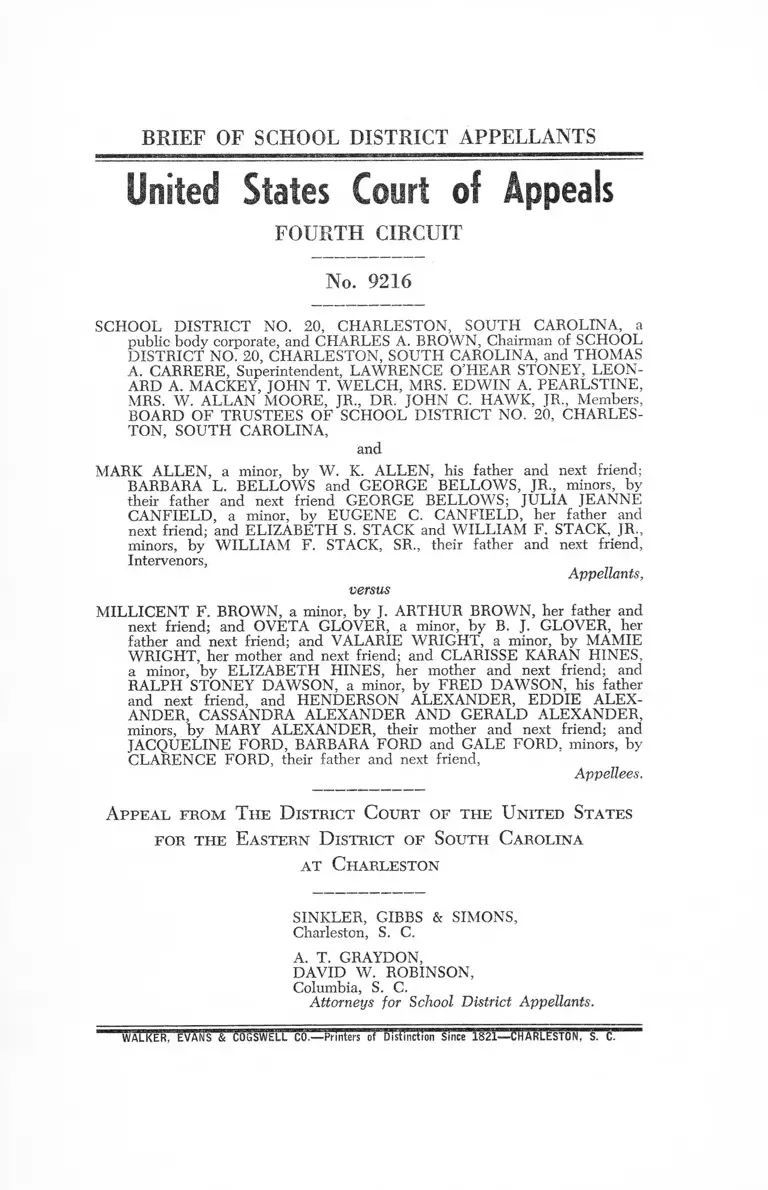
BRIEF OF SCHOOL DISTRICT APPELLANTS
United States Court of Appeals
FOURTH CIRCUIT
No. 9216
SCHOOL DISTRICT NO. 20, CHARLESTON, SOUTH CAROLINA, a
public body corporate, and CHARLES A. BROWN, Chairman of SCHOOL
DISTRICT NO. 20, CHARLESTON, SOUTH CAROLINA, and THOMAS
A. CARRERE, Superintendent, LAWRENCE O'HEAR STGNEY, LEON
ARD A. MACKEY, JOHN T. WELCH, MRS. EDWIN A. PEARLSTINE,
MRS. W. ALLAN MOORE, JR., DR. JOHN C. HAWK, JR., Members,
BOARD OF TRUSTEES OF SCHOOL DISTRICT NO. 20, CHARLES
TON, SOUTH CAROLINA,
and
MARK ALLEN, a minor, by W. K. ALLEN, his father and next friend;
BARBARA L. BELLOWS and GEORGE BELLOWS, JR., minors, by
their father and next friend GEORGE BELLOWS; JULIA JEANNE
CANFIELD, a minor, bv EUGENE C. CANFIELD, her father and
next friend; and ELIZABETH S. STACK and WILLIAM F. STACK, JR.,
minors, by WILLIAM F. STACK, SR., their father and next friend,
Intervenors,
Appellants,
versus
MILLICENT F. BROWN, a minor, by J. ARTHUR BROWN, her father and
next friend; and OVETA GLOVER, a minor, by B, J. GLOVER, her
father and next friend; and VALARIE WRIGHT, a minor, by MAMIE
WRIGHT, her mother and next friend; and CLARISSE KARAN HINES,
a minor, by ELIZABETH HINES, her mother and next friend; and
RALPH STONEY DAWSON, a minor, by FRED DAWSON, his father
and next friend, and HENDERSON ALEXANDER, EDDIE ALEX
ANDER, CASSANDRA ALEXANDER AND GERALD ALEXANDER,
minors, by MARY ALEXANDER, their mother and next friend; and
JACQUELINE FORD, BARBARA FORD and GALE FORD, minors, by
CLARENCE FORD, their father and next friend,
Appellees.
A p p e a l f r o m T h e D is t r ic t C o u r t o f t h e U n it e d St a t e s
f o r t h e E a s t e r n D is t r ic t o f So u t h C a r o l in a
a t C h a r l e s t o n
SINKLER, GIBBS & SIMONS,
Charleston, S. C.
A. T. GRAYDON,
DAVID W. ROBINSON,
Columbia, S. C.
Attorneys for School District Appellants.
W Al T<Er" ' iiEVANS i"& doGSWELL."'CO.— pVmt“ “ ''of' 1 mlslVn,”t!o7i“ lsince'"lS2X—"dFHARLESTON. S. C.
INDEX
P a g e
Statement of the Case_____________________________________ 1
Statement of Questions Involved___ ______________________ 4
Statement of Facts__________________________________ 4
Argument:
Question No. 1_______________________•____ ___________ 7
Question No. 2______________ 9
Question No. 3________________________________________15
Question No. 4__________________________ 16
TABLE OF CASES
P a g e
Briggs v. Elliott, 132 F. Supp. 776 (1955) _______________ 17
Brown v. Board of Education, 349 U. S. 294 (1955),
75 S. Ct. 753; 99 L. Ed. 1083 _________ _____________ 14, 16
Brunson v. Board of Trustees of School District No. 1
of Clarendon County, 4 Cir. 311 F. 2d 107, 109
(1962) __________________________________________________11
Burford v. Sun Oil Co., 319 U. S. 315, 63 S. Ct. 1098,
87 L. Ed. 1424 ___________ 11
Carson v. Warlick, 238 F. 2d 724, cert. den. 353 U. S.
910, 77 S. Ct. 665, 1 L. Ed. 2d 664 (1956) _________ 14,16
Jeffers v. Whitley, 309 F. 2d 621 (1962) ______________11,15
McNeese v. Board of Education, 373 U. S. 668, 83
S. Ct. 1433, 10 L. Ed. 2d 622 (June 3, 1963) ______ 11,13
Peterson v. City of Greenville, 373 U. S. 244, 83 S. Ct.
1119, L. Ed. 2 d _________________________________________ 16
Shelley v. Kraemer, 334 U. S. 1, 68 S. Ct. 836, 92 L. Ed.
2d 1161 _________________________________________________16
U. S. v. Cruickshank, 92 U. S. 542 ______ __________________ 16
BRIEF OF SCHOOL DISTRICT APPELLANTS
United States Court of Appeals
FOURTH CIRCUIT
No. 9216
SCHOOL DISTRICT NO. 20, CHARLESTON, SOUTH CAROLINA, a
public body corporate, and CHARLES A. BROWN, Chairman of SCHOOL
DISTRICT NO. 20, CHARLESTON, SOUTH CAROLINA, and THOMAS
A. CARRERE, Superintendent, LAWRENCE O’HEAR STONEY, LEON
ARD A. MACKEY, JOHN T. WELCH, MRS. EDWIN A. PEARLSTINE,
MRS. W. ALLAN MOORE, JR., DR. JOHN C. HAWK, JR., Members,
BOARD OF TRUSTEES OF SCHOOL DISTRICT NO. 20, CHARLES
TON, SOUTH CAROLINA,
and
MARK ALLEN, a minor, by W . K. ALLEN, his father and next friend;
BARBARA L. BELLOWS and GEORGE BELLOWS, JR., minors, by
their father and next friend GEORGE BELLOWS; JULIA JEANNE
CANFIELD, a minor, by EUGENE C. CANFIELD, her father and
next friend; and ELIZABETH S. STACK and WILLIAM F. STACK, ]R „
minors, by WILLIAM F. STACK, SR., their father and next friend,
Intervenors,
Appellants,
versus
MILLICENT F. BROWN, a minor, by J. ARTHUR BROWN, her father and
next friend; and OVETA GLOVER, a minor, by B. J. GLOVER, her
father and next friend; and VALARIE WRIGHT, a minor, by MAMIE
WRIGHT, her mother and next friend; and CLARISSE KARAN HINES,
a minor, by ELIZABETH HINES, her mother and next friend; and
RALPH STONEY DAWSON, a minor, by FRED DAWSON, his father
and next friend, and HENDERSON ALEXANDER, EDDIE ALEX
ANDER, CASSANDRA ALEXANDER AND GERALD ALEXANDER,
minors, by MARY ALEXANDER, their mother and next friend; and
JACQUELINE FORD, BARBARA FORD and GALE FORD, minors, by
CLARENCE FORD, their father and next friend,
Appellees.
A p p e a l f r o m T h e D is t r ic t C o u r t o f t h e U n it e d St a t e s
f o r t h e E a s t e r n D is t r ic t o f So u t h C a r o l in a
a t C h a r l e s t o n
STATEMENT OF THE CASE
This is a suit which was commenced by appellees who are
or were minor Negro school pupils enrolled in the Charleston
City Schools. The Complaint by its prayer sought to enjoin
( 1 )
the Charleston District No. 20 School Board from operating
a compulsory bi-racial school system in Charleston County
and asked the Court to direct the presentation of a plan for
desegregation by the School Board. (Ap., pp. 8-9).
The district involved encompasses the City of Charleston
and the defendant School Board has denied that there is
compulsory segregation of the races in the schools of the dis
trict. As to the particular Negro appellees, the School Board
averred that the procedures set out by Statute and the rules
of the School Board have not been followed by several ap
pellees and that four appellees who applied in 1961 had been
denied the right of transfer on non-racial grounds after proper
hearings.
As a further defense the School Board alleged certain ethnic
differences between the white and negro races which make
the education of the two races on a fully integrated basis de
structive of the educational system in the district. The School
Board asserted this position in its Answer ( Ap., pp. 15-19)
and again in its Petition for Amendment and/or Vacation of
the Order of the District Court (Ap., pp. 301-308).
The intervention of certain white pupils was permitted,
and the intervenors filed an Answer setting out the same gen
eral allegations as to ethnic differences between the races and
relied on that defense alone. The testimony in this regard
was presented by the intervenors and the School Board’s posi
tion ( stated in the Motion to Amend the District Court’s
Order) is substantially the same as that of the intervenors
with reference to that issue. No separate brief will be filed
by the School Board on that issue and the Court’s attention
is directed to the brief of intervenors.
Lengthy and exhaustive testimony was taken, principally
2 School D ist. No . 20 & M ark Allen , et a l , A ppellants, v ,
M illicent F. Brow n , et a l , A ppellees 3
on the ethnic issue, in hearings conducted in Columbia on
August 5 and 6, 1983.
The appellees’ case was based on the deposition of Thomas
A. Carrere, Superintendent of the School District involved
( Ap., pp. 34-46); certain interrogatories and answers (Ap., pp.
47-57); and the testimony at the trial of Mr. Carrere (Ap.,
pp. 71-84), and of the chairman of the Board of School Dis
trict No. 20 (Ap., pp. 84-85) and of the Supervisor of negro
schools for the District ( Ap., pp. 85-91).
The portion of the record relating to the administrative
procedures issue is contained in pages 92-100 of the Appendix
and on pages 248-276 of the Appendix. That testimony and
the records will be reviewed under Point 2.
On August 22, 1963, District Judge Martin issued an Order
directing the enrollment of 11 of the appellees “at the white
school, where a white child would normally attend . . . ”
The Order restrained the Board from refusing admission, as
signment or transfer of other negro children on the basis of
color for the year 1964-65, enjoined the Board from “futile,
burdensome or discriminatory administrative procedures” and
set out specific administrative procedures to be followed. The
Order also allowed the Board to file a school desegregation
plan but provided for the Court-ordered plan to remain in
effect until such a plan is presented and approved.
The School Board defendants moved to amend and/or va
cate Judge Martin’s Order, and the grounds for the appeal
by these appellants ( School District No. 20, its Board of Trus
tees and its Superintendent) are set out on pages 297-301 of
the Appendix. An exception relating to the administrative
directions contained in the order is set out in paragraph 14
of Part III of the Petition (Ap., p. 308).
The petition was refused by Judge Martin on September
5, 1963, and the appeal to this Court followed.
STATEMENT OF THE QUESTIONS INVOLVED
1. Was the procedure provided by the South Carolina
Statutes for transfer of pupils, and the rules promulgated
pursuant thereto by the Charleston County Board of Educa
tion, adequate?
2. Were the procedures properly followed by the Board
of Trustees of School District No. 20 and the Charleston
County Board of Education?
3. Even if the procedure under the statutes and rules were
found inadequate or if the same were not properly followed
by school authorities, did the District Judge err in specifying
and promulgating administrative rules for the operation of
the schools?
4. Was there any basis for findings by the District Court
that the schools were operated on a basis of compulsory segre
gation enforced by the School Board?
STATEMENT OF FACTS
No negro child has ever presented himself for initial enroll
ment at the first grade level in a school other than one at
tended by negro children in the City of Charleston (Ap. 51
and 100). Prior to the applications of the plaintiffs in this
suit, the first of which were in the fall of 1960, no negro stu
dents had ever applied for transfer to a school other than
one attended by negro children.
In October of 1960, several negro pupils, including most
of the plaintiffs in this suit, filed applications for transfer to
schools up to that time attended only by white children. The
Trustees of the School Board replied promptly to these ap
4 School D ist. N o . 20 & M ark Allen , et a l , A ppellants, v .
M illicent F. Brow n , et a l , A ppellees 5
plications for transfer, advising that the time for applying
for transfer under the Board’s regulations had passed and that
the requested assignments could not be considered. The rules
and administrative procedures under which these transfer ap
plications were denied (Ap. 248) require filing of such appli
cations four months in advance of the opening of school, and
since the 1980-196.1 school year had already started, these
applications were not timely. The applicants processed their
applications pursuant to the rules and administrative pro
cedures and pursuant to South Carolina law (Ap. 313 et seq.)
by appeal to the County Board of Education from the School
Board’s denial. The School Board filed a return to the appeal
and the County Board of Education held a hearing and af
firmed the School Board’s action. The County Board of Educa
tion held that the four-months rule was a reasonable one and
that there had been no abuse of discretion in its application.
Reproduced in the Appendix, beginning at p. 251 and ending
at the middle of p. 258, are the 1960 proceedings with respect
to three Ford children; similar proceedings were separately
had with respect to all the other 1960 applicants and sub
stantially similar disposition made of their applications.
Nothing further was done following the County Board of
Education’s dismissal of the 1960 petitions for transfer. The
1960 proceedings involved the Alexander, Dawson, Ford,
Glover, Hines, Wright, Toomer and Seabrook children.
In 1961, a different Brown child but the same Dawson,
Glover, Hines, Wright and Seabrook children applied for
transfer, this time early in May and more than four months
prior to the opening of the schools for the 1961-1962 year.
All these children were given a hearing by the defendant School
Board. Prior to the hearing, the Board conducted a thorough
investigation into each child’s record, background and per
sonality, considering all available pupil records and interview-
mg the school Principal in each case, as well as their teachers
wherever possible. On the basis of such investigation and
hearing the Board concluded as to each applicant that it was
to his or her best interests educationally to remain in the
school from which transfer was being sought.
The negro children appealed the Board’s determination to
the County Board of Education and upon a hearing de novo
that body concluded that the School Board’s action was predi
cated upon the welfare and interests of the child for whom
transfer was sought and that the propriety of the School Board’s
denial of such transfer was abundantly supported by the rec
ord.
Reproduced in the Appendix, beginning at p. 258 and end
ing on p. 273, are the 1961 proceedings with respect to the
Wright child; similar proceedings were separately had with
respect to the Brown, Dawson, Hines and Seabrook children
and substantially similar disposition was made of their appli
cations. The Glover child did not appeal to the County Board
of Education from the defendant School Board’s denial of her
transfer application.
The plaintiffs in this suit accordingly comprise: (1 ) Milli-
cent Brown, Valarie Wright, Clarisse Hines and Ralph Stoney
Dawson, all of whom completed the South Carolina statutory
administrative procedures under the defendant School Board’s
rules and administrative procedure; (2 ) the Alexander and
Ford children, who did not participate in the 1961 transfer
applications following denial of their 1960 applications on the
ground of the four-months rule; and (3 ) Oveta Glover, who
only partially completed the South Carolina statutory adminis
trative procedures.
The Toomer and Seabrook children did not join in the
suit and subsequent to the filing of the suit the plaintiff Valarie
6 School D ist. N o . 20 & M ark Allen , et a l , A ppellants, v .
M illicent F. Brow n , et a l , A ppellees 7
Wright and one of the five Alexander children, Henderson
Alexander, ceased to attend the Charleston schools.
A factual summary of the administrative procedure in this
case is contained in the discussion of Question 2 below.
ARGUMENT
1. The Statutory procedure and rules promulgated by
School District No. 20 were adequate.
Whether the statutes and rules were adequate is not to be
determined by the results obtained under those rules but by
the statutory enactments and rules themselves. Improper ad
ministration of the procedure would not invalidate the rules
if they are adequate when properly administered.
If the hearings held pursuant to the rules had resulted in
the admission of one or more negroes to Charleston’s white
schools, then there would be no complaint by appellees about
the procedure. But that was not the case, and the District
Judge has held the rules and regulations inadequate because
“they fail to establish a right of choice, to a child or his
parents, at the time of enrollment and the announcement of
such right of choice made known to the parents of pre
school children.” (Ap., p. 291).
But the District Judge found that “No formal application
has been made by any negro child to enter a white school at
the first grade level.” All of the appellees had petitioned for
transfer to a white school.
What the District Judge has done is to find that the rules
and regulations are inadequate because the School Board failed
to grant the requests of appellees for transfer.
The Statute (Section 21-230 ( 9 ) ) provides that school trus
tees shall “Transfer any pupil from one school to another so
8 School D ist. No . 20 & Mark Allen , et a l , A ppellants, v .
as to promote the best interests of education, and determine
the school within its district in which any pupil shall enroll.”
(Ap„ p. 313).
Sections 21-247—21.247.6 provide a remedy for a parent who
does not agree with the action of the Board of Trustees of
the School District upon an application for transfer. (Ap., pp.
314-315) That procedure, in summary, is as follows:
(a ) An appeal to the County Board of Education by peti
tion;
(b ) Separate hearings de novo by the County Board of
Education;
(c ) An appeal to the Court of Common Pleas upon the
record below from any order of the County Board
of Education;
(d ) An appeal to the Supreme Court of the State.
The rules and administrative procedures adopted by the
School Trustees provided for: (Ap., pp. 248-250)
(a ) Written applications for a request for transfer to be
filed four months before the opening of the schools concerned;
(b ) Reasons for the transfer set out in the application;
(c ) Standards for the Board to follow in passing on such
applications including “scholarship attained, age, culture, daily
companions and associates, intelligence, whether the educa
tion of applicant and his standing in class better fits him to
the school in which he has been enrolled or the one men
tioned in the application, and such further facts and standards
as may be in the public interest for the promotion of educa
tion and to protect the health, morals, and general welfare
of the community.”
M illicent F. Brow n , et a l , A ppellees 9
(d ) Written notice of the Board’s public hearing;
(e ) A public hearing;
( f ) Right of appeal to the County Board of Education
and the Courts.
No mention of race is made in the statutes or the rules. If
pupils are to be given the unquestioned right to transfer upon
application, the orderly administration of the schools would
end.
The District Judge has not specified wherein the statutes
and rules are inadequate, and we assert that the procedure
is entirely reasonable and adequate. The lack of positive
provisions promoting “free choice” in no wise shows that the
rules are inadequate.
The statute and rules were there for the use of any parent;
clearly they are not inadequate as a matter of law.
2. The procedures were properly followed by the School
Board in this case.
The exact procedures set out by the statutes and rules and
regulations of the School Board were followed in this case.
The 1960 application for transfers to white schools, all of
which were filed in October on behalf of 12 of the appellees,
were all rejected because the 1960-1961 term was underway;
the rule provided for the submission of applications four
months before the opening of school. Eight of these ap
plicants took no further administrative steps although the Dis
trict Judge found that their applications would have been
denied had they pursued the administrative relief.
The primary purpose of a school system is education, and
in order for there to be any reasonable chance of conveying
an education to the pupils, a system is necessary—even im
perative. Overcrowded conditions and disruption of orderly
educational processes is destruction of education itself.
There was no contention on the trial (and there can be
no good faith contention) that the Board acted improperly in
rejecting the applications for transfer in the middle of the
school year. The District Judge recognized the danger and
impracticability of wholesale transfers in 1963-1964. The Dis
trict Judge recognized by his Order the impropriety of in
term transfers.
These denials were therefore entirely proper.
W e come, therefore, to the applications for transfer which
were filed in May, 1961. The four applications with which
this appeal is concerned were filed as required and the fol
lowing is the chronology of the handling of these applications.
1. May 1st: Applications for transfer filed.
2. May 5th: Receipt of application acknowledged by
School Board.
3. July 12th: Hearing set before School Board for July
19th.
4. July 19th: Hearing held.
5. July 29th: Denial of transfers recommended by Spe
cial Committee of the School Board as not
being in “best interests” of children in de
tailed report on each child. ( Ap. pp 260-
267).
6. July 31st: Petition for transfer denied by School Board.
7. August 10th: Petitions filed with County Board of
Education.
10 School D ist . No . 20 & M ark Allen , et a l , A ppellants, v .
M illicent F. Brow n , et a l , A ppellees 11
8. August 29th: Return filed by School Board asking
that petition to County Board be dis
missed.
9. January 18th, 1962: Appeals dismissed by the County
Board of Education after hear
ing de novo.
The various applications have been handled in exact ac
cordance with the statutory directives and procedures and
there is nothing in the pleadings or in any of the record which
indicates that race was the factor, or even a factor, which
motivated the denials of these transfers.
The various applications were handled on an individual
basis, for the rights are individual, and nothing in this record
would indicate a better or preferable method of treatment.
In Brunson v. Board of Trustees of School District No. 1
of Clarendon County, 4 Cir. 311 F. 2d 107, 109 (1962) the
Court said:
“As we stated in Jeffers [v. Whitley, 4 Cir. 309 F. 2d 621
(1962)], we have held that rights under the Fourteenth
Amendment are individual and are to be individually asserted
only after individual exhauston of any reasonable state reme
dies which may be available ®
The “state remedies” referred to in Brunson are, of course,
administrative and procedural, Burford v. Sun Oil Co. 319 U. S.
315, 63 S. Ct. 1098, 87 L. Ed. 1424, and not rights given by
state law in state litigation, McNeese v. Board of Education,
373 U. S. 668, 83 S. Ct. 1433, 10 L. Ed. 2d 622 ( June 3, 1963).
The facts in the instant case distinguish it from Jeffers v.
Whitley, 4 Cir. 309 F. 2d 621 (1962).
Here the administrative remedies, as administered, cannot
be called “ unnegotiable obstacle courses;” there has been no
“invariable denial of interracial transfer requests;” they cannot
be said to accord only “freedom of choice at the first grade
level, without any right of choice thereafter;” and in the ad
ministrative hearings held by the Board of Trustees and the
County Board of Education there has been no “general disre
gard by the School Board of the constitutional rights of negro
pupils who do not wish to attend schools populated exclusively
by members of their race.”
Charleston children attend schools with other children of
their own race in the absence of applications to attend specific
schools. It is clear that the Board was warranted in conclud
ing that such voluntary attendance did not conflict with their
constitutional rights. A voluntary separation of the races in
schools “is uncondemned by any provision of the Constitution,”
Jeffers v. Whitley, supra, at p. 627 of 309 F. 2d, and failure
to apply to attend a specific school reasonably indicates satis
faction with the Board’s school “assignment” practice.
The court recognized in Jeffers v. Whitley, supra, at p. 628
of 309 F. 2d, that administrative remedies “have a place in a
voluntary system of racial separation,” and that in such a
system “a school official might still deny a particular request
upon grounds thought not to undermine the voluntary nature
of the system.” “In that event,” the court said, “it would be
appropriate for the state to provide the applicant effective
means of administrative review, and failure to pursue an ade
quate administrative remedy might foreclose judicial interven
tion.”
Although the court found in Jeffers that the School Board
had been “obstinate in refusing to recognize the constitutional
rights of Negro applicants,” it held that the plaintiffs were
not entitled to an order “requiring the School Board to effect
a general intermixture of the races in the schools.”
12 School D ist. No . 20 & M ark A llen , et a l , Appellants, v .
M illicent F. Brow n , et a l , A ppellees 13
The applications here involved were handled by the Board
of Trustees and by the County Board of Education on the
basis of the educational best interests of the respective ap
plicants, as found by the Boards from the showing made, and
not on the basis of their race. They were all transfer applica
tions, and no circumstances appeared which negatived the
usual conclusion that it is educationally in the best interest
of a school child to continue in the class of which he or she
has become a part.
It is respectfully submitted that the evidence does not show
compulsive segregation, like that found in Jeffers; on the con
trary, there is here a total absence of evidence of “official
coercion or compulsion.”
Hence, the question presented to the Court is whether the
rejections of the transfer applications by the Board were sus
tained by, or were unwarranted under,, the evidence adduced
before it, and not whether they were assigned to schools in
violation of their constitutional rights. In other words, the
case made before the Court is not a Fourteenth Amendment
case at all, but presents only the issue whether the transfer
applications of those who petitioned the County Board of
Education to review the action of Board of Trustees were
properly handled.
McNeese v. Board of Trustees, etc., supra does not support
a contention that school children and their parents may ignore
the rules of the Board of Trustees relating to school assign
ments.
What McNeese held, and all that it held, was that a Federal
Court should not fail to act upon a claim arising under the
Fourteenth Amendment because state law also afforded a
right to relief maintainable in state court litigation; the Court
added that the administrative remedy relied on was not suf
14 School D ist. No . 20 & M ark A llen , et a l , A ppellants, v .
ficiently adequate to warrant the Court to follow the self-
restraint principle, since the petitioners there did not have an
absolute right to invoke the administrative procedure provided
by state law.
What the late lamented judge John J. Parker said in Carson v.
Warlick, 238 F. 2d 724, cert. den. 353 U. S. 910, 77 S. Ct.
665, 1 L. Ed. 2d 664 (1956) puts this case in the proper
perspective:
“Somebody must enroll the pupils in the schools. They
cannot enroll themselves; and we can think of no one
better qualified to undertake the task than the officials
of the schools and the school boards having; the schools
in charge. It is to be presumed that these will obey the
law, observe the standards prescribed by the legislature,
and avoid the discrimination on account of race which
the Constitution forbids. Not until they have been ap
plied to and have failed to give relief should the courts
be asked to interfere in school administration. As said by
the Supreme Court in Brown v. Board of Education, 349
U. S. 294, 299, 75 S. Ct. 753, 656, 99 L. Ed. 1083:
‘School authorities have the primary responsibility
for elucidating, assessing and solving these problems.
Courts will have to consider whether the action
of school authorities constitutes good faith imple
mentation of the governing constitutional priciples.’ ”
In the instant case all the plaintiffs are concerned with trans
fer applications and no initial assignments are involved, but
in any situation, whether transfer or assignment, obviously
some administrative action by school officials must necessarily
be involved, otherwise chaos would result in the school system
from whimsical and uncontrolled assignments and transfers.
M illicent F. Brow n , et a l , A ppellees 15
The factual investigation required for determination in this
case is whether or not the school officials have been refusing
the transfer of pupils on the basis of race. Such an investiga
tion was made in Jeffers v. Whitley, supra, in which this Court
held that the North Carolina Pupil Placement Act, previously
approved by it, was in that particular instance being uncon
stitutionally administered so as to result in discrimination and
inadequate remedy. It appeared in that case that the schools
of Caswell County, North Carolina, had been compulsively
administered so as to result in segregation, and that the ad
ministrative process had been used consistently and solely to
prevent freedom of choice. Certainly no such proof is present
in this case, where the plaintiffs have proved no more than a
voluntarily segregated school system and where they have
not sought to establish in any particular whatsoever, an in
adequate or discriminatory handling of the administrative pro
cess.
The defendant School Board’s proof establishes a prompt
and full hearing and an impartial and thorough investigation
of the transfer applications, with no intimation of any racial
overtones in any way affecting the final administrative determ
ination.
3. Even if the procedure and rules were deemed inade
quate, the District Judge erred in specifying and promulgat
ing rules for the operation of the schools.
While it is the position of the School Board, as set out
above, that the procedures and rules were adequate ( Ques
tion 1) and were properly administered (Question 2 ), the
inadequacy of the statutes and rules or the improper ad
ministration of adequate statutes and rules is no basis for the
District Court to take over the administration of the Charles
ton County School System.
In the sixth paragraph of that Court’s Order (Ap. p. 294-
295) the District Judge set out and decreed the specific ad
ministrative procedure and even went so far as to prescribe
the notice to be given, the time for such notices to be mailed
to parents of pupils. The Court even provided that variances
from the methods prescribed must be done only with that
Court’s approval.
The United States Courts are the proper forum for the
supervision of desegregation of schools which are within its area,
and the propriety of using the United States District Courts
for that purpose has been recognized by the Supreme Court
in the Brown decision and subsequent cases involving de-
segration of public schools.
But this does not mean that the courts are to take over the
school system and prescribe administrative procedures. For
this is a function of school boards, and as Judge Parker said
in Carson v. Warlick, supra'.
“We can think of no one better qualified to undertake the
task than officials of the schools and the school boards hav
ing the schools in charge.”
4. Was there any basis for findings by the District Court
that the schools were operated on a basis of compulsory
segregation enforced by the School Board?
The Fourteenth Amendment applies only to state action.
Civil Rights Cases, 109 U. S. 3; U. S. v. Cruickshank, 92 U. S.
542; Peterson v. City of Greenville, 373 U. S. 244, 83 S. Ct. 119,
L, Ed. 2d; Shelley v. Kraemer, 344 U. S. 1, 68 S. Ct. 836, 92
L. Ed. 1161.
Therefore, even though racial segregation existed, the record
must show that it was compulsorily maintained and enforced
by the Board. See Brown v. Board of Education, 349 U. S.
16 School D ist . N o . 20 & M ark Allen , et a l , A ppellants, v .
M illicent F. Brow n , et a l , A ppellees 17
294 (1955); 75 S, Ct. 753, 99 L. Ed. 1083; Briggs v. Elliott,
132 F. Supp. 776 (1955).
There is no evidence in the record of racial discrimination
by the Board. The 1960 transfer requests of the plaintiffs
were refused on grounds relating solely to the timeliness of
the requests and the adverse effect of a mid-year transfer on
the pupils. There is no evidence that race was a factor. Of
the four 1961 transfer applicants who exhausted the adminis
trative procedures, two would have continued in the same
negro schools if all pupils in the district had then been re
assigned to schools on a purely geographical basis and a third
graduated in 1962. There is no evidence that race was a
factor in the refusal to reassign the fourth, or that the Board’s
decision was unreasonable.
There is absolutely no evidence to support the findings of
the District Court that the transfer requests of these plaintiffs
who failed to exhaust their administrative procedures would
have been denied ultimately.
In each case the plaintiffs were given prompt and impartial
hearings and determinations were based upon their individual
educational best interests.
No initial assignments were made by the Board to segre
gated schools. Each parent picked a school for his child on
the first day of his first school year. The school to be attend
ed was not in any way controlled by the Board or by official
pre-school clinics or enrollment procedures.
No Negro parents ever sought to enter their pupils in white
schools before the transfer attempts of these plaintiffs.
The Board’s rules and the placement law had been uni
formly applied by the Board. Plaintiffs’ transfer requests were
the first received by the Board after the new rules were
18 School D ist. N o . 20 & M ark A llen , et a l , A ppellants, v .
adopted in 1959. There is no evidence that transfer requests
from white pupils would have been handled differently.
On the basis of the foregoing, we respectfully submit that
the administrative procedures followed by the appellant School
Board were entirely adequate and reasonably implemented
by the School Board without racial motivation, and that there
is no basis in the record for the District Court’s finding that
the Charleston schools have been operated on the basis of
compulsory segregation, and lastly, that the District Court
had no authority to specify and promulgate rules for the op
eration of the Charleston schools, and that the Order Below
should accordingly be reversed.
Respectfully submitted,
SINKLER, GIBBS & SIMONS
DAVID W. ROBINSON
A. T. GRAYDON
Attorneys for Appellant School Board.