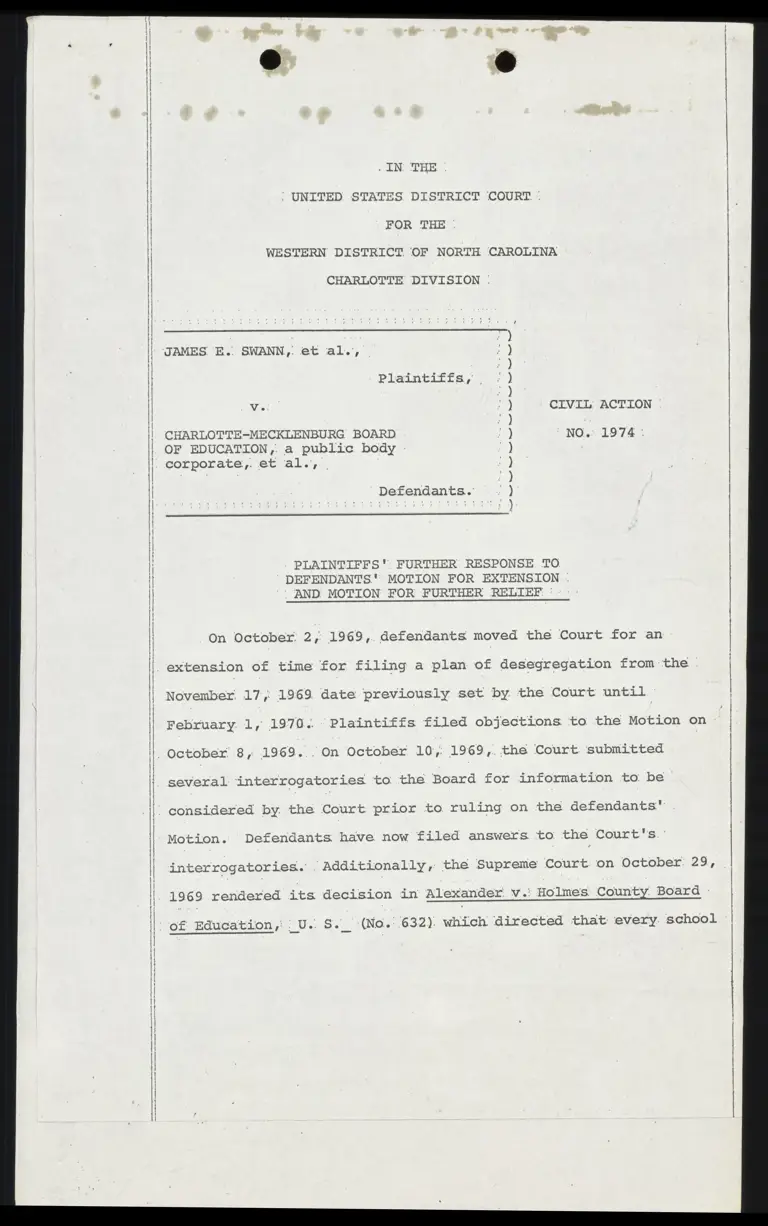
Plaintiffs' Further Response to Defendants' Motion for Extension and Motion for Further Relief
Public Court Documents
October 31, 1969
9 pages
Cite this item
-
Case Files, Swann v. Charlotte-Mecklenburg Hardbacks. Plaintiffs' Further Response to Defendants' Motion for Extension and Motion for Further Relief, 1969. d7dabe73-2e34-f111-88b4-7c1e526962fd. LDF Archives, Thurgood Marshall Institute. https://ldfrecollection.org/archives/archives-search/archives-item/0fca1320-d70b-4058-8359-edac7db06be2/plaintiffs-further-response-to-defendants-motion-for-extension-and-motion-for-further-relief. Accessed June 02, 2026.
Copied!
[||ac2f47b7-6744-45c1-bd98-9e824d36c233||] SS
S
S
JAMES E. SWANN, et al.,
..corporate,. et al., .
INTHE
. UNITED STATES DISTRICT COURT .
FOR THE .
WESTERN DISTRICT OF NORTH CAROLINA
CHARLOTTE DIVISION .
Plaintiffs,
5 1 SN CIVIL ACTION .
CHARLOTTE-MECKLENBURG BOARD NO. 1974 .
OF EDUCATION, a public body
Defendants.
PLAINTIFFS' FURTHER RESPONSE TO
" DEFENDANTS' MOTION FOR EXTENSION .
© AND MOTION FOR FURTHER RELIEF ‘© -
On October 2, 1969,. defendants moved the Court for an
extension of time for filing a plan of desegregation from the
November 17, 1969 date previously set by the Court until
February 1, 1970. - Plaintiffs filed objections to the Motion on
. October 8, 1969... On October 10, 1969,. the Court submitted
several interrogatories to the Board for information to be
considered by the Court prior to ruling on the defendants"
Motion. Defendants have now filed answers to the Court's.
- of Education, . U. S._ (No. 632) which directed that every school
district "terminate dual school systems at once and...operate
now and hereafter only unitary schools." (Emphasis added.)
(A copy of the decision is attached hereto as Exhibit A.)
District Courts were permitted to hear objections or proposed
amendments to. desegregation plans but only after school districts
have effectively completely desegregated.
Defendants’ answers to the Court's inquiries, together with |
that the Court direct institution of a plan of desegregation
which will ‘immediately and effectively accomplish ‘a unitary
school system.
1. The Court concluded in its order of April 23, 1969
that "the law has moved from an attitude barring discrimination
to an attitude requiring active desegregation;" "that [t]he
manner. in which ‘the Board has located schools and operated the .
pupil assignment system has continued and in some situations
accentuated patterns of racial segregation in housing, school
attendance and community development," that the "majority of the .
black students, however, still attend segregated schools and
seldom, if ever, see a white fellow student. Many all-black and
all-white schools still remain. . The neighborhood school concept : |
and freedom of choice as administered are not furthering
desegregation." . The Court directed that the Board submit a plan
for desegregation "to be predominantly effective in the fall of
1969 and to be completed by the fall of 1970."
2.. The Board submitted a plan, pursuant to the Court's.
. directive, on May 28, 1969. . As found by the Court. in:its order
of June 20, 1969, the plan was basically the ‘same as ‘that re-
jected in the April: 23rd order. . The Court rejected the plan
and ordered that the defendants submit a new plan. : The Court :
- found that the Board's freedom of choice provision increased
rather than decreased segregation and that
| m2
|
|
|
|
|
| . the Court finds as a fact that no
. zones ‘have apparently been created
| or maintained for the purpose of
| promoting desegregation; that the
| whole plan of "building schools °
| where the pupils are" without further .
| control promotes segregation; and
| . that certain schools, for example
| ' Billingsville, Second Ward, Bruns
Avenue and Amay James, obviously
serve school zones which were either
| created or which have been controlled
| ~. 80 as to surround pockets of black
i students and that the result of these .
actions is discriminatory. . These are
not named as an exclusive list of such
| situations, but as illustrations of a
; long standing policy of control over. the .
| makeup of school population which scarcely
fits any true "neighborhood school™
| philosophy. Frye Sl
| 3. ‘on July 29, 1969, the Board submitted a new plan which . |
proposed an affirmative policy of desegregation, increased
. desegregation of teachers and the closing of 7 ‘inner-city black .
schools. = The Board advised the Court that 3000 black students would be affected by the closing of the black schools and would
be assigned to previously all-white or predominantly white .
schools. Additionally, the Board proposed to reassign 1245 °
black students to all-white schools or predominantly which .
schools from overcrowded black schools. . Thus,’ 4245 black
students would be reassigned to further desegregate the school
system.’ The Board retained, however ,. freedom of choice for these students and proposed no assignment of white students
. to predominantly or all black schools. | By order dated August 15, .
1969, the court reluctantly approved the amended plan finding
! the affirmative policy statements of the Board, the steps toward
. desegregation of staffs, the reassignment of the 4245 black
- desegregation of the school system. . The Court made clear,
. however, that it would no longer tolerate one-way (Negro to
students, the Board's proposal to reevaluate its building
program and attendance lines and the proposed compensatory
educational program to constitute substantial steps toward
white). desegregation and directed that the Board present on or
before November 17, 1969 a plan for complete desegregation.
4. e0n August 31, 1969, plaintiffs moved the Court for
further relief alleging that the defendants had failed to im=-
plement even the minimal steps promised or directed in the .
Court's order of August 15, 1969... The information filed by the .
Board pursuant to the Court's inquiries substantiates plaintiffs'
allegations:
a. . Of the 3000 students from the closed
all-black schools 1242 are assigned
to predominantly white schools; 844:
remain in all-black schools; 914 ‘are .
unaccounted for. fo
_b. . Of the 1245 black students in over-
crowded classes only 73 have now been
reassigned to predominantly white
schools.
(The Board states that it is concerned
about the responses of the black .
students and parents ‘and it should be,
for it has promised the Court that an
additional 4245 black students would
be assigned to integrated schools for
this ‘school year when neither the plan
nor its subsequent administration by
the Board was designed to accomplish .
this objective. = And the facts now .
supplied the Court clearly demonstrate .
that what was promised and anticipated
simply has not been accomplished.)
c. . The freedom of choice chart supplied by
the Board does not reflect the number
of students, white and black, who have:
opted out of schools in which their race .
is in the minority to schools ‘in which .
their race is ‘in the majority. Plaintiffs
are advised that these students are .
—l
automatically reassigned to schools
. chosen the following year and are not :
- reflected in the statistics having
freedom of choice results for this
school year. Moreover, and contrary
. to the Board's. assertion, the statistics
| supplied clearly show that freedom of
. choice is not further desegregating the .
system but perpetuating segregation. Of
the 4500 black students who were to be |
in predominantly white schools this
year, approximately 2000 have elected,
. under freedom of choice to. attend all=-
. black schools. © And, as examples,
Barringer, 20% black,. lost 10 whites;
' Billingsville,: 100% black, lost 2 whites;
. Bruns Avenue,’ 99% black,. lost 2 whites;
Elizabeth, 91% black, lost '18 whites;
. Amay James, 99% black, lost 25 whites;
| - Piedmont 89% black, lost 27 whites; West :
Charlotte, the only black senior high .
school, lost 3 whites.
(The Board has not shown, and
plaintiffs submit, cannot show, any
| . constitutionally permissible basis for
. continuing freedom of choice. Its de=-
. sign and purpose here was clearly to
serve as safety value to permit students
. to escape integrated schools. Its"
purpose has been served and its con-
. tinued use should be enjoined now. : Green.
vv. School Board of New Kent County, 391.
‘State Board of Education, . F. Supp. , .
Ts el, vp. 7235 W. D.K.. Cu)
March. 31, 1966). |
. desegregate ‘teachers and school personnel
much more is required to eliminate the .
- racial ‘identities of staff and school °
personnel at the various schools.
Exhibit "D",. attached to the Board's
answers, reveals several schools with 1,
| 3 'and 4 ‘teachers of the opposite race.
More important, however, is ‘the continued
reluctance of the Board to assign black
- personnel to special duties, coachers,
guidance personnel, etc.. :
_ e. | The Board has failed to provide the
. compensatory educational program out-
lined in its ‘amended plan and commended
by the Court. We are now told that the .
' Board intends to make a request for the .
- funds to institute what the Board
promised would be ongoing at ithe Dgue s.r
i ginning of the school year. Despite the .
"one-way desegregation, many Negro
students have accepted reassignment to
©
{
|
|
|
|
|
|
d. While the Board has taken some steps to
|
|
H
|
|
|
integrated schools. Many had
anticipated that the promised pro-
grams would be fully implemented to
aid their OS and adjustment.
: Once again, however, they are ‘told
sometime ‘in the future.
£. Most telling ‘of. the Board's. statistic
. that the Board's practices and policies -
are perpetuating segregation is
Exhibit "D". Thus, for example, Billings-
i ville, adjacent to 5 white schools, had
no white students ‘in 1965, 2 in 1968 and
| none for 1969; Hidden Valley, adjacent
3 EO predominantly black Tryon Hill, has no
. black students; Barringer had no black |
students in 1965 ‘and now is 98% black;
Elizabeth, Lakeview, Tryon Hills, Haw-
. thorne and Piedmont have had similar
- results.
g. Eleven schools in this system today re-
; "main all-black, 8 remain all-white; 10
- black schools have less than 10 per cent
B white students; 36 white schools have .
| : 10%8%0or less black students, eight
. thousand one hundred and sixty black
students attend school with no integration;
' 6605 white students have no hlack students
at their schools; 26,688 white students
| and 3432 black students attend schools
|
with less than ten percent of the students
of the opposit race..
Now with respect to the Board's request for delay.
Plaintiffs have previously moved the Court that the Court
| appoint its own educational consultant to devise a plan for
. complete desegregation of the school system for Board action
and the responses now given the Court make clear that the .
- Board will not carry out its constitutional duties as directed.
. The Board contends that it has commissioned Mr. 3. W. Weil -
. to devise new attendance areas which will affect all schools
and that it will take 3 months to redraw the attendance areas ' |
as planned. Redrawing the attendance lines, however, will not:
. desegregate all ‘schools -- "Dramatic results are expected.
It is hoped that the number of all white and all black schools will be substantially reduced. : The number of such schools cannot be determined at this time." (Answer to question 7 ‘of
the Court, p.7 of the Board's Report): And despite the failure . |
I
f
I
|
CPS
| -6
|
t
I
i
i
|
|
|
|
|
i
|
i
|
of the Weil plan to completely desegregate, the Board will
. consider other methods only "where practical, educationally
feasible and where such techniques offer reasonable prospects °
| of producing stable desegregation (Emphasis added.) in such .
affected schools." (Answer to question 6 of the Court, p.7
of Board's Report) "The Board does not feel that it will
|
|
| be possible to produce pupil desegregation in each school by
| September 1970....[T]he restructuring of attendance lines
| coupled with faculty desegregation may satisfy constitutional
ji requirements." (Emphasis added.) (Answer to question 8 of the
Court, p.8 of Board's Report) = The Board clearly promises
. to do no more than what it wants to do and when it wants to
notwithstanding the Court's directive and constitutional
requirements. Plaintiffs submit that the Board's Report :
plementing its alleged policy statements on desegregating the
school system. Even without Alexander, the Report requires that].
. the motion be denied and that the Court take other steps to
|
f
|
|
|
| patently demonstrate that the Board has no intention of im-
|
|
!
|
| insure desegregation "at once." = With Alexander, plaintiffs
- respectfully submit that the motion should be denied and that °
. the Court should proceed forthwith to devise and institute a
plan which will immediately and effectively establish a
unitary, non-racial school system "now and hereafter".
WHEREFORE, plaintiffs renew their objections to defendants’
motion for extension of time and again move the Court for
apointment of educational consultants to devise a plan for
opiate desegregation to be instituted forthwith. Plaintiffs -
further move that the Court now specifically enjoin any further
construction or additions pending the adoption and implemen- tation of a Court approved plan of desegregation. Plaintiffs
further renew their prayers for relief and for show cause filed
Cl
« !
| ® tH
il
|. August 31, 1969 and in their Response £iled Ocitber 8, 1969.
| Respectfully submitted,
}
| CONRAD 5. “PEARSON
| 203 '1/2 ‘East Chapel Hill Street
Durham, North Carolina
|
CHAMBERS, STEIN, FERGUSON and LANNING .
216 West Tenth Street
Charlotte, North Carolina
JACK GREENBERG.
{
|
|
|
| JAMES M. NABRIT, III .
| NORMAN CHACHKIN
|
|
{
10 'Columbus Circle .
New York, New York
ATTORNEYS FOR PLAINTIFFS
' CERTIFICATE OF SERVICE :
. The undersigned hereby. certifies that copies of the fore-
going Further Response and Motion were served upon defendants -
. by depositing copies of same in the United States mail, postage
prepaid and addressed to:
Mr. William J. Waggoner
Weinstein, Waggoner, Sturgis: & ‘Odom
11100 Barringer Office Tower
. Charlotte, North Carolina
Mr.. Brock Barkley
Law Building .
- Charlotte, North Carolina
Mr. Gaston Gage .
Law Building
Charlotte, North Carolina
Honorable Robert Morgan
Attorney General
State of North Carolina
‘Raleigh, North Carolina
|
|
|
|
|
|
{|
i
ll
I Mr. Andrew Vanore, Jr.
| taff Attorney
I . Office of ‘the Attorney General
|
|
|
|
|
|
{
|
t
|
State of North Carolina
| Raleigh, North Carolina
sy
This 2): day of October, 1969.
|
tH
| | nN Sil
| 3 Sh CFs: a!
Att torney For Pale
EXHIBIT A
UNITED STATES SUPREME COURT
OCTOBER TERM 1969
NO. 632
ALEXANDER v. HOLMES COUNTY
BOARD OF EDUCATION OCTOBER 29, 1969
These cases come to the Court on a petition for certiorari
to the Court of Appeals for the Fifth Circuit. The petition was
granted on October 9, 1969 and the case set down for early argument.
The question presented is one of paramount importance involving as
it does the denial of ™ndamental rights to many thousands of school
¢hil“xen who are presently attending Mississippi schopls under
segregated conditions contrary to the applicable decisions of this
Court. Against this background, the Court of Appeals should have
denied all motions for additional time because continued operation
of segregated schools under a standard of allowing all deliberate
spced for desegregation is no longer constitutionally permissible.
Under explicit holdings of this Court, the obligation of every
scheol district is to terminate dual school systems at once and to
oparate now and hereafter only unitary schools. Griffin v. Schocl
Board, 377 U.S. 218, 234 (1964); Green v. School Board of New
Kent County, 391 U.S. 430, 438, 439, 442 (1968).7 Accordingly, it
is hereby adjudged, ordered and decreed:
1. The Court of Appeals' order of August 28, 1969 is
vacated and the cases are remanded to that Court to issue its
decree and order nffective immediately, declaring that each of the
sthool districts here involved may no longer operate a dual school
system based on race or color and directing that they begin imme-
di.lely to operate as unitary school systems within which no parson
is to be effectively excluded because of race or color. :
2. The Court of Appeals may in its discretion direct the
schiools here involved to accept all or any part of the August 11,
1859 recommendations of HEW, with any modifications which that
Court deems proper in so far as its recommendations insure a totally
unitary school system for all eligible pupils without regard to
race or color. The Court of Appeals may make its determination and
enter its order without further arguments or submission.
3. While each of these school systems is being operated
as a unitary school system under the order of the Court of Appeals,
trie Distrcect Court may hear and consider objections thereto or
propcsed amendments thereof provided, however, that the Court of
Appeals order shall be complied with in all respects while the
District Court considers such objections or amendments if any are
made, No amendments shall become effective before being passed
upon by the Court of Appeals. 3
4. The Court of Appeals shall retain jurisdiction to
insure prompt and faithful compliance with its order and may modify
or amend the same as may be determined necessary or desirable for
the operation of a unitary school system. \
i
5. The order of the Court of Appeals dated August 28,
oe having been vacated and the case remanded for proceeding in
onformity with this order, the judgment shall issue forthwith and
son Court of Appeals is requested to give priority to the execution
of this judgment as far as possible and necessary. 3
: [||ac2f47b7-6744-45c1-bd98-9e824d36c233||]