Correspondence from Stein to Clerk Re: Motion for Leave and Other Court Documents
Public Court Documents
July 21, 1969
43 pages
-
Case Files, Swann v. Charlotte-Mecklenburg Hardbacks. Correspondence from Stein to Clerk Re: Motion for Leave and Other Court Documents, 1969. 931683dc-2d34-f111-88b4-7c1e526962fd. LDF Archives, Thurgood Marshall Institute. https://ldfrecollection.org/archives/archives-search/archives-item/0fd06e58-ea0a-4ab6-91c4-326b4b9ee758/correspondence-from-stein-to-clerk-re-motion-for-leave-and-other-court-documents. Accessed October 17, 2026.
Copied!
[||7af79a80-a777-4352-9c6e-1caec04b7762||] ® » ik
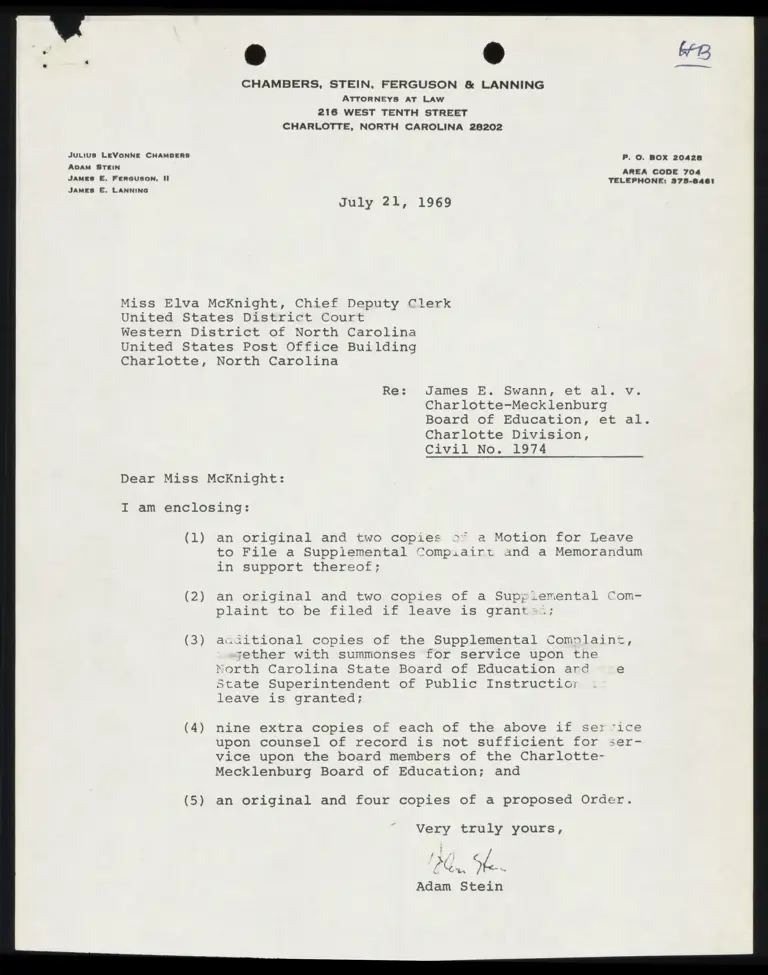
CHAMBERS, STEIN, FERGUSON & LANNING
ATTORNEYS AT LAW
216 WEST TENTH STREET
CHARLOTTE, NORTH CAROLINA 28202
JuLius LEVONNE CHAMBERS P. O. BOX 20428
ADAM STEIN AREA CODE 704
JAMES E. FERGUSON, II TELEPHONE: 375-8461
JAMES E. LANNING
July 21, 1969
Miss Elva McKnight, Chief Deputy Clerk
United States District Court
Western District of North Carolina
United States Post Office Building
Charlotte, North Carolina
Re: James E. Swann, et al. v.
Charlotte-Mecklenburg
Board of Education, et al.
Charlotte Division,
Civil No. 1974
Dear Miss McKnight:
I am enclosing:
(1) an original and two copies »° a Motion for Leave
to File a Supplemental Comp.airt and a Memorandum
in support thereof;
(2) an original and two copies of a Suppg.emental Com-
plaint to be filed if leave is grant =;
(3) aciitional copies of the Supplemental Comnlaint,
yether with summonses for service upon the
North Carolina State Board of Education ard e
State Superintendent of Public Instructior
leave 1s granted;
(4) nine extra copies of each of the above if ser "ice
upon counsel of record is not sufficient for ser-
vice upon the board members of the Charlotte-
Mecklenburg Board of Education; and
(5) an original and four copies of a proposed Order.
Very truly yours,
/ Ss
ae
Vd
{ Ln ); ay
Adam Stein
AS :sd
Enclosures
cc: Brock Barkley, Esq.
William J. Waggoner, Esq.
Gaston H. Gage, Esq.
Conrad O. Pearson, Esq.
James M. Nabrit, III, Esq.
IN THE
UNITED STATES DISTRICT COURT
FOR THE
WESTERN DISTRICT OF NORTH CAROLINA
CHARLOTTE DIVISION
JAMES E. SWANN, et al.,
Plaintiffs,
Vv.
CHARLOTTE~-MECKLENBURG BOARD OF EDUCATION,
a public body corporate; WILLIAM E. POE;
HENDERSON BELK; DAN HOOD: BEN F. HUNTLEY:
BETSEY KELLY; COLEMAN W. KERRY, JR.:
JULIA MAULDEN; SAM McNINCH, III; CARLTON
G. WATKINS: THE NORTH CAROLINA STATE BOARD
OF EDUCATION, a public body corporate; and
DR. A. CRAIG PHILLIPS, SUPERINTENDENT OF
PUBLIC INSTRUCTION OF THE STATE OF NORTH
CAROLINA,
CIVIL ACTION
NO. 1974
Defendants.
C
r
”
®
N
a
”
’
Sa
s”
N
a
l
a
Sm
al
l
S
u
n
S
a
p
g
l
ua
l
N
l
Y
u
e
S
u
a
g
a
t
e
e
d
“
e
a
S
e
t
MOTION FOR LEAVE TO FILE
SUPPLEMENTAL COMPLAINT, TO ADD ADDITIONAL
DEFENDANTS AND FOR TEMPORARY RESTRAINING
ORDER
Plaintiffs, by their undersigned counsel, respectfully move
the Court for leave to file a Supplemental Complaint and for a tem-
porary restraining order restraining the defendants from giving con-
sideration or effect to and from enforcing, administering, or applying
certain provisions of North Carolina General Statutes §115-176.1 and
as grounds therefor show the following:
1. Plaintiffs seek, by this motion, leave to file a
Supplemental Complaint, copies of which are being forwarded this day
to the Court together with summonses for service upon the North
Carolina State Board of Education and Dr. A. Craig Phillips, Super-
intendent of Public Instruction of the State of North Carolina, parties
which the plaintiffs seek to add as defendants to this action. Plain-
tiffs have served copies of the Supplemental Complaint upon counsel
for those defendants now parties to this action.
2. The Supplemental Complaint seeks injunctive and
declaratory relief against the following prohibitions contained in
North Carolina General Statutes §115-176.1 1
"No student shall be assigned or compelled
to attend any school on account of race,
creed, color or national origin, or for
the purpose of creating a balance or ratio
of race, religion or national origins.
Involuntary bussing of students in con-
travention of this Article is prohibited,
and public funds shall not be used for
any such bussing."
3. For reasons stated more fully in the Supplemental
Complaint, plaintiffs allege that the purpose, motive and effect of
the statutory provisions complained of therein is to forbid the defen-
dants, now parties to this action, and other school officials in the
State of North Carolina from complying with existing lawful orders of
this and other courts and to forbid them from complying with the re-
quirements of the Thirteenth and Fourteenth Amendments to the Consti-~
tution of the United States. Plaintiffs allege that this is so because
compulsory assignments and involuntary bussing, prohibited by North
Carolina General Statutes §115-176.1, are necessary devices for com-
plying with the orders of this Court entered on April 23, 1969, and
June 20, 1969, and for complying with constitutional requirements.
4. Plaintiffs seek to add as parties-defendant, the North
Carolina State Board of Education and Dr. A. Craig Phillips, the
Superintendent of Public Instruction. These parties are charged by
the constitution and laws of the State of North Carolina with the
general supervision and administration of the public schools and the
1/ North Carolina General Statutes §115-176.1 was enacted as Chapter
1274 of the Session Laws of the 1969 North Carolina General Assembly
which was ratified on July 2, 1969. A copy of the Ratified Bill is
attached to the Supplemental Complaint as Exhibit A.
2
disbursement of public funds to the various public schools in North
Carolina. They are thus required by North Carolina law to insure
that public funds are not spent for involuntary bussing and pupil
assignments. They are therefore proper and necessary parties to an
adjudication of the constitutional issues raised by the plaintiffs in
the Supplemental Complaint. In addition, they are proper parties to
this proceeding because, they, together with local school officials
have an affirmative duty to take active steps to disestablish the
dual school system in Charlotte-Mecklenburg County and other adminis-
trative units throughout the State.
5. Plaintiffs, in their Supplemental Complaint, request
that a three-judge Court be constituted to determine their constitu-
tional challenge to a statute of state-wide application. This motion
for a temporary restraining order is addressed to the single District
Court judge hearing this case pursuant to 28 U.5.C. §2284 (3).
6. Plaintiffs allege that, unless immediately restrained,
the defendants will apply the statutory provisions complained of here-
in and will thereby fail to comply with the orders of this Court of
April 23 and June 20, 1969, thus causing plaintiffs irreparable
damage. In support of this allegation, the plaintiffs attach hereto
the affidavit of Reginald A. Hawkins, the next friend of plaintiffs
in this action.
WHEREFORE, plaintiffs respectfully pray that they be
granted leave to file their Supplemental Complaint, that they be
allowed to add the North Carolina State Board of Education and Dr. A.
Craig Phillips, Superintendent of Public Instruction of the State of
North Carolina as defendants in this action and that all defendants
be restrained from enforcing the complained of provisions of North
Carolina General Statutes §115-176.1.
Respectfully submitted,
CONRAD O. PEARSON
203 1/2 East Chapel Hill Street
Durham, North Carolina
CHAMBERS, STEIN, FERGUSON & LANNING
216 West Tenth Street
Charlotte, North Carolina
JACK GREENBERG
JAMES M, NABRIT, III
NORMAN CHACHKIN
10 Columbus Circle
New York, New York 10019
Attorneys for Plaintiffs
CERTIFICATE OF SERVICE
The undersigned hereby certifies that a copy of the fore-
going Motion for Leave to File Supplemental Complaint, to Add Addi-
tional Defendants and for Temporary Restraining Order was served upon
counsel for the Charlotte-Mecklenburg Board of Education; William
E. Poe; Henderson Belk; Dan Hood; Ben F. Huntley; Betsey Kelly:
Coleman W. Kerry, Jr.; Julia Maulden; Sam McNinch, III and Carlton
S. Watkins, defendants, by depositing copies of same in the United
States Mail, postage prepaid, addressed to:
Brock Barkley, Esq.
Law Building
Charlotte, North Carolina 28202;
William J. Waggoner, Esd.
Weinstein, Waggoner, Sturges and Odom
1100 Barringer Office Tower
Charlotte, North Carolina 28202; and
Gaston H. Gage, Esq.
Grier, Parker, Poe, Thompson,
Bernstein, Gage and Preston
1014 Law Building
Charlotte, North Carolina 28202
This day of July, 1969.
Attorney for Plaintiffs
IN THE
UNITED STATES DISTRICT COURT
FOR THE
WESTERN DISTRICT OF NORTH CAROLINA
CHARLOTTE DIVISION
JAMES E. SWANN, et al.,
Plaintiffs,
CIVIL ACTION Ve.
THE CHARLOTTE~-MECKLENBURG
BOARD OF EDUCATION, et al.,
NO. 1974
Defendants.
Na
ar
?
Na
e”
S
n
N
t
?
S
m
t
u
t
?
Na
p?
a
t
l
“w
at
i
V
i
?
“w
at
t
AFFIDAVIT
REGINALD A. HAWKINS, being first duly sworn, deposes and says
that:
l. He is a citizen and resident of Mecklenburg County, North
Carolina;
2. He is the father and next friend of Reginald A. Hawkins,
Jr., Wayne B. Hawkins and Lorena B. Hawkins who are plaintiffs in this
action;
3. He has read House Bill 990 which was introduced at the
1969 Session of the General Assembly in May 7, 1969,by Representative
Carson of Mecklenburg County and others and which is attached to Plain-
tiffs' Supplemental Complaint as &Zxhibit B;
4. He has read House Bill 990 as amended and ratified on
July 2, 196% by the North Carolina General Assembly and which is
attached to Plaintiffs' Supplemental Complaint as Exhibit A;
5. He followed the course of said legislation as it was re-
ported in the press:
6. He has read the newspapers and has heard on television
statements made by the Chairman of the Charlotte-Mecklenburg Board
co” Rducation; other members thereof and counsel for the Board that the
Board is obligated to and intends to abide by said legislation unless
and until declared unconstitutional by the courts or is repealed by
the Legislature.
7. It is his opinion and he so alleges that the Charlotte-
Mecklenburg Board of Education abides by the prohibition contained in
the Ratified House Bill 9290 which reads: "No student shall be assigned
or compelled to attend any school on account of race, creed, color
or national origin, or for the purpose of creating a balance or ratio
of race, religion, or national origins. Involuntary bussing of stu-
dents in contravention of this Article is prohibited, and public funds
shall not be used for any such bussing.” and that the Board will be
unable to adopt a plan for desegregation which will disestablish the
dual system in the Charlotte-Mecklenburg School System.
AFFIANT
Sworn and subscribed to before me this day of July, 196°.
NOTARY PUBLIC
My Commission Expires:
IN THE
UNITED STATES DISTRICT COURT
FOR THE
WESTERN DISTRICT OF NORTH CAROLINA
CHARLOTTE DIVISION
JAMES E. SWANN, et al.,
Plaintiffs,
CIVIL ACTION Ve.
THE CHARLOTTE~MECKLENBURG
BOARD OF EDUCATION, et al.,
NO. 1974
Defendants.
N
t
”
N
a
a
N
t
;
Sp
at
?
N
t
’
N
a
t
a
t
N
n
?
N
g
?
“
w
t
“a
ug
?
w
w
’
MEMORANDUM OF LAW IN SUPPORT OF
PLAINTIFFS' MOTION FOR LEAVE TO
FILE A SUPPLEMENTAL COMPLAINT,
ADD PARTIES-DEFENDANT AND FOR
TEMPORARY RESTRAINING ORDER
I
PLAINTIFFS SHOULD BE GRANTED
LEAVE TO FILE THEIR SUPPLEMEN=-
TAL COMPLAINT AND TO ADD PARTIES~-
DEFENDANT
Plaintiffs seek by way of Supplemental Complaint to attack
the constitutionality of provisions of a recently ratified bill
entitled, "AN ACT TO PROTECT THE NEIGHBORHOOD SCHOOL SYSTEM AND TO
PROHIBIT THE INVOLUNTARY BUSSING OF PUPILS OUTSIDE THE DISTRICT IN
WHICH THEY RESIDE." (House Bill 290, 19692 Session Laws of the General
Assembly of North Carolina, ratified on July 2, 1969, a copy of which
is attached to the Supplemental Complaint as Exhibit A. The Act
creates -a new section of the General Statutes §115-176.1l.)
® “
Plaintiffs claim that prohibitions against involuntary
assignma~t on account of race and involuntary bussing to that end Y
are unconc'ltutional on their face and as applied and have the pur-
pose and effect of nullifying existing lawful orders of this Court
issued to vindicate constitutional rights.
The Supplemental Complaint prays for the formation of a three-
judge court to hear plaintiffs' claim pursuant to 28 U.S.C. §§2281
nd 2284. Plaintiffs seek injunctive and declaratory relief. In oO
addition, plaintiffs have filed a motion for a temporary restraining
order addressed to this Court pending decision by a three-judge court.
Plaintiffs are clearly entitled to a hearing before a three-
judge court. Attacking a statute by filing a supplemental complaint
in school cases where legislatures have enacted legislation which
affects existing orders perding school cases is the common procedure.
Bush v. Orleans P-xrrish School Board, 188 F. Supp, 916 (E.D. La. 1960)2/
affirmed 364 U.S. 500 (1960); Griffin v. County School Board, 377
U.S. 218. See also the order entered July 14, 1969 in Turner v.
Warren County Board of Education, C.A. No. 569, E.D.N.C., allowing
plaintiffs to file a supplemental complaint and to add additional
parties-plaintiff and defendant, including the defendants sought to
be added here, to challenge the constitutionality of the creation of
new school units within Warren County.
1/ The provisions complained of are:
"No student shall be assigned or compelled
to attend any school on account of race,
creed, color or national origin, or for
the purpose of creating a balance or
ratio of race, religion or national
origin. Involuntary bussing of students
in contravention of this Article is
prohibited, and public funds shall not
be used for any such bussing."
2/ See Id. at note 1 for the history of the case in dealing with
legislative enactments which impinged upon orders of the District
Court. Other enactments and cases followed.
x 2
Plaintiffs seek by way of Motion and Supplemental Complaint
to add the North Carolina State Board of Education and Dr. A. Craig
* » - . a » S/ 4/
Phillips as defendants. By the Constitution and laws— of North
Carolina these defendants are charged with the supervision and
administration of the public schools in the State and the public funds.
Thelr general and specific duties certainly encompass the duty to
insure that "public funds shall not be used for any such [involuntary]
bussing." North Carolina General Statutes §115-176.1. They are thus
proper and necessary parties to an adjudication of the constitutionality
of the provisions of North Carolina General Statui:s §115-176.1 of
which the plaintiffs complain.
Furthermore, as Judge Butler has stated in a recent and well
reasoned decision, these State officials have an affirmative, active
duty to insure that the dual school system is eliminated in all public
schools in the State.
nme State's duty to effect a tran-
sition from the dual system of schools
formerly imposed by the constitution
and laws of the State of North Carolina
to a unitary nonracial school system
falls not only upon the local school
boards, but also upon the State Board
of Education and the State Superin-
tendent of Public Instruction.=
As Judge Butler has held, they are proper parties in any school de-
segregation case in North Carolina.
At any rate, if either chould seek to a2''0id being a party
to this proceeding, the proper procedure would be a motion to dismiss
3/ Article IX, Section 8 created the State Board of Education and
sets forth their powers and duties. Article III, Section 1, establishes
the office of the State Superintendent.
4/ North Carolina General Statutes, Chapter 115.
5/ Goodwin v. Johnston Countv Roaxwd of Education, Civil Action No.
2114, July 8, 1969 (a copy of the decision is attached hereto); See
also, Lee v. Macon County Board of Iducaticon, 267 F. Supp. 458 (M.D.
Ala. 1967) affirmed sui». nom. Wallace v. United States, 389 U.S. 215:
Franklin v. Quitman County Pocard of Education, 288 F. Supp. 509 (N.D.
Miss. 1968).
after service of the complaint.
Plaintiffs have tendered a proposed order granting plaintiffs
leave to file a supplemental complaint, adding parties-defendant and
directing the marshal to serve the Supplemental Complaint and summonces
on the State Board and State Superintendent.
II
THIS COURT SHOULD ISSUE A TEMPORARY
RESTRAINING ORDER PENDING HEARING
AND DECISION BY A THREE-JUDGE COURT
A. This Court has jurisdiction to issue a tenporary restrain-
ing order pending hearing by a three-judge court.
Congress has provided that where a three-judcs court is re-
quired, a single judge to whom application for a threc-judge court
has been made, may issue a temporary restraining orde- to prevent
irreparable injury. 28 U.S.C. §2284 (3) provides:
“"(3) In any such case in which an
application for an interlocutory
injunction is made, the district
judge, to whom the application is
made may, at any time, grant a
temporary restraining order to
prevent irreparable damage. The
order, unless previou=zly revoked
by the district judge, shall
remain in force only until the
hearing and determination by the
full court. I“ shall contain a
specific finding, based upon
evidence submitted to such judge
and identified by reference
thereto, that specified irreparable
damage will result i €. the order is
not granted. "=
Such restraining orders have been entered in a variety of cases.
Restraining orders were issued on several occasions prior to a hearing
by a three-judge court following the filing cof a supplemental complaint
6/ It might be noted that requirements of Rule 65 of the Federal
Rules cf Civil Procedure, such as notice, do not apply to temporary
restraining orders issued under this section. Tennessee Public Service
Commission v. United States, 275 F. Supp. 87 (D.C. Tenn. 1967).
7/ See note 39, 28 U.S.C. A §2284.
2
* »
in the New Orleans school desegregation case. Bush v. Orleans Parrish
Board of Education, supra.
B. Plaintiffs will suffer irreparable harm unless this Court
temporarily restrains operation of the complained of portions of Nobth
Carolina General Statutes §115-176.1.
The last sentence of 28 U.S.C. §2284(3) requires a finding
based upon evidence of irreparable damage which will flow from a
failure to issue a temporary restraining order. It hardly bears re-
peating that in Brown v. Board of Education, 347 U.S. 483, the Supreme
Court held that racially segregated public education causes irreparable
harm to black students. Indeed the Supreme Court this term found, as
one might expect, the segregated school system of a neighboring County
produced substantially more illiterate Negroes than whites, Gaston
County v. United States, U.S, » 23 L.ed 24 309 (1969). The
Court said last term the schools were to be desegregated now. Green
v. School Board of New Kent County, 391 U.S. 430.
"This deliberate perpetuation of
the unconstitutional dual system
can only have compounded the harm
of such a system. Such delays
are no longer tolerable . . .
The burden upon a school board
today [May, 1968] is to come for-
ward with a plan that promises
realistically to work, and promises
realistically to work now."
Id at 338-339 (emphasis added)
Fifteen years after Brown and more than a year after Green, the defen-
dants have yet to come forward with a constitutional plan. The delay
is intolerable; the harm is compounded. If the statute in question
threatens further harm, then this Court should act as have other
courts. Cooper v. Aaron, 358 U.S. 1; Griffin v. County School Board,
377 U.S. 218; Bush v. Orleans Parrish Board of Education, supra.
The final consideration 1s, therefore, whether the statute
threatens to interfere with the existing orders of this Court requiring
"a plan and a timetable for the active
desegregation of the pupils, to be
predominantly effective in the fall
5
of 1969 and to completed by
the fall of 19270."
or interferes with the constitutional duties of the defendants. This
Court has already found that:
"The system of assigning pupils
by 'neighborhoods, ' with free~-
dom of choice for both pupils
and faculty, superimposed upon
an urban population pattern
where Negro-: residents have
become concentrated almost
entirely in one quadrant of a
city of 270,000, is racially
discriminatory. . . The
neighborhood school concept
never prevented statutory ra-
cial segregation; it may not
now validly be used to per-
petuate segregation." (Opinion
and Order of April 23, 1969, p.l.)
The Court additionally found that 23,000 of the 32,000 children
eligible to ride busses, at state expense did in fact ride busses,
and that using busses is a device to desegregate the schools, might
be the most efficient and inexpensive device available to the Board.
(Opinion and Order of April 23, 1969, pp. 15-16) In paragraph 4,
(pp.20~21) of the Order, the Court listed several devices for the
Board to consider, including bussing. The Court also indicated that
the plaintiffs' 70-30%, white-black, desegregation proposal might by
the most efficient and satiffactory plan. (p.18)
The Court's Opinion and Order of June 20, 19269, as supplemented
which rejected the defendants' first plan, found over 17,000 of
Charlotte's 21,000 black students to be attending racially identi-
fiable black schools. The Court held that "desegregation of the schools
is something that has to be accomplished independent of freedom of
transfer. This is a fact which, because of the complexity of the
statistics, has only becomce clear to the Court since the previous
order was issued." (p.3) The Order required a new plan by August,
1969.
In the face of their findings (and others) we now have North
Carolina General Statutes §115-176.1 which provides, in part:
"No student shall be assigned
or compelled to attend any
school on account of race. . .
or for the purpose of creating
a balance or ratio of race. . .
Involuntary bussing of students
in contravention of this Arti-
cle is prohibited, and public
funds shall not be used for
any such bussing.®
The new statute, thereafter, purports to give legal saiction to free~
dom of choice plans "voluntarily" adopted by boards of education.
While freedom of choice is not unconstitutional per se, Green v.
School Board of New Kent County, supra, it is not cons:itutionallw
acceptable where it does not produce the elimination =f the dual
system "root and branch." The Supreme Court found in 3Sreen and in
Monroe v. Board of Commissioners, 391 U.S. 450 (1968), that freedom of
choice did not work in those school districts. Where the Court
finds that freedom of choice does not dismantle the d:.al system, as
it h2s found in this case, then students must "be assigned or com-
pelled to attend. . . school on account of race. . .' to create
"« «+ . a balance or ratio of race. . ." as prohibited by North Carolina
General Statutes §115-176.1. And involuntary bussing in Charlotte
and most places is a necessary device to effect the racially determined
assignments Such racial assignments to dismantle the dual system
are precisely what are required by the mandate of Brown and Green,
and what are required in Charlotte-Mecklenburg. Involuntary racial
assignments to overcome the effects of past discrimination were re-
quired by courts prior to Green, e.g., Coppedge v. Franklin County
Board of Education, 273 F. Supp. 289 (E.D.N.C. 1967), affirmed 394
F.2d 410 (Fourth Circuit, 1968); Corbin and United States v. County
School Board of Loudoun County, Va., 283 F. Supp. 60 (E.D. Va. 1967);
Singleton v. Anson County Board of Educa*in=-,6283 F. Supp. 895 (¥.D.
N.C. 1968) and have been constitutionally required upon the basis of
Green in scores of cases decided in the past year, e.g., Felder v.
Harnett County Board of Education, F.24 , No.12,894 (Fourth
Circuit, April 22, 1960); Adams v. Matthews, 403 F.2d 181 (Fifth
Circuit, 1968): Boomer v. Beaufort County Board of Education, 2°24
F. Supp. 179 (E.D.N.C. 1963); United States v. Bertie County Board
of Education, 293 F. Supp: 1276 (E.D.N.C. 1968).
The legislative enactment can therefore only be viewed as
another attempt to interpose a state law between school officials and
the Constitution. The last such effort, the so-called Pearsall Plan,
was struck down by a three-judge court in this district. Hawkins,
et al., v. The North Carolina Board of Education; Edwin Gill, Treasurer
of the State of North Carolina: and The Charlotte-Mecklenburg Board
of Education, 11 Race Relations Law Reporter, 745 (W.D.N.C. 1966).
The language of a recent decision of a three-judge court in South
Carolina is applicable here. "A review of the record, including the
historical background of the Act [a tuition grant Act], clearly re-
veals that the purpose, motive and effect of the Act i$ to unconsti-
tutionally circumvent the requirements first enunciated in Brown v.
Board of Education, 347 U.S. 483 (1954), that the State of South
Carolina not discriminate on the basis of race or color in its public
educational system.” Brown v. South Carolina State Board of Education,
296 F. Supp. 199, 202-203 (D.S.C., 1958), affirmed 39 S. Ct. 449
(1968), There can be little doubt that the prohibitions in North
Carolina General Statutes §115-176.1 will ultimately be declared
unconstitutional. This Court should therefore issue a temporary
restraining order to insure that the statute will not frustrate the
existing orders of this Court.
Respectfully submitted,
CONRAD O., PEARSON
203 1/2 East Chapel dill Street
Durham, North Carolina
CHAMBERS, STEIN, FERGUSON & LANNING
216 West Tenth Street
Charlotte, North Carolina
JACK GREENBERG
JAMES M, NABRIT, III
NORMAN CHACHKIN
10 Columbus Circle
New York, New York 1001¢
CERTIFICATE OF SERVICE
The undersigned hereby certifies that a copy of the fore-
going Memorandum of Law In Support of Plaintiffs' Motion For Leave
to File a Supplemental Complaint, Add Parties Defendant and for Temporary
Restraining Order was served upon counsel for the Charlotte-Mecklenburg
Board of Education; William E. Poe; Henderson Belk; Dan Hood;
Ben FF. Huntley: Betsey Kelly; Coleman W. Kerry, Jr.; Julia Maulden:
Sam McNinch, III and Carlton G. Watkins, defendants, by depositing
copies of same in the United States Mail, postage prepaid, addressed
to:
Brock Barkley, Esq.
Law Building
Charlotte, North Carolina 28202;
William J. Waggoner, Esq.
Weinstein, Waggoner, Sturges and Odom
1100 Barringer Office Tower
Charlotte, North Carolina 28202; and
Gaston H. Gage, Esq.
Grier, Parker, PoOe, Thompson,
Bernstein, Gage and Preston
1014 Law Building
Charlotte, North Carolina 28202
This day of July, 1969.
Attorney for Plaintiffs
—~_—
SUN
CP
SS
(
P
U
P
P
I
E
S
UD
I
US
N
WR
Gs
We
Wa
fl INITED STATES DISTRICT COURT
| EASTERN DISTRICT OF NORTH CAROLINA
t
e
fe
AR
m
s
RALEIGH DIVISION
tan [J uy
iL D i ' pa. - 2 i
/
14 Er ‘
JUL 8 830
§ SAMUEL A. KOWALD pe
y PY en Neal ~ Lt 2 oh 2 i= - o tr GAWGQK
{ JAMES GODWIN, Co Che ’ A, Ss. DISTRICT C vim ae
pi ~ wig
i V.
JOHNSTON COUNTY BOARD OF EDUCATION, CIVIL ACTION :
i & public body corporate; NORTH
CAROLINA STATE BOARD 3 EDUCATION,
a public body corporate; and DR.
A. CRAIG PHILLIPS, NORTH CAROLINA
STATE SUPERINTENDENT OF PUBLIC
INSTRUCTION,
NO. 2114
V
M
”
S
a
?
C
e
?
S
P
S
N
”
S
N
”
S
P
N
S
N
S
P
N
N
S
S
N
N
N
S
N
N
A
O02 1:8 30 N
le hy ~~ - oY = o~ - vA - — - do = 3 ~ £ 8 = -~ - on }
as dlged racladLdy d4Alscrinina OXY Practices OY thie deiendaancts in {
'
— lv mm d= 3 * ~~ yn de 8 iy A Ya Y ma
the aéninis tration of che JOQnLs On coun YY Pui Schools . Le }
o
d
mot and
Ab £ing on a
“
or Lhe
the
he Court!
nf
£ 4
FS -
AM o
Instruction nt
4
-
each of
on oO
calle
denied
Public
£
ha
were
ent oO
ALD Oo
e Court
da
oh
tq
0
4
4
.
Oo
. as
de In
e State Superinten
)'4
-
n raised > estio
ot
the State Superinten
-
an ucation Ed of oard
m
Sn
.
school sy
347 U.S.
ne State ©
N
1
Ae
Fi
il
-
of
Amendment tC
dua
to local
the £
urteenth
Ae
on
2 oF
g vestiges oO
Board of Education,
2 12
(SYS
North Carolina pr
Y.
=
i.
and other
Brown
State ©
in
so A
zemalinin
-—
1
.
th
which was est
=
A
Supreme Court
ate
be
—
N
e S
Lithe
d= Ya
ad
oO
system 1c school -
he
rd
—~ -—
hee 31150
-
Chanter
Q
4
0
0
>
x
(5)
0)
n
(0)
5
3
'
«:
P
3:
N
>
.
™
£0
ie!
1
v
£4
fs)
Q
wn
3)
.
i
$4
a
$I
$4
0
+
Q
0
J
3
+
»
'®
0)
Q
3
«
W
0)
x
:
a)
4
13
5
0
0
~
Toby
r3
"“
.
—
Of
0
|
a
0
A
Sys
4
RET
g
E
Be
.
5
|
oy
ly
Q
0
™
gp
-~
aN
0
9)
(0)
0
0
n
Q)
I)
9]
—
44
0
oo
Q
™
Q
WO
o
™
0
m
r~
(oF
3
44
4)
’3
«3
d
uy
wn
~~
(Q]
oN
™
QO
™
5
—
Q
—
oO
n
2
Na
3
fis
~~
HP
™
.
(ae)
oS
~
IS)
AS J
0
0)
J
>
O
io
(0)
(ty)
pS
>
.
™
3
(}
f-
(0)
d
3
0
n
,
HA
”N
“4
Q
3
3
.
~
Wn
.
@)
4
03
+
=
Xe
40]
3
3
0
0
+
3
s
)
O
o
0)
fa
.
OR.
ME
3
—~
«
Oo
0
be
(g
A
97
=
4
QO
2
ved
vd
A,
—
.
$4
.
Q
P
E
$4
0
Q
Q
—
0)
0)
$I
is
(8)
Q
oO
fe
Wi
o
Dd
+
.
eo)
J
~
a
H
S
5
0
Mm
3
£3
0)
n
53
4
Lah
a
a
Q
4
W
I
R
E
EE
I}
nl
o
a)
QV
.
Q
O01
L
P
~
J
$3.
260
ET
eA
)
a
La
| S
R
S
R
S
e
ER
a
y
R
R
e
T
R
R
ERE
o)
J
©
LS
F
W
A
?
>
d
Oo
5
=
0
g
d
49
0)
ed
+
Q
$y
™M
[op
0
AS)
fv}
0
BE >
£278
pS
.
$I
Q
E
>
Q
Q
0
5
bo}
0
§3
“
Qo
=
K ©;
jo
=
>
.
™
Q
£3
+d
«+
©
oF
Q
0
nu
.Q
oO
oO
oO
+
V
=
[0]
0)
-
~
>
—~
.
[O))
3
3
4
P
E
O
W
3
ed
4
H
jo
3
3
iJ
0
0
0
|
.
Yd
~
|
~
0
0
Q
O
m
a
n
0n
(0)
£2
Q
L
D
,
S
T
Q
US]
0
d
Le
fs
Q
io
—
—~
n
lo)
(0)
™
Q
n
4
(o)]
.
pe
0
orf
3
0
u4
Q
S
a
r
i
t
y
0)
(0)
0
«{
rd
a
3
(]
a
Q
Q
(eo)
=
4
+
Xi
5
P
P
A
W
~
Q
O
T
N
)
33
3
(0
+
Q
+
0
~
4
Q
4
ga
P
P
Py
A
ier
Q
o
0
J
Dyed
P
d
>
0
L
2
G
u
n
d
o
oF
+
Oo
3
@
uv
v
q
@
0
+H
[1]
[by]
iS)
H
3
wn
~
3
43
er
ia
H
o
w
n
2
=
n
@
Js
J
4
J
Ny
J
Q
a
10)!
P
A
H
-
»
I
Oo
0
(o)}
tv}
a
OL
ho
Lo
RY
&
Jo]
O
H
A
H
n
-
Q
—
+H
-
l
be
3
Qf
Y
d
)
JEL
+ SIONS
w ) SR
SCR
| TREE 1
JER ©
Bee
|
BRE
J
Q
B
.
B
l
e
d
Net
9
3
0
4
Q
i
ena’
B
E
BR
9
Yq
0]
“
.
—
i
S
9
8
M
O
©
Q
©
>
0
Sy
irl
pS |
0
0
Oo
oO
]
(®)
-
Q
=
.
D
.
o~
+H
3
~
Q
Nn
4
Q
i
oO
0
8
he
7 0 BR
60
TL
ae
oF)
.
fa
9
&;
Ko]
Q
3
0)
T
Ko
9)
>
>.
™
p
O
0
0
3
d
H
Ho
BRINE
})
oe
:
4
0)
0
0
4)
+
q
0
P
0
0
™
SO
ol
OT)
4
a
CR
RT
WIE
ET
a
BRE
Rel
C
R
BB
eat
et
EY, JA
SL lie
©
B
e
oe
TR
J
x3
+
Oo
a
~~
o
—
hid
Q
N
$
0
)
f
a
)
2
0]
S
M
G
P
a
t
O
H
+H
-
(eo
+H
0)
10]
+
U4
0
(o]
™
3
Q
0
2
P
A
H
S
Q
Fe
3
P
-
A
'
g
=
2
IR ©
a
49
n
oO
a
[by]
(0)
wn
82)
0
2
(0)
Q
n
(0)
.
>
To
(®)
Oy
Q
o
g
a
—
Gq
P
E
G
bo
-
Ih]
io]
1]
5
4
a
$
I
4
n
0
—
4)
~
i
wn
Q
HP]
AH
Q
H
P
Q
4I
1J
N
e
d
O
O
H
-
A
N
Is
33
0
Q
3
(o]
)
>
[oF
lo
3
—~
.
ir
wn
$4
QO
H
-
d
A
4
0
Z
4
«
QO
M
o
a
Q
0]
Q
H
H
3
0
£3
Oo
0}
Q
0
“rd
=
O
It
oD
U4
wn
Coa
BR
Ee
Q
O
S
D
@
>
0D
kD)
0}
>
(0)
0
>1
3
49
0
oe
0)
H
J
0
-
Q
yy
oO
or
4
Ui.
Q
-
+
4
0
2
$2
nf
TRV
UC
I
P
GE eg
@
-
=
0)
2
he
P
0
om
0
=
eo
Oph
oN
0}
5
9
0
Ju4
0
©
O
O
O
-
a
ic
>
0
U4
d
ie)
3
0)
8
«A
4
d
o~
(eo)
:
£3
3
D
o
T
Q
A
44
"
on VE
0h Bf yl
RU
3)
~
wn
n
U4
le!
0
tv
Ito
(08)
jon
4
0
(eo)
™M
HO)
(0)
O
(0)
Ia
£
3
3
4
0
(0)
=
0
1
a
2
tv
Q
Q
Q
0
oO
«
J
lS)
fe
4
ii
oF
o
3
—
S|
“1
Q
©)
P
I
>
@
0
Q
O
P
3
0
[oN
Oo
0
HP
—
fo
«
0
©
wn
J
™N
~
43
nb
E
R
A
S
eis
=
n
H
P
o
P
a
c
o
A
eo’
Oo
Oo
2
VO)
—y
0
hh
9
.
[£8
9
Oo
d
44
Q
.
M
i
g
5
:
0
0
pS
a
s
+
+4
O
@
=
>
43
oF
d
Q
0
ud
AQ
0
0
3
HD
.
pS
m
0
0]
0
6)
Q
F
0)
Ite
Id
P
u
y
o
YH
aE
[O)
ri
+9
E
ro!
pe
,
Q
3
=
Q
rd
4+
UA
wn
©
3
4
Q
ed
0
00
Be
Oo
o)}
g
n
n
v
4
d
3
>
fe
$4
jo
VRS
“df
J)
hi
re
0.
0
Q
t
S
0
9
1
0
:
of
~|
w|
ww
0
4
0
%
3
0
yy
4
Tg.
0
Q
@
H
G
A
A
oO
3
~~
3
H
Q
0
5
Tg)
oD
m
(0)
A
H
~
Iv
S
l
©
A
-A
AQ
e
d
O
0
Q
I]
4
(0)
3
Py
a0
oe
0
Q
Q
Mm
~
«4
0
™
te!
oO
(«d
©
3d
B
i
d
)
DY
43
3
Ie)
3
.
0
S
a
y
1d
:
d
0
QO
Je!
3
4
Oo
3
0
Lo
A
=|
pS
r~
3
<
44
Oo
n
O
d
g
.
Q
(@)
Q
H
f
O
-
4
@Q
O
Q
3
“
8]
bv]
)
T
Q
+3
®
3
0}
Yy4
~
(|
r~
Oo
0
oO
Mm
4
Qi
>
H
i
Oo
+H
O
P
P
O
A
C
n
pS]
n
0n
8)
Q
Ss
£3)
fo
«rd
r
»
(0)
™M
(0)
(0p)
[bv]
Q
P
Q
O
y
e
lO
(1)
Or
ing
Q)
cd
-d
H
“4
-
=r
-
3
S$
|®
1
Q
qo}
0)
m
Ro
J
.
5
G
l
o
O
F
0
Q
on
DEW
i
S
R
u4
or R
T
Q
9
>
po
BREE
©
3
0s
I
=|
Q
pS
~
0
.
p=
>
.
+
J
n
d
Qo
wn
oF)
y
g
>
-
«
y4
4
£+
ap
oO
$I
ed
O
A
b
a
Q
3]
«3
.
10)
wn
>
{0
(@
n
N
i
o
9
.
3
Q
vy
N
Y
-
+
4
0
2
eo
«
2
(1)
U4
4
1»
s
o>
3
Ae
Ra
Q
5
-
po
Oo
Q
$4
44
SR
Eee
EP
.
4
2
0
U
L
.
4
0
)
=
+
9
O
Oo
8
®
oO
0
©
49
>
Ss
.
Tw
Mm
0
nN
(0)
»
Q
Q
.
n
0
ir
$4
0
rd
O
44
“«
.
[0]
O
>
Q
4
3
{J
y4
n
$4
(4)
H
J
ed
+2
(o
@
>
0
m
(0)
.
gS
0)
{o)
e
4
Q
rd
fv}
4)
Q
Oo
U4
Oo
O
+)
(3
0
0)
gt
Zz
0
4
$4
5
0)
Q
Q
3
J
(oR
«
i
Oo
O
3
Mm
0
>
B
+
p}
I
ol]
©
>
apes
¥
Q
0
0
1
MIRE
|
ISIE
Ee
x3
a
Q
$4
Q
0
~~
>
2
«4
9]
QO
Q
Q
[1
wn
0
Q
un
Q
u
+
HH
>
0)
04
~
0
3
o~
a
o~
(0)
3
>
0
$9
0
J
8.
HJ
+
92
oF
1d
Q
>
0
Lo
x
|
(00
¥
™M
$4
0)
(0)
Q
d
£3
Q
aS
leet
1)
0)
©)
:3
73
x5
4)
ol]
«i
0
ul
on
(«
“r
©
Q
3
K
x
J
3
x
44
J
J
J
>
Ui
op
©
{J
£3
0
nN
nN
Mm
—
Xe
aS
«Tt
$4
HH
$I
IS)
0
0
iS}
®)
n
ER
0
tH
—
—
—
—
—
—
—
—
—
—
—
—
—
—
—
—
—
—
—
—
—
—
—
—
—
-
p
—
—
-
—
—
0
-
—
~
-
.
-
~
~
-
a
--
~
-
1
1
-
££
=
«
-
:
Q
«©
Q
Q
0
$)
*
Q
n
0
[
3
t
J
.
$3
i)
’
’
J
0
a3
x3
£3
Q
0
0]
>
—
uy
~
Mm
{3
$4
3
(}
f14
6)
0
”n
"wi
Q
$$
0
KS)
Q
8
8
3)
4
3
9
A
1
(
0
~~
QD
«@
4)
3
U4
Xe
wD
0)
’
>
ved
.
Q
($)
$)
[e)
~
0
O
Le
A
9)
Q
Q
£2
(0)
[0]
r~
8)
4)
$4
4)
Oo
Q
ed
=
4
«
(®)
wn
=
4)
.
n
oO
0
3
4
7
I
m
4)
lL ®)
LO
"3
n
a
HI
Q
Oo
Q
0
Ud
Hd
8
Q
«
J
i
RE
0
2
$4
3
4)
«
r
n
3
oN
0
$I
=!
)
d
3
a
®
—
a)
[o))
£3
3
x
0
0
{J
Yd
1}
Oo
$I
d
(bb
[s}
4)
{J
O
n
4
[oF
J
is)
(0)
Q
3
3
«
(®)
04
(9)
eo
0]
4
44
oO
0
~
wn
3
3
13
$I
Q
3
[iy]
«
0
=
Oo
-
rd
3
-
Q
3
(0)
m
nN
J
[bh]
J
(Ls
.
(d
1
2
33
0]
yd
(le)
$4
Ho
£4
=
ed
1)
+)
wn
i
(9)
0
(0)
Q
[1]
4
Q
(0)
3
n
4
4)
0
0
~
(0)
ed
0
£8)
4
[1]
(}
“4
(6)
Q
>
Rv
eN
5
>
[1]
pL
(
J
0
“cd
o)
21
I)
-
=
0
0)
«
Sy
m
-
~
A
4
'¥
J
I
oe
—
0
$4
$4
0
—
"s
+
Q
Q
»
8
[10]
$
ed
to
«4
>
Q
—
1]
3
.
Q
J
2h
J
d
[js
4)
O
J
Q
+H
(o]
0
P
0
3
Q
3
0
—
Oo
>
0
3
d
iS)
3
Y
U
)
1]
fa
d
—
0
de
Se
>
ey
+P
Q
¢
A
d
J
ES
$4
-
IV
0,
4
0]
0
I
.
—
ed
Q
g
2
n
{J
43
8)
8.
n
u
3
eo)
qe]
NH
-
-
(0)
J
(0)
!
@)
=
Q
)
Q
5D
<
Eo
3
wn
J
“
-
1
0
Yq
Q
3
es
=
ENE
i
0
(}
2"
Q
io]
0
Q
0)
$
>1
—
$I
0!
Q
0
0
£
Q
Ib)
E
E
Q
a
Ko!
8
Q
fa
4
0)
Q
>
N
O
Y
Q
+
Q
A
0]
d
0
J
~
Q
0
n
-
+
3
0,
x
oO
3
HP
-
.
fm
«
(0)
44
5
0
x
[os]
>
-—
(IF
£3
0
4
4
—
H
G
H
-
+H
™
He
$
0
rd
Q
>
+H
Q
3
0
0
HP
™
H
0)
J
0)
(0)
ES)
ed
Q
"J
0
P
O
or
P
Yq
Q
.
lo}
Lp
=
8)
d
«
~
~
~~
A
Q
3
fl
oO
1
ol
Q
3}
3
pb
«
n
nw
nu
(0)
+H
S|
pS]
Q
Q
>
~
~
~
U4
-
S|
0)
Oo
lop}
pw»
a
£3
4
P
u
g
PI
0
=
Q
(®
~
2
4
KS
J
Q
S|
0)
-
(0)
Oo
=
2]
(a
)]
(0)
oO
0)
(4
(0)
ud
[&
+I
42
OO
NH
4
3
[o
0
Ta
4
os
PH
04
Y
(@)
.
©
(0)
rd
0
i
(0)
ed
~
0
g
S
5)
x
5}
3
et
-4
ES
2
ft]
(6)
3
Q
(0)
~
Q
a
eo
>
fo)!
LE
H
P
4
0
0
3
Q
0]
J
S
L
L
ONE
oF
=
0
tv
oO;
d
1S
lo)
Oo
, 9
lo)
Q
(0)
0
=
1
=
—
[1]
, ®
1
U4
I
0
>
1
0)
(4)
©
Q
Q
4
Q
=
2
ST»
(0)
Q
0
Q
Q
=
oO
0
J
(o)
[o}
Q
4)
Q
0
44
3
3
(0)
od
4)
lt}
y
u
n
ogao
oa
Ro
Q
(0)
«l
i
(OR
+I
lo)
pS]
Q
pS
°
S|
Q
o
wn
70]
=
oO
hh]
0
“4
5
®)
[1]
J
D
n
O
.
5
0
HP
kB)
rd
oF
(6)
[0
n
Yy
d
(¥]
~
m
3
fis
-
le!
lo]
4
S|
pS
fa
QO
3
J
=
ou
RE,
R
o
W
3
Q
0
~
ang
.
SE
0
o
i
BS.
¢
RE
)
3
ad
0)
£3
1
Q
n
o
o
Q
3
9
lo EHEC
Sol
T
0)
9
QO
ng
43
|
2
3
:
2
9
Set
SREY
Q
Q
>
+ B
e
+
Beker
MRNA
»%
TER
n
C
a
I
(9)
(14
0
+
d
“4
Te
0
(1+
Q
(0)
=
0
(0)
H
4)
8]
Yq
-—
U4
3
$$
Q
-
Q
>
i
43
0
[]
«rd
Q
13
H
qo!
0
d
[ty]
(0)
HI
QO
—
Q
ge
.
A
Ny
(0)
iB)
Q
0,
3
pS
«3
[¥
43
T
<
(®
Q
$I
0)
To
3
n
Yq
Q
0n
(®)]
EB)
le)
Q
n
o
3
3
[14
fs}
0
0)
i
o
u
:
og
£
#)]
£3
fv}
(e]
5
0
>
.
(eo)
0)
oO
5)
:
.
=
0
J
0
|
Q
Q
H
Q
S
3
0
0
d
|
d
0}
+
Q
=
OC
J}
4
~~
o
ef
6)
J
i
S
e
Ito
0
apt
«
9
Q
TR
Q
4
Q
pi
O
-~
(0)
0)
8)
(0)
1s]
0]
-
[tv]
Y
0
[@)]
WW
10]
pS
~~
.
[1]
hs
H
EB
ie
0
bo T
R
©
3
QO
Died
~-
>
6]
0
0
«eo
S|
0
«4
0
—
Bb)
0
2:
Q
Te
4
0
63]
pS]
8
HJ
Yq
$4
4
A
16)
+
>
oO
-
>
&
(0)
0
~
0
(0)
3
=
ts |
.
It
Q
[o6)
oO
m
«
Q
0
:
3:
$I
3
3
0
pS
o>
d
pS
-
4
—
Ts
0
i
Oo
0n
C)
z
:
wn
Q
a
J
0,
0
10]
«ed
0]
oO
J
r
e
l
e
BO
0
on
J
9
n
x
Yq
iv
Le
=
4
>
0)
<3
$)
19]
0]
=
“4
Q
-
5
J
Q
irl
Qo
vd
o
s
SRE"
HEREC SHE
Ys
CRY
2
0
ora
a
wv
Q
3
0)
3
a
4
>
0,
Q
43
+
o
n
o
n
0
Q
0}
-
Q
(o]
Oo
(0)
[is]
0
ro)
Q
8
.
i
.
-
>
tv}
Q
9
|S
Hy
>
d
H
Q
>
d
HH
«rd
=
-
®)
9
4
2
=
pe]
+
u
>
Bl
fo!
Oy
rd
0)
Q
>
oF
Q
3
3
4
to)!
0)
J
QO
A
—
Q
4+
-r4
©
4
n
Q
8]
43
—
M®
-
$4
(OF)
18)
©)
1s}
S|
oO
QF
[0]
Oo
+
Q
te
SEES
0
>
0)
0
=
Q
1s
3
(6)
4
=
tv]
Oo
Q
3
oN
4
1}
3
=
—
0}
MH
3
3
O
0]
H
5.
n
g
dg
a
lo)
Oo
0
=
[0]
-
fe}
(o]
$4
4
m
S30
rd
=
to}
(0)
wn
Q
P=»
£8
oR
0
2
wy
EE
-
:
i
0
ir
d
s
Q
:
oO
ES
iS}
Q
Q
0]
4
E
io
An
.
4
Q
~
[0]
Yy
Q
£3
L
e
0
J
0)
H
=
3
0
a
r
iP
—~
H
.
=
$9
Q
1S
Q
(0)
0
5
A
0
=
P
O
A
A
0
44
mM
S
Oy
O
Y
S
E
L
AE
| S
E
E
IRE
deed
.
rd
Cf
0
Px
ane
© SHORE
1
URE |
|
TR
44
G
U
Q
(0)
$
3
[©
=
S|
:
0
x
(0)
Q
io]
3
1]
3
I
P
Q
Q
($)
44
—
3
4
g
e
—~
44
4
4 BEE
=
[0]
~~
0}
Q
4)
Th
i
Q
Q
0
r~
1s}
mn
3
>
3
T
oO
0
:
H
O
®
Q
Pp
12
Oo
44
fe
4
£5
4
0
0
-
0
lo)
N
(0)
Ve)
e
3
~
4
I}
.
(®)
-
=
U4
0
0)
“rd
Q
fo!
(7
£3
J
P
i
r
e
s
=
mn
U4
-
Jo
4
oN
a
2
Q
©
Is
|
+H
(QV
0
Vo
J
Oo
ill
0
Q
J
=
P
q
0}
3
0}
0]
3
©
0
Q
x
tv}
Jo
3
0]
Le
0}
4
0
Co}
fT
0
pS
-
cd
J
~
h)
$4
0
S
E
T
B
n
A
Se
WG
SN
of
©
=
GR
~
0
{o
JRE
IS
fo)
3
>
0)
3
+
go!
“4
ord
@
i)
Yq
0
4
>
0
Oo
d
4
—
1B)
2
be
“d
J
O
1h
>
Q
0
EE
0
5
(0)
3)
GAEL
ERE
e
e
d
0
of
©
Q
co
CQ
dg
4)
$
0
0
(8)
Le
=
Mm
0
Q
Q
x
13
0
uy
fy
re
<
Q
n
Q
~~
ord
Q
it
0
0
2
(4)
(1s
Ri
(]
a
4
2
3
HS
|
54
P
H
i
2
S
s
P
A
0
[0]
FE
4)
2
3
I]
3
I]
£2
x
Q
py
>
-
Q
$4
:
0
(9)
43
Q
0
0)
44
fo)
0
i
Q
I
8!
49
eo)
"J
O
.
0
+
>
On
2
£3
+4
1J
£3
EB
Q
4)
1]
“4
Q
Yd
—
0.
0
=
0
$4
m
0
3
jo
0
[oF
8)
iB)
QV
9
0
3
0
0
)
0
«
£3
J
J
n
H
[)
2
0
3]
ey
3
4
4
OV TESRE
R
i
0
io
4
{J
1
3
$4
(6)
Se
0
3
3
=|
$
ud
tn
m
—
wn
J
Yq
0
uy
Q
ud
oO
| &
3
(Q
£3
{3
@
3
44
wn
+H
wn
0)
fis
«
fl
fis}
cD
0
50
(o)]
iB
“A
0)
J
(4)
O
J
5
NOT
I
C
O
R
N
E
R
E
D
Ga
a
a
—
—
~
-
.
-y
p
—
—
—
e
a
r
n
s
i
ag
S
e
t
e
ee
a
U
9
)
;
[
0
[
iY
[
'
0]
«ed
0
a
Q
X
‘
«ed
.
—
~
3)
10)
=
oO
n
Ty
Q
[e¥
ie
0
>
QQ
a
Q
—
fe
18
3
0
n
oO
8)
0
~
1}
Q
oe
[1h]
~
~
[ON
hd
T
e
“
4
od
0
EF
Q
r
d
r
s
H
\O
fv
P
fo
>
wn
Q
v
Q
0
0
4)
2
0
oN
S|
(&
fv
(eo)
n
1
M
wn
>
“ed
Oo
(o)]
“cd
§)
~
od
0
d
[0]
[Is
4d
f3
£2
\)
44
3
my
of
Oo
0
2
PETE.
LE
5
0
ge)
—
8
=
O
a
(0)
~
>
Q
+H
1
n
8]
Mm
J
f+
O
J
4)
4
£9)
8
fo}
3
J
Q
rolip
b
S|
2
—
[1+]
0
i
Q
d
x3
A
(0)
(0)
Q
o
4)
92810}
0
1
>y
Q
P
u
n
d
d
0
g
r
i
d
W
i
i
w
e
e
0
Q
P
9
©
A
Wome
WT Ne
aR
Ra
EEE
CR
RY
1
0
d
-~
3
Oo
33
aed
0]
8]
Q
Q
*
4
0
3)
0
-
3
u
y
O
d
J
—
I
«4
L
4
0
Q
O
5
3
0
P
D
E
.
0
d
0
=
ed
§)
0
iS
I
(0)
Is
4
0
4
3
s
to)
Colin
Bar
Boo Wil
pe min
b
5
1
@
0
44
13
5430
0
O
S
T
E
O
Re
0
3
erg
ried
a
a
y
J
3
SEESL
QU
0
13
ed
lo)
B
P
O
L
0
G
3
H
R
>
XR
J
3
0
0
H
0
0
0
0
-
4
0
U
Y
0
@
O
Y
H
O
4e)
<
WH
H
H
d
d
44
a
Qo
0
Q
O
V
A
P
O
-
A
N
O
Q
W
H
O
u
d
lt)
s
Mm
3
$2
©
oF
Q
ww
3
8]
>
U4
(©
d
v
5
©
-r4
=
=
Ho]
4
2
4
D
v
i
r
y4
>
0
s
+
0
<4
0
YN
0
>
F
O
d
U
0
A
£
2
.
wn
fis
4
[e)
ee
0
9
3
-
J
Q
lo)
om
©
2
H
b
Q
M
Syd
ded
D
0
MH
D
0
NH
nw
0
L
v
3
P
n
P
Oo
Q
od
m
(0)
-
fq
Q
a
0]
Q
0
—
O
H
O
0
0
I
Vo XR
c
s
E
a
IR
BB
Y
E
STE
=
Q
NH
pi
pS]
Q
(0)
3:
3
-
.
=
FB)
0)
N
i
a
0
0
g
.
-
0
.
0
0
.
0
oy JET
0
1s 2
1) i
H
R
O
U
P
0
5
P
A
M
fy
[iy]
0
4
+H
>
r
d
d
—
(e]
Q
Q
O
g
.
UD
H
a
.
O
R
D
©
H
D
Cad’
3
O
M
a
g
a
2
i
3
8
QO
r
3
—~
d
$$
4
d
—
0
0
(0)
4
H
n
v
O
r
i
O
d
O
4
4
QD
H
N
mm
4
0
0
O
C
.
0
:
0
9
QO
©
>
(eo)
1
(o)
I
94
ge:
Q
Yq
(ON
0
Q
H
d
©
QU
~-H
0n-N
2
3
DO
0)
S
y
d
O
r
2
0,0)
2
Dy
YY
3
r
i
o
d
3
:
r
y
Xe)
0
0)
0)
0)
(v}
3
po
(o)
(0)
x
Q
$
=
QO
'n-N
3
Dy
84-4
c
h
m
EL
w
v
8
ET
cS
P
o
n
g
n
y
O
0
0
>
i
x:
i
of
0]
Q
4
Q
(6)
0
0
EB)
12:0.
9
«
0
0
O
D
A
O
O
n
T
O
I
O
g
}
d
M
0
3
QC
4d
0
0
U4
4
QO
0)
KS
x<:
n
3
d
2
-
4
O
wd
YA
d
d
r
Q
O
M
N
D
C
T
T
S
S
ed
S
s
e
rd
Q
O
w
3
=
0
Q
0
oO
3
n
4
d
+H
1)
~
Q
3-12
0
-
3
)
n
u
n
4
4
O
T
C
8
O
O
H
P
E
M
O
O
I
O
H
E
.
G
pe
c
o
»
te!
ed
en
-4
(o)
0
=
©
n
Q
Y
O
H
TT
O
Q
I
O
V
O
T
H
A
W
AH
YM
P
o
n
g
S|
QO
~
O
V
S
K
Q
~~
S|
0
0
0
1}
0
3
3
Q
n
55
3
SE
I
Ca
fe
le
ire 30 EE
off
oo
BE 1
BE v-
T
C
0
th
Sh +
BT
Q
d
Oo
H
B
©
3
ed
S|
Z
—
-
J
Q
©
n
«4
HJ
0
PD
o
b
4
Dn
d
g
V
A
O
W
—
Q
Q
3
.
0
c
c
3
O
g
1
IS
I<
Q
0
Q
3
Q
>
J
(eo)
>
Mm
£
Q
=
(0)
3
@
4
S
OU
™
P
L
U
E
E
Z
H
O
E
O
U
O
Y
O
U
a
Q
a
2
0)
£y
3
0
X
2
—
Ts
((o)
4
=
4
’3
0
«4
oO
©
BE
ii
ge
01) J
eRe
Q
Q
O
0
-
0
4
0
QO
O
T
a
Q
A
Ve)
3g
9)
0
0
—
Q
3
oO
I
%
28
(0)
]
Q
Q
-
n
7s
|
—
«di
L
R
~
~
0
d
3
-
0
>
$3
H
—
=
bot
Ie
2
O
U
4
O
8]
Q
I
a
0
A
oO
0
2
S
Y
H
-
4
0
x3
oF
[o))
Q
O
—
oF
3
0
to}
Mn
3
I
(0)
~~
0
A
T
+
£5
O
C
3
4
A
.
Q
0
O
0
~~
d
P
>S>
M
o
l
U
Y
PI
1
+
2
3
d
iS)
J
-
«©
iB)
0
"oy
Pe JE
1 SO 4
Q
£2
5
O
r
Wn
f
o
W
w
a
0
3
~
0
6].03
Dy
0]
Q
>
S|
’
.
0m
J
, Bo
$4
Oo
O
t
h
r
i
e
n
D
y
Dip
n
N
g
o
d
O
A
H
I
D
E
0
H
P
P
Y
i
o)
5
34
to!
>
0
wn
J
(0)
Q
+
J
on
(IT
>
M
0
O
A
d
YI
P
d
dd
H
U
Y
©
0,
0
A
O
Qe
a
g
u
d
3
.
9
ONE
a
“4
u-d
0
42.5.0
3
5
0
0
)
3
0
uy
J
BEE
5
0
0-4.
QR
W
A
P
G
O
O
5
0
8
G
0
O
l
O
g
Berd
20
Ig
H
WH
P
P
0
+
«
=r
Oo
~
o
+
J
d
or
>
0
o
O
O11.
6§G
O
P
o
n
i
]
O
O
3M
3
£2 WF
BO
H
e
3
o
c
o
o
u
d
g
i+,
d
Q
-
0)
omrl)
0
ST
Da
QV
d
Q
H
i
N
Q
GQ
B
E
A
~
Q
O
L
Y
u
O
T
O
P
J
P
O
0
0
+
2
H
o>
iJ
{JI
S|
—
J
(O))
U4
Yq
0
H
[1]
.
o
r
d
Q
s
To
S
N
E
)
rd
rf
eA
L
D
T
O
L
4
Csity
O
d
0
g
e
t
s
=
Oy
d
0]
0)
2
.
S|
rd
0)
4
oO
3
Ta
|
lo)
J
4
.
3
4
4)
E
B
E
R
T
ee
BS
H
U
GB
O
N
S
i
t
h
G
r
i
C
N
8
O
T
O
L
Oo
(9)
+H
Qa
[®)
[1]
0
0)
0]
44
ed
(O)]
F
Q
d
P
~
~
3
4
P
Q
e
d
3
1
%
gue
LB
—
OO
O
d
N
O
O
W
0
(0)
U4
Je)
Q
n
10]
0}
.
Oo
0
I
on
Q
SB
—
$I
S
i
s
oC
S
S
ee
D
e
d
4
eH
T
Y
3
S
eH
Cr
er]
D
3
-
0
L
H
3
4
=
S|
a
m
rd
>
3:
4
[0]
2
©
wd
$
3
0
O
r
3
3
3
.
0
«
3
o
d
d
Q
P
A
C
T
H
O
D
1)
fio!
fo)
Q
ts}
[xq
~~
n
2
(®)
Its]
x
(o)
a
4
0
n
-
4
XN
n
A
d
A
Q
L
U
T
.
Q
O
Q
3
0
n
P
3
4
8
8
2
0
dg
~
w
o
o
d
pe
Q
£3
Q
Q
n
4
-
=
>
+
«
4
QU
Q
n
o
oS
S
r
)
RB
S
N
M
O
o
O
O
0
O
A
T
T
N
N
O
L
D
L
U
A
H
P
Y
O
O
L
W
Y
n
u
n
d
3
0
0
£4
to}
44
aN
be
“rd
[10]
+
J
lo)
3
©
0
N
Q
0
0
M
v
@
O
W
H
Q
$3203
0
0
0
H
2
3
a
4
2
a
n
d
“
q
o
0
[))
9)
—
(0)
DQ
3)
St
Oy
0
~
I
mm
o
od
«
L
v
l
OB
D>
O
A
O
N
3
F
A
G
0
O
T
Tg
J
4
G
r
e
s
0)
eo
KY
peed
27RD
a
nn
3
+
JRE
3
d
ord
O
U
T
P
P
E
e
d
5
1
:
0
fond
U
y
S
H
R
P
OH4A
C
M
H
A
J
M
4
.
Q
Q
Q
0
pS
h
“4
3
Q
0
0
E
O
P
PH
E
n
c
0
s
HA
DQ
H
A
W
n
'
3
0
D
0
P
2
0
n
O
r
Q
$
(0)
0)
a
0
.
4
“
[0
+H
«4
io]
2:
C
Y
P
YT
O
a
t
D
3
0
O
I)
3
N
a
a
t
C
O
O
N
D
C
e
r
O10
O
H
A
<r
5
(p)
{J
r~
“4
0)
OF
Q
J
0
4
Q
“rq
0
rt
O
B
E
R
R
H
O
O
N
N
N
K
H
W
L
H
T
O
C
H
O
P
H
E
I
T
H
M
N
O
E
R
N
R
W
W
A
O
D
Y
49
07
3
0
7
ei
3
o
[ts]
9)
0]
$
d
0)
ry
3
(«+
0)
0
Q
+
ER
b
KC
~
(4)
~~
43
(0)
Q
wn
a
J
0
XL
3
~
0
1
—{
[©]
fo}
a
|
iin
d
3
i)
3
0
n
0
A
«
43
tH
.
.
a
a
p=
(o]
—
(1
0!
0
.
(3
M14
43
4
x
(0)
u4
«rd
I}
(0)
44
wn
“rd
97
0
f
Ny
I
{J
U4
Q
nw
oO
Yd
4
3
(85)
ri
OF
a)
ge
|
n
J
3
,
0)
44
3
"3
on
9)
T=
a)
0
2
x
=
|
1)
0
H4
iO
0
nN
A)
ol
oF
5)
0
3
0]
@)
15
A
0
}
b
|
ih
'
|
ed
|
jo
in
|
$4
|
0)
Q
£3
Pl
‘J
)
qQ
Q
0
)
Q
©
$I
6)
4
uy
uy
fe
$4
:
$4
0
$4
0
0)
f
ER
%
rd
(8)
Ith
A
IN
(0)
Q
(0)
3
ih
A
oF
!
i)
{
(
Q
"J
—
“4
0
0
>
0
8)
Oo
Oo
f
(4)
Q
i$)
i
J
fe
[o
3
ved
wn
Q
0
Q
U
UJ
Q
m
od
P)
be
f3
)
“3
Oy
@
‘0
[1]
rd
8
3
>
$4
5
(0)
(3
re
O
.
'
$4
ba
fy
0
J
20)
$d
[iy]
“ry
4
fis)
a
Q
a
+
4
hi
(
a
21
Sy
Y
2
Q
ie
iS)
|
—
O
QO
iS
Q
J
4
$I
0)
*
=
Ie)
J)
3
(8)
8)
wn
Q
©
8!
“rd
I
U
J
53
0
0
.
$4
{
X
0
Oo
Q
0
pS
-
Q
ed
3
$I
“rd
Q
a
«J
SE
o
rd
{J
=
Oo
Q
a
E80)
Q
9]
0
Q
n
wn
Q
1®)
J
Q
(3
ps
t
.
3
fe
+H
In
0
0]
xX;
x3
[1]
iB
o:
$4
.
©
fe
pe
y
a
Ar
iJ
4
(0)
0
a
iS)
8)
4
1s}
3
Q
Q
$2
lo)
|
>
Q
“4
4)
U
4
3
-
oR
=
(0)
~~
4
S|
=
3
,
Q
44
i
0)
HP
0
Q
6
Lo.
.
+
3
Oo
J
0
0
44
—~
6)
wn
m
SS
\)}
Q
Lol
wil
©
(0)
Bal
oT
$4
fe
£3
-
(
3
2)
nN
x
0]
ed
3
Q
(®)
®
n
3
iE
O
«4
-
iD
O
Q
1
:
4
A
(0)
Q
~
$4
o)
»
[o))
d
S|
H
0
“4
oO
0
4
Q
Yq
Q
3
@
|
+4
@©
Y4
Herd
1
DO
C
r
y
$4
a8
J
n
C+
4
=
—~
is}
iv}
3
0
88)
9)
P
Ta
Oo
.
ord
9)
J)
r
t
s
O
n
g
u4
4
3
O
D
Q
8}
10]
,
ph
Nr
«3
wn
2
Q
(e))
®
~
,
—~
28
I
S|
4d
pS
N
r
3
0
2
A
2
4
3
0
0
0
J
0g
[10]
iB)
-
5
0
p
ty)
5.
-
3
Q
SB)
Q
4
0
(0)
od
flv)
4
3
«
n
>
!
.
3
($)
wn
Sa
—
QO
iN
Q)
$I
—
—~
lo)
0
=
»
&
0!
8
$I
—
Q
O
a
d
D
:
m
M
A
g
d
o
g
g
o
0p)
3
Z
i
=
>
>
J
0
Q
lo)
fis)
Q
0)
Q
4
Q
Q
0
A
n
Q
E
1
4
3
4
al
§
BE
M
O
O
I
i
Q
(iJ
a
i
QO
Q
fs
(®)
=
U4
n
.
Q
8
fa
Q
A
rd
5
Bor
n
.
Q
fl
4
O
Q
O
M
Q
Q
=
AB
©)
Q
0
.
£8
Oo
-
3
44
QQ
a
O7)
n
0
—
ord
0
O
D
P
O
I
3
4
3
0
4
J
1)
1)
$4
ST
+
ip
jo!
[1s
0)
-
—
1)
£&
Y
i
-
n
d
H
O
E
O
r
i
0
O
0
0
d
0
°
3
3
1
Q
—
24
+
=
J
[1s
0
.
Qt
clerd
0
Oo
jo
O
1
1
0
n
d
d
g
a
3
-
0
fit.
H
e
r
d
1)
$2
H
=
O
J
J
>
{0
0
-
jo
0)
[SH
r)
43
[4]
0
)
Oo
>
0
DO,
0
eo
«4
OQ
Ny
0
x
=
©
>
—
pS
3
0
Q
(0
0
d
*
3
3
“4
[oN
.
4
>
Yd
~~
O
r
a
33.0)
AQ
J
i
of
fo
=
0
0
+H
fa
0}
—
Q
U4
[63]
H
E
)
0)
™
O
r
I
O
0
0
Q
e
~
n
r
t
o
~
a
y
3
1
3
4
3
3
(©)
3
™
8
.
fl
3
0)
rd
.
d
Q
a
0]
pS
(©)
Sr
0)
0
=
d
Q
J
«4
a
0
~~
~~
3
0
3.00
WN
A i
OF)
p=]
—
x
Q
4
[
£3
iJ
0
$3
Q
«4
[5]
iD
U4
(0)
+
S|
S|
4
.
3
3
L
0
0
0
b
e
0
~~
QO
4)
Mm
fo}
a
.
CD)
Ye
3
t
0
£3
8]
0
J
(0)
0
uy
Q
[1]
$1.0
O
d
d
Y
Y
)
S
7
3
LLU)
48
"
A
Q
$4
$e
$2
0
™
Win
0
QO
os
3
$y
~~
“rd
re}
()]
(ON
Q
C
O
C
S
I
N
y
O
D
a
y
J
8
uy
5)
{J
Of
C
=
r+
0
1
=
0
oie
SR
Jug
HE
eo
GT
{J
a
jo
+
P
P
0
Q
~
~
0
Lo.
®
+r
Oo
Oo
=
or
Q
«J
i)
1
oN
—
13
U4
oO
—
£3
4
00]
Te
$4
cs
C
T
O
E
Q
O
O
N
N
A
A
N
A
Q
O
H
@
=
3
Q
13
2
3
6}
Q
n
d
0
ES
m
-
re
Q
OQ
1
3
a
W
I
C
L
D
A
R
N
[e))
n
:
«4
fe
1
-3
0
0
»
=
Lo}
=
S|
J
oF
O
d
d
3
D
P
n
i
n
5)
oN
£3
1)
iB
Q)
O
03
6)
oO
=
«q
fo}
0]
-r
Q
0]
Q
oN
(0)
~
O
(®)
dQ
0
Q
F
0
0
CS
I
C
O
W
S
.
0
Q
3
8
Sot
re
is
s
0
.
5
-—
“4
0
J
0,
7
4.
QQ
Q
n
x
S|
8
13
0)
Qi
y
d
a
Br 0
BEE e
l
f
-
>
Q)
A
ro}
J
0
£3
£3
i
0
4
©)
0
[68]
3
-
8)
oF
S
0
0
O
N
N
P
O
A
H
I
r
F
I
O
+
J
-
z
4
Q
[1
~
3
(®
0
od
Q
0]
i
+
i5
0)
A
Q
y4
>
co
GL
Le
J
By
oO
$9
oh
or
0)
Oo
[0]
x
$4
~
(8)
~
0
y4
4
ph
4
wn
0
5
0
s
Jo!
d
Q
P
oY
jo
wn
w
e
n
00
BRT
RG
0
>
pS
9)
4
Yd
3
[]
TK
o
J
Yd
a
>
.
3
£4
Q
Q
13
un
O
u
d
0)
D
t
)
ri
Yd
4
-
H
oy
«3
«4
oH
iB
C
eo
—
o
-
0
Se
®)
J
.
[rq
Y
J
(OF
9)
I
D
0
D
0
O
D
Q
5
J
«4
3
=
3
~
Q
3
8
0
+
.
J
3
>
J
S|
3
S|
0
Q
L
Q
4
4
0
%
J
a
n
daa)
v
i
g
oad
63]
or
Q
[®]
i
84
oO
OQ
a
nd
Y
J
0
.
9
er
ash
Dele
JE
TY
Car
AEN
Qed
Sr
i
Sr
i
E
T
O
0)
ea
EE
HM
=
0
H
=:
£3
Q
£5
>
+)
(o))
n
(0)
R
E
L
u
.
ade
BAST
1)
U4
-
pS
-
3
1
~
Q
0]
[1]
$4
Q
43
Q
9
(@\
§8
EB)
m
pe
J
Q
4
O
vit)
MN BE
JB /)
(3 I
1
BN 5
0
a0
0
2
Q
C
It
0
$I
rd
>
Q
42
ery
2]
J
$4
0
[1s]
d
RS
3
0
3
3
rd
Q
0
.
0
£1
Q
~
Q
m
Q
J
pS
Ko
io]
0
Fm
0
he
0)
>
4
N
3
“4
Q
4
5
0
Q
C
O
P
M
A
C
H
N
A
O
d
P
S
N
Q
H
A
H
O
{]
(4)
Lp
te)
wu
A
3
+d
5)
Q
2
>v
rd
0)
$4
0)
0)
—
Le
Yq
ede
WEL
4
rd
ed
O
d
H
P
4
-
4)
i
Its
iY
®)
=
Q
«rq
1)
A
Mm
©
€)
4
—
$I
Q
=
A
1
0
0
NN
N
L
M
O
Y
M
S
O
d
0
~~
$I
, I
'
0
=
Ma
0
0
5
Ko!
4
PS
0}
[®
$4
O
0
0
0
v
l
a
d
0
2
4
,
C
0
4
LR
wn
0
“eH
:
A
“rd
©}
~~
0
4
3
3
Q
(0s!
~
0
Q
Q
M
>
P
E
C
H
C
1
0
0
N
P
m
Yq
Q
n
3
4
Cl
Q
Q
0)
4)
0
a
rd
H
Oo
3
J
J
(0
3
3
yy
Q
O
’
~
Io)
22
h
o
e
0
Q
2
$4
$I
3
—~
0)
43
Q
3
$3
0,
0)
Ly
0
J
i
J
42
oe
Ny
to}
Q
Q
0
Ig)
n
to}
Q
U4
0
3
3
0
0
0}
0)
.
£2)
~
J
=
Q
Q
0
iy
oO
2
x3
@
Q
i
Sh
>!
A
n
¢))
4
n
—
fis!
Mn
oo
0)
Ih
1)
~
1)
+
)
i
4
8)
“
a
J
x
{J
4
0
PJ
0
z
\
n
rd
TB
3
Q
\
QO
[0]
0
—
J
$3
4)
$y
fi}
Q
«ZL
|
3
«a
io
1)
1)
0
Q)
0
3
In
(3
9)
$4
3
[oF
mn
Ue!
J
os
4)
“wd
or
O
\
1
Cy
0
ia
£3
£3
$35
rd
O
0
Q
0)
S
E
E
3
d
0
d
“4
5
QO
4
$;
«
42
iJ
J
“4
mn
$4
ps
0
0
Po
Ih
0
J
>
+
I
4
Mm
Ys
&
fx}
$I
od J
a)
is
Wi
0)
4
0)
-
$I
fa
[
x
©
3)
|
4)
0
3
|
0
"ws
v4
is
’
—
dQ
Q
fe
QO
N
N
1
i
~
3
x
3
“-
),
B
{3
bY
|
1
()
/
’
J
Xs
~r
Q
|
ed
|
N
®)
®)
A
od
i)
4)
n
IP)
1)
Rr
UR
(3
44
fa
r)
pS
3
$
pS
O
i5
a
wn
0
Q
wn
™
PJ
0
wr
Bs
«Jd
Mn
«
O
ER
0
6)
0
Gd
Q
3
oO
3
+)
Yq
~
i>
ud
$4
nN
n
i)
$3
eA
Yq
i$)
in
9
0
(J
fo
1%
43
$4
fi
0
—
{3
U4
.
og
J
0
oO
rd
(0)
[1H]
wn
A
N4
|
§
4
A
4)
0)
3
i)
"“)
Q
a
wy
3
£3
~
wy
d
\}
>
«
bY
$4
ud
A
0
n
oO
0
4
WD)
0
hg
:
gs
{&'
0
©)
$I
(
od
$2
™
Ww
N
>
oO
$))
J
bog
3)
0
od
oR
~
aD)
J
3
i)
Mn
(3
pF
rd
0)
J
4
0
©
6)
U8)
0
0
43
Q
x
ord
.
J
i)
Mn
¥
(3
4)
3
3
d
4
£2
Q
0
4
oN
.
3
=
.
QV
i
Q
2
™M
£3
AB
vd
‘3
(J
£2
i
0
"4
0)
3
ie
0
3b
ON
(®)
Nu
¥
Yq
|
wn
Q
tv
O
r
a
pS]
oO
uy
(0)
(eo
$I
AN
W
jo
$4
0
RR
(0D)
8)
0
aD
(3
14
£53
“od
f=
0
IS
ftv
wn
.
0
4
0
-4
44
3
AS
44
3
4
4
lo)
oA
0
0
$4
0
0
—
®)
£3
&,
0
—
©)
5
Q
Mi~x
nN
Q
J
Q
Q
3
0
Ny
:
8)
,
J
§))
‘J
53
£
-
ed
0
0
3
Q
—
Q
5)
4
.
i. 2
Ia
|
$4
.
(0
Q
>
0
(q
3
A
oO
©
0
2]
4
i
oO
16]
QF
(©)
1
1
)
4
3
eo]
oe
wn
[0]
yd
J
4
thn
$3
IP)
"J
“4
Q
i.
0
O
J
0
T
d
J
rf
Fi
Ce
bh
OF
U
B
See
{J
3
3
.
Q
3
0
J
J
Q
ry
Q
iI
J
0
ie
bi
Q
a
3
+)
S|
$I
6)
[1]
Q
4
~
nN
U4
«
i
>
13
hd
(®)
Q
0
“
oH
MM
$4
$I
[0
p
0
0
£3
3
0
0
3
3
BS
~
~
0)
d@
0)
d
A
E
C
+
H
.
by}
SEE
0
(I
+
SROs BRR
ee
BY
5
Q
Oo
pA
B=
0)
w
e
d
(oF
Fo
ed
Q
=|
~~
5
2
13
«@
Q
'&
i
QV
Q
0
A
+
=
Ud
T
Q
4
0
3
Q
.
2
>
3
“4
Q
0}
0)
1)
6)
:
3
“4
$4
0
A
>
:
pS
J
2
Q
~
xd
—
Q
Q
04
Q
8
«4
Q
™
z
1
13
J
0
>
0
aD
J)
pS
=
9)
Q
“3
>
oO
0
49
d
53
Q
+
(0)
(0)
3
wn
QF
+r
0
{J
x3
0s
0
fe
3
(
-4
Mn
[e)
rd
Q
Fo
ow
O
“e
3
N
+
(o]
rd
J
3
>
=)
0]
H
~
S|
1
Q
Q
{3
£3
i$)
W
Oo
$4
0
$I
1]
cd
£3
2
%
=
6
—
x3
$
n
Q
3
‘3
0
0
3
4
b!
x3
iB
pS
0
Q
0
1)
W
Q
Q
(®)
oO
Yd
0)
Xo)
0
1]
Q
.
4
Q
O
n
KB
5
1)
n
pS]
J
Q
n
J
Q
0]
wn
©)
l
n
Q
O
4
(®
=
(Q
0
(@)
>
n
.
i
-
1)
I
s
-
—
“
4
i
$I
J
mn
5
Is
0
H
“ed
4
+
Q
J
oO
!
3
ftv
—
fq
5
iS
0)
£2
BP
‘3
fl
~
8
Q
3
0
Ud
(J
I
J
a
[4
—~
5
L
Q
(3
oN
—
nN
om;
i
3
QO
ND
=
nm
q
«
i
£3
Q
£2
(
ved
®)
©)
3
0
Q
[4
PR
0
Ke
0)
—
—
~
3
Q
0
rg
vo
44
Oo
>
0
1J
(0)
4
MN
or WO
3
1)
Re)
>1
{I
3
0]
=
A
Ca
£4
3
J
—
-
0
x3
—~
0
[oF
=
3
0
ord
Q
3
3
oi
"|
U4
0
=
—
n
(5)
9
.
{4
3
3
%)
0
9
J
9)
-
(@s}
$
3
re]
3
1
8}
0)!
3
W
is
0
(3
a
Be
«4
=
J
Sue
1
(0)
=
Ww
0)
0
0
3
{6
3
3
0
1]
0
J)
fe
Tar.
J
0
>
>
Q
x
0
0
~~
-
0
4
44
J
Oo
&))
3
J)
S|
[b]
0
£3
Q
8)
J
8
Q
.
rd
0)
J
(®)
U)
£2
oi
42
.
U4
+
ie
.
0
| &
Q
4
vd
s
rd
yy
eo
5,
13
jo
J
Ny
|
7
AJ
0]
Oy
n
BS
0
.
9
0
0
La
0)
io)
“3
5
H
var?
0
Q
0
0
«A
J
3
hy}
$4
Q
Q
Q
6)
o
3
-
Ate
|
3
£2
i)
Q
3
.
H
Q
0
J
J
$44
0d
~~
Q
43
5
Io
0)
5s
$4
$4
1
jor)
i
4
:
=
—
T
wn
©)
o]
T
44
0
9)
Li)
vs
SAI
O
4
mn
5
0
J
.
“4
4
0
Oo
Oo
Q
C
oF
bY]
Lo
RR
Ja
2
=
>
2
i
$4
$4
0
(0)
=
q
0
0)
3
n
Q
n
4
>
ba
J
>
Oo
°~
>
Q
7a
J
<3
0
$I
i
©
[0
“rd
Yq
Q
3
£3:
$3
vi
0
OT
(J
>
.
0,
n
A
—
O
po
i
Q
«3
0
$4
[63]
dd
(
to]
O
Q
=
0
0n
1
“rd
4
A)
£3
gs
d
3
0
=
=!
Mm
+4
[
0
0)
pS
Q
,
.
2
Q
fq
m
0
{3
iB
O
A
pS
1)
3
A
1)
8)
0
oO
3
Te)
0
“4
0,
ale
(0)
U4
33
J
0
£
3
0)
pS
I
Is
3
5,
J
0
rd
jo
J
£5
19
0
Q
Q
ry
(8)
1
«4
0
Q
=
«4
.
1)
Oy
0
10)
0
[tv]
Q
0
Q
QD
>
0
—
2
£3
>
.
0
+
44
—
i
J
oF
x3
0
4
i
0
13
pir
3
«*
44
x3
ch
wn
=
Fa
Q)
(eo)
(8)
4
[o))
-rd
i
go!
to
0
7]
£3
Q
0
£3
tv!
J
.
0
—
3
(eo)
0
0
J
1)
9)
3
Oo
$4
0
~~
™
>
0
Q
4
3
r
d
Q
“4
0)
Ip
iy
0
78
0!
J
o
0
43
{2
J
>
1)
jo
eo
33
i
I]
0]
<3
0
ry
£4
0]
J
.
{J
—
x
-r4
Q
1!
$4
Q
or
=
-rd
O
To
3
3
1)
13
=
£1
Q
Q
3
@)
4d
p
wn
43
po}
2
0}
$
Oo
fo)
0)
>
J
Oo
u4
0
(0)
©
Q
0
a
8)
I
5)
3
~
4
4
3)
fd
0
Q
Q
2
.
to}
0
“4
9)
Mm
w
iB)
Q
0
Y
(o)]
ge
fio
«rd
19)!
2
3
rd
2
fo)
“*?
0n
OH
3
iv!
3
A2
Aa
O
0
nN
>
Q
0
4
$3
m
«4
Q
1)
0
Q
4
(0)
£3
uq
“4
J
1
iB
U
r—
Q
iJ
4
oh
~~
~~
Sh
(0)
0
Q
J
4
oO
Q
pS
1s)
0
—
1}
C)
4
Y
9
Y
3
3
Jo
.
3
H
fx.
00d
Oo
oN
$4
2
a)
i
L3
By
0
!
$4
0
ed
rd
SL
N
Q
‘3
e)
R
a
hv
i>
0
J
“4
fe
0
4
I
),
16)
«d
3
4
“rd
@
(0)
0}
'3
i=
Q
1}
3
>
~
(
h
t
“a
‘J
£3
(J
ER
0
53
3
0)
0
3
K
0
wn
0
}
4
(6)
$4
3
13
4
a
3
0
[9
eo
J
3
Po
1)
Q)
04
f
o
r
d
0
34
UO
44
Q
wi
n
e
d
Q
3
on
o)
i
BR
|
AR
iJ
Q
0
H
>
B
E
,
H
:
+
=
-r4
0)
Cs
n
—
0
3)
44
13
Q
(0)
Q
0
3
>
Q
0
3
“4
cd
U4
3
0
>
>
for
0
44
0
J
{J
0
(J
y4
r4
13
1)
a
$q
ud
3
1)
o
Q
9
Q
Q
Q
0)
25,
0
3
fa
“hed
>
$)
13
i:
£1
@
0
0
Ih
ox“
4
lo}
0}
0
es
d
£2
Q
Oo
5)
“
{
J
3
Q
~
rs
2
>
0
$2
b
"J
Dy
Nd
O
“4
fe
n
=|
J
0
fq
$I
fe
Oo
U4
fi
J
4
$9
©!
~4
J
7
0)
5
3
0
“4
3
0
$4
4
-—
“ed
~
S|
0
J
0n
rd
1S
QD
uyyq
8)
0
Q
3
ord
)
4
$2
iJ
0
>
0
)
O
w
wo
—
£3
J
Q
$4
BY
yy
:
$4
wn
J
(®]
0
3
$3
f-
J
Nn
3
0
I=
rd
0
$4
4
$4
\O
3
ID)
13
3
(
0
I
0
uy
-
4)
q
0
£2
Q)
Gy
O
1
(s
’
2
iP
$4
{J
3
be
x1;
A
Yd
(«
oN
4
0
0
=:
x3
d
O
4
{
4
03
CS
QD
$3
Q
0
3
O
pe
{
4
fie
~
3
4
0
ON
oF
i)
rf
®)]
£2)
ef
QO
B
5
Q
1
4
Mm
ip
IP)
0
IB)
$3
NG.
O
uy
wn
1)
yy
y,
(
”\
p \
J Nd
Cs A y
TNT nv Co rT, YY Ae T mor MAM CO
Uv A DU STATES 1 20 Ue JON 0 3 FY
: Sz
® 4 0.
CHAMBERS, STEIN, FERGUSON & LANNING
ATTORNEYS AT LAW
218 WEST TENTH STREET
CHARLOTTE, NORTH CAROLINA 28202
P. O. BOX 20428 JuLius LEVONNE CHAMBERS
s July 15, 1969
ADAM STEIN AREA CODE 704
JAMES E. FERGUSON, li TELEPHONE: 375-8461
JAMES E. LANNING
Honorable James B. McMillan, Judge
United States District Court
Western District of North Carolina
Charlotte, North Carolina
Re: Swann, et al., v. Charlotte-
Mecklenburg Board of Education
Dear Judge McMillan:
I am enclosing a copy of a recent decision by Judge Butler
in the Eaton v. New Hanover County Board of Education case.
The principal issue in this case, as you will note, was
whether the engrafting of geographic attendance zones upon
racially segregated housing patterns complied with defendant
Board's affirmative duty to disestablish its dual school
system. We believe that the language of Judge Butler's
Opinion is pertinent to the Charlotte school case.
-
4 By copy of this letter, I am forwarding copies of Judge
Butler's Opinion to counsel for the various parties.
Sincerely yours,
James E. Lanning
JEL:v1r
COs Brock Barkley, Esc.
William J. Waggoner, Esq.
Gaston H. Gage, Esqg. a
Norman Chachkin, Esq...”
Frank Schwelb, Esq.
Enclosures
3g
a
|
jo
0]
0
a
©
~
8
4
-
0)
—
O
[(s}
i
f
:
1]
ow»
U4
0
[1]
0
KO)
Q
HP
0)
is
Mm
3
~~
a
"r-
Q
Ay
0
Q,
0]
J
O
lo)
|
a
or
0,
.
=
1}
-
o
-r
{J
U4
3
4
ka]
=
Q
0
4)
-r
U4
}
0]
0
7)
iS)
©)
O
i
3
@)
4
J
1
Q
A
=
<jt
0,
=r
3
[18]
Oo
wn
+
a
0)
[00]
i
EH
(a
Q
=]
4
Q
J
jo
©
CQ
re}
mM
Q
(0)
~
J
oF
©
0)
Io]
8
3
or
4
0
UY
0
Qy
0)
a
Jo
jo
(0)
4
(0)
fo
8]
>
rf
a
Q
0}
Y
C)
~~
(0)
HH
(4)
—
QQ
U4
Q
4
4
.
Ie)
+H
Q
0
+H
Q
|
Ie;
a7
>
O
0)
~
0
rr
4
4
o
3
Q
£4
~
=
4
0s]
Ra
[0]
|
n
Je
wn
OQ
ar
(@)
4
0]
4
L)
S|
n
a
4
U4
m
Q
=
(@]
0)
04]
(@)
=
“
<G
3
©
Uf
Ll
Qy
ES)
d
Za
0
Q
ny
1
5
d
a
n
H
4
+H
n
<
|
wn
a
3
kai
EH
in
[0]
U4
+
0
(0)
ry
Q
Q
i
~
oO
0)
H
0
«
gq
A
Z
“
o
p
+H
>
aH
i
[a
>
wn
Its]
4)
0
0
(@)
(@)
eS
O
oh
[14]
4
Io]
U4
@)
a
oF
~
0)
0
wn
O
@)
Q
0]
-
<
Q
=
La
~
a
Gy
dg
2
r
|
a
0}
Q
|
E
H
r
|
CL)
os
|
3
H
OQ
or
®)]
U4
=
4
eo)
0)
1]
Q
+
pS |
a
c
(0)
=
n
re}
arf
ti
pn
4
=
wn
®)
0
Q
re
ES)
Uf
1®]
La
J
0
J
»
+
[ae
I.
Uy
HS]
H
U4
©
Ry
~
or
[o))
Z
i.
[=]
Pe
~~~
~
~
~
~
~
~
~
~
~
~
ae
[4]
cl
n
=
r
0
<3
\
0
=
wn
nr
|
n
Q
or
[10]
=
43
O
(@))]
pz
a.
0
AN
=
F
[ry
0
]
U4
4
®)
ol
JJ
-
0}
Qy
-
=
Oo
~
of
a
i
e
cS
4
a
oo
~
£3]
.
A
>
43
0
a
0)
GC
J
MH
0
0
~
ie
mn
D
Fy
£4
J
4
3
or
—
jo
©
M4
n
>
4
f]
Fry
Q
=
~
[ad]
fo
0
n
.
0
oF
©
(0)
©
=
ae
F~4
(a
O
~
n
n
4
=
'e)
or
.
RE
3
0)
3
x
ae
H]
¢
4
H
O
v
win
§
+
P
B
Md
E
MH
=
FH
[a
r—
U4
a
—
a
0
(8)
0)
[8]
a
+
n
f=
0
0
i
I
0]
PEE
2
0
©
S
E
T
SSE
.
0
Q
3
U4
fd
Hi
J
Io]
EH
or
~
33
(8)
|
33
n
'®)
-
[a]
Q
+H
a
<
>
4
cl
©
4
0
Q
I]
I]
0)
or
Q
Q
3
rf
KS,
0
0
Oy
nn
+H
J
>
HH
2
63]
U4
eo)
or
|.)
5
=
i
J
Wn
<
I
=
0
g
k
0
Te
Ret R
l
le
Tey
Bae
Se
§
J
=
=]
2
ny
a
0
Ay
pe
0
=]
0
8]
U4
Ie]
Ho)
EH
pe
=]
rf
lo]
0
=
@)
Q
+
0
<
EH
4
a
0)
IT
0; BORE
i
a
=.
@
£3)
=
.
EH
@)
(8)
-
@)
oO
1]
@)
Q
-
-
=
wn
rg
©
=
©
4)
1)
or
0
ct
©
I
J
ES
4
0)
8]
Nn
<
iS
re
5)
el
.
f
y
a
a
8
4)
L
or
0)
[8]
J
.
Oy
0
[]
J
O
0
-
8)
1)
5
0
0
ie,
Q
5
ri
a
OF)
©
.
J
1
Q
3
=
Q
Ye
@)
Cc
mn
0
8
5
4
Fab
n
SB)
+
4
Te!
“
1)
[o
0
FE
=]
ae
0
4
Qy
=]
+H
jo
=
(]
«
IG
Ta
A
0,
wn
dd
-
SF
o
O
®)
<
0
3
U4
o
M
©
a»
E
M
0
oi BE
& SE
of
0)
O
H
0)
RE
IN THE
UNITED STATES DISTRICT COURT
WESTERN DISTRICT OF NORTH CAROLINA
CHARLOTTE DIVISION
JAMRBRS E. SWANN, et al.,
Plaintiffs,
Vv.
CHARLOTTE~MECKLENBURG BOARD OF EDUCATION,
a public body corporate; WILLIAM EE. POE;
HENDERSON BELK: DAN HOOD: EN FF. JUNTLEY:
BETSEY KELLY; COLEMAN W. KERRY, JR.:
JULIA MAULDEN; SAM McNINCH, III; CARLTON
3. WATKINS; THE NORTH CAROLINA STATE BOARD
OF EDUCATION, a public body corporate; and
DR. A. CRAIS PHILLIPS, SUPERINTENDENT OF
PUBLIC INSTRUCTION OF THE STATE OF NORTH
CAROLINA,
CIVIL ACTION
NO. 1974
T
t
”
N
e
r
t
”
N
t
”
m
t
g
t
”
“
a
t
”
N
u
n
’
N
a
s
t
“
u
u
“
t
l
“
w
t
?
S
u
n
t
t
h
“
u
t
“
u
a
?
“
o
t
?
“S
ue
t
S
u
m
i
t
”
Defendants.
S
r
SUPPLEMENTAL COMPLAINT
I
This Supplemental Complaint is a proceeding for a temporary
restraining order and a preliminary and permanent injunction against
the enforcement of the portions of North Carolina 3eneral Statutes
§115-176.1, (Chapter 1274 of the Session Laws of the 126% 3eneral
Assembly of North Carolina, ratified on July 2, 1269, a copy of
which is attached hereto as Exhibit A ) which reads:
"No student shall be assigned or compelled
to attend any school on account of race,
creed, color or national origin, or for
the purpose of creating a balance or
ratio of race, religion or national
origin. Involuntary bussing of stu-
dents in contravention of this Article
is prohibited, and public funds shall
not be used for any such bussing."
In addition, plaintiffs seek. a declaratory judgment that the stat-
utory provisions complained of are unconstitutional on their face
and as applied.
II
A. Jurisdiction of this Court is invoked under 28 U.S.C.
§ 1343, this being a suit in equity authorized by 42 U.S.C. § 1983 to
redress the deprivation, under color of North Carolina Law, of rights,
privileges and immunities guaranteed by the Thirteenth and Four-
teenth Amendments to the Constitution of the United States.
B. Jurisdiction is further invoked under 28 U.S.C. §§ 2281
and 2234, this being a suit for a temporary restraining order, an
interlocutory and permanent injunction restraining the enforcement,
oo
i operation and execution of portions of North Carolina General sgtat-
Jdtes§ll5-175.1 and requiring the convening of a three-judge Federal
Qourt., Jurisdiction is further invoked under 22 U.S.C. §§ 2201 and
2202, this being a suit for a declaratory judgment declaring the
unconstitutionality of portions of North Carolina General Statutes
115-175.1.
III
A. The plaintiffs bringing this Supplemental Complaint
are those plaintiffs who originally brought this action styled
James E. Swann, et al., v. Charlotte-Mecklenburg Board of Education,
Civil Action No. 1974, which was filed on January 12, 1965.
B. This Supplemental Complaint, as the original complaint,
is brought on behalf of the individual plaintiffs and other black
/
students and parents similarly situated, pursuant to Rule 23 f(a) and
(b) of the federal Rules of Civil Procedure. There are common
2
questions of law and fact affecting the rights of such other black
students, who are and have been limited, classified, segregated or
otherwise discriminated against in ways which deprive or tend to
deprive them of aqual educational opportunities because of race or
color. The members of the class are so numerous as to make it
impracticable to bring them all before the Court. A common relief
is sought and plaintiffs adequately represent the interests of the
class.
Iv
The defendants in this action are:
{a) The Charlotte-Mecklenburg Board of Education, the
original defendant in this case, and the individual members therzof
heretofore added as defendants by order of the Court dated June 4,
1269;
(b) The North Carolina State Board of Education, a public
body corporate of the State of North Carolina, which is charged by
the State Constitution and laws with the duty and responsibility
of the general supervision and administration of the public schools
and educational funds of the State of North Carolina; and
/e¢) Dr. A. Craig Phillips, who is the elected State
Superintendent of Public Instruction of the State of North Carolina,
the administrative head of the Public School System of the State and
by force of law, a memberand the Secretary of the State Board of
Education.
Vv
Plaintiffs initially commenced this action on January 12,
1965, (Civil Action No. 1974) against the Charlotte-Mecklenburg
Board of Education seeking to obtain the elimination of racial seg-
regation in the public schools in Mecklenburg County.
VI
On July 14, 1969, the Court entered an Order approving a
3
plan submitted by the Board for the desegregation of the schools.
The plaintiffs appealed and the decision was affirmed by the United
States Court of Appeals for the Fourth Circuit. (Swann v. Charlotte-
Mecklenburg Board of Education, 359 F.24 (Fourth Circuit
1966) .)
VII
A. On September 6, 1968, the plaintiffs moved the Court for
further relief contending that the Board was required to take further
steps to disestablish the dual school system in Mecklenburg County.
B. On April 23, 19692, the Court, following several days of
testimony heard in March, 1969, entered an Opinion and Order Regard-
ing the Desegregation of the Schools of Charlotte and Mecklenburg
County. The Court found that the schools remained segregated, that
the pupil assignment system and the placement of the schools con-
tinued to racially segregate the pupils, that the faculties had
not been adequately desegregated as previously directed by the Court
in 1965 and that the Board was to submit a plan for the desegregation
of the schools by May 15, 1969,
C. The Order directed the defendants to submit a plan for
the active and complete desegregation of the teachers within the
system to be effective in the 1959-70 school year and that the plan
should seek to apportion teachers to each school in substantially the
same ratio (3 to 1) as the ratio of white teachers and black teachers
in the system at large.
D. The defendants were also directed to submit a plan and
timetable for the active and complete desegregation of the pupils
within the system to be predominantly effective in the fall of 1959,
nd to be completed by the fall of 1970.
E. The Board was directed to consider several methods of
desegregation which had been advanced by the plaintiffs, including
pairing of grades and schools; feeding elementary schools into
4
funior and s=2nior high schools; combining zones and free choice
where each method proceeds logically toward eliminating segregation:
bussing and other transportation; setting up large consolidated
school units freely crossing city and county lines to serve larger
areas; and to seek aid as may be available from State and federal
agencies.
’. The Court thereafter upon request of defendant, granted
an extension of time until May 22, 19269, within which to file its
plan.
VIII
A. On May 15, 19269, the plaintiffs filed a motion for a
temporary restraining order seeking to restrain all school construc-
tion pending approval by the Court of a school construction plan
designed to promote desegregation of the schools.
B. The Board filed its plan on May 28, 1269, as required
by the Order of the Court.
C. On June 4, 1959, the Court entered orders setting a date
for hearing on the adequacy of the defendant's plan and set forth
certain questions to which the parties were to respond at the hear-
ing. In addition, the Court ordered that all members of the Board
of Tducation be addasd as parties-defendant.
D. On June 11, 19269, the plaintiffs filed objections to the
plan submitted by the defendant and moved for civil contempt.
TB. On June 11, 1269, the defendants moved to set aside the
Order of the Court adding the individual Board members as defendants.
On June 12, 1969, a similar motion was filed on behalf of the
defendant, Jilliam E. Poe. The plaintiffs filed a response in
opposition to these motions.
Ff. A hearing was held on the adequacy of the plan and on
all pending motions on June 16, 17, and 18, 1969.
5
A. The Court entered an Opinion and Order dated June 20,
12969, which was supplemented by additional findings on June 24, 1369.
B. The Court denied the motions of the individual Board
manbers to dismiss and denied plaintffs' motion for contempt.
C. The Court found that a desegregation plan had been sub-
mitted to the Board by Wes Superintendent, but that the Board struck
out virtually all the effective provisions of the plan; that the
plan filed as to pupils and teachers was nearly identical to the
one previously found racially discriminatory; that the attendance
areas of several of the schools were racially gerrymandered; that
the defendants had not met their burden to show that the school
construction plan would promote the desegregation of the schools.
D. The Court found that desegregation of schools is some-
thing that has to be accomplished independent of freedom of transfer.
%. The Court ordered the defendants to prepare and submit
by August 4, 126°, a positive plan for the desegregation of the
Char lotte~-Mecklenburg School System as originally directed on April
23, 195%,
A. The April 23, 1962 Order of the Court contained the
following findings by the Court:
"The 'Neighborhood School’ Theory . . .
The neighborhood school concept may well
be invalid for school administrative pur-
poses even without regard for racial
problems. The Charlotte-Mecklenburg
School Board, today, for example, is trans-
porting 23,000 students on school busses.
First graders may be the largest group
sO transported. If a first grader lives
far enough from school to ride a bus, the
school is not part of his neighborhood.
When racial segregation was required by
law, nobody evoked the neighborhood school
theory to permit black children to attend
white schools close to where they lived.
The values of the theory somehow were
6
repudiated by ths 1255 North Carolina
General Assembly and still stands re-
pudiated in the Pupil Assignment Act
of 1955-56, which is quoted above. The
neighborhood school theory has no
standing to override the Constitution.
Bussing. Under North Carolina General
Statutes, §§115-180, the Board is
expressly authorized to operate school
busses to transport school children.
The state pays bus expenses only for
rural children and for some who have
been annexed into the city in recent
years. This apparent discrimination
against city dwellers is reportedly
under attack in another Court. This
Board already transports 23,000 stu-
dents to school every day out of the
32,000 who live in the area presently
eligible for bus service. The present
cost of school bussing is about 519
for bus operation plus the cost of the
bus which is 31,500 per bus should
not exceed 320 per pupil a year. In
other words, it costs about 340 a year
per pupil to provide school bus trans-
portation, out of total per pupil school
operating costs of about $540. The
income of many black families is so low
they are not able to pay for the cost
of transportation out of segregated
schools to other schools of their choice.
The Board has the power to use school
busses for all legitimate school pur-
poses. Busses for many years were used
to operate segregated schools. There is
no reason except emotion (and I coniess
to having felt my own share of emotion
on this subject in all the years before
I studied the facts) why school busses
can not be used by the Board to provide
the flexibility and ecomony necessary to
desegregate the schools. Busses are
cheaper than new buildings; using them
might even keep property taxes down."
B. The Court found that 95% of the blacks were concentrated
in the western portion of the City of Charlotte and that official
action taken on schools, zoning and planning had contributed to this
concentration.
XI
A. On May 7, 1969, a member of the Mecklenburg County House
delegation of the North Carolina General Assembly intrmnduced a bill
7
(House Bill 9290, a copy of which is attached hereto as Exhibit B)
entitled "AN. ACT TO PROTECT THE NEIGHBORHOOD SCHOOL SYSTEM AND TO
PROTECT THE INVOLUNTARY BUSSING OF PUPILS OUTSIDE THE DISTRICT IN
WHICH THEY RESIDE." The Bill, as subsequently amended, was ratified
on July 2, 126¢ (See Bxhibit A), and is now codified as North Carolina
General Statutes §115-176.1.
B. The ratified bill, which has the same title as the bill
introduced on May 7, 1969, provides:
1. Students cannot be excluded from any school on
account of race.
2. Students shall be assigned to the school within
the geographical district where the pupil resides, except
for children attending special schools or except for any
reason the local board deems sufficient.
3. "No student shall be assigned or compelled to attend
any school on account of race, creed, color or national
origin, or for the purpose of creating a balance or ratio
~
of race, religion or national origins. Involuntary
bussing of students in contravention of this article is
prohibited, and public funds shall not be used for any
such bussing."
4. The article does not apply in temporary situations
of unsuitability of schools or over-crowding.
5. Nor does it apply to "any assignment made pursuant
to a choice made by any pupil . . . pursuant to . . .
a freedom of choice plan voluntarily adopted by the
Board."
XII
The defendants State Board of Education and State Superin-
tendent of Public Instruction are responsible to insure that the
prohibitions against involuntary student assignments and bussing
S
contained in North Carolina 3eneral Statutes §115-176.1 ars complied
with in the Charlotte-Mecklenburg fchool System and other administra-
tive units throughout the State and that public funds over which
they have control not be used for any such bussing.
XIly
Involuntary bussing and pupil assignments which are pro-
hibited by North Carolina General Statutes §115-176.1 are necessary
devices to carry out the existing orders of this and other Federal
Courts in North Carolina and to comply with the duties imposed by
the Constitution upon defendants herein and other school officials
in North Carolina. The purpose, motive and effect of provisions of
North Carolina General Statutes §115-176.1 complained of herein, is
to forbid these defendants and other school officials in North
Carolina from complying with existing lawful orders of this and other
Pederal Courts and to forbid them from complying with the requirements
of the Thirteenth and Fourteenth Amendments to the Constitution in
the State of North Carolina. The provisions thus violate the consti-
tutional rights of plaintiffs and others similarly situated.
Plaintiffs and those similarly situated and affected, on
whose behalf this action is brought are suffering irreparable injury
and will suffer irreparable injury in the future by reason of the
provisions of the Statute complained of herein. They have no plain,
adequate or complete remedy to redress the wrongs complained
of herein other than this action for a declaratory judgment and
injunction. Any other remedy to which plaintiffs could be remitted
would be attended by such uncertainties and delays as to deny sub-
stant: ~1l relief, would involve a multiplicity of suits and would
Q
7
cause further irreparable injury.
WHEREFORE, plaintiffs respectfully pray that, upon the
filing of this Supplemental Complaint, the Court:
1. Issue a temporary restraining order restraining the
defendants, their agents and other persons acting in concert with
them from giving consideration or effect to and from enforcing,
administering, or applying the provisions contained in North Carolina
General Statutes §115-~176.1 complained of herein;
2. Convene a three-judge District Court as required by 28
U.S.C. §§2281 and 2224;
3. Advance this cause on the docket and order a speedy
hearing of this action according to law and upon such hearing:
a. Enter judgment declaring the statutory provisions
complained of herein void as repugnant to the Thirteenth
and Fourteenth Amendments to the Constitution of the
United States:
b. Enter a preliminary and permanent injunction re-
straining all defendants, their agents and other persons
acting in concert with them from giving consideration
or effect to and from enforcing, administering, or
applying the complained provisions of North Carolina
General Statutes§ll5-176.1;
c. Allow plaintiffs their costs herein, reasonable
attorneys fees and such other and further relief as to
the Court may appear equitable and just.
Respectfully submitted,
{i
/ Tle Lo D) amy
CONRAD O. PEARSON
203 1/2 East Chapel Hill Street
Durham, North Carolina
10
® ®
CHAMBERS, STEIN FERGUSON & LANNING
216 West Tenth Street
Charlotte, North Carolina
JACK GREENBERG
JAMES M, NABRIT, III
NORMAN CHACHKIN
10 Columbus Circle
New York, New York 10019
Attorneys for Plaintiffs
CERTIFICATE OF SERVICE
The undersigned hereby certifies that a copy of the fore-
going Supplemental Complaint wa: served . xn counsel for the Charlotte-
Mecklenburg Board of Education; ill:i.. ‘o¢ + Henderson Belk;
Dan Hood; Ben F. Huntley. aeoay Ke. .aBele We Kerry, Jr.;
Julia Maulden; Sam McNinch, III and caciton G. . .«.s8, defendants,
by depositing copies of same in tne United States Ma.., oostage prepaid,
addressed to:
Brock Barkley, Esq.
Law Building
Char lotte, North Carolina 3202:
William J. Waggoner, Esq.
Weinstein, Jaggoner, Sturc 4 Odom
1100 Barringer Office Towe.
Charlotte, North Carolina .82(”;:; and
Gaston H, Gage, Esq.
Grier, Parker, Poe, Thompson,
Bernstein, Gage and Preston
1014 Law Building
Charlotte, North Carolina 23202
This 00) day of July, 196%.
Attorney for Pl. nc.ffs
bh g ; [] A v 2 M . : NN 1] Jeet A | 1] A Exhibit A @®@ NORTH CAK@LINA f A SOT A A
A SCL \ A RI Y
hee § V7 \ Re MAOVOLIVIDL
( CCCINNI 7 SESSION
RATIFIED RII
NA LITICL Dill
CHAPTER 1274
HOUSE BILL 990
AN ACT TO PROTECT THE NEIGHBORHOOD SCHOOL SYSTEM AND TO PROHIBIT
THE INVOLUNTARY BUSSING OF PUPILS OUTSIDE THE DISTRICT IN WHICH
The General Assembly of North Carolina do enact:
Section 1. There 1s hereby created a new Section of
Chapter 115 of the General Statutes to be codified as G.S. 115
176.1 and to read as follows:
NGeSe 115~-176.1. Assignment of pupils based on race,
creed, color or national origin prohibited. No person shall be
refused admission into or be excluded from any public school in
this State on account of race, creed, color or national Origin.
No. school attendance district or zone shall be drawn for the
purpose of segregating persons of various races, creeds, colors
Or national origins from the community.
Where administrative units have divided the geographic
area into attendance districts or zones, pupils shall be assigned
to schools within such attendance districts; provided, nowever,
that the board of education of an administrative unit may assign
any pupil to a school outside of such attendance district or zone
in order that such pupil may attend a school of a specialized
kind including but not limited to a vocational school or school
operated for, or operating: programs for, pupils mentally or
physically handicapped, or for any other reason which the board
Of education in its sole discretion deems sufficient. No student
shall be assigned or compelled to attend any school on account of
race, creed, color or national origin, or for the purpose of
creating balance or ratio of race, religion or national [0
]
origins. Involuntary bussing of students in contravention of
this Article is prohibited, and public funds shall not be used
for any such bussing.
Tne provisions of this Article shall not apply to ‘a
temporary assignment due to the unsuitability of a school for its
intended purpose nor to any assignment or transfer necessitated
Dy overcrowded conditions or other circumstances which, in the
sole discretion of the School Board, require assignment or
The provisions of this Article shall not apply to an
application tor the assignment or re-assignment by the parent,
guardian or person standing in loco parentis of any Pupil ..or to
any assignment made pursuant to a choice made by any pupil who is
eligible to make such choice pursuant to the provisions of a
rreedom of choice plan voluntarily adopted by the board of
education of an administrative unit."
Sec, 2. All laws and clauses of laws in conflict with
this Act are hereby repealed.
Sec. 3. 1f'part Of the Act is held to: be in violation
the Constitution of the United States or North Carolina, such Hh
rt shall ke severed and the remainder shall remain in full
Sec. 4. This Act shall be in full force and effect upon
its ratification.
House Bill 990
In the General Assembly read three times and ratified,
this the 2nd day of July, 1969.
H. P. TAYLOR, JR
BH. P. Taylor, Jr.
President of the Senate.
¥ BL D P Gadaty
Philip P. Godwin
Speaker of the House of Representatives.
House Bill 990 3
NORTH CA 08 INUR IM CAROLINA
rr ONIEDAT ACCEAZDI Y A g 31 i -— 1 1 £3 ay b fo F% | Bel, &
LINCLANAL AQVOCIVIDL
1969 SESSION
HOUSE BILL 990
(Public)
Sponsors: :
Representatives Carson, J. Johnson, and Hege.
Referred to: Education
May 7
l A BILL TO BE ENTITLED:
pa AN ACT TO PROTECT THE NEIGHBORHOOD SCHOOL SYSTEM AND TO PROHIBIT
3 THE INVOLUNTARY BUSSING OF PUPILS OUTSIDE THE DISTRICT IN WHICH
(5
2
™
)
The General Assembly of North Carolina do enact:
Section ‘1. There 1s hereby created a new Section of
Chapter 115 of the General Statutes to be codified as G.S. 115-
183.1 and to read as follows:
"G.S. 115-183.1. Pupil assignment within neighborhood;
involuntary bussing prohibited. Notwithstanding any provisions
of this or other Chapters, no pupil shall be assigned to a school
outside the district in which he resides except upon the
application of his parent, guardian, or person standing in loco
parentis as hereinbefore provided.
Pupils residing within a district where two or more
schools are located shall be assigned to the school which is
closest tO their place of residence unless application to attend
elsewhere is made by the parent, guardian, or person standing in
loco parentis. Applications for assignments outside the pupils’
® ]
ORTH CAROLINA GENERAL ASSEMBLY 1969 SESSION
Oo
/~\
1 school district or to a school further from the pupils' residence
2 than another school within the district shall be determined by
3 the city or county board as hereinbefore set forth.
4 The city or county board may, in its discretion and
5 subject to provisions as hereinbefore set forth, provide
6 transportation for pupils assigned either within or without the
7 district. Provided, however, students shall not be bussed or
transported outside their respective districts or to a school
(o
F
H
wn
(a
H OQ §
(V
8
g more distant from their residences than another school within the
0 xcept in cases where the parent, guardian, or person
standing in loco parentis has requested such assignment as
2 hereinbefore set forth. Public funds, whether from taxation or
13 any other source, shall not be used to provide transportation for
14 Pupils assigned in contravention of this Article."
15 Sec. 2. All laws and clauses of laws in conflict with
16 this Act are hereby repealed.
17 Sec. 3. If part of the Act is held to be in violation
18 of the Constitution of the United States or North Carolina, such
19 part shall be severed and the remainder shall remain in full
2) Sec. 4. This Act shall be in full force and effect upon
2 House Bill 900 [||7af79a80-a777-4352-9c6e-1caec04b7762||]