Fifth Circuit Statement on Petitions for Rehearing or Rehearing En Banc
Public Court Documents
2 pages
-
Case Files, Norwood v. Harrison - Hardbacks. Fifth Circuit Statement on Petitions for Rehearing or Rehearing En Banc, 43541d99-722e-f111-88b4-7c1e527f53b4. LDF Archives, Thurgood Marshall Institute. https://ldfrecollection.org/archives/archives-search/archives-item/0fd886dd-edb6-4734-8a08-e964cdd0b2e3/fifth-circuit-statement-on-petitions-for-rehearing-or-rehearing-en-banc. Accessed October 17, 2026.
Copied!
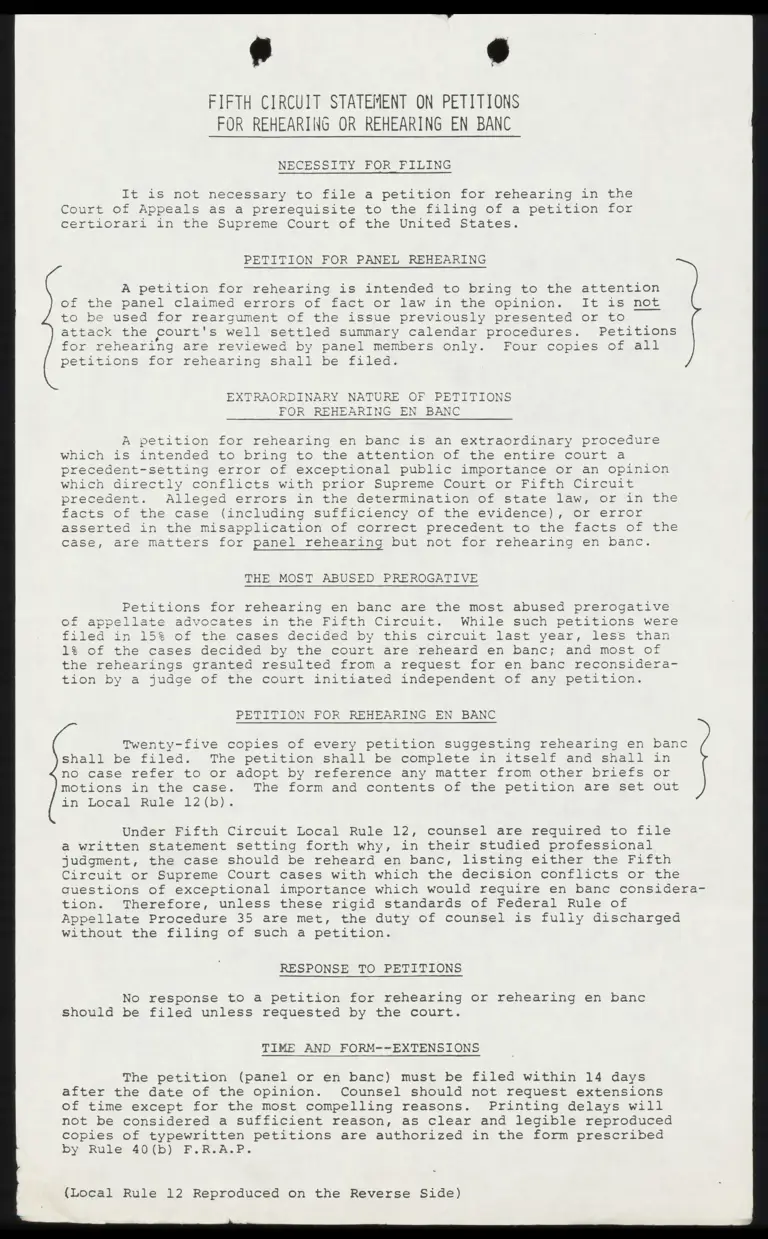
     [||e428541b-1b92-4a0c-8e51-8bb3905ebaaa||] FIFTH CIRCUIT STATEMENT ON PETITIONS
FOR REHEARING OR REHEARING EN BANC


NECESSITY FOR FILING


It is not necessary to file a petition for rehearing in the

Court of Appeals as a prerequisite to the filing of a petition for
certiorari in the Supreme Court of the United States.

PETITION FOR PANEL REHEARING


A petition for rehearing is intended to bring to the attention
of the panel claimed errors of fact or law in the opinion. lt is not
to be used for reargument of the issue previously presented or to
attack the court's well settled summary calendar procedures. Petitions
for rehearing are reviewed by panel members only. Four copies of all

petitions for rehearing shall be filed.

EXTRAORDINARY NATURE Or PETITIONS

FOR REHEARING EN BANC


A petition for rehearing en banc 1s an extraordinary procedure
which is intended to bring to the attention of the entire court a
precedent-setting error of exceptional public importance or an opinion
which directly conflicts with prior Supreme Court or Fifth Circuit
precedent. Alleged errors in the determination of state law, or in the
facts of the case (including sufficiency of the evidence), or error
asserted in the misapplication of correct precedent to the facts of the
case, are matters for panel rehearing but not for rehearing en banc.

THE MOST ABUSED PREROGATIVE


Petitions for rehearing en banc are the most abused prerogative
of appellate advocates in the Fifth Circuit. While such petitions were
filed in 15% of the cases decided by this circuit last year, less than
1% of the cases decided by the court are reheard en banc; and most of
the rehearings granted resulted from a request for en banc reconsidera-
tion by a judge of the court initiated independent of any petition.

PETITION FOR REHEARING EN BANC


Twenty-five copies of every petition suggesting rehearing en banc
shall be filed. The petition shall be complete in itself and shall in
no case refer to or adopt by reference any matter from other briefs or
motions in the case. The form and contents of the petition are set out

in local Rule 12(b).

Under Fifth Circuit local Rule 12, counsel are required to file
a written statement setting forth why, in their studied professional
judgment, the case should be reheard en banc, listing either the Fifth
Circuit or Supreme Court cases with which the decision conflicts or the
guestions of exceptional importance which would require en banc considera-
tion. Therefore, unless these rigid standards of Federal Rule of
Appellate Procedure 35 are met, the duty of counsel is fully discharged
without the filing of such a petition.

RESPONSE TO PETITIONS


No response to a petition for rehearing or rehearing en banc
should be filed unless requested by the court.

TIME AND FORM--EXTENSIONS


The petition (panel or en banc) must be filed within 14 days
after the date of the opinion. Counsel should not request extensions
of time except for the most compelling reasons. Printing delays will
not be considered a sufficient reason, as clear and legible reproduced
copies of typewritten petitions are authorized in the form prescribed
by Rule 40(b) F.R.A.P.

(Local Rule 12 Reproduced on the Reverse Side)


* »
RULE 12. EN BANC


(a) Procedure. A suggestion for a hearing or rehearing en banc may
be made as provided in F.R.A.P. 35 and herein or by any judge of the
Court in active service on his. own motion.

The court en banc shall consist of all circuit judges in regular
active service of the circuit. A circuit judge of the circuit.who
has retired from regular active service shall also be competent to
sit as a judge of the court en banc in the rehearing of a case or con-
troversy if that judge sat on the panel at the original hearing thereof.
See also Fed. R. App. P. 35,728 U.S.C. 846(c), and Allen v. Johnson,


381 ‘F.24.527 (5th. Cir. 1969). 1f rehearing en banc is granted, every
party shall furnish to the clerk 15 additional copies of every brief
the party has previously filed.

(b) Form of Suggestion. Twenty-five copies of every petition suggesting
rehearing en banc shall be filed. The petition shall be complete in it~
self and shall in no case refer to or adopt by reference any matter from
other briefs or motions in the case. It shall contain the following

items, in order:


(1) The certificate of interested persons required for briefs

by local Bule 1I3(f)(1l);

(2) Where the petitioner for rehearing en banc is represented

by counsel, one or both of the following statements of counsel

is applicable:

I express a belief, based on a reasoned and studied

professional judgment, that the panel decision is con-

trary to the following decision(s) of the United States
Court of Appeals for the Fifth Circuit [or the. Supreme

Court of the United States], and that consideration by
the full court is necessary to secure and maintain uni-

formity of decisions in this court: [citing specifically

the case or cases]

I express a belief, based on a reasoned and studied

professional judgment, that this appeal involves one or

more questions of exceptional importance: [set forth

each question in one sentence]


Attorney of record for


Counsel are reminded that in every case the duty of counsel is

fully discharged without filing a suggestion for rehearing en banc

unless the case meets the rigid standards of F.R.A.P. 35(a).

(3) Table of contents and citations;

(4) A statement of the issue or issues asserted to merit en banc

consideration. Jt will rarely occur that these will be the same

as those appropriate for panel rehearing. A petition for rehear-
ing en banc is an extraordinary procedure which is intended to
bring to the attention of the entire court a precedent-setting
error of exceptional public importance or an opinion which directly

conflicts with prior Supreme Court or Fifth Circuit precedent.

Alleged errors in the determination of state law, or in the facts
of the case (including sufficiency of the evidence), or error

asserted in the misapplication of correct precedent to the facts
of the case, are matters for panel rehearing but not for rehearing
en banc;


(5) A statement of the course of proceedings and disposition of
the case;

(6) A statement of any facts necessary to the argument of the issues;

(7) Argument and authorities. These shall concern only the issues

required by paragraph (4) hereof and shall address specifically,
not only their merit, but why they are contended to be worthy of
en banc consideration;

(8) Conclusion; and [||e428541b-1b92-4a0c-8e51-8bb3905ebaaa||]