Challenge to Boston School Committee Election Process
Press Release
March 4, 1975
-
Press Releases, Volume 6. Challenge to Boston School Committee Election Process, 1975. f584e707-bb92-ee11-be37-00224827e97b. LDF Archives, Thurgood Marshall Institute. https://ldfrecollection.org/archives/archives-search/archives-item/1116af1b-f193-49f1-a5a1-de9afb682225/challenge-to-boston-school-committee-election-process. Accessed October 06, 2026.
Copied!
    ‘DIATE RELEASE

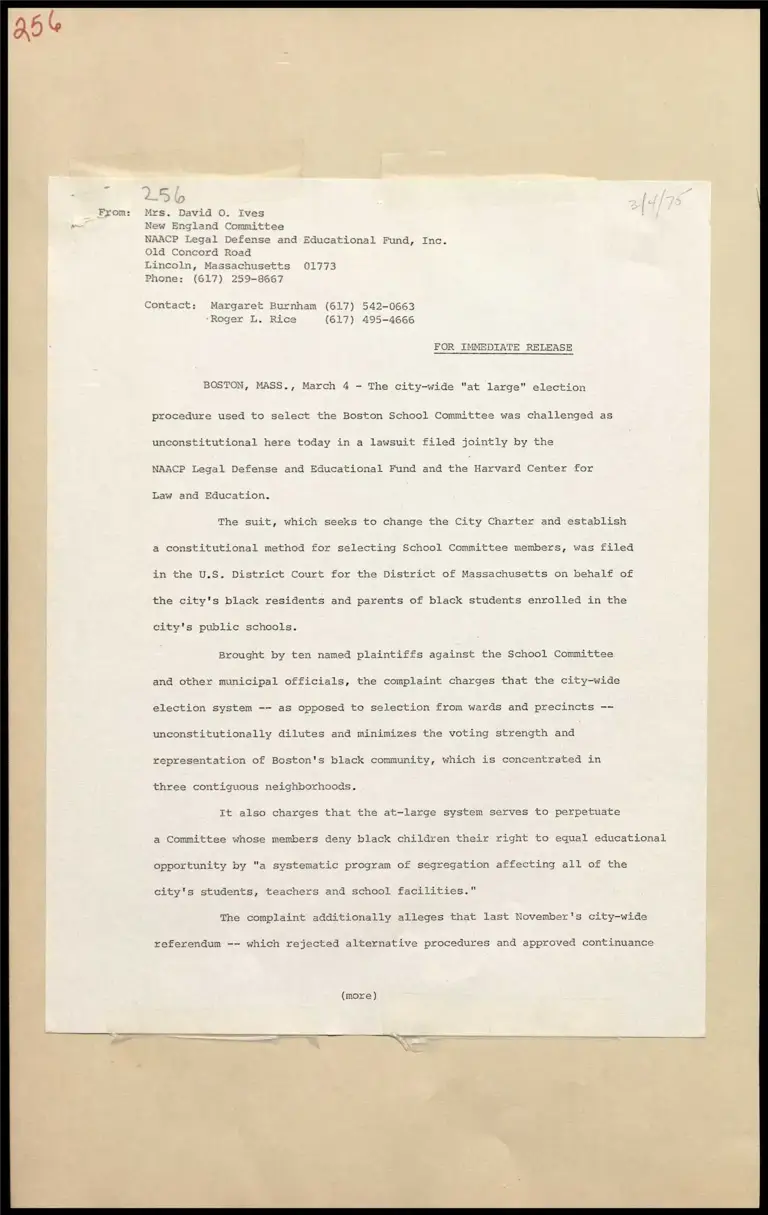
BOSTON, MASS., March 4 - The city ide "at large"

procedure used to select the Boston School Committee was challenged as

unconstitutional here today in a lawsuit filed jointly by the

NAACP Legal Defense and Educational Fund and the Harvard Center for

Law and Education.

The suit, wh: seeks to change the City Charter and establish

a constitutional method for selecting School Committee met iled ers,

in the U.S. District Court for the District of Massachusetts on behalf of

the city's black residents and parents of black students enrolled in the

ublic schools.

Brought by ten named plaintiffs against the School Committee

x municipal officials, the complaint charges that the city-wide

election system -- as opposed to selection from wards and precincts --

unconstitutionally dilutes and minimizes the voting strength and

representation of Boston's black community, ich is concentrated in

three contiguous neighborhoods.

It also charges that the at-large system serves to perpetuate

1 educational deny black children their right to a Committee whose mem

Opportunity by "a tematic program of segregation affecting all of the

The complaint additionally alleges that last November's city-wide

referendum -- which rej alternative procedures and approved continuance

(moxe)


of the at-large system -- was conducted along racial lines ina

"racially tainted" election which renders unconstitutional the continued

use of such a system. By maintaining the city-wide method of elec on,

the plaintiffs aver, black voters have virtually been excluded from the

process by which School Committee members are chosen.

To date, no black resident has been elected to the School

Committee, though black children comprise nearly a third of Boston's

public school population.

The plaintiffs further charge that the political process

leading to the nomination and election of School Committee members is not

equally open to black citizens. Successful candidates, the complaint

alleges, have frequently relied on predominantly white groups of municipal

and School Department employees for endorsements, financial contributions

and other assistance in the non-partisan School Committee elections.

Such support, the plaintiffs assert, is widespread and vitally

important to a successful re-election campaign in a city where School

Committee members have traditionally maintained segregated programs which

favor the ‘employment of white School District employees.

The complaint charges, moreover, that the defendant School

Committee members and their predecessors have infected the electoral

process by stimulating, encouraging and organizing white opposition to

school desegregation, thereby serving to polarize both the electorate and

School Committee elections along racial lines.

# # #

NOTE TO EDITOR: The NAACP Legal Defense and Educational Fund

is a completely separate organization, even though originally

(more)


use and Educational Fund, Inc., frequently

& 5 fay ® ° rganization.has a

eadquarters in New York City, and works

with 400 cooperating attorneys throughout the country.

he Legal Defense Fund is not involved in the

Boston

handled by NAACP.