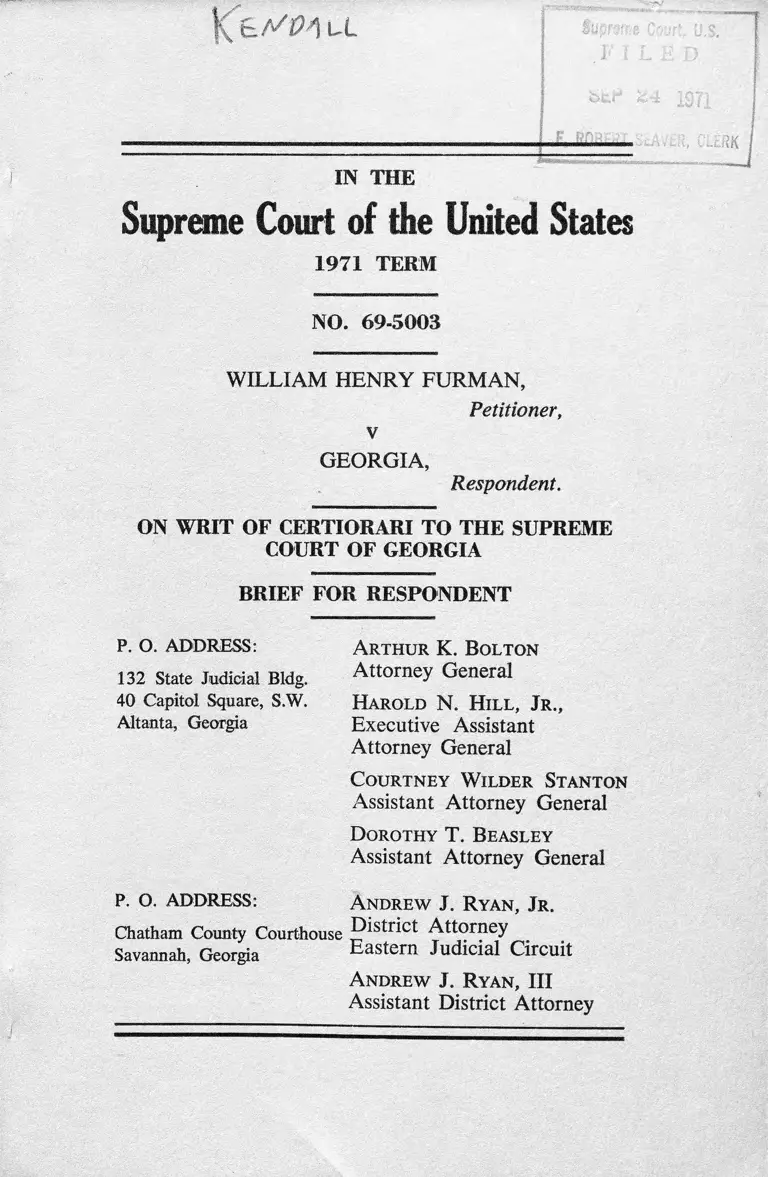
Furman v. Georgia Brief for Respondent
Public Court Documents
September 24, 1971
-
Brief Collection, LDF Court Filings. Furman v. Georgia Brief for Respondent, 1971. 4ceaff90-b29a-ee11-be36-6045bdeb8873. LDF Archives, Thurgood Marshall Institute. https://ldfrecollection.org/archives/archives-search/archives-item/1201defb-3cac-4f98-aad7-ec98e565c0c9/furman-v-georgia-brief-for-respondent. Accessed October 05, 2026.
Copied!
Kt/^uL
IN THE
Supreme Court of the United States
1971 TERM
NO. 69-5003
WILLIAM HENRY FURMAN,
v
Petitioner,
GEORGIA,
Respondent.
ON WRIT OF CERTIORARI TO THE SUPREME
COURT OF GEORGIA
BRIEF FOR RESPONDENT
P. O. ADDRESS:
132 State Judicial Bldg.
40 Capitol Square, S.W.
Altanta, Georgia
Arthur K. Bolton
Attorney General
Harold N. Hill, Jr.,
Executive Assistant
Attorney General
Courtney W ilder Stanton
Assistant Attorney General
Dorothy T. Beasley
Assistant Attorney General
P. O. ADDRESS: ANDREW J. RYAN, J r .
Chatham County Courthouse Districrt Attorney
Savannah, Georgia Eastern Judicial Circuit
Andrew J. Ryan, III
Assistant District Attorney
TABLE OF CONTENTS
CONSTITUTIONAL AND STATUTORY PRO
VISIONS INVOLVED ...............
QUESTION PRESENTED . . . . . . .
STATEMENT OF THE CASE . . . . . .
SUMMARY OF ARGUMENT . . . . . . .
Page
1
2
2
2
ARGUMENT:
I. The death penalty for
murder is not per se cruel
and unusual, in the con
stitutional sense, and is
therefore not a depriva
tion by the State of Peti
tioner Furman's life with
out due process of law . . . . 20
II. The "Indicators" of un
acceptability of death
as a penalty are not
reliable yardsticks,
are not relevant or ap
propriate yardsticks, and
do not provide accurate
measures for determining
that standard of decency
beyond which states may
not go in fixing pun
ishment 45
11.
III. Capital punishment is an
appropriate maximum pen
alty for murder in our
society today and its
use is not forbidden to
the states as cruel, and
unusual punishment in
contravention of the Eighth
and Fourteenth Amend
ments ...................... 84
IV. There is no issue in this
case concerning Petition
er's mental condition at
the time the sentence was
imposed because (1 ) no
question was raised at
any stage of the proceed
ings below, either at
trial or subsequently, and
(2) there are no facts
which cast any real doubt
on Petitioner's mental com
petency at the time of sen
tencing; rather the record
plainly shows otherwise. . . 88
V. Georgia law safeguards an
insane man from execution. . 92
CONCLUSION 95
1X1 .
APPENDICES:
APPENDIX A:
Statutory Provisions and
Rules Involved........... la
APPENDIX B:
Crimes Under the Criminal Code
of Georgia Punishable by Death . lb
APPENDIX C:
Persons Currently under Death
Penalty in Georgia, Sept. 20,
1 9 7 1 ............................ le
IV
TABLE OF CASES
Aikens v. California ................ 20
Barbour v. Georgia, 249 U.S. 454
(1919) . . . . . . . . . . . . . 90
Bartholomey v. State, 260 Md. 504,
273 A.2d 164 ( 1 9 7 1 ) .............. 82
Brady v. United States, 397 U.S.
742 (1970) ...................... . 86
Brown v. State. 215 Ga. 784 (1960). . 94
Butler v. State. 285 Ala. 387,
232 S.2d 631 (1970) . . . . . . . 82
Duzier v. State. 441 S.W.2d 688
(1969) . . . . . ................... 82
Edelman v. California, 344 U.S. 357
(1957) . . . . . . . . . . . . . . 89
Ex parte Kennmler, 136 U.S. 436
(1890) ........... . . . . . . . . 22,
23, 35, 36,
38, 85
Howard v. Fleming, 191 U.S. 126
(1903) . . . . . ................... 36,
37, 69
Jackson v. Georgia, No. 69-5030 . . 17
V.
Louisiana ex rel. Francis v.
Resweber, 329 U.S. 459 (1947). . . 23,
24, 25, 35,
38-39, 44, 58
McGaut’ha v. California, 402 U.S.
183 (1971) ............. . . . . . 34,
39,
69, 79, 83,
84
Manor v. State, 223 Ga. 594
(1967) . . . . . . . . . . . . . . . 12
Massey v. State, 222 Ga. 143
(1966) ................. 82
O'Neil v. Vermont. 144 U.S. 323 (1892)
.............. 36,
37, 85
Parker v. North Carolina, 397 U.S.
790 (1970) .......................... 86
People v. Walcher. 42 111.2d 159
246 NE2d 256 (1969). . .............. 82
Powell v. Texas, .392 U.S. 514,
530 (1968).................. 53
Rivers v. State. 226 S.2d 337
(Fla. 1969) .................... 82
Robinson v. California. 370 U.S. 660,
682, 683 ( 1 9 6 2 ) ................. 29,
43, 53
VI .
Schmid v. State. 226 Ga. 70(1970) . . 15
Sims v. Balkcom. 220 Ga. 7 (1964) . . 82
Solesbee v. Balkcom. 339 U.S.
9 (1950) ........................... 25,
26, 48, 53,
94, 95
State v. Calhoun, 460 S.W.2d
719 (Mo. 1970) . . . . . . . . . . 82
State v. Cerny, 480 P.2d 199
(Wash. 1971) ...................... 82
State v. Crook, 253 La. 961,
221 S.2d 473 (1969) . . . . . . . 82
State v. Davis, 158 Ct. 341,
260 A.2d 587 ( 1 9 6 9 ) ............. 82
State v, Kelback, 23 Utah 2d 231,
461 P . 2d 297 ( 1 9 6 9 ) ............. 82
State v. Rogers, 275 N.C. 411,
168 S . E . 2d 345 ( 1 9 6 9 ) ........... 82
Trop v. Dulles, 356 U.S. 86,
89, 100 (1958)............... 27,
29, 33, 39,
40, 42, 46,
52, 53, 85
vxx.
Weems v.United States.
370-371, 384 (1910).
217 U.S. 349,
28
29, 31- 32,
33, 37, 38
48, 53, 85
Whitus v. Georgia,
545 (1967) . .
385 U.S.
79
Wilkerson v. Utah. 99 U.S. 130(1879). 35
Williams v„ State, 222 Ga. 208(1966). 12
Wilson v. State. 225 S.2d 321
(Fla. 1969) . . . . ......... 82
Witherspoon v. Illinois. 391 U.S.
519 (1968) ...................
61, 63, 78
79
VXXX.
Annals of Congress, Vol. II,
Appendix pp. 2274, 2281 . . 86
Bedau, H., The Death Penalty
in America, (Rev. ed 1967)
p. 120. .................... 51
City of Atlanta, Department
of Police, 91st Annual
Report, Dec. 31, 1970 . . . 80
Cohen, B . Law Without Order
OTHER AUTHORITIES
(1970)...................... 51
Ershine, 34 Pub Op Q (1970-
7 1 ) ................... .. - 60
Farrand, The Records of the
Federal Convention of 1787,
Vol. I, Yale University
Press 1934 .............. .85
Georgia House Study Commit
tee Report, 1968 House
Journal, p. 3451........... 59
Georgia Senate Study Commit
tee Report, 1966 House
Journal, p. 2669. . . . . . 59
X X .
Good Housekeeping, November
1969, vol. 169, p. 24 . . . 61
Hearings before the Subcom
mittee on Criminal Laws and
Procedures of the Committee
of the Judiciary, United
States Senate on S. 1760,
March 20, 21, and July 2,
1968... . . . . . . . . . . 58
Mutchmor J. R. "Limita
tion of Death Penalty in
Canada" Christian Century,
January 24, 1968, Vol. 85,
P- 120......................49
Nation's Business, November
1970, vol. 58, p. 28. . . . 60
Newsweek, January 11, 1971,
pp. 23, 24, 27............. 58
Pennington, John, "The Death
Penalty: Have We Walked the
Last Mile?", Atlanta Journal
and Constitution, Aug. 30
and Sept. 6, 1970 . . . . . 75
OTHER AUTHORITIES— continued
X.
Perry and Cooper, Sources of
Our Liberties, American Bar
Foundation, 1959. . . . . . 85
Rutland, The Birth of the
Bill of Rights7^776^1791,
University of North Carolina
Press, 1955 ................ 75
Time, April 15, 1966, vol. 87,
p. 40. .................... . 50
United Nations, Department of
Economic and Social Affairs,
Capital Punishment (ST/SOA/
SD/9-10) (1968) .47
United States Department of
Justice, National Prisoner
statistics Number 44, August
1969, Table 15, p. 30. . . . 32,
56, 62
OTHER AUTHORITIES--continued
XX .
STATUTORY AND CONSTITUTIONAL
PROVISIONS
G a. code Ann. § 6-805(f) (Ga.
Laws 1965, pp. 18, 24) 10
Ga. code Ann. § 24-3005 (G a .
Laws 1889, p. 156; 1950, p.
427, 428) 94
Ga. code Ann. § 26-1001 (1969) 12
G a. code Ann. § 26-1003 (1969) 13
Ga. code Ann. § 26-1004 (1969) 12
Ga. code Ann. § 26-1101 (1969) 12
G a. code Ann. § 26-1901 and -1902
(1969) 55
G a. code Ann. § 26-3301 (Ga. Laws
1969, p . 741) 31
G a. code Ann. § 27-1502 (1933) 89
G a. code Ann. § 27-405 i(Ga. Laws
1962, p . 453, 454) 6
G a. code Ann. § 27-2514 (G a . Laws
1924, p . 195) 67, 76
G a. Code Ann. § 27-2515 (G a . Laws
1924, p . 196) 76
XIX .
Ga. Code Ann. § 27-2602-2604 (Ga.
Laws 1960, pp. 988, 989, Ga.
Laws 1874, p. 30) 92
Ga. code Ann. § 38-415 (Ga. Laws
1962, pp. 133-135) 6
Ga. Code Ann. 77-309(c)(d) (Ga.
Laws 1956, pp. 161, 171 as a-
mended) 66
Ga. Code Ann. 77-310(d)(Ga. Laws
1956, pp. 161, 173, as amended) 93
N. M. Stat. Ann. (1969 Cum.
Pocket Part) 40A-29-2.1 57
Official Compilation of the Rules
and Regulations of the State of
Georgia, Rules of the State
Board of Corrections, Sec. 125-
1-2-.05 75
Rules of the United States Supreme
Court, Rule 23(l)(f) 90
IN THE
SUPREME COURT OF THE UNITED STATES
1971 Term
No. 69-5003
WILLIAM HENRY FURMAN,
Petitioner,
GEORGIA,
Respondent.
ON WRIT OF CERTIORARI TO THE
SUPREME COURT OF GEORGIA
BRIEF OF RESPONDENT
CONSTITUTIONAL AND STATUTORY
PROVISIONS INVOLVED
In addition to the provisions recited
by Petitioner, this case involves also
certain Georgia statutes and published
Rules of the State of Georgia Board of
Corrections, each of which is set forth
2
as Appendix A to this Brief [herein
after cited as "App. A, pp. _____ ] at
App. A, pp. la - 16a infra.
QUESTION PRESENTED
"Does the imposition and car
rying out of the death penalty
in this case constitute cruel
and unusual punishment in vio
lation of the Eighth and Four
teenth Amendments?"
STATEMENT OF THE CASE
William Joseph Micke, Jr., age 29,
died on August 11, 1967, at his home
in Savannah, Georgia, as the result of
a bullet being shot through his lung and
producing severe hemorrhaging (A. 17,
18, 32). The unprovoked shooting oc
curred as follows: Micke and his wife
retired to bed sometime after midnight,
when he returned from his initial night
of work at a second job taken to supple
ment the family income. Mr. Micke's
primary employment was with the United
States Coast Guard (A. 18). The young
family included five children, ranging
in age from one year to fifteen years
(A. 17). Between 2:00 and 2:30 a.m.,
before falling asleep, the Mickes heard
noises and, thinking it was 11-year-old
Jimmie sleepwalking, Mr. Micke went to
get Jimmie back to bed (A. 18, 19).
3
Mrs. Mi eke, listening, heard her husband's
footsteps quicken. Then she heard a loud
sound and her husband's scream (A. 19).
Believing then that someone was in the
house because of Mr. Mieke's cry, and
fearful that someone else was also in the
house, and afraid that her children might
be harmed, Mrs. Micke ran to the bedrooms
for the children and gathered them into
her bedroom in an effort to protect them
(A. 19, 21, 22). She and the children
then screamed for their neighbor, she
realizing that she had no gun or other
means to defend against an intruder (A.
19, 22). She called the police as soon as
she saw Mr. Dozier, the neighbor, come out
of his house (A. 19), but her hysteria
prevented the police from learning what
the disturbance was (A. 24). Sergeant
Spivey, who was just one or two blocks
away from the Micke home when the call
came at about 2:23 a.m., went immediately
there and was met by Mr. Dozier out front
(A. 24, 26). They thought an intruder was
still in the house, so Sergeant Spivey
checked the front door and, finding it
locked, went around to the back door.
The back of the house was dark, and
when the officer tried the back door, it
opened (A. 24-25). Shining his flash
light into the house, he saw Mr. Micke’s
body lying on the floor with a large
puddle of blood around the head and
shoulder (A. 25). Still thinking there
4
was an intruder in the house, the officer
crawled through the rooms and found no one
other than Mrs. Micke and the children
locked in a front bedroom (A. 25). Upon
doubly checking Mr. Micke's vital signs.
Sergeant Spivey concluded that he was dead.
Other policemen arrived, an ambulance was
called, and an investigation begun (A. 26).
Officers Hall and Goode and others
immediately scanned the area in a search
for the assailant (A. 37, 41). Hall sta
tioned himself at the far end of a wood
ed area next to the Micke house, in his
patrol car with the lights off and motor
running (A. 38). Petitioner came out of
the woods and when he saw the patrol car,
he walked faster and then started to run
(A. 38-39). Hall and other officers pur
sued, finally on foot, and traced Peti
tioner 's tracks to the nearby home of his
uncle (A. 39). After obtaining the uncle's
permission to search the area, the officers
located Petitioner hiding under the house
and pulled him out by the hand (A. 39, 40,
41). A search was made of Petitioner
and a .22 caliber pistol, which was later
identified as having discharged the bullet
which killed Mr. Micke, was taken from his
right front pocket (A. 40-43, 49, 50;
R. Transcript 67-71). No other civilian
was seen out in the area during the course
of the search (A. 40).
5
Detective Smith testified (after a
voluntariness hearing before the court in
the absence of the jury and after the
court concluded that the statements were
not inadmissible on that account [A. 44,
46]), that on the same day and following
an explanation of Petitioner's rights to
him 1/ and his indication that he did not
then want a lawyer# the detective said he
had one question# which was: " . . . did
he get inside of the house" (A. 47).
Petitioner's reply# he said, was:
"A. He state yes, that he was
in the kitchen; the man come in
the kitchen, saw him in there
and attempted to grab him as he
went out the door; said the man
hit the door, instead of catching
him, he hit the door, the door
slammed between them, he turned
around and fired one shot and
ran." (A. 47).
The investigation at the Micke home,
commenced while Officers Hall and Goode
and others were searching for the assail
ant (A. 26, 29, 33, 37, 41) yielded
latent fingerprints on a washing machine
on the back porch which were later deter-
Officer Goode testified that his
constitutional rights were also read
to him upon arrest (A. 42).
1/
6
mined to have been made by Petitioner
(A. 28, 33, 37). The inch-thick ply
wood door which lead from the small
porch to the kitchen where Mr. Micke's
body was found, contained a bullet hole
(A. 27, 29), the appearance of which
indicated that the bullet came into the
house (A. 27, 30). Mrs. Micke testified
that the door had been locked (A. 20).
It appeared that the washing machine had
been pulled away from a window, a fan
moved, and the door unlocked on the inside
by slipping a hand through the window
(A. 20, 21, 27, 28, 31).
After the State presented its
case, Petitioner's counsel (who has been
counsel throughout the proceedings and up
to the present time) asked that the jury
be excused and that the defendant be
called to determine, on the record, whe
ther he then wished "to make a sworn or
unsworn statement or no statement at
all." (A. 50). This was done (A. 50) .2J
2/ Georgia law gives a criminal defendant
these three options. Ga. Laws 1962,p.453
Ga. Code Ann. § 27-405, App. A, p.
6 a. See also Ga. Laws 1962, pp.
133-135, Ga. Code Ann. § 38-415 and
-416.
7
Petitioner verified that his attorney
had discussed these three alternatives
with him and advised him in this regard,
and that it was his decision not to make
a statement (A. 51). After further ex
planation by the court and his attorney,
in which it was emphasized that he could
make either a sworn or an unsworn state
ment, the court asked: "Do you want to
tell this jury anything?" The defendant
then said, "Yes". (A. 52, 53). He reit
erated this desire before the jury, and
after his attorney instructed him to
"Give your name, your age and everything
else about you," the following transpired:
"The Defendant: William Henry Furman.
"Mr. Mayfield: Speak a little louder,
please.
"The Defendant: William Henry Fur
man. I am twenty-six. I work at
Superior Upholstery.
"Unidentified: Where?
"The Defendant: Superior Upholstery.
"Mr. Mayfield: Speak loud enough now
for everyone to hear you and hear
you clearly.
"The Defendant: They got me charged
with murder and I admit, I admit
8
going to these folks1 home and they
did caught me in there and I was com
ing back out, backing up and there
was a wire down there on the floor.
I was coming out backwards and fell
back and I didn't intend to kill no
body. I didn't know they was behind
the door. The gun went off and I
didn't know nothing about no murder
until they arrested me, and when the
gun went off I was down on the floor
and I got up and ran. That's all to
it.
"Mr. Mayfield: Now, do you have
anything else you want to tell this
jury about this case?
"The Defendant: Yes, sir, one other
thing; they didn't — questioned me
down there, down there at the police
station, they didn't told me nothing
about a lawyer and I told them who I
wanted as an attorney and they still
asked me questions and I wouldn't an
swer none. That's — that's all I've
got to say.
"Mr. Mayfield: Anything else you want
to say now?
"The Defendant" That's all.
"Mr. Mayfield: You may come down.
9
Note: (The defendant withdrew
from the witness stand.)" (A.
54-55).
Before the trial commenced, a motion
to suppress evidence was heard and denied,
a motion challenging the array of the jury
venire was submitted upon stipulation of
transcript from another case, and other
defense motions were made and denied (R.
8-15, Re Transcript 2, 2-a, 11A through
11 BE; A. 11, 12).
In obtaining a panel of forty-eight
qualified jurors, only one person was dis
qualified, and thus required replacement,
for answering that he would refuse to im
pose capital punishment in a case regard
less of the evidence (A. 12-15).
The trial was held on September 20,
1968 (A. 10), the homicide having occur
red on August 11, 1967 (A. 17). The
lapse of time was occasioned by defen
dant 1s attorney having moved for psychi
atric examination and evaluation at an
institution designated by the court and
at State expense so that the jury could
have the information in determining guilt
or innocence and proper punishment (A. 6 ).
On October 24, 1967, the court granted the
motion inadvertently referring to it as a
special plea of insanity, and ordered
defendant sent to Milledgeville (Central)
State Hospital for examination (A. 8 ).
10
By the terms of the order, the findings
were to be sent to the court, the solici
tor general, and defendant's counsel.
Defendant was returned to the court in
April, 1968, as being competent to stand
trial, it having been determined that he
was not psychotic, knew right from wrong,
and was able to cooperate with his coun
sel in preparing his defense (Petitioner's
Brief, Appendix B, p. 3b).
No further reference was made to any
insanity, either in terms of a defense or
in terms of being competent to stand trial.
Despite all of the pre-trial and post
trial activity which marks the course of
this case, the subject did not arise un
til after this Court granted certiorari
and preparations for the appendix began
(Petitioner's Brief, App. B, p. lb).
Contrary to the assertion putting the blame
for omission of the "reports" on the
trial court clerk, the law clearly im
poses this duty of perfecting the record
on the party contending the record is
incomplete, in this case,the Petitioner.
Ga. Laws 1965, pp. 18,24; Ga. Code Ann.
§ 6-805(f), App. A. p. la.
Respondent knows of no requirement that
the clerk include in the record more than
is recorded in his office.
The merits of the new assertions
regarding Petitioner's mental condition
are palpably suspect since, although
11
trial counsel pressed an appeal before
the Georgia Supreme Court and was thus
responsible for drawing up the enumera
tion of errors and supporting brief
based on the record, the absence of the
letters was not even noticed or thought
important enough to be made a part of
the record at that stage, as may be done
in accordance with appellate practice.
Ga. Laws 1964, pp. 18, 24, supra.
Petitioner, in his Statement of the
Case, refers to the characterization of
the crime given in the opinion of the
Georgia Supreme Court (Petitioner's
Brief, p. 6). That Court, in section
6 of its opinion (A. 67, 68), ruled that
the general grounds of the motion for
new trial 3/were not meritorious.
2/ That is, contentions that the
verdict was contrary to evidence and
without evidence to support it; that
the verdict was decidedly and
strongly against the weight of the
evidence; and that the verdict was
contrary to law and the principles
of justice and equity. See R. 20.
12
The reason was that the evidence was suf
ficient to show either implied malice 4/
or at least the death occurring in the
commission of a felony. .5/
Contrary to Petitioner's comment,
Georgia law at the time of his convic
tion, and still now, divides crimes of
homicide into three categories: murder
4 /
V
Ga. Code Ann. § 26-1004: "Implied
Malice. Malice shall be implied
where no considerable provocation
appears and where all the circum
stances of the killing show an
abandoned and malignant heart. Cobb,
783." This now comprises § 26-1101 (a)
of the Code of Georgia, effective
July 1, 1969. (Petitioner's Brief,
App. A, p. 4a)
Illustrated, as the Court notes, by
Williams v. State, 222 Ga. 208 (1966)
and Manor v. State, 223 Ga. 594(1967)
This type of murder is now defined in
the Criminal Code of Georgia, § 26-
1101(b). (Petitioner's Brief, App. A,
p. 4a).
Formerly Ga. Code Ann. § 26-1002,
now Criminal Code of Georgia §
26-1101. (Petitioner's Brief, App.
A, p. la, 4a).
y
13
voluntary manslaughter , and invol
untary manslaughter -§/. The Committee
Notes which accompany the new Criminal
Code of Georgia effective July 1, 1969,
discusses the decision not to divide the
offense of murder into degrees:
"An examination of murder legisla
tion in operation in 30 States
discloses that six jurisdictions
(Illinois, Louisiana, Mississippi,
Oklahoma, South Carolina, and
Texas) follow the Georgia pattern
of dividing homicide into murder,
voluntary, and involuntary man
slaughter, with separate defini
tions of these offenses. The
remaining 24 States, approximately
80 % of the jurisdictions studied,
in addition to having statutes deal
ing manslaughter, divide murder
into degrees for purposes of pro
secution and punishment. . . .
* * *
7 /
Formerly Ga. Code Ann. § 26-1002,
now in Criminal Code of Georgia,
§ 26-1101.(Petitioner 1s Brief,
8/ APP* PP* la, 4a).
Formerly Ga. Code Ann. § 26-1009,
now in Criminal Code of Georgia,
§ 26-1103. (Petitioner1s Brief,
App. A, pp. 2a, 4a).
14
"While more than three-fourths of
the States divide the offense of
murder into degrees, primarily to
facilitate punishment, Georgia has
always followed the common-law
view of a single definition.
Illinois and Louisiana, which have
recently enacted criminal Code
legislation, have adopted the de
finitional classification of homi
cide similar to the method presently
employed in Georgia. The Model
Penal Code Proposed Official Draft
approves and utilizes the single
definition (Section 201.2)."
Committee Notes, Criminal Code of
Georgia, 1970 Revision, p. 84.
Thus, Georgia submits to the jury
trying the case the discretion to fix the
punishment at death in a murder case, and
does not limit its consideration by classi
fications of degree. The value of any
life ended by murder is thus given the
same weight insofar as the maximum penalty
imposeable is concerned. The myriad of
variables attendant to each case is left
to consideration of the jury, represent
ing the community, as to which murder
cases appropriately call for the death
penalty.
Petitioner states, as a footnote,
his Amended Motion for New Trial chal
lenged a certain jury instruction re
15
garding felony murder (Petitioner's Brief
p. 7, fn. 4). He did not object to the
instruction when given (A. 64).
He states that he incorporated the
challenge by reference into the Enumera
tion of Errors which formed the basis of
appeal to the Georgia Supreme Court, but
it appears there only thusly:
"7. That the Court erred in one
and all of the respects set out in
the amended Motion for New Trial and
for the reasons set forth thereon."
Enumeration of Errors dated March 27,
1969, p. 2 (Not paginated in origi
nal record in this Court and not
included in printed Appendix.).
The Supreme Court of Georgia does not con
sider enumerations not briefed or argued.
Schmid v.State, 226 Ga. 70 (1970). And
it is abundantly evident that Petitioner
did not assert the matter below at all,
as at the conclusion of the Georgia
Supreme Court's opinion, it is stated:
"7. Having considered every
enumeration of error argued by
counsel in his brief and find
ing no reversible error, the
judgment is Affirmed.11 (A. 68).
Consequently, Petitioner can raise no
inference or implication that any issue
in this regard was properly raised.
16
Petitioner refers to "additional
facts" concerning him which the jury did
not know but which "appear in the record"
(Petitioner's Brief, pp. 8-9). That
these "facts" are not a part of the record
and were not a part of the record before
the court below has already been pointed
out. It is further noted that the
"facts" alluded to, i.e., results of
psychiatric examination, were fully
available for disclosure to the jury,
had Petitioner's counsel deemed it favor
able to the defendant to make such a
revelation. The letters are dated
February 28, 1968, and April 15, 1968
(Petitioner's Brief, App. B, pp. 2b and
3b), long before the trial on September
20, 1968, and it is obvious from their
content that defense counsel would not
have chosen to make the jury aware of
their substance. There is no basis what
soever for Petitioner's bald statement
that the two letters "indicate that
Petitioner Furman is both mentally
deficient and mentally ill."
(Petitioner's Brief, p. 9). The lately
contrived "issue" of insanity is further
dealt with in this Argument, infra, p. 88 et
The facts concerning the same are simply
recited here, in refutation of Petitioner's
erroneous Statement of the Case in this
regard.
Contrary to Petitioner's statement,
he was not "committed" to Central State
Hospital upon a special plea of insanity.
17
There was no such special plea of insan
ity, which would have ultimately required
a jury determination of competency to
stand trial, such as occurred in Jackson's
case. See Jackson v. Georgia, No.
69-5030, A. 12, 13, 17, 18, 21, 33.
Instead, counsel simply moved for psy
chiatric examination, at State expense,
to be used for purposes of defense and
possibly for sentencing (A. 6). As
indicated heretofore, the court in
granting the motion inadvertently
referred to it as a plea of insanity,
but none was ever filed nor did counsel
ever make any issue of competency to
stand trial.
Petitioner also asserts an erroneous
conclusion regarding the meaning of the
second letter: the Hospital did not re
port on April 15, 1968, that he was THEN
diagnosed identically as he had been diag
nosed on February 28. Instead, the letter
merely repeated the earlier diagnosis as
having at one time been made, and it then
goes on to say that the present condition
is different. There is no basis for con
cluding, as Petitioner inferredly attempts
to, that the Hospital deliberately sent
back for trial a man who had some mental
condition which should have legally avoid
ed trial and sentencing.
18
SUMMARY OF ARGUMENT
THE IMPOSITION AND CARRYING OUT
OF THE DEATH PENALTY IN THIS
CASE DOES NOT CONSTITUTE CRUEL
AND UNUSUAL PUNISHMENT IN VIOLA
TION OF THE EIGHTH AND FOURTEENTH
AMENDMENTS.
The Fourteenth Amendment, by virtue
of which cruel and unusual punishment for
bidden by the Eighth Amendment is a pro
hibition against the states, provides
that the states may not deprive any per
son of life without due process of law.
Conversely, the states may deprive a
person of life so long as the mandates of
due process of law are observed. The
Eighth Amendment, adopted as part of a
declaration of rights to confine the
federal government, may not effect a
curtailment of a right of the states
recognized by the states-restricting
Fourteenth Amendment.
The Eighth Amendment does not pro
hibit the penalty of death for crime,
in that such a penalty was historically
acceptable in the context of the period
in which the Amendment was adopted,
has thereafter traditionally been a
part of the penal system in this country,
and is widely accepted today as a rea
sonable, rational, and appropriate
19
instrument in the control of crime. it
is not a punishment that is prohibited as
constitutionally "cruel and unusual."
The function of State legislatures to
define crimes and fix punishments is
therefore not restricted against providing
such a punishment.
This case is devoid of any issue
concerning the sanity of Petitioner.
There is no constitutional barrier
to the imposition and carrying out of
the death penalty in the case at bar.
20
ARGUMENT
I
THE DEATH PENALTY FOR MURDER
IS NOT PER SE CRUEL AND UN
USUAL, IN THE CONSTITUTIONAL
SENSE, AND IS THEREFORE NOT A
DEPRIVATION BY THE STATE OF
PETITIONER FURMAN'S LIFE WITH
OUT DUE PROCESS OF LAW.
The Court has framed the question for
examination to be, whether the imposition
and carrying out of the death penalty in
Furman's case constitutes cruel and un
usual punishment in violation of the
Eighth and Fourteenth Amendments. Peti
tioner contends that his sentence is a
rare, random, and arbitrary infliction
and for that reason is prohibited by
the Eighth Amendment principles briefed
in Aikens v. California, No. 68-5027.
He states therein that the Due Process
Clause of the Fourteenth Amendment is
"involved" 2/, but he makes little or
no reference to it thereafter, travel
ing instead on the assumption that the
Eighth Amendment is incorporated into
the Due Process Claiise and so it need
9/ Aikens Brief, p. 2.
21
only be examined in terms of the former.
However, since the Eighth Amendment is
not, alone, applicable to the States
and was not applicable to them in any
sense before the adoption of the Four
teenth Amendment in 1868, the question
at issue must be reviewed in the context
of the latter's requirements. The
Eighth Amendment imposes no restrictions
on the States, but the Fourteenth Amend
ment does. The Due Process requirements
will therefore be developed as the appro
priate arena in which to focus on the
cruel and unusual punishment question.
The Fourteenth Amendment Due Pro
cess Clause guarantees:
"(N)or shall any State deprive
any person of life, liberty or
property without due process of
law; . . . " (Emphasis added).
It does not prohibit a State from
depriving a person of life, but rather
the prohibition is that it shall not be
done without due process of law. Thus,
the Nation saw fit, one hundred years ago,
to give constitutiqnal permanence to the
right of every person to demand due pro
cess before his life could be forfeited
by the State. The mandates of this
clause, in terms of cruel and unusual
punishment, has been stated variously:
2 2
In Ex parte Kemmler, 136 U.S. 436 (1890)
the Court explained:
"[I]n the Fourteenth Amendment,
the same words [due process of
law] refer to that law of the
land in each State, which derives
its authority from the inherent
and reserved powers of the State,
exerted within the limits of
those fundamental principles of
liberty and justice which lie
at the base of all our civil and
political institutions. Undoubt
edly the Amendment forbids any
arbitrary deprivation of life,
liberty or property, and secures
equal protection to all under like
circumstances in the enjoyment of
their rights; and in the adminis
tration of criminal justice re
quires that no different or higher
punishment shall be imposed upon
one than is imposed upon all for
like offenses. But it [the Four
teenth Amendment] was not designed
to interfere with the power of
the State to protect the lives,
liberties and property of its
citizens, and to promote their
health, peace, morals, education
and good order." I_d. at 448.
Kemmler complained that the form of
the death penalty, electrocution, was
23
cruel and unusual and therefore a depri
vation of life without due process of
law. The Court concluded that in order
to reverse the New York highest court,
it would " . . . be compelled to hold
that it had committed an error so gross
as to amount in law to a denial by the
State of due process of law to one ac
cused of crime." id. at 448. Peti
tioner's complaint faces the same test
because in order to prevail, it, too,
must evidence a denial of substantive
due process: whereas Kemmler challenged
the form of infliction, i.e ., electro
cution itself, rather than the procedure
for inflicting it, Petitioner chal
lenges the punishment, i.e., the death
penalty, itself, rather than the proce
dure by which it was imposed on him.
In Louisiana ex rel. Francis v.
Resweber, 329 U.S. 459 (1947), the
circumstances of execution were com
plained of as cruel and unusual punish
ment. Thus, procedural due process was
the frame. Mr. Justice Frankfurter
developed the concept of the due pro
cess safeguard in a concurring opinion
and said it is part of "the conceptions
of justice and freedom by a progressive
society." Id., at 467.
"The Fourteenth Amendment,” he
wrote, "did mean to withdraw
from the States the right to
24
act in ways that are offensive to
a decent respect for the dignity
of man, and heedless of his free-
dom. " Id,, at 468.
"In short," he continued, "the
Due Process Clause of the Four
teenth Amendment did not withdraw
the freedom of a State to enforce
its own notions of fairness in the
administration of criminal justice
unless, as it was put for the Court
by Mr. Justice Cardozo, 'in so doing
it offends some principle of justice
so rooted in the traditions and con
science of our people as to be ranked
as fundamental.'" I_d. at 469.
This context, then, is the proper
one in which the Court is to review
State penal laws, with respect to whether
they are cruel and unusual. The question
of the moment is whether the death penalty
offends some principle of justice so
rooted in the traditions and conscience
of our people as to be ranked as funda
mental. This test looks to the solid past
as well a constitutional inquiry should,
rather than simply to the shifting pre
sent, which Petitioner presses with his
emphasis on a test of "evolving standards.
Measured by this due process test,
it is indisputable that the death penalty
for crimes which immediately endanger or
25
take life does not offend a rooted prin
ciple of justice. The existence and
application of the death penalty itself
has been an integral part of our penal
systems since at least Colonial days,
although, as Justice Burton pointed out
in dissent in the Louisiana case, tor
turous means and forms of inflicting
death is prohibited as shocking funda
mental instincts of civilized man.
Id. at 473.
Since due process standards are very
broadly conceived, Mr. Justice Frank
furter cautioned, "great tolerance toward
a State's conduct is demanded of this
Court." _Id. at 470. The State does not
assert that its position in this case
cannot be maintained without a great
tolerance being shown by the Court, but
rather points up this concept to illus
trate the foreshortened framework of
Petitioner's premise.
Although Solesbee v. Balkcom, 339
U.S. 9 (1950) is not a punishment case,
it involves an application of the Due
Process Clause. The question was whether
the method applied by Georgia to deter
mine the sanity of a convicted defendant
offended due process. The Court held
that the statute as applied did not do so.
Mr. Justice Frankfurter, who dissented,
again exhaustively reviewed the meaning of
the Due Process Clause. The rule against
26
executing an insane person is "protected
by substantive aspects of due process,"
he noted. (Id. at 24). This conclusion
followed from an application of the sub
stantive aspect of due process, which
was phrased thusly:
"It is now the settled doc
trine of this Court that the
Due Process Clause embodies a
system of rights based on moral
principles so deeply embedded in
the traditions and feelings of
our people as to be deemed funda
mental to a civilized society
as conceived by our whole history."
Id. at 16.
* * *
"In applying such a large, un-
technical concept as 'due pro
cess,' the Court enforces those
permanent and pervasive feelings
of our society as to which there
is compelling evidence of the
kind relevant to judgments on
social institutions." Id. at 16.
The distinction between substan
tive and procedural due process which
was there made was that substantive
due process prohibited killing an in
sane man, whereas procedural due pro
cess required that where a question of
27
sanity arises, the prisoner must be
given the opportunity to show that he is
otherwise. This distinction illustrates
that Petitioner's argument, as embodied
in the Aikens Brief, must be construed
to be that the death penalty violates
substantive due process, because the
theory is that any execution actually
inflicted in our contemporary society
would be unconstitutional.
Trop v. Dulles, 356 U.S. 86 (1958)
is strictly an Eighth Amendment case
because of its federal character. Due
process considerations did not enter
in. Therefore, Petitioner's lifting
of the test suggested in that case and
his primary reliance thereon distorts the
question in this case. Its adaptability
to the present situation must be circum
scribed by the superimposition of the
broad limits in which due process allows
the States to operate.
Petitioner, moreover, makes the Trop
test unworkable in a judicial setting by
construing it narrowly. The evolving
standards of decency, he says, are ones
which are current and can be measured by
contemporary statistics and public
opinion indicators and world-wide
"trends". Such a close-to-pocket con
struction of the Trop language not only
fails to take into account the changes
of tomorrow but refuses to acknowledge
28
the judicial setting in which it must
be applied. Petitioner's brief is
replete with partial statistics, as
sertions of unconfrontable "experts",
and all types of "objective indicators"
which allow not of cross-examination
and which are not subject to the rules
of evidence. It is submitted that the
standards intended by the statement that
"the [Eighth] Amendment must draw its
meaning from the evolving standards of
decency that mark the progress of a
maturing society" -i2/ are standards of
fundamental significance and capable
of demonstration to a judicial body that
is confined to the evidence in the record
of a case and is not equipped with the
facilities for factual investigation and
the gathering of conflicting evidence
which a legislative body would have. The
scope and magnitude of the "evidence"
proffered by Petitioner itself bespeaks
an attempt that would more fittingly be
directed to a legislature. The Court,
as a matter of fact, has on more than
one occasion with respect to penalties,
pointed this out: see dissent of Mr.
Justice White, concurred in by Mr.
Justice Holmes, in Weems v. United
States, 217 U.S. 349, 384 (1910); dis-
10/ 356 U.S. at 101.
29
sent of Mr. Justice Clark in Robins on
v. California, 370 U.S. 660, 682, 683
(1962); dissent of Mr. Justice White in
Robinson v. California, supra, 370 U.S.
at 689. At the least, the Court has
taken cognizance of the comprehensive
task involved in reaching the conclusion
that a legislatively defined crime or
legislatively fixed punishment is uncon
stitutional :
"And for the proper exercise of
such power [judicial power to judge
the exercise of legislative power]
there must be a comprehension of
all that the legislature did or
could take into account, -- that
is, a consideration of the mischief
and the remedy." Weems v. United
States, supra, 217 U.S. at 379.
The standard, then, is the much broader
one implicit in "the dignity of man"; it
requires only that the power to punish "be
exercised within the limits of civilized
standards". Trop v. Dulles, supra, 356
U.S. at 100. The overriding applicability of
the Fourteenth Amendment due process con
cept, which was absent in the Trop and
Weems tests, is present in Robinson v.
California, supra, 370 U.S. 660 (1962).
There the Court concluded that it was
"doubtless" that a law which made a crim
inal offense of a disease would universal
ly be thought to be cruel and unusual
30
punishment in violation of the Eighth
and Fourteenth Amendments, -ii/ The
fundamental character of the condemna
tion is therefore the gauge.
The narrow construction which Peti
tioner puts on "contemporary human know
ledge", "public opinion enlightened by
humane justice", and "evolving standards
of decency that mark the progress of a
maturing society", also falls prey to one
of his own arguments. The United States
Constitution is, to be sure, a vital
organ which must be interpreted with
deference to its elastic nature. This
does not mean, however, that it may be
construed solely to fit today's needs,
desires and best judgment. That is
employment more appropriate to laws,
which can be made today and changed, modi
fied, altered, amended, or repealed
tomorrow. Laws can be experimented
with. But the Constitution remains as it
stands, subject only to infrequent and
difficult-to-achieve amendment. If the
Court were to construe the foundation
document in terms of current world or
national opinion, and assuming for the
sake of argument that Petitioner has
demonstrated total contemporary rejection
11/ 370 U.S. at 666.
31
of the death penalty, the constitutional
invalidation of capital punishment would
remove it foreover as a penal sanction in
this country, absent constitutional
amendment.
Such finality should not be imposed
when it has not been shown that the death
penalty serves no legitimate purpose and,
even more importantly, when no one can
yet imagine the types or magnitudes of
crimes that will surely evolve in future
generations. Who, for example, envi
sioned twenty years ago that our society
plagued with gun-point airplane high
jacking, would find it necessary to define
a new crime, commonly referred to as
"skyjacking", and provide as a maximum
the death penalty? A2/ Who today can
imagine the new and more broadly sweeping
crimes that can evolve in the increasingly
complex, mobile, speeding, technological,
interdependent society in which we live?
It is all too well known that the flip of
a switch can destroy millions. As the
Court succinctly stated in Weems v. United
States, 217 U.S. 349 (1910):
12/ See Ga. Laws 1969, p. 741; Criminal
Code of Georgia § 26-3301. (App. A,
p. 5) .
32
"The future is their (constitution's)
care, and provision for events of
good and bad tendencies of which no
prophecy can be made. In the appli
cation of a constitution, therefore,
our contemplation cannot be only of
what has been, but of what may be."
Id. at 373.
Note also that this statement immedi
ately succeeds the Court's observation
that the death penalty was not meant to
be excluded by the Eighth Amendment pro
hibition.
The penalty here sought to be out
lawed should be abolished by the law
makers, if such a penalty is currently
unacceptable as Petitioner says. Then,
if ever again thought useful or necessary,
it could likewise be reinstated. Ex
perience would then provide a knowledge
able guideline by a number of states
which at one time elected to abolish the
penalty. -=-=/ But to ban it as a matter
of constitutional imperative is not only
unjustified in terms of its present posture
but is also dangerous in terms of its
future use. As it was pointed out on pre-
13/ United States Department of Justice,
National Prisoner Statistics Bulletin,
Number 45# August, 1969, Table 15, p.
30 [hereinafter cited as NPS] .
33
vious occasions, the power of the
legislature to define crimes and their
punishment must yield only to a consti
tutional prohibition;
"The function of the legislature
is primary, its exercise fortified
by presumptions of right and legal
ity, and is not to be interferred
with lightly, nor by any judicial
conception of its wisdom or propriety.
They have no limitation, we repeat,
but constitutional ones, and what
those are the judiciary must judge.
We have expressed these elementary
truths to avoid the misapprehension
that we do not recognize to the ful
lest the wide range of power that
the legislature possesses to adapt
its penal laws to conditions as they
may exist, and punish the crimes of
men according to their forms and fre
quency." Weems v. United States,
supra, 217 U.S. at 379.
The sane principle is reiterated in
Trop v. Dulles, supra, 356 U.S. at 103:
"Courts must not consider the
wisdom of statutes but neither
can they sanction as being merely
unwise that which the Constitution
forbids."
34
And more recently in McGautha v. California,
402 U.S. 183 (1971):
"Our function is not to impose on
the States, ex cathedra, what might
seem to us a better system for deal
ing with capital cases. Rather it
is to decide whether the Federal Con
stitution proscribes the present pro
cedures of these two States in such
cases." Id. at 195 .
In the instant case, the antagonist
to the traditional penalty has not only
failed to show that it is constitutionally
forbidden but even that it is unwise.
Fundamental requirements of fairness and
decency are ^hat the Due Process Clause
embodies, — and it is that bedrock
standard which Petitioner must show
capital punishment contravenes. It is
abundantly evident that he has not proved
his case.
Emphasis has been given to the due
process setting in which the claim of
cruel and unusual punishment must be
viewed. This is not to deny that judi
cial measurements of Eighth Amendment cruel
and unusual punishment are not to be
applied. Indeed they are, as is illus-
14/ McGautha v. California, supra
402 U.S. at 215.
35
trated by at least as early a case as
Louisiana ex rel. Francis v. Resweber,
supra, 329 U.S. at 463 (1947)-
The test of whether punishment is
cruel and unusual in the constitutional
sense has been variously stated in dif
fering circumstances. In attempting to
ascertain the meaning of the Eighth
Amendment clause in the federal case of
Wilkerson v. Utah, 99 U.S. 130 (1879),
the Court in part measured the mode of
execution by the proposition that the
Constitution forbids punishments of
torture and all others in the same line
of unnecessary cruelty. In that regard,
death by electrocution does not fail the
test. Ex Parte Kemmler, supra. Even
Petitioner concedes as much. .15/
"Punishments are cruel", the Court
said in Kemmler, "when they involve tor
ture or a lingering death; . . . some
thing inhuman and barbarous . . . "
Ex parte Kemmler, supra, 136 U.S. at 447.
15/ Aikens Brief, App. I, p. 9i:
"Under correct application," elec
trocution "insures a death that is
both instantaneous and painless."
36
The meaning of cruel and unusual
punishment was subsequently expanded and
liberalized to cover a broader spectrum.
Mr. Justice Field, in dissent in 0 1 Neil
v. Vermont, 144 U.S. 323 (1892), pre
cursed the concept that the inhibition
is directed not only against punishments
of a torturous character, "but against
all punishments which by their excessive
length or severity are greatly dispro-
portioned to the offenses charged."
Id. at 340. The punishment imposed in
that case was, in Field's opinion, "a
punishment at the severity of which, con
sidering the offenses, it is hard to
believe that any man of right feeling
and heart can refrain from shuddering."
Id. at 340. So measured, the punishment
which has over the past several years
been imposed by juries to at least most,
if not all, of the approximately 660 per
sons now under death penalty in this
country, cannot be said to be excessive
in terms of the right feeling and heart
of any man.
The Court in Howard v. Fleming,
191 U.S. 126 (1903) declined to set out
a rule for determining what punishment
is cruel and unusual or under what cir
cumstances the Court would interfere
with the decision of a state court in
respect thereto. Reference was made
instead to Ex parte Kemmler, supra.
37
The Court did say, however, that "Undue
leniency in one case does not transform
a reasonable punishment in another case
to a cruel one." Howard v. Fleming, supra,
191 U.S. at 136. By that measurement,
the penalty in the cases sub judice will
stand.
The excessiveness concept outlined
by Mr. Justice Field in O'Neil., supra,
was applied in Weems v. United States,
217 U.S. 349 (1910). After reviewing
the history of the cruel and unusual
punishment clause and the judicial pro
nouncements concerning it, the Court
concluded that the punishment provided
by statute in Weems was cruel in its
excess and unusual in its character.
Thus, because of its degree and because
of its kind, it was deemed invalid.
Petitioner here, too, challenges the
statutory punishment itself, rather than
merely its application in his case. He
says in effect that it is per' se cruel
and unusual. He assumes that it is
"cruel" and directs his attention to an
attempt at showing that it is also
"unusual."
But is the death penalty excessive,
that is, cruel, per se for murder and
other crimes that take, or clearly and
presently endanger, innocent life?
It is inconceivable that in our system
of justice the victim should be compelled
38
to suffer more than the attacker. The
death penalty has always been regarded
by this Court as constitutionally al
lowable as a punishment:
"Punishments are cruel when they
involve torture or a lingering
death; but the punishment of death
is not cruel within the meaning of
that word as used in the Constitu
tion. It implies there something
inhuman and barbarous, and some
thing more than the mere extin
guishment of life." Ex parte
Kemmler, supra, 136 U.S. at 447.
Lest there be any doubt as to the
meaning of that statement, the Court in
Weems, supra, 217 U.S. at 370-371, ex
plained:
"It was not meant in the language
we have quoted to give a comprehen
sive definition of cruel and un
usual punishment, but only to ex
plain the application of the pro
vision to the punishment of death.
In other words, to describe what
might make the punishment of death
cruel and unusual, though of itself
it is not so."
Mr. Justice Burton repeated this pre
cept with approval in his dissent in
Louisiana ex rel. Francis v. Resweber,
39
supra, 329 U.S. at 463, footnote 4.
More recently it was said:
"At the outset, let us put to
one side the death penalty as an
index of the constitutional limit
on punishment. Whatever the argu
ments may be against capital
punishment, both on moral grounds
and in terms of accomplishing the
purposes of punishment— and they
are forceful— -the death penalty
has been employed throughout
history, and, in a day when it
is still widely accepted, it can
not be said to violate the consti
tutional concept of cruelty." Trop
v. Dulles, supra, 356 U.S. at 99.
Mr. Justice Black' s concurring opinion in
McGautha v. California, supra, makes it
plain:
"The Eighth Amendment forbids
'cruel and unusual punishments.'
In my view, these words cannot
be read to outlaw capital punish
ment because that penalty was in
common use and authorized by law
here and in the countries from
which our ancestors came at the time
the Amendment was adopted. It is
inconceivable to me that the
Framers intended to end capital
punishment by the Amendment. Al
though some people have urged that
40
this Court should amend the Consti
tution by interpretation to keep it
abreast of modern ideas, I have
never believed that lifetime judges
in our system have any such legis
lative power. See Harper v.
Virginia Board of Elections, 383
U.S. 663, 670 (1966) (Black, J.,
dissenting)." Id. at 226.
It is not pretended that previous
pronouncements foreclose the question.
However, the consistent views expressed
over the years by this Court on this
subject illustrate that the death penalty
is not an unacceptable punishment. It
cannot be said that these views do not
give expression to that common standard
of decency required of punishment in our
society by humane justice, or that they
must be abandoned because contemporary
human knowledge has rendered the death
penalty constitutionally "unusual".
Returning to the meaning of the
cruel and unusual punishment clause and
its previous construction by this Court,
which serves to instruct as to its
appropriate application in this case,
the Weems definition was reiterated in
the later federal case of Trop v. Dulles,
supra, 356 U.S. at 100. The Eighth
Amendment merely circumscribes the power
to punish so that it does not exceed
"the limits of civilized standards."
41
Id. at 100. The punishment of dena
tionalization for even a minor deser
tion in wartime was found to exceed
these limits because it destroyed the
political existence of the individual
and his right to have rights. It was
found to be excessive, contrary to "the
dignity of man." The death penalty,
when so measured, withstands the test.
Execution is a traditional penalty which
may be imposed depending on the enormity
of the crime, the Court in Trop noted.
Id. at 100. It is submitted that the
Petitioner has failed to carry his
burden of showing that the death penalty
is no longer clothed with validity.
His primary assertion is that capital
punishment has now become unusual in a
constitutional sense because of the
rarity of actual execution, and that
that rarity proves its unacceptability
in terms of "evolving standards of
decency." The failure of his proofs to
substantiate his claim is demonstrated
subsequently.
"Unusual”, that aspect of the clause
to which Petitioner directs the weight
of his argument, was given particular
attention in footnote 32 of the Trop
decision. Without concluding whether the
word "unusual" should be given an inde
pendent meaning, it was observed that
the Court:
42
" . . . simply examines the
particular punishment involved
in light of the basic prohibi
tion against inhuman treatment,
without regard to any subtle
ties of meaning that might be
latent in the word 'unusual.'"
Going on, the Court suggested that:
"If the word 'unusual' is to
have any meaning apart from
the word 'cruel', however, the
meaning should be the ordinary
one, signifying something dif
ferent from that which is gen
erally done."
And why did the Court regard denational
ization as "unusual" in this sense? Be
cause:
"[i]t was never explicity sanc
tioned by this Government until
1940 and never tested against the
Constitution until this day."
Trop v. Dulles, supra, 356 U.S.
at 100, fn. 32.
The death penalty on the other hand,
has always been sanctioned in this country
and is still sanctioned by the vast major
ity of jurisdictions here. It was such
an integral part of the penal system
when the Amendment was adopted that there
43
was not even a question so far as
Respondent can find, in Congress or in
any of the State legislatures to which
it was sent for ratification, as to
whether that Amendment conceivably ex
cluded the death penalty. And as to its
testing against the Constitution, it
would appear that the question would have
come up prior to this almost 200th year
of our national history, if it had been
regarded as debatable.
The "contemporary human knowledge"
test which Petitioner extracts from
Robinson v. California, supra, must be
examined in its context in order to be
a reliable guide in the present action.
The Court said:
"It is unlikely that any State
at this moment in history would
attempt to make it a criminal
offense for a person to be men
tally ill, or a leper, or to be
afflicted with a venereal dis
ease. A State might determine
that the general health and wel
fare require that the victims of
these and other human afflic
tions be dealt with by compul
sory treatment, involving
quarantine, confinement, or
sequestration. But, in the
44
light of contemporary human
knowledge, a law which made a
criminal offense of such a dis
ease would doubtless be univer
sally thought to be an infliction
of cruel and unusual punishment
in violation of the Eighth and
Fourteenth Amendments. See
Louisiana ex rel. Francis v.
Resweber, 329 U.S. 459, . .
Id. at 566.
Thus, the Court considered the penalty
to be so grossly antagonistic to contem
porary human knowledge that universal
thought would "doubtless" regard it as
violative of the Eighth and Fourteenth
Amendments. The same degree of attitude
or opinion is not present in terms of
capital punishment. Even Petitioner's
statistics show that there is no "univer
sal thought" in this country on its
validity in the constitutional sense, or
that such thought is "doubtless" a
condemnatory one.
II
45
THE "INDICATORS" OF UNACCEP
TABILITY OF DEATH AS A PENALTY
ARE NOT RELIABLE YARDSTICKS,
ARE NOT RELEVANT OR APPROPRIATE
YARDSTICKS, AND DO NOT PROVIDE
ACCURATE MEASURES FOR DETER
MINING THAT STANDARD OF DECENCY
BEYOND WHICH STATES MAY NOT GO
IN FIXING PUNISHMENT.
It has been demonstrated that the
antagonist has failed to take into
account the due process aspect of the
question before the court, and the
perimeters of that aspect have been
explained. it has also been pointed
out that the interpretation by the
antagonist, of the tests heretofore
enunciated and applied by this Court
in construing the "cruel and unusual
punishment" prohibition, has been too
narrow and has sought to restrict the
Court to a simplq present pulse-taking.
A proper perspective of the question
would sustain the punishment imposed,
when history, experience, and purpose
are scrutinized within the light of
present knowledge. Leave that for
the moment, however, and turn to the
"proof" which Petitioner offers. it
fails even the tests which he has
proposed; that is, it fails to show
that the standard which he has out
lined is not being met by the State.
46
The premise which Petitioner
attempts to prove, and whigh he says
spells the doom of capital' punish
ment, is that the death penalty has
a fatal characteristic, i.e., "extreme
contemporary rarity resulting from a
demonstrable historical movement which
can only be interpreted fairly as a
mounting and today virtually universal
repudiation." 23—/ The following
objective indicia, he asserts, all
point to unacceptability by contem
porary standards:
(1) The suggestion is made that
there is a world-wide trend towards
disuse for civilian crime, a de_ facto
abolition.
Firstly, by excluding military
crimes from discussion, Petitioner
attempts to artificially limit the
scope of the Eighth Amendment which,
as exemplified by its application to
wartime desertion in the case of Trop
v. Dulles, supra, admits of no such
restriction. What this distortion
does is allow the argument to be made
that the death penalty has been
"abolished" in many countries. Peti
tioner has failed to point out that
13/ Aikens Brief, p. 12.
47
it has been almost universally
retained for war-time crimes or
treason. 12— / The legislative
restrictions on the use of the
death penalty in this and other
countries certainly do not
constitute "abolition". It
presents rather a matter of degree.
Thus the moral and legal absolutes
presented in Petitioner's Brief
are hedged, he having excluded at
the outset an entire class of crimes
the inclusion of which would weaken
his argument. Petitioner has tacitly
admitted by this exclusion that the
death penalty has not been outlawed
but has at the most been restricted.
It is highly questionable,
secondly, whether the international
picture is an appropriate measure
of whether a State has contravened
our Federal Constitution. Although
the court in Trop took cognizance
of the non-acceptability by civilized
iZ/ United Nations, Department of
Economic and Social Affairs,
Capital Punishment (ST/SOA/
SD/9-10) (1968).
48
nations of the world of statelessness
as a punishment for crime, the penalty
of denationalization in that case was
of a peculiarly international character
and involved the international political
status of the person. Thus, the law of
other nations was uniquely pertinent.
It is not so with the penalty of death,
which does not involve an individual's
citizenship relationship with his
country or others. The same Trop
opinion, moreover, comments on the death
penalty in terms of "our", meaning our
Nation's, history.
It was to the States that Mr.
Justice Frankfurter looked in Solesbee
v. Balkcom, 339 U.S. 9 (1950). In the
dissent he tested the due process
problem:
"The manner in which the States
have dealt with this problem
furnishes a fair reflex, for
purposes of the Due Process
Clause, of the underlying feel
ings of our society about the
treatment of persons who
become insane while under
sentence of death." id. at 21.
in Weems v. United States, supra,
217 U.S. at 380-381, the Court compared
the Philippine punishment, for Eighth
Amendment purposes, only with the law of
49
the United States and with other punish
ments in the Philippines.
Further, Petitioner cites no
authority for the proposition that
the Framers intended the test of
"cruel and unusual punishment" to be
a poll-taking of other countries1 use
of a particular punishment. It is un
likely that such a concept was envi
sioned.
And it cannot be said that the
reports cited by Petitioner 23/ indi
cate a world-wide repudiation of such
certainty that the death penalty contra
venes the very dignity of man. Great
Britain only abolished it after a trial
period which indicates its own hesitancy,
and Canada is still undergoing a five-
year experiment that will expire unless
affirmatively acted on by its Parlia
ment. 23/ Such built-in vacillation
23/ Aikens Brief, p. 27, fn. 46.
23/ See report of the "Limitation of
Death Penalty in Canada" by J. R.
Mutchmor, Christian Century, Janu
ary 24, 1968, Vol. 85, page 120.
Just prior to the enactment of the
experimental abolition in Canada,
the death penalty was retained by
(continued on next page)
50
by the two countries whose underlying
philosophies are most closely allied
with our own refutes the implication
that our country alone remains barbaric
In addition, the circumstances of
other countries may indeed permit them
to abolish the death penalty; their
crime rates and penal facilities, their
systems of criminal law and their under
lying concepts of crime, themselves un
doubtedly each affected the decision to
abolish. Thus, the mere number of such
foreign countries have no effect on the
constitutionality of what, in most of
these United States, is regarded as a
legitimate and needed penalty for crime
(2) The Petitioner alleges that
the countries have abandoned capital
punishment because of their concern
with fundamental human decency, which
he says is illustrated by an intense
concern of religious groups, a crusade
fervor with which the forces against
the death penalty have moved, and anti
a vote of 143 to 112 despite
the fact that Prime Minister
Lester Pearson and the leaders of
all other major parties favored
abolishing it. "Time", April 15,
1966, Volume 87, page 40.
51
capital punishment opinions of highly
respected persons. Bedau lists
examples of literature stating the
case for capital punishment. 25/
The "objective indicator" which
is thus put forth is merely contrived
as a bald conclusion. Without a
careful study of the circumstances
under which a foreign country designed
to discontinue use of the death penalty,
it cannot be surmised that its reason
was that which Petitioner wishes it to
be. A conclusion, especially of the mag
nitude made by Petitioner in this regard,
cannot reliably be drawn from a small
and carefully selected set of illustra
tions, especially ones that do not even
accurately portray what they portend to.
For example, the fervor of crusade
alluded to is indicative of most,
if not all, attempts to reverse time-
honored and traditional concepts and
practices. It does not "show" that
the reason for abolition is basically a
concern with fundamental human decency.
It goes without saying that forces
55/ Bedau, The Death Penalty in Ameri
ca (Rev. ed 1967), p. 120. See
also, Bernard Lande Cohen, Law With
out Order (1970).
52
destructive of society are also often
imbued with the fervor of a crusade.
(3) Petitioner condemns what he
regards as the mainstay of support
for the death penalty. This "indicator
of unacceptability" is the belief in
retribution, atonement, or vengeance.
The implication is that such is not a
legitimate purpose.
In the first place, punishment for
its own sake is not regarded in law as
unconstitutional. The Court in Trop
referred to this in finding that the
purpose of denationalization was simply
to punish the deserter: "There is no
other legitimate purpose that the sta
tute could serve," the court concluded.
"Here the purpose [of the law] is
punishment, and therefore the statute
is a penal law." Trop v. Dulles, supra,
356 U.S. at 97. Mr. Justice Brennan,
in his concurring opinion in Trop,
indicated that if the sole purpose of
punishment was retribution, the punish
ment was not a valid one. Not inci
dentally, in discussing the purposes
of the penal law, he noted that the
thought of death as a penalty would
serve the legitimate purpose of deter
rence. Trop v. Dulles, supra, 356 U.S.
at 112 .
53
It is patent that the death penalty
serves a number of legitimate ends of
punishment, contrary to Petitioner's
contention. Such recognized purposes
are deterrence of the wrongful act by
threat of punishment (Trop, supra,
concurring opinion of Mr. Justice
Brennan, 256 U.S. at 111-112; Robinson,
supra, dissent of Mr. Justice Clark,
370 U.S. at 68; Powell v. Texas, 392
U.S. 514, 530 [1968]); the protection
of society itself and of its members
(Solesbee v. Balkcom, supra, 339 U.S.
at 13; Robinson, supra, concurring
opinion of Mr. Justice Douglas, 370 U.S. at
677; Trop, supra, Mr. Justice Brennan concurring
opinion, 256 U.S. at 111-112; included
as a purpose of the penal law is the
insulation of society from a dangerous
individual by imprisonment "or execu
tion") ; the repression of crime and
prevention of repetition (Weems v .
United States, supra, 217 U.S. at 381).
How can it possibly be said that
the death penalty does not act to
deter would-be crime perpetrators
from carrying out their schemes? In
Powell, supra, 392 U.S. at 531, the
Court presumed that the very existence
of criminal sanctions serves to reinforce
condemnation of murder, rape and other
anti-social conduct. it cannot, on
54
the other hand, be presumed that the
threat of death has not stayed the
hand and saved the life,simply because
the penalty has failed to deter those
who commit capital felonies. Statis
tics could never be gathered to prove
how many capital crimes were averted
by the existence of the death penalty,
for no census gatherer or poll-taker
could persuade even one person to admit
that he would have committed a murder,
or rape, or an armed robbery, or a
kidnapping, but for the knowledge
that he could have received the death
penalty! It is in the very nature of
man to recoil the most strenuously from
forfeiture of his life. Although this
deterrent effect cannot for lack of
knowledge be measured in terms of the
numbers of capital crimes NOT committed,
other indications of the prevailing
belief in the superior deterrent effect
of the death penalty are recitable:
a) Six of the states which have
partially abolished the death penalty
have retained it for certain crimes.
New York, Vermont, North Dakota, and
Rhode Island are particularly notable
for retaining it for murders committed
by certain prisoners, and New York and
Vermont retain it also for murder of ap i /police officer or certain persons in ■—
21/ NPS, p. 30.
55
the prisons. What primary purpose
could these carefully selected excep
tions have other than deterrence?
Certainly the exceptions do not bear
witness to a greater value being placed
on some victims' lives than on others.
The resultant disservice of such
circumscription as New York placed is
tragically illustrated by the recent
prison uprising in which a woefully
large number of persons, some civilian,
were killed; it is doubtful that all of
the prisoners responsible were "lifers".
New York1s law, however, arbitrarily
limits the death penalty "for persons
found guilty of killing a peace officer
who is acting in the line of duty, and
for prisoners under a life sentence who
murder a guard or inmate while in confine
ment or while escaping from confinement."22/
b) The threat of the death penalty
for armed robbery palpably serves as a
deterrent; it is common knowledge that
robbers frequently accomplish their
evil ends with unloaded weapons. Can
it be said that this is not because
they are aware that an armed robbery
can draw the death penalty but an
unarmed robbery cannot? 23/
22/ NPS, p. 30.
23/ Criminal Code of Georgia, §§ 26-
1901 and -1902.
56
A burglar, too, realizing that he risks
the death penalty if in the course of
his venture, his gun goes off and some
one is killed, may well be persuaded to
guarantee against that possibility.
c) The deterrent value of the death
penalty vis-a-vis other penalties was
documented at some length in the Hearings
before the Subcommittee on Criminal Laws
and Procedures of the Committee on the
Judiciary, United States Senate, on S.
1760, March 20, 21, and July 2, 1968,
pages 187-192 of the Report. The deter
rent effect was shown by evidence of
experience, by the psychology of deter
rence, and by statistics.
(4) The next insupportable
"indicator" is Petitioner's statement
that the United States has over
whelmingly rejected the death penalty
as shown by the decreasing trend of
executions since 1930 even though
many jurisdictions retain the death
penalty on the books.
This is grossly misleading. In
the first place, the fact that only2 5 /fourteen states of fifty --- ‘ have
2 5/ This and the other statistics
mentioned in this section are
drawn from NPS, Table 15, p. 30.
(continued on next page)
57
abolished the death penalty either
partially or completely cannot be ex
plained away by saying that the majority
have it only on their books but do not
actually use it. The fact cannot be
escaped that America is not yet ready,
if ever it will be, to abandon capital
punishment altogether. It is not pre
pared to do that even by legislative
action, much less by constitutional
fiat declaring it contrary to the
fundamental concepts of ordered liberty.
The retention states have not
ignored the law that is on their books
nor the question now being posed.
Eleven states have experimented with
abolition and have subsequently restored
the penalty, and of those eleven, only
three reabolished it and one of those
reabolitions occurred in the Nineteenth
Century. In the forty years from 1917
to 1957, only the state of Missouri
abolished the death penalty, and it was
restored in that state in 1919 and
Also, N. M. Stat. Ann. (1959
Cum. pocket part) § 40A-29-2.1.
(Aikens Brief, App. G. p. 9 g.).
58
remains in force. Since 1947, when
Louisiana ex rel. Francis v .
Resweber, supra, was decided, only
seven states have abolished the death
penalty while two enacted partial
abolitions. One of the seven, Delaware,
restored the penalty after three years 1
experience. Viewed in another per
spective, in the thirteen years since
Trop v. Dulles, supra, only four states
abolished the death penalty, plus the
two which adopted partial abolition.
It is therefore stretching the point
to incredulity to say that the penalty
has been overwhelmingly rejected in this
country, or that there is any "trend"
in this regard.
Affirmative displays of desired
retention have recently been demon
strated by the Illinois referendum in
December, 1970 and by the results
of an extensive study undertaken in
Georgia by Study committees of the
II26/ Reported in Newsweek, Janu
ary 11, 1971, pp. 23, 24, 27.
59
Senate and of the House in 1966 and
1967. 27/ Public hearings were held
in a number of locations throughout
Georgia, written material on the sub
ject was examined, persons responsible
for administration of the penal laws
were queried, and inquiries were made
of the states classified as having
abolished capital punishment, with
respect to their crime rates before
and after abolition and with respect
to life imprisonment as the maximum
penalty. Based on these studies, the
majority reports of each of the com
mittees recommended retention of the
death penalty.
Other clear indications of the
Nation's attitude and opinion, which
must have at least some bearing on
the "standards of decency" which the
27/ 1966 House Journal, p. 2669,
contains the Senate Report;
1968 House Journal, p. 3451,
contains the House Report.
The Senate Committee was
created pursuant to Senate
Resolution No. 107. Senate
Journal 1965, p. 1226. The
House Committee was created
pursuant to House Resolution
No. 3, House Journal 1967, p . 15.
60
community embraces, are the results
of numerous polls. The polls collected
by Erskine in 34 Public Opinion Quarter
ly (1970-71) bear witness to the high
percentages of persons in this country
who favor capital punishment. The
Gallup polls indicate a rise from 45%
to 51% "For Capital Punishment"
between the years 1965 and 1969. "Time"
magazine on June 6, 1969, pp. 26, 27,
reported the results of a Louis Harris
poll which indicated that 48% of the
Americans questioned favored capital
punishment while 38% did not. Among
men, 58% favored it and among women,
40%. "Nation's Business" reported in
its November, 1970, issue, vol. 58 p. 28,
that the results of its October invi
tation to "Sound Off to the Editor" on
"Should the death penalty be abolished?/
were that four out of five replies were
"no". The readers in this case were of
course primarily businessmen. Taking
into account that most states and the
federal government retain the death
penalty, it is significant that the much
touted opposition did not take advantage
of the opportunity to show their numbers
in this poll. The vote was notably
nearly two to one in favor of the death
penalty in a poll undertaken by a
national women's magazine, "Good House
keeping", and reported in the November
61
1969 issue, vol. 169 p. 24. 62.1%
favored it and 35.8% were against it;
only 2 .1% reported "no opinion".
The Court in Trop, supra, was
therefore demonstrably correct when it
stated that the death penalty is still
widely accepted in this country, and
Petitioner's attempt to discredit that
statement or prove that it is no longer
valid falls short of its goal. Although
polls are not solid proof, they are an
acceptable barometer when an "indication
will suffice for the purposes of the
question in inquiry. The court allowed
as much in Witherspoon v. Illinois, 391
U.S. 510, 520,fn. 16 (1968).
Petitioner overlooks the most signi
ficant and reliable measuring device,
and the one that is more pertinent to
this inquiry than any other. That is
the contemporary American jury. The
Court itself pointed to this keystone
in Witherspoon v. Illinois, supra, 391
U.S. at 519-520 :
"Guided by neither rule nor
standard, 'free to select
or reject as it [sees] fit,'
a jury that must choose
between life imprisonment and
capital punishment can do
62
little more--and must do
nothing less— than express
the conscience of the com
munity on the ultimate .
question of life or death...."— '
Let us look at what the juries are
doing in this country. In 1968, 102
persons received the death sentence; in
1967, 85 persons were so sentenced; in
1966, 118 death sentences were imposed;
in 1965, 86; in 1964, 106; in 1963, 93;
in 1962, 103; in 1961, 140. 22/ Thus,
in only eight years of the last decade,
28/ "And one of the most important
functions any jury can perform in
making such a selection is to
maintain a link between contempo
rary community values and the
penal system, a link without
which the determination of
punishment could hardly reflect
'the evolving standards of
decency that mark the progress
of a maturing society.' "
29/ NPS, Table 4, p. 12.
63
833 persons received the death sentence
in the United States. Assuming that in
all cases it was a jury which made the
determination of this penalty, the total
number of persons thus selected by the
random methods employed to obtain jurors
representing a fair cross-section of the
community amounted to 9,996 or almost
ten thousand persons! Keeping in mind
that these conscientious people, sworn
to dispatch the solemn duties of meting
out justice, were faced with actual
cases and real defendants, and that they
deemed the death penalty appropriate in
a very real sense and through a very
personal involvement in the debate,
the significance of these figures is
indisputable. It is abundantly evi
dent, therefore, that the people do
not believe that we can afford to dis
pense with the death penalty as an
effective weapon against crime in our
society.
The juries in the two Georgia
cases at bar were selected in accord
ance with the requirements of Wither
spoon v. Illinois, supra, (A. 12-15).
Insofar as the penalty was concerned,
only those prospective jurors who
stated in voir dire that they would
not even consider returning a verdict
in accordance with the maximum pro
vided by law, were excluded for cause.
64
In Furman's case, only one member of
the panel of 48 was disqualified for
this reason. So out of 49 persons
randomly selected to represent the
community by jury duty, only 2%,when
faced with a specific case in which
the decision as to punishment would
be his, affirmatively indicated that
he would refuse to impose capital
punishment regardless of the evidence
(A. 13). Even the juror who indi
cated a general opposition to capital
punishment saw fit to impose the penalty
in this case (A. 12, 21). In Jackson's
case (No. 69-5030), of a total of 60
prospective jurors submitted to the voir
dire, 12, or only 1 out of 5, similarly
were disqualified (A. 33-37).
in Georgia, 33 persons are currently
under death penalty (App. C, pp.1-6).
All were sentenced by juries. Eight were
sentenced within the last two years.
The attitudes of the community thus
reflected show conclusively that the
death penalty is far from being rejected,
much less "overwhelmingly rejected",
and is certainly not universally thought
of in this country as being contrary to
standards of decency.
65
(5) Petitioner misconceives the
conclusion he draws from the data
concerning the number of executions in
the United States in recent years.
The penalty, he says, is no longer in
actual use because the incidence of
executions is "freakishly rare". The
conclusion that this is the result of
"prevailing" abolitionist sentiment is
undocumented and insupportable, con-
trarily, it is demonstrable that there
have been fewer executions recently
because the condemned criminals have
averted the carrying out of the
penalty by pursuing a variety of appeals
and other post-conviction proceedings.
The proper conclusion to be drawn is
that out system of law is increasingly
providing greater and wider opportunity
for the convicted defendant to chal
lenge the proceedings which ultimately
resulted in his sentence. The perfec
tion of our system of criminal justice
is the apex sought as we constantly
strive for the greatest degree of fair
ness. The advancement well known to
this Court need hardly be given illustra
tion. It is marked by requirements
tending towards greater impartiality
of juries and their freedom from preju
dice or discrimination, by safeguards
against involuntary confessions and
erroneous lineup identification, by
provision for effective assistance of
counsel for all who are charged with
crime. This advancement, which assures
66
more than ever before that a man will
be afforded due process by a full
panoply of protections, also allows
review of his trial to a greater
degree, by more tribunals, and sub
ject to a finer scrutiny through the
use of verbatim transcripts and post
conviction evidentiary hearings. And
that development, taken advantage of by
prisoners whether under prison terms or
under death penalty, bears most
heavily on the carrying out of execu
tions in recent years.
The status of persons subject to
capital punishment in Georgia provides
a concrete and irrefutable picture
which is likely repeated in state after
state. Limitations of time and informa
tion prevent a revelation of such scope here.
In Georgia, however, there are actually
33 persons now under death penalty.
This number is not reflected in the
published statistics because many of
the prisoners are in county jails
rather than in the State penitentiary,
since it is the policy of Georgia to
retain a man locally while he has legal
proceedings pending. Ga. Laws 1956,
pp. 161, 171, as amended; Ga. Code
Ann. § 77-309 (c) and (d) (App. A, p. 13a).
67
By the same token, condemned pris
oners are generally to be sent to the
State penitentiary not more than twenty
days nor less than two days prior to
the date set for execution. Ga. Laws
1924, p. 195; Ga. Code Ann. § 27-2514
(App. A, pp. 8a-9a). During periods
of stays of execution, prisoners are
to be incarcerated in the jail of the
sentencing county. 3_0/ described in
detail in the chart submitted at
Appendix C, of the 33 present cases,
13 persons currently have petitions
for certiorari pending before this
Court, 7 have motions for new trial
pending before the trial courts, 5 have
habeas corpus proceedings in motion or
on appeal, and 2 have executions stayed.
One person is in prison out-of-state
and 3 are awaiting the setting of new
execution dates. 3JL/ The court pro
ceedings in progress involve numerous
30/ Opinions of the Attorney General
of Georgia, 1959, pp. 245-246.
31/ App. C, p. 10c.
68
alleged grounds, the variety of which
demonstrates that the decisions in the
cases now before the Court may very
well not affect any of them. (App. C, pp.
1-6) .
It is plain, at any rate, that it
is not public opinion that has caused
a cessation in executions but rather
an expansion of post-conviction remedies
which are being invoked to a greater
degree. The fallacy of Petitioner's
conclusion concerning public opinion
is also pointed out by the numbers
of persons sentenced to death in the
last few years. 32/ It is contrary to
common sense to conclude that the
juries which imposed capital punish
ment on 102 felons in 1968 did so in
the belief or hope that the penalty
would not be carried out. 33/
As to Petitioner's assertion
that the death penalty is a southern
phenomenon, it is noted that although
the "South" is classified as one of
five geographical groups, it comprises
one-third of the fifty-two jurisdictions
32/ Supra, pp. 62-63.
33/ NPS, p. 12.
69
counted. It is more to the point
of this case, however, that mere geo
graphical predominence does not render
a penalty constitutionally prohibited.
The fact that the northern state of
New York retains the death penalty only
for persons found guilty of killing a
peace officer who is acting in line of
duty and for prisoners under life sen
tence who murder a guard or inmate
while in confinement or while escaping
from confinement HL/ does not render
Georgia's retention of the death penalty
for the murder of anyone unconstitu
tional. A harsher sentence in one state
does not make it cruel and unusual for
that reason. As the Court observed in
Howard v. Fleming, supra, 191 U.S. at
136, in sustaining a state sentence
against an attack that it was cruel and
unusual:
"If the effect of this sen
tence is to induce like
criminals to avoid its ter
ritory, North Carolina is to
34/ Aikens Brief, p. 38.
35/ NPS, Table 15, p. 30, note (a).
70
be congratulated, not
condemned."
(6) The "rarity" which is alluded
to in the abortive attempt to disprove
the generally wide acceptance of the
death penalty as a viable tool of crime
prevention and criminal justice in this
country, has previously been put in its
more accurate perspective. The faulty
conclusions relied on in this regard
therefore miss wide the mark. As
reemphasized lately by the Court in
McGautha v. California, supra, 402 U.S.
at 213 : " . . . it requires a strong
showing to upset [a] settled practice
of the Nation on constitutional grounds."
Even Petitioner admits that the
"rarities" he proffers only "imply"
American unacceptance of the death
penalty for consideration by the court
of the constitutional issue at hand.36/
36/ Aikens Brief, p . 39.
71
And the implications from the
public opinion polls might, more
logically than Petitioner concludes,
be that Americans are alarmed by the
growth of crime in their country and
by the evidences of disrespect for
the law which they see around them.
We say "more logically" because
it does not stand to reason, as
Petitioner contends, that a polled
person will indicate an opinion
contrary to what Petitioner purports
is a universal attitude, meanwhile
harboring a belief against capital
punishment. What could possibly
induce the polled public to speak
for capital punishment and deliber -
ately take what Petitioner regards
as an unpopular and "condemned"
stand? it stands to reason, instead,
that the polled public means what it
says and that the "overwhelming
rejection" is a fiction. Thus, the
"swings in public opinion" referred
to by Petitioner 37/ may instead
reflect a belief that the lack of
actual carrying out of death sentences
37/ Aikens Brief, p. 39.
72
imposed in the last several years is
directly related to the rise in the
rate of serious crimes.
(7) Petitioner suggests that
the number of death penalties meted
out and the number of actual execu
tions now taking place is an objec
tive indicator that the American
conscience has repudiated the penalty.
Much has already been discussed in
refutation, but an additional point
needs to be made with regard to the
number of death sentences imposed
by today's juries. The proportion
ately fewer instances in which juries
find the death penalty mandated may
well indicate not their revulsion to
it (or they would not impose it at
all) but rather a more stringent demand
for a showing of aggravated circum
stances than previously. Thus,
BECAUSE it is evident that juries are
giving greater caution before selecting
the death penalty, and BECAUSE it occurs
almost exclusively in instances of
heinous crime, juries are shown to re
serve the death penalty for unusual cases.
There is all the more reason to retain
38/ See App. C, pp. lc - 6c.
73
it as a constitutional penalty. Both
the imposition and the carrying out of
a death penalty in this country today
are surrounded with greater safeguards
and humanitarian considerations than
have existed in the past. The expanded
guarantees of due process, as well as
the increasingly more conscientious,
knowledgeable, and more cautious jury,
give added reason for retaining rather
than abolishing it. Our system of
criminal justice assures more than
ever before that those who are
ultimately required to pay the maximum
penalty will have had a full measure
of due process protection and the
responsible consideration of his
peers. Such a framework must be
regarded as adding to the constitu
tionality of the death penalty. That
it may result in fewer actual imposi
tions and executions should not,
because of that additional due process,
result in unconstitutionality of the
penalty. The "cruel and unusual
punishment" prohibition surely does
not compel depriving the states
which are concerned with ordered
liberty, and the jurors who act
directly on behalf of the citizens
of the States, of the freedom to
impose and carry out the traditionally
maintained penalty of death where
justified.
74
(8) Petitioner refers next to what
he describes as a "secrecy" which envelopes
executions and suppresses the truth about
them from subjection to public opinion.
The fact that they are not carried out in
the open public objectively indicates,
he intimates, that society must therefore
regard this punishment as repellent.
No distinction is made between the
society which Petitioner alleges is the
suppressor and the society which is "un
enlightened" and the society which alleg
edly is thus shown to consider it repug
nant. It strains logic to believe that
society is so chameleon, or that one hand
does not know what the other hand is doing.
Moreover, it is provincial to suggest
that the public does not realize the im
port of an execution. The numerous arti
cles that Petitioner himself cites bear
witness to the fact that a great deal of
literature is put before the public to
inform it of the subject. The anatomy
of an execution has been repeatedly
described and discussed and testified
to at various public hearings,
as Petitioner himself acknowledges, e.g.,
at footnote 89, page 45 of the Aikens
Brief and Appendix I therein. Illus
trative also is the type of article
that appeared in "The Atlanta Journal
and Constitution Magazine" last
75
year. 39/ The article graphically
pictured and described the electric
chair and procedure used in Georgia.
It is notable that the reams written on
the subject and directed to the public
has not led to abolition of capital pun
ishment in these United States.
As to information concerning exe
cutions, the news media policy of the
State Board of Corrections is an open
one. 12/ A recent pertinent example
of the application of this policy was
22/ "The Death Penalty: Have We Walked
The Last Mile?", the first of a two-
article series by John Pennington
appearing in the issues of August 30
and September 6, 1970.
Secretary of State, Official Com
pilation of the Rules and Regulations
of the State of Georgia, "Rules of
the State Board of Corrections,"
Sec. 125-1-2-. 05; App. A.,p. 16a.
76
the televised interview of Petitioner
Lucious Jackson, Jr. (Case No. 69-5030)
by NBC on the "Xerox Quarterly Report",
September 8, 1971. Thus it cannot be said
that knowledge of executions is suppressed.
As to the assertion that executions
are carried out "clandestinely", the
date of execution is made a part of the
sentence itself, which is a public
record. Also, the condemned per
son may have present, if he desires,
his counsel, relatives, and such clergy
man and friends as he wishes. ^-/
This introduces the pivotal point
regarding the fact that executions are
carried out privately.
41/ A. 5, Ga. Laws 1924, p. 195;
Ga. Code Ann. § 27-2514, App.
A. pp. 8a - 9a.
i!/ Ga. Laws 1924, p. 196; 1956, pp.
161, 182; Ga. Code Ann. § 27-
2515, App. A., p. 10a.
77
(9) Petitioner suggests that such
privacy indicates society's revulsion to
public execution. That is indeed true.
Such a mode of carrying out the penalty
imposed is now generally considered
barbaric because it unnecessarily robs
the condemned man of the last vestiges
of dignity. Decency calls for an aban
donment of the public circus atmosphere
of execution, not for the abandonment of
execution itself.
The humane method predominantly
invoked is regarded as sufficient
to serve the purposes of the punishment.
It is the obvious consensus that re
quiring a condemned man to make a
spectacle of himself in his last hour
is too great a price to extract for
the additional deterrent value such
a procedure might have.
No authority is advanced, nor is any
known to Respondent, for the proposition
that the deterrent effect of the death
penalty is erased by imposing it pri
vately. That the would-be capital
felon would be deterred only by the sight
of another's forfeiture of life and
would not be deterred at all by the
thought of the forfeiture of his own,
is simply not supportable.
78
(10) The discretionary aspect
which the death penalty now has,
Petitioner contends, provides its only
basis of acceptability to the public.
While it may be true that a rigid,
mandatory use of the death penalty, to
cover all manner of acts forbidden
within the definition of a capital
crime, might impose cruel and unusual
punishment on a particular offender,
it does not follow that individualiza
tion of penalty by the device of mini
mum - maximum penal laws reaches the
same result. It goes without saying
that the discretionary aspect of the
death penalty, as well as other pen
alties, removes the very arbitrariness
of which petitioner complains. The
feature of discretion allows the jury
to take a less wooden approach to pen
alty. Most importantly in the context
of the present inquiry, it allows the
community standard to be more immediately
felt and applied and is more direct than
any change in statute. That juries do
impose the death penalty under this pro
cedure makes it abundantly evident that
such is as close a reflection of com
munity standards as is presently pos
sible and that it is not, moreover, a
result of insensitive or slow-moving legis
lative directive. The function of the jury
as maintaining a link between community
values and the penal system is noted in
Witherspoon v. Illinois, supra, 391 U.S. at
519.
79
(11) Another indefensible "indicium
of unacceptability" is Petitioner's
reference to the identity of death pen
alty prisoners.
Petitioner admits that evidence
supporting his theory cannot be brought
forth. This omission in itself is fatal
to the premise because the burden is his
to establish the unconstitutionality
claimed. 43J certainly he cannot do so
by mere innuendo.
Moreover, it can hardly be pre
sumed that the juries in this country
have conspired to sentence only certain
classes of persons within our society,
or that the juries responsible for the
death penalties now outstanding were
infected with an impermissible discrim
ination. If the Petitioner in any case
now before the Court believes he was
unconstitutionally discriminated against
because of his status in society, he has
not shown so. And the tools for doing so
have been made clear and available. See
Whitus v. Georgia, 385 U.S. 545 (1967);
Witherspoon v. Illinois, supra.
liL/ McGautha v. California, supra,
402 U.S. at 203.
80
In addition, safeguards against
arbitrariness or other lack of due
process for disadvantaged persons have
increased substantially in the last
several decades. Added to those pre
viously mentioned is the right to effec
tive assistance of counsel for the
indigent, to cite just one.
It is submitted that if it appears
that those receiving the death penalty
fall primarily into one particular class
or another, it is not because of some
rampant discrimination but rather be
cause the rate of capital felonies is
proportionately higher by far among such
groups. The 1970 Annual Report of the
Atlanta, Georgia, Police Department 44/
shows in that year a total of 55 murders
committed by white persons and 187 mur
ders committed by Negro persons. 45/
Thirty-one persons were killed by white
assailants, and one-hundred eighty-seven
persons were killed by Negro assailants ..!§/
City of Atlanta Department of Police,
91st Annual Report, December 31, 1970.
Supra, p. 15.
Supra, p’. 15.
81
Eighty-eight cases of rape by a Negro male
were booked, while the total for white
males was 18. 47/ The facts are thus
destructive of the presumption.
(12) Petitioner asserts that since
the legislatures have failed for various
reasons to give expression to the public
conscience in this area, the Court must
do so.
As has been demonstrated, however,
the public conscience has not condemned
the death penalty per se. Nor have the
courts. The decisions of the state high
courts have consistently upheld the death
penalty against claims that it is con
trary to the cruel and unusual punish-
Supra, p. 41.
82
ment provision of the Constitution. Hi/
48y Recent cases holding that the death
penalty is not cruel and unusual
punishment are: Butler v. State,
285 Ala. 387, 232 S.2d 631 (1970);
State v. Davis, 158 Ct. 341, 260
A.2d 587 (1969); Rivers v. State,
226 S.2d 337 (Fla. 1969); Wilson v.
State. 225 S.2d 321 (Fla. 1969);
Massey v. State, 222 Ga. 143 (1966);
Sims v. Balkcom. 220 Ga. 7 (1964);
People v. Walcher, 42 111.2d 159,
246 N.E.2d 256 (1969); State v.
Crook. 253 La. 961, 221 S.2d 473
(1969); Bartholomey v. State, 260
Md. 504, 273 A.2d 164 (1971);
Duiser v. State, 441 S.W.2d 688
(Mo. 1969); State v. Calhoun.
460 S.W.2d 719 (Mo. 1970); State
v. Rogers, 275 N.C. 411, 168
S.E.2d 345 (1969); State v. Kelback,
23 Utah 2d 231, 461 P.2d 297 (1969);
State v. Cerny, 480 P.2d 199 (Wash.
1971).
83
Such an objective indicator as a
survey of state judicial consideration
and pronouncement provides a most rele
vant and appropriate yardstick.
It is thus abundantly clear that
Petitioner has failed to make that strong
showing required to upset the settled
practice of the Nation on constitutional
grounds. McGautha v. California, supra,
402 at 203, and the cases cited therein.
84
III
CAPITAL PUNISHMENT IS AN
APPROPRIATE MAXIMUM PENALTY FOR
MURDER IN OUR SOCIETY TODAY AND
ITS USE IS NOT FORBIDDEN TO THE
STATES AS CRUEL AND UNUSUAL PUN
ISHMENT IN CONTRAVENTION OF THE
EIGHTH AND FOURTEENTH AMENDMENTS.
It was submitted at the outset of
this discussion on "indicators" ^9/
that, in addition to the fact that Peti
tioner has not made his case, a proper
perspective of the question would of
itself sustain the death penalty as a
punishment, when history, experience, and
the light of present knowledge are scru
tinized. These criteria, posed in
McGautha v. California, supra, 402 U.S.
at 207-208, as the relevant factors to be
considered, soundly indicate that the
death penalty should not be declared
offensive to the Constitution. The pur
poses of the death penalty as a means of
controlling crime and protecting society
have already been discussed, and the
country's long experience with it does
not teach that it has no relevancy to
these goals. The experience of those
states which have deleted it from their
laws has provided a track record of over
49/ See p. 45.
85
fifty years in some instances, and yet
that experience has not persuaded the
great majority of states to join them.
As to history, this Court has on
a number of occasions examined the his
torical context in which the Eighth
Amendment was adopted. It is
clear that at the time the amendments
known as the Bill of Rights were consider
ed by Congress and subsequently by the
state legislatures to which they were
sent for ratification in 1789, there was’
no question that the death penalty was
5Q/ Ex parte Kemmler, supra, 136 U.S.
at 446, et seq.; O'Neil v. Vermont,
supra, 144 U.S. at 339 et seq.;
Weems v. United States, supra, 217
U.S. 368, at seq.; 389, et seq.;
Trop v. Dulles, supra, 356 U.S.
at 100. See also Parrand. The
Records of the Federal Convention
of 1787, Vol. I, Yale University
Press, 4th Printing 1934; Rutland,
The Birth of the Bill of Rights,
1776-1791, University of North
Carolina Press, 1955, Perry and
Cooper, Sources of Our Liberties,
American Bar Foundation, 1959.
86
not regarded as cruel and unusual pun
ishment. The same First Congress which
adopted the Bill of Rights approved an
act setting the punishment for certain
crimes against the United States, on
April 30, 1790. It provided the penalty
of death for a number of crimes, including
treason (Section 2), murder (section 3),
a number of high seas crimes (sections
5 and 9), rescue of a capital felon
(section 23), forgery of, and other
crimes related to, public securities
(section 14), and others. _5J/
From that early time until this,
the death penalty has been an integral
part of our penal system, and has been
accepted as a legitimate and necessary
instrument in the exercise of the right
of the sovereign to protect itself and
its constituents. This Court has itself
given what appears to be tacit approval
of the penalty as a means, both in some
of the cases hereinbefore discussed in
such later cases as Brady v. United States,
397 U.S. 742 (1970); Parker v. North
Carolina, 397 U.S. 790 (1970).
51 / Annals of Congress, Vol. II,
Appendix pp. 2274, 2281.
87
The crux of the matter is that
nothing appears in the instant cases
to compel, or even to warrant, a re
versal of this development.
THERE IS NO ISSUE IN THIS CASE
CONCERNING PETITIONER'S MENTAL
CONDITION AT THE TIME THE SEN
TENCE WAS IMPOSED BECAUSE (1)
NO QUESTION WAS RAISED AT ANY
STAGE OF THE PROCEEDINGS BELOW,
EITHER AT TRIAL OR SUBSEQUENTLY,
AND (2) THERE ARE NO FACTS WHICH
CAST ANY REAL DOUBT ON PETITIONER'S
MENTAL COMPETENCY AT THE TIME OF
SENTENCING; RATHER THE RECORD
PLAINLY SHOWS OTHERWISE.
Petitioner attempts to raise at
this juncture a challenge to his mental
•^soundness" in September, 1968, when he
was tried and sentenced. In terms cap-
-able of application in a legal sense and
relevant to a judicial inquiry, he ap
parently refers to mental competency.
It has been pointed out in Respon
dent's Statement of the Case that
the question is a new one in the long
history of this case. No mention at
all was made of it at trial. The record
is vacant of any comment whatsoever in
this regard. Had counsel thought him
incompetent, he surely would have made
some mention of it before or during the
88
I V
Supra, pp. 10-11.
89
course of the trial. He had instigated
psychiatric examination of Petitioner in
October, 1967, shortly after the crime
was committed (A. 6, 8), but following
Petitioner's return to the court in April,
no assertion appears during the months of
preparation which culminated in the
September trial. No plea of insanity
was made nor was any defense of
insanity offered. Not the slightest
bit of evidence appears. Nor was any
complaint made in this regard in the
motion for new trial or in the amended
motion for new trial. / The enumera
tion of errors submitted to the court
below is also devoid of any suggestion
along such line (R., unnumbered pages).
Moving along, the Petition for Certiorari
filed in this Court also contains no such
assertion, and even the Reply Brief bears
no reference. Since no complaint was
made in all of the time and throughout all
of the proceedings beginning with Peti
tioner’s return for trial up until the
present Brief on the Merits, no question
exists which addresses itself to the con
sideration of this Court. Edelman v.
California. 344 U.S. 357 (1957);
££/ As provided by Ga. Code (1933)
§ 27-1502; App. A., p. 7a.
54 R. 20, 34-43.
90
Barbour v. Georgia, 249 U.S. 454 (1919);
Rules, Supreme Court of the United States,
Rule 23(1)(f). Not only is there no
substantial federal question, there is no
question at all.
Moreover, a careful scrutiny of the
record unearths no facts which cast any
real doubt on Petitioner's mental compe
tency at the time of trial and sentencing.
He now alludes to two letters purportedly
made a part of the record, which letters
were not in the record before the court
below, and he claims that they raise sub
stantial doubts concerning his competency.
Presumably he means at the time of trial
and/or sentencing, although this is not
made clear. The letters, even if they
had been made available to the Supreme
Court of Georgia, could have made no
difference whatsoever in connection with
its decision. The reason, as noted above,
is that no point was made to which they
would be relevant. Nor are the letters
probative at all in terms of Petitioner's
assertion here. The one dated closest
to the time of trial plainly states that
Petitioner was not psychotic, knew right
from wrong and was "able to cooperate
with his counsel in preparing his defense"
(Petitioner's Brief, App. A, p. 3b).
91
The record, on the other hand,
demonstrates Petitioner's competency.
Although he may not have understood the
legal terminology or concepts when first
questioned by his counsel and the court,
he obviously understood plain English
and made the determination to tell the
jury his side of the story (A. 50-55).
To say that he did not comprehend the
nature of the proceedings against him,
or that he was unable to assist counsel
in the preparation of his defense, is
thus baseless.
92
V.
GEORGIA LAW SAFEGUARDS AN
INSANE MAN FROM EXECUTION
Petitioner moves from his contention
regarding competency at time of sentencing
to insanity at the time of execution.
If that be his concern, again there is
no cause for the Court's consideration
of the matter. The State wholeheartedly
agrees with the assertion that the exe
cution of an insane person would offend
basic precepts of humanitarianism. It
has provided statutory avenues designed
to prevent such a miscarriage. The
record indicates that none have been
pursued on Petitioner's behalf, and
therefore he cannot assert before this
Court that the State has deprived him of
due process or thereby inflicted a
cruel and unusual punishment on him.
He has not, to put it succinctly,
exhausted his remedies, and therefore,
any question in this regard that might
arise is not only not ripe for review, it
has not yet been born.
The safeguards referred to provide
for an investigation into the sanity of the
person under death penalty. Ga. Laws I960,
pp. 988, 989; Ga. Code Ann. § 27-2602. Ga.
Laws 1874, p. 30; Ga. Code Ann. §§ 27-2603
and 27-2604.
93
This procedure is mentioned by Petitioner
at page 18 of his brief and is recited
in Appendix A thereto, page 3a. However,
he omits recital of section 27-2603,
which may be found herein in Appendix A,
p. 10a. it is a special procedure provided
for capitally sentenced felons and its
substance has been reviewed and approved
by this Court. Solesbee v. Balk.com,
339 U.S. 9 (1949). In all other cases,
the authority to transfer mentally ill
inmates is vested in the State Board of
Corrections, the procedure to be set out
by the Director. Ga. Laws 1956, pp.
161, 173, as amended; Ga. Code Ann.
§ 77-310(d); App. A., pp. 14a-15a. Opinions
of the Attorney General, 1968, No. 68-136,
p. 162.
The legal test of insanity, for pur
poses of determining whether an allegedly
insane convict should be executed, as
applied in a Governor's investigation,
is as follows:
"Whether the prisoner after
conviction has the mental
ability to comprehend: (1)
the offenses for which he
was tried; (2) the nature
of and the reason for the
punishment to be imposed
upon him; and (3) any facts
or circumstances whch might
make his punishment unlawful,
94
and whether he has the ability
to make these facts or circum
stances known either to his
counsel or to the court."
Opinions of the Attorney General,
1968, No. 68-310, p. 443.
See also Brown v.State, 215 Ga.
784 (1960); Solesbee v. Balkcom,
204 Ga. 122 (1949), affirmed
339 U.S. 9 (1949).
There is thus no cause for complaint
in this regard.
Even if there had been raised any
question concerning Petitioner's mental
condition at the time of imposition of
sentence, Georgia law provides for judi
cial inquiry in such a case. 55/ rjv̂g
trial judge may, in its discretion, order
a mental or psychiatric examination.
Due process does not require, as a
matter of constitutional law, the type
of inquiry suggested by Petitioner,
nor should it. Petitioner demands judi
cial examination into, and determination
of, whether he is competent to be exe
cuted and whether he is mentally capable
55/ Ga. Laws 1889, p. 156; 1950, p.
427, 428; Ga. Code Ann. § 24-3005;
App. A., p.2a.
95
of receiving a death sentence. Such
considerations, even with the assistance
of medical experts, would be impossible
of calculation. Who could possibly fore
tell what effect the imposition of a
particular sentence will have on a man's
sanity? By what gauge could it be as
certained what his mental condition will
be in the future at time of execution?
There is, moreover, nothing in this
case which would indicate on hindsight
that the sentence should not have been
imposed due to its effect on Petitioner's
mental condition.
Finally, there is no valid connection
between (a) the lack of a sua sponte judi
cial inquiry into Petitioner's mental capa
city to receive sentence and (b) the con
stitutional prohibition against cruel and
unusual punishment. The question, if
there had been one in this case, would
direct itself to the requirements of due
process, as in Solesbee v. Balkcom, supra,
and not to the Eighth Amendment.
CONCLUSION
It is unavoidably clear that the
imposition and carrying out of the death
penalty in this case does not constitute
cruel and unusual punishment in violation
of the Eighth and Fourteenth
96
Amendments, and that the judgment of the
Supreme Court of Georgia should be'affirmed.
Respectfully submitted,
ARTHUR K. BOLTON
Attorney General
HAROLD N. HILL, JR., Executive
Assistant Attorney General
COURTNEY WILDER STANTON
Assistant Attorney General
DOROTHY T. BEASLEY
Assistant Attorney General
ANDREW J. RYAN, JR.
District Attorney
ANDREW J. RYAN, III
Assistant District Attorney
97
I,, Dorothy T. Beasley, Attorney of
Record for the Respondent herein, and a
member of the Bar of the Supreme Court
of the United States, hereby certify that
in accordance with the Rules of the Supreme
Court of the United States, I served the
foregoing Brief for Respondent on the Peti
tioner by depositing copies of the same
in a United States mailbox, with first
class postage prepaid, addressed to
counsel of record at their post office
addresses:
JACK GREENBERG
JAMES M. NABRIT, III
JACK HIMMELSTEIN
ELIZABETH B. DuBOIS
JEFFRY A. MINTZ
ELAINE R. JONES
10 (.Columbus Circle
Suite 2030
New York, New York 10019
B. •-CLARENCE MAYFIELD
910 West Broad Street
Savannah, Georgia 31401
MICHAEL MELTSNER
Columbia University Law School
435 West 116th Street
New York, New York 10027
98
ANTHONY G. AMSTERDAM
Stanford University Law School
Stanford, California 94305
ATTORNEYS FOR PETITIONERS
This day of September, 1971.
DOROTHY T. BEASLEY
APPENDICES
la
APPENDIX A
STATUTORY PROVISIONS AND RULES INVOLVED
Ga. Code Ann. (1970 Cumulative
Pocket Part) § 6-805. Preparation of
record for appeal; reporting of evidence
and other matter when narrative form
used. - (f) Where any party contends
that the transcript or record does not
truly or fully disclose what transpired
in the trial court and the parties are
unable to agree thereon, the trial court
shall set the matter down for a hearing
with notice to both parties, and resolve
the difference so as to make the record
conform to the truth. If anything mat
erial to either party is omitted from
the record on appeal or is misstated
therein, the parties by stipulation,
or the trial court, either before or
after the record is transmitted to the
appellate court, on a proper suggestion
or of its own initiative, may direct
that the omission of misstatement shall
be corrected, and, if necessary, that a
supplemental record shall be certified
and transmitted by the clerk of the trial
court. The trial court or the appellate
court may at any time order the clerk of
the trial court to send up any original
papers or exhibits in the case, to be
returned after final disposition of the
appeal. (Acts 1965, pp. 18, 24).
2a
Ga. Code Ann. (1971 Revision) § 24-
3005. (4872) Contingent expenses of
superior court; payment.— -Any contingent
"expenses incurred in holding any session
of the superior court, including lights,
fuel, stationery, rent, publication of
grand jury presentments when ordered
published, and similar items, such as
taking down testimony in cases of fel
ony, etc., shall be paid out of the
county treasury of such county, upon
the certificate of the judge of the
superior court, and without further
order, provided however that the judges
of the superior courts in counties hav
ing a population of 70,000 or more
according to the United States census
of 1940 or any future census may within
their discretion order a mental or
psychiatric examination made by a
properly qualified psychiatrist after
a person has been convicted of a crime
or has pleaded guilty to a crime and
before sentence is imposed, if said
judge believes within his discretion
that such an examination is necessary
to a just and proper sentence and
that the expenses of such an examina
tion shall be paid out of the county
3a
treasury of such county upon the
certificate of the judge of the
superior court and without further
order. (Acts 1889, p. 156; 1950,
pp. 427, 428.)
NOTE: Chatham County, Georgia, total
population: 188,299. I960
Census of Population, Vol. I,
Part 12, United States Depart
ment of Commerce, Bureau of
Census.
4a
Criminal Code of Georgia (1970
Revision) § 26-1901. Robbery.— A per
son commits robbery when, with intent
to commit theft, he takes property of
another from the person or the im
mediate presence of another (a) by use
of force; or (b) by intimidation, by
the use of threat or coercion, or by
placing such person in fear of im
mediate serious bodily injury to him
self or to another; or (c) by sudden
snatching. A person convicted of rob
bery shall be punished by imprisonment
for not less than one nor more than 20
years. (Acts 1968, pp. 1249, 1298.)
§ 26-1902. Armed robbery.— A
person commits armed robbery when,
with intent to commit theft, he takes
property of another from the person or
the immediate presence of another by
use of an offensive weapon. The offense
robbery by intimidation shall be a les
ser included offense in the offense of
armed robbery. A person convicted of
armed robbery shall be punished by
death or imprisonment for life, or by
imprisonment for not less than one nor
more than 20 years. (Acts 1968, pp.
1249, 1298; 1969, p. 810.)
5a
Criminal Code of Georgia (1970
Revision) § 26-3301. Definition; pun
ishment; continuing offense; juris
diction. - A person commits hijacking
of an aircraft when he (1) by use of
force; or .(2) by intimidation, by the
use of threats or coercion, places the
pilot of an aircraft in fear of immediate
serious bodily injury to himself or to
another, causes the diverting of an
aircraft from its intended destination
to a destination dictated by such person.
A person convicted of hijacking an air
craft shall be punished by death or life
imprisonment. The offense of hijacking
is declared to be a continuing offense
from the point of beginning and juris
diction to try a person accused of the
offense of hijacking shall be in any
county of Georgia over which the air
craft is being operated. (Acts 1969,
pp. 741, 742)
6a
Ga. Code Ann. (1970 Cumulative
Pocket Part), § 27-405 (935 P.C.)
Evidence; statement or testimony of
defendant. - The court shall hear all
legal evidence submitted by either
party, and shall always permit the
defendant to make his own statement of
the transaction (not under oath) if he
desires to do so. The weight to be given
to such statement shall be entirely
in the discretion and sound judgment
of the court. Whenever such statement
is made, it shall be the duty of the
court to reduce it to writing, and re
turn it with the other papers to the
proper court in the event of a commit
ment. In the alternative, however,
if the prisoner wishes to testify and
announces in open court before any court
of inquiry his intention to do so, he
may so testify in his own behalf. if
he so elects, he shall be sworn as any
other witness and may be examined and
cross-examined as any as any other wit
ness, except that no evidence of general
bad character or prior convictions shall
be admissible unless and until the de
fendant shall have first put his char
acter in issue. The failure of a defen
dant to testify shall create no presump
tion againsb him, and no comment shall be
made because of such failure. (Acts 1962,
pp. 453, 454.)
7a
Ga. Code (1933) (1953 Revision,
Ga. Code Ann.) §27-1502. (976 P.
C.) Plea of insanity, how tried.—
Whenever the plea of insanity is ~filed,
it shall be the duty of the court to
cause the issue on that plea to be
first tried by a special jury, and
if found to be true, the court shall
order the defendant to be delivered
to the superintendent of the Milledge-
ville State Hospital, there to remain
until discharged in the manner prescribed
by law.
8a
Georgia code Annotated (1953
Revision) § 27-2514. Sentence of death;
copy for penitentiary superintendent.
Time and mode of conveying prisoner to
penitentiary. Expenses.— Upon the con-
viction of any person of a crime the pun
ishment of which is death, it shall be
the duty of the presiding judge to sen
tence such convicted person to death
according to the provisions of this law,
and to make such sentence in writing,
which shall be filed with the papers in
the case against such convicted person,
and a certified copy thereof shall be
sent by the clerk of the court in which
said sentence is pronounced to the super
intendent of the State penitentiary, not
less than 10 days prior to the time fixed
in the sentence of the court for the exe
cution of the same; and in all cases it
shall be the duty of the sheriff of the
county in which such convicted person is
so sentenced, together with one deputy
or more, if in his judgment it is neces
sary, and provided that in all cases the
number of guards shall be approved by the
trial judge, or if he is not available,
by the ordinary of said county in which
such prisoner is sentenced, to convey
such convicted person to said peniten
tiary, not more than 20 days nor less
than two days prior to the time fixed in
the judgment for the execution of such
condemned person, unless otherwise di
rected by the Governor, or unless a stay
9a
of execution has been caused by appeal,
granting of a new trial, or other order
of a court of competent jurisdiction,
and the expense for transporting of said
person to the penitentiary for the pur
pose of electrocution shall be paid by
the ordinary of the county wherein the
conviction was had, or the board of com
missioners of roads and revenues, the
county commissioner, or other person or
persons having charge of the county funds,
out of any funds on hand in the treasury
of such county. (Acts 1924, p. 195.)
10a
Georgia code Annotated (1970
Cumulative Pocket Part) § 27-2515.
Execution by warden and assistants;
witnesses.— There shall be present at
such execution the warden of the peni
tentiary, or a deputy warden thereof,
who shall serve as executioner, at
least two assistants, two physicians
to determine when death supervenes, an
electrician, a suitable guard, and, if
the condemned person so desires, his
counsel, relatives and such clergymen
and friends as he may desire. (Acts
1924, p. 196; 1956, pp. 161, 182.)
Ga. Code Ann. (1953 Revision)
§ 27-2603. (1075 P.C.) Insane convict
committed to the Milledgeville State
Hospital. - When any person shall, after
conviction of a capital crime, become in
sane, and shall be so declared in accord
ance with the provisions of the preceding
section, the convict shall be received
into Milledgeville State Hospital, there
to be safely kept and treated as other
adjudged insane persons. All the provi
sions of the law relating to insane persons
under sentence of imprisonment in the
penitentiary shall apply to the class of
cases herein provided for, so far as
applicable. (Acts 1874, p. 30).
11a
Ga. Code Ann. (1970 Cumulative
Pocket Part) § 77-113. Disposition
of tubercular prisoners.--When any
person confined in the common jail
awaiting trial for any offense against
the penal laws of this State, or there
confined after conviction for any
such offense, or serving any jail
sentence imposed upon him by authority,
or there committed for any civil or
criminal contempt, or serving any mis
demeanor sentence under county juris
diction in a public works camp or other
institution for maintenance of county
prisoners, shall be afflicted with
tuberculosis, the judge of the superior
court may order his delivery by the
sheriff to the superintendent of the
Battey State Hospital or such other
institution as may be approved and
supported by the State Board of Health
for the care of tubercular patients,
and thereupon he shall be so delivered
and received, and he shall be there
securely confined, kept and cared for.
The period of time such person is
thus kept and confined in such hospital
or institution shall be credited upon
any jail sentence being served by him
in the same manner as though he had
remained in such jail. Any such person
committed for any civil or criminal
contempt while in such hospital or
other institution shall remain for all
12a
purposes under the orders, juris
diction and authority of the court
committing him for contempt in the
same manner as though he had remained
in such common jail. (Acts 1960, p .
769; 1964, p. 365.)
13a
Georgia Code Annotated (1970
Cumulative Pocket part) § 77-309(c) (d)
* * * * (c) immediately upon the
imposition of such a sentence as pro
vided in paragraph (b) of this section
and after all appeals or other motions
have been disposed of so that said con
viction has become final, the clerk of
the court shall immediately notify the
Director of Corrections of the sentence,
and shall forthwith dispatch therewith,
by mail, a complete history of such
person upon forms provided by the Di
rector .
•kick
(d) Within a reasonable time
thereafter, the Director of Corrections
shall assign such prisoner to a correc
tional institution designated by him in
accordance with subsection (b) of this
section. it shall be the financial re
sponsibility of such correctional insti
tution to provide for the picking up and
transportation, under guard, of such
prisoner to his assigned place of deten
tion. . . .
(Acts 1956, pp. 161, 171; 1964, pp. 489,
490; 1968, p. 1399; 1969, p. 602.)
14a
Ga. Code Ann. (1964 Revision)
§ 77-310. Classification and segre
gation of prisoners' establishment of
separate camps; removal of women
prisoners; transfer of mentally
diseased and tubercular” prisoners.
* * *
(d) The State Board of Corrections
is authorized to transfer mentally
diseased inmates from the Georgia State
Prison or other institutions operating
under its authority to the criminal ward
or facility of the State Hospital' for
insane at Milledgeville, Georgia. Such
prisoner shall remain at said hospital
until the superintendent of said hospital
declares that his sanity has been restored
at which time the said prisoner shall
be returned to the custody of the State
Board of Corrections. At any time after
completion of his sentence a prisoner
detained at Milledgeville State Hospital
on the ground that he is mentally
diseased may petition for a trial of
the question of his lunacy in accord
ance with the procedure provided in
sections 35-236 and 35-237. Prior to
completion of his sentence this proce
dure shall not be available to him.
15a
Provided, however, that upon being
presented with a proper certification
from the county physician of a county
where a person is sentenced to prison,
that such person so sentenced is a
dope addict or alcoholic to the extent
that his health will be impaired or
his life endangered without immediate
treatment, the Board of Corrections
is hereby directed to transfer such
prisoner to the criminal ward or
facility of the State Hospital at
Milledgeville. Said prisoner shall
remain there until the hospital
authorities determine he is able to
serve his sentence elsewhere.
16a
Official Compilation, Rules and
Regulations of the State of Georgia,
Volume II, Rules of the State Board of
Corrections § 125-1-2.05 News Media
Policy. Amended. Members of the news
media possessing press passes issued by
the Board of Corrections may visit all
institutions, without prior appointment,
at any hour of the normal business day
and they shall be allowed to visit any
part of the institution that they desire.
Such news media personnel shall be accom
panied, for safety reasons, by a person
so designated by the warden. inmates
shall not be interviewed without the per
mission of the Board of corrections and
no article or program of a derogatory
nature shall be published without first
giving the Director an opportunity to
offer a rebuttal. Authority Ga. consti
tution 1945, Art. V., Sec. V., Par. I
(Ga. Code Ann., Sec. 2-3401); Ga. L.
1956, pp. 161, 170 (Ga. Code Ann., 77-307).
Effective May 4, 1971. Administrative
History. Original Rule filed and effec
tive on December 31, 1969. Amended:
Filed April 14, 1971; effective May 4,
1971.
l b
APPENDIX B
CRIMES UNDER THE CRIMINAL CODE OF GEORGIA
PUNISHABLE BY DEATH
Criminal Code of Georgia,
Sec. :
26-1101
26-1311
26-1902
26-2001
26-2201
26-2401
26-3301
Murder
Kidnapping
Armed Robbery
Rape
Treason
Perjury
Aircraft Hijacking
1c
APPENDIX C
PERSONS CURRENTLY UNDER DEATH PENALTY IN GEORGIA
SEPT. 20, 1971
(Information appears in court records
and Department of Corrections files.)
NAME RACE AGE CONVIC. SENTENCE JUDGE COUNTY OFFENSE FACTS ABOUT PRESENT STATUS OF CASE ASSERTED GROUNDS
and DATE DATE or VICTIM LOCATION
SEX JURY
Arkwright,
Willie
NM 36 7/16/67 7/18/67 Jury Screven Rape WF, unknown to D,
robbed, beaten,
choked, raped 3
times by D and
accomplice
Central
State
Hospital
(for
exam)
petition for
writ of cert
pending in US
Sup ct
Misapplication of Witherspoon;
standardless jury; cruel and
unusual; challenge to array; more
attorney's expenses needed; challenge
to Ga. change of venue procedure
Cummings,
George
NM 19 4/7/69 4/7/69 Jury Fulton Murder Innocent M by
stander shot
while D under
influence of Red
Devil
Fulton
County
Jail
Petition for
writ of cert
pending in US
Sup Ct
Unitary trial; denial of D's dis
covery motion; denial of D's motion
to cross-examine prospective jurors
concerning death penalty
Furman,
William
Henry
NM 28 9/20/68 9/20/68 Jury Chatham Murder WM shot when he
surprised D bur
glarizing his
home at 2 am
Central
State
Hospital
Set for argu
ment before US
Sup Ct
Cruel and unusual, insanity at
time of sentencing
Abbreviations used:
N - Negro
W - White
M - Male
F - Female
D - Defendant
2c
NAME RACE AGE CONVIC. SENTENCE JUDGE COUNTY OFFENSE FACTS ABOUT PRESENT STATUS OF CASE ASSERTED GROUNDS
and DATE DATE or VICTIM LOCATION
SEX __________ __________ JURY________ __________________________________ _________
Grantling,
Charles
F.
NM 22 3/24/70 3/25/70 Jury Upson Rape 18 yr old WF
raped and se
verely beaten
by D and accom
plice knife and
gun
Upson
County
Jail
Motion for new
trial pending in
Upson County
General grounds *
Hart,
Robert
NM 19 Jury Fulton Armed
Robbery
NM permanently
paralyzed by D's
gunshot during
armed robbery
Fulton
County
Jail
Affirmed-Ga.
Sup Ct
1/7/71
Henderson,
Tommy
Lee
NM 34 12/10/70 12/12/70 Jury DeKalb Kidnapping
and Murder
WF kidnapped by
D and accomplice
and NM (age 27)
accomplice of D
Georgia
State
Prison
Petition for
writ of cert
pending in US
Sup Ct
Standardless jury; unitary trial;
application of Sims v. Georgia;
exclusion of scrupled juror;
cruel and unusual
Jackson,
Lucious
NM 24 12/10/68 12/10/68 Jury Chatham Rape WF raped while D
threatened her
life with pair of
scissors at her
throat. Attempted
robbery also
Georgia
State
Prison
Set for argu
ment in US
Sup Ct
Cruel and unusual; standardless
jury; unitary trial; misapplica
tion of Witherspoon
Jackson,
D.W.
NM 35 6/71 6/71 Jury Coweta Murder NM (12 yrs) also
shot the boy's
mother and raped
14 yr old sister
Coweta
County
Jail
Motion for new
trial pending
in Coweta Co
General grounds
* In Georgia, the general grounds of a motion for new trial are:
1) verdict contrary to evidence;
2) verdict contrary to the weight of the evidence;
3) verdict contrary to law.
3c
NAME RACE AGE CONVIC. SENTENCE JUDGE COUNTY OFFENSE FACTS ABOUT PRESENT qipATUS OF CASE ASSERTED GROUNDS
and DATE DATE or VICTIM LOCATION
SEX JURY
Johnson,
Edward
NM 24 9/13/69 9/13/69 Jury Fulton Murder WM (80 yrs old)
shot during armed
robbery, D on
drugs
Fulton
County
Jail
On appeal to 5th
Cir from denial
of habeas corpus
Cruel and unusual; disqualification of
jurors - opinion on death penalty
Johnson,
Johnny
B.
NM 32 5/6/69 5/7/69 Jury Worth Murder WM policeman shot
with shotgun dur
ing official in
vestigation
Georgia
State
Prison
Hearing on peti
tion for habeas
corpus set 10/4/
71-Tattnall Co__
No proof of waiver; no commitment hearing; chal
lenge to array; inadequate counsel; improper in
structions; standardless jury; cruel and unusual;
cruiltv plea-waiver of jury trial; exclusion of scrupled jurors
King,
Otis
NM 20 “6/23/71 6723/71 Jury Fulton Murder and
armed rob
bery
WM security guard
shot during armed
robbery
Fulton
County
Jail
Motion for new
trial pending in
Fulton County
General grounds
Lee,
James
C.
NM 26 12/4/68 1/3/69 Jury Rich
mond
Murder WM medical stu
dent surprised D
in act of bur
glary
Georgia
State
Prison
petition for
writ of cert
pending in US
Sup Ct
Standardless jury; unitary trial; cruel and
unusual; denial of effective counsel
Lingo,
Joe
NM ~24 2/1/68 5/2S755- Jury Lowndes Murder WM shot during
armed robbery of
service station
at which he
worked
Georgia
State
Prison
Execution stay
ed by Governor
10/14/70
Manor,
Robert
NM 41 9/28/68 9/28/68 Jury Chatham Murder WF (age 62) had
employed D. Died
during rape by D
Georgia
State
Prison
Petition for
writ cert
IJS Sup Ct
Cruel and unusual; standardless jury; involuntary
confession
Massey,
Dewayne
WM 28 9/21/65 7/22/65 Jury Turner Rape WF (age 28) beat
en and raped in
front of her 4 yr
old child
Georgia
State
Prison
Petition for
writ cert
US Sup Ct
Change of venue; standardless jury
4c
NAME RACE AGE CONVIC. SENTENCE JUDGE COUNTY OFFENSE
and DATE DATE or FACTS ABOUT PRESENT STATUS OF CASE
VICTIM LOCATION
ASSERTED GROUNDS
SEX j u r y
McCrary,
Prentice
NM 18 4/2/70 4/2/70 Jury ! Upson Rape WF (age 18) beat
en and raped,
threatened with
knife and aun
Upson
County
Jail
Motion for new
trial pending in
Upson County
General grounds
Miller,
William
Jack
NM 41 2/22/67 2/22/67 Jury Jones Rape WF raped at knife
point in front of
aged mother
Georgia
State
Prison
Petition for
writ cert in
US Sup Ct
Jury selection; right to counsel at preliminary
hearing; competence to stand trial; standardless
jury; cruel and unusual
Mitchell,
John
Henry
NM 24 5/19/69 5/19/69 Jury DeKalb Rape WF raped by four
NMs at gunpoint;
had delivered
child only 3 wks
earlier
Georgia
State
Prison
Petition for
habeas corpus
pending in
Tattnall Co
Equal protection-death penalty given mostly to in
digents, blacks; no counsel at line-up or setting new
date. Cruel and unusual; standardless jury; challenge
to array; unitary trial struck by judge
Mobley,
Charlie
NM 28 5/12/65 6/4/65 Jury Burke Murder M, local grocer
shot during armed
robbery
Georgia
State
Prison
Awaiting new exe
cution date; H-C
denied by 5th cir
Moore,
Robert ;
F. |
NM 39 4/14/66 4/16/71 Jury Camden Murder M shot during
armed robbery
Georgia
State
Pur is on
Motion for new
trial pending in
Camden County
General grounds
Park,
A.C.
WM 82 1/68 1/68 Jury Jackson Murder WM, solicitor
general of
county killed by
dynamite attached
to car
Georgia
State
Prison
Petition for
writ of cert
pending in
US Sup Ct
Confession of co-conspirators; right of con
frontation
pass,
Bean E.
WM 4/3/70 4/3/70 Jury DeKalb Murder WM & WF killed
when they sur
prised D in act
of burglary
DeKalb
County
Jail
Execution stay
ed pending fil
ing of petition
for writ of
cert US Sup Ct
(Enum. of Errors in Ga.Sup.Ct.) Refusal of court to
accept guilty plea; objection to evidence; disquali
fication of jurors who would never impose death
penalty; sheriff mentioned case to panel; coerced con
fession ; no charge on insanity; improper instruction
5c
NAME RACE AGE CONVIC. SENTENCE JUDGE COUNTY OFFENSE FACTS ABOUT PRESENT STATUS OF CASE ASSERTED GROUNDS
and DATE DATE or VICTIM LOCATION
SEX JURY
Roach,
Freddie
WM j 7/18/65 7/20/65 Jury Whit
field
Rape WF (age 25)
beaten, choked,
raped, threaten
ed with knife
Georgia
State
prison
No action pend
ing; awaiting
new execution
date
' ' ' . r , t r , . . . . , - ' JH - n .1 ii i .» ii i|
Sheats ,
La
fayette
NM 11/2/70 11/2/70 Jury Clarke Murder M shot during
armed robbery
Clarke
County
Jail
Mot for new trial
pending in
Clarke Co
General“grounds
Smith,
Ronald
Lee
WM 25 7/10/70 7/10/70 Jury Spalding Murder M, killed during
armed robbery
Spalding
County
Jail
Mot for “new trial
pending in
Spalding Co
General grounds
Jury Screven Murder WF (about age 18)
killed after
meeting D at
dance, body hor
ribly mutilated
Georgia
State
Prison
Petition for
habeas corpus
pending in
Tattnall Co
Equal protection-dealth penalty mostly for
indigents with appointed counsel; challenge
to array; standardless jury; unitary trial;
cruel and unusual
Suggs,
Steve B. WM 25 10/1/68 10/1/68
9/25/68 Jury Lamar Murder M, shot with
shotgun
Georgia
State
Prison
Petition for
writ cert in
US Sup Ct
Challenge to array; need for psychiatric exam;
denial of "speedy trial" because State "knowing
ly" used illegal jury lists
Sullivan,
Julious
NM 35 3/15/67
Jury Chatham Murder WM policeman
shot with own
gun by D who
attempted to
escape
Georgia
State
Prison
Petition for
writ cert in
US Sup Ct
Standardless jury; unitary trial, cruel and
unusual; exclusion of those completely opposed
to death penalty; challenge to array; search
and seizure
Thacker ,
James C.
NM 24 12/13/65 12/13/65
Walker ,
James H.
NM 25 4/17/69 4/17/69 Jury DeKalb Rape WF raped by four
NMs at gunpoint,
had delivered
child 4 wks
earlier
Georgia
State
Prison
Petition for
writ cert in
US Sup Ct
Misapplication of Witherspoon; conviction con-
trary to evidence; no counsel at line-up; cruel
and unusual
. . . ............. .... - .... .......................................... .................... ................. .................................................. — ..... — — --- - - - - - - - - - - - - - - - - - - - - 1
6c
NAME RACE
and
SEX
AGE CONVIC.
DATE
SENTENCE
DATE
JUDGE
or
JURY
COUNTY OFFENSE FACTS ABOUT
VICTIM
PRESENT
LOCATION
STATUS OF CASE ASSERTED GROUNDS
Ward,
Ray
NM 29 7/21/69 7/25/69 Jury Pulaski Murder WM (70 yrs old),
local grocer shot
during apparent
armed robbery
Georgia
State
Prison
Petition for
writ of habeas
corpus pending
in Tattnall Co
Equal protection-death penalty imposed mostly
on indigents? cruel and unusual; standardless
jury; unitary trial; removal of Negroes from
jury
Williams,
Venson
E.
WM 37 10/7/65 10/7/65 Jury Gwinett Murder 3 WM policemen
investigating
auto theft. Shot
with own guns by
D & accomplice
Georgia
State
Prison
Petition for
writ of cert
pending in US
Sup Ct
Due process-does in camera hearinq on D 's
request for discovery violate?
Williams,
Johnny
B.
NM 27 7/18/67 7/18/67 Jury Screven Rape WF choked and
raped by D three
times. Also
robbed
Screven
County
Jail
Petition for
writ of cert
pending in US
Sup Ct
Equal protection-death penalty imposed mostly
on Negroes; standardless jury; cruel and un
usual; burden of proving alibi on D
Ramsey,
Ed
NM 9/15/55 9/15/55 Jury Elbert Robbery by
force
No information South
Carolina
State
Prison
(life
sentence)
Four men, one woman under death sentence were declared insane by Governor's Insanity Commission.
7c
RECAPITULATION OF INFORMATION ON PERSONS
CURRENTLY UNDER DEATH PENALTY IN GEORGIA
I Description of crime for which death
penalty imposed:
A Murder:
During armed robbery or
burglary 10
Killing of police or se
curity guard 4
Apparent sexual motives 2
Killing of public
official (premeditated) 1
Domestic quarrel (12 yr
old boy killed) 1
Killing of accomplice
during kidnapping 1
Senseless slayings (no
apparent motive 2
Total 21
B Armed Robbery:
D shot victim who was per
manently paralyzed 1
Facts unknown 1
2Total
8c
C Rape
Beatings 5
In front of sensitive
witness 2
Daring robbery (or
attempted robbery) 3
Raped more than once or
more than one man 4
Life threatened and en
dangered all
Gun 4
(includes 2 co-D's for
same crime)
Knife 4
Scissors 1
Choking 3
More than one man _4
Total 10
(Adds up to more than total-
some crimes involve several
elements.)
TOTAL 33
9c
II Race of defendants:
A Murder:
Negro defendants 16
Known N victims 1
Known W victims 9
White defendants 4
Known W victims 4
B Armed Robbery:
Negro defendants 2
Known Negro victims 1
C Rape:
Negro defendants 8
White defendants 2
All victims white
III Sentended:
All by jury
IV Present location:
Georgia State Prison 19
County Jails 11
Central State Hospital 2
(temporary)
Out-of-State 1
V Current Status
Motion for new trial 7
State habeas corpus
Federal habeas corpus
Petition for certiorari in
United States Supreme Court 13
Set for argument in United
States Supreme court 2
Awaiting new execution date 3
Execution stayed 2
Out-of-State 1
VI Length of time since con
viction :
16 years 1
(in South Carolina
State Prison)
6 years 5
5 years 1
4 years 4
3 years 7
2 years 6
1 year 7
this year 2
10c
rtf
i—
i