Reply Brief for Petitioners and Cross-Respondents
Public Court Documents
1970
76 pages
-
Case Files, Swann v. Charlotte-Mecklenburg Hardbacks. Reply Brief for Petitioners and Cross-Respondents, 1970. 2b8575ee-2d34-f111-88b4-7c1e526962fd. LDF Archives, Thurgood Marshall Institute. https://ldfrecollection.org/archives/archives-search/archives-item/130194b3-a99b-45c1-aa9f-8ad6698f3eee/reply-brief-for-petitioners-and-cross-respondents. Accessed October 16, 2026.
Copied!
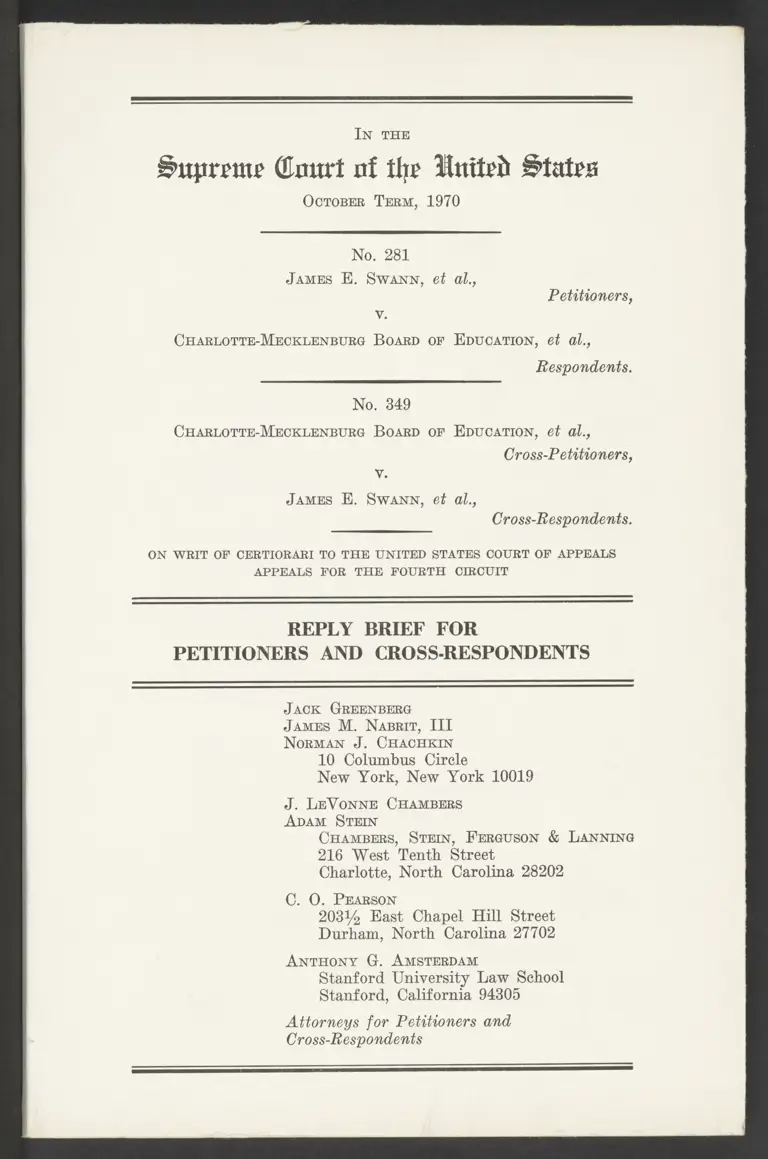
     [||3f2ec79d-1461-4d1e-b055-8d2c310eae08||] IN THE

Supreme Court nf the United States
OctoBER TERM, 1970


No. 281

JAMES E. SwaANN, et al,
Petitioners,

Vv.

CHARLOTTE-MECKLENBURG BOARD OF EDUCATION, ef al.,

Respondents.


No. 349

CHARLOTTE-MECKLENBURG BOARD oF EDUCATION, et al.,

Cross-Petitioners,
V.

JAMES E. SWANN, et al.,

Cross-Respondents.


ON WRIT OF CERTIORARI TO THE UNITED STATES COURT OF APPEALS

APPEALS FOR THE FOURTH CIRCUIT


REPLY BRIEF FOR

PETITIONERS AND CROSS-RESPONDENTS


JACK (GREENBERG
JAMES M. NasriT, 111
NorMAN J. CHACHKIN

10 Columbus Circle
New York, New York 10019

J. LEVoNNE CHAMBERS
ApAM STEIN

CHAMBERS, STEIN, FERGUSON & LANNING
216 West Tenth Street
Charlotte, North Carolina 28202

C. O. PEARSON
20315 East Chapel Hill Street
Durham, North Carolina 27702

ANTHONY G. AMSTERDAM
Stanford University Law School
Stanford, California 94305

Attorneys for Petitioners and
Cross-Respondents


r
y

g
r
e


F
S
 a
l

INDEX

Preliminary Statement ..........ccc.ibcoreemmeemnmssesciserseransaesonsisees

ARGUMENT:

i

11.

111.

IV.

The Charlotte-Mecklenburg County Schools Were

Segregated by Unconstitutional Governmental

Action J a lo  edineseerss

The Assignment Plan Now in Effect Is Workable

and Desegrogates the Schools ...............................

The School Board Proposes No Viable Rule of

Law to Define the Goal of a Unitary System ......

The District Court Was Correct in Not Attempt-

ing to Declare a General Rule of Law to Govern

the Multitude of Varied Circumstances of School

Segregation in Other Cities and Other Parts of

the United States... he

The Civil Rights Act of 1964 Does Not in Any

Way Limit the Power of the Courts to Fashion

Remedies for Unconstitutional Racial Segrega-

tion in Public Schools or Prohibit the Courts

from Requiring Busing of Pupils to Disestab-

lish Dual Segregated School Systems ..................

Y7

24

28


ii

PAGE
TABLE OF AUTHORITIES

Cases:

Brewer v. School Board of the City of Norfolk, 397

P1327 (4th Civ. 1988)... 14
Brown v. Board of Education, 347 U.S. 483 (1954)....3, 4, 8,

14, 24, 29,

30, 37
Brown v. Board of Education, 349 U.S. 294 (1955)........ 3
Burton v. Wilmington Parking Authority, 365 U.S. 715
dl LTR Bee Le Se EL Te 3

Carter v. West Feliciana Parish School Board, 396
U.8.200 (1970). iii ei oi 27

Commonwealth of Pennsylvania v. City of Philadel-
phia, 353 U.S, 230- (1957). emi Gan aria 17

Cooper v. Aaron, 358 U.S. 1 (1958)... 3
Coppedge v. Franklin County Board of Education, 394

F.2d 410 (4th Cir. 1968), affirming 273 F. Supp. 289
(LD. N.C. 1967)

Davis v. Board of School Commissioners of Mobile
Comnty, OT. 1070, No. 436... 25, 27

Dowell v. Board of Education of the Oklahoma Public
Schools, 396 11.8. 260-(1969) . ....... +: = 24

Dowell v. School Board of Oklahoma City, 244 F. Supp.
971 (W.D. Okla. 1965) affirmed 375 F.2d 158 (10th
Cir. 1967), cert. den., 387 U.S. 931 (1967)

Eason v. Buffaloe, 198 N.C. 520, 152 S.E. 496 (1930)... 13

Gaston County v. United States, 395 U.S. 285 (1969),
affirming 338 F. Supp. 678 (D. D.C. 1968)... 17

Gomillion v. Lightfoot, 364 U.S. 339 (1960)


iii

PAGE

Green v. County School Board of New Kent County,

S01. U.S. 430 (T988)........ heii bcc sisinininnnridsone 24

Henry v. Clarksdale Municipal Separate School Dis-

trict, 409 F.2d 682 (5th Cir. 1969) cert. den., 396 U.S.

00. (1969) ...iill ne ditt eesti dn 16, 25

Kemp v. Beasley, 423 F.2d 851 (8th Cir. 1970).............. 16

Keyes v. School District Number One, Denver, 303

F. Supp. 279 (DD. Colo, 1969)........i000 4 Sitio boilers 16

Lane v. Wilson, 307 U.S, 268 (1039)....cccscsemresnroseenss 17,31

Local 189, Papermakers & Paperworkers v. United

States, 416 F.2d 980 (5th Cir. 1969)... cn... 17

Louisiana v. United States, 380 U.S. 145 (1965)............ 17

Manning v. Board of Public Instruction of Hillsbor-


  ough County, F.2d (5th Cir., No. 28643,

May Tf 1070) teers rsa 16, 25

Monroe v. Board of Commissioners, 391 U.S. 450

ELL ea ee ee LS 24, 30

Northeross v. Board of Education, 397 U.S. 232 (1970) 24

Phillips v. Wearn, 226 N.C. 290, 37 S.E.2d 895 (1946) 13

Raney v. Board of Education, 391 U.S. 443 (1968)...... 24

Ross v. Eckels, —— F.2d (5th Cir., No. 30080,

August 25, 1070) ............csiperin csr crisesasracassurssssostissansueis 16, 25


Shelley v. Kraemer, 334 US. 1 (1948)... 13

Singleton v. Jackson Municipal Separate School Dis-

trict, 419 F.2d 1211 (5th Cir. 1969), reversed sub

nom. Carter v. West Feliciana Parish School Board,

396 US. 200. (1970).......occonceiintnn ni 37


iv

PAGE

United States v. Board of Education of Baldwin
County, 423 F.2d 1013 (3th Cir. 1970)... ...... 16

United States v. Board of Education School District
No. 1, Tulsa, Okla., F.2d (10th Cir. 1970)... 25

United States v. Greenwood Municipal Separate School
District, 406 F.2d 1086 (5th Cir. 1969), cert. den.,
2 US. 907 (1989)... oo. 16

United States v. Indianola Municipal Separate School
District, 410 F.2d 626 (5th Cir., 1969), cert. den.


3 US. 1011 (1970) ........... 16
United States v. Montgomery County Board of Educa-

tion, 395 U8. 23 (1969)... ..... .. ... 24
United States v. School District, 151 of Cook County,

Illinois, 286 F'. Supp. 786 (N.D. IIL. 1968), affirmed,
404 PIA LIS (Teh Clr. 1968)... 16,25

Valley v. Rapides Parish School Board, 423 F.2d 1132
(th Civ. 1970) ...._ ....... oo. 16

Vernon v. R. J. Reynolds Realty Co., 226 N.C. 28, 36
SEA 70 (916)... a 13

Statutes:

2080 SI843 a 35

USC $1083 a 35

42 U.S.C. §2000c, Civil Rights Act of 1964, $401 ...2, 32, 33,

34, 35,

39, 40

42 U.S.C. §2000c-6 (a), Civil Rights Act of 1964, §407 (a)

2, 32

42 U.S.C. §2000c-8, Civil Rights Act of 1964, §409 ....._.. 35

42 U.S.C. §§3601 et seq., Civil Rights Act of 1968 14

N.C Gon Sint. 8113476... 6


PAGE

Other Authorities:

Charlotte Observer, Sept. 5, 1970 ........cconicicaeccniinecnce 14

110 Cong. Ree 1598-2... teenie 39

110 Cong. Bee. 2280 oie sir sioveiasees 39, 40


Ix THE

Supreme Court of the United States

OctoBer TErM, 1970


No. 281

James EH. Swann, et al.,

Petitioners,

V.

CHARLOTTE-MECKLENBURG Boarp or Ebpucatiow, ef al.,

Respondents.


No. 349

CHARLOTTE-MECKLENBURG Boarp or EbpucatioN, ef al.,

Cross-Petitioners,

Y.

James E. SwANN, ef al.,

Cross-Respondents.


ON WRIT OF CERTIORARI TO THE UNITED STATES COURT OF

APPEALS FOR THE FOURTH CIRCUIT


REPLY BRIEF FOR

PETITIONERS AND CROSS-RESPONDENTS

Preliminary Statement

The respondents and cross-petitioners (hereinafter

school board) seek to pose the issue in this case of whether

a school board may continue to operate one or more pre-


2

dominantly black schools. We feel that the issue is more

properly posed in the decision of the district court below,

namely, whether in the context of the facts developed in

this case, the pervasive role of the state and its agencies
in creating and perpetuating a racially segregated system,

a school board may continue to deny equal educational

opportunities to black children on the pretext of preserving

“neighborhood schools” or avoiding transportation of stu-
dents when a feasible alternative is available for complete
desegregation. This reply is addressed to the activities
and practices of the state, particularly those of the school
board, which produced the segregated system which the
district court sought to eliminate; the feasibility and prac-

ticability of the plan directed by the court; and the fact

that the school board and the various amici who have sub-
mitted briefs in this matter suggest no viable alternative
rule of law to that adopted by the district court and advo-
cated by the petitioners herein. We also discuss the pos-
sible applicability of the decision of the Court in this case
to other jurisdictions and the applicability of §§401(b) and
407(a) of the Civil Rights Act of 1964, 42 U.S.C. §2000¢(b)
and 42 U.S.C. §2000¢-6(a).

For the Court’s information we are attaching as an ap-
pendix to this reply a copy of the interim report filed by
the school board showing the results of desegregation for
the present school term under the plan directed by the
district court. As the report demonstrates the plan elim-
inates all racially identifiable schools in the system with the
exception of 3 elementary schools and as to these 3 schools
some steps are now being taken in order to alleviate the
overcrowded conditions and to prevent resegregation.


3

ARGUMENT

I.

The Charlotte-Mecklenburg County Schools Were

Segregated by Unconstitutional Governmental Action.

The School Board and several amici® challenge for the

first time the district court’s findings of state created and

perpetuated racially segregated housing and public schools.”

They contend that the admitted segregation is merely

adventitious. The record, however, clearly demonstrates

the contrary. As the district court stated in its Memo-

randum Opinion of November 7, 1969, segregation of the

races in the Charlotte-Mecklenburg system is not “consti-

tutionally benign.”

In previous opinions the facts respecting [the location

of schools] . . . their controlled size and their popu-

1 See, e.g., Amicus Curiae Brief for the Classroom Teachers
Association of the Charlotte-Mecklenburg School System, Incorpo-
rated, pp. 20-21.

2 The Commonwealth of Virginia suggests that such inquiry is
irrelevant. See, e.g., Brief for the Commonwealth of Virginia,
Amicus Curiae, pp. 8-10. The district court found, however, that
the varied actions of the state, including the School Board, had
resulted in racially segregated schools as condemned in Brown Vv.
Board of Education, 347 U.S. 483 (1954), 349 U.S. 294 (1955);
that inquiry into the forces of the state creating or perpetuating
racial diserimination were indeed appropriate and required by
decisions of this Court; see, e.g., Burton v. Wilmington Parking
Authority, 365 U.S. 715 (1961), for the Fourteenth Amendment
prohibits “State support of segregated schools through any arrange-
ment, management, funds, or property.” Cooper v. Aaron, 358 U.S.
1, 19 (1958). This Court further stated in Cooper, supra at 17:
“In short, the constitutional rights of children not to be diserim-
inated against in school admission on grounds of race or color
declared by this Court in the Brown case can neither be nullified
openly and directly . . . nor nullified indirectly . . . through evasive
schemes for segregation whether attempted ‘ingeniously’ or ‘ingenu-
ously.’ ” Finding state imposed segregation and a feasible means
to correct it, the district court was obligated by the Constitution to
enforce the constitutional rights of the black children of this school
system.


4

lation have already been found. Briefly summarized,

these facts are that the present location of white schools

in white areas and of black schools in black areas is

the result of a varied group of elements of public and

private action, all deriving their basic strength origi-

nally from public law or state or local governmental

action. These elements include among others the legal

separation of the races in schools, school buses, public

accommodations and housing; racial restrictions in

deeds to land ; zoning ordinances; city planning; urban

renewal ; location of public low rent housing; and the

actions of the present School Board and others, before

and since 1954, in locating and controlling the capacity
of schools so that there would usually be black schools

handy to black neighborhoods and white schools for

white neighborhoods. There is so much state action
embedded in and shaping these events that the result-
ing segregation is not innocent or “de facto,” and the
resulting schools are not “unitary” or desegregated.®

(657a, 661a-662a).

? Contrary to the board’s assertion (see Briefs of Respondents
and Cross-Petitioners, p. 46), this finding did not constitute a re-
versal of the previous findings of the court; rather it was at this
point that the court was pointedly advised by the board, that the
board had no intention of complying with the directives of the
court. The district court has described its painstaking, patient,
but unsuccessful efforts to encourage the board to discharge its
affirmative duty to desegregate. (See Supplemental Memorandum
1221a-1238a). It was the board’s recalcitrance which led Judge
Sobeloff to note in dissent that “this Board, through a majority
of its members, far from making ‘every reasonable effort’ to fuli-
fill its constitutional obligation, has resisted and delayed desegre-
gation at every turn.” (No. 9, 1291a-1293a) Moreover, the record
clearly demonstrates that the constitutional violations which the
district court sought to remedy resulted not just from practices
of other governmental agencies but to a large extent from the
board’s conduct and action in locating and controlling schools,
school sites, capacities, attendance districts, ete., all taken in con-
junction with and in furtherance of the developing racial housing
patterns, both before and after this Court’s decision in Brown.


5)

We discuss below some of the record evidence supporting

these findings.

In the district court’s findings of April 23, 1969 (285a,

296a), the court described Charlotte and Mecklenburg

County as follows:

The central city may be likened to an automobile hub-

cap, the perimeter area to a wheel, and the county area

to the rubber tire. Tryon Street and Southern Rail-

road run generally through the county and the city

from the northeast to the southwest. Trade Street runs

generally northwest to southeast and crosses Tryon

Street at the center of town at Independence Square.

Charlotte originally grew along the Southern Railroad

tracks. Textile mills with mill villages, once almost

entirely white, were built. Business and other industry

followed the highways and the railroad. The railroad

and parallel highways and business and industrial de-

velopment formed something of a barrier between

east and west.

By the end of World War II many Negro families

lived in the center of Charlotte just east of Independ-

ence Square in what is known as the First Ward-

Second Ward-Cherry-Brooklyn area. However, the

bulk of Charlotte’s black population lived west of the

railroad and Tryon Street and north of Trade Street

in the northwest part of town. The high-priced, al-

most exclusively white, country was east of Tryon

Street and south of Trade in the Myers Park-Provi-

dence-Sharon-Eastover area. Charlotte thus had a

very high degree of segregation of housing before the

first Brown decision.

Today, the degree of segregation in housing is even more

pronounced. Some of the factors which have contributed

to the school segregation follow:


6

1. Location and control of schools. Prior to 1954 all

public schools in the City of Charlotte and Mecklenburg

County were segregated pursuant to the state law and

Constitution. The district court attached as an Exhibit

to its Memorandum of Decision and Order of August 3,

1970 a collection of segregation codes of the state which,

as indicated by the Memorandum Decision (Br. A4), re-

mained in the state statutes as late as 1969. Schools were

located and students and staff personnel were assigned to

the various schools on the basis of race. Subsequent to the

Brown decision and prior to the institution of this pro-

ceeding no affirmative steps were taken by the board to

disestablish the racially segregated system. Some token

integration did take place under the North Carolina Pupil

Assignment Act, N. C. Gen. Stat. §115-176, pursuant to

which a few black students requested transfer to previ-

ously all-white schools. The school board, however, con-
tinued to locate and control the various capacities of schools
in order to maintain racial segregation.** These practices

have continued even through the present day.

In conjunction with the racially developing residential
patterns, the school board built or made additions to the
following schools subsequent to 1954 solely to accommo-
date black students.

* Separate boards governed the city and county schools until
1961, at which time the two school units were merged.

‘2 The board controlled grade structures to maintain segregation.
In 1965 the system had a basically 6-3-3 grade structure, except
that some black schools had different patterns to facilitate racial
segregation such as grades: 1-4, 1-7, and 5-9, for example. (See
Appellants’ Appendix in 1966 appeal to the 4th Circuit, No. 10207,
pp. 25-29).


7

Schools Year of Construction Years of Additions

Burns 1968

Marie Davis 1951 1953
1957
1959

Double Oaks 1952 1955
1965

Druid Hills 1960 1964

First Ward 1912 1950)
1961)
1968) practically

complete new
facilities.

Lincoln Heights 1956 1958

Oaklawn 1964

University Park 1957 1958
1964

(Plaintiff’s Exhibit 1 in original record; 124a-132a)°®

Several white schools were built in white areas and pre-

dictably enrolled only white students:

Schools Year of Construction

Devonshire 1964

Albemarle Road 1968

Beverly Woods 1969

These examples are not meant to be exclusive but only

exemplary of the practices followed by the board prior

5“Q. Dr. Self, when you built schools since 1954, what efforts
did you make, other than what you testified to yesterday, to locate
the schools in an area that would effect the greatest maximum
integration of students in the system? A. The schools were lo-
cated in such a way as to house the youngsters, Mr. Chambers,
not to effect a maximum amount of integration.

“Q. You did not attempt to do it? A. We made an attempt to
house the youngsters in the neighborhood.” (132a)

* * *

“Q. And I think that on your drawing board right now are
plans to build more schools that are going to be all white and
some that will be all black. A. I'm sure that the enrollment in
the schools will be affected by the neighborhood served.” (129a)


8

to and since Brown. (Plaintiffs’ Ex. 1 in original record;

127a-129a). Hven at the time of the March 1969 hearing

the board was proceeding with construction of a new

junior high school (Carmel Road) which under the board’s

most recent attendance zone plan would have been 100

per cent white (512a (designated ‘Project 600”), 747a).

Additionally, the board has added mobile units in order

to accommodate any influx of black or white students in

the segregated schools rather than redraw attendance dis-

tricts and assign either black or white students to schools

of the opposite race (Pls’. Ex. 1 in original record). De-

fendants have controlled school districts in order to limit

the race of students assigned to the various schools (Com-

pare Pls’. Exs. 1, 4, 24). As the court noted in its Opinion

and Order of June 20, 1969:

“[I]t may be timely to observe and the court finds

as a fact that no zones have apparently been created

or maintained for the purpose of promoting desegre-

gation; that the whole plan of ‘building schools where

the pupils are’ without further control promotes seg-

regation; and that certain schools, for example Bill-

ingsville, Second Ward, Bruns Avenue and Amay

James obviously serve school zones which were either

created or which have been controlled so as to sur-

round pockets of black students and that the result

of these actions is discriminatory. These are not

named as an exclusive list of such situations, but as

illustrations of a long standing policy of control over

the makeup of school population which scarcely fits

any true ‘neighborhood school’ philosophy.” (455a-
456a) (see also note 5, supra; 132a).

Transportation has been arranged for students in order

to perpetuate segregation. FKven through the 1964-65 school

vear, the board continued racially overlapping bus routes.


9

For students in the city and its immediate environs, black

schools have been located within convenient walking dis-

tance of black residential areas. White schools have gen-

erally been located in outlying white residential areas

necessitating bus transportation. Thus of the 23,384 stu-

dents provided transportation during the 1969-70 school

year only 541 of such students were transported to black

schools (1014a-1032a, 1203a-1204a). Coupled with these

practices the school board continued freedom of choice to

permit those students enclosed within school districts of

the opposite race to transfer to other schools where their

race would be in the majority.

9. Urban Renewal. Urban renewal has contributed to

the residential segregation by relocating black families

from urban renewal areas to black residential areas or

areas rapidly changing to black. Principally, all of the

black families relocated by the city urban renewal pro-

grams, principally all of which have taken place since

1960, have been relocated in black residential areas and

the few white families who have been relocated have been

relocated in white residential areas. A similar practice has

prevailed in the relocation of families uprooted by new

streets and highways (209a-214a, 282a-283a; Plaintiffs’

Exhibit 42). The court characterized this practice as

follows:

Under the urban renewal program thousands of Ne-

groes were moved out of their shotgun houses in the

center of town and have relocated in low rent areas

to the west. This relocation of course involved many

ad hoc decisions by individuals and by city, county,

state and federal governments. Federal agencies

(which hold the strings to large federal purses) re-

portedly disclaim any responsibility for the direction

of the migration; they reportedly say that the selec-

tion of urban renewal sites and the relocation of dis-


10

placed persons are matters of decision (“freedom of
choice” ?) by local individuals and governments. This
may be correct; the clear fact however is that the
displacement occurred with heavy federal financing
and with active participation by local governments,
and it has further concentrated Negroes until 95% or
so of the city’s Negroes live west of the Tryon-railroad
area, or on its immediate eastern fringe (297a-298a).

The record demonstrates, however, that even this reloca-
tion did not afford the affected families a “free” choice
for, as indicated below, homes in other areas were simply
not available to black families (PIf. Exhs. 14, 19, 42 in the
original record; 28a-64a, 208a-215a, 282a-283a). Moreover,
with the overcrowding of schools which resulted from the
relocations, the school board simply added additional
rooms to existing black schools to accommodate the black
students.

3. Public Housing. Consistent with the city’s zoning
practices of locating multi-family and low income housing
in black residential areas, all public housing, built prin-
cipally since 1960 and now generally occupied by blacks,
has been located in black residential areas. FEven pro-
jected public housing has been designated for black resi-
dential areas (PIf. Exhs. 14, 19, 29 and 42 in original
record; 215a-217a). The effects of such practices in per-
petuating segregated housing is seen even in the most
recent plan directed by the district court where three of
the elementary schools and one of the junior high schools,
projected to be predominantly white, have since the begin-
ning of this school year become predominantly black be-
cause of the relocation of additional black families in
federally financed, low-income housing in black residential
areas of the four school districts (Reply Brief App. 10a-
15a).


11

4. City Zoming. City zoning has influenced separation

of the races by marking out and designating by land usage

those areas of the city occupied by blacks and those occu-

pied by whites. Beginning in 1947, the city enacted its

first zoning ordinance and in effect delineated the black and

white residential areas. All white residential areas were

zoned residential with restricted land usage. All black

residential areas, with the exception of two small pockets

adjacent to white residential areas, were zoned industrial

for multi-land usage, including heavy industry, multi-

family homes and high density areas. Even the two ex-

cepted black areas were zoned for higher density use than

the white residential areas (174a, 202a-207a, 251a, 268a,

272a-283a). This difference in zoning practices for black

and white residential areas has been carried forward to

the present day in the major revisions of the zoning ordi-

nance in 1962.

Industrial zones have continued to be restricted to black

residential areas. Additionally, the residential zoning au-

thorized for the black areas in the 1962 zoning ordinance

has been limited to high density zones, R-6 and R-9 requir-

ing 6,000 square feet and 9,000 square feet, respectively,

for a single family home. No black residential area in the

City today has a higher density zoning than R-9 while

principally all white residential areas have restricted zon-

ing of R-12, R-15 or above (206a-208a; PIf. Exh. 10 in

original record (maps showing present zoning for city of

Charlotte)). As testified by plaintiffs’ witness during the

March 1969 hearing, the effect of such zoning makes the

land in the black residential areas accessible to other

uses; permits the rapid deterioration of the quality of the

land—*“and this is clearly evident from the amount of

industrial development which has taken place in areas of

Negro residences;”’ reduces the housing value; and intro-

duces blighted and noxious usages into the area (204a).


12

It delineates for governmental and private developers,
school officials and home buyers and renters those areas of
the city for blacks and those for whites.

5. City Planning. City planning has further enforced
segregation in housing. In a comprehensive proposal in
1960 entitled “The Next Twenty Years” (Plf. Exh. 12 in
the original record), the City Planning Commission pro-
posed the continuation of basically the same racially dis-
criminatory zoning practices with high density and multi-
land usage in black residential areas and restricted zoning
in the white residential areas. While the proposal itself,
absent approval by the City Council, should have no con-
trolling effect, it nevertheless provided the blueprint for
developers of what land usage would be permitted in the
future. As plaintiffs’ witness testified:

The only elements of the plan which develop any com-
pelling force are those elements which relate to facili-
ties or land uses which are normally provided by
government, things such as roads, or public buildings.
Quite naturally, the development of residential or
industrial land is subject to the decision-making of
private developers within, of course, whatever the legal
constraints are which the city imposes. But the plan
very definitely sets a direction in the recoommenda-
tions which it develops and it’s those recommendations
which are particularly significant in this case (188a).

* * *

This planning document [“The Next Twenty Years]
was developed in 1960 so that this is the major impact.
The secondary effect of this document is the proposed
interstate highway system and the major arterial
streets in the Charlotte area. And again one can see
that the major north-south route—I-77—tends to re-
inforce this north-south division by running adjacent


13    to and parallel to the industrial band which runs

through the city [separating the black residential area

on the west from the white residential area on the east]

(195a, 196a).

The Planning Commission’s proposal was largely en-

acted by the City Council in the revised zoning code of

1962 (202a, 220a).

6. Streets and Public Highways. Streets and public high-

ways have perpetuated barriers between the races. Streets

have been designed to provide ease of communication only

within the separate white or black residential areas with

little means of communication between them. Additionally,

one of the major federally financed interstate routes now

being constructed through the city, the North-South Kx-

pressway (I-77), further marks, along with the Tryon

Street-Southern Railroad, the division between the racially

separate areas (195a, 216a-217a; PIf. Exh. 13 in original

record).

7. Private Discrimination. Private discrimination has

been pervasive in establishing and perpetuating the racially

segregated housing that exists in the city. Blacks simply

have been denied access or the right to purchase or rent

in white residential areas. Construction firms and real

estate agents and banking institutions, including the fed-

eral government, have planned and developed racially seg-

regated areas. As the court below noted (1264a), such

developments were perpetuated by racially restrictive cove-

nants which were enforced by the North Carolina Supreme

Court until this Court’s decision in Shelley v. Kraemer,

334 U.S. 1 (1948). See, e.g., Phillip v. Wearn, 226 N.C.

290, 37 S.E. 2d 895 (1946); Eason v Buffaloe, 198 N.C.

520, 152 S.E. 496 (1930); Vernon v. R. J. Reynolds Realty

Co., 226 N.C. 58, 36 S.E. 2d 710 (1946). Such develop-

ments have been followed by the school board with con-


14

struction of new schools “to house the youngsters in the
neighborhood.” (132a) Black areas or developments have
been purposely located west of the Tryon Street-Southern
Railroad dividing line and white developments on the
east side of the dividing line. Prior to the 1968 Civil
Rights Act, 42 U.S.C. §§3601 et seq., real estate agents
were bound by their code of ethics to perpetuate this
policy of discrimination (PIf. Exhs. 33, 34, 35, 36 in origi-
nal record; 28a-57a, 282a-283a). Limitations on the ability
and freedom of blacks to purchase and rent homes in other
areas of the city continue today.

The school board now proposes to engraft on this
segregated system, district and housing pattern zones
which would leave the majority of the black and white
students in racially segregated schools (See projected
enrollment under board’s plan of February 2, 1970, 744a-
748a). The pervasiveness of the state practices in creat-
ing and perpetuating the housing patterns and segregated
schools is no different than the former constitutional pro-
visions compelling racial separation in public schools. It
is clearly illusory to contend otherwise for the black stu-
dents in the all black and predominantly black schools
would be locked into those schools just as effectively and
with as much state control as they were under the former
compulsory system rejected in Brown. Cf. Brewer v.
School Board of City of Norfolk, 397 F.2d 37, 41-42 (4th
Cir. 1968). The district court addressed this problem in
its Memorandum Decision and Order of August 3, 1970.

“The principle difference between New Kent County,
Virginia, and Mecklenburg County, North Carolina, is

¢ A black family which moved into a home in a white residential
area of the city on September 4, 1970 was intimidated and
threatened repeatedly and nightriders fired shotgun blasts into
their home while the family was asleep. Charlotte Observer, Sept.
9, 1970, at 1A.


15    that in New Kent County the number of children being

denied access to equal education was only 740, where-

as in Mecklenburg that number exceeds 16,000. If
Brown and New Kent County and Griffin v. Prince

Edward County and Alexander v. Holmes County are

confined to small counties and to “easy” situations,

the constitutional right is indeed an illusory one. A

black child in urban Charlotte whose education is be-

ing crippled by unlawful segregation is just as much

entitled to relief as his contemporary on a Virginia

farm.” (Br. A10)

Additionally, the court noted that the issue involved here

is not the validity of a “system” but the rights of indi-

vidual people:

If the rights of citizens are infringed by the system,

the infringement is not excused because in the abstract

the system may appear valid. “Separate but equal”

for a long time was thought to be a valid system but

when it was finally admitted that individual rights

were denied by the valid system, the system gave

way to the rights of individuals.” (Br. A13)

The court again noted that “the essence of the Brown

decision is that segregation implies inferiority, reduces

incentive, reduces morale, reduces opportunity for asso-

ciation and breadth of experience, and that segregated edu-

cation itself is inherently unequal.” (Br. A15)

Testing results which the court had noted in previous

orders (see Order of August 15, 1969, 579a, 586a-590a;

Opinion and Order of December 1, 1969, 698a, 702a-706a ;

Supplemental Findings of Fact of March 21, 1970, 1198a,

1206a) further substantiated the adverse effect that ra-

cially segregated schools have on black children in the

Charlotte-Mecklenburg school system.


16

It was this record of state imposed segregation which

led the court to reject any finding of de facto or consti-

tutionally benign racially segregated schools and housing

in the Charlotte-Mecklenberg system. The Fourth Circuit

held these findings to be “supported by the evidence” and

accepted “them under familiar principles of appellate re-

view.” (264a).

It is these facts and findings which required that appro-

priate steps be taken by the school board to disestablish

the state imposed segregated system.

Several lower court decision have held that school offi-

cials under these circumstances may not perpetuate seg-

regated schools under the guise of a neighborhood system.

Henry v. Clarksdale Municipal Separate School District,

409 F.2d 682 (5th Cir. 1969) cert. den. 396 U.S. 940 (1969) ;

United States v. Greenwood Mumicipal Separate School
District, 406 F.2d 1086 (5th Cir. 1969) cert. den. 395 U.S.
907 (1969) ; United States v. Indianola Municipal Separate

School District, 410 F.2d 626 (5th Cir. 1969), cert. den. 396
U.S. 1011 (1970); Valley v. Rapides Parish School Board,
423 F.2d 1132 (5th Cir. 1970) ; United States v. Board of
Education of Baldwin County, 423 F.2d 1013 (5th Cir.

1970) ; Manmmngs v. Board of Public Instruction of Hills-

borough County, 427 F.2d 874 (5th Cir., No. 28643, May
11, 11970); Ross v.oBekels, F.2d (5th Cir. No.
30080, Aug. 25, 1970) ; Kemp v. Beasley, 423 F.2d 851 (8th
Cir. 1970) ; United States v. School District, 151 of Cook
County, Illinois, 286 F Supp. 786 (N.D. IIL. 1968), affirmed
404 F.2d 1125 (7th Cir. 1968); Dowell v. School Board of
Oklahoma City, 244 F. Supp. 971 (W.D. Okla. 1965) affirmed

375 F.24 158 (10th Cir. 1967), cert. dew. 337 U.S. 931

(1967) ; Keyes v. School District No. 1, Denver, 303 F.
Supp. 79 (D. Colo. 1969).


17

Such holdings are based on the long established prinei-

ple that a state may not evade the prohibition of the

Fourteenth Amendment by engrafting neutral, or otherwise

unobjectionable practices upon constitutionally objection-

able ones, where the effects would perpetuate constitutional

deprivations. See, e.g., Lane v. Wilson, 307 U.S. 268

(1939) ; Commonwealth of Pennsylvania v. City of Phila-

delphia, 353 U.S. 230 (1957); Louisiana v. United States,

380 U.S. 145 (1965); Gomillion v. Lightfoot, 364 U.S. 339

(1960) ; cf. Gaston County v. United States, 395 U.S. 285

(1969), affirming 288 F. Supp. 678 (D.D.C. 1968). See

also Coppedge v. Franklin County Board of Educ., 394 F.2d

410 (4th Cir. 1968), affirming 273 F. Supp. 289 (E.D.N.C.

1967) ; Local 189, Papermakers & Paperworkers v. United

States, 416 F.2d 980 (56th Cir. 1969); pp. 32-34 Brief

Amicus Curiae for the National Education Association.

II.

The Assignment Plan Now in Effect Is Workable and

Desegregates the Schools.

The school board urges here that the pupil assignment

plan it offered to the district court on February 2, 1970,

which has been rejected in every respect by both courts

below, should have been approved. We have discussed

at some length in our brief on the merits the court directed

plan which is now in effect and the majority board plan.’

7 The board plan is actually the plan of five of the nine members
of the board. Four members of the board offered an alternative
plan for the complete desegregation of the system at the July, 1970
hearing. Judge McMillan found that plan acceptable, but the board
chose to implement the plan which had been directed on February
5,1970 (BR. Al et seq.).


18

We respond here only to respondents’ discussion in sup-

port of their plans for junior and senior high schools,

matters not directly addressed by our brief on the merits.

The Junior High School Plan. The board’s principal

attack on the present assignment plan as ordered by the

court is that it employs the technique of satellite zones

while under the board plan all students would be assigned

to a school within a zone which surrounds their school.

The board therefore says that its plan maintains the

“neighborhood school” concept. The court-ordered plan,

it says, does not. We have previously demonstrated that

the neighborhood school theory cannot be supported in

history and tradition as a justification for continued
segregation because it was widely and invariably dis-
regarded in order to promote segregation.! Moreover, a
comparison of the two plans shows that the board’s argu-

ments are entirely spurious.

At the junior high school level the court ordered plan

draws zones around the twenty-one schools. In addition

some smaller zones (satellites) are made in the black inner-
city area which do not surround any schools. The black
children in these zones are assigned to nine of the 21
junior high schools;’ 12 of the schools have no satellites.’

(See Respondents-Cross Petitioners’ Brief Appendix, Map
7.) The board’s plan includes no satellites. (See Respon-

$ See Brief for Petitioners, pp. 80-83. See also, Opinion and
Order, April 23, 1969, 305a-306a.

* There are satellites for Eastway, Cochrane, Wilson, McClint-
lock, Albemarle Road, Carmel (sometimes referred to as P-600),
Smith, Quail Hollow and Alexander Graham (sometimes referred
to as “A.G.”).

12 The schools without satellites are: Alexander, Coulwood, Ran-
son, Northeast (sometimes referred to as J. H. Gunn, Wilgrove or
P-601), Williams, Northwest, Spaugh, Kennedy, Sedgefield, Pied-
mont, Hawthorne and Randolph.


15

dents’-Cross-Petitioners’ Brief Appendix, Map 6.) How-

ever, the board would leave 842 black children in Piedmont

Junior High, a racially identifiable school (830a). This

would nearly double the number of black students at Pied-

mont from the 1969-70 school year (Ibid). The board’s

justification for leaving a segregated black junior high

school is its adherence to what it calls the neighborhood

school concept. We suppose a neighborhood school means

that the children who attend the same school are ‘“neigh-

bors.” A close examination of the board’s maps shows that

the white and black children attending the junior high

schools are as much “neighbors” under one plan as under

the other.

The board zones are drawn so that there are corridors

which lead into and include portions of the black community

in order to integrate the formerly white schools.’ Four

of the five predominantly black schools were dealt with by

extending the zones to include white areas. (Id. Map. No.

6)''* Five of the predominantly white schools under the

board’s plan would remain nearly all-white (830a).'?

The court ordered plan, on the other hand, eliminates

the board’s corridors leading from black neighborhoods

to white schools and simply assigns the black students

to the outlying white schools. In fact, some of the same

students residing within satellites of five of the schools

would be assigned to the same school under the board

plan.'* Other black children were assigned from satellite

11 See, e.g., Coulwood, Ranson, Cochrane, Eastway, Wilson, Sedge-
field, Smith and Randolph.

11a See, e.g., Hawthorne, Kennedy, Northwest, and Williams.

12 Albemarle Road, McClintock, Quail Hollow and the two schools
opened for the 1970-71 year, Carmel (P-600) and Northeast (re-
ferred to variously as J. H. Gunn, Wilgrove and P-601).

13 Smith, Bastway, Cochrane, Wilson, and Alexander Graham
(A.G.).


20

zones in the central city to predominantly white schools

not desegregated by the board’s plan. Under both plans

black children are assigned to outlying schools and white

children are assigned to formerly black inner-city schools.

The principal difference in technique therefore between

the plans is that the court ordered plan does not have

connecting corridors between the white schools and the

black areas. The principal difference in result is that

court’s plan is effective, complete and stable while the

board’s plan is limited, incomplete and is subject to the

problems of resegregation.’* We offer the following addi-

tional commitments about the board’s connecting corridors

and the administrative workability of the plans.

The board’s connecting corridors bear no relationship

to any conceivable neighborhood concept nor any relation-

ship to any natural landmarks such as major thorough-

fares. Therefore, the transportation system would be

considerably more complex under the board’s plan than

under the plan adopted by the court. Judge McMillan

emphasized this point in the Supplemental Findings of
Fact of March 21, 1970:

“Two schools may be used to illustrate this point.

Smith Junior High under the board plan would have

a contiguous district six miles in length extending 41%

miles north from the school itself. The district

throughout the greater portion of its length is one-

1* This is emphasized by the board’s Interim Report on Desegre-
gation, of September 23, 1970 (printed as an appendix herein, 10a-
15a), which describes a developing problem of resegregation at
Spaugh caused by new public housing projects. The board’s limiting
requirement that all students must reside within a zone surrounding
a school would make it impossible to deal effectively with this situa-
tion caused by the policies and actions of governmental officials.
By using the techniques of the court-ordered plan, the board can
control the population at Spaugh so that it does not become a
racially identifiable black school.


21

half mile wide and all roads in its one-half mile width

are diagonal to its borders. Eastway Junior High

presents a shape somewhat like a large wooden pistol

with a fat handle surrounding the school off Central

Avenue in East Charlotte and with a corridor extend-

ing three miles north and then extending at right

angles four miles west to draw students from the

Double Oaks area in northwest Charlotte. Obviously

picking up students in narrow corridors along which

no major road runs presents a considerable trans-

portation problem.

The Finger plan makes no unnecessary effort to

maintain contiguous districts, but simply provides for

the sending of busses from compact inner city atten-

dance zones, non-stop, to the outlying white junior

high schools, thereby minimizing transportation tie-

ups and making the pick-up and delivery of children

efficient and time-saving. (1210a-1211a).


The district judge’s finding was supported by the testimony

of the court consultant'® and the superintendent of

schools :*®

Dr. Self, the school superintendent, and Dr. Finger,

the court appointed expert, both testified that the

transportation required to implement the plan for

junior highs would be less expensive and easier to ar-

range than the transportation proposed under the

board plan. The court finds this to be a fact. (1210a).

He concluded his analysis of the plan in the following way:

In summary, as to junior high schools, the court finds

that the plan chosen by the board and approved by the

15 957a-958a.

16 803a-804a.


22

court places no greater logistic or personal burden

upon students or administrators than the plan pro-

posed by the school board; that the transportation

called for by the approved plan is not substantially

greater than the transportation called for by the board

plan, that the approved plan will be more economical,

efficient and cohesive and easier to administer and will

fit in more nearly with the transportation problems

involved in desegregating elementary and senior high

schools, and that the board made a correct adminis-

trative and educational choice in choosing this plan in-

stead of one of the other three methods (1211a-1210a).

The Senior High School Plan. The board also complains

about the approval by the courts below of the satellite zone

for Independence High School from which 300 black chil-

dren are assigned to a school which would have had only
23 blacks enrolled under the board plan. Judge Butzner
in approving this portion of the plan observed that:

The transportation of 300 high school students from

the black residential area to suburban Independence

School will tend to stabilize the system by eliminating

an almost totally white school in a zone to which other

whites might move with consequent “tipping” or re-

segregation of other schools (1273a).

He also noted that the non-stop bus trips for these students
compares favorably in terms of distance with the trans-

portation of other students assigned to Independence “and

is substantially shorter than the systems average one-way
trip of 17 miles” (1273a, n. 6).

The distance involved is also substantially equivalent

to the distance to be traveled under the board’s high school


23

plan by inner-city black students assigned to South Meck-

lenburg, East Mecklenburg, and West Mecklenburg and

by which students are assigned to the formerly all-black

West Charlotte School. (See Respondents-Cross-Peti-

tioners’ Brief Appendix, Map No. 8.)

Moreover, the children living within the Independence

satellite zone would, under the board’s plan, be assigned

to Harding and West Mecklenburg high schools serving

the area which the board reports is experiencing greater

black enrollment than expected at the elementary and

junior high school levels because of recently completed

public housing.'” If the 300 black children now going to

Independence were, instead, going to Harding and West

Mecklenburg, we would expect that the board would be re-

porting the anticipated resegregation at the high school

level which they now expect at Spaugh Junior High School.

Spaugh now has a 38.4% black enrollment. Under the board

plan the combined enrollment at Harding and West Meck-

lenburg High Schools would be 39% black.’ The combined

enrollment is now only 31% black. Presumably the forces

which the board expects to create resegregation at Spaugh

Junior High School, if not corrected, including the antici-

pated early occupancy of 240 additional public housing

units at Little Rock Homes would also have had the same

effect upon Harding and West Mecklenburg High School

if the district court had not required the assignments to

Independence.

17 See appendix to this brief, 10a-15a.

18 This figure is computed by adding 300 black students to the
September 23, 1970 enrollments reported at Harding and West
Mecklenburg.


24

III.

The School Board Proposes No Viable Rule of Law

to Define the Goal of a Unitary System.

The board asks this Court to “give instruction and guid-

ance to school boards” as to the requirements of a unitary

school system. (Brief of Respondents p. 32; hereinafter

referred to as “Brief”) They offer, however, no standard

or rule which would clarify the law.

The school board’s position, as we understand it, is that

the legal conclusions drawn by the Fourth Circuit are cor-
rect (Id. p. 36). The board supports the court’s rule of
reasonableness (Ibid.) which was stated as follows:

“[S]chool boards must use all reasonable means to inte-

grate the schools in their jurisdictions.” (1267a)

The board does not seem to deny that it has some affirma-
tive duty to desegregate.’® Indeed, it quotes with approval

1? Respondents are not clear as to what they view as their minimal
obligations to desegregate. They claim that “In formulating its
plan, the Board to a very significant degree has elected to exceed
Constitutional requirements” (Brief, p. 80). However, we do not
understand them to adopt the position of several of the amici that
a unitary system is created by engrafting upon a dual school sys-
tem an ostensibly neutral geographic assignment plan, which leaves
racial segregation intact. Amicus Curiae Brief for the Classroom
Teachers Association of the Charlotte-Mecklenburg School System,
Incorporated; Amicus Curiae Brief of the State of Florida; ef.
Amicus Curiae Brief of William C. Cramer, et al. Such a position
clearly conflicts, we think, with the decisions of this Court in Brown
v. Board of Education, supra; Green v. Country School Board of
New Kent County, 391 U.S. 430 (1968) ; Monroe v. Board of Com-
missioners, 391 U.S. 450 (1968); Raney v. Board of Education,
391 U.S. 443 (1968) ; United States v. Montgomery County Board
of Education, 395 U.S. 225 (1969) ; Dowell v. Board of Education
of the Oklahoma City Public Schools, 396 U.S. 269 (1969) and
Northeross v. Board of Education, 397 U.S. 232 (1970). The other
circuits are in agreement with the court below that a dual school


25

the conclusion of the court that smaller school districts are

required to desegregate completely: “All schools in towns,

small cities, and rural areas generally can be integrated

by pairing, zoning, clustering or consolidating schools and

transporting pupils.” (1267a quoted at p. 36, Brief for Re-

spondents).

In our brief on the merits we have criticized the “reason-

able means” test (pp. 58-65) on the ground that it is a sub-

jective standard which portends a new era of litigation and

which sanctions a great deal of continuing segregation.

The board’s position underscores what we have said. They

would have this Court adopt the rule of the Court of Ap-

peals, but reject its application to the facts of this case.

The board thus argues that its affirmative duty to eliminate

the vestiges of segregation would be satisfied by its de-

segregation plan of February 2 (726a-748a) even though

more than one-half of the black children would still be at-

tending racially identifiable black schools because it says

its plan employs all reasonable means. In concluding their

brief, the board asserts that the means they have chosen

are reasonable because their choices represent the “value

judgments of the elected school board and the educators or

its administrative staff” (Id., at 100).

At bottom, the board is arguing that locally elected

school boards must be vested with the discretion to deter-

mine not only the means but also the extent of desegrega-


system is not dismantled by simply drawing zone lines which leave
racial segregation in the schools undisturbed. See, e.g., Henry v.
Clarksdale Municipal Separate School District supra; Mannings v.
Board of Public Instruction of Hillsborough County, supra; Ross
v. Eckels, supra; see analysis of Fifth Circuit's “Neighborhood
School” concept in Brief for Petitioners Davis v. Board of School
Commissioners of Mobile County, O.T. 1970, No. 436; United States
v. School District, 151 of Cook County, Illinois, supra; United
States v. Board of Education, School District No. I, Tulsa, Okla.,

F.2d (10th Cir. 1970). We therefore do not address

further the arguments of the above amics.


26

tion which is to occur within their jurisdictions. This plea

for school board discretion is echoed in several amicus

curiae briefs filed in this case. Brief for the Commonwealth

of Virginia, Amicus Curiae, p. 27; Brief of the City of

Chattanooga, Tenn., Amicus Curiae, p. 28; Amicus Curiae

Brief of David E. Allgood, An Infant etc., et al., p. 13.2°

If the constitutional rights of black children to a de-

segregated school are to be left to the best judgments of

local school boards, then, of course, many of the legal

problems will be solved. A unitary school system would be

whatever a local school board determines it to be. It would

also, almost inevitably, be a segregated school system.

Judge Sobeloff spoke to the matter of school board dis-

cretion in his dissent below:

In making policy decisions that are not constitutionally

dictated, state authorities are free to decide in their

discretion that a proposed measure is worth the cost

involved or that the cost is unreasonable, and accord-

ingly they may adopt or reject the proposal. This is

not such a case. Vindication of the plaintiffs’ constitu-

tional rights does not rest in the school board’s disere-

tion as the Supreme Court authoritatively decided six-

teen years ago and has repeated with increasing

emphasis (1288a).

The board offers no rule which would resolve the questions

which it claims need answers,’ other than its request that

20 Some of these amici seem also to argue for a “colorblind” test
of the variety described in the preceding footnoote.

1 The State of Florida, Governor Claude R. Kirk, Jr., The Com-
monwealth of Virginia, The Chattanooga Board of Education, the
Concerned Citizens of Norfolk, Virginia and the Classroom Teachers
Association of the Charlotte Mecklenburg School System, Ine., as
amact curiae, join in respondents insistence that there are important
questions to be answered. We perceive no viable answers in their


27

the discretionary decision of school boards be honored by

the courts. We cannot believe that these crucial constitu-

tional rights are to be left to a majority vote.

The school board offers no viable definition of a unitary

school system. The Fourth Circuit’s reasonable means test

is “inherently ambiguous” (1289a) and is “a new litigable

issue” which, as the board’s brief makes clear would be

“exploit[ed] . . . to the hilt.” (1290a). Petitioners urge

this Court to reject the reasonableness test either as an-

nounced in the court below or as would be further limited

by the school board. The only thing certain about “reason-

ableness” as a standard in this context is that it sanctions

a significant amount of continued segregation in the public

schools.

Petitioners find no warrant in Brown or its progeny for

any standard or test which at the outset assumes that

segregation will remain. We submit that a dual school

system must be required to reorganize so that every black

child is to be free from assignment to a racially identifiable

“black” school, at every grade of his education. The only

exception to this general rule would be where eliminating

all black schools is absolutely unworkable.?? The plan or-


submissions. They would either have the Court adopt a “color
blind” standard which would leave segregation intact (see note, 20,
supra, and accompanying text) or a rule placing great emphasis on
school board discretion (see note 19, supra, and accompanying text.)

22 See the concurring opinion of Mr. Justice Harlan in Carter v.
West Feliciana Parish School Board, 396 U.S. 290, 292 (1970).

See also the dissenting opinion of Judge Sobeloff below :

Of course it goes without saying that school boards are not
obligated to do the impossible. Federal courts do not joust at
windmills. Thus it is proper to ask whether a plan is feasible,
whether it can be accomplished (1284a).


28

dered by the district court in this case accomplishes the

goal?® which we urge. And it works.?*

1v.

The District Court Was Correct in Not Attempting

to Declare a General Rule of Law to Govern the Mullti-

tude of Varied Circumstances of School Segregation in

Other Cities and Other Parts of the United States.

The school board’s brief suggests that Judge McMillan

relied upon grounds to support his desegregation order

which would apply to Chicago (or other large northern

cities) as well as to Charlotte-Mecklenburg. The board

thereby attempts to precipitate this Court into considera-

tion of the enormously complicated problem that is some-

times termed “de facto” school segregation.?® The Court

is neither required nor able to consider that problem in

this case.

Judge McMillan did not base his order on general prin-

ciples applicable out of the context of classical school

segregation under state segregation laws and practices—

de jure segregation—nor, indeed, upon broad principles of

23 See Brief for Petitioner, Davis v. Board of School Commis-
stoners of Mobile County, O. T. 1970, No. 436, pp. 63-49, for a full
discussion of the general principle we ask this Court to announce.

24 See Report, ete., which is printed as an Appendix to this Brief,
4a-9a (showing enrollment in the schools as of September 21, 1970).

6 We think the labels “de facto” and “de jure” are somewhat
unhelpful and confusing because the terminology tends to beg the
question at issue, i.e., whether the government is responsible for
the segregation to a sufficient extent that the Fourteenth Amend-
ment prohibits its continuance. The terminology tends to assume
that there is a distinction between the causes of segregated schools
in the North as opposed to the South. That is a question which
must in the final analysis be decided in the concrete circumstances
of cases which present the issues.


29

any sort applied out of the context of the particular school

system of Charlotte. What Judge McMillan did, as he

was legally and realistically obliged to do was to consider

all of the factors in the Charlotte situation that were

relevant to determining whether the school board had ful-

filled its obligations under Brown v. Board of Education,

347 U.S. 483 (1954), and, if not, what steps were neces-

sary to require it to fulfill those obligations.

That is also the only question before this Court. Noth-

ing in this case obliges the Court to consider questions of

so-called de facto segregation, for in this case we deal with

an archetype of de jure segregation and a question of the

proper remedies for it.

Prior to 1954, public schools in Charlotte-Mecklenburg

were segregated pursuant to the state constitution and

laws of North Carolina. Judge MeMillan’s opinion of Au-

gust 3, 1970, attaches as an appendix the elaborate code

of segregation laws adopted in North Carolina, including

about sixty-five sections of the General Statutes and two

sections of the Constitution. (This exhibit of the segrega-

tion laws has not been printed in the appendices, but is

contained in the original record attached to the opinion of

August 3, 1970.) Under this segregation code racial segre-

gation of pupils and faculties and all aspects of the system

was complete. A dual system of schools for whites and

Negroes was maintained throughout the state under the

compulsion of these laws. As Judge McMillan has noted

many of these laws were still on the books in North Car-

olina when his April 23, 1969, opinion was written, although

many were repealed thereafter by the 1969 General As-

sembly.

Although segregation in schools was unconstitutional

from 1954 to 1970, as a practical and a legal matter, racial

segregation has continued in the Charlotte-Mecklenburg


30

schools through the 1969-1970 school year. The board main-

tained until June 1969 a pupil assignment system based

on geographic zones and freedom of transfer which was

substantially the same as that held unconstitutional by this

Court in Monroe v. Board of Commissioners of Jackson,

Tenn., 391 U.S. 450 (1968). Thus Judge McMillan found

last year that the 9,216 pupils “in 100% black situations

are considerably more than the number of black students

in Charlotte in 1954 at the time of the first Brown decision”

(661a). Judge McMillan has been addressing a problem

of how to desegregate all-black schools in Charlotte which

remained in the pre-1954 pattern.

In determining whether the promise of Brown I that

such segregation would be eliminated “root and branch”

is applicable, Judge McMillan and this Court should prop-

erly give weight to the impact of all factors which operate

within the school system of Charlotte-Mecklenburg to bring

about its present condition or enable its change. It was

for this reason that Judge McMillan considered—and we

invite this Court to consider—such matters as housing

demographic patterns effected by public housing, urban

renewal, city zoning, racial restrictive covenants enforced

by state laws, and by school planning decisions (school loca-

tion, school size, grade structure, school attendance areas,

ete.). All of these factors are related in determining the

school system that Charlotte has today, and in appraising

whether it meets the requirements of a desegregated sys-

tem. Judge McMillan recognized, as this Court must, that

the present system is the result of many factors. For ex-

ample, decisions about whether to build schools, where to

build schools, and the capacity of the schools to be built,

shape neighborhood and demographic patterns over many

years. Now that the schools have shaped the neighborhood,

Judge McMillan reasonably took the view that a school

system was not meeting its obligation to desegregate if it


31

now permitted the neighborhoods to shape the schools. The

neighborhoods to which respondents advert as the basis of

the “neighborhood school principle” are themselves the

product of state planning and state action of many sorts,

by the board of education and other state organs over many

years. One can no more say that a neighborhood school

principle in this setting achieves desegregation because it

is “color blind” than one could sustain the operation of

“color blind” Grandfather Clauses used by many states to

perpetuate voting diserimination after this Court voided

more obvious forms of denying black citizens the franchise.

Lane v. Wilson, 307 U.S. 268 (1939).

But this does not mean that any of the factors considered

by Judge McMillan here urged on this Court would have

the same significance in another context, particularly with

relation to a different question: for example, the question

whether the City of Chicago has an unconstitutionally seg-

regated school system in the first instance. This Court

should be exceedingly cautious in indulging the assumption

suggested by respondents that Chicago does pose the same

—or indeed a different—problem than does Charlotte. We

simply do not know, respondents do not know, and the

Court does not know what problems Chicago may pose.

One thing that the Court does know is that school deseg-

regation problems are very complex, and arise against the

full, complicated factual situations in different localities.

What appears to be “de facto” in one context may be “de

jure” in another. It is wholly inappropriate for the Court

to decide this case in light of fears or concerns as to how

problems in Chicago might be resolved, when there is not

now a record before the Court suggesting either what the

issues in Chicago might be or what the full set of com-

plicated factual circumstances in Chicago, relevant to those

issues, are.


32

V.

The Civil Rights Act of 1964 Does Not in Any Way

Limit the Power of the Courts to Fashion Remedies

for Unconstitutional Racial Segregation in Public

Schools or Prohibit the Courts from Requiring Busing
of Pupils to Disestablish Dual Segregated School
Systems.

The school board and some of the amicus curiae have

argued that two provisions of the Civil Rights Act of
1964—sections 401(b) and 407(a), codified as 42 U.S.C.
§§2000¢(b)?*¢ and 2000c-6(a)*"—justify reversal of the dis-

26 §2000¢c. Definitions

As used in this subchapter—
* * *

(b) “Desegregation” means the assignment of students to
public schools and within such schools without regard to
their race, color, religion, or national origin, but “desegre-
gation” shall not mean the assignment of students to public
schools in order to overcome racial imbalance.

Pub.L. 88-352, Title IV, §401, July 2, 1964, 78 Stat. 246.
27 §2000c-6. Civil actions by the Attorney General—Complaint ;

certification; motice to school board or college
authority ; institution of cwil action; relief re-
quested; jurisdiction; transportation of pupils to
achieve racial balance; judicial power to insure
compliance with constitutional standards; vm-
pleading additional parties as defendants

(a) Whenever the Attorney General receives a complaint in
writing—

(1) signed by a parent or group of parents to the effect
that his or their minor children, as members of a class of
persons similarly situated, are being deprived by a school
board of the equal protection of the laws, or

(2) signed by an individual, or his parent, to the effect
that he has been denied admission to or not permitted to
continue in attendance at a public college by reason of race,
color, religion, or national origin,

and the Attorney General believes the complaint is meritorious
and certifies that the signer or signers of such complaint are


33

trict court’s desegregation plan. The board’s brief argues

that the Civil Rights Act of 1964 “expressly prohibits a

United States Court to order transportation to achieve

racial balance in schools” (School Board brief herein,

Argument 1.-E-4). This audacious effort to convert the

Civil Rights Act into a sword against school desegrega-

tion has been rejected by every court of appeals which

has been confronted with the argument, including the

decision below by Judge Butzner (A. 1274a). See peti-

tioners’ brief herein at pp. 65-66 and cases cited. Judge

Butzner concluded for the court below:

Those provisions are not limitations on the power of

school boards or courts to remedy unconstitutional

segregation. They were designed to remove any im-

plication that the Civil Rights Act conferred new juris-

diction on courts to deal with the question of whether


unable, in his judgment, to initiate and maintain appropriate
legal proceedings for relief and that the institution of an action
will materially further the orderly achievement of desegrega-
tion in public education, the Attorney General is authorized,
after giving notice of such complaint to the appropriate school
board or college authority and after certifying that he is satis-
fied that such board or authority has had a reasonable time to
adjust the conditions alleged in such complaint, to institute
for or in the name of the United States a civil action in any
appropriate district court of the United States against such
parties and for such relief as may be appropriate, and such
court shall have and shall exercise jurisdiction of proceedings
instituted pursuant to this section, provided that nothing herein
shall empower any official or court of the United States to issue
any order seeking to achieve a racial balance in any school by
requiring the transportation of pupils or students from one
school to another or one school district to another in order to
achieve such racial balance, or otherwise enlarge the existing
power of the court to insure compliance with constitutional
standards. The Attorney General may implead as defendants
such additional parties as are or become necessary to the
grant of effective relief hereunder.

* * *

Pub.L. 88-352, Title IV, §407, July 2, 1964, 78 Stat. 248.


34

school boards were obligated to overcome de facto

segregation (1274a).

The board’s argument is entirely untenable because it

is in conflict with the plain language of the Civil Rights

Act and with the legislative purpose of the Congress.

The language of section 407 (a) makes it clear that the

relevant proviso was added merely to insure that the law

was not interpreted to enlarge the powers of the federal

courts. There is no language in the section which prohibits

the courts from doing anything. Section 407 authorizes

the attorney general to institute school segregation cases

in the name of the United States in the federal courts

upon receiving complaints of aggrieved citizens that they

were “deprived by a school board of the equal protection

of the laws.” The section provides that the United States

may sue “for such relief as may be appropriate” and that

the appropriate district courts “shall have and shall exer-

cise jurisdiction of proceedings instituted pursuant to this

section.” Immediately after this grant of jurisdiction over

suits brought by the attorney general, section 402 states

the proviso that the board relies on, which says that

nothing therein empowers any official or court of the

United States “to issue any order seeking to achieve a

racial balance in any school by requiring the transportation

of pupils or students from one school to another or one

such school district to another in order to achieve such

racial balance, or otherwise enlarge the existing power of

the court to insure compliance with constitutional stan-

dards” (emphasis added).

There is simply nothing in this language that prohibits

the federal courts from doing anything. It certainly does

not forbid anything the courts find necessary to “insure

compliance with constitutional standards” (section 407).


35

The whole purpose of §407 is to enable the federal govern-

ment to institute suits to “further the orderly achievement

of desegregation in public education” by enforcing the

Equal Protection Clause through suits in the federal courts.

The proviso applies only to suits instituted pursuant to

the section—that is, where the federal courts exercise the

jurisdiction conferred to entertain school desegregation

cases instituted by the attorney general. The provision has

no application whatsoever to this Charlotte school case

which was not instituted by the attorney general but was

filed by petitioners who invoked the district court’s juris-

diction under 28 U.S.C. §1343 to enforce their rights under

42 U.S.C. §1983 and the Fourteenth Amendment. The

United States is not even a party to this case. Section 409

of the Act (42 U.S.C. §2000¢c-8) provides that “Nothing in

this title shall affect adversely the right of any person to

sue for or obtain relief in any court against discrimination

in public education or in any facility covered by this title.”

Thus, the Congress made plain that any limitation placed

on suits brought by the attorney general would not “ad-

versely affect” suits brought by private litigants.

But even assuming arguendo that the section does apply

to suits initiated by private citizens seeking desegregation,

there is nothing in the language or in the legislative his-

tory which suggests that it was the purpose of the Con-

gress to restrict the power of the federal courts in decid-

ing constitutional issues in school desegregation contro-

versies. On the contrary, Senator Humphrey, the manager

of the bill in the Senate (where the provision originated),

explained its purpose quite clearly. His statement dispels

any possibility of ambiguity about the purposes of the

proponents of the provision:

Mz. HumpaREY. Mr. President, this matter requires

a statement. Therefore, I take this time to state, for


36

the proponents of the bill, that the language of title IV

which provides that nothing in the title shall empower

any Federal court or official to issue an order requir-

ing the transportation of school children to correct

racial imbalance in the schools has been the subject

of considerable discussion. This provision of title IV

recognizes that the problems of racial imbalance and

school transportation are presently the subjects of

considerable court consideration and local administra-

tive action, as well as a great deal of discussion, often

heated, among parents and educators. In some in-

stances, courts have decided that racial imbalances

may constitute a denial of equal protection of the

laws. Balaban v. Rubin, 32 U.S. L.W. 2465; Blocker v.

Board of Education, 32 U.S. LW. 2465; Jackson v.

Pasadena School Board, 382 F.2d 878. On the other

hand, relief has been denied on the grounds that school

racial imbalance resulting from de facto segregation

is not per se unconstitutional. Bell v. City of Gary,

324 F.2d 309, certiorari denied, 32 U.S. L.W. 3384.

Some communities are attempting to correct racial im-

balances by the transporting of children; others refuse

to do so. The purpose of the pending Dirksen-Mans-

field-Humphrey-Kuchel substitute is to make clear that

the resolution of these problems is to be left where it

is now, namely, in the hands of local school officials

and the courts. This bill is made neutral on the res-

olution of these problems by the language of title IV.

It is to be used as the vehicle to require transportation

to correct racial imbalances; it is not to be used as

an excuse for local officials to refuse to carry out their

obligations. Obviously this provision could not affect

a court’s determination concerning racial imbalance

and possible corrective measures; this is dependent

upon the court’s interpretation of the 14th amendment.


37

As floor manager of this legislation, I wish to note

the intention of those who sought to deal with the vex-

ing problem of de facto segregation through the lan-

guage contained in Dirksen substitute amendment.

Thus it is entirely clear that the Congress intended to

be neutral on the question whether racial imbalances vi-

olated the Fourteenth Amendment and to leave that and

related questions about transportation for the courts to

decide in interpreting the Constitution. We have studied

the entire legislative history of the provision, including all

the matters cited by the board and the amici curiae, and

we find that quite simply there is nothing which indicates

that the Congress sought to limit the power of the federal

courts to interpret the Constitution and apply the doctrine

of Brown v. Board of Education, 347 U.S. 483 (1954). The

Department of Justice reached the same conclusion in a

detailed memorandum filed in November 1969 in fourteen

school cases submitted before the Fifth Circuit sitting en

banc. We quote at length from the Justice Department

study of the legislative history in the margin below.?

28 See Memorandum of the United States filed in Singleton v.
Jackson Municipal Separate School District, 5th Cir., No. 26285
(and other en banc school cases), 419 F.2d 1211 (5th Cir. 1969),
reversed as to desegregation delay sub mom. Carter v. West Felici-
ana Parish School Board, 396 U.S. 290 (1970). The following
summary appears at pp. 5-8 of that Memorandum :

“Summary

“The meaning of the proviso in section 407 (a) regarding
transportation and of the qualifying language in section 401(b)
depends upon the phrase ‘racial imbalance.” The latter phrase
was used, in a different context, in the original version of H.R.
7152, the bill which became the Civil Rights Act of 1964. The
bill as introduced provided that the Commissioner of Educa-
tion could award grants and render technical assistance to (1)
school districts undergoing desegregation and (2) districts
faced with problems of racial imbalance. The authority of the


38

Lengthy discussions in some of the amicus briefs about

what Congress meant by the statutory term “racial bal-

ance” are essentially beside the point because—whatever

that phrase may mean—Congress has not prohibited the

courts from doing anything with respect to “racial bal-

ance.”

There is even less reason to think that section 401(b)

has anything to do with this case. The definition of “de-


Attorney General to initiate lawsuits was limited to actions
to achieve desegregation.

“During hearings on the bill before a House subcommittee,
the term ‘racial imbalance’ was equated with de facto segrega-
tion, the situation existing in a city where, solely because of
residential patterns, certain schools were attended largely by
members of one race. Some members of the subcommittee ex-
pressed opposition to Federal action with regard to de facto
segregation. The bill as reported by the House Judiciary Com-
mittee deleted the references to ‘racial imbalance.” Thus, both
the authority of Commissioner of Education to render assis-
tance and the authority of the Attorney General to bring suit
were limited to desegregation.

“Despite the removal of references to ‘racial imbalance,” Con-
gressman Cramer offered and the House adopted an amend-
ment adding to the definition of ‘desegregation’ in section
401(b) the statement that ‘ “desegregation” shall not mean the
assignment of students . . . in order to overcome racial imbal-
ance.” Congressman Cramer wished to make clear that Title IV
was not to apply to de facto segregation. The purpose of Title
IV was to implement the Fourteenth Amendment.

“In the Senate, as in the House, the proponents of the bill
stated that Title IV was intended to reach unconstitutional
state action and that it would not affect racial imbalance in
schools which resulted exclusively from housing patterns. The
compromise bill offered in the Senate, which was ultimately
enacted, added to section 407 (a) the proviso concerning ‘racial
balance.” The purpose of the change was to reemphasize that
the Congress was not authorizing Federal intervention, e.g.
requiring busing, with respect to school systems which were in
compliance with the Fourteenth Amendment.

“Senator Humphrey, the floor manager for the bill, and other
members of Congress expressly recognized that the provisions
of Title IV would not affect judicial construction of the Four-
teenth Amendment.


39

segregation” in section 401(b) provides a meaning for the

term “as used in this title”—or in the code: “as used in

this subchapter.” The reference is to Title IV of the Act

which, in addition to authorizing suits by the attorney gen-

eral (as indicated above in the discussion of section 407),

does nothing else except authorizing activities of the Com-

missioner of Education: to conduct a survey and make a

report on the lack of educational opportunities (section

402), to grant technical assistance to school boards and

other units implementing “desegregation” of public schools

(section 403), to conduct training institutes (section 404),

and to make financial grants to school boards for dealing

with desegregation problems (section 405). Thus the defini-

tion of desegregation in Title IV has only to do with suits

by the attorney general (and he is authorized to enforce

the equal protection guarantee) and the activities of the

Commissioner of Education. None of this has anything to

do with this lawsuit by private citizens—pupils and parents

—filed in a district court pursuant to the civil rights juris-

diction of the district courts to enforce their rights under

the Fourteenth Amendment. There was no effort by the

Congress to define the meaning of the Equal Protection

Clause in section 401(b), and nothing in the Act indicates

that any such thing was intended.?®

29 Congressman Cramer, who sponsored an amendment adding
the last clause in section 401 (b), proposed the idea on the House
floor on February 1, 1964 (110 Cong. Rec. 1598), stating he favored
putting “something specific in it [the bill] saying that it is not the
intention of Congress to include racial imbalance or de facto seg-
regation. I think we should consider an amendment to that effect.”
The amendment was offered and agreed to February 6, 1964 (110
Cong. Ree. 2280), following Mr. Cramer’s assertion that its pur-
pose was merely “to strike ‘racial imbalance’ from the bill and from
this title which I otherwise, in its present form, believe is still in
the bill as I have said before many times.” He said:

“The purpose is to prevent any semblance of congressional
acceptance or approval of the concept of ‘de facto’ segregation
or to include in the definition of ‘desegregation’ any balancing
of school attendance by moving students across school district


40

In addition, of course, there is no prohibitory language

of any kind in section 401. It defines desegregation but

does not attempt to limit—or even refer—the federal

courts to that definition. There is nothing in Title IV (or

elsewhere in the Act) indicating that the definition is to

have any force at all in the courts. Nor is there any legis-

lative history suggesting that the definition related to the

courts’ powers.

Respectfully submitted,

JACK GREENBERG
James M. Nasrir, III
Normax J. CHACHKIN

10 Columbus Circle
New York, New York 10019

J. LEVoxNE CHAMBERS
ApaM STEIN
CramBERS, STEIN, FERGUSON & LiANNING

216 West Tenth Street
Charlotte, North Carolina 28202

C. O. Pearson
203% Kast Chapel Hill Street
Durham, North Carolina 27702

ANTHONY (I. AMSTERDAM
Stanford University Law School
Stanford, California 94305

Attorneys for Petitioners and
Cross-Respondents


lines to level off percentages where one race outweighs another”
(110 Cong. Rec. 2280) (emphasis added).

Mr. Cramer’s brief in this Court distorts this simple history by
editing the above quoted remarks to delete—with ellipses—the mat-
ter which we have italicized in the last quoted speech. Amicus
Curiae Brief of William C. Cramer, in this case, p. 13. Mr. Cramer’s
brief now asserts that his amendment was not concerned with the
problem of racial balance in de facto areas but with his own con-
stituency. Brief of Mr. Cramer, p. 22. It would seem that Mr.
Cramer’s style of argument is rather disingenuous, both on the
House floor and in his brief in this Court.


APPENDIX


IN THE

Un~rttep StaTEs District COURT

For THE WESTERN DisTRicT OF NORTH CAROLINA

CHARLOTTE Division

Civil Action No. 1974


James E. SwaNN, ef al.,
Plawntiffs,

VS.

CuArLOTTE-MECKLENBURG BoArRD or EbpucaTiow, et al.,

Defendants.


Interim Report on Desegregation,

September 23, 1970

In accordance with the prior filing by the defendants

herein, the Charlotte-Mecklenburg Board of Education

furnishes the following information to the Court:

1. Transportation has posed the greatest impediment

to opening of schools on a full day schedule. The system

has received from the State of North Carolina 185 buses, of

which 35 have been renovated and now permit the system

to operate a total of 398 school buses. In addition, 39 city

transit and nine Trailways buses are operating so that 71

schools may operate on a full-day basis by staggering open-

ing and closings and 32 schools are operating on a part-day

schedule, two hours in the afternoon. School openings range

from 7:30 a.m. to 1:00 p.m. The condition of the buses

loaned through the offices of the State Board of Education

are not in as good condition as represented, thereby im-

peding the ability of the system to put them into service.

1a


2a

Interim Report on Desegregation, September 23, 1970

Arrangements have been made for 17 buses to be repaired
by other school districts.

By the end of this week, it is expected that 82 of the 103
schools will be on full-day schedules, though their opening

and closing hours will be staggered. An additional 21
schools will await satisfactory transportation arrange-
ments. Efforts are being made to involve parents in car
pools so that these schools may open on a full-time basis.

2. The attachment designated Exhibit 1 reflects the an-
ticipated membership, actual membership or enrollment and
actual attendance by race on September 21, 1970, for junior
and senior high schools.

3. The attachment designated Exhibit 2 reflects the an-
ticipated membership, actual membership or enrollment
and actual attendance by race on September 21, 1970, for
elementary schools.

4. Attached marked Exhibit 3 is a report on the distribu-
tion of professional staff by school and race as of Septem-
ber 21, 1970.

5. With respect to elementary schools, it is noted that as
a result of movement of residents, three elementary schools,
Barringer, Berryhill and Amay James, now house a pre-
dominantly black student body. The Board of Education
instructed the staff to review the racial condition of these
schools and make recommendations. Attached marked Ex-
hibit 4 is a copy of the report of the staff to the Board of
Hducation. No action has been taken with reference to this
report.

6. Attached marked Exhibit 5 the court will find an
elementary attendance map on which the new housing de-
velopments have been located within the various attendance
districts.


3a

Interim Report on Desegregation, September 23, 1970

7. The change of the residential neighborhood gives rise

to possible problems in the Spaugh Junior High School

attendance district because of rapid changes occuring with-

in the district. At the direction of the Board, the staff

studied this condition and presented its report, a copy of

which is attached, marked Exhibit 6. No action has been

taken with reference to this report.

Respectfully submitted this 23rd day of September, 1970.

/s/ WirLiam J. WAGGONER

William J. Waggoner

WEINSTEIN, WAGGONER, STURGES,

Opom AND BicGer

1100 Barringer Office Tower

Charlotte, North Carolina

/s/ BExgamin S. Horack

Benjamin S. Horack

Ervin, Horack AND McCARTHA

806 Kast Trade Street

Charlotte, North Carolina

Attorneys for Defendants


4a

Exhibit 1 Attached to Interim Report

(See Opposite) EF


CHARLOTTE - MECKLENBURG SECONDARY SCHOOLS

REPORT OF MEMBERSHIP AND ATTENDANCE

JUNIOR |I1GH SCHOOLS


SCHOOL ANTICIPATED ACTUAL MEMBERSIIIP ACTUAL ATTENDANCE
MEMBERSHIP 9-21 - 70 9 ~- 21 - 70

B W T % 2B B Ww T % %B

Albemarle Rd. 1134 330) 7062 1092 96.2 | 30.2 |: 289 727 10161 89.5] 29.3
Alexander 1041 3174{ 720 1037 99.6 { 30.5 290 6713 : 9611 92.31 30.1
Carmel 634 186 1{ 4064 | 650 102.5) 28.6 158 439 | 5971 94,1 | 26.4
Cochrane 1291 3364 945 1281 n9.2.1 26.2 300 91s 1215] 94.1 | 24.6
Coulwood 783 2331 555 788 1100.61 29.5 225 527 752 96.01 29.9
Eastway 1168 3611 793 1154 93.8 31.2 327 764 1091 1 93,4. ¢ 20,9
Alexander-Graham 1076 2721 707 | 979 90,9 71:27.7 1 241 680 9021 85.51 26,1
Ilawthorne 988 339 563 1 902 91.2 37.5 |: 312 4908 3101 8]1.9 38.5
Kennedy 842 206 | 545 751 89.11 27.4 199 481 680 80,7 | 29.2
McClintock 1326 316 964 1280 96.5 124.6 287 940 122721 .92.51:23.3
Northeast 612 51 { 562 613 1100.1 8.3 50 524 574 { 93.7 8.7
Northwest 1161 4337 521 954 82.12 145.35 |! 408 474 832! 75.91 46.2
Piedmont 693 153; 518 1 671 06.8 {22.8 {! 130 446 576 4 83.1 22.5
Quail llollow 1481 383 1138 1521 (102.7 {25.1 [i 3431 1101 1444 | 97.5 23.7
Randolph 1023 253 1.731 984 96.3 + 25.7 242 700 942 { 92.0, 25.6
Ranson 810 2731 568 841 N03. 8132.4 {i 266 532 793 71 983.5 1 33.53
Sedgefield 1031 3041 718 1622 99,1 7209.2 1 265 668 033 90.41 238.4
Smith 1304 422 ( 303 1315 100.8 {32.0 1; 385 862 1247 | 95.6 | 30.3
Spaugh 1110 440 {( 715 1155 (104.0 | 33.0 |i 404 602 1006 {| 90.6 | 40.1
Williams 1038 307 | 641 948 91.3 132.3 | 294 613 907 787.3 1.32.1
Wilson 854 3207 011 | 93] 109,00 { 34,3 if 281 583 8064 {101.1 | 32.5

i 1 .

TOTAL : 21,400 6,235 14,0301 20,269 97.5 [29.8 | 5,096 [13,747 119 4431. 00,5 | 29.2

SENIOR HIGH  SCIIO0LS |

East Mecklenburg 2097 50541603. 12108 300.5 {23.9 469 1512 1931! 94.4 §.25.6
Garinger 2344 648 11716 12364 {00.8 {27.48 588 | 1585 2173 192,727 {1 27.0
llarding | 1107 3431 711) 1053 95.1 132.5 298 531 029183. | 32.0
Independence 1672 345411275 11618 9.7 [21.3 265 | 1219 1484 288.7 | 17.82
Myers Park 2303 40511782 12277 ag 8 121.7 448 | 1705 21534 93.4 | 20.8
North Mecklenburg! 1461 417 | 0936 1353 92.6 130,83 375 867 1245 | 85.2 | 30.3
Olvmpic 1283 284.1021 1305. 101.7 (21.7 251 959 12101 94 3 0120.7
South Mecklenburg || 2200 493./1585 2073 94.4. 123.7 | 434 1497 1031 1 87.7 | 22.4

i
West Charlotte 1769 606] 845 1451 2.0 141.7 588 7253 13411 75.8 | 43.8
West Mecklenburg |[! 1529 46711075 1542 100.3% | 30.2 423 984 1407 { 92.0) 30.0

I |

TOTAL 17,7064 ¥ 4,603 12,546117,149 96.51 26.8% 4,142111,712{15,854, 39.2 26.1 .
i | |

: aR Ce 1] 1. i i RG
rm


Ha


6a

Exhibit 2 Attached to Interim Report

(See Opposite) EF


. i en mai


Charlotte~Mecklenburg Llervientary Schools

Heport of


Membership and Attendance

9=21=70 Jw21=70
School Antic, Actual Membership Attual Attendance

Mem. R ¥ 7 2 93 B. ¥ T tr ion

Albemarle Road 486 154 158 312 105.3 30,111358. 1323 1458 194.2% 29,5;

Allenbrook 519 142 1355 [497 195,98 28,4 120: 1346 1476 191.7} 29 3

Ashley Park 571 228 1339 {587 no2,5 3p.8p2o1 1388 1575 101.4% 28.9

Bain 780 22 i733 }1235496.9 2,922 1599 i721 02.4 3.03

sarringer 527 290 1235 | 325 100.4 55,2)1286 (220 1506 196.0% 56,5

Berryhill 866 688 |386 [074 180.6 64,1}640 [352 992 114.5] 64.5

Beverly Woods 605 172 $433 1385 196,73 29,4115 [400 1931 {91.17 29.4

Billingsville 383 125 1239 {414 108.4 30,28122 1268 1391 102.11 31,3

Briarwood 670 719 i550 1669 too.o 32, 71909 $426 1678 133.71 90.2

Bruns Avenue 762 L251 413 1664 187.) 27.81996 13283 1619 18%.2% 22,1

Chantilly 445 | 122 i394 1456 A02,50 94 88416. .1329 1435 197.8 26.1

Clear Creek 306 66 1260 1335 109.5 10,7] gs 1255 [310 104.2) 50.4

Collinswood 717 491 3427 1762 00.50 22.3512 1407 1715 11080, 4a,

Cornelius 442 154 1304 1458 HO03,6) 313,61149 1291 L440 99.5) 32.9

Cotswold 522 124 1417 541 ho3.6| 22,01123 [404 1527 {00.90 23,3

Davidson 247 112 1147 F259 104.9 43,2]108 :144 1259 102,01f 10.9

Marie Davis 668 189 422 611 191.5! 30,91177 1403 580 186.8} 10.5
; : 3

Derita 813 157 {640 797 192,0! 19,71250 612 762 (93,7 19.2

Devonshire } 833 259 607 866 101.5] 29,9247 571 818 53:.9130.2

Dilworth 447 | 160 369 | 529 18.3] 30,21152 1347 500 11.8 | 30.0

Double Oaks } 705 | 194 4372 1566 B0,2 3) 34,31188 {357 {943 77.3] 3h.

Druid Hills | sas 150 265 415 103,5 3p, 11146 ,237 1403 190.8 36.2

Eastover | 314 duo 1371.1491 198,50 2,,47107 1307 474 92:21 22.5.

Elizabeth | 627 | 181 3941575 1.7 21,00173 374 547 87,2 31.6

Enderly Park 451 25¢ 275 1332 .117,9 43,1 220 251 400 108.4 47.7


Charlotte-Mecklenburg Elementary Schools

Report of Membership and Attendance


9-21-70 . 9=21=-70
School Antic. Actual Membership Actual Attendance

Mem, B W T 2 =z 8. ¢ T io um;

First Ward 778 226 435 667 { 84,9; 34,10 127 [402 1989 75.71 31.7

Hickory Grove 560 203 1356 1559 199.8] 36.31191 1337 |528 1394.3 36.2

Hidden Valley 928 271 1617 1888 | 95.6] 30.5} 258 1403 1861 hos.bi 295.56

Highland 426 138 J 29) jy Log [100.7] 22.9112) 1270 PA05 105.10 31.4

Hoskins 263 1j3 165 | 278 1105.7] 40.67 108 | 180 1908 196.51 40.0

Huntersville 687 50.1521. 1 671 V.97.60 22.3) 147 (50) {643 94.3% 22.7

Huntingtowne Farms 574 191 {380 571 199.4] 33,4182 {371 i334 §j96.,51 33.0

Idlewild 671 ¥67 1455 622 {92.6} 26.83 749 439 1388 187.6! 25.3

Amay James 320 L449 99 | 548 {171.2f 81.9 | 416 80 1496 {155.0} 83.9

Lakeview 400 11k. 1253 1367 191.7) 31.02103 1228 {3Lhi (35 3 ¥ 25.2

Lansdowne 669 274-5} 468 1702 Tyy0.9] 36.9) 7220 {443 {672 Yoo. {| 3}

Lincoln Heights 727 189 fue? ser { 21.2] 31.00 183 1382 {968 177.7 | 32.4

Long Creek 821 325 }505 | 830 [101.0] 39.1)320 j481 [801 }97.6 | 39.95

Matthews 878 92 1837 1929 j105.8} 9.907 8 1308 894 pOY.B| 9.6

Merry Oaks L445 116 $316 | 432° 97,0] 26.8) 112 ]308 fu17 $93.7 26.9

Midwood 558 103 431 {534 195.60 19.2] 98 |399 [497 [89.0] 19.7

Montclaire 603 leh | 42] 58 197.04 28.0164 i142} 585 197.0 128.0

Myers Park Elem. 538 hi. 1378 1522 1 97.00.27.5%128 1367 l495 1a2 0} 25.6

Nations Ford 889 212 {725 l'en7 {105.3} 22.61 200 B73 (873 (98.2) 2.9

Newell 608 62 1544 1600 199.6) 10.2 1.57 1595 15727 lo4.1 § 10.0

Oakdale 680 17) 1505 9676 {199.41 25.2 178 {477 i647 195.1! 26.7

Oakhurst 698 253 {537 1790 U1i3,1) 32.0019% 1516 {710 UQ1.7) 27.3

Oak lawn 595 180 1295 {476 V80.0; 37.3:1175. v2a0 {465 178.2 ) 37,6

Olde Providence 540 91 1365 1456 184.4] 19.5 85 [355 1438 181.1 1 19.4

Park Road 530 i 155 {357 l>5is 97.1] 30.6 | 1k 330 47s 49.6 30.5


Charlotcie-Mecklenburg liencntary Schools

peport of Mewbership and Attendance: -


9-21-70 9-21-71
School ARLE. Actual Membership Actual Attendance

IGM . Lid T 2 =D B Lu : °F b al —

Paw Creek | 578 | 104 | 362 | 466 | 80.6 22.3] 95 352 |447 77.31 21.2

Sawiiresk Annex. 2s 97 | 220 | 317 | 91.8 30.5{ 95 [216 {311 [90.11 30.5

Pineville 1 527 136 | 3551 501 } 95.0 27.11 136 | 365 1 50] ssp 27.1

_ Pinewood 2 837 | 243 (525 | 768 | 91.70 31.6] 233 | so | 737 | 88.11 31.6

Plaza Road 521 142 | 350.1 50) 1 96.1 28.31.1361 329 46% 1 89 2 | 29.2

Rama Road | 7u6 | 277 Lugo | 767 [102.8] 36.11 277 {483 | 760 li01.9 | 36.4

Sedgefield Elem. | 637 | 205 | 406 | 611 | 95.9] 33.5] 192 | 390 | 582 | 91.4 | 32.9

Selwyn | 505 182 | 340 522 1103.3] 34.81 173 338 | 511 101.2 33.8

Shamrock Gardens 485 | 98 390 | 488 1100.6 20.0! 93 | 376 | 469 | %.7 | 19.8

Sharon | 295 96 186 222 1 95,9 2.0] 91. {180 ! 271 91.9 | 33.5

Starmount gen. 1.20 146 | 653 | 99.0 31.6 181 430 | 61] l92.7 | 29.6

Statesville Road | 691 | 180 | 496 676 97.8 26.6 L176 473 649 93.9 | 21.7

Steele Creek 607 ] 24L4 306 640 oy 38.1 | 226; 383 609 100. | 37.1

Thomasboro 664 176 L478 | 65 98.41 26.9] 163 | ues 1629 {94.7 1239

Tryon Hills 510 | 24l {286 | 530 1103.9 46.0 | 226 | 268 gh 96.9 45.7

Tuckaseegee 59h J 181 1376 1 557 | 93.7, 32.4 | 177 361 538 90.6 | 32.8

University Park 752. 1 259 355 { 614 | 80.8! 42.1 | 25] 331 582 76.7 43,1

Villa Heights 51 5234 476 | 710 | 9.5] 32.9 | 196} Lh 640 185.2 | 30.6

Westerly Hills et am Loi . 636 | 98.7 36.9 220 | 389 L609 jgh6 ! 35.

Wilmore | 398 | 197 (213 410 103.0] 48.0] 186 [198 |38k 96.5 | 48.4
Windsor Park 733 | 18 siz ges 96 1 26.6 176 503 1679 92.6 | 25.9

Winterfield 695 | 239 | 82 | 721 103.7] 33.1208 | 459 667 195.9 sy


Re SR CEE SE TE i Sr

42,937 13,576 28,873 ~~ 298.7 32.0.1z,71p ~~ 40,25} 93.7) 31.8 SNA © mre and 35s IAAI. $e mr en se RSA “al


7a


8a

Exhibit 3 Attached to Interim Report

(See Opposite) ==


Charlotte-Mecklenburg Elementary Schools

AN ANALYSIS OF ENROLLMENT AND HOUSING PROBLEMS

September 21, 1970

The Problem:


The enroliments of three elementary schools in the western section
of the county are turning out to be majority black. There is a strong
possibility that the schools will become totally black unless some
preventive measures are taken. The anticipated enrollment for the three

schools in question are as follows:

Black White Total Capacity  % Black

Barringer 296 262 558 513 53

Berryhill | 640 Ly] 1081 810 59

Amay James 458 133 591 Los 77

The Cause:

Majority black enrollment in these three schools is the result of
changing neighborhoods and the location of three public housing projects
in the area. The projects are:

Nalton Village 1 Bedroom LO Units
2 Bedrooms 75 J
3 1 93 I

L i 72 B]

5 [B] 20 i

300 Units

Boulevard Homes 1 Bedroom 4O Units
2 Bedrooms 74 Ho
3 it 98 IN

L i 68 Nl

5 11 20 1

300 Units


Bedroom 15 Units
Bedrooms 90 4)

It 95 it

it 20 ]

it 2a It

“240 Units

Little Rock Homes

v
i

E
F
w
p
 —


Both Dalton Village and Boulevard Homes are completed. Both are

75% occupied now. One hundred percent occupancy is anticipated by

November 1, 1970. :

Ninety units of Little Rock Homes are scheduled to be completed

by December 31, 1970. Completion date for the remaining 150 units is

scheduled for February 1, 1971.

Dalton Village is located in the Amay James attendance area. As

of September 16, 1970, 329 children had been enrolled at Amay James

from the project. Enrollment by grade was: Grade ] - 57, Grade 2 -

61, Grade 3 - 63, Grade 4 - 50, Grade 5 - 53, and Grade 6 ~ 45,

Boulevard Homes and Little Rock Homes are both located in the

Berryhill district. As of September 16, 1970, 358 children had enrolled

at Berryhill School from Boulevard Homes. None have been registered
from Little Rock Homes. Enrollment by grades from Boulevard Homes was:

Grade | - 74, Grade 2 - 72, Grade 3. ~ 53, Grade 4 - 59, Grade 5 ~ 56,

and Grade 6 - 44,

In addition to the three public housing projects, a large private
housing project is located in the area in the Steele (reek district.

This development, named Roseland 1'and 2, contains 504 units, all of

which are completed. The sizes of the 504 units are as follows: one
bedroom = 176 units, two bedrooms =- 224 units, three bedrooms =~ 104
units. A representative of the owner indicated that 50% of the units

were occupied at this time. As of September 16, 1970, 81 had enrolled
at Steele Creek from Roseland 1 and 2.

Several small private housing projects are located in the Barringer
district. One such project, Keyway, located on Maiden Street, has just
been completed. The project contains 56 units. One hundred and three

pupils from this project have enrolled at Barringer.

The Parker Heights housing project off Remount Road is located in

the Ashley Park attendance area. Parker Heights contains 100 units.
Thirty pupils from this project attend Ashley Park.


Information on Housing Projects
September 17, 1970


School Attendance No. Completed Completion Per Cent No.
Project Area No. Units 9-15-70 Date Occupancy Pupils

Dalton Village Amay James 300 300 75 * 320

Boulevard Homes Berryhill 300 300 75 * 358

Little Rock Homes Berryhill 240 -0- 90-12/31/70 -0- -0-
150-2/1/71

Roseland (1 & 2) Steele Creek 504 504 50 81

Keyway Barringer 56 56 100 *103

Parker Heights Ashley Park 100 100 100 30


* Reports from school principals indicate by September 21 the almost totally occupied
count of number of pupils:

Dalton Village 340
Boulevard Homes 419
Keyway 123

£


The Alternatives


If it is determined that preventive measures need to be taken in order

to relieve the situation, several alternatives should be considered.

la To relieve overcrowding at Berryhill, reassign elementary

students as follows:

(a) 140 pupils from Thomasboro's downtown satellite
district to Clear Creek.

(b) 240 pupils from Berryhill's Boulevard Homes
district to Thomasboro.

(c) Another 179 pupils: 47 each to Allenbrook 1-5 and Tuckaseegee
1-5: 60 to Paw Creek (1-4) and 25 to Druid Hills (Gr 6).

As a result of these moves the following enrollment pattern would be

established:

W B T 7B

Clear Creek 246 203 L449 45

Thomasboro 525 259 784 33

Allenbrook 379 206 584 35

Druid Hills 301 177 L78 37

Paw Creek L3L 194 628 31

Tuckaseegee 428 238 666 36

Berryhill Lh] 241 685 36


eee

1b To relieve overcrowding at Amay James redraw the Nations Ford

attendance line so as to include 280 of Dalton Village; and,

satellite 60 pupils to Shamrock Gardens from the remainder

of Dalton Village.

As a result of this move the following enrollment pattern would be

established:

W B 4 7B

Shamrock Gardens 381 164 5a5 31

Nations Ford 674 L495 1169 L2

Amay James 133 118 251 Ly

This move would transfer an additional 280 pupils to Nations Ford.

These pupils would be accommodated by using mobile units at Nations Ford or

by using portions of Sterling Child Development Center. (8 rooms).


Page 6

lc To relieve conditions at Barringer, send the 123 pupils

from Keyway Apts:

(a) 140 pupils from Oakhurst's downtown satellite district

to Bain.

(b) 123 pupils from Keyway to Oakhurst.

As a result of these moves the enrollment would be:

W B T 7B

Bain 752 163 91 «© 33

Barringer 262 173 L35 40

Oakhurst 565 195 760 26


9a


10a

Exhibit 4 Attached to Interim Report

(See Opposite) ==


A
E


—
 ’

|


: D “ 4 -O

/ | [s) (0) [a | A c | ir ne

: f be Ih To pe ’ 1 1 righ fF) rt
    LE de i A Es TEPER IRC

. C : ene . : - & L .


£ tN Sas we \ ¢ |

| : ~~ TX L @ N77 oF ; 1
$i \ . am,

~~ ? 1 = wr hh d A %

z fag iF Wa -— ] | A { 3 ; N

yen ltr i § ee | wo >

a = 3 I 7 = — [ ~ @

o , . —— : ==2
eS : (# < \ = WL)

| [of =F = 0, oo C 3 | ® @~
TW - A &

% 3 . Le 29: ww) [/

z

% 1 a : ” 5 Sr


| : 0) \ ANGE vw NX Ah 34 NX

- 7

weve hp ; A \
| A. | ge 2 \

8 “2: A 8 J 4 a sol

hE by a — A am
Put oT = Sng of eB Jd . rs ctf.

1X] et! Be Fenn 7 8 oy
USING FRO oa ATS Sa ha

71 | CHARLOTTE-MECKLENBURG SCHOOLS 9-21-70 ES ts SI Zio: & TS PD --
i. a 5 WARN I % | he Yo

hn / ™N A; . iy '-4 ® ELEMENTARY SCHooLs \ : = - pe
ie 35 — = bis ai op \e

z t $y Yd , FA
1 LHI LOW-INCOME DWELLING UNITS of dg ti {do nN & By £


          -===- SCHOOL ATTENDANCE LINES . SEs : 7 : i : Ego


    rman A e\ Ta B 7A NPE 5 \ .. iF)


11a


12a

Exhibit 5 Attached to Interim Report

(See Opposite) ==


ENROLLMENT PROBLEMS
September 22, 1970

The roblen:


The major enrollment rroblen in the secondary schocls is in the
Spaugh arsa.: 1his problem is a result of the large number of pub-
lic and private low rent housing in the western area. These pros
jects are now Si Btribnces anong the junior high school attendance
areas 3s follows:

cuiil tellcw--sre=enow. Roseland

SHith-=recvsreromenc~--= Kevway

Rilson--~---csconcvcn=en. Dalton Village

Carnel----2-crrucenenns Parker Heights

SPalgllee rcccccmcen=vcn-s Boulevard llores and
Little Rock Homes

The school in the greatest potential difficulty is Sp»augh, The
present racial ratio at Spaugh is 33.4% black, Little Reck Homes
is not vet occupied. When this is occupied, together with other
changes in the Spaugh area, Spauch Junior High could hecone, before
the end of this school vear, as predominately black schoecl.

Suggested Remedyd|


a. ihe Independence High S5chool satellite area is ncw served,
prisarily, by Wilson ané Snauch Junior Hick Schools, It would be
desiranle to relate this area to the junier high schools which
serve Independerce.

2. »ortheast Junior igh Schoel, with a black ratis of 8.4% is
an osvicus imbalance, Elementary znd senior high students are now
being transrorted the same distance that wculd be necessary if 2
Sate. ite area were created for Northeast,

$. 1t is suggested that the Wilson satellite (which serves the
Inde-endence area) in the Johnson C. Smith lniversity zrea be
transferred to McClintcck znd Albemarle Road Junior High School,

gd. It is suggested that the part of the Spaugh attendance area
which serves the Independence satellite be transferred to Northeast

x2darle Road Junior High Schools.

e, It is sugested that the Little Rock Homes development be
2ssizned to the Wilson Junjor High School attendance area,


ae following chart shows the present data for these junior high
scaccls and tne anticipated data should these chanzes be adopted:

S

PRESENT MEMBERSHIP


Anticipated Actual ‘exbership 8/13/70
Scagol Cap. Enrollnent ar w T 18

Mdeolintock 1100 1329 315 330 1271 24.7

Alzenarle Rd... 1133 1154 506 "42 1055 29.0

\Criheast 70 pL 51 852 603 8.4

wilsen 1253 354 326 33% 812 35.7

Spaugi jos] 1110 440 pie 1144 58.4

PROPUSEZD ADJUSTMENTS =~ Bert. 13270

Anticipated Prorcsed Membership
School Cap. Enrollment B 3 T 3B

Mcllintock 1100 1326 393 236 1349 29.1

Albeaarle Rd, 1158 11385 350 T4¢ 1099 31.8

Nortaeast 70 912 129 332 681 12.9

wiison 1255 §54 2438 586 834 29.7

Spaudzh 1091 1110 318 cov 1027 31.1

PROFCSED ADJUSTMENT ~ Februzry 1971
(with full occupancy of Little -ocx Homes)

Anticirated Proposed '‘enbership
s¢icol fap. Enrollnent B LJ T %B

ilscn 1253 854 333 38% 919 36.2


Sug ested Hemedy 22


Assicn the Little Rock rcres project (not now occupied) to
Northeast Junior {lish School 2s a satellite, This would create
a black population of approxinately 19,53, 1t would leave Spaugh
Junisy High at the 38.4 ratio... It has the advantage of not re-
quiring any pupils to be moved at this time. It has the disad-
vantare oF causing bussing of a greater distance than remedy #1,
It dces not relate junior hizh snd senior high areas to the de-

not offer 2 very rermanent sree that plan Fl does, It goes
solutien to the problem at Srazurch,

ne following chart shows she effect of this plan on the
s involved:

PRES=Z7 JEMEERSHID


Anticirated Actual “erbership 9/18/70

Scnool fap Enrc.izent B id T %2E
——————————— TO TT LT mantels

Northeast 670 81a 51 S52 603 8.4

PROPOSED ADJUSTMENT


51d 136 552 688 19.8 (@
))


3


| a
) Nortineast


13a

a
i
n

R
E
E


14a

Exhibit 6 Attached to Interim Report

(See Opposite) I~


15a [||3f2ec79d-1461-4d1e-b055-8d2c310eae08||]