Speed v Tallahassee FL Brief in Opposition
Public Court Documents
March 5, 1958
29 pages
-
Brief Collection, LDF Court Filings. Speed v Tallahassee FL Brief in Opposition, 1958. 234857e6-c49a-ee11-be37-00224827e97b. LDF Archives, Thurgood Marshall Institute. https://ldfrecollection.org/archives/archives-search/archives-item/13277e34-2f59-41a0-9dca-15d6d1f38e32/speed-v-tallahassee-fl-brief-in-opposition. Accessed October 06, 2026.
Copied!
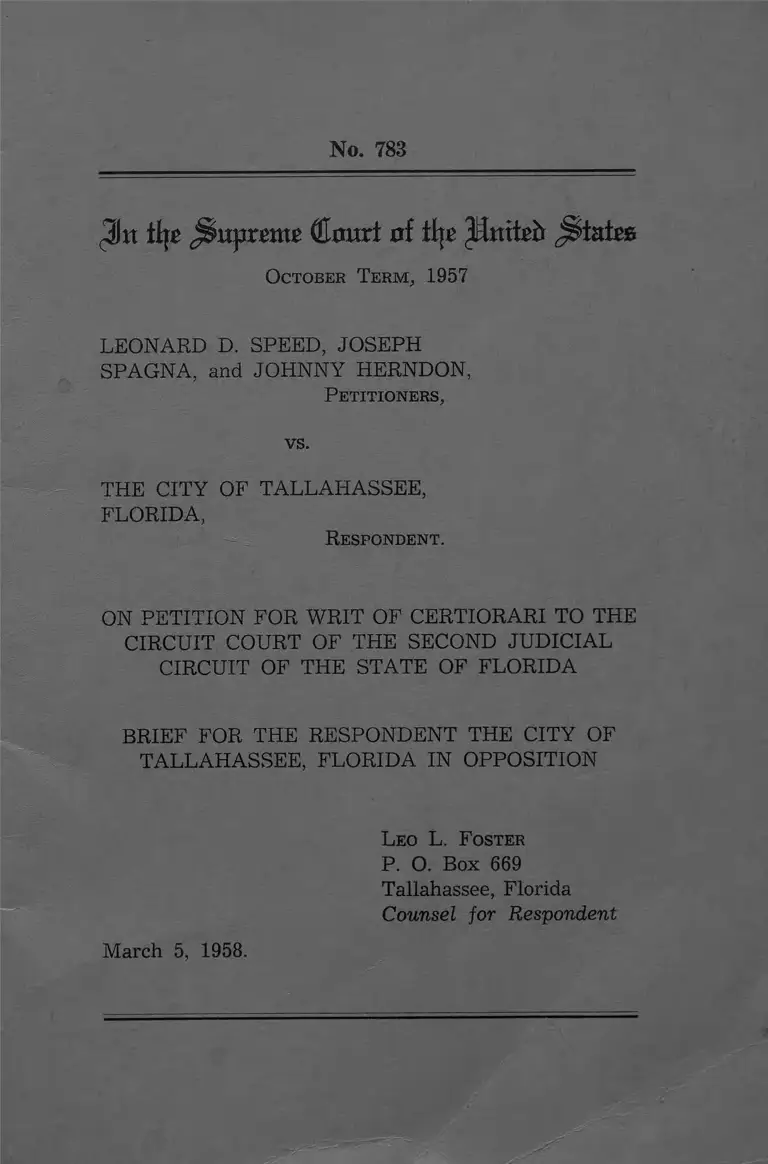
No. 783
3 it tip Supreme Court of tip Putted jitatee
October Term, 1957
LEONARD D. SPEED, JOSEPH
SPAGNA, and JOHNNY HERNDON,
Petitioners,
vs.
THE CITY OF TALLAHASSEE,
FLORIDA,
Respondent.
ON PETITION FOR WRIT OF CERTIORARI TO THE
CIRCUIT COURT OF THE SECOND JUDICIAL
CIRCUIT OF THE STATE OF FLORIDA
BRIEF FOR THE RESPONDENT THE CITY OF
TALLAHASSEE, FLORIDA IN OPPOSITION
Leo L. Foster
P. O. Box 669
Tallahassee, Florida
Counsel for Respondent
March 5, 1958.
I N D E X
PAGE
Opinions Below________________.—*------------------------ 1
Jurisdiction __ _l------- ~----- —.------------------------- ------- 2-6
Question Presented________________ -__ __________ 7
Statute Involved __ *___—__-__-_—__ ...------- ...---------- 7
Statement of the Case________-— ...------------------------ 7-10
Argument ____ _______________----------------------------— 10-14
I—How Federal Questions were Raised______ — 10
II—The Decision Below is Clearly Correct--------- 11-14
Conclusion ________________ _____________ *---------- - 14
Appendix A—Judgments and Sentences in Cases No.
60022, 60023, and 60024_____________ 15-17
B—Article 5, Sections 1, 3, 4, 5, and 6, Con
stitution of the State of Florida______ 18-24
CITATIONS
Cases :
Bowe vs. Scott, 233 U. S. 658, 664-5___________ 6
Capital City Dairy Co. vs. Ohio, 183 U. S. 238, 248 4
Central Union Co. vs. Edwardsville, 269 U. S. 190,
194-5 __________________________________ 3
Davis vs. Schmell, 81 Fed. Supp. 872, Affirmed
336 U. S. 933_______________ -___________ 12
Enterprise Irrig. Dist. vs. Farmers Mut. Canal
Co., 243 U. S. 157, 163-4____________ -___6
Fox Film Corp. vs. Muller, 296 U. S. 207„_----- -— 6
Harding vs. Illinois, 196 U. S. 78, 88___________ - 4
Herndon vs. Georgia, 295 U. S. 441, 442-3_____ 4
Hunt vs. City of Jacksonville, 34 Fla. 504, 16 So.
398 ____________________________________ 2
I N D E X
CITATIONS— ( Continued )
PAGE
Cases: (Continued)
Malone vs. City of Quincy, 66 Fla. 52, 62 So. 922— 2
Matthews v. Huwe, 269 U. S. 262, 265-6------------ 3
Mernaugh v. City of Orlando, 41 Fla. 433, 27 So. 34 2
New York Central vs. New York, 186 U. S. 269,
273 ____________________________________ 5
New York ex rel Bryant vs. Zimmerman, 278
U. S. 63, 67-8_,____ ...____________ _________ 6
Oxley Stave Co. vs. Butler County, 166 U. S. 648,
655 ___________________________________ 4
Parker vs. Illinois, 333 U. S. 571, 574-5--------------- 3
Pennsylvania R. Co. vs. Illinois Brick Co., 297
U. S. 447, 462-3_______ „ _________________ 3
Stratton vs. Stratton, 239 U. S. 55--------------------- 3
United Automobile Aircraft and Agricultural Im
plement Workers of America vs. Wisconsin
Employment Relations Board, 350 U. S. 521— 13
Yick Wo vs. Hopkins, 118 U. S. 356---------------- - 12
Statutes :
28 U. S. C. Section 1257____ i_________________ 3
Ordinance No. 368, as amended by Ordinance No.
659, as Amended by Ordinance No. 741 of the
City of Tallahassee, Florida------------------------ 7
Other Authorities :
Constitution of the State of Florida, Article 5, Sec
tions 1, 3, 4, 5, and 6--------------------------------- 2
31 it tlje Supreme (Umtri of ifft Ptttiefr Stales
October Term, 1957
No. 783
LEONARD D. SPEED, JOSEPH
SPAGNA, and JOHNNY HERNDON,
Petitioners,
vs.
THE CITY OF TALLAHASSEE,
FLORIDA,
Respondent.
ON PETITION FOR WRIT OF CERTIORARI TO THE
CIRCUIT COURT OF THE SECOND JUDICIAL
CIRCUIT OF THE STATE OF FLORIDA
BRIEF FOR THE RESPONDENT THE CITY OF
TALLAHASSEE, FLORIDA IN OPPOSITION
OPINIONS BELOW
The opinion of the Municipal Judge of the City of
Tallahassee, Florida was merely a ruling on a motion
for a directed verdict at the conclusion of the City’s case
and is not a final judgment or order. The motion for
directed verdict is found at page 62 of the certified tran
script of the proceedings in the Municipal Court and the
ruling thereon is found on page 74 thereof.
Subsequently, the Municipal Court entered final judg
ments and sentences in the three cases which are printed
in Appendix A, infra.
1
2
JURISDICTION
The Circuit Court of the Second Judicial Circuit in and
for Leon County, Florida, which affirmed the judgments1
in these three cases, is the primary trial court in Florida
and has final appellate jurisdiction of all cases arising
in Municipal Courts and no appellate proceedings lie in
such cases from the Circuit Courts,2 but the Supreme
Court and the District Courts of Appeal have express
power to issue writs of certiorari which is a common law
writ which issues in the sound judicial discretion of the
Court to an inferior court, not to take the place of an
appeal, but to cause the entire record of the inferior
court to be brought up by certified copy for inspection in
order that the superior court may determine from the
face of the record whether the inferior court has ex
ceeded its jurisdiction; or has not proceeded according
to the essential requirements of the law in cases where
no direct appellate proceedings are provided by law. Ma
lone vs. The City of Quincy, 66 Fla. 52, 62 So. 922.
The judgment of the Circuit Court under the Florida
Constitution is not final and is reviewable by the District
Courts of Appeal and by the Court of last resort, the
Supreme Court of Florida, where it can be shown, as is
alleged here, that the Circuit Court has not proceeded
according to the essential requirements of the law. The
validity of City ordinances are often tested in Florida in
this manner. Hunt v. The City of Jacksonville, 34 Fla.
504, 16 So. 398; Mernaugh v. City of Orlando, 41 Fla. 433,
27 So. 34; Malone v. City of Quincy, 66 Fla. 52, 62 So. 922.
1 The three judgments and sentences in the cases No. 60022
(City of Tallahassee vs. Joseph Spagna) ; No. 60023 (City of
Tallahassee vs. Johnny Herndon); and No. 60024 (City of
Tallahassee vs. Leonard D. Speed) are set out in the Appen
dix A, infra.
2 Article 5, Sections 1, 3, 4, 5, and 6, Constitution of the
State of Florida, are set out in Appendix B, infra. Article 5
is the judiciary article of the Florida Constitution.
3
If there is discretionary review by a higher State
Court, the exercise of such discretion must be invoked.
Stratton vs. Stratton, 239 U. S. 55; Matthews v. Huwe,
269 U. S. 262, 265-6.
The jurisdictional statute permitting this Court to re
view State Court cases by certiorari relates only to the
final judgments rendered “by the highest court of a State
in which a decision could be had.” 28 U. S. C. Section
1257. A decision could have been had in these three cases
in the District Court of Appeal and in the Florida Su
preme Court by the writ of certiorari.
It is essential to the jurisdiction of this Court under
Section 1257, supra, that a substantial Federal question
has been properly raised in the State Court proceedings.
The Federal right, privilege, or immunity must have
been specially set up or claimed and the proper method
of raising the Federal question is dependent upon Florida
practice. Central Union Co. v. Edwardsville, 269 U. S.
190, 194-5; Pennsylvania R. Co. v. Illinois Brick Co., 297
U. S. 447, 462-3; Parker v. Illinois, 333 U. S. 571, 574-5.
On the 19th of January, 1957, one Emory Elkins filed
his affidavit that Joseph Spagna, John Herndon, and
Leonard Speed did unlawfully occupy a space on a motor
transportation bus operated for hire by Cities Transit,
Inc., other than the space assigned by the driver or oper
ator of said transportation bus and did then and there
refuse to accept and occupy the space assigned them, and
upon tender of the fare paid, refused peaceably and with
out disorder to remove themselves from the motor trans
portation bus after being requested so to do by the driver
or operator thereof contrary to the ordinance of the City
of Tallahassee, Florida, in such cases made and provided
and on the same date warrants for their arrest were is
sued by the Municipal Judge. The Defendants did not
file a motion to quash the affidavit as they should have
4
done according to Florida practice but in lieu thereof
entered pleas of not guilty and the case went to trial
on the issue of whether or not the Defendants had vio
lated the ordinance. They were found guilty and judg
ment and sentence of the Municipal Court were entered.
The Defendants filed their grounds for appeal as fol
lows: (1 ) the verdict is contrary to the weight of the
evidence; (2 ) the verdict is contrary to the law; (3 ) the
court erred in denying defendants motion for directed
verdict. The material part of the motion for a directed
verdict of acquittal is as follows: “The ordinance, as
promulgated and as enforced by the City of Tallahassee,
is in violation of the Constitution of the State of Florida,
the Constitution of the United States; more specifically,
the 14th Amendment, the Due Process Clause and the
Equal Protections Clause of said Constitution of the
United States, in that the salient parts of this ordinance
ostensibly require seating passengers in order to dis
tribute weight, avoid health hazards, preserve peace,
tranquility and good order, and numerous other illusory
and certainly almost mythical factors.” (T-63, 64)
The Circuit Court affirmed the judgments and sen
tences of the Municipal Court.
The jurisdiction of this Court to re-examine the final
judgment of the State Court cannot arise from mere
inference but only from averments so distinct and posi
tive as to place it beyond question that the petitioner in
tended to assert a Federal Right. Oxley Stave Co. vs.
Butler County, 166 U. S. 648, 655. The Supreme Court
will not take cognizance of a claim grounded upon a mere
reference to the Constitution of the United States. Hern
don v. Georgia, 295 U. S. 441, 442-3; Harding vs. Illinois,
196 U. S. 78, 88; Capital City Dairy Co. vs. Ohio, 183 U. S.
238, 248.
5
We recognize that where the State Court holds that a
Federal question is before it and then proceeds to con
sider and dispose of same, the Supreme Court’s concern
with proper raising of the Federal question disappears
but “ it is well settled in this Court that it must be made
to appear that some provision of the Federal, as distin
guished from the State Constitution, was relied upon and
that such provision must be set forth.” New York Cen
tral vs. New York, 186 U. S. 269, 273. Here the only
claim made was “ the ordinance, as promulgated and as
enforced by the City of Tallahassee is in violation of the
Constitution of the State of Florida, the Constitution of
the United States * * *.” The Court overruled the mo
tion opining “An ordinance * * * comes into Court with
a presumption of legality and constitutionality * *
(T-74)
The judgment on appeal provided “This cause coming
on to be * * * heard upon the appeal * * * and the record
in said cause having been examined and no denial of any
constitutional * * * right of appellants * * * having been
made to appear * * * ORDERED * * * that the * * *
judgment appealed from * * * is * * * affirmed * * *.”
The motion for review sets up three grounds:
“ 1. That the judgment of this Court which reads
in part: ‘no denial of any constitutional or statutory
right of appellants or pre-judicial error other
wise, having been made to appear, and the court
being advised in the premises . . . . , ’ does not
take into consideration Ground Number 1 of the
appellants’ assignment of errors which urges that
the appellees did not prove the commission of any
crime cognizable by law beyond and to the exclusion
of a reasonable doubt, said assignment dealing with
the sufficiency of evidence and not with any statu
tory, constitutional or prejudicial error.
6
“ 2. That this Court erred in ruling that there
has been no denial of any constitutional or statutory
right.
“ 3. That this Court erred in ruling that there has
been no prejudicial error made to appear in this
case.”
The order denying motion for review states: “This
cause coming on * * * to be * * * heard upon the motion
of appellants for review of the Court’s final judgment
* * * and it now appearing to the Court that the suffi
ciency of the evidence to sustain the conviction of the
said defendants was duly considered as well as each and
every other assignment of error or ground for the ap
peal * * * ORDERED * * * that said motion * * * is
* * * denied * * *.”
If the claim is made that an ordinance is unconstitu
tional it will be assumed that reference is being made
to the State Constitution and rights thereunder rather
than the Federal Constitution. New York ex rel Bryant
\vs. Zimmerman, 278 U. S. 63, 67-8; Bowe v. Scott, 233
U. S. 658, 664-5. These judgments and opinions neither
explicitly or impliedly recognize the presence of a Fed
eral question nor do they render a decision thereon. The
judgment of the Circuit CouD here sought to be reviewed
is based on non-Federal grounds: (1 ) sufficiency of the
evidence; (2 ) no denial of any Florida Constitutional
right. The non-Federal grounds are adequate to support
the judgment, and review by this Court is precluded.
Fox Film Corp. v. Muller, 296 U. S. 207; Enterprise
Irrig. Dist. v. Farmers Mut. Canal Co. 243 U. S. 157,163-4.
7
QUESTION PRESENTED
IS THE ORDINANCE AS PROMULGATED AND
AS ENFORCED BY THE CITY OF TALLAHASSEE,
IN VIOLATION OF THE CONSTITUTION OF THE
UNITED STATES, 14TH AMENDMENT, THE DUE
PROCESS CLAUSE AND THE EQUAL PROTECTION
CLAUSE IN THAT SALIENT PARTS OF THIS ORDI
NANCE OSTENSIBLY REQUIRE SEATING PASSEN
GERS IN ORDER TO DISTRIBUTE WEIGHT, AVOID
HEALTH HAZARDS, PRESERVE PEACE, TRAN
QUILITY AND GOOD ORDER?
This was the question presented to the trial court.
(T. 63-64)
STATUTE INVOLVED
Ordinance No. 368, as amended by Ordinance No. 659,
as amended by Ordinance No. 741, of the City of Talla
hassee, Florida.
STATEMENT OF THE CASE
On the 19th of January, 1957, one Emory Elkins filed
his affidavit averring that the Defendants Spagna, Hern
don and Speed, performed certain acts and deeds con
trary to the ordinance of the City of Tallahassee. The
Defendants entered pleas of not guilty and the cases
proceeded to trial on that issue. The Defendants made
no motion to quash nor did they in any way attack the
affidavit charging the offense as is customary and usual
in the Florida practice. The Defendants were found
guilty and the judgment and sentence of the Municipal
Court were entered.
The Defendants filed their notice of and grounds for
appeal. At the trial held before the City Judge, William
F. Jacobs was called as a witness on the behalf of the
City of Tallahassee and testified that he had prepared
City of Tallahassee Exhibit No. A, which is the chart
8
showing the seating arrangements on the City Transit
bus and the chart was admitted into evidence without
objection. This chart is very material evidence in this
case.
Emory Elkins was then called by the City and testi
fied that he was a driver for the bus company and was
so employed during January, 1957. He examined the
chart (City’s Exhibit No. A ) and testified that the chart
accurately portrayed the position of seats on the bus in
question and that he was driving the bus on January
19th, 1957, and that Joseph Spagna, John Folsom and a
person whose name was Kennedy, came on his bus as a
party of three; they gave him transfers as they entered
the bus and he assigned them seats, which he was re
quired to do as a part of his job. The seats that he as
signed the three were 15, 16, and 17, which seated them
—two together and one across the aisle. He further testi
fied that they then sat in the seats so assigned.
He further testified that the Defendant Dan Speed
and the Defendants John Herndon and Harold Owens
also approached his bus as a party of three and handed
him transfers; that they entered the bus and he assigned
them seats numbered 19, 21, and 22, which sat two of
them together and one across the aisle. He further testi
fied that they also sat in their assigned seats; that other
people were passengers on the bus and after the passen
gers were seated he proceeded to continue on his regu
larly assigned run; that his first stop was Gadsden and
Georgia Streets where a passenger was let off, at which
time the Defendants Spagna, Speed, and Herndon
switched seats; that is, the Defendant Speed, who had
been assigned seat no. 19, moved to seat no. 16; Folsom
moved from his seat to another, and the Defendant
Spagna moved from the seat assigned to him to another
seat. Neither of the three Defendants had asked for a
re-assignment of their seats and this switching of seats
9
was done without any authority. He testified that he
asked them to take their assigned seats or accept a re
fund of their money and they refused the fare and re
fused to get off and refused to resume their assigned
seating arrangements; that he then telephoned the po
lice; that the police responded to his call and when they
arrived the Defendants were still sitting in the seats
which they had arbitrarily appropriated and were not
occupying the space assigned to them by the driver.
On cross examination Elkins stated that he started the
assignment of seats on his bus to all passengers at all
times; that he was instructed to assign seats according
to the weight of the persons boarding the bus, to take
into consideration the possibility of a collision in dis
tributing this weight; that he was also instructed to as
sign seats taking into consideration health hazards; that
he was not instructed to refrain from assigning seats to
colored and white passengers together; that he was in
structed to assign passengers to seats in such manner
as to preserve the peace, tranquility and good will of the
community and that in studying the system of assign
ments he made a study of Ordinance No. 741 and all the
factors involved therein. He further testified that once
assigned a seat, an individual would have no right to
change that seat.
Robert Maige, Captain Tallahassee Police Department,
testified that when he got to the bus, Herndon and Ken
nedy were sitting in seats 15 and 17; Speed was sitting
in 16; Folsom in 18; Spagna in 20 and Harold Owens
in 22; that the driver asked them to get back in the seats
they had been assigned and they refused; that the driver
offered them their pay back to get off the bus and they
would not do that; that Captain Todd asked them to
resume their seats and they would not move, and that
they were then placed under arrest. Captain Wayne
Todd corroborated Maige’s testimony.
10
The City Attorney then introduced into evidence a
certified copy of paragraph 7 of the original petition for
declaratory judgment and injunctive relief filed in Civil
Action No. 603 in the United States District Court for
the Northern District of Florida, Tallahassee Division,
as City Exhibit No. B, which constitutes a sworn judicial
admission as to the facts contained therein. This Exhibit
is also material to the issues before the Court. The City
then rested its case and the Defendants moved for a di
rected verdict. The Court overruled the motion for a
directed verdict. The Defendants then announced that
they did not wish to present any testimony and rested.
The Court then found the Defendants Spagna, Speed,
and Herndon guilty.
ARGUMENT
I
HOW FEDERAL QUESTIONS WERE RAISED.
These cases were initiated by the Affidavit of one
Emory Elkins. The Defendants did not file a motion to
quash the Affidavit nor did they attack it in any manner
but, on the contrary, at their arraignment, entered pleas
of not guilty. At the beginning of the trial the Court re
iterated these facts and asked the Attorney for the De
fendants if a plea of not guilty was still his plea at the
morning of the trial. The Defense counsel answered
“That is the plea.” (T-2)
The case proceeded on the issue made by the plea of
not guilty and the trial court and the appellate court
found that the evidence was sufficient to uphold a judg
ment of guilty and a sentence for the violation of the
ordinance.
11
II
THE DECISION BELOW IS CLEARLY CORRECT
The trial court did not err in refusing to grant the
Defendants a verdict of acquittal on the second ground
interposed: “ The ordinance, as promulgated and as en
forced by the City of Tallahassee, is in violation of the
Constitution of the State of Florida, the Constitution of
the United States; * * * in that the salient parts of this
ordinance ostensibly require seating passengers in order
to distribute weight, avoid health hazards, preserve
peace, tranquility and good order, and numerous other
illusory and certainly almost mythical factors.”
The ordinance, on its face, does not have the effect of
depriving the Defendants of their liberty or their prop
erty without due process of law, and on its face, is a
reasonable exercise of police power in the seating ar
rangement requirement provided therein.
In fact the Defendants Herndon and Speed in their
sworn petition filed in the United States District Court
for the Northern District of Florida, Civil Action No.
603, have stated under oath:
“ That while this ordinance purports to make a valid
classification, its operation and application for all
practical purposes are discriminary on account of
race and in violation of Title 18 U. S. Code Section
242.” (City of Tallahassee Exhibit B (T 57-60)).
The Defendants, therefore, admit that the ordinance
makes a valid classification but complain that its opera
tion and application make it discriminatory. Thus, the
statute is constitutional because, on its face, it estab
lishes a reasonable classification and does not have the
effect of depriving Defendants of their liberty or prop
erty without due process of law, nor does it have as its
only basis for assignment the prohibited standard of race.
12
See Yick Wo vs. Hopkins, 118 U. S. 356, and Davis vs.
Schmell, 81 Fed. Supp. 872, affirmed 336 U. S. 933. Nor
is there any testimony to show that the operation of the
statute or the enforcement of the statute by the City of
Tallahassee is in violation of the Constitution of the
United States, nor does the operation or enforcement
have the effect of depriving defendants of their liberty
or property without due process of law or as having im
plied as its only basis for assignment the prohibited
standard of race.
The testimony of the driver is uncontradicted that he
was instructed to assign seats according to weight of the
persons boarding the bus; to take into consideration the
possibility of collision in distributing this weight; to as
sign seats, taking into consideration health hazards; to
assign passengers to seats in such manner as to preserve
peace, tranquility and good will of the community. He
testified that he was not instructed to refrain from as
signing seats to colored and white persons together.
He was asked this direct question:
“Q. Were you instructed to refrain from assigning seats
to colored and white passengers together?
* * * * *
“A. No.” (T 22-24)
* $ . £ * *
“Q, * * * were you instructed to assign passengers
boarding the bus to seats in such a manner as to
preserve the peace, tranquility and good will of the
community?
“A. Yes.
* * * * *
“Q. * * * did you make a study of Ordinance No. 741,
and all the factors involved therein?
“A. Yes.
13
“Q. And since January 7, 1957, you have been seating
all passengers on the bus that you are operating
according to these standards set by Ordinance No.
741? Is that correct?
“A. Yes.” (T 24-25)
The Defendants offered no evidence to the contrary
and there is no evidence in this record that the basis
of assignment was ever the prohibited standard of race.
In fact, there is no evidence in the record as to the race,
creed or color of the Defendants or any of the persons
involved in this controversy. As far as the record goes
these Defendants could be all negroes, or they could all
be white.
When counsel, in their brief, state:
“ Tallahassee cannot accomplish indirectly by this
ordinance that which it is prohibited from doing
directly by the dictates of the requirement of equal
protection; for even if the ordinance in question
can be said to be fair on its face, the record discloses
that here it was in fact used to separate Negro and
white passengers solely because of their race, no
other reason for the separation appearing.”
they bring a matter into Court which is not in the record
and is no fair inference from the factual situation as pre
sented by the record. The statement “ the record discloses
that here it was in fact used to separate Negro and white
passengers solely because of their race” is untrue. The
record shows that the undisputed sworn testimony of
the driver of the bus is to the contrary.
The Supreme Court of the United States in the case
of the United Automobile Aircraft and Agricultural Im
plement Workers of America vs. Wisconsin Employment
Relations Board, 350 U. S. 521, stated:
“This general rule does not take from the States
power to prevent mass picketing, violence, and overt
14
threats of violence. The dominant interest of the
State in preventing violence and property damage
cannot be questioned. It is a matter of genuine local
concern. * * *
“The States are the natural guardians of the public
against violence. It is the local communities that
suffer most from the fear and loss occasioned by
coercion and destruction. We would not interpret
an act of Congress to leave them powerless to avert
such emergencies without compelling directions to
that effect.”
CONCLUSION
For the foregoing reasons it is respectfully submitted
that this Petition for a Writ of Certiorari
denied.
; .. T ^ X "
Leo L. Foster
P. O. Box 669
Tallahassee, Florida
Counsel for Respondent.
should be
March 5, 1958
15
APPENDIX A
CASE NO. 60022
IN THE MUNICIPAL COURT OF THE
CITY OF TALLAHASSEE, FLORIDA
Charge
Violation of Seating Arrange
ment Ordinance, Park and Mon
roe, Within the City Limits of
the City of Tallahassee, Florida,
on the 19 day of January, 1957,
contrary to the Laws and Ordi
nances of said City. Defendant
arranged and plead not guilty.
JUDGMENT
After hearing the evidence and duly considering the
same, the Court found the Defendant guilty of the charge
and pronounced the following sentence, to-wit: the sen
tence of the law and the judgment of the Court is that
you pay a fine of $500 dollars and in default of said fine,
that you be confined to the City Jail for a period of 60
days until this judgment is satisfied, & 60 days.
Date Sentenced 2-27-57
City of Tallahassee,
vs.
Joseph Spagna
/ s / JOHN A. RUDD
Municipal Judge
16
CASE NO. 60023
IN THE MUNICIPAL COURT OF THE
CITY OF TALLAHASSEE, FLORIDA
Charge
Violation of Seating Arrange
ment Ordinance, Park and Mon
roe, Within the City Limits of
the City of Tallahassee, Florida,
on the 19 day of January, 1957,
contrary to the Laws and Ordi
nances of said City. Defendant
arranged and plead not guilty.
JUDGMENT
After hearing the evidence and duly considering the
same, the Court found the Defendant guilty of the charge
and pronounced the following sentence, to-wit: the sen
tence of the law and the judgment of the Court is that
you pay a fine of $500 dollars and in default of said fine,
that you be confined to the City Jail for a period of 60
days until this judgment is satisfied, & 60 days.
Date Sentenced 2-27-57
City of Tallahassee,
vs.
Johnny Herndon
/ s / JOHN A. RUDD
Municipal Judge
17
CASE NO. 60024
IN THE MUNICIPAL COURT OF THE
CITY OF TALLAHASSEE, FLORIDA
Charge
Violation of Seating Arrange
ment Ordinance, Park and Mon
roe, Within the City Limits of
the City of Tallahassee, Florida,
on the 19 day of January, 1957,
contrary to the Laws and Ordi
nances of said City. Defendant
arranged and plead not guilty.
JUDGMENT
After hearing the evidence and duly considering the
same, the Court found the Defendant guilty of the charge
and pronounced the following sentence, to-wit: the sen
tence of the law and the judgment of the Court is that
you pay a fine of $500 dollars and in default of said fine,
that you be confined to the City Jail for a period of 60
days until this judgment is satisfied, & 60 days.
Date Sentenced 2-27-57
City of Tallahassee,
vs.
Leonard D. Speed
,/s/ JOHN A. RUDD
Municipal Judge
18
APPENDIX B
ARTICLE V. JUDICIAL DEPARTMENT
§ 1. Courts
Section 1. The judicial power of the State of Florida
is vested in a supreme court, district courts of appeal, cir
cuit courts, Court of Record of Escambia County, crimi
nal courts of record, county courts, county judge’s courts,
juvenile courts, courts of justices of the peace, and
such other courts, including municipal courts, or com
missions, as the legislature may from time to time ordain
and establish. [Adopted general election, Nov. 6, 1956.1
§ 3. Practice and Procedure
Section 3. The practice and procedure in all courts
shall be governed by rules adopted by the supreme court.
[Adopted general election Nov. 6, 1956.1
§ 4. Supreme Court
Section 4. (a ) Organization. The supreme court shall
consist of seven members, one of whom shall be the chief
justice. Five justices shall constitute a quorum, but the
concurrence of four shall be necessary to a decision.
(b ) Jurisdiction. Appeals from trial courts may be
taken directly to the supreme court, as a matter of right,
only from judgments imposing the death penalty, from
final judgments or decrees directly passing upon the
validity of a state statute or a federal statute or treaty,
or construing a controlling provision of the Florida or
federal constitution, and from final judgments or decrees
in proceedings for the validation of bonds and certificates
of indebtedness. The supreme court may directly review
by certiorari interlocutory orders or decrees passing upon
19
chancery matters which upon a final decree would be di
rectly appealable to the supreme court. In all direct
appeals and interlocutory reviews by certiorari, the su
preme court shall have such jurisdiction as may be neces
sary to complete determination of the cause on review.
Appeals from district courts of appeal may be taken
to the supreme court, as a matter of right, only from de
cisions initially passing upon the validity of a state
statute or a federal statute or treaty, or initially constru
ing a controlling provision of the Florida or federal con
stitution. The supreme court may review by certiorari
any decision of a district court of appeal that affects a
class of constitutional or state officers, or that passes upon
a question certified by the district court of appeal to be
of great public interest, or that is in direct conflict with
a decision of another district court of appeal or of the
supreme court on the same point of law, and may issue
writs of certiorari to commissions established by law.
The supreme court may issue writs of mandamus and
quo warranto when a state officer, board, commission, or
other agency authorized to represent the public gener
ally, or a member of any such board, commission, or
other agency, is named as respondent, and writs of prohi
bition to commissions established by law, to the district
courts of appeal, and to the trial courts when questions
are involved upon which a direct appeal to the supreme
court is allowed as a matter of right.
The supreme court may issue all writs necessary or
proper to the complete exercise of its jurisdiction.
The supreme court or any justice thereof may issue
writs of habeas corpus returnable before the supreme
court or any justice thereof, or before a district court of
appeal or any judge thereof, or before any circuit judge.
20
The supreme court shall provide for the transfer to the
court having jurisdiction of any matter subject to review
when the jurisdiction of another appellate court has been
improvidently invoked.
(c ) Chief Justice. The chief justice of the supreme
court shall be chosen by the members of the court and
shall serve for a term of two years. In the event of a va
cancy, a successor shall be chosen within sixty days for
a like term. During a vacancy or whenever the chief
justice is unable to act for any reason, the justice longest
in continuous service and able to act shall act as chief
justice.
(d ) Clerk and Marshal; Process. The supreme court
shall appoint a clerk and a marshal who shall hold office
during the pleasure of the court and perform such duties
as the court directs. Their compensation shall be fixed
by law. The marshal shall have the power to execute the
process of the court throughout the state, and in any
county may deputize the sheriff or a deputy sheriff for
such purpose. [Adopted general election Nov. 6, 1956.1
§ 5. District Courts of A ppeal
Section 5. (a ) Appellate Districts. The state shall be
divided into three appellate districts of contiguous coun
ties as the legislature may prescribe.
(b ) Organization; number and selection of judges. A
district court of appeal shall be organized in each appel
late district. There shall be three judges of each district
court of appeal. Not less than three judges shall consider
each case and the concurrence of a majority shall be nec
essary to a decision. The court shall hold at least one
session every year in each judicial circuit within the dis
trict wherein there is ready business to transact.
21
The judges of the district courts of appeal organized
hereunder shall be selected as follows: Between June
first and July first, 1957, the governor shall appoint three
persons to serve as judges of each district court of appeal
until their successors are elected, as herein provided. The
judges so appointed shall take office and assume their
duties on July first, 1957, and shall serve for a term to
be designated by the governor in accordance with the fol
lowing schedule: The governor shall appoint one judge
in each district for a term expiring on the first Tuesday
after the first Monday in January 1959, following the
election of his successor at the general election in No
vember 1958, which judges shall be identified as Group
“A ” ; one judge in each district for a term expiring on
the first Tuesday after the first Monday in January 1961,
following the election of his successor at the general
election in November 1960, which judges shall be identi
fied as Group “B” ; and one judge in each district for a
term expiring on the first Tuesday after the first Monday
in January 1963, following the election of his successor
at the general election in November 1962, which judges
shall be identified as Group “C” .
The successors of the original judges of the district
courts of appeal shall be elected at the general election
next preceding the expiration of their respective terms
of office.
(c ) Jurisdiction. Appeals from trial courts in each
appellate district, and from final orders or decrees of
county judge’s courts pertaining to probate matters or
to estates and interests of minors and incompetents, may
be taken to the court of appeal of such district, as a mat
ter of right, from all final judgments or decrees except
those from which appeals may be taken direct to the
supreme court or to a circuit court.
The supreme court shall provide for expeditious and
inexpensive procedure in appeals to the district courts
22
of appeal, and may provide for review by such courts of
interlocutory orders or decrees in matters reviewable by
the district courts of appeal.
The district courts of appeal shall have such powers
of direct review of administrative action as may be pro
vided by law.
A district court of appeal or any judge thereof may
issue writs of habeas corpus returnable before that dis
trict court of appeal or any judge thereof, or before any
circuit judge in that district. A district court of appeal
may issue writs of mandamus, certiorari, prohibition,
and quo warranto, and also all writs necessary or proper
to the complete exercise of its jurisdiction.
(d ) Clerks and Marshals. Each district court of ap
peal shall appoint a clerk and a marshal who shall hold
office during the pleasure of the court and perform such
duties as the court may direct. Their compensation shall
be fixed by law. The marshal shall have power to exe
cute the process of the court throughout the state, and in
any county may deputize the sheriff or a deputy sheriff
for such purpose. [Adopted general election Nov. 6,
1956.1
§ 6. Circuit Courts
Section 6. (a ) Judicial Circuits. The legislature may
establish not more than sixteen judicial circuits each
composed of a county or contiguous counties and of not
less than fifty thousand inhabitants according to the last
census authorized by law, except that the county of Mon
roe shall constitute one of the circuits.
(b ) Circuit Judges. The legislature shall provide for
one circuit judge in each circuit for each fifty thousand
inhabitants or major fraction thereof according to the
23
last census authorized by law. In circuits having more
than one judge the legislature may designate the place
of residence of any such additional judge or judges.
(c ) Jurisdiction. The circuit courts shall have exclu
sive original jurisdiction in ail cases in equity except such
equity j urisdiction as may be conlerred on juvenile courts,
in ail cases at law not cognizable by subordinate courts, in
ail cases involving the legality of any tax, assessment, or
toll, in the action of ejectment, in all actions involving
the titles or boundaries of real estate, and in all criminal
cases not cognizable by subordinate courts. They shall
have original jurisdiction of actions of forcible entry and
unlawful detainer, and of such other matters as the legis
lature may provide. They shall have final appellate juris
diction in ail civil and criminal cases arising in the county
court, or before county judges’ courts, of all misdemean
ors tried in criminal courts of record, and of all cases
arising in municipal courts, small claims courts, and
courts of justices of the peace. The circuit courts and
judges shall have power to issue writs of mandamus, in
junction, quo warranto, certiorari, prohibition, and habeas
corpus, and all writs necessary or proper to the complete
exercise of their jurisdiction.
The circuit courts and circuit judges shall have such
extra-territorial jurisdiction in chancery cases as may
be prescribed by law.
(d ) Court Commissioners. A circuit judge may ap
point in each county in his circuit one or more attorneys
at law, to be court commissioners, who shall have power
in the absence from the county of the circuit judge, to
allow writs of injunction and to issue writs of habeas
corpus, returnable before himself or the circuit judge.
Their orders in such matters may be reviewed by the
circuit judge, and confirmed, qualified or vacated. They
may be removed by the circuit judge. The legislature
24
may confer upon them further powers, not judicial, and
shall fix their compensation.
(e ) Recommendation to Attorney General; Report to
Legislature. It shall be the duty of the judges of the cir
cuit courts to report to the attorney general at least thirty
days before each session of the legislature such defects
in the laws as may have been brought to their attention,
and to suggest such amendments or additional legislation
as may be deemed necessary. The attorney general shall
report to the legislature at each session such legislation
as he may deem advisable.
( f ) State Attorneys. In each judicial circuit a state
attorney shall be elected by the qualified electors of that
circuit in the same manner as other state and county
officials, to serve a term of four years and to fulfill duties
prescribed by law.
(g ) Clerks of the Circuit Courts. In each county a
clerk of the circuit court, who shall also be clerk of the
board of county commissioners, recorder, and ex officio
auditor of the county, shall be elected by the qualified
electors of that county in the same manner as other state
and county officials, to serve a term of four years and to
fulfill duties prescribed by law. [Adopted general elec
tion Nov. 6, 1956.1
25
CERTIFICATE OF SERVICE
I hereby certify that a copy of the foregoing Brief for
the Respondent The City of Tallahassee, Florida, In Op
position, has been furnished by Air Mail, postage pre
paid, to the following counsel in compliance with Rule
33, Section 3, Subsection b, Supreme Court Rules.
Thurgood M arshall
10 Columbus Circle
Suite 1790
New York 19, N. Y.
Constance Baker M otley
10 Columbus Circle
Suite 1790
New York 19, N. Y.
Francisco A. Rodriguez
703 Harrison Street
Tampa, Florida
L eo L. Foster
Counsel for Respondent
This 5th day of March, A. D. 1958.