Memorandum on Thorpe v. Housing Authority of the City of Durham
Press Release
October 21, 1968
-
Press Releases, Volume 5. Memorandum on Thorpe v. Housing Authority of the City of Durham, 1968. f4c82816-b992-ee11-be37-00224827e97b. LDF Archives, Thurgood Marshall Institute. https://ldfrecollection.org/archives/archives-search/archives-item/133104e4-0314-47c9-9e97-3dbe3d2477c9/memorandum-on-thorpe-v-housing-authority-of-the-city-of-durham. Accessed October 07, 2026.
Copied!
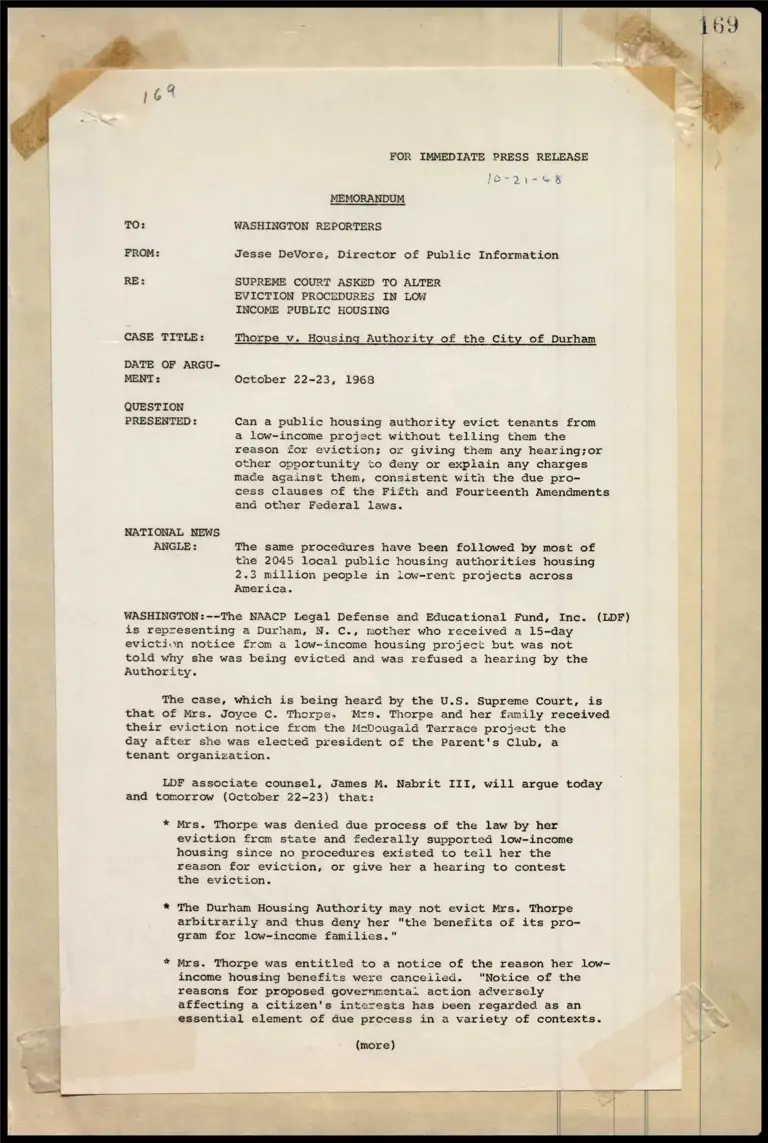
    FOR IMMEDIATE PRESS RELEASE

C-21-&8

MEMORANDUM

TO: WASHINGTON REPORTERS

FROM: Jesse DeVore, Director of Public Information

RE: SUPREME COURT ASKED TO ALTER

EVICTION PROCEDURES IN LOW

INCOME PUBLIC HOUSING

CASE TITLE: Thorpe v. Housing Authority of the City of Durham

DATE OF ARGU-

MENT: October 22-23, 1968

QUESTION

PRESENTED: Can a public housing authority evict tenants from

a low-income project without telling them the

reason for eviction; or giving them any hearing;or

other opportunity to deny or explain any charges

made against them, consistent with the due pro-

cess clauses of the Fifth and Fourteenth Amendments

and other Federal laws.

NATIONAL NEWS

ANGLE: The same procedures have been followed by most of

the 2045 local public housing authorities housing

2.3 million people in low-rent projects across

America.

WASHINGTON:--The NAACP Legal Defense and Educational Fund, Inc. (LDF)

is representing a Durham, N. C., mother who received a 15-day

eviction notice from a low-income housing project but was not

told why she was being evicted and was refused a hearing by the
Authority.

The case, which is being heard by the U.S. Supreme Court, is

that of Mrs. Joyce C. Thorpe. Mrs. Thorpe and her family received

their eviction notice from the MoDougaid Terrace project the

day after she was elected president of the Parent's Club, a

tenant organization.

LDF associate counsel, James M. Nabrit III, will argue today

and tomorrow (October 22-23) that:

* Mrs. Thorpe was denied due process of the law by her

eviction from state and federally supported low-income

housing since no procedures existed to tell her the

reason for eviction, or give her a hearing to contest

the eviction.

* The Durham Housing Authority may not evict Mrs. Thorpe

arbitrarily and thus deny her "the benefits of its pro-

gram for low-income families."

Mrs. Thorpe was entitled to a notice of the reason her low-

income housing benefits were cancelied. "Notice of the

reasons for proposed governmentai action adversely

affecting a citizen's interests has been regarded as an

essential element of due process in a variety of contexts.

(more)

|

|

|

|


SUPREME COURT ASKED TO ALTER

EVICTION PROCEDURES IN LOW Oct. 21, 1968

INCOME PUBLIC HOUSING -2-

* Mrs. Thorpe was entitled to an administrative hearing to

contest the eviction. "The right to a hearing has long

been regarded as one of the fundamental rudiments of fair

procedure necessary where the government acts against

a citizen's vital interest."

The LDF will say that, according to the U.S. Department of
Housing and Urban Redevelopment, there are approximately 2045

local housing authorities with low-rent projects throughout

the United States.

For years the local authorities have given tenants only

month-to-month leases and have evicted tenants without stating

a reason. Since this case was first presented to the Supreme

Court, the federal government in February 1967 adopted a new

rule somewhat modifying the eviction procedures.

A circular issued by the Department of Housing and Urban

Development, states that tenants must be informed of the reason

for their eviction and must be given a chance to reply or give

an explanation.

However, the Supreme Court of North Carolina has said that

these requirements do not apply to Mrs. Thorpe’s case.

But the Supreme Court has not yet spoken on the subject,

and persons interested in public housing hope that the Thorpe

case will bring an authoritative statement of the rights of low-

income tenants and local authorities.

=o0=

NOTE: The NAACP Legal Defense and Educational Fund, Inc. (LDF)

is a separate and distinct organization from the NAACP. Its

correct designation is NAACP Leqal Defense and Educational

Fund, Inc., which is shortened to LDF.