Ham v. Bell Brief for Plaintiff-Appellant
Public Court Documents
January 30, 1980
-
Brief Collection, LDF Court Filings. Ham v. Bell Brief for Plaintiff-Appellant, 1980. 2104122e-b59a-ee11-be36-6045bdeb8873. LDF Archives, Thurgood Marshall Institute. https://ldfrecollection.org/archives/archives-search/archives-item/13c8914e-dc51-4f23-8b6c-f2cc0eb6148e/ham-v-bell-brief-for-plaintiff-appellant. Accessed October 05, 2026.
Copied!
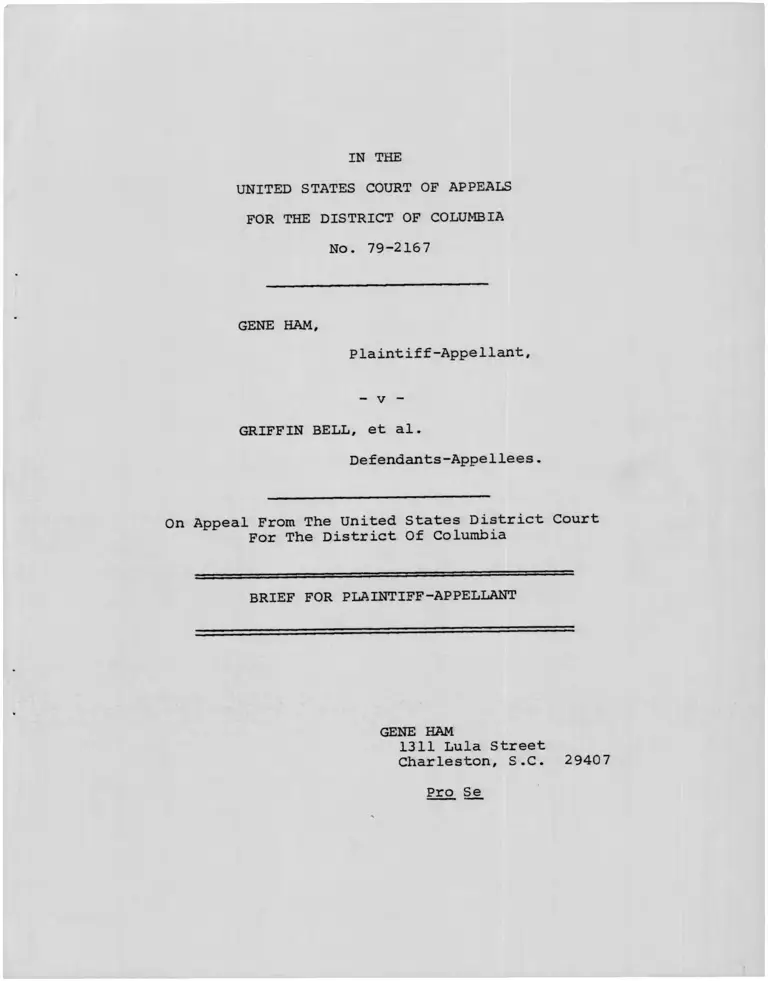
IN THE
UNITED STATES COURT OF APPEALS
FOR THE DISTRICT OF COLUMBIA
No. 79-2167
GENE HAM,
Plaintiff-Appellant,
- v -
GRIFFIN BELL, et al.
Defendants-Appellees.
On Appeal From The United States District Court
For The District Of Columbia
BRIEF FOR PLAINTIFF-APPELLANT
GENE HAM
1311 Lula Street
Charleston, S.C. 29407
Pro Se
CERTIFICATE REQUIRED BY RULE 8 (c)
The undersigned, plaintiff pro se, certifies that the
following listed parties appeared below:
Gene Ham, Plaintiff
Griffin Bell, Attorney General of the
United States and the United States
Department of Justice, Defendants
These representations are made in order that Judges of
this Court, inter alia, may evaluate possible disqualifica
tions of recusal.
GENE HAM
1311 Lula Street
Charleston, S.C. 29407
By:
INDEX
PAGE
Certificate ................................. i
Question Presented ............................. 1
Reference to Parties and Ruling ............... 1
Statute Involved .............................. 2
Statement of the Case ......................... 2
Argument ....................................... 5
CONCLUSION ..................................... 7
CERTIFICATE OF SERVICE ........................ 8
TABLE OF CASES
Page
Adickes v. Kress Co., 398 U.S. 144 (1970)............... 5
Haines v. Kerner, 404 U.S. 519 (1972) 5
Ham v. Bell, (D.D.C. No. 79-0082, August 30, 1979) . . . 2
Hudson v. Hardy, 412 F.2d 1091 (D.C. Cir. 1968) aff1d on
rehearing, 424 F.2d 854 (1970)...................... 5
Hummel v. Riordon, 56 F. Supp. 983 (N.D. 111. 1944) . . . 6
Roseboro v. Garrison, 528 F.2d 309 (4th Cir. 1975) . . . 5
Willmar Poultry Co. v. Morton-Norwich Products, Inc.,
520 F. 2d 289 (8th Cir. 1975).................. .. 6
XRT, Inc. v. Krellenstein, 448 F.2d 772 (5th Cir. 1971) . 6
Statutes and Rules
5 U.S.C. § 552 .................... .. 1,2,3,4,7
Rule 56, Fed. Rules of Civ. Proc, . . . . . . . . . . . . 2
IN THE
UNITED STATES COURT OF APPEALS
FOR THE DISTRICT OF COLUMBIA
No. 79-2167
GENE HAM,
Plaintiff-Appellant,
- v -
GRIFFIN BELL, et al.
Defendants-Appellees.
On Appeal From The United States District Court
For The District Of Columbia
BRIEF FOR PLAINTIFF-APPELLANT
Question Presented
Did the District Court err in granting defendants' motion
for summary judgment in this Freedom of Information Act case
without giving the pro se plaintiff the necessary time to file
an adequate response?*
Reference to Parties and Ruling
On August 30, 1979, Judge June L. Green issued a
* This is the first appearance of this case before this
Court.
memorandum decision. Ham v. Bell, (D.D.C. No. 79 0082,
August 30, 1979), which is reproduced in the Appendix at pp. S
(Hereinafter referred to as "A" .")
Statute and Rule Involved
This case involves the Freedom of Information Act, 5 U.S.C.
§ 552, and Rule 56, Federal Rules of Civil Procedure, the
texts of which are set out in the appendix.
Statement of the Case
This Freedom of Information Act case began with the filing
of a complaint, pro se, by the plaintiff, Gene Ham, in January
1979. At the time of the filing, plaintiff was incarcerated
by the State of South Carolina at Columbia, South Carolina.
On March 23, 1979, while the action was pending, plaintiff was
released from prison, but was unable to secure counsel to
represent him in this action.
The basis of the action was a request under the F.O.I.A.
by the plaintiff made on March 11, 1977, to the Department of
Justice, and specifically the Federal Bureau of Investigation.
Plaintiff requested any and all information gathered and
compiled on him. His particular concern was the gathering of
reports concerning his civil rights activities in South
Carolina and the use of those reports in bringing about his
arrest and conviction for alleged crimes. One purpose for
obtaining information from F.B.I. files was to substantiate
his claims that he was prosecuted and convicted because of
2
his civil rights activities, and not because he was in fact
1/
guilty.
The F.B.I. provided him with material on file in both the
field office in Columbia and at headquarters in Washington,
D.C. Certain information was withheld, however- Plaintiff
appealed administratively, some additional materials were
released, but by and large the determination to withhold por
tions of the released documents was affirmed. This present
action was timely filed pursuant to 5 U.S.C. § 552(a)(4)(B).
In his complaint, and in subsequent correspondence,
plaintiff called the court's attention to the fact that he was
indigent and requested the appointment of counsel. At all
times, the court was aware of plaintiff's pro se status. (See,
appendix, p. 8 •)
On or about February 12, 1979, the government filed its
answer, generally denying that plaintiff was entitled to any
relief. On February 22, 1979, a status call was held at which
the plaintiff was neither present, because of his incarceration
nor represented. At that time his motion for appointment of
counsel was denied. Plaintiff had received notice of the
status call only on February 21. (A. p. 7 .)
Subsequently, on or about April 22, 1979, defendants
filed a motion for summary judgment. It was mailed to plain
tiff addressed to his place of incarceration. Since he had been
1/ Post-conviction challenges to his convictions are presently
pending in both state and federal courts in South Carolina.
3
released, however, the copy never reached him. Another set of
the papers was mailed sometime in July (A. p. 149), but did not
reach plaintiff until August 10, 1979. (A. p.148 .)
On August 22, 1979, plaintiff submitted an affidavit in
letter form reciting that the motion for summary judgment had
been recently received, and that plaintiff had been attempting
to obtain counsel to assist him in filing "the necessary legal
and proper reply" to the motion. (A. p.14 8 .) Plaintiff
requested an extension of time to reply and renewed his request
for appointment of counsel. (Ibid.)
On August 30, 1979, however, the court denied the motion
and granted defendants' motion for summary judgment. The motion
relied on lengthy affidavits from two F.B.I. agents and asserted
that the matters excluded came within the provisions of 5 U.S.C.
§§ 552(b)(7)(c) and (d). Attached to the affidavits of the
agents were copies of the documents with the deletions made.
At no time were the unexpurgated documents submitted to the
district court for an in camera inspection to determine whether
the deleted material in fact came within the cited exceptions.
4
ARGUMENT
A Grant of Summary Judgment Without
A Response From the Plaintiff Or an
In Camera Inspection of the Documents
Was Improper.
As the Supreme Court has indicated, motions for
summary judgment should be granted only where all of the
requirements of Rule 56 have been met, and where it is
clear that there are no issues of material fact. Other
wise, a party's right to a full adjudication on the merits
of his case may be unjustifiably cut off. See, Adickes v.
Kress Co., 398 U.S. 144 (1970). This Court has cautioned
specifically that in the case of prisoners pro se:
The requirement of the summary
judgment rule may not
fairly be applied "with strict
literalness" to a prisoner un
represented by counsel and subject
to the "handicaps . . . detention
necessarily imposes upon a litigant."
Hudson v. Hardy, 412 F.2d 1091, 1094 (D.C. Cir. 1968),
aff'd on rehearing, 424 F.2d 854 (1970). See also, Haines
v. Kerner, 404 U.S. 519 (1972); Roseboro v. Garrison, 528
F.2d 309 (4th Cir. 1975).
It is also inappropriate to grant summary judgment
where the relevant information is peculiarly within the
knowledge of the movant without giving the opposing party
5
the opportunity to conduct discovery pursuant to Rule 56(f).
See, e.q., XRT, Inc, v. Krellenstein, 448 F.2d 772 (5th Cir.
1971); Hummel v. Riordon, 56 F.Supp. 983 (N.D. 111. 1944).
All of the factors set out above militated against
granting the motion for summary judgment in this case.
First, plaintiff, a pro se prisoner, was in no way informed
of the consequences of a failure to respond to the affidavits
filed by the government. Indeed, he was attempting to get
additional time to find an attorney and receive legal counsel;
nevertheless, the motion was granted less than three weeks
after he had received it and after he had requested more time.
Second, in an FOIA Case the facts that determine
whether everything has been released or whether materials
have been properly withheld are peculiarly within the agency's
knowledge. Thus, for example, depositions of the agents who
supplied the affidavits could establish whether they had
themselves fully searched to determine whether all documents
referring to plaintiff had been located. Plaintiff's letter-
affidavit, also prepared pro se, was sufficient under Rule 56(f)
to establish the necessity for allowing discovery in order to
respond adequately to the motion. Once such a showing had
been made, it was, of course, improper to grant summary judg
ment. See, Willmar Poultry Co. v. Morton-Norwich Products,Inc.,
520 F .2d 289 (8th Cir. 1975).
6
Finally, the granting of summary judgment under
the circumstances of the present case without at least
conducting an _in camera inspection of the deleted portions
of the documents was particularly inappropriate. Under
§ 552(a)(4)(B) the court may conduct such an inspection to
determine whether the agency has met its burden of establish
ing that the material came within the §552(d) exemptions
relied upon. With no discovery and a pro se plaintiff who
had been unable to file a response to the motion at the very
least the court should have examined the unexpurgated documents
to ensure that the plaintiff's rights were protected.
CONCLUSION
For the foregoing reasons, the decision of the court
below should be reversed
Respectfully submitted
GENE HAM
1311 Lula Street
Charleston, South Carolina
29407
Pro se
7
CERTIFICATE OF SERVICE
I hereby certify that I served copies of the
attached Brief by depositing the same in the United States
mail, postage prepaid addressed to Lillian A. McEwen, Esq.,
Assistant United States Attorney, United States District
Courthouse, Room 3432, 3rd and Constitution Avenue,
Washington, D.C. 20001.
January o 0 , 1980.
Gene Ham, pro se.
8
Appendix of Statute and Rule Involved.
5 U.S.C. § 552. Public information; agency rules,
opinions, orders, records, and
proceedings
(a) Each agency shall make available to the public
information as follows:
* * *
(3) Except with respect to the records made available
under paragraphs (1) and (2) of this subsection, each agency,
upon any request for records which (A) reasonably describes
such records and (B) is made in accordance with published
rules stating the time, place, fees (if any), and procedures
to be followed, shall make the records promptly available to
any person.
★ ★ *
(B) On complaint, the district court of the United
States in the district in which the complainant resides, or has
his principal place of business, or in which the agency records
are situated, or in the District of Columbia, has jurisdiction
to enjoin the agency from withholding agency records and to
order the production of any agency records improperly withheld
from the complainant. In such a case the court shall determine
the matter de novo, and may examine the contents of such agency
records in camera to determine whether such records or any part
thereof shall be withheld under any of the exemptions set forth
in subsection (b) of this section, and the burden is on the
agency to sustain its action.
★ * *
(b) This section does not apply to matters that are --
(1) (A) specifically authorized under criteria
established by an Executive order to be kept secret in
the interest of national defense or foreign policy and
(B) are in fact properly classified pursuant to such
Executive order;
(2) related solely to the internal personnel rules
and practices of an agency;
(3) specifically exempted from disclosure by statute
(other than section 552b of this title), provided that
such statute (A) requires that the matters be withheld
from the public in such a manner as to leave no discretion
on the issue, or (B) establishes particular criteria for
withholding or refers to particular types of matters to be
withheld;
l
(4) trade secrets and commercial or financial
information obtained from a person and privileged
or confidential;
(5) inter-agency or intra-agency memorandums or
letters which would not be available by law to a party
other than an agency in litigation with the agency;
(6) personnel and medical files and similar files
the disclosure of which would constitute a clearly
unwarranted invasion of personal privacy;
(7) investigatory records compiled for law en
forcement purposes, but only to the extent that the
production of such records would (A) interfere with
enforcement proceedings, (B) deprive a person of a right
to a fair trial or an impartial adjudication, (C) consti
tute an unwarranted invasion of personal privacy, (D) dis
close the identity of a confidential source and, in the
case of a record compiled by a criminal law enforcement
authority in the course of a criminal investigation, or
by an agency conducting a lawful national security
intelligence investigation, confidential information
furnished only by the confidential source, (E) disclose
investigative techniques and procedures, or (F) endanger
the life or physical safety of law enforcement personnel;
(8) contained in or related to examination,
operating, or condition reports prepared by, on behalf of,
or for the use of an agency responsible for the regulation
or supervision of financial institutions; or
(9) geological and geophysical information and data,
including maps, concerning wells.
Any reasonably segregable portion of a record shall be provided to
any person requesting such record after deletion of the portions
which are exempt under this subsection.
Rule 56(e) and (f), Fed. Rules of Civ. Proc.
(e) Form of Affidavits? Further Testimony; Defense Required.
Supporting and opposing affidavits shall be made on personal
knowledge, shall set forth such facts as would be admissible in
evidence, and shall show affirmatively that the affiant is com
petent to testify to the matters stated therein. Sworn or certi
fied copies of all papers or parts thereof referred to in an
affidavit shall be attached thereto or served therewith. The
court may permit affidavits to be supplemented or opposed by de
positions, answers to interrogatories, or further affidavits.
When a motion for summary judgment is made and supported as pro
vided in this rule, an adverse party may not rest upon the mere
allegations or denials of his pleading, but his response, by
IX
affidavits or as otherwise provided in this rule, must set
forth specific facts showing that there is a genuine issue
for trial. If he does not so respond, summary judgment, if
appropriate, shall be entered against him.
(f) When Affidavits are Unavailable. Should it appear
from the affidavits of a party opposing the motion that he
cannot for reasons stated present by affidavit facts essential
to justify his opposition, the court may refuse the application
for judgment or may order a continuance to permit affidavits to
be obtained or depositions to be taken or discovery to be had
or may make such other order as is just.
in