Huffman v. Wainwright Court Opinion
Working File
July 20, 1981
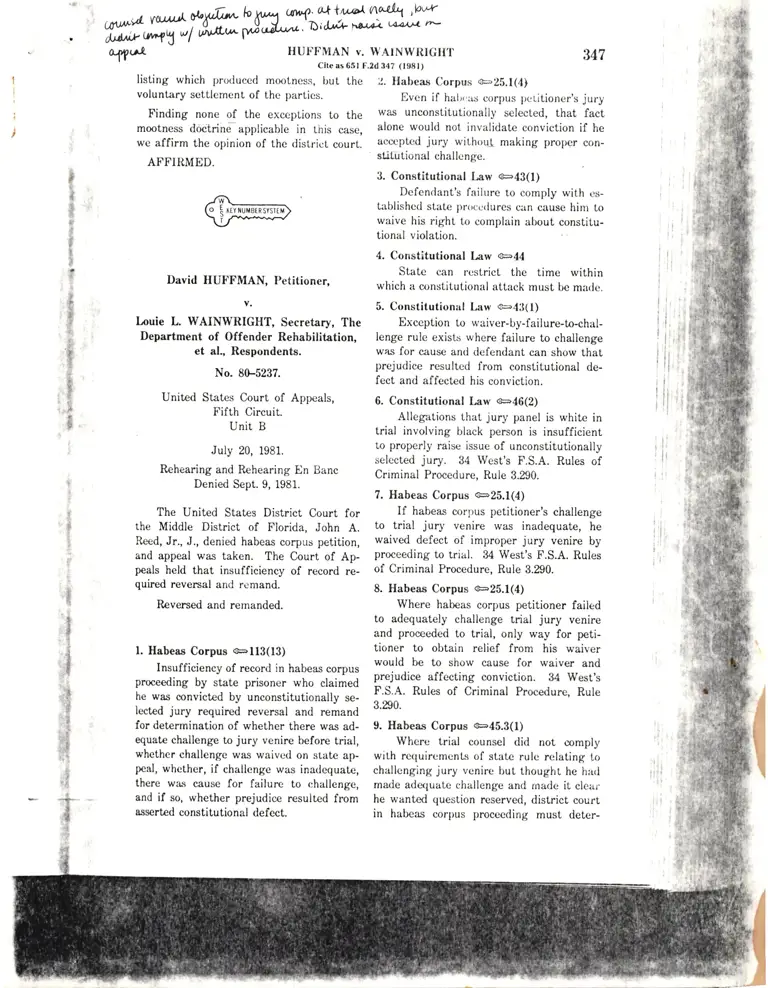
-
Case Files, Bozeman & Wilder Working Files. Huffman v. Wainwright Court Opinion, 1981. ba67f806-f092-ee11-be37-6045bdeb8873. LDF Archives, Thurgood Marshall Institute. https://ldfrecollection.org/archives/archives-search/archives-item/13d2e3f4-b4e1-46bd-b5e9-58c2ca774ea2/huffman-v-wainwright-court-opinion. Accessed September 20, 2026.
Copied!
    ffi;w-rw,,iffi#:ffir
listing which pnrrluced mootncss,
voluntary scttlcment of thc partics.

Finding none of the exceptions to the
mootness doctrine applicable in this case,
wc affirm the opinion of the districL court.

AFFIRMED.

David HUI'FMAN, Petitioner,

v.

l.ouie L. WAINWBIGHT, Secretary, The
Department of Offender Rehabilitation,

et al., Respondents.

No. 8f5237.

United States Court of Appeals,
Fifth Circuit.

Unit B

July 20, 1981.

Rehearing and Rehearing En Banc
Denied Sept.9, 1981.

The United Statres District Court for
the Middle District of Florida, John A.
Reed, Jr., J., denied habeas corpus petition,
and appeal was taken. The Court of Ap-
peals held that insufficiency of record re-
quired reversal and remand.

Reversed and remanded.

l. Habeas Corpue c=lf3(13)
Insufficiency of record in habeas corpus

proceeding by state prisoner who claimed
he was convicted by unconstitutionally se-
lected jury required reversal and remand
for determination of whether there was ad-
equat€ chailenge to jury venire before trial,
whcther challengc was waivcd on statc ap-
pcnl, whcthcr, if challengc was inadequatc,
there wa.s cause for failure to r:hallenge,
and if so, whether prejudice resulted from
asserted constitutional defect.

but the ;t. Ilalrcas Corpus G.25.1(4)

Evcn if halr,,ls corl)us lrcr.itioner's jury
was unconstitutionally selected, that fact
alone would not invalidate conviction if he
acccptcd jury withouL making prol)er con-
sLilutional challenge.

3. Constitutional [,aw @43(l)
Defendant's failrrrc to comply with r)s-

tablishcd statc prrx:erlurcs cxn cause hinr Lo

waive his right to complain about constitu-
tional violation.

4. Constitutional [,aw ce44
Statc can rcstrict the time within

which a q-rnstitutional attack must bc mtrlc.

5. Constitutiontl Ltw e",t3(1)
Exccption to waiver-by-failure-io-chal-

lenge rule exisls where failure to challenge
was for cause and dcfendant can show that
prejudice resulted from constitutional de-
fect and affected his conviction.

6. Constitutional [,aw e46(2)
Allegations that jury panel is white in

trial involving black person is insufficient
to properly raise issue of unconstitutionally
selccted jury. 34 West's F.S.A. Rules of
Criminal Procedure, Rule 3.290.

7. Habeas Corpus F25.1(4)
If habeas corl)us petitioner's challenge

to trial jury venire was inadequate, he
waived defect of improper jury venire by
proceeding to trial. 34 Wes!'s F.S.A. Rules
of Criminal Procedure, Rule 3.290.

8. Habeas Corpus e,25.1(4)
Where habeas corpus petitioner failed

to adequately challenge trial jury venire
and proceeded to trial, only way for peti-
tioner to obtain relief from his waiver
would be to show cause for waiver and
prejudice affecting conviction. 34 West's
F.S.A. Rules of Criminal Procedure, Rule
3.290.

9. Habeas Corpus F45.3(l)
Whcre trial counsel did not comply

wi[h rcrluiremcn[s of statc rulc rclating [o
challcnging jury venirc but thought he h:ul
made adequate ch:rllenge and madc it clear
he wanted question reserved, district court,
in habeas corl)us procecding must deter-

wd HUI|I'MAN v. WAINWIiIGIIT
Clte as 651 F.zd 347 (te8t)

34t

I
F

N'

I
:

t
4
,;L

t
i,
t

!t

)

-i
It


.J
't
.,

!
t

:s,
$

t,

!
s
i
{

348 65T FEDERAL REPORTER, 2d SERIES

mine whether petiLioner sufficiently com-

plied with state procedural rule' 34 West"s

tr'.S.1. nut* of Criminal Procedure, Rule

3:290.
- '

10. Constitutional Law e43(1) -
A defendant can waive a constittrtional

deftict by failing to assert point on appeal'

ll. Habeas CorPus e-25.1(4)

Habeas corpus petitioner may obtain

relief from his failure to assert challenge to
jury venire at brial or on appeal if he can

show cause and Prejudice.

12. Habeas CorPus e25.f(4)
A constitutionally drawn jury may be

all white, or all black, but depriving defend-

ant of chance of having mixed-race jury

would seem to meet prejudice requirements

for relief from waiver of right to claim

improper jury venire.

13. Habeas CorPus e25.1(4)
It is job of district court in habeas

cor?us proceeding to examine evidence to

see whether it might defeat claim of preju-

dice asserted by petitioner who had waived

right to claim improper jury venire'

14. Habeas Corpus c-25.1(4)

In determining whether habeas corpus

petitioner who waived right to claim that
jury was selected in unconstitutional man-

ner was prejudiced, appellate court looked

to see if case had racial or sexual overtones

and what effect timely objection might
have had on community and the defendant's

chances to obtain a fair trial.

15. Habeas CorPus e25.1(4)
Before habeas corpus petitioner who

failed to timely raise claim that jury selec-

tion process wa.s unconstitutional would be

entitied to habeas corpus relief, district
court would have to find that petitioner had

been prejudiced by a constitutional defect'

16. Habeae CorPus e25.1(l)
In defining cause for purpose of reliev-

ing habeas corpus petitioner from waiver of
constitutional defect, court has attempted

to secure defendants who have not stratc-
gically withhcld constitutional objections in

state court proceedings from possibility of
injustice.

17. Habeas CorPus e=25.1(4)

Habeas corpus court should consider all

factors bearing on petitioner's failure to

raise on direct appeal his claim that trial
jury was selected in unconstitutional man-

ncr.

18. Habeas Corpus e=25.1(4)

If objection to unconstitutional method

of selecling jury was waived for cause and

counsel was deterred from raising objection

on appeal, waiver on appeal would also be

for cause.

19. Habeas CorPus e98
Where habeas corpus petitioncr claimed

that trial jury was selected in unconstiiu-

tional manner, habeas court must first de-

termine whether unconstitutional selection

process existcd before considering any con-

stitutional relief from conviction.

David Huffman' Pro se.

Claude H. Tison, Jr., TamPa, Fla., for
petitioner.

Jim Smith, Atty. Gen', Tallahassee, Fla.,

Michael A, Palecki, Michael J. Kotler, Asst'

Attys. Gen., Tampa, Fla., for respondents'

Appeal from the United States District

Court for the Middle District of Florida'

Before TUTTLE, RONEY and VANCE,

Circuit Judges.

PER CURIAM:

tll David Huffman was probably con-

victed by an unconstitutionally selected

jury. At issue on this appeal is whether the

federal courts are barred from reviewing

Huffman's conviction in habeas corpw pro'

ceedings under the law governing waiver as

stated in Wainwright v. Sykes, 433 U'S' 72,

9? S.Ct. 2t:97, 53 L.Ed.2d 594 (19?7), and

cas€s of this Circuit. Because the record is

not sufficient on certain detcrminative
points, we revelse and remand the denial of

habeas corpus relief for the district court to

hold an evidentiary hearing and determine


IlUl't.MAN v. WAINwILIGIIT
Clte as 651 f.zd 3,17 (1081)

(1) whether thcre was an adequatr: chal- 25 L.Ed.Zl ?85 (1970); Michel v. l,ouisiana,
lenge to the jury venire beforc trial; (2) 350 U.S. 91, 76 S.Ct. 158, 100 L.Ed. 83
whether the challenge was waived on thc (19515); kttcliff v. Estclle,597 l'.2(l 474(lLh
state appeal; (3) whether, if the challengc Cir. 19?9).

was inadequate, there was cause for the
failure to challenge; and (4) if so, whether
prejudice rcsultcd from the assertcd consti-
tutional defect. Undergirding habeas cor-
pus relief, of course, woukl be a decision
that Huffman's jury venire was drawn in
the same manner found unconstitutional in
Jordan v. State, 293 So.2d 131 (Fla.App.
1974).

Huffman was convicted by a Sarasota
County, Florida jury in 1972 on charges of
rape and breaking and entering with intent
to commit a felony. He petitioned the dis-
trict court for a writ of habeas corpus alleg-
ing that blacks were systematically exclud-
ed from the jury venire thereby depriving
him of his right to trial by an impartial jury
chosen from a representative cross section
of the community. The district court de-
nied the petition for the reason that Huff-
man had failed to raise this claim on direct
appeal and had therefore waived his right
to litigate the issue in a federal habeas
corpus proceeding.

124) The law is clear. Even if Huff-
man's jury was unconstitutionally selected,
that fact alone will not invalidate his con-
viction if he accepted the jury without mak-
ing the proper constitutional challenge.
See Davis v. United Sfates, 411 U.S. 233, 93
S.Ct. 1577, 36 L.Ed.zd 216 (19?3); Evans v.

Maggio,5s7 F.2d 430 (sth Cir. 1977); Mar-
lin v. Florida, 489 F.2d 702 (sth Cir. 19?4);
Rivera v. Wainwright, 488 F.2d n5 (ifh
Cir. 19?4). A defendant's failure to comply
with established state procedures can cause
him to waive his right to complain about a
constitutional violation. Wainwright v.

Sykes, 4&3 U.S. ?2, 97 S.Ct. 2/197,53 L.Ed.2d
594 (1977). The state can r€strict the time
within which the constitutional attack must
be made, after which the defendant will be
deemed a.s a matter of law to have waived
his right to ttl.ack [hc <lcfcct, or, in othcr
words, thc rlcfcn<lrrnL will lrc dccmcrl Lo

have acccptcd thc jury. See Parker v.

North Carolina, 397 U.S. 790, 90 S.Ct. 1458,

349

t5l An exception lo this waiver-by-fail-
ure-to-challenge rule exisLs, however, where
the failure was for cause and the defendant
can show that prejudice resulted from the
constitutional defect and affected his con-
viction. Wainwright v. Sykcs, 433 U.S. 72,

97 S.Ct. %:97,53 L.Ed.zd 594 (L977); Fran-
cis v. Hendcrson, 4?5 U.S. 536, 96 S.Ct.
1?08, 48 L,Ed.zd 149 (1976); Jiminez v. Es-
telle, 557 F.zd 506 (Sth Cir. 19?7). The
application of this "cause and prejudice"
exception to the present case is discussed in
detail below.

The firct qucstion always in this kind of
case is whether the defendant did in fact
sufficiently challenge the jury venire within
the time required. Uncertainty here is
present because although the attorney did
timely question the all-white jury venire, he
did not pursue it, and there is some question
whether his challenge was specific enough
for Florida law.

A concededly timely challenge was made
to the trial court by an oral nrotion to strike
the panel, after the jury panel was selected
by the jury commissioners but before the
jurors for Huffman were called. Defense
counsel noted the defendant was black, the
rape victim was white, and the entire panel
was white. He noticed the same character-
istics of the jury panel two weeks prior
while preparing for another trial. He of-
fered to interrogate the jury commissioners
to determine whether there was systematic
exclusion of blacks from juries in Sarasota
County. He wanted the selection of the
jury reserved as a question for purposes of
the record. He said he had not filed a
written motion because it was not until that
day that he had seen the jury panel.

The prosecutor noted that the proper
means for making the challenge was by
written motion setting forth the grounds
and facts upon which the challenge is made.
IIc inrlicttcrl thitt tny inhercnt prcjudicc,
biius, or fcclings of rucial cnrnity coul<l bc
brought out during thc voir dirc cxamina-
tion.

,der all
,ure to
rt trial
,l man-

method
use and
,bjection

also be

" claimed
constitu-
first de-
selection
any con-

Fla., for

isee, Fla.,
ller, Asst.
;pondents.

s District
,f Florida.

i VANCE,

,bably con-
,y selected
.'hether the
reviewing

corpus pro'
{{ waiver as

133 U.S. 72,

(19??), and
ire record is

t,erminative
he dcnial of
, ict-court to
I determine

ll

i:;
i

il
i,
I'
I

i;'


350 65I FDDI'ITAL ITEPOIITI'II, 2d SI'IIIES

,iI
l:,
|, |:

{t
,

i.',

*1

Thc court askcd if the dcfcnse counsel
would likc to <;ucstir;n the Supervisor ol
Elections, indicating that "shc can speak for

-. them for your rccortl." Huffman's attor-
ney refused, saying irc knew that the Su-
pervisor would say "that they are exlracted
from the voting rolls without imputing any-
thing to color." The court agreed that it
wa-s sure that would be the case. Counsel
said he was prepared to proceed with the
understanding that he had placed on the
record that the jury pancl was white. Flor-
ida Rule of Criminal Procedure 3.290 re-
quires that: "A challenge to the panel shall
be in writing and shall specify the facts
constituting the ground of the challcnge."

t6-8l The Florida Suprcme Court in
Dykman v. State,294 So.2d 633 (Fla. 1973),

and .Ro.7'as v. SLate, 288 So.2d 234 (Fla.
1973), stated that before a court is required
to permit an investigation of its jury pool
there must be a sufficient factual showing
to raise reasonable suspicion that the panel
was improperly drawn. An allegation that
the jury panel is white in a trial involving a
black person is an insufficient factual show-
ing standing alone. See Reliford v. State,
241 So.2l 871 (Fla.App.19?0). If Huffman's
challenge to the jury venire was inade-
quate, he waived the defect of the improper
jury venire by proceeding to trial. Statc v.

Silva,259 So.2d 153 (Fla. 1972); Johnson v.

Statc, 28 So.2d 544 (Fla.Dist.Ct.App.1972).
The only way for Huffman to obtain relief
from his waiver would then be to show
cause for the waiver and prejudice affect-
ing the conviction. Francis v. Hendercon,
4% U.S. 536, 96 S.Ct. 1708, 48 L.Ed.2d 149
(1e76).

t9l Even if counsel did not comply with
the requirements of Florida Rule of Crimi-
nal Procedure 3.290, he thought he had
made an adequate challenge. Huffman's
attorney made it clear he wanted the ques-
tion reserved. It is doubtful that either
counsel could have shown at that time the
method of jury selection later found to be
uncongtitutional. Thc district court must
dctcrminc whcthcr undcr thesc circum-
stancos Huffman sufficiently complied with
the Florida procedural rule.

[10, 1l] A sccond questi<-rn as to waiver
involvcs thc appcal. A dcfcndant can
waivc :i defect by failing lo assert the point
on nlrpcal. State v. Matara,266 So.2d 661
(Fla. 1972); Burau v. State, 353 So.2d 1183
(F la.App.1977). Huflman was permitted an
ap1rcal only after filing a pro se ntotion for
relief since his initial court-appointed attor-
ney failed to perfect a timely appeal.
Huffman was represented on app€al by
counsel from the same public defender's
office that was handling Lhe Jordan case
which successfully challenged the mcthod of
choosing the jury venire in Sarasota Coun-
ty. For reasons not shown in the record,
Huffman's attorncy did not raisc the jury
challenge on appcal. In any event, how-
ever, Huffman may obtain relief from his
failure to challenge at trial or on appeal if
he can show cause and prejudice.

[12, 13] Whether Huffman may show
prejudice so as to meet the second require-
ment of the exception of Sykes appears to
pose little difficulty. Huffman was a black
man accused of raping a white woman. A
mixed-race jury might clearly have a spe-
cial perception in a mixed-race case. His
defense was consent. His jury was all
white. Although a constitutionally drawn
jury may well be all white, or all black,
depriving Huffman of the chance of having
a mixed-race jury would seem to meet the
prejudice requirements for relief. Cf. Ro-
sales-Lopz v. United Slates,

-
U.S.

-,
101 S.Ct. 1629, 68 L.Ed.2d 22 (1981).

We, of course, have not examined the evi-
dence to see whether it might defeat the
claim of prejudice, this being the job of the
district court.

If4.15l In determinins the existence of
p5e.i u d ice. th i s Apurt h as I gb:9_!g_.:Sjf_ th".
case had racial or sexual overtones. see.Ey-
ans v. Maggio, 55? F.2d 430 (sth Cir. 1977);
Wells v. Wainwright,488 F.2d 522 (5th Cir.
19?3), a.nd_what -effect a tiqely_qhiection
might have hqd -gn th.e community and the
dcfdri<iu ril6- chanccs to obtai n q -f air- !r.r-al,
sac lilblli'i. Wainiright,4S8 tr.2d 5n gLh
Cir. 19?3). Before Huffman would be enti-
tled to any relief, the district court would

4.!t:
I
It'
T,
&i
'I B.r.J g. -;

Ft^ l-u,J(


lltl l,'lfjllAN \'. \1'AtNWItl(ill'l'
Cltc si 651 t.2d 347 ( l98l )

have Lo finrl Ilufinr:rn hiul becrr prejurlict:rl gic urlvarrt:tgr: c:lr) l)c g;rirrctl florn failure to
by thc constitutional <lcfcct. <:rrmJrly wiLh thc prrx:ctlural rulc." Id, rl

Discovcring the existcnce <,f causc rle- 644 (ciLati<-rns <-rmittctl).

mands a morc coml)lcx inquiry. The Su- tl6l In defining causc, this Court has
preme Court has dcliberaicly refraincrl thus attcm|terl to sccurc rlcfcndanls who
from dcfining "causc antl prcjrrttictf ' h:rvc noL sLratc,git::tlly rviLhlrcl<l consliLu-
Wainwright v, Sykc.s, 433 U.S. xt 87, 97 tional objcctions in stirtc courl procccdings
S.Ct. at 2506. In cstablishing the contours from thc possibility of injustice. 'Io somc
of the "causc" exccption, wc must therefore cxtent wc have thereforc tended to view
look to the rearioning underlying the hold- cause in terms of the nature of thc proce-
ing of Sykes. One of the major concerns dural waiver and with an eye to the possible
expresscd by thc Court was to eliminatc resulling llrejurlicc. Thc appreciation that
"sandbagging" by dcfcnse lawycrs who con- cuusc lnrl prcjutlicc unrlcr S1'kcs are some-
sciously chosc lo raise constitutional claims times intcrrclatctl is rcfleclcd in the deci-
for the first limc in a fedcral haboas pro- sions of othcr courts as wcll. See Goodman
ceeding. /d. at 89-90,97 S.Ct. at 2507-08. & Sallett, Wainu,right v. Sylics: ThcLowcr
The Court belicved that iLs holding woultl tre1aral CourLs lles.prxr6,30 llasti,gs L.Rev.
"have the szriutary effect of making thc 1683, l?22 (19?g) an<l cascs ciLcd thercin.
state trial on the merits the 'main event' This apltroach <lraws support fr.m the con-
. . . . " Id. at 90, 97 S.Ct. at 2508. cern of the Sy/rcs majority to avoid a mis-

While seeking to promote goals of effi- carriage of justice and from the analysis

ciency and finality, the Court reaffirmed offered in the concurring opinion of Justice

the traditional role of the habeas writ as an Stevens:
instrument of justice. The Court stated its [I]f the constitutional issue is sufficiently
conviction that grave, even an exprcss waiver by the

[t]he "cause"-and-"prejudice" exception defendant himsclf may sometinres be ex-
of the Francls rule will afford an ade- cuSed. tr[atters such as the competcnce
quate guarantee . . . that thc rule will of counsel, the proccdural contcxt, in
not prevent a federal habeas court from which the asserted waiver occurrcd, the
adjudicating for the first time the federal character of the constitutional right at
constitutional claim of a defendant who stake, and the overall fairness of the en-
in the absence of such an adjudication tire proceeding, may lre more significant
will be the vicLim of a miscarriagc of Lhan the languagc of the test the Court
justicc. purports to apply.

4ii3 U.S. at 90-91, 97 S.Ct. at 2508-09. 433 U.S. at 95-96,97 S.Ct. at 2510-11 (foot-

p41*"*pigg.g{ by the Court by defining F.?A 126,130 n.6 (8th Cir. 197?) (:ipplving

"cause" sufficicnt to excuse a procedural the factors suggested by Justice Stcvens to

default in tigtrt of the' determiiration to find a showing of causc and prejudice).

rygid_,j, miscarriage of jus-i.ice." see e. g., see a/so Hill, ?/re ForfeiLure of constitu-
{iiio* ,. Unitd States, 571 F.zd 8?6, 880 tional Rights in Criminal Cases, 78 Colum.L.
(5th Cir. 1978); Jiminez v. Estelle,557 F.2d Rev. 1050, 1076 (1978) (suggesting factors to

I SOO, StO-tl (bth Cir. 197?). ln Harris v. be taken into accounL in disallowing proce-
I Sp"r.r, 606 F.2d 639 (5th Cir. 19?9), we dural default to avoid a miscarriage of jus-

siat€d that the definition of cause must tice). We also note that the Supreme Court
encompass the goal of securing justice and has indicated the interrelationship of cause

the intercst against sandbagging. We held and prejudice under prescnt l'ederal Rule

that the issuc of ndcquatc causc "turns on of Criminal l)rocc<lure 12(f) in ShoLwcll
whether a finrling of ctusc safcguarrls Muufucturing Co. v. United Sl'rtc.s, 371

against a'miscarriage of juslicc' ... anrl U.S. ll4l,3ti3, u3 S.01. 44U,461, I L.Ud.2d
whether it can be presumed that no strate- 35? (i963).

35t

.iver
can

,oino
r 661
r183
dan
,r for
Ltor-
,peal.

Ibv
rder's

case

od of
()oun-

rcord,
' jury
how-

'm his
.,eal if

show
quire-
ars to
black

rn. A
a.Spe-
'. His
'as all
drawn
black,

having
,et the
r)f. Ro-

U.S.
(1e81).

he evi-
:at the

i, of the

I ence of
e if the
see Ev-
-. 1e77);
5th Cir.
bjection
and the
ir trial,
;22 (bth
be onti-
t would

J
i'\
l.
I.

l!.
rl
'i,
t{.f
!
.f:li'ti
i'
.!i

L f..
ri
t{
,3

li .try

rts
i,

lr ..'
I i r'.il ;li
ll 'i.
lr . t;
il '.il :r .r
i, ' i[.&i
lr r. !r

; 'r
i.r

lrl
'l r

il'
r' .tt,

, lF
rt

,tl ',: i,; ,,,.r;
, j i.

,' ' i:

lL
r.-ii

I i, .l't:lt
.l

..
,1,:

l:e
'1,.

1.1

,.':

.,;
;..),,

1 :l:

'te
,.f

't!
{

l:,

i..
:rl:t


352

U?, l8l While the determination of
cause and prejudice is properly lcft to the
district court, the limited record beforc us

-indicatos that this case may involve a grave

miscarriage of justice if it is established

that Huffman was indeed convicted-ly an

unconstitutionally selected jury and that no

objection conccrning the jury venire was

withheld for strategic reasons. The consti-

tutional right at stake was fundamental,
and the prejudice was potentially great.

This is not a moreover,

651 FEDUIiAL IIT]POIITDIT" 2d SEITIDS

sue at trial and the court denied his request

to examine the jury commissioners. If
Huffman has deliberately been deprived of
a constitutional right and has been unable

to procure information about this depriva-
tion, due weight should be given to this
fact. Cf. Freeman v. Georgia,sgg F.2d 65'

72 (lth Cir. 1979), cert. denied, 444 U.S.

1013, 100 s.ct. 661, 62 L.Ed.zd Ml (1980)

(state cannot successfully argue that de-

fendant waived right to request evidence

when police statement misled defense into

believiug evidence to be unfavorable);
White v. Estelle,566 F.2d 500, 501 n.1 (5th

Cir. 19?8) (state cannot successfully claim
procedural default when "the action of the

state court itself made necessary the proce-

dural default that occurred"). Regarding
the failure to raisc the issue of jury selec-

tion on appeal, the observations noted

above as to the character of the right in-
volved and the possible prejudice incurred
are applicable here was well. The district
court should also consider the fact that
Huffman was represented on appeal by a
Iawyer from the public defender's office
that had just handled Jordan v. State' Ad-
ditionally, it should consider any difficulty
experienced by Huffman in obtaining coun'

sel to represent him on appeal. Such con-

siderations are relevant to determining
whether he received inadequate representa-
tion constituting cause under Sykes. Cf.

Sincox v. united States, S?1 F.2d at 8?9-80
(counsel's failure to protect two fundamen-
tal rights constituted cause); Jiminez v.

Estclle, 557 F.Al at 510-11 (guggesling

qause cxists when counsel incompetently ig-
nmordoes
nof co@ce); llachcl
il-Bordenkircier, 590 F.2d 200, 204 (6th Cir'
19?8) (cause exists when failure to make

timely objcltions s[ems from inexperience,

inattention or lack of knowledge of the

tlaw); Collins v. Auger,577 F.2d 1107, 1110

n.2 (8th Cir. 19?8), cert. denied, 439 U.S.

1133, 99 S.Cr. 291, 58 L.Ed.2d 2M (1979)

(lack of knowledge of facts or law consti-

tutes cause for failure to object). Finally,
if the objection at trial was waived for
cause and counsel was deterred from rais-

ing the objection on appeal in consequence,

the waivcr on appeal will also be for cause.

t19l A fundamental question, of course,

is whether Huffman's jury venire was

drawn in the same manner declared to be

unconstitutional in Jordan v. State, fr3
So.2d 131 (Fla.App.197a). Both time and

place so indicate. Huffman and Jordan

were tried on criminal charges in the Cir-
cuit Court for Sarasota County. Huffman
wzrs tried on November ?3, 1972; Jordan
was tried two months later, beginning Jan-

uary 30, 19?3. The court in Jordan deter-

mined the jury commissioners in Sarasota

County had unconstitutionally used subjec-

tive judgment rather than objective critpria
in choosing the precincts from which jurors

should be drawn. The use of the precincts

was held to be constitutionally improper

since the selection for the venire must come

from the entire county and not some politi
' cal sub-unit to the exclusion of others. It

has never been determined, however, that
Huffman's jury venire suffered the same

constitutional defects. The district court

should make such a determination before it
considers any constitutional relief from the

conviction.

In remanding the case for further pro-

ceedings, we are mindful that a state court

held the Sarasota County jury selection

method unconstitutional. The same state

public defender's office which represented

Huffman on appeal handled that case.

When Huffman collaterally attacked his

conviction under Florida Rule of Criminal

Procedure 3.290 on the basis of the improp-

peti-
rn to

the alleged--violation jf his rights: Huff-
man's attorney raised the jury selection is-


LINITItI) S'I'ATI,lS r'. IIAIlltlSoN
Clte as 65t F.2d353 (1981)

353

tly ig-
' does

Jachel
.h Cir.
make

'ienee,
,f the
/, 1110

9 U.S.
(1e?9)

consti-
.rinally,

ed for
m rais-
rlUence,

I CaUSe.

courBe,
i'e was
rl to be
b, n3
rr€ &nd

Jordan
he Cir-
uffman
Jordan
ng Jan-
'r deter-
arasota

i subjec-
criteria
i jurors
recincts
.-rprop€r

st come
e politi-
ren. It
er, that
'le Same
':t court
lrcfore it
r'rom the

her pro-
rte court
;eiection
ne state
,resented

,rt case.
'ked his
iriminal
,improp

er jury venire, the F loritla Supreme Court
dismissed hislletition for a *'rit of certiora-
ri for lack of jurisdictiorr. Iluffman v.

State; 350 So.ki 5 (Fla. 1lr?7). Thc court
aplrarently founrl no conflict between the
decision in Jordan wherc thc delendant had
made a prima facic showing of imllrollcr
jury venire selection anrl the dccision in
Huffman in which there had been no prima
facie showing. Scc l'la.Const. art. V,
S 3(bX3) (1972). The dissenting opinions in
the Florida Supreme Court clearly indicate
that if Iluffman's petition had been treated
as a habeas corpus petition, Huffman might
have received relief in the state court.

The United States Supreme Court then
denied Huffman's certiorari pretition appeal-
ing from the Florida court's dismissal of his
petition. Huffman v. Florida, 435 U.S.
1014, 98 S.Cr. 1888, 56 L.Ed.2d 395 (1978).

Justice Stevens in his concurring opinion
indicated that state revicw had been ex-
hausted but that Huffman's federal claim
remained opcn for review in a federal habe-
as corpus procceding. 435 U.S. at 1017, 98

S.Ct. at 1890.

With this procedural background, plain-
tiff brought his federal habeas corpus pro-
ceeding. Because the rccord before us is
incomplete, it is appropriate that the case

be remanded to the district court to make
the necessary legal and factual determina-
tions under the law as statcd in Sykes and
its progeny. We emphasize, however, that
the rule of Sykes is not a mechanical onc.
It was intended to avoid manipulation of
the court system without sacrificing it.s

ability to do justice. If Huffrnan was prej-
udicially deprived of a constitutionally se-

lected jury, it is difficult to undersLand on
the basis of the facts presented on this
appeal how the purposes of the rule will be

served by a refusal to vindicate his funda-
mental rights.

REVERSED AND REMANDED.

LTNITDD STATES of America,
Plaintiff-Appellee,

v.

Jim T: HARRISON, Jr.,
Defendant-Appellant.

No. 80-7.116.

Unitcd StaLes Court of Appeals,
Fifth Circuit.

July 20, 1981.

Ilehearing and Rehearing En Banc
Denicd Sept. 11, 1981.

Dcfendant w:rs convicted in thc United
States District Court for the District of
Georgia, at Rome, Harold L. Murphy, J., on

33 counts of distributing contr<-rlled sub-
stances, and he appealed. On original hear-
ing, the Court of Appeals, 628 F.2d 929,

reverscd. The Government petitioned for
rehearing. 0n rehcaring, the Court of Ap-
peals, Gulbold, Chief Judge, held that the
indictmcnt charging thc doctr.rr of osteol)a-
thy with unlawfully and knowingty distritr-
uting and causing to be distribuleci a con-
trollcd substance for other than a legiti-
nlate medical purpose and not in usual
course of professional practicc was suffi-
cient to state an offense, since t}^e allega-
tions protccted the doctor from exposure to
criminal prosecution for errors of judgment
as t<l arnount prescribed and as to the neces-

sity for the prescription.

Pctition for rehcaring granted; convic-
tion affirmed.

l. Drugs and Narcotics el03
Indictment charging doctor of osteo-

pathics with unlawfully and knowingly dis-
tributing and causing to bc distributcd a
controlled substance for other than legiti-
mate medical purpose and not in usual
course of professional practice was suffi-
cient to state offense, since allegations pro-
tected doctor from exposure to criminal
prosecution for errors of judgmcnt as to
amount prescribcd and as to neccssity for
prcscription. Comy>rehcnsivc Drug Abusc
Prcvention and Control Act of 1970,

$ 40l(aX1), 21 tl.S.C.A. S 8al(aX1).

li

t,

I

,tr
il

't.
ti

if
,f
'rf,
t'ir

i ii"
, ':! i',

' ri

:;';;'i, i
,1{ +,!:+

, ti'l!.
t:

l,l-

;,.
.r ts.::

i 'i:'t.

..i

.i,

.' ,;

ii'

.(

I