Current Issues in Reapportionment (Law and Policy Quarterly)
Press
December 22, 1981
-
Case Files, Thornburg v. Gingles Working Files - Guinier. Current Issues in Reapportionment (Law and Policy Quarterly), 1981. 2cae30d2-db92-ee11-be37-6045bdeb8873. LDF Archives, Thurgood Marshall Institute. https://ldfrecollection.org/archives/archives-search/archives-item/149056e6-07d8-41a5-acd4-73a2c2471d16/current-issues-in-reapportionment-law-and-policy-quarterly. Accessed October 05, 2026.
Copied!
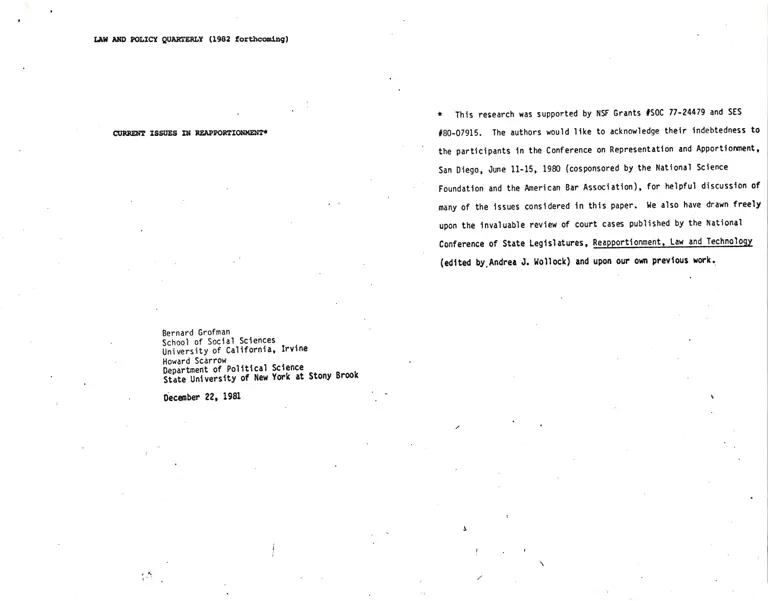
    IIf rD l()LICf, QUAEIEnII (1982 lorthoclag)

CONSE*T I85OE8 D NBTPEOBEIOT{EtT'

Bernard Grofman
School of Soclal Sclences
ini*"sity of Callfornla' IrYlne
Howard Scirrow
iieoirtment of Polltlcal Sclence
;i:i! fii;.ilii'oi ttu Yok rt Stonv Erook

tteccnben 22' l98t

t Thls research ras supported by tlSF Grants ,sw 77-24479 and SES

,80-07915. The authors would llke to acknowledge thelr lndebtedness to

' the partlclpants ln the Conference on Representatlon and Apportlomentr

San Dlego, June 11-15, 1980 (cosponsored by the National Sclence

Foundatlon and the Anerlcan Bar Assoclatlon), for helpful discusslon of

many of the lssues consldered ln thls paper. l{e a'lso have dram freely

upon the lnvaluable revla of court cases published by the tlational

ConferenCe of State Leglslatures, Reapportlorunent, Lav and Technology

(edtted by.Andrer J. ttollock) and upoo our ont Drevlors rrk'

It


I.
II.

lIl.

. TAstE tr CotlTtllTs

Introductlon

Crlterla for Slngle-l{ember Dlstrtctlng

1. Conpetlng 0lstrlcttng Crlterla

2. Proportlonaltty of Group Representatlon and Afflrnrtlve

Actlon GerrYmanderlng l

3. The Balloon Effect

a. Cholce of Dlstrlctlng ilechanlsm

itectton t4echanlsms 0ther than Stngte-lrlenber Dlstrlcts rlth

Plrrl ltY-8ased El ectlons

1. llultlsrember and At'large Plurallty-Based Electlons

2, tlelghted Votlng, Approval Votlng' the Alternatlve

Yota' rnd Proportloral Representatlon

Comluslons

L lntroductlon

In Baker v. Carr (369 U.S. 186 (1962)) the U.S. Supreme Court

afflrmed that Judlclal redress could be sought to conpel a state to

reapportlon lts leglslature ln accord wlth new census data. In a nurnbcr

of subsequent cases, the Court addressed ltself to the lssue of voter

representatlon and the constltutlonal acceptablllty of varlous

apportlorment and votlng schemes. ilost of those cases lnvolved an

expllcatlon of the meanlng of the l4th lmendment .equal protecHon.

clause as lt applled to Congresslonal, state, and Iocal apportiorment

lssur,es. The notlon of 'equal protection' suggests various criterla rtrlch

re might rlrh anY electoral scheme to satlsfy. At minlmum, of cours€, rg

would wlsh to guarantee each cltlzen the rlght to exerclse hls vote.

However, once re moye beyond thls baslc rlght, the quesHon of xhat

'equal protectlonr requlres (or rather, dlsrllors) becomes a very

dlfflcult one.

In llesber.ry v. Sanders (376 U.S. I (1964)), a case rrtrlch struck dom

as unconstltuilonal gross populatlon dlsparltles among Georgia

Congresslonal dlstrlcts, the U.S. Supreme Court (376 U.S. at 8) held that

'(0)ne man's vote . . . ls to be worti . . . as much as anotherrs.' tri

Reynolds-v. Slms (3.77 U.S. 533 (1964)) and lts companlon cases, the court

extended thls 'one personr one vote' doctrlne to state leglslatures

holdlng, ln dlfferent hrt equlvalent language (377 U.S. at 568), that
r(A)n lndlvldualrs rlght to vote for state leglslators ls

unconstltutlonally.lnpatred *ren lts relght ls ln a substantlal fashloo

lY.

f .'..


2

dtiuted when ccmpared rlth votes of cltlzens llvlng ln other parts of the

state.' In Avery v. l,lldland Cornty (390 U.S. 474 (1968)) the Court

extended the scope of lts rullngs dom to the loctl level for, unlts wlth

ipneral responslblllty.' All these cases lnvolved plurallty electlons

rlth slngle-member dlstrlcts ln whlch there were large dlfferences ln the

dlstrict populatlons. In these cases' the Colrt asserted that each

lndlvldual who votes should have hls vote count'equallf wlth the vote

cast by each other lndlvldual, 1.e., glrcn'one person, one vote're vlsh

rone vote, one value' (Auerbach, 1964). The dlfflculty cann ln

operatlonallzlng such a crlterlon.

In Reynolds v. Slms the Court asserted that the 'equal protectlon'

clause of the U.S. Constltutlon dld not requlre preclse numerlcal

equallty but'honest and good falth effort to construct distrlcts . . ..

as nearly of equal populatlon as ls practlcable." The Reynolds declslon

also acknowledged the posslblllty of conslderations other than strlct

populatlon equallty enterlng lnto apportlorment declslons.

So long as the dl,rergences fron a strict populatlon
standard ar'e based on legltlmate conslderatlons lncldent to
the effectuatlon of a ratlonal state policy, some
devlatlons frsn the equal populatlon prlnclple are
constltutlonally permlsslble (377 U.S. at 579).

However, rtrlle Reynolds ldentlfied r-".".., where states mlght rlsh to

act, e.9., rto malntaln the lntegrlty of varlous polltlcal subdlvlslons'

lnsofar as posslble, and provlde for conpact dlstrlcts of contlguous

terrltorjl (377 U.S. rt 578), the Court ras rqulck to llnlt the range of

rcccptrblc Justlflcrtlons for deulatlons fro the equal popul.tlon rule'

3

(Trlbe, 19782746-7471, In subsequent declslons the Court has reiterated

the need for very strlct populatlon equallty ln Congresslonal dlstrlctlng

--declslons (see esp. Klrkpatrick v. Prelsler (1969) 394 U.S. 526, rhere

the Court reJected as unconstitutlonal a dlstrictlng wlth an average

devlatlon of .745 percent frqn strlct equality. In that case' the

largest district exceeded the ldeal of perfect dlstrlct population

equallty by 2.43 percent; the smallest distrlct was below the ldeal by '

1.7 percent for a nrange" of 4.13 percent). The Court, however, has

allowed for greater flexibl'lity ln state dlstrlctlng declslons and even

gneater flexlblllty ln local dlstrlctlng declsions. (See esp. I'lahan v.

Howell 410 U.S..315 (1973), and Abate v. Mundt 403 U.S. 182 (1971). where

ranges of 15.4 percent and 11.9 percent, respectively' were pennitted).

Uhen the Supreme Court entered the reapportionment 'thicket' ln Baker

y. carr, (369 U.S. 186 at 3OO (1951)), Justlce Frankfurter warned that

r,l.lhat ls actually asked of the Court ln thls case lS to choose among

conpefi ng bases of representatlon--ultlmately, real ly among competlng

bases of representatlon.n Looking back on that warning' rlth the benefit

of over 15 years of htndsight, we can see that, while the road frm Baker

v. Carr (ln which a state legis'lature was merely requlred to fulflll lts

own constitutional requlrement for perlodlc reapportionment) to the

. strlct equal populatlon guide llnes of Kirkpatrlck v. Preisler (394 U.S.

526 (1969)) was not a stralght one, the Court's task along the xay uas

alded lrmeasurably by the exlstence of clear statlstlcrl measures through

whlch the amount of devlatlon frqn Populatlon equallty ln dlfferent

leglslatures (or the srme leglslature at dlfferent perlods) could be

.T

rt


cmpared. These statlstlcal measures (e.g., standard devlailon, average

devlatlon, electoral percentage; see especlally the adrnlrable dlscusslon

ln l{ollock, 1980: 5-9) allowed the court to set out clear g,itdeilnes as

to rtat level of devlatlon fron strlct populailon equallty would be

allowed for each type of govermentar unlt (federal, state, and local),
The prlnclpal focus of most reapporfiorment cases ln the 60rs through

the mld 70's was ln specrfyrng standards for popuratron equalrty of
dlstrlcts and mathematlcal formulae to assess compllance wlth these

standards. (see lrollock, 1980:5-20, or Trrbe, 197g, for further detalls
of these cases.) uhlle the corrt maJorlty ln lts hlstoric deciston ln
Reynolds asserted that the goal of the court was the achlevement of,falr
and effectlre representaHonr' ln fact, however, most of the court.s
energles ln the apportlorment area until the mld 70's were devoted to the
elucldatlon of the standards of populailon equallty across distrrcts
rhlch would govern ln each type of goverrunental Jurlsdlcilon. However,

by def lnlng equallty of crilzen representailon rn terms of equally
populated dlstrlcts, the supreme court was able to avold ln most of the

early reapportiorment cases, ever really comlng to gnlps wlth the deeper

lssues of the phl'losophy of representatlon. In many of the key

apportlorment cases (e.g. llesberry v. sanders 376 u.s. at 1g; Reynolds v.
slm 377 u.s. at 559-580), the court's termrnology, lf not rts reasonlng,

ls sloppy ln clarmrng equal representaHon for egual numbers of peop.le as

Its goal; and then equafing ,equal popu't ailoni rlth 'equal
represcntatlon.,l (See Dlxon, 19692 ZZI-ZZil!. Only a lttila
rcflectloo ls rcqrlrcd to see the very seyere llnltailons of deflnlng

equallty of cltlzen representatlon solely ln terms of equally populated

dlstrlcts. As Dlxon 11969:zztl qulte strongly (ano rue bellevc qultc

rccurately) put lt:

(T)here is no such thing as 'equal representation' in adlstrict system of e'lecting legislatois. There may be ,equal
populatlonr districts, which ls an obJecilve'ly verifiable'
concept. But with a district basls there can-never be ,equal
representatlon' because all dlstrlcHng discriminates by
dlscountlng utterly the votes of the minorlty voters.

Let us envlsage two cltlzens: one llves ln a hlghly compeiltlrre

dlstrlct, where every vote counts--so to speak--and another lives in a

distrlct whlch always goes for the same party each year by a 4 to I or 5

to 1 margln.' One cltlzen alwqys has a chance to determine his distrlct.s
electoral outcome; the other neve" has.2 It ls far frtrn obvlous that
these two cltlzens are equally well represented. Indeed, one of the mst

dlstlngulshed scholars ln the reapportlorment area, the late Robert

Dlxon, argued that

A goal of 'equal representaHon' can be approximated only
through.abolishlng single member dlstricts and using
proportional representation, such as the party llst-form used
ln Europe, gr sme verslon of the Hare system . . ., (E)qual
representatlon' ls generically a proportional representaHon
concept. (Dlxon, 1959:228)

In the 1960s the prlnclple was clearly establlshed that courts could

lntervene ln the politlcal process to protect cltlzen rights to effectlvc

representatlon defined ln tems of equally populated and periodically

reapportloned dlstrlcts. It ls hard, ln retrospect, to appreclate hor'
tireatenlng thls court lnvolvement ln the reapportlonnent process was

T


6

then seen to be. l{hat ras controverslal then ls taken for granted now,

and the doctrlne of 'one person, one voter has been elevated to the

status of moral platltude.

In the 1970s the supreme court was forced to begln to confront the

subtler and far more ccnplex lssues of rfalr and effecfive
representatlon' ln terms of the constltutlonallty of electlon mechanlsms

other than slngle member dlstricfinq and, for equlpopulous slngle member

distrlctlng, ln tenns of determln{ng when the drawlng of dlstrlct llnes

constltutes unconstltuilonal raclal or parilsan gerrymanderlng. In

Sectlons II and III of thls paper we shall dlscuss these two rssues, (l)
electlon mechanlsms other than slngle-member distrrcts and (2)
rsophlstlcatedr gerrymanderlng; ln greater detall; slnce they rlll be the
representatlon quesfions rlth rtrlch the key court cases of the l9g0s.can

be erpected to deal.

Because malapporfionment of state leglslatures was for many lears the

subJect of crltlcal corment by polrilcal.screnilsts, rt was to be

expected that once court-ordered reapporilonment occurred, analysts rould.

set about trying to measure lts lmpact. Glven the methodorogrcal

dlfflcultles rtrlch beset most early studles of reapporilorment lmpact,

and the vlrtual absence of any later more methodlcally soph{stlcated

studles' the guestlon of the pollilcal lmpact of reapporilonment ls,
horever, llttlc better understoodtodqy thrn lt ras ten yearc ago. (sec

Srffcll. 1982 forthcotng)

II. Crlterla for Slngle l{enber 0lstrlctlng

1. ConfllctinS Crlteria

lle lnventory ln Table I nearly two dozen crlterla for evaluating the

falrness of apporilorment schemes. Impectlon of thls table makes lt
apparent that there are multlple and confllctlng 'reasonab]e' goals *tlch

have been advocated for reapportlorment declslon-maklng. Moreover, th63e

Crlterla are not JuSt lnventlons of academlC researchers rith time on

thelr hands--a Iarge nunber of them have been enshrined lnto statute.

Indeed, reformers of the ccmmon cause mode, anxlous to keep'politlcs'

out of the reapportlorynent arena ln the 1980's, have advocated tying the

hands of those dolng the reapportioning by saddling these.decision-makers

wlth an extenslve lnventory of statutorlly mandated crlterla for 'falr'
dlstrlcHng. In prlnclple, the ldea ls to put so many constralnts on thc

process that there's only one plan (or at most a handful of plars) that

satlsfles the enumerated crlterla, and to plck the set of'crlterla So

thtt there's no mblgulty about how they're meant to apply'3

Table I about here

Thls seanlngly reasonable ldea falls at three cruclal polnts.. Flrst'

enough of the proposed crlterla for slngle-nember dlstrlctlng (e.9.'

CgtpactneSS, av6ldange Of breakup Of 'natural Comunltlesr' avoldance Of

dllutlon of the votlng strength of raclal or llngulstlc orlnorltles) 1rc.

ln fact left so l,ll-deflned as to stlll lcave open t 893! der'l of


8

flexlblllty. Indeed, ln most cases there would at mlnlmum be hundredS of

plans that arguably satlsfy all the speclfled gutdellnes'

Second, many of the proposed crlteria are lnccmpatlble lrt who'le or ln

part, and the courts are golng to face ln the 1980's the task of

untangllng rhat varlors sets of crlterla 'really' mean and how

reapportlorment statutes shall be lnterpreted when statutory provlslons

tnclude confllctlng crlterla. For example, to provlde certaln

geographlcally dlspersed mlnorltles wlth dlstrlcts ln whlch 'thelrr Yolce

rlll not be submerged may requlre crosslng of county/clty boundarles

and/or requlre vlolatlons of mlnlmal dlstrlct compactness. All three of

these requlrements--lntegrlty of political boundarles, conpactness, and

mlnorlty representatlon--are to be found in callfornla's State

Constltutlon, recently amended by voter referendum (Proposltlon 5, June

1980), and slml.lar constltutional or statutory provlslons exlst ln at

least a dozen other states (e.g', Colorado)' Although the Callfornla

anendment llStS crlterla ln order of lmportance, lt ls far frcrn clear

frm the language of that amendment that the llstlng is lntended to

provlde a lexlcographlc orderlng. ln caltfornla (and elsewhere) we would'

rntlctpatesultsalleglngthatalternatlvedlstrlctlngplanscould

pnovlde large lmprovements ln certaln crlterla (e'9', mlnorlty

representatlon) wlth only mlnlmal cost to other crlterla (e'9.'

ccmpactness) and thus should be pneferred

Thlrd, ln focusslng on formal crlterla (e'g', cqnpactness)' most lf

not rll of ttre recently proposed (or enacted) sets of crlterla dlsregard

thc 'polltlcrl' consequences of redlstrlctlng
's

neasured by the

9

relatlonshlp between a polltlcal party's vote share and lts expected sert

share. As the late Robert Dixon clearly polnted out (Dixon, 1981,

forthcomlng), lhere are several key facts ln dlstrlctlng whlch must be

understood. One fact ls that there ls not Just one but hundreds of uays

that a ccmputer can draw dlstrict llnes rtrlch wlll satlsfy the court's

lns!stence on populatlon equallty. (See esp. Backstrm et al., 1978.) A

second key fact {s that there are no *neutral' cholces among thls great

varlety of optlons. *llhether the llnes are drawn by a nlnth-grade clvlcs

class, a board of Ph.D.ts, or a cmputer, every llne on a map aligns

partlsans and lnterest blocs ln a partlcular way,'and election results

wlll vary accordlng to whlch llnes are chosen. A thlrd key fact, whlch

Dlxon lanented, ls that'the flrst two facts are not understood by the

Judges who rule on these (reapportlonment) matters, by many Journallsts

who report on these matters, and by members of the general publlc"

I,lhat Dixon argued for (1982 forthcoming) ls that we should avold r

dlstrlctlng process wlrlch can be characterlzed by either one of tvo

extremes--the extpeme of partisan lust (to use an apt phrase due to

tr,layhew,1971) or the extreme of legislative maps drawn by blindfolded

grtographers. Rather, we should see the dlstrlctlng process as one ln

whlch we try to reallze certaln artlculated values, recognlzlng that smlg

of these values are mutua'lly lnconpatlble ln utrole or in part and that

trade-offs are requlred. In our vlew, whlle 'partlsan lust' ls clearly

lmpermlsslble, consclous conslderatlon of the probable partisan (and also

raclal/I lngulstlc) lmpll catlons of alternrtl ve dlstrl ctlng schemr ls

deslrable. 0f course, drarlng the llne betreen pernlsslble and

s


l0

impermlsslble ipolltlcal' conslderatlons ln the dlstrlctlng process ls

not easy. 8ut ne should note that the Supreme Court has clearly

lndlcated that taklng lnto account the expected.partlsan lmpact of a

dlstrlctlng scheme as one of the factors ln chooslng anong alternatlve

schemes ls not prohlblted (see our dlscusslon of Gaffney v. Cumnlngs

belor); and lndeed, ln the case of lmpact on raclal/lingulstlc

representatlon such foreslght as to expected consequences may even be

held to be necessary for Jurlsdlctlons covered by the Votlng Rlghts Act

(see dlscusslon of raclal vote dilutlon standards belm).

tlhat are the va'lues vrtrlch should be taken lnto account ln

dlstrlctlng? tlo doubt most famlllar ls the goal of preservlng 'natural'

csnnr,nltles and the related goal of not crosslng polltlcal subunlt

boundarles. 0ther rell-known goals lnc'lude requlring contlgulty of

dlstrlcts and lmposlng a requ{rement of dlstrlct compactness. lut there

are certaln other valuesr not generally as famlllar, wtrlch are also

rorthy of reallzatlon and 91trlch mlght ln.certaln lnstances appear mone

ccmpelllng than the ones Just mentloned (see Table 1):

(l) The maJorlty rule prlnclple: l{hlle the Supreme Court has

perslstently refused to endorse any crlterlon of strlct proportlonal

representatlon, at mlnlmm lt mtght be argued that votlng maJorltles

shorld be transfonned lnto leglslatlve maJorltles and that any

dlstrlctlng whlch falled to achleve thls had falled to provlde falr and

cffectlve representatlm (see Scarror, 1982, forthcornlng). The Supreme

Canrt has, horever, not jet been confronted Ylth such an argument' or

rltlr docunentrtlon rtrlch rould demonttrrta that a glven dlstrlctlng

ll

effort uas so biased as to consistently be llkely to deny a group rlth

the support of a maJorlty of voters control of the legislaturet rnd thus

deny effectlve,implementatlon of the maJority rule prlnclple.

(2) Absence of blas: At the aggregate level, for partisan

elections, an even more general goal than that of translating an

electoral maJorlty lnto a leglslatlve maJorlty ls the goal that the

dlstrlcting systern not be biased agalnst one or the other of our two

maJor partles. Thls crlterion has been termed 'neutralltyr by l{ieml and

Deegan (1978). 8y neutrallty we mean that both partles should have to

poll approxlmately the same proportion of the vote ln order to wln a

glven portlon.of the dlstrlcts. (t{ote that the maJorlty rule princlple

ls subsumed ln the prlnclple of neutrallty. Any two-party.statem xtrlch

satlsfles neutrallty wlll (un'less lt ls perverse) necessarily glve a

votlng maJority at least a bare maJorlty of leglslatlve seats.) tlhy

should one party have to poll 55 percent of the state vote ln order to

wln a maJority of the leglslature, whlle the other party has to poll

only, say, 48 percent? I'lhy should a party be denied maJority control of

the legls'lature lf lt polls a maJority of the vote? Any one' or any

group, whlch deslgns a dlstrlctlng system rrtrlch achleves these

results--even lf the system ls the product of well-lntentloned,
:

bllndfolded nonpartlsans--has deslgned a system whlch has achleved thc

very opposlte of falr and effectlve representatlon.

(3) Preservatlon of mlnlmal representatlon: In addltlon to belng

neutral (unbalsed), lt seerns rersonable that a dlstrlctlng systen should

15surc that nelther pafty ls ever totally obllterated by a landsllde. To


assure that result, as nell as to lnsure sane contlnulty of leglslatlve

mnbershlp, there must be ssne safe dlstrlcts for each party.

(4) Polltlcat ccmpetltlveness: 0n the other hand, however, lt also

app€ars deslrable that many dlstrlcts should be competltlve. Hor else ls

nar blood golng to be lnfused lnto the leglslature, or hor else ls

maJorlty control golng to shlft back and forth as the maJorlty sentlment

ln the electorate shlfts back and forth?

The problein, of course, ls how these varlous crlterla can be

reconclled. t{leml and Deegan (1978), ln what ls destlned to be a classlc

essayr have begun to speclfy feasible trade-offs between goals such as

electoral responslvenets, neutrality, and conpetltlveness. In deslgnlng

dlstrlctlng plans, we belleve that the trade-off issue can be addressed

ln an operrtlons research framework as a problem of maxlmlzlng a

speclfled obJectlve functlon (a relghted set of goals) subJect to

constralnts (the votlng strength of the relevant partles/groups ln the

electorate and the geographlc dlstrlbutlon of thls votlng strength). As

far as.He are aware, the only dlrect appllcatlons of the powerful

mathematlcal tools ln the operatlon research llterature to the polltlcal

aspects of reapportlonment are Nleml and Deegan (1978) and l,lusgrove

(1977), although operatlons research technlques have often been used to

flnd sets of dlstrlcts whose devlatlons from an equal populatlon standard

frll rlthln an acceptable range and many avallable programs also take'

dlstrlct corpactness lnto account. (See e.9., Nagel , 1972.1

lle belleve rork on fonnal characterlstlcs of the trade-off

relatlonshlgs eong confllct{ng crlterlr fon rfalr and effectlve'

t3

representatlon can be useful ln clarifylng (a'lbelt certainly not

resolving) the value choices faced by those engaged in redistrlctlng by

provldlng lnvaluable lnsight lnto what cholces are lgg{!lg. Sfinllerly,

such research could ultlmately be of great value to the courts.

2. Proportionality of Group Representatlon and Afflrmatlve Action

Gerymanderi ng

If we look to the aggregate outcome level, one natural crlterlon to

Judge apportlorment schemes by ls proportlonal representation of group

lnterests: the crlterion that cognlzable groups (whether political

parties or rqclal or rellglous mlnorltles) obtaln representatlon ln the

leglslature proportlonal to thelr share of population.4

In l,lhltcomb (403 U.S. at 153-154), the U.S. Supreme Court expllcltly

reJected the vlew that the protectlon of mlnorlty rlghts requires sqrn

form of proportlonal representatlon for mlnorlties. The Court in

Ihitccmb, like the Federal Dlstrlct Court before lt, eschewed any

lndlcatlon that Negroes llving in the ghetto were entltled to any certaln

number of leglslators. Rather, "dlstrlcts should be dram with an e1t

that ls color bllnd, and sophlstlcated gerrymanderlng would not be

countenanced" (llhitcsnb, 403 U.S. at 138, cf. 305 F. Supp at l39l-92).

Nonetheless, ln a serles of cases beginnlng wlth Gaffney v. Ctrnrnings

(412 U.S. 735 (f973)), the U.S. Suprerne Court has cqne remarkably close

to endorslng dlstrlctlng deslEred to lnsure proportional representatlon

of groups when thls apportloment does not vlolate equal populltlon

strndards. In Gaifney the Court uas confronted vlth a scheme deslged to

12


l4

guarantee each party a percentage of House and Senate seats ln the

connectlcut leglslature proportlonal to thelr share of the statewlde

vote. To do thls the clear maJorlty of seats was designed to be ,safe,

for one or the other party. The result ras descrlbed by proponents rs ra

falr polltlcal balancer. and by opponents as rpolltlcal gerrymanderlng..

The Supreme Cort, acceptlng tn effect the former characterlzafion,

aiserted that

(tt)eittrer we nor the district courts have a constitutlona'lyarrant to lnvalldate a state plan, otherwise withln to'lerable
ploportion limits, because lt undertakes, not to minimlze or
eliminate the political strength of 6ny lroup or party, but to
recognlze lt and, through dlstrlctlng, provlde a rough sort of
proportlonal. representailon ln the leglslatlve halls-of thestate (412 U.S. at 754).

Accordlng to Gerhard casper (1973:23), rThe court had never before

gone so far ln supportlng proporHonal representafion as an ldeal.r

Horever, as one lawler (Dolgow, Lgll:4l}) has polnted out, lf a

leglslature can establlsh distrlct llnes to falrly represent the tro
donlnant polltlcal lnterests, lt ls not dlfflcult to lmaglne lts
proceeding one'step further and 'locklng' those lnterests lnto the

cltadels of power.

There are several lmportant phllosophlcal and pollcy lssues ralsed by

the Gaffney declslon re 'sophlsficated' polltical gerrymanderlng. One of

these ls the deslrablllty of rsafe-seat' dlstrlctlng. Another lssue

lrlses, lf lnstead of Denocrats and Repub'llcans, ye are deallng rlth
other groupsr e.9,, raclal, rcllglous, or llngulst{c mlnorltlca, }lor

3hflld thrt rffrct our Judgmont u to tlre rpproprlrtcness of

l5

gerrymanderlng ln the lnterest of guaranteed mlnorlty representatlon?

Consider two groups roughly equal ln slze occupylng a territory whlch ls

to be partiHoned lnto tuo dlstrlct!. Should thls partltloning be done

so as to gl,n each group one safe seat? 0r would lt be preferable to

foster polltlcal ccmpetitlon and fluldity--ln which candidates might rlsh

to seek support across partlsan/raclal/religious lines? Uhat if the

ratlo ls 60/40? Should the mlnority stlll get a safe seat? Slnllarly'

conslder a mlnorlty uhlch makes up roughly one thlrd of the populatlon of

an area (over whlch lt ls spread falrly evenly) whlch ls to be

partltloned lnto three districts. Shou'ld the strength of this minority

be concentrated so as to vlrtually guarantee lt one seat' or is it lndeed

better for the mlnorlty and/or for falr representatlon to allocate seats

by crlterla of geographlc conpactness (ln whlch case the mlnority rlll
have no representatlve of lts own but perhaps partlal claim on the

allegiance of three representatives)? Thls lssue ls dlrectly pendlng ln

Seaman v. Upton, ln u.s. Distrlct court for the Eastern District of

Texas, whlch deals wtrlch Texas congresslonal apportlorment. This and

related lssues also arose directly ln Several cases that cane before

federal courts ln the mld-7Os, with results that do not polnt c'learly ln

a slngle dlrectlon.'

The court's benl91 attltude toward blpartlsan grrynanderlng uas

reasserted ln tihlte v. tleiser (412 u.S. 7S3 at 797-798 (1973)) ln whlch

It held that drawlng dlstrtct boundarles'in such t way ts to mlnlnlze

the nurnber Of contests between present lnCumbents does not ln and of

Itself ertrbllsh lnvldlgsness.' lut ln Tavlor v. llcKclthen (t199 F. 2d

.\


893 (1971)) the Flfth Clrcult orployed the much weaker standards of a

polltlcal access test to overturn a reapportlonment plan lmposed by the

Unlted Strtes Dlstrict Court for the Eastern Dlstrlct of Loulslrna.5

Cttlng t{hitcomb for the proposltion that the Constltution' extendst!'f{Tlrotectlon of the Iaws to peop'le, not to
lnterests, the Fifth Circult found no substantlal evldence
that speclal black dlstrlcts were necessary to assure
successful black partlclpatlon ln the polltlcal system
(Do'l gor, 1977 z 466-477 l.

tn the most important gemymandering case to date, United Jewish

0rganlzations of llllllancburg v. Carey 430 U.S. 144 (1976) orlglnally

llted Jewlsh 0rganlzatlons of llllllamsburg v. !ilson, 510 F. 2d 5121,

the Suprem Court ruled permlsslble a form of 'afflrmatlve actlon'

gerrymanderlng. To correct alleged underrepresentatlon of black and

Puerto Rlcan mlnorltles, certaln leglslatlve dlstrlct llnes ln New Yohk

rere redrawn so as to create at least one state assembly dlstrlct ln

Brooklyr rlth an overwhelmlng black and hlspanlc maJorlty. Previously

blacks and hlspanics had been more or less evenly spread over the

dlstrlcts ln qlestlon. In the process, a tlghtly knlt ultraorthodox

counmlty of Hasldlc Jetrs, whlch had been contalned entlrely wlthln the

boundarles of a slngle assembly dlstrlct wlth a 61.5 percent nonwhlte

populatlon, was dlvlded lnto two dlstrlcts--one wlth an 88 percent

nonrtrlte populatlon and the other rlth a 55 percent mlnorlty

constltuency. The Court held that lt ras not lmpermlsslble for the state

to drar llnes so as to correct lnvldlous dlscrlmlnatlon and that the

plalntlffsr as *rlte votars, r€re not belng denled egal opportunlty for

polltlcrl p.rtlclprtlon.

l7

The Court's argument for lts declslon ln Unlted Jewish Organizatlons

ls not, ln our view, a wel'l reasoned one. As Dolgow (1977:a78) notes,

rBoth Unlted Jewlsh 0rganizatlons and Zinmer reflect a conceptlon of

polltlcal particlpation that equates access t{lth 'wlnning' and 'rlnnlng'

wlth electlng rmy own kind.,,, lle, on the other hand, share the vler of

Trlbe (1978:658-659) that

To speak of a group's electing 'lts' representative is,.after
all, an oversiriplification. VarT6[s candidates appeal in
va.ying degrees'to all population groups. 1!,: I minority
mig"nt insuie some representation even in a district where it
corlld not come close to electing a candidate who espoused its
views without reservation; the minority could help elect the
candidate whose views were least obnoxious to its members. 0f
course, if there were clearly dichotomized minorities and

majoritis5--and if voters never cast wayrvard ba'llots--the
miiority might still be conpletely denied representation' 8ut
these fictuil assumptions dify the facts of political life;
there are many types of lnterests and many gradations,of ,
oplnion,with-theresultthataprocessofaccofilnodatlonrs
oeneraliv undertaken ln which even small mlnorltles can

iuccessfirllv vie for influence.

llhlle the l,lil'll armburg case has been attacked as ref letting 'an

underlylng assunptlon of the right to proportlonal representation'

(Dolgow, 1977:4751, thls drastically overstates the nature of the Suprene

cor:rt,s holdlng ln Il'l]lansh.,rg. Flrst, the Jurlsdlctlon was one coYered

by the Federal votlng Rlghts Act, and this created a speclal presumptlon

that .afflrmatlve actlon, might be called for. The Court',s seening

support of afflrmative actlon gerrymanderlng ln Brooklyt should not be

construed as necessarlly extendlng to Jgrlsdlctlons not covered by the

Votlng Rlghts Act.6 Second, the nonwtrlte and hlspanlc popglatlon

flgures ln the nerly created dlstrlcts glve the lnpresslon that these

I

l6


dlstrlcts ought lopsldedly to be under mlnorlty control. In fact, lf
corrected for the proportlon of the populatlon whlch ls of votlng age

(conslderably lower for hlspanlcs and blacks), thcn the dlstrlcts look

cons I derably more competl tl ve ( Erlc Schnapper, personal conmunl catlon,

June 13, 1980).' They 'look even more conpetltlve when we take lnto

account loler mlnority turnout and the Ilkellhood that black voters and

voters of Puerto Rlcan descent wlll not always vote as a bloc. Flnally,

rhlle the Hasldlc Jerlsh Conmunlty hlthertofore had an Assembly dlstrlct

to ltself, lts menbershlp had been dlvlded across other polltlcal

boundarles (e.9,, U.S. Congresslonal dlstrlcts).

3. The Balloon Effect

,*r..orrnon,
"ld

vler that f6r slngle-member dlstrlcts ra chance

pattern rlll, over the long haui, operate ln such a rray as to make the

percentage of the populatlon and the percentage of representatlon more or

less equal' (llelIs, 1979:529). However, for conplex statlstlcal reasons

rhlch space llmltatlon prevents us frqn dlscusslng (see Tufte, 1973;

llleml and Deegan, 1978; Grofman, 1982c forthcomlng), except under very

speclal clrcumstances unllkely to be ever achleved ln practlce, random

distrlctlng wlll not yleld proportlonallty between a group's vote

percentage and the share of leglslatlrre seats lt wins. In partlcular, ln

a tro-party ccmpetltlon lf partlsan.strength ls randomly dlstrlbuted

rcross dlstrlcts (wlth a certaln speclfled varlance), then a random

dranlng of dlstrlct llnes glves rlse to an expected S-shaped relrtlonshlp

betreen prrty': aggregate vote share and lts share of leglslatlve seats.

t. ',:

t9

If ne let S be seat share and V vote share, thls seats-vote relrtlon-

shlp ls rnll approximated by the functlon 1-S . l-v K . For K.3, u.
SV

have the so-called'cube law'of politics (Kendall and Stuart,1950).

One lmpllcatlon of the "cube )ar' (or any K 01) ls wtrat Eackstrm,

et al., (1978) have referred to as the'balloon effect,' ln whlch the

leglslatlve power of maJorltles ls exaggerated and that of mlnorltles

dg!g[399. (See Flgure l.)

Flgure I about here

The "balloo.n effectr wlll be less pronounced when minoritles are

geographlcally concentrated. For a group with less than 50'percent

votlng strength, to the extent that lts votlng strength ls geograhically

concentrated lts seat share wlll, ln general, be more nearly proportlonal

to lts vote share than would be predicted by the cube law. Ssne of its

votes may be wasted by being concentrated ln lts om 'safe" districts,

but thls waste ls overshadowed in lmportance by the posslbility of the

mlnorlty concentratlng sufflclent of lts strengh to capture a number of

distrlcts rather than wasting lts strength through dlspersion (Musgrove,

1977; l{lldgen and Engstrsn, 1980). Backstrcn, et al. (1978), Engstrm

and lllldgen (1977) and tllldgen and Engstrcn (1980) have proposed to' .s

measure falrness of apportlorment (1.e., proportlonallty between vote

share and seat share) as re'latlrre to that rtrlch rould be statlstically

exp€cted under a randqu drrwlng of cmprct and contlguons dlstrlct llnes'

18


20

given the actual geographlc pattern of mlnorlty and maJorlty populatlon

dl spersion.

lle anilclpate that wlth the lncreased sophlstlcatlon of polltlcal

sclence models of seats-votes relatlonships (see esp. Tufte, 1973; Nleml

and Deegan, 1978; Eackstrdfl, et al., 1978; Engstron and l{lldgen' 1977;

ltlldgen and Engstrcm, l9S; Grofman, 1982c, forthcomlng), cmplex

statlstlcal challenges to dlstrlctlng schemes based on thelr expected

rrlal or partlsan lmpacts rtll be brought to the courts ln the 1980s.

Such challenges rlll not rest on a demand for proportlonallty but rather

on a demand for neutrallty and falrness.

Even when crlterla such as equlpopulatlon, compactness' and

contlngulty are all adhered to, contemporary technology stlll admltS a

plethora of alternatlre dlstrlctlng schemes (see Backstrom et al.,

1978). trloreover, re should emphaslze that contrary to popular bellef'

one can't recognlze a polltlcal gerrymander by lts stppq. Cartography ls

not what determines a gerrymander. One can have a gerrymander wlth

dlstricts wtrlch appear on slght to be hlghly regular, and fair

dlstrlctlng schemes which may appear to the eye to contaln grossly

gerrymandered dlstrlcts. l{hat deflnes a gerrymander ls the fact that

sone group or groups (e.9., a glven polltlcal party or a glven

raclal/llngulstlc group) ls dlscrlmlnated against compared to one or mor€

other groups li that a greater number of votes ls needed for the former

to achlevc t glwn proportlon of leglslatlve seats than ls true for the

latter, and thls blas ls not on€ rhlch can be attrlbuted solely to the

r,1

2l

dlfferlng degree of geographic concentratlon among the groups (see

especially Sickels, 1966; Musgove 1977)'

Ingeneral'ltisourviewthatwhenthelmpactofadlstricting
scheme (or electlon system) can be proJected (or Judged ln retrospect)

wlth a very hlgh degree of certainty, schemes whlch can be shown to be

grossly discrimlnatory ln thelr lmpact on the representation of

cognlzable groups beyond what might reasonably be expected by chance

should be struck down as unconstltutlonal. tte do not belleve that

schemes whlch can't be dlrectly shown to have been l1!9g!!ong]]y

gerrymandered ought therefore to have been made lnvlo'lable to

constitutional chal1enge.

At issr.e is (1) the theoretical problem of hot{ to measure extent of

dlscrlmlnatlon and how to determine what constltutes @]-U
slgrificant devlatlon and (2) how to reallstlcal'ly project 'hypothetlcal'

electlon outcsnes.

In thls context lt ls useful to conslder the Supreme Court's coment

ln ttre 1973 case of Gaffrey v. Cunrnlngs (412 U.S. 735 at 752'753,

enphasls added).

It may be suggested that those who redistrict and

reapportio-n shouli-work with census' not political, data and

actrlbve population equalit.v without regard for. political.
irnpuit. 'But this poiitica'ily mindless Spproach may produce'
;;ih;; i nten anceredwhether intendetf or-not' gros

ffiint, it is most unlikely that the - -poiitiiit imiact of-such a plan wou'ld.remain, undiscovered by


22

rl. Cholce of Distrlctlng Hechanlsm

lle share the preference of the late Robert Dlxon for a blpartlsan

process of dlstrlctlng rather than for a process which has been (at least

ostenslbly) polltlcally 'bllndfolded.' 0n thls topic, we can refer the

author to Dlxon's own full masterful surmary 11979225-271'

lle agree, too, wlth Dlxon that the agency responslble for dlstrlctlng

ought not to be hanpered by rigld standards (e.g. maximizlng cmpactness)

deslgned to ellmlnate all discretlon. Indeed, rlgld a prlorl 'technlcal'

standards, whlch do not take lnto account the dlstribution of

parHsanshlp and gnoup mernbdrshlp, nay be counterproductlve to the

.Chlevement of 'falr and effectlve' representatlon. As Dlxon (1969:27)

rlsely Puts lt:

Loose guldes such as contlguity, observance of local pollttcal
Oivisi6n llnes, and ccnpactness lnsofar as ccmpatibl.e wlth
iiitr[ poputati6n equality are corrnonly mentioned and may be

tuil'h-rxlf; h.8[f; .tr 8f, l[r 6f,
ntn8'Ef Btlg[c. 3t'grriegy 15ements

pol I tl ca'l rePresentatlon.

In our vlew, the greatest rlsk ln a bipartlsan districtlng process ls

that the dlstrlctlng that results wll'l be a 'blpartisan gerrymander,'

1.e., one xhlch seeks to preserve lncumbents of both parties and to

drastlcally reduce the number of potentlally ccmpetltlve dlstrlcts. Such

a gerrymander wou'ld vlOlate our bellef that 'seats ln a representatlve

body sholld ching . . . atB vote totals change* (llleml and 0eegan'

1978:130{). Llkc llxon (1979:28-32) 11e applaud the emphrsls ln Gaffnev

thrt dtttrlctlng ought to rYold nmuflcturlng a legt:lrtlve naJorlty gut

23

of a mlnority of the popular vote, but t€ are less sanguine than Diron

that an unbiased but also largely uncompetitive set of dlstrlcts' such as

that approved by the Court ln Gaffney, ls deslrable. Unfortunately' as

noted prevlously, glven polltical and demographlc reallt{es ln the real

rorld, no dlstrictlng syste,n can simultaneous'ly satlsfy all the criterla

we mlght wish lt to (see Nleml and Deegan, 1978). liloreover, predlctlng

the ten-year conseuences of a glven dlstrlctlng scheme'ls a vlrtual

lmposslblllty. . In Connectlcut, the court-sanctloned oppose.d

rbl-partlsan' gerrynander turned out to haw r dlstlnctly partlsar edge

as the decade vore on.

III. Electlon ilechanlsms other than Slngle-l{ember Dlstrlcts

0f the Justlflcatlons advanced for devlatlons fron the equal

populatlon rule, the deslre to preserve local poltttcal boundarles ls the

nost cormonly volced and the most frequently accepted. However, lf the

deslre to preserve pollttcal boundaries ls made a maJor concern, then

thls leads to conslderatlon of systems of representation other than

slmple slngle-member dlstrictlng and ralses rea'l constitutlonal lssues as

to what equal representatlon conslsts of. If polttlcal subunits aie of

dlscrepant slzes, ln a slngle-member dlstrlctlng system sme smalI unlts

wlll be denled thelr'own'representatlves, whlle sone larger unlts rlll
bc dlvldrd up. Polltlcrl boundrrles crn b. ful'ly prescrved only by (f) '

allowlng for nultlple-member dlstrlcts (rfilch nqy use plurallty

l'i


24

.at-large. votlng, or sme form of proportlonal representatlon), or (2)

by uslng relghted votlng to cornpensate for populatlon dlfferences across

polltlcal subunlts.

t{hlIe stngle membershlp dlstrlctlng ls the most common form of

representatlon ln the U.S., multlmember dlstrlctlng and mlxed slngle- and

rnultlple-nrernber apportlorments are to be found ln varlous levels of

goyerrment ln the U.S.; and ln one state (New York) weighted votlng ls

the most cormon of the varlous systems ln use for county government. In

the late 19[(},s and 70's such non-gnd systems have cone under lncreaSlng

challenge as vlolatlng 14th Amendment 'egual protectlono standards.

l. tlultlple-llember and At-Large Plurality-Based Electlons

Apportlorment schemes at the state and local level often nrake use Of

nultlmember dlstrlcts, the polar type of wttlch ls' of course! the

at-1arge election. Such plans typlcally allocate the number of

representatlws to a district ln direct proportlon to that distrlct's

populaHon. In the aftermath of the supreme court's entrance into the

'polltlcal thlctet' of reapportlonment, the constltutlona'llty of

nultlrnember dlstrlcts has recently been challenged on several grounds.

Flrst, multlmember dlstr{cts are sald to submerge polltlcal law (or

raclal/Ilngulstl c) ml norltl es. 7 Representatl ves frsn mul tlmember

dlstrlcts are usually elected by tle same set of voters and often act as

a bloc. Ghosen frsn the same constltuency' almost certalnly of the same

party, the l&ntlty of lnterests among at-l57ge representstlves could be

Gxp€ctcd to be geatcr thrn tho3c chosen fro dlstlnct dlstrlcts' and

?5

thus they probably wlll not ful'ly mlrror the vlers of all the cltlzens ln

' the constitrrncy (especlally those ln the overall voting mlnority).

Second, ln multlmember dlstrlcts the tle between a representatlve and

hls constituency ls weakened when a rroter does not have a slngle

representat{ve to regard as trhi3 own.' (See Jeuett, 1982, forthcomlng.)

A thlrd accusatlon agalnst multlmember dlstricts ls based on a

mathematlcal argument, advanced by Banzhaf (1966; see Lucas 1974) rhlch

clalms that resldents of smaller dlstricts are belng denied equal

representatlon because resldents ln the larger dlstrlcts vho are electing

representatlves proportlonal to thelr numbers have a more than

proportlonate chance of affectlng electlon outcqnes. (Thls lssr.re and the

mathematlcs underlying thls argument are dlscussed at length. ln Grofnan

(1981(b)) and Grofman and Scarrow (1981(a).)8

In the first of the post-Baker cases challenglng multlmember

dlstrlcts, Fortson v. 0orsey ((1965) 379 U.S. 433 ) the challenge ras

related to the second argument we have noted above. The complalnt was

that voters ln the Georgia legislature's slngle-member districts cbuld

elect thelr own representatives; wtrlle voters ln the multimanber

dlstrlcts (who elected representatlves at large but with the candidates

requlred.to be resldents of a subdlstrlct, wlth each subdistrlct

. allocated exactly one representatlre) were, lt was proposed, being denled

thelr own representatlve, slnce voters frsn outslde the subdlstrlct

ttelped to choose the subdistrlct's representatlve. 'The Court upheld

Georgla's dlstrlctlng sJctcn, concludlng that voters ln multlmember .

dlstrlcts dld lndeed elect thelr our rePresentttlv6-the representrtlY6

ir


of the county, rather than of the suMlstrlct ln whlch they happened to

reslde' (Trlbe, 19782752, emphasls ours).

In Fortson (379 U.S. 433) the Supreme Court h6ld (as lt niA tn

Reynolds at 577.) that 'equal protectlon does not necessar{ly requlre

formatlon of all slngle-member dlstrlcts ln a state's leglslatlve

apportlorment scheme.' The Corrt asserted ln Fortson (379 U.S. at 439

that 'the leglslatlve cholce of multimember districts ls subJect to

constltutlonal cha'llenge only upon a showlng that the plan was deslgned

to or vould operate to mlnlmlze or cancel out the votlng strength of

raclal or pol{tlcal groups,'a vlen lt reafflrmed ln the next case to

coile up on thls lssue (Burns v. Rlchardson (1965) 384 U.S. 74).

The challenge to the multimember apportlorment scheme ln the next

naJor case ln thls area, l{hltcqnb v. Chavis, 403 U.S. 124 (1971), rested

on wtrat we have ldentlfled above as arguments one and three. Flrst, lt
ras alleged that l,tarlon the county multimember distrlct 'lllegally
mlnlmlzes anM cancels out the votlng power of a cognlzable raclal

mlnorlty ln Harlon Countf (403 U.S. at 144). Thls clalm ras reJected by

the Cqrt on the grounds of an lnadequate showlng as to the facts.

Second, lt ras clalmed (based on the argument ln 8anzhaf,1965) that

'rotlng power does not vary lnversely wlth the slze of the distrlct and

that to lncrease leglslatlve seats ln proportlon to lncreased populatlon

gl*s undue votlng power to the votlr ln the multimember dlstsrlct slnce

he has more chances to detennlne electlon outcmes than does the voter ln

the slngle-nrember dlstrlct' (403 U.5. at 144-145). Thls second argument

rac rlso reJected by the Suprene Court, ln frct, qulte declslvely and

27

lndeedderlslvely.However,lnt,lhltccmbthecourtcontlnuedtoassert

tht the constitutlonality of multimember dlstrlctlng could be challengd

on a case-bY-case basis.

In llhite v. Regester 412 U.S. 766 (1973), the u.s. suprerne court

foundthatmultimemberdlstrlcts,asdeslgnedandoperatedlnEexar

county, lnvldious'ly excluded b'lacks and Hexlcan-Amerlcans frcm polltlcal

participatlonrandthatslngle-memberdlstrlctswererequiredtoremedy

theeffectsofpastandpresentdlscrimlnatlonagalnstblacksand

l,lexlcan.Americans.Inl,rlhitetheCourt.llveduptoltspromiselnFortson

and Lltrltcom! that a properly mounted challenge to multlmember

dlstrictlng, when sustained by a historlca.| record of discrlmlnatlon'

could, ln fact, succeed.

In subsequent cases, scme apportionments whlch make use of

multlmember distrlcts have been struck down as unconstltutiona'l by the

federal courts, usually ln sltuations wtrere there was a we'll docunented

record of prevlous. discrimlnation, and a record of raclally or

lingulstlcal]ypolarizedvoting;butthecourtshavereiteratedthat

multimember dlstrlcts are not per se unconstitutional. However. the

Supreme court (ln connors v. Johnson 402 U.S. 690 (1971) and chaPotan v.

ileler 420 U.S. 1 (1SZS) nas lndlcated a presumptlon against

,court-ordered mu]tlmernber distrlct plans ln the absence of exignt

clrcumstances? (Trlbe 1978:755, emphasis ours); wtrile the votinq Rights

Acthas,s'lncetheearlylgT0s,beensoconstruedbytheJustlce

DepartmentastovlrtuallybanaJurlsdlctloncoveredbytheActfr@

renlaclnq slngle-member. dlstrlcts wlth nultlnenber ones (see Engstro'

26


28

igZg), although sme shlfts frm an at-large electlons to mlxed slngle

member dlstrlcts and at-large electlons have been allowed.

In the most lmportanat case on multimember dlstrlctlng declded to

date,g the Supreme Canrt ln Clty of t'lob'lle A'labama v. Bolden (48 L.t{.

4435, 1980) ruled (ln a 6-3 vote wlth Justlces Brennan, llhlte, and

llarshall dlssentlng) that an at-large e'lection system ln Moblle did not

unfairly dllute black votlng strength--overturnlng a lower court ru]lng

whlch reqglred l,loblle to ellmlnate lts present form of (commlsslon-based)

goverrment and swltch to slngle-member dlstrlcting.

The facts ln the I'loblie case are not really ln dlspute. Under the

ar-large system for clty councll electlons, because of a pattern of

racllally po]arlzed bloc votlng, black electoral success was nll' desplte

b'lack's constltutlng a masslve populatlon mlnority ln the clty. There

exlsted a clear hlstory of raclal dlscrlmination ln the city as wel1.

The key questlon at lssue ln Hobile was whether there had to be proof of

dlscrlmlnatory lntent. Justlce Stewart. (Joined by Justlces Burger'

Powell and Rehnquist), followlng a llne of reasonlng lald down ln Vlllage

u.s. 252, sald that there had to be prnposeful discriminatlon. Howeven'

there rere flve addltlonal separate opinlons ln Mobl'le ln addltlon to the

four member plurallty oplnlon; and lt ls dtfficult to be sure what, lf

any, clear guldellnes have been laid down ln thls case.

It does appear' however, that before repudlatlng a multlmember

systen, r mdorlty of the present court wlll elther requlre very hlgh

standards of proof of dlscrlnlnatory lg!g! (the four Justlces ln the

29

plurallty) or allow to pass constitutlonal muster any scheme xhich is

supported by any neutral Justsificatlon, 1.e., any votlng scheme rhlch

ls not entirely motlvated by a deslre to curtall the polltical strength

of the mlnorlty (Justlce Stevens). Giren such strlngent criterla, far lf
any, multlmober districting schemes would be declared unlawful.

tloreover, the one holdlng on whlch there was a clear mqfority ln Moblle

was that the impact standards enunciated by the Fifth Clrcuit Court of

Appeals ln Zirmer v.!q[qi!!g! 467 F. 2d 1381 were lnsufflclent by

themselves to establlsh a prima facle case for lntentlonal

dlscrlmlnation. It was under these standards that many of the mu'ltlnembr

dlstrlctlng s.chemes prevlously repudl ated as unconstitutlonally

dlscriminatory had been Judged (see Grofman, 1982, forthcoming).

The I'lobi'le case ls a very troubllng one ln a number of ways. Flrst,

we prefer the repudiated standaards of Zinmer to those enunciated ln any

of the concurring oplnlons ln Mobi'le. The prevaillng standards ln l{oblle

wlll perpetuate election systems whlch severely handicap black and

hlspanlc electoral success, 6peclally at the munlcipal lerel.l0

Second, we flnd the plurality oplnlon remarkably sophlstic ln lts

claim that lts vlews ln the Mobile declsion are fully consistent rlth

earller declslons iuch as Fortson v. Dorsey and Whlte v. Regester. In

particular, the Ianguage of Fortson (379 U.S. at 439, enphasls added) ls

c'tear that the 'cholce of multlmember dlstrlcts ls subJect to challenge

oniy rpon a show'lng that the plan was deslgned to or would operate to

mlnlnlze or cancel out the votlng strength of raclal or polltlcal

groups.' Slnllarly, as Justlce llhlte scathlngly polnts out ln hls
\

of Arlinoton tleiqhts v. Iitan Houslnq Devel ration, 429


30

Otssent ln lloblle, the standards .nr*rated by the Flfth Clrcult Court of

Appeals ln Zirmer rere derlved directly frqn the Supreme Court's own

language ln llhlte v. Regester and }lhltccnb v. Chavis

Thlrd, the absence ln Moblle of any constltutlonal prlnclples on

rhlch a maJorlty could clearly agree mean that we can expect confllctlng

declslons frcm the lower courts on the constltutlonallty of partlcular

electlons systems rhlch make use of multlmember dlstrlcts or at-large

el ectl ons .
l1

'/
2. l,leighted Voting, Approval Votlng, the Alternatlrre Vote, and

Proporti onal Representat I on

Slngle-nanrber dlstrlcts may be used ln conJunctlon with welghted

votlng, or vlth approval votlng or the alternatlre rot.l2 replaclng a.

simple pltnallty rule. Each of those modiflcatlons to the usual electlon

procedures has varlous advantages and various dlsadvantages. Space

llmltatlons, however, prevent us dlscusslng these alternatlve electlon

mechanlsms ln any detall. (See Rae, 1971; Grofman, 1975, 1981(a),

1981(b) and varlous essqys ln Grofman et al. 1982 forthcomlng.)

In welghted votlng, rather than there belng, say, a representatlve

for every ten thousand voters, representatlves receive votes ln the

leglslature whlch are a functlon of the populatlon they represent' e.g.'

one weighted vote for each ten thousand voters ln thelr constltuency.'

Thls devlce ras adopted ln tln 196G by a nunber of llew York countles

rtrlch had prevlously elected r county board of supervlsors comlttlng of

ona raprGantrtlya frcn each tornrhlp regrrdl.st of tornshlp

3l

populatlon--a form of unit votlng system struck dom by the New York

courts ln 1965. t{elghted votes ln all the Netl York counties to adopt

welghted votlng'ln the 60s were allocated dlrectly Proportlonal to the

populatlon belng represented. In an important case ln the late 60's'

Iannucci v. Board of Supervlsors of the County of Uashington (282 ll.Y.

2d. 5021, the llew York court of Appeals held that weighted votlng ras

permlsslble only if the welght asslgments were such as to girre rise to

Banzhaf power values for each leglslator exactly proportlonal to the

population he/she represents. Such Banzhaf power scores are based on a

game-theoretic notlon of 'declsiven votes--votes which could change the

outcome (see Banzhaf, 1965, 1966; Brans, 1975; Lucas, 1974; Grofman and

Scarrm, 1980, 1981(a,b)). In general, the welghts which optimize the

flt between a leglstor,s Banzhaf power score and the slze of the

constltuency he represents wil'l be very close to welghts assigned on the

basls of a slmple llnear proportionallty between a leglslator reighted

vote and the population he represents.

uhile weighted voting as used in Ner York counties permlts huge

dlscrepancles (as much as 100 to 1) between the weights of the legislator

frm the Iargest and the smal'lest units belng represented, lt does have

the strlklng advantage of also permittlng polltlcal subunlts (townshlps

ln the case of Nen York county gverrunent) to stay lntact and to each

have a representatlve of lts om. tlelthted votlng has not, to our

knowledg, been used ln local goverrments outslde of the state of tler

York, but lt ls avallable as a devlce yhlch could be consldered ln post'

1980ir r.gapportlomcntl--llthough tts conrtltutlonallty hrs never been


32

subJect to test ln federal courts. Its best potentlal use, ln our vlfl,

rould be where subunlts were not wldely discrepant ln sl:e (e.9.,

populafion ratlos of less than 2 to 1). Its use ln such cases has been

strongly advocated by Professor Lee Papayanopoulos (persona'l

comnunlcatlon, June 15, 1980), who has served as a consultant to most of

the Nen York countles wtrlch have adopted weighted voting'

Approvalvotlng(BramsandFlshburn,lgTS)permltseachvotertocast

as many ballots as there are candidates, less one' 8y votlng for a

candldate,avoterlsexpres.slngwllllngnesstoseethatcandidate

elected. The candidate l|lth the geatest number of 'approval' votes ls

decl ared el ected.

Erans and Flshburn (1978) shcw that approval votlng has a nunber of

nlce propertles. One of the deslrable characteristics of approva'l votlng

lsthatltrendersmorellkelytheselectionofanmajorlt/.winner.A
rmaJorltf rlnner ls simply that candidate, if any' rrho could recelve a

maJorlty ln a head-on-head contest agalnst each of the other candidates'

CIearly, a maJorlty wlnner (lf one exlsts) satisfies our lntultlve

not,lons of wtrat ls meant by a 'maJorltf cholce (Black, 1958; Grofman'

lggl(d) forthccrnlng). conslder the Goodell vs. Buckley vs. otlnger New

York senatorlal vote. Buckley won wlth only about 40 percent of the

vote. If 0Hnger werenrt ln the race, Goodell would have beaten Buckley'

since llberal Democrats would have.voted for Goodell ln preference to.the

conservatlre Buckley. 0n the other hand, lf Buckley had not been ln the

raccr lt lr vary llkcly thrt Goodell hluld havc berten 0tlnger"stnce

1016 con3cryttlyt Yote6 rould htvc problbly Yoted for thc Republlcrn

33

candldate, Goodell, rather than the Democrat, 0tlnger, even thougir both

candldates were popularly ldentified as strong llberals. Eecause Goodell

could have beaten either of hls opponents ln a head-on-head contest, he

ls what we have been referrlng to as a Condorcet wlnner. 0f course, ln

the actual race, he'lost. Had voters cast approval votes, lt ls llkely

that many llberals rnuld have voted for both Goodell and 0tinger, that

strong conservatives wou'ld have voted for Euckley only, and that sqne

Republlcan conservatlves would have voted for Goodell as well. Since

llberal voters in thls race outnumbered conservatlve ones and Republlcan

voters outnumbered Democratlc ones, lt ls llkely that Goode'll uould have

been elected had approval voting been used for thls race.

The alternatirre vote ls another mechanism which has been proposed to

cope wlth multicandldate races in which the plurallty choice may be other

than the Condorcet w'lnner. Under the alternatlve vote, voters are asked

to rank order all candidates. AII flrst-place votes are counted. If no

candidate receives a maJority of flrst-place votes, the Imest candldate

ls dropped and hls/her votes real'located to the second cholce candldates

on those ballots whlch had deslgated him a first choice. The process of

dropplng the lowest.candldate frcm the race and reallocating votes

contlnues, until one candidate has recelved a maJority. It can be shom

(Grofman, 1975) that under reasonable assumptlons the alternatlve vote

makes lt more llkely that r'maJorltya dnner wlll be chosen. In the

Goodell-Buckley-0tlnger senatorlal contest, the alternatlve vote uould

llkely have led to the cholce of Otlnger. No candldatc rec€lwd r

mrJorlty.,of flrrt-plrce cholcosr Goodell rocelved the feuest flrst cholce


34

votes, and most Goodell voters would have had 0Hnger as thelr second
cholce. Thus, ln thls case, the maJority winner would not have been

chosen; however, the perverse result of a candldate (Buckley) belng

chosen *ro was not preferred to elther of hls opponents whould have been

avoi ded.

The a'lternatlrn vote has been used ln a fen ciiles (mosily *college

towns') but has never caught on as a voilng reform--posslbly because the

rank-ordered ballot compllcates voter cholce and the transfer procedures

conslderably ccnpllcate the vote tallylng process.

Proportlonal representation, although the most common elecfion
mechanism ln dernocratlc soclefies, ls largely foreign to the U.S.

electora'l erperlence. Llke most Engllsh speaklng nations, vlrtually all
electlons ln the u.S. make use of slmple plurallty declslon-maklng..Only

s]lghtly over two dozen u.S.'cltles have ever made use of pR (ln the forn

of the Hare slngle transferable vote)--most durlng the perlod 19ls-1945.

crrently only canbridge (for both munlclpal and school board electlons)

and llew York (for school board elecHcns only) make use of the Hare

system. However, frsn 1870-1980 the lower house of the Illinols
teglslature was electei frcrn 3-member dlstrlcts uslng cunulailve voilng,
a form of proportlonal representatlon. 13, 14 tlhlle pR has been

voclferously attacked as leadlng lnevitably to factionallsm and a

breakdown of stable maJorlty gove.rrment, the u.S. experlence wlth the

Hare spten and wlth cumulatlrre votlng has been largly poslilve. pR.s

fallure to catch on {n the u.s., and lts repudlailon ln vlrtually rll the

Jurlsdlctlon: drlch used lt, can be attrlbuted to a varlety of

35

factors--few lf any of which have anythlng to do with its actual merits'

(See Grofman, 1982(a) forthcoming.)

tlhile early in this century the slngle transferable vote xas struck

down by the courts ln scrne Jurlsdlctions on the grounds that lt vlolated

constltutlonal or charter provlslons wtrich gave cltizens the right t0

vote for the candidates of their choice, there are no recent cases

challenging lts 'legitimacy. Ilhi'le federal courts have repudiated the

doctrlne that groups have an a prlorl rlght to proportlonal

representation, ln our vlew lt ls unljkely that statury adoption of PR

would be blocked on "one man' one vote" grounds.

He believe that the present-day concern for effective mlnorlty

representation ought to 'lead to renewed lnterest in proportional

representatlon. There are, however, aS yet no signs of such a PR revlval

at the local or state Ievel and, lndeed, cumulative voting has Just been

ended ln Il'llnols.15 In the Democratlc party, however, winner-take-all

prlmarles have been replaced by a form of proportlonal representatlon ln

the presldentlal nqnlnatlng process, and mlnorlty guotas (or goals) for

&legate selectlon have been adopted.

V. CONCLUSIONS

cases lnvolvlng reapportlonment deal wlth one of the fundamental

problems of democratic theory--the nature of 'falr and effectlve'

representatlon. Reapportlorunent lltlgatlon ls an area uhich ccmblnes

legal scholarshlp on the expllcatlon of constltutlonal prlnclp'les rtth'


35

the use of statlstlcal technlques to analyze case-speclflc data. Soclal

sclence research on the lmpllcatlons of alternailve dlstrlcHng

p'l ans/electoral systerm, whether ln the context of the speclfic f actua'l

clrcumstances of a partlcular case or ln terms of abstract models of

trade-off relatlonshlps anong confllctlng dlstrlcilng crlterla, can plqy

an lmportant ro1e ln aldlng Judges to resolve the consiltutional and

erplrlcal questlons that wlll be at lssue in the reapporHorynent

lltlgatlon of the 1980s. In the 1980s the equal populailon standard wlll
be taken for granted. The key quesilons whlch the courts wlll confront

rl't'l be much subtler, €.9., (t) How do we measure polltlcal
gerrymanderlng and establlsh standards as to when gerrymanderlng has

exceeded constltutlonally permlsslble limlts? (2) llow do we detemlne

xhen nonslngle-merber dlstrlct electlon mechanlsms have

unconstltutlonally'submerged' or ncllutedu the vofing strength of raclal

or other mlnorltles? (3) How do we reconclle confllcfing consiltuilonal

or statutory dlstrlctlng criteri a?

l{e believe that soclal sclence research can be useful to the courts

ln clarifylng the value cholces that must be made ln provldlng standards

of statlstlcal measurement for concepts (such as gerrymanderlng), whlch

are at present qulte fuzzl'ly deflned at best. llhlle the existence of

clear and wldely acceptable statlsfical measures of gerryrnandering and/or

vote dllutlon rould certalnly have b'een no panacea for the dlfflcult
declslons confronted by the court ln cases llke clty of l.toblle v. Bolden

(1980) or gaffney v. Cunmlngs (1973), and rlhllc such mc{ures of effect
(or expected effeet) do not dlrectly address the lssue of lntent to

'37

discrlminate, ntrich has been emphasized on recent cases such as Hobile;

nonetheless, it seems clear to us that, as y1e move into the 1980's, U.S.

courts would be helped (especially ln cases lnvolving alleged racial or

partisan gerrymandering) by the development of statistica'l technlques to

csnpare expected outccmes of partlcular dlstrlctlng/e'lectoral scheroes

11lih the outcomes that mlght be expected glven rneutral' slngle-mea$er

d I strl ctl ng .


Footnotes

Scholars ln other Engllsh-speaking democracies shake thelr heads ln

dlsbe'llef that U.S. courts should have been so aIl-consumed with

questlons of mathematlcal precislon ln populatlon equality.

Canadlans have long recognized that a leglslative dlstrlct located

ln a dense unban area ls easler to represent ln the Canadian House

of Cornons than ls a dlstrlct in the Pralrie provinces whose

dimensions are measured ln thousands of square mlIes. Hence

Canadlans don't worry that one dlstrict may be 25 percent smaller ln

populatlon than another. Brltishers have acknowledged that t.lelshmen

and Scotsmen are outnumbered by Englishmen by a margin of 9 to 1,

and they have conc'luded that the House of Conmons ls a better.

representatlve body lf thosi cultural mlnoritles are allowed to

elect representatives ln greater number than a strict populatlon

formula would a'llow. In other yrords, Canadians and Britons have

attorpted to csne to grlps rtth the conplex and admlttedly dlfficult
questlon of'representatlon rather than to be consurned by the quest

for mathematlcal equal ity.

tle mlght further extend the argument lf we assume that both

dlstrlcts are equally conpetltlve but that the lncumbent leglslator

ln one dlstrlct, thanks to hls sen{orlty, heads a powerful

cofinittee, whlle the other ls only a freshmen leglslator.

An exrnplc of such leglslatlon li H. R. 11516 (96th Congresr, lst

Scsrlo, ,lrnuuy a5, 1979), drlrrn up ulth Comnon Clute supportr

39

whlch requlres (a) that single-member dlstrlcts satlsfying equal

populatlon guldellnes (permlttlng only a 2 percent dlscrepancy frm

strl ct

equallty), (b) that the boundarles of each distrlct shall

{consistent with the equal populatlon requlrement) colnclde rith the

boundarles of local subdivisions, (c) ttrat each dlstrlct shall be

ccmposed of contlguors territorles, (d) that districts shall be

conpact ln form, (e) ttrat the boundarles of districts may not be

drawn for the purpose of favoring any polltlcal party or any

speciflc incumbent or any other lndivldual, and (f) that the

boundarles of a dlstrlct may not be drarm for the purpose of

dlluting the votlng strenth of any language minorlty group or of any

raclal minorlty group. (See Conmon Cause, 1977; Adams, 1977.1

4. Recall that single-member dlstrlctlng wlll not ln general achieve

aggregate proportionality between a party or group's vote share and

Its share of leglslative seats.

5. The factors relied upon by the court to reach this conclusion

lncluded "the shrinklng rrhlte populatlon, the lncreaslng black

populatlon, and the accelerating black reigstratlon" ln 0rleans

Parlsh. Since thb three districts with rtrite mqiorlties would still
have substantlal nonwhite cormunltles, blacks would be assured 'a

volce ln the politlcal processes" (![ at 9OZ). Emphasis was also

placed upon the fact that r black senator had been elected ln one of

the dlsputed dlstrlcts, although black reglstratlon ln that dlstrlct

x$ under flfty percent, 8y cmgarlsm, the dlstrlct court'r plan
I

38

1.

2.

3.


6.

40

vlrtually assured whlte control ln tro dlstrlcts for the foreseeable

future. So great was the whlte maJorlty ln these leglslatlve seats

that the 'ytlte senators frcrn these dlstrlcts could lgnore wlth

lmpunlty the speclal needs of blacks ln those distrlcts" (Id at 902)'

0f course, lf you don't like the t{illiarmburg rullng thls may be

scant consolatlon. The Votlng Rights Act now covers 25 states ln

whole or ln part. (See ttollock, 1980, for detalls.) It explres ln

1982, and the flght over lts renewal ls expected to be lntense

(Joaqutn Avlla, Mexlcan-Amerlcan Legal Defense and Educatlonal Fund'

personal cormunlcatlon, llovember 1980).

CIearly, the nature of polltlcal and demographlc realltles wlll

determlne the extent to which slngle-member or multimember

dlstrlctlng wlll help or hlnder particu'lar politlcal, raclal, or

rellglous mlnorltles. If a mlnorlty ls reasonab'ly large and

geographically concentrated, it may expect to get lts "ovin"

representatlve(s) ln a sinqle-member distrlct but might be swamped

by other groups lf forced to conpete for representatlon ln a very

large mu'ltimember.dlstrlct. 0n the other hand, if a mlnorlty ls not

geographically concentrated and lf lt has some political 'clout,' lt
may be far mre effectlve ln a larger mu'ltlmember unlt where lt may

be granted sme representatlon, perhaps even representatlon

proportlonal to lts numbers,. than engaged ln ftghtlng and loslng a

ncnber of struggles for control of slngle-member dlstrlcts. (Cf.

dlscusslon ln Carpenettl, 1972.) thnetheless, the avallable

cnplrlcrl evldence ls wlte strong that, at least for munlclprl

41

electlons, mlnority representatlon ls considerably more proportlonal

ln ward-based cities than in cltles with at-large elections.

Particularly strlking is the evidence based on before-and-after

cunparisons of cities wtrlch shlfted frcrn at-large to district-based

electlons. (See Grofman, 1981a forthcomlng, and references thereln.)

Itultlmernber dlstricts have, however, not been without their

defenders. Around the turn of the century replacing district

systems wlth at-large elections was the goal of munlcipal refomers

anxlous to break the power of "wardo politicians. A number of

scholars, such as Bryce (1889:463-64; cited in Klain' 1955:1118)'

deplored the spread of single-member districts' holding them

responslble for the decline ln quallty of state 'legisl.atures. Thc

area of cholce being smaller, 'lnferlor men are chosen.'

For a more detalled discussion of the lssues ln the

slngle-member versus multimember controversy, see Grofman (I981

forthcoming and appendlx thereto, available upon request frqn the

author ).

l,lobiIe lnvol,red a cormisslon form of government wtrlch mingles

leglslative and administratlve functlon, and lt has been suggested

that "as a direct precedent for multimember state legislatlve

dlstricts, the Mobile case may nell be lrrelevant' (Burks, Epsteln,

and Allto, 1980:29). Nonetheless, as these authors 90 on to say'

the Constltutlonal prlnclples on whlch t'lobile was decided are 'those

that wlll contlnue to govern leglslatlve and congresslonal '.L,

redlstrlctlng ctses to come.r Ie should also note that there are '''
.\

8.

7.

9.


tt342

' lEDorttnt dlfferences b.ty€an casas tltc lgllE, brought aa 12. Th€ alternitlve vot€ ls tha slngla tr.nsfa.abh rotr r.ttrlcted to.
aoni tsitonat ch.Ilenlei, and claaa trought und€r tha votlng Rtghtt slngle-nent€r d'lstrlct'

lct, for *rt.h dtffefent *rndn.ds nry apply (tea crofflan, tr8l., 13' lie ui' the terin proportlonll repr$ent'tlon to r.fcr to th'

lor fuller dtacu33ion) rtrElple th.t the dlstrtbuiton of lagtrlatura ie.tr should

lo. Th. coo. tuHonrltty of r|lll m. ber el€cHon3 tr of p.rHculrr , corEsrond rlth the dlstrlbutlon of th! poDular vota for lcqlalatlv!

. Goncara at the locrl lcva! of goverrnent slnce norc thu 60 p€rcent cindldates'

ot u.s. cltl€s and abo{t one thlrd of t 's. coontle! use rn rt-lrrla 14'' ln llllnols lsseflbly taccsr voter3 llerc glvln 3 voter rhlch th€y r'y

ryit€Ir tnd a rlgniflcant pr€p...tlon of tha reIlalnlng cltles r dlvlded equilly
'mong

3 crndl'te! (on€ vote G!ch)' dlvld!
'qu'Ilv

countlci ui. r lr of slngl. .nd [ulthrErber dlatrlct! (&v€ll,
' rmng 2 ctndld'tes (on'

'nd
i hrlf votes etch)' ot glven

'xclusfvlly

l9r1i x.. .fi/s, l97g). to ono c.ndld.te (rho rec.'lver rll 3 votes). ctirulrtlv. votlng r.t

lr. rhcra are . ru b€r ot consfltufional subfl.fi.s rn th€ lrobfle caia o used ln th€ prln'ry rtclt for Ailenbly .€'tt'

$rch our drlc1rlsrdr omrts .nfiEryr ..g., tho draHnc on b.t*.n l5' A
'efetinfur

to rcduce the
'lre

o' th' lo*r houre' rfilch
'l5o

caiaa undcr tha Fourteenth &Endrent .nd c.ses under thc Ftft..nth 'lltrln't'd
curul'tlti rotlngr crrfl'd ln xovsrb'r 1980'

lfiendient (aec Bu'ls, Epsteln, rnd Atlto, l9O:$-33).

Th! l,lobile cale llselt has be€n remanded to a lomr court for

furthar rrgu@nt as to lpproprlrte reredy ind a n€r, lmportrnt casc

ylll ba bafore tha U.S, Suprglle Corrt ln l9@, Rog€rs v. Lodqe

(formerly Lodge v. Burton, Fifth Circuit, Slip t{o. 78-3241) whlch

offers the doctrlne that a substantlal and apparent dlscriminatory

effect whlch has exlsted over a long perlod of time and has not been

redressed, shou'ld be treated as prlma facle evldence of lntent to

dlscrlminate. If tils doctrlne ls accepted, mlnorltles say be able

to 6cOG frsr the Jaws of iloblle.


4514

References

Adarns, Bruce

'A l,lodel State Reapportlotent Process: The Contlnulng Quest for rFalr

and Effectlve Representatlon.'' Harvard Journal on Legislatlon' Vol.

14, No. 4 (June 1977), pp. 825-904.

Auerbach, Carl A.

'The Reapportionment Cases: One Person, One Vote - One Vote' One

Value.' In Phllip Kurland (Ed.), Supreme Court Revlew. Chlcago:

Unlrrerslty of Chlcago Press, 1964, pp. 1-87.

Sackstron, Charles, Leonard Roblns, and Scott Eller

'lssues ln Gerrymanderlng: An Exploratory l,leasure of Partlsan

Gerrymanderlng Applled to illnnesota.r lt'llnnesota Law Revlew Vol. 52

(1978), pp. 1121-59

Banzhaf, John F. III

'tleighted Voting Doesn't lJork: A ilathenatlcal Analysls.' Rutgers Lar

Levlevr, Vol 19 (1965)' pp. 317-343.

Banzhaf, Johd F. III

'l.lu ltl -Member El ectoral

0ne-Vote' Prl ncl pl e?r

Blcker, Itilllam E. 'The Effects of Halapportlonment ln the States--A

Histrlal.' In Nelson Polsby (Ed.)' Reapportionment ln the 1970s-

Berkeley: University of Callfornla Press, 1971, pp. 151-201.

Black, Duncan

The Theory of Cormlttees and Electl.ons. New York: Cambrldge

University Press, 1958.

Blalr, G. S.

Cumulative Voting: An Effectlve Electoral Devlce ln Illinols

Po'litics. Champalgn, Illlnols: Unlverslty of Illlnols Press, 1950.

Blalr, G. S.

'Cumu'latlve Votlng: An Effectlve Electoral Devlce for Fair and

llinority hepresentation.' In Lee Papayanopoulos (Ed.).' Democratle

Representation and Apportionment. Ner York: Nu York Academy of

Sciences, 1973, pp. n-26,

Brady, David and Richard Murray

'Reformers and Skeptics. Testlng for the Effects of Apportlonment

Patterns on Pollcy 0utputs.r In l,l. Holden, R. ilathew' and D. Dresange

(Eds.), lJhat Goverrunent Does, Beverly Hll'ls: Sage Publlcations' 1975.

8rarm, Steven J.

Gane Theory and Polillcs. llew York: Free Press, 1975.

Bram, Steven J.

The Presldentlal Electlon Game. tlfl Haven' Conn.: Yale Unlrerclty

Press,1978.

Dlstrlcts--Do They Vlolate the rOne- l'lan'

Yale Law Journal, Vol. 75 (1966), pp.

Analysls of the Electoral

13 (1968), pp. 314-332.

1309-1338.

Eanzhaf, John F. III
'0ne llan, 3,312 Votes: A l,lathematlcal

College.' Vlllanova Lar Revlew, Vol.


1745

8iams, Steven J.

'Approval Votlng.' In B. Grofman, A. LlJphart, R. McKly' and H.

Scarrow (Eds.), Representatlon and Redlstricllng Issues., Lexlngton

8ooks, 1982 forthcomlng.

8rams, Steven J. and Peter C. Flshburn.

'Approval Votlng.' lmerican Polltlcal Sc'lence Revlew' Vol. 72' No.

3, (Sept. 1978), PP. 831-847.

Bryce, James B.

The Anerlcan Csnnonnealth, Vol. I. New York: l'lacmillan, 1889.

8rks, Phtllp E., Davld A. Epsteln' and Sanuel A. Allto.

'Federal Case Larr: State Leglslatlve and Congresslonal

Dlstrictlng.' In A. llo'tlock (Ed.), Reapportlonnent: Law and

Technology. Denver: l{atlonal Conference of State Leglslatures' 199),

pp.5-52.

Carpenettl, l{alter L.

'Leglslatlve Apportionment: l.lultlmenber Dlstrlcts and Falr

Representatlon.' Unlversity of Pennsylvanla Law Revlew' Vol. 120

ll972l, pp'. 665-700

Casper, Gerhard

'Apportloment and the Rlght to Vote: Standards of Judlclal

Scrutlny.r Supreme Court Revia (1973)' pp. l-33.

Ccmon Cause

Reapportlonment: A Better llay. A Cqnmon Cause Proposal.

tlashlngton, 0.C.: Coamon Cause. t{ovenber 1977.

Dlxon, Robert G., Jr.
Democratic Representation and Reapportlonment ln Lan and Polltlcs.

New York: 0xford Universlty Press, 1958.
Dlxon, Robert G., Jr.

"The Warren Court Crusade for the Holy Grall of '0ne Han-0ne Vote."

Supreme Court Revlew (1969), 9p. 219-270.

Dlxon, Robert G., Jr.

'The Court, The People, and 'One Man,One Vote.'' In llelson l{.

Polsby (Ed.), Reapportionment ln the 1970's. Eerkeley: Unlverslty of

Callfornla Press, 1971, pp. 7-45.

Olxon, Robert G. Jr.
nReapportionment and Equallty of Polltlcal 0pportmlty.'

:

Unpublishbd manuscript, 0ctober 19, 1979.

Olxon, Robert G., Jr.

'Falr Crlterla and Procedures for Establlshlng Leglslatlve

Dlstrlcts." In B. Grofman, A. LlJphart, R. McKay, and H. Scarror

(Eds.). Eepresentation and Redistricting Issues. Lexington Books'

. 1982 forthcoming. Reprlnted fron Pollcy Studles Journal, speclal

I ssue , l.larch 1981 .

Dlxon, Robert G., Jr.

'Crlterla for D.istrictlng.' In 8. Grofman, A. LlJphart, R. HcKly'

and h. Scarrow (Eds.). .

Lexlngton, 1982 forthcomlng.


It9
48

Dodd, Lawrence

Coalltlons ln Parllanrentary Government. Prlnceton, ll.J.: Prlnceton

Unlverslty Press, 1976.

Dolgor, Samuel R.

. 'Polltlcal Representatlon: The Search for Judlclal Standards.'

Brooklyn Lar Revlew, Vol. 43 (1977), pp. 431-487.

Engstrm, Rlchard L.

'The Supreme Court and Equl-Populous Gerrymandering: A Remalnlng

0bstacle ln the Quest for Falr and Effectlve Representatlon.r

Arlzona State Law Journal, Vol. 1976, No. 2 (1977),9p.277-319.

Engstran, Rlchard L.

'Racla'l Vote Dllutlon: Supreme Court ln Interpretatlons of Sectlon 5

of the Voting Rlghts Act.' Southern Unlverslty Law Revlew, Vol. 4,

l{o. 2 (Sprlng 1978), pp. 139-163.

Engstron, Rlchard L. and John K. llildgen

'Prtnlng Thorns frqn the Thlcket: An Emplrlcal Test of the Exlstence

of Raclal Gerrymandering.' Legislatlve Studles Quarterly, Vol. 2,

ilo. 4 (November 1977), pp. 465-479

Erlckson, Robert

'The Partlsan Impact of Reapportlonment.' l,lldwest Journal of

Politlcal Sclence, Vol. 57 (1971), pp. 57-71.

Grofman, Bernard

'A Revla of l.lacro-Electlon Systems.' In Rudolph lllldenrnann (Ed.)'

Gennan PolItlcal Yearbook (SozlalrlssenschaftlIches Jahrbuch fur

Polltlk), Vol. 4. llunlch Gernany: Verlrg, 1975, pi. 303-352.

Grofman, Bernard

1'Alternatlvei to Stnste-Member Plurality Districts: Legal and

Emplrlcal Issues.' Policy Studles Journal. Special lssue on

,,ieapportionment Pollcy,' April 198f(a). Reprinted ln 8. Grofoan' A.

LiJphart, R. McKay and H. Scarror (Eds.)' Representation and

Redlstricting Issues. Lexing'.on: 1982, forthcming.

Grofman, Bernard

"Falr and Effectlve Representatlon.' Ethlcs. (1981(b)).

Grofman, Eernard

"The Theory of Connlttees and Electlons.' In Gordon Tullock (Ed.).

Toward a Science oi Politics Elacksburg, VA: Public Choice Center,

Virginlna Polytechnlc Instltute and State Unlverslty, 1981(c)'

pp.11-17.

Grofman, Eernard

"Fair Apportlonment and the Banzhaf Index.' Amerlcan Mathematics

tlonth'ly Vol. 88, No. I (1981(d) ), 1-5.

Grofman, Eernard

"For Single-Member Districts, Randm ls Not Equal.' In 8. Grofnan'

A. L'lJphart, R. t'lcKay and H. Scarrow (Eds)' Representation and

Redfstrlct'ing. Lexlngton, 1982(a), forthcomlng.

Grofman, Bernard

"Single-Member v. At-Large Electlons, Part I: Theoretical Issues.'

Unpubllshed manuscrlpt, Schml of Setal Sclences, Unlverslty of

Callfornla, Irvlne, 1982(b).

s


5l50

Grofnan, Bernard

'Single-l.lember v. At-Large Electlons, Part II: A Revlew of 21

EnplrlcaI Studles, 1970-1980. Unpubllshed manuscrlpt, School of

Soclal Sclences, Unlverslty of Callfornla, Irvine, 1982(c).

Grofman, Bernard, Arend LiJphart, Robert l,lcKEy, and Howard Scarrow

(Eds.), Representatlon and Redistricting Issues. Lexlngton: 1982'

forthcoml ng.

Srofman, Eernard and Howard Scarrow

'Iannuccl and lts Aftermath: The Applicatlon of the Banzhaf Index to

llelghted Votlng in the State of l{ew York.' In Steven Erams et al.

(Ed.), App'lled Gane Theory. Vlenna: Sprlnger-Verlag, 1980.

Grofman, Eernard and Howard Scarrow

'The Riddle of Apportlonment--Eguallty of llhat?' Natlonal Clvlc

Rorlev Vol. 70, ilo. 5 (l'lay 1981(a)' pp. 242'254.

Grofman, Bernard and Horard Scarrow

'tlelghted Votlng: The Record ln New York County Government.r

Legistatlve Stu Vol.5, t{o.2 (l'lay 1981(b),

pp.287-304)

Husen, Roger A. and Robert E. Crew

'The Pollcy Impact of Reapportlotuent.r Law and Soclety Revlew, Vol.

8 (Februuy 1973), pp. 69-93.

Hardy, Rlchard J. and Kathryt N. Harmon

'The Impact of Reapportlonment on Pollcy Expendltures: A

Quasl-Experimental Time-serles Analysls, 1957-1977.' Prepared for

the Annual Meetlng of the l.lldrest Politlcal Sclence Assoclatlon'

April 1979.

H_oag, Clarence G. and George H. Hallett Jr.
Proportional Repre:sntatlon. New York: l{acmlllan, 1925' (Reprlnted

New York: l,lacmlllan, 1969).

Jewell, Malcolm

"Conmentary on tThe Court, The People' and '0ne Manr One Vote." In

llelson Polsby (Ed.), Reapportlonnent ln the 1970's. Eerkeley:

Unirersity of Callfornla Presst 1971, pp. 46-52.

Jerell, I'lal colm

*Ccmments: The Consequences of Slngle- and llultl-l'lember

Dlstrlctlng." In B. Grofman, A. LiJphart, R. !'tcKay and H. Scarrou

(Eds.). Representation and Redistrlctlng Iss , Lexlngton Books'

(1982, forthcoming).

Kendall, l,l. G. and A. Stuart

*The Law of Cublc Proportlons ln Electlon Results.' Erltlsh Journal

of Sociology, Vol. I (1950), 1A ff.
Klaln, Haurlce

'A New Look at the Constltuencles: A Recount and a Reapprals!1.'

lmerlcan Polltlca'l Sclence Revler (1955)' pp. 1105-1119.


52

Xdkllnskl, James

'Cumulatlve and Plurallty Votlng: .An Analysis of Illlnolst Unique

E'lectoral System.' llestern Polltlcal Quarter'ly (1972), 9p, 726-746.

Lucas, l{llllan F.

. 'ileasurlng Power ln llelghted Votlng Systems.i Case Studies ln

Applled l,lathematics. I'lathematics Assoclatlon of Amerlca, Module ln

Applled }lathematlcs, 1976. (Origlna'lly publlshed as Technical Report

W, Department of 0peratlons Research, College of Englneerlng,

Cornell Unlrcrslty, Ithaca, l{ew York, September 1974).

llacl,lanus, Susan A.

'Clty Corncll Electlon Procedures and I'tinorlty Representatlon: Are
They Related?' Soclal Sclence Quarterly, Vol. 59, llo. I (June 1978),

pp. 153-161.

llr5fiar, Davld R.

'Congresslonal Representatlon: Theory and Practlce ln Drawlng the

Olstricts.' In Nelson Polsby (Ed.), Reapportloment ln the 1970s.

Berkeley: Unlrcrslty of Callfornla Press, 1971.

HcKay, Robert B.

Reapportionnent: The Law and Polltics of Equal Representatlon. ilfl
t*-

tlcKay, Robert B.
'Reapportiorment: Success Story of thel{arren Court.r illcflgan lgg
Revian, Vol. 67 (1958), pg. 223-36

llusgrove, Phlllp

The General Theory of Gerrjrmander{ng. Beverly Hllls, Callfornla:

Sage Publlcrtlom, L977.

53

l{agel, Stuart

xConputers and the Lav and Polltlcs of Redlstrlctlng.' !9]lg,f, Vol.

5 (1e72).

llleml, Rlchard and John Deegan, Jr.
*Ccmpetitlon, Responslveness and the Srlng Ratlo.r Atnedcq4

Politlcal Sclence Revlew, VoI. 72, t{0. 4 (Oecenber 1978), pp.

1304- 1323.

llote:

'Proportional Representation 8y Race: The Constltutlonality of

Benlgn Raclal Redlstrlctlng,' l,llchlgan Lar Revleu, Vol. 74 (1976),

pp. 820-841.

0rRourke, Timothy

The Impact of Reapportionment. l{ew Jersey: Transactlon 8ooks, 19&),

ch. 1.

Polsby, Nelson t{. (Ed.)

Reapportlorment ln the 1970s. Eerkeley: Unlverslty of Callfornla
Press, 1971.

Rae, Dougl as

The Political Consequences of Electoral Lavs. Ner Haven: YaIe

Unlverslty Press, 1971.

Ranney, Austin

Curlng the l.lischlef of Faction: Party Refoym ln Anerlca. Berieley:

Unlversity of California Prcss.

Saffel, David

rThe Pollcy Consequences of Reapportiorment.' In 8. Grofman, A.

LiJphart, R. tlcKay and H. Scarrm (Eds)., Representatlon and
.\

Redlstrlctlng Issues. Lexlngton: 198?, forthconlng.


54 55

Scarrm, Howard
rCorrrents: The Impact of Reapportlorunent on Party Representation ln

the State of t{erl York.' In B. Grofman, a LlJphart, R. l.lcKay and H.

Scarrow (Eds.), Representatlon and Redlstrlcting Issues, Lexlngton

Books, 1982, forthcomlng. (Reprlnted fron @,
' speclal lssue, l,larch 1981.)

Scarror, Howard

rThe Partlsan Consequences of Reapportlonent: tlhat l'le Can Learn frqn

Ner York.' In B. Grofman, A. LlJphart, R. l-lcKay and H. Scarrow

(Eds.), Representatlon and Redlstrictlng Issues. Lexlngton: 1982,

Tufte, Edward R.

'The Relatlonshlp Between Seats and

American Political Sclence Revlew,

Votes ln Two-Party Systems.'

Vol. 67 (1973) pp. 540-547.

forthcoml ng.

Slckels, R. J.

'Oragons, Bacon

Reapportl orment.

and Oumbbells: lrlho's

Lar Journal, Vol. 75,

I 300-1308.

Sllva, Ruth C.

'Ccmpared Values of the Slngle and ilultl-l,lember Leglslatlve

Dlstrict.' ttestern Politlcal Quarterly, Vol. 17 (September 1964),

pp.504-516.

Stlll, Jonathan. 'Polltlcal Equallty and Electlon Systems.r E!!lg,
VoI. 91 (Aprll 1981).

Tr{be, Lanrence

Arnerlcan Constltutlonal Lan. itlnneola, llry York: Foundatlon Press,

1978.

U. S. Conmlss'lon on Civil Rl ghts

The Voting Rlghts Act: Ten Years After. U.S. Govt. hlntlng 0fflce'

I 975.

Usl aner, Erl c l''1. and Ronald E. l.leber

"Reapportionment, Gerrymandering, and Change ln the Partisan Balance
of Power in the Anerican States.' Paper presented at the Annual

Ygq[inS of the lrnerlcan Polltlcal Sclence Assoclatlon. September
llelchi'S0san and Albert K. Karnig.

"Representatlon of Blacks on Big City School Eoards.' Soclal Science

Quarterly, Vol. 59 (1978), pp. 152-171.
tteltilTavlii-t.

'Af f i rmatl ve Gerrymanderl ng Conpounds Dlstrl ctl ng Probl ens.? &!!9!{
Civic Review (January 1978), pp. 10-17.

llells, David I.
nRedistrlctlng ln New York State: It's a Questlon of Sllclng the

Salami.' Empire (October/November 1978), pp. 9-13.

tlel'ls, Davld

.Testlmony at Hearings before the Csnnlttee on Goverrmental Affalrs

of the U.S. Senate on S.596, l{lnety-Stxth Congress' Flrst Sesslon.'

U.S. Goverrment Prlntlng 0fflce' 1979.

Strl ps,

' Yale

Afrald of

(July 1966), pp.


56

Illdgcn, Jolm f. rnd Rlchard L. Engstro

l9&), pp. 123-435.

Iolloct, lndrer J. (cd.)

tcrpportlomcltil!-!41tsllglgg. 0olurr! lrtlonrl Gonfcrncc of

Strtr tqlrlrtrm3. Jurt' 1080.

'r.1

,'


!.
F


F

 P
IF

rr
liS

ic
i

E
E

lS
:l

lr:
:li

!=


e
--

 l
,

aa


a-
l-A

,
:

li
a-


-o

ln


Y


,
-

l€
oo


r

r
ti

-l
lo

--
-

-
-

I

--


6-


a-


t
-

ii
r

'-8
3-

'
r

.
li

!
i'E


lL

.
a-

i
b

.r
€

-la .li
:r

1
li

-5


a
l-

C
O


16

da


l-

si


li
-l

l-

;3 -1
3 tli ilg

l! t-

3'
riE

8E
{3


oo

a,


!c
a'


13 l-

ac
t6


I- lr

:i-
o

33
'5


-'5


1r

=
a-

t
ac


<

 :


-:


d
-e

1a
'

-5
0a


6<

,t-
-.


Z


o

a3
r.

'.B
eP

rF
E

,e
g:

:!
':i


E

E
 i3

 r
*;

i l
:!

iE
s

;:i
 E

:i
lg

:
E

-s
;E

 tE
:E

 :
i

ii;
;;E


=

;E
 qe

;
::=


i:3


Iq

:
!s

9.
:li

s:


le
,

-3
9?

o-
:"

i!
?e

a'


o"


!"


I=
'

-6
_-

g
tr

._
3

;_
-

3;


--
"e


6.

3
:F

g
'ti


:;3


l.l

!
i

id
5;


,A

r
P

Q
n

-<
=


-E

=


n
-:

i=


;i-


if
n

-0
6

-o


-
l-P

;i-


-;


|
-

I
o

--
i-

hi
;

oo


-l
-

ii;


H
c:

 '
{

l=
 E

::
i:;


ie

i
a_

si
 ::

i
I
:

aI
l'a

i
€

it
!i?

.3
ri

I:i


=
E

i E
i

li
;3

8
:F


-

;:
!i3


-;

3
s!

?
5E

5
s5


5

;a


a_
cs

 :
:

-3
.E

E
i

i.;


li
H

..-


E
b

-
a

=
T

'E
?

,-
-a

ai
t

aa

oB :

t.
r

,i

E
 iE

 l1
ie

 ;5
ig

 lt
a1

t
rs

 l:
le

 ;E
i;

r;
g*

!
a'

:r
:

:3
Ie

,
53

:
E

 '
gi

:
E

E
IE

E
 iX

:
i

il,
'

tr
-g

D
-.

:B
:

3E


t5
3

3
a=

=


2=
.

*L
j"

7
aa

<


ci
t

it€


ni


i:r


?
-=

i
.=


E

=
'

t
6E t;

t
ai


i

3a


B


:i
e

a-
.

a
E

'
3

aa
?

I 3 a

ii?
?;

::g
lrl

E
tq

;
'

-
tlr

e
;

i2


c:


E
 i'

6'
.ii

.
1

:3


?;


B
 I


:

:3
-4

-- r
=

?t
1

:
3:

 E
-'

?
s

a
:r

g
'i

f,B


-
-

-
=

-
io

ill
i!:

;;i
::i

q
^-

-.
-!

;:E
:a

-^
qi

i!'
:;;

;ii
iiP

gi
S

t:i
il-

:r
:E

B
r,

rj-
-

-
,=


-

o
t

I
e

i
.9

-?


q
-3

.
--


r

!
E

 ;
i

7l
-.

;;
-

iii
i;i

iii
i:E

iil
'il

 s
;1

r
i

1;
.

.,
e

.2
=

.-
 '

--
 l

i
e
'g


s2

is
!;l


ii;

;
ii

!
iir

i
2

it
E


l=

E
r

^-
-?

;
'2

 ;
?

=


a=
,

';,


1=


-
:-


'

t.!

:
i:r

'-
,

;
';E

.
i.i

?a
z

E
 ?


ai

a;
::B


c

3
5;

-
9.

'?


si
*i

=
zi


r

i
:r

;
;i-

.
c

:
gc

.i
/-

.o


-
e

ai
.1

1
-=

3e
l

i
?

i{
ld

:-
=

i.3


_
q

i
Ir


?:

;
c

E


.:

la
i:i

 F
:

3
E

j;a


;!
E

-
i::


E

 ?


i
e

-1
5

1
A


.

-
.L

?
:

;
A

ilr
s

't
I

;
ta

-
;1


9

?
;

1E
u

-
,

t
tla

zl
et

3;
=


.3


Z


=

-7
?t

q
i*

i
I

i
1-

.
I-

5
-

-
-

i6


i
?

a
-

;ta


:
;

q

ii;
 E

i
i

-;
c-


3

€
3

21
i,

ig


',e
tc

:
o

3

iii
-

;
i,.


a

si
i

P
:

?-

lrt


=


;
E

.t8
=

L
Z

-=
--

s-
-

r]
'll

-1
1-

Lr
i-:

=
-

..-
--

:
.-

-=
-.

.'-
-:

-.
-'-

j'-
--

:J
:-

:::
.'l

;.-
-':

-"
:

',
-'i

-
..-

{
.'
.

.-
'-.

1
.e

' .
:1

.,
..
' .:

'l-
:
:,

-:
 .

 )