Robinson v. Lorillard Corporation Court Opinion
Unannotated Secondary Research
1971
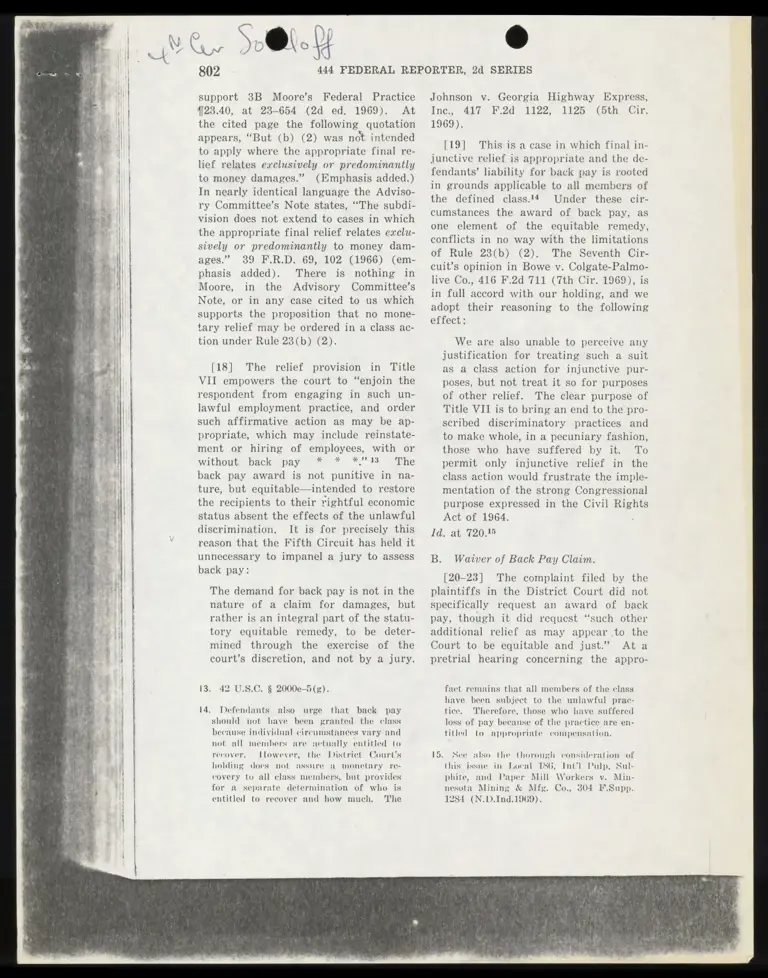
2 pages
-
Case Files, Henry v. Clarksdale Hardbacks. Robinson v. Lorillard Corporation Court Opinion, 1971. c773e3c4-8418-f111-8342-0022482cdbbc. LDF Archives, Thurgood Marshall Institute. https://ldfrecollection.org/archives/archives-search/archives-item/15c967c8-ff0e-4d46-b37e-404c1816d538/robinson-v-lorillard-corporation-court-opinion. Accessed September 28, 2026.
Copied!
     [||053cd111-6db8-43dc-9e7a-2cd66512e4d8||] \.

support 3B Moore’s Federal Practice

123.40, at 23-654 (2d ed. 1969). At
the cited page the following quotation

appears, “But (b) (2) was not intended
to apply where the appropriate final re-

lief relates exclusively or predominantly

to money damages.” (Emphasis added.)

In nearly identical language the Adviso-

ry Committee's Note states, “The subdi-

vision does not extend to cases in which

the appropriate final relief relates exclu-

sively or predominantly to money dam-

ages.” 39 F.R.D. 69, 102 (1966) (em-

phasis added). There is nothing in

Moore, in the Advisory Committee's

Note, or in any case cited to us which

supports the proposition that no mone-

tary relief may be ordered in a class ac-

tion under Rule 23(b) (2).

[18] The relief provision in Title

VII empowers the court to “enjoin the

respondent from engaging in such un-

lawful employment practice, and order

such affirmative action as may be ap-

propriate, which may include reinstate-

ment or hiring of employees, with or

without: ‘back ‘payi: ® * '*7" 13 The

back pay award is not punitive in na-

ture, but equitable—intended to restore

the recipients to their rightful economic

status absent the effects of the unlawful

discrimination. It is for precisely this

reason that the Fifth Circuit has held it

unnecessary to impanel a jury to assess

back pay:

The demand for back pay is not in the

nature of a claim for damages, but

rather is an integral part of the statu-

tory equitable remedy, to be deter-

mined through the exercise of the

court’s discretion, and not by a jury.

13. 42 U.S.C. § 2000e-5(g).

14. Defendants also urge that back pay

should not have been granted the class

because individual circumstances vary and

not. all members are actually entitled to

recover. Distriet Court's

holding does not assure a monetary re-

covery to all class members, but provides

for a separate determination of who is

entitled to recover and how much, The

However, the

444 YEDERAL REPORTER, 2d SERIES

Johnson v. Georgia Highway Express,

Inc, 417 F.2d 1122, 1125 {5th Cir.

1969).

[19] This is a case in which final in-

junctive relief is appropriate and the de-

fendants’ liability for back pay is rooted

in grounds applicable to all members of

the defined class.'* Under these cir-

cumstances the award of back pay, as

one element of the equitable remedy,

conflicts in no way with the limitations

of Rule 23(b) (2). The Seventh Cir-

cuit’s opinion in Bowe v. Colgate-Palmo-

live Co., 416 F.2d 711 (7th Cir. 1969), is

in full accord with our holding, and we

adopt their reasoning to the following

effect:

We are also unable to perceive any

justification for treating such a suit

as a class action for injunctive pur-

poses, but not treat it so for purposes

of other relief. The clear purpose of

Title VII is to bring an end to the pro-

scribed discriminatory practices and

to make whole, in a pecuniary fashion,

those who have suffered by it. To

permit only injunctive relief in the

class action would frustrate the imple-

mentation of the strong Congressional

purpose expressed in the Civil Rights

Act of 1964.

1d. at 720.15

B. Wawver of Back Pay Claim.

[20-23] The complaint filed by the

plaintiffs in the District Court did not

specifically request an award of back

pay, though it did request “such other

additional relief as may appear to the

Court to be equitable and just.” At a

pretrial hearing concerning the appro-

fact remains that all members of the class

have been subject to the unlawful prac-

tice. Therefore, those who have suffered

loss of pay because of the practice are en-

titled to appropriate compensation.

Nee also the thorough consideration of

this issue in Local 186, Int'l Pulp, Sul-

phite, and Paper Mill Workers v. Min-

nesota Mining & Mfg. Co., 304 INSupp.

1284 (N.D.Ind.1969).


ROBINSON v. LORILLARD CORPORATION 803
Cite as 441 I.2d 791 (1971)

priateness of a class action, one of the

lawyers for the plaintiffs clearly indicat-

ed that the suit was one for injunctive

relief rather than recovery of lost

wages. It was not until well after trial

of the case, though before the judge had

entered a decision, that a request was

made for additional relief in the form of

back pay for the class. Defendants

argue that these facts constitute an ef-

fective renunciation and waiver of any

right to receive an award of back pay.

The starting point for resolution of
this issue is Rule 54(¢) of the Federal

Rules of Civil Procedure which pro-

vides:

Except as to a party against whom a

judgment is entered by default, every

final judgment shall grant the relief

to which the party in whose favor it

is rendered is entitled, even if the
party has not demanded such relief in

his pleadings. (Emphasis added.)

This provision has been liberally con-

strued, leaving no question that it is the
court’s duty to grant whatever relief is

appropriate in the case on the basis of

the facts proved.'® The pleadings serve

only as a rough guide to the nature of

the case.

There are only two limiting principles

to the general rule which might avail

the defendants. The first is that a rem-

edy desired by mone of the parties

should not be forced upon them. Mercu-

ry Oil Refining Co. v. Oil Workers Int’

Union, 187 F.2d 980, 983 (10th Cir.

1951); International Nikoh Corp. v. H.

K. Porter Co. 358 F.2d 284, 290 (7th

Cir. 1966) (dictum). But that is not

our case. Although the plaintiffs ini-

tially indicated that they were not seek-

ing back pay, prior to the entry of judg-

ment they added a request that back pay

be awarded the class. Clearly it was not
forced upon them against their will.

“The one other limiting principle which
might assist defendants’ case is ex-

16. Sce generally 6 Moore's Federal Practice
1 54.62 (2d ed. 1966) ; 3 Barron & Holtz-
off, Federal Practice and

1194 (Rev.ed. 1958).

Procedure §

pressed in the following manner by

Rental Development Corporation of

America v. Lavery, 304 F.2d 839, 842

(9th Cir. 1962) :

If, however, it is made to appear that

the failure to ask for particular relief

substantially prejudiced the opposing

party, Rule 54(c¢) does not sanction

the granting of relief not prayed for
in the pleadings.

In our case, because the obligation to

provide back pay stems from the same

source as the obligation to reform the

seniority system, any general defenses

relevant to the back pay award were

equally relevant to the suit for injunc-

tive reliet. Any specific defenses relat-

ed only to computation of back pay may

be raised during the process of assessing

individual back pay claims, possibly be-

fore a special master.” The defendants

have in no way been prejudiced by the

belated claim.

C. Appropriateness of Back Pay

Award.

[24] As a final protest, defendants

argue that the award of back pay repre-

sents an abuse of discretion on the part

of the District Court. As has been not-

ed in Bowe v. Colgate-Palmolive Co., su-
pra 416 F.2d at 721, however, the Title

VII grant of remedial authority “should

be broadly read and applied so as to ef-

fectively terminate the practice and

make its victims whole.”

Defendants argue that even if the

SEOC “no reasonable cause” finding is

not a complete bar to the action, the

District Court should have taken it into

account in determining whether to

award back pay. We have already dis-

cussed in part II of this opinion the fact

that Title VII suits are de novo proceed-

ings which are not influenced by the

EEOC decision in the case. Quite prop-

erly the District Court ignored the “no

reasonable cause” finding.

17. The District Court has deferred compu-
tation of back pay for individual class

members. See 319 INSupp. at 843. [||053cd111-6db8-43dc-9e7a-2cd66512e4d8||]