NAACP v. Hampton County Election Commission Jurisdictional Statement
Public Court Documents
January 1, 1984
-
Brief Collection, LDF Court Filings. NAACP v. Hampton County Election Commission Jurisdictional Statement, 1984. 74fd5134-bf9a-ee11-be36-6045bdeb8873. LDF Archives, Thurgood Marshall Institute. https://ldfrecollection.org/archives/archives-search/archives-item/16cd8ddd-aded-4c22-a5e6-ab223bfa9f1a/naacp-v-hampton-county-election-commission-jurisdictional-statement. Accessed September 16, 2026.
Copied!
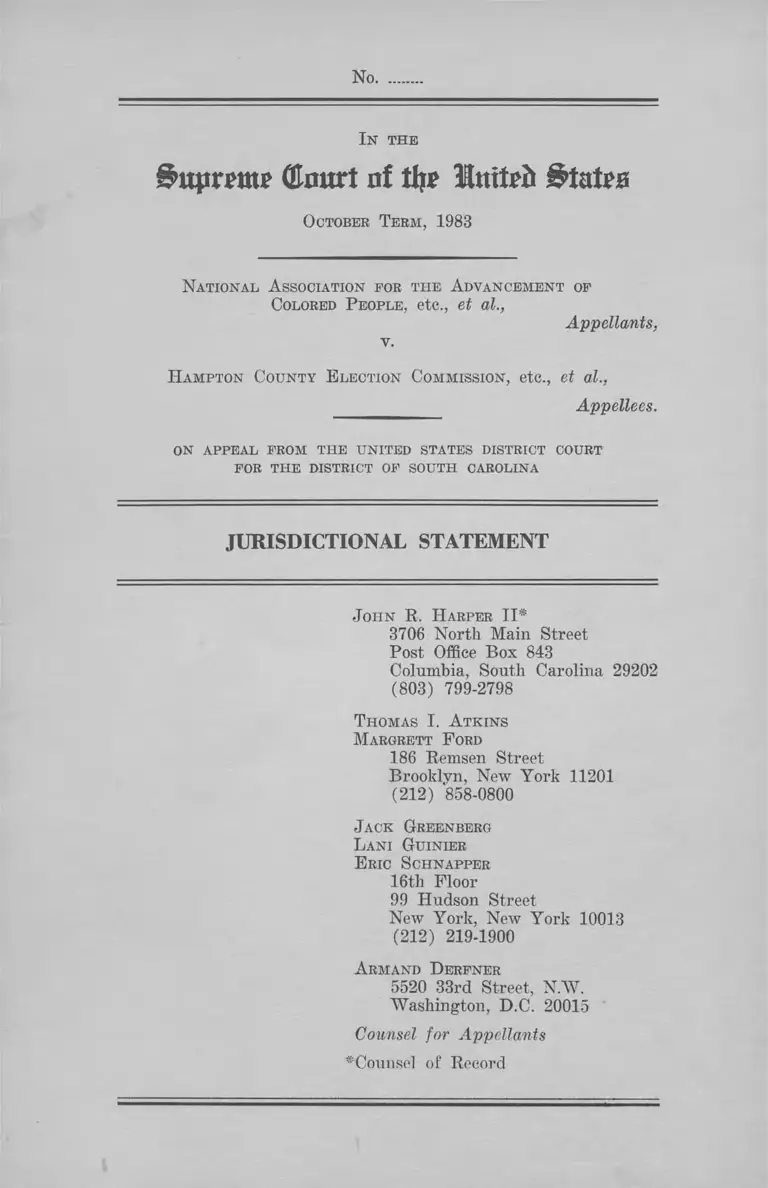
No.
I n the
i>upmttp (Emtrt of tft* l&ate
O ctober T erm , 1983
National A ssociation for th e A dvancement of
Colored P eople, etc., et al.,
Appellants,
v.
H am pton County E lection Comm ission , etc., et al.,
Appellees.
ON APPEAL FROM T1IE UNITED STATES DISTRICT COURT
FOR THE DISTRICT OF SOUTH CAROLINA
JURISDICTIONAL STATEMENT
J o hn R. H arper II*
3706 North Main Street
Post Office Box 843
Columbia, South Carolina 29202
(803) 799-2798
T hom as I. A tk in s
M argrett F ord
186 Remsen Street
Brooklyn, New York 11201
(212) 858-0800
J ack Greenberg
L an i G uinier
E ric S chnapper
16th Floor
99 Hudson Street
New York, New York 10013
(212) 219-1900
A rm and D erfner
5520 33rd Street, N .W .
Washington, D.C. 20015
Counsel for Appellants
* Counsel of Record
W .m o (ran.
Lani Guinier
June 27, 1984
Julius Chambers
Eric says that we have
a few more weeks to
deliberate on these
issues.
LG/r
Attach
1
Questions Presented
(1) Did the District Court err in holding that, in pre
clearing an election law under section 5 of the Voting
Rights Act, the Attorney General must be deemed to pre
clear as well all future changes in election practices and
procedures which may occur in the implementation of that
law?
(2) Did the District Court err in holding that changes
in election practices and procedures need not he precleared
under section 5 of the Voting Rights Act if those changes
occur in the implementation of a separate election law which
itself had earlier received such preclearance?
(3) Did the District Court err in holding that the im
plementation of a non-precleared change in election pro
cedures cannot be enjoined under section 5 of the Voting
Rights Act unless that change is in fact “ alleged to have
had either racially discriminatory purpose or effect” ?
(4) Did the District Court err in holding that state ac
tion knowingly and illegally implementing a change in
election law to which the Attorney General had objected
under section 5 is never to be invalidated by the federal
courts so long as that change subsequently receives pre
clearance ?
a
Parties
The appellants in this action are the National Associa
tion for the Advancement of Colored People, Inc., the
Hampton County, South Carolina Branch of the National
Association for the Advancement of Colored People, Inc.,
Benjamin Brooks, Jack J. DeLoach, Jessie M. Taylor,
Rev. Ernest McKay, Sr., Soletta Taylor, Jesse Lee Carr,
W.M. Hazel, John Henry Martin, Washington G. Garvin,
Jr., Dora E. Williams, James Fennell, Vernon McQuire,
Bossie Green and Earl Capers.
The appellees in this action are:
(1) The Hampton County Election Commission and its
members, Randolph Murdaugh, III, Richard Sinclair,
James Wooten, and W.H. Smith,
(2) The Hampton County School District No. 1 and its
trustees, Philip Stanley, Lenon Brooker, Rebecca
Badger, Wiley Kessler and Gerald Ulmer,
(3) The Hampton County School District No. 2 and its
trustees, T.M. Dixon, Willie J. Orr, Virgin John
son, Jr., Rufus Gordon, and Lee Manigo,
(4) Willingham Cohen, Sr., Marcia Woods, Louise Hop
kins, Charlie Crews and William Bowers, the mem
bers of the Hampton County Council, and
(5) Wilson P. Tuten, Jr., the Hampton County Trea
surer.
Ill
TABLE OF CONTENTS
PAGE
Questions Presented ......................................................... i
Parties ................................................................................ ii
Table of Authorities......................................................... iv1
Opinion Below .................................................................. 1
Jurisdiction ........................................................................ 2
Statutes Involved............................................................... 2
Statement of the Case ..................................................... 2
The Questions Are Substantial ...................................... 7
Conclusion .......................................................................... 18
A pp e n d ix—
Order of the District Court, September 9, 1983 .... la
Notice of Appeal ....................................................... 12a
Votings Rights Act of 1965, Section 5 .................. 14a
Act No. 547, South Carolina Laws (1982) . 17a
Act No. 549, South Carolina Laws (1982) . 19a
1Y
T able of A uthorities
Cases: page
Allen v. State Board of Elections, 393 U.S. 544 (1969)
8, 9,11,12,13,14,15-16,17
Berry v. Doles, 438 U.S. 190 (1978) ........................ 8,14,15
Blanding v. Dubose, 454 U .S .------ (1982) .................... 17
Canady v. Lumberton Board of Education, —*— U.S.
------ (1982) .................................................................... 17
City of Rome v. United States, 446 U.S. 156 (1980) ....9,12
Connor v. Waller, 421 U.S. 656 (1975) ........................... 10
Dougherty County v. White, 439 U.S. 32 (1978) ....9,10,16
Georgia v. United States, 411 U.S. 526 (1973) ........... 13
Hadnott v. Amos, 394 U.S. 358 (1969) ........................ 9
Hicks v. Miranda, 422 U.S. 332 (1975) ........................ 17
McCain v. Lybrand, No. 82-282 ........................................ 17
Perkins v. Matthews, 400 U.S. 379 (1971) ...........11,14,16
United States v. Board of Supervisors, 429 U.S. 642
(1977) .............................................................................. 16
United States v. Sheffield Board of Commissioners, 435
U.S. 110 (1978) .............................................................12,13
Whitely v. Williams, 393 U.S. 544 (1969) .................... 9
Statutes and Constitutional Provisions:
28 U.S.C. § 1253 ................................................................ 2
28 U.S.C. § 2101(b) .......................................................... 2
42 U.S.C. § 1973c ..........................................................passim
Y
PAGE
Voting Rights Act of 1965, § 2 ....................................... 6n
Voting Rights Act of 1965, § 5 ................................... passim
Act 547, South Carolina Laws (1982) ........................2, 3, 5
Act 549, South Carolina Laws (1982) ...................... passim
Regulations:
28 C.F.R. § 51.12(g) ......................................................... 9
28 C.F.R. § 51.20 ............................................................... 4
Rules:
Rule 6(a), Federal Rules of Civil Procedure............... 2n
Supreme Court Rule 12.1 ............................................... 2
Supreme Court Rule 29.1 ............................................... 2n
Reports:
S.Rep. No. 97-417 ............................................................. 15
H.R. Rep. No. 97-227 ....................................................... 15
TJ.S. Constitution:
Fourteenth Amendment ................................................ 6n
Fifteenth Amendment ..................................................... 6n
No.
I n the
(to ri of thr llnttrfc Stairs
October T erm, 1983
National A ssociation for the A dvancement of
Colored P eople, etc., et al.,
v .
Appellants,
H ampton County E lection Commission, etc., et al.,
Appellees.
ON APPEAL FROM THE UNITED STATES DISTRICT COURT
FOR THE DISTRICT OF SOUTH CAROLINA
JURISDICTIONAL STATEMENT
Appellants National Association for the Advancement of
Colored People, etc., et al., appeal from the order of Sep
tember 9, 1983, of the three-judge United States District
Court for the District of South Carolina denying injunc
tive relief and dismissing the complaint in this action in
sofar as it sought relief under section 5 of the Voting
Rights Act of 1965.
Opinion Below
The opinion of the district court of September 9, 1983,
which is not reported, is set out at pp. la -lla of the ap
pendix hereto.
2
Jurisdiction
The order of the three-judge district court, denying in
junctive relief and dismissing the complaint insofar as it
sought relief under section 5 of the Voting Rights Act, was
entered on September 9, 1983. (App. la ). A timely notice
of appeal was filed on October 10, 1983.1 (App. 12a). See
28 U.S.C. § 2101(b). On December 7, 1983, the Chief Jus
tice extended the date for docketing this appeal until
December 16, 1983. The jurisdiction of this Court is in
voked under 28 U.S.C. § 1253.
Statutes Involved
Section 5 of the Voting Rights Act of 1965, as amended,
42 U.S.C. § 1973c, is set out at pp. 14a-16a of the appendix
hereto. Acts 547 and 549 of the South Carolina Laws of
1982 are set out at pp. 17a-18a and pp. 19a-21a of the
appendix.
Statement of the Case
From prior to 1964 until 1982 the Hampton County pub
lic school system was controlled by the Hampton County
Board of Education. During this period the six members
of the County Board were appointed by the Hampton
County members of the South Carolina legislature. The
school system was in turn divided into two school dis
tricts with separate Boards of Trustees, whose members
were appointed by the County Board. Over 91% of all
white public school students in the county attend the schools
1 The thirtieth day after September 9, 1983, was a Sunday, Octo
ber 9, 1983. Accordingly, the notice of appeal was due on October
10, 1983, the date on which it was filed. Rule 6(a) , Federal Rules
of Civil Procedure; Supreme Court Rule 29.1.
3
in District No. 1, while the student population of the Dis
trict No. 2 schools is 92% black. Each school district has
operated autonomously under the general supervision of
the County Board and of an elected County Superintendent
of Education.
On February 18, 1982, the South Carolina legislature
enacted Act 547, which provided that, beginning January
1, 1983, the six members of the County Board were to be
elected rather than appointed. The Superintendent of
Education, while continuing.to be elected at-large, was to
serve as a seventh voting member of the newly consti
tuted County Board. The first elections for the new County
Board were to be conducted in November, 1982. The pur
pose for electing the County Board members, rather than
appointing them, was apparently to create a County Board
responsive to consolidating School Districts Nos. 1 and 2.
Act 547 was promptly submitted to the United States At
torney General for preclearance under section 5 o f the
Voting Bights Act, and received that preclearance on
April 28, 1982.
The adoption of Act 547, however, provoked substan
tial opposition among the white residents of District No. 1.
According to the complaint, those whites circulated a peti
tion calling for the abolition of both the County Board and
the position of County Superintendent of Education, thus
severing the connection between Districts One and Two.
As a result of that petition, and with the backing of the
Hampton County Council, a white member of the county
legislative delegation introduced legislation to overturn
Act 547. This new measure was enacted on April 9, 1982
as Act 549. Act 549 abolished the Hampton County Board
of Education and the position of Hampton County Super
intendent of Education. It provided that their duties were
to be assumed by the Trustees of School Districts 1 and 2.
Beginning in November, 1982, the Trustees of those school
4
districts were to be elected at-large at the general elec
tion. Act 549 provided that candidates for election to these
newly reconstituted school boards were to file with the
county Election Commission between August 16 and 31,
1982. Implementation of Act 549, however, required ap
proval of a referendum of Hampton County voters to be
conducted in May, 1982.
When Act 549 was adopted there was ample time, a
total of 129 days, to obtain preclearance before the sched
uled filing period was to begin on August 16. But although
Department of Justice regulations expressly authorized
consideration of a preclearance request prior to the hold
ing of any necessary referendum, 28 C.F.R. § 51.20, no
effort was made to submit Act 549 during either April or
May of 1982. Wrhen the necessary referendum approved
Act 549 on May 25, 1982, there remained sufficient time,
83 days, in which to obtain preclearance prior to the com
mencement of the filing period. But state and local officials
delayed still further. Not until June 24, 1982, some 30
days later, was the necessary submission received by the
United States Attorney General; by then the time remain
ing until the statutory filing period was to begin was less
than the 60 days normally required for preclearance under
section 5.
As a result of these delays, the Attorney General had
taken no action on Act 549 when the filing period for
elections under that Act commenced on August 16, 1982.
Despite the fact that section 5 of the Voting Rights Act
forbids any implementation of a new election practice or
procedure which lacks preclearanoe, Hampton County elec
tion officials, who were well aware of the requirements
of federal law, began to accept petitions for candidates
seeking election in the new districts created by Act 549.
On August 23, 1982, the Attorney General objected to Act
549 insofar as it abolished the County Board. Despite this
5
objection, Hampton County officials continued to imple
ment the Act 549 filing period. On September 1, 1982,
after that filing period had ended, county officials sub
mitted to the Attorney General a request for reconsidera
tion of his objection. They also began for the first time to
accept filings for election under Act 547, the only law
which then had the necessary preclearance. On November
2, 1982, having received no response to their request for
reconsideration, county election officials held elections for
the County Board under Act 547. Of the six board mem
bers elected on that date, three were black and three were
white.
On November 19, 1982, the Attorney General withdrew
his objection to Act 549. On November 29, 1982, the chair
man of the Hampton County Election Commission wrote
the South Carolina Attorney General and requested his
opinion on three questions:
(1) Should an election be held to elect Trustees for
Hampton County School Districts 1 and 2?
(2) I f so, when should such an election be held?
(3) Should the filing period for the respective District
Boards of Trustees be “ reopened” ?
The state Attorney General responded on January 4, 1983,
advising the County that it should hold new elections “ [a]s
soon as possible” and that it need not “ reopen” the filing
period. Acting on this advice, the Hampton County Elec
tion Commission conducted elections in Districts 1 and 2
on March 15, 1983. The six individuals elected in Novem
ber, 1982, to the County Board of Education were never
permitted to take office.
The advice given by the state Attorney General and
acted upon by the county had two distinct effects of im
6
portance to this litigation. First, although the express lan
guage of Act 549 authorized election of District Trustees
only during a general election, the Trustees were in fact
chosen at a special off-year election. Second, despite the
fact that Act 549 contemplated that the filing period would
begin several months after the Act went into effect, the
filing period for the 1983 election in fact closed more than
two months before the statute became effective. The only
time at which candidates for District Trustee were per
mitted to file for that office was when the conduct of such
filings was illegal under section 5 of the Voting Rights
Act.
The appellants, two civil rights organizations and sev
eral residents of Hampton County, commenced this action
in the United States District Court for the District of
South Carolina seeking an injunction to forbid the pro
posed elections as illegal under section 5 of the Voting
Rights Act,2 and to place in office the duly elected mem
bers of the County Board of Education. Appellants al
leged that the proposed elections violated section 5 be
cause they were to occur at a time other than that pro
vided for in Act 549, and because the elections were limited
to candidates who had filed for election during the illegal
August 1982 filing period.3 A three judge court was con
_2 The complaint also alleged that the Election Commission, in
violation of section 3 of Act No. 549, had failed to certify to the
South Carolina Code Commissioner the results of the May 1982
referendum. Although we disagree with the district court’s rea
sons for rejecting this claim, our review of the record indicates
that that certification was in fact made. Accordingly, we do not
seek review of the district court’s denial of injunctive relief re
garding the alleged lack of certification.
3 The complaint also alleged that the abolition of the elected
County Board of Education violated section 2 of the Voting Rights
Act and the Fourteenth and Fifteenth Amendments. These claims
were not dismissed, and are the subject of continuing litigation
in the district court.
7
vened to hear the case, as required by 42 TJ.S.O. § 1973c.
Appellants unsuccessfully sought to enjoin the March 15,
1983, special election. Subsequently, on September 9, 1983,
the district court denied appellants’ request for injunctive
relief and dismissed their complaint insofar as it sought
to state a claim under section 5 of the Voting Eights Act.
The Questions Presented Are Substantial
This case presents yet another attempt on the part of
a jurisdiction subject to section 5 of the Voting Rights
Act to avoid compliance with the provision’s requirement
that no alteration in any election practice or procedure
be implemented until and unless precleared by the Attorney
General of the United States or the United States District
Court for the District of Columbia. The voting changes
involved in this appeal took place in connection with an
election for school trustees, which was held under new
procedures which either lacked preclearance under the
Voting Rights Act or had in fact been objected to by the
Attorney General. The district court, in denying any in
junctive relief, created no less than four new exceptions
to the requirements of section 5. The decision below, if
upheld by this Court, would substantially impair the scope
and effectiveness of section 5, and seriously interfere with
the ability of the Attorney General to carry out his ad
ministrative responsibilities under the Voting Rights Act.
This case arose, quite simply, because the appellees
ignored section 5 not once but several times in the course
of changing the system of selecting school boards in Hamp
ton County. First, the implementation of the new statute,
Act 549, was begun without the required preclearance, and
continued even after an objection had been entered by the
Attorney General. Following an interlude o f compliance
during which implementation stopped and a scheduled elec
8
tion was canceled, the violations began anew after the
Attorney General withdrew his section 5 objection to Act
549. At that point the appellees proceeded to set a new
election and to adopt election procedures different from
those in the text of Act 549, without any effort to preclear
these new changes. Finally, in conducting the new election
the appellees barred from the ballot all candidates except
•those who had filed under Act 549 at a time when the
conduct of a filing period under Act 549 was clearly illegal
under the Voting Rights Act. One of the would be candi
dates rejected because of a failure to participate in this
illegal filing period was the chairman of the about to be
abolished County Board of Education, who wished to run
for a seat on one of the trustee boards which was to re
place his office.
The first election law change which has never received
preclearance under section 5 is an alteration of the date
for conducting the initial election of the trustees of the
local school boards. Section 1(b) of Act 549, as earlier
approved by the Attorney General, authorized the elec
tion of district trustees only at the “ general election” held
in November of even-numbered years in South Carolina.
A state statute altering the election date from the general
election to March of an off-year would clearly have been
a change in a “ standard, practice or procedure with respect
to voting .... ” 42 U.S.C. § 1973c. This Court has repeatedly
held that Congress intended section 5 “ to reach any state
enactment which altered the election law of a covered State
in even a minor way.” Allen v. State Board of Elections,
393 UjS. 544, 566 (1969). In Berry v. Doles, 438 U.S .190
(1978), this Court held that section 5 applied to a state
statute changing the time at which certain Georgia county
officials were to be elected. Such a change in the timing
of an election has an obvious potential adverse impact on
the number of minority voters participating when, as here,
9
the election is moved from a regular general election to a
special election, since voter turnout at special elections
is predictably lower. In the instant case, for example,
over 6000 Hampton County voters participated in the
November 1982 general election/ while less than half that
number voted in the March 1983 special election.
Second, the procedures adopted by appellees effectively
constituted a change in the candidate filing rules. Act 549,
as approved by the Attorney General, authorized only two
filing periods, the August 16-31 period for a contemplated
November, 1982, school board election, and the usual filing
period for subsequent school board elections. The Act
neither established any filing period for a March 1983
special election, nor sanctioned the use of the August
1982 filings for any election other than that to occur in
November, 1982. This Court has repeatedly held that such
candidate qualification rules are subject to section 5. City
of Rome v. United States, 446 U.S. 156, 160-61 (1980)
(residence requirement); Dougherty County v. White, 43-9
U.S. 32 (1978) (mandatory leave for candidate in govern
ment job ); Hadnott v. Amos, 394 U.S. 358 (1969) (filing
requirements for independent candidates); Whitely v.
Williams, 393 U.S. 544, 570 (1969) (filing requirements
for independent candidates). The Justice Department sec
tion 5 regulations expressly require submission of “ [a]ny
change affecting the eligibility of persons to become can
didates.” 28 C.F.R. § 51.12(g). Submission of changes in
such laws is required because candidate qualification rules
may “undermine the effectiveness of voters who wish to
elect . . . candidates” excluded by those rules. Allen v.
Board of Elections, 393 U.S. at 570.
The filing rule at issue in this case to an extraordinary
degree “burdens entry into elective campaigns and, con- 4
4 Complaint, Exhibit 15-1.
10
comitantly, limits the choices available to voters.” Dou
gherty County v. White, 439 TJ.S. at 40. The standard
adopted in January 1983 for the March 1983 special elec
tion required prospective candidates to have filed no later
than August 31, 1982. By the time that that requirement
was announced, the deadline it imposed was more than
four months past. This unusual ex post facto requirement
had an obvious discriminatory impact. First, the March
special election was open only to candidates who had been
willing to participate in the palpably illegal August 1982
filing, which had been conducted at a time when imple
mentation of the statute involved violated section 5. Pro
spective candidates could only obtain a place on the March
1983 ballot by “ obeying” in August 1982 election rules
to which an objection had been interposed by the Attorney
General and which under the Voting Rights Act were
not and could not then have been “ effective as laws.”
Connor v. Waller, 421 U.S. 656 (1975). Second, since
only one black candidate5 had filed for election as a trustee
of District No. 1 during the illegal August 1982 filing
period, the rule guaranteed white domination of that Dis
trict regardless of the wishes of minority voters, and de
prived those voters of any opportunity to vote for more
than a single black candidate. Thus, had the decision to
require an August, 1982 filing been contained in a state
statute and submitted to the Attorney General, there was
good reason to believe that he would have objected to it.
The district court nonetheless held that these new elec
tion procedures did n’ot require preclearance under sec
tion 5, offering in support of its conclusion several different
theories, each of which is, in our view, incompatible with
the Voting Rights Act.
5 Lenon Brooker. He was among the five candidates elected in
March, 1983.
11
The district court reasoned, first, that once an election
law is precleared, section 5 is simiply inapplicable to any
alterations in election procedures which occur in the im
plementation of that precleared law. Thus the new pro
cedures involved in this case, it asserted, did not
constitute “changes” within the meaning of Section 5.
Each of these acts were not alterations of South
Carolina law, hut rather steps in the implementation
of & new statute. . . . [T]he preclearance requirement
of Section 5 applied to the new statute, Act No. 549,
while the ministerial acts necessary to accomplish the
statute’s purpose were not “ changes” contemplated by
iSeetion 5, and thus did not require preclearance. (App.
8a-9a).
On the district court’s view, once Act 549 was precleared,
Hampton County election officials were free to select any
date for the trustee elections and to adopt any filing re
quirement, regardless of whether, as in fact occurred, the
date and filing requirement were different than those in
the Act submitted to and approved by the Attorney General
of the United States.
Were that the rule, preclearance of any election law
under section 5 would free state and local election officials
to alter at will any other election practice or procedure
that might be involved in the implementation of the pre
cleared law. Such an exemption from the coverage of
section 5, carrying with it an open invitation to evasion
'of the requirements of the Voting Rights Act, is clearly
inconsistent with the intent of Congress “ to give the Act
the broadest possible scope.” Allen v. Board of Elections,
393 U.S. at 567. This Court has consistently refused to
create an exception to section 5 for purportedly “minor”
changes made by local election officials, see e.g. Perldns v.
Matthews, 400 U.S. 379 (1971), and the Attorney General
12
has properly insisted that even those technical changes
in election procedures needed to implement longstanding
election laws must be submitted for preclearance. City of
Rome v. United States, 446 U.S. 156, 183 (1980).
The district court apparently applied this novel excep
tion to section 5 in rejecting appellants’ claim that the
appellees had prematurely abolished the position of Super
intendent of Education. Act 549 did abolish that position
as of June 30, 1985, but plaintiffs complained that by mid-
1983 the Superintendent had been stripped of his prior
responsibility and authority.6 The district court reasoned
that since Act 549 had been precleared under section 5,
“ Section 5 does not reach this aspect of plaintiffs’ corn-
plant” , despite the fact that abolition of that position was
being implemented two years earlier than the particular
date actually authorized by Act 549 and approved by the
Attorney General.
The district court suggested, in the alternative, that
the new election procedures at issue in this case had some
how “been precleared along with the . . . provisions of
Act No. 549.” (App. 9a). In particular the court asserted,
apparently with regard to the illegal August 1982 filing
period, that “ the eventual preclearance of Act 549 ratified
and validated for Section 5 purposes those acts of imple
mentation which had already been accomplished.” (App.
10a). But this Court has repeatedly rejected suggestions
that the Attorney General be deemed to have approved
changes in election procedures where those changes were
not formally submitted to him in full compliance with the
applicable section 5 regulations. City of Rome v. United
States, 446 U.S. at 169 n. 6; United States v. Sheffield
Board of Commissioners, 435 U.S. 110, 136 (1978); Allen
6 Affidavit of John W . Dodge, Hampton County Superintendent
of Education, dated July 13, 1983.
13
v. Board of Elections, 393 UjS. at 571. It is not sufficient
that the Attorney General may have known of a proposed
change; the responsible authorities must “ in some unam
biguous and recordable manner submit any legislation or
regulation in question to the Attorney General with a re
quest for his consideration pursuant to the Act.” Allen
v. Board of Elections, 393 U.S. at 571. “ [T]he purposes
Of the Act would plainly be subverted if the Attorney
General could ever he deemed to have approved a voting
change when the proposal was neither properly submitted
nor in fact evaluated by him.” United States v. Sheffield
Board of Commissioners, 435 U.S. at 136.
In the instant case the Attorney General could not pos
sibly have evaluated or intended to approve the changes
at issue when he withdrew his objection to Act 549, since
that objection was withdrawn in November, 1982, and the
decisions at issue—to hold a special election and to require
candidates to have registered in August, 1982—were made
in January 1983, two months after the Attorney General’s
action. I f a decision by the Attorney General to preclear
a new statute has the sweeping effect attributed to it by
the district court, approving as well both premature imple
menting steps of which the Attorney General may be un
aware, and subsequent implementation actions which he
could not foresee, it would be impossible for the Attorney
General to carry out his responsibilities under section 5
in an informed and conscientious manner. Under the best
of circumstances “ [t]he judgment that the Attorney Gen
eral must make is a difficult and complex one, and no one
would argue that it should be made without adequate in
formation.” Georgia v. United States, 411 UjS. 526, 540
(1973). But if the Attorney General cannot know in ad
vance what implementing steps he is implicitly approving,
it would be manifestly impossible to make the critical
judgment which Congress contemplated.
14
In addition, the district court concluded that the Novem
ber, 1982, preclearance of Act 549 ipso facto removed all
taint of illegality from the August 1982 filing period. Bely
ing on this Court’s decision in Berry v. Doles, 438 TJ.S. 190
(1978), the court below held that “ a retroactive validation
of an election law change under Section 5 could he achieved
by after-the-fact federal approval.” (App. 10a). In Berry,
as in Perkins v. Matthews, 400 U.S. 379 (1971), the issue
before this Court was whether an election held without
the necessary section 5 preclearance must be voided and
conducted anew even though the changes at issue subse
quently received the required preclearance. Neither case
established a per se rule that such relief was never ap
propriate. Perkins held only that “ [i]n certain circum
stances” invalidation of an action taken in violation of
section 5 might not be required, 400 U.S. at 396, and Berry
merely found such circumstances to be present on the par
ticular facts of that case. 438 U.S. at 192. Both cases
recognized the desire o f Congress to prevent the imple
mentation of all election changes which had not received
section 5 preclearance, not just those to which such pre-
clearance would ultimately be denied.
Fourteen years ago, noting that the scope of section 5
raised “complex issues of first impression” , this Court in
dicated a temporary reluctance to overturn elections con
ducted without preclearance. Allen v. Board of Elections,
393 U.S. at 572. In extending section 5 in 1982, however,
Congress made clear its desire that the Voting Bights Act
be strictly complied with. Congress amended the bailout
provisions of the Act to ensure that exemption from
coverage by section 5 not be accorded to jurisdictions
which had violated that provision. The Senate Beport
emphasized:
“ [I] t is the Committee’s intent that compliance with
Section 5 means that even if an objection is ultimately
15
■withdrawn or the judgment of the District Court for
the District of Columbia denying a declaratory judg
ment is vacated on appeal, the jurisdiction is still in
violation if it had tried to implement the change while
the objection or declaratory judgment denial was in
effect.” S.Rep. No. 97-417, p. 48.
Virtually identical language appears in the House Report,
H.R. Rep. No. 97-227, p. 42. Both the House and Senate
Reports include extensive references to the failure of
covered jurisdictions to make the timely submissions re
quired by section 5.
As Justice Brennan noted in his concurring opinion in
Berry, in the absence of any credible threat that actions
violative of section 5 will be invalidated by the federal
courts, “ the political units covered by § 5 may have a posi
tive incentive flagrantly to disregard their clear obliga
tions and not to seek preclearance of proposed voting
changes.” 438 H.S. at 194. That is precisely what oc
curred in the instant case. The defendant election officials
knowingly implemented Act 549 when it lacked section 5
preclearance, in the hope that such preclearance would
eventually be obtained, and in the apparent belief that
subsequent preclearance would immunize from redress that
unlawful implementation. The district court’s decision en
courages precisely the sort of section 5 violation which
concededly occurred in August 1982, and flies in the face
of the clear intent o f Congress.
Finally, the district court held that an allegation of
“ either racially discriminatory purp'ose or effect” was “ es
sential to a Section 5 action.” (App. 8a). This is a thinly
disguised version of a construction of section 5 that has
been repeatedly and unanimously rejected by this Court.
In Allen v. Board of Elections this Court held:
16
A declaratory judgment brought by the State pur
suant to § 5 requires an adjudication that a new
enactment does not have the purpose or effect of racial
discrimination. However, a declaratory judgment ac
tion brought by a private litigant does not require the
Court to reach this difficult substantive issue. The
‘only issue is whether a particular state enactment is
subject to the provisions of the Voting Rights Act,
and therefore must he submitted for approval before
enforcement. 393 U.S. 558-59. (Emphasis in original).
In Perkins v. Matthews, 400 U.S. 410 (1971), the district
court dismissed a section 5 action because it believed that
the election law changes at issue lacked any discrimina
tory purpose or effect. This Court reversed:
The three-judge court misconceived the permissible
scope of its inquiry into [plaintiffs] allegations. . . .
What is foreclosed to such district court is what Con
gress expressly reserved for consideration by the Dis
trict Court for the District of Columbia or the At
torney General—the determination whether a covered
change does or does not have the purpose or effect
“ of denying or abridging the right to vote on account
of race or color.” 400 U.S. at 383-85.
That rule has since been reaffirmed in Dougherty County
v. White, 439 U.S. 32, 42 (1978) and United States v.
Board of Supervisors, 429 U.S. 642, 645-46 (1977). Neither
the evidence adduced in a private action to enforce sec
tion 5, nor the allegations of the complaint in such an
action, are to be tested by standards which Congress has
expressly reserved to a preclearance proceeding in the
District Court for the District of Columbia or before the
Attorney General.
17
The decision of the district court in this case is thus
wholly at odds with both the intent of Congress in enact
ing the Voting Rights Act and the established construc
tion of section 5. That decision is likely to encourage the
problems of noncompliance with section 5 which have con
tinued to engage this Court, See, e.g., Blandmg v. Dubose,
454 U .S .------ (1982); Ccmady v. Lumberton Board of Ed
ucation, ------ U.S. ------ (1982) ; McCain v. Lybrand, No.
82-282. Summary affirmance by this Court would require
federal courts throughout the country to adhere to the ill-
considered standards applied below, until and unless this
Court directed otherwise. Hicks v. Miranda, 422 U.S. 332,
344-45 (1975). Summary affirmance would as a practical
matter overrule, at least in part, virtually every section 5
decision handed down by this Court since Allen v. Board
of Elections, and would wreak havoc in the implementa
tion and administration of section 5. The questions pre
sented by this appeal are as substantial as the decision
of the district court is unsound.
18
CONCLUSION
For the above reasons, this Court should note prob
able jurisdiction of this appeal.
Respectfully submitted,
John R. H arper II*
3706 North Main Street
Post Office Box 843
Columbia, South Carolina 29202
(802) 799-2798
T homas I. A tkins
M argrett F ord
186 Remsen Street
Brooklyn, New York 11201
(212) 858-0800
Jack Greenberg
L ani Guinier
E ric S chnapper
16th Floor
99 Hudson Street
New York, New York 10013
(212) 219-1900
A rmand Derener
5520 33rd Street, N.W.
Washington, D.C. 20015
Counsel for Appellants
^Counsel of Record
APPENDIX
la
I n the
DISTRICT COURT OF THE UNITED STATES
F or the D istrict of South Carolina
A iken D ivision
Civil Action 83-612-6
Order of District Court, September 9, 1983
National A ssociation for the A dvancement of
C olored P eople, I nc., etc., et al.,
Plamtiffs,
—versus—
H ampton County E lection Commission,
a public body politic; et al.,
Defendants.
On July 21, 1983, this case came before a three-judge
district court for arguments on whether certain actions
alleged by the plaintiffs constituted changes in election
practice or procedure which had not received preclearance
by the United States Attorney General, pursuant to Sec
tion 5 of the Voting Rights Act of 1965, 42 U.S.O.A.
§ 1973(c). It was conceded that if there had been no
“change” within the meaning of Section 5, or if such change
had been properly precleared, the portion of this action
brought under Section 5 should be dismissed, and the three-
judge court dissolved. After consideration of the argu
ments and memoranda of counsel, this court unanimously
concluded that there had been no Section 5 changes ac
complished without preclearance in this matter. For that
2a
reason, the three-judge court dismissed the Section 5 por
tion of this case in an oral Order. The instant Order in
corporates and memoralizes that earlier ruling from the
bench.
The factual background of this action focuses upon the
history of governance of the public school system of Hamp
ton County, South Carolina. Since the provisions of Sec
tion 5 apply to departures from the voting standards, prac
tices, or procedures that existed on November 1, 1964, that
date becomes significant as the baseline against which
Section 5 “ changes” are measured.1 Since well before that
point, the Hampton County Public School System was
controlled by the Hampton County Board of Education
(the “ County Board” ), the Hampton County Superin
tendent of Education (the “ Superintendent” ), and the
Boards of Trustees for School Districts One and Two
(the “ Trustees” ). The six member County Board was
appointed by the Hampton County Legislative Delegation.
In turn, the County Board appointed Hampton County
residents to serve as Trustees of the individual Districts,
each trustee board having six members. A County Super
intendent elected at large by the qualified voters of Hamp
ton County served as an advisor to the teachers and
trustees of each district. Each school district operated
separately under the general supervision of district super
intendents.
On February 18, 1982 the South Carolina General As
sembly passed Act No. 547, Acts and Joint Resolutions,
1 Section 5 requires South Carolina and its political subdivi
sions to obtain federal approval from the United States Attorney
General or the United States District Court for the District of
Columbia before enforcing any “practice or procedure with respect
to voting different from that in force or effect on November 1,
1964.”
Order of District Court, September 9, 1983
3a
1982 (R311), which changed the government body for the
Hampton County public school system. Beginning Jan
uary 1, 1983, the County Board was to be composed of six
at-large members, who were to be elected, rather than ap
pointed. The Superintendent, while continuing to be elected
at-large, was to serve as an ex officio County Board member,
having all rights and privileges of other members includ
ing the right to vote. The purpose for electing the County
Board members, as opposed to appointing them, was to
create a County Board that would be responsive to con
solidating School Districts One and Two. Act No. 547 was
submitted by the South Carolina Attorney General to the
United States Attorney General, who precleared it, pur
suant to Section 5 of the Voting Rights Act, on April 28,
1982.
Act No. 547, however, was superseded by another piece
of legislation, Act No. 549, Acts and Joint Resolutions,
1982 (R398). On April 9, 1982, the Governor of South
Carolina signed Act No. 549, which abolished the Hampton
County Board of Education and the Hampton County
Superintendent of Education. Once these offices were
abolished, their respective duties were to be assumed by
the Trustees for School District One and Two.
Beginning with the November 1982 general election, the
District One and Two Trustees were to be elected at-large,
rather than appointed, by a plurality vote of the electors
within each respective district. The number of Trustees
serving on each board was reduced from 6 to 5. Act No.
549 stated that a candidate offering for election in Novem
ber 1982 must file with the Hampton County Election Com
mission during the period August 16-31, 1982. Act No.
549 contains no language giving local election officials the
authority to hold a filing period other than the one specified.
Order of District Court, September 9, 1983
4a
These changes in the school system’s governing body
were contingent upon approval by a majority of the quali
fied electors voting in a referendum in May 1982. Ac
cordingly, the Hampton County Election Commission con
ducted a referendum on May 25, 1982. A majority of the
voters approved Act No. 549. Therefore, by mandate of
the voters of Hampton County, the offices of the County
Board and Superintendent of Education were to cease to
exist on June 30, 1982 and June 30, 1985, respectively.
As required by Section 5 of the Voting Rights Act, Act
No. 549 was submitted to the United States Attorney Gen
eral for preclearance on June 16, 1982. The next week,
June 23, the sitting County Board members adopted an
Order of Consolidation that consolidated Districts One and
Two into a unitary school district. The following week,
however, the same County Board voted to rescind its
earlier Order of Consolidation.
Act No. 547 had already been precleared by the United
States Attorney General. Thus, Act No. 549, in order to
supersede Act 547, had to receive preclearance itself.
The situation was further complicated by the fact that
the Attorney General is given 60 days to respond to a
request for preclearance. In addition, the Attorney Gen
eral may request additional information from the sub
mitting authority. Such a request tolls the original 60-
day period so that it does not start to run until the addi
tional information is received. Thus it is possible that the
submitting jurisdiction may have to wait for 120 days be
fore it receives a response on preclearance.
When this fact is taken into account, there existed the
chance that the filing period for candidates for District
One and Two Trustees, August 16-31, would expire be
fore the Attorney General precleared Act No. 549. If Act
Order of District Court, September 9, 1983
5a
No. 549 was precleared, pursuant to state law, it would
supersede Act No. 547. But if preclearance came after
August 31, Trustee elections could not be held as sched
uled, because no candidate would have qualified by filing
during the specified statutory filing period.
To avoid this potential dilemma, the Hampton County
Election Commissioner began accepting Trustee filings on
August 16, 1982. On August 23, 1982, a full 60 days after
Act No. 549 was submitted, the Attorney General objected
to a portion of Act No. 549. The Attorney General found
neither a discriminatory purpose nor effect in the change
of the method of selecting Trustees from appointment to
election, but he was unable to conclude that the proposal
to terminate the County Board was not discriminatory
toward black Hampton County residents. The Attorney
General noted, however, in his objection letter that the
“Procedures for the Administration of Section s (28 C.F.R.
51.44) permit you to request the Attorney General to rê
consider the objection.”
Because the Attorney General’ s objection was received
in the middle of the filing period, the Hampton County
Election Commission continued to accept filings until the
end of August while Hampton County officials determined
whether they would submit a request for reconsideration
of the objection.
Hampton County submitted a request for reconsidera
tion on September 1, 1982. Because there remained the
chance that the request for reconsideration would be de
nied, the Election Commission also began accepting filings
for the election of County Board members under Act No.
547. A candidate who had filed for the office of Trustee
was also permitted to file for the County Board. As of
November 1,1982, the Attorney General had not responded
Order of District Court} September 9, 1983
6a
to the request for reconsideration. Accordingly, the Hamp
ton County Election Commission held elections for County
Board members on November 2, 1982.
Shortly thereafter, the Attorney General withdrew his
objection to Act No. 549. In his letter of November 19,
1982, the Attorney General withdrew his objection to the
abolition of the County Board because “a reappraisal of
South Carolina law establish [ed] that the county board
lacks authority to effect a consolidation and its abolition
. . . will not have the potentially discriminatory impact we
had initially perceived.”
Once the Attorney General precleared Act No. 549, Act
No. 547 became void. Even though the election for County
Board members had been held in November 1982, Act No.
547 became a nullity when the Attorney General precleared
Act No. 549.
Threafter, the Hampton County Election Commission
prepared to hold elections for the Trustees of Districts
One and Two. On November 29,1982, Randolph Murdaugh,
III, Chairman of the Hampton County Election Commis
sion, wrote the South Carolina Attorney General and re
quested an Attorney General’ s opinion on the following
three questions :
(1) Should an election be held to elect Trustees for
Hampton County School Districts Nos. 1 and 2?
(2) I f so, when should such an election be held?
(3) Should the tiling for the respective District Board
of Trustees be reopened?
The South Carolina Attorney General responded to these
questions in a January 4, 1983 opinion. Referring to an
earlier Attorney General opinion that the proposed con-
Order of District Court) September 9, 1983
7a
solidation of Districts One and Two was of no effect, the
South Carolina Attorney General concluded that “ the pro
visions of Act [No. 549] are now in effect and it requires
that an election he held for the school trustees.” In re
sponse to Mr. Murdaugh’s question about the timing of
such an election, the South Carolina Attorney General
responded: “As soon as possible.” Finally, regarding the
question as to whether the filing period should be reopened,
South Carolina’s chief legal officer concluded that “ there
is no reason to reopen filing as only the date of the elec
tion has changed.” Acting upon this legal advice, the
Hampton County Election Commission published a Notice
of Election setting March 15, 1983, as election day.2
From the foregoing chain of events, plaintiffs have
identified five claimed Section 5 changes that they urge
were enforced without proper preclearance by the Hamp
ton County Election Commission. These alleged changes
are as follows:
(1) conducting an election for Trustees without first
certifying the results of the referendum to the
South Carolina. Code Commissioner as required
by Section 3 of Act No. 549 (R398);
(2) accepting of filings for the Trustees’ positions
after the Attorney General objected to Act No.
549;
(3) (a) conducting an election for Trustees without
first seeking authority for a filing period;
Order of District Court, September 9, 1983
2 Five Trustees were elected to the District Two Board on March
15, 1983, all of whom are black. One black person and four white
persons were elected Trustees of District One.
8a
(b) conducting an election for Trustees without
holding a filing period subsequent to withdrawal
of the Attorney General’s objection;
(4) conducting an election for Trustees after the May,
1982, date specified for such elections in Act No,
549; and
(5) the abolition of the office of the Hampton County
Superintendent of Education and the devolution
of his duties on the Trustees of Hampton County
School Districts One and Two.
In this court’s view, plaintiffs’ first contention does not
involve a change in voting practice or procedure within
the meaning of Section 5. Even though Section 3 of Act
No. 549 (R398) required certification of the results of the
referendum by the county election commission to the county
legislative delegation and the South Carolina Code Com
missioner, the failure of the election commissioner to so
certify is purely a state law problem. Moreover, the fail
ure of the election commissioner to certify the referendum,
results to the code commission is not alleged to have had
either racially discriminatory purpose or effect. Such an
allegation is essential to a Section 5 action. Otherwise,
federal courts “would henceforth be thrust into the details,
of virtually every election, tinkering with the state’s elec
tion machinery, reviewing petitions, registration cards,
vote tallies, and certificates of election for all manner of
error and insufficiency under state and federal law.” Powell
v. Power, 436 F.2d 84, 86 (2d Cir. 1970).
Plaintiffs’ second, third and fourth alleged changes also
fail to constitute “ changes” within the meaning of Section
5. Each of these acts were not alterations of South Caro
lina law, but rather were steps in the implementation of a
Order of District Court, September 9, 1983
9a
new statute. It is not questioned that Act No. 549 consti
tuted a Section 5 “ change” that require preclearance, hut
the administrative actions of accepting filings and con
ducting an election for Trustees was not a change in South
Carolina election law, but rather an effort to conform to
it. In this court’s view, the preclearance requirement of
Section 5 applied to the new statute, Act No. 549, requir
ing that it he precleared before becoming effective, while
the ministerial acts necessary to accomplish the statute’ s
purpose were not “ changes” contemplated by Section 5,,
and thus did not require preclearance.
Even if plaintiffs’ second, third and fourth alleged
changes were to be considered as “ changes” under Section
5, this court concludes that they have now been precleared
along with the remaining provisions of Act No. 549. The
fact that the eventual preclearance of Act No. 549 fol
lowed the filing period for the Trustees’ positions is not a
bar under Section 5. In Berry v. Doles, 438 U.S. 190 (1978),
the Supreme Court recognized the necessity of taking a
practical approach toward reducing the disruptive delays
frequently generated by requests for preclearance. The
Court in Berry was confronted with a Section 5 challenge
to a change in a Georgia statute regulating voting proce
dures for the election of the members of the Peach County
Board of Commissioners of Roads and Revenues. The
Berry case was filed four days prior to the contested elec
tion, and the election was held as planned. The three-
judge district court held that the change, which had not
been precleared at the time of the election, violated Sec
tion 5, but refused to set aside the election. On appeal,
the Supreme Court affirmed the finding of a Section 5 vio
lation, but reversed the denial of affirmative relief regard
ing the election. The Supreme Court concluded that the
Order of District Court, September 9, 1983
10a
appropriate remedy was to permit the responsible officials,
to have 30 days within which to apply pursuant to Section
5 for approval of the change in question. Citing Perkins
v. Matthews, 400 U.S. 379 (1971), the Court noted as.
follows:
We indicated in [Perkms] that “ [i]n certain circum
stances . . . it might be appropriate to enter an order
affording local officials an opportunity to seek federal
approval and ordering a new election only if local
officials fail to do so or if the required federal ap
proval is not forthcoming.” 400 TLS., at 396-397. The
circumstances present here make such a course ap
propriate.
In this case, appellees’ undisputed obligation to sub
mit the 1968 voting law change to a forum designated
by Congress has not been discharged. We conclude
that the requirement of federal scrutiny imposed by
§5 should be satisfied by appellees without further
delay. . . . I f approval is obtained, the matter will be
at an end.
438 U.S. at 192-193.
By its decision in Berry, the Supreme Court clearly in
dicated that a retroactive validation of an election law
change under Section 5 could be achieved by after-the-
fact federal approval. Thus, it is the court’s view that
in the case at bar the eventual preclearance of Act No. 549
ratified and validated for Section 5 purposes those acts of
implementation which had already been accomplished.
The fifth and final change asserted by the plaintiffs,
the abolition of the office of Hampton County Superin
tendent of Education and the devolution of his duties on
Order of District Court, September 9, 1983
11a
the Trustees, was provided for by Act No. 549.3 As in
dicated in the preceding discussion of the second, third,
and fourth alleged changes, this action was approved when
the Act itself was precleared by the Attorney General.
Thus, Section 5 does not reach this aspect of plaintiffs’
Complaint.
For the reasons set forth above, the court concludes
that the five instances alleged by the plaintiffs do not
represent changes in election practice or procedure within
the meaning of Section 5 of the Voting Eights Act of 1965
which were instituted without preclearance by the Attorney
General. Further, the alleged changes have in fact been
ratified and approved by the United States Attorney Gen
eral’s eventual preclearance of Act No. 549 in its entirety.
Therefore, the court denies plaintiffs’ request for injunc
tive relief and dismisses those portions of the Complaint
which seek any relief from this three-judge court under
Section 5 of the Voting Eights Act of 1965.
A nd It Is So Ordered.
/ s / E obert F. C hapman
Eobert F. Chapman
United States Circuit Judge
/ s / Charles E. Simons, Jr.
■Charles E. Simons, Jr.
United States District Judge
/ s / F alcon B. H awkins
Falcon B. Hawkins
United States District Judge
Order of District Court, September 9, 1983
3 The Hampton County Superintendent of Education was elected
for a four-year term commencing July 1, 1981 and expiring June
30,1985. Act No. 549 abolishes this position effective June 30, 1985.
10a
appropriate remedy was to permit the responsible officials,
to have 30 days within which to apply pursuant to Section
5 for approval of the change in question. Citing Perkins
v. Matthews, 400 U.S. 379 (1971), the Court noted as.
follows :
We indicated in [Perki/ns\ that “ [i] n certain circum
stances . . . it might be appropriate to enter an order
affording local officials an opportunity to seek federal
approval and ordering a new election only if local
officials fail to do so or if the required federal ap
proval is not forthcoming.” 400 U.S., at 396-397. The
circumstances present here make such a course ap
propriate.
In this case, appellees’ undisputed obligation to sub
mit the 1968 voting law change to a forum designated
by Congress has not been discharged. We conclude
that the requirement of federal scrutiny imposed by
§5 should be satisfied by appellees without further
delay. . . . I f approval is obtained, the matter will be
at an end.
438 U.S. at 192-193.
By its decision in Berry, the Supreme Court clearly in
dicated that a retroactive validation of an election law
change under Section 5 could be achieved by after-the-
fact federal approval. Thus, it is the court’s view that
m the case at bar the eventual preclearance of Act No. 549
ratified and validated for Section 5 purposes those acts of
implementation which had already been accomplished.
The fifth and final change asserted by the plaintiffs,
the abolition of the office of Hampton County Superin
tendent of Education and the devolution of his duties on
Order of District Court, September 9, 1983
11a
the Trustees, was provided for by Act No. 549.3 As in
dicated in the preceding discussion of the second, third,
and fourth alleged changes, this action was approved when
the Act itself was precleared by the Attorney General.
Thus, Section 5 does not reach this aspect of plaintiffs’
Complaint.
For the reasons set forth above, the court concludes
that the five instances alleged by the plaintiffs do not
represent changes in election practice or procedure within
the meaning of Section 5 of the Voting Rights Act of 1965
which were instituted without preclearance by the Attorney
General. Further, the alleged changes have in fact been
ratified and approved by the United States Attorney Gen
eral’s eventual preclearance of Act No. 549 in its entirety.
Therefore, the court denies plaintiffs’ request for injunc
tive relief and dismisses those portions of the Complaint
which seek any relief from this three-judge court under
Section 5 of the Voting Rights Act of 1965.
A nd It Is So Ordered.
/ s / R obert F. C hapman
Robert F. Chapman
United States Circuit Judge
/ s / Charles E. Simons, Jr.
Charles E. Simons, Jr.
United States District Judge
/ s / F alcon B. H awkins
Falcon B. Hawkins
United States District Judge
Order of District Court, September 9, 1983
3 The Hampton County Superintendent of Education was elected
for a four-year term commencing July 1, 1981 and expiring June
30,1985. Act No. 549 abolishes this position effective June 30, 1985.
12a
Notice of Appeal
I n the
UNITED STATES DISTRICT COURT
F ob the D istrict oe S outh Carolina
A iken D ivision
Filed October 10, 1983
Civil Action No. 83-612-6
National A ssociation fob the A dvancement of
Colored P eople, I nc., etc., et al.,
Plaintiffs,
v.
H ampton County E lection Commission, etc., et al.,
Defendants.
Plaintiffs National Association for the Advancement of
Colored People, Inc., Hampton County, South Carolina,
Branch of the National Association for the Advancement
of Colored People, Inc., Benjamin Brooks, Jack J. Deloach,
Jessie M. Taylor, Rev. Ernest McKay, Sr., Soletta Taylor,
Jesse Lee Carr, W. M. Hazel, John Henry Martin, Wash
ington G. Garvin, Jr., Dora E. Williams, James Fennell,
Vernon McQuire, Bosie Green and Earl Capers, hereby
appeal to the Supreme Court of the United States from
the order of the District Court denying injunctive relief
on the claims based upon 42 U.S.C. Section 1973c entered
in this case on September 9, 1983. This appeal is taken
13a
Notice of Appeal
pursuant to 28 U.S.C. Section 1253 and 42 U.S.C. Section
1973c.
/ s / John R. H arper II
John R. H arper II
3706 North Main Street
Post Office Box 843
Columbia, South Carolina 29202
(803) 799-2798
T homas I. A tkins
Margrett F ord
186 Remsen Street
Brooklyn, New York 11201
(212) 858-0800
Columbia, South Carolina
October 10, 1983.
14a
Section 5 of the Voting Rights Act of 1965, as amended,
42 U.S.C. § 1973c, provides:
§ 1973c. Alteration of voting qualifications and pro
cedures; action by State or political sub
division for declaratory judgment of no
denial or abridgement of voting rights;
three-judge district court; appeal to Su
preme Court
Whenever a State or political subdivision with re
spect to which the prohibitions set forth in section
1973b(a) of this title based upon determinations made
under the first sentence of section 1973b (b) of this title
are in effect shall enact or seek to administer any
voting qualification or prerequisite to voting, or stan
dard, practice, or procedure with respect to voting
different from that in force or effect on November 1,
1964, or whenever a State or political subdivision with
respect to which the prohibitions set forth in section
1973b(a) of this title based upon determinations made
under the second sentence of section 1973b (b) of this
title are in effect shall enact or seek to administer any
voting qualification or prerequisite to voting, or stan
dard, practice, or procedure with respect to voting
different from that in force or effect on November 1,
1968, or whenever a State or politcal subdivision with
respect to which the prohibitions set forth in section
1973b(a) of this title based upon determinations made
under the third sentence of section 1973b(b) of this
title are in effect shall enact or seek to administer any
voting qualification or prerequisite to voting, or stan
dard, practice, or procedure with respect to voting
Voting Rights Act of 1965, Section 5
15a
different from that in force or effect on November 1,
1972, such State or subdivision may institute an ac
tion in the United States District Court for the Dis
trict of Columbia for a declaratory judgment that
such qualification, prerequisite, standard, practice, or
procedure does not have the purpose and will not
have the effect of denying or abridging the right to
vote on account of race or color, or in contravention
of the guarantees set forth in section 1973b(f)(2) of
this title, and unless and until the court enters such
judgment no person shall be denied the right to vote
for failure to comply with such qualification, prerequi
site, standard, practice, or procedure: Provided, That
such qualification, prerequisite, standard, practice, or
procedure may be enforced without such proceeding
if the qualification, prerequisite, standard, practice,
or procedure has been submitted by the chief legal
officer or other appropriate official of such State or
subdivision to the Attorney General and the Attorney
General has not interposed an objection within sixty
days after such submission, or upon good cause shown,
to facilitate an expedited approval within sixty days
after such submission, the Attorney General has af
firmatively indicated that such objection will not be
made. Neither an affirmative indication by the At
torney General that no objection will be made, nor
the Attorney General’s failure to object, nor a declara
tory judgment entered under this section shall bar
a subsequent action to enjoin enforcement of such
qualification, prerequisite, standard, practice, or pro
cedure. In the event the Attorney General affirma
tively indicates that no objection will be made within
the sixty-day period following receipt of a submis
Voting Rights Act otf 1965, Section 5
16a
sion, the Attorney General may reserve the right to
reexamine the snbmisson if additional information
comes to his attention during the remainder of the
sixty-day period which would otherwise require ob
jection in accordance with this section. Any action
under this section shall be heard and determined by
a court of three judges in accordance with the provi
sions of section 2284 of Title 28 and any appeal shall
lie to the Supreme Court.
Voting Rights Act of 1965, Section 5
17a
Act No. 547, South Carolina Laws 1982, provides:
Composition of Hampton County Board of Education
Section 1. Notwithstanding any other provision of
law, beginning January 1, 1983, the Hampton County
Board of Education shall he constituted and elected
as follows:
A. (1) Six members shall be elected at large from
the county in an election conducted by the county elec
tion commission at the time general elections are held
beginning with the general election of 1982.
(2) To have his name placed on the ballot a person
must file with the election commission, not less than
forty-five days before the election, a petition signed
by not less than fifty qualified electors of the county.
Each signature 'shall be followed by the voter regis
tration number of the petitioner. Petitions must be
approved by the county board of voter registration.
(3) No political party designation shall appear on
the ballot in connection with the names of candidates.
(4) The six candidates receiving the highest vote in
the election shall be declared elected. In the event of
a tie vote, procedures provided in the state election
laws shall apply.
B. Terms of members shall be for four years and
until their successors are elected and qualify except
that in the initial election of 1982 the three members
elected who receive the smallest vote shall serve ini
tial terms of two years only.
C. Vacancies shall be filled in the next general elec
tion for a full term or unexpired term as the case may
Act No. 547, South Carolina Laws (1982)
18a
be except that if a vacancy occurs more than one year
prior to a general election it shall be filled by appoint
ment by the Governor upon recommendation of a ma
jority of the county legislative delegation for a period
until the vacancy can be filled by election.
D. In addition to the elected members, the county
superintendent of education shall serve ex officio as
a member of the board and in such capacity shall have
all rights and privileges of other board members, in
cluding the right to vote.
E. As of December 31, 1982, the terms of all board
members then serving shall expire.
F. Except as provided in this act the poAvers, duties
and procedures of the board as prescribed by laAv shall
continue in full force and effect.
Time effective
Section 2. This act shall take effect upon approval
by the Governor.
Act No. 547, South Carolina Laws (1982)
19a
Act No. 549, South Carolina Laws, provides:
Board of education abolished, trustees elected
Section 1. Contingent upon approval of the total
proposal by a majority of the qualified electors voting
in a referendum to be held in May, 1982, as hereafter
provided for, the following shall occur:
(a) The Hampton County Board of Education shall
be abolished at midnight on June 30, 1982; the office
of the Hampton County Superintendent of Education
shall be abolished at midnight on June 30, 1985; upon
abolition their respective duties shall devolve upon
the trustees for Hampton County School Districts
Nos. 1 and 2; and after June 30, 1982, the Hampton
County Treasurer shall pay any proper claim ap
proved by a majority of the trustees of either School
District No. 1 or School District No. 2, on behalf of
their respective districts, provided sufficient funds are
on deposit in the proper district account.
(b) Beginning with the general election in Novem
ber, 1982, trustees for Hampton County School Dis
tricts Nos. 1 and 2 shall be elected by a plurality vote
of the electors within their respective district qualified
and voting at the general election for representatives.
The number of trustees shall be five for each school
district and their terms of office shall begin January
1, 1983. The three candidates in each district receiv
ing the highest number of votes shall serve for terms
of four years and the remaining two trustees shall
have initial terms of two years, after which all terms
shall be for four years. In each case trustees shall
serve until their successors are elected and qualify
Act No. 549, South Carolina Laws (1982)
20a
and each school board shall elect its chairman annually.
Trustees shall receive no salary but shall be reim
bursed for actual expenses incurred. A candidate for
membership on a school board must reside in the school
district he seeks to represent and all candidates offer
ing for election in November, 1982, must file during
the period August 16-31, 1982.
Beferendum conducted
Section 2. The Hampton County Commissioners of
Election shall conduct a referendum within the respec
tive county school districts during May, 1982, to deter
mine whether the provisions of Section 1 of this act
shall be implemented. The specific date for the ref
erendum shall be determined by the county election
commission. The county election commission shall
thrice publish notice of the referendum in a news
paper of a countywide circulation, the last publica
tion to be not less than one nor more than two weeks
before the referendum. All election laws contained in
Title 7 of the 1976 Code applicable to county refer-
endums shall apply. Ballots shall be prepared and dis
tributed to the various voting precincts of the county
with the following printed thereon:
“ Shall the Hampton County Board of Education be
abolished on June 30, 1982, and its duties placed upon
the trustees for Hampton County School Districts
Nos. 1 and 2; shall the office of the Hampton County
Superintendent of Education be abolished on June 30,
1985, and its duties placed upon the trustees for
Hampton County School Districts Nos. 1 and 2; and
shall the trustees for Hampton County School Dis-
Act No. 549, South Carolina Laws (1982)
21a
tricts Nos. 1 'and 2 (five trustees per district), rather
than being appointed, be elected by plurality vote dur
ing general elections for representatives beginning
with the election in Novembr, 1982, with their terms
to begin January 1, 1983, and with terms of office to
be four years, except that of those initially elected
two from each district shall have initial terms of two
years ?
I agree to the above proposals □ Yes □ No
Place a check or cross mark in the block which ex
presses your answer.”
Results certified
Section 3. The Hampton County Commissioners of
Election shall certify the results of the referendum
directed in Section 2 of this act to the Hampton County
Legislative Delegation and to the South Carolina Code
Commissioner.
Act No. 549, South Carolina Laws (1982)
MEIIEN PMSS INC. — N. Y. C.