Transcript of the Evidence Volume 4
Public Court Documents
April 8, 1975
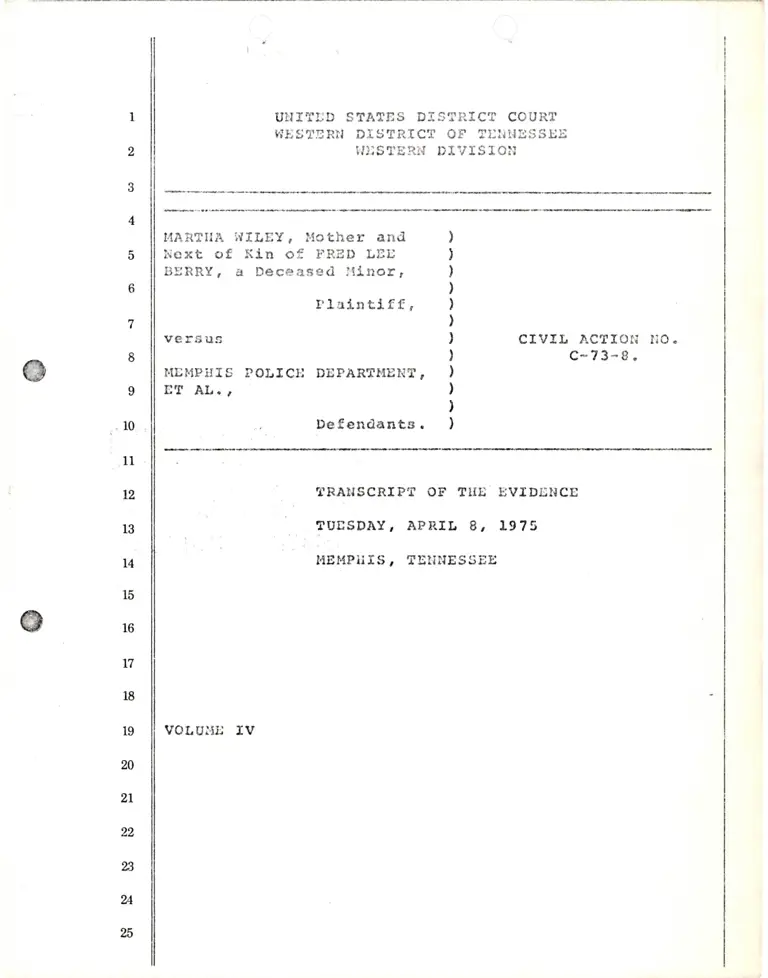
-
Case Files, Garner Hardbacks. Transcript of the Evidence Volume 4, 1975. 0eae7bc1-24a8-f011-bbd3-000d3a151b15. LDF Archives, Thurgood Marshall Institute. https://ldfrecollection.org/archives/archives-search/archives-item/16fce33d-6649-4c1c-aa0a-1ca3ce657c7e/transcript-of-the-evidence-volume-4. Accessed September 26, 2026.
Copied!
o
3
4
5
6
7
8
9
10
11
12
13
14
15
16
17
18
19
20
21
22
23
24
25
UUITLD STATES DISTRICT COURT
VJKSTURrJ DISTRICT OF TRIiUESSRE
WESTERN DIVISION
MARTHA WILEY, Mother and
IsOXt of Kin of FRED LEE
BERRY, a Deceased Minor,
Plaintiff,
versus
MEMPHIS POLICE DEPARTMENT,
ET AL,,
Defendants.
CIVIL ACTION no,
C-73-8.
TBAHSCRIPT OF THE EVIDENCE
TUESDAY, APRIL 8, 1975
MEMPHIS, TEIEJESSEE
VOLU21E IV
484
1
2
3
4
5
6
7
8
9
10
11
12
13
14
15
16
17
18
19
20
21
22
23
24
25
I-K-D-II-X
WITNESS DIRECT
EXAMINATION
CROSS-
EXAMINATION
Chief hill Price 4 87, 496 494, 498
James K. Richards 517, 540 531
Billy Cox 542, 551 547
William E. Gross 556 566
Velton Rodgers 575,
586
584 , 582, 585
o
o
1
2
3
4
5
6
7
8
9
10
11
12
13
14
15
16
17
18
19
20
21
22
23
24
25
4 85
(\7hcreupon, pursuant to the overnio'ht
recess. Court convened at eleven a.m. in this
matter, and the follov/ing proceedings were
had.)
THE COURT; Gentlemen, when v;e adjourned on
yesterday, I believe v/e had concluded the testimony
in the case of Wiley versus others, Memphis Police
Department, and others, the testimony of Captain
Colette, and then we had to interrupt these pro-
ceedings.
We are ready to proceed with any further proof
and evidence to be adduced by the defendant.
We did understand that the plaintiff was
offering, or planning to offer and tender certain
other eichibits, and the notion that was made by
the defendants at the conclusion of the plaintiff'^
proof that was taken under advisement did include
any exhibits that the defendants properly intro
duced for whatever appropriate purposes.
Are there any statements or comments before
we proceed with the next proof and evidence.
MR. ARNOLD: If we could offer those exhibits
at a later time. Your Honor, and go ahead with the
proof, his proof, we'll bo glad to do so.
THE COURT: All right, sir.
1
2
3
4
5
6
7
8
9
10
11
12
13
14
15
16
17
18
19
20
21
22
23
24
25
486
MR. SHEA: Cone around. Chief Price.
487
O
O
1
2
3
4
5
6
7
8
9
10
11
12
13
14
15
16
17
18
19
20
21
22
23
24
25
CHIEF BILL PRICE,
the said witness, having been first duly 3V7orn,
testified as follows :
DIRECT EXAMINATION
BY MR. SHEA:
Q Please state your name to the Court?
A Bill Price.
0 And you are the former chief of police of the city
of Memphis, is that correct?
A Yes, sir.
Q Vihat is your profession or occupation?
A I an law enforcement planner with the Memphis-Delti
Development District.
Q And what is your address. Chief?
A Four 0 nine eight Indian.
Q And that is right here in Memphis?
A Yes, sir.
Q And were you once employed by the Memphis Police
Department?
A Yes, sir.
Q And what period of time, when did you go to work
for the Memphis Police Department?
A August 22, 1941.
Q And just state how you progressed?
A I was on the police department, August 22, 1941, a$
o
1
2
3
4
5
6
7
8
9
10
11
12
13
14
15
16
17
18
19
20
21
22
23
24
25
4 80
patrolman.
I waa made a lieutenant in 1950.
I was made a captain in 1961.
Ana ins|jector in 19 64 .
Assistant chief, 1967.
And chief of police, January first, 1972.
Q All right, sir.
Then you were chief, you became the chief of police!
January the first, 1972?
A , Yes, sir.
Q All right.
Do you recall the instance when Fred Lee Berry was
killed by the Memphis Police Department?
A Yes, sir.
Q All right, sir.
Just tell U3 how it came to your attention?
A Well, I was, of course, at homo this particular
night when this occurred, and I was notified by them,
the detectives of this, of the Memphis police force.
Q You were not at the scene at the time of his death*
A No, sir.
Q All right, sir.
Chief, what was the lethal force or the firearms
police of the Memphis Police Department at the time tha
you became chief?
o
o
409
1 A The firoarns v/as to be used only as a last resort
2 to stop a felon or a burglar, or whatever you prefer to
3 call them, but the felon, but only as a last resort was
4 a firearm to be used.
5 Q Chief, there is an exhibit, 38, that is already in
6 evidence, and I would like to hand it to you and ask
7 you if you recognize it?
8 A - Yes, sir. This is a policy and procedure that we
9 have, had followed at this time.
10 All right, sir.
11 Policy, that v;as in effect then quoted the state
12 laws concerning making arrests, or 40 dash 808;
13 ' "Rosistence to officer: - if, after
14 notice of the intention to arrest the defen-
15 dant, he either flees or forcible resist, the
16 ' officer nay use all the necessary means to
17 effect the arrest.
18 "The Tennessee Supreme Court has held as
19 regards the means to which an officer may
20 resort to make an arrest, the lav/ sharply disl-
21 tinguishes between felonies and misdemeanors.
22 While an officer may shoot or even kill a
23 felon, if that is the only means of taking him
24 on preventing his escape; yet in doing so the
25 officer acts at his peril, for a jury may find
o
o
1
2
3
4
5
6
7
8
9
10
11
12
13
14
15
16
17
18
19
20
21
22
23
24
25
490
that there v/aa no reasonable necessity for the
killing and that he is guilty of at least man-
slaughter. But an officer has no right to
shoot at one guilty of only a misdemeanor to
atop his flight or prevent his escape.
"If with diligence and caution the pri
soner might othor\N’iso be taken or held, the
officer will not be justified for the killing
even though the prisoner may have committed a
felony.
"The above law and State Supreme Court
decisions are set out as all of us should be
constantly reminded of cur rights and obliga
tions as police officers. Although force is
necessary and required in appropriate instances
to effect an arrest, defend ourselves and
fellow officers, and prevent the escape of
fleeing felons, we all realize that only that;
force which is necessary is permitted by law !I
and no more, and none of us wish to use any
more force than is necessary,"
Chief, did you ever give any direct order to
Officer Richards to shoot Fred Lee Berry?
A no, sir.
Q Did you order him or his follow officers to shoot f--
491
O
O
1 strike that question.
2 And all you know about this incident is that you
3 were notified at home?
4 MR. CALDV7ELL; We object to leading questions
5 Your Honor.
6 MR. SHEA: Excuse me. I*m sorry.
7 You nay ask.
8 MR. CALDWELL: Your Honor, we have Officer
9 Price's deposition introduced into evidence. I
10 don't think Mr. Shea brought out anything that we
11 haven't discussed in the deposition. For that
»
12 reason, we will not cross-examine him now.
13 THE COURT: All right.
14 Chief Price, was there, to your knowledge, at
15 the tirae you assumed the office of chief, was there
j
16 any written policy, other than as has been stated |
17 with regard to the, either the duties or the respon-
18 sibilities of police officers in the instance of
19 fleeing felons?
20 THE WITNESS: To my knowledge, no, sir. !1I
21 THE COURT: And at that time, to your knowledge,
22 were there any written guidelines with regard to 1
23 the implementation of that policy, or with respect!
24 to the use of firearms or the occasions when offi-|
25 cers were to use their firearms?
492
O
o
1
2
3
4
5
6
7
8
9
10
11
12
13
14
15
16
17
18
19
20
21
22
23
2-4
25
THE 'WITNESS; If I understand you correctly,
sir, this v;ould all be taught a person when he v/eni
into the basic training of the police, and in the
in-training training, this would all be stressed
time after time,
THE COURT: 'Who, if anyone, v/as specifically
responsible for the training of new officers or
recruits during the period that you were assistant
chief, from 1967 until 1972?
THE HITNEHG; Captain Coletta was in charge
of firearms training. Captain Moore, I believe,
Glen Moore, was in charge of the part of tho training.
Inspector Wannamaker, at different tiraes, v/as in
charge of the training academy, and these people,
along with our legal advisors, people from the
Attorney General's office, would instruct in the
school,
THE COURT; Who, if you recall, from, served
as legal advisor, any specific individuals that,
if you recall?
THE VJITNES5; Ronald Krelstcin was legal advif
sor for the police department when I became chief,}It
and he remained until I left the police departmentL
(THE COURT; ’Who, do you recall anyone besides
Mr. Krelstein?
4S3
O
o
1
2
3
4
5
6
7
8
9
10
11
12
13
14
15
16
17
18
19
20
21
22
23
24
25
THK WITNESS: Yes, Gonercii Canale, who was
assigned to the City Attorney office v/as assistant
to the police office at, as legal officer.
THE COURT: And vierc there any occasions for
officers who had been in service -- (interrupted)
THE WITNESS; Yes, sir.
THE COURT: (Continuing) -- and, and active
police officers to receive any refresher training
or any other type of training with regard to the
policy that we have discussed?
THE WITNESS: Yes, sir, this was done periodi-
I
cally at the training acadeny, at the Armour Cente:
This is what we, we refer to as in-training
training, and from time to time was brought about.
THE COURT: All right.
Any further questions?
MR. CALDWELL: Your Honor, I may have a ques
tion or two with the Court's questions that has
prompted --
If I could get a copy of Exhibit 16.
(Whereupon, Exhibit 16 is passed to Mr.
Caldwell.)
MR. CALDWELL: Thank you.
CROSS-EXAMINATION
BY MR. CALDV7ELL:
o
o
494
1 Q Chief Price, you were appointed by Mayor Chandler?
2 A Yes, sir.
3 Q Effective January 1, 1972?
4 A Yes, sir.
5 Q And then you v/ere sort of acting chief for a while
6 while Civil Service requirements were met, or something^
7 A Yes, sir.
8 Q - And you, you retired on what date?
9 A On July the first, 1974.
10 Q Okay.
11 You recall that, that the death of Fred Lee Berry
12 was the first of a series of four police shootings in
13 January of 1972, which created some community turmoil
14 or protest?
15 A If I remeniber correctly, he was the first, yes, si:|-
Q And there were three of those particular shootings
17 I think resulted in death, I think one was a wounding,
18 is that correct?
19 A I believe that is correct, yes, sir.
20 Q Do you recall a statement issued January 19, 1972,
21 by Mayor Chandler in connection with these series of
22 shootings?
23 A Mo, sir, I‘m afraid I don't.
/24 Q Let me shov/ you document. Exhibit 15, and ask you
25 if you recall corroborating with Mayor Chandler in
o
1
2
3
4
5
6
7
8
9
10
11
12
13
14
15
16
17
18
19
20
21
22
23
24
25
495
preparation of that statement?
A Yes, sir.
Q Do you recall that statement?
A Yes, sir,
Q All right, sir.
And then on January 20 , 1972, you issued a nev;
firearms use police, and let mo ask you if that is the
document marked Exhibit 16?
A Yes, sir. Vie were working, v/orking on this at thi;
particular time, and I'm sure this is what I issued,
yes, sir.
Q All right, sir.
And there, this new policy came out in connection |
with the Mayor's statement on these series of shootingsi
is that correct? j
i
A Yes, sir. We were revising a whole lot of procedure
!and policies of the police department, and this fell into
that category. They were working into, into, into that]
Q At the time, at the time you took office, Mr.
Krelstein was legal advisor, am I correct, that he had
already been in the process of gathering information
about revising the deadly force policy?
A Yes, sir.
Q And hovf long was he your legal advisor?
A Sir, the entire time that I was in the chief's
o
1
2
3
4
5
6
7
8
9
10
11
12
13
14
15
16
17
18
19
20
21
22
23
24
25
49 6
office, from January first, ‘72, to July first, '74* |
Q All right, sir*
And this was, policy, was result of corroboration j
v/ith him and with others, although perhaps its tiiiiing j
I
was prompted by the particular incident which was accom-|
panying? j
A Well, like I said, we were working, looking, workin
on a number of policies and procedures. .I
HR. CALDVIELL: Your Honor, I think Exhibit 16 j
has been admitted into evidence, and I will, wouldj
i
offer Exhibit 15, which is Mayor Chandler's state-'
ment, which the chief has identified.
THE COURT; All right.
Vlithout objection, then, lot the exhibit be
introduced into evidence.
(Whereupon, said exhibit previously
marked Number 15 for identification, was
received in evidence.)
MR. CALDWELL: That is all I have.
Thank you, Your Honor.
THE COURT: All right.
Mr. Shea, do you have anything?
f
MR. SHEA: May I see Exhibit 12, please?
REDIRECT EXAMINATION
BY MR. SHEA: ___ _
o
o
3
4
5
6
7
8
9
10
11
12
13
14
15
16
17
18
19
20
21
22
23
24
25
497
Q Chief, I hand you Exhibit 12, and ask you if you
recognize it? You have Exhibit 10 before you, and, sir,
let me show you another exhibit.
MR. SHEA: VJhere is Exhibit (pause)
MR. CALDV7ELL; Eleven.
MR. SHEA; Eleven.
(Whereupon, said exhibit is passed to
Mr. Shea.)
Q (continuing) -- Chief, that is from the operations
and procedure manual.
A Manual, yes, sir, um-hurn.
Yes, sir.
Q Okay, and that was in effect, I believe it shows
the date of 1967, look at the top, corrected March 7?
A March 7, 1967, yes, sir.
Q It has in there a section 40 dash 35, 6, parens
(2), and 8011, paren (6), that had to do with firearms,
and when, when resistence to arrest occurred?
A Yes, sir.
MR. SHEA: Thank you.
THE COURT: Anything further?
MR. CALDWELL: Mr. Shea has prompted one more
question. Your Honor.
THE COURT: All right.
498
O
2
3
4
5
6
7
8
9
10
11
12
13
14
15
16
17
18
19
20
21
22
23
24
25
1 RECROSG-EXAMXMATIOll
BY MR. CALUWKLL;
Q Chief, let iiie show you a document which has bean
admitted into evidence as Exhibit 11, and there is,
there is a copy of the littlo blue manual?
A Uir."hum.
Q Uas that in use when you took, v;hen you became
chief of police in January, 1972?
A Yes, sir, wo still had this manual.
Q At what tine, at what point in time did you discon
tinue the regular use of this manual?
t
A I don't remember the date.
Q But at some point you have discontinued the use
of that particular --
A Yes, sir.
Q (Continuing) -- particular manual?
A Yes, sir.
Q But it was in use in January, 1972?
A To the best of my recollection, it was.
MR. CALD\7ELL; That is all, Your Honor.
THE COURT; Chief Price, when you were assis
tant chief between the period of '67 and when you
occupied that, that office, and until you became
the chief, do you recall whether there were dis
cussions betv;een you and others in equivalent
o
o
2
3
4
5
6
7
8
9
10
11
12
13
14
15
16
17
18
19
20
21
22
23
2.}
25
1
49 9
leadership positions, the chief or others, relating
to the specific policies regarding use of tliese
necessary and evan deadly force with regard to
fleeing felons?
THL WITNESS: If I remember correctly. Your
Honor, we would discuss this and, in staff meeting
and meetings of this nature, but the dates and
times I simply don't remember.
THE COURT; All right, sir.
Anything further?
MR. CALDWELL: No, sir. Your Honor.
MR. SHEA; Nothing further.
Thank you,
THE COURT; Thank you, you may step down, sir
(Witness excused)
MR. CALDWELL; Your Honor, would it be appro—
priate now for us to offer some additional exhibit!!
\and try to close our case?
d €,
THE COURT; All right, sir.
MR. CALDWELL: Your Honor, I think we have
offered the depositions of four police officers,
Roleson, Krelstein, and Richards, and Cox, and we
have also offered into evidence the deposition of
Chief Price, Director Hubbard, Mayor Chandler, and
Captain Ray, I think.
o
o
2
3
4
5
6
7
8
9
10
11
12
13
14
15
16
17
18
19
20
21
22
23
24
25
1
50 0
I think that is all tliat we have offered into
evidence at this point,
Dy stipulation, Your Honor, we have taken the
deposition of FBI Agent Ben Hale, v;hich we would
also offer into evidence, but I can’t find the
original of it. It doesn't seen to be in the
clerk’s office.
Your Honor, if we can't, if we can't find the
original, perhaps we can offer the copy into evi
dence, although it is not notarized, I don't think
there is any problem v/ith that.
THB COURT: All right.
The deposition of FBI Agent Bon Hale.
MR. CALDWELL: Ben D. Hale, Il-a-l-e, Your
Honor .
THE COURT: Exhibit Mumbar?
MR. CALDWELL; Should we mark all of the depo
sitions. Your Honor?
MR. SHEA; I think I v;ould, subject to the
consideration that, tnat they are offered by, into
evidence, not merely filed, that offered into evi
dence, that the clerk v/ill use the next exhibit
number and mark them by letter designations, the
depositions of Cox, Roleson, and Calliham, Richard
Chandler, Ray, Price, Hubbard, and Hale.
e ,
rOl
O
O
1
2
3
4
5
6
7
8
9
10
11
12
13
14
15
16
17
18
19
20
21
22
23
2-1
25
THE CLEHK; Will be Hup.ber 47, sir.
MR. CALDWELL; lIuiT’b&r 47, is thcit what you
said?
THE COURT: All right, 47.
(Whereupon, the said deijositions were
accordingly marked Exhibit Hunibor 4 7 v/ith
letter designations not announced, and
received in evidence.)
MR. CALDWELL; Your Honor, I would like to
take up another matter which, which v;e had some
previous discussion about, Exhibit 22 is a survey
of the attitudes toward, conducted by Dr. Vidulich
and Mr. Shea indicated to me yesterday morning tha^
he would withdraw his authenticity objection to
that exhibit, although he obviously is not con
ceding to having it admitted into evidence, he
v̂ ould now stipulate to its authenticity, and -- am
I correct in that, Mr. Shea, with that stipulation
we would reoffer Exhibit 22 for all purposes.
THE COURT: Do you wish to be heard with
respect to that matter, Mr. Shea?
MR. SHEA; If Your Honor please, to obviate
the necessity of bringing someone down to prove it
as to that. I’ll stipulate as to that phase of it,
however. Your Honor, the conclusions that are
o
2
3
4
5
6
7
8
9
10
11
12
13
14
15
16
17
18
19
20
21
22
23
24
25
1
502
reached therein and the entire instrument, as far
as I'rn concerned, is not admissible. It has no
probative value and it, or it is certainly inmater
and irrelevant to the issues here. The conclusions,
that are reached in there are not all bad, in fact
the main conclusion reached is that the attitude
was one in favorable, slic|htly favorable to the,
towards the police, but I object to the whole inci
dent.
THE COURT: Well, x;itho\it ruling on the mater
iality or relevancy, or what weight and value, if
any, will be attributable to the exhibit, it has
been, the authenticity of it, the objection has
been vrithdrawn, and the Court will, therefore,
admit it into evidence and, therefore, not make
any ruling one way or the other v;ith regard to the
several contentions that are made on either side
with respect to its propriety.
HR. SHEA: Your Honor, may I cross not
cross-examine, as I understand it, but use the
instrument and not waive my objection to the incon
sistencies?
THE COURT: Yes, sir, you may.
The same rule applies, gentlemen, I think I
have tried to make it clear to you throughout that
al
o
o
2
3
4
5
6
7
8
9
10
11
12
13
14
15
16
17
18
19
20
21
22
23
24
25
1
503
neither side waives an objection to a document, or
to a line of inquiry by examining a v/itness per
taining to that.
I have stated tliat throughout, and with regard
to these documents, and exhibits, if they are intro
duced over an objection, or if inquiry is made by
the adverse party over objections, the party may
pvirsue to cross-exaraine or go into that matter witlji
out waiving his underlying objection to the line
of inquiry of a particular document or exhibit thaj:
is involved.
MR. CALDUELL; Your Honor, we have marked a
number of other documents which, which I v/ould lik^
to identify and offer at this tine to mark as
Exhibit 1(a), Exhibit 1(b), and Exhibit 2(a) --
I'm sorry, just Exhibit 1(a), 1(b), and 1(c), is
an exchange of correspondence, beginning with the
letter from me to the chairman of the city council
on January 14, 1972, with a response dated January
21, 1972, from Chief Price, which is Exhibit 1(b);
the first letter being 1(a), and a response from
the city /attorney, January, January 25, 1972,
which is Exhibit 1(c), and we offer those, those
items into evidence if Your Honor please.
THE COURT; For v/hat purpose, Mr. Caldwell?
o
o
2
3
4
5
6
7
8
9
10
11
12
13
14
15
16
17
18
19
20
21
22
23
24
25
1
504
MR. C.'LDSiliLL; For two purposes, Your honor,
one, to the, to the city's response indicated, indi
i
cates a purpose or at least a perception on the
part of the city. City Attorney, as to v/horo dcadi)
force was used in this particular situation; and
secondly, v/e v;ant to, to shov; Your Honor that on
January 14, 1972, the defendants, all defendants
wez'e put on notice of this lawsuit, and that at
that tine, on that same date, coincidentixlly, this
natter v;as presented to the Ghclby County Grand
Jury and no true bill returned.
Subsequently, fron the investigative file,
v;ill show that after these, these exhibits were,
or after this letter, this letter v;as written and
the defendants v;ere put on notice, that defendants
conducted renewed investigations, the homicide
bureau investigations, and the cririe scene squad,
squad, and as I understand it, Mr. Shea is going ,
to have v/itnesses from the crime scene squad to
testify, and we -- part of the relevance is to show
that they were aware that a lawsuit, that legal
action was being contemplated at this time,
THH COURT: Well, I'm going to, at this time,
suggest, in light of what has been stated by coun
sel, that these exhibits are tendered as exhibits
o
o
2
3
4
5
6
7
8
9
10
11
12
13
14
15
16
17
18
19
20
21
22
23
24
25
1
505
in t;hc cniino; that they should ireta.i.n thau.t icieriwi
fication status, pending an opportunity for the
defendants' counsel to respond, or if it may be
raaterial, based upon proof and evidence, that
relates to any of these matters, that it is a con
tinuing tender that these matters be put into evi
dence .
At this point, at least, the Court does not
feel that there has been a sufficient relevance
shown on all of the matters pertaining to circura-
stances and situations after the fact, and the
Court will consider that they are tendered, but
that they should, at this time, retain their ident
fication status, pending further opportunity to
show that it should be admitted as pertinent and
relevant.
MR. CALDWELL: Your Honor, marked as Exhibit,
Exhibit 2{a) and 2(b), Exhibit 2(a) is a letter
dated January 30, 1973, following the filing of
this lawsuit, from me to Director Hubbard, enclosing
to hira a threatening letter received by Mrs. Wiley
contains racial slurs, and racial epithets and
directed at her.
And Exhibit 2(b) is Director Hubbard’s raopon|;c
and, other than, other than Director Hubbard's
o
o
2
3
4
5
6
7
8
9
10
11
12
13
14
15
16
17
18
19
20
21
22
23
24
25
1
506
response of February 6, his deposition reveals
there has been no further response, and t'ley have
been, been unable to locate any record of havimj
inv'Gs tiy a ted the particular letter.
VJe think the threatening letter, itself, has
relevance in the general context of the racial
attitudes.
THE COURT: Of the defendants?
HR, CALDWELL: The racial attitude on the par^
of the v;hite community, well, they, we don't know
whether it is, v;hether it v/as of the white commu
nity, the defendants have no record of there havin
been an investigation on this, and we are not
offering it to suggest, we are not suggesting that
one of the defendants wrote it.
THE COURT: Mr. Shea, do you want to respond?
MR. SHEA; Certainly, Your Honor, that has no
relevancy to this matter. Could have been one of
any seven thousand calls or letters, the police
department didn't follow up and make an in-departmjint
investigation, according to Mr. Caldwell. It has
no probative value in this matter.
THE COURT; I am going to rule that they may
be marked for identification only, but that the
Court doesn't see that those things have any
o
o
2
3
4
5
6
7
8
9
10
11
12
13
14
15
16
17
18
19
20
21
22
23
24
25
1
50 7
pertinency, relevancy to the raatter relating to
1973 (72), but I an going, it doesn't seen to the
Court to be any specific basis of connection, or
any purported connection to, with any of the parti
in this particular litigation.
V/a'll sinply have those renain as submitted
for tAio Court, and counsel may, if he wishes to
elaborate for the record, any other statement v/ith
regard to the intendment or purpose of the intro
duction.
r4Ro CALDWELL; I would add. Your Honor, we
think that letter directed to Mrs. Vliley is pri
marily the kind of attitude the defendants had,
racial discriminatory practices, as found in the
community, and it relates to the defendants' his
tory, practices, in that regard, and these kind of
practices are prevalent throughout the community.
THE COURT: All right, sir, all right, they
will remain for identification only.
MR, CALDV/ELL; Thank you, Your Honor.
defendants' (plaintiffs') Exhibit 4(a),
4(b), and 4(c), are answers to the second interroga
tories. They ansv/ered, and because part v;ere not
ansv/ered, until, until after the Court ordered,
and we offer them as an exhibit at this time.
o
o
1
2
3
4
5
6
7
8
9
10
11
12
13
14
15
16
17
18
19
20
21
22
23
24
25
508
THL COURT: Lot then bo introduced.
{VTliereupon, the said exhibits, previcusl;
marked 4(a), (b), end (c), for identification
wore received in evidence.)
MR. CALD'7ELL; Exhibits 5(a) — v/ell, 5(a)
through 5(d), and 6(a) through 6(r), Your Honor,
are, are matters and also Exhibit 1, Exhibit 8(a),
and Exhibit 9, are items which v̂ ore, v;hich were
collected in the course of either homicide bureau
or internal affairs bureau, or crime scene squad
investigation of the case, and I'm not sure what
some of them are statements from witnesses, others
are investigative facts, and we have marked them
all, marked them all as being the entire contents
of the file, except some receipts, and that sort
of thing,
THE COURT: What are they being offered for?
What puri)ose?
MR, CALDWELL; V<oll, some being, maybe I could
go through, I don't know what Mr. Chea's position
is going to be on the statement, but a number of
the preliminary reports. Exhibits 6(n), for example);.
Is a preliminary report dated February 7, 1972,
and my understanding that this exhibit had been
introduced into evidence during the course of
o
o
2
3
4
5
6
7
8
9
10
11
12
13
14
15
16
17
18
19
20
21
22
23
24
25
1 Mr, Arnold’s cross-examination of Patroiiaan
Hichardcon, or Patrolman Richards, but the clerk
didn't have it marked as having been admitted.
THE CLERK: (Indicating).
MR. CALDV;ELL: You do have?
THE CLERK; Yes, sir.
MR. CALD.?ELL: I ’m sorry, Exhibit (n) has
been admitted into evidence.
MR. SHEA; If Your Honor please, if we are
going to take up all of the tine on all of his
exhibits here this morning, and it is hard to say
»which exhibit is v/hich at this point, but the
answer to that exhibit, is, if you are asking if
we waive our objection to it, the answer is no, or
-- (interrupted)
MR. CALDWELL; Maybe it would be better, Your
Honor, if we wait then, instead, until the end,
Mr. Shea v/ants, and I want him to be able to, to
be allowed to put on his case.
THE COURT: All right, sir.
Because of the fact that, which allows docu
ments to be discovered from the internal affairs,
for the first time, to the knowledge of the Court,
or for any consideration, to our knov;ledge, the
defendant waives some of the objections, and the
o
2
3
4
5
6
7
8
9
10
11
12
13
14
15
16
17
18
19
20
21
22
23
24
25
1
5i0
fact that thoy were discovered, includes cumulative,
jor some otIie;c natters, would not naks thorn neces- |
I
sarily subject, at this tine, to be introduced to !
this case, in this case. |]
If we are going to be submitted statements of!I!witnesses, and everything of that nature that havej
appeared before the Court, unless there is, and I
agreed that they are evidence, and -- (interrupted)
KR. CALDWELL: I understand. Your Honor, some
of the iteras are sort of charts and drav/ings of
the scene, that sort of thing, which sort of speaks
» !for themselves, and there arc others, some documents
I
that happen to be, such as the juvenile file, |
involved v/ith Fred Lee Berry, we think arc also !
irelevant to our case, but in view of the potentiali
problem. I'll just hold these and, and go over then
with Mr. Shea at the next recess.
THE COURT; All right, sir.
MR. CALDWELL: Your Honor, marked as Exhibit
14, is an interoffice memorandum, dated January 13',
I
t1972, indicating the procedure that would be j
iIfollowed from that day forward when an officer dist-
icharges his revolver or shotgun, and it is really jj
relevant only in a sense that it goes along with |
these other changes in policy which were occurring
o
o
1
2
3
4
5
6
7
8
9
10
11
12
13
14
15
16
17
18
19
20
21
22
23
24
25
.11
at that time.
Mr, Shea indicates he has no, indicates he han
no objection to this, to the exhibits. Your Honor.
TIIL COURT: All right, there being no objec
tion, let it be introduced.
(Whereupon, the said exhibit previously
narked Munber 14 for identification, v;as
received in evidence.)
MR. CALDWELL: Your Honor, I indicated 6(n)
had been admitted, and 6(b), which was the dis
patcher's log, was also admitted into evidence pre-'
viously in that exiiibit, 5 and 6.
And marked as Exhibit 21, Your Honor, is a
document entitled History of Memphis Police
Department, tracing the police department from
1827 to, until 1954, and this, this document is
being offered in evidence to show a resolution that
was dealt with by the, by the city council in 1874
wherein a resolution requesting the police board
to put twenty colored men on the force lost by a
vote of sixteen to three, and we offer that as part,
of the historical evidence of racial discriminatioi.
within the department.
Authenticity has been agreed to. I don't knov
whether iMr. Shea will Jiave objection to this
o
o
1
2
3
4
5
6
7
8
9
10
11
12
13
14
15
16
17
18
19
20
21
22
23
24
25
docuiDon t.
Till, COURT: Who pi'cpared it and what is it?
MR. SlILA: I7ho prepared it?
MR. CALDWCLL: What?
MR. SililA: iMio prepared it?
MR. CA.LD'WLLL: Well, I, I thought there was
a page on it to show vjho prepared it. It came fror,
the public library and reference made to it in the
ad-hoc committee's final report as having been pre
pared by the defendant in 1954, but this particulaj
page does not indicate who prepared it, but I mean
I gave you this two months ago.
7iS to the authenticity, again, I requested a
stipulation as to the authenticity.
• MR. SKL'A: Well, I'll go along v/ith tie fact
that you gave me two months ago.
- . ̂ THE COURT; Gentlemen, let's, I'm going to
suggest that you gentlemen work out, during the
recess time, v/hat it is you are seeking to intro
duce, and v/hich ones, if any, there is agreement
about, and which ones there is, are not, so we can
get some live testimony on, and the plaintiffs
will not be prejudiced from being afforded an oppor
tunity at the conclusion of the plaintiff's proof
to tender into evidence any matters that the
o
« - o
2
3
4
5
6
7
8
9
10
11
12
13
14
15
16
17
18
19
20
21
22
23
24
25
1
il3
plaintiff foals are relevant and material, and witii
the opportunity of the defendant to be heard.
7vt least the Court is learning one thing, that
vre are going to have to bo very careful in dealing
witii any, any of you in future cases with regard
to having to dot i's t\nd cross t's about what is
I
and what is not, and where is and where is not, and
in the ienvjth of tiiae that it is taking to go
through things that ought to be clarified and
ought to have been taken care of at pretrial, and
so you gentlemen will take up all of the exhibits
and tlie plaintiff will be afforded an opportunity j
to be heard with regard to all of the exhibits, and
the defendant will be called upon to specify what
objections they have, if any, with regard to these
matters.
But it docs occur to the Court, when we are
talking about the history, for example, the history
Iof the police department from 1874 to 1954, that I
ithere needs to be some specifications about what ■
Iit is, v;hat it is being offered for, for what pur-i
I
jpose it is being offered, and what connection, if i;
ithere is, to that matter too, so that v;e won't be
taking a lot of time in discussing all of these
things without having it specified specifically
o
o
2
3
4
5
6
7
8
9
10
11
12
13
14
15
16
17
18
19
20
21
22
23
24
25
1
.14
\7hat purpose and v.’hat objection is involved with
regard to that and other exhibits.
HR. CALDWLLL: In vicv; of that. Your lienor,
I'll just liold off on the rest of tlieni until the
recess, goinj over with Mr. Sliea about theni.
THIi COURT: Mr. Clerk, will you tell us now
v/hat exhibits have been introduced.
Tlib CLIiRK: Number 3, 4(a), (b) , (c) --
(interrupted)
MR. SHEA: Hold it just a minute.
Okny, (JO ahead.
THE CLERK; Four (a), (b), and (c); 6(d), 6(n
10(a), 10(b); 11; 12; 13; 14; 15; 16; 17; 18; 19 ---
18(b); 19(c); 20(a); 22; 23; 32; 35; 36; 37(a)
through (f); Humber 38; 40(a); 42; 43; 44(a), 44(b
and 46; and 47, these depositions, depositions.
THE COURT; Ail rig lit, sir.
HR, CALDWELL;; Your Honor, as I understand it
did the clerk rend 18(a) and 18(b) as having been
admitted?
Nineteen (a) and 19(b), and 20, as I under
stand it wore admitted insofar as they include
data not going beyond, well, they are really mcn-
itioned, .because, because -- based on that, anyv/ay,|
I think that is all right on that.
o
o
1
2
3
4
5
6
7
8
9
10
11
12
13
14
15
16
17
18
19
20
21
22
23
24
25
51!
THE COURT: All riyht-
ThosG data that the Court admitted, as v/e
recall, all of the statistical data tliat, that wen-
to, or preceding 1972, not thereafter,
/ill right, gentlemen, are v/e ready to proceed^
MR. SHEA: Your Honor, v/e have one request I
would like to make that I don't knov/ how to handle
i t.
Mr, Ricnards is represented by Mr. Chastin,
who is with the law firm of Russel X. Thompson, an<̂
I believe the police union, is that correct?
MR. CHAGTIH: Yes, sir.
MR. SHEA: Ha is asked that he be permitted,
I don't knov/ whether ho is an attorney of record
this matter, but v/ould Your Honor object if these
gentlemen have any questions, if Mr. Chastin has
any questions, that he wants to ask, should he
channel thera all through me -- I v/ould be very
happy to have Mr. Chastin involved in the case, buj:
I just don't v/ant to -- (interrupted)
THE COURT; Mr. Caldv/ell, you or Mr. Arnold
want to be heard on that?
MR. CALDWELL; Your Honor, throughout the
entire litigation, as far as we have been able to
tell, the City Attorney's office has purported to
o
2
3
4
5
6
7
8
9
10
11
12
13
14
15
16
17
18
19
20
21
22
23
24
25
1
516
represent everybody involved as defendants, v;hether
present city officials or not. I woiild just like
to make it clear that the City /attorney’s office
docs represent the city, the department, the defen
dants, and Mr. Chastin is supplemental to Mr, Shea
representation, if that is clear, I don’t think v/e
have any objection.
As I understand, you v/ant Mr. Chastin to --
(interrupted)
MR. SHEA: In the event that I don't ask some
questions that he v/ould like to ask.
THE COURT: The Court is going to permit Mr.
Chastin to act supplemental, to act as supplementai-y
counsel, unless there is some statement to the con
trary that the Court concludes that Mr. Caldwell's
statement is correct, that Mr. Shea and other mem
bers of the city of Memphis attorney's staff are
attorney of record for all of the attorneys in the
cause and if Mr. Chastin is permitted to partici
pate, it is for the limited act of acting as supplti-
mental counsel, but not as replacement counsel.
MR. SHEA: Yes, sir.
Come around, Mr. Richards.
THE COURT: iMr. Richards, you remain under
oath, sir.
o
1
2
3
4
5
6
7
8
9
10
I
11
12
13
14
15
16
17
18
19
20
21
22
23
24
25
517
JAME5 U. RICHARDS,
tho said witness, heaving been previously sworn, was
recalled to the witness stand and testified as follows:
DIRECT EXAMINATIOM
______
Q Please (interrupted)
HR. C?>LD.1ELL; I'm sorry, Your Honor, I night
have misunderstood the procedure. Is Mr. Shea
calling Mr. Richards?
MR. SHEA: Yes, sir, I have. If I omit any
thing, I would like to ask the Court to let Mr.
Chastin ask, prior to Mr. Caldwell's cross-
examination .
' THE COURT: Yes, sir.
BY HR. SliLA:
Q Mr. Richards, you understand that the Court has
explained to you you are still under oath, as you have
testified earlier?
A Yes, sir.
Q I don't want to belabor this record, but just
briefly, v;ould you tell us the events that occurred on
the night of January the Bth, 1972?
A Oh, v;ell, sir, we were, we had just, just gotten
in service about, about seven forty-five, or ten minute^
'til eight, or something like that. We were on our way
0
0
2
3
4
5
6
7
8
9
10
11
12
13
14
15
16
17
18
19
20
21
‘ 22
' 23
24
25
1
>18
up to our ward and we received the call out on Lanar,
iioluing a prisoner, or soraethiny like that, it escapes
ne nov;, the e::act nature of the call, and v/e were at
the Elvis Presley and the interstate, northbound, de
heard a call go out, i-»rov/ler on the inside, inside at
South Bellevue Marine, and at Bellevue and Ferguson,
and being so close, v;e asked the dispatcher, we told th«‘
dispatcher our location, and he said;
"Okay, show you on the call."
We continued on northbound where there was another
car that had already beat us to the scene. Mister --
V7ell, Officer Calliharn and Officer Roleson.
We, when v;e arrived to the north of the building,
they said:
"They are inside. There are three inaid^."
— or something like that, to that nature.
We v/ont on north and went around to the building
from Ferguson, back to the east, and we parked the squacji
car. Patrolman Cox was driving, parked the squad car
on Ferguson, right even with the rear of the building.
Jumped out of the patrol car.
At that tine, two male blacks took out running from
the rear of the building, I don't know whether they came,
come out at the door or windov;, I'm not exactly sure.
They came out. That was exactly when they were getting
o
3
4
5
6
7
8
9
10
11
12
13
14
15
16
17
18
19
20
21
22
2.3
24
25
519
out/ out at that tir.io, we started hollering for thera to
halt/ and v/e ran along parallel v;ith then about seventy
or eighty feet, they were on the inside of the -- there
was a chain-link fence there/ and they were on the in
side/ on the edge/ of the thing/ and the fence was abou|.
six feet high, and had barbed wire on top of it.
We ran, as I say, hollering, we were running,
running and hollering to halt. We went down to the end
end of the ditch. We got to the end of the fence, into
a, into a little, into the ditch, and they jumped down
into the ditch and started around, and started, and wheh
when they got in the ditch, and started running around,
around to the rear, started around, running back tov ârd
the apartments and I hollered and told them to halt, ancfl
it was then tliat we decided that we were going to, cjoin
to have to fire.
Q What were the lighting conditions back in the ditĉ .?
A The lighting conditions were poor in the ditch.
Q Now, all right, sir.
Now, there has been some testimony earlier that
you had been in the neighborhood before, patroled the
neighborhood, called on Mr. Hoffman, I believe it was?
A Yes, sir.
0 The owner of the business?
A Yes, sir, that is correct.
2
3
4
5
6
7
8
9
10
11
12
13
14
15
16
17
18
19
20
21
22
23
24
25
1
j Z I
Q Would you state how long it v;ould have taken you
Had you returned to the squad car and attempted to pur
sue them v;ith the vehicle?
A Oh, they v;ould have, by the time we could have
gotten up to the squad car, they would have fled into
the apartments and gone on. It is quite a ways. In
order to got down to where they were running in the
Squad car, you would have to have gone back over to the
next street, or else back around to Elvis Presley, or
gone back to Cleraentine and gone back up to, into the
apartment area. It v;as a fairly large complex.
Q It has already been introduced into evidence, the
Exhibit 35, and could you point --
MR. SHEA: May I bring this thing forward?
THE COURT: Yes, sir.
HY MR. SHEA:
Q This is 35 here (indicating to exhibit), and this
is Exhibit 36.
All'right, and looking in, looking at Exhibit 36 -
MR. SHEA: Can Your Honor see?
THE COURT: Yes, sir.
BY MR. SHEA:
Q Exhibit 36 shows us where you stopped your squad
car?
A Part of the, parked the patrol car where the end
o
2
3
4
5
6
7
8
9
10
11
12
13
14
15
16
17
18
19
20
21
22
23
24
25
1
521
of tho building, p.irked our car right there (indicating)
on Ferguson.
THE COURT: I'n going to aak that the v/itness
get a red marker and nark v;ith a one, the spot tha
he is indicating on Exhibit 36.
THE '7ITI3ESS: Right about there (indicating) .
THE COURT: That is all right. Mark a one at
that position that you have just indicated.
THE WXTNEGE: (Harking.)
BY MR. SHEA;
Q All right/ sir.
And where were you when you were in positj.on of
firing?
A (Indicating.)
MR. SHEA: Should that not bo Number 2?
THE COURT: Mark that 2.
THE V7ITNESS: (Marking.)
BY MR. SHEA;
Q NOW/ Mr. Richards/ your squad car is positioned
here at point one?
A Yes, sir.
Q State whether or not the chain-link fence runs the
entire distance of the parking area and the parking are
for the Peyton Place, and the Marine area, and the Gale
Shop?
o
o
2
3
4
5
6
7
8
9
10
11
12
13
14
15
16
17
18
19
20
21
22
23
24
25
1
522
A The narine, itself, is entirely v/ithin the chain-
link fence, and v;ith three strands of barbed v;ire on it
There is nothing about the Peyton Place except the one
in the back, in the, along here, this is the drainage
ditch, and this is a pen.
Q There is a pen in the back?
A Yes, sir. There is a drainage ditch here, and it
goes on down here (indicating).
Q All right, sir.
You may resume your seat, please.
Exhibit 37(e), oh, come back down again, please,
using the humeral 3, could you position where the body
was found after the shooting incident?
A (VJitness is drax:?ing.)
Q Can you shov; us approximately in yards, the distance
in yards, the distance from v;here you were firing from
and where the body was found?
A I believe it was finally measured off at two hundriid
and eight feet.
C Two hundred and eight feet?
A (Hods head in the affirmative.)
Q All right, sir.
Just have a seat.
Exhibit Humber 37(e), is that the location where
the body was discovered, or can you toll?
o
o
1
2
3
4
5
6
7
8
9
10
11
12
13
14
15
16
17
18
19
20
21
22
23
24
25
A I can’t e::actly from this no’./, at all.
g Was that what the terrain was like in the ditch?
A Yes, sir. The terrain v/as exactly like this throuc^h-
out the whole ditch.
Q ’Well, I believe you said that the body was taken
out, out of the ditch by you and some of the officers,
other officers of the fire department personnel who too]
it to' the hospital?
A Yes, sir.
g Did you go back into the ditch or examine, or had
you, did you ever find anything that had been taken by
the burglars?
A Yes, sir.
On the bank, approximately where we fovind the body
opposite v/ith the body, we found some shotguns, and I
have forgotten what else. There were a couple of cases
Q (Passing photograph to the v;itncss.)
MR. SURA: If Your Honor please, we v;ould likt
to nark this the next exhibit, please.
THE COURT: Let it be identified as the next
exhibit number.
THE CLERK; Forty-eight.
(Whereupon, the said instrument was
accordingly marked Exhibit h’uraber 4 0 for
identification only.)
o
o
1
2
3
4
5
6
7
8
9
10
11
12
13
14
15
16
17
18
19
20
21
22
23
24
25
524
Tilll COURT; All ri<jht.
BY MH. Sin:A;
U What does that particular picture show?
A Tlic shotgun, nov/, and a case, I don't knov/ if the
shotgun was in the case or not, that is v;hat we found.
Like I said, we were taking the body out. We v̂ eat, you
knew,- straight oji across through the natter and, and up
the bank, and this was right up at the other side whore
v/e v;ent out at.
Q Now, directing your attention ttgain to the picture
that just shows the ditch. v7hat was in the ditch that
night?
A Broken bottles, rocks, sone v/ater, v;eeds, under
brush, just numerous thinvgs, just -- (interrupted)
Q State whether or not there was anything in the
ditch that could have been used as a weapon to kill you^
h viell, broken bottle or rock, anything really, then
and the shotgun in Ilxhibit 48, we had got on the other
side, you never can tell.
Q All right, sir.
Now, directing your attention to -- How long have
you been on the Meaphis Police Department?
A As of now, six and one-half years.
Q Vihen did you first go on the department?
A September the 30th, 1968.
o
o
1 Q And durincj your recruiting, were you taught, taugh
2 the use of fireams?
3 A Yes, sir.
4 Q By v/hom?
5 A Dy Captain Coletta.
6 Q Did any member of the attorney's staff, the counse
7 or any member of tlie staff, come out and lecture to you
8 all on the law?
9 A I v;ould have to go back to my notes. I don't reneiji-
10 ber. I still have the notes that I took v/hen I went
11 through it, when I v/ent through the academy.I
12 Q All right, sir.
13 By wliom Were the recruits examined on the topic^
14 that v;ere discussed at some specific period of time?
15 A Yes, sir.
16 Q And was it necessary to pass those tests to contini(ie
17 on to the next stage of your training?
18 A Yes, sir.
19 Q All right, sir.
20 If you recall, what training did Captain Coletta
21 give you in the use of shotguns or in the use of lethal
22 force?
23 A If you cannot catch a felony, and only a felon, a
24 felony, after you have tried as best you could, you
25 could see that you would never be able to possibly catch
o
1
2
3
4
5
6
7
8
9
10
11
12
13
14
15
16
17
18
19
20
21
22
23
24
25
S2G
hiir., then, then you could use deadly force.
Q iiow were you taught to aim at the fleeing party?
A At the largest place of the body.
Q All right, sir.
All right, sir.
And I believe, in your deposition there is a state-'
luent that you were taught to shoot to kill. Hill you
explain that statement?
A h’ell, during training we were taught to never pull
our firaariu unless we were going to kill, intended to,
that was the purpose of it, just stop or, I don't -- it
is kind of hard to explain, you are shooting to stop or
kill, it is six of one or half dozen of the other, you
had to do it. That is about it.
Q All right, sir.
There was no particular order, direct order given
to you to shoot to kill without yelling a warning or —
(interrupted)
MR. ARNOLD; Your Honor, I object to the
leading.
THE COURT; I will sustain the objection as
to the leading.
MR. SHEA; Excuse me.
0 iJhat were your instructions as, as to the warning
shots, or hov.’ to apprehend a fleeing felon?
o
.V 5,
2
3
4
5
6
7
8
9
10
11
12
13
14
15
16
17
18
19
20
21
22
23
24
25
1
527
A No uarnina shot at all. "‘Obey had an incident befor
this that there were, warning shots had been tired, I
believe, and someone had gotten hurt out of the deal.
Just to nake every attempt possible to stop, and then
at this tine, if it is your, in your mind that you can'
do anything to stop the felon, then fire.
It is hard, sort of hard to explain. I don't --
(interrupted)
y State v/hether or not you followed the accepted pro
cedure, the firearras procedure on the night of January
the 0th, 1972?
A Yes, sir# I did, to my training, I could not, in
all honesty believe that we v;ould over have caught both
male blacks as they v/ero going down in the ditch, and
tliat was the last resort, that is what we had to do,
Q There was some testimony at an earlier time that,
that after, in a report that has been marked as an exhii*
bit in this matter, by that, was given shortly after the
incident took place, a resume of several pages long,
that after the first shot, or was it the first shot, or
was it the second shot that one of the parties stumbled|.
Do you recall v;hether or not, or if somebody stumbled,
or when they stumbled?
A It was that, following back, in the excitement, I
would, I said, I stated the third one.
r O QD ̂ o
o
o
1
2
3
4
5
6
7
8
9
10
11
12
13
14
15
16
17
18
19
20
21
22
23
24
25
Q It was tae third one?
A I had four in there, fircjtl once, twice, third tine
and then just as soon as one person went to, you know,
I said, I quit, I had one ir.ore, I did not just, just
didn’t (intex'rupted)
0 You had another round in your gun?
A Yes, sir, I had another round in there, and I didn
just -- (interrupted)
Q And that is because you felt that -- (interrupted)
MR. ARNOLD; Objection, Your Honor.
THE COURT; I'll sustain the objection.
BY MR. SHEA;
Q I believe you further testified that this v/as a
most unpleasant experience?
A Yes, sir.
Q Do you recall exactly what you said the last time?
A Well, I was shaken up by the whole thing. I didn'^
want to do it. It hurt, but it was something that I
had to do.
MR. SHEA: If Your Honor please, if Mr, Chastln
has any questions,
THE COURT; All right, sir.
DIRECT EXAMINATION
2.1 MR. CIIASTIN (Continuing) :
Q Officer Richards, when you began firing, were you
o
o
.29
1 trying to conforri v;ith any particular technique?
2 A I was shooting to just stop what was happening., thit
3 was it. I had taken a kind of prone-falling position
4 there, they liad gone through the fence, was pouring dow:|i
5 rain, and bad v/eather, and everything.
6 Q And that technique, where did you learn that tech-
7 nique at?
8 A At the academy.
9 Q At the tine that you started firing, was there any
10 fear in your mind that the fleeing suspect may have
11 fallen on the ground to return your fire?
12 i'lR. ARNOLD: If it may please the Court, Your
13 Honor, that is at least a leading question, and it
14 can be only -- (interrupted)
15 THE COURT; Yes, sir.
16 MR. ARNOLD; (Continuing) -- and it can be
17 only self-serving, and we object to this.
18 THE COURT; I'll ask counsel to rephrase the
19 question.
20 BY MR. CHASTIN:
21 Q When you started executing this technique, what di-̂
22 you have in mind?
23 A There were so many things going through my mind at
24 the time, I really cannot tell you in all sincerity.
25 0 Did, v;hen you executed this technique, did the
o
o
2
3
4
5
6
7
8
9
10
11
12
13
14
15
16
17
18
19
20
21
22
23
24
25
1 possibility cone through your mind that there night be
some response, sorae counter-response?
MR. ARMOLD: Objection, Your Honor, on the
sane ground, only one ansv;er he can get on that,
and that is "yes, sir." And that is obvious.
THi: COURT: I an going to overrule the objec
tion .
A . Yes, sir.
BY MR. CIIASTIll:
0 Did you ansv/er?
A Yes, sir. I just don't know. Like I say, there
were so many things that I don't know run through ny
nind at the tine, whether they v/ere going to get away,
or get us, or \'/hat-have-you, no, I can't tell, like I
say, it v/as dark down through that, I didn't know what
was down there. I saw then running that way. I didn't
know what was there.
Q Did, could, assuning response v/ould be possibly
dangerous -- (interrupted)
MR. ARNOLD; Objection, on the sane ground.
THE COURT: I v/ill sustain the objection to
the question as put.
BY MR. CHASTIH:
Q How nany shots did you fire?
A Three.
o
o
5 31
1 Q Why didn‘t you fira Mho fourth round?
2 A He looked like he wont down, stumbled, went down
3 for some reason. I don’t know, I thought I might have
4 to use it, I didn’t know what they might be rabbitting.
5 Q by rabbitting, what do you mean?
6 A 'Well, lots of tines, they just fall dov;n, just iik^
7 a rabbit, and jump up.
8 Q ' Have you ever been in n position \;here a suspect
9 has been rabbitting?
10 A Sure. They may, sometimes they v̂ ill stop and just
11 lay there like they are dead. That is, and I don't wan^
12 to shoot anybody while they are dov;n, if they stop,
13 we’ll go see v/hat happens.
14 MR. CilASTIN; Thank you very much.
15 THE COURT; YOU may cross-examine.
16 CROGU-EXAMINATION
BY MR. ARNOLD:
17 ’ ~
18 Q Officer Richards, you have been in here the whole
19 time and you have testified, and you have identified tli'̂!
20 policy of the police department that authorizes deadly
21 force to shoot at certain fleeing felonious suspects
22 and in defense of yourself, and in defense of other peo-
23 pie?
24 A Yes, sir.
25 0 You have, you have, you have identified that you
532
O
o
2
3
4
5
6
7
8
9
10
11
12
13
14
15
16
17
18
19
20
21
22
23
24
25
1 thought the rocks and broken bottles in the ditch could:IIhave been used as a v/eapon, but you are not telling us |
that if n raisderneanor, or suspected nisdei!\eanor runs j
through a ditch v/hore there is broken bottles and rocks |
that you just start shooting at hira on self-defense
grounds, are you?
A If tlicy happened to run in, in n ditch, I would not
have ever shot at a isiisdeivieanor. j
I will say again, if I had gone down there and iI
somebody comes up with a bottle, I couldn't have snot --
(interrupted) iI
Q Uell, of course, that didn't happen in this case, j
at the present time?
A Mo, no, sir.
0 There was no evidence of anybody using a rock to
throw at you, or to hurt you two hundred and five feet
away, is there?
A Would you repeat?
Q I said there is no evidence that anybody is going
to use a rock in a ditch, from a ditch, upon, against
you, some two hundred feet away from where you are?
h I can't say a rock or anything, I didn't know what
v;as in the ditch.
Q Well, was there any evidence of someone using a
rock at you?
o
o
33
1 A No, sir,
2 Q And there v;as no evidence of anybody using a broken
3 bottle against you as a weapon, v/o.s there?
4 A No.
5 Q And further, v/hen the people carae out of the back
6 of that building, they weren't carrying those shotguns,
7 were they?
8 A - Mo, sir, not.
9 Q When you sav; thera, you didn't, there was nothing
10 that they had that you could have, that you could iden-
11 tify as they were carrying as weapons, was it?
12 A I can't identify what they are carrying. Like I
13 said, there v/ere tv;o people running. Somebody could
14 have a pistol in their pocket, I don't know.
15 Q Can you tell us that you thought tliey had a pistol
16 in their pocket and by your observation?
17 A I can't be looking at a man running seventy-five
18 feet away from me, in pouring down rain, and at eight
19 o'clock at night, and tell you that, no, sir, I can't.
20 Q So you had no basis to believe that they had a
21 pistol in their pockets?
22 A It is possible, I, I can't say for sure that they
23 did, and I cannot say that they did not.
24 Q V/ell, you had no probable cause to believe that
25 they had a weapon in their pockets, did you?
o
1
2
3
4
5
6
7
8
9
10
11
12
13
14
15
16
17
18
19
20
21
22
23
24
25
-34
A '.Whether or not, thay \/ere corumittiny a felony, and
they were a distance away from me, and there are a lot
of burglars that carry pistols.
Q You did not see one, did you?
A I could not tell.
Q And you certainly could not, did not see the shot
gun?
A - Ilo, sir,
Q And you did not see anybody try to use a rock or
broken bottle against you?
A No, sir.
Q 1 believe you had previously testified that, that
you had assumed the shotgun had been brought out at an
entirely different time than the time they come from th^
back of the building; is that what you believe?
A Yes, sir.
Q For purposes of these exhibits, you have marked on
Exhibit 36, three places?
A Yes, sir.
Q Number 1, where you stopped the car; number 2, the
position where you were from which you were firing; and
number 3, the position where you found the body.
Would you make those same notations, notations on
Exixbit 35?
A Yes, sir.
o
o
1
2
3
4
5
6
7
8
9
10
11
12
13
14
15
16
17
18
19
20
21
22
23
24
25
535
(V*itne33 is narkimj.)
A Parked the squad car against hers (indicating),
would be numbor 1; firing from this position, the fence
(indicating); and body was right in there (indicating).
Q Harked three.
After you pulled up the squad car, you have testi
fied that you yelled "Halt". Did you and Officer Cox
have any conversations?
A Mot other than hollering "Halt" a lot of tiir.es, no^e
Q With each other, did you have any conversing?
A (Nods head in the negative.)
Q Could you, could you tell us everything that v;as
said fror.i the tirae you first sav/ the two individuals
until you fired your shots?
A. Anything v;e said, we got out of the car, we startê ji
screaming for, for thera to holt, and as we cane from
here (indicating) , when we came from the squad car, theĵ
run out of the building on the back, and they were on
the outside, they v/ere only abov:t seventy-five feet
away, at this tirae, and then v/e ran parallel with theia
along the fence here and they were on this side of the
fence, and we were on the other side of the fence, and
all the time we were yelling to ther̂ to halt, and then
we got up hero in this position, and they run down into
the ditch, and continue on this v.'ay, and wo continued
o
2
3
4
5
6
7
8
9
10
11
12
13
14
15
16
17
18
19
20
21
22
23
2̂1
25
1
536
hollering, and it finally bccane clear that at this t-.:r'=j
they v/ere not going to stop, and we aidn't, v;e coulan’t
get through the, over the fence, at the tirae, so we
could get to then, and that is when v;e firec.
Q Is it your testiiaony that the words that you said
through that period of tii;ie was "Half several tiwee.-’
i\ Yes, sir, a fev/ tirrica .
Q . What else did you say?
A I said that is it.
Q What else did Officer Cox say?
A He was just screaking "Half also.
Q Did he say anything else?
A I don't renieiuber. Like I say, I was screaming and
we were both screaming at the top of our lungs, and
hollering halt, and by this time (interrupted)
Q You wore screaming halt and nothing eli>e?
A I was screaming halt.
Q Then I take it that at no time you have identified
yourself as police officers?
A Well, v;e, they looked at us when we were there, I
figured when they first came out of there, they, when
they first came out of the back, when they came out,
they came out and looked back, and kept on going, I
figured if you cannot sec the tv;o policemen in the patrol
car, and the lighting right in the rear of that place
537
O
O
2
3
4
5
6
7
8
9
10
11
12
13
14
15
16
17
18
19
20
21
22
23
24
25
1 v;as good, dov/n in the ditch it vvas not, and -- (inter
rupted)
Q But did you answer my question?
A I tried to*
Q Ky question was, 1 take it that at no time you eve:
identified yourself as a police officer?
A I might have, I cannot say definitely one way or
the other, yes, or not, like I say, I said, 1 was excithd,
iI
at the time, I was trying to stop, you know, what was
happening.
Q And your prior statement was that the only thing
that you said was "Halt"?
A I was, oh, well -- (interrupted)
Q Go ahead, I'm not trying to stop you.
A I v/as just trying to get them to stop. I screamed
and hollered halt, and I might have said halt, police,
or it v/as kind of excited in the heat of the chase.
Q Prior to my asking you the question, at any rate, II
you don't ever remember yelling that you were police, or
identifying yourself as police officers; and is that |
correct?
A You've got me there.
0 You testified earlier that you were familiar with
the store?
A Y e s , 3 i r . '
o
o
538
1 Q And you wore faniliar with, %>?hat v;as the owner's
2 name?
3 A Don Hoffman.
4 Q Don Iloffmai'..
5 And you were familiar with the dog that was therer
6 you were faniliar that Don Hoffman had a dog, I'm sorry?
7 A Yes, sir.
8 Q And that you had been in the store prior to this
9 occasion investigating two burglaries and -- (interrupted)
10 A Yes, sir.
11 Q And that you occasionally drove around the area?
12 A Yes, sir.
13 Q What were the hours that Hr. Hoffman kept in runnir
14 his store?
15 A Sometimes about eight thirty or nine in the mornin
16 until five thirty or six at night.
17 Q And did you know hov/ many employees he had?
18 7i I don't know the total nuraber. I think it was
19 about four or five,
20 Q On neither of the other two occasions, on either
21 of the other two occasions, had there been any report o
22 anybody being in the store, is that correct?
23 A What do you mean by that, sir?
24 Q At the time of the burglaries, I ’m sorry?
25 A No one was at the time, during the time of, of the
o
o
1
2
3
4
5
6
7
8
9
10
11
12
13
14
15
16
17
18
19
20
21
22
23
24
25
539
aach burglary.
Q And you checked by there froia tine to tirae at nigĥ .
on your rounds, because you knew the store v/as closed
and nobody was there and you were looking for burglary
suspects; is that correct?
A Yes, sir.
Q And so, on the night in question you further had
no' reason whatsoever to believe that anybody was in thal|;
store other than, of course, the three suspects; isn't
that correct?
A Yes, sir.
Q And if, in fact, it v/ould have been contrary to
everything you knev; about the past history of that
store for anyone to have been there at, at eight o'clocJj:
at night?
A Don has stayed there sometimes working on his book-j-
v^ork, late, but his car, you knov/, sonetines his car is
there and you can tell when his car is there that, that
he is, you know, he locks hir.self in the back, to the
office, and you could tell that his car was there.
Q You could tell that his car v;as there?
A Yes, sir, you could tell if the car was there.
Q Where, where did he always park that car?
A He parked it, the car, right here, right next to
the sign, right there. Boots (indicating).
o
o
2
3
4
5
6
7
8
9
10
11
12
13
14
15
16
17
18
19
20
21
22
23
24
25
1
54 0
Q So it vaa obvious to you v;hen you pulled in that
night that Don's car was not there as well, is that
correct?
A Yes, air.
MR. ARl.'OLD; That in all.
THE COURT: Anything further?
REDIRECT EK7vMIlIATION BY MR. SHEA:
Q Did Mr. Hoffman have other employees?
A Yes, sir.
Q All right, sir.
A He had employees, been one or tv/o mech
couple, just to help out.
C? You didn't know about where they parked their
do you?
anres, and a
cars
MR. ARNOLD: Object to the leading question.
MR, SHEA: I beg your pardon.
^ ̂ ask you, state v;hether or not you know v/hetlier
anybody was inside of that store building that was
v/orking there?
A That night particularly?
Q Yes, sir.
A I have been there, there is not anybody in the
business. Don alv/ays stays by to close up, himself, anjl
he parks his car in the same spot as the boats, and that
o
o
2
3
4
5
6
7
8
9
10
11
12
13
14
15
16
17
18
19
20
21
22
23
24
25
541
was it.
All right, sir.
hR. SiiRA: That is all.
i'lR. ARIJOLD: That is all. Your Hono:
THE COURT: YOU nay step down.
(Witness excused)
MR. SHEA: Mr. Cox.
o
o
1
2
3
4
5
6
7
8
9
10
11
12
13
14
15
16
17
18
19
20
21
22
23
24
25
542
BILLY COX,
the said witness, having been first duly 3v;orn,
testified as follov/u :
DIR2:CT EXAMIIJATIOIJ
BY MR. LHBA:______
Q Please state your nanc?
A Billy Cox.
Q Mr. Cox, you are einployod by the Memphis Police
Department?
A Yes, sir.
Q How long have you been so employed?
A Eleven years.
Q All rigJit, sir.
now, you are sergeant at the present time?
A Yes, si r.
Q Just state to the Court v/hat occurred on January
the 8th, 1972, at approximately eight o'clock in the
evening?
A Well, we were on our way from South Precinct, just
coming to work, and we received a call somewhere out on
Lamar, holding the prisoner, and en route we heard this
call go out that a prowler is inside on South Bellevue.
We were approximately two blocks away. We told the dis
patcher of our location, and so he told us to make that
call, along with another car.
o
o
2
3
4
5
6
7
8
9
10
11
12
13
14
15
16
17
18
19
20
21
22
23
24
25
1
543
Just before v;e cjot thero/ another car had advised
that they were on the front, and that they saw prowler;
inside.
So we v/ent around to the back and narked the car,
and we got out and observed two, two r.ale blacks run
froni the building, and I started hollering for thera to
stop, and they didn't stop, so v/e run on around to the
back, back tov/ards the drainage ditch, hollering for then
to stop, and hollering all the tine, and they still
didn't, and both started shooting.
Q Do you recall exactly what the words were that you
used in trying to get them to stop running?
A I can't say for sure, no, sir.
Q All right, sir.
The, if you will step down, a moment, sir. Sergeant.
Mr. Richards has made a 1 and 2 and 3, would you
put the position >f the squad car and where the firing
took place, and where the body was found at approximately
the same place as that?
A To the best of ny memory, scons like it might have
been, maybe a little further this was, the squad car.
Q A little further to the east?
A East, I mean, approximately. I'm not positive of
that.
Q Well, v/ould you state about hov/ far you had to run
o
1
2
3
4
5
6
7
8
9
10
11
12
13
14
15
16
17
18
19
20
21
22
23
24
25
54 4
before you got to the ditch?
A It is fifty or seventy-five feet, maybe.
0 All right,sir.
Hesurae your seat, please.
Thank you.
What kind of weapon did you have that night?
A Pistol, .38 caliber. Smith and Wesson,
Q - .Thirty-eight, and did you fire your pistol?
A Yes, sir.
Q How many, how many times?
A Twice, V
Q To the best that you know, you did not hit either
one of the prowlers?
A
Q
No, sir.
All right, sir.
Now, whore is the shotgun carried in the squad car^
A I believe that it is, at that time, it was carried
in the gunrack on the passenger side, fastened to the
dash, and fastened to the dash and the barrel facing
toward the top of the car.
Q If this is the dashboard of the automobile, and th^
seats are back there, the shotgun would be belted,
fastened to what, that kind of position?
A Yes, sir, with the barrel facing, the gun, facing
the top.
o
1
2
3
4
5
6
7
8
9
10
11
12
13
14
15
16
17
18
19
20
21
22
23
24
25
54 5
Q Kov; do you fasten it, fasten the shotgun?
A A X'̂ rrench under the dashboard, and on a little bit
further tovw’ard the driver's side, in other words, it is
not to the center of the dash, it is a little bit to th<.
on the driver's side there.
0 Like a wiper?
A Yes, sir, electric wiper.
Q About hov; long does it take to ctctivate that weapo
A Just a few seconds, long enough to reach in and
pull the button, take it out of the rack.
Q All right, sir.
All right.
Are you, you, you were, were you the driver or
passenger of the car?
A I was the driver.
Q Is it, it is the passenger's responsibility to, to
the shotgun?
A Most of the time it is.
Q All right, sir.
How long a time does it take for you to stop the
squad car and alight from it?
A A few seconds.
Q If you take only — All right, sir.
State v/hether or not it would have been feasible
for you to got back -- are you familiar with the terraih
o
o
546
1 out there that you patrol?
2 A Fairly, preitty well,
3 Q Fairly v;cll, pretty well?
4 A (Nods head in the affirmative.)
5 Q V/ill you state, state v/hether or not you knew that
6 there was a fence runnin*̂ ̂ along that ditch there?
7 A Yes, sir, I knew that.
8 Q All right, sir.
9 Could you tell the Court why you didn't get back
10 in the squad car and attempt to pursue the fleeing
11 felons in the automobile?
12 A Well, there, the nearest road would have been way
13 back around on Cleraentine, that goes into the apartmenti
14 Q Approximately hov/ long would it have taken, would
15 it have taken you to get back around on Clementine?
16 A Tv/o or throe minutes, depends on the traffic, how
17 much would be out there.
18 Q How long would it take you to get back on Elvis
19 Presley?
20 A About the same.
21 Q All right, sir.
22 Now, you have been on the police department severe
23 years?
24 A Eleven.
25 Q Eleven years, is that correct?
o
1
2
3
4
5
6
7
8
9
10
11
12
13
14
15
16
17
18
19
20
21
22
23
24
25
;47
A Y a 3, sir.
Q 'v-Tith the police departraen t.
Vihcn you came to the police clepartnent/ did you
have any training in firearins/ weapons/ and/ any in^truc,
tion as to the use of the firearms?
A Yes , sir.
Q Uhat instructions v;ere you given as to, as to the
use of the deadly force?
A The use, as to the use of the deadly force, to use
deadly force only when a felon has resisted arrest/ and
a felon is fleeing.
Q Do you recall v/ho taught you that?
A I believe it v;as Captain Burgress.
0 All right, sir.
And had you had any teaching, inservice training
on the use of deadly force?
A Yes, sir, we go back every so often and I can't sayiI
exactly, supposed to be every year, but it has been the;
last two or three years, but prior to that I don't knowj
ho'̂ long it has been.
Q I see .
MR, SHEA: You may ask him.
CROSS-EXAMIl.’ATIOH
3Y MR. ARNOLD:
0 0fficcr Cox, you said you were familiar with this
548
O
O
2
3
4
5
6
7
8
9
10
11
12
13
14
15
16
17
18
19
20
21
22
23
24
25
1 area. You have baen in the covirtroom when Officer
Kichards was testifying, so you have heard hin talk
about his familiarity.
vvere you so assigned v?ith hira on other nights when
he drove around this area and checked on the South
Dellevue Marine store?
A No, sir, I didn't, I didn't run that v/ard that
night. I had run it prior to there, prior to this
happening, but not with Mr. Richards.
Q Had you also done the same thing, or how were you
familiar v/ith the area? I
A At one tine I ran the v/ard that goes west from
Bellevue for approximately a year, and checking buildin-
I have checked in the back of that place.
Q And how did you check in the back of that place?
A Well, by pulling up on Ferguson and, Ferguson
Street, or behind, or between there, and between that
and the next building, locking in the roar.
Q Vlould you point that out, please, on, on the two
pictures, and show us if you could the two places that
you are talking about that you checked?
A Pulled in the drivev/ay through here (indicating) .
THE COURT: Just a moment.
Would you indicate that again to me, excuse
me, sir.
s ,
o
1
2
3
4
5
6
7
8
9
10
11
12
13
14
15
16
17
18
19
20
21
22
23
24
25
549
Till; h'lTHESS: That is, this is a driveway thaf.
runs, I believe, right in through this hero (indi
cating) .
BY MR. ARNOLD;
Q And could you identify it?
Wo have pi'eviously used an identification of that
area as Little Abner’s parking lot, does that make sens(̂
to you?
A Yes, sir.
Q And you had been on, on prior occasions, you had
gone into, down into that area as well, is that correct?
A Yes, sir, pulled through here, checking buildings
(indicating).
Q All right, sir.
All right.
And then again, on Ferguson, that is the street,
of course, you start, you stopped your car on that nigh^?
A Yes, sir.
Q How many times had you made that kind of check in
the past prior to this incident, as best you can remem
ber?
A Several times.
Q Would, would the number ten be more or less than
the number of times you had done that px*ior to January
8, 1972? ■
o
o
2
3
4
5
6
7
8
9
10
11
12
13
14
15
16
17
18
19
20
21
22
23
24
25
1
550
Probably checked, would bo checked probably checker
it wore tiriea, and probably I chocked nioro than that,
Q Would you have checked possibly as many as twenty
times ?
A Possibly.
Q So you possibly checked it twenty times , and probalvly
more.
So you are familiar with that?
Yes, sir,
Q Now, you just stated to Mr, Shea that the reason
you didn't pursue in the car was that you would have had
to have gotten back and driven over to the Clementine
Apartments because tiiat was the nearest road, was that
your statement?
A It is the nearest place you can go through in the
car, yes, sir.
Q That is not through the alley, isn’t it nearest,
the alley, the nearest place, the Little Abner's parkinc^
lot here, and, is it possible that you could have gone
through there with that squad car?
A They have a dump pile, back at this time, they had
a dump pile over here, the car would not have been able
to have gone over this right nere, and then this buildi:ig
right back from there, right behind this building here.
Q but that is nearer than the road over on where the
o
2
3
4
5
6
7
8
9
10
11
12
13
14
15
16
17
18
19
20
21
22
23
24
25
1 Clenentine Apartmants are, isn't it?
h Yes, sir, that is nearer.
Q v;ho fired first?
A I don't ren\er.\ber. Approximately the sane tiifte«
Q Officer Richards fired three shots, and you fired
tv;o?
h Yes, sir.
C- Do you think your shots were simultaneous or could
they have, could one have fired first, or the other, or
can you reraenber at all?
A. I can't remember, I can't say for sure. I don't
know.
Q 'rfho fired last?
A I don't knov;.
MR. ARNOLD: That is all. Your Honor.
MR. SHEA: One further question.
THE COURT: All riyht, sir.
REDIRECT EXAMINATION
BY MR. SHEA:________
Q Mr. Cox, state whether or not, in your nind, there
was any other way of, to stop those parties that were
fleeing that night?
A There was no other v;ay.
MR. SHEA: That is all.
THE COURT: Anything further?
o
o
1
2
3
4
5
6
7
8
9
10
11
12
13
14
15
16
17
18
19
20
21
22
23
24
25
552
MR. ARIJOLD; No, sir.
THE COURT; Officer Co::, do you know whether
or not there was any evidence, to your knowledge,
tliat any of the shots that you fired had hit any
luoving target?
THE WITNESS: 1 didn't know who it v;as that
had hit hin until tlie next day after I lieard the
autopsy report. I had no way, I had no idea which
one of us had hit him.
THE COURT; Were you able to see or observe
whether or not any of the suspects ware stumbling
or falling?
THE V7ITNESS: I didn't see him fall.
Richards said he sav? one go down. After he
said that we went to check, and see if there was
anybody in the ditch, anybody hit.
THE COURT; All right.
Anything further?
MR. ARNOLD:' No.
THE COURT; You may step dov;n, sir.
MR. SHEA; If Your Honor please, I would like
to have narked as an exhibit, and file it vrith you,
the deposition of Don T. Krag, the next number.
THE COURT: Any objection to that?
MR. ARNOLD; No. That was taken as an
o
o
3
4
5
6
7
8
9
10
11
12
13
14
15
16
17
18
19
20
21
22
23
24
25
oviuentiary deposition. Your Honor.
THE COURT; Let the deposition of Mr. Krag be
introduced as an evidentiary E-xhibit Huir.ber --
THE CLERK: Huir̂ ber 49.
THE COURT; Forty-nine.
{'•/hereupon, the said deposition v;as
accordingly marked Exhibit Jjumfoer 4 9 and
x*ecaived in evidence.)
MR. SHEA; If Your Honor please, to sort of
orient the Court, if I could, this is a driveway i
running along l;ere (indicating) , and there has been• Itestiiaony, you can just barely see the side of a j
house right there, this, Mr. Krag is the one that |
Officer Richards testified had the key to the gate*
1!and he let the officers down into the ditch. His j
house is immediately adjacent to -- v/hen I say |
immediately, I mean it is just adjacent to the j
ditch, his driveway is next to tiie road, about evenI
here (indicating), without belaboring the Court ini
this, on page six, Mr. Krag states that; i
j
"Just tell us what took place around I
eight o'clock on the evening, as best you can!I
recall? i
"Yes, sir. My wife and myself just had |
dinner and just finished eating, no noise in |
554
O
O
2
3
4
5
6
7
8
9
10
11
12
13
14
15
16
17
18
19
20
21
22
23
24
25
1 the house at all, like TV’s or radios, and al.
of a sudden we heard, ’halt, halt, halt,' and
by that tiiae the guns blasted aloose. It
really kind of scared us at the time, because
of the window there.”
THE COURT; All right, sir.
/vnything further?
MR. GHEA; Yes, sir, Your Honor, v/e have, if
I may sort of give Your Honor an idea of what our
proof is, wo have two short witnesses, I believe,
from the crime scene, or one, depending on, v/e
think v/e have two, to back up any additional proof
and after that, a clerk from the juvenile court,
who has been told, who has been here. I'm told, foi
quite some time.
THE COURT: All right, sir.
Ke'll stand adjourned until one thirty in
this matter.
(v;hereupon, at 12:20 p.m., the Court was
in the noon recess and pursuant to the noon
recess Court reconvened at 1:28 p.n., and the
follov/ing proceedings were had.)
MR. ARNOLD: If the Court please?
THE COURT; Yes, sir.
MR. ARNOLD: May it please the Court, as to
j:
o
o
2
3
4
5
6
7
8
9
10
11
12
13
14
15
16
17
18
19
20
21
22
23
24
25
1 with these exhibits, could we continue our effort
on those and attempt, we are attempting to work out
i
v/ith counsel of the reiaaining questions. Wo have |
{
some of them solved, and v;ithout taking them up }I1with the Court at this time -- (interrupted) |
THE COURT; I'es, sir, you may proceed.
o
o
1
2
3
4
5
6
7
8
9
10
11
12
13
14
15
16
17
18
19
20
21
22
23
24
25
i56
NILLIA14 i:. GROSS ,
the saitl witness, having been first duly av/orn,
testified as follcv/s:
DIRECT DXAMIllATION
BY MR. HOLMES;____
Q h’ould you please state your name and address to
the Court?
A Uilliam E. Gross, 4728 Tutwiler, Memphis, Tennesse^'
Q How arc you employed presently, sir?
A Memphis Police Department.
Q What is your present rank?
A Sergeant.
Q How long have you been with the Memphis Police
Department?
A Since 1955.
Q Okay.
And in January of 1972, what bureau were you
assigned to at tlio time?
A I was assigned to the crirae scene squad.
Q All right, sir.
On January 8, 1972, at approximately seven thirty,
or approximately eight o'clock, did you have an occasio:(i
to receive a call to South Bellevue?
Q
Yes f sir, we did,
All right, sir.
o
o
2
3
4
5
6
7
8
9
10
11
12
13
14
15
16
17
18
19
20
21
22
23
24
25
1
557
A '.7g received a cal3. to rceec the officers at 259G
Sovith Bellevue.
Q And what was the nature cf that call?
h Shooting and burglary.
Q iv’hen you arrived at the scene, could you describe
what activities you, you observed?
A Yes, sir; yes, sir.
Vlhen v/e arrived at the scene, which was South
Bellevue and Marine, and also a Hoffman’s Sporting Good
we were met by homicide officers and several ;/ard cars,
and we had been advised by Lt. Thomas Marshall, who was
in charge of the homicide officers at that time, that
there had been a burglary and one of the suspects had
been shot.
Q All right, sir.
Exactly v;hat did you do? What was your assignment
once you arrived there?
A We were requested by Lt. Marshall of homicide to
sketch the outside of the scene and also took photograpijis,
and dusted inside for fingerprints and gathered evidenc<t
that they had collected down there.
Q Did you actually take part in making the measureme;jits?
A Yes, sir, I did.
0 the area?
A Yes , sir .
553
O
o
1
2
3
4
5
6
7
8
9
10
11
12
13
14
15
16
17
18
19
20
21
22
23
24
25
o All right, sir.
MR. HOLMES: I would like to have that marked
as the next exhibit.
TIIH COURT: Let it be identified -- (inter
rupted)
MR. ARNOLD: If it please the Court, there
has been preliminarily marked as Exhibit 6
Why, did you want to introduce it?
HR. HOLMES: The only problem with this, it
doesn't, I don't think you can actually see the
measurements here, the figures right here (indi
cating) .
THE COURT: Let the record reflect that the
exhibit that has just been identified Number --
for identification -- the same as 6(j) for identi
fication .
MR. ARIJOLD: Could it, could I see it, please?
MR. HOLMES: Yes, sir.
May I approach the witness, please?
THE COURT: Yes, sir.
DY MR. HOLMES:
Q Now, Officer Gross, could you identify for the
Court, please, this?
THE COURT: You may approach, if you wish,
Hr. Arnold.
o
1
2
3
4
5
6
7
8
9
10
11
12
13
14
15
16
17
18
19
20
21
22
23
24
25
559
HR. ARI.'OLD; Thank you.
LY HR. IIOLHES;
Q Can you identify what that ia that I have just
handed to you?
A Yes, sir, tliitj is a sketch of the outside terrain,
yard, the drainage ditch, and a sketch of the building,
the whole building itself.
Q Nov;, can you just generally describe, in reference
let's say, to the photograph right here?
THE COURT: V.hich is Exhibit 35, is it not?
MR. HOLMES: Exhibit 35.
Q (Continuing) -- What happened on this sketch, and
where the ditch is, and the north and southbound
drainage?
A Yes, sir. This would be north, the north end of
the drainage ditch, I think, where the, I, yes, sir, it
would, I guess you would call it six-link fence running
across, around, across west to east, across the end of
the drainage ditch, and there would bo, this would be
the south end of the drainage ditch right here (indi
cating) , would be the tree where the two shotguns were
found on the v;est side of the ditch, and this area
right here (indicating), where this arrow is, is where
we were pointed out that the victira was found.
Q All right, sir.
o
o
1
2
3
4
5
6
7
8
9
10
11
12
13
14
15
16
17
18
19
20
21
22
23
24
25
560
Tlii: COUP.T: v̂ oulcl you speak a little louder,
please, sir.
THE WITNESS: I ' rr; sorry.
Inhere this arrov/ is, is where the suspect was
found in the ditch. He had already been removed
before I, our arrival on the scene.
This is a cyclone fence that runs completely
around the back part of this business, and then
it drops off to a three foot fence from here down,
south.
BY MR. HOLMES: I
Q Now, on this sketch it has a figure two hundred
and eight feet, that is the area, what is that?
A That represented the distance from v/here the shot
gun, where the shotgun shells vx'ere found to where the
suspect's body was pointed out to us that was removed.
Q Tell U3 , tell us, you have a measurement right her^,
I believe, it says, can you read v/hat that says?
A That is twelve feet. This would be from this fenc^
to v/here the shotgun shells v;ere found on the ground.
Q All right, sir.
You have a figure on the north end here, v/hat does
this represent right here?
A That represents the measurement from the front end
of the squad car which was pulled east on Ferguson, on
o
o
2
3
4
5
6
7
8
9
10
11
12
13
14
15
16
17
18
19
20
21
22
23
24
25
1
r> 6 3.
to the e<:ige of the .
Q And how much, 1
.A Fifty-six feet
Q All right, sir
Did you make a
drainage ditch?
A Yes , sir.
Q - V7hat is the v;i
A The width, we
sasurenent of the width of the
one feet.
Q I see.
A That was from the top of the bank on the east side
to the top of the bank on the west side.
U Okay.
I see a sixteen foot inoasureraent from the southern
cyclone fencer you know/ which includes the sportiny
goods store to a point on it to a point v/hich 1/ I
believe is a tree. Can you tell us what that represent:
right there?
A The sixteen foot represents the fence from the pen
to v;here the two shotguns were found by the tree.
Q All right, sir.
Can you describe to the Court the nature of the
fence v/hich encloses this storage yard area of the
sporting goods store, I mean, as far as hov; high it is?
o
o
562
1 A There, this area, area here (indicating), fron the
2 north end of the building, running back north, and,
3 north, and then east, and then south, and then back into
4 the back of the east side of the building was eight feet̂
5 high. It dropped off to three feet from here south,
6 and I understand I'm not sure, I don't recall whether
7 it had barbed wire at the, strand of barbed wire, at
8 the top, wire at the top or not, they did have a guard
9 dog inside of the storage area.
10 Q All right, sir.
11 How, the fence which is immediately north of txie
12 drainage ditch, this fence right here (indicating),
13 approximately how high, approximately hov; high was that
14 to your knowledge?
15 A I don't reiaeinber, sir.
16 Q Do you remember v/hether there was a barbed wire
17 fence at that point?
18 A No, sir, I don't.
19 Q I see.
20 A I don't remember.
21 Q Sergeant Gross, were you ever inside of the busi-
22 ness establishment?
23 A Yes, sir, we were.
24 MR. SHEA; If Your Honor please, these are no^
25 marked. The clerk is out, may wo go ahead?
o
1
2
3
4
5
6
7
8
9
10
11
12
13
14
15
16
17
18
19
20
21
22
23
24
25
56 3
THL: COURT: Yes, sir, you nay proceed, and if j
Iyou wish to have then identified and/or introduced^
j
we'll take care of that later.
MR. HOLMES: Yes , s X r,
MR. ARIIOLD: Are those
MR. HOLMES; Yes , sir.
MR. CALDWELL: I will
clerk. Your Honor. 1t
THE COURT: All right, let the photographs !
f I
be narked for identification at this time. Exhibit!
i51, with the letter designations in the order,
Mr. Clerk, you can help us out there.
(Whereupon, the clerk returns to the
courtroom.)
THE COURT; The clerk is trying to be two
places, and going and doing two things in connection
with getting a jury qualified, and being in the
room at the same time.
All right, Mr. Ilclmes.
MR. HOLMES: Okay. Thank you.
0 Sergeant Gross, can you identify this picture that
I, which was marked 51 for identification?
A I think this portrays, this is a photograph that
was taken from inside of the store, the Marine store, ii
showing the front door, where the glass had been knocked
o
1
2
3
4
5
6
7
8
9
10
11
12
13
14
15
16
17
18
19
20
21
22
23
24
25
564
out in the bottom of it,
Q And I have here 51(b), can you identify, can you
recall v/hat part that was?
A Yes, sir. This v/as inside of the Marine store,
behind, taken with the, the photographs taken of the,
this place here, taken of the, rather the storage area
here, behind the counter.
Q ̂ I have here 51(d). Can you tell us what that por
trays?
A This is inside the Marine store, behind one of the
counters v/here the merchandise has been strewn.
Q You recall seeing that?
A Yes, sir.
Q Now, I have Exhibit 51(e). Do you recall seeing
that at the store that night?
A Yes, sir. This is inside of the Marine store,
behind the, taken of the pliotographs, photograph taken
behind the counter where the place had been rununageci.
Q All right, sir.
Fifty-one (f), do you recall seeing that in the
sporting goods store?
A Yes, sir .
This was inside of the office of the sporting good;>
store, and -- (interrupted)
Q And what does it sho\/?
o
2
3
4
5
6
7
8
9
10
11
12
13
14
15
16
17
18
19
20
21
22
23
24
25
1
56 5
A Where a drawer had been taken out of the desk and
papers had been strewn about the floor.
Q I have a picture of 51, Exhibit 51(c). Can you
tell us what this portrays?
A On the scene, scene, first of all, where it is
located in reference to, actually, to this map.
This is a photograph of the shotguns that were
found by the tree.
Q Tree?
A Tree.
Q And?
A And it was taken from the west side of this three
foot fence here (indicating) .
Q Which is inside of the ditch?
A Yes, sir, no, we were outside, and the tree, and
the shotguns v/ere inside there.
0 All right, sir.
A There, there, is the fence (indicating) on the west
side of the ditch, and east side of the ditch, this was
upon the bank, on the west side (indicating) of the
drainage ditch,
MR. HOLMES: Your Honor, we would like to ask
those pictures be admitted into evidence on behalf
of the defendant.
THE COURT: All right, without objection, lot
56G
O
1
2
3
4
5
6
7
8
9
10
11
12
13
14
15
16
17
18
19
20
21
22
23
24
25
them be admitted in evidence.
MR. ARNOLD; No objection.
TIIL CLERK: Fifty-one (a) through (f) .
(V/hereupon, the said exhibits previously
marked 51(a) through (f) for identification,
were received in evidence.)
THE COURT: All right, Mr. Arnold.
CROSS-EXAMINATION
BY MR. ARI40LD;
Q I apologize for not getting your name.
A Gross.
Q Is it G-r-o-s-s?
A Yes, sir.
Q All right, sir.
And was it Sergeant? ^
A Yes, sir.
Q Sergeant, on the diagram that has been introduced
into evidence. Exhibit Number 50, Exhibit 50, I believe
it is here, yes, sir, it is, this is it.
Is that drawn to a scale of any type?
A No, sir.
Q The figures are accurate as to the best of your
judgment, but there is no scale, and that is an appro:<i-
mate, is that correct?
A Right.
o
o
56 7
1 Q All right, sir.
2 You have drawn the lot in terms of right angles.
3 I believe there would not be a right angle here, but
4 v/ould be somewhat loss than a right angle, that is the
5 part that runs along Ferguson, the fence, coming, coming
6 back this v;ay.
7 VJhat used to be there, did there used to be some-
8 thing there, to your knowledge, or can you remember?
9 A I can't remember.
10 Q Slight slope you have by this, back to the left.
11 Could you identify some of the photographs that you
12 have looked at, v/ould you have any opinion about that,
13 after looking at those photographs, and again, if you
14 don't remember, I'm not asking you to say anything that
15 you don't know, or remember?
f
16 A Actually, I'm not the one that drew the sketch.
17 We took the measurements on these distances, but as far
18 as actually drawing the sketch. Officer Caesar is the
19 one that made the sketch, as well as I remember, I don't
20 know v/hether it is angling back this v/ay or whether it
21 is by here (indicating).
22 Q Right angle -- (interrupted)
23 A On the sketch, yes, air.
24 0 As well as you can remeiaber, does this fifty-three
25 feet ten inches from the back of the building to the
o
2
3
4
5
6
7
8
9
10
11
12
13
14
15
16
17
18
19
20
21
22
23
24
25
1
568
fence, v;ould that be the distance that would be approxi--
mately equal to the back of the building from the fence
all the way along to the bacJ:?
A Yes, sir.
Q So, at least those two lines were, lines were
parallel, is that correct?
A Right.
Q - And then I v/ould call your attention to, would ask
you about this, this fifty-three feet here, what did
you say that represented?
A That was from the front of the squad car that was
pulled east on Ferguson to the east fence running along
the west side of the drainage ditch.
Q Then my question is, if fifty-three feet ten inches
from the fence, fence to the building is accurate, all j
1
ialong here, do you not have the squad car placed too
far forward and should that not be placed some few feet
bel^ind the edge of the building here (indicating)?
A Right.
Q And so the exact location would be on Exhibit 50,
some three feet behind the lines v/hich would run, run
out from the edge of the building; is that correct?
A Right.
Q Would you take the orange pen that is there and
make that designation so that it would be approximately
o
2
3
4
5
6
7
8
9
10
11
12
13
14
15
16
17
18
19
20
21
22
23
24
25
1
5G9
three feet behind the building then, as per your later
answer to the question?
A Are you talking about drawing this?
Q The front of the squad car, yes, sir.
A Approximately hare (indicating).
Q And the nark you have made there, just for tiie
record, is a straight mark in orange like a number, lik^
number one?
A Yes, sir.
Q And that would represent the front of the squad
car more accurately than the previously designated
drawing?
A Yes, sir.
Q Wo have identified in previous testimony for recog
nition purposes, this parking lot area here as Little
Abner's parking lot. Does that make sense to you?
A I don't recall, but it v/as open. I do know that
it was not fenced in.
Q And, that is right, it is a night club area of som^
type, and there is a parking lot, do you remember that
or not?
A No, sir.
Q All right, sir.
In that area it is the area directly south of the
South Bellevue Marine building, that parking lot area you
o
2
3
4
5
6
7
8
9
10
11
12
13
14
15
16
17
18
19
20
21
22
23
24
25
1
570
just testified that the fence there v-’as three feet high
is that correct?
A This fence that runs from, from here, south, as fai
as v;c could determine, was three foot.
Q I v/ould like to shov; you a photograph marked 37(f)
which is, has previously been introduced into evidence,
and ask you if this is the three foot high fence that
yovi are talking about?
A Y o g , sir.
Q And these ncaaurcnients that you are giving are you:;
measurements that you did yourself, is that correct?
A I, along with Officer Caesar took the measureiuents
Q Nov/, all right, sir.
A 'We didn't measure the hoighth of the fence. It
apxjroximately three feet high.
Q I see .
You observed that yourself, did you not?
A Y e s , o i r .
Q Did you go into the ditch, yourself?
A Wo, sir, I did not.
MR. ARNOLD; That is all I have. Your Honor.
THE COURT: Anything further?
MR. HOLMES: No further questions.
THE COURT: V/ill you show me on the sketch,
please, sir, the enclosed area in which you stated
o
o
2
3
4
5
6
7
8
9
10
11
12
13
14
15
16
17
18
19
20
21
22
23
24
25
1
571
thcit the <juard dog was situated or supposed to be
situated?
TKi: VlITilESS; If Your Honor please, as well af
I can recall, it was this fencod-in area from here
to here (indicating).
I don't know c>;actly v;here the guard dog -was,
the owner, or someone from the store came down and
put the dog up before we ever went in this fenced-
in area. I don't remomber wlicther there was anothe;
fenced-in area inside here where they had the dog
or not.
TIIL COURT; All right, sir.
Anything else, gentlemen?
HR. ARNOLD; No sir.
THE COURT: You raay step down, sir.
(Witness excused)
MR. SllEh: If Your Honor please. Officer
Montgomery is here, however, his testimony would
be accumulative.
THE COURT; What is the purpose of Officer,
Officer Montgomery's testimony?
MR. SHEA; Would be the same as this officer,
by Officer Gross. lie was a member of the crime
scene, the detachment that arrived there and made
these measurements.
o
1
2
3
4
5
6
7
8
9
10
11
12
13
14
15
16
17
18
19
20
21
22
23
24
25
572
TKE COL'RT: All ri.j’it, is there any desire
that the officer be examined or cross-examined to
the same effects substantially as Sergeant Gross?
r.R. ARNOLD: Ho, sir.
THE COURT: All right, sir.
MR. SHEA: May I Speak to counsel just a
moment?
THE COURT: Yes, sir.
MR. SHEA: If Your Honor jjlease, it is our
understanding that the Court \7ill empanel a jury
at two o ’clock?
THE COURT: As api>roximately close to that
time as we feasibly can.
MR. SME-\: V.'ell, the last witness I have is
somewhat, perhaps v;e can, perhaps we can stipulate
as to wliat the records are, and also get these
other matters ironed out. This is the last v/itnes?
that the city has and if we could take a little
recess now, v/e can have this, these things worked
out. The last witness v^on't take very long.
THE COURT; All right.
Gentlemen, of course, if v;e proceed to begin
to empanel our jury, baaed on our previous experi
ence in this rjcittor, it will take us a good hour
at least to do that, so if you gentlemen are going
o
o
2
3
4
5
6
7
8
9
10
11
12
13
14
15
16
17
18
19
20
21
22
23
24
25
1
573
to consent that we do that, if wo do that, if we
do take a recess now to go into these laatters, it
will be probably an hour before we will be ready
to hear from you further.
MR. CALDWELL; Your Honor, I think, I think
if we can stipulate to the exhibits, we can wind
this thing up in five minutes after recess.
THE COURT; All right, sir.
MR. CALDWELL; Vie would have no rebuttal,
MR. CHEA; Your Honor, if it does take an hour
to go ahead and get the jury, can Your Honor give
us some idea as to how much time we will have to
argue this thing out? I think we v/ould like to
finish this thing this afternoon.
THE COURT: Well, I'll hear you, hear from
you after this, after you gentlemen will tell me
how long you think you need to argue?
MR. SHEA; We'll try to get ours -- (interrupted)
MR. CALDV7ELL; We would prefer, if it would |
be all right with Your Honor, to submit either
post-findings, or post-briefs.
THE COURT; Well, in any event, I'm going to
call on you gentlemen to submit, well, I will tell
you now that the Court will expect you, within a
reasonable time, v/hich I'll hear from you as to
o
o
6
7
8
9
10
11
12
13
14
15
16
17
18
19
20
21
22
23
24
25
574
what you each think it a reasonable time, any pro
posed findings or conclusions based on th.e evidence
that will be ruled upon that there is properly
admissible in the case, while the Court is perfectly
agreeable to hearing frora you in argument, we woulc
expect your findings and/or conclusions, and any
argument that you wish to submit in su^jport, or
data in support of those matters, the Court will
very carefully examine. It will take us, frankly,
gentlemen, some additional to go through all of
the deposetions that have been filed. We have not»
completed that, because, well, v/e have been trying
this case, we have been interrupted in some other
matters, and we simply have not had the opportunity
to read all or to examine carefully as v/e will all
of the exhibits that have been properly introducedi
So it is going to take us some time to go into
those matters.
MR. SliKA: Your Honor, wo would rather go
ahead and try to put our v/itness on now.
THE COURT: All right.
HR. ARNOLD: If we could, we think we could
finish shortly after tv/o o'clock, and we'll be gon
before the jury panel begins.
THE COURT: All right, you may proceed.
575
O
O
1
2
3
4
5
6
7
8
9
10
11
12
13
14
15
16
17
18
19
20
21
22
23
24
25
veltqn k g d g e r s,
the said witness, having been first duly sv/orn,
testified as follov/s :
DIRECT EXAMINATION
BY MR. SHEA:
Q
A
Q
A
Q
A
Q
A
Q
Please state your name to the Court?
Volton Rodgers.
Mr. Rodgers, by v;hom are yon employed?
Memphis and Shelby County Juvenile Court.
All right, sir.
How long have you beeii so employed?
Nine years.
Did you know Fred Lee Berry, Jr., personally?
Not personally, just, just vaguely.
All right, sir.
May I have those records?
(Whereupon, said records are passed to
Mr. Shea.)
Q Mr. Rodgers, would you tell the Court what the
first entry is in that record pertaining to Fred Lee
Berry?
MR. ARNOLD: If it please the Court, I have
just seen, of course, the matter that Hr. Shea
wishes to introduce. It is our position that,
thought, I thought the things which ought to bo,
o
o
2
3
4
5
6
7
8
9
10
11
12
13
14
15
16
17
18
19
20
21
22
23
24
25
1
576
ought to be consiiiored by thia Court, uî der any
circu'instances, and v;e have had sons discussion with
this, about what the Court ought to be, ought to
be any adjudication, and not merely arrests, and
suspicions, and things like that. They ought to
be actual adjudications where orders v;ere entered
and counsel v/ishes to introduce matters of arrests
and other things, which we would urgcj the Court do
not, in any v/ay, deal with the character of the
person or have any other relevancy at all to this
case.
MR. GllEA: Yoxir Honor, I will agree, if there
was no substantial action of the charge against
him, it should not be advised; however, some
handed — some matters in juvenile court are
handled in what they call "not judicial" way.
THE COURT: Well, let me hear from the witnesi
and not from counsel as to the purported evidence.;
As the Court has previously ruled, that any
matters are of adjudication in the juvenile court,
we'll consider for whatever purpose, if any may be
appropriate, or relevant, to the issues in this
case, inclviding the issue, issue of damages, as to
any other matters.
We will consider the objections as and when
2
3
4
5
6
7
8
9
10
11
12
13
14
15
16
17
18
19
20
21
22
23
24
25
1
577
they are made in light of the testimony ns to whether
ior not those are matters of mere suspicion or whether
they are natters of official cognisance, or v/hether
they are of any significance, v;hataver, for any
purpose,
So v;e'll just continue, v/e w’ill proceed with j
the natter and a continuing objection will be con-;
sidered on the part of counsel for the plaintiff |
as to any relevance as to the juvenile court
records to the issues that arc before us in this
case.
I
MR. ARNOLD; We don't object to those charges
ibefore the Court, and we are not making that object
tion.
THE COURT: All right, sir.
BY MR. SHEA;
Q All right. Hr. Rodgers, v/hat is the first entry,
would you read that, please, and tell us what it is
about?
A First entry is August the 10th, 1965, Fred Lee
Berry, male black, age ten, charged with burglary,
third degree, three counts.
Q What was the termination?
A The order read that the child be, child is released
to the custody of his parents with a warning.
o
2
3
4
5
6
7
8
9
10
11
12
13
14
15
16
17
18
19
20
21
22
23
24
25
1
57S
The Court didn't r.iaku adjudication of deliquency
with, in the natter.
MR. ARNOLD: V;e object to the entry of this
one. Your Honor, is the type of thincj that I'n
talking about.
TIID COURT; VJell, the Court is going to over
rule the objection to the introduction of the evi-
donco and the ruling again, to the same effect, as
we have made in other previous natters, and that i^
that this is a non-jury matter, and permitting the
evidence in, we are not ruling that this particulai-
matter has any relevancy, or that any weight or
faith or credit should necessarily be attached to
it. V7e are not attaching anything to it, wa are
not ruling either way, but in any event, it is, if
it is determined that it is pertinent or relevant
to any of the issues, it will be considered, and
your objection will be noted, and again, the obje.c--
tion to any of these matters, other than has been
stated, will be deemed a continuing objection and
cross-eKasnination, if any, pertaining to these
matters does not waive the objection that has been
made in this matter.
SHEA; Thank you. Your Honor.
Q What is the next thing?
o
o
1
2
3
4
5
6
7
8
9
10
11
12
13
14
15
16
17
18
19
20
21
22
23
24
25
79
A Wilful failure to attend school.
Q And how old was Freddie Berry at that time?
A Fourteen years of age, 1969, March 7, '69.
Q Vlhat was the determination of the Court?
A Adjudication, nonjudication and warning and released
to mother.
Q Vihat is the next one?
A April, April the 25th, 1969, burglary in the third
decree of Georgia Avenue School.
Q What was the determination by the Court in that
instance?
A Adjudication, deliquent, committed to Tennessee
Department of Corrections for indefinite period of time
committed tine suspended and placed on probation.
Q All right, sir.
What is the next entry?
A Assault and battery.
Q What was his age at that time?
A Fourteen. That was October 16, of '69.
Q Sixty-nine.
What was the determination by the Court in that
case?
A Non-adjudication deliquent, sustained.
MR. SHEA; Your Honor, we don't v/ish to offer
that.
580
O
o
1
2
3
4
5
6
7
8
9
10
11
12
13
14
15
16
17
18
19
20
21
22
23
24
25
THE COURT: All right.
VJe will not consider that for any purpose.
BY MR. SHEA;
Q What is the next entry?
A May the llth, 1970/ wilful failure to attend
school.
lionjudicated/ warned and counseled.
Beg your pardon?
Warned and counseled.
0
A
Q
A
Q
A
Warned and counseled.
What is the next entry?
IOctober the 28th, 1970, disorderly conduct.
What the determination of that?
Petition sustaining committed to the Tennessee
Department of Corrections for indefinite period of time.
Q And what was the disorderly conduct involved there?
A Petition reads;
"Disorderly conduct in that he did use
profane and vulgar language to an assistant
school principal. Hr. Chastene Thompson."
0 Is that the principal of the school?
A The assistant principal at that time.
Q What was the determination?
A Petition was sustained and committed to the
Tennessee Department of Corrections for indefinite
o
3
4
5
6
7
8
9
10
11
12
13
14
15
16
17
18
19
20
21
22
23
24
25
531
period of tin;e .
Q For indefinite period of time. V/hat is the next
entry thereon?
h The next entry is, is his release of, from the
training school.
Q Vihat is the training school, where is it located,
if you know?
A - Well, probably should have been Markville,
Tennessee.
Q All right.
A I'm not sure.
Q That is what I'm talking about, was that here in
Memphis, not Tall Trees, anything like that?
A No, sir.
Q All right, sir.
V?hen is the next entry?
A August the 24th, 1971.
Q All right.
A Assault and battery.
Q And what was the disposition in that case?
A Warned, counseled, and continued at home.
Q Continued at home.
So even after he got out of the training school he
v/as back before juvenile court?
A That was right, sir.
5S2
O
O
1
2
3
4
5
6
7
8
9
10
11
12
13
14
15
16
17
18
19
20
21
22
23
24
25
MR. Sllil/i: You niny ask.
Tim COURT: Mr, 7irnold.
MR. ARNOLD; Yg s , sir.
C ROS S-K XAMIM ATION
BY MR. ARNOLD;
Q Mr. Rodgers/ you have two files or jackets there,
do you not? One is called the social file and one is
called the legal file, is that correct?
A That is correct.
Q And the natters that you have been reading fron on
direct testimony have been primarily from the social
file, is that correct?
A That is right.
1 ^
Q In the legal file there are three orders concernincj
Fred Lee Berry, is that correct?
A That is correct.
Q And, and of those three orders, now, now if I may
ask you, the difference in the tv’o files is that the i
social security file reflects any contact that is had
with a child, in fact, a family, you have got other
things in that social file relating to other members of
Fred Lee's family, haven't you?
A Yes, sir.
Q And it deals with contact v/ith the family. And
the legal file deals with legal rules of, some of those
o
o
1
2
3
4
5
6
7
8
9
10
11
12
13
14
15
16
17
18
19
20
21
22
23
24
25
533
contacts, is that correct?
A That is true. I
Q And of those three inatters that are in the leyal |j
file, the first is burglary in the third degree, July 2Q,
1968, on the 8th day of Hay, 19G9, the child was found |
deliqucnt, and placed on probation; is that correct?
A That is right. May 8, that is right.
Q The second order is the order signed 23 November,
1970, dealing with disorderly conduct in that he did use
profanity and vulgar language at the assistant school
principal, is that correct?
A That is correct.
Q And the third order is the order which was signed :
iafter his death, February 29, 1972; is that correct?
A Yes, sir.
Q And those are the orders from the legal file that ;
you have pertaining to Fred Lee Berry?
A Well, this one is an old one. This is the first
order, first complaint that was made. It was an order
on that also.
Q Now, where did you get that one from?
A It was separate. We went to a new system and we
keep, keep this older, older in here, and along with
this additional.
Q And what was the date of that?
o
2
3
4
5
6
7
8
9
10
11
12
13
14
15
16
17
18
19
20
21
22
23
24
25
1
584
A The 27th of August, 1965 . that is whon he v;as ton
years old. This is the third order,
g All right.
So when I asked you about these matters from the
legal file, the reason I did not get it was because that
was back in the old system, is tliat correct?
A That is right.
Q All right, sir,
HR. ARIIOLD: That is all I have. Your Honor.
THE COURT: Anything further?
REDIRECT EXAMINATIOII
BY MR. SHEA;________ •
Q Mr. Rodgers, I believe you stated that you have
been with the department some nine years, is that correct?
A That is right.
Q State whether or not, when Mr, Fred Lee Berry was
still a junior, he was sixteen years of age, at the time
of his death?
A (Nods head in the affirmative.)
Q If you know, what would have been the punishment
for burglary in this particular case?
A At the time he probably would have been terminated
as community placement, would have been terminated and
returned to the institution.
MR. SHEA: Thank you.
o
o
1
2
3
4
5
6
7
8
9
10
11
12
13
14
15
16
17
18
19
20
21
22
23
24
25
585
MR. ARNOLD: Ju3t one question.
RECROSS-EXAMIIIATION
BY MR. ARNOLD:_____
Q In that regard, in that regard, I want to ask you,
show you this document narked Exhibit 8(b), and ask you
if you can identify v/hat that is?
A This is a consent order that v/as entered with
Thomas 3. Lurry. He was the officer that was involved
at the tiir.e.
MR. SHEA: If Your Honor please, I am going
to object to any consent order pertaining to
another child. There is no background here to
determine whether that child had been arrested, or
when he v;as ten years old, and has a continuing
history, there is no relevancy whatsoever in that
matter to this matter here in this case, certainly
can't control in this case.
THE COURT: Nell, that is a matter, Mr. Shea,
that you may cover by cross-examination if, if the
matter is pertinent or relevant. I'll overrule
your objection to the inquiry pertaining to Exn.oi
8(b). Of course, you don't waive your objection
if you do examine in that area.
BY MR. ARNOLD:
Q Proceed. Did you identify that as a consent order
586
O
o
3
4
5
6
7
8
9
10
11
12
13
14
15
16
17
18
19
20
21
22
23
24
25
2
regarding Thomas Lurry?
A That is right.
Q Do you know the incident that consent order is per
taining to?
A YeS/ sir. It is concerning the burglary of the
business at South, of the South Bellevue Marine.
Q On what date?
A January the 8th, 1972.
Q And what punishment did Mr. Lurry receive?
A Probation, was placed on probation. This was a
consent order that, placing him on probation.
Q That is signed by Judge Turner, is it not?
A That is right.
Q And how old was Mr. Lurry at this time?
A Seventeen.
Q All right, sir.
MR. ARNOLD: No further questions.
FURTHER REDIRECT EXAMINATION
BY HR. SHEA: __________
Q Mr. Rodgers, you don't know what Mr. Lurry's past
history is, do you? You don't have his history as a
child, do you?
A No, sir, I don't have his child history. I was
familiar with him, if that, that he didn't have a past
record at that time.
o
o
2
3
4
5
6
7
8
9
10
11
12
13
14
15
16
17
18
19
20
21
22
23
24
25
1
oe
588
nother, v;ith regard to any of those matters, any
of these appearances, or proceedings that took pla
before the Court?
THE VIITIJSSS: Yes, sir. One of the officers
there at the court, now, ho is a supervisor now,
and he is much mere familiar — (interrupted)
MR. SHEA: (Standing.)
THE WITNESS: (Continuing) with the family
of Berry.
MR. SHEA; If Your Honor please, I think when
ho is reading the disposition, he indicated that
Ithe child v/as warned and counseled with and returned
to the custody of — (interrupted)
THE COURT: I ara aware of that, Mr. Shea, but
whether or not the mother was a party to any of
those proceedings, v/e don't know, and I’m going to
ask the witness as to v/hether or not he knows or
whether the file reflects that Mrs. Wiley was pre
sent or participated, or counseled with regard to
any of these matters,
MR. SHEA: Yes, sir.
THE WITNESS: Yes, sir. Now, when he was
committed to the training school, he was, she was
listed as being present in the Court on November
the 23rd, 1970.
o
o
3
4
5
6
7
8
9
10
11
12
13
14
15
16
17
18
19
20
21
22
23
24
25
5 G 9
Also the matter of nay 22, 1970 shown that ah<
was, he was v/arncd and counseled and released to
IIhis mother. j
The same thing, October the 22nd, 1369, when ,
the charge was, was not sustained, substantiated, |
ihe was released to his mother, ;
THE COURT: I'm not interested in that natter
with the charge of not being substantiated. I am
not interested in that charge, for any purpose. j
THE V7ITHESS; Okay. !
wow, Hay 8, of ’69, what they show her, they
chow the step-father as being present in court whoa
I
he was placed on probation. |
THE COURT: All right. j
iIokay. !
Anything further, any further questions,
gentlemen?
MR. ARNOLD; No, Your Honor.
MR. SHEA! NO, Your Honor.
THE COURT; Thank you, sir.
THE WITNESS; Thank you.
(Witness excused)
MR, SHEA; May we admit into evidence this
particular right here (indicating)
, _ T '-Hlnk the has handedIf Your Honor please, I c.hin
o
o
2
3
4
5
6
7
8
9
10
11
12
13
14
15
16
17
18
19
20
21
22
23
24
25
1
;90
U3 a picture, Exhibit Humber 48, that was introduc.
and identified only.
I would like to ask that it be introduced.
THE COURT: All right.
v;ithout objection, lot Exhibit 48 be introduccid
(Whereupon, the said instrument previous:.
marlced Mumber 48 for identification was
received in evidence.)
THE COURT; Any other proof and evidence?
MR. CALDWELL: Your Honor, v;o have a couple
of exhibits.
THE COURT: All right, gentlemen, I v;ould lik«;
to dispose of this as readily and as quic/.ly as
possible. I don't want to cut anybody off, but
let's proceed to expedite this.
MR. ARNOLD: There is something, a matter
which is, as far as I know, there is no objection
at all. Your Honor, this is an affidavit.
THE COURT: Now, just a minute.
The Court can't hoar Mr. Arnold and get in,
get this in the record, and you gentlemen are going
to have to consult in the hearing of the court
‘ reporter in order to get what you say in the record
All right, sir, you may proceed.
t
HR. ARNOLD: Your Honor, this is an affidavit
o
o
2
3
4
5
6
7
8
9
10
11
12
13
14
15
16
17
18
19
20
21
22
23
24
25
1 of the paralegal in our office, v;ho has attempted
to contact Thomas B. Lurry in an effort to either
get a statement or get him ready for a deposition,
or get him present at the trial, and the affidavit
states his un -- inability to get in contact with
Mr. Lurry.
We introduce this affidavit, to use the phrase
of Mr. Shea, out of an abundance of caution, in
that if the Court would find any use of the absent
witness rule against us that wo would ask that
there be, that this be in, be introduced, and
marked the next number.
THE CLERK: Fifty two.
MR. ARNOLD; Fifty two.
THE COURT; Without objection, let it be intr(|>
duced as Exhibit Number --
, , THE CLERK: Number 52.
it
*
i ‘ (Whereupon, the said affidavit was
accordingly narked Exhibit Number 52 and
received in evidence.)
MR. CALDWELL; Your Honor, if I may briefly
and quickly, as possible — (interrupted)
MR. SHEA: Let's take then one at a time.
MR. CALDWELL; Your Honor, I would like to
make as Exhibits 6(q), this is the police arrest
592
O
O
2
3
4
5
6
7
8
9
10
11
12
13
14
15
16
17
18
19
20
21
22
23
24
25
1 record, record of arrests, which indicates that
the police departnent searched the defendant Mr.
Lurry, at the police headquarters on the night of
this incident, and — (interrupted)
MR. SHEA: If Your Honor please, we have a
continuing objection to any of these instruments
being offered for relevancy. I feel that it does
not have any bearing on this case at all.
That is my objection.
THE COURT: All right.
At the time, let the objection be noted, and
we will let it be introduced, without ruling on
the materiality or relevancy of the matter.
MR, CALDVAELL: Your Honor, we previously intro
duced Exhibit 21, which is a history of the Memphis
Police Department from the year 1827 up to 1954, |
and reference was made to the department in 1964,
and I checked the reference to find out the authenr!
ticity of this, and Mr. Shea agrees with that, but|
not as to the relevancy of it.
THE COURT: All right, I will rule, let it be
introduced without ruling as to anything in the
exhibit as being of any significance to the points
we are considering here by this Court.
MR. CALDWELL: Exhibit 25 and 26 are documentfe
o
2
3
4
5
6
7
8
9
10
11
12
13
14
15
16
17
18
19
20"
21
22
23
2.4
25
1
593
introduced about, about. Exhibit 25 is a report of
council investigating committee, appointed by the
council of the city of Memphis, dated September 5,
1972, to ro-investigate various charges, allegatiojis
of the police department, and police misconduct,
and this is the report made by the raerabers of the
committee in a meeting v/ith the mayor of the city,
and City Attorney, and the Attorney General of
Shelby County, and the committee was made up of
Mr. James Lanier, Mr. Odell Horton, and Don Owens,
and they utilized the services of the FBI, and
some law students, and they made recommendations
with regard to the employment practices of Memphis
Police Department, and other things.
MR. SHEA; Of course, I object. Your Honor,
as to the materiality or relevancy of this also.
THE COURT: All right, sir, let it be intro
duced on the same basis, and the same ruling as
the exhibits previously introduced, with the objec
tion of the defendant being noted.
(V/hereupon, the said exhibit previously
marked Number 25 for identification, was
received in evidence.)
MR. CALDWELL; Exhibit Number 26 is also a
document entitled Memphis Police and the Minority
o
o
2
3
4
5
6
7
8
9
10
11
12
13
14
15
16
17
18
19
20
21
22
23
24
25
1
.9 4
Conmunity, prepared by the United states Departr.ient
of Justice dated May, 1974. It is prepared, pur
portedly to offer immediate relief by the communitj
relation service committed both to the black com
munity leaders and the Memphis Police Department,
to enyage in immediate action, activities, to en
gage the black community in programs v;hereby the
officers will be accepted by both the community
leaders, and the residents of the community, and
the information was produced or provided by the
department in determining of hiring and employment
practices, a policy which goes to racial discrimi
nation in employment. There is also a discussion,
v/ith no conclusions, as I have noted in Director
Hubbard's deposition with regard to the deadly
force policy.
THE COURT: All right, let it be admitted,
noting the defendant's objection, but the Court
v/ill note that it does not consider any matters
that bear after nineteen -- after the year of 1972,
the date of this matter, to be material or relevant
but it is admitted if it bears upon, or has infor
mation pertaining to that date or before.
(Whereupon, the said Exhibit previously
marked Number 26 for identification was
1
2
3
4
5
6
7
8
9
10
11
12
13
14
15
16
17
18
19
20
21
22
23
24
25
595
recoived in evidencG.)
MRc CALDv7ilLL; Well, of course, we think these:
documents present a statistical history, and v;e do
think that even a document prepared in 1973 would
be relevant in that regard.
THE COURT; Let's proceed.
HR. CALDWELL; Exhibit 27(a) through 27(1) ar^
related to the deadly force policy utilized by
other police departments v;hich were collected pur
suant to Mr. Krelstein's survey, which has been
identified, to which were referred, referenced by
the Memphis Police Department, and produced to us
through discovery processes, and we offer these.
THE COURT; 'When?
MR. CALDWELL; This, Your Honor, Mr. Krelsteii^'s
letter, some of them show that they were received
in the response to his letter that, those, for
example, 27(b) is October 21, 1970, Movembor 9, 1971,
November 12, 1971, October 27, 1971, October 27,
1971, October 26, 1971, December 17, 1971.
THE COURT; V7hat is the relevancy of that?
MR. CALDWELL; These are policies. Your Honor;
which contacts were had, were at least, directives
and in regard to the approach to the use of deadly
force, which were considered by, but rejected by
o
o
1
2
3
4
5
6
7
8
9
10
11
12
13
14
15
16
17
18
19
20
21
22
23
24
25
59 6
the d e p a r t i ; ‘. G n t s .
THE COURT: '.7ell/ it Kentucky and Meniphis and
Kansas City, have policies different fron
Tennessee, then is Tennessee bound to follow those
policies as to any criminal matters or any matters
pertaining to criminal law?
MR. CALDWELL; Well, Your Honor, concerning
the use of deadly force, as used by the department
both then and now, and under both Chief Lux and
at the tine of January 8, 1972, was not justified
by any compelling or any racial, or any governmental
interests, or lav/ enforcement necessity.
We think the findings of other lav/ enforcement
agencies, or the fact that they, at least, have
more restrictive policies, I may say, is relevant
to the issue of whether or not there is a criminal
or even a racial governmental interest served by
the policy which allows police officers to shoot
unarmed fleeing property crime suspects.
THE COURT: Mr. Shea?
MR. SHEA: Your Honor, I -- (interrupted)
THE COURT: Just a moment.
All right, you may proceed.
MR. SHEA: Your Honor, has isolated the issue
that we are not bound by what somebody else does.
o
o
2
3
4
5
6
7
8
9
10
11
12
13
14
15
16
17
18
19
20
21
22
23
24
25
1
597
It is just like well, you could probably put in the
Sears RoebucJc catalogue. Your Honor, I think it is
irrelevant, and I think it should be excluded.
THE COURT: Well, I an going to adrait it as
that matter that the police, evidencing that the
police, or I4r. Krelstein, has been involved in the
survey, that, as a legal advisor, may have made an
investigation, and obtained information pertaining
to their policy.
I will admit it without making any adjudication
as to the theory or position of either party with
regard to that matter.
MR. CALDWELL: Exhibit 2C, Your Honor, is the
deadly force policy of the Knoxville Police
Department, which Mr. Shea has stipulated to its
authenticity, and we offer that into evidence to
show the other Tennessee police department applica
tion of the state statute.
THE COURT: As binding on the city of Mempliisl
MR. CALDWELL: No, sir. Your Honor, we are
offering it not as the policy binding on the police!
department, but to show that there are reasonable
law enforcement alternatives to the taking of the
human life when nothing more than property is at
stake.
59 8
O
o
2
3
4
5
6
7
8
9
10
11
12
13
14
15
16
17
18
19
20
21
22
23
24
25
1 And in tlve same vein, we would have the
Exhibit 29, v;hich is the, it follows up, of the
Kansas City Police Departniont, which was among
those, received by the Memphis Police Department.
THE COURT: V/ell, I will not admit, let it be
identified only as to the Kansas City Police
Department.
THE CLERK: That is Number 29 for identifica
tion. .
THE COURT: All right, sir.
MR. CALDV7ELL: But as to the Knoxville?
THE COURT; I v/ill admit the Knoxville on the
same basis.
24R. CALDWELL: Exhibit 30, Your Honor, is an
exhibit to the FBI, Don Hale's deposition, regarding
the ninety-nine facts about the FBI, only one of
which refers to the FBI firearms use policy, and
substantially agreed to by Chief Lux in his cross-
examination of that, would be a question, would be
question number fifty-eight on page sixteen of the
Exhibit 30.
THE COURT; Well, let's just admit question
number fifty-eight that you are arguing about, the
one that you contend is pertinent, and leave out
all of the other ninety-nine in the record, in tiiit
o
o
2
3
4
5
6
7
8
9
10
11
12
13
14
15
16
17
18
19
20
21
22
23
24
25
1
.99
case. This case is going to be astronomical/ abso
lutely/ v;hen it goes up/ whatever this Court's
decision is, the record, v/hen it goes to appeal, tc
the Appellate Courts, and we have admitted sixteen
thousand pages, two thousand of v;hich may be rele
vant, is a natter of concern to the Court, parti
cularly when we are going to have to read the
tv/enty-six thousand pages in an effort to decide
what is pertinent and what is not, in the exhibits]I
If this is one that you deem is relevant, ther
you admit that one page, and the rest of it you
nay nark as identification, you nay admit whatever
it is that caiao from the however many pages you
have there, and noting the objection to the defen
dant, and let that be introduced v/ithout being sub
mitted, v;ithout submitting the ninety-nine questions
that you have there and that you have admitted has
no relevancy to this natter or to this inquiry
whatever.
MR. CALDWELL: Well, Your Honor, I just admit
that as a document, to introduce, to introduce it
as pertinent to the issues in this case, it is a
document that v;e were furnished on discovery, and
we do not offer it as a burden to the Court here,
but we do offer it as pertinent to the issues
o
1
2
3
4
5
6
7
8
9
10
11
12
13
14
15
16
17
18
19
20
21
22
23
24
25
600
involved.
TIUJ COURT: Mr. Caldwell, I don't plan, I don*
know whether you learned of these facts through
discovery or not, or if you received these facts
by vjay of discovery, and the fact that it caine fro::
the police department doesn't mean that it is rele
vant or material.
If there is something there that you think, is
{interrup ted)
MR. CALDWELL: Your Honor, I contend that I
am having to establish the relevancy to every docu--
ment that has been introduced, and I believe that
the evidence before the Court v/hich has disagreed
v/ith the argument on relevancy, and that it is ray
knowledge and understanding, and I am not trying
to lead this Court into anything, or an appeal
later, these are matters that v;e have spent a great
deal of time and effort on, and we did and do think
they are relevant to the facts here.
I v/ould like for 30 to be introduced, and als(i)
I have number 58.
THE COURT: All right, sir.
The question is what is the total policy of
the FBI concerning the use of firearms and and the
answer is an FBI agent is told not to use firearms
o
o
2
3
4
5
6
7
8
9
K'/
r.
v2
13
14
15
16
17
18
19
20
21
22
23
24
25
1
60i
nly in an effort to, for the safety of hinsel.f,
to safeguard the lives of other persons, and that
is the entirety of that, and that v;ill be admitted
MR. CALDVIELL; I would also like to offer the$e
(indicating).
THE COURT: All right, let it be acknowledged
and admitted into evidence as questions from the
Fiil, or v/hatever you want to specify that document
is .
MR. SHEA: And we object.
THE COURT: All right, sir.
MR. CALDWELL: The deadly force study, the
three hundred eighteen deadly force studies by the
Boston Police Department, and it has been stipulat<^d
as to the authenticity of course, and Mr. Shea ha:
the same objection as to the relevancy.
This is done by the Boston Planning Research
Division, and concluded with recommending tv/o
optional policies.
We also offer for, as the same reasons as the
other policies.
THE COURT; All right, let it be identified
only.
MR. SHEA: If Your Honor please, isn't that
the same exhibit as v;e have already admitted?
602
o
o
2
3
4
5
6
7
8
9
10
11
12
13
14
15
16
17
18
19
20
21
22
23
24
25
1 lilL COURT; It is identified only at this tirac
And let it be made a part of the record, and
any statements that counsel raay v/ant to make for
the record in connection v;ith the Kansas City and
Dos ton matters, he may do so.
THU CLERK; Exhibit 31 for identification.
THE COURT; Yes, sir.
MR. CALDWELL: I have two other docuraents I
would Ixke to have marked for identification. Your
Honor, one is the section of the Task Force Report
on the Presidential Commission, which was discussed
in cross-examination of Mister, of Chief Lux, and
the other is the Challenge of Crime in a Free
Society Report by the President's Commission on Lâir
Enforcement and Administration of Justice, and
various i>arts of which we discussed v;ith Chief Lux,
THE COURT: noting the objection to the defen
dant, let them be introduced, again, with the Courj:
making it clear that in introducing the evidence
offered by either party, at this point, the Court
is not necessarily attributing any particular weigijit,
faith or credit, or materiality to any of the docu
ments .
THE CLERK: That is Number 53, 52 and 53.
MR. CALDWELL: Your Honor, we previously
o
o
2
3
4
5
6
7
8
9
10
11
12
13
14
15
16
17
18
19
20
21
22
23
24
25
1
G03
identified r.xhibit 24(a) thirough 24(d)/ and I irion-
tionod I would withdraw those copies of the reportJ^,
and these are transcripts of the comraittee, ad-hoc
hearings.
Till-: COURT; All right, sir.
The clerk asks for the record, 1(a), (b) , and
(c) , v;as for identification, and so was 2(a), and
2 (b) .
Gentloraen, I am going to adjourn this liearing ,
and we'll select a jury, and after you have had an
opportunity to go over any of these matters witn
the clerk, then we’ll hear from you further.
I am not going to delay further in proceeding
with the others. I'm sorry to inconvenience you,
but if there are other matters that you need to
take up, and the Court will ciiscuss with you after
you have had an opportunity to consider what is a
reasonable tirac to submit proposed findings of fac|.
and conclusions, and other r.\atters.
It is, we have been going about twenty-five
minutes here, dealing with a number of exhibits,
and I'm certain that is important to both sides,
but we can deal with counsel on tnat and take these
raatters up witJiout holding the prospective jurors
and the parties up in the other case that is now
o
1
2
3
4
5
6
7
8
9
10
11
12
13
14
15
16
17
18
19
20
21
22
23
24
25
GC4
v/aiting to go on, so -- (interrupted)
JiR. CALDWELL; I v/ould J.ike to nake tv;o re
sponses, Your Honor.
One, and v/e don’t have anything else as far
as v/e knov/, and the second one is that Your Honor
did indicate to us yesterday that v/e v/ould be given
j
time today until v/e conpleted the coraplete lawsuit<
I
which I v/ould like to also do, and I state here for
the record, that we have completed this lav/suit in;
Iless than the three days indicated that the initial
j
time would be taken to try the lav/suit. |
THE COURT: Thank'you.
:1R. ArdlOLD; If we prefer to stay, I think.
Your Honor, Mr. Caldwell and I discussed, and v/e
both agree that we would ask the Court for thirty j
days in v/hich to prepare our conclusions of law j
and post-trial briefs. I don't know what else the;( I
Court wishes to take up with us. It seems to me |
that if we leave now, with that understanding, it
Iwould not be necessary here, for us to return today!
for further discussion.
THE COURT; All right, sir.
What about the matter that the clerk brought
up as to the matters that are tendered that haven't
been ruled upon?
o
2
3
4
5
6
7
8
9
10
11
12
13
14
15
16
17
18
19
20
21
22
23
24
25
1
G05
MR. CALDUiJLL; Your Honor, ny understanding
is that the Court has rejected those received and
had received then as offers of proof only,
TUB COURT: All right, sir.
Then that is the way it will be treated inso
far as those are concerned.
iMR. SliliA: Your Honor has rejected those, and
it is not a part of the record?
THE COURT: Those arc the letters between
counsel and the director, Director Hubbard, and,
as I recall, matters pertaining to the city couneiJ.
»investigation.
MR. CALD^7ELL: That is correct. Your Honor.
THE COURT: Those are the matters offered by
the plaintiff and are in Identification status only
MR. CALDWELL: Your Honor, I am correct, if
Your Honor please, in my post-trial brief, we may
brief, v;e may brief any argument in support of
reconsideration of any part?
THE COURT: Yes, sir; yes, sir, any of the
matters that have been identified.
MR. CALDWELL: Yes, sir.
THE COURT; You are free, and each side will
have thirty days in which to submit proposed
findings and conclusions, and/or arguments with
o
o
2
3
4
5
6
7
8
9
10
11
12
13
14
15
16
17
18
19
20
21
22
23
24
25
1
GOG
reference to documents that have been introduced,
and if there are references to documents that have
merely been tendered and identified only, the Cour-t
needs to knov/ about that so that the record will
be clear that this arguraent pertains to documents
that have been tendered, but not been introduced
as far as the Court is concerned.
HR, SliUA: Your Honor, we v;ill subrait those
to the Court and not to adversary counsel until
after the thirty days?
THR COURT: V7ell, they will be filed within
thirty days, and they v/iil be exchanged at the tiuû
that they are filed. I'll not receive thcra after
the thirty days, and if either side feels that a
response is indicated, I should hear from you to
that effect immediately.
MR. ARHOLD: All right, sir.
Till: COURT; All right, gentlemen, thank you.
MR. CALDA'ELL: Thank you. Your Honor.
(Whereupon, at 2:35 p.m,, the hearing v/a:̂
adjourned.)
G07
O
o
2
3
4
5
6
7
8
9
10
11
12
13
14
15
16
17
18
19
20
21
22
23
24
25
1 UllITED STATES DISTHICT COURT
h'ESTERN district of TJ-INUESSEE
'W E S TE R1J DIVISI Oil
CIVIL ACTIOW WO,
C-73-8.
MARTHA V/ILEY, Mother and
licxt of Kin of FRED LEE
BERRY, a Deceased Minor,
Plaintiff,
versus
MEMPHIS POLICE DEPARTMENT,
ET AL.,
Defendants.
I, Inez Edmondson, Official Court Reporter for the
United States District Court, Western District of
Tennessee, do hereby certify that the foregoing six
hundred and six pages of transcript are a true and
correct transcription of my stenotype notes, taken by
mo in the above-styled cause, to the best of my knov/ledg
and ability, of the evidence in the case.
This certificate is made pursuant to the Federal
Rules of Civil Procedure.
This the 29th day of October 1975.
OFFIciAL COURT REPORTER