Evans v. Newton Petition for Writ of Certiorari to the Supreme Court of Georgia
Public Court Documents
January 1, 1964
-
Brief Collection, LDF Court Filings. Evans v. Newton Petition for Writ of Certiorari to the Supreme Court of Georgia, 1964. 08a81542-b19a-ee11-be36-6045bdeb8873. LDF Archives, Thurgood Marshall Institute. https://ldfrecollection.org/archives/archives-search/archives-item/17024885-b66f-4b8e-9ddd-2ab0918dc151/evans-v-newton-petition-for-writ-of-certiorari-to-the-supreme-court-of-georgia. Accessed October 05, 2026.
Copied!
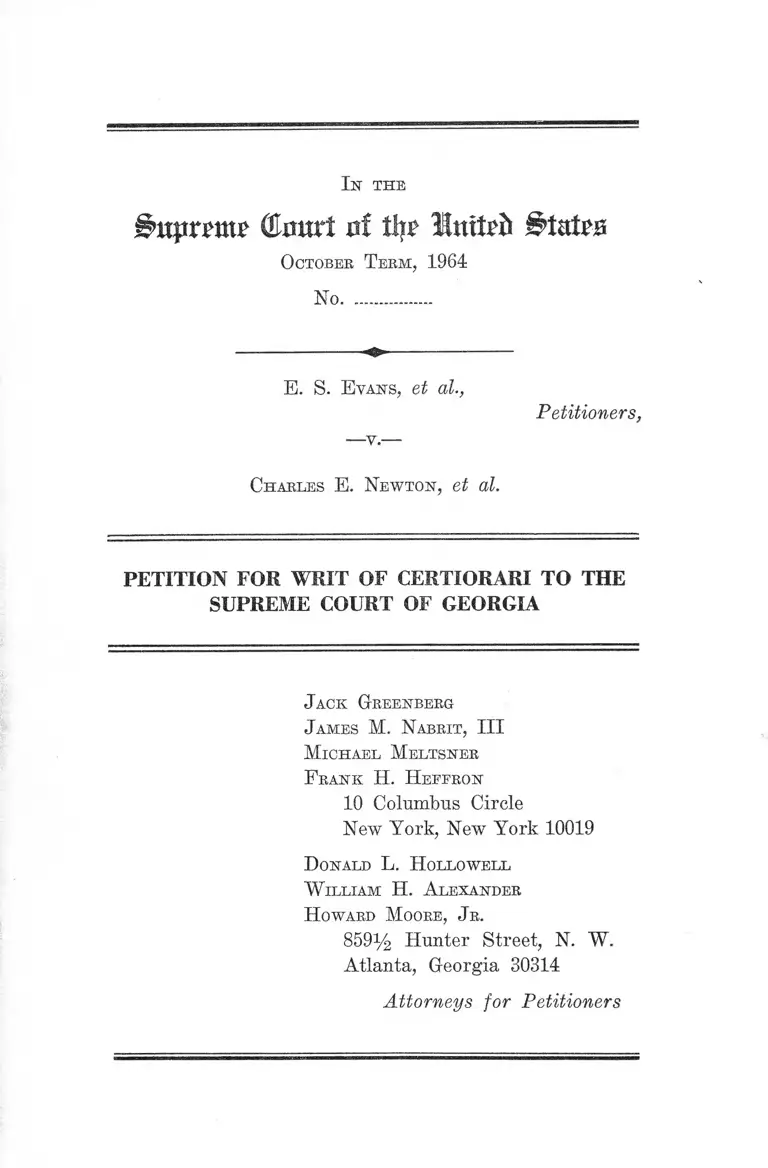
I n t h e
j^ttprem? ©Hurt of % Itttteft States
October Term, 1964
No..................
E. S. E vans, et al,
Petitioners,
—v.—
Charles E. Newton, et al.
PETITION FOR WRIT OF CERTIORARI TO THE
SUPREME COURT OF GEORGIA
J ack Greenberg
J ames M. Nabrit, III
Michael Meltsner
F rank H. IIeferqn
10 Columbus Circle
New York, New York 10019
D onald L. H ollowell
W illiam H. A lexander
H oward Moore, Jr.
859% Hunter Street, N. W.
Atlanta, Georgia 30314
Attorneys for Petitioners
I N D E X
Opinion Below ......................... .......................................... 1
Jurisdiction ............ .............. ......... ..................................... 2
Questions Presented ..................................... ................... . 2
Statutory and Constitutional Provisions Involved____ 3
Statement ..... ..... ..... ....................... ......... .......... .............. 5
How the Federal Questions Were Raised and Decided
Below ............... ..................... .............. ..... ....... ....... ...... 9
Reasons for Granting the Writ .......... ..................... ...... 12
I. This Case Involves Enforcement by the State
of Racial Discrimination in Violation of the
Fourteenth Amendment ..... ............ .......... ....... 12
II. The State of Georgia and the City of Macon
Are So Involved in the Operation of Bacons-
field as to Invalidate Under the Fourteenth
Amendment Any Enforcement of the Racially
Discriminatory Terms of Senator Bacon’s
Will ..... .......................................... ................... . 17
Conclusion..................... .......... ............. ....... ..................... 25
A ppendix....... ............ ..... ......... ................ .......... ......... ..... . la
Opinion of Supreme Court of Georgia _______ __ la
Judgment of Supreme Court of Georgia ........... 10a
Order of Supreme Court of Georgia Denying
Rehearing ........................ .......... ................... .......... 10a
PAGE
n
Letter Opinion of Superior Court of Bibb County .. 11a
Order of Superior Court of Bibb County............... 13a
PAGE
Table of Cases
Adams v. Bass, 18 Ga. 130 (1855) ..... ...... .......... ........... 19
American Colonization Society v. Gartrell, 23 Ga. 448
(1858) ............................................................................... 19
Beckwith v. Rector, etc., of St. Philip’s Parish, 69 Ga.
564 (1882) ................................ ...... .................................. 21
Burton v. Wilmington Parking Authority, 365 U. S.
715 ........................................................................ 17,20
Charlotte Park and Recreation Comm’n v. Barringer,
242 N. C. 311, 88 S. E. 2d 114 (1955), cert, denied,
350 IT. S. 983 ......................... .............. ................. ......... . 14
Cox v. De Jarnette, 104 Ga. App. 664, 123 S. E. 2d 16
(1961) ................................. 22
Creech v. Scottish Rite Hosp. for Crippled Children,
211 Ga. 195, 84 S. E. 2d 563 (1954) .............................. 16
Eaton v. Grubbs, 329 F. 2d 710 (4th Cir. 1964) ....... 21, 24
Emory University v. Nash, 218 Ga. 317, 127 S. E. 2d
798 (1962) ................. .............. ................ ..................... . 21
Estate of Stephen Girard, 391 Pa. 434, 138 A. 2d 844
(1958) .............. ..11,15
Goree v. Georgia Industrial Home, 187 Ga. 368, 200
S. E. 684 (1938) ............. ................... ......... ................... 21
Guillory v. Administrators of Tulane University, 212
F. Supp. 674 (E. D. La. 1962) .................. .................... 16
Holmes v. City of Atlanta, 350 U. S. 879 12
Ill
Jones v. City of Atlanta, 35 App. 376, 133 S. E. 521
(Ga. Ct. App. 1926) .............. .......... ............... ............. 23
Leeper v. Charlotte Park and Recreation Comm’n, 2
Race Rel. L. Rep. 411 (Super. Ct. Mecklenburg
County 1957) ......... .... ....... ........ ......... ................. ..... . 14
Lombard v. Louisiana, 373 U. S. 267 .......................15,16,17
Marsh v. Alabama, 326 U. S. 501 .................... ...... ....... 24
Morehouse College v. Russell, 219 Ga. 717, 135 S. E. 2d
432 (1964) ____________ ____________ ______ __________ 22
Morehouse College v. Russell, 109 Ga, App. 301, 136
S. E. 2d 179 (1964) .......................... ........ ........... .......... 22
Morton v. Savannah Hospital, 148 Ga. 438, 96 S. E.
887 (1918) ................................ ...................................... 22
Muir v. Louisville Park Theatrical Ass’n, 347 U. S.
971 ..................................................................................... 12
Murphy v. Johnston, 190 Ga. 23, 8 S. E. 2d 23 (1940) ... 23
Pace v. Dukes, 205 Ga. 835, 55 S. E. 2d 367 (1949) 23
Pennsylvania v. Board of Directors of City Trusts
of the City of Philadelphia, 353 U. S. 230 ......... 11,12,13,
14,15,17
Pennsylvania v. Board of Directors of City Trusts
of the City of Philadelphia, 357 U. S. 570 ..... ......... 11,15
Peterson v. City of Greenville, 373 U. S. 244 .....15,16,17,
19, 20
Regents of University System v. Trust Company of
Georgia, 186 Ga. 498, 198 S. E. 345 (1938) ......... 23
Rice University v. Carr, 9 Race Rel. L. Rep. 613 (D. C.
Harris County, Tex. 1964), appeal dismissed, No.
14,472, Tex. Ct. Civ. App., February 4, 1965 ........... 16
Robinson v. Florida, 378 U. S. 153...... ............. ...11, 16,17,19
PAGE
IV
Shelley v. Kraemer, 334 U. S. 1 ...................................... 14,15
Simians v. Moses H. Cone Memorial Hospital, 323
F. 2d 929 (4th Cir. 1963), cert, denied, 376 U. S.
938 ........................................ ...... ........ ............... .. .......... 24
Simpson v. Anderson, 220 Ga. 155, 137 S. E. 2d 638
(1964) ................................ .......... .......... ..... ............ . 21
Smith v. Allright, 321 U. S. 649 ........... ......................... . 24
Stubbs v. City of Macon, 78 Ga. App. 237, 50 S. E. 2d
866 (1948) ........................... 22
Terry v. Adams, 345 U. S. 461..... .............. .............. ....... 24
Turner v. City of Memphis, 369 IT. S. 350 ....................... 17
Watson v. City of Memphis, 373 IT. S. 562 ................. 12
Statutes
28 IT. S. C. §1257(3) ..................................... ............... . 2
Const. Ga. 1877, art. 7, sec. 2, par. 1, Ga. Code Ann.
§2-5002 ................ 20
Const. Ga. 1945, art. 7, sec. 1, par. 4, Ga. Code Ann.
§2-5404 ......... ......................... ............... .......... .................. 3, 21
Ga. Code Ann. §69-301 ................. ....... ..... ........ ....... . 22
Ga. Code Ann. §69-504 .............. ....................... 5, 9,10,11,14,
18,19, 21, 23
Ga. Code Ann. §69-505 ................................................ ..... 20
Ga. Code Ann. §§69-601 through 69-616.......................... 24
Ga. Code Ann. §85-707 .................................. ............ ....... 23
Ga. Code Ann. §92-201 ..................................................... 4, 21
Ga. Code Ann. §108-201 ............................................... 21
PAGE
V
Ga. Code Ann. §108-202 _______ __ ____________......10,16, 22
Ga. Code Ann. §108-203 ...................................................... 21
Ga. Code Ann. §108-204 .......................................... ........... 22
Ga. Code Ann. §§108-206 through 108-209 ................ 22
Ga. Code Ann. §108-212 (1963 Supp.) .......................... 22
Pa. Stat. Ann., tit. 18, §4654 .............................. ..... ......... 15
PAGE
Other A uthorities
American Bar Association, Canons of Professional
Ethics, No. 10 ....................................................... ..... . 16
Clark, Charitable Trusts, the Fourteenth Amendment,
and the Will of Stephen Girard, 66 Yale L. J. 979
(1957) ..................... ............................ ................. ........... 24
Woodward, The Strange Career of Jim Crow, Ch. II
(1957) ........ ........... ........................................................... 19
In t h e
(Eflurt of % Imtpf* States
October Term, 1964
No..................
E. S. E vans, et al.,
Petitioners,
Charles E. Newton, et al.
PETITION FOR WRIT OF CERTIORARI TO THE
SUPREME COURT OF GEORGIA
Petitioners pray that a writ of certiorari issue to re
view the judgment of the Supreme Court of Georgia in
the case of E. S. Evans, et al. v. Charles E. Newton, et al.,*
entered on September 28, 1964. Rehearing was denied on
October 8,1964. Mr. Justice Stewart, on December 22, 1964,
granted an order extending the time for filing this petition
for writ of certiorari to and including March 5, 1965.
Opinion Below
The opinion of the Supreme Court of Georgia (R. 132) is
reported at 138 S. E. 2d 573 and is set forth in the appendix
infra, p. la.
* Petitioners are E. S. Evans, Louis H. Wynn, J. L. Key, Booker
W. Chambers, William Randall, and Van J. Malone. The respon
dents are all parties who were defendants in error in the Supreme
Court of Georgia. See note 5 infra.
2
Jurisdiction
The judgment of the Supreme Court of Georgia in this
case was entered on September 28, 1964 (R. 147). Rehear
ing was denied October 8, 1964 (R. 153). On December 22,
1964, Mr. Justice Stewart extended the time for filing the
petition for writ of certiorari to and including March 5,
1965.
The jurisdiction of this Court is invoked pursuant to
Title 28, U. S. C. §1257(3), petitioners having asserted
below and asserting here deprivation of rights, privileges
and immunities secured by the Constitution of the United
States.
Questions Presented
1. Land was left in trust to the City of Macon, Georgia,
for use as a public park for the exclusive use of white
women and children; the city administered the park on a
discriminatory basis through an appointed board of man
agers; after Negroes were allowed to use the park, the city
and the board of managers petitioned a court of equity to
appoint new trustees so that Negroes might be excluded
from the park; the court appointed new trustees for that
purpose. Is the state thereby enforcing racial discrimina
tion contrary to the Fourteenth Amendment?
2. In the above circumstances a state statute authorized
gifts of land in trust for the establishment of parks
limited to white women and children; the state granted
tax exemption to such trusts only if use of such parks were
limited according to race; the state by law encouraged the
establishment of charitable trusts to fulfill a public function
of providing public recreational facilities; the state granted
3
limited liability in tort eases to such charitable institutions;
the state granted them perpetual existence, unlike non-
charitable trusts; and the City of Macon administered the
park for years on a discriminatory basis. Has the state
become involved in the operation of the park to such an
extent as to require the applicability of the equal protection
clause of the Fourteenth Amendment?
Statutory and Constitutional Provisions Involved
This case involves Section 1 of the Fourteenth Amend
ment to the Constitution of the United States.
This case also involves the following constitutional and
statutory provisions of the State of Georgia:
Const. Ga. 1945, art. 7, sec. 1, par. 4, Ga. Code Ann.
§2-5404:
Exemptions from taxation.—The General Assembly
may, by law, exempt from taxation all public property;
places of religious worship or burial and all property
owned by religious groups used only for residential
purposes and from which no income is derived; all
institutions of purely public charity; all intangible per
sonal property owned by or irrevocably held in trust
for the exclusive benefit of, religious, educational and
charitable institutions, no part of the net profit from
the operation of which can inure to the benefit of any
private person; all buildings erected for and used as a
college, incorporated academy or other seminary of
learning, and also all funds or property held or used
as endowment by such colleges, incorporated academies
or seminaries of learning, provided the same is not in
vested in real estate; and provided, further, that said
exemptions shall only apply to such colleges, incorpo
4
rated academies or other seminaries of learning as are
open to the general public; provided further, that all
endowments to institutions established for white peo
ple, shall be limited to white people, and all endow
ments to institutions established for colored people,
shall be limited to colored people; . , .
Gu. Code Ann. §92-201:
Property exempt from taxation.—The following de
scribed property shall be exempt from taxation, to w it:
All public property; places of religious worship or
burial, and all property owned by religious groups used
only for single family residences and from which no
income is derived; all institutions of purely public char
ity ; hospitals not operated for the purpose of private or
corporate profit and income; all intangible personal
property owned by or irrevocably held in trust for the
exclusive benefit of, religious, educational and chari
table institutions, no part of the net profit from the
operation of which can inure to the benefit of any pri
vate person; all buildings erected for and used as a
college, nonprofit hospital, incorporated academy or
other seminary of learning, and also all funds or prop
erty held or used as endowment by such colleges; non
profit hospitals, incorporated academies or seminaries
of learning, providing the same is not invested in real
estate; and provided, further, that said exemptions
shall only apply to such colleges, nonprofit hospitals,
incorporated academies or other seminaries of learn
ing as are open to the general public: Provided, fur
ther, that all endowments to institutions established
for white people, shall be limited to white people, and
all endowments to institutions established for colored
people, shall be limited to colored people; . . .
5
Ga. Code Ann. §69-504:
Gifts for public parks or pleasure grounds.—Any
person may, by appropriate conveyance, devise, give, or
grant to any municipal corporation of this State, in
fee simple or in trust, or to other persons as trustees,
lands by said conveyance dedicated in perpetuity to the
public use as a park, pleasure ground, or for other
public purpose, and in said conveyance, by appropriate
limitations and conditions, provide that the use of said
park, pleasure ground, or other property so conveyed
to said municipality shall be limited to the white race
only, or to white women and children only, or to the
colored race only, or to colored women and children
only, or to any other race, or to the women and children
of any other race only, that may be designated by said
divisor or grantor; and any person may also, by such
conveyance, devise, give, or grant in perpetuity to such
corporations or persons other property, real or per
sonal, for the development, improvement, and mainte
nance of said property.
Statement
This suit was commenced by some of the respondents to
effect the banishment of Negroes from a public park estab
lished in Macon, Georgia under the will of Augustus Oc
tavius Bacon, a United States senator from Georgia. The
will of Senator Bacon (R. 19), executed on March 28, 1911,1
provided in Item 9th for a gift of real property to the City
of Macon as owner and trustee for the maintenance of a
park for the white women and children2 of the City of
1A codicil was added September 6, 1913 (R. 43).
2 The Board of Managers was given discretion to open the park
to white men and white non-residents of Macon (R. 31). This
power was exercised (R. 15).
6
Macon, under the supervision of a Board of Managers ap
pointed by the Mayor and Council (R. 27). The will set
aside a separate fund in trust to defray expenses of ad
ministering the park (R. 34). The park, named Baconsfield,
was operated in accordance with the racial limitation in
Bacon’s will until a short time before this suit was insti
tuted, when Negroes were allowed to use the park (R. 15).
On May 4, 1963, Charles E. Newton and other members
of the Board of Managers of Baconsfield3 filed a petition
in the Superior Court of Bibb County, Georgia, requesting
the removal of the City of Macon as trustee, the appoint
ment of new trustees, and the transfer of title in Bacons
field to newly appointed trustees. Named as defendants
were the City of Macon and the trustees of certain residu
ary legatees of Bacon’s estate, the Curry heirs.4 This relief
was sought explicitly for the purpose of enforcing the ra
cially discriminatory terms of Bacon’s will (R. 12-17).
The City of Macon filed its answer (R. 47) admitting
most allegations of the petition, but stating that it had
“ no authority to enforce racially discriminatory restric
tions with regard to property held in fee simple or as trus
tees for a private or public trust and, as a matter of law,
is prohibited from enforcing such racially discriminatory
restrictions” (R. 48). The defendant trustees for the Curry
heirs filed their answer admitting all allegations of the
petition and joining in “ each and every prayer of said
petition” (R. 51); they were represented by the same coun
sel as the plaintiff members of the Board of Managers (R.
3 The Board of Managers did not sue as an entity. Each member
sued, through private counsel, in his capacity as member of the
Board (R. 12).
4 The trustees for the Curry heirs were Guyton G. Abney,
J. D. Crump, T. I. Denmark and Dr. W. G. Lee (R. 12).
7
17, 51). Plaintiffs filed a motion for summary judgment
(E. 54).
On May 29, 1963, a diversity of interest appeared in this
lawsuit for the first time when Rev. E. S. Evans and five
other Negro citizens of the City of Macon, petitioners here,
moved for leave to file a petition in intervention (R. 56).
In their intervention petition of June 18, 1963, the Negro
intervenors alleged that the appointment of new trustees
of the park in order to comply with the racial limitation in
Bacon’s will would violate the Fourteenth Amendment (R.
61). The intervenors requested that the Superior Court
“ effectuate the general charitable purpose of the testator
to establish and endow a public park within the City of
Macon by refusing to appoint private persons as trustees”
of the park (R. 62-63). Their petition also challenged the
plaintiffs’ standing to sue (R. 63).
On January 8, 1964, the plaintiff members of the Board
of Managers filed an amendment to their original petition
requesting that all Negroes be enjoined from using the
park (R. 65). The amendment requested the addition as
plaintiffs of four previously unrepresented residuary lega
tees under Bacon’s will, the Sparks heirs (R. 66); a request
was also made that the trustees of the Curry heirs, origi
nally joined as defendants, be permitted to assert the in
terests of the Curry heirs as plaintiffs (R. 67). Simul
taneously, the Sparks heirs intervened, asking that all
relief requested by the original plaintiffs be granted (R.
69). Also at the same time, the trustees for the Curry
heirs asked to be allowed to assert their interests as plain
tiffs, and joined in all of the plaintiffs’ prayers for relief
(R. 72). In addition, the Sparks heirs and the trustees for
the Curry heirs, all of whom were represented by counsel
for the plaintiff Board members, asked for reversion of
the trust property into Bacon’s estate in the event that
other relief were denied (R. 70, 74).
8
On February 5, 1964, the City of Macon, the only defen
dant making any pretense of defending the suit, amended
its answer stating that the City had resigned as trustee of
Baconsfield (R. 94) pursuant to resolution of the Mayor
and Council on February 4, 1964 (R. 79), and requesting
the court’s acceptance of its resignation and the appoint
ment of substitute trustees (R. 76).
On May 5, 1964, the Negro intervenors amended their
petition, alleging that the Fourteenth Amendment would
be violated if the relief sought by the other parties were
granted (R. 95).
No evidentiary hearing was held. The Superior Court
issued its decree on March 10, 1964, allowing intervention
by all who had requested it, accepting the resignation of
the City of Macon as trustee of Baconsfield, appointing
three private individuals as new trustees, and retaining
jurisdiction of the case (R. 99). No ruling was made on
the requests that Negroes be enjoined from using the park.
The conditional prayers for reversion of the trust property
were deemed moot (R. 100).
Appeal was taken to the Supreme Court of Georgia by
petitioners, the Negro intervenors.5 On September 28, 1964,
the Supreme Court of Georgia affirmed the judgment of
5 The defendants in error on the appeal were the City of Maeon,
the four Sparks heirs, the four trustees for the Curry heirs, and
the three newly appointed trustees of the park. By amendment to
the bill of exceptions, ̂the original plaintiffs, the members of the
Board of Managers of Baconsfield, were added as defendants in
error on the appeal (R. 105, 110, 130). Subsequent to the decree
of the Superior Court, all seven members of the Board of Man
agers of Baconsfield submitted their resignations to the three newly
appointed trustees of the park (R. 115). The trustees then re
appointed three of the members of the Board of Managers and
substituted four new members of the Board (R. 116). All members
of the Board of Managers, whether original appointees or new
appointees, "were made parties to the appeal (R. 131).
9
the Superior Court of Bibb County. A motion for rehear
ing was denied on October 8, 1964 (R. 153).
How the Federal Questions Were Raised
and Decided Below
The federal constitutional issues, on which this case
turned, were raised at the outset by the Negro intervenors,
petitioners here, in their intervention petition (R. 59).
There it was alleged that enforcement of the racial limita
tion in Bacon’s will by a court of the State of Georgia “ is
violative of the Fourteenth Amendment to the United
States Constitution” (R. 61). It was also alleged that “dis
crimination based solely upon race is no longer a permis
sible object of state action whether such action is that of
an administrative agency, the state executive officers and
employees, the state legislature, or the state courts” (R.
62). The intervenors requested that the Superior Court
“ effectuate the general charitable purpose of the testator”
by refusing to appoint private trustees (R. 62-63).
Following the intervention of Bacon’s heirs and the res
ignation of the City of Macon, the Negro intervenors
amended their petition, alleging: 1) that the “ equal pro
tection clause of the Fourteenth Amendment to the United
States Constitution prohibits this Court from enjoining
Negroes from use of the park” , 2) that “ the equal protec
tion clause of the Fourteenth Amendment” prohibits ac
ceptance of the City’s resignation and the appointment of
new trustees “ for the purpose of enjoining [sic] [enforc
ing] the racially discriminatory provision in the will of
A. 0. Bacon,” 3) that §69-504 of the Georgia Code6 “pre
scribes racial discrimination and is therefore violative of
6 Section 69-504 of the Georgia Code authorized gifts of prop
erty to municipalities for the operation of parks “for white women
and children” and other racially designated classes, supra, p. 5.
10
the equal protection clause to the Fourteenth Amendment” ,
and 4) that §108-202 of the Georgia Code (the cy pres
provision) “ properly construed, requires that the racially
discriminatory provision in A. 0. Bacon’s will be declared
null and void” (R. 95-96).
The order of the Superior Court of Bibb County rejected
the constitutional claims of the Negro intervenors by im
plication (R. 99). Upon issuing its order and decree, Judge
Long of the Superior Court wrote a letter to counsel for
all parties stating that the “ racial limitation in Senator
A. O. Bacon’s will is not unlawful for any reason as con
tended by the intervenors, Reverend E. S. Evans, et al.”
The letter also said that the appointment of new trustees
was proper since the City of Macon, acting as trustee,
could not “ apply constitutionally the racial criterion pre
scribed by the testator.” The doctrine of cy pres was held
to be inapplicable to this trust. Appendix, infra, p. 11a.
On appeal the Supreme Court of Georgia affirmed the
ruling of the Superior Court (R. 147), deciding all issues
adversely to petitioners. In its opinion the Supreme Court
of Georgia stated: “ Counsel for the plaintiffs in error
(the Negro intervenors) assert that the decree of the
judge of the superior court was ‘patent enforcement of
racial discrimination contrary to the equal protection
clause of the Fourteenth Amendment’ to the Federal Con
stitution” (R. 141). The court rejected this contention. It
also held that Ga. Code Ann. §69-504 did not require that
Senator Bacon’s gift to the City include a racial limitation
and held that such a racial limitation was not invalid (R.
142-143). The Supreme Court of Georgia rejected peti
tioners’ contention that the racial limitation should be
stricken under the cy pres doctrine (R. 143-144). Finally,
it held that the action of the Superior Court in accepting
the City’s resignation as trustee and appointing private
11
trustees was consistent with this Court’s ruling in Penn
sylvania v. Board of Directors of City Trusts of the City
of Philadelphia, 353 U. S. 230, pointing out that the Su
preme Court of Pennsylvania subsequently approved the
appointment of private trustees for Girard College and
this Court dismissed the appeal and denied certiorari,
Estate of Stephen Girard, 391 Pa. 434,138 A. 2d 844 (1958);
Pennsylvania v. Board of Directors of City Trusts of the
City of Philadelphia, 357 U. S. 570 (R. 144-146).
Petitioners moved for a rehearing, contending that Ga.
Code Ann. §69-504, providing for gifts of real property to
municipalities for the benefit of white persons or for the
benefit of Negro persons, brought this case within the hold
ing of this Court in Robinson v. Florida, 378 U. S. 153,
which held that a state regulation requiring desegregated
restaurants to provide racially separate rest-room facilities
constituted state encouragement of segregation in violation
of the Fourteenth Amendment (R. 149). The Supreme
Court of Georgia denied rehearing without opinion (R.
153).
12
Reasons for Granting the Writ
The decision below conflicts with applicable decisions
of this Court on important constitutional issues.
I.
This Case Involves Enforcement by the State of
Racial Discrimination in Violation of the Fourteenth
Amendment.
This is a classic case of state enforcement of racial dis
crimination by every branch of government, legislative,
executive, administrative, and judicial. The responsibility
of each branch is no less than in the many cases prohibiting
discrimination in public recreational facilities, e.g., Wat
son, v. City of Memphis, 373 U. S. 562; Holmes v. City of
Atlanta, 350 U. S. 879; Muir v. Louisville Park Theatrical
Ass’n, 347 U. S. 971.
The suit began when the members of the Board of Man
agers of Baconsfield, who had been enforcing racial dis
crimination for generations, sued for relief that would
enable them to resume the practice. Under Bacon’s will,
the Board members were appointees of the Mayor and
Council of Macon' with the sole function of administering
the park owned in trust by the City (R. 31). They must be
regarded as part of the administration of the City of
Macon. See Pennsylvania v. Board of Directors of City
Trusts, 353 U. S. 230.
Significantly, the Board of Managers did not sue as a
collective entity, but each member sued individually in his
capacity as a member of the Board. Presumably, if the 7
7 All seven appointees must be white, at least four must be women
and one should be a descendant of Senator Bacon, if possible (r !
13
Board had sued as a body, it would have been entitled, as
a municipal agency, to representation by the City Attor
ney. Since the principal defendant was the City of Macon,
the nonadversary, sham nature of the suit would have been
exposed from the beginning if this had occurred. In any
event, the Board members suing individually were treated
as competent parties.
The involvement of the executive and legislative branches
of City government is evident also. In the first instance,
the City failed to exercise its control over its own litigation
by preventing the suit altogether. As defendant, the City
put up the weakest kind of defense. It did not even sug
gest to the Superior Court that the Board members, suing
individually, lacked the capacity to represent an agency of
the City (R. 47). At no time did the City raise any objec
tions, constitutional or otherwise, to the transfer of its
public park to other trustees (R. 49). Eventually, the City,
acting through its Mayor and Council, caved in completely,
voluntarily submitting its resignation (R. 94), and joining
in the plaintiffs’ request that the new trustees be appointed
so that Negroes could be excluded again from Baconsfield
(R. 76).
Undoubtedly the City could have prevented the result
brought about by this suit. Several municipalities have
received gifts from private donors mandating racial dis
crimination in the use of the property transferred. Faced
with the conflict between the terms of the gift and the re
quirements of the Constitution, they have continued to use
donated resources and ignored governmentally unenforce
able limitations rather than devise schemes for private dis
criminatory operation.8 In the Girard College Case, where
8 The City of Charlotte purchased the reversionary interest from
the heirs of a testator who required racial discrimination, so that
the City could continue to provide recreational facilities for its
14
the Board of Directors of City Trusts was a statutory body
with independent power to sue, the City of Philadelphia
and the State of Pennsylvania entered the suit through
their official counsel, respectively, on the side of the Four
teenth Amendment, 353 U. S. 230. By contrast, the Mayor
and the Council of the City of Macon bear direct, if
not primary, responsibility for the racial discrimination
brought about by this suit.
The responsibility of Georgia’s judiciary is apparent on
the surface. Two of Georgia’s courts held that the dis
criminatory terms of a private instrument must be given
effect, despite the Fourteenth Amendment, to insure the
exclusion of Negroes from a place of public accommodation.
It is submitted that this result was foreclosed by Shelley
v. Kraemer, 334 U. S. 1.
In many ways, state involvement was less clear in
Shelley than here. In Shelley, the instrument containing
the discriminatory clause was an agreement between pri
vate parties, in which the state had no part. The lawsuit in
Shelley represented a genuine controversy between private
parties—Negroes who wanted to maintain their home and
other home owners who wanted to secure the exclusion of
Negroes from the neighborhood, a putative right obtained
in the bargaining process. Finally, the subject of the law
suit in Shelley was a private home, rather than a place of
public accommodation.
In this case, the racial limitation was encouraged by,
imposed upon, and accepted by the state. Section 69-504
of the Georgia Code invited Senator Bacon to restrict use
citizens, Leeper v. Charlotte Park and Recreation Comm’n, 2 Race
Eel. L. Rep. 411 (Super. Ct. Mecklenburg County 1957), even
though the racial limitation had been held valid, Charlotte Park
and Recreation Comm’n v. Barringer, 242 N. C. 311, 88 S. E. 2d
114 (1955), cert, denied, 350 U. S. 983.
15
of the park to the women and children of one race.” The
limitation was accepted and enforced by the City and its
agents for many years, including several years following
this Court’s decision in the Girard College Case. In the
spring of 1963, a turning point for civil rights in this coun
try, Negroes were allowed to use the recreational facilities
of Baconsfield because the City recognized that overt en
forcement of discrimination by the state would no longer be
tolerated. But City officials promptly went to court and
asked that private trustees be substituted so that discrim
ination could be reintroduced under private supervision.
Whether the original proponents be viewed as City
agents or the City itself, it was an instrumentality of the
state that sought judicial enforcement of discrimination
in this case. Cf. Lombard v. Louisiana, 373 U. S. 267,
where an official policy of segregation in restaurants was
held to invalidate trespass convictions of Negroes who
challenged that policy. It is of minor importance that the
racial limitation on use of Baconsfield can be traced to an
individual owner of private property. That was true in
the first Girard College Case, 353 IT. S. 230, where it was
held that the policy could not be enforced by a state
agency.9 10 It was also true in Shelley v. Kraemer. More
over, this Court held in Peterson v. City of Greenville, 373
9 See pp. 18-20, infra.
10 In the second Girard College Case, the Supreme Court of
Pennsylvania approved the appointment of private trustees to con
tinue discriminatory operation. Estate of Stephen Girard, 391
Pa. 434, 138 A. 2d 844 (1958), appeal dismissed and cert, denied,
357 U. S. 570. Petitioners challenge the correctness of the ruling
of the Supreme Court of Pennsylvania. This Court’s refusal to
review may be read in the light of the possible availability of relief
for the Negro plaintiffs in the courts of Pennsylvania under Pa.
Stat. Ann., tit. 18, §4654, forbidding racial discrimination in “pri
mary and secondary schools, high schools, academies, colleges and
universities, extension courses and all educational institutions un
der the supervision of this Commonwealth. . . . ”
1 6
U. S. 244, that there are times when the private role in
originating officially enforced policies of discrimination
will not be considered. See also Lombard v. Louisiana, 373
U. S. 267 and Robinsonv. Florida, 378 U. S. 153.
Nor is it important that the private heirs of Senator
Bacon joined with the members of the Board of Managers
in the request for enforcement of the restriction in Bacon’s
will. They did so only as an afterthought, and they were
represented by the same attorneys as the Board members.
Thus their interests must have been identical with those
of the Board members. See American Bar Association,
Canons of Professional Ethics, No. 10.
Finally, it should be noted that the courts of Georgia
refused to apply the doctrine of cy pres. Under this doc
trine, which is firmly established in Georgia as a means
of effectuating a testator’s charitable intent, see Ga. Code
Ann. §108-202; Creech v. Scottish Rite Hosp. for Crippled
Children, 211 Ga. 195, 84 S. E. 2d 563 (1954), the Superior
Court could have ensured the maintenance of a public park,
permitted white persons to continue using it, and retained
City administration by refusing to appoint new trustees.
Instead it chose the course which would permit racial dis
crimination. Compare Guillory v. Administrators of Tulane
University, 212 F. Supp. 674, 687 (E. D. La. 1962) (admin
istrators under discriminatory will allowed to desegre
gate) ; Rice University v. Carr, 9 Race Rel. L. Rep. 613
(D, C. Harris County, Tex. 1964), appeal dismissed, No.
14,472, Tex. Ct. Civ. App., February 4, 1965 (same).
17
II.
The State o f Georgia and the City o f Macon Are So
Involved in the Operation o f Baconsfield as to Invali
date Under the Fourteenth Amendment Any Enforce
ment o f the Racially Discriminatory Terms o f Senator
Bacon’ s Will.
As this Court held in Burton v. Wilmington Parking Au
thority, 365 U. S. 715, 722, discrimination by private entities
is invalid under the Fourteenth Amendment if “ to some
significant extent the State in any of its manifestations has
been found to have become involved in it.” In Burton and
in Turner v. City of Memphis, 369 U. S. 350, this reasoning
was held to justify injunctive relief against the institutions
practicing discrimination. In Peterson v. City of Green
ville, 373 U. S. 244, the same reasoning was applied to in
validate criminal trespass convictions, where a local or
dinance required discrimination by private restaurateurs.
See also Lombard v. Louisiana, 373 U. S. 267; Robinson v.
Florida, 378 U. S. 153. It is submitted that the involvement
of the State of Georgia and the City of Macon in the opera
tion of Baconsfield invalidates the result reached in this
case.
One factor meriting serious consideration under this
heading is the fact that racial discrimination has been en
forced by each department of government, as pointed out in
the previous argument. Another factor of significance is the
continuous ownership and operation of Baconsfield on a
discriminatory basis for a substantial length of time. It is
settled under the first Girard College Case that continued
operation by municipal authorities would make further ex
clusion of Negroes impossible. The question now presented
is whether it is possible to wipe away the effects of city
administration merely by appointing new trustees.
18
According to Bacon’s will, the Board of Managers was
given “ complete and unrestricted control and management
of the said property with power to make all needful regu
lations for the preservation and improvement of the
same . . . ” (R. 31). Bacon provided funds for
the management, improvement and preservation of said
property, including when possible drives and walks,
casinos and parlors for women, playgrounds for girls
and boys and pleasure devices and conveniences and
grounds for children, flower yards and other orna
mental arrangements . . . (R. 32).
He expressed the hope that the Board of Managers would
preserve his two houses (R, 33) and “ the present woods
and trees” on the property (R. 34). In the years of their
administration the City and the Board of Managers have
exercised the discretion granted them. They have decided
what types of facilities to provide, what buildings to pre
serve and for what purposes, and whether to alter the land
scape. The City was in control during the years when
Baconsfield took shape as an institution open to the public.
The effects of its administration remain.
A fact of critical importance in this case is the State of
Georgia’s responsibility for the original restriction of
Baconsfield to a distinct racial group. Section 69-504 of
the Georgia Code, enacted in 1905, well before Bacon pub
lished his carefully drafted will, provides:
Any person may, by appropriate conveyance, devise,
give, or grant to any municipal corporation of this
State, in fee simple or in trust, or to other persons as
trustees, lands by said conveyance dedicated in per
petuity to the public use as a park, pleasure ground,
or for other public purpose, and in said conveyance, by
appropriate limitations and conditions, provide that the
19
use of said park, pleasure ground, or other property
so conveyed to said municipality shall be limited to the
white race only, or to white women and children only,
or to the colored race only, or to colored women and
children only, or to any other race, or to the women
and children of any other race only, that may be desig
nated by said devisor or grantor; and any person may
also, by such conveyance, devise, give, or grant in per
petuity to such corporations or persons other property,
real or personal, for the development, improvement,
and maintenance of said property.
Many choices were offered to donors. Lands could be dedi
cated to the exclusive use of the white race, the colored
race, or any other race, or the women and children of the
white race, the colored race, or any other race. But no
choice was offered for those who might have preferred to
endow an integrated park.
The Supreme Court of Georgia held in this case that
§69-504 did not require that gifts be limited racially (R.
142), but no such construction was in existence to guide
testators and their attorneys in 1911 when Bacon wrote
his will. Men are careful to conform to the letter of the
law when preparing their wills. This statute was passed
during the time when segregation laws were sweeping the
South, see Woodward, The Strange Career of Jim Crow,
Ch. II (1957), and its words revealed a separatist intent.
The unhappy fate of pre-Civil War testamentary trusts for
the emancipation or resettlement of slaves stood as a warn
ing to any who might depart from the explicit directions of
the statute. See Adams v. Bass, 18 Ga. 130 (1855); Amer
ican Colonization Society v. Gartrell, 23 Ga, 448 (1858).
The rule of Peterson v. City of Greenville, 373 IT. S. 244
and Robinson v. Florida, 378 U. S. 153 applies. The State
2 0
of Georgia suggested that Senator Bacon limit his gift to
one of several racial classes, and he did so, following the
words of the statute very closely (R. 30). In these circum
stances, Senator Bacon’s personal motives—explicitly set
forth at some length in his will (R. 32-33)—are of no conse
quence; “ a palpable violation of the Fourteenth Amendment
cannot be saved by attempting to separate the mental urges
of the discriminators.” Peterson v. City of Greenville, 373
IT. S. 244, 248. Georgia expressly authorized racial restric
tions in §69-504 and, in a companion statute, §69-505, offered
enforcement of them through the police power.11 See Burton
v. Wilmington Parking Authority, 365 U. S. 715, 726
(Stewart, J., concurring).
Reinforcing these statutes, the law of Georgia has for
many years conditioned tax exemption on the existence of
segregation. At least since 1877, the Constitution has au
thorized exemption from taxation for “all institutions of
purely public charity.” Ga. Const. 1877, art. 7, sec. 2, par. 1,
Ga. Code Ann. §2-5002. In 1918 an amendment to the Con
stitution included a proviso that “ all endowments to insti
tutions established for white people, shall be limited to
white people, and all endowments to institutions established
for colored people, shall be limited to colored people; . . . ”
Editorial note, Ga. Const. 1877, art. 7, sec. 2, par. 1, Ga.
11 Ga. Code Ann. §69-505 provides:
Municipality authorized to accept.—Any municipal corpora
tion, or other persons natural or artificial, as trustees, to whom
such devise, gift, or grant is made, may accept the same in
behalf of and for the benefit of the class of persons named in
the conveyance, and for their exclusive use and enjoyment;
with the right to the municipality or trustees to improve,
embellish, and ornament the land so granted as a public park,
or for other public use as herein specified, and every municipal
corporation to which such conveyance shall be made shall
have power, by appropriate police provision, to protect the
class of persons for whose benefit the devise or grant is made,
in the exclusive used and enjoyment thereof.
21
Code Ann. §2-5002. This exemption and proviso were car
ried over into the statute setting forth tax exemptions, (la.
Code Ann. §92-201, and readopted in the Georgia Constitu
tion of 1945, art. 7, sec. 1, par. 4, Ga. Code Ann. §2-5404.12
Tax exemption is always a valuable subsidy, and “may
attain significance when viewed in combination with other
attendant state involvements.” Eaton v. Grubb.s, 329 F. 2d
710 (4th Cir. 1964). Senator Bacon was eager to obtain tax
exemption for Baconsfield, providing in his will that a
special statute should be sought if tax exemption should
be denied (R. 32). In Georgia tax exemption is dependent
upon the erection of racial barriers.
The Baconsfield trust, created pursuant to Ga. Code Ann.
§69-504, is but one of several types of charitable trusts to
which the State extends support in numerous ways in addi
tion to tax exemption. See Ga. Code Ann. §108-203. The
courts of Georgia have often remarked that charitable
trusts are looked upon with special favor. See, e.g., Simp
son v. Anderson, 220 Ga. 155, 137 S. E. 2d 638 (1964);
Goree v. Georgia Industrial Home, 187 Ga. 368, 200 S. E.
684 (1938) and cases cited; Beckwith v. Rector, etc., of
St. Philip’s Parish, 69 Ga. 564 (1882). The statutes of
Georgia reflect this solicitude, providing for the enforce
ment of charitable trusts in equity, Ga. Code Ann. §108-201,
the effectuation of the testator’s intent under the cy pres
12 In Emory University v. Nash, 218 Ga. 317, 127 S. E. 2d 798
(1962), the Supreme Court of Georgia held that the proviso on
racial limitation could not be applied to deprive a desegregated
university of its tax exemption because the racial proviso was incon
sistent with another proviso stipulating that tax exemption should
only apply to “such colleges, incorporated academies or other
seminaries of learning as are open to the general public,” Ga. Code
Ann. §92-201. However, because there is no conflicting statute
requiring that tax exempt parks be open to the general public,
Georgia’s law continues to condition tax exemption of parks on
the maintenance of racial limitations.
22
doctrine, §108-202, and continuous supervision by equity
courts, §108-204. Particular favoritism is extended to chari
table trusts in §§108-206 through 108-209, which lay down
rules of procedure and construction directed toward up
holding the validity of attempted charitable trusts. Chari
table, or public, trusts are enforced in the courts by the
Attorney General or the solicitor general of the circuit
in which the trust corpus lies. Ga. Code Ann. §108-212
(1963 Supp.).
One of the many ways the State of Georgia supports
charitable trusts is by extending them immunity from suit
in certain tort situations. Under the present rule, an in
stitution’s charitable assets cannot be recovered by a per
son claiming negligence of the institution’s employees.
Morehouse College v. Bussell, 219 Ga. 717, 135 S. E. 2d
432 (1964); id., 109 Ga. App. 301, 136 S. E. 2d 179 (1964);
Cox v. De Jarnette, 104 Ga. App. 664,123 S. E. 2d 16 (1961);
Morton v. Savannah Hospital, 148 Ga. 438, 96 S. E. 887
(1918). Noncharitable assets, such as money received for
services or a liability insurance policy, can be recovered
by one suing under respondeat superior, and all assets are
subject to recovery for administrative negligence, or the
torts of the institution as opposed to its employees. Ibid.
Nonetheless, Georgia continues to offer charitable enter
prises a substantial degree of immunity from suit, with
very little doctrinal change having occurred in the last fifty
years. See Morton v. Savannah Hospital, supra.
Georgia has a comparable doctrine of immunity from
suit for municipalities where a governmental function is
being performed. Ga. Code Ann. §69-301. It has been held
that maintaining a park is a governmental function, so that
the municipality is immune from liability for the acts of
its officers or employees in connection with the park. Stubbs
v. City of Macon, 78 Ga. App. 237, 50 S. E. 2d 866 (1948);
23
Another incident of charitable trusts in Georgia, illus
trating the support offered them by the state and their simi
larity to governmentally owned and operated institutions,
is perpetual existence. Georgia retains in its law of pri
vate, or noncharitable, trusts, the traditional rule against
perpetuities limiting their duration to “ lives in being . . . ,
and 21 years, and the usual period of gestation added there
after.” Ga. Code Ann. §85-707. However, the rule against
perpetuities does not apply to charitable trusts. Regents
of University System v. Trust Company of Georgia, 186
Ga. 498, 512, 198 S. E. 345 (1938); Murphy v. Johnston,
190 Ga. 23 (7), 8 S. E. 2d 23 (1940); Pace v. Dukes, 205
Ga. 835, 55 S. E. 2d 367 (1949). In the case of Baconsfield,
perpetual existence is guaranteed by §69-504.
This element of perpetual existence is a factor of major
significance. It is axiomatic that a man has a right to exer
cise his prejudices in the use of his private property during
his life, and to dispose of his property by will, making irra
tional choices about its recipients and uses. But no man
has the right to control his property through eternity. The
law sets temporal limits on testamentary encumbrances,
and in the exceptional situation of the charitable trust it
exercises close supervision. In this case Georgia has not
only given Bacon’s trust perpetual existence, but has exer
cised its broad powers to assure the maintenance of segre
gation to the end of time.
It has been shown that charitable trusts—whether the
trustees be public or private—are carefully nurtured by
the State of Georgia, as by other states. The reason the
state fosters these institutions to such a degree lies in the
fact that charitable trusts perform many functions often
Jones v. City of Atlanta, 35 App. 376, 133 S. E. 521 (Ga.
Ct. App. 1926).
24
performed by the state. See Clark, Charitable Trusts, the
Fourteenth Amendment, and the Will of Stephen Girard,
66 Yale L. J. 979, 1010 (1957). As an example, Baconsfield,
established under a charitable trust, serves as a public rec
reational facility for some of the citizens of Macon. The
provision of recreational facilities is a public function un
der the laws of Georgia. Ga. Code Ann. §§69-601 through
69-616 authorizes municipalities to set aside existing public
property or acquire new property for use as parks, play
ground and recreation centers.
Thus Baconsfield was set up under one of several gov-
ernmentally developed methods of providing public parks.
The Constitution forbids racial restrictions in public facil
ities established by government ; it would be anomalous if
public parks set up under other, equally effective, govern-
mentally fostered plans could be so restricted. In analogous
situations, the Fourth Circuit has held that medical facilities
operated by private groups under comprehensive state plans
to provide health facilities for all citizens are subject to the
nondiscrimination requirements of the Fourteenth Amend
ment. Simkins v. Moses H. Cone Memorial Hospital, 323
F. 2d 929 (4th Cir. 1963), cert, denied, 376 U. S. 938; Eaton
v. Grubbs, 329 F. 2d 710 (4th Cir. 1964). Cf. Smith v. All-
wright, 321 U. S. 649, Terry v. Adams, 345 U. S. 461.
Indeed, this Court’s decision in Marsh v. Alabama, 326
U. S. 501 requires the desegregation of Baconsfield. Since
the company town in Marsh was like any other town in all
respects except ownership, the commands of the Fourteenth
Amendment were held to be applicable. Apart from its
previous ownership, Baconsfield is no different from, any
other public park.
25
CONCLUSION
For the foregoing reasons the petition for writ of
certiorari should be granted.
Respectfully submitted,
Jack Greenberg
James M. Nabrit, III
Michael Meltsner
F rank H. Heeeron
10 Columbus Circle
New York, New York 10019
Donald L. H ollowell
W illiam H. A lexander
H oward Moore, Jr.
859^ Hunter Street, N. W.
Atlanta, Georgia 30314
Attorneys for Petitioners
A P P E N D I X
APPENDIX
In the Supreme Court oe Georgia
22534
Decided Sept. 28, 1964
209
Evans e t a l. v. Newton e t a l.
The record does not support the contentions of the plain
tiffs in error, and the judge could not properly have gone
beyond the judgment rendered. The judgment is not shown
to be erroneous for any of the reasons urged by counsel
for the plaintiffs in error.
Opinion o f Supreme Court o f Georgia
The will of A. 0. Bacon (which was probated in solemn
form) in Item Nine gave in trust described property, to be
known as “Baconsfield” , to named trustees for the benefit
of his wife and two named daughters for their joint use,
benefit, and enjoyment during the term of their natural
lives. It was provided that upon the death of the last sur
vivor, the property, including all remainders and rever
sions, “ shall thereupon vest in and belong to the Mayor
and Council of the City of Macon, and to their successors
forever, in trust for the sole, perpetual and unending, use,
benefit and enjoyment of the white women, white girls, white
boys and white children of the City of Macon to be by
them forever used and enjoyed as a park and pleasure
ground, subject to the restrictions, government, manage
ment, rules and control” of a board of managers consist
ing of seven persons, not less than four to be white women
and all seven to be white persons. In order to provide for
the maintenance of the park, income from described real
property and bonds was to be expended by the board of
managers.
2a
Charles E. Newton and others, as members of the Board
of Managers of Baconsfield, brought an equitable petition
against the City of Macon (in its capacity as trustee under
Item Nine of the will of A. 0. Bacon), and Guyton G.
Abney and others, as successor trustees under the will
holding assets for the benefit of certain residuary bene
ficiaries. It was alleged: The city as trustee holds the
legal title to a tract of land in Macon, Bibb County, known
as Baconsfield, under Item Nine of the will of A. 0. Bacon.
As directed in the will, the board through the years has
confined the exclusive use of Baconsfield to those persons
designated in the will. The city is now failing and refusing
to enforce the provisions of the will with respect to the
exclusive use of Baconsfield. Such conduct on the part of
the city constitutes such a violation of trust as to require
its removal as trustee. It was prayed that: the city be
removed as a trustee under the will; the court enter a de
cree appointing one or more freeholders, residents of the
city, to serve as trustee or trustees under the will; legal
title to Baconsfield and any other assets held by the city
as trustee be decreed to be in the trustee or trustees so
appointed for the uses originally declared by the testator;
and for further relief.
The City of Macon filed its ansiver asserting that it can
not legally enforce racial segregation of the property known
as Baconsfield, and therefore it is unable to comply with
the specific intention of the testator with regard to main
taining the property for the exclusive use, benefit, and en
joyment of the white women, white girls, white boys, and
white children of the city. The city prayed that the court
construe the will and enter a decree setting forth the duties
and obligations of the city in the premises. The other de
fendants admitted the allegations of the petition and
Opinion of Supreme Court of Georgia
3a
prayed that the city be removed as a trustee. The peti
tioners thereafter filed a motion for summary judgment.
Reverend E. S. Evans and others, alleging themselves
to be Negro residents of the City of Macon, on behalf of
themselves and other Negroes similarly situated, filed an
intervention in the cause and asserted: The restriction and
limitation reserving the use and enjoyment of Baconsfield
Park to “white women, white girls, white boys and white
children of the City of Macon,” is violative of the public
policy of the United States of America and violative of the
Constitution and laws of the State of Georgia. The court
as an agency of the State of Georgia cannot, consistently
with the equal protection clause of the Fourteenth Amend
ment of the Constitution of the United States and the
equivalent provision of the Constitution of the State of
Georgia, enter an order appointing private citizens as trus
tees for the manifest purpose of operating, managing, and
regulating public property (which passed to the City of
Macon under a charitable trust created by will) in a racially
discriminatory manner. Although the charitable devise at
the time of its creation was capable of being executed in
the exact manner provided by the will, by operation of law
it is no longer capable of further execution in the exact
manner provided for by the testator. The court should
effectuate the general charitable purpose of the testator to
establish and endow a public park by refusing to appoint
private persons as trustees.
By amendment to the petition it was alleged: By the
will of A. 0. Bacon a trust was established for his heirs.
The trust has been executed as to four of his seven heirs
now living, A. 0. B. Sparks, Willis B. Sparks, Jr., Virginia
Lamar Sparks, and M. Garten Sparks. The interests of
three remaining heirs, Louise Curry Williams, Shirley
Opinion of Supreme Court of Georgia
4a
Curry Cheatham, and Manley Lamar Curry, are still held
under an executed trust by four trustees holding under
the authority of the will, these trustees being Guyton Ab
ney, J. D. Crump, T. I. Denmark, and Dr. W. G. Lee. These
seven persons have an interest in the litigation since, if
the trust purpose expressed in the will with respect to the
designation of persons who may use Baconsfield should
fail, the property comprising Baconsfield, together with
the property providing the upkeep of Baconsfield, will re
vert to the estate of A. 0. Bacon and be distributed to
these heirs. The amendment prayed that the Sparks heirs
be allowed to intervene and that the trustees be allowed to
assert the interests of the other heirs. It was also prayed
that the Negro intervenors and other members of the Negro
race resident in Macon be permanently enjoined from en
tering and using the facilities of Baconsfield. The Sparks
heirs and the trustees of the other heirs of A. 0. Bacon
filed an intervention praying that the relief sought by the
original petitioners be granted, but that if such relief not
be granted, the property revert to them.
The City of Macon filed an amendment to its answer,
alleging that pursuant to resolution adopted by the Mayor
and Council of the city at its regular meeting on February
4, 1964, the city has resigned as trustee under the will of
A. 0. Bacon. It prayed that the resignation be accepted
by the court.
The Negro intervenors filed an amendment to their inter
vention in which they asserted: The equal protection clause
of the Fourteenth Amendment to the United States Con
stitution prohibits the court from enjoining Negroes from
the use of the park, and from accepting the resignation of
the City of Macon as trustee and apointing new trustees
for the purpose of enjoining (enforcing!) the racially dis
Opinion of Supreme Court of Georgia
5a
criminatory provision in the will of A. 0. Bacon. Code
§ 69-504 prescribes racial discrimination and is therefore
violative of the equal protection clause of the Fourteenth
Amendment to the United States Constitution. Since the
racially discriminatory provision in the will was dictated
by that unconstitutional statute, enforement of the racially
discriminatory provision is constitutionally prohibited.
Code § 108-202, properly construed, requires that the ra
cially discriminatory provision in the will be declared null
and void. The interveners prayed that the court withhold
approval of the attempted resignation of the city as trus
tee under the will, direct the city to continue to administer
the park on a racially nondiscriminatory basis, and deny
the injunction sought by the petitioners to exclude Negroes
from the use of the park.
On March 10, 1964, the judge of the superior court en
tered an order and decree in the case which adjudged as
follows: (1) The intervenors named are proper parties in
the case and are proper representatives of the class which
their intervention states that they represent, the Negro
citizens of Bibb County and the City of Macon. (2) The
defendants, Gluyton G. Abney, J. D. Crump, T. I. Denmark,
and Dr. W. G-. Lee, as successor trustees under the will
of A. O. Bacon, and intervenors A. 0. B. Sparks, Willis
B. Sparks, Jr., Virginia Lamar Sparks and M. Garten
Sparks are also proper parties. (3) The City of Macon
having submitted its resignation as the trustee of the prop
erty known as Baconsfield, the resignation is accepted by
the court. (4) Hugh M. Comer, Lawton Miller, and B. L.
Bagister are appointed as trustees to serve in lieu of the
City of Macon. (5) The court retains jurisdiction for the
purpose of appointing other trustees that may be neces
sary in the future. (6) It is unnecessary to pass upon the
Opinion of Supreme Court of Georgia
6a
secondary contention of the intervenors Guyton G. Abney
and others.
Reverend E. S. Evans and others in their writ of error
to this court assign error on this order of the trial judge.
Their contentions will appear from the opinion.
Opinion of Supreme Court of Georgia
A lmand, Justice. Counsel for the plaintiffs in error (the
Negro intervenors) assert that the decree of the judge of
the superior court was “ patent enforcement of racial dis
crimination contrary to the equal protection clause of the
Fourteenth Amendment” to the Federal Constitution. The
decree did not enforce, or purport to enforce, any judgment,
ruling, or decree as related to the intervenors. After deter
mining that all parties were properly before the court, the
decree did two things: (1) Accepted the resignation of the
City of Macon as trustee of Baeonsfield, and (2) appointed
new trustees.
“The law of charities is fully adopted in Georgia . . . ”
Jones v. Habersham, 107 U. S. 174(5). Under the law of
this State any person may, by will, grant, gift, deed, or
other instrument, give or devise property for any charitable
purpose. Ga. L. 1937, p. 593 (Code Ann. 108-207). Any
public convenience might be a proper subject for a chari
table trust. Code 108-203. A charity once established is
always subject to supervision and direction by a court of
equity to render effectual its purpose. Code 108-204. It
is the rule that a charitable trust shall never fail for the
want of a trustee. Code 108-302.
Whether the will of A. O. Bacon, establishing a trust for
the operation of Baeonsfield, contemplated by the language
“to the Mayor and Council of the City of Macon and to
their successors [italics ours]” that the named trustee
might resign, need not be determined. The City of Macon
did resign, and the judge of the superior court was con
7a
fronted with the commandment of Code 108-302 that a trust
shall never fail for the want of a trustee. Being empowered
to appoint trustees when a vacancy occurs for any cause
(Thompson v. Hale, 123 Ga. 305, 51 S E 383; Harris v.
Brown, 124 Ga. 310(2), 52 S E 610; Woodbery v. Atlas
Realty Co., 148 Ga. 712, 98 S E 472; Sparks v. Ridley, 150
Ga. 210(3), 103 S E 425), the judge exercised such power
and appointed successor trustees.
The contention by counsel for the plaintiffs in error that
Code 69-504 required A. O. Bacon to limit the use of Bacons-
field to the members of one race cannot be sustained. Code
69-504, in providing for gifts limited to members of a race,
simply states that any person may “ devise, give, etc.” The
law of Georgia does not by Code 69-504, nor by any other
statutory provision, require that any testator shall limit
his beneficence to any particular race, class, color, or creed.
Such limitation, however, standing alone, is not invalid, and
this Court has sustained a testamentary charity naming
trustees for establishing and maintaining “ a home for
indigent colored people 60 years of age or older residing
in Augusta, Georgia.” Strother v. Kennedy, 218 Ga. 180
(127 SE2d 19). A. O. Bacon had the absolute right to give
and bequeath property to a limited class.
Counsel for the plaintiffs in error assert that: “As the
City was unable to comply with the racially discriminatory
direction of the trust, three alternatives were open to the
lower court: (1) declare the racially discriminatory pro
vision null and void; (2) remove the trustee (or accept its
resignation) and appoint a non-governmental trustee; (3)
declare failure of the trust.” They insist that the judge
should have chosen the first alternative.
Counsel for plaintiffs in error assert that the court
should have applied the provisions of Code 108-202 that
Opinion of Supreme Court of Georgia
8a
when a valid charitable bequest is incapable for some rea
son of exact execution in the exact manner provided by the
testator a court of equity will carry it into effect in such
way as nearly as possible to effectuate his intention. The
answer to this contention is : the application of the cy pres
rule, as provided in this code section, was not invoked by
the primary parties to this case, and even if it be conceded
(which we do not concede, see Smith v. Manning, 153 Gfa.
209, 116 S E 813 and Fountain v. Bryan, 176 Ga. 31, 166
S E 766) that the intervenors could raise such issue, the
facts before the trial judge were wholly insufficient to
invoke a ruling that the charitable bequest was or was not
incapable for some reason of exact execution in the exact
manner provided by the testator. There is no testimony in
the record of any nature or character that the board of
managers provided by the will cannot operate the park
pursuant to the terms and conditions of the will.
Counsel for the plaintiffs in error cite Pennsylvania v.
Board of Directors of City Trust of the City of Philadel
phia, 353 IT. S. 230. In the Pennsylvania case the United
States Supreme Court pointed out that the board which
operated Girard College was an agency of the State of
Pennsylvania by legislative act, and that the refusal to
admit Negroes to Girard College was therefore discrimina
tion by the State. Upon the return of the case to the Su
preme Court of Pennsylvania for further proceedings not
inconsistent with the opinion, that court remanded the case
to the Orphans’ Court for further proceedings not incon
sistent with the opinion of the Supreme Court of the United
States. The Supreme Court of Pennsylvania, on the sec
ond appearance of the case (see Girard College Trustee
ship, 391 Pa. 434), stated that the Orphans’ Court con
strued the United States Supreme Court’s opinion to mean
Opinion of Supreme Court of Georgia
9a
that the Board of City Trusts was constitutionally incap
able of administering Girard College in accordance with the
testamentary requirements of the founder, and the Orphans’
Court entered a decree removing the Board as trustee of
Girard College and substituting therefor thirteen private
citizens, none of whom held any public office or otherwise
exercised any governmental power under the Common
wealth of Pennsylvania. The Supreme Court of Pennsyl
vania affirmed this action on review, and again sustained
action denying admission to Girard College by the Negro
applicants. Counsel for the defendants in error cite Girard
College Trusteeship, 391 Pa. 434, and strongly rely on this
Pennsylvania case. (On review by the United States Su
preme Court the motion to dismiss was granted, and treat
ing the record as a petition for certiorari, certiorari was
denied. Pennsylvania v. Board of Directors of City Trust
of Pennsylvania, 357 U. S. 570. A motion for rehearing was
denied. 358 U. S. 858.) In so far as the Girard College
Trusteeship case is applicable on its facts to the present
case, it supports the rulings we have made.
The record does not sustain the contentions of the plain
tiffs in error, and the judge could not properly have gone
beyond the judgment rendered. This judgment is not shown
to be erroneous for any of the reasons urged by counsel
for the plaintiffs in error.
Judgment affirmed. All the Justices concur.
Opinion of Supreme Court of Georgia
10a
Supreme Court of Georgia
Atlanta, September 28,1964
The Honorable Supreme Court met pursuant to adjourn
ment. The following judgment was rendered:
E. S. Evans et al. v. Charles E. Newton et al.
This case came before this court upon a writ of error
from the Superior Court of Bibb County; and, after argu
ment had, it is considered and adjudged that the judgment
of the court below be affirmed. All the Justices concur.
Judgment o f Supreme Court o f Georgia
Order of Supreme Court of Georgia Denying Rehearing
Supreme Court of Georgia
Atlanta, October 8,1964
The Honorable Supreme Court met pursuant to adjourn
ment. The following order was passed:
E. S. Evans et al. v. Charles E. Newton et al.
Upon consideration of the motion for a rehearing filed
in this case, it is ordered that it be hereby denied.
11a
STATE OF GEORGIA
Superior Courts of the Macon J udicial Circuit
Macon, Georgia
Chambers of:
Oscar L. L ong
H al B ell
W. D. A ultman
Judges
Mr. A. 0. B. Sparks, Jr.
J ones, Sparks, Benton & Cork
Attorneys at Law
Persons Building
Macon, Georgia
Mr. T rammell F. Shi
Attorney at Law
Southern United Building
Macon, Georgia
Mr. Donald L. H ollo well
Attorney at Law
859% Hunter Street, N. W.
Atlanta, Georgia
R e : Charles E. Newton, et al. v.
The City of Macon, et al.,
No. 25864, Bibb Superior Court.
Gentlemen:
After careful consideration of the Motion for Summary
Judgment in the above stated case, I have reached the
following conclusions.
Letter Opinion o f Superior Court o f Bibb County
Bibb, Crawford
Peach and Houston
March 10, 1964 Counties
12a
The racial limitation in Senator A. 0. Bacon’s will is
not unlawful for any reason as contended by the inter
veners, Reverend E. S. Evans, et al.
The inability of the City of Macon, as Trustee, to apply
constitutionally the racial criterion prescribed by the testa
tor for use of the property as a park for white women and
white children affected the trustee and not the trust, and
the City having tendered its resignation as trustee, it is
proper that the Court accept the resignation and appoint
private trustees who can carry out the purpose and intent
of the testator as set forth in the will.
It is my opinion that the doctrine of Cy Pres cannot be
applied to Baconsfield. There is no general charitable pur
pose expressed in the will. It is clear that the testator
sought to benefit a certain group of people, i.e., “ the white
women, white girls, white boys and white children of the
City of Macon” , and it is clear that he sought to benefit
them only in a certain way, i.e., by providing them with a
park or playground. Senator Bacon could not have used
language more clearly indicating his intent that the bene
fits of Baconsfield should be extended to white persons only,
or more clearly indicating that this limitation was an es
sential and indispensable part of his plan for Baconsfield.
The Court has, therefore, this day signed and filed with
the Clerk of this Court an order and decree, a copy of which
is herewith enclosed.
Yours truly,
/ s / 0. L. Long
OLL:ese
CC: Mr. Romas Ed Raley, Clerk
Bibb Superior Court
Macon, Georgia
Letter Opinion of Superior Court of Bibb Comity
13a
Order o f Superior Court o f Bibb County
No. 25864
B ibb Superior Court
B ill in E quity
Charles E. Newton, et al.
v.
City of Macon, et al.
Order and Decree
The Motion for Summary Judgment filed in behalf of
petitioners in the above captioned matter having come on
regularly to be heard, and the Court having duly considered
all pleadings filed in behalf of all parties to said cause and
the briefs filed in behalf of petitioners and the intervenors
Rev. E. S. Evans, Louis H. Wynne, Rev. J. L. Key, Rev.
Booker W. Chambers, William Randall, and Rev. Van J.
Malone, it is
Considered, ordered and adjudged as follows:
(1) The intervenors named above are proper parties to
this case and are proper representatives of the class which
their intervention states they represent, to-wit, the negro
citizens of Bibb County, Georgia, and the City of Macon,
Georgia.
(2) The defendants Guyton G. Abney, J. D. Crump, T. I.
Denmark and Dr. W. G. Lee, as successor Trustees under
the Last Will and Testament of Augustus Octavius Bacon,
deceased, are also proper parties to the case, as are the
14a
intervenors A. 0. B. Sparks, Willis B. Sparks, Jr., Virginia
Lamar Sparks and M. Garten Sparks.
(3) The defendant the City of Macon having submitted
its resignation as Trustee of the property described in the
petition and known as Baconsfield, said resignation is here
by accepted by the Court.
(4) Under the principle that a trust shall not fail
for want of a trustee it becomes the duty of this Court to
appoint new trustees to serve in lieu of the City of Macon;
and the following, all being citizens and residents of Bibb
County, Georgia, are hereby appointed as Trustees, to-wit,
Hugh M. Comer, Lawton Miller and B. L. Register.
(5) The Court hereby retains jurisdiction for the pur
pose of appointing another trustee or trustees in the event
any of the persons named above fails to accept his appoint
ment or in the event of the future death, incompetency or
other cause whereby any or all of such Trustees fail or
cease to act as such.
(6) Since the relief herein granted is also that primarily
sought by the defendants Guyton G. Abney, et ah, as Trus
tees under the Last Will and Testament of Augustus Octa
vius Bacon and by intervenors A. 0. B. Sparks, Willis B.
Sparks, Jr., Virginia Lamar Sparks and M. Garten Sparks,
it is therefore unnecessary to pass upon and the Court does
not pass upon the secondary contentions outlined in para
graph 5 of the amendment to the answer and cross bill filed
by Guyton G. Abney, et al., as Trustees and in paragraph 6
of the petition for intervention filed by the above named
intervening heirs.
So ordered, this the 10th day of March, 1964.
/ s / 0. L. Long
J.S.C.M.C.
Order of Superior Court of Bibb County
38