Motion for Leave to File Brief Amicus Curiae and Brief Amicus Curiae for the National Education Association
Public Court Documents
June 25, 1970
32 pages
-
Case Files, Swann v. Charlotte-Mecklenburg Hardbacks. Motion for Leave to File Brief Amicus Curiae and Brief Amicus Curiae for the National Education Association, 1970. 6f744ff8-2d34-f111-88b4-0022482cdbbc. LDF Archives, Thurgood Marshall Institute. https://ldfrecollection.org/archives/archives-search/archives-item/172145d7-490f-4dba-b5a8-203d47b750cd/motion-for-leave-to-file-brief-amicus-curiae-and-brief-amicus-curiae-for-the-national-education-association. Accessed October 18, 2026.
Copied!
     [||933c84c5-ce86-4198-8522-055585de9fef||] ® w
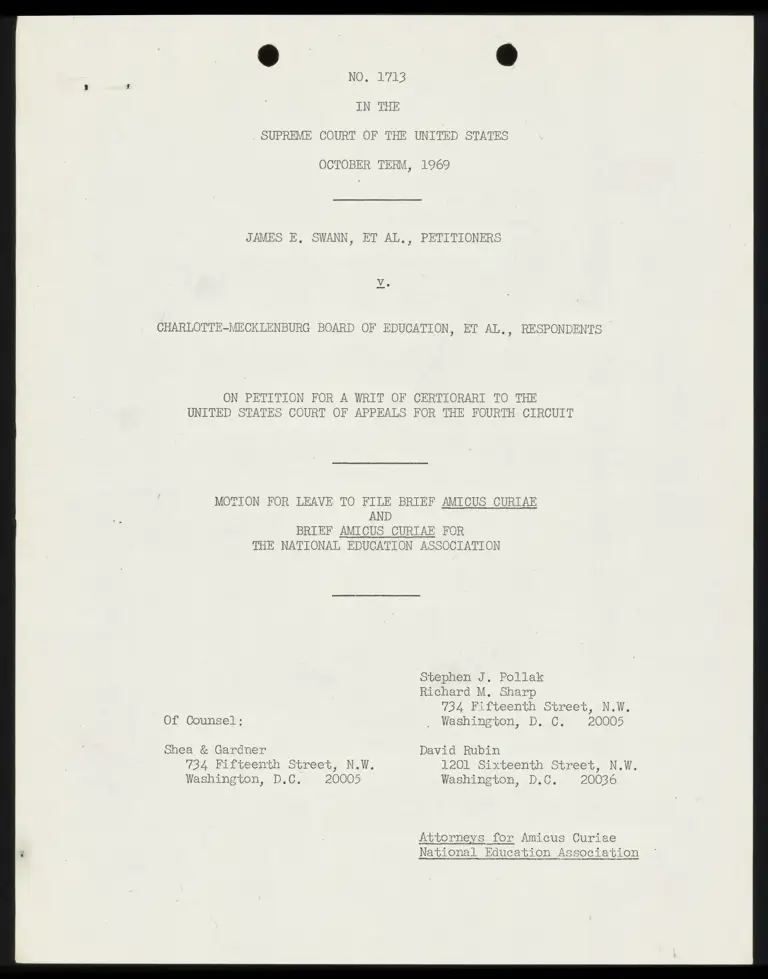
NO, 1713

IN THE

SUPREME COURT OF THE UNITED STATES

OCTOBER TERM, 1969


JAMES E, SWANN, ET AL., PETITIONERS

CHARLOTTE-MECKLENBURG BOARD OF EDUCATION, ET AL,, RESPONDENTS

ON PETITION FOR A WRIT OF CERTIORARI TO THE

UNITED STATES COURT OF APPEALS FOR THE FOURTH CIRCUIT


MOTION FOR LEAVE TO FILE BRIEF AMICUS CURIAE
AND

BRIEF AMICUS CURTAE FOR
THE NATIONAL EDUCATION ASSOCIATION


Stephen J. Pollak
Richard M, Sharp

734 Fifteenth Street, N.V.
Of Counsel: . Washington, D. C. 20005

Shea & Gardner David Rubin

734 Fifteenth Street, N.W,. 1201 Sixteenth Street, N.W.

Washington, D.C. 20005 Washington, D.C. 20036

Attorneys for Amicus Curiae

National Education Association


INTEREST OF THE NATIONAL EDUCATION

STATEMENT.

1. Bescrivtion of the Ch ecklenburg School System.


History of

      The Desegregation oy the District Court on
February Ei )

4. The Decision of the Court of Appeals.


REASONS FOR GRANTING THE WRIT.

Introduction.

The Duty to Disestablish Racially Identifiable |


xevornice of Nonelawy DOgis. isis visti

The Reasonableness Plan

mein PD uy Ce PRIVEE MIRE


CONCLUSION . .

Cases:

Alexender Y. . 0

306 U.8. 15 069 14,18,20,22


Brewer v. School Bo

3rown v. Board of

Brown v. Board of


Carrington v. Rash,

  Cato v. Parham, 302

Cella v. United States, 308 F.2d 183 (7th Cir. 1953)


- ii -

Cases [Cont'd]:


Dowell v. School Board of Oklahoma City, 244 F. Supp. 971
(W.D. Okla. 1965), aff'd, 375 F.2d 158 {10th Cir. 1967),
gert, dented, 387 U.8..93L {1067) sis vv viv a a Begh is


Green v. County School Board of New Kent County,

3010.8, 430 (1968)...


Griffin v. County School Board, 377 U.S. 218 (1964). . .

Harman v. Forssenius, 380 U.S. 528 (1965). . .

Henry v. Clarksdale Municipal Separate School District,


409 F.2d 682 (5th Cir. 1969), cert. denied, 396 U.S. 940 (1969)


Kemp v. Beasley, No. 19072, p. 14 (Slip.Op.)
(8th Civ, Werch 17, 3070) C0, oid ih

Keyes v. School District No, 1. Denver. 303 F. Supp. 27°
(D. Colo. 1969), stay pending appeal granted, F.28

(10th Cir. No. 432-69, Aug. 27, 1969), gtay vacated,
rr sus. 1215. £1969), .. ogy .


Louisiana v. United States, 380 U.S. 145 (1968). . .


. Missouri ex rel. Gaines v. Canada, 305 U.S. 337 (1938) . . .


Monroe v. Board of Commissioners of the City of Jackson,

391 U.S. 450 (1968)


Ohio Bell Telephone Company v. Commissioner, 301 U.S. 292 (1937)


oma v, Cotifomia. 232 U8. 633 {1o.8) L'. &

Raney v. Board of Pducation, 391 U.8. 433 (19568) . . .

Russell-Newman Manufacturing Company v. National Labor Relations

Board, 370 F.2d 980 (5th Cir. 1967)

Schlesinger v. Wisconsin, 270 U.S. 230 (1926).

Spangler and United States v. Pasadena City Bd. of Ed.,

No. 68-1438-R (C.D. Calif. March 12, 1970).


Sweatt v. Painter, 339 U.S. 629 (1950) . . .


United States v. Baldwin County, No. 28880 (5th Cir.,
March 9, 1970).

Page

15

4,34,18,20, 21

18

19

15

13,82

13,22

4, 20


- iii -

Cases [Cont'd]: Pag ®


United States v. Greenwood Municipal Separate School District,

405 728 3086 {oh Clr 13008) vi vi wa aid Cee whe a ett wi


United States v. Jefferson County Board of Education,

B72 FL20 836 {Sth Clv. ' JOBGYE o ails "vive iv sins. win 0 minh


United States v. Montgomery County Board of Education,

205 eB. 225 IBO0) iT de Ne eR EA


United States v. School Distriet No. 15), Cook County,

286 F. Supp. 785 ({N.D. 111. 1968), ‘aff'd 404 F.24 1125
(7th Cir, 3968) vy ah ete Tk aie a eae ea ee W516 20

Valley v. Rapides Parish School Board,
No. 129277 {Suh Civ., Maveh 6, 1970) 5° io idl V0 LE iy


Miscellaneous:

U.S. Commission on Civil Rights, Racial Isolation in the


Public Schools 106, 204 L10B7Y vu von ie hi ass wi vie inves 90


IN THE

SUPREME COURT OF THE UNITED STATES

CTOBER TERM, 1969

No, 1713

JAMES E, SWANN, et al., Petitioners

Vv.

CHARLOTTE-MECKLENBURG BOARD OF EDUCATION, et al., Respondents

ON PETITION FOR A WRIT OF CERTIORARI
TO THE

UNITED STATES COURT OF APPFALS FOR THE FOURTH CIRCUIT


MOTION OF THE NATIONAL EDUCATION ASSOCIATION
FOR LEAVE TO FILE BRIEF AMICUS CURTAE


The National Education Association hereby moves, pursuant to

Rule 42 of the Rules of the Supreme Court, for leave to file the at-

tached brief amicus curiae in support of the petition for writ of cer-


owann, et al., in

the above-entitled cause, Consent to the filing of the brief has been

sought from the petitioners and from the Charlotte-Mecklenburg Board of

Education and members thereof, respondents, Petitioners have consented ,—L/


37 The written consent of the petitioners has been filed with the Clerk.


No response has been received to date to the requests made of the

Charlotte-Mecklenburg Board of Education anu the members of the Board.

The National Education Association (hereinafter NEA) is an

independent, voluntary organization of educators open to all profes-

sional teachers, supervisors and administrators, It presently has

over one million regular members, and is the largest professional or-

ganization in the world, NFA was first organized in 1857 and was

chartered by a special act of Congress in 1906. Its statutory purpose

ie (3 Stat. B05) ww

to elevate the character and advance the interests
of the profession of teaching and to promote the
cause of education in the United States,

The overall policies of NEA are determined by its Representative Assem-

bly, a body composed of approximately 7,000 delegates representing af-

 filiated local and state education associations.

NEA has conducted detailed studies of the educational impli-

cations of the maintenance of dual school systems based upon race. It

has long been committed to the principle that racial segregation in

education adversely affects the quality of the education received by

both black and white students. Reflecting this position, the Represen-

tative Assembly at the June 1969 Convention adopted a formal continuing

resolution providing, in part (NEA Handbook 1969-70, p. 66):

The Association endorses the decision of the
U.S. Supreme Court in Brown v. Board of Education
and urges compliance with subsequent federal laws

and regulations in this area .


De

On March 20, 1970, the Executive Committee of the Association adopted

a more specifi resolution on desegregation in the public schools and

recommended it to the Board of Directors ana the 1970 Representative

Assembly:

The NEA believes it is imperative that de-~
segregation of the nation's schools be effective,

Policies and guideline statements for school de-
segregation in all parts of the nation must be
strengthened and must comply with Brown v. Board
of Fducation and subsequent judicial decisions
and with civil rights legislation and decisions.


The Association recognizes that acceptable
desegregation plans will include a variety of
devices such as geographic realignment, pairing

of schools, grade pairing and satellite schools,
These arrangements often require that some stu-

dents be bused in order to implement desegregation
plans which comply with established guidelines

adhering to the letter and spirit of the law,

It has long been settled that complete disestablishment of

formerly de jure segregated school systems is required by the Constitu-

tion. This case presents to the court important issues concerning the

meaning of a school board's responsibility to convert from a dual to a

unitary school system and the steps which it may be required to take

to accomplish that conversion, As the principal association of educa-

tors in this country, NEA can draw upon a breadth of experience to in-

form the court as to the reasonableness of the requirements for desegre-

gation framed by the district court's order of February 5, 1970, when

judged from the standpoint of educational considerations as well as the


practices and expenditures of other school systems. Pursuant to

leave granted by the court of appeals, NEA filed a brief amicus

curiae in the proceedings below (see, e.g., 194a, 21la) and, upon

invitation, presented oral argument ,—2/

Accordingly, the National Education Association respectfully

requests that this Court grant leave to file the attached brief amicus

curiae in support of the petition for a writ of certiorari to the

Court of Appeals for the Fourth Circuit.

Respectfully submitted,

Stephen J, Pollak
Richard M, Sharp

734 Fifteenth Street, N,V.
Washington, D, C. 20005

Of Counsel:

Shea & Gardner : David Rubin :

'734 Fifteenth Street, N.V, 1201 Sixteenth Street, N.W.
Washington, D. C. 20005 Washington, D. C. 20036

Attorneys for Amicus Curiae

National Fducation Associati ah phe dA NAN SAU U


2/ The NEA and its State associations have participated as amicus
curiae in other major proceedings involving issues of education and
race, See Alexander v. Holmes County Board of Fducation, 396 U.S,
19 (1969; Carter v. West Feliciana Parish School Board, No. 29745
{5th Cir. 1970); Smuck v. Iobson, 408 F.24 175 (D.C. Cir. 1969); Lee
v. Macon County Board of Fducation, 283 F. Supp. 194 (M.D. Ala. 1968).


1
.


IN THE

SUPREME COURT OF THE UNITED STATES

OCTOBER TERM, 1969

No. 1713

JAMES E. SWANN, ET AL., PETITIONERS

V.

CHARLOTTE-MECKLENBURG BOARD OF EDUCATION, or AL, RESPONDENTS


BRIEF FOR THE NATIONAL EDUCATION ASSOCIATION
AS AMICUS CURTAE

TAN SITPPORT. OF TOR PRIDTIOTON FOR AN V¥WRTTD NF OTRPTARART TN
“at WoL 4 la [EFS ig BE (TR ST SIR Ta ELT 0 CR RE WS PRE 1 dbl ob / 4 | ZT BPRS TR BR NN YW PO I LU

0

THE UNITED STATES COURT OF APPEALS FOR THE FOURTH CIRCUIT


INTEREST OF THE NATIONAL EDUCATION ASSOCIATION

The National Education Association (hereinafter NEA) is an

independent, voluntary organization of professional educators. It has

over one million members, including teachers, supervisors, and adminis-

trators. As stated in the Association Charter, its purpose is "to ele-

vate the character and advance the interest of the profession of teachers

and to promote the cause of education in the United States." Both the

NEA and its members have a deep interest in the quality of education re-


ceived by the children of all races. NEA endorses the decision of this

Court in Browy v. Board of Fducation, 347 U.S. 483 (1954), and considers

it imperative that desegregation of the nation's schools be complete and

effective, In pursuit of these purposes NEA has recently conducted in-

vestigations of the problems of race and education in the school systems

of Wilcox County, Alabama; Baltimore, Maryland; some 22 counties in

Louisiana; Detroit, Michigan; some 30 counties in Mississippi; Hyde

County, North Carolina; and the region of Fast Texas, NEA has also par-

ticipated in several school desegregation cases, including the appeal

proceedings before the Fourth Circuit in the instant case, and in numer-

ous others has actively supported efforts to secure judicial relief.


STATEMENT

A 1. Description of the Charlotte-lecklenburg School System.


The Charlotte-Mecklenburg Schcol System is the forty-third largest in

the United States, educating more than 84,500 pupils in 106 schools,

including 76 elementary schools, 20 junior high schools, and 10 senior

high schools. While the system covers the county's 550 square miles,

over 50,000 of the students reside within the City of Charlotte. (Ap-

pendix to Petition for Certiorari, pp. 9a-10a, 18a, 85a-86a, 1230. )—/

The 1969-70 budget was $57,711,344, of which nearly $51,000,000 repre-

sented operational expenses (1392) .~2/

Of the 84,500 students, about 29 percent, or 24,714, are

nnan+t
A NY , OF 59

21,000 of the system's 24,714 black students attend schools with-

City of Charlotte (57a). The predominant percentage of the sys-

tem's black students live in a triangular area, four or five miles on

a side, in the northwestern quadrant of the city. This area is almost

exclusively Negro. (la, 12a, l4a, l4Ra-144a.)

2. History of Desegregation. The Charlotte-Mecklenburg Board


of Educati s rat . dual system of schools based upon race (185a),

A suit for desegregation was initiated in 1965 (la), and the district


nv The Appendix will be cited hereinafter by page number only.

5
~2/ Expenditures for construction of school buildings are not included
in these budget figures (139a).


court ordered into effect a plan proposed by the School Board based

upon geographic zoning with a free transfer provision which was ap-

proved by the court of appeals (185a). In September 1968, following

the decisions of this Court in Green v. County School Board of New Kent


County, 391 U.S. 430 (1968), Raney v. Board of Education, 391 U.S. 433


1268 and Monroe v. Board of Commissioners of the City of Jackson
J EE al 3

391 U.S. 450 (1968), the petitioners filed a motion for further relief

which sought greater speed in desegregation and elimination of other

racial inequities (la). Following a hearing, the district court con-

cluded that the "manner in which the Board has located schools and

operated the pupil assignment system has continued and in some situa-

tions accentuated patterns of racial segregation in housing, school at-

tendance, and community development! (28a); ; that the Board has created

“or controlled school zones so as to promote segregation of black stu-

dents (54a); and that the Board has an affirmative duty to promote facul-

ty desegregation and desegregation of pupils, and to deal with the prob-

lem of the all-black schools (29a), The district court ordered the

Board to submit by May 15, 1969, a plan for complete desegregation of

teachers to be effective with the 1969-70 school year, and for desegre-

gation of pupils to be predominantly effective in the fall of 1969 and

to be completed by the fall of 1970 (30a, 3la),

Pursuant to this and subsequent orders of the district court, the

Board submitted two plans, neither of which was considered adequate by the

court (5la, 55a, 68a, 69a). On August 15, 1969, because of the shortness of


time before the opening of school, the district court approved an

interim plan for the 1969-70 school year ani directed the Board to

present, on November 17, 1969, a plan for complete faculty and stu-

dent desegregation for 1970-71 (70a-7la), The 1969-70 plan proposed

to close seven black inner-city schools and to transfer their 3,000

students to suburban schools, all but one of which were white (83a).

It also proposed to transfer 1,245 black students from eight over-

crowded black or predominantly black schools to white suburban schools

(64a, 83a). The Board, however, did not carry out the plan (83a).

Only 1,315 of the promised 4,245 black students were transferred to

white schools (84a).

The Board's November 17. 1969 plan was disapproved by the

district court which found that "it contains no promise nor likelihood

of desegregating the schools" (93a). Among other provisions, the plan

provided that no white students would be assigned to schools with less

than 60 percent whites; and that where schools were to be desegregated,

the ratio of black to white students would not exceed 60 percent white

--40 percent black (94a-95a). Seven all-black elementary schools were

to remain that way (94a).

The Sit court thereupon designated a consultant to pre-

pare a desegregation plan in accordance with nineteen principles drawn

from the decisions of this Court and the lower federal courts and set

forth in the opinion and order (103a-108a). The court invited the

Board to submit a further plan of its own (110-1112).


wel


3. The Desegregation Plan Ordered by the District Court on


February 5, 1970. Reviewing the results of almost four and one-half


years of court-ordered desegregation, the district court found in Nov-

ember 1969 that the Charlotte-Mecklenburg schools "are still in major

part segregated or 'dual' rather than desegregated or 'unitary'" (86a).

"Of 24,714 Negro students, something above 8,500 ave attending 'white!

schools or schools not readily identifiable by race"; 13,945 were still

in 90-100 percent black schools ;—3/ and 9,216 of these were in 100 per-

cent black schools, Of 59,828 white students, over 45,000 were attend-

ing schools which were 86-100 percent white (85a-86a), Ninety-eight of

the 106 schools in the System continued to be "readily and obviously

identifiable by the race of the heavy majority of their faculties!

(84a).

The district court found that these student assignment patterns

reflected the segregation of Mecklenburg County's residential areas (86a),

This segregation, it said, "is the result of a varied group of elements

of public and private action, all deriving their basic strength origi-

nally from the public law or state or local RO action, These

elements include among others the legal separation of the races in

schools, school buses, public accommodations and housing; racial re-

strictions in deeds to land; zoning ordinances; city planning; urban


2 The court found that more than 16,000 black students were attending
schools which were between 56 percent and 100 percent black (85a).


renewal; location of public low rent housing; and the actions of the

present Schoo! Board and others, before and since 1954, in locating

and controlling the capacity of schools so that there would usually

be black schools handy to black neighborhoods and white schools for

white neighborhoods" (86a-87a; see also 12a-l4a). Based upon these

findings, the district court ruled, "[tlhere is so much state action

embedded in he shaping these events that the resulting segregation

is not innocent or 'de facto,!' and the resulting schools are not 'uni-

tary! or desegregated" (87a).

Faced with these conditions, the district court, on February ’ P) oF

5, 1970, framed a desegregation plan using, where it could, portions

held that an acceptable plan would have to be consistent with sixteen

requirements set forth in the order (1172). Some of the requirements

were expressed in mandatory terms, such as number five wt ]hat no black

school be operated with an all-black or predominantly black student

body." Others, although framed as requirements, were drawn to allow

leeway for practical considerations incident to the operation of the

fo
m

(D


m (D


=
 re
 cluded number six calling for the assi

of pupils so that "as nearly as practicable the various schools at

various grade levels have about the same proportion of black and white

|] students," and number seven providing that transportation be offered

on a uniform non-racial basis-to children who live farther from the

school to which they are assigned "than the Board determines to be td

walking distance."


The district court then approved a Sesbivanstion plan in

four separate parts, one each for the senior high schools, for the

junior high schools, for 27 elementary schools for which new zones

were defined, and for 34 elementary schools which were paired and

assigned noncontiguous zones. For the senior high schools, the

court approved a zoning plan submitted by the Board which integrated

nine of the System's ten schools with percentages of black students

ranging from 17 percent to 36 percent. The court ordered one modifi-

cation: it vesuived that 300 pupils be transported from the black

residential area of the city to the Independence School which would

have been 2 percent black and under-capacity under the Board's plan

(190a, 123a).

The court disapproved the Board's rezoning plan for the

junior high schools because it left the Piedmont School 90 percent

black, and offered the Board various alternatives which would desegre-

gate all the junior high schools, The Board chose to adopt the plan

proposed by the court's consultant which combined zoning and satel-~

lite districts and which left the junior high schools from 9 percent

to 33 percent black (125a, 190a-19la).

The Board's plan for the elementary schools was based en-

tirely upon zoning. It would have left more than half the black ele-

mentary pupils in nine schools 86 to 100 percent black and would have

assigned about one-half the white elementary pupils to schools 86 to

100 percent white (191a). Rejecting that proposal, the court adopted


plan offered by its consultant which drew new zones for 27 schools

and paired 34 others, each of which was assigned noncontiguous zones.

Approximately 22,400 of the 44,000 elementary pupils would attend the

paired schools, 10 of which are in the city and 24 of which are out-

lying suburban white schools, Children in grades 1-4 from the zones

surrounding all 34 schocls would attend the 24 suburban schools,

while those in grades 5-6 would attend the 10 city schools (133a).

The racial make-up of the elementary schools would vary from 3 percent

to 41 percent black (129a-131a).

Under the court-approved plan, no schools would remain all-

black or predominantly black, The pairing and grouping of schools,

as well as rezoning provided for in the plan, would, the court found,

add a maximum of 13,300 children who "may conceivably require trans-

"portation" to the 23,600 pupils transported daily on school buses and

the 5,000 whose fares on public coach lines are paid by the Board (138a,

155a). Of these 13,300 children, 1,500 would be at senior high level,

2,500 at junior high, and 9,300 at elementary school level (155a).

One hundred thirty-eight additional buses would be required, 90 for

the elementary students (155a). The cost of implementing the plan

would be $266,000 for bus operations ($186,000 of this for the elemen~

tary school phase) and a one-time expenditure of $745,200 for additional

buses ($486,000 for the elementary phase) (156a-157a, 182a, 1908, wil


~4/ The district court did not consider the plan immutable, It stated
that "the duty imposed by the law and by this order is the desegregation

~ (continued on page 8)


4. The Decision of the Court of Appeals. The court of ap-

peals, by a vote of four to two, vacated the district court's judgment ,—/

The eonrl carefully analyzed and specifically accepted the district

court's finding "that residential patterns leading to segregation in

the schools resulted in part from federal, state, and local governmen-

+81 sction® (186s). Ii connliuted that "[plredominantly black schools

were the inevitable oT of the School Board's policy of locating

schools and fixing their size to fit these segregated residential pat-

terns (186a). The court of appeals recognized that this condition was

not unique to Charlotte; that "[s]imilar segregation occurs in many

other cities throughout the nation, and constitutional principles deal-

ing with it should be applied nationally" (188a).


A (continued) of schools and the maintenance of that condition. The
plans discussed in this order, whether prepared by Board and staff or
by outside consultants, . . . are illustrations of means or partial


1

means to that end. [Footnote omitted The defendants are encouraged
es to use their full 'know how! and resources to attain the results above

described, and thus to achieve the constitutional end by any means at
their disposal, The test 1s not the method or the plan, but the re-
sults." The court stated its intention "to leave maximum discretion in
the Board to choose methods that will accomplish the required result."
(118a-11%a, 121a.)

ir Chief Judge Haynsworth and Judge Boreman concurred in an opinion

of Judge Butzner. Judge Bryan wrote a separate opinion dissenting in
part but joined in voting to vacate the judgment of the district court
in accordance with the opinion of Judge Butzner "for the sake of creat-
ing a clear majority for the decision Es remand" (226a). Judges Sobe-
loff and Winter concurred in part and dissented in part (20la). Judge
Craven disqualified himself (184a).


which it would apply to resolve the issues in the case: "first, not

every school in a unitary school system need be integrated; second,

nevertheless, school boards must use all reasonable means to inte-

grate the schools in their jurisdiction; and third, if black residen-

tial areas are so large that not all schools can be integrated by

using reasonable means, school boards must take further steps to as-

sure that pupils are not excluded from integrated schools on the basis

of race! (1892) .~&/ It held bussing to be "a permissible tool for

achieving integration," but declared that "[i]n determining who should

be bussed and where they should be bussed, a school board should take

into consideration the age of the pupils, the distance and time re-

quired for transportation, the effect on traffic, and the cost in rela-

“tion to the board!s resources" (194a).

Applying these principles, the court of appeals approved the

desegregation plan for junior and senior high schools, holding that

"it provides a reasonable way of eliminating all segregation in these

schools" (195a). The appellate court also affirmed the district court's

disapproval of the School Board's elementary plan because it left about


£/ The court identified such "further steps" to include special
classes, functions and programs on an integrated basis to be made avail-
able to pupils in the black schools, majority to minority transfers
with transportation provided, and assignment to an integrated school
for a later portion of a black student's career (189a).


ny

one-half of both black and white pupils in schools that were nearly

completely segregated (1978) .—2/ However, the court of appeals found

the elementary plan approved by the district court unacceptable,

holding that "[t]he board . . . should not be required to undertake

such extensive additional bussing to discharge its obligation to create

a unitary school system! (1982) .-8/


ed The court of appeals also approved the provisions of the district
i rig / aa

gn
~~ RIG peta. RE (ICE J 1 frail dd ry Ci 25 o court's order deali neg. wiltil r1acuyiiies ©28 ),

-&/ The court's use of the phrase "such extensive additional bussing!
followed a recitation of the following facts: the plan would require
transporting 9,300 pupils in 90 additional buses; the greatest portion
would involve cross-bussing; the average daily round trip would approxi-
mate 15 miles through central city and suburban traffic; the additional
elementary pupils would represent an increase of 39 percent over all
pupils presently being bussed and would require an increase of about 30
percent in the present fleet of buses; and, when added to the additional bussing required under the junior and senior high plans, the total per- centage increases would be: pupils, 56 percent; and buses, 49 percent
(198a).


oy i

REASONS FOR GRANTING THE WRIT

1. “Iotroduction, The decision of the Coury of Appeals for

the Fourth Circuit presents two issues of fundamental importance to the

future course of school desegregation, The first issue is whether a

school board, in fulfilling its obligations to establish a unitary

system, must disestablish the identity of all "black" and "white"

schools by reassigning students, and providing transportation where

necessary, even though this will require the board to bear financial
9/

and other burdens, The = issue, which arises only if this Court oD
 Qo OQ S o,


J

should conclude that the constitutional obligation to establish a

unitary system may be circumscribed by the costs and other burdens its

ful fi1Tment would require a school board to assume; ig what standards

school boards and district courts should apply in framing an acceptable

desegregation plan,

the court itself recognized (186a-187a), the duty of vir-

tually every school board with responsibility for an urbanized area

of any size will hinge upon the resolution of these issues. Undoubtedly

the principle announced by the Fourth Circuit, if allowed to stand, too,


_9/ As we show infra, pp. 16-17, the true basis of the conclusion of

the court of appeals that os elementary school plan was unreasonable had
to be the financial cost entailed in purchasing and operating the <0

additional buses required to Hani the 9,300 additional children

required to be bussed, The sonableness of the plan judged upon

the basis of the other measures referred to by the court of appeals--age

of pupils, time and dista ance required for transportation and effect on
this record.

J

traffic--appears clear on Hx


17


would significantly influence the future course of desegregation of rural

11.19/ Thus, the case is truly one of national significance

2. Tie Duty to Disestablish Racially Tdentifiable Schools The r— Arle A A

court of appeals quite properly affirmed the district court's conclusion

that the predominantly black schools in the Charlotte-Mecklenburg system

are the "inevitable result" of state action (186a).1L/ Having so ruled, the

primary question, then, was whether, under the Equal Protection Clause of

the Fourteenth Amendment, the School Board was required to reassign students

so as to disestablish the racial identity of these schools,

Until this case, it was recognized that the constitutional duty of

a school board under such circumstances was to terminate all vestiges of its

dual system "at once and to operate now and hereafter only unitary schools."

Alexander v. Holmes County Board of Education, 396 U.S. 19,20 (1969). And


a unitary school system had been understood to be one without schools which

.are racially identifiable by reason of their student bodies, Green v. County \

School Board of New Kent County, 391 U.S, 430 (1968), or their faculties, Uni-


ted States w. Montgomery County Board of Fducation, 395 U,S8.225 1969). A num-


ber of other lower courts,including the Fourth Circuit itself, have interpreted

these rulings to bar neighborhood student assignment plans which freeze


10/ The considerations on which the duty to disestablish the racial iden-

tity of predominantly black schools would depend--cost, for example--(see
discussion, infra, pp.16-17 ) are not unique to urban systems. History
teaches that rural systems would urge them as grounds for relief from the

constitutional mandate to operate unitary schools, Indeed, the court of ap-
peals suggested that the constitutional principles "should be applied na-
tionally" wherever segregation exists because government policies foster

. segregated neighborhood schools (188a).

z/ The findings of the district court and their affirmance by the court
of appeals are set forth in the Statement, supra, pp. 6-7, 10,


in the effects of residential segregati

This was the conclusion of the di

acceptable desegregation plan must pr

operated

116s), of Yebruavy 5, 1970;

3.

atnt at
stric (¥

The Irrelevance of Monetary

on

12/
resulting from state action.

court which held that an

"(+t That no school be

with an all-black or predominantly black student bodv" (Crder p . \

ENG
UO UO Like the district cours,


the court of appeals recogn

However, it held that

not all the schools can be integra

school board may leav

correctly recognized that "bu

integration" (194a). Kemp v. Beasl


-

Fumio

Henry v. Cle


ized the ob]

ted

where "black resid

Hh y &
[8 J

permi

igation of the =r

ential ar

using

School Board +o re-~

are so large that

reasonable means," the

ed

The court, we believe

ssible tool for achieving

« 19782, pv. 14 (Slip Op.) {Eth

rich, 409 F.24 682,

2 1]
(5th Cir. 1969), ce
Greenwood Munic Po SC]

Valley wv. Rapides Parish ¢ St a
United St v. Baldwi ounty No
Kemp Beasley, No.
School Dist, 151, 286 F,
1123 {7th cir, 1968); Dowell


tates

v. Beasley,


786,
Vv, Schoo

Supp.

bJ

4

a. Sa.

. United tates v.
20 086, 1093 (5th C mr,

Wo 1 St Cir., March 6.
80 (5th Cir. March 9, 1970) ;

17, 1970); United
Tl), 1968), affid,

of hon CLLy

a. tes [a]

404 7.24
244 °F, San

St LE,


971 (W.D. Okla. 1965), affd,

387 U.S. 931 (1967 JE Spangler

ay Wy LY upp .

cert.

City Bd
denied,

of


(10th Cir. 1967),

Pasadena
    Ed., No, 68-1438-F (C.D, Calif.

NO. 1. Devwer, 303 7.
granted, IF, 2d

vacated, 396 1215; see
In Brewer

ic
Supp. 279,
{xo Cir.


Vv . Bo ar ra

\ ~~"

Tn Aa

ar 1 Cit


270); Keyes v.

Colo. 1969),
27,

school District

S gi ay pen

A


>

rk,


Sch 22 1

1968), the court of appe
that the residentia patter ns
"The school board cannot build
private racial discrimination."

als 5
are

the court

duty are

13/ The steps indic
constitutional set

ated

forth,

went

the

supra,

on,
the result of private einai oud

its exclusionary attendance areas upon

Board

é¢ 37, 41
saying i hg is immateri

might teke to sati
Pell, n.6,

sfy its


hy 0

Cir., March 17, 1970); United States v. Jefferson County Board of Fducation, med


372 F.2d 836, £98 (5th Cir. 1966); United Stites v. School District No, 15°,

Cook County, 286 F. Supp. 786, 79° (W.D. 111, 1968), aff'd, 404 F240


1125 (7th Cir. 1968). It said, however, that in determining the part

bussing mey reasonably play in a unitary school system "a school board

should take into consideration the age of the pupils, the distance and
J

time required for transpertation, the effect on traffic, and the cost

in relation to the board's resources" (194a).

Viewing the plan for junior and senior high schools against

these principles and the background of national, state and local

transportation policies, the court found "it provides a reasonable way

PSE - - i: he | re | py ~ IW, TT DE J. Bh Sy . ~ ke I a

SLAIe CINE gu) BEefgTErat Od 10 these BCa0u.L 3

plan. As we now show, a review of the plan against the five measures the

court said should be taken into consideration compels the conclusion that

the plan was rejected because the court of appeals found the financial

cost of the bussing tynreasonable, "14/


1
- At the most, the elementary school plan would have entailed an an-
nual expenditure of $186,000 to operate the buses plus a one-time invest-
ment of $486,000 for the 90 additional buses (191a). In aggregate, the

first-year expense would be just slightly above one percent of the system's
annual budget (1392). From this there should be subtracted the value of

the improvement in the education available to black children which is
significant, although not easily quantifiable in dollars,


XV

Thus, with respect to the measures of time,

raffic, the district court found that the children required to be

"will not as a group tra y. far, nor will

lence more inconvenience than the more than 28,000 children

are already being transported. . ." (1l43a), end this finding was

disturbed by the court of appeals. The average one-way bus trip per

elementary pupil would be seven miles (15 compared to average of

between 15 and 17 miles per child in the

12 to 13 miles under the plan for senior high pupils (195a). The average
1%
\

time would be 35 minutes as against nearly an hour and a quarter today

per child in the system (153a).

Insofar as the age of the pupils to be bussed is concerned,

court found that the plan would require bussing of au

additional 9,300 elementary students, This figure is just under 70

st of the 13,300 additional students of all ages required

bussed by the plan. Statewide in North Carolinas

pupils bussed are elementary students (127a)

Thus, the reasonable inference is that cost alone was the basis

for the conclusion of the court of appeals tha- he elementary plan was : Pp

jection of the plan is

confirmed by the court's statement that tlhe boar + + Bhould not be

required to undertake such extensive additional bussing . . ."(198a).

The court of appeals has thus announced a new constitutional

principle governing school desegregation: that the duty to disestablish

all racially identifiable schools is a conditional one depending upon the


i

financial costs involved, This principle conflicts with the well considered

of this Court which establish that "[t he obligation of every schcol

el
4 to serminate dual school systems

Board of V
rma I a ereafter only unitary schools." Alexander v,

266 4.8. 19, In Green v. County School Board, 391


430, 442 (1968), the Court, adopting the language of the Court of Ap-

peals for the Fifth Circuit, defined a unitary system as "a system without

a 'white! school and a !'Negro! school, but just schools."

To date, this Court has never held, or even suggested, that this

constitutional mandate may be avoided by a showing that performance would

entail monetary costs. In Green, this Court held that the school board

was under an Na fPirmative duty to take whs steps might be necessary


ft +A AAvirraat A A 17 \ 7 + A 2
vv uv ‘ Cy w oll, 2 LCA A AV

a1 IIo yo A cnr acetic
wi |

~ ~~
Ue P 3 ip ( \CIIPAG E10 (5

There was no suggestion that a "unitary system" was not a fixed goal ex-

tablished by the Constitution, Inde le WOIC nosen by the Court in-

dicated that a unitary system is one "in which racial discrimination would

be eliminated root and branch.” at 437-38, der t lecigion of

the court of appeals, the constitutional objective, the unitary system,

would vary according to the cost of the steps available to the school board.


15


See Griffin v. County School Board, 377 U.S. 218 (19 64), where this
Court held that a school board may be dared to spend Wi tever is neces-
sary to afford the pupils in its Ain sd qesegresa ted education equal
to that being afforded pupils in other systems - throughout the State,


wo ¥

10

The interpretation given the Constitu:ion by the court of

appeals cannot withstand analysis: Thus, no State could be heard to justify

a denial of a jury trial or due process of law on the grounds that fulfillment

-} these rights costs too much, The right to equal protection of the laws

stands on the same footing. Thus, "[t]lhe State is forbidden to deny due
4

.

process of law or the equal protection of the laws for any purpose whatsoever,"

    Schlesinger v. Wisconsin, 270 U.S. 230, 240, (1926). Certainly factors such

as "convenience and saneleney” do not exempt the State or other governmental

ements of the Fourteenth Amendment. Ohio Bell   agencies from the requir

Telephone Company v. Commissioner, 301 U.S. 292, 305 (1937); Russell-Newman


2 (0


( turing Company v, National labor Relations Board, 370 F.2d 950, 984, : 3 ; 5a . ; p Ls


  (5th Cir. 1967); Cella v. United States, 208 F.2d 183, 789 (7th Cir,

1953). The right to equal protection, moreover, is a right personal to each

individual. Sweatt v. Painter, 339 U.S. 629, 635 (1950); Missouri ex rel,

Gaines v. Canada, 305 U.S. 337, 351 (1958). A black child assigned to a black


school such as Double Oaks or Lincoln Heights (126a, 127a) is afforded little

37/

consolation--and no vindication of his "personal and present" constitutional

4 A

right--by the fact that the Board is affording other students an integrated

education,


z LE . Es ita i a - , . . . : - 16 The ruling of the court of appeals also seems inconsistent with the well
recognized rule that states may not casually deprive a class of individuals of a


constitutional right because of some remote administrative benefit to the state,

Jarman v. Forssenius, 380 U.S. 528, 542-44 (1965) (requirement of a certificate of
residence as a precondition to voting); Carrington v. Rash, 380 U.S. 89, 96 (1965)
(servicemen permitted to vote only in the county of residence at the time of entry
into service); Oyama v. California, 332 U.S. 633, 646-47 (1948).

17/- Sweatt v. Paint


The court below suggested that where costs of bussing warrant, certain

"other steps"--the offering of special integrated classe freedom of transfer

with transportation, and an integrated school assignment later on-~may be sub-

stituted for the elimination of predomi ently black schools, The decisions

of this Court in Green v. County School Board,


the City of Jackson, 391


constitutional inadequacy of these alternatives.

disapproved freedom hoice freedom of

Negro students in all-black schools and placed upon them the bur

a desegregated experience.

m + nm er ZR RC, 13 POT Sl (E eI Ae LT ry og . To Poo Loonie A33ighmeny Or pla Sluge S LO a deseg regated school CgI

ater "portion of their school careers! is merely to hold out the hope Co

of a morsel of desegregation and to ignore the rule that token des egregation ga 5S

to comply with the constitutional requirement. During their elementary sc

years these black students would be "effectivel iy excluded" from desegregated


schools because of their race, Alexander v. Holmes County Board of Education,

96 U.S. 19, 20 (1969). Beyond these constitutional considerations, the

unreasonableness of such an alternative is shown by the fact that maximum

benefits from desegregated education come only if pupils are assigned to

integrated schools at an early age. U.S, Commission on Civil Rights

Racial Isolation in the Public Schools 106, 20/4


4. The Reasonableness of the Digtrict Court's Plan for

A Desegregation of the Elementary Schools. NEA believes that the Court should

in Green that the school oard is under an

i
Le necessary 10 convert tc a unitary syst

437-438; and that it should reject the suggestion that the duty to

separate schools based upon race may be avoided because its

fulfillment will cost money. Such a ruling would dispose of this

However, if the court should accept the rule framed

of appeals, a significa issue would still remain: the court of appeals

purported to apply a "rule of reason," but it did not indicate the standard

it applied in reaching the judgment that the "undertakings" incident to the

plans for desegregation of the senior and Junior high schools were reasonable

but vhiocse required for the elementary schools were nol, In essence,

court struck down the elementary school plan because of the "extensive

additional bussing" (198a) it would require, but failed to indicate the

criteria it applied in determining how much bussing was too much--and why

School boards and lower federal c 3 are left at large by the appellate

court's ruling. The vast discretion inherent in the rule is an open invitation

to circumvent the constitutional right of black children to equal educational


91.5 29 (1955), it has been


18 / Since Brown v. Board of Education, ir
recognized that the district invested with broad powers to frame
relief from racial ion in the public schools, Indeed, the Court
has declared that the district court not only has the "power" but in fact
"the duty to render a decree which will so far as possible eli janie the
discriminatory effects of the past as well as bar like discrimins 1 in the
future.  loulsisns v, United States, 380 U.8, 145, 154 62), gnole in
Green, supra, at 438 n.4 In our view, the district court properly fulfilled
this duty and did not abuse its discretion in framing the elementary school’
plan,

courts ar

at]


® on »
" . . . 1. . . . L .

Ppportunity--an invitation which the 16-year history since Brown demonstrates is
19¢

all too likely to receive wide acceptance.

a

CONCLUSION

From Brown to Alexander, the quastion was one of "all deliberate soee

timing of transition from separate to equal schools, This case presents

question whether, now that the Court has declared the transition period closed,

the constitutional objective itself is to be realized, If the decision below

is allowed to stand, it acasts a host of separate black schools in every urban

community which, for the forseeable future, will be impregnable to constitutional

attack,

NEA urges the Court to grant the petition for a writ of certiorari

1.0 filed in behalf of James E., Swann, et al., and to establish an expedited schedule

for briefs and argument which will permit a decision at the earliest practicable

time,

Respectfully submitted,

Stephen J. Pollak
Richard M. Sharp

734 Fifteenth Sireet, N. W.
Washington, D. C. 20005

Of Counsel:

Shea & Gardner David Rubin
73/4 Fifteenth Street, NV. 1201 Sixteenth Street, NV.
Washington, D.C. 20005 Washington, D.C. 20036

Attorneys for Amicus Curiae
National Education Association


22/ The decisions In Kemp v. Beasley, No, 19072 (8th Cir. March 17, 1970);
United States v. hool District No, 1g * Cook County, 286 F. Supp. 786
{N.D. 11%.) aff'd, +04 7.24 1125 (Hn Cir, 1068); Spangler and United
States v. Pasadena City Board of Education, Civ. No. 68-1438 (M.D. Calif.
March 12, 1970); and Keyes Vv. School District No... Denver 302% BR, Supp, 27S
{D, Colo, 1969), F.2 d___ (10th Cir. No. 432-69, August 27, 1969), 306 U.S.
1215 (1969), indicate - that, with the increasing focus on integration of urban
schools, the need to make bussing a part of such plans will be increasingly at
issue, Paradoxically, while the appellate court's decision creates

for the exercise of discretion to limit desegregation, it severely,

believes unwarrantedly, restricts the traditional discretion of the di
court to frame a plan which will secure the constitutional objective. Revien
now by this Sours ‘will insure that no such unwarranted restriction survives,


ERTIFICATE OF SERVICE

The undersigned hereby certifies that he has this day served

copies of the foregoing Motion for leave to File Brief Amicus Curise

and the accompanying Brief upon counsel in this case by depositing

e United States mail, postage prepaid, addressed

Brock Barkley, Esq.

Taw Building
Charlotte, North Carolina

Pliny Le lm, Esq.

Ss igh Forth Carolina

Gaston H, &
Crier, Parker, Poe, Thompson,

Bernstein, Gage and Preston

1014 Law Building
PY. 2 as” nds 8 7% om TE

Cig Louie P) Ne Big LLL La l'OL L110

Honorable Robert Morgan
Attorney General
State of North Carolina
Raleigh, North Carolina

James H, Carson, Jr., Esq.

law Building

Charlotte, North Carolina

Benjamin S. Horack, Esq.
806 Fast Trade Street
Charlotte, North Carolina

Whiteford S. Blakeney, Esq.
North Carolina National Bank Building
Charlotte, North Carolina

Villiam H. Booe, Esq.
Law Building

Charlotte, North Carolina


A iv he 7

Conrad O, Pearson, Esq.
203-1/2 Fast Chapel Hill Street
Durham, North Caro’ina

L. Lovo Chambers, Esq.
Adam Stein, Esq.

Chambers, dis n, Ferguson & lansing
216 West Ter Street
Charlotte i Carolina

Jack Greenberg, Esq.
James M, Nabrit, III, Esq.
Norman Chachkin, Faq.
10 Columbus Circle
New York, New York

Erwin Griswold, Esq.

Solicitor General of the United States
Department of Justice

Washington, D. C.

Jerris Leonard, Esq.
Assistant Attorney General
Civil Rights Division
United States Department of Justice

Washington, D. C.


Attorney for National Education
Association, Amicus Curise [||933c84c5-ce86-4198-8522-055585de9fef||]