Plaintiffs' Response to Application for Stay
Public Court Documents
March 10, 1970
10 pages
-
Case Files, Swann v. Charlotte-Mecklenburg Hardbacks. Plaintiffs' Response to Application for Stay, 1970. c0619755-2e34-f111-88b4-7c1e526962fd. LDF Archives, Thurgood Marshall Institute. https://ldfrecollection.org/archives/archives-search/archives-item/17d0d6f9-7ae4-4d4a-bfb7-9e32992e3aee/plaintiffs-response-to-application-for-stay. Accessed October 16, 2026.
Copied!
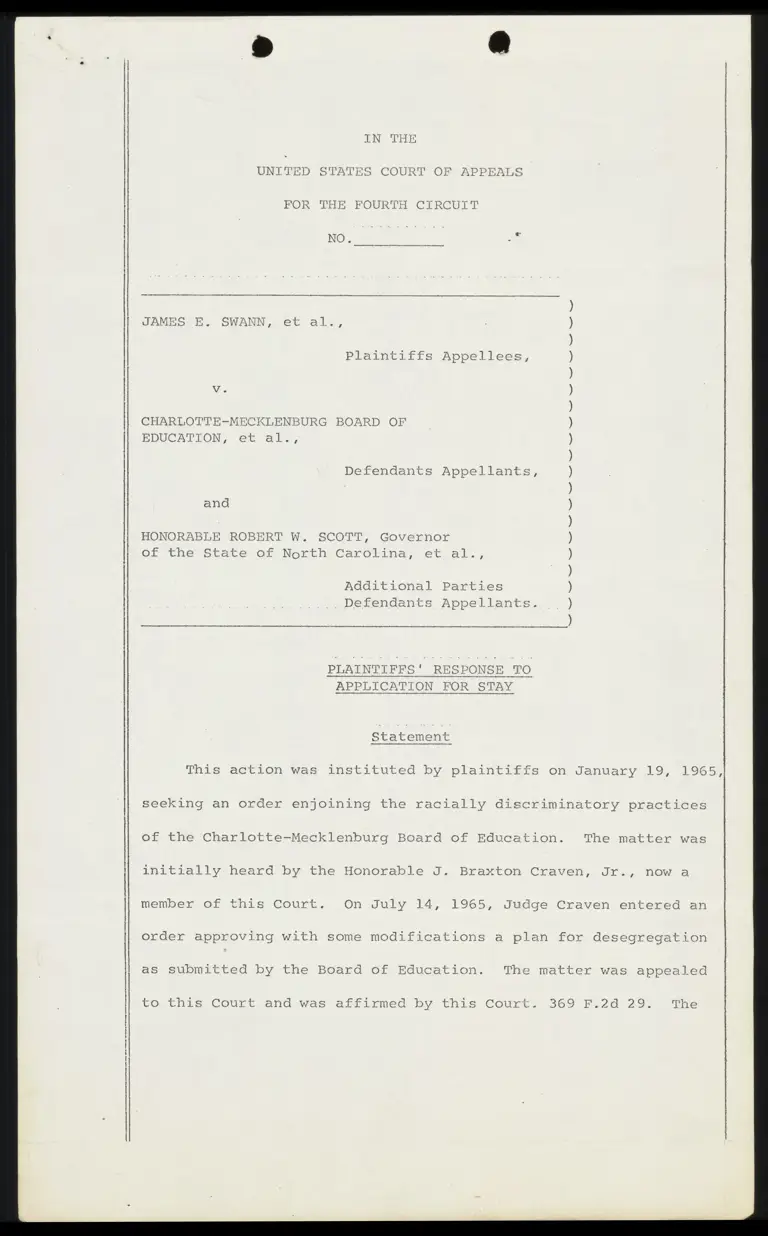
     [||5c4d3e5f-3920-4568-8d07-97f0cd3ad45a||] IN THE

UNITED STATES COURT OF APPEALS

POR. THE FOURTH CIRCUIT

NO. .¥


JAMES E. SWANN, et al.,

Plaintiffs Appellees,

Vv.

CHARLOTTE-MECKLENBURG BOARD OF

EDUCATION, et al.,

and

HONORABLE ROBERT W. SCOTT, Governor

Of the State of North Carolina, etc al.,

Additional Parties

. Defendants Appellants.

N
t


N
a


N
a
t


N
a
t


N
i
t
?

N
l


N
t
?


“
a
t
?


a
t
l


a
t


n
t


“
m
u
t
?


“
u
t


“
w
i
t


u
t
?


a
t


“
a
?


u
t
”


w
t
?


o
h


PLAINTIFFS' RESPONSE TO

APPLICATION FOR STAY


Statement


This action was instituted by plaintiffs on January 19, 1965,

seeking an order enjoining the racially discriminatory practices

of the Charlotte-Mecklenburg Board of Education. The matter was

initially heard by the Honorable J. Braxton Craven, Jr., now a

member of this Court. On July 14, 1965, Judge Craven entered an

order approving with some modifications a plan for desegregation

as submitted by the Board of Education. The matter was appealed

to thig Court and was affirmed by this Court. 359 7.24 29. The


plan as then approved provided for geographic assignment of pupilsd,

with freedom of choice, permitting students to transfer to other

schools after initial assignment. The plan also directed the

Board to employ and assign teachers and school personnel without .

consideration of race.

On September 6, 1968, plaintiffs moved the Court for further

relief on the basis of Green v. County School Board of New Kent


County, 391 U.S. 430, which reiterated the affirmative obligation

of school officials to take whatever steps are necessary to

disestablish segregated school systems. The District Court found

in its initial order on April 23, 1969, that the Charlotte-

Mecklenburg School System was still largely segregated and directed

the School Board to submit a plan on or before May 15, 1969, for

the desegregation of students and teachers in the system. On

three separate occasions, the School Board simply refused to

comply with the orders of the Court and finally advised the Court

that it did not feel it had any obligation to go further with

steps to eliminate the remaining segregated schools. Faced

with this open defiance, the District Court on December 1, 1970,

sought the assistance of an educational consultant in preparing

a plan to comply with the constitutional mandates of the Supreme

Court. Even in its December order, however, the Court again

invited the School Board to reconsider its position and submit

a plan as it had directed in April of 1969.

On February 5, 1969, the Court ordered implementation of a

plan which embodied parts of a plan prepared by the Board of


sducation and of the plan prepared by the Court consultant. This

plan provides for the alteration of some school attendance zones

and the pairing of some schools. Some school attendance areas

remain unchanged. The Court further directed that the School

Board provide transportation for those students who are reassigned

under the Court's order for the purpose of promoting further

integration of students.

In attempting to evade the February 5, 1970 order of the

District Court, as it had previously done with respect to the

previous orders of the Court, the School Board has publicly sought

to promote opposition to the Court's order by contending that the

Court has ordered massive transporting of students over extended

areas at excessive cost. The Board further contends here that

the order imposes impossible conditions which it cannot meet.

In the preparation of the plan finally approved by the

Court, the Court consultant worked closely with the administrative

staff of the School Board. In fact, the final proposal presented

by the Court consultant was drafted by the administrative staff

as one which could be implemented during the 1969-70 school year.

Rather than seeking to prepare for implementation of the

Court's order, the School Board has set about to attempt to

establish its inability to comply. The School Board has publicly

and before this Court contended that it must purchase 526 buses

at a Sri of more than $4,500,000.00 to transport 23,000 addition-

al students which it contends the Court order directs. Despite

the affidavit of Mr. J. D. Morgan, attached to the Application


For Stay, Mr. Morgan in deposition admitted that he had not

considered different methods for transporting students; that in

{| fact, if he routed buses differently, at least one-half of the

526 buses and of the alleged capital outlay would not be required.

See pages .15-17 of deposition of Mr. J. D. Morgan taken on

February 25, 1970. As» further indication of the patent mis-

representation of the School Board, the School Board contends

that it must now transport an additional 23,000 students. The

Court order provides for transporting only those students assigned

more than walking distance to promote integration. The record

clearly establishes that this figure will be only 10,000 students]

The School Board has added 13,000 more students who are not

now provided transportation and who are not required to be trans-

ported by the order of the Court. Moreover, the School Board

alleges that millions of dollars will be required to provide

transporation when the evidence clearly indicates otherwise. The

exaggerated figures of cost for complying with the Court's order

is clearly designed to attempt to show that the Board is unable

to comply with the order. The Board presently transports 23,000

students daily at an average annual cost of $20.00 per pupil.

In July, 1969, the Board proposed to transport 4,500 Black students

under the same conditions as directed by the District Court here

and secured funds of $185,000.00 for that purpose. Only 746

of the students are now being transported. The Board simply

has not explored other avenues for determining the availability

of any funds which might be necessary to comply with the Court's


|
! 1 4

}

order. In fact, it is not-clear that any additional funds not al-}

ready budgeted will be necessary since the Board has not actually

considered the number of students involved and all avenues for pro;

viding transportation for students as directed by the February 5,

1970 order.

The Board contends that it will not be able to secure the
.

necessary buses in order to comply with the Court's order, even if

buses were avallable., As found by the Court, it is not clear that

additional buses will be required or that the buses now available

with the State Board of Education would not satisfy whatever

additional buses might be required.

The District Court has carefully considered and reviewed the

evidence and the law in this case. Despite the recalcitrance and

contemptuous conduct of the Board throughout the proceeding, the

District Court has tried to fashion a decree which was practicable)

fair and in compliance with the Constitution. The District Court

has considered all of the contentions of the Board, including

those advanced here that the order imposed impossible conditions

and has rejected them. Over the objections of the plaintiffs

and only with the assurance of the Superintendent that the plan

and timetable were feasible, the District Court delayed implemen-

tation of the plan for the elementary school phase until April 1,

1970 and for the junior and senior high schools phase until May 4,

1370,

Pending now before the District Court is a motion by plain-

tiffs to find the School Board and the Superintendent in contempt

of the Court's order because of their failure to carry out the

orders of this Court. On February 27, 1970, the School Board


il At the hearing on November 5, 1970, Mr. J. D. Dark, Director of

the Division of Transportation of the State Board of Education,
a defendant in the case, testified that the State had in excess of}

400 buses on hand, 75 of which his office was willing to allocate
immediately to the Charlotte system. TE

-5=


voted to ignore the District Court's order and to comply with

the State Court's restraining order which sought to enjoin

implementation of the District Court's February 5, 1970 order.

The record here clearly establishes a segregated school .

system created and perpetuated by the School Board. The record

further establishes that the plan directed by the District Court

can feasibly be implemented within the time directed.


Reasons for Denying Stay


The District Judge properly rejected the School Board's

application for a stay pending appeal so that desegregation of

  the district might proceed pendente lite. Jhis is in accord with

the decisions of the Supreme Court that school districts are ob-

ligated to "terminate dual school systems at once and to operate

now and hereafter only unitary schools." Alexander v. Holmes

County Board of ¥Fducation, 306 U. 8.19 (1969); Dowell v. Board


  of Bducation, U.S. y 24 L.ed 28 414 (1969); Carter v., West

Feliciana Parish School Board, 0. SS. 7-24 Led 28 382
a

(1970). This Court, applying Alexander, said "Further delays will


not be tolerated in this Circuit," Nesbit v. Statesville City


  Board of Bducation, 418 7.28 1040 (4th Cir. 1969).° See also

Stanley v. Darlington County School District, F.2¢ = (4th


Cir, 21070),

Carter was not new law. The Supreme Court had repeatedly held

that delays in implementing the constitutional right of Negro

children to a desegregated public school education are "no longer

tolerable" after fifteen years of evasion and delay since Brown Vv.

Board of Education, 349 U. 8. 294 (1955). See Green v. County

School Board, 3%1 U. 8S. 430, 438 (1968); Watson v. Memphis, 373 U.

S$..573, 579 (1963); Bradley v. School Board, 382.0. S. 103 (1965);


Rogers v, Paul, 382 U. 8S. 198 (1965); Griffin v. County School


Board, 377 U. 8. 215, 234 (1864); Goss v. Board of Pducation, 373


U. S. 683, 689 (1963). The District Judge performed his duty

under the Green case by formulating a plan of desegregation which

is designed to actually accomplish desegregation of the school

system. This process required numerous hearings and involved the

ART of many months. When the District Judge finally formu-

lated an ELLA A plan for the desegregation of the system with

the aid of a consultant designated by the Court (after the Court

had on numerous occasions rejected School Board proposals as

Tet


to inadequate), it was the obligation of the District Judge to put

the desegregation plan into effect without delay. The Trial

Judge, over plaintiffs objections, actually has deferred implemen-

tation of the plan for several weeks to enable the school system

to make plans for the change, but has corréctly refused to stay

the order pending appeal.

The decision below refusing a stay is not only consistent

with and compelled by the Supreme Court's most recent decisions

requiring immediate desegregation. Alexander, Dowell and Carter,

supra, but the decision denying a stay is in accord with fifteen

years of precedents during which time the Supreme Court and the

individual justices of the Court in Chambers have uniformly

refused to issue stays so as to Zatnl implementation of lower

court orders requiring that school desegregation proceed, and have

frequently overturned stays issued by lower courts. A stay in

this case would be entirely unprecedented as demonstrated by the

following cited cases in which school desegregation stays have

been denied or vacated. Lucy v., Adams, 350 U. S. 1 (1955); County!

School Board of Arlington County, Va. v. Hamm, 4 Race Rel. L. Rep.


14 (1959) (Order of Chief Justice Warren in Chambers) ; United

States v. Louisiana, 364 U. 8S. 500 (1960); Ennis v. Evans, 364


U. S. 802 (1960); Houston Independent School District v, Ross, 364


U. 8S. 803 (1960); Orleans Parish School Board v. Bush, 364 U. S.


B03 (1960); Danner v. Holmes, 364 U. 8. 939, 5 Race Rel. 1. Rep.


1092 (1961) (refusing to reinstate a stay dissolved by Chief


Judge Tuttle of the Fifth Circuit in Holmes v. Danner, 5 Race Rel.

IL. Rep. 1081 :{1961)); Board of Fducation v., Taylor, 82 8. Ct. 10


(1961) (Opinion of Mr. Justice Brennan in Chambers); Meredith v.


Pair, © L.ed 284 43, 83 8. Ct.-10 (1962) (Opinion of Mr. Justice

Black in Chambers); Board of School Commissioners v. Davis, 11


L.ed 24 26, B84 ' 8. Ct. 10 (1963) (Opinion of Mr, Justice Black in

Chambers); Wallace v. Lee, 387 U. S. 916 (1967); Caddo Parish


4 *

School Board v. United States, 386 U, §. 1001 :{1967). In an


unreported order in Boomer v. Beaufort County, N. C. Board of

Education and Felton v. Edenton-Chowan School Administrative Unit,


(August 30, 1968) Mr. Justice Black vacated stay orders issued by

a panel of the Fourth Circuit and reinstatéd injunction requiring

prompt school desegregation. The Boomer order said that the

Green decision "requires that the desegregation of school be

completely carried out at the earliest possible moment." Mr.

Justice Brennan similarly vacated stays and reinstated injunctions

in cases involving Denver and Oklahoma City. Xeyes v. School


District No. 1, Denver Colo., 396 U. 8. 1215 {August-29,.1969).


Mr. Justice Brennan's stay injunction in the Oklahoma City case

was subsequently vindicated by the action of the entire Court.

Dowell v. Board of Fducation of the Oklahoma City Public Schools,


U. 8. : .:,.24 1L,,ed 24 414 (196%). The Oklahoma City and

Denver cases are particularly relevant in the present contex

because both cases involved school board appeals from desegregatio

orders which were challenged becaused they required transportation

of students to promote desegregation. See also the temporary

injunctive orders granted in Carter v. West Feliciana Parish

School Board, 396 UO, 8S. 226 (196%).

Plaintiffs, therefore, respectfully submit that the Court

~ should deny defendants' application for stay.

Respectfully submitted,

Siig

/7
QONRAD O. PEARSON

203 1/2 East Chapel Hill Street
Durham, North Carolina

CHAMBERS, STEIN, FERGUSON & LANNING

216 West Tenth Street
Charlotte, North Carolina 28202

JACK GREENBERG

JAMES M. NABRIT, 111

NORMAN CHACHKIN

10 Columbus Circle
New York, New York 10019

Attorneys for Plaintiffs

-0

Nn


The

served

for St C

al

Q
wD) tates

ay upon

parties-

CERTIF

undersig

oO

es of the for copi

counsel fo

4.
defendant b;

Me 3 od ore
Mall , postage

Brock Ba
n

Le aw D

Gaston H.

irieyr, Ps
3dernstein

1014 Law

Chavlotte,

Honorable

Attorney

State of
a - 1 ww} Ralelgh,

Femes H.

Law Build

her lotte

Benjamin

806 East
Charlotte,

Whiteford

North Carolina

Charlotte,

fhis—3ré—day—of—Mareh 3916.

(LO awm Ba

Fae Budden

Q hor sth

JCATE OF SERV. [CE

egoing

SL
] 3


0 —


ad


i


rn


Mh
 U

H
L


r the defendants

~ rr
8 copies

North Carolina

. Waggoner, Esq.

5 Waggoner, Sturges

inger Office Tower

, North Caroline


rker,
Gag oe A ~~

» Thompson,
and Preston

Building

North Carolina

Robert

General

North Carol:

North Carol

Morgan

ha
-
1

.
13 13

Carson, Jr.
ing

North

3 SF I | J

Caroling

Horack, E

Trade Eiraat

North Caro

Q
Te SQ.

lin:

frre

Q S. Blakeney, Ei
National B

North Carolina

vl


a a mma

ET [||5c4d3e5f-3920-4568-8d07-97f0cd3ad45a||]