Letter from Paust to Attorneys RE: Dum-Dum Bullets and Human Rights
Correspondence
November 9, 1979
2 pages
-
Case Files, Garner Working Files. Letter from Paust to Attorneys RE: Dum-Dum Bullets and Human Rights, 1979. 997d9e20-34a8-f011-bbd3-000d3a53d084. LDF Archives, Thurgood Marshall Institute. https://ldfrecollection.org/archives/archives-search/archives-item/17da66d1-f8c0-4df4-b11a-8e359b7cfbc4/letter-from-paust-to-attorneys-re-dum-dum-bullets-and-human-rights. Accessed September 15, 2026.
Copied!
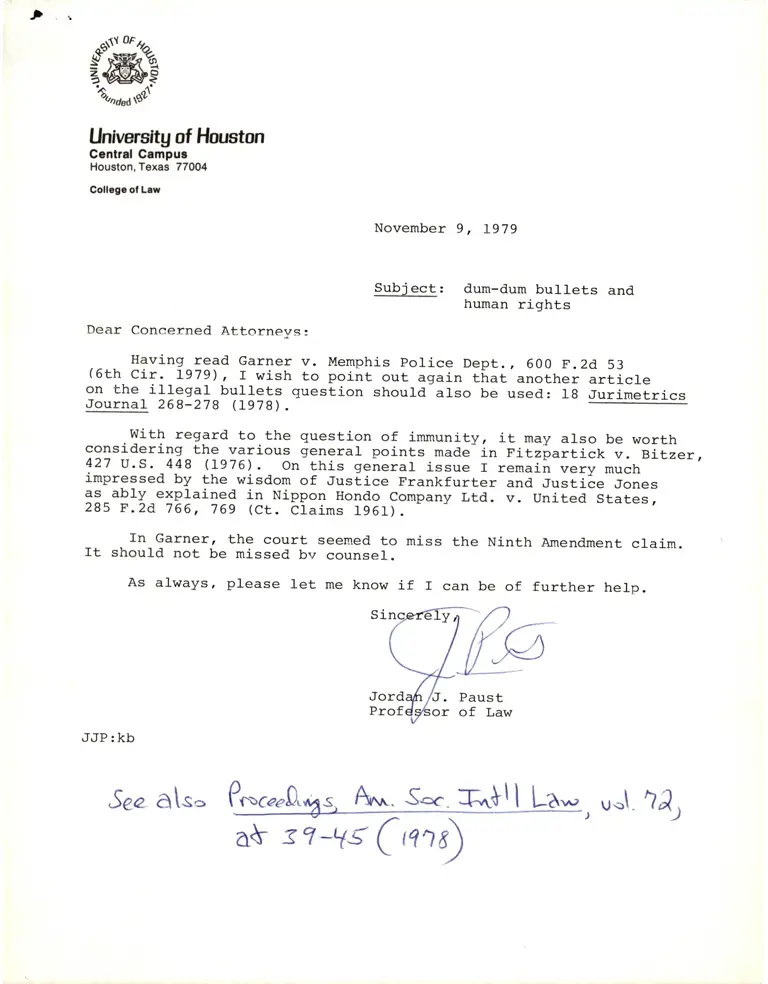
University o f Houston
Central Campus
Houston, Texas 77004
College of Law
November 9, 1979
Subject: dum-dum bullets and
human rights
Dear Conoerned Attornevs;
Having read Garner v. Memphis Police Dept., 600 F.2d 53
(6th Cir. 1979), I wish to point out again that another article
on the illegal bullets guestion should also be used: 18 Jurimetrics
Journal 268-278 (1978). ---- -̂------
With regard to the question of immunity, it may also be worth
considering the various general points made in Fitzpartick v. Bitzer,
427 U.S. 448 (1976). On this general issue I remain very much
impressed by the wisdom of Justice Frankfurter and Justice Jones
as ably explained in Nippon Hondo Company Ltd. v. United States
285 F.2d 766, 769 (Ct. Claims 1961).
In Garner, the court seemed to miss the Ninth Amendment claim.
It should not be missed bv counsel.
As always, please let me know if I can be of further help.
S i nqjereliT^'
J. Paust
or of Law
JJP:kb
PROPOSED FEDERAL LEGISLATION CONCERNING ILLEGAL WEAPONS
extract from: A. Evans & J. Murphy (eds), Legal Aspects
of International Terrorism 609-610 (1978):
Prohibitions of Illegal Weapons. Having worked on the dum-dum
bullet controversy here in the United States, tlie writer finds a significant need
to adopt national legislation to supplement legal prohibitions of illegal weap
ons.'*'’ Weapon systems proscribed from use per se under international law are
also clearly illegal under U.S. constitutional law.'* ' Supplementary federal
statutory law and penal tic.s appear desirable, however, for the following reasons:
(1) illegal \ve:ipon systems arc still available in nearly every gun shop across the
country for purcha.se by teirorists; (2) record use of these weapon systems by
those engaged in normal criminal activity is on the increase; and (3) several
police officers and other citizens have been killed with these weapon systems in
the last few years, but there is insufficient regulation of the manufacture, sale,
and use of such illegal weapon systems in the United States at this time.
For tiiis purpose, the following draft amendment to the House draft version
of H.R. 3625' * ̂ is offered for e.xecutive consideration and possible submission
to the House:
Any person who inanulactures, produces, or sells weapon systems for use against
human beings or u.ses them to kill or injure a human being when such weapon
systems are proscribed for use agaifist human beings under international law,
shall be fined not more than SIO.OOO per incident or imprisoned not more than
10 years, or botli; but if death results, sueh person shall be subject to
imprisonment for any term of years or for life. This provision shall have
extraterritorial effect to the extent that sueh is consistent with international law.
With the transnational availability of such illegal weapon systems, the
United States might also recommend to foreign states that they adopt similar
implemcntary legislation to supplement or create domestic penal offenses and to
establisli sanctions for tlic violation of sucli international and domestic law. The
problems posed are mo.st serious. Without effective sanction, we will witness the
spread of the use of illegal weapons against aliens in general, businessmen,
tourists, diplomats, and others, with serious threats to the continued existence
of law and authority. Furtliermore, with the increased interdependence of
societies in the global arena, and the increase in alien tourist, business, diplomat,
and other ventures into U.S. cities and counties, it seems increasingly likely that
the death or injury of an alien by the unregulated use of illegal weapon systems
will lead to :i claim by a foreign state against the United States of state
responsibility foi a death or injury by means violative of international law.'*’
To leave the country open to such a claim, and the political, ideological, or
economic sanctions that can follow, is hardly policy-serving or a rational
maximization of self- ind common interest. The United States might also benefit
greatly from the adoption of a national testing institution that compares effects
of weapon systems both outside and within the human body with international
and national legal norms to assure compliance with the law.' **