Memorandum on Additional Discovery Issues
Public Court Documents
January 14, 1980
11 pages
-
Case Files, Garner Hardbacks. Memorandum on Additional Discovery Issues, 1980. 039a6aef-26a8-f011-bbd3-000d3a53d084. LDF Archives, Thurgood Marshall Institute. https://ldfrecollection.org/archives/archives-search/archives-item/18dfa011-b3e1-47ce-9a3f-d71ab023e51a/memorandum-on-additional-discovery-issues. Accessed September 25, 2026.
Copied!
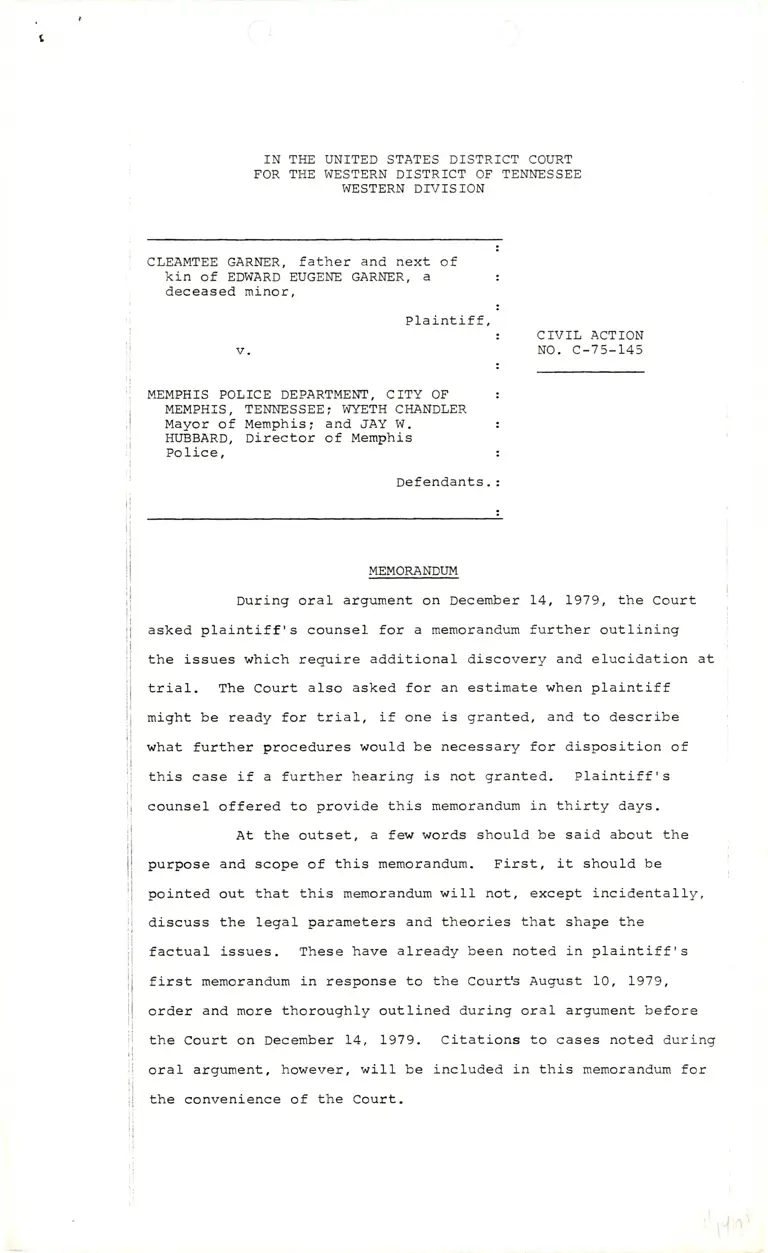
IN THE UNITED STATES DISTRICT COURT
FOR THE WESTERN DISTRICT OF TENNESSEE
WESTERN DIVISION
CLEAMTEE GARNER, father and next of
kin of EDWARD EUGENE GARNER, a
deceased minor.
Plaintiff,
V,
MEMPHIS POLICE DEPARTMENT, CITY OF
MEMPHIS, TENNESSEE; WYETH CHANDLER
Mayor of Memphis; and JAY W.
HUBBARD, Director of Memphis
Police,
Defendants,
CIVIL ACTION
NO. C-75-145
MEMORANDUM
During oral argument on December 14, 1979, the Court
asked plaintiff s counsel for a memorandum further outlining
the issues which require additional discovery and elucidation at
trial. The Court also asked for an estimate when plaintiff
might be ready for trial, if one is granted, and to describe
what further procedures would be necessary for disposition of
this case if a further hearing is not granted. Plaintiff's
counsel offered to provide this memorandum in thirty days.
At the outset, a few words should be said about the
purpose and scope of this memorandum. First, it should be
pointed out that this memorandum will not, except incidentally,
discuss the legal parameters and theories that shape the
factual issues. These have already been noted in plaintiff's
first memorandum in response to the Court's August 10, 1979,
order and more thoroughly outlined during oral argument before
the Court on December 14, 1979. Citations to cases noted during
oral argument, however, will be included in this memorandum for
the convenience of the Court.
Second, plaintiff has not endeavored to detail or even
list every area of what may be proved or produced at trial. Nor,
prior to discovery, can plaintiff identify the exact source of
relevant data, whether testimonial — expert or lay -- or docu
mentary, At this stage of the case, plaintiff cannot state
conclusively what will or will not be produced or discussed at
trial as he would in a pre-trial order entered into on the eve ■
of trial after discovery and preparation have been concluded.
Rather, it is the understanding of plaintiff that the purpose of
I
this memorandum is solely to aid the Court in its decision j
I
regarding the necessity for further hearings and trial by better
describing the scope of the relevant issues and proof so that ^
the Court can better ascertain whether a trial is necessary. In
so doing, plaintiff has endeavored to be as exhaustive as possible,
IIII. I
The areas of inquiry and proof at trial would be as
follows;
1, Racial Discrimination:----------------------------------------------------------------------------------------------------------------------------------------------- i
The relevant factual inquiries include extensive
statistical data in order to intelligently assess the racial
impact of the Memphis Police Department's liberal use of deadly
force policy. The total number of incidents involving use of
deadly force — with rare exceptions, missed shots, woundings
and fatalities are only chance variations resulting from equally
1/serious decisions -- and the race of the police shooting op
ponent in each case must be ascertained. This,'in turn, must
be compared against several figures. These include the racial
breakdown of the Memphis population, of all arrestees in Memphis
1_/ Indeed, the number of cases that result in death should be
a predictable percentage of firearm discharges. See discussion,
infra.
- 2 -
and of all those arrested for violent crimes. In light of the
Memphis policy to allow use of deadly force against those in
volved in property crimes, these figures need to be compared
against the racial breakdown of arrestees for property crimes
I
as well.
The geographic location of police shooting incidents
also needs to be ascertained to see whether police are more
likely to use deadly force in minority residential areas. This
data must in turn be viewed against the above data regarding
various arrest, rates to see whether it correlates with pre
dictable incidence of opportunity or need for use of deadly
force or whether it is racially related.
Finally, the percentage of shooting incidents that j
result in death and the racial breakdown of the victims must be
contrasted with the race of all police shooting opponents to '
I
see whether fatalities are indeed random or racially related. j
. . i2. Adequacy of Memphis Police Department Training: |
This issue was already partially illumined at the first
i
trial. Other relevant areas of inquiry include the degree of
training in alternatives to use of deadly force, the degree of
in service training, and the content of legal training. More
importantly, training in Memphis needs to be compared with that
in other major and comparable municipal police departments and
the FBI. Specifically, it needs to be seen whether the Memphis
Police Department training in fact measures up to these standards
in the above three and other areas. On the issue of inservice
training, for example, according to information now available to
plaintiff's counsel, Memphis provides only annual inservice
training. In contrast, Birmingham tests its officers twice a
year, Indianapolis thrice. In Detroit and Portland, officers
participate in retraining exercises involving simulated barri-
- 3 -
i
caded gunmen and hostage situations. In Detroit, and in other
departments such as Oakland, role call time is used for stress-
ing deadly force policies on a monthly basis or for discussing
and analyzing recent use of force incidents. Other issues are
: whether Memphis' training meets the standards of other police
: forces which use simulated conditions, as in New York; training
in night shooting, as in Portland, Birmingham and Indianapolis;
stress shooting, as in Birmingham and Indianapolis and Oakland;
exercises, as in Kansas City and Indianapolis. Yet
another question is the adequacy of training in shooting at a
moving target. See generally, Popow v. City of Margate. 476 ■
F. Supp. 1237, 1246 (D.N.J. 1979).
Also relevant to the issue of adequacy of training is
proof regarding the actual understanding of Memphis police
officers of the substance of the Memphis use of deadly force train
ing. Although this will be discussed separately, infra, section 4,:
it is also relevant to the training issue as a discrepancy between I
11
Ijthe content of the training and what the officer takes home "might '
,I indicate to a trier of fact that there was inadequate communica-
|̂tion to officers of the city's policy and rules on this subject." ’
ijld.
I 3. Intradepartmental Investigation and Discipline;
The issue of investigation of use of deadly force
I incidents and discipline of officers who have violated departmental
i
!policy is also relevant to establish whether the city ratifies
{<
iunconstitutiona1 actions or whether it in fact encourages a de
■j facto policy of unrestrained use of deadly force. Popow, supra,
476 F. Supp. at 1246-47. See also Mayes v. Elrod. 470 F. Supp.
1188, 1194 (N.D. 111. 1979). Several issues in this area need to
be developed in this record for the first time. They include
jevidence regarding the Internal Affairs Bureau of the Memphis
- 4 -
Police Department "lAB" which is charged with receiving and
investigating complaints of police misconduct generally. The pol
icies and practices of the lAB which contribute to an overall
climate of condonation of Memphis police use of deadly force, and
physical abuse and misconduct generally, need to be explored.
These include its practice of conducting polygraph tests only on
complainants and not on the accused officers; the failure to
accept or investigate telephone or anonymous complaints; and the
requirement of a signed, sworn statement from each complainant
which is immediately turned over to the accused officer. This
li latter practice must further be evaluated in light of evidence
i|
that may be developed regarding harrassment by Memphis police ;
1
officers of lAB complainants and witnesses. The ultimate factual
issue is whether the functioning of the lAB merely serves to i
protect officers charged with use of deadly force and misconduct '
i
generally, thereby establishing the implicit policy that Memphis
police officers may do as they please without fear of internal !!
discipline or investigation. |1
iAs a corrolary, the resulting disciplinary procedures
need to be evaluated, both with regard to instances of the use
of deadly force and police misconduct and physical abuse generally.
About one-third of all lAB complaints involve physical abuse.
In approximately 40% of all cases, the lAB recommends that the
charges are "founded" [sic]. Nevertheless, only about 5^% of
all lAB complaints of physical abuse result in any disciplinary
action whatsoever. Only 3̂ %̂ result in disciplinary action
more serious than a reprimand. If disciplinary action is viewed
in terms of only those complaints of physical abuse that are
found supportable by the lAB, then disciplinary action still
!only occurs in 16% of those cases.
- 5 -
Also, the careers of Memphis police officers involved
in use of deadly force and other types of physical misconduct
need to be followed to see whether the occasional reprimand or
suspension has any effect on subsequent promotions or assign
ments or whether officers are in fact rewarded for such conduct.
See Turpin v. Mailet, 579 F.2d 152 (2d Cir.) vacated and remanded,
439 U.S. 974 (1978), aff'd as modified on remand, 591 F.2d 425
(2d Cir. 1979).
Finally, expert testimony about the disciplinary poli
cies and procedures of other police departments and their effect
on the use of deadly force will be relevant and helpful to the
Court to assess the sufficiency of the Memphis practices.
4. Subjective Evidence of Memphis' Daily Force Policy:
There is no evidence in this record with regard to
what Memphis officers generally, and Officer Hymon particularly,
understand to be the Memphis Police Department on resort to
use of deadly force. As already noted, such evidence will be
relevant to the adequacy of training. It will also be relevant
to the issue of adequate supervision. In Popow. supra, the
Chief of Police testified that the rules governing shooting in
a residential area were "common sense." The court indicated
that this "could be found by a finder of fact to demonstrate
grossly inadequate supervision." Id., 476 F. Supp. at 1245.
Further, evidence of the policemen's subjective understanding
of the Memphis policy will be relevant, together with evidence
on failure to discipline, to establish what Memphis' real, though
implicit, policy is. In Wiley v. Memphis Police Department,
this Court found that the officers testified that "they were
trained whenever they used their firearems to 'shoot to kill.'
Quoted in Wiley v. Memphis Police Department, 548 P.2d 1247,
- 5 -
,1
1250 (6th Cir. 1977), Additional evidence of this "shoot to
kill" policy and that it causes the unwarranted deaths of un
armed fleeing felons will be necessary to the decision in this
case.
5. Causal Relationship Between the Municipal Policy
and the Injury Inflicted:
To succeed under Monel1. the plaintiff must show that
the injury suffered was caused by a municipal "policy or custom."
Accordingly, plaintiff will seek to adduce evidence regarding
the causal relationship between police departments' policies
and training and incidence of use of deadly force. Evidence
of the experience of other police departments with use of deadly
force policies and the effects of such policies on officers'
behavior in the street, as well as expert testimony, will be
relevant in this regard. It can be shown that jurisdictions
that have more carefully drawn use of force policies and better
and more frecruent instruction and training do experience less
use of deadly force, particularly unjustified use.
6. Operational Needs and Other Asserted Justifications
for Memphis' Deadly Force Policy:
Also relevant will be evidence relating to claimed
operational needs and other asserted justifications said to
support Memphis' liberal use of deadly force policy. Plain
tiff will endeavor to show that the policies adopted by Memphis
are not necessary to nor compelled by considerations of officer
safety. Evidence will consist of policies and practices of
other departments, the testimony of experienced police profes
sionals and statistical data regarding rates of arrest for
violent felonies, officer deaths or injuries, and a community
safety index based on homicide rates.
- 7 -
similar evidence with regard to any claimed deterrent
or apprehension justification for Memphis' liberal use of deadly
force policy will be presented. Plaintiff will seek to put
on such evidence to show that the deadly force policy is not
justified by the necessities of law enforcement, that the
actual practice of use of deadly force by Memphis police of
ficers does not comport with any such claimed justifications,
and that, therefore, such undisciplined and uncorrected use
of deadly force evidences a municipal policy of the wholesale
use of deadly force by Memphis officers.
Finally, depending on the above and on what is devel
oped in discovery and at trial, evidence regarding the purposes
of Memphis' liberal use of deadly force policy may be intro
duced to show that Memphis employs deadly force for constitu
tionally insufficient or impermissible reasons.
7. Use of "Dum-Dum" Bullets:
Although there had already been some testimony re
garding the use and effects of hollow point "dum-dum" bullets,
the record was deficient in several respects. Plaintiff will
seek to establish the effects of the use of "dum-dum" bullets
when viewed together with training to shoot at the torso. Evi
dence will also be presented with regard to the ammunition
policies and practices of other police departments and the
FBI and the rationality of the claimed justification for the
use of "dum-dum" bullets.
- 8 -
8. Evidence Related to a Qualified Good Faith Defense
if Available;
If the Supreme Court decides a good faith defense is
available to a municipality, and depending on the parameters
established in such a decision, evidence relating to the avail
ability of such a defense will be necessary. Assuming a qua
lified defense is available, the facts upon which such a defense
rests will have to be established. If it is modeled on the
current good faith defense available to individuals under §1983,
then the following can be said: "The good faith defense is
composed of both objective and subjective factors." Leite v .
City of Providence, 463 F. Supp. 585, 588 (R.I. 1978). Evi
dence regarding the subjective intentions of the municipal
policy, perhaps as inferred from the types of evidence des
cribed above, will be necessary to the application of any good
faith defense. Any direct evidence of a subjective intention
will also be relevant if it can be developed through deposition
and discovery.
Moreover, the application of a good faith defense in a
case such as this where the allegations include inadequate train
ing and supervision may not in fact be appropriate. As the
court in Leite, supra, observed, " [t]raditional 'good faith
defense' analysis is not particularly helpful in these circum
stances.__" Rather, the question is whether the muni
cipality was deliberately indifferent to the constitutionally
protected interests of the plaintiff, a "culpability standard
[that] concerns the defendant's state of mind" and serves much
the same purpose as the good faith defensei Id. at n.2. This
is a factual issue to be decided based on direct evidence of
the subjective state of mind of the deciding municipal officials,
if available,and on the inferential evidence regarding munici-
- 9 -
pal policy described above.
II
I!
During oral argument on December 14, 1979, the Court
also requested that plaintiff's counsel include in this memorandum
a discussion of the further proceedings that will be necessary for
the disposition of this case, including a date when plaintiff would
be ready to proceed to trial.
With regard to a possible trial date, plaintiff can only
state that he cannot be ready for trial before July 1, 1980. This
time is necessary to allow for adequate discovery and preparation
and in order to allow plaintiff's counsel to fulfill his ethical
obligations in other cases. When, during oral arguiaent before
this Court, plaintiff's counsel volunteered to provide this infor
mation within thirty days, he had a pre-trial conference scheduled
for the following weerk. The Court in that case rescheduled that
conference. Plaintiff's counsel now has pre-trial conferences set
ifor January 24, 1980 in Inmates of Mobile County v. Purvis, Civ.
No. 76-416-P (S.D. Ala.), and for February 11, 1980 in Guthrie v.
Evans, Civ. No. 3068 (S.D. Ga.). After those conferences, plain
tiff's counsel will be in a better position to give this Court an
estimate of when he can reasonably be ready for trial, whether he
can be ready for trial sooner or at some other time.
With regard to what proceedings will be necessary for
disposition of this case without a trial, plaintiff would suggest
that he be allowed to formulate and tender an offer of proof as to
what would have been presented at trial. Concurrent with the sub
mission of this proffer, plaintiff would submit a full brief on
the legal and factual issues in this case. Plaintiff would also
- 10 -
I request a full oral argument after the submission of the brief and
'the proffer. Plaintiff estimates that this too will require until
'July 1, 1980 , given the other professional commitments described
,above.i l,1 Plaintiff stands ready to provide the Court with any further
information necessary. If the Court so requests, plaintiff's
'i
i, counsel will provide an updated estimate of the time necessary toi i''proceed in this case after .his last pre-trxal on February 11.
I I
Respectfully submitted.
Ujb
STEVEN L. WINTER
10 Columbus Circle
Suite 2030
New York, New York 10019
WALTER LEE BAILEY, JR.
161 Jefferson Avenue
Suite 901, Tenoke Building
Memphis, Tennessee 38103
Attorneys for Plaintiff
Certificate of Service
I hereby certify that a copy of the foregoing Memorandum
IiIl has been served by United States mail, postage prepaid, to Henry
!|: L. Klein, Esq., 100 No. Main Building, Suite 3500, Memphis,
Tennessee 38103, this 1 V^^day of January, 19 80 .
Steven L. Winter
- 11 -