Memorandum of Law in Opposition to Motion to Dismiss
Public Court Documents
September 2, 1977
49 pages
-
Case Files, Hatcher v. Methodist Hospital - Hardbacks. Memorandum of Law in Opposition to Motion to Dismiss, 1977. ed880de8-5384-f111-ab0f-7c1e527d528a. LDF Archives, Thurgood Marshall Institute. https://ldfrecollection.org/archives/archives-search/archives-item/1934d0d5-ea0f-46e0-a376-35e6d58a7aa4/memorandum-of-law-in-opposition-to-motion-to-dismiss. Accessed October 10, 2026.
Copied!
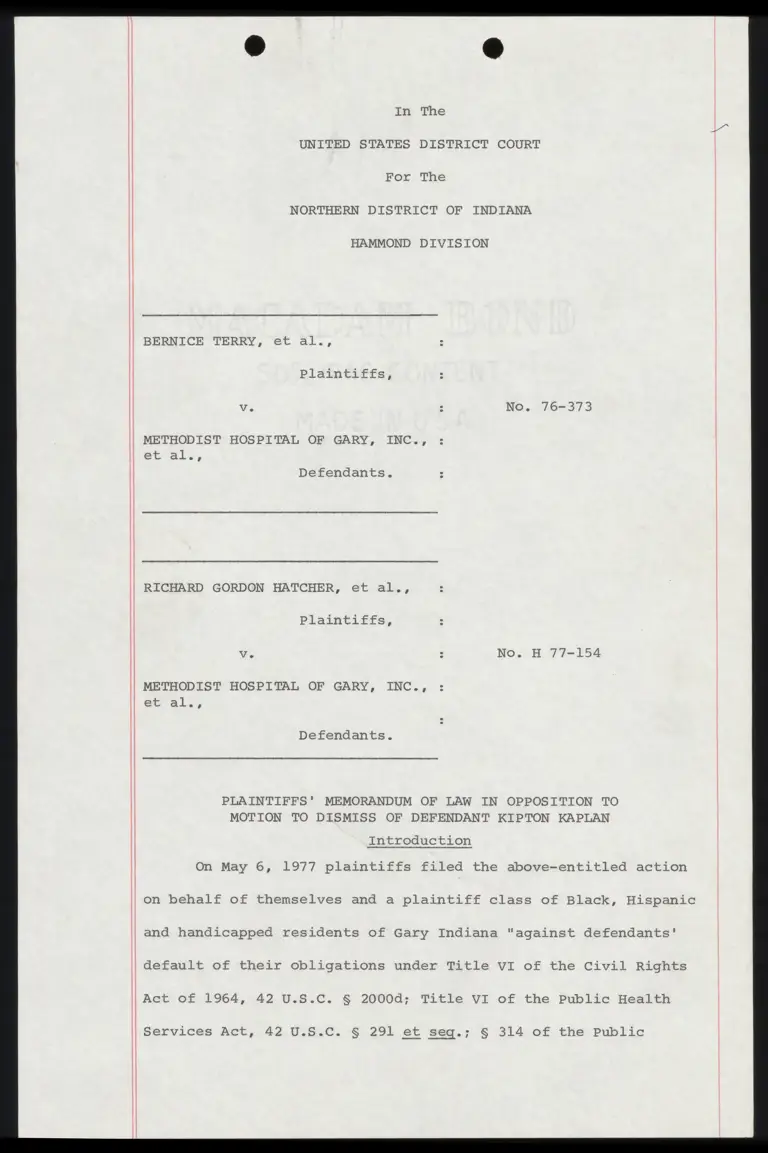
     [||14e85527-c36a-4c21-81f6-701838379ddc||] In The

UNITED STATES DISTRICT COURT

For The

NORTHERN DISTRICT OF INDIANA

HAMMOND DIVISION


BERNICE TERRY, et al.,

Plaintiffs,

Ve No. 76-373

METHODIST HOSPITAL OF GARY, INC., :

et al.,

Defendants.


RICHARD GORDON HATCHER, et al., 2

Plaintiffs, :

Ve No. H 77-154

METHODIST HOSPITAL OF GARY, INC., :

et al.,

Defendants.


PLAINTIFFS' MEMORANDUM OF LAW IN OPPOSITION TO

MOTION TO DISMISS OF DEFENDANT KIPTON KAPLAN

Introduction


On May 6, 1977 plaintiffs filed the above-entitled action

on behalf of themselves and a plaintiff class of Black, Hispanic

and handicapped residents of Gary Indiana "against defendants’

default of their obligations under Title VI of the Civil Rights

Act of 1964, 42 U.S.C. § 20004; Title VI of the Public Health

Services Act, 42 U.S.C. § 291 et seqg.; § 314 of the Public


Health Services Act, 42 U.S.C. § 246; § 504 of the Rehabilitation

Act as amended in 1973, 29 U.S.C. § 794; § 1122 of the Social

| Security Act, as amended in 1972, 42 U.S.C. § 1320a-l; and to

redress the deprivation of plaintiffs' rights under the Fifth and

Fourteenth Amendments to the Constitution of the United States and

the Civil Rights Act of 1871, 42 U.S.C. § 1973." (Complaint, ql.)

The action "challenges the existence, perpetuation, and expansion

of segregated and unequal hospital facilities operated by

Methodist Hospital of Gary, Inc. It also challenges the approval

of and granting of federal financial assistance to said facili-

| ties" by HEW, the Indiana State Board of Health, and defendant

Kipton Kaplan, as Executive Director of the Northern Indiana

Health Systems Agency, Inc., (hereinafter "HSA") (Complaint ql).

Defendant HSA is a nonprofit corporation which receives

continuing federal financial assistance to perform reviews of

health facility capital expenditures and to make recommendations

to state and federal authorities on such reviews pursuant to

| § 1122 of the Social Security Act (hereinafter § 1122) (Complaint,

§ 10; Memorandum of HSA In Support of its Motion to Dismiss, pp.

2-3).

As stated in the Complaint, 17, and noted in other memo-

randa submitted by plaintiffs, the local agency which was the

| predecessor of the HSA approved the proposal to construct Broadway

Methodist Hospital and the Hill-Burton grant and loan application

| without considering the impact of the new facility on the minority


/
and handicapped residents of Gary. In 1976, when Methodist

Hospital submitted an application under § 1122 and for Hill-

Burton federal financial assistance in connection with the expan-

sion of Broadway Methodist Hospital, defendant HSA recommended

approval of the Hill-Burton loan guarantee and the § 1122 appli-

cation without making findings

"e. « «. as to the effect of the grant of

the application on the minority and

handicapped residents of Gary, the effect

since the opening of the Broadway

Methodist Hospital on the minority and
handicapped residents of Gary, or the

comparative quality of care at Gary

Methodist Hospital and Broadway Methodist

Hospital." (Complaint, €20.)

As a result of its failure to perform its legal obligations,

| plaintiffs charge the HSA with having "violated Title VI by:

(a) approving the § 1122 application

of defendant, Methodist Hospital

of Gary, which is in violation of
Title VI and § 504;

(b) performing their functions pursu-

ant to § 314 (b) and Title XV

without consideration of and in

violation of Title VI." (Complaint,

928.)


| 1/ The Northwest Indiana Comprehensive Health Planning Council,

I Inc., (HPC) was the predecessor to defendant HSA. The Executive

| Director of HPC is the same person who is now Executive Director

| of the HSA, Kipton Kaplan (Defendant HSA's Answers, In Part, To

| Plaintiffs' Interrogatories, #26(l)).Like the HSA, the HPC re-

| ceived continuing federal financial assistance under contract

| with the Indiana State Board of Health and HEW to perform § 1122

| functions; it also reviewed applications for Hill-Burton federal

| financial assistance, including that of Methodist Hospital of
| Gary, Inc.


Defendant HSA now moves to dismiss the causes of action

as to it on the grounds that (1) plaintiffs have failed to ex-

' haust administrative remedies and (2) plaintiffs have failed to

state a claim upon which relief may be granted.

In its Memorandum of Law In Support of its Motion to Dismiss,

defendant HSA sets forth a "Background of the Proceedings" (pp.

3-6) and "The Statutory Scheme by Health Planning" (pp. 6-13).

| Since some of the facts and statutory schemes are not pertinent

to this action, plaintiffs will first set forth a short summary

of the statutory scheme as it applies to and concerns defendant

HSA and the causes of action in plaintiffs' complaint.

* * * *

At the outset, it is crucial to note what statutory rights

form the basis for the cause of action against the HSA and what

| statutes are not the basis. Plaintiffs do not challenge the HSA's

actions under any health planning or financial assistance statute

| or program per se; they do challenge the violation of their rights

and the HSA's default of its obligations under two civil rights

statutes, Title VI of the Civil Rights Act of 1964, and § 504

of the Rehabilitation Act, which prohibit discrimination by recip-

ients of federal financial assistance on the basis of race, color,

national origin and handicap, and which apply both to defendant

| Methodist Hospital of Gary, Inc., which receives and have received

2/
massive federal funding, and to defendant HSA, which receives


2/ Methodist Hospital receives federal monies under the Hill-

Burton program, 42 U.S.C. § 291 et seq., Medicare, Medicaid and

Title VI.


federal funds on a continuing basis to perform certain functions

| under the various substantive health planning and funding

| statutes, including the review of Methodist Hospital's applica-

tions for the expansion of Broadway Methodist Hospital under

| 3/
I § 1122 and the Hill-Burton program.

Defendant HSA describes four statutory schemes for health

| planning and funding: the Hill-Burton program, the "partnership

for Health Act," 42 U.S.C. § 246, Section 1122, 42 U.S.C. § 1320a-1,

| and the National Health Planning and Resources Development Act, 42

| U.S.C. § 300K et seg.

4/
The Hill-Burton Act, passed in 1946, initiated federal in-

| volvement in the development of health facilities planning by

| requiring State agencies to survey the needs of various areas in

the State, to develop a plan for implementing those needs, and to

approve project applications for federal grants, loan guarantees

and loan interest subsidies in accordance with the assessment of

those needs. The Hill-Burton program is administered on three

I levels, Federal (HEW), State (in this case, the Indiana State

| Board of Health), and local (in this case the HPC and then de-

fendant HSA). See Section 605 (b) (4) of the Hill-Burton Act, 42

| 4a/
| U.S.C. § 291(e)(b) (4).


' 3/ The HSA receives funds under the National Health Planning and
| Resources Development Act, 42 U.S.C. § 300K et seq., (see Memo-
| randum of HSA at pp. 5-11, and attachment two to defendant HEW's

| partial answers to Plaintiffs' Interrogatories, attached as

| Exhibit A to this Motion).

| 4/ Pub. L. 725, Title VI of the Public Health Service Act of

1946, 79th Cong., 2d Sess.

 4a/ Section 604 (b) (4) requires the local planning agency designate

' under 42 U.S.C. § 246 (b) to have an opportunity to comment upon a

| Hill-Burton application section. And, as noted infra, the HSA has

| subsumed all activities formally performed by the § 246 (b) agency.

| See 42 U.S.C. § 3001, et seq.

5 oe


In 1966, Congress passed the "Partnership for Health Act,"

which expanded the concept of health planning into one of "com-

| prehensive health planning" and further fostered the development

| of State and area planning agencies. Under this Act, the Indiana

| State Board of Health received federal financial assistance as a

State Agency under 42 U.S.C. § 246(a) (§ 314 (a)) and the predeces-

sor of defendant HSA, the HPC, received federal funding as a non-

| governmental and planning agency under 42 U.S.C. § 246 (b) (§ 314

(b)). That Act focused upon voluntary efforts to limit capital

expenditures for replacement, modernization, and expansion of

| health facilities. See 42 U.S.C. § 246(a) (2) (H).

Voluntary efforts were found to be inadequate by Congress.

In 1972 more "teeth" was put into the effort for rational health

| planningwhen Congress passed § 1122 of the Social Security Act,

42 U.S.C. § 1320. Section 1122 requires approval of health facil-

ity construction if the facility intends to obtain reimbursement

for such construction under federal financial reimbursement pro-

grams. Section 1122 is administered on three levels, Federal (HEW),

| State (in this case, the Indiana State Board of Health) and local

(in this case, the HSA). The statute directs the Secretary of

HEW to enter into an agreement with the State Agency which makes

and submits to the Federal Agency its findings and recommenda-

tions with respect to proposed capital expenditures by any health

facility (42 U.S.C. § 1320a~1(h) (i)). The State Agency is direct-

ed to receive from the local agency its findings and recommenda-


tions and such supporting materials as the State Agency may find

| necessary (42 U.S.C. § 1320a-1(h) (2)). Both defendant Indiana


State Board of Health and defendant HSA receive operational (or


| administrative) monies to perform their § 1122 functions.

Finally, in late 1974, Congress passed the National Health

| Planning and Resources Development Act (P. L. 93-641, 42 U.S.C.

| 's 300K et seg.). As defendant admits (Memorandum of HSA, p. 5),

[che HSA has been designated and receives federal monies to perform

| its responsibility of review of § 1122 reviews, and to receive and

| approve or disapprove applications for federal funds appropriated

Finace the Public Health Service Act, the Hill-Burton program (Id.

| at p. 12). The designation under this Act subsumes the functions

| of the "National Partnership For Health'Act, the Act under which

| the Health Planning Council received federal funds to perform health

| planning functions. See 42 U.S.C. § 300L-4.

The four federal health schemes described here and detailed

‘at greater length in the memorandum of HSA form a complex web of

| federal, state and local funding, review and planning in the area

| of health and hospital construction. As these schemes relate to

| the HSA and this lawsuit, however, only four points must primarily

| pe kept in mind: First, the HSA receives federal funds to review

 aspricasions by facilities under § 1122 and the Hill-Burton pro-

| gram. Second, the HSA in 1976 reviewed and recommended for ap-

| proval, the application of Methodist Hospital for § 1122 approval

and Hill-Burton monies. Third, as a recipient of federal monies to

perform its functions under the various health acts, defendant HSA |

| is subject to the provisions of Title VI and § 504 in the programs

| it helps to administer and is obligated not only to include in its

| review of applications under § 1122 and Hill-Burton the provisions

| of those civil rights statutes, but also to disapprove any appli-

| cations by recipients which discriminate on the basis of race,

| color, national origin and handicap. Fourth, defendant HSA is

hy oN


names as a party to this action because of its failure to fulfill

those obligations in connection with the § 1122 Hill-Burton appli-

cation of Methodist Hospital of Gary, Inc., to expand the facili-

ties at Broadway Methodist Hospital.


II. The Complaint States A Claim

Against The HSA Upon Which

Relief May Be Granted.


A. The Standard of Rule

12(b), and Not Rules 19

and 20, Apply Where A

Party to An Action

Seeks to be Dismissed.

Defendant HSA bears a heavy burden on a motion pursuant to

Rule 12(b) (6), Fed. R. Civ. P., to dismiss the Complaint for fail-

ure to state a claim upon which relief can be granted. As the

‘Supreme Court has held:

"[T]lhe accepted rule [is] that

a complaint should not be dis-

missed for failure to state a

claim unless it appears beyond

doubt that the plaintiff can

prove no set of facts in sup-

port of his claim which would

entitle him to relief." Conley

v. Gibson, 355 U.S. 41, 45-46

(1957) (emphasis added).


On a motion to dismiss, the allegations of the Complaint are ac-

4
‘cepted as true, and must be viewed in the light most favorable

to the plaintiffs. Jenkins v. McKeithan, 395 U.S. 411, 421-22


(1969); Conley v. Gibson, supra; Fuhrer v. Fuhrer, 292 F.2d 140,


1143 (7th Cir. 1961). Thus, the question presented is whether in


5 / E.g., Radovich v. National Football League, 352 U.S. 445


(1957). Thus, HSA's statement at page 32 of its memorandum that

it may prove it considered civil rights implications is irrelevant

for purposes of this motion.


5/
the light most favorable to the plaintiffs, and with every doubt

£77
resolved in their behalf, the Complaint states any valid claim

_8/
for relief.

Although the motion of defendant HSA seeks dismissal for

failure to state a claim, defendant erroneously relies on cases in-

terpreting Rules 19 and 20, Fed. R. Civ. P. Rules 19 and 20 both

concern joinder of individuals or entities not joined as parties in

the Complaint.

Rule 19 states the rule for compulsory joinder of parties—


parties without whom an action may not be able to proceed. 3A

Moore's Federal Practice 419.01-1[4] at p. 2120 (2d ed. 1974). 1It

1s important to note that:

"Compulsory joinder is an exception

to the general practice of giving

plaintiff the right to decide who

shall be parties to the lawsuit."
7 Wright & Miller, Federal Practice

and Procedure, § 1602 at p. 15 (1972).


Rule 19 is plainly inapplicable to the present motion; defendant

HSA is a party and does not suggest that entities not before this


| 6/ Jenkins Vv. McKeithan, supra; Illinois Migrant Council wv.

Campbell Soup Co., 5197.24 391 (7th Cir. 1975).


\7/ E.g., Burns v. Paddock, 503 F.2d 18 (7th Cir. 1974; Jung v.
K&D, Mining Co., 260 F.2d 607 (7th Cir. 1958),


 8/ See 5 Wright & Miller, Federal Praetice and Procedure, 91357

lat p. 601 (1969), n.:75.


-10=


Court are essential to an adjudication of the Complaint. The stand-

‘ard, purpose, and application of Rule 19 are thus inapplicable in

determining a Rule 12(b) (6) motion and the cases relied upon by

defendant at pp. 23-29 of its memorandum lend no support to its

position.

Rule 20 is similarly inapplicable. As with Rule 19, Rule

20 sets a standard for joining parties not before the court. In

‘sharp contrast to Rule 12(b) (6), where the standard is the legal

2/
sufficiency of the Complaint, Rule 20

" «+ « « allows the exercise of wide

discretion by the Court in entertaining

joinder. It does not confer a right to

add parties, though their joinder would

fit the rule's requirements." Fair

Housing Development Fund Corp. V.

Burke, 55 F.R.D. 414, 422 (1972).


Thus, the discussion of the HSA in its memorandum at pp. 29-32 mis-

interprets the correct standard, is inapplicable to and cannot

support defendant's motion.

B. The Northem Indiana Health

Systems Agency, Inc., is a

Recipient of Continuing Fed-

eral Financial Assistance and

is Obligated to Comply With

and Enforce Title VI of the Civil

Rights Act of 1964 and Section

504 of the Rehabilitation Act

of 1973 During its Review of

Hospital Applications Under

§ 1122 and Hill-Burton.

Title VI of the Civil Rights Act of 1964 provides:


. 9/ Jenkins v. McKeithan, supra;

Conley v. Gibson, supra.


=11=


"No person in the United States shall

on the ground of race, color, or na-

tional origin, be excluded from par-

ticipating in, be denied the benefits

of, or be subjected to discrimination
under any program or activity receiving

federal financial assistance." 42 U.S.C.

§ 20004 (emphasis added).


Defendant HSA admits that it receives federal funds to perform

'health planning functions under § 1122 and the Hill-Burton program,

Title VI of the Public Health Services Act. (Memorandum of HSA,


pp. 12, 33; see also Exhibit A to this Memorandum and 42 U.S.C.

is 300 L-2)). The funds supply most, if not all, of the funds used

by defendant to perform its functions, and as such, subject their
| 10/

programs to the obligations of Title VI and Section 504.

Defendant correctly notes, at p. 28 of its Memorandum, that

|its functions and procedures are determined by the federal govern-

ment and that HEW and the Congress control its financing as well

as the proper uses of its funds. However, far from relieving the

HSA from obligations under Title VI and Section 504, it is these

very facts that impose upon the HSA the obligation to consider and

‘to enforce these civil rights statutes in its health planning

functions.

Congress has the power to impose conditions upon recipients

log federal financial assistance, including the obligation to op-

orate their programs and perform their functions in accordance with

lthe prohibitions and criteria of Title VI. Lau v. Nichols, 414


10/ Section 504 and the regulations passed pursuant to Section 504
mirror the language of Title VI and Title VI regulations. Compare

42 U.S.C. § 20004 with 29 U.S.C. § 794; 45 C.F.R. Part 80 with 42
Fed. Reg. 22675 (May 4, 1977). The arguments here, made in

the context of Title VI, therefore apply with equal force to

Section 504. See also Lloyd v. Regional Transp. Auth., 548 F.2d

R277, 1280, 1285: {7th Cir. 1977).


“l=


U.S. 565, 569 (1974). According to the Regulations issued pursu-

ant to Title vi, 45 C.F.R. § 80.13(F):

"The term "Federal Financial Assistance"

includes (1) grants and loans of

Federal funds . . . (5) any Federal

agreement, arrangement, or other con-

tract which has as one of its purposes

the provision of assistance."

And, 45 C.F.R. § 80.2 provides:

"This regulation applies to any program

for which Federal financial assistance

[as defined in 45 C.F.R. § 80.13(f)]

is authorized to be extended to a re-

cipient under a law administered by
the Department [of Health, Education,

and Welfare. . ." (emphasis added).

Thus, contrary to HSA's position, the explicit language of the reg-

ulations impose the requirements of Title VI upon all programs

receiving federal monies, including defendant HSA; the fact that

|HEW is the ultimate decision-maker in the § 1122 and Hill-Burton

programs does not, according to the regulations, insulate the HSA

from its civil rights obligations. Nor, of course, does the fact

that defendant HSA "has no responsibility for the regulations under

which it must operate" (Memorandum, p. 29) mean the HSA need not

follow those regulations.

Defendant also correctly notes that it lacks the power or

discretion to alter its responsibilities (Memorandum, at p. 25).

However, those requirements are not limited to the criteria set

forth in the Hill-Burton Statute and Section 1122 Statute per se.

As the Courts of Appeal in Gardner v. Alabama, 385 F.2d 84, 817


(5th Cir. 1967) and Shannon v. HUD, 436 F.2d 809, 817 (3rd Cir. 1970)


noted, Title VI has given a refined meaning to all government

assistance programs — civil rights considerations must be super-

imposed upon all social and health legislation. See also 42 C.F.R.

-] 3


§ 53.112. (Title VI applies to Hill-Burton program); 42 C.F.R.

'§ 100.104 (a) (2) (Review by designated planning agency, in this

case HSA, is obligated under § 1112 to determine and make findings

as to whether a proposed expenditure is consistent with the stand-

ards, criteria, or plans developed pursuant to the Hill-Burton pro-

gram [Public Health Service Act] [including Title VI standards]).

i=. view of the fact that Title VI was passed in large part as a

response to the decision by the Court of Appeals in Simkins v.


Moses: H. Cone Memorial Hospital, 323 F.2d 959, cert. denied, 376


U.S. 938 (1964) which declared the "separate-but-equal" clause in

11/
‘the Hill-Burton Act unconstitutional it is especially appropriate

era the regulations under Title VI extend civil rights responsi-

bilities to all levels of the federally-funded health planning

process.

Defendant HSA attempts to minimize its role in the approval

lof Methodist Hospital's and other facilities' § 1122 and Hill-

Burton applications (see Memorandum, pp. 24, 33). As a general

proposition, this is inaccurate. The HSA is the first regulatory

toed to consider such applications and its recommendations are

given great weight. Certain of its decisions are binding upon the

Secretary of HEW. See 42 C.F.R., § 103(d). Moreover, in this

case, HEW has stated that it "relied very much on HSA evaluations."

Title VI Report and Findings of HEW concerning Methodist Hospital,


1l1/ See 110 Cong. Rec. 7054-7058, 7060-7063, 14433-14440 (1964).

=


October 21,1977, p. 8 (attached as Exhibit B to this Memorandum).

In any event, the responsibility to apply and to enforce Title VI

is independent of the question of which agency holds definitive

power, and which agency "approves" or "merely recommends"approval

of hospital construction projects. As the local agency receiving

federal funds and responsible for performing functions under

§ 1122 and Hill-Burton, defendant HSA, as well as the state agency

and HEW, are subject to Title VI.

In the Appendix to the HEW civil rights regulations are

listed certain programs or activities which are covered by Title

vi. 45 C.F.R. Part 80, Appendix A. A review of certain programs

listed in that Appendix remove any doubt whatsoever that defendant

HSA is subject to and obligated to consider Title VI in its health

planning review.

Included in the Appendix, under the rubric of "Continuing

132/

State Programs," are the Hill-Burton program and the compre-

13/

hensive health planning program (Section 314). The inclusion of


J2/ 42 U.8.C. §:291. See 45 C.F.R. Part B80, Appendix, Part 2.

Continuing Assistance to State Administered Programs, No. 22,

"Grants, loans and loan guarantees with interest subsidies for

hospital and medical facilities."


13/ 42 U.S.C. § 246(a). See 42 C.F.R. Part 80, Appendix, Part 2.

Continuing Assistance to State Administered Programs, No. 20,

"Grants to States For Comprehensive Health Planning."


-]5-


these programs is crucial in several respects. First,

the terminology "continuing state programs" makes clear that

the obligations of Title VI apply not only to the recipients of

grants, loans and loan guarantees under the Hill-Burton Act, but

also to the continuing State programs, including defendant HSA,

. which is part of Indiana's Hill Burton program which administer

and review the applications by hospital facilities for such funds.

Secondly, the inclusion in the appendix of the Section 314

program establishes that agencies funded by federal funds to per-

form health planning functions are themselves subject to Title VI.

| As noted in Part I of this Memorandum and at pp. 2, 7-8 of de-

fendant HSA's Memorandum, the predessor of defendant, the North-

| west Indiana Comprehensive Health Planning Council, Inc. (which

' was headed by Kipton Kaplan) received federal funding under the

42 U.S.C. § 246 (B) (Section 314 (b) of the "Partnership for Health

Act") to perform health planning functions. As noted in defend-

ant's Memorandum, pp. 11-13 and Part I of this Memorandum, the

' National Health Planning and Resources Development Act of 1974,

| Pub. L. 93-641, 42 U.S.C. § 300K et sed.,now encompasses the func-

tions previously enumerated under the § 314 program. Thus,

f defendant HSA is federally funded under that Act to perform the

| same functions as were previously performed under the § 314 pro-

| gram, and, in addition, to conduct § 1122 and Hill-Burton reviews.

As the Title VI regulations provides, "The fact that a type of

| Federal assistance is not listed in Appendix A shall not mean,

if Title VI of the Act is otherwise applicable, that a program is

| not covered." 45 C.F.R. § 80.2. This section, read together

=1l6m=


| witn (L) the definition of "federal financial assistance" which by

| its terms included the assistance to defendant HSA and (2) the in-

| clusion in Appendix A of health planning programs, the functions

| of which are now performed by the HSA under the 1974 Act, 42 U.S.C\

| § 300K et seqg., conclusively establishes that the HSA is subject

| to Title VI and obligated to consider the civil rights concerns

| set forth in 45 C.F.R. Part 80 in its health planning and con-

| struction reviews.

In addition to the language of the regulations, HEW, which

| is charged with the ultimate responsibility for enforcing and

applying Title VI to federally-funded health and hospital pro-

| grams, has confirmed that health systems agencies, including de-

| zendant HSA, are subject to Title VI. In a letter dated March 16,

| 1977, addressed to Marilyn Rose, Esqg., co-counsel for plaintiffs

| in this action, St. John Barrett, then Acting General Counsel for

| the Department of Health, Education and Welfare, responded to an

{ tnauivy as to whether Title VI and Section 504 applies to § 1122

| reviews. Mr. Barrett stated the position of HEW as follows:

"Planning agencies that receive assistance

under [the § 1122 progran] are subject to

Title VI and Section 504 and no person

may be excluded from participation in,

denied the benefits of, or subjected to

discrimination under that program by

those agencies on the basis of race,
color, or national origin. Those agencies

may not discriminate in violation of either

Title VI or Section 504 in connection with
the exercise of the authority vested in

them, under Section 1122 or any other

state or federal law, to review health

facility relocation and other capital

construction programs."

=] 7


| See letter attached as Exhibit C to this Memorandum. It is well

| recognized that the interpretation of a statute by the agency

| charged with its enforcement is entitled to great deference. E.g.,

| Albemarle Paper Co. v. Moody, 422 U.S. 405, 431 (1975); Griggs v.


| Duke Power Co., 401 U.S. 424, 433-434 (1971).


That defendant HSA 1s subject to Title VI is consistent with

| the purposes and construction of the remedial civil rights statute.

| As the District Court in Bob Jones University v. Johnson stated:


"Beyond giving the literal language

of Section 601 its ordinary meaning

« « « 1t 1s also important to consider

whether . . . a construction comports

with the Congressional purpose under-

lying Title VI . . . . In the absence

of statutory language or legislative

history which would clearly seem to
exclude Title VI coverage . . . the

broad language of Title VI should be

interpreted in the remedial context in

which the Title was presented to

Congress by the Kennedy Administration.

Under such circumstances narrow read-
ings of Title VI coverage are inapprop-

riate. See Miller v. Amusement Enterprises,

Iinc., 394 F.28 "342 (5th Cir. 1968).

Nothing in the congressional debate on

what became the Civil Rights Act of 1964

compels exclusion of these statutes from

Title VI coverage. The sweeping language

of Section 601 suggests otherwise." 396

F. Supp. 597,604 (D.S.C. 1974), aff'd,

529 F.2d 514 (4th Cir. 1975).


The Court in Bob Jones University held that VA payments to veter-


ans are covered by Title VI; the reasoning of the Court there

‘applies with equal, if not greater, force to defendant HSA in view

‘of the terms of the Title VI regulations, and the legislative his-

‘tory of the Act which so keenly evidenced particular concern in

| the hospital area, and the function of the HSA in the Hill-Burton

land § 1122 review process. See supra.

-18-


Thus, defendant HSA is obligated to assess the health needs


| of the area and, under § 1122 and the Hill-Burton programs, to

‘approve projects with the terms of that assessment, an assessment

which must include whether the construction and expansion of a

hospital facility, like Broadway Methodist Hospital, would have

the effect of segregating patients on the basis of race, color,

national origin, and handicap or otherwise discriminating against

the minority and handicapped residents of Gary. See 45 C.F.R.

§ 80.3(b) (3). As a recipient of federal financial assistance,

the HSA is further obligated to "utilize criteria or methods of

administration which [do not] have the effect of subjecting in-

dividuals to discrimination because of their race, color, or

national origin" [or handicap], 45 C.F.R. § 80.3(b) (2). Similar

to the holding of the Court of Appeals in Shannon v. HUD, supra,


defendant HSA, as the agency administering health planning and

construction programs at the local level, must use some institu-

tionalized means to consider the civil rights implications of a

proposal and render an informed decision under the § 1122 and

Hill-Burton proces that does not violate Title VI and Section 504.

The Complaint, qg1l7, 20 and 28, charges a violation of

those obligations and states a claim for which relief can be

granted.

-19~


| é ® |

| |
} | |

| !

1


III. This Court Has Subject Matter
| Jurisdiction Over The Complaint
| As There Are No Further Admin-
ll istrative Remedies That Need
| To Be Exhausted.


A. Plaintiffs have Exhausted
| Administrative Remedies
| under Title VI. |

| On or about October 1, 1976, numerous individuals, includ-

| ing plaintiff Hatcher, sent letters and mailgrams to the Regional

| office of HEW to protest the grant of federal funds to Methodist

| Hospital. At that time, prior to the filing of this lawsuit,

| HEW properly treated those protests as Complaints pursuant to

| 45 C.F.R. §80.7(b) and responded to those Complaints by letter
| {


|
|

|

|
| and report dated October 21, 1976. See exhibit B to this memo-

|randum. The eleven page summary which was sent to the complainants,
|

|

l


| including plaintiff Hatcher, concluded that "the Office of Civil

| Rights found the applicant [Methodist Hospital] to be in compliance
it
i}

with Title VI and recommended clearance to the Public Health |

| Services. We have been informed that the applications were |

|
| approved and that funds were granted, "Exhibit B at p. ll. That |

| | summary constituted final resolution of the Complaints pursuant
11

|to 45 C.F.R. § 80.7 (d) (2) which provides: |

| "If an investigation does not warrant |
ll action pursuant to subparagraph (1) of |
| this paragraph the responsible Department

official or his designee will so inform
| the recipient and the complainant, if any,

in writing."

Having exhausted their administrative remedies, plaintiffs are

now entitled to pursue their Complaint in feder al court.

|
| It is worth note that while defendant HSA, like Methodist |

IH
H

|Hospital, maintains that the Complaints sent to HEW were not really]
|

—


complaints, HEW itself subsequently informed this court by letter

I | ‘that it was re-evaluating its position and has now withdrawn its

2 0-

!

|
|

|

1

i

|

|


‘motion. It can thus be inferred that HEW no longer considers

| further exhaustion to be required.

In any event, whether or not the Complaints were in "the

| form of a Complaint" (memorandum of HSA, p.22), HEW had the

obligation to investigate. According to the regulations issued

pursuant to Title VI, a Title VI investigation is required to

be conducted "whenever a compliance review, report, Complaint

or any other information indicates a possible failure to comply

with [the Title VI regulations]." 45 C.F.R. § 80.7 (c). As the

| reports issued by HEW in October, 1976 and March, 1977 indicate,

| HEW had more than sufficient notice and issued a determination

Foi NAACP v. Wilmington Medical Center, Inc., 426 F. Supp. 919


| (1977).

a, 5 He


B. The Exhaustion Requirements

Under Title VI and § 504 Are

Inapplicable to the Present

Case,

As the Supreme Court has stated in McKart v. United Sta tes,


1395 U.S. 185, 193 (1969), "[alpplication of the [exhaustion of

|administrative remedies] doctrine to specific cases requires an

lunderstanding of its purposes and of the particular scheme invol-

ved." An analysis of those factors in this case establishes that

there are no administrative procedures which inhibit plaintiffs’

resort to the judicial process.

1. Exhaustion of Administrative

Remedies Is Inapplicable to

the Causes of Action Against

HEW, the State Agency and the

HSA.

Plaintiffs are not required to exhaust administrative reme-

dies insofar as they challenge the procedures of HEW, the State

Agency and defendant HSA in failing to enforce Title VI and Section

1504 in the review of applications under the § 1122 and Hill-

Burton programs. The Court of Appeals for the Third Circuit held

lin a similar Title VI case where plaintiffs charged inadequacies

'in the procedures by which administrative officials exercise their

‘administrative responsibilities under Title VI, that there are no

ladministrative procedures to exhaust:

". « « the procedures afforded under

the Civil Rights Act of 1964 are

designed to provide redress against

specific discriminatory acts and to

not pertain to the adequacy of HUD

procedures."


Shannon v. HUD, 436 F.2d 809, 820 (3rd Cir. 1970); see also Adams


'v. Richardson, 480 F.2d 1159 (D.C. Cir. 1973); Lee County School


District No. 4 v. Gardner, 263 F. Supp. 26, 31. Since the § 504

hg ft


4 »

Complaint procedures mirror those under Title VI, the same reason-


ing applies.

Unlike the case of Writer's Guild of America, West, Inc., V.


FCC, 423 F. Supp. 1064 (D.C. Cal. 1976), the plaintiff's Complaint

here challenges the procedures, as welll as the decision by de-

fendant HSA.

| 2. The Purposes of the Exhaustion

Have No Application to the

Cause of Action Against the

Federal, State and Local Agency

Defendants.

1)

i

As defendant HSA concedes, the exhaustion doctrine is not

‘absolute. The Supreme Court had delineated criteria which must

be considered in determining if exhaustion is required: whether

"the function of the agency and the particular decision sought to

be reviewed involve the exercise of discretionary powers granted

tthe agency by Congress, or require application of special expertise,’

land whether resort to the administrative process is likely to be


futile. McKart v. United States, supra, 395 U.S. at 194-5.


Accord, Weinberger v. Salfi, 422 U.S. 749, 764-768 (1975).

Defendant is correct that in determining whether to apply

lehe exhaustion doctrine, federal courts have looked to the nature

land extent of the discretionary powers granted by Congress (Memo-

randunm, p. 14-15). However, in this case, there is no discretion

that HEW may lawfully exercise with regard to the application of

mitle VI and Section 504 to the health planning review process

under § 1122 and the Hill-Burton programs. Under those statutes

and the regulations interpreting them, HEW and the State and local

agencies which receive federal funds to review hospital construction

proposals are subject as a matter of law to Title VI and Section

Wy


| 504 and must utilize methods which consider the civil rights im-

| plications of proposals they review and approve. See Point II,

| supra.

Nor is this an area where HEW has particular expertise to

| offer. The issue as to defendant HSA does not involve the intri-

| cacies of hospital or health financing or planning, but is solely

la conflict as to the standards utilized by defendant HSA in its


' reviews. This situation here is thus unlike that in Weinberger v.


| Bendex Pharmaceuticals, Inc., 412 U.S. 645, 652 (1975) where the


| determination of the issue depended "on the expert knowledge and

| experience of scientists based on controlled clinical experimenta-

| tion and backed by substantial support in scientific literature."

| Rather the issue here — that of proper civil rights enforcement

|| procedures — is particularly suited to judicial resolution;


| "[r]esolving the conflict requires impartial adjudication, not

| specialized understanding." Writers Guild of America, West, Inc.


| v. FCC, 423 F. Supp. 1064, 1983 (C.D. Cal. 1976).

Exhaustion is also unnecessary as to defendant HSA to per-

| mit the agency to develop a factual record. That principle is

| applicable to a situation such as a rate making case, where the

relevant evidence is in the possession of the plaintiff and the

| agency uses its powers and expertise to develop a record. In this

| case, defendants HSA and HEW already know what procedures they

| followed, and do not need an administrative process to develop a

| factual record.

Finally, the doctrine of exhaustion of administrative reme-

| dies has no application where it is clear that the relevant agency

0


| will not grant the relief in question and where such exhaustion

| would be inadequate to afford the relief sought. Glover v. St.


Louis-San Francisco Railway Co., 393 U.S. 324, 330-333 (1969);


| American Federation of Government Employees v. Acree, 475 F.2d


1289 (D.C. Cir, 1973),

As to the Title VI cause of action, HEW has already twice

declined to require Methodist Hospital to correct its practices,

| despite its knowledge of racial segregation and discrimination at

. the hospitals. See Exhibit B to this Memorandum. In view of

| HEW's determination, it is clear that further resort to the de-

fendant federal agency would be an exercise in futility.

The decision by HEW to conduct an investigation of hospitals

in Lake County does not and cannot serve to preclude plaintiffs’

access to this Court. To begin with, HEW does not contend that

| such a result is proper or consistent with the principles and

| purposes of exhaustion. More importantly, to allow HEW's reopen-

| ing of an investigation to frustrate judicial review would result

| in a total denial of a mechanism by which beneficiaries of in-

| stitutions subject to Title VI could obtain final administrative

determination. In such circumstances, the Supreme Court has held,

"neither the principle of 'exhaustion of state remedies' nor the

| doctrine of 'primary jurisdiction' has any application to the


| situation." Rosado v. Wyman, 397 U.S. 397, 406 (1970). In

| Rosado, the petitioners, who were welfare recipients, did not seek

| review of an administrative order to proceeding to Federal court,

| nor could they as HEW had no procedures whereby they "could

| trigger and participate in HEW's review of state welfare programs,"

and obtain a final decision." Id. The procedures provided for HEW |

-25~


to follow when it decides to terminate federal funding to state

| welfare plans are similar to the procedures for terminating funds

to recipients of federal funds who violate Title VI, except that

| beneficiaries of Title VI programs may file complaints and obtain

| decisions by HEW concerning their grievances. Compare, 42 U.S.C.

| §§ 604 (a), 1316 with 45 C.F.R. Part 80. If HEW's further investi-

| gation were to nullify the "finality" of its previous decision,

| the result would be an indefinitely prolonged administrative pro-


cess and the result here and under other Title VI situations would

| be identical to that faced by the petitioners in Rosado v. Wyman:


| plaintiffs could obtain no final agency decision. According to

| the decision of the Supreme Court, in the absence of a mechanism

| to obtain such a final determination, the exhaustion requirement

is inapplicable. d.; Lloyd v. Regional Transportation Authority,


| 548 F.2d 1277, 1287 (7th cir. 1977).

Similarly, judicial review of alleged violations of Title VI

. are not limited solely to those cases in which HEW has made a de-

| termination of a violation. Adams v. Richardson, 480 F.2d 1159


(D.C.C. 1973). Moreover, the lack of any specific statutory or

| regulatory time limitation in which HEW must act also cannot act

to preclude indefinitely the right of plaintiffs to seek judicial

|| relief. See id. Indeed, in Adams v. Richardson, the district


court by supplemental order filed March 14, 1975 enjoined HEW to

I make a determination as to whether there is a Title VI violation

| in school districts receiving federal aid "[w]ithin 90 days of

' receipt by HEW of a complaint or other information of racial dis-

| crimination." Paragraph F(a) of Supplemental Order, (a copy of

which is attached to Plaintiff's Memorandum of Law in Opposition

wr


to HEW's now withdrawn motion, as Exhibit A). It has been more

than eleven months since HEW received complaints alleging viola-

tions of Title VI by defendant Methodist Hospital. Plaintiffs

| suggest that there is no reason why a specific time limitation for

reviewing complaints should not be imposed on HEW's investigation

| of hospital complaints, just as they are subject to in school

| cases. In any event, HEW itself properly does not seek to frus-

| trate judicial review indefinitely by continual reopening of in-

| vestigations or similar dilatory tactics, and defendant HSA cannot

| be allowed to do so.

Turning to the § 504 claim raised, it should first be noted

that at the time the Complaint in this case was filed, there were

no regulations issued pursuant to § 504. HEW, the agency respon-

sible for enforcing § 504, has not argued that § 504 claims must

| be first represented to its personnel; defendant's argument, in

essence, is that it should defend its actions before HEW and not

before the court.

Moreover, HEW's Office for Civil Rights (OCR), by allocating

virtually no staff to enforce § 504, has rendered its enforcement

| procedures for § 504 practically inoperative. An examination of

| HEW's OCR Annual Operating Plan for Fiscal Year 1977, the year in

which plaintiffs' Complaint arose, confirms plaintiffs' assertion

| that HEW has inadequate resources to investigate the issues raised

| by this lawsuit.

According to OCR's 1977 Annual Operating Plan (AOP), there

are no staff positions in Region V, the regional office responsi-

| ble for Lake County, for the investigation and enforcement of

ov I


| § 504 complaints. 42 Fed. Reg. 11154 (Feb. 25, 1977). OCR allo-

I cated only 29 positions for § 504 enforcement nationwide for FY

1977. 41 Fed. Req. 41776 (Sept. 23, 1976). In fact, only 11 po-

| sitions were eventually filled. (Deposition of Gwendolyn Gregory,

| pp. 35-38, taken in the case of N.A.A.C.P. v. Wilmington Medical


| Center, Civil Action No. 76-298 (D. Del.), submitted to the Court

' under separate cover). These 11 people are responsible for the

investigation of an anticipated 349 § 504 complaints.

Indeed, OCR in its proposed AOP for 1978 admits that its AOP

for 1977, which indicated that backlog could be reduced by the end

of this fiscal year, was "totally unrealistic and disregarded OCRS

other lawful responsibilities," and admits that the entire nation

and Region V, have a serious backlog of § 504 complaints. 42 Fed.

' Reg. 39824 (Aug. 5, 1977). OCR recognizes that the backlog will

| only be eliminated by fiscal year 1980 or 1981. 1d.

Moreover, as noted earlier, the allegation that the agencies

| which reviewed Methodist Hospital's failure to enforce § 504 and

adopt procedures to consider § 504 concerns, is not subject to the

| exhaustion requirement. Adams v. Richardson, 480 F.2d 1159 (D.C.


Cir. 1973); Shannon v. HUD, 436 F.2d 809, 820 (3rd Cir. 1970);


| Lee County School District No. 1 v. Gardner, 263 F. Supp. 26, 31


(D.S5.C.-1967).

In light of the dual inadequacy of lack of resources and in-

| appropriateness of the complaint procedure to deal with allega-

| tions implicating those procedures themselves, this Court should

| retain jurisdiction of the § 504 counts. In the area of discrim-

| ination, courts have often retained jurisdiction without requiring

| exhaustion of administrative remedies, or else retained jurisdic-

| tion while overseeing administrative proceedings. N.A.A.C.P. V.


YG


wilmington Medical Center, supra: Grubbs v. Butz, 514 F.2d 1323


(D.C. Cir. 1975); Drennon v. Philadelphia General Hospital, 428


F. Supp. 809 (E.D. Pa. 1977); N.A.A.C.P. Western Region v.


Brennan, 360 F. Supp. 1006 (D.C. Cir. 1973).

In N.A.A.C.P. Vv. Wilmington Medical Center, plaintiffs


raised issues of Title VI and § 504 discrimination very similar

to those raised by plaintiffs herein. Mindful of the lack of HEW

resources to make a prompt and thorough investigation of the

issues raised by the action, the plaintiffs did not file an admin-

istrative complaint with OCR. HEW moved to dismiss the complaint

for failure to exhaust administrative remedies, contending that

it did in face have sufficient resources to investigate properly

the Title VI and § 504 allegations. The Court, however, retained

jurisdiction and ordered HEW to submit a detailed plan for in-

vestigating plaintiffs' allegations.

The Court stated:

"In view of the grave doubt created

by plaintiffs over the capability

to perform the appropriate review,

the Secretary will be requested to

submit for the Court's consideration

a detailed plan for processing plain-

tiffs' complaint and an estimate of

the period of time required to carry

out the plan. If it later appears

that the Secretary is unable or un-

willing to conduct his review in a

timely fashion, the Court may find

that exhaustion of administrative

remedies would be futile and proceed

to consider the Title VI and § 504

allegations without benefit of an ad-

ministrative record."

426 F. Supp. at 925. In its Order, the Court further stressed its

intention of retaining jurisdiction and supervision over the

"administrative" process. Paragraph 3 or the Order attached to

it 3 Son


Plaintiffs' Opposition to Motion to Dismiss of Methodist Hospital

as Exhibit C states:

"If any proposal (for investigation of

the Title VI and § 504 allegations)

submitted by the Secretary...is not

reasonable under the circumstances, the

Court will proceed in a manner designed

to avoid prejudicing the rights of the

other parties and the public interest.”

In Brennan, supra, plaintiffs challenged as inadequate a


plan proposed by the Department of Labor to remedy Title VI and

other violations brought to light by plaintiffs. The Court held

that although the agency plan was not so facially deficient as to

require total abrogation, and that although the doctrine of ex-

haustion applied "to a certain extent" to allow time to test the

agency plan's sufficienty, it would retain jurisdiction "until it

[could] be demonstrated that further relief [was] or [was] not

necessary." 360 F. Supp. at 1018. The letter sent by HEW to

hospitals in Lake County (forwarded to this Court) which indi-

cates that HEW plans to investigate possible violations of Title

VI and § 504 makes clear that resort to administrative remedies

should not be required. The issuance of that letter, as HEW

notes, was prompted by facts brought to its attention as a result

of these cases. Yet, HEW does not indicate when the investiga-

tion will begin, how many personnel will be assigned to conduct

it, or when it will be completed. Action taken by HEW, after the

commencement of this lawsuit, should not and cannot serve to

frustrate plaintiffs' right to judicial review. As noted above,

HEW itself does not contend that it does. Rather, as the cases

cited above hold, judicial review is necessary of the actions of

Methodist Hospital and of the other defendants, including

the HSA, in light of the inadequacy of and

30


consequent futility of resort to the administrative process.

The present situation requires judicial intervention to in-

sure that plaintiffs receive the relief to which they are entitled.

C. The Review Procedures Set

Forth in § 1122 Have no

Applicability to the Instant

Action.

Defendant HSA cites the regulations under § 1122 (Memoran-

dum, pp. 19-20) and contend that these procedures are "the only

remedy available." This argument misperceives the nature and

statutory predicates of plaintiffs' Complaint. As stated in Part

I of this Memorandum, plaintiffs are not prosecuting this action

under § 1122. Plaintiffs do not allege that either § 1122 or the

Hill-Burton Act per se have been violated, but, rather, that de-

fendants have violated the provisions of Title VI and § 504,

which apply to agencies and hospitals who receive federal finan-

cial assistance. In short, no reconsideration of the § 1122 de-

cision is sought and the statutory provisions relied upon by

defendant do not apply to this case.

Iv. Conclusion


For the reasons stated above, the Motion to Dismiss of

defendant Kipton Kaplan should be denied.

Respectfully submitted,


JACK GREENBERG

MELVYN R. LEVENTHAL

BETH J. LIEF

10 Columbus Circle, Suite 2030

New York, New York 10019

-3]~


JULIAN B. ALLEN, JR.

2009 Broadway

Gary, Indiana 46407

CHRISTINE HICKMAN

MARILYN G. ROSE

1751 N Street, N. W.

Washington, D. C. 20036

Attorneys for Plaintiffs

Dated: September 2, 1977

—-_32=


Certificate of Service


I hereby certify that a copy of the foregoing

PLAINTIFFS' MEMORANDUM OF IAW IN OPPOSITION TO MOTION

TO DISMISS OF DEFENDANT KIPTON KAPLAN was served by

United States mail, postage prepaid, on the 2nd day

of September , 1977, on counsel for defendants


as follows:

Rebecca L. Ross, Esq.
Department of Justice
10th and Pennsylvania Avenue
Washington D.C.

Marvin G. Garvin, Esq.
Edward L. Koven, Esq.
Regional Attorney and General Attorney |
Department of Health, Education and Welfare
300 South wacker Drive, 18th Floor |
Chicago, Illinois

I Fred W. Grady, Esq.
I Assistant United States Attorney

| Northern District of Indiana
Federal Building, 502 State Street
Hammond, Indiana 46325

Attorneys for Defendant Secretary of
Health, Education and Welfare

Hodges, Davis, Gruenberg, Compton & Sayers
Bruce E. Sayers, Esd.

5525 Broadway
Gary, Indiana 46401

Attorneys for Defendant Methodist Hospital
of Gary, Inc.

Theodore L. Sendak, Esq.
Assistant Attorney General of Indiana
219 State House |
Indianapolis, Indiana

Attorneys for State Defendants

Anthony DeBonis, Jr., Esq.
Joseph E. Costanza, Esq.
Murphy, McAtee, Murphy & Costanza
First National Bank Building

ll 720 W. Chicago Avenue
East Chicago, Indiana 46312

Attorneys for Defendant Kipton Kaplan

Mr. Francis T. Grandys
Clerk, United States District Court

I Northern District of Indiana
| 507 State Street

ll Hammond, Indiana 46320


Christine Hickman, Esq.
Marilyn G. Rose, Esq.
Center for Law and Social Policy
1751 N Street, N.W.
Washington D.C. 20036

Julian B. Allen, Jr., Esq.
2009 Broadway
Gary, Indiana 46407


Beth J7 Lief /
Counsel for Plaintiffs


#

Ax Af 2 Z

*
> EXHIBIT "C"

DEPARTMENT OF HEALTH, EDUCATION, AND WELFARE

OFFICE OF THE SECRETARY

WASHINGTON, D.C. 20201


March 16, 1977 : OFFICE OF THE

: : GENERAL COUNSEL

Ms. Marilyn G. Rose
Center for Law and Social Policy
1751 N Street, N. W.
Washington, D. C. 20036

' Dear Ms. Rose:

The Secretary has asked that I respond to your
January 27 letter requesting that the Department recon-

sider its position in NAACP, et al., v. Wilmington
Medical Center, et al. First you ask that we reconsider
our position regarding the applicability of Title VI of

the Civil Rights Act of 1964 and section 504 of the
Rehabilitation Act of 1973 to activities under section
1122 of the Social Security Act, which provides for

‘review by state,and local planning agencies of capital

construction by health facilities participating in the

Medicare, Medicaid, and Maternal and Child Health

programs. Second, you ask that we restructure the

; Department's method for enforcing the site selection

standards imposed by regulations issued under Title VI

and proposed under section 504.


With respect to the first issue, you are mistaken in

\ your view that we consider the section 1122 program to be

© exempt from Title VI and section 504. Planning agencies

that receive assistance under that program are subject to

Title VI and section 504 and no person may be excluded

from participation in, denied the benefits of, or subjected

to discrimination under that program by those agencies on

the basis of race, color, or national origin. Those

- agencies may not discriminate in violation of either

dee Title VI or section 504 in connection with the exercise

of the authority vested in them, under section 1122 or

any other state or federal law, to review health facility

relocation and other capital construction proposals.

However, health facilities proposing relocation do
not receive assistance under section 1122. The applicability

of Title VI and section 504 to them is determined, not by
whether their proposals are subject to section 1122 review,

but by whether they are receiving federal financial


assistance from some other source, such as the Medicare,

Medicaid, and Maternal and Child Health programs. Assuming

a facility is subject to Title VI and section 504 because

it is receiving assistance under a federal program, enforce-

ment of its obligations under the two statutes is appro-

priately carried out, not through distorting the section

1122 review process, but through the civil rights enforcement

procedures applicable to departmental programs generally.

' This leads to your second issue, concerning the

Department's method for enforcing the Title VI and proposed

section 504 site selection standards. I can assure you

that, contrary to the statement in your letter, it is not

the Department's position that it can ignore the civil

rights aspects of relocation by a health facility receiving

federal financial assistance unless the facility seeks {

federal assistance to accomplish the relocation. In §

particular, we see the Wilmington Medical Center, as a

participant in the Medicare and Medicaid programs, subject

to the Title VI site selection regulations. Our attention

having been called to the possibility that the proposed

relocation of the facility is in violation of those regu-

lations, we are now actively investigating the situation.

If we determine that there has been a violation, we will

proceed to enforce the regulations through the Title VI

enforcement process.

In addition, the Office for Civil Rights is under-

taking to review our procedures for the enforcement of the

site selection regulations and to consider means of making

them more effective. Any such improvements would, of

course, have to be consistent with the provisions of

Title VI which prohibit the termination of assistance until

| a recipient has been notified of its failure to comply with

the requirements of the title and the Department has deter-

- mined that compliance cannot be secured by voluntary means.

I hope ‘this letter clarifies the Department's position.

- You may be assured that the Secretary shares your interest in

effective enforcement of the civil rights obligations of

participants in the Department's programs.

      Sincerely,


        oA LS


EXHIBIT "A"


FEDERAL, SHARE AND TOTAL BUDGETS

Northern Indiana HSA

Highland CHP(b)

Ft. Wayne CHP(b)


Northern Indiana HSA


      5/1/77 - 4/30/78 (not complete funding; what's awarded to date)

Federal Share $ 756,324
Total $ 856,324


5/1/76 - 4/30/77 Federal Share $ 610,935
Total $ 723,356


NW Indiana CHP(b), Highland


    10/1/71 - 9/30/72 Federal Share

Total

90, 000
177,298 R

A
L


    10/1/72 - 9/30/73 Federal

Total

30, 855
218,091 <A


<A


    10/1/73 - 4/30/75 Federal Share $ 219,182

Total $ 408, 307

    6/76 Federal Share

Total
156, 906
275,305 £

3


fH


Region 3 Health Planning Council, Ft. Wayne


TILIT2 - 6/3/73 Federal Share $ 30,515
Total $ 53,056


   7/1/73    6/30/74 Federal Share
Total

80, 000
106, 700 A


€0


              7/1/74 89,290 4/30/75 Federal Share
; 137,112 Total      +A


A


5/75 - 6/76 Federal Share

Total

TOTAL FEDERAL MONIES FOR THREE AGENCIES

TOTAL BUDGETS

page 2

$ 115,633
$ 219,904

$2,279,640

$3,175,433


INTRODUCTION


pt EXHIBIT

- r= 9 , i 5 —

HILL--BURTON APLLICATIONS B (hen oy -
OF THE METHODIST HOSPITAL i)

OF GARY I[uC.


MEDICAL CEN wn Pr eer LT ' -

AM vo

The Department of Health, Education, and Welfare, particularly the
Office for Civil Rights, has received objections from several sources
to the approval of Hill-Bur

Gary, Inc.

(Project No.
Indiana 213).

Sent

9/28/76

9/24/76

9/24/76
9/29

9/29/76

9/28/76

9/7/76

9/29/76

ton funds for the Methodist Hospital of

The applications are Methodist Hospital cf Gary, Inc.

- Indiana 212) and Broadway Methodist Hospital Eon No. -

Received

10/1/76

9/27/76

10/1/76

10/1/76

© 10/1/76

10/7/76

9/15/76

9/29/76

Richard Gordon Hatcl.er

Daisy R. Stone

Vernon Smith

Clarence N. Viood

Barbara L. Wesson

Stephen R. Tallackson

I. Nature of Objections


The specific cbjections are listed.

of the author has been quoted.
where

Objections have been reccived from the following perso

Mayor, Gary, Indiana

President, Gary Bran ch

of the NAACP

President, Gary Common

Council

Regional Director,

Central Regional Offic,

Nacional Urbaa League, lnc.

President, Medical Center

of Gary, Inc.

Exccutive uLirector,

Gacy Human Relation:

Commission

possible, the actual lauguage


Me ‘Duplication or Zirvicas oy PLE

i. "Nesrhodisz Hospital has already made a huge investnent in
South County, contrary to orosent and projected health

23 Of Lziz County, Infdann. + «v 'Thig unneeded and
ranted expansion has duplicated services which are

ady avallable in Gary, Indiana and which will only
to 1lncresase the cost of health care throughout Lake

¢ is odd and conspicuous that no study had ever
wn the reed for more primary cara facilities in South

County." (Ms. Wesson statement to HSA Executive
Committee, August 25, 1976.)

2. ". . . Nsthodist Hospitel has alreacy invested heavily in
thie Szuth County area and the current proposal if closely.
examined, will indicate that the ‘reasons’ for expansion
are rot Justified and will only serve to increase the
alreacy nigh cost of medical care in Lake County, Indiana."
(Mr. .hood, Letter +o Hr. Floyd Russaw, September 23, 1976.)

3. See Ms. Stone statement below (C-2).

Increase in Cost of Health Care

l. See Ms. Wesson statement above (A=1).

2. See Mr. Wood statement above (A=2).

3. "To allow Methodist Hospital to continue its expansion in
the suburbs. . . will only serve to further reduce the
quality of health care to the citizens of Gaity, Indiana
and to increase the cost of health care for everyone in
Lake County." (Mayor Hatcher, Letter of September 28, 1976.)

Lack of Commitment to Gary

1. "Methodist Hospital's reluctance to totally modernize its
Gary facility (evidenced by (i) its failure to replace its
inadequate power plant, X-ray and emergency recom. . . and
(ii) Methodist deleting three of the original five inprove-
ments for G.M.H. that were in the present pending grant and
loan application) will probably be furthered by this
increasing identification of G.M.H. as the 'black hospital'.”
(Mr. Tallackson, Letter of September 29, 1976.)

ge 0


2. MieThodist Hyupizal will nok share with the citizens of
Gary their long range plans for the community. Toney also


ot 3cin with he commuri ty (the Medical Center of

Gary, Inc., St. Mary's Medical Center of Gary, and the
Northwest Indiana Health Systems Agency, Inc.) in joint
nealth faclliity and program planning to combine, share, or
eliminate dudlications, in order to achieve the maximun .
utilization of health care dollars and, therehy, maintain
full service health facilities of the highest quality in
Gary". (is. Stone, Letter to Secretary Matthews,
Sastarcer 23, °1976.)

3." "He anour age you to demand Methodist Hospital to develop a

of Sauy and the needs of the citizens of the County”

long range plan, which will meet the needs of the citizens :
{
|

|

(liayor Zatcher, Letter of September 28, 1976.)
|

D. HSA Lack cI XResponsibility

"It is our o»ninicn that the NWorthern Indiana lcalth Systems Agaacy
is abdicating its role and res sponsibility in the case of their
position in regard to the application by Methodist Hospital ii. .".
(Mr. Wood, Letter to Mr. Floyd Russaw, September 28, 1976.)

E. Negative Impact on Gary

1. Reduction of Quality of Care in Gary   a) ". . . relegated to the institution within the city which
would be unable to offer medical care on par with the
“institution to the South". (Mr. Wood)

b) See Mayor Hatcher statement above (B--3).

c) "This proposal is another step in abandoning health services
to the citizens of Gary, Indiana". "The poor and minorities

. will receive the leftover care when the health resources arc
shifted to South County". {Ms. Wesson)

2. Acceleration of "White Flight"

a) "The serious question as to whether or not the original
construction of B.M.H. has greatly accelerated the existing
flight of white patients and physicians to the suburbs and
suburban hospitals should be dealt with prior to . . . any
rurther development/expansion at the Broadway site".
Hig Tallackson, Letter of September 29, 197G.)


-.
| ‘ \

.

D) ore Iis2tsrs will leave Gary and the health care in the
rospitai will deteriorate”. (Ms. Wesson)

¢} See Xr. Wood statement below (E-5-b).

3. Racial Socgrezation

a) "The racial segregation of patient populations at the two
nospitzls that already exist would be greatly accelerated".
(lr. Tallackson)

bh) ¥YCeig avident that the drive for this shift in resources
1g ozs2d on the economic gain of a few and is fueled by
reclizl fear and hatred". (Ms. Vesszon)

4. Declinz La Bed Occupancy at Gary Methodist :

£ haz zen brought to the attention of the Gary Human
Relaticns Commission chat G.M.If. normally has 120 to 160
empty 23s. . . If thet expansion occurs, then another 5
sharp Crop in the number of occupied beds ac G.d.10. may occur’. : |
(Mr. Tallackson)

5. Broadway Methodist Thrcatens Existence of Gary liethodist

a) "We are opposing this application because of the necacive
impact this action will have on Gary, Indiana". (Mavorr
Hatcher) :

b) ". . . the ultimate results of such an action. Namely, the
weaving away from the City of Gary, the good physicians and
the 'apying' patients". (ir. Vood)

LL] c) « oe Methodist Jlospital's application . . . will ou,
adversely affect its Gary facility". (#r. "allackson)

d) "HEW should also consider withdrawing the $14 million
dollar Hill-Burton Loan Subsidy which was given to
Mcthodist Hospital in 1973 to build their Broadway
Suburban Hospital, which is a direct cause for the present
deteriorating hospital situation in Gary". (ids. Stone)

II Comaents

A. Duplication of Services


The possibility of duplication of scrvices and the threat this wold
pose to Gary irethodist Hospital was foreseen by the Uifice for Civil
Rights. To avert this problem HEW required the Methodist Hospital of
Gary, Inc. 20 sign Assurances in 1973 that:

A —d) -


Any and all plans to duplicat®. at Broadway Methodist Hospital
services now present at Gary !»thodist Hospital or the
implementation of new programs, in accordance with Public Law
92-603, at eituer hospital musi be submitted to and approved
by the Regional Civil Kiyhts Director of the Department of
Health, Education, and Welfare in a manner consistent with
Title VI of the Civil Rights Act of 1964 and the regulations
pursuant thereto.

The Hospital nas lived up to this assurance on two occasions:
(a) upon the closure of the OB department at St. Mary Mercy
Medical Center in Gary and (b) by submitting its proposals for
the current Hill-Burton funds to the Office for Civil Rights as
early as July 19, 1974.

The Northern Indiana Health Systems Agency has the responsibility
for assessing the merits of certain applications for federal func
This Office has relied con the H3A and its predecessor (the CIP) f
information regarding duplication of services. In a lotter to our
Office, dated August 23, 1976, the IiSA informed us thai. cach
component of the Hospital's plan met real needs and did not result
in "unneeded or unwarranted" expansion with the possible excention
of the laundry, which the LSA felt should be a joint venture with
other hospitals.

There does exist a duplication of services in Lake Conky,  Indiang,
namely a surplus of beds. This is not, hewever, solely the result
of the building of the Broadwav Methodist Hospital. It should be
remembered that four new hospitals were builc at the same time:.
Broadway, Hobart Mercy, St. Anthony in Crown Point, and the
Munster Hospital. The latter two were built without CHP or State
approval. What is necded to stop the proliferation of hospital
beds is legislation requiring certificate of rced. This is a
State responsibility. Neither HEW nor this Office can raauire the
State to enact such legislation. A study of health care in Lake
County by the Northwest Indiana Comprehensive Planning Council and
Arthur D. Little, Inc. warned against the very situation whicn now
exists (Hospital Study, June 1971). That study and an earlier one

in 1960 by the Hamilton Asscciates. did see a need for health
facilities in South Lake County, waile varning against actions
which would undermine Gary health facilities.

S

or


Hospital

ivoived,
ethodlist Hogpital ol,Gary, Inc. Without such planning,

gucnces were likely:

Zacilities, bed facilities which are kept filied

e financial necd of the institution rather than
eeds of the patient. Estimated annual operational

itals were set at $30,000 per bed.

italizc patients rather than use alternative

wzzliticn for scarce manpower resources

ngive and unnecessary duplication of facilities and equiyment

xn2ial maldistribution of regourcos anong geographic

prrulation groups (PP 25 and 29-30).

Gary Methodist Hospital is not the sole player in the game. Thus,
it is not solely to blame. On the other hand, & case could Le made
that the blame worthy institutions are St. Anthony Hospital and the
Munster illedical Center, which were not approved by the CIP. IGgeally,
there should be a consolidated medical program Zor the eastern half
of the county. This issue, however, is not within the domain of the
Office for Civil Rights. Title VI of the Civil Rights Act of 1954
docs not guarantee cost effective nealth programs. It guarantoes
that citizens will not be denied health care or treated differently
on the basis of their racc, color, or national origin whatever ihe
quality of the health care offered by the recipient of federal
funds.

With respect to the specific actioas to he taken by the Hospital, a
CEP Analysis in July 1974 took the position that the steps would
effectively result in cost savings.

Lack of Commitment to Gavy


The statements of the Board of Directors of the Methodist Hospital
of Gary, Inc. affirming its commitment tc Gary are a natter of
public record. NA resolution was passed on April 13, 1972. The
1973 Assurances between HEW and the Hospital were rcvorted in the
press. As recently as July 19, 19735, the Administrator reaffirmed

Holliday of Lhe Modical Center
of Gary, Ir 80, apparently, the concera lus aot whal. the stated
intent of tho liospital is. Rather, the concern is thal cericin
actions or lack of action reflect lack of commibrant. Spaeciiicelly
mentioned zre the failure to modernize, the failure to share long-
range plars, znd the reluctance to plan jointly wiil commualty
health rez: .r-es.


\
*

The OF3ice for Civil 2ights came a ross ro reports that Gary


8 powir plan, X-ray, aps omergency room fecilities’
eCuatz’. This charge iw apparently based on the

3 s¢ to vilcun funds {ron the 1966 Cary Joint Hospital |
Fund would be used, The Pund Drive letter of November 17, 1966

€


does nc: srezxk in terms of inadequacy as much as it does of ]
"expansion®. |

: |
In the .273 Anrczl Report to the Board of Directors, the Administrator
reportas artial remodelling of the E.R. is mentioned in the
1972 Ions Gram Recciwmendations made to the Board of Directors.
The power mentioned only in terms of expansion to meet the :
needs oI tiiz H:zalth Services Building. X-Rav facilities are not s
mentionai zz all.

the Offic: Z:r Civil Rights also has a deep concern about the
Hospital's cirosiument to Cary. It belicves thay actione not words

-are proof tI this commitment. In chat light, considerable weight
must be gi-azn to the following facts:

Lp

1) The Imergency Room at Gary was remodeiled in 1973. Wo ite, Eo
2) The ICU--CCU at Gary were Puen: ey i
3) The Hospital proposes to expend $3,281,370 for a Health

Services Building in Gary.
4) $1,262,200 of $4,862,000 earmarked for cons truction at »/

~ Merrillville is for a laundry which will also benefit: . i 1
the Gary facility.

5) Methodist Hos apdial assumed the responsibility for providing
obstetrical care after St. Mary Mercy closed its obstetrical
department.

Whether these steps go far enough can be debated. Illowever, i is
the judgment of this Office that thev do manifest commitment.

Secondly, there is question of the ilospital's reluctance to share Seed

: long-range plans, developed in 1972. The Office for Civil Rivnks
has no authority to compel the Hospital to disclose these plans.
It is surprising that a comunity hospital, such as Gary Mathodist,
has not done so.

|

long-range plans with the people of Gary. Ihe Hospital docs have “Jt, i) |
4 SY |


a —

% |


Finglliy, thare 1s tic guestion of Lhe Hosplual's reluctance to

plan Jointly. This jhanomenon - 27% which all hospitals in Tdis

County ur: guil® =~ has beon noted in the aforementioned studics.

12 the reonth D-LANAYS are corroci, joint planning is a must. This

OZ2ice £inn0t coirpsh roecipivais of foderal funds to plan Jointly ox
even individvse Lr. Vinat it can do is insure that whatever plans i
are developed So not discriminate on the basis of race, color, or |

nations. oricin.,


The el

can .on

of HEH.

s of the HSA in carrying cut its responsibhilitics

ated by the Public Health Services Administration

E. Negative _---ict on Gary


1.  Reduct..r. of Quality Cave ia Cary

This I of hcalth care is a complex isuwe walch chis 0f%fico

is not alifiecd to assess. Ve relied very much on ESA ¢ovalua-
tions. L ch single component of the two Hill-Purton applications

was fcund by the HSA to be necessary, cost cfrfective, and ’

beneficial. The HSA, however, made no attempt to compare the |
quality of care at both institutions. It is the experience of
this O0f{Zice that there is no agency with an adaqueole instrument |
to compare the quality of carc at different institutions. ‘ithe
best that can be done is to assess that quality of care within
an institution. The Office for Civil Rights intends to concinue
exploring this issue with the resources available to it.

Quality of care is complex because it involves such diverse
factors as the number and skill of medical personnel, the cuaiity |
of facilities and equipment, and the timeliness and appropriate-

ness of treatment. The question of medical personnel will be |
treated later. Regarding facilities and eaguipment, the QSfice
for Civil Rights has no evidence, to date, that the Hospital las |
taken steps to reduce the level of quality in violation of

Title VI. Likewise, we have no evidence that the level of treat-

ment has been reduced in violation of Title VI. However, as

mentioned previously, this is a difficult arca to measure.

2. Acceleration of "White"Flight


This 13 an ugly reality and a persistent problem. However, wo

do not ind that we can prove the Hospital guilty of complicity.

i


gnow that "White flight" Logan as fax

1950, the White ponulation of kavy hos

ince 19€¢%, the total populaticn of Geary

5, wnile tho “lack population increased by

. a &

=

1050 1958 1979
133,911 178,320 375,415

39,326 69,340 093,561

94,585 108,980 81,854

1 Hospital Study noted that physicians were

ané were relocating to the South.

Vise noted a similar trend in Cnicago. Thus,

Tray be argued that the Hospital ‘ig gullly of rac. sm hwy

=> nln the otodus, Lt cannob be argued that iL sdinitiated

Sinan,


nizncd Lo OU hy Lhe Henplital suc Lhe bilndivinn 10 =

z.ilrtyv~-four physicians on staff moved to "Merrillville

This was prior to construction of the Broadway

tha Hospital's actions aid and abet "White flight"?

is onc of those "Which camg first? Tho ciiickhnn or ine

egg?" tvpe questions. We have date that shows a declince in

the number of white physicians on staff from 1¢73 to 1976.

Total White Black Hispanic Oriental


1972 144 113 27 1

1976 137 81 28 2

Thirty-six white physicians who were on the active steff in

1972-1973 axc no longer on the active staff. Bight are on the

Courtesy staff and five are ou the Honorary staff... We do not

know what became of the remainder. If Broadway Methbtist was

intended as a "haven" or if the Hospital's actions accelerated

White flight, the Hospital has still lost over 30% of the White

staff it had in 1972-73. It should be reoromberced that thuire are

three other hospitals in South Lake County cownmabing with

Broadway Methodist and the two Gary hosnitals for medical staff.

A finel comment concerns the limits of HEW's authoritv over

physiciais. At the time the Assurance were originally drafted,

a provizion was included which obliged the liospital to compl)

physiclins to practice at Gary Methodist an a condition for


Ww


4

oO te PERM se Negic ul Attorney : ad that there
Stasis

Was ny aliignl es Cos the government to dictate to physicians
whores ther ghasldvmant ines 1a, 1971 CH? study recorurer.de:l
SRLS NCEA IlS Ln gasternn Lake County merge staffs to insure


Glepiaso dish viiutiion of Phy: uens. Obviously, thig recomen=-
datits tas ical by all par ..cs and no agcacy has tho
BuluIpity ts risiive itl

2h the Finsl annlysis, the availability of physicians is the
Kay To hea th care in Gary. In that vein, the Hospital's
A heh Betablish a Family Practice Residency must be
vi 2 £loxvt to attract physicians to Gary. liowever,
th nas been attempting this since 1972 without
suz Hospital's position is that the space vnich
Wi.l :: avnllable after construction of whe lcalth Services
Buildlionr vi1l'ba a major step towards realization of the
protrz=. The issue of phvsician availability and the
Hoepita.'s: role in it is one that must be cloucly tracked.

This tor de a reality. It'cin be attributed directly to hho
physicians. Thus, this DEfice cannot charge tie Hospital with
the Creation of a dual system in violation of Title VI. This
Office polled one-third of the Black physicians on the Hospital
staff. Their comments support Mr. Tallackson's statement. All
stated that they are rerfectly free to practicz at Brozgwa ay
llethodist and that some of their Black colleagues lo. Eowever,
in gencrel, they prefer to practice at Gary Methodist and White
physicians prefer Broadway Methodist. Again, we come back to
the free choice of physicians.

Mr. Wesson's statement also bears truth. Develcuments in the
health field in Lake County do seom to have heen aictated more
by economics than health needs. The shift of resources is
Bndonhiodly prompted to some degree by racial fear and hatred.
The question is whether the administration of the Hospital is
‘the primary and/or sole cause or whether the greed, fear, and
hatred of other hospitals, the physicians, and the Deople have
created these forces. Our evaluation of the situation, of this
time, is that the llospital has acted in the best interests of
Gary in the face of Jorces hayoné itu conbynl,

Decline in Bed Occupancy at Gary Methodist

In our judgment, the occupancy rate at sGary Mcthedist would have
declined wiiether or not Broadway Methodist opened aiven the
construciisn of 5t. Anthony, llobart Mercy, and the Munster
Hospitals. It was the position of the CliP, the Srote Board of
Health, oni HEW that the best hopes for Gary Methodist lay in
Lhe conrzruction of the Broadway facility which would he IT 4
of a sinsli corporation with Gary Methodist. This provided
some insurznce for the financial solvency of Gary tethodist


5. Broadway Methciist Threatens fizisltence of Gary Methodist
5 Nl

The objectiens in this category have been treated specifically

elsewhere. The primary concern oxpressed is the negative

impact the iiospital's actions will have on Gary.

CONCLUSION


Based cn a review of the Hospital's application and the issues, the Office

for Civil Rights founé the applicant to be in compliance with Title Vi and

recommended clearance to the Public Mealth Services. We have becn informed

that the applications were approved and that funds werc granced. Tae

granting of the funds does not preclude later action by the Office fox Civil

Rights to seex termination of the grant in the event that a Title VI

violation is proven.

The Cffice for Civil Rights presently has no evidence that the Hospital

actions constitute a violation of Title VI. In an issue as complex as this,

there 1s always the possibility that previously unknown past developmencs ox

new developments will come to light which will negate our findings or reouire

new ones. The granting of the funds does not preclude later action by the

ffice for Civil Rights tou seek termination of the grant in the event that a

Title VI violation is proven.

-1l1l- [||14e85527-c36a-4c21-81f6-701838379ddc||]