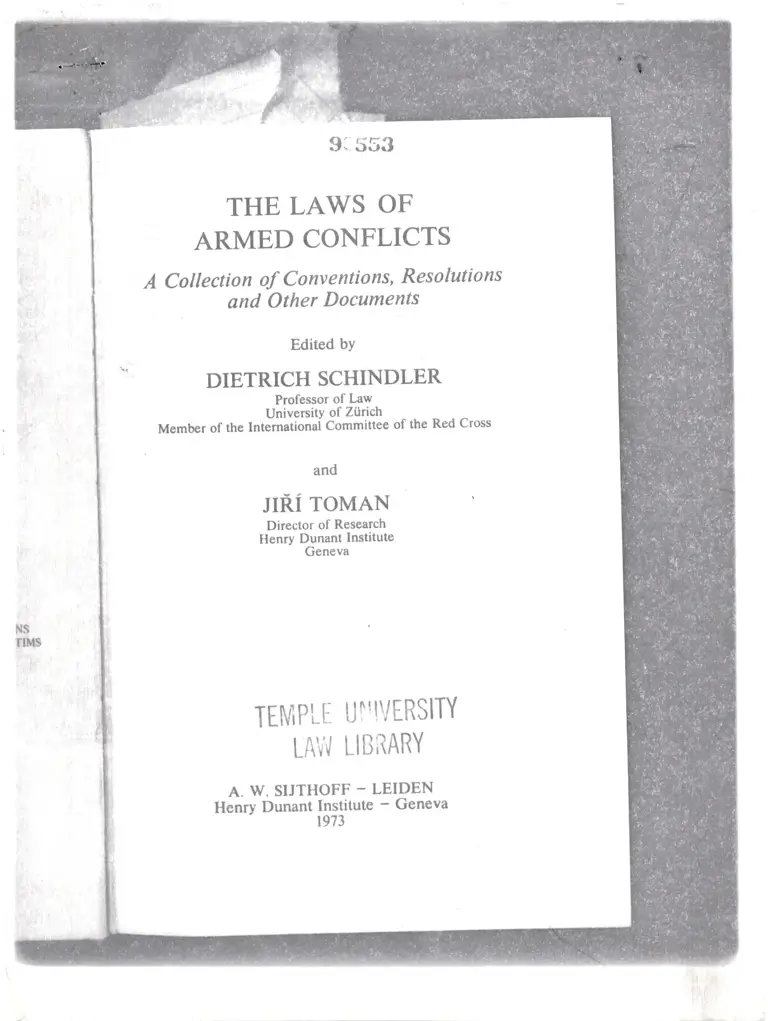
The Laws of Armed Conflicts
Unannotated Secondary Research
January 1, 1973
7 pages
-
Case Files, Garner Working Files. The Laws of Armed Conflicts, 1973. 5de7f46f-33a8-f011-bbd3-000d3a53d084. LDF Archives, Thurgood Marshall Institute. https://ldfrecollection.org/archives/archives-search/archives-item/1ab341c8-1097-4125-9ca4-24b1be0e80c8/the-laws-of-armed-conflicts. Accessed September 27, 2026.
Copied!
* > r 'y. • ’\w
^ > -r.-^
f * * M '* - V ' i
9v553
NS
riM S
THE LAWS OF
ARMED CONFLICTS
A Collection of Conventions, Resolutions
and Other Documents
Edited by
DIETRICH SCHINDLER
Professor of Law
University of Zurich
Member of the International Committee of the Red Cross
and
JIRI TOMAN
Director of Research
Henry Dunant Institute
Geneva
t e m p l e UriVERSITY
LAW LIBRARY
A. W. SIJTHOFF - LEIDEN
Henry Dunant Institute - Geneva
1973
\
n
V
It
)f
le
•d
•r-
lie
ikI
>1-
tfr
to
thf
: (><
\
HAGUE CONVENTIONS ON LAND WARFARE 1899/1907
1899
anny;
(c) To kill or wound an
enemy who, having laid down
arms, or having no longer means
of defence, has surrendered at
discretion;
To declare that no
quarter will be given;
(e) To employ arms, pro-
jectdes, or material of a nature
to cause superfluous injury ;
(f) To make improper use
of a flag of truce, the national
flag or military ensigns and uni
form of the enemy, as well as
the distinctive badges of the
Geneva Convention;
(g) To destroy or seize the
enemy’s property, unless such
destruction or seizure be impera
tively demanded by the necessi
ties of war.
Art. 25. The attack or bom-
1907
Art 24 Ruse^ of war and the
ciiiplo>mciit ol iiictliods iiclCs-
sary to obtain information about
the enemy and the country, are
considered allowable.
I Cf. Article 44 of the 1899 Convention p. 87
6-7
(c) To kill or wound an
enemy who, having laid down
his arms, or having no longer
means of defence, has surrendered
at discretion;
(d) To declare that no
quarter will be given;
(e) To employ arms, pro
jectiles, or material calculated to
cause unnecessary suffering;
(f) To make improper use
of a flag of truce, of the national
flag or of the military insignia
and uniform of the enemy, as
well as the distinctive badges of
the Geneva Convention;
(g) To destroy or seize the
enemy’s property, unless such
destruction or seizure be impera
tively demanded by the necessi
ties of war;
(h) To declare abolished, sus
pended, or inadmissible in a court
o f law the rights and actions o f
the nationals o f the hostile party.
A belligerent is likewise forbidden
to compel the natiomls o f the
hostile jMirty to take jxirt in the
operations o f war directed against
their own country, even i f they
were in the belligerent’s service
before the commencement o f
the war i
Killing those
who hjve
surrendered
Quarter
Weapons
causing
unnecessary
suffering
Abuse of flags
and uniform
Uiiiiecessaiy
destruction
or seizure
of property
Rights
and
actions
Forced service
against one's
own country
.Art. 24. Ruses of war and
the employ uieiil ol measures
neces-sary for obtaining infor
mation about the enemy and the
country are considered pennis-
sible
Obtaimiig
p e t i n i t t r d
.Art. 25. ITie attack or bom-
77
Tt.SfVv'̂
8 DtCl ARATK)N Oh SI P!Tl RS»l RC lfU>*
between civilized nations, and tliat Commisiion havuig by common agree
ment fixed the technical limits at which the necessities of war ought to yield
to the requirements of humanity, the Undersigned are aulhon/ed by the
orders of their Governments to declare as follows
Considering;
That the progress of civilization should have the effect of allesiaiing
as much as possible the calamities of war;
That the only legitimate object which Stales should endeavour to ac
complish during war is to weaken the military forces of the enemy,
That for this piirjTOse it is sufficient to disable the greatest possible
n u m b e i o l m e n ,
That tliis object would be exceeded by the employment of arms which
uselessly aggravate the sufferings of disabled men, or render their death
inevitable;
That the employment of such arms would, therefore, be contrary to
the laws of humanity ;
The Contracting Parties engage mutually to renounce, in case of war
among themselves, the employment by their military or naval troops of any
projectile of a weight below 400 grammes, which is either explosive or
charged with fulminating or inflammable substances.
They will invite all the States which have not taken part in the delib
erations of the International Military Commission assembled at St. Peters
burg by sending Delegates thereto, to accede to the present engagement.
This engagement is compulsory only upon the Contracting or Acceding
Parties thereto in case of war between two or more of themselves, it is not
applicable to non-Contracting Parties, or Parties who shall not have acceded
to it. . u
It will also cease to be compulsory from the moment when, in a war be
tween Contracting or Acceding Parties, a non-Contracting Party or a non-
Acceding Party shall join one of the belligerents.
The Contracting or Acceding Parties reserve to themselves to come here
after to an understanding whenever a precise proposition shall be drawn up
in view of future improvements which science may effect in the armament
of troops, in order to maintain the principles which they have established,
and to conciliate the necessities of war with the laws of humanity.
Done at St. Petersburg, 29 November (11 December) 1868.
(Here follow signatures)
SIGNATURES AND ACCESSIONS
Austria-Hungary
Baden i
Bavaria
Belgium
Brazil >
Denmark
I Baden and Brazil acceeded in 1869.
96
France
Great Britain
Greece
Italy
Netherlands
Persia
Portugal
svAi.fr
DECLARATION CONCERNING EXPANDING BULLETS 1899 10
No. 10
DECLARATION (IV. 3) CONCERNING EXPANDING BULLETS
Signed at The Hague, 29 July 1899.
INTRODUCTORY NOTE. U ke the Declaration o f St. Petersburg of 1 868
the Hague DecMtfation (IV , 3) o f 1899 gives expression, w ith regard to a par-
ticuUr bu lle t, to the custom ary rule prohibiting the use
flict unneceisarUy cruel w ounds. The Declaration is aimed at the Dum-Dum
bullet which is so called after the arsenal near Calcutta where the bullet was
fast made.
ENTRY INTO FORCT.: 4 Septem ber 1900.
AUTHENTIC n-XT: French. The EngUsh translation below is reprinted
f r ^ Scott, Hague Convention,, pp. 227-228. It reproduces the translation
of the United States Department of State.
TEXT PUBLISHED IN: Conference Internationale Je la Paix IH99, pp. 254-
255 (French); Les deux Conferences de la Paix, p. 44 (French); Scott,//u.guc
Contention,, pp. 227-228 (Engl,); Martens, NRGl. 2»me s<rie, Vol. XXVI,
pp. 998-1002 (French, German); D eltenre, pp. 138-141 (Engl French
Gwman, DutchV, CHiv.rt, Vol. 12. pp. (>43-646 (French, S p a n .) .G ^ S . 1907
No. 32 (Engl., French); BFSP. Vol. 91 . I 898-1 899. pp. 1014-1016 (French),
Higgins, pp. 491-492 (Engl.. French); A JIl . Vol. I , 1907, SuppE, pp. 157-
1 5 r(E n g l., French); De Q ercq, Vol. 21. PP. 741-743 (French); Bustam ante,
pp. 232-234 (Span.); Korovin, pp. 367-368 (Russ.); Mezhdunaro4noe pravo.
Vol. Ill, pp. 38-39 (Russ ).
The undersigned. Plenipotentiaries of the Powers represented at the Inter
national Peace Conference at The Hague, duly authorized to that effect by
their Governments. Inspired bv the sentiments which found expression in the
IKxiaiation ol .St. Petcisbuig ol Novvml>ci (11 Dc^cmbci) 1M>8,
Declare as follows: , . . i
The Contracting Parlies agree to abstain from the use ol bullets which
expand or flatten easily in the human body, such as hiillets with a hard en
velope which dsves not entirelv emver the core or is pierced with incisions.
TV present Dedaratmn is only binding for the Contracting Powers in the
case of a war between two or more of them.
It shall cease to be binding from the time when, in a war between the Lon-
traclmg Powerv otu; of the belligerents is toined by a non-Contracting Power.
The preaent DeciaratK'ii shall be ralitied as soon as possible.
Tha ratdication shall be deposited at The ILigue.
10.3
f ■ ■ - , r : H t j u V » .* 1
OXFORD MANUAL 1913 57
No. 57
THE LAWS OF NAVAL WAR GOVERNING
THE RELATIONS BETWEEN BELLIGERENTS
MANUAL ADOPTED BY THE INSTITUTE OF INTERNATIONAL LAW
(Oxford Manual of Naval War)
Adopted at 0 \|o rd , 9 August 1913.
INTRODUCTORY NOTL. The Second International Peace Conference at The
Hague expressed the wish “ that the preparation of regulations relative to the
laws and custom s o f naval war should figure in the programme of the next
C onference.” This wish induced the Institu te o f International Law to
appoint a com m ittee in 1910 “ to search and choose the studies which may
be of the most u tility for the preparation o f the Peace Conference and
organize their discussion by the Institu te .” On the proposal o f this com
m ittee it was decided to prepare regulations concerning the laws and customs
of war at sea. A special com m ittee, with Professor Fauchille as rapporteur,
prepared a draft manual analogous to the Oxford Manual on I.and Warfare of
1880 (sec No. 3). At its session in 1913, the Institute adopted the text below.
AUTHENTIC TI XT: French. The English translation below is reprinted
from Scott, Hetolutions o f the Institute o f International Law. pp. 174-201.
TEXT PUBLISHED IN: Annuaire de I’lns ti tu t de Droit international, Vol. 26
(1913), pp. 610-640; Resolutions de I ’lnstitut de Droit international 1117.1-
1956, pp. 231-258 (.Ftench); Scott , Resolutions o f the Institute o f International
Im w , pp.174-201 (Engl.);D eltenre,pp.667-71 5(K ngl.,French,G erm an, D u tch ).
TABLE OF CONTINI S
Section I. On localities where hostilities may take place
Section II. On the armed force of belligerent States
Section HI On means of Injuring the cneiiiv
SC' Ill'll l\ . On llic rights nul ili lies .n ihc Ih IIii'i ii ii's
with regard to enemy property
Section V. On the tights and duties ol the hclligcrcnts
with regard to individuals
SeetKin VI. On the rights and duties of the bellipereiil
m osvupwd tenitory
Section VII On conventions between bcihgerenis
Section VHI. On the formalities of seizure and on
prize ptoc-edure
SaetKm IX. On the end ol hostilities
Additionai Article
KK
89-99
1181-1 I '
lib
63''
57 OXfX>RD MANUAL 1913
Aiticles 3 and following, ahall bt tonudcrtd a t tMUigrrciita, if tfccy act ofMlily
they respect (he laws and ucape\ of war
and if
SI CTION III
On Mt-ans of Injuring the Enemy
Arl. 14. Principle. The iighl of belligeients to adopt means of injuring the enemy is
not unlimited.
Arl. IS. Treacherous and barbarous methods. Ruses of wrar are considettd permis
sible. Methods, however, which involve treachery are forbidden.
Thus it is forbidden:
(1) To kill or wound treacherously individuals belonging to the opposite tide,
(2) To make improper use of a flag of truce, to make use of fabe flags, unifornu,
or insignia, of whatever kind, especially those of the enemy, as well as of
the distinctive badges of the medical corps indicated in Articles 41 and 42.
Art. 16., In addition to the prohibitions which shall be established by specLsI
conventions, it is forbidden:
(1) To employ poison or poisoned weapons, or projectiles the sole object of which
is the ditfusion of asphyxiating or deleterious gases;
(2) To employ arms, projectiles, or materials calculated to cause unnecessary
suffering. Entering especially into this category are explosive projectiles or
those charged with fulminating or inflammable materials, leas than 400
grammes in weight, and bullets which expand or flatten easily in the human
body, such as bullets wtth a hard envelope which does not cover the core
entirely or is pierced wtth incisions.
Art. 17. It is also forbidden:
(1) To kill or to wound an enemy who, having laid down his arms or haviitg no
longer means of defense, has surrendered at discretion;
(2) To sink a ship which has surrendered, before having taken off the crew;
(3) To declare that no quarter will be given.
Art. 18. Pillage and devastation arc forbidden.
It is forbidden to destroy enemy property, except in the cases where such destruction
is imperatively required by the necessities of war or authorized by provisiont of the
present regubtions. s«̂ -
Art. 19. Torpedoes. It is forbidden to employ torpedoes which do not become
harmless when they have missed their mark.
• ;■ ■■■*■, w.
Art. 20. Submarine mines. It is forbidden to lay automatic contact mines, anchored
or not, in the open sea.
Art. 21. Belligerents may lay mines in their territorbi waters and in those of the
enemy.
640